Mom Accuses FBI Of Entrapping Her ‘Neurodiverse’ Teenager In Terrorism Scheme

Mom Accuses FBI Of Entrapping Her ‘Neurodiverse’ Teenager In Terrorism Scheme

Authored by Ken Silva via Headline USA,

In June 2022, Colorado woman Deanna Meyer contacted her local sheriff’s office about violent and terroristic statements that her mentally ill 17-year-old son, Davin Meyer, was making at the time.

The Federal Bureau of Investigation building headquarters is seen in Washington. / PHOTO: AP

The local sheriff, in turn, contacted the FBI, which then began communicating with the teenager online. Months later, the FBI arrested Davin as he was about to board an airplane, ostensibly to travel to the Middle East to join ISIS.

But Davin’s mother says he is no ISIS fighter. Instead, he’s an 18-year-old with no friends, who suffers from numerous mental health issues, including autism, depression and anxiety, according to the mom.

At a detention hearing on Friday, Deanna reportedly expressed remorse that she ever sought help from law enforcement, blaming the FBI for ensnaring her son in a phony terrorism plot.

“I bet my life he would never do that without that encouragement [from FBI informants],” she said Friday, describing how her son communicated with at least two FBI informants in chat rooms from last November until he was arrested.

U.S. Magistrate Judge Reid Neureiter disregarded Deanna’s pleas on Friday and ordered Davin to remain in custody. Neureiter pointed to the fact that Davin allegedly threatened his mother’s life when he was still a juvenile—even though the mother said he hasn’t threatened her since he turned 18.

The judge did acknowledge the mother’s arguments in his five-page order.

“The mother testified at the detention hearing that she never believed he would likely move ahead with his expressed intentions, and the defendant only took steps to travel to the Middle East after finding a ‘community’ online, which included confidential FBI sources,” Judge Neureiter said.

“According to the defendant’s mother, he has ‘never had a friend’ and finding this community that appeared to be supportive of his plans is what likely caused him to act by buying the ticket to fly to Turkey.”

Neureiter also acknowledged Davin’s mental health problems.

“The defendant is ‘neurodiverse’ and was diagnosed at the age of nine of being on the autism spectrum, and he has also been diagnosed with having a low processing speed and massive depression. The defendant may also have obsessive compulsive disorder,” the judge said.

“The defendant has received diagnoses of autism spectrum disorder; attention-deficit hyperactivity disorder; adjustment disorder with mixed anxiety and depressed mood; specific learning disorder with impairment in mathematics; and major depressive disorder, recurrent episode, moderate.”

However, Judge Neureiter said it’s in the public interest to keep Davin incarcerated.

This is a difficult situation, and must be extremely heart-wrenching for the defendant’s family, in particular his mother, who has long believed the defendant needs help and therapy,” he said.

“Putting a defendant with his disabilities in jail, pending trial, will not address his condition nor provide the therapy that he apparently needs. It will, however, ensure that he cannot do violence to anyone.”

The judge concluded by saying he’d reconsider his order if the Meyer family can find a suitable mental health facility to house Davin.

Other bizarre details about the Meyer case can be found in the arrest affidavit of FBI task force officer Joni Tangeman.

For instance, Tangeman said Davin followed “white supremacist ideology” when he was 15-years-old, before he began practicing Islam in late 2020. Tangeman further said that Davin said when he was 17 that if he didn’t go to the Middle East, he would build a fertilizer bomb in the United States—the same bomb used in the Oklahoma City bombing.

Additionally, the FBI officer admitted she knew about Davin’s mental health issues when investigating him.

“I am aware that MEYER has previously received mental health treatment, including residential treatment programs,” she said, adding that Davin apparently refused to take his medication when he converted to Islam.

“MEYER refused to take any prescription medication prescribed by the psychiatrist because it would be against his Islamic religion, and he also refused to go to school or participate in online school programs,” Tangeman said.

“Records show that MEYER has received diagnoses of autism spectrum disorder; attention-deficit hyperactivity disorder; adjustment disorder with mixed anxiety and depressed mood; specific learning disorder with impairment in mathematics; and major depressive disorder, recurrent episode, moderate.”

The Meyer case follows the FBI arresting another mentally challenged 18-year-old, Mateo Ventura, for allegedly intending to help ISIS. Last month, The Intercept published an interview with Ventura’s father, who also accused FBI informants of entrapping his son.

“He was born prematurely, he had brain development issues. I had the school do a neurosurgery evaluation on him and they said his brain was underdeveloped,” Ventura’s father, Paul Ventura, told The Intercept. “He was suffering endless bullying at school with other kids taking food off his plate, tripping him in the hallway, humiliating him, laughing at him.”

Ventura is currently in a private mental health facility as his case proceeds. Meyer’s preliminary hearing is set for July 31.

Ken Silva is a staff writer at Headline USA. Follow him at twitter.com/jd_cashless.

Tyler Durden
Tue, 08/01/2023 – 18:40

via ZeroHedge News https://ift.tt/tgp1fno Tyler Durden

Goldman Sachs Analyst Found Dead In NYC Water

Goldman Sachs Analyst Found Dead In NYC Water

The 27-year-old Goldman Sachs senior analyst who went missing after a “Zeds Dead” concert in New York City’s Brooklyn borough early Saturday morning has been found dead. 

The father of Goldman’s John Castic told Fox 5 New York that his son was found floating in the waters of Newtown Creek Tuesday — about a half mile from where he went missing. 

“They have found his body and confirmed it’s him.

“It appears to have been death by misadventure. His wallet and phone were found on him,” his father, Jeffrey Castic, told Fox 5. 

Castic was last seen at 0230 ET Saturday, leaving a Zeds Dead concert at The Brooklyn Mirage in East Williamsburg. 

The New York Post said, “At about 11 a.m. on Tuesday, a man spotted a bloated, shirtless body floating face-down in the English Kills, a branch of the East River tributary, near 1100 Grand Street.”

Fox 5 pointed out that another young man also vanished from the same music venue in June and turned up dead five days later in Newtown Creek.

Police said the deaths are both being investigated. Some have speculated there might be some connection. 

This is the second Goldman analyst to have perished in about a year. 

Tyler Durden
Tue, 08/01/2023 – 18:20

via ZeroHedge News https://ift.tt/picJQWj Tyler Durden

Confidence In US Military At Lowest Point In 26 Years: Gallup Poll

Confidence In US Military At Lowest Point In 26 Years: Gallup Poll

Authored by Ryan Morgan via The Epoch Times,

Confidence in one of the most trusted institutions in the United States, the military, has fallen to its lowest point in more than 25 years, according to a new poll by Gallup.

On Monday, Gallup shared the results of a June poll, which found about 60 percent of U.S. adults who were surveyed expressed either a “great deal” or “quite a lot” of confidence in the U.S. military, while the remainder expressed “very little” or only “some” confidence in the military. This figure marks the lowest level of confidence in the U.S. military since 1997.

The drop in support was most significant among respondents who identified as Republican. Since Gallup began polling trust in the military in 1975, Republicans have typically held the highest degree of confidence in the U.S. military. In the final year of President Donald Trump’s presidency, 91 percent of Republican respondents had expressed moderate to high confidence in the military. Now only 68 percent of Republican respondents feel that way, a 23-point drop.

The U.S. military also lost a significant measure of trust and confidence from independent voters. In 2019, 73 percent of independents felt a moderate to high confidence in the military, but that number fell to 68 percent in 2020 and has since dropped an additional 13 points.

Democratic confidence in the military has not seen much resurgence since President Joe Biden took office. During Mr. Trump’s term, the portion of Democrats who had moderate to high confidence in the military fell from 69 percent in 2016 to a low point of 58 percent in 2019. Just 61 percent of Democratic respondents had moderate to high confidence in the military near the end of Mr. Trump’s presidency in 2020. Democratic confidence in the military did rise in the first two years of Mr. Biden’s presidency, up to 68 percent last year, but has fallen back down to 62 percent this year. Democratic confidence in the military was higher in 2017 and 2018 under Mr. Trump than it is now.

While trust in the military has reached a low point not seen in a quarter century, the military still remains one of the most trusted institutions in the country. In fact, the military was second only to small businesses as the most trusted institution, with 65 percent of respondents expressing a “great deal” or “quite a lot” of confidence in those businesses.

Twenty-six percent of respondents expressed a “great deal” or “quite a lot” of confidence in the presidency, placing that institution alongside public schools, banks, and big tech companies in terms of public trust, while 14 percent of respondents shared a “great deal” or “quite a lot” of confidence in big businesses and just 8 percent felt the same about Congress.

Declining Trust in Military

The Gallup poll did not include additional questions about what is contributing to the loss of confidence in the military.

Other recent polling has also indicated a loss of confidence in the U.S. military. In February of last year, the Pew Research Center published results (pdf) finding 74 percent of respondents had at least a fair amount of confidence that the U.S. military’s ability to act in the best interests of the U.S. public. That number was down from 83 percent who felt the same way in November of 2020.

In November of last year, the Ronald Reagan Presidential Foundation published its National Defense Survey results (pdf) for 2022, finding just 48 percent of respondents had “a great deal” of trust and confidence in the military. Seventy percent of respondents had felt “a great deal” of trust and confidence in the military in 2018 when the Reagan Foundation first began the survey, showing a 22-point drop.

Sixty-two percent of respondents in the Reagan Foundation survey said military leadership becoming overly politicized contributed to their declining confidence. Those concerns about politicization were held by 60 percent of Democrats, 60 percent of Independents, and 65 percent of Republicans. Fifty percent of that survey’s respondents blamed “wokeness” in the military for hurting their confidence, while 46 percent said “far-right or extremist individuals” hurt their confidence in the military.

Fifty-nine percent of the respondents in the Reagan Foundation survey said the performance and competence of the president had decreased their confidence in the military.

The military struggled to reach its recruiting goals last year.

The U.S. Navy hit its recruiting goal for active-duty enlisted personnel but missed its goals for recruiting new active and reserve officers and reserve enlisted personnel. The U.S. Air Force also met its active-duty recruiting goals but missed its recruiting goals for the Air Force Reserve and Air National Guard.

The U.S. Army saw the biggest miss of all branches last year, with the service falling 15,000 recruits short of its 60,000 recruit goal for fiscal year 2022—a 25 percent shortfall.

In April, Army, Navy and Air Force leaders predicted they could miss their recruiting goals again this year, the Military Times reported.

Tyler Durden
Tue, 08/01/2023 – 18:00

via ZeroHedge News https://ift.tt/X2TqsG4 Tyler Durden

Trump Indicted (Again) For ‘Efforts To Overturn 2020 Election’; DeSantis Defends

Trump Indicted (Again) For ‘Efforts To Overturn 2020 Election’; DeSantis Defends

Update (1834ET): As reactions to Trump’s latest indictment roll in, one notable defender is Florida Governor Ron DeSantis, who tweeted that he would, as president, “end the weaponization of government, replace the FBI Director, and ensure a single standard of justice for all Americans.”

DeSantis added that DC is a “swamp,” and that it’s “unfair to have to stand trial before a jury that is reflective of the swamp mentality.”

*  *  *

Another day, another indictment aimed at keeping former President Trump out of the Oval Office.

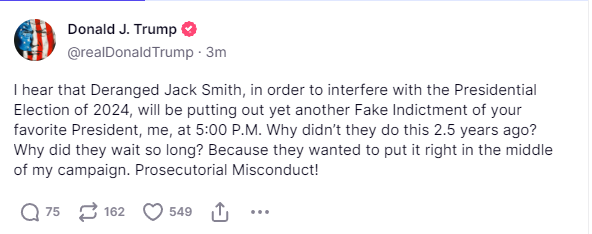
“I hear that Deranged Jack Smith, in order to interfere with the Presidential Election of 2024, will be putting out yet another Fake Indictment of your favorite President, me, at 5:00 P.M,” Trump wrote Tuesday on Truth Social. “Why didn’t they do this 2.5 years ago? Why did they wait so long? Because they wanted to put it right in the middle of my campaign. Prosecutorial Misconduct!” he continued.

And on Tuesday, Jack Smith did just that – indicting Trump yet again for his efforts to overturn the results of the 2020 presidential election.

The indictment focuses on schemes by Trump and his allies to subvert the transfer of power and keep him in office despite his loss to Joe Biden.

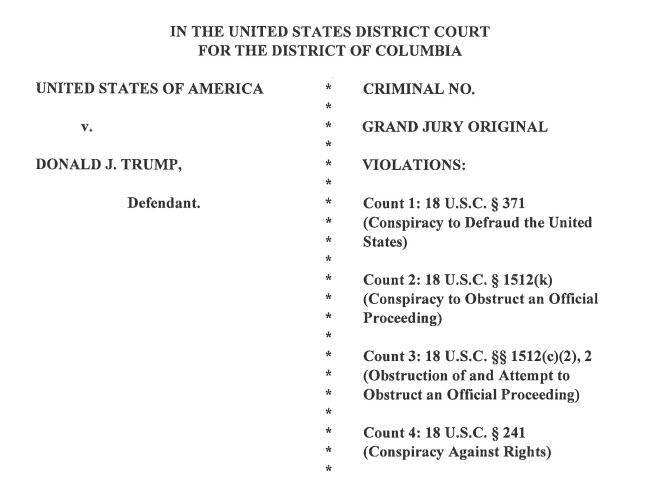
Trump has been indicted on four counts:

The Conspiracy

From on or about November 14,2020, through on or about January 20,2021, in the District of Columbia and elsewhere, the Defendant, DONALD J. TRUMP, did knowingly combine, conspire, confederate, and agree with co-conspirators, known and unknown to the Grand Jury, to defraud the United States by using dishonesty, fraud, and deceit to impair, obstruct, and defeat the lawful federal government function by which the results of the presidential election are collected, counted, and certified by the federal government.

The purpose of the conspiracy was to overturn the legitimate results of the 2020 presidential election by using knowingly false claims of election fraud to obstruct the federal government function by which those results are collected, counted, and certified.

Special Counsel Jack Smith gave a lame speech following his latest ‘win’ (that surely won’t actually help Trump, right?)

Watch:

The Defendant, his co-conspirators, and their agents made knowingly false claims that there had been outcome-determinative fraud in the 2020 presidential election.

These prolific lies about election fraud included dozens of specific claims that there had been substantial fraud in certain states, such as that large numbers of dead, non-resident, non-citizen, or otherwise ineligible voters had cast ballots, or that voting machines had changed votes for the Defendant to votes for Biden.

These claims were false, and the Defendant knew that they were false.

In fact, the Defendant was notified repeatedly that his claims were untrue—often by the people on whom he relied for candid advice on important matters, and who were best positioned to know the facts –  and he deliberately disregarded the truth.

Read the full docket below:

It’s the third criminal case brought against the former president as he seeks to reclaim the White House.

*  *  *

As we detailed earlier, on Monday, Trump called the indictments “election interference” and “prosecutorial misconduct,” adding that they’re being used to distract from investigations into the Biden family’s own dealings with foreign nationals.

“The Radical Left Democrat Thugs shouldn’t be allowed to investigate me during, and in the middle of, my campaign for President. Why didn’t they file these ridiculous charges 2.5 years ago?” Trump wrote, adding “They waited because they wanted to illegally and negatively influence the 2024 Presidential Election, arguably the most important Election in the history of the USA. We are going to take our now Third World Nation (Airports, Elections, Roads/Highways, Borders, etc.) and, MAKE AMERICA GREAT AGAIN. BE STRONG!”

Trump’s defenders jump into action

Yesterday was an awful day for the @JoeBiden crime family,” tweeted former Arizona Gubernatorial candidate Kari Lake (R), referring to bombshell allegations against the Biden family over international corruption. “The regime desperately needs a distraction for their Pravda Press to spread.”

Watch as they indict @realDonaldTrump again to change the narrative.

Meanwhile, Bloomberg reports that Trump is “burning through money on legal fees so fast that it risks leaving him short of cash just when he will need it most — in a potential general election rematch against President Joe Biden next fall.”

The former president raised $54 million from donors in the first six months of the year – more than any other Republican candidate, but that his legal bills are emptying his coffers nearly as fast as he fills them.

Nearly half of Trump’s January-to-June haul went to lawyers, $25.5 million, draining cash reserves left from the midterm cycle, according to Federal Election Commission filings. A person familiar with the finances of Trump’s committees said legal expenses were actually closer to $40 million.

Two entities, Save America and Make America Great Again PAC — which is separate from MAGA Inc. — are footing his legal fees. They ended June with only $4.2 million cash on hand, about enough to cover another month’s worth of costs. The expenditures forced Save America, which donated $60 million in 2022 to Trump’s super PAC, to ask for a refund. It got $12.3 million back.

To keep the entities paying his legal fees funded, Trump will have to divert about half the money he raises through a joint fundraising committee. From January to June, the joint fundraising committee transferred $29.2 million to Trump’s campaign and $2.2 million to his leadership PAC and ended June with $5.7 million cash on hand. The remainder was spent on fundraising expenses. -Bloomberg

“The weaponized Department of Justice has continued to go after innocent Americans because they worked for President Trump,” said campaign spokesman Steven Cheung. “To protect these innocent people from financial ruin and prevent their lives from being completely destroyed, the leadership PAC contributed to their legal fees.”

Trump, meanwhile, can continue to tap his allied super PAC, Make America Great Again, Inc, which had $31 million at the end of June after depleting 44% of its cash in the first six months of 2023.

More via the Epoch Times;

Mr. Trump said on July 27 that his lawyers had met with the Justice Department and had a “productive meeting,” and that “an indictment of me would only further destroy our country.”

Jurors were seen entering a courthouse Thursday morning, and news reports had claimed an indictment could come as soon as that same day.

More than 1,000 people have already been charged with Jan. 6-related offenses.

Multiple Cases

Mr. Trump is facing another investigation in Georgia, where Fulton County Superior Court Judge Robert McBurney on Monday rejected Mr. Trump’s bid to disqualify Fulton County District Attorney Fani Willis from prosecuting the case.

The criminal investigation centers around a phone call Mr. Trump made to Republican Georgia Secretary of State Brad Raffensperger in 2020, asking about the number of votes for him in the state.

“I just want to find 11,780 votes, which is one more than we have,” then-President Trump said to Mr. Raffensperger.

Ms. Willis maintains that Mr. Trump tried to illegally overturn the results of the presidential election in the state of Georgia. Mr. Trump says the investigation is “strictly a political witch hunt.”

Mr. Trump’s legal team argued that she had a partisan interest in the case, which should disqualify her. Judge McBurney wrote that the team failed to show Ms. Willis was biased in her actions.

The case will be heard on Aug. 10.

Meanwhile, Georgia Gov. Brian Kemp has been contacted by Mr. Smith’s office, presumably about the Jan. 6 case.

Mr. Smith is also in charge of the Mar-a-Lago case concerning classified documents, in which he last week announced three new charges.

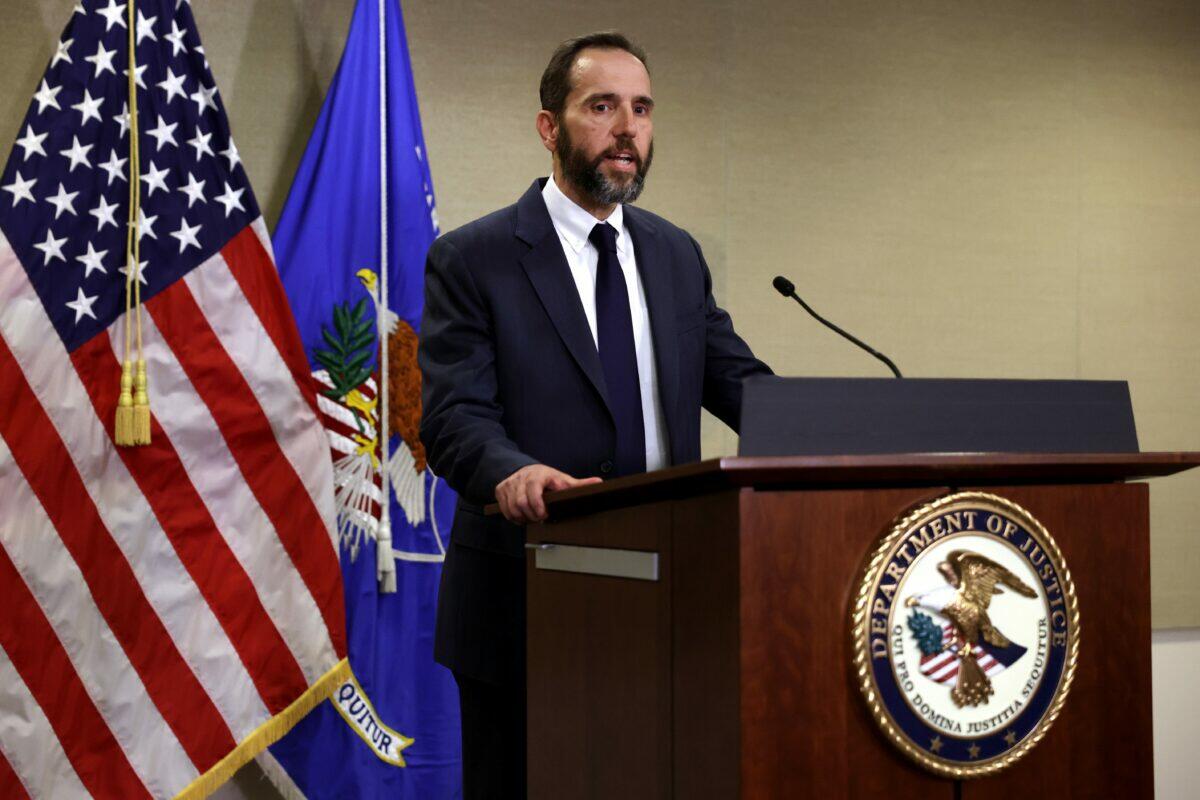
Special counsel Jack Smith delivers remarks on a recently unsealed indictment against former President Donald Trump at the Justice Department in Washington on on June 9, 2023. (Alex Wong/Getty Images)

Last week, the special counsel charged Mr. Trump with willful retention of national defense information and two charges in connection to the claims that he told a Mar-a-Lago worker to delete security tapes to prevent a grand jury from seeing them. In that filing, the Department of Justice (DOJ) named Mar-a-Lago staffer Carlos De Oliveira as a third defendant in the complaint.

On Sunday, Mr. Trump denied all three charges.

Mar-a-Lago security tapes were not deleted,” Mr. Trump wrote on Truth Social. “They were voluntarily handed over to the thugs, headed up by deranged Jack Smith. We did not even go to court to stop them from getting these tapes. I never told anybody to delete them. Prosecutorial fiction & misconduct! Election interference!”

“They knowingly accuse you of a fake crime, a crime that they actually make up, you fight these false charges hard, and they try and get you on ‘obstruction,’” Mr. Trump wrote. “We are dealing with sick and evil people!”

Alina Habba, spokesperson and attorney for Mr. Trump, told Fox News in a July 30 interview that Mr. Trump never directed an employee to delete tapes.

“When he has his turn in court, and when we get to file our papers, you will see that every single video, every single surveillance tape that was requested, was turned over,” Ms. Habba said. “If President Trump didn’t want something turned over, I assure you, that is something that could have been done. But he never would act like that. He is the most ethical American I know.

The new superseding indictment that came out, which they tried to get another headline for President Trump, was facts that said that President Trump did what? What was the obstruction of justice because no tapes were deleted. He turned them over; he cooperated as he always does. But they would like the American public to believe in these bogus indictments that there are some facts that say that President Trump was obstructing justice.”

Mr. Trump has pleaded not guilty to all charges and maintains that as president, he had the right to take the documents as well as the right to declassify them. The case is set to go to trial in May 2024.

Tyler Durden
Tue, 08/01/2023 – 17:40

via ZeroHedge News https://ift.tt/6kOQgAN Tyler Durden

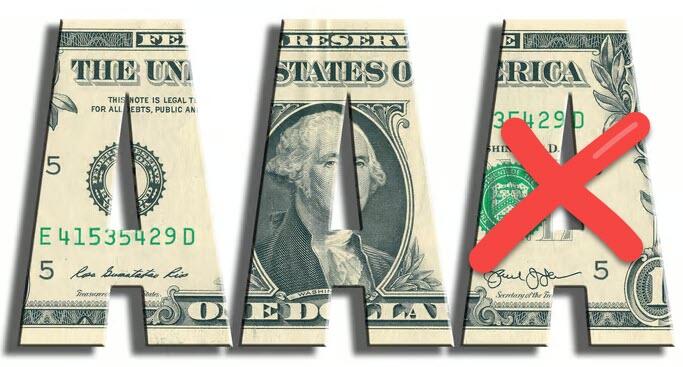
“Arbitrary… Outdated!” – Yellen Outraged After Fitch Cuts USA’s AAA-Rating

“Arbitrary… Outdated!” – Yellen Outraged After Fitch Cuts USA’s AAA-Rating

Update (1750ET): Treasury Secretary Yellen is pissed, calling the downgrade “arbitrary” and “outdated.”!

I strongly disagree with Fitch Ratings’ decision. The change by Fitch Ratings announced today is arbitrary and based on outdated data. Fitch’s quantitative ratings model declined markedly between 2018 and 2020 – and yet Fitch is announcing its change now, despite the progress that we see in many of the indicators that Fitch relies on for its decision. Many of these measures, including those related to governance, have shown improvement over the course of this Administration, with the passage of bipartisan legislation to address the debt limit, invest in infrastructure, and make other investments in America’s competitiveness.

Fitch’s decision does not change what Americans, investors, and people all around the world already know: that Treasury securities remain the world’s preeminent safe and liquid asset, and that the American economy is fundamentally strong.

Over the past few years, the United States has undergone a historically fast economic recovery from a deep recession. Today, the unemployment rate is near historic lows, inflation has come down significantly since last summer, and last week’s GDP report shows that the U.S. economy continues to grow. The American economy remains the world’s largest and most dynamic economy, with the deepest and most liquid financial markets in the world. To build on this, President Biden and I have been focused on making critical investments in our country’s core economic strength and productive capacity. 

President Biden and I are committed to fiscal sustainability. The most recent debt limit legislation included over $1 trillion in deficit reduction and improved our fiscal trajectory. Looking forward, President Biden has put forward a budget that would reduce the deficit by $2.6 trillion over the next decade through a balanced approach that would support investments for the long-term.” 

Perhaps she should read this…

*  *  *

In the middle of the debt-ceiling ‘crisis’ in May, with Fitch, Moodys and DBRS all threatening to do what S&P boldly did in 2011 and downgrade the US should the debt ceiling crisis lead to a technical default, China’s leading rating agency, China Chengxin International Credit Rating decided not to wait, downgrading the USA’s rating by one notch, to AA+ from AAA, citing high inflation and the widely watched debt-ceiling stand-off.

Today, Fitch decided to get off the pot and join S&P and Chengxin, downgrading USA’s Long-Term Foreign-Currency Issuer Default Rating (IDR) to ‘AA+’ from ‘AAA’.

Key Rating Drivers

Ratings Downgrade: The rating downgrade of the United States reflects the expected fiscal deterioration over the next three years, a high and growing general government debt burden, and the erosion of governance relative to ‘AA’ and ‘AAA’ rated peers over the last two decades that has manifested in repeated debt limit standoffs and last-minute resolutions.

Erosion of Governance: In Fitch’s view, there has been a steady deterioration in standards of governance over the last 20 years, including on fiscal and debt matters, notwithstanding the June bipartisan agreement to suspend the debt limit until January 2025. The repeated debt-limit political standoffs and last-minute resolutions have eroded confidence in fiscal management. In addition, the government lacks a medium-term fiscal framework, unlike most peers, and has a complex budgeting process. These factors, along with several economic shocks as well as tax cuts and new spending initiatives, have contributed to successive debt increases over the last decade. Additionally, there has been only limited progress in tackling medium-term challenges related to rising social security and Medicare costs due to an aging population.

Rising General Government Deficits: We expect the general government (GG) deficit to rise to 6.3% of GDP in 2023, from 3.7% in 2022, reflecting cyclically weaker federal revenues, new spending initiatives and a higher interest burden. Additionally, state and local governments are expected to run an overall deficit of 0.6% of GDP this year after running a small surplus of 0.2% of GDP in 2022. Cuts to non-defense discretionary spending (15% of total federal spending) as agreed in the Fiscal Responsibility Act offer only a modest improvement to the medium-term fiscal outlook, with cumulative savings of USD1.5 trillion (3.9% of GDP) by 2033 according to the Congressional Budget Office. The near-term impact of the Act is estimated at USD70 billion (0.3% of GDP) in 2024 and USD112 billion (0.4% of GDP) in 2025. Fitch does not expect any further substantive fiscal consolidation measures ahead of the November 2024 elections.

Fitch forecasts a GG deficit of 6.6% of GDP in 2024 and a further widening to 6.9% of GDP in 2025. The larger deficits will be driven by weak 2024 GDP growth, a higher interest burden and wider state and local government deficits of 1.2% of GDP in 2024-2025 (in line with the historical 20-year average). The interest-to-revenue ratio is expected to reach 10% by 2025 (compared to 2.8% for the ‘AA’ median and 1% for the ‘AAA’ median) due to the higher debt level as well as sustained higher interest rates compared with pre-pandemic levels.

General Government Debt to Rise: Lower deficits and high nominal GDP growth reduced the debt-to-GDP ratio over the last two years from the pandemic high of 122.3% in 2020; however, at 112.9% this year it is still well above the pre-pandemic 2019 level of 100.1%. The GG debt-to-GDP ratio is projected to rise over the forecast period, reaching 118.4% by 2025. The debt ratio is over two-and-a-half times higher than the ‘AAA’ median of 39.3% of GDP and ‘AA’ median of 44.7% of GDP. Fitch’s longer-term projections forecast additional debt/GDP rises, increasing the vulnerability of the U.S. fiscal position to future economic shocks.

Medium-term Fiscal Challenges Unaddressed: Over the next decade, higher interest rates and the rising debt stock will increase the interest service burden, while an aging population and rising healthcare costs will raise spending on the elderly absent fiscal policy reforms. The CBO projects that interest costs will double by 2033 to 3.6% of GDP. The CBO also estimates a rise in mandatory spending on Medicare and social security by 1.5% of GDP over the same period. The CBO projects that the Social Security fund will be depleted by 2033 and the Hospital Insurance Trust Fund (used to pay for benefits under Medicare Part A) will be depleted by 2035 under current laws, posing additional challenges for the fiscal trajectory unless timely corrective measures are implemented. Additionally, the 2017 tax cuts are set to expire in 2025, but there is likely to be political pressure to make these permanent as has been the case in the past, resulting in higher deficit projections.

Exceptional Strengths Support Ratings: Several structural strengths underpin the United States’ ratings. These include its large, advanced, well-diversified and high-income economy, supported by a dynamic business environment. Critically, the U.S. dollar is the world’s preeminent reserve currency, which gives the government extraordinary financing flexibility.
Economy to Slip into Recession: Tighter credit conditions, weakening business investment, and a slowdown in consumption will push the U.S. economy into a mild recession in 4Q23 and 1Q24, according to Fitch projections. The agency sees U.S. annual real GDP growth slowing to 1.2% this year from 2.1% in 2022 and overall growth of just 0.5% in 2024. Job vacancies remain higher and the labor participation rate is still lower (by 1 pp) than pre-pandemic levels, which could negatively affect medium-term potential growth.

Fed Tightening: The Fed raised interest rates by 25bp in March, May and July 2023. Fitch expects one further hike to 5.5% to 5.75% by September. The resilience of the economy and the labor market are complicating the Fed’s goal of bringing inflation towards its 2% target. While headline inflation fell to 3% in June, core PCE inflation, the Fed’s key price index, remained stubbornly high at 4.1% yoy. This will likely preclude cuts in the Federal Funds Rate until March 2024. Additionally, the Fed is continuing to reduce its holdings of mortgage backed-securities and U.S. Treasuries, which is further tightening financial conditions. Since January, these assets on the Fed balance sheet have fallen by over USD500 billion as of end-July 2023.

ESG – Governance: The U.S. has an ESG Relevance Score (RS) of ‘5’ for Political Stability and Rights and ‘5[+]’ for the Rule of Law, Institutional and Regulatory Quality and Control of Corruption. Theses scores reflect the high weight that the World Bank Governance Indicators (WBGI) have in Fitch’s proprietary Sovereign Rating Model. The U.S. has a high WBGI ranking at 79, reflecting its well-established rights for participation in the political process, strong institutional capacity, effective rule of law and a low level of corruption.

Additionally, they warn that the following could lead to more negative ratings actions…

  • Public Finances: A marked increase in general government debt, for example due to a failure to address medium-term public spending and revenue challenges;

  • Macroeconomic policy, performance and prospects: A decline in the coherence and credibility of policymaking that undermines the reserve currency status of the U.S. dollar, thus diminishing the government’s financing flexibility.

All hail Bidenomics.

Tyler Durden
Tue, 08/01/2023 – 17:26

via ZeroHedge News https://ift.tt/TMRFhdX Tyler Durden

This Pro-Mask “Study” Is Why You Should Never “Trust The Science”

This Pro-Mask “Study” Is Why You Should Never “Trust The Science”

Authored by Kit Knightly via Off-Guardian.org,

Last week it was reported that the Australian state of Victoria may be considering “permanent” facemask mandates to achieve “zero-Covid”.

Now, we don’t need to get into the personal liberty implications of such a law, or  the near-infinite supply of evidence that masks don’t work to prevent the transmission of respiratory disease.

They don’t work, they never worked. Mandating them was a political move designed to make the fake Covid “pandemic” appear real, and their continued use is a symptom of brainwashing or a by-product of chronic virtue signaling.

The mask debate, such as it was, is over.

No, the only aspect of this development worth talking about is the “evidence” used to support the position – and trust me, the quotes are entirely justified.

The “study” which claims to demonstrate the benefits of permanent masking was published in the Medical Journal of Australia last week and titled “Consistent mask use and SARS‐CoV‐2 epidemiology: a simulation modelling study”.

“Simulation modelling study” is very much the key phrase there. For those who don’t know,  “simulation modelling studies” involve feeding data into a computer programme, then asking it to form conclusions.

Clearly, they are only as reliable and useful as the data you use. In fact, you can very easily make them produce any result you want by feeding in  the “right” (bad) data.

In this particular modelling study they started out by telling the computer that cloth masks reduce transmission by 53% and respirators reduced it by 80%:

Odds ratios for the relative risk of infection for people exposed to an infected person (wearing a mask v not wearing a mask) were set at 0.47 for cloth and surgical masks and 0.20 for respirators

Essentially, they told their computer that masks prevent disease…and then said “ok, computer, since you now know masks prevent disease  – what would happen if everybody wore them all the time?”

The computer then told them – obviously  – that nobody would get sick.

Because they made it logically impossible for it to say anything else.

But there’s a bit more to it.

The next layer of interest is where they got their input data from.

After all there have been dozens of studies done on masks over the years, 98% of which say masks don’t work.

So, did our guys they choose a peer-reviewed real-time control trial relying on lab-tested double-blind results?

Perhaps one of the dozen or so such trials listed in our 40 facts article?

Did they maybe average the results of multiple studies?

No, they used a phone survey.

One phone survey.

This phone survey, published last year and conducted in late 2021.

In this *ahem* “scientific study”, they had people randomly call up those who had recently been tested for “Covid”, ask them “did you wear a mask?” and then published the conclusion – “masks reduce transmission by 53%” – as if they meant something.

Interestingly, if you scroll down to the “affiliations” section you can see that one of the authors is a Pfizer grant recipient.

Rather more troublingly – and for some reason not mentioned as a conflict of interest – is that the whole study was produced by the California Board of Public Health.

California had already had a mask mandate in place for almost a year before this “study” was even started.

What we have here is not “science” it’s a computer model based on the results of a subjective phone survey conducted by a government agency with a vested interest. It is entirely meaningless, and yet is published in journals and cited by “experts”, perhaps even used as the basis of introducing new laws.

This is how “The ScienceTM” works. And, although Covid has maybe opened many people’s eyes to this issue, it is far from unique to “Covid”. You are just as likely to find this kind of “research” published on any topic – especially those that serve a political purpose – and have been for years if not decades.

Stanford Professor of evidence-based medicine,  John Ioannidis wrote a paper called “Why Most Published Research Findings Are False”, and that was back in 2005.

This has nothing to do with the “pandemic”, and everything to do with the difference between science and “The Science”. So let’s examine that distinction.

“Science” is an approach to the world. A rational method for gathering information, testing new ideas and forming evidence-based conclusions.

“The Science” is a self-sustaining industry of academics who need jobs and owe favours.

An ongoing quid pro quo relationship between the researchers – who want honors and knighthoods and tenure and book deals and research grants and to be the popular talking head explaining complex ideas to the multitudes on television – and the corporationsgovernments and “charitable foundations” who have all of those things in their gift.

This system doesn’t produce research intended to be read, it creates headlines for celebrities to tweet, links for “journalists” to embed, sources for other researchers to cite.

An illusion of solid substantiation that comes apart the moment you actually read the words, examine the methodology or analyse the data.

Self-reporting surveys, manipulated data, “modelling studies” that spit-out pre-ordained results. Affiliated-authors paid by the state or corporate interests to provide “evidence” that supports highly profitable or politically convenient assumptions.

This mask study is the perfect example of that.

Interlacing layers of nothing designed to create the impression of something.

That’s why they want you to trust it, rather than read it.

Tyler Durden
Tue, 08/01/2023 – 16:45

via ZeroHedge News https://ift.tt/yXPfhvl Tyler Durden

WTI Soars After Biggest Weekly Crude Draw In History, Biden Admin Gives Up On SPR Refill

WTI Soars After Biggest Weekly Crude Draw In History, Biden Admin Gives Up On SPR Refill

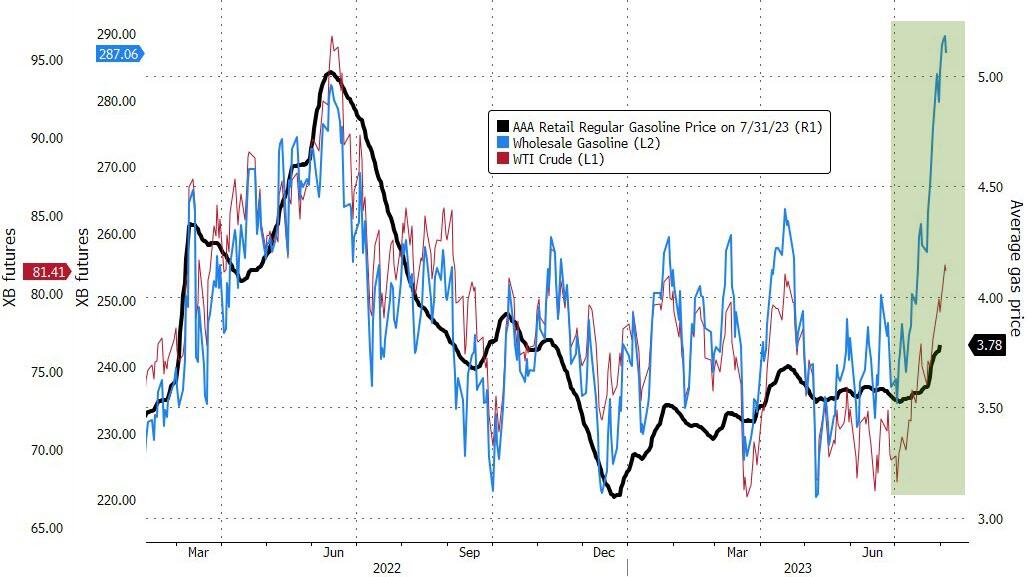
Update (1700ET): You cannot make this shit up. Minutes after the biggest weekly crude draw in history… and with crude prices at 2023 highs… and with wholesales gasoline prices exploding higher (implying retail pump pries are set to soar), the Biden administration has given up on its efforts to refill the Strategic Petroleum Reserve…

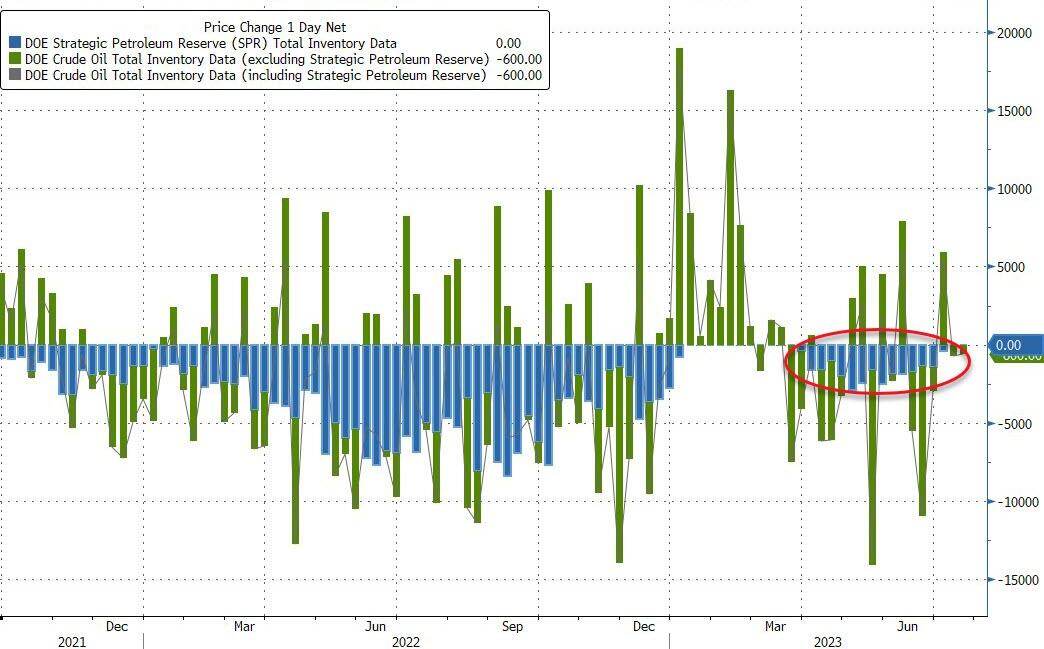
As a reminder, the Biden admin has been drawing down on the SPR for the last 14 weeks and – despite all the promises – has not refilled the “STRATEGIC” reserve one little bit…

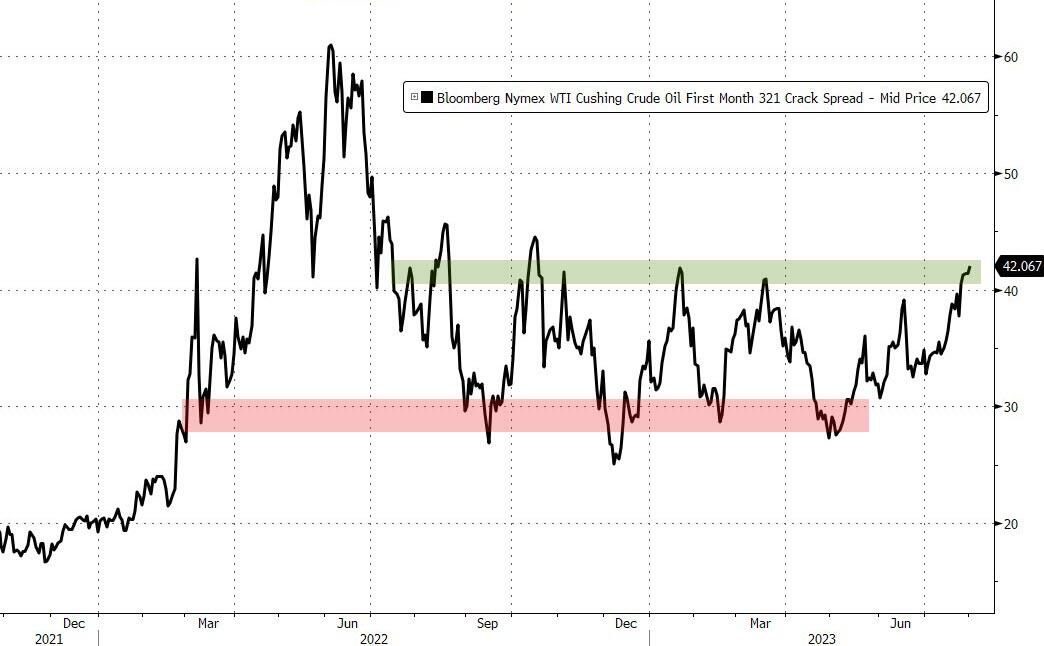
The 3-2-1 crack spread is blowing out…

As a reminder, when one product spread is blowing out, the market is saying that there needs to be more output of said product.

When all spreads are blowing out simultaneously, that may be the market’s way of signaling it needs more refining capacity to satisfy growing product demand.

We are seeing more of the latter (as Jet Fuel and Diesel cracks are also blowing out).

*  *  *

Oil prices gave back some of the recent solid gains today despite OPEC’s crude production tumbled by the most in three years as Saudi Arabia implemented a deeper cutback in a bid to shore up global markets, as dollar strength weighed on crude prices (and weak PMIs threatened demand outlooks).

“The OPEC+ Joint Ministerial Monitoring Committee will meet online on Friday, providing Saudi Arabia an excellent opportunity to roll its voluntary 1 million bpd production cut announced on June 3 for July production for another month to September. It would be the second time the Saudis have extended the voluntary 1 million bpd production cut. There is speculation that another 1 million roll forward could slow the global war on inflation, and kill the “golden goose,” especially heading into the end of summer driving season, and the beginning of shoulder season,” Robert Yawger, executive director of energy futures at Mizuho Securities USA, wrote in a Monday note.

Volumes also remain muted in light summer trading, while volatility is at the lowest since January 2020.

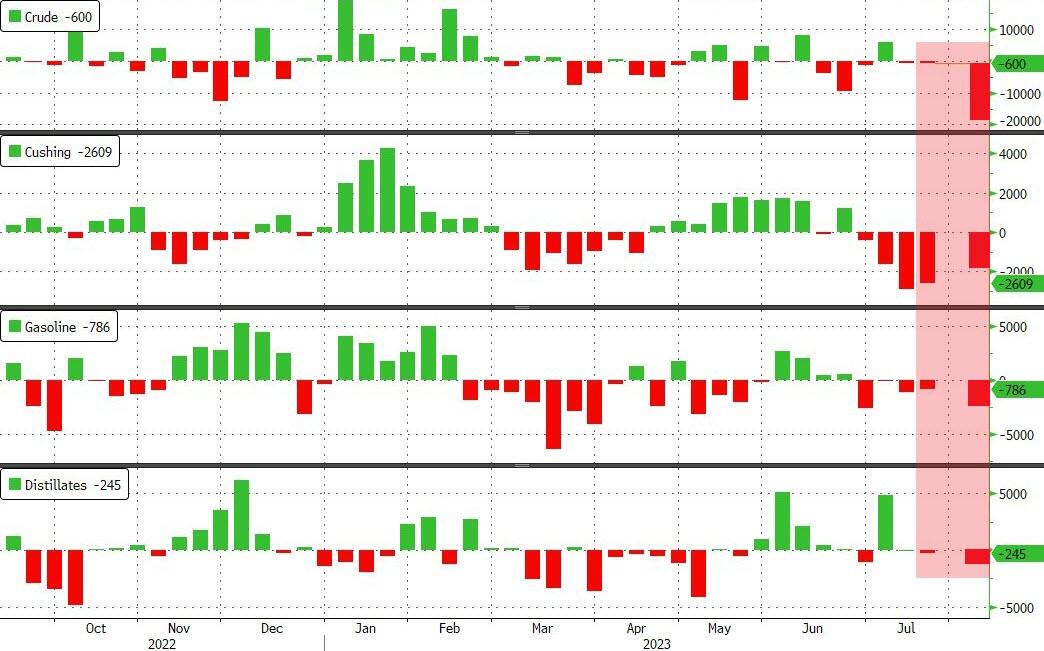
Expectations were for more inventory draws after last week’s across-the-board drop…

API

  • Crude -15.4mm (-1.3mm exp) – biggest weekly draw on record

  • Cushing -1.76mm

  • Gasoline -1.68mm (-1.3mm exp)

  • Distillates -512k (-100k exp)

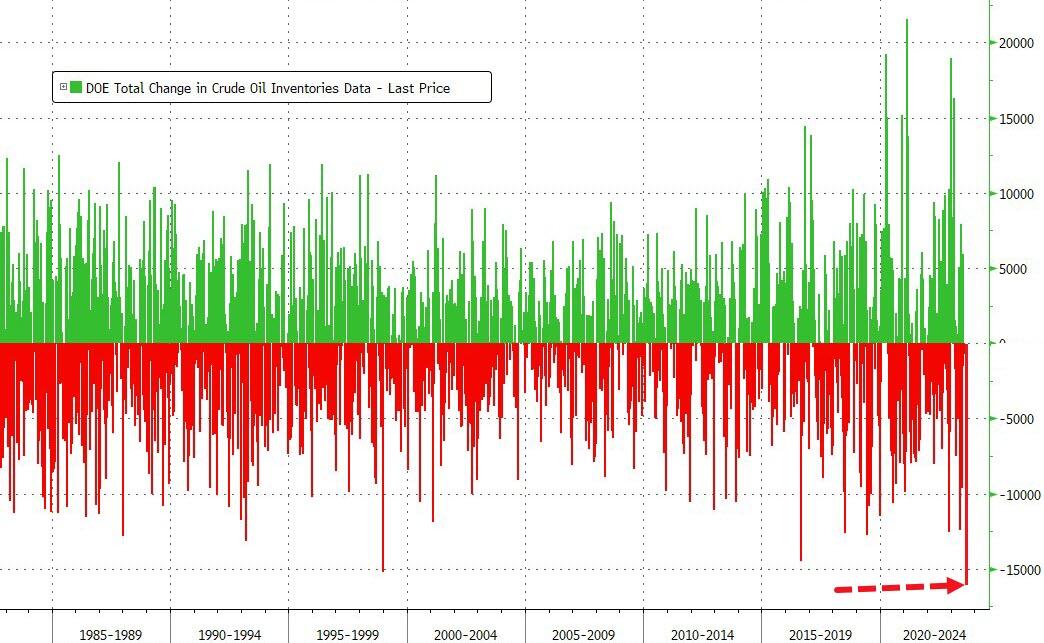
Umm… API reports that Crude stocks fell 15.4mm barrels last week (yes 15.4!!!) – over 10x expectations. Product inventories also fell as did stocks at the Cushing Hub.

Source: Bloomberg

If that holds for the official data released tomorrow that will be the biggest weekly draw in the data’s history (back to 1982)

Source: Bloomberg

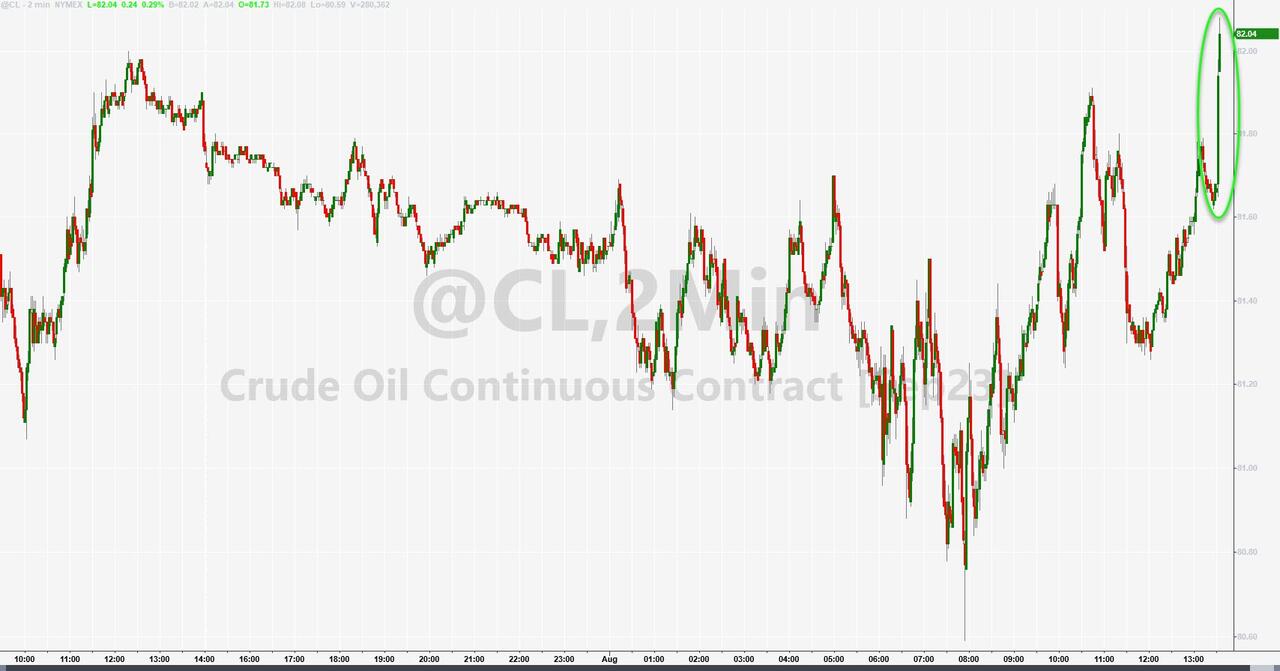
WTI was hovering around $81.60 ahead of the API report (well off the day’s lows) and bounced on the massive draw into the green for the day, back above $82…

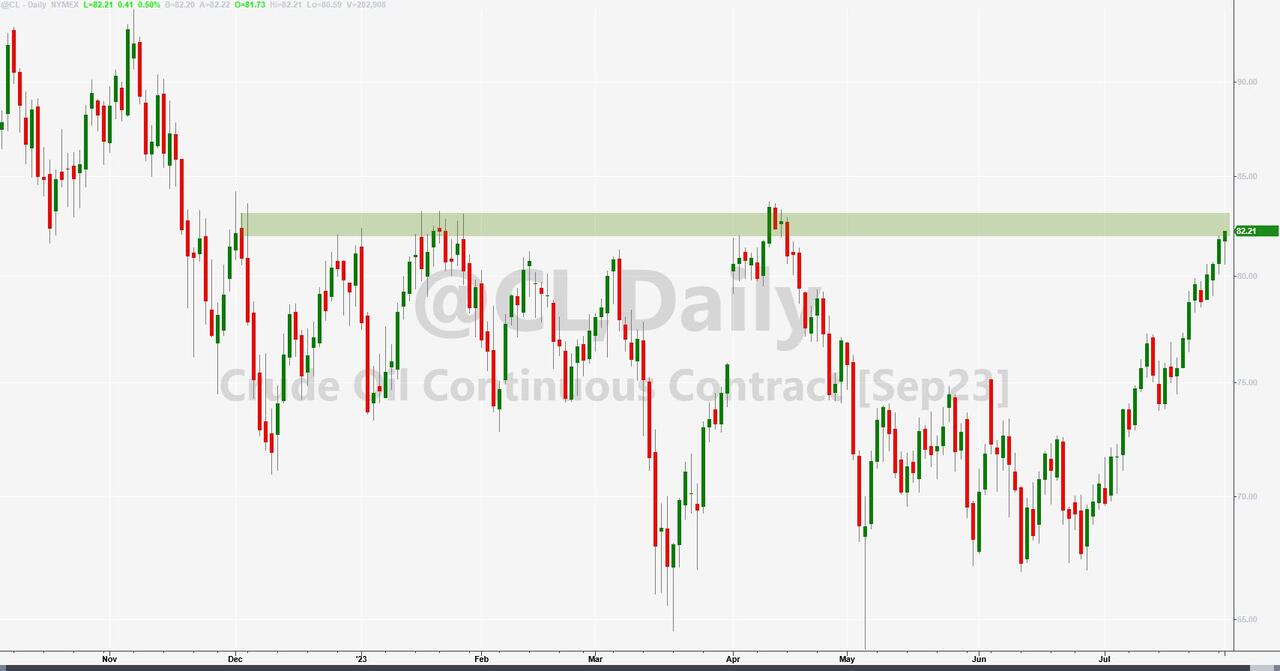
Back up to 2023 highs…

“Oil remains one of the most attractive trades and buyers will likely emerge on every dip,” said Edward Moya, senior market analyst at Oanda,in a note.

Shit’s about to get real for Mr. Biden…

Unleash the SPR again?

Tyler Durden
Tue, 08/01/2023 – 16:40

via ZeroHedge News https://ift.tt/jHVAX6B Tyler Durden

Lessons From The Unraveling Of The Roman Empire: Simplification, Localization

Lessons From The Unraveling Of The Roman Empire: Simplification, Localization

Authored by Charles Hugh Smith via OfTwoMinds blog,

The fragmentation, simplification and localization of the post-Imperial era offers us lessons we ignore at our peril.

There is an entire industry devoted to “why the Roman Empire collapsed,” but the post-collapse era may be offer us higher value lessons. The post-collapse era, long written off as The Dark Ages, is better understood as a period of adaptation to changing conditions, specifically, the relocalization and simplification of the economy and governance.

As historian Chris Wickham has explained in his books Medieval Europe and The Inheritance of Rome: Illuminating the Dark Ages 400-1000the medieval era is best understood as a complex process of social, political and economic natural selection: while the Western Roman Empire unraveled, the Eastern Roman Empire (Byzantium) continued on for almost 1,000 years after the fall of the Western Roman Empire, and the social and political structures of the Western Roman Empire influenced Europe for hundreds of years.

In broad-brush, the Roman Empire was a highly centralized, tightly bound system that was remarkably adaptive despite its enormous size and the slow pace of transport and communication. Roman society was both highly hierarchical–the elites claimed superiority and worked hard to master the necessary tools of authority– slaves were integral to the building and maintenance of Rome’s vast infrastructure–and open to meritocracy, as the Roman Army and other classes were open to advancement by anyone in the sprawling empire: every free person became a Roman Citizen once their territory was absorbed into the Empire.

When the Empire fell apart, the model of centralized control/power continued on in the reigns of the so-called Barbarian kingdoms (Goths, Vandals, etc.) and Charlemagne (768-814), over 300 years after the fall of Rome. (When the Ottomans finally conquered Constantinople in 1453, they also adopted many of the bureaucratic structures of the Byzantine Empire.)

Over time, however, the feudal model of localized fiefdoms nominally loyal to a weak central monarchy replaced the centralized model of governance. This adaptation fit the highly fragmented nature of European societies in this era.

But centralized influence never went away. The Christian churches based in Rome and Constantinople continued to exert centralized influence in politically fragmented regions, and monarchies continued to exist, in various states of strength and weakness. The Holy Roman Empire–as Voltaire is reputed to have observed, “neither Holy, Roman or an Empire”–had an enormously complex history in Germany and the rest of Europe. The monarchies in England and France remained in place, and the city-states of northern Italy wielded influence via trade and shifting alliances.

In other words, the Medieval era was ultimately a complex competition between overlapping models of governance and sharing resources, a competition between centralized and localized (what Wickham calls “cellular”) nodes of power and the various ways that rulers and those they ruled dealt with each other.

Throughout the era, the legitimacy of rulers ultimately flowed from public assemblies, a tradition inherited from Rome that manifested in aristocratic courts and the church’s leadership (bishops, etc.) and eventually, in parliaments. This tension played out in the sharing of costs and resources and the general direction of the state.

As a general rule, when monarchs consolidated too much power, they engaged in catastrophically costly and doomed wars (The Hundred Years War) because they were able to override or ignore the cautious counsel of elite assemblies.

Understood as a selective process of adapting to changing circumstances, this history offers us valuable lessons and templates for our future.

Once the centralized power of Rome fragmented, economic, social and political power simplified and relocalized. Trade volume shrank and trade routes vanished. Once the bureaucratic and military structures dictated by Rome collapsed, regions and localities were on their own.

Elites naturally sought out the best means to consolidate and expand their power, and residents (as a general rule, the peasantry and town-dwellers) sought to improve their own lives by reducing costs and securing access to resources.

The immense geographic, cultural, social and economic diversity of Europe was in effect freed to play out. This diversity is still evident; the European Union may have unified the European financial system, but cultural and social divisions have not dissolved.

Wickham distinguishes between two primary sources of income and wealth accessible to elites and governments: land and taxes. Collecting taxes requires an immense bureaucracy to identify and assess property owners, tenant farmers, merchants, collect duties on trade flows, etc. Taxes are the only reliable way to fund professional armies and the stupendous bureaucracy required to manage a complex centralized empire. The Byzantine Empire survived multiple rivals, invasions, etc. largely due to its competent tax collection bureaucracy, and European monarchies could only fund long, costly wars once they established tax collection bureaucracies.

Wealth from land–surplus skimmed from the labor of peasants–was adequate to fund highly localized nobility (many of which had one or two castles and a small fiefdom), but it wasn’t reliable enough or large enough to support professional armies or vast centralized states.

How does this history offer a template for the next 20 years?

I have long held that the dominant global forces binding the global economy are globalization and financialization. Both have greatly increased the income and wealth that nation-states can tax to fund their vast structures: military, social welfare, and bureaucracies of management, regulation and control.

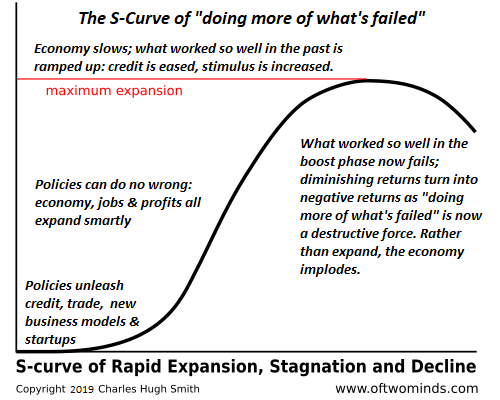
I have also held that globalization and financialization became hyper-structures prone to over-extension and the diminishing returns of the S-Curve. (see chart below) Both have reversed and are now in decline, a decline that I anticipate will accelerate unpredictably and rapidly as each dynamic is centralized and tightly bound, meaning each subsystem is highly interconnected with other subsystems. Should one break, the entire system unravels.
Globalization may appear to be decentralized, but the vast majority of global trade and capital flows through a few centralized nodes, and many aspects of trade depend on a very small number of routes and suppliers. This makes global trade exquisitely sensitive to disruption should any critical supplier or node fail.

Financialization is equally centralized and tightly bound, to the absurd degree that obscure financial structures (reverse repos, etc.) can trigger cascading crises in the real-world economy.

I anticipate a global simplification of trade and finance as fragile hyper-structures collapse as the failure of subsystems cascade through the entire system.

These systems have greatly accelerated extremes of wealth-income inequality by their very nature, and these vast distortions and imbalances are unsustainable. Also unsustainable is the immense expansion of the plundering of the planet’s remaining resources via globalization and financialization. These dynamics will collapse under their own weight.

What will be left? Once the income and wealth that supported enormously costly nation-state governments contracts, central governments will no longer be able to fund their gargantuan systems. (States that attempt to fund their activities by printing money will only speed the collapse of their finances and thus their coherence.)

As in the post-Roman era, central authority may well continue, but its actual power and influence will be greatly reduced. Without expanding income and wealth to tax, the central state may attempt to extract most of the nation’s surplus, but this stripmining of elites and commoners alike will trigger pushback and revolt.

A more sustainable response would be to offload most of the central government’s financial burdens onto states, provinces, counties, etc., in effect pushing the impossible task of maintaining entitlements and promised spending on local entities.

Given the diversity of cultures, social values and economic dynamics in large nations and regions, we can anticipate a flowering of adaptations to these greatly reduced means. Some localities will favor increasing authoritarian controls, others will favor reducing authoritarian controls and ceding authority to the smallest units of public assembly.

Locales (shall we call them fiefdoms?) will divide naturally along geographic boundaries, just as fiefdoms in medieval Europe fell into natural boundaries shaped by rivers, valleys, mountain ranges, etc., and along economic and cultural borders.

This relocalization may manifest in the well-known forecasts of the US breaking into multiple regional states, or it might manifest as I suggest in a much-weakened but still influential central government ceding power to local political structures which may themselves fragment or form alliances with nearby entities with whom they share cultural and economic ties.

In other words, a churn of evolutionary adaptations can be expected. Just as there was no one post-Roman adaptation that worked equally well everywhere, we can expect there to be some adaptations of roughly equal success and many that are unsuccessful.

As individuals and households, we want to be located in successful adaptations that share our values and offer us agency, i.e. a say in public assemblies and the freedom to move and work as we see fit.

As I have outlined many times in the blog and in my books, locales that are highly dependent on long global supply chains and distant capital for their essentials will fare very poorly once those supply chains break and the capital dries up. Regions and locales that generate their own essentials (food, energy, metals, concrete, electronics, etc.), talent and capital are much more likely to generate enough resources to satisfy both local elites and the public.

As I explain in my book Self-Reliance, we who have lived in the past 75 years of expanding production and consumption of Everything have lost touch with both the natural world that sustains us and the social and practical skills needed to endure and prosper in an era in which the engines of centralized power and wealth (globalization and financialization) decay and collapse.

Some locales will choose to foster relocalization and individual agency. Others will cling on to failing models of authoritarian control and globalization / financialization.

Ironically, perhaps, the most successful regions will be prone to indulging in hubris and denial, just as the Roman elites, basking in their centuries of dominance, dismissed the “Barbarians” and clung to their delusions of grandeur even as their world fragmented around them.

Those locales left behind by globalization and financialization may well offer much better opportunities for successful adaptation, relocalization and individual / household agency.

It is human nature to find reasons to dismiss the storm clouds on the horizon. We look around and find solace in the apparent strength of our institutions and economy, while ignoring their sobering dependence on unsustainable hyper-globalization and hyper-financialization.

The fragmentation, simplification and localization of the post-Imperial era offers us lessons we ignore at our peril. It’s important to view these lessons not just as an academic abstraction but as a guide to your own decisions about what places are most conducive to your security and well-being. Not every locale will do equally well, and the culture of many places may not be a great match for your own values and goals. If you decide to move, sooner is better than later.

*  *  *

This essay was drawn from my Weekly Musings Reports sent exclusively to subscriberspatrons and Substack subscribers. Thank you very much for supporting my work.

My new book is now available at a 10% discount ($8.95 ebook, $18 print): Self-Reliance in the 21st Century. Read the first chapter for free (PDF)

Become a $1/month patron of my work via patreon.com.

Subscribe to my Substack for free
Tyler Durden
Tue, 08/01/2023 – 16:20

via ZeroHedge News https://ift.tt/dMl8pBR Tyler Durden

Journal of Free Speech Law: “The ‘Constitutional’ Rise of Chinese Speech Imperialism,” by Prof. Ge Chen

The article is here; here is the Abstract:

This article conceptualizes China’s new constitutional doctrine of “party supremacy” and explains the implications it carries for speech regulation in both domestic and international public spheres. In particular, the article captures the Chinese Communist Party’s scheme of legitimizing its comprehensive speech regulation through party supremacy. This new constitutional doctrine, in contrast to China’s earlier dualistic constitutional framework, attempts to overcome the textual and contextual barriers for speech regulation and reshape the constitutive mechanism of the CCP’s domestic and international speech rules. Thus, there is a multi-layer “constitutional” spillover effect of intra-party speech regulation. First, the party-state may well redefine the distinction between the regulation of political speech and that of non-political speech:‌ the former is geared exclusively to the CCP’s intra-party rules under the tutelage of constitutional law. Consequently, the new constitutional doctrine could alter the structure of China’s speech regulatory framework in two aspects:‌ it both verticalizes the entire body of speech norms by prioritizing party rules and fully empowers party organs in the institutional governance of political speech.

Moreover, the party-state strives to extend the new constitutional framework to speech regulation in a transnational context. Here it seeks to reinforce the textual and contextual substance of its regulatory framework for overseas political speech by legitimizing party supremacy through authoritarian constitutional theories, customizing the CCP’s speech regulation in cross-border trade arrangements, and building a global identity with constitutional legitimacy for party supremacy that goes against constitutionalism itself. Thus, the article unveils this scheme as the underlying driving force of Chinese speech imperialism—a nuanced and tangible legal regime with a tacit, but uncompromising, constitutional blueprint of a power-monopolizing party to undermine the protection of free speech in liberal democracies.

The author is an Assistant Professor in Global Media and Information Law, Durham Law School (England); an Affiliated Fellow, Information Society Project, Yale Law School; and an Associate, Center for Intellectual Property and Information Law, University of Cambridge. He has written extensively on Chinese law.

The post Journal of Free Speech Law: "The 'Constitutional' Rise of Chinese Speech Imperialism," by Prof. Ge Chen appeared first on Reason.com.

from Latest https://ift.tt/wfAHiqh
via IFTTT

Columbia Law School Posts, then Retracts, Video Statement Requirement for Applicants

Aaron Sibarium reports for the Free Beacon:

“All applicants will be required to submit a short video, no longer than 90 seconds, addressing a question chosen at random,” the school’s admissions page said Monday morning. “The video statement will allow applicants to provide the Admissions Committee with additional insight into their personal strengths.”

Critics slammed the move as a thinly veiled attempt to defy the Supreme Court’s ruling and practice affirmative action by other means, using appearance as a proxy for race. Columbia’s decision “has all the hallmarks of a willful effort to evade the requirements of Title VI of the Civil Rights Act,” said Edward Blum, the founder of Students for Fair Admissions, the plaintiffs in the June case that outlawed affirmative action. “What is a 90-second video supposed to legitimately convey that a written statement could not?”

Reached for comment by the Washington Free Beacon, however, a spokesman for the law school said it had all been a misunderstanding and, by 6:00 PM Monday evening, Columbia had scrubbed the language from its website.

The post Columbia Law School Posts, then Retracts, Video Statement Requirement for Applicants appeared first on Reason.com.

from Latest https://ift.tt/XpAmePf
via IFTTT