Police Watched as a Man Drowned and Discouraged Bystanders From Helping, Lawsuit Claims


Tennessee River

A Tennessee man drowned last year as police watched and actively discouraged others from helping the man. Now, the man’s mother has filed a lawsuit against the officers, claiming their negligence caused her son’s death.

Mika Wheeler Clabo was a 30-year-old man who had been experiencing a mental health crisis when he ran into the Tennessee River in Knoxville on the morning of July 25, 2022. A few minutes after falling into the water—which was murky and filled with vines and branches—four police officers and two EMTs had arrived on the scene.

According to the suit, Clabo “yelled out several times, gasping and groaning, desperate for help, as he tried in vain to pull himself up or free himself from the vines that snared him.” However ” for approximately fifteen minutes, other than coaxing Mika on by yelling at him to ‘swim’ or ‘get out,’ no one helped him.”

As the gathered first responders watched, several employees at a nearby restaurant offered to help Clabo. One man even offered to give the officers access to a storage area that held flotation devices and a small boat but was refused.

“These men and others were warned off by the KPD officers against making any effort to help Mika, with one officer repeatedly telling them ‘he’ll drown you too’ or words to that effect,” the lawsuit claims. Instead, the officers said they were waiting for a rescue boat.

But the rescue boat came too late. The lawsuit claims that 13 minutes after falling into the river, Clabo’s head went underwater. Though the rescue boat arrived just a few minutes later, Clabo had drowned, and his body had become so entangled with the vines in the riverbank that it would not be recovered for two hours.

“The officers acted recklessly by merely watching a man who they believed to be mentally compromised struggling to free himself from vines, brush, and tree limbs before drowning,” the lawsuit states. “It is clear that the officers knew there was a substantial risk of death to Mika, yet consciously chose a course of action that ignored that deathly risk.”

However, while the officers’ indifference as Clabo drowned was disturbing, it’s unlikely that the lawsuit against them will succeed. In 2005, the Supreme Court found that the police have no legal duty to protect individuals from harm. In failing to rescue Clabo, the officers may have acted callously and cruelly—but also likely within the law. 

The post Police Watched as a Man Drowned and Discouraged Bystanders From Helping, Lawsuit Claims appeared first on Reason.com.

from Latest https://ift.tt/ed2FiSu
via IFTTT

Should Donald Trump and Hunter Biden Both Be Prosecuted?


A protestor outside President Donald Trump's arraignment

In this week’s The Reason Roundtable, editors Matt Welch, Nick Gillespie, and Peter Suderman welcome special guest Jacob Sullum to wade through the latest Donald Trump indictments and Hunter Biden’s legal woes.

1:11: Trump indictment roundup

24:18: Hunter Biden’s plea deal

38:59: Weekly Listener Question

48:58: This week’s cultural recommendations

Mentioned in this podcast:

Trump’s Alleged Cover-Up of His Cover-Up Reinforces the Obstruction Charges Against Him,” by Jacob Sullum

2 Reasons It’s Not Clear That Trump ‘Corruptly’ Obstructed an Official Proceeding,” by Jacob Sullum

Here Is Why Trump’s ‘Contingent’ Electors Say They Did Nothing Illegal,” by Jacob Sullum

How Hunter Biden’s Plea Deal Fell Apart,” by Jacob Sullum

Hunter Biden Shouldn’t Go to Prison for Violating an Arbitrary Gun Law,” by Jacob Sullum

Clark Neily: Regardless of Guilt, Trump Won’t Go to Jail,” by Nick Gillespie and Zach Weissmueller

Trump’s Impeachment Trial Will Only Make Us Hate Washington Even More,” by Nick Gillespie

Judge Napolitano: Enough Evidence ‘to Justify About Three or Four Articles of Impeachment.’” by Nick Gillespie

All Drug Offenders Should Be Treated Like Hunter Biden: Leniently,” by Nick Gillespie

Squirtle’s seen some shit, man,” tweets Nick Gillespie

First Family Follies,” by Nick Gillespie

Andrew Tatarsky and Maia Szalavitz: How ‘Harm Reduction’ Is Transforming Drug Policy,” by Nick Gillespie

What Will the End of the Drug War Mean for Addicts? Look to Oregon,” by Zach Weissmueller

Ethan Nadelmann: Legalize ALL Drugs. NOW.” by Nick Gillespie and Zach Weissmueller

Send your questions to roundtable@reason.com. Be sure to include your social media handle and the correct pronunciation of your name.

Today’s sponsor:

  • Sometimes in life, we’re faced with tough choices, and the path forward isn’t always clear. Whether you’re dealing with decisions around career, relationships, or anything else, therapy helps you stay connected to what you really want while you navigate life, so you can move forward with confidence and excitement. Trusting yourself to make decisions that align with your values is like anything—the more you practice it, the easier it gets. It’s helpful for learning positive coping skills and how to set boundaries; it empowers you to be the best version of yourself; it isn’t just for those who’ve experienced major trauma. If you’re thinking of starting therapy, give BetterHelp a try. It’s entirely online, designed to be convenient, flexible, and suited to your schedule. Just fill out a brief questionnaire to get matched with a licensed therapist, and switch therapists anytime for no additional charge. Let therapy be your map, with BetterHelp. Visit BetterHelp.com/roundtable today to get 10 percent off your first month.

Audio production by Ian Keyser; assistant production by Hunt Beaty.
Music: “Angeline,” by The Brothers Steve

The post Should Donald Trump and Hunter Biden Both Be Prosecuted? appeared first on Reason.com.

from Latest https://ift.tt/MBREXrO
via IFTTT

Missouri v. Biden Fifth Circuit Panel Announced

I believe this just happened today, since argument is next week (Aug. 10); the panel is Judges Edith Brown Clement, Jennifer Walker Elrod, and Don Willett. Recall that this is the expedited appeal of the July 4 injunction that barred various federal departments from encouraging social media platforms to delete certain content.

The post <i>Missouri v. Biden</i> Fifth Circuit Panel Announced appeared first on Reason.com.

from Latest https://ift.tt/zVu486K
via IFTTT

Banks, Bonds, & Bullion Battered As Dollar Rips To Start August

Banks, Bonds, & Bullion Battered As Dollar Rips To Start August

Yields surged higher today, despite dismal economic data, as supply (corporate and govt) dominated along with positive employment signals from the PMIs (although the JOLTs data was shitshow and should have trumped any positives from PMIs). The dollar also ripped higher… on a bad data day (to start the month) as PMIs were abysmal around the world (and non-USD fiat weakness means USD fiat strength).

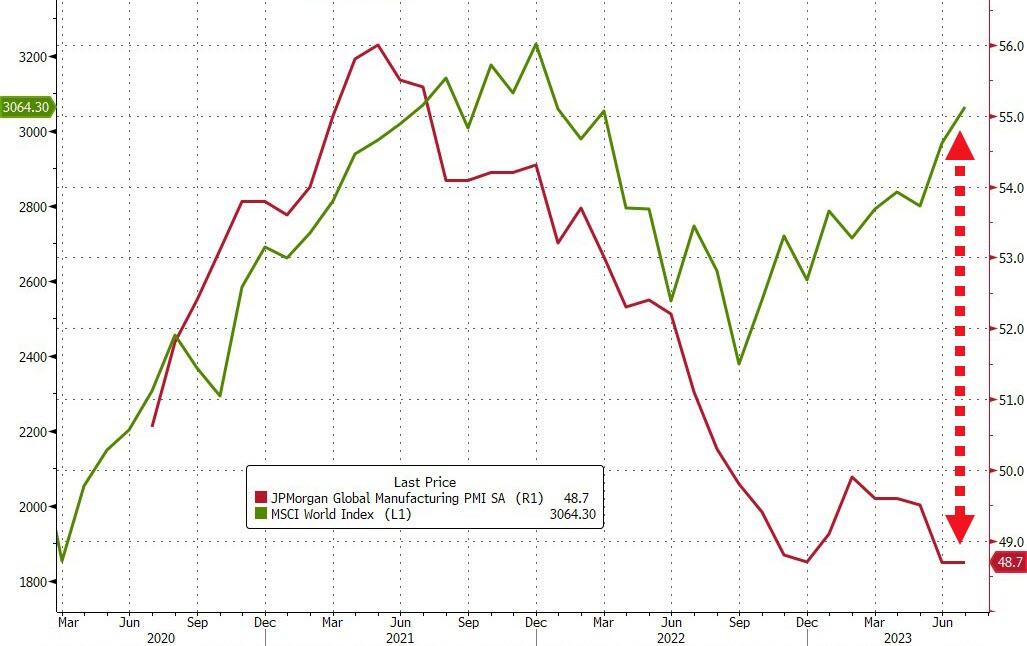
Global Manufacturing PMIs and Global Stocks seem to be in disagreement…

Source: Bloomberg

“probably nothing…”

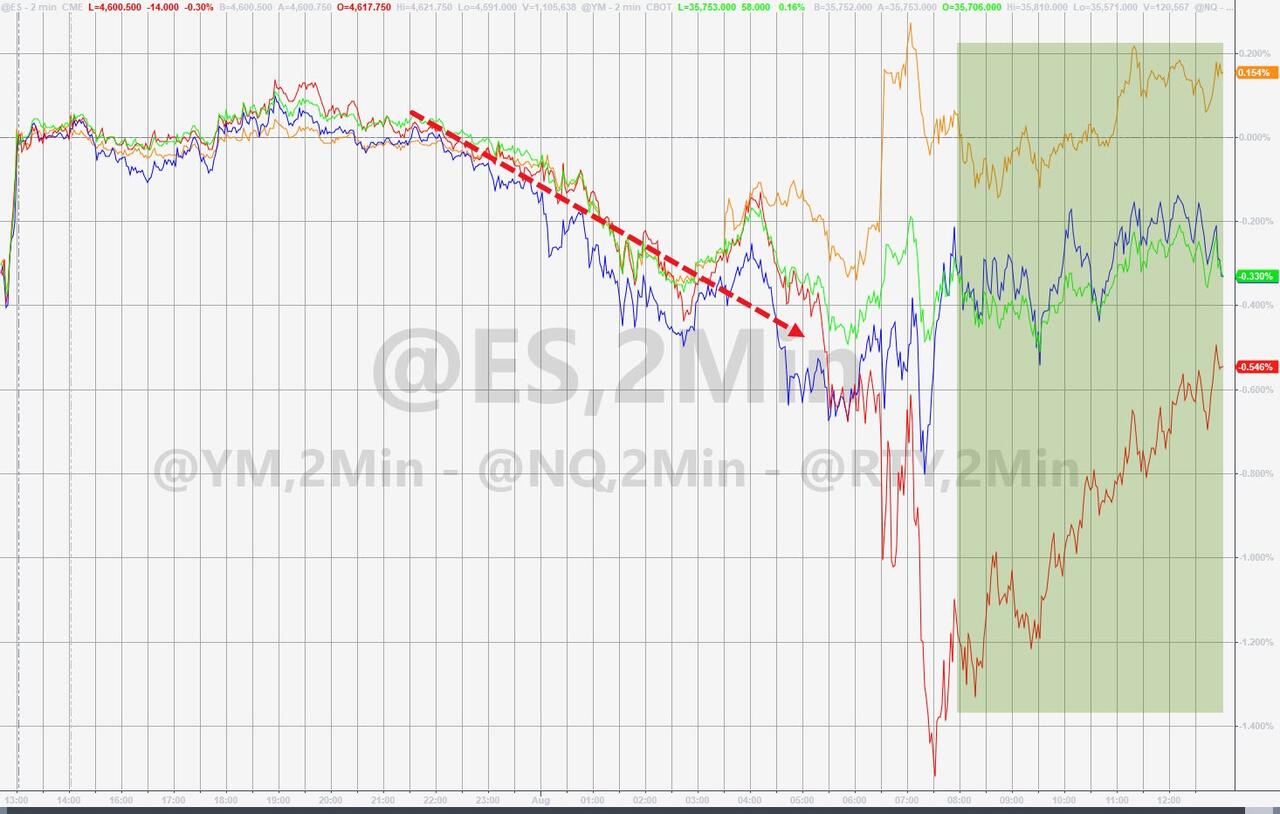
Equity markets were broadly under pressure today early on but the ubiquitous short-squeeze lifted them off the lows. The Dow ended higher

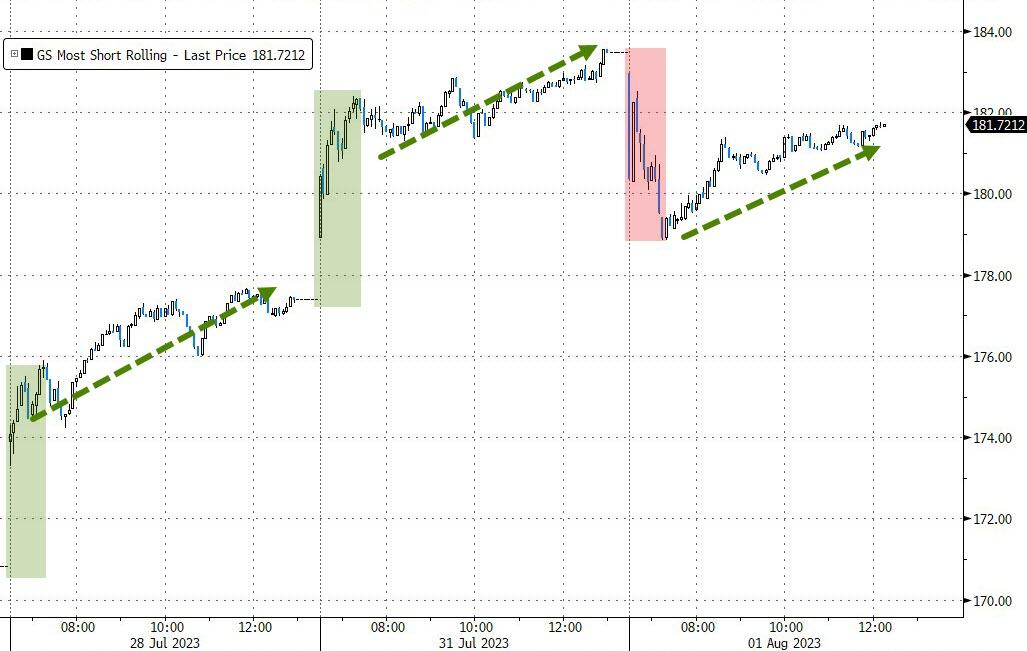
Another day, another short-squeeze…

Source: Bloomberg

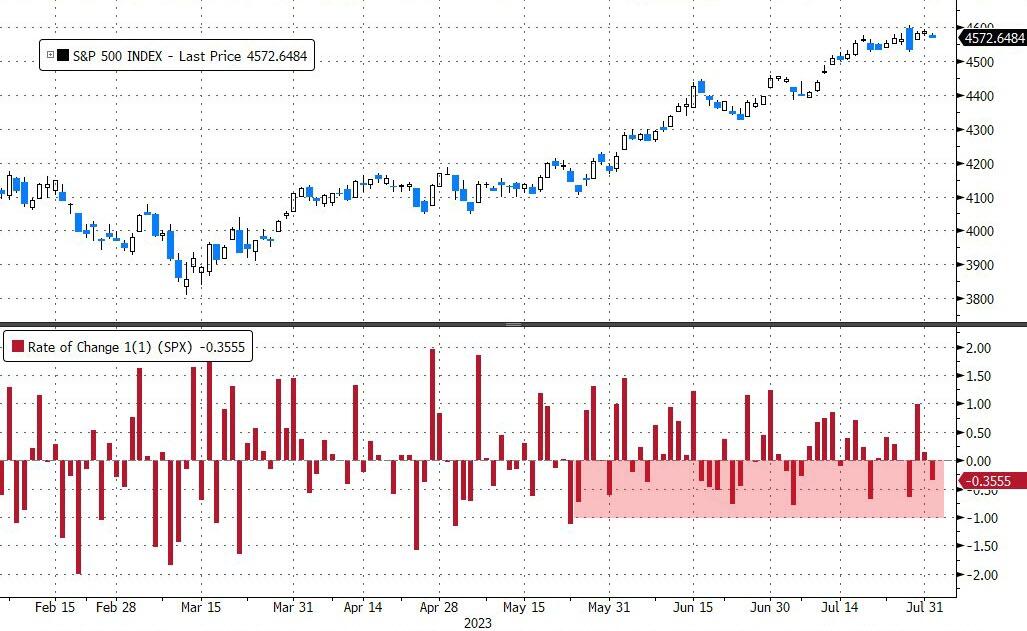
It’s now been 40 days since the S&P had a down 1% day…

Source: Bloomberg

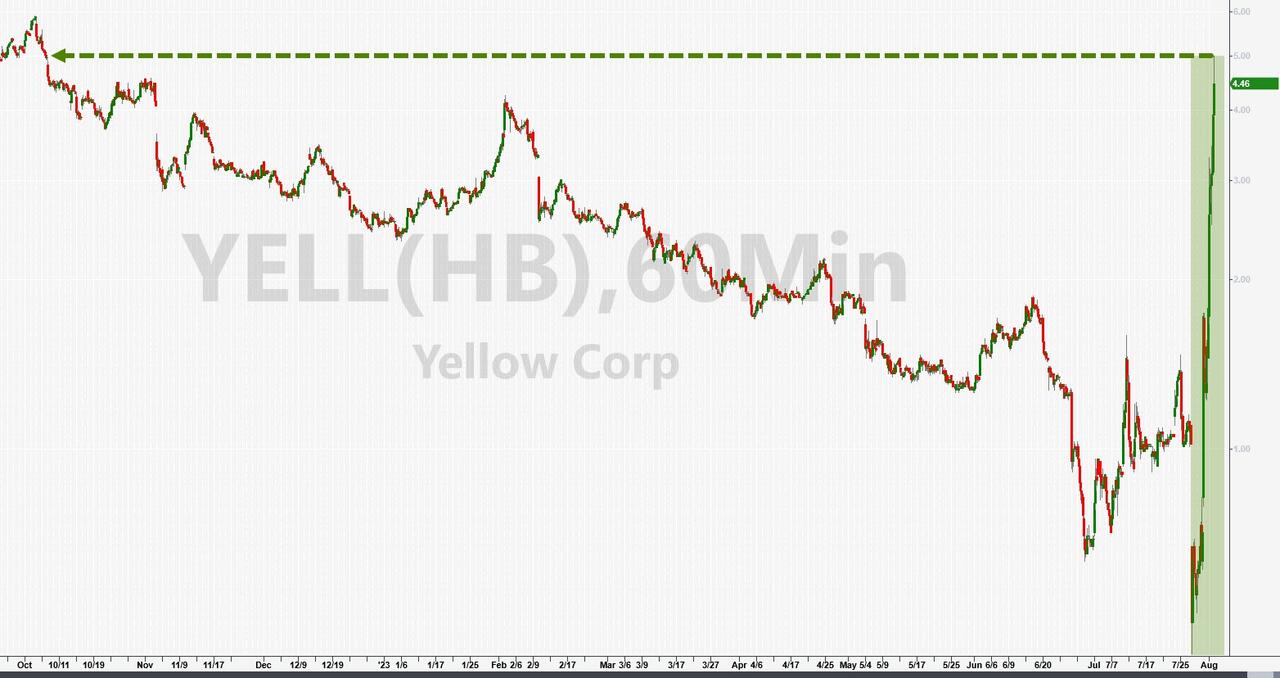
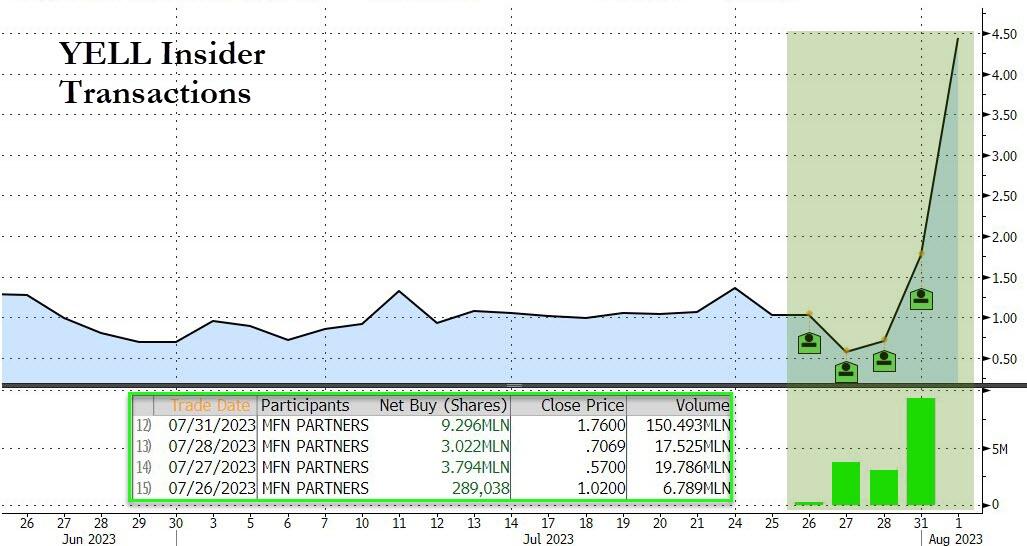
And of course, bankrupt trucker Yellow was up over 150% today – hitting $5.00, its highest since Oct 2022 – massively higher from the 43c lows late-last week…

And WTF is this!!!!

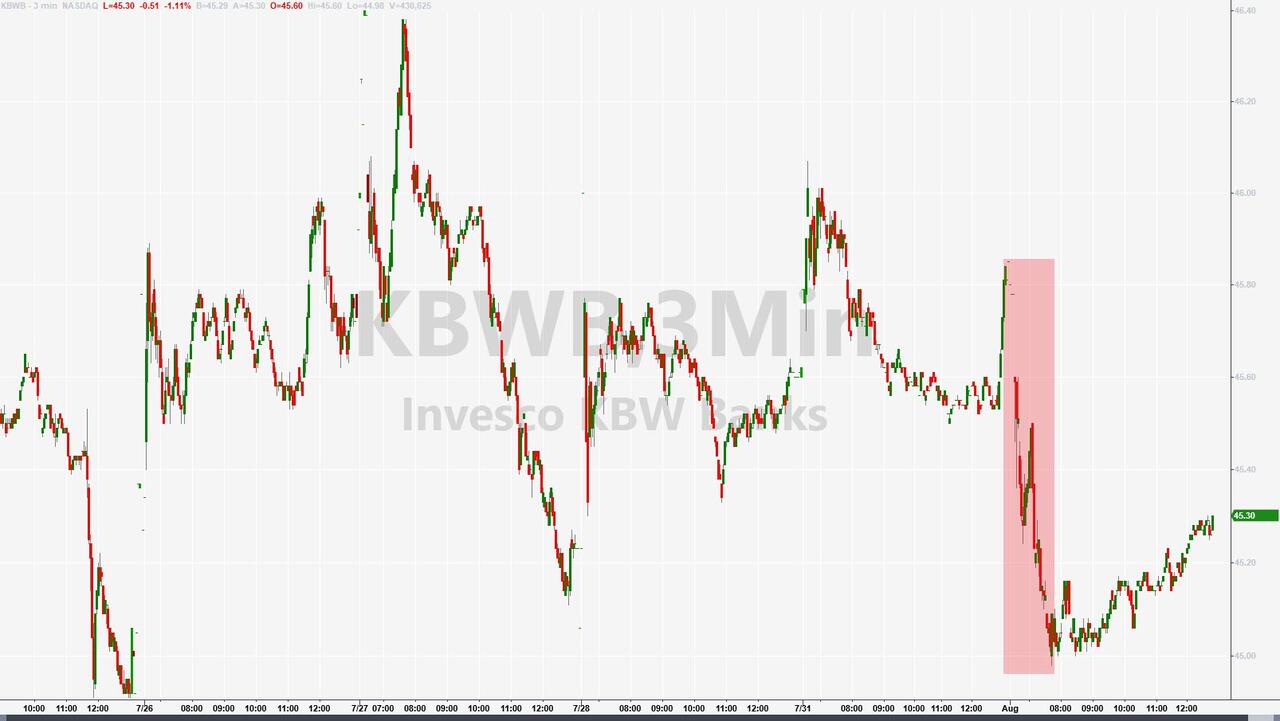
Banks were dumped today…

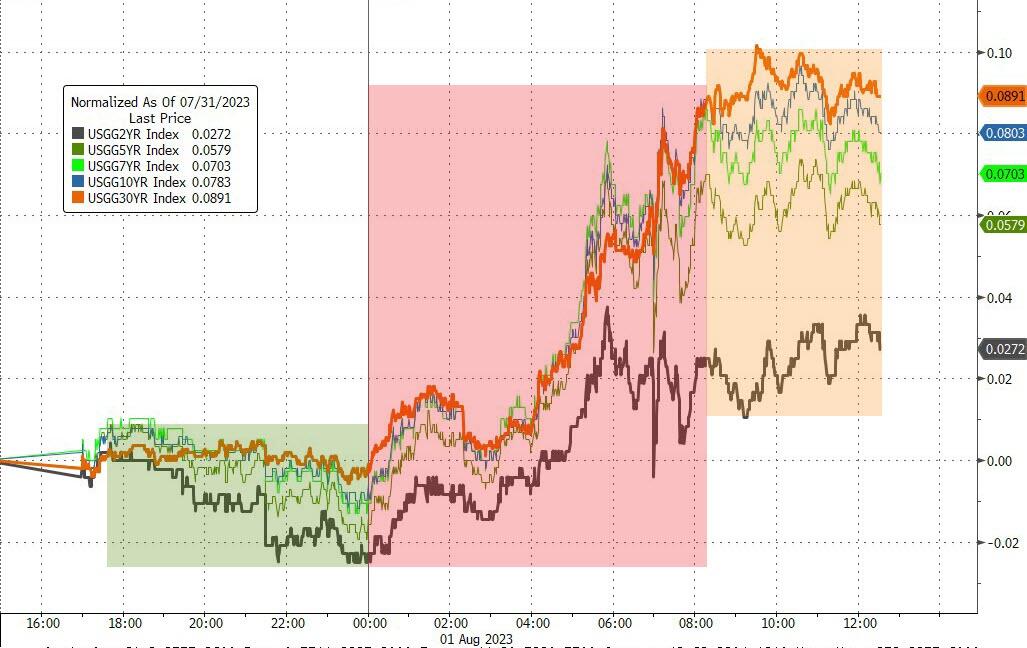
Treasuries were clubbed like a baby seal during the European session and the selling pressure abated after Europe closed. The long-end notably underperformed…

Source: Bloomberg

Bloomberg’s Alyce Andres offers 10 reasons why bond investors are so bearish today.

  1. The US refunding projections for Wednesday are skewed higher after the Treasury increased borrowing estimates Monday

  2. The technical break of 4% in 10s was meaningful and provided some momentum as yields retest recent highs ahead of the refunding announcement and Friday’s jobs report

  3. Foreign real money sold 10-year futures contracts right out of the gates today in New York, while cash desks noted similar accounts exited longs in 5s

  4. Relative-value accounts sold in both 5s and 20s against 2s

  5. Financial-linked corporate bond issuance slowed today, lessening the need to receive in swaps

  6. Month-end is out of the way — lessening the need for indexing demand

  7. With the adjustment in duration, investors are preparing for for convexity sales. Dealer desks say it has yet to materialize but easily could

  8. Pressure also seen in mortgage-backed securities, with hedge fund sales due to the shift in duration. Weakness in MBS can often lend to hedging flows in Treasuries. Dealers report the recent money manager bid looks a bit tired in MBS

  9. Commodity Trading Advisors and speculative accounts remain short and are willing to let those winning trades ride — feeling no pressure to unwind

  10. Liquidity is low, exaggerating price action

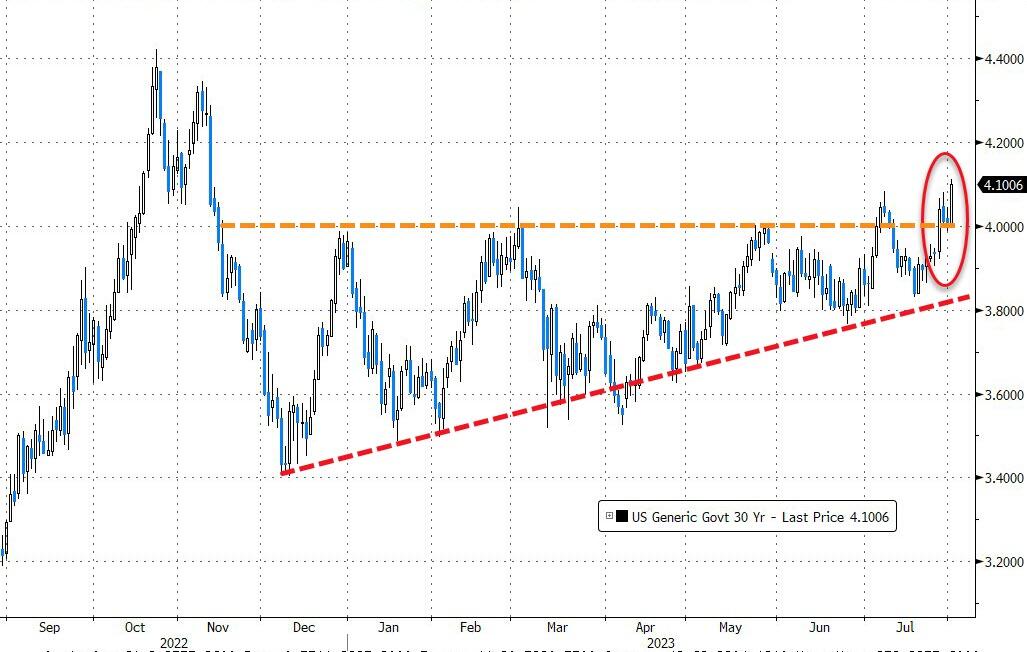
10Y yields topped 4.00% and 30Y yields ripped up to their highest since Nov 2022

Source: Bloomberg

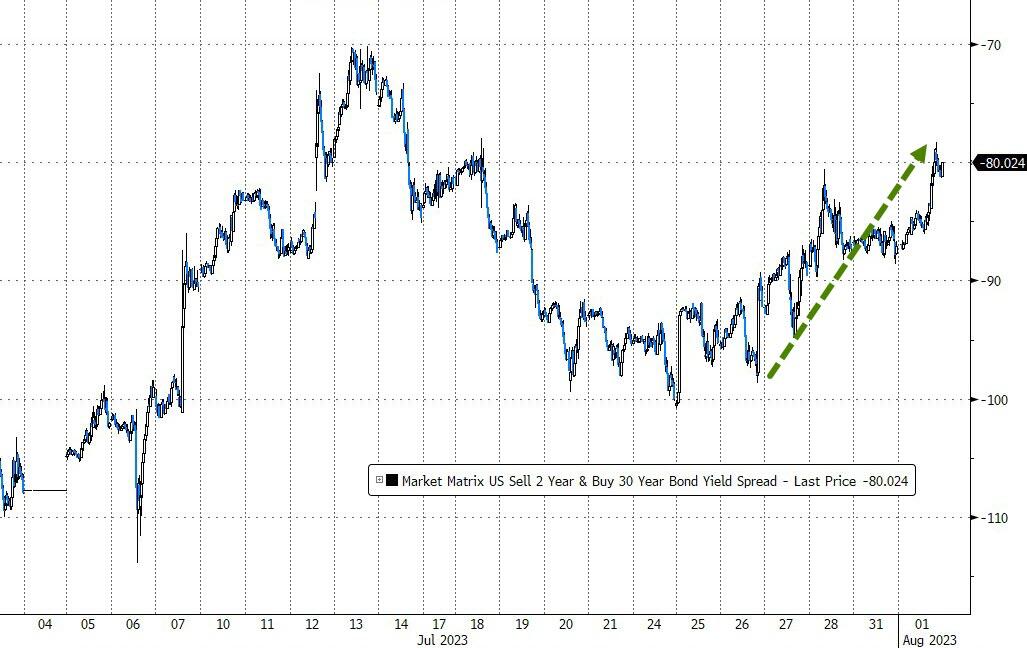
The yield curve (2s30s) steepened notably today (less inverted)…

Source: Bloomberg

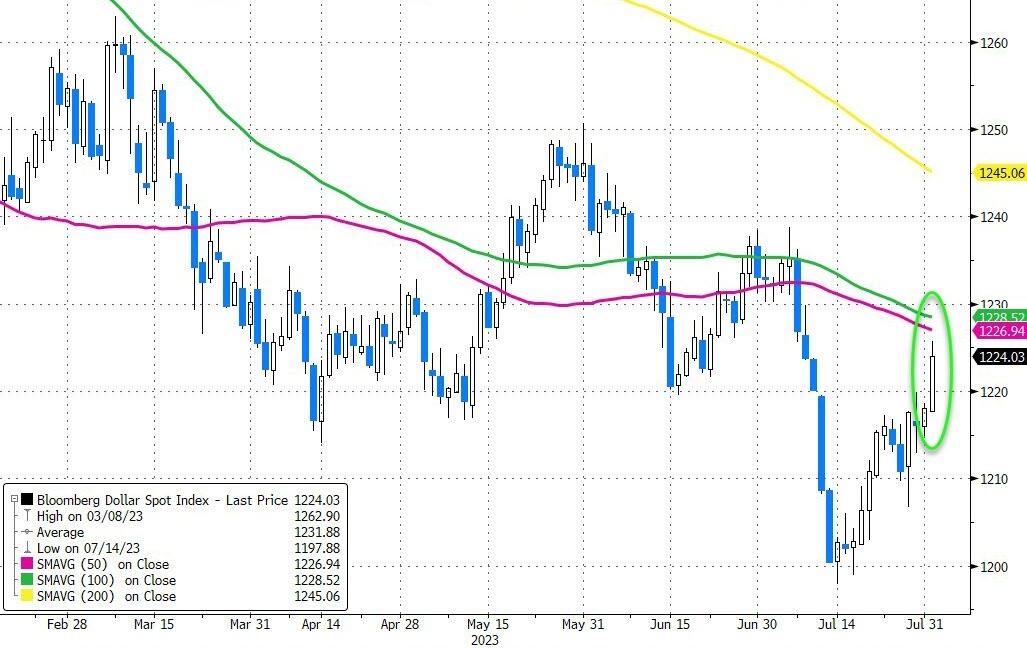
The dollar extended its rebound from mid-July’s plunge (retracing almost 70% of the drop)…

Source: Bloomberg

We also note that The Dollar Index is closing in fast on key technical levels…

Source: Bloomberg

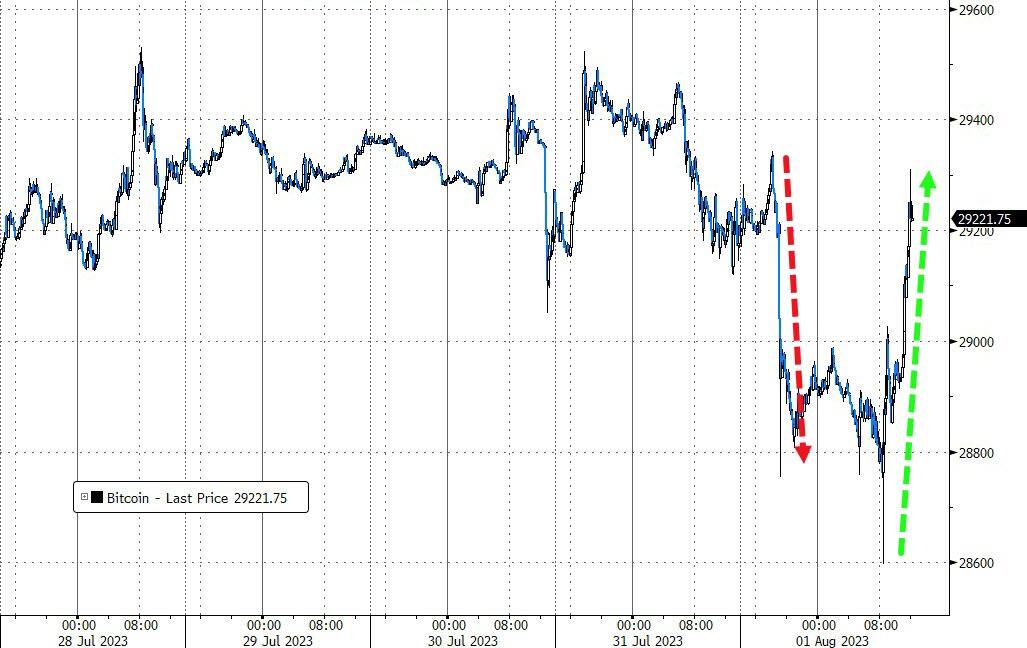
Bitcoin dumped and pumped back above $29k…

Source: Bloomberg

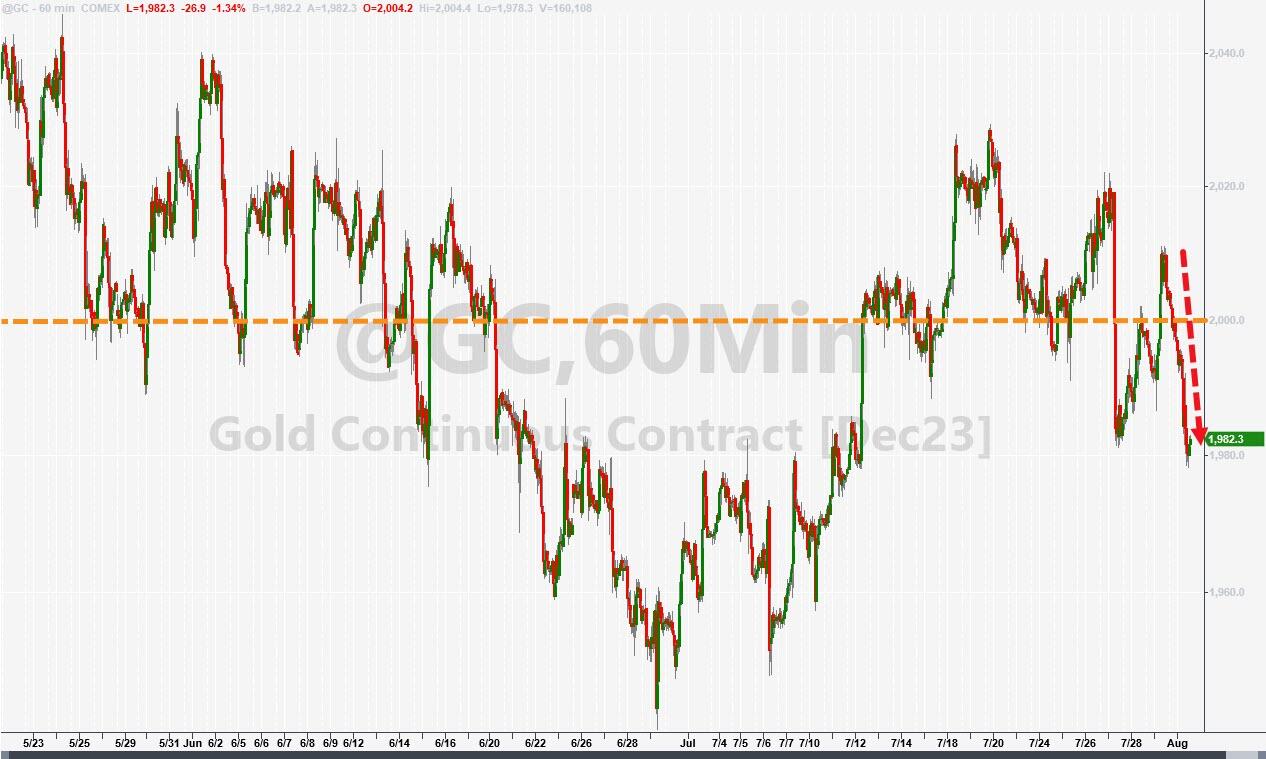
Gold tumbled back below $2000 today…

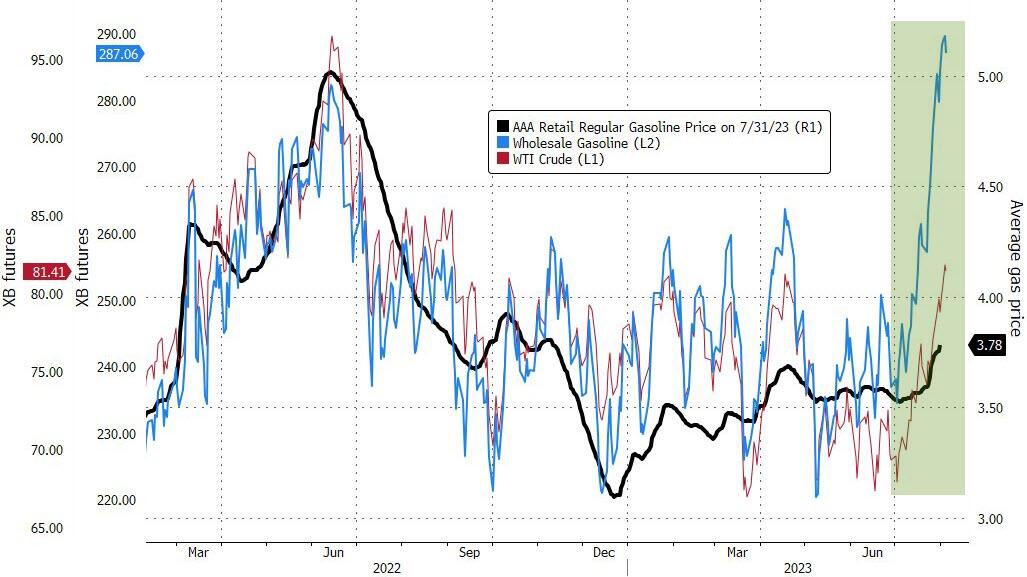
WTI hit $82 today, back at OPEC-Cut highs from April…

Finally, Mr.Biden may have a problem (well let’s be honest, this is but one of many)…

Source: Bloomberg

Retail gas prices are set to explode (and that won’t help the “inflation is defeated” narrative).

Tyler Durden
Tue, 08/01/2023 – 16:00

via ZeroHedge News https://ift.tt/RazDcVQ Tyler Durden

Strong Investment Demand For Physical Gold Continued In Second Quarter

Strong Investment Demand For Physical Gold Continued In Second Quarter

Via SchiffGold.com,

Investment demand for physical gold was up by 20% in the second quarter compared to last year, continuing a trend we’ve seen over the last 12 months. This helped push overall gold demand up 7% year on year when including over-the-counter (OTC) sales and stock flows.

Coin and bar demand came in at 277.5 tons in Q2, a 6% increase over the same quarter last year, according to the World Gold Council Gold Demand Trends for Q2. Gold bars accounted for 162.9 tons of that demand. That was a 6% drop compared to the second quarter of ’22. Coin demand came in at 88.9 tons, a 25% increase year-on-year.

Second-quarter coin and bar demand was 4% above the five-year quarterly average.

Extremely strong demand for physical gold in Turkey and more broadly in the Middle East helped drive gold coin and bar demand higher. Demand in that region offset weak demand in the Eurozone.

We saw this strong demand for physical gold despite a record LBMA gold price that averaged $1,976 per ounce during the quarter. This was a 4% increase over the previous record set in Q3 2020.

A 21.3-ton decrease in gold ETF holdings pulled down overall investment demand to 256.1 tons, but it was still 20% higher compared to the second quarter of last year. The drop in ETF holdings happened despite two straight months of ETF inflows in April and May.

Overall, total second-quarter gold demand fell by 2% compared to Q2 2022 excluding stock flows and OTC transactions. This was partially due to a slowdown in central bank gold buying. Although central banks continued to add to their gold holdings in the second quarter, big sales by Turkey pulled down the net total increase.

When you factor in strong over-the-counter (OTC) gold demand, overall demand was up 7% year on year to 1,255 tons.

OTC trades take place directly between two parties. According to the World Gold Council, hard data on the OTC market is not readily available. It is estimated by factoring in changes to inventories on commodity exchanges, any unobserved changes in fabrication inventories, and any statistical residual.

Industrial gold demand lagged in Q2 due to continued weakness in the consumer electronics market.

Jewelry consumption managed a modest improvement despite the high gold price environment. It was up 3% year-on-year to 476 tons.

Excluding OTC transactions, gold demand was down 6% through the first half of 2023 at 2,062 tons, but when you factor in the strong OTC market, demand was up 5% to 2,460 tons.

Tyler Durden
Tue, 08/01/2023 – 15:30

via ZeroHedge News https://ift.tt/KYS4Me8 Tyler Durden

BREIT Hit By Ninth Consecutive Month Of Redemptions; Plans Pivot To AI Data-Centers

BREIT Hit By Ninth Consecutive Month Of Redemptions; Plans Pivot To AI Data-Centers

Blackstone has limited investor redemption requests from its $68 billion real estate trust for high-net wealth investors for eight consecutive months while storm clouds continue to gather over commercial real estate markets.

According to a letter obtained by Bloomberg, Blackstone Real Estate Income Trust (BREIT) recorded investor outflows of $3.7 billion in July — the lowest redemption requests since the run on the fund began in November 2022. However, BREIT only returned about $1.3 billion, or approximately 34% of what was requested — as it continues to gate redemption to prevent massive outflows. 

“This structure was designed to both prevent a liquidity mismatch and maximize long-term shareholder value.

“A shareholder who began submitting repurchase requests when proration began has received approximately 94% of their money back and the semi-liquid structure is working as intended,” according to the letter.

BREIT has been working through redemption requests for the last eight months. We have provided a detailed account of the panic out of BREIT as CRE markets come under pressure in a high-rate environment: 

Remember when BREIT received a $4 billion bailout cash infusion from the University of California earlier this year?

Late January, Blackstone President Jonathan Gray told Financial Times that BREIT was experiencing a “backlog” of redemption requests. 

Redemption requests surged in Spring:

Bloomberg said BREIT had sold CRE assets to raise capital: 

BREIT has sold $12 billion of real estate assets since the beginning of 2022, generating $2.5 billion of profit during its ownership, according to Blackstone. Recent transactions include an $800 million sale of a Texas hotel, and a $2.2 billion deal to offload a self-storage business. 

Financial Times report spun the negative asset sales story into a puff piece about how BREIT prepares to “invest billions in data centers to feed the artificial intelligence boom.” 

BREIT should prioritize meeting redemption requests and quelling the ongoing panic withdrawals before capitalizing on the AI boom.

We’ve pointed out (“New “Big Short” Hits Record Low As Focus Turns To $400 Billion CRE Debt Maturity Wall“) that the regional banking crisis kick-started CRE turmoil. JPMMorgan Stanley, and Goldman Sachs have all joined the CRE gloom parade. 

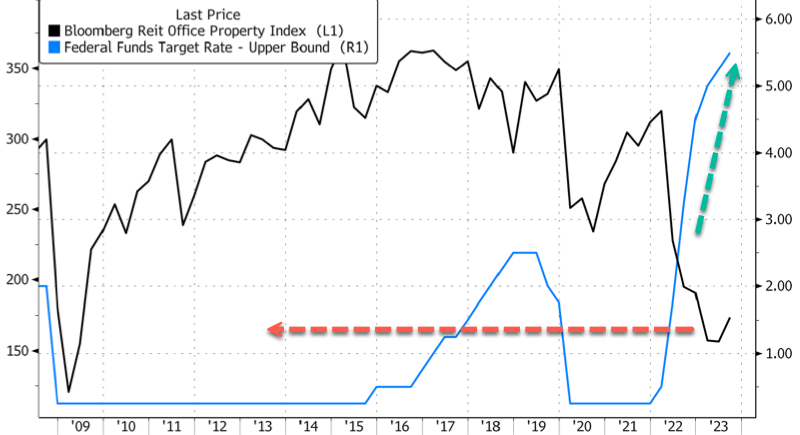
Also, thank the Federal Reserve’s aggressive rate hikes for the CRE mess. 

Tyler Durden
Tue, 08/01/2023 – 15:10

via ZeroHedge News https://ift.tt/UAH08Bp Tyler Durden

It’s Year 5 Of The Biden Crime Family Coverup

It’s Year 5 Of The Biden Crime Family Coverup

Authored by Frank Miele via RealClear Wire,

A truism that came out of the Watergate scandal is that often the coverup is worse than the crime. But that is not the case in the unraveling Bidengate scandal. The alleged crime here is so bad that it is probably the worst ever committed by an American president.

Yet the coverup should be studied, too. It deserves superlatives for its longevity, inventiveness, and sheer audacity. The strategy has been simple: deny, deflect, destroy. Deny the facts. Deflect with distractions, and when all else fails, work tirelessly to destroy Trump, who was among the first to raise questions about the Biden family’s shady dealings. At Year 5, it may be the most successful coverup in modern history, especially since so many of the facts have been in plain sight for the entire time.

So what exactly is Bidengate? A decade-long influence-peddling scheme that saw Joe Biden, the former vice president, using his son Hunter as a conduit for millions of dollars in payoffs from foreign entities in Ukraine, China, and elsewhere in exchange for favorable treatment. The most famous instance of this scheme was the millions of dollars paid to Hunter Biden for his role as a board member of the corrupt Burisma energy company in Ukraine. Even Hunter acknowledged that his only qualification for being on the board was his last name.

Trading on one’s name to gain employment is not a crime in itself, but using your father’s public office to influence U.S. policy is definitely against the law – especially when the clout is used to protect your corrupt foreign employer.

That’s just what happened in March of 2016 when Vice President Biden threatened to withhold $1 billion in U.S. aid to Ukraine if prosecutor general Viktor Shokin were not immediately fired. Biden even bragged about this escapade a few years later when he told the story to the Council on Foreign Relations.

It’s hard to know whether Biden’s threat to withhold aid was approved by the State Department or whether it was “on the fly” diplomacy, but we do know that Shokin has publicly stated that he was fired because he was investigating Burisma’s alleged corruption, and that after he was fired there was no further substantial investigation of Burisma. Quid pro quo.

Another famous mantra from the Watergate era is “Follow the money.” It almost makes you think Biden was taunting his accusers, quipping to a reporter on June 8, “Where’s the money?” when asked about allegations of corruption.

That’s what we want to know,” the reporter should have demanded, but of course there was no follow-up question. There never is.

Biden’s cheeky response suggests he had reason to think that he could count on the source of any ill-gotten wealth being kept private. And he may have had good reason for that belief.

On July 20, a little more than a month after Biden asked “Where’s the money?”, Sen. Chuck Grassley released an unclassified FD-1023 FBI informant form alleging that Biden and his son Hunter had split a $10 million payment from Ukrainian oligarch Mykola Zlochevsky, the owner of Burisma. Among the many intriguing breadcrumbs in that document was the informant’s claim that the payment to the Bidens was so well disguised that it would take years to uncover:

Zlochevsky responded he did not send any funds directly to the “Big Guy” (which [the FBI source] understood was a reference to Joe Biden). [The source] asked Zlochevsky how many companies/bank accounts Zlochevsky controls; Zlochevsky responded it would take them (investigators) 10 years to find the records (i.e. illicit payments to Joe Biden).

So that’s one possible answer to Joe Biden’s taunt: “Where’s the money?” Perhaps it’s well-hidden.

There are so many flashing red warning lights in the Biden scandal that a casual observer would be forgiven for assuming he was in Amsterdam. Case in point: The FBI informant reported in his June 2020 statement that Zlochevsky had called Joe Biden the “Big Guy” in 2019. That’s the same gangster nickname that one of Hunter Biden’s business associates used to refer to Joe in an infamous email on the “Laptop from Hell” when discussing what percentage of capital equity was being held by Hunter for Joe in a Chinese investment scheme. The laptop was in FBI hands since December 2019, but the email in question wasn’t circulated in public until the New York Post published it on Oct. 15, 2020. The informant’s use of the phrase prior to that time is strong circumstantial evidence that the FBI’s trusted human source was indeed privy to confidential and damning information about Biden.

But what’s truly maddening about the Biden coverup is just how long it has lasted while more and more evidence has mounted. Recent congressional hearings unearthed a trove of detail about bank payments to Biden family members, and IRS whistleblowers have laid bare the protection racket that the FBI and DOJ have been running for the Bidens. Most of that is just confirmation of what we already knew.

Remember, the first time most Americans heard about the Bidens’ bribery schemes was in September 2019 when the transcript of a phone call between President Trump and then-new Ukrainian president Volodymyr Zelensky was released. In it, Trump raised the issue of former Vice President Biden’s alleged corruption and asked Zelensky to cooperate with U.S. authorities by “looking into” rumors of criminal activity by the Bidens.

Imagine if Congress had opened an inquiry then into the question of Hunter Biden’s huge salary for sitting on the board of Burisma Energy, the company controlled by oligarch Zlochevsky. Hunter Biden might be in prison now, and his father would have retired to Delaware to live out his final years in shame.

Instead, Democrats in Congress put Trump on trial for daring to notice that which must not be named – the influence-peddling scheme run by Joe Biden and his kin. The impeachment was America’s crash course on Ukrainian corruption, but somehow the mainstream media missed the story and tried to convince the public that Biden was the victim. They hid the evidence then, just as they did last week when Hunter Biden’s sweetheart plea deal fell apart.

The Democrat-adjacent media seem to have a hard time understanding the case against Hunter Biden – and Joe Biden – even after five years. It’s not uncommon to hear cable news anchors lamenting that the Republicans are persecuting Joe and that they haven’t proven the president did anything wrong.

Either they don’t understand the meaning of the word proven, or they don’t understand our system of justice. It is not the job of Congress or reporters to prove anything, but rather to investigate and unearth evidence. For anyone who has eyes to see, there is a mountain of evidence against both Hunter and Joe Biden. But what we are still waiting for – what the nation is waiting for – is justice. To get that, we need a prosecutor who will present the evidence to a jury and ask for a verdict. Then and only then will the president’s guilt be proven or unproven.

How many more years do we have to wait?

Tyler Durden
Tue, 08/01/2023 – 14:50

via ZeroHedge News https://ift.tt/QsFbmS2 Tyler Durden

Russian Crude Shipments Tumble To Lowest Since January As Urals Price Jumps To $65, Breaching Embargo Cap

Russian Crude Shipments Tumble To Lowest Since January As Urals Price Jumps To $65, Breaching Embargo Cap

A few weeks ago, we reported that Russian crude oil exports are finally starting to show signs of decline.

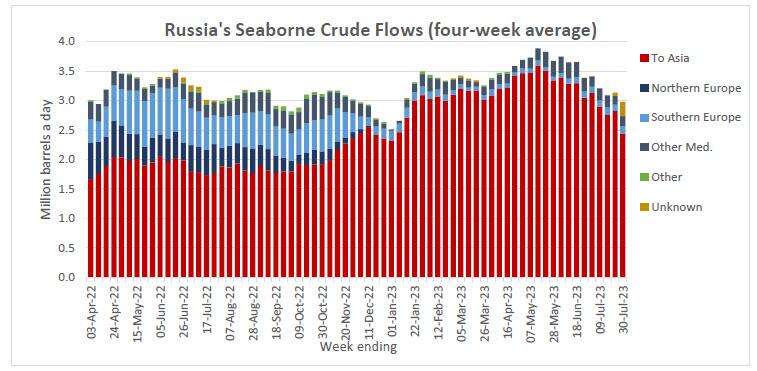
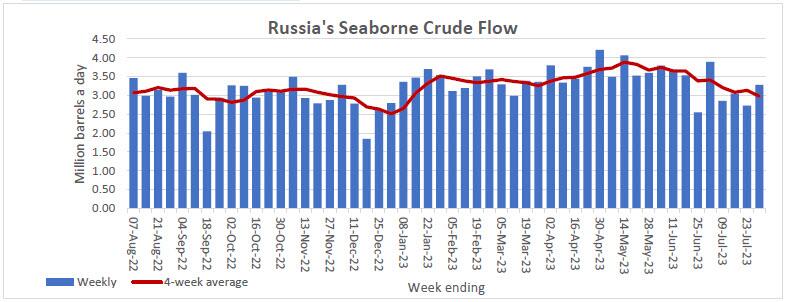
Since then, the slowdown in Russian outbound flows has accelerated substantially, and as Bloomberg’s Julian Lee reports, Russian seaborne crude flows in the four weeks to July 30 slid to the lowest since early January, as Moscow continues to cut supply to international markets.

Russia’s four-week average crude shipments fell by 154k b/d to 2.98m b/d, down by 905k b/d from their peak in mid-May and 400k b/d below the level seen in February.

… even as the more volatile weekly shipments jumped, rising w/w by 548k b/d to 3.28m b/d, although a lot of the weekly swing is due to seasonality.

As a reminder, February was the baseline month cited when the Russian government announced a 500k b/d output cut that was due to come into effect in March. While the cut was clearly delayed, Russian seaborne flows are now clearly in compliance with Russia’s output cut.

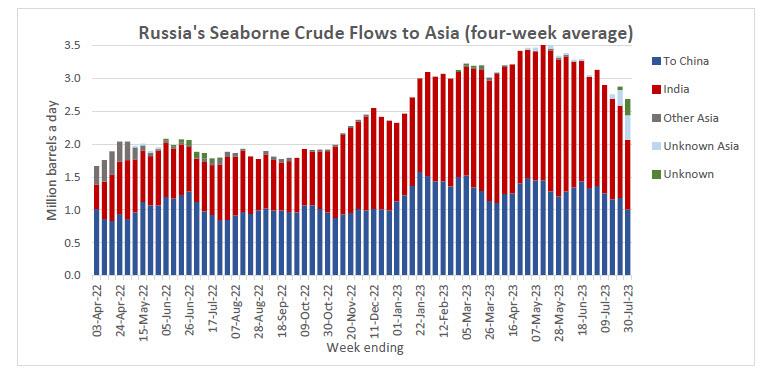
A breakdown of Russian flows by destination shows that Indian supplies have dropped sharply, followed by a more modest decline in China shipment, even as shipments to “unknown” countries in Asia have picked up.

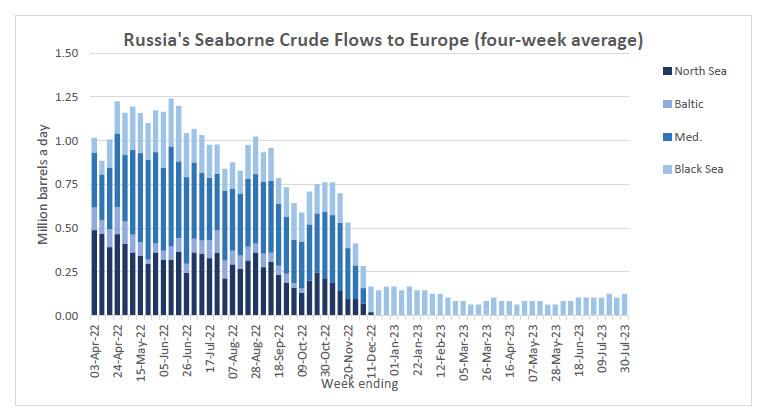
Where there was no pick up, was in Russian flows to Europe…

… and there certainly won’t be a pick up any time soon, as the average price for Russia’s Urals crude export blend soared 16.4% m/m to $64.37/bbl in July, the Finance Ministry said in a statement.

That price is far above the G-7 price cap for Russia’s oil, set at $60/bbl (see “In “Victory” For Moscow, Russia Defies Sanctions By Selling Oil Above Western Price Cap” for more). And while the July price of Urals was nearly 18% down y/y from $78.41/bbl in July 2022, it means that virtually all Urals supply is now verboten to western clients, who will be afraid of consequences should they violate the embargo.

Tyler Durden
Tue, 08/01/2023 – 14:30

via ZeroHedge News https://ift.tt/3qQXMaf Tyler Durden

Rickards: Here’s What The Fed Does Next

Rickards: Here’s What The Fed Does Next

Authored by James Rickards via DailyReckoning.com,

The Fed raised interest rates again last week. But that’s the past. What does the future look like?

Today, you’ll receive a full recap of what happened with last week’s Fed meeting. I’ll explain what happened in terms of policy moves, what Fed Chair Jay Powell believes will happen next, and what will actually happen.

Importantly, the difference between Powell’s expectations and market expectations creates opportunities for investors to profit from those competing forecasts.
So, without further ado, let’s break it all down…

Last Week’s Fed Meeting, Explained

Last Tuesday, I offered the following forecast of what would happen at the FOMC meeting the following day:

“On Wednesday, the Fed will raise its target rate for fed funds by 0.25%. That increase will raise the federal funds target to 5.50% after being set at 5.25% at the May 3, 2023 FOMC meeting. After Wednesday, we’ll be back in wait and see mode. … The Fed will not declare that rate hikes are over for the year or that they have reached the terminal rate. They need to keep their options open.”

Here’s what actually happened…

The Fed did raise interest rates 0.25% as I projected. At the same time, they warned that rate hikes are still on the table and they could raise rates again as early as September 20.

That makes twelve Fed meetings in a row going back to March 16, 2022 when I got the Fed forecast right, and my advice that the Fed would leave further rate hikes on the table was correct. Events remain uncertain from here, but it’s so far, so good for my forecasting.

I don’t say that to brag, it’s just that I’ve studied the Fed for years and know what makes it tick. They’re really very predictable once you know how they think and what they look for.

Here’s the text of part of the Fed’s press release issued at 2:00 pm ET on July 26:

“The Committee seeks to achieve maximum employment and inflation at the rate of 2 percent over the longer run. In support of these goals, the Committee decided to raise the target range for the federal funds rate to 5-1/4 to 5-1/2 percent. The Committee will continue to assess additional information and its implications for monetary policy. In determining the extent of additional policy firming that may be appropriate to return inflation to 2 percent over time, the Committee will take into account the cumulative tightening of monetary policy, the lags with which monetary policy affects economic activity and inflation, and economic and financial developments. In addition, the Committee will continue reducing its holdings of Treasury securities and agency debt and agency mortgage-backed securities, as described in its previously announced plans. The Committee is strongly committed to returning inflation to its 2 percent objective.”

The FOMC vote in favor of this policy statement was unanimous.

It’s important to look at the Fed’s reasoning behind its moves and to consider what’s next both for the Fed and the U.S. economy.

Fed Chair Jay Powell’s press conference following the announcement is always more informative than the official announcement and this meeting was no exception. Powell’s insistence on flexibility going forward is obvious.

Inflation Over the Target Rate Until 2025?

Powell began with his usual warnings that tight labor market conditions may continue to put upward pressure on inflation. He said, “The labor market remains extremely tight,” and “Labor demand still substantially exceeds the supply of available workers.”

Powell also made it clear “The process of getting inflation back down to 2% has a long way to go.” Then, late in the press conference he dropped this bombshell in response to a reporter’s question about future inflation: “We don’t see ourselves getting inflation all the way back to 2% until 2025.”

That does not mean the Fed will keep raising rates until 2025.

The Fed has long said that they will reach a “terminal rate” where they will do nothing further and just wait for inflation to come down on its own. But this is the first time Powell has said when he expects inflation to come back to the Fed’s target level even if they stop raising rates.

It pulls the rug out from under those who expect rate cuts in 2024 or believe that the Fed won’t hike rates again this year.

Powell expanded on this theme that rates will remain higher for longer even if rate hikes stop. He said, “It will take time for the full effects of our ongoing monetary policy… to affect inflation.”

He also said, “What our eyes are telling is that policy has not been restrictive enough for long enough to bring inflation down.” And that, “if data tells us … we need to do more, then we will do more.”

One reporter asked whether a strong economy today might give inflation a new boost even in the face of the Fed’s tightening over the past 16 months. She referred to this as the Barbie and Taylor Swift economy — a reference to strong consumer spending on discretionary and even luxury spending in categories such as travel and entertainment.

Powell replied firmly by saying, “Stronger growth over time could lead to inflation,” and “Inflation has proved stronger than we and other forecasters have expected.”

Looking at the short-term instead of the longer-term, Powell made it clear that a rate hike as early as September is very much in play. He said, “We will continue to make our decisions meeting-by-meeting” and a September rate hike is “possible.”

This gave a new definition to the idea of a “skip” policy.

When the Fed skipped a rate hike in June and came back in July with last week’s rate hike, they seemed to be setting up a pattern of raising rates every other meeting until they hit the terminal rate.

Powell demolished that “every other meeting” schedule. He clarified, “we haven’t made a decision to go to every other meeting.” He said that “a more gradual pace could mean two out of three meetings.”

In other words, the skip tempo is not every other meeting; it means a skip in rate hikes every now and then. And that means a September rate hike is back on the table. In Fed jargon, September is a live meeting.

The Long-Term Outlook for Further Hikes

Longer term, the Fed will be “looking at the whole broader picture” and “if we need to keep fighting inflation … we’ll go ahead and raise rates.” This harks back to the June meeting where the “dots” (Fed financial projections) said that the Fed might raise rates twice before the end of the year.

With the July rate hike now accomplished, that still leaves one more rate hike, possibly in September, waiting in the wings.

In conclusion, Powell offered this reminder that, “The worst outcome for everyone would be to not deal with inflation and not get it down now.”

That goes back to “Volcker’s mistake,” which I’ve mentioned before.

Powell does not want to repeat the mistake of Paul Volcker, who also fought inflation with rate hikes, but cut rates too early and came to regret it.

When Paul Volcker was appointed Fed chair in 1979, he immediately set about ending the worst inflation the U.S. has seen since the end of World War II by raising rates.

Then the U.S. was hit with a recession in January 1980, and Volcker was under intense pressure to cut rates in the face of a recession and layoffs.

He blinked. Volcker lowered the fed funds target rate by seven percentage points.

The recession was over by July 1980, but inflation was not. The Fed and Volcker had damaged their credibility as inflation fighters.

This became known as the infamous Volcker Mistake.

If Volcker had ignored the 1980 recession, inflation might have come down by 1981. Instead, it lasted until 1983 and was only defeated by a recession worse than the one Volcker was initially worried about.

Powell does not want to repeat the Volcker Mistake. He knows how that turned out and doesn’t want to end up in the history books for the same thing.

My conclusion: The Fed is not done and more rate hikes are coming. September is the most likely candidate for the next rate hike as of now.

Tyler Durden
Tue, 08/01/2023 – 14:10

via ZeroHedge News https://ift.tt/zcZ7CPE Tyler Durden

House GOP Launch Probe Into Hunter Biden’s Absurd Plea Deal

House GOP Launch Probe Into Hunter Biden’s Absurd Plea Deal

House Republicans have launched an investigation into Hunter Biden’s sweetheart plea deal from his father’s Justice Department, which was so egregious that a judge sent it back to the drawing board.

According to the Washington Times, the House committees conducting a probe into the agreement say parts of it were “atypical” to the point where the lead federal prosecutor was forced to admit under questioning that there was no precedent for this type of arrangement.

‘Odd’ features of the deal include a provision which gave Hunter immunity from future prosecutions on crimes beyond the scope of the current case. Another provision limits the government’s ability to prosecute Hunter, should he violate the terms of the deal.

Last week US District Judge Maryellen Noreika said she was not ready to accept the plea deal, and asked both sides to file additional briefs explaining the legal structure of the revised deal.

“I don’t really understand the scope” of the agreement, Noreika said, noting that the younger Biden has had numerous foreign business dealings. At one point, she raised a hypothetical as to whether Biden could be charged as acting as an unregistered foreign agent under the Foreign Agents Registration Act, per Bloomberg.

Under the original plea agreement, Biden intended to plea guilty to two misdemeanor tax crimes committed in 2017 and 2018, and would avoid prison on the gun possession charge.

As part of the conditions for Hunter’s release, he must not consume alcohol or prohibited drugs, or possess a firearm, must submit to random drug tests as required, must actively seek employment and not violate any laws.

In a letter to Attorney General Merrick Garland, the GOP committee chairmen demanded to know how Hunter’s bizarre arrangement was reached, and whether it was the DOJ or Biden’s lawyers who first suggested it.

The Department’s unusual plea and pretrial diversion agreements with Mr. Biden raise serious concerns — especially when combined with recent whistleblower allegations — that the Department has provided preferential treatment toward President Biden‘s son in the course of its investigation and proposed resolution of his alleged criminal conduct,” wrote Judiciary Chairman Jim Jordan, Ways and Means Chairman Jason Smith and Oversight and Accountability Chairman James Comer. -Washington Examiner

As noted by attorney Techno Fog via The Reactionary, the prosecutors handling the Hunter Biden case have gone way harder against other suspects for the same crimes:

…it’s important to understand who we’re dealing with. Leo Wise is a trial attorney in the DOJ Criminal Division – Public Integrity Section. He has held that position since June of 2023; prior to that, he was the Chief of the US Attorney’s Office for the District of Maryland’s Fraud and Public corruption unit (a position from which he was demoted after disagreements with supervisors over staffing). He has been with the DOJ since at least 2004.

By all accounts, Wise is an aggressive prosecutor. It’s in his DNA. He was part of the Enron Task Force, assisted in the racketeering trial against big tobacco (US v. Philip Morris), and prosecuted significant high-profile cases against corrupt leadership in Baltimore, including the Baltimore Police Gun Trace Task Force, former Baltimore mayor Catherine Pugh, and former Baltimore City State’s Attorney Marilyn Mosby. Wise also “brought the biggest racketeering case in Maryland history.”

Assisting Wise on the Hunter Biden case is Derek Hines, an equally aggressive prosecutor whose current role is Assistant US Attorney at the DOJ Criminal Division. Hines, for example, was part of Wise’s prosecution team in the Baltimore Police Gun Trace Task Force, which “won indictments against 11 men – eight Baltimore cops, two civilians, and one Philadelphia office” who robbed drug dealers, sold drugs, and ran interference for drug dealers.

Wise and Hines have been described in one Baltimore Sun article as relentless prosecutors who “are like the terminator.” They are hardliners who “pursue stern sentences and prosecute even small-time crooks.

2018: Derek Hines (L) and Leo Wise

The Hunter Biden case isn’t the first time Wise and Hines have prosecuted a tax case. Back in 2018, they prosecuted Darryl De Sousa, a former Baltimore Police Commissioner for three counts of failing to file individual tax returns. The case of De Sousa is particularly instructive, as it demonstrates the uncharacteristically soft prosecution of Hunter Biden by Wise and Hines. Allow us to explain.

De Sousa was charged with failing to file an income tax return for the years 2013-2015, in violation of 26 USC § 7203. Not only had he failed to file income tax returns for those years, but De Sousa had also owed the IRS taxes for other years (2008-2012) and had “falsely claimed deductions that he was not entitled to.”

The De Sousa case was relatively small, though it did concern misconduct by a public official. He only owed approximately $60,000; the tax loss calculated by the IRS was between $40,000 and $100,000. De Sousa pleaded guilty to failing to file an income tax for the years 2013-2015. DOJ prosecutors Wise and Hines (who, by the way, both served under currently Special Counsel Robert K. Hur when he was US Attorney for the District of Maryland) saw to it that the stipulation of facts included in the November 20, 2018 plea agreement itemized (1) the false deductions claimed by De Sousa, such as vehicle expenses and travel expenses and charitable donations; (2) the specific times De Sousa was put on notice that he owed taxes; and (3) the specific amounts owed by De Sousa in each of the applicable years.

Wise and Hines, true to their reputations, demanded De Sousa go to prison: 12 months incarceration was necessary to send a message to all other tax cheats. There was no promise to recommend probation. The judge would end up sentencing De Sousa to 10 months.

Let’s compare De Sousa’s treatment to the Hunter Biden case.

  • Both cases involve violations of 26 USC § 7203 (willful failure to pay tax).

  • The tax loss in the De Sousa case was between $40,000 and $100,000; Wise and Hines recommended he serve a year in prison. The tax loss in the Hunter Biden case is between $1,199,524 and $1,593,329. Wise and Hines, in apparent agreement with DOJ supervisors, recommend Hunter get probation.  

  • Where Wise and Hines made sure the Court was aware of the numerous false deductions in the De Sousa Case, Wise and Hines agree that Hunter Biden’s more significant deductions for sex clubs and prostitutes was because Hunter “miscategorized certain personal expenses as legitimate business expenses.” In doing so, these prosecutors have allowed felony fraud to be excused as a mis-categorization.

  • In fact, Wise and Hines omitted a discussion of the facts underlying many of the charges recommended by the IRS Tax Division, including those involving fraud (26 USC § 7206). De Sousa never received that benefit – likely because De Sousa, unlike Biden, wasn’t allowed to write his own stipulation.

  • Wise and Hines agreed to the claim that Hunter Biden received $1,000,000 from Patrick Ho (a Chinese national convicted for bribery) “as a payment for legal fees” – without even thinking to question whether that payment was a bribe masked as legal fees.

  • Wise and Hines failed to inform the Court of whether Hunter Biden owed California income taxes. In the De Sousa case, that defendant’s outstanding Maryland tax obligations were listed for a number of years and he was required to pay restitution to Maryland.

  • De Sousa’s plea deal was standard and readily accepted by that court. The Hunter Biden plea/diversion was “unprecedented” and abnormal and without “authority”, contained ambiguous paragraphs that could have allowed Hunter to avoid any type of FARA prosecution, and the diversion itself is probably unconstitutional.

If we can briefly summarize – in the De Sousa case, DOJ prosecutors Wise and Hines wanted to send a message that you get a harsh sentence if you try to avoid your taxes. The DOJ, assisted by Wise and Hines, now sends a different message in the Hunter Biden case: the son of the President gets preferential treatment. More egregious tax crimes are no longer subject to imprisonment.

Barring shocking revelations, DOJ “terminators” Leo Wise and Derek Hines, the prosecutors who in the past pursued “stern sentences”, the two men who made their names in the Department by taking down notorious targets, are now doing all they can – from misrepresenting Hunter’s conduct to the Court to omitting key details of Hunter’s tax fraud – to make sure the President’s son doesn’t even get a slap on the wrist.

Tyler Durden
Tue, 08/01/2023 – 13:50

via ZeroHedge News https://ift.tt/KuapfYo Tyler Durden