Benchmark crude oil prices have risen to the highest level for three months after the extension of production cuts by Saudi Arabia and its allies in OPEC+ sparked a rush to cover bearish short positions by investors.
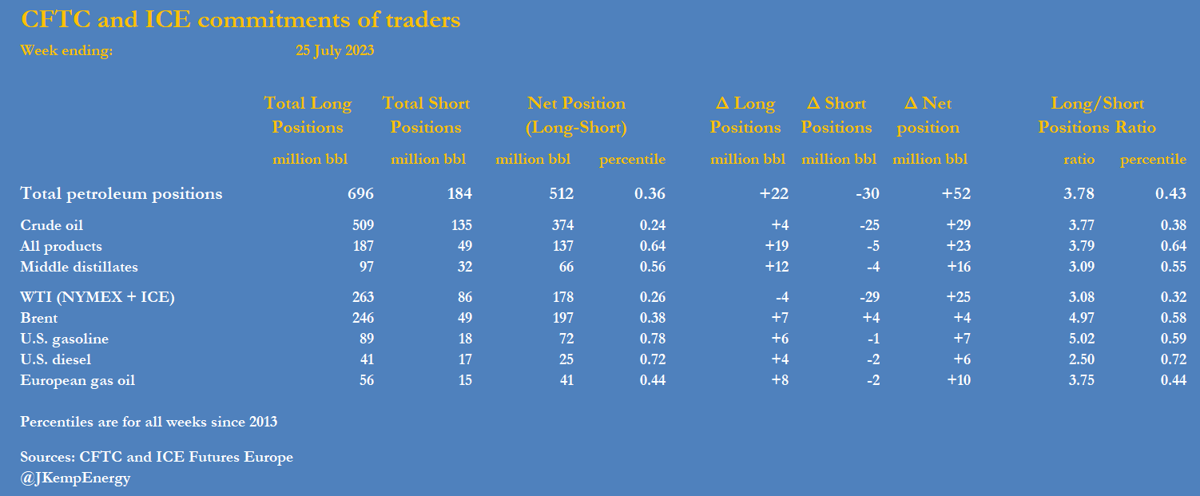
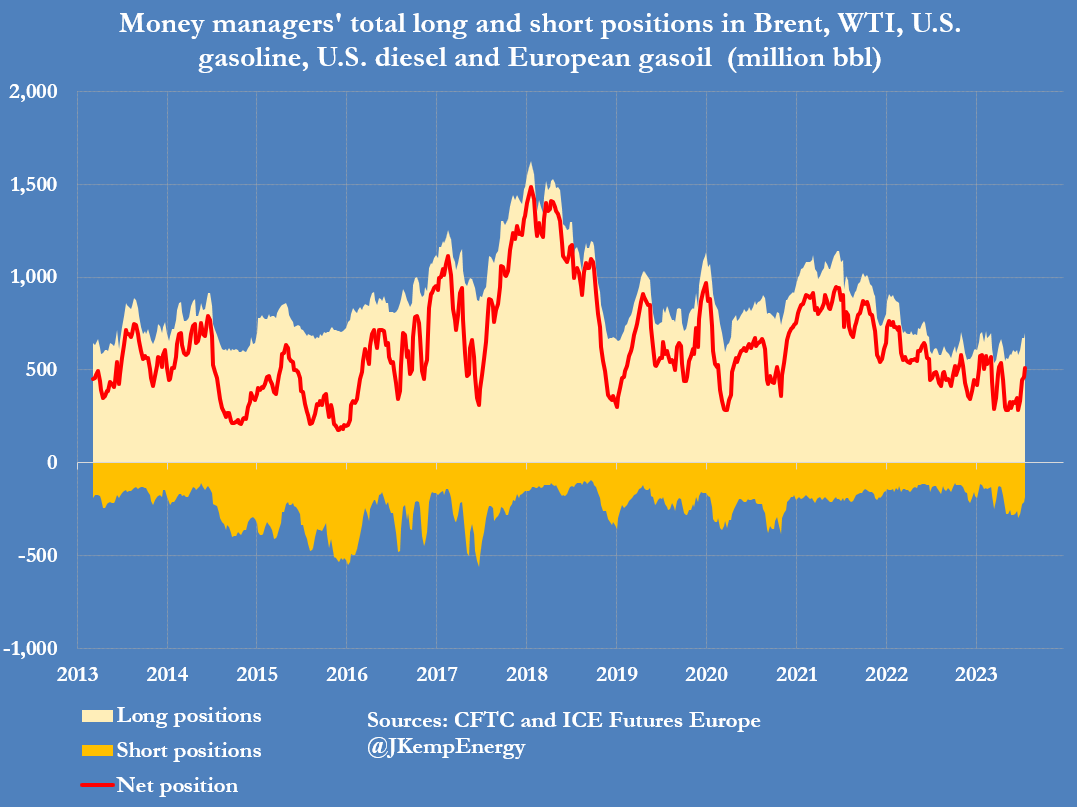
Hedge funds and other money managers purchased the equivalent of 52 million barrels in the six most important petroleum futures and options contracts over the seven days ending on July 25.
Fund managers had purchased a total of 229 million barrels over the four weeks since June 27, according to reports filed with the U.S. Commodity Futures Trading Commission and ICE Futures Europe.
Most of the buying was in contracts linked to crude oil (+169 million barrels) with a particular emphasis on NYMEX and ICE WTI (+132 million).
Saudi Arabia’s output cut coupled with increased optimism about the prospects for an economic soft landing in the United States lifted some of the pessimism that had depressed WTI positions.
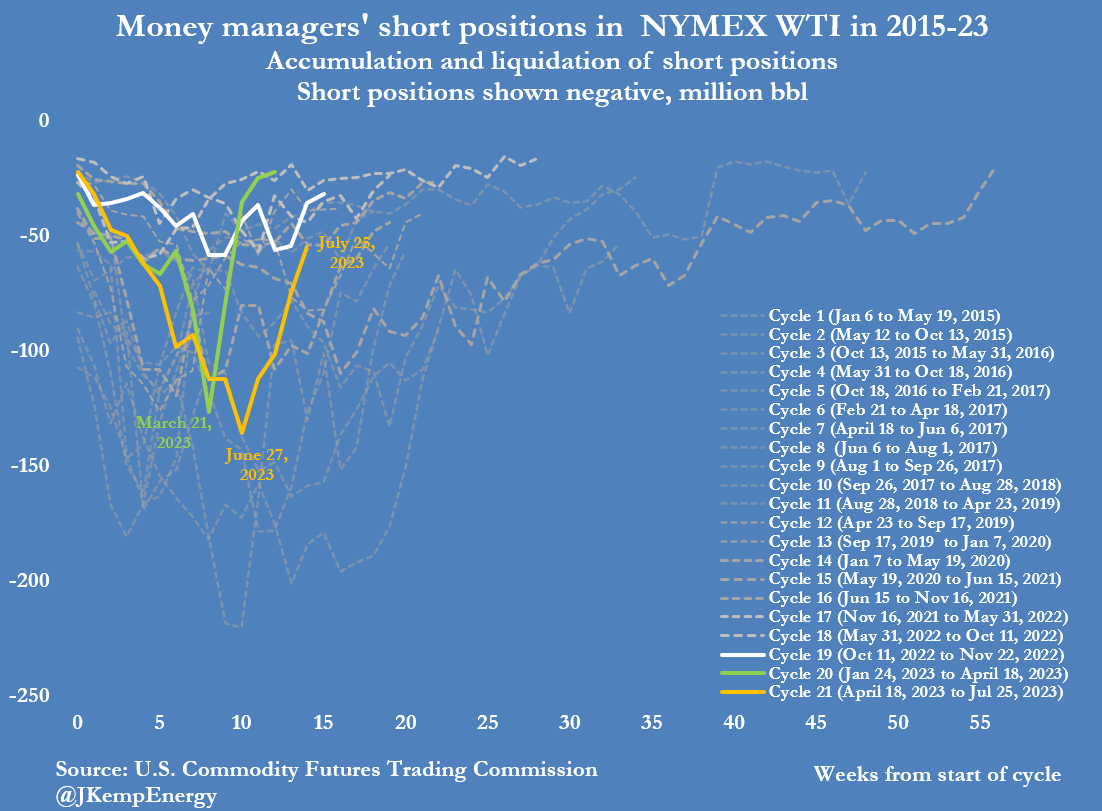
Bearish short positions were cut by 104 million barrels while bullish long positions increased by 65 million across the NYMEX and ICE WTI contracts.
Short-covering has helped lift front-month WTI futures prices to over $81 per barrel on August 1 from less than $68 on June 27.
Across WTI and Brent, the combined position increased to 374 million barrels (24th percentile for all weeks since 2013) on July 25, up from a record low of just 205 million barrels on June 27.
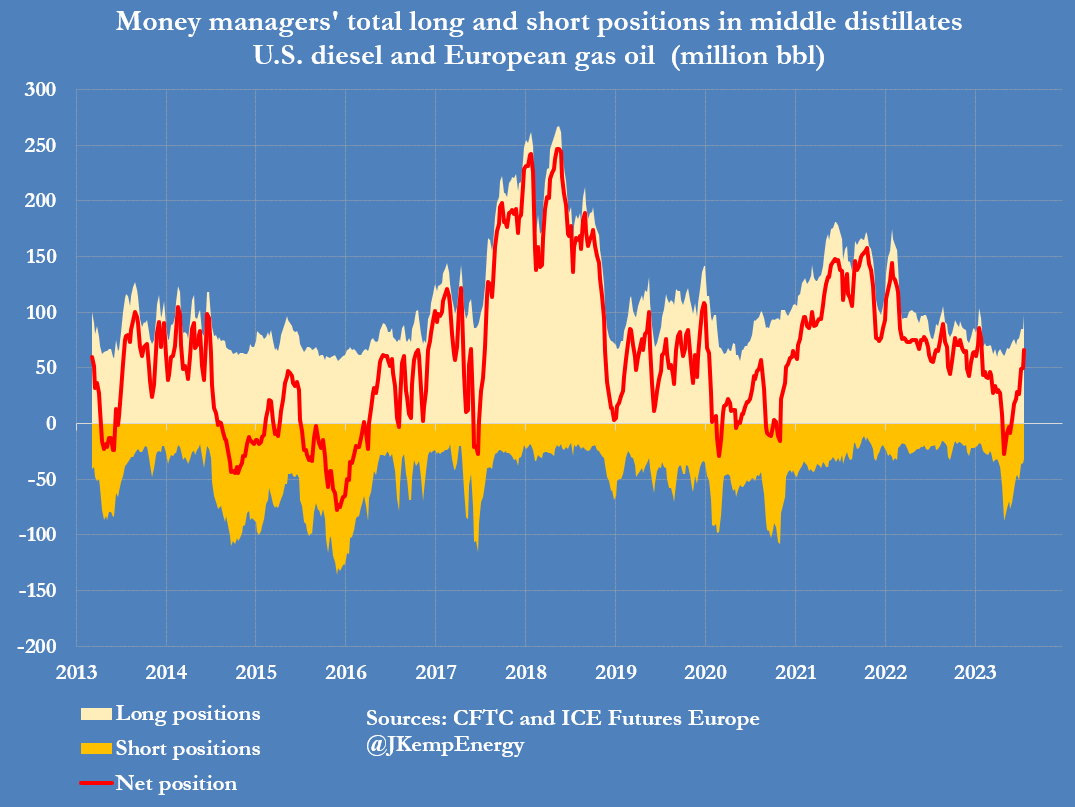
Over the same four weeks, position-building was also evident in contracts tied to the price of refined fuels (+60 million barrels) with a particular focus on middle distillates (+37 million).
Fund managers have become increasingly optimistic about fuel prices given that inventories remain well below normal despite the industrial recession in North America, Europe and China over the last 6-9 months.
In the event of a soft-landing and subsequent return to expansion, increasing fuel consumption could tighten already-depleted fuel supplies quickly.
European gas oil futures and options have experienced an especially rapid increase in positions over the last four weeks (+29 million barrels).
As a result, the net position rose to 41 million barrels (44th percentile) on July 25 from just 12 million barrels (18th percentile) on June 27.
Europe’s industrial economy is currently experiencing its worst slowdown since the first wave of the coronavirus pandemic in 2020 and before that the recession associated with the financial crisis in 2008/09.
But inventories are well below the long-term seasonal average and supplies will tighten rapidly if the U.S. economy expands again soon after a soft landing.
U.S. NATURAL GAS
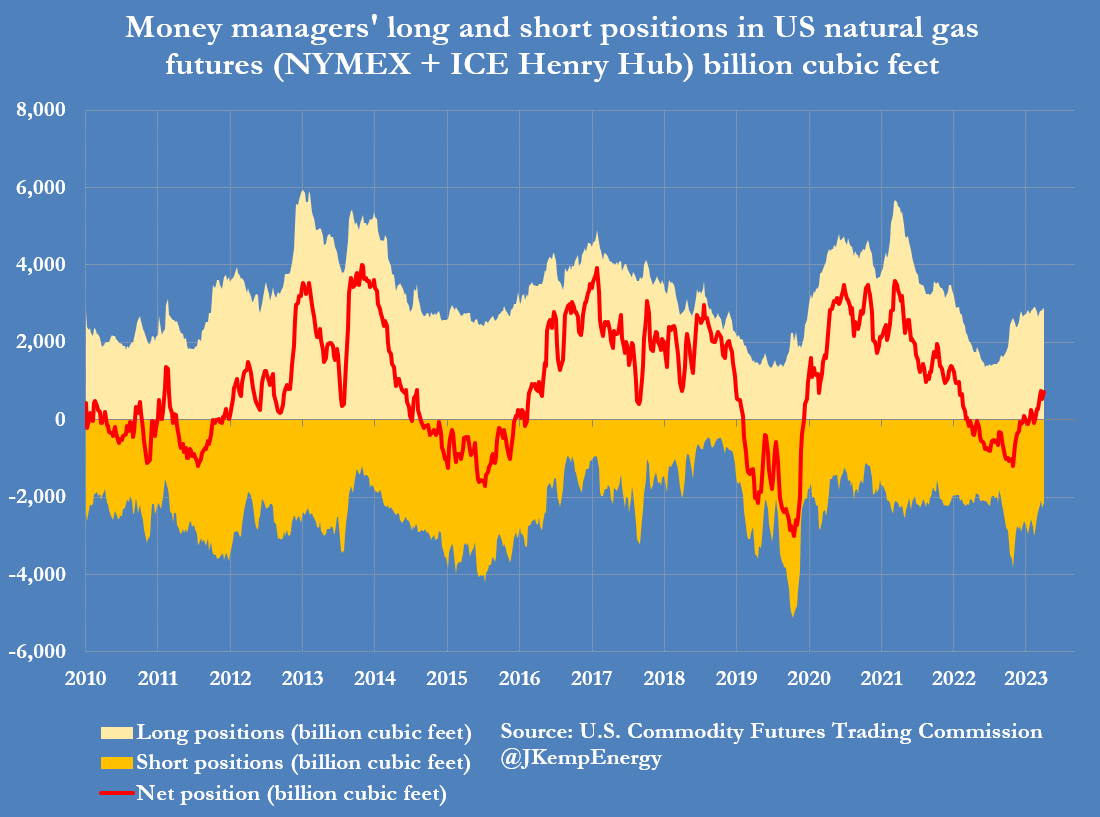
Portfolio investors are trying to become bullish about U.S. natural gas despite inventories remaining stubbornly above the long-term average and only slight signs of the surplus eroding.
Hedge funds and other money managers purchased futures and options equivalent to 176 billion cubic feet over the seven days ending on July 25.
The net position increased to 723 billion cubic feet (47th percentile for all weeks since 2010) from a net short of 1,061 billion cubic feet (7th percentile) on January 31.
Working gas inventories in underground storage were still +248 billion cubic feet (+9% or +0.72 standard deviations) above the prior 10-year seasonal average on July 21.
But the surplus has narrowed from +299 billion cubic feet (+12% or +0.81 standard deviations) on June 30, which suggests the production-consumption balance may be moving into a small deficit.
The number of rigs drilling for oil and gas fell by more than 100 (-14%) in July 2023 compared with the recent cyclical peak in December 2022.
Slower drilling is likely to translate into less production of gas-well and associated gas from the third quarter of 2023 through until at least the first quarter of 2024, which could quickly erode surplus inventories.
From a positioning and fundamental perspective the balance of price risks is tilted to the upside, encouraging investors to start rebuilding a bullish position, albeit cautiously.
Yellow’s Collapse A Tailwind For Other Freight Carrier Names, Deutsche Bank Says
With major trucking firm Yellow slated for bankruptcy and a wind-down of its operations, the key question is where its billions of dollars in business is going to wind up being siphoned off to.
The firm was responsible for roughly 15% of major corporations’ less than truckload (LTL) shipments, according to Bloomberg. It has struggled with a sizeable debt load and changing consumer habits coming out of Covid. Yellow has $1 billion in debt due in 2024 alone and has struggled to find common ground with its union.
The company’s labor force of 30,000 employees, 22,000 of which are union employees, were notified of the company’s bankruptcy plans this week. The company has about 300 cargo terminals, about half of which it owns. It had already started to liquidate some of these properties and its remaining ones are on small parcels of land.
And now Yellow’s loss looks like it will be a marked positive for the rest of the industry. Old Dominion and XPO are expected to be two of the main beneficiaries, according to Lee Klaskow, a transportation and logistics analyst with Bloomberg Intelligence.
Amit Mehrotra with Deutsche Bank weighed in this week, stating: “This development is clearly very positive for the companies that remain open for business.” He listed Old Dominion, Saia, CSX and FedEx among other top picks in the industry.
“To put this in context, Yellow is more than double the size of TFII on a shipments basis, almost double SAIA’s level, and about the same size as ODFL. Despite this level of scale, the company contributed 0% to industry profits, which highlights the reasons for its ultimate exit,” he wrote.
He also noted that LTL stocks have outperformed already since mid-June, when it became clear that Yellow was at risk. “The bottom line is we still see significant upside potential at all LTL companies, but what will separate one from another from here will be execution. Adding the right type of volume and keeping service levels high will be
critical for prospective upside. We suspect market participants will start paying closer attention to the details, in this regard.”
Mehrotra cited SAIA as his top pick: “Our top pick remains SAIA. As we said on Friday, We estimate SAIA’s volume trends in the last week have improved about 10% and the company is deploying tools to prioritize volumes moving through its network (we believe the company is deploying tools for drivers to sort pickups by priority and profitability, as just one example of how it’s managing higher business levels). We also have no concerns on ODFL, in this regard.”
Thomas Wadewitz at UBS added: “While this disruption has been anticipated for a while, we believe the boost to volume and pricing for other LTL companies is likely to provide support.”
“There are some strong companies out there that can service the needs of the shippers,” added Melanie Burnham, chief financial officer of competitor Hercules, who also noted that Yellow’s bankruptcy would have hit much harder if it happened several years ago during the nation’s Covid-induced “supply chain hell”.
Klaskow’s recent note adds: “To their benefit, unlike two decades ago, there is now a much more robust investor market for truck terminals. Those buyers have been more elusive in 2023 than in 2022, but a bankruptcy auction of this magnitude will be hard for them to ignore.”
In 2023, the Utah legislature passed a bill—S.B. 287—requiring commercial entities that provide pornography and other materials defined as being harmful to minors to verify the age of individuals accessing that material. A commercial entity may be held liable if it “fails to perform reasonable age verification methods to verify the age of an individual attempting to access the material,” and a commercial entity that is found to have violated the law “shall be liable to an individual for damages resulting from a minor’s accessing the material, including court costs and reasonable attorney fees as ordered by the court.”
S.B. 287 identifies three reasonable age verification methods. Relevant here is the use of a “digitized information card.” The Act defines “digitized identification card” as
a data file available on any mobile device which has connectivity to the Internet through a state-approved application that allows the mobile device to download the data file from a state agency or an authorized agent of a state agency that contains all of the data elements visible on the face and back of a license or identification card and displays the current status of the license or identification card.
Plaintiffs contend that S.B. 287 is unconstitutional and seek an order “enjoining the Commissioner of Utah’s Department of Public Safety from permitting its data files to be downloaded for use” in the age verification process “and the Attorney General from otherwise intervening to enforce the Act.” …
The court concluded that such lawsuits against government officials—such as the Utah Attorney General and the Utah official in charge of issuing identification cards—are permissible only if those officials are involved in enforcing the law. When a law is enforced through civil lawsuits by private individuals (as is the case with, say, libel law, most workplace harassment and discrimination law, and many other areas of the law), preenforcement challenges aren’t available unless some specific likely plaintiff can be identified. The court relied extensively on Whole Woman’s Health v. Jackson (2021), which held largely the same about Texas’s SB 8, which authorized private lawsuits against abortion providers; but other precedents had so held as well. The court concluded:
Plaintiffs … suggest that “[r]elief from this Court would … redress Plaintiffs’ injuries by discouraging putative litigants from wasting time suing under a statute promising illusory awards of unrecoverable damages.” The Supreme Court rejected a similar argument in Whole Woman’s Health. There, the petitioners argued that enjoining the attorney general from enforcing a statute “would also automatically bind any private party who might try to bring … suit against them.” The Court noted that this theory suffered “from some obvious problems.” The Court explained that even “[s]upposing the attorney general did have some enforcement authority …, the petitioners have identified nothing that might allow a federal court to parlay that authority, or any defendant’s enforcement authority, into an injunction against any and all unnamed private persons who might seek to bring their own … suits.” Therefore, the potential to ward off future suits is not sufficient.
The Court acknowledges Plaintiffs’ concerns about the propriety of the legislature outsourcing the enforcement of laws that raise important constitutional questions. The wisdom of such policy decisions is best left to the other branches of government. It may be of little succor to Plaintiffs, but any commercial entity sued under S.B. 287 “may pursue state and federal constitutional arguments in his or her defense,” they just cannot receive a pre-enforcement injunction against the two named Defendants.
Seems correct to me; as I wrote on the subject following the Court’s Whole Woman’s Health (SB 8) decision, federal law has never guaranteed a right to a pre-enforcement constitutional challenge to a law. In particular, when it comes to civil lawsuits (including ones that implicate constitutional rights, such as the Free Speech Clause, the Free Exercise Clause, the Second Amendment, and more), potential targets must often wait until they are sued and then raise the Constitution as a defense, rather than by suing up front.
Pre-enforcement challenges to governmental enforcement do happen, because one can seek an injunction against the enforcer. But when it comes to tort liability in which there could be a wide range of potential plaintiffs, such pre-enforcement challenges are usually unavailable, since there’s no particular person one can sue up front. Again, constitutional rights can still be vindicated; they just have to be raised defensively in response to a lawsuit, rather than preemptively in the rightsholder’s own lawsuit seeking an injunction.
We see this in many free speech cases, such as New York Times v. Sullivan and Snyder v. Phelps: When speakers feel chilled by unconstitutionally overbroad tort rules related to, say, libel (Sullivan), or intentional infliction of emotional distress (Snyder), or the right of publicity (an area that remains unresolved), they generally need to raise the defenses after they are sued—the New York Times, for instance, couldn’t just sue the state of Alabama before Sullivan’s lawsuit in federal court to try to get Alabama’s libel law narrowed.
The same would apply to tort lawsuits against gun manufacturers, gun sellers, or gun owners as well; any Second Amendment defense, or for that matter any federal statutory defense under the Protection of Lawful Commerce in Arms Act would have to be raised as a defense, not as a pre-enforcement challenge against state court judges or clerks. To be sure, the very presence of such civil causes of action may create a “chilling effect”; but that has historically not been seen as enough to create a categorical entitlement to filing a pre-enforcement challenge to block the civil cause of action.
Here’s the key passage from the Whole Woman’s Health majority:
[M]any paths exist to vindicate the supremacy of federal law in this area. Even aside from the fact that eight Members of the Court agree sovereign immunity does not bar the petitioners from bringing this pre-enforcement challenge in federal court [because the majority allowed a suit to be brought against state medical licensing officials -EV], everyone acknowledges that other pre-enforcement challenges may be possible in state court as well. In fact, 14 such state-court cases already seek to vindicate both federal and state constitutional claims against S. B. 8—and they have met with some success at the summary judgment stage. Separately, any individual sued under S. B. 8 may pursue state and federal constitutional arguments in his or her defense….
The truth is, too, that unlike the petitioners before us, those seeking to challenge the constitutionality of state laws are not always able to pick and choose the timing and preferred forum for their arguments. This Court has never recognized an unqualified right to pre-enforcement review of constitutional claims in federal court. In fact, general federal question jurisdiction did not even exist for much of this Nation’s history. And pre-enforcement review under the statutory regime the petitioners invoke, 42 U. S. C. §1983, was not prominent until the mid-20th century. To this day, many federal constitutional rights are as a practical matter asserted typically as defenses to state-law claims, not in federal pre-enforcement cases like this one. See, e.g., Snyder v. Phelps, 562 U. S. 443 (2011) (First Amendment used as a defense to a state tort suit).
As our cases explain, the “chilling effect” associated with a potentially unconstitutional law being “‘on the books'” is insufficient to “justify federal intervention” in a pre-enforcement suit. Instead, this Court has always required proof of a more concrete injury and compliance with traditional rules of equitable practice. The Court has consistently applied these requirements whether the challenged law in question is said to chill the free exercise of religion, the freedom of speech, the right to bear arms, or any other right. The petitioners are not entitled to a special exemption.
The FBI’s efforts to mislead a federal court in order to wiretap an adviser to the Trump campaign were more extensive than previously reported, according to classified documents described to RealClearInvestigations.
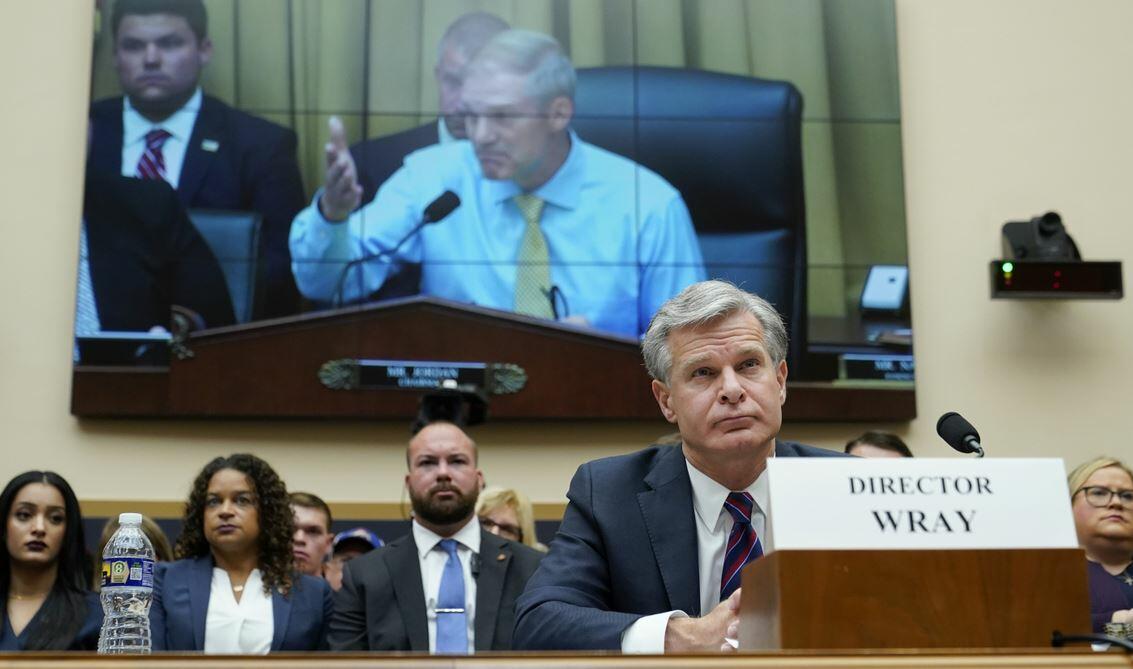
FBI Director Christopher Wray just last month told Congress he has instituted reforms in response to FISA surveillance abuses, yet at the same time he appears to have tried to hide the full extent of those abuses under redactions.
The embattled bureau tried to hide its misconduct by redacting information about its actions under the guise that it involved sensitive intelligence information. RCI has learned that at least some of the redacted material, included in a “Classified Appendix” to Special Counsel John Durham’s final report, has nothing to do with protecting “sources and methods” and other “sensitive” investigative techniques.
Instead, it covers up additional improper behavior by the FBI brass, which initiated and signed off on all four of the Foreign Intelligence Surveillance Act applications to spy on former Trump adviser Carter Page and his contacts within the Trump campaign and presidency in 2016 and 2017.
For example, the FBI tried to justify continuing to spy on Page in early 2017 by indicating to the secret FISA court that it had verified a rumor about Page receiving dirt on Hillary Clinton from the Russian government and facilitating a “well-developed conspiracy of cooperation” with the Kremlin to swing the 2016 election in Trump’s favor. But the bureau had corroborated no such thing. Its source was a front-page report in the Washington Post – one the newspaper later retracted after determining it was false, according to two former U.S. officials who have seen the original, unredacted FISA applications and described the passages to RCI.
The embarrassing revelation hasn’t been previously reported thanks to redactions blacking out references to the Washington Post article in the still-partially classified applications. The officials confirmed to RCI that the censored section covers up the FBI’s reliance on the bogus Post story, published in March 2017, as purported evidence supporting probable cause to continue spying on Trump’s former aide. In the sections of the FISA renewal applications blacking out references to the Post, the officials said, the FBI claimed the underlying text was “sensitive information.” The officials spoke on the condition of anonymity because they were not authorized to discuss still-classified sections of the FISA warrant affidavits.
The FBI’s references to the Post story are contained in the April and June 2017 FISA applications. These applications were so tainted by bad information, politics, and glaring exculpatory omissions that after an inspector general’s probe, the Justice Department years later had to secretly concede to a federal surveillance court that they were “insufficient” to establish probable cause to spy on Page and therefore “were not valid”
FBI Director Christopher Wray recently told Congress he has instituted a number of reforms in response to the FISA surveillance abuses, yet at the same time, he appears to have tried to hide the full extent of those abuses under redactions.
An FBI spokeswoman said, “We decline comment on this matter.” Attempts to reach Durham, who has closed his office looking into FBI malfeasance, were unsuccessful.
This is not the only instance in which the FBI misrepresented unconfirmed news reports to secure authorization to spy on the Trump campaign. The bureau’s FISA applications also referenced a September 2016 Yahoo News account to substantiate the false claim that Page had met with Kremlin officials in Moscow during the presidential campaign.
That Yahoo article by Michael Isikoff said the allegations had been confirmed by a “well-placed Western intelligence source.” Isikoff later revealed that the source, former British intelligence agent Christopher Steele, had concocted the false allegation about Page in a series of now-debunked memos financed by Hillary Clinton’s campaign. Hence, Steele was “corroborating” his own shoddy work. Instead of following the law and verifying this material before including it in the FISA application, the FBI simply repeated it as fact. In 2018, Isikoff said it was “a bit beyond me” why the bureau referenced his article.
The officials who spoke to RCI said the inclusion of the since-retracted Post story may be even more egregious because it was unsourced, which should have sent red flags flying at the FBI. Post reporters said a key source of the dossier’s allegations was a Belarusian-American businessman named Sergei Millian. The Post, however, provided no source for this blockbuster claim, which Millian vociferously denied.
The FBI’s reliance on the false Post story was “an act of desperation,” noted one of the officials. In late March 2017, he said the FBI’s Crossfire Hurricane team investigating possible collusion between the Trump campaign and Russia faced a dilemma. A court deadline to reapply for a warrant to spy on Page was fast approaching, and it still hadn’t verified the sourcing for the key “conspiracy” charge against him and the Trump campaign.
Moreover, agents had reason to be skeptical about the information, which formed the cornerstone of their case.
Over the previous two months, the FBI had conducted a series of interviews with Igor Danchenko, a Russia-born Washington-based researcher who helped compile Steele’s dossier of derogatory information about Trump’s alleged ties to Russia, including the core “conspiracy” assertion. During the debriefings, Danchenko confessed he couldn’t be sure his alleged source, Millian, actually told him what he attributed to him about Page in the dossier.
The FBI needed the explosive allegation to be true because it was the heart of the factual information supporting probable cause to electronically monitor Page as a supposed Russian collaborator under the authority of the Foreign Intelligence Surveillance Act. The FISA law, initially enacted in 1978 and broadened in the aftermath of 9/11, is now under intense scrutiny on Capitol Hill in light of previously exposed FBI abuses of the congressionally granted surveillance power. The bureau included the information in earlier requests for wiretaps, but they were set to expire in early April 2017. To justify renewing them another 90 days, the FBI was under pressure to show FISA judges additional evidence to support its suspicions about Page. Validating Millian as the main source of the dossier was critical, but the agents had come up empty, developing no evidence that corroborated the allegations.
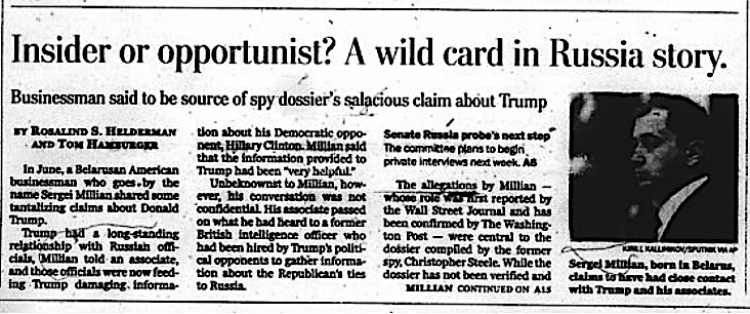
Just in time, the Washington Post published a story online on March 29, 2017, that supposedly “confirmed” Millian was the source of the allegations against Page and the core claim of a Trump-Kremlin conspiracy. The strangely unsourced article carried the headline, “Who is ‘Source D’? The man said to be behind the Trump-Russia dossier’s most salacious claim: The story of Sergei Millian.” The next day, the Post ran the same story on Page One of the paper, but under the headline: “Insider or opportunist? A wild card in Russia story: Businessman said to be source of spy dossier’s salacious claim about Trump.” The above-the-fold article appeared just eight days prior to the April 7 deadline the FBI faced to resubmit an application to the FISA court for a fresh warrant to secretly monitor Page.
In its April 7 affidavit requesting a renewal of the warrant, FBI headquarters advised the FISA court that the Post had confirmed that Millian was the source for the dossier’s allegation that the Kremlin was “feeding” the Trump campaign “very helpful” dirt on Clinton through Page. It also cited the article to buttress the dossier’s linchpin allegation of a “conspiracy of cooperation” between the Trump campaign and the Russian leadership, according to the two officials who have seen what is behind the blacked-out section of the sworn affidavit, which runs more than 100 pages. The references to the Post appear on page 22 of the FISA document.
As a result, the FISA court renewed the wiretaps. It approved them again on June 29, 2017, based in part on the same supposedly corroborative Washington Post article, according to the two officials, who have also seen the original, unredacted June application. On the strength of essentially fake news, surveillance court judges permitted the FBI to continue to vacuum up all of Page’s communications through Sept. 22, 2017.
The Post was forced to retract its story in November 2021 when Durham proved in a court filing that Danchenko had never actually spoken to Millian and simply invented him as his source — and therefore made up the “conspiracy” allegation and everything else he attributed to Millian. A week after Durham debunked the Millian hoax, Washington Post Executive Editor Sally Buzbee said the Post could no longer stand behind the accuracy of the story and ordered the newspaper to print a retraction.
But in 2017, the story served the FBI’s purposes, even as agents came to doubt the Millian sourcing because of Danchenko’s dissembling (yet, agents nonetheless swore to the FISA court that Danchenko had been “truthful and cooperative”). Headquarters had to hang on to the slim chance it could be true because the Millian-sourced allegations were central to their case for spying on the Trump campaign. Without them, the case would have collapsed. Former FBI officials say it’s highly unlikely the bureau would have been able to convince the spy court to continue to grant permission to monitor Page.
The FBI also relied on other allegations sourced to Millian as both “Source E” and “Source D” in the Steele dossier, including the made-up story that Russian President Vladimir Putin had a compromising sex tape of Trump cavorting with prostitutes in a Moscow hotel. The entire dossier turned out to be a series of invented rumors or outright fabrications that the FBI knew at the time were underwritten by the Hillary Clinton campaign as political opposition research.
FBI veterans who have sworn out affidavits for FISA wiretaps told RCI they have never known the bureau to cite media stories as evidence to corroborate leads or support probable cause to obtain such all-invasive warrants from the spy court.
“Absolutely not,” said former assistant FBI Director Chris Swecker. “I signed scores of FISA orders as they moved up the chain of command from the field office up to headquarters for final approval. None of them included that type of information, which is absolutely malpractice and incompetence, or worse.”
“Never, ever, ever,” added 27-year FBI veteran special agent Michael Biasello. “The FISA verification process known as the Woods Procedures was created to eliminate this problem, but [then-FBI Director James] Comey’s hand-picked bunch at headquarters did not follow them. They were a bunch of arrogant investigators relying on erroneous and tainted information from Washington reporters rather than a traditional, responsible investigation gathering the facts.”
Biasello said resorting to using such a murky newspaper story to backstop the main thrust of the FBI’s surveillance case suggests its case was more of a political fishing expedition than a legitimate national security matter. He added that the FBI and DOJ are now trying to cover up the full breadth of their FISA scandal through unjustified redactions and classifications.
The FBI and DOJ refuse to fully declassify the documents, which Senate Republicans managed to release to the public in 2020, albeit with large sections blacked out. Whole pages of the renewal applications remain secret, even though the Foreign Intelligence Surveillance Court invalidated the warrants in the wake of a scathing 2019 inspector’s general report. The IG found the spy warrants were based on allegations fabricated by Clinton-funded researchers and had omitted exculpatory information proving the innocence of Page, a former U.S. Navy lieutenant, whom the FBI knew was working for U.S., not Russian, intelligence.
Special Counsel Durham did not uncover what’s lurking beneath the FISA redactions in a recently released report of his four-year criminal investigation of FBI misconduct in the Russiagate probe. He explained that because of the “sensitive and classified nature” of certain “portions” of the FISA applications, he was compelled to discuss them only in a Classified Appendix to the report. He said the classification effort was “coordinated” with the FBI.
In other words, much of the FBI’s wrongdoing remains shielded from public view.
Unusual Handling by Washington Post
The way the Post corrected its story was highly unusual.
Instead of appending a correction, the paper, which won a Pulitzer Prize for its Trump-Russia reporting, removed all references to Millian as the dossier’s source in online and archived versions of the original article, including all citations cataloged in the Lexis-Nexis database of news articles. It also took down a video that accompanied the story. The paper then reposted a new article with a different headline – “Sergei Millian: High-level access to Trump or unwitting bystander?” – but under the same bylines of Tom Hamburger and Rosalind Helderman, who shared the controversial 2018 Pulitzer (although the Millian article was not part of its entry).
The new version of the story contains an “Editor’s Note” noting the date when the original was published, but oddly, it does not link to it. In a story the Post ran reporting on its “unusual step of correcting and removing large portions” of the article, it also failed to link to the original version of the article and only linked to the retooled one. The original version has been scrubbed from Google and Twitter.
Journalism historians say they are not aware of another major newspaper making wholesale changes to a story four years afterward and republishing an edited version of the story.
In a statement to RCI, a spokeswoman for the Post shrugged off criticism. “The Post handled this correction with complete transparency,” said Kathy Baird, the paper’s chief communications officer. “As you can see in the Editor’s Note, portions of the story and an accompanying video were removed and the headline was changed,” she added. “This is consistent with the principles and practices we follow when issuing corrections for our readers so that all published information is up-to-date and accurate.”
Another curious aspect of the story is how it got through Post editors without any sourcing or attribution. Normally such a sensitive story, which potentially libeled Millian, would require intense scrutiny, if not a legal review.
Millian shared emails with RCI showing he tried to steer the Post reporters off the story, insisting it was “a vicious lie” and a smear campaign against him and the incoming Republican president. But the newspaper nonetheless reported he was the source for the most explosive parts of the dossier and never printed his rebuttals at length after reaching out to him by email. The Post did note that Millian denied in a Russian TV interview having “any compromising information” about Trump, and that Trump aides “vehemently” rejected claims Millian had close ties to Trump. (The Post’s description ‒ “vehemently” ‒ appears in the FBI’s application, the two officials told RCI, but the word is hidden under a redaction, the only word blacked out in the sentence. There is no explanation provided for censoring “vehemently” in the document, but the officials posit the FBI was worried it would too easily connect to the Post story if left unredacted.)
“The liberal press never printed my statements,” Millian said. “They all just went along with Steele’s lies.” After the Post story ran, Millian said he demanded retractions from the paper, arguing its article was “reckless” and “defamatory,” but the Post refused to retract it or run a correction or clarification until November 2021, when Durham exposed the lies in an indictment.
After I demanded the Washington Post to retract, they informed me that they believe their source and will not delete the story,” he added. “I asked who is their source? They did not answer who.”
Whoever it was, the Post had great faith in it and felt confident enough in its authority to run a story without citing any sources to back up its supposed scoop that Millian was behind the most explosive claims in the dossier.
Did it come from the FBI or officials working with the FBI? Again, the Post and FBI are mum. “We do not disclose information on our sources,” the Post’s Baird said. However, the Post was talking to federal investigators at the time.
On April 11, 2017, just four days after the FISA warrant was re-approved, the Post broke the story about the FBI surveilling Page under the headline, “FBI obtained FISA warrant to monitor former Trump adviser Carter Page,” and attributed the story to “law enforcement and other U.S. officials.” It added: “This is the clearest evidence so far that the FBI had reason to believe during the 2016 presidential campaign that a Trump associate was in touch with Russian agents,” helping the FBI justify its unprecedented investigation of the Trump campaign.
Current FBI Director Wray has said the bureau “regrets the errors and omissions” in the FISA applications, and he has promised to reform how agents seek such warrants under the spy program. In the meantime, Wray has been lobbying Congress to renew FISA authority before it expires at the end of the year, arguing it’s a critical tool for protecting Americans from foreign terrorists and spies.
Comey: Applications ‘as Thick as My Wrist’
But critics on the Hill warn the FBI is also using the tool for political purposes.
Lawmakers note the FBI knew it was highly unlikely that Page could be a threat to national security because he had previously helped its counterintelligence agents capture and imprison a real spy from Russia. Page even helped the CIA monitor Russia. The FBI withheld from the court Page’s history of cooperating with U.S. intelligence ‒ and even illegally doctored a CIA email to show otherwise. So why the apparent frame-up? Internal text messages suggest key headquarters officials pushing for the FISA wiretaps, including the official who led the Crossfire Hurricane investigation, Peter Strzok, were biased against Trump and were motivated to “stop” him from becoming president. They also developed an “insurance policy” in case he won. Maintaining wiretaps that would allow headquarters to eavesdrop on political communications well into Trump’s presidency might have been part of that policy.
Civil libertarians say FISA judges can be easily manipulated by politically biased or corrupt agents because of the special way the court is set up.
The powerful Foreign Intelligence Surveillance Court that authorizes the FBI to intercept the communications of suspected threats – including U.S. citizens like Page – is highly secretive and opaque. Unlike other federal courts, it lets agents petition judges to monitor targets without defense lawyers present. So FISA court judges hear only the government’s side of the case, inviting the kinds of abuses witnessed in the Trump probe.
Page was never charged with espionage or any crime. He told RCI that he has received “numerous death threats that directly resulted from the false allegations” that he was a traitor.
The FBI would not say if it has sequestered the 11 months of intercepts it collected from Page so agents cannot misuse the private information.
Wray’s predecessor, James Comey, approved the first three FISA warrant applications to spy on Page before he was fired by President Trump in May 2017. Speaking at an FBI conference just five months before he okayed the initial October 2016 FISA application, Comey claimed he took great pains to avoid abusing such surveillance powers.
“Every morning I review the stack of requests that we’re about to send to the federal court to seek permission to wiretap people ‒ for a limited period of time ‒ in our national security investigations,” Comey said in May 2016. “Those applications are often as thick as my wrist or thicker. It is a huge pain in the neck to get permission to bug somebody in the United States, and that’s the way it should be. That’s constraint. That’s oversight. That’s power being checked.”
The Department of Education has started the process of enrolling student loan borrowers into its Saving on a Valuable Education (SAVE) plan, just weeks after the U.S. Supreme Court quashed the Biden administration’s attempt to forgive billions of dollars in student loans.
SAVE is an Income-Driven Repayment (IDR) plan.
“A beta version of the updated IDR application is now available and includes the option to enroll in the new SAVE Plan—the most affordable repayment plan yet,” says the Student Aid website. “We’re accepting applications now to help us refine our processes ahead of the official launch. If you submit an IDR application now, it will be processed and will not need to be resubmitted.”
“The application may be available on and off during this beta testing period. If the application is not available, try again later. You will receive an email confirmation after you have applied.”
On June 30, the U.S. Supreme Court voted in a 6–3 decision to strike down the Biden administration’s controversial student loan forgiveness plan, which would have canceled as much as $20,000 for around 40 million borrowers, resulting in a massive $800 billion tax-payer commitment.
Following the SCOTUS ruling, Mr. Biden promised he would pursue a “new way” to circumvent the decision. On the same day as the ruling, the Department of Education (DOE) announced the SAVE plan.
At present, the DOE offers four Income-Driven Repayment plans for students to pay off their debts—Revised Pay As You Earn Repayment Plan (REPAYE Plan), Pay As You Earn Repayment Plan (PAYE Plan), Income-Based Repayment Plan (IBR Plan), and Income-Contingent Repayment Plan (ICR Plan).
The SAVE plan is intended to replace the REPAYE plan, which is one of the most widely used of the four existing plans. The remaining three will be phased out or limited by the DOE.
Borrowers who are already enrolled in the REPAYE plan or recently applied for it will automatically be transferred to the SAVE plan. There is no need to reapply for such borrowers.
Debt Cancelation in Another Form
According to the SAVE plan, borrowers with undergraduate loans will only make payments equal to 5 percent of their discretionary income rather than 10 percent. The Biden administration estimates this would save borrowers roughly $1,000 annually.
In addition, loan forgiveness will be available for borrowers with balances of $12,000 or less after 10 years of repayments, down from the earlier 20-year repayment requirement.
The SAVE plan has attracted criticism for the burden it will add to government expenditure. The DOE’s own estimates has costs at $138 billion over a decade.
However, the Congressional Budget Office’s estimates arrived at $230 billion, while the Foundation for Government Accountability calculated the cost to likely come to $471 billion.
In an interview with The Epoch Times, Caleb Kruckenberg, an attorney at Pacific Legal Foundation, called the SAVE plan as just another form of debt cancellation.
“What they’re saying is, we’re not transferring any debt, we’re just changing the terms of repayment on the amount you have to repay everything,” he said.
“But at the same time, if you look at the policy, it’s saying, well, from a large number of borrowers, your monthly payment is going to be $0. And after a certain number of payments, we’ll forgive your loans.
“I mean, that’s a more complicated way of saying we’re canceling debt,” he said.
SAVE vs REPAYE, Restarting Student Loan Repayments
The SAVE plan makes three significant changes compared to REPAYE. First, it raises the income exemption from 150 percent above the poverty line to 225 percent. As such, borrowers making $32,800 or less will not have to pay any amount as monthly repayment under the plan.
Hungarian Foreign Minister Péter Szijjártó has claimed that the member countries of the European Union are expecting to fund the war in Ukraine for at least another four years at a cost of €5 billion per year.
In a video posted online, Szijjártó states “The European Union thinks that there will be war in Ukraine for another four years. How many people will die in four years? How many Hungarians will die in four years? And how much more devastation will be created in four years that someone will then have to repair?”
❗️FM Szijjártó: The European Union thinks that there will be war in Ukraine for another four years. How many people will die in four years? How many Hungarians will die in four years? And how much more devastation will be created in four years that someone will then have to… pic.twitter.com/QLCmt6ATB8
The comments prompted Slovakian Foreign Minister Miroslav Wlachovský to respond “Dear Péter, please do not tell what other people think before you ask them. EU consists of 27 countries. I don’t recall any debate when we said the war will continue for 4 years. War can stop tomorrow. EU is not a problem, Russia is a problem.”
Wlachovský added “Russians, go home! Let there be peace! 1956,” referring to the year that there was an anti-Soviet uprising in Hungary.
Dear Péter, please don’t tell what other people think before you ask them. EU consists of 27 countries. I don’t recall any debate when we said the war will continue for 4 years. War can stop tomorrow. EU is not a problem, Russia is a problem. Ruszkik haza! Legyen béke! 1956 https://t.co/RGPxVbxGaF
Wlachovský’s post then prompted Hungarian Minister of State Tamás Menczer to respond “Minister Wlachovsky either has a bad short-term memory — and this is a benign assumption — or he is lying.”
Menczer further noted that EU foreign ministers agreed at their last meeting to propose financing arms shipments to Ukraine for the next four years at a combined cost of €20 billion.
“The Slovak foreign minister did not oppose the proposal,” Menczer continued, then posing the question “If there will be no war in the next four years, why should there be financing for arms supplies?”
“The Hungarian position is unchanged: We want an immediate ceasefire and peace,” Menczer concluded.
State Secretary Tamás Menczer responds to @MWlachovsky:
Minister Wlachovsky either has a poor short-term memory or he is lying. Because at the last meeting of EU foreign ministers, they discussed a proposal to spend €5 billion a year for the next 4 years to finance arms… https://t.co/4ycOonhA4s
Who knows how much more the U.S. will send to Ukraine in that time.
This comes as Ukrainian President Vladimir Zelensky commented last week that “As long as the war continues, nothing can be enough,” despite Ukraine having received an estimated €165 billion ($185.6 billion) from Western nations, including the U.S.
In the age of mass Silicon Valley censorship It is crucial that we stay in touch. We need you to sign up for our free newsletter here. Support our sponsor – Turbo Force – a supercharged boost of clean energy without the comedown.
Also, we urgently need your financial support here.
Elizabeth Warren, the Senator from Massachusetts, is full of great ideas.
Her image of the perfect world is one of nonstop government regulation. All business must be controlled… by her, of course.
Only an ex-professor knows best how the 330+ million person American economy should function!
Warren’s first brainchild was the Consumer Financial Protection Bureau (CFPB). President Obama signed the agency into law in the wake of the 2008 financial crisis, with the mission to “protect” consumers from unfair, deceptive, and abusive practices by big business.
Yet this is an agency that itself is so unfair, deceptive, and abusive that it was sanctioned by a federal judge for its unethical actions earlier this year..
In short, the judge said that the CFPB was indiscriminately bullying a private company. When ordered them to cease and desist, the CFPB then showed “blatant” and “willful” disregard for the judge’s instructions.
Like the CDC, and many other federal agencies for that matter, the CFPB has become highly ideological. Fanatical really. And they’re far more likely to assault businesses that don’t bend the knee to the political left.
It sounds like there needs to be a government agency to protect businesses from the CFPB.
The larger issue, of course, is that the CFPB (which has now been around for more than a decade) is yet another agency that creates rules and regulations… each of which has a cost.
Regulations aren’t free. Businesses and individuals have to take time and often spend money to comply… time and money that could be better spent on productive activities.
The CFPB also costs taxpayers money. The CFPB, in fact, has been under fire for spending lavishly (nearly 3x over budget) to renovate its headquarters building, which comes with a fancy waterfall..
What exactly is the benefit for this agency? How are taxpayers better off?
For most people, the answer is “not at all”. I doubt you jump out of bed in the morning thanking your lucky stars that the CFPB is there to protect you.
Yet despite its dubious benefit, the CFPB’s cost to taxpayers… and to the US economy… is substantial.
But naturally they never learn from their mistakes. And so Elizabeth Warren is back with another great idea that taxpayers can foot the bill for.
Her new bill, the Digital Platform Commission Act of 2023, would establish a Federal Digital Platform Commission with the power “to regulate access to, competition among, and consumer protections for digital platforms”.
Perfect. For Elizabeth Warren, it’s not enough to create more regulations. She wants to create more regulatory AGENCIES… including a special commission where bureaucrats and politicians can tell websites how to design their layouts.
Don’t get me wrong, I have no love for the Big Tech and social media companies. I think Mark Zuckerberg has had a major role in f’ing up the world… and I’ve said before that if he chased children around in real life with the same perversion as he watches them online, he’d probably be in jail next to Jared from Subway.
But a new agency to regulate ALL online businesses will be yet another bureaucracy with no benefit to average guy.
It’s not like there aren’t enough regulations now. The Code of Federal Regulations is nearly 200,000 pages at this point.
Yet somehow, anytime something goes wrong, the solution is not just more regulations, and but more regulatory agencies!
That means that people who could be doing something productive in the private sector are now in government agencies making it more difficult and expensive to do business.
Again, this all comes at a cost. Regulations are expensive in that they require taxpayer funds, plus time, money, and energy for businesses to comply. The consequence is that excess regulations make the economy less productive… and America cannot afford to be less productive right now.
Back in the 1980s and 1990s it was 3.3%. And it turns out that the 1.3% difference in growth has an enormous impact.
If real US economic growth had remained at 3.3% for the past 20 years, most of the US financial problems would have already melted away.
Tax revenue would have grown so much that budget deficits would be non-existent. America’s debt-to-GDP ratio today would be less than 50%, and falling (instead of > 120% and rising).
At sustained 3.3% growth, in fact, the national debt would hit zero by 20233. Social Security would be completely funded. The US would have no financial challenges whatsoever. And the US dollar’s dominance would be unquestioned.
The US government could even spend to its heart’s content on every fanatical woke idea they could think of… simply because the economy would be so strong and productive.
And it’s not like an additional 1.3% growth isn’t achievable. Again, the US achieved this in the 1980s and 1990s.
You’d think that, in the face of such obvious historical data, politicians would do everything in their power to maximize productivity. They’d embrace capitalism, cut red tape, create incentives for production, support small businesses, make taxes more efficient, etc.
Or at a minimum, they’d simply stay out of the way.
But instead, they do the exact opposite. They consistently create new regulations and roadblocks to productivity… just like Elizabeth Warren’s stupid new idea.
Now, it’s not like this ONE new agency is going to wreck the economy or send the US over edge.
In fact, America’s financial woes are still fixable if they start doing the right things.
But think about the financial health of a nation like our individual, physical health.
No one has a heart attack from one french fry. But a lifetime of french fries causes serious health problems. At a certain point, you just have to put down the McDonalds and start making healthy decisions.
But they can’t manage to do that. Elizbeth Warren seems to think that french fries are healthy, and she’s blind to the consequences of her horrendous ideas.
Which is why we write so much about having a Plan B. The people in charge just don’t understand. Every day they come up with more destructive ideas that make the economy weaker and create more long-term problems.
A great Plan B reduces your exposure to the risks they create. It includes things like diversifying your savings into other currencies and other assets that they don’t control.
And, yes, it even means having another place to go if you ever really need it.
Since December 2022, state and local law enforcement entities have arrested dozens of people protesting the construction of a police training facility, derisively referred to as “Cop City” by opponents, in a state-owned Georgia forest. Authorities have charged more than 40 protesters with domestic terrorism, even though the arrest warrants don’t allege any explicit terrorist activity: Some are accused of throwing rocks or possessing incendiary devices, while others are simply charged with trespassing.
Now, a member of Congress and a consortium of civil liberties advocacy groups want answers from the Department of Homeland Security (DHS).
As justification for domestic terrorism charges, arrest warrants from the Georgia Bureau of Investigation (GBI) all use identical language to say that “the accused affirmed their cooperation” with “Defend the Atlanta Forest (DTAF), a group classified by the United States Department of Homeland Security as Domestic Violent Extremists” (DVEs).
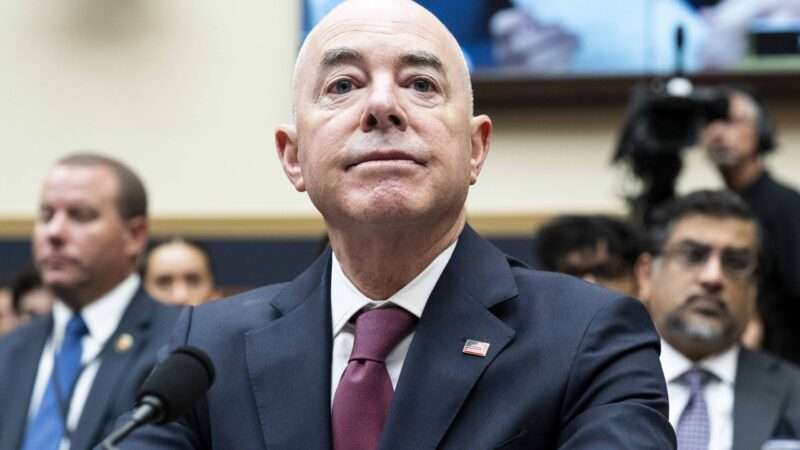
On July 26, DHS Secretary Alejandro Mayorkas appeared before a House Judiciary Committee oversight hearing. Many of the Republicans on the committee took the opportunity to accuse Mayorkas of “dereliction” of duty, leading to increased traffic of both people and drugs across the border with Mexico.
But Rep. Cori Bush (D–Mo.) pressed Mayorkas on whether DHS targeted activists and progressive movements, specifically the Cop City arrests and prosecutions. Bush asked Mayorkas, “Do you acknowledge that the department has referred to [Cop City] opponents…as ‘alleged domestic violent extremists’ and ‘militants’ comprising ‘violent far-left occupation’?”
Mayorkas dodged the direct question, merely saying that he is “familiar with activities in Atlanta that are lawful, and I am also familiar with activities to which you refer that are unlawful.” He said he was unaware of Georgia law enforcement’s decisions at the state level but affirmed, “Lawful protest is a proud tradition in this country. There cannot be a connectivity between an ideology and the expression of that ideology through violent means. That is when we get involved: to prevent violence.”
In a July 27 letter to Mayorkas, the NAACP Legal Defense and Educational Fund, the American Civil Liberties Union (ACLU), the Brennan Center for Justice, and the Center for Constitutional Rights collectively expressed “deep concern” over the department’s use of the DVE label. Citing events in Atlanta, the letter alleges that “lax DHS standards and intelligence practices have contributed to concerning arrests and prosecution[s].”
The letter says that the term domestic violent extremists is “overly broad and lacks specific legal parameters and reliable factual and evidentiary thresholds.” It further states, “DHS’s dissemination of unreliable and potentially biased ‘domestic violent extremism’ information to state and local law enforcement can contribute to constitutional violations.”
In fact, a DHS spokesperson told Reason in an emailed statement that the agency “does not classify or designate any groups as domestic violent extremists,” instead using the term “to refer to the conduct of groups or individuals in the United States who seek to advance their ideological goals through the unlawful use of violence.” In an emailed statement to Reason, a GBI spokesperson stipulated, “Although DHS reports that they do not classify or designate any groups as domestic violent extremists, the description provided by DHS for a domestic violent extremist does in fact describe the behavior of the individuals of the group in question.”
As ACLU Senior Policy Counsel Aamra Ahmad tells Reason, that distinction is not enough. “Although DHS does not, and should not, formally designate domestic groups as terrorists, or domestic violent extremists, it regularly uses the stigmatizing and vague domestic violent extremism language to describe the actions of groups and individuals in the U.S., including in its intelligence analysis, which is widely distributed to state and local authorities” and “risks stigmatizing people engaged in First Amendment–protected speech and association.”
She adds that the Atlanta protests “illustrate how overbroad domestic terrorism laws can be and how they can be abused, and in the particular case of Cop City, used to punish dissent.”
CVS Health Plans To Ax 5,000 Jobs In “Once-In-A-Generation Transformation”
Update:
CVS Health confirmed layoffs are happening: “A number of non-customer-facing positions across the company.”
CVS: ‘WE MUST TAKE DIFFICULT STEPS TO REDUCE EXPENSES’
CVS SAYS CUTTING ‘A NUMBER OF NON-CUSTOMER FACING POSITIONS’
CVS SAYS REPRIORITIZING INVESTMENTS AROUND CARE DELIVERY, TECH
* * *
The first half of 2023 was euphoric, stocks roared to near-record highs, talks about a ‘hard landing’ dissipated, hype about ‘Bidenomics’ sparked new hopes about economic revival, and consumers splurged on travel. But the second half might be a different story as the signs of companies continuing to reduce costs indicate dangers lurk ahead.
The latest evidence of cost-cutting due to mounting macroeconomic uncertainty is a report from The Wall Street Journal revealing CVS Health plans to reduce its total workforce by 5,000 employees.
“The company on Monday said in a statement that the jobs affected are primarily corporate positions. CVS said it doesn’t expect customer-oriented roles in stores, pharmacies and clinics will be affected in the layoff plan,” The Journal said.
In a memo to staff, CEO Karen Lynch said the layoffs would allow CVS to “be at the forefront of a once-in-a-generation transformation in health care.”
Lynch continued in the memo by explaining travel and the use of consultants and vendors would also be limited to reduce spending. Other cost-cutting measures include winding down “certain business initiatives and using technology to increase productivity,” The Journal noted.
At the end of 2022, CVS employed over 300,000 workers in the US. Most layoffs are expected to be in corporate — and those folks will receive severance pay, benefits, and job placement help.
The layoffs come months after CVS acquired Oak Street Health for $10.6 billion, picking up about 169 medical centers in 21 states. It plans to broaden CVS Health’s value-based primary care platform and clinics for the aging population. In March, CVS bought Signify Health, a home-healthcare firm, for $8 billion.
Also, CVS is expected to release its quarterly earnings report on Wednesday. It reported a rise in revenue for the quarter ending in March compared with a year ago but downgraded its 2023 outlook because of surging costs related to recent acquisitions.
Judge Jed Rakoff gave a detailed interpretation of the Howey test that was at odds with the decision in the Securities and Exchange’s case against Ripple…
A United States Securities and Exchange Commission lawsuit against Terraform Labs is set to go ahead after a U.S. judge overseeing the case denied the firm’s motion to dismiss on July 31.
In handing down the order, the judge also rejected a July 13 decision from U.S. District Judge Analisa Torres, who ruled that Ripple did not violate securities laws by selling its XRP token on public exchanges.
The SEC first filed a suit against Terraform Labs and its founder, Do Kwon, on Feb. 16, alleging them of “orchestrating a multi-billion dollar crypto asset securities fraud.”
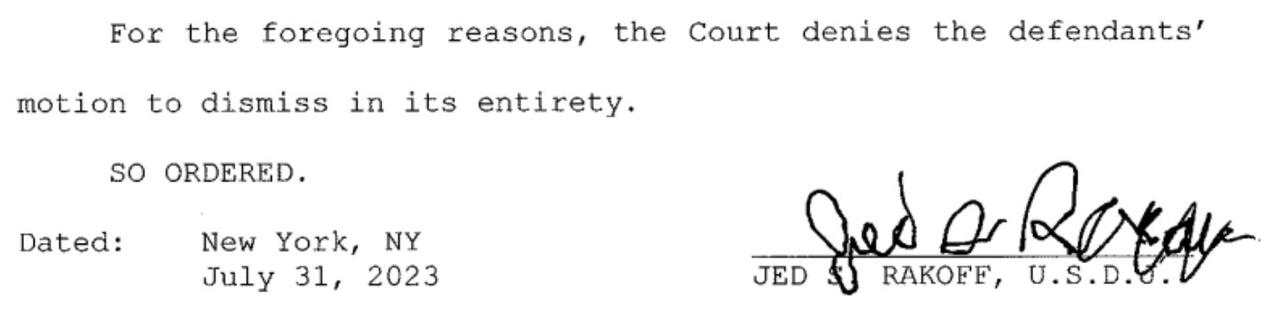
Judge Rakoff denies Terraform Labs’ motion to dismiss. Source: Courtlistener
In rejecting the defendants’ motion to dismiss, Judge Jed Rakoff of the Southern District Court of New York found that:
“For purposes of this motion, all well-plead allegations must be taken as true, and all reasonable inferences therefrom must be drawn in the SEC’s favor.”
In its previous dismissal motion, Terraform Labs’ representatives argued that the SEC lacks jurisdiction over both the company and its founder. It also pushed back against the agency’s position that tokens including Mirror Protocol (MIR), Terra Classic (LUNC) and TerraUSD Classic (USTC) are securities.
It also argued that “Congress is not only engaging in robust debate over how crypto should be regulated, it is asking the SEC to wait for Congress to act.”
However, Judge Rakoff rejected the argument that the SEC lacked the authority to regulate crypto tokens without Congressional authorization, rejecting Terraform’s objection that cited the “Major Questions Doctrine.”
Newsflash: Ripple Decision Already in (Big) Trouble
SDNY District Judge Jed Rakoff today allowed the SEC to go forward with its case against Terraform Labs and founder Do Kwon. In doing so, Judge Rakoff specifically rejected the distinction made in the Ripple case between public… pic.twitter.com/JZZ8vukfFt
The judge also devoted several pages to an analysis of the Howey test. The judge noted that no formal contract is necessary to meet the test, and tokens themselves may be considered tokens in arguments before the court, Rakoff wrote.
The court also declined to “draw a distinction between these coins [MIR and LUNA] based on their manner of sale.” Therefore:
“The Court rejects the approach recently adopted by another judge of this District in a similar case, SEC v. Ripple Labs Inc. […] Howey makes no such distinction between [primary and secondary] purchasers.”