Bullion, Bonds, & Black Gold All Bid As Rate-Cut Hopes Ramp-Up

Bullion, Bonds, & Black Gold All Bid As Rate-Cut Hopes Ramp-Up

Inflation down (in Europe) and Growth up (in US) prompted more ‘goldilocks’ narrative calls today.

But, as Goldman’s Chris Hussey pointed out, 3Q GDP is in the rearview mirror, and the implications of the report (and other releases today) for 4Q GDP growth were not good. In fact, Goldman lowered their 4Q23 GDP growth forecast by 50bp to +1.4% today as the October trade and inventory reports – also released today – came in light and gross domestic income rose by only 1.5% in 3Q – well below the pace of GDP.

All of which pushed rate-cut expectations higher again (now 125bps of cuts priced in for 2024)…
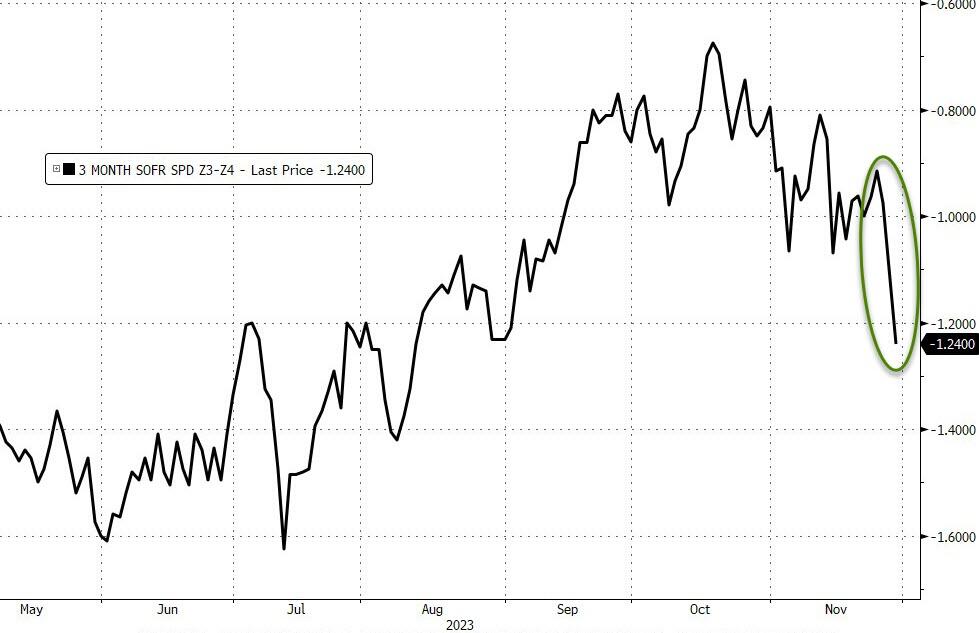
Source: Bloomberg

…and the first rate-cut timing has now moved to May from June…
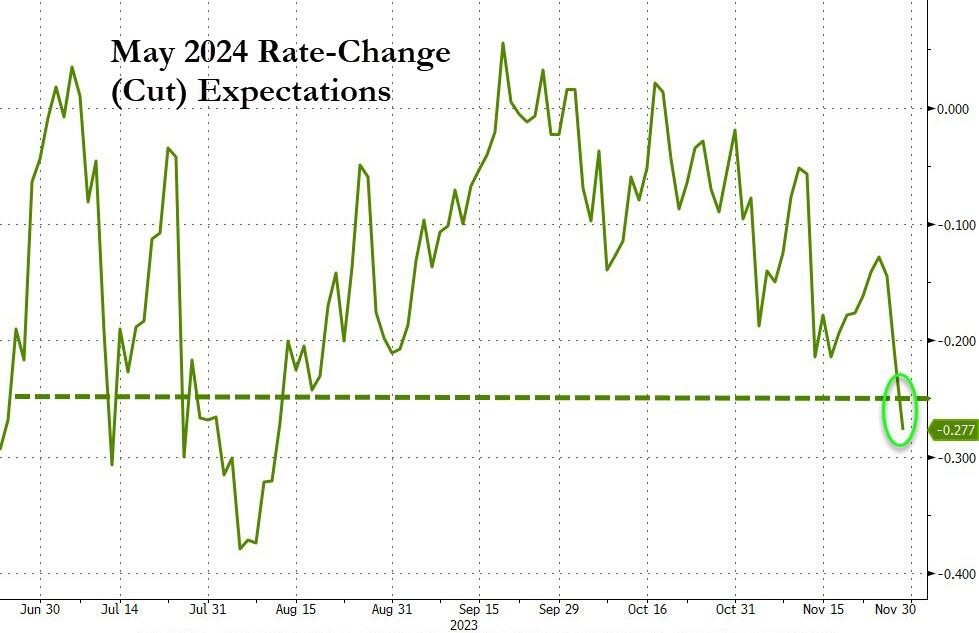
Source: Bloomberg

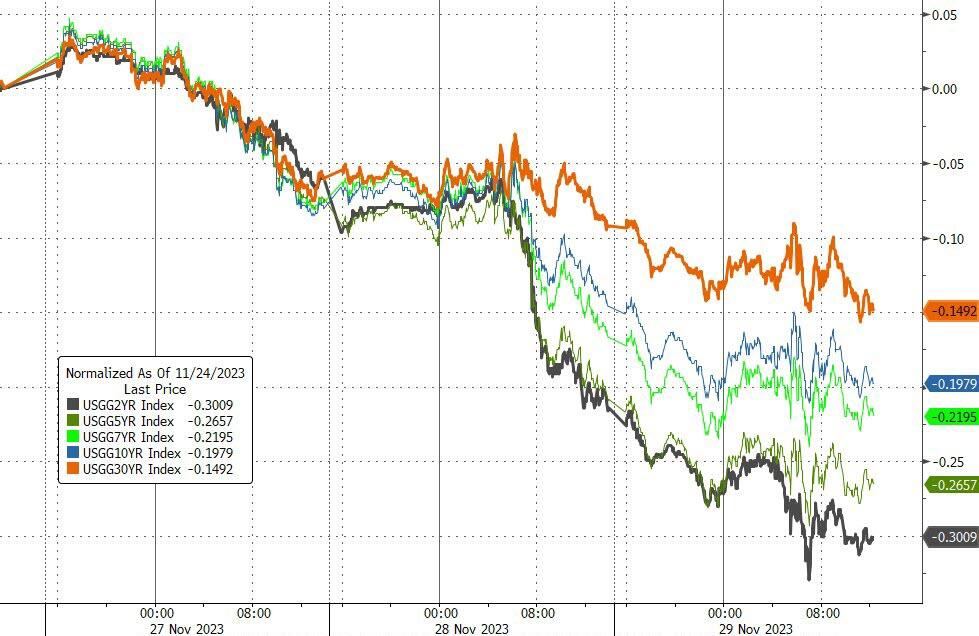
…and sent Treasury yields even lower on the week (once again led by the short-end, 2Y -9bps, 30Y -6bps)…
Source: Bloomberg

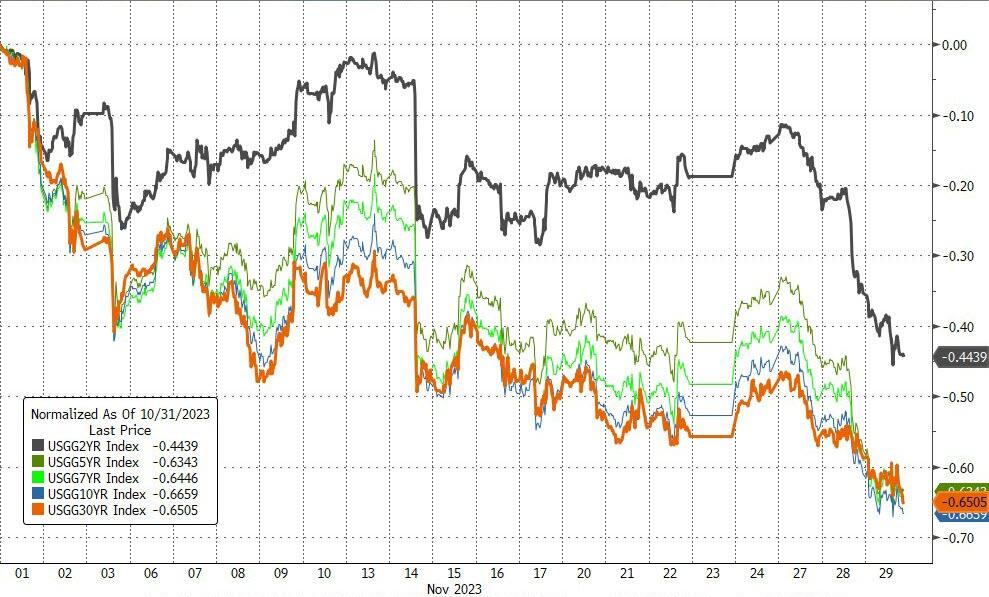
As we noted earlier, November is set to be bonds’ best month since 2008 as 10Y and 30Y Yields are down a stunning 65bps…
Source: Bloomberg

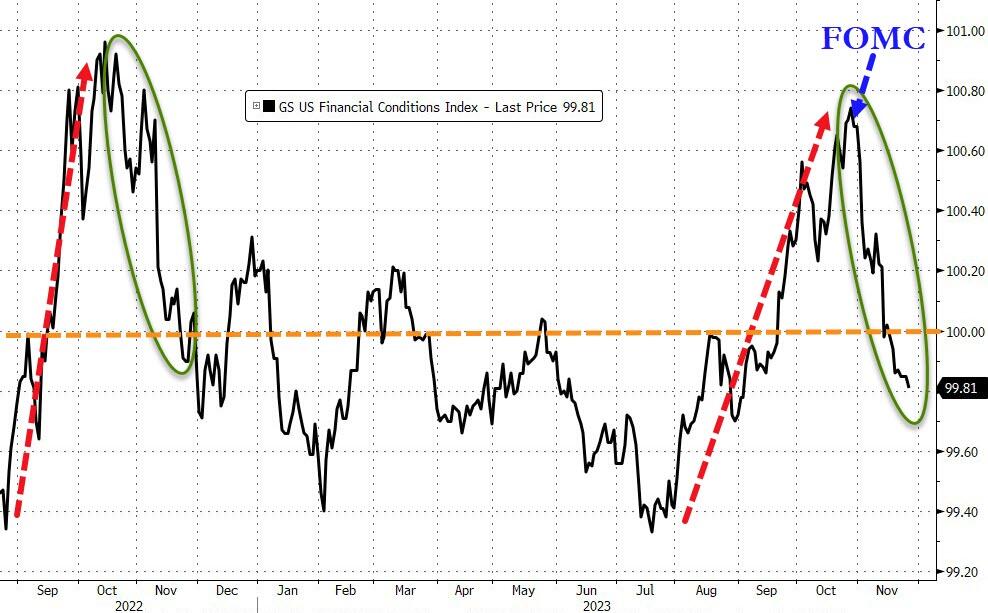
Sadly, The Fed seems completely disconnected and stuck with its old narrative as SF Fed’s Mester proclaimed that “broad tightening in financial conditions is helping curb demand”. That may well have been true until you muppets started jawboning about how “the market is doing The Fed’s job” and that you’re near the end of the cycle. Financial conditions have massively loosened in the last month…
Source: Bloomberg

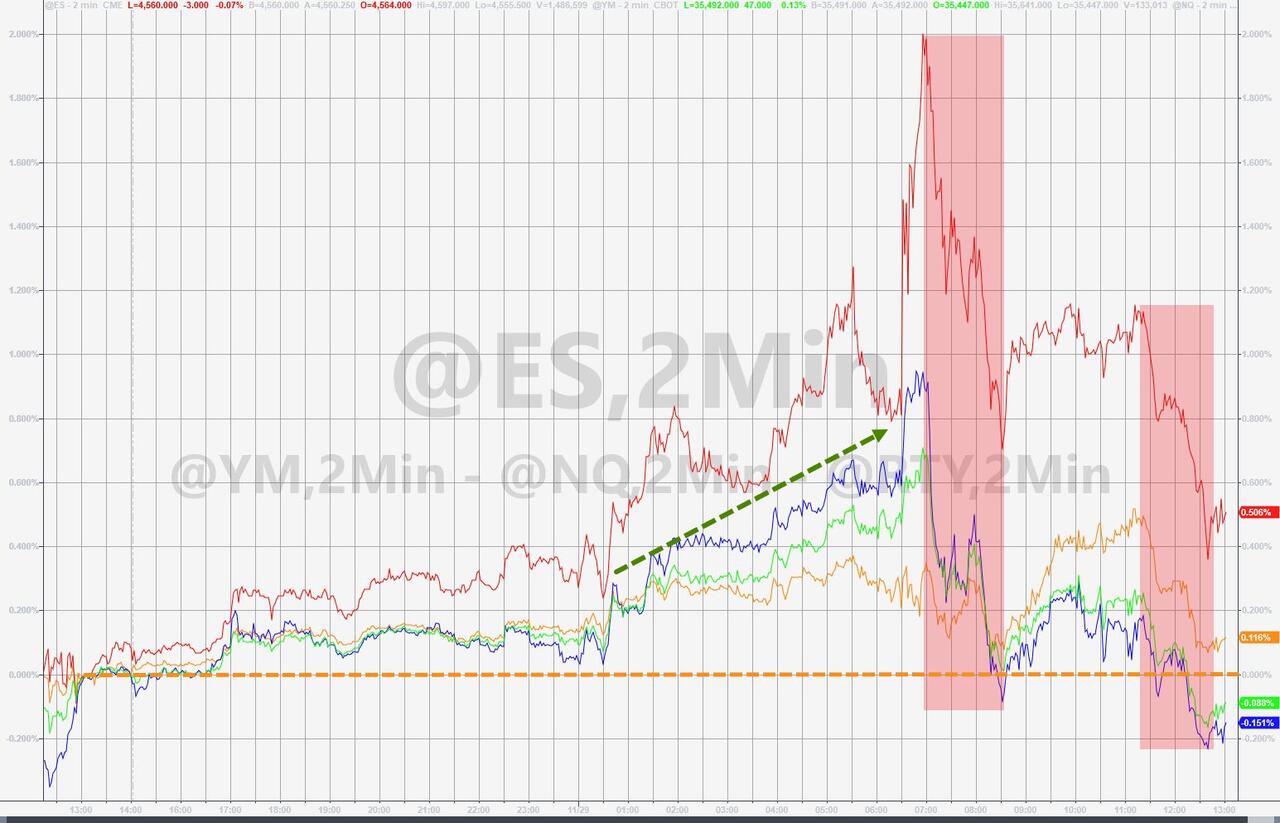
As stocks remain on pace for their 4th best month in the last 12 years, early gains into the cash open were gradually sold into with Nasdaq and S&P the biggest losers and Small Caps holding on to decnet gains despite late-day selling-pressure (ahead of tomorrow’s PCE)…
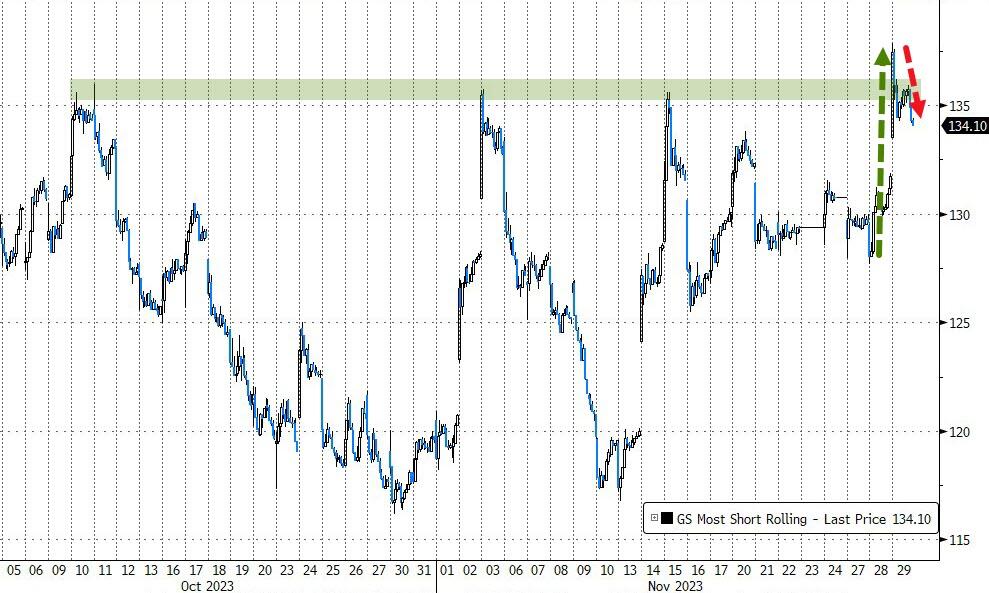
‘Most Shorted’ stocks were squeezed again – up to recent resistance – and reversed modestly from there…
Source: Bloomberg

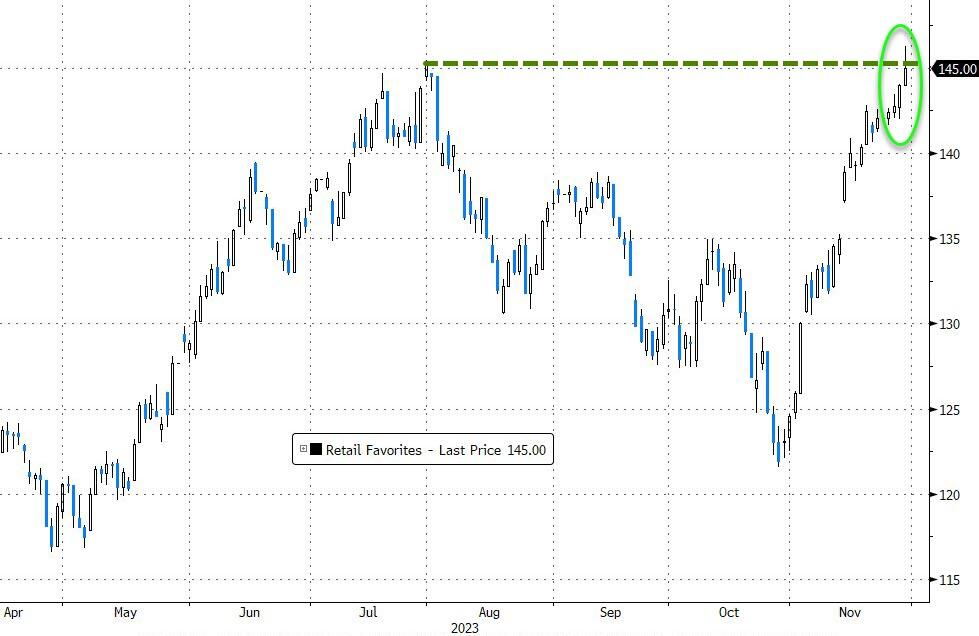
Meme stocks are soaring again as Goldman’s ‘Retail Favorites’ hits a new cycle high…
Source: Bloomberg

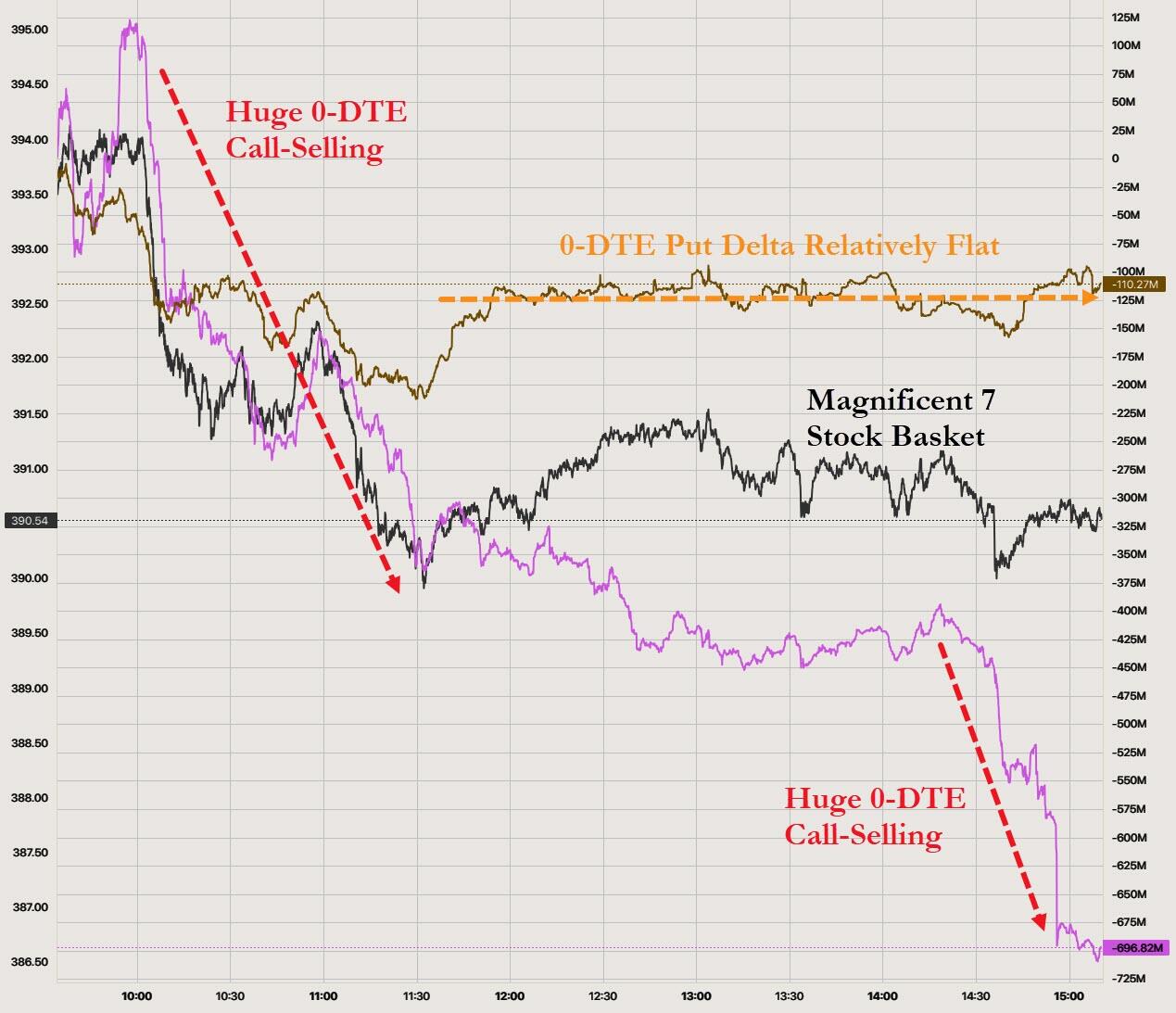
…But, the ‘Magnificent 7’ stocks were lower overall with huge 0-DTE call-covering early and late…
Source: SpotGamma

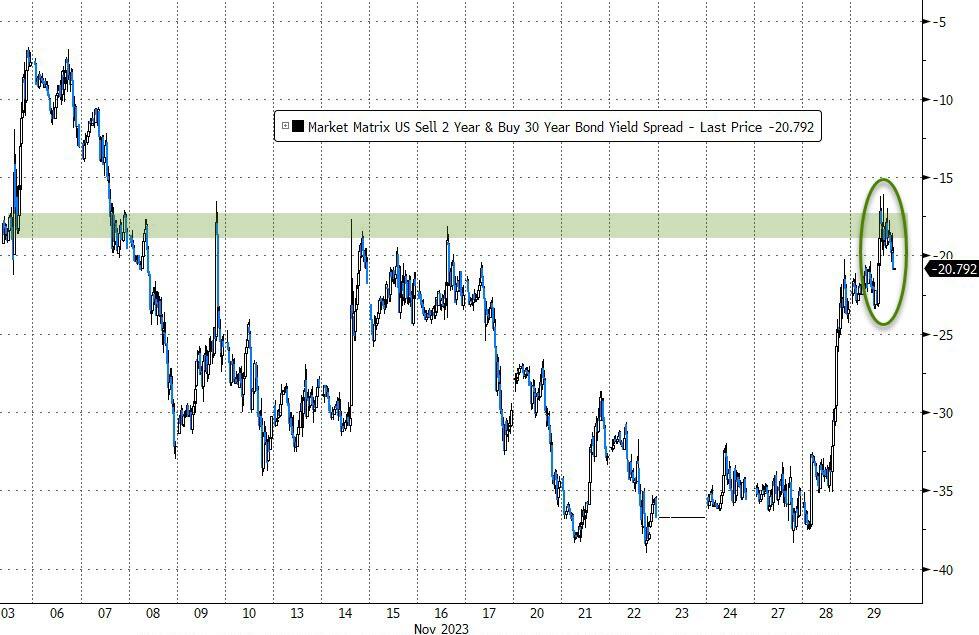
The bull-steepening continued in bond-land with 2s30s up to -16bps on the day…
Source: Bloomberg

…as 2Y yields fell to their lowest since June…
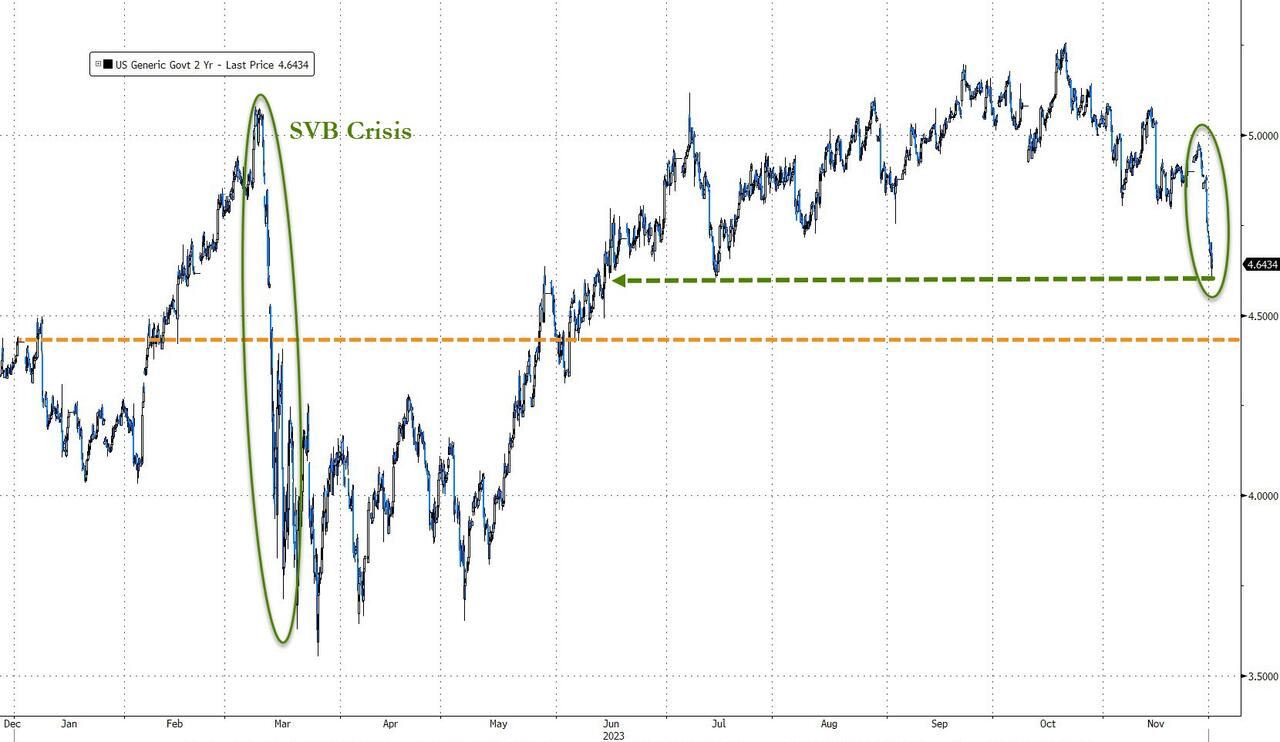
Source: Bloomberg

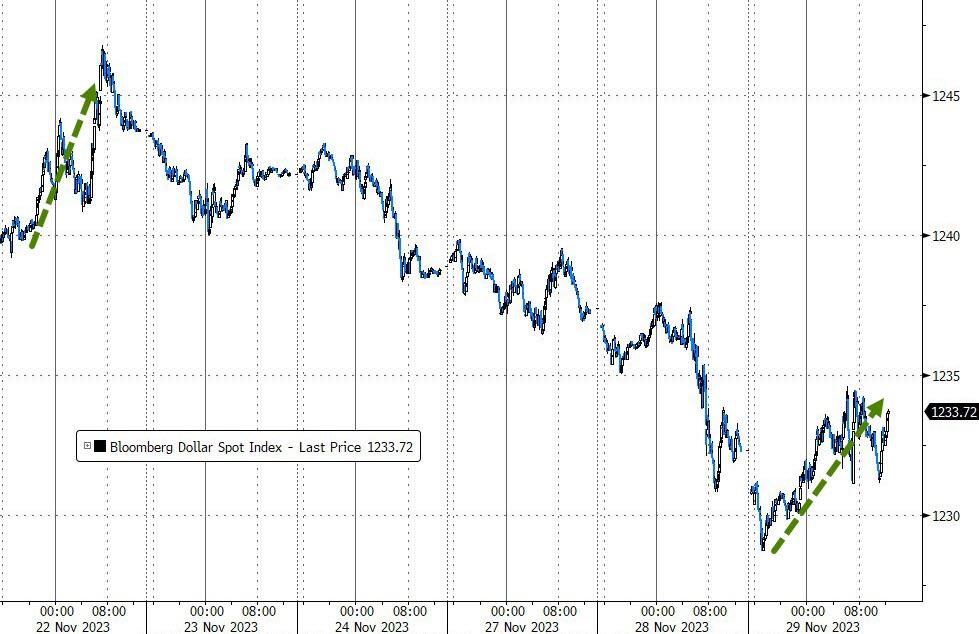
The dollar managed gains on the day after 4 down days in a row...
Source: Bloomberg

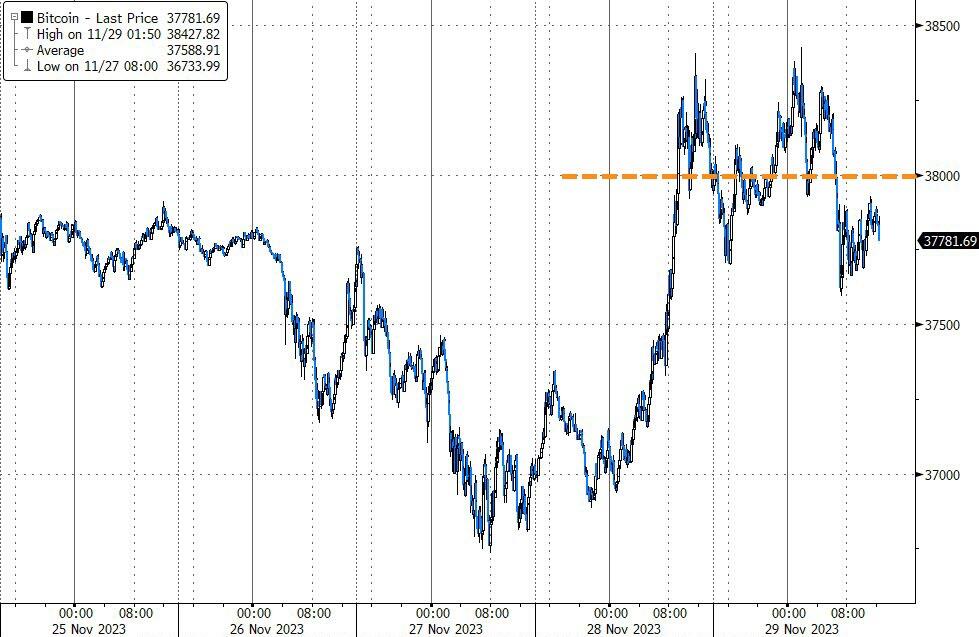
Crypto was marginally lower on the day with Bitcoin
Source: Bloomberg

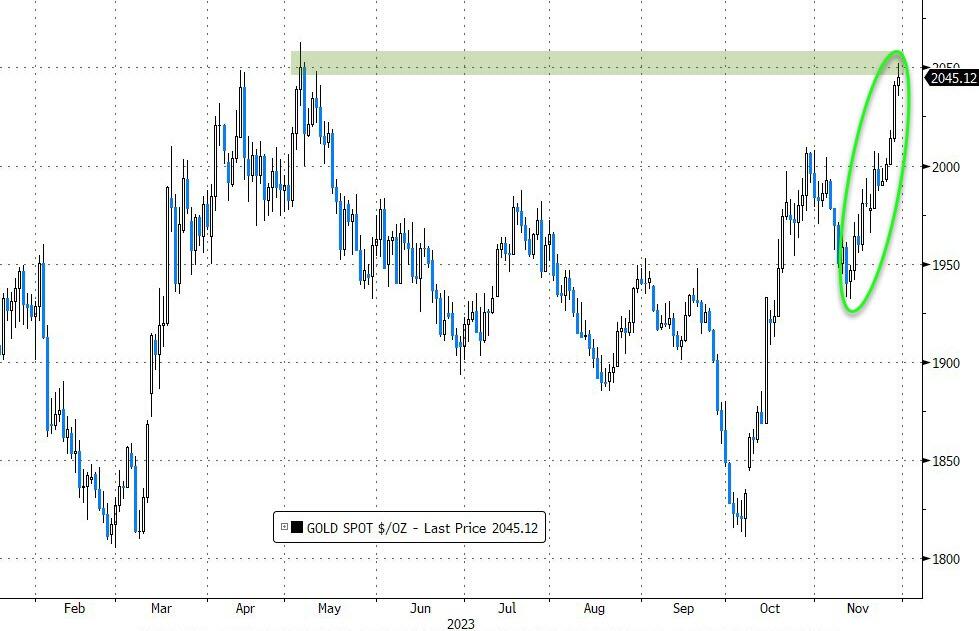
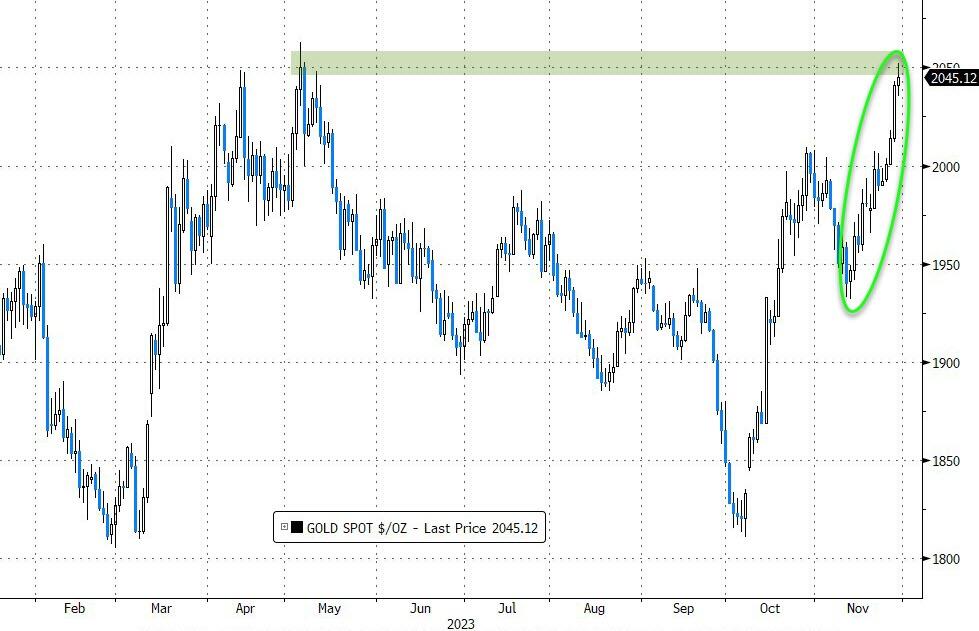
Gold prices continued their charge towards new record highs…
Source: Bloomberg

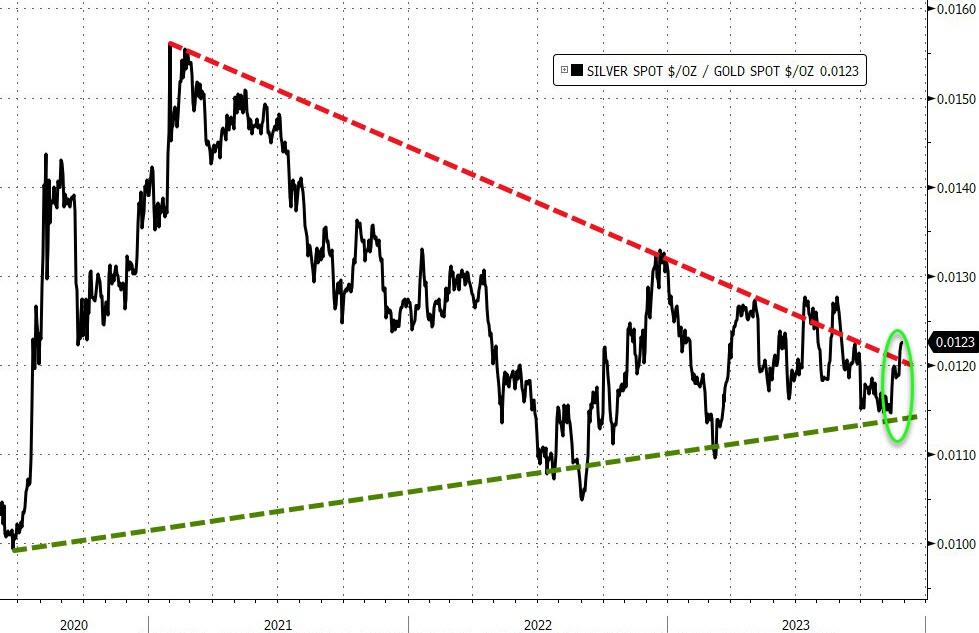
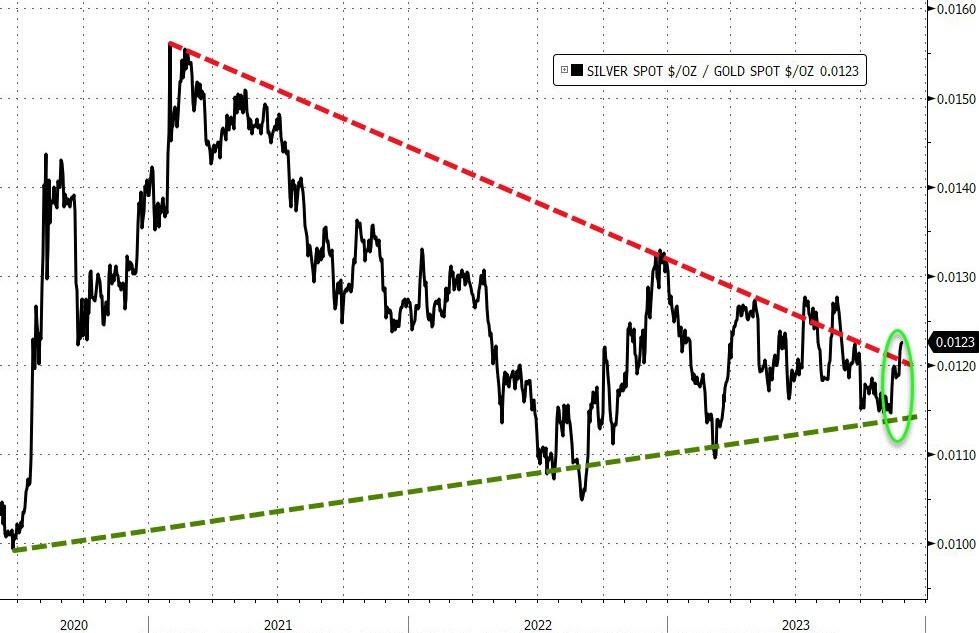
And notably, silver has started to outperform very recently, breaking above its downtrend relative to gold…
Source: Bloomberg

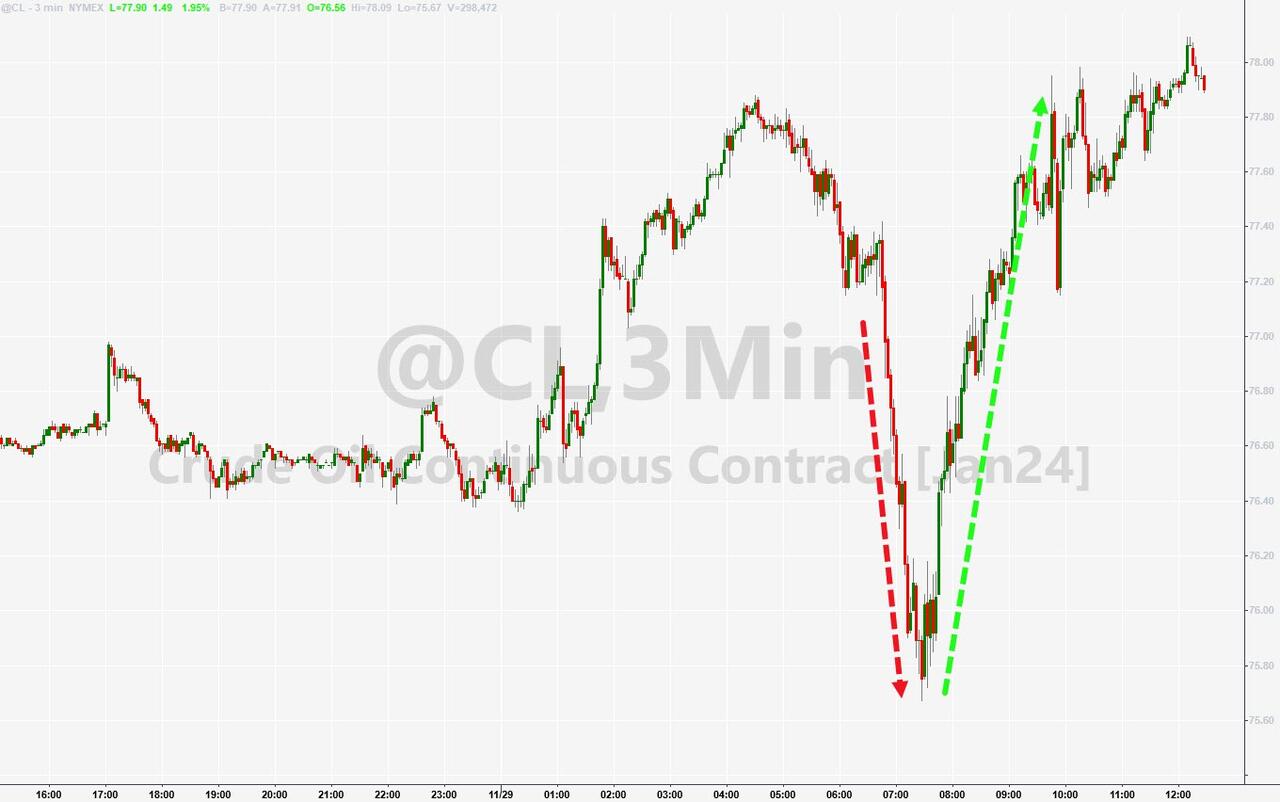
Oil prices pumped and dumped ahead of tomorrow’s OPEC+ meeting (after increased production cut rumors trumped across-the-board inventory builds and record US production)…
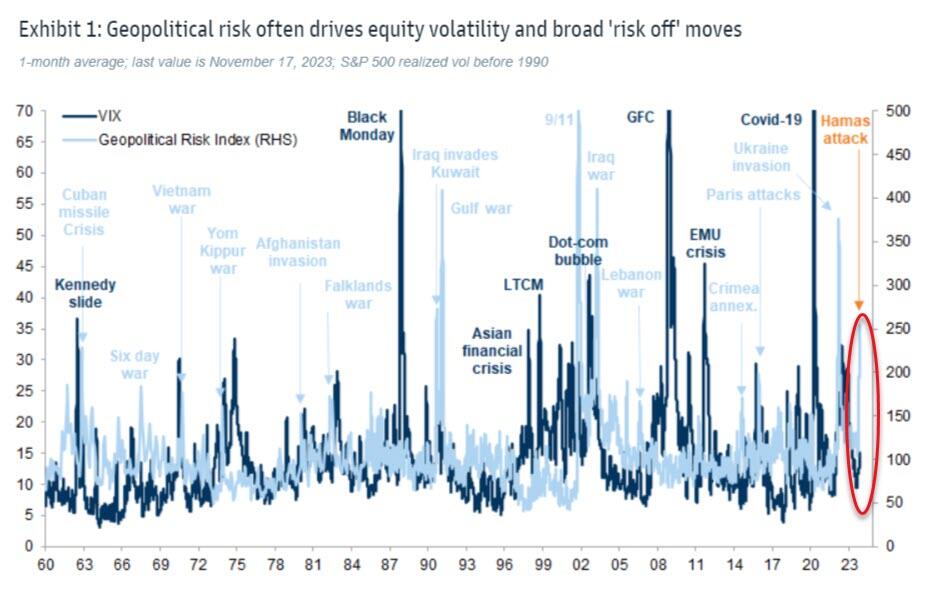
Finally, we note that historically, spikes in geopolitical risk have driven higher volatility. But, as Goldman Sachs points out in a note today, the latest spike in risk has not been accompanied by a meaningful spike in the VIX…
Source: Goldman Sachs

Goldman clearly doesn’t believe it’s different this time and recommends taking advantage of the low level of volatility in both equities and ‘safe assets’ (ex bonds) to focus on hedges.

Tyler Durden
Wed, 11/29/2023 – 16:00

via ZeroHedge News https://ift.tt/b2RxTki Tyler Durden

11th Anniversary Of Bitcoin’s First ‘Halving’: From $12 To $37,000

11th Anniversary Of Bitcoin’s First ‘Halving’: From $12 To $37,000

Authored by Helen Partz via CoinTelegraph.com,

Bitcoin, the largest cryptocurrency by market value, experienced its first-ever halving 11 years ago today. As the community celebrates the anniversary of the first Bitcoin halving, it’s timely to revisit some of Bitcoin’s historical milestones ahead of the next halving expected in April 2024.

The first Bitcoin transaction occurred nearly 15 years ago on Jan. 3, 2009, a few months after the pseudonymous creator of Bitcoin, Satoshi Nakamoto, published the Bitcoin white paper in October 2008.

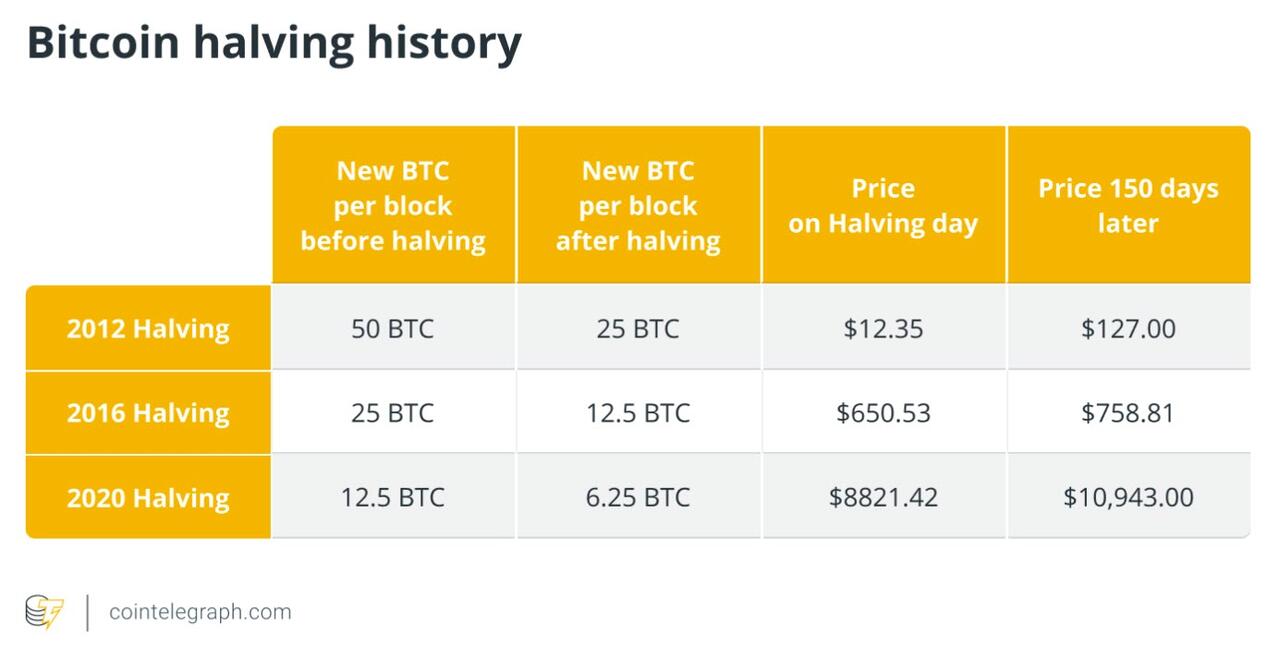
On Nov. 28, 2012 — three years and 10 months after Bitcoin’s first block was mined — the first-ever halving event took place. At the time, BTC traded at around $12, according to data from StatMuse, or 308,200% below Bitcoin’s current price, according to data from CoinGecko.

Though Bitcoin’s halving and the digital currency’s 21 million supply cap are not directly described in Nakamoto’s white paper, the document still hints at certain mechanisms to control the creation of new BTC. The white paper reads:

“To compensate for increasing hardware speed and varying interest in running nodes over time, the proof-of-work difficulty is determined by a moving average targeting an average number of blocks per hour. If they’re generated too fast, the difficulty increases.”

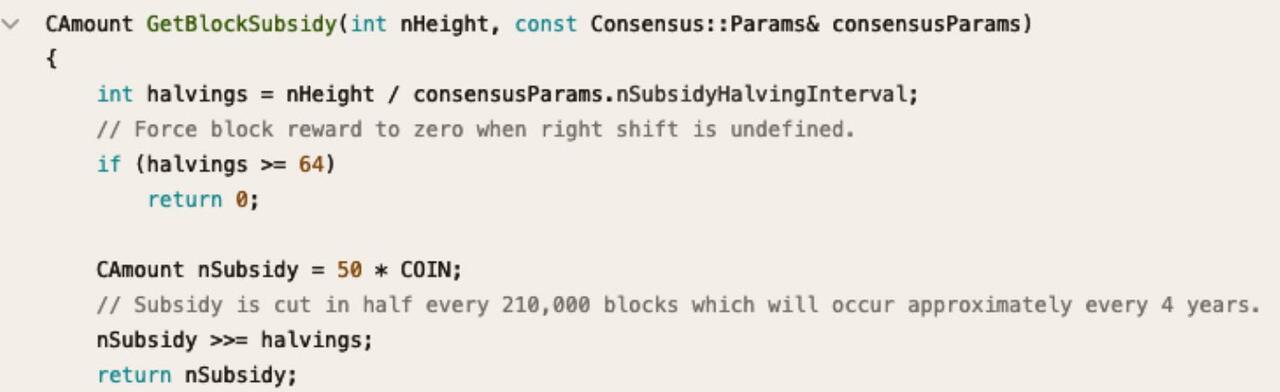
Unlike some basic information in the Bitcoin white paper, the halving aspect is mentioned in the Bitcoin source code. The halving is specifically available on the Bitcoin Core GitHub repository on the validation.cpp file and indicates the miner’s block subsidy is “cut in half every 210,000 blocks, which will occur every four years.”

A Bitcoin halving-related snippet from the Bitcoin Core repository. Source: GitHub

The Bitcoin halving mechanism had been programmed into the BTC mining algorithm to counteract inflation by maintaining scarcity.

Before the first halving occurred, miners were compensated with as much as 50 BTC per block. After the first halving event in 2012, the subsidy was slashed to 25 BTC, followed by the second halving in 2016, which reduced the subsidy to 12.5 BTC. The most recent Bitcoin halving occurred in 2020, cutting the block subsidy from 12.5 BTC to 6.25 BTC.

As Bitcoin halvings significantly increase the cryptocurrency’s scarcity, the Bitcoin price cycle has been historically impacted by halvings.

Just a year after its first-ever halving, Bitcoin had risen to nearly $1,000, while the second halving triggered a 350% surge during the year after the event, with BTC subsequently rallying to then all-time highs of nearly $20,000 in December 2017.

In the aftermath of the third Bitcoin halving, BTC surged to its all-time high of almost $69,000 in November 2021.

The anniversary of the first Bitcoin halving comes as the cryptocurrency community awaits the fourth Bitcoin halving, which is now expected to occur on April 17, 2024.

Many Bitcoin advocates are especially bullish on the Bitcoin price in 2024 amid growing expectations that United States securities regulators could finally approve a spot Bitcoin exchange-traded fund.

The 2024 halving won’t be the last one, though. Bitcoin miner reward is expected to be halved 34 times until it reaches 0 BTC after all 21 million Bitcoin are mined.

Based on the current schedule, the maximum supply of 21 million Bitcoin will be reached around 2140

Tyler Durden
Wed, 11/29/2023 – 15:45

via ZeroHedge News https://ift.tt/XUY8Kay Tyler Durden

Controversy Over an Important Article Finding Large Negative Effects of Zoning


zoning-laws-abolish | Illustration: Lex Villena; Lev Kropotov
(Illustration: Lex Villena; Lev Kropotov )

Chang-Tai Hsieh and Enrico Moretti’s 2019 article, “Housing Constraints and Spatial Misallocation” is a much-cited and highly influential paper in the literature on the economic effects of zoning. It finds that exclusionary zoning restrictions in several major US metro areas had large negative effects on the economy. Between 1964 and 2009, the authors concluded, they lowered GDP to the point where it was 8.9% lower in 2009 than it would have been if these jurisdictions had only average levels of zoning restrictions.

In 2021, economist Bryan Caplan pointed out methodological errors in the authors’ calculations, which—when corrected—showed they greatly underestimated the negative effects of zoning.  The authors acknowledged they had erred, and the apparent net effect was to further strengthen the case against zoning.

Recently, economist Brian Greaney of the University of Washington posted a critique the Hsieh-Moretti article in which he argues they made serious methodological errors that, when corrected, severely weaken their conclusions. Unlike in the case of Caplan’s critique, this time the authors have not admitted error. Hsieh has posted a response to Greaney (drawn from his referee report on Greaney’s paper), and Greaney, in turn, has posted a rejoinder. Housing policy expert Salim Furth has a helpful overview of the issues raised by Greaney though he only briefly notes Hsieh’s response).

This debate is ongoing, and it’s not yet clear to what extent the Hsieh-Moretti article will end up being discredited. The issues involved are technical in nature, so I cannot easily summarize them here. Interested readers will have to read the article, critique, response, and rejoinder for themselves, to get a sense of what is going on. And, unfortunately, much of it is not easily accessible to those with no background in econometrics. Greaney’s paper has not—so far—been published, and it’s not entirely clear whether it will survive peer review, and what it will look like in its final form (assuming publication).

Nonetheless, my tentative judgment is that Greaney has at least raised serious questions about the article’s model and use of data. At the very least, scholars and policy analysts should be more cautious in citing the Hsieh-Moretti study unless and until these doubts are resolved.

In addition, the fact that the article had already been shown to have one significant methodological error (the one Caplan found) should, in retrospect, have led more of us to wonder whether there were others.

I feel an obligation to emphasize these points because I am a longtime critic of  zoning and have cited the Hsieh-Moretti study in various writings of my own. I also highlighted the error identified by Caplan, pointing out how it strengthened the case against zoning. Intellectual honesty requires pointing out new analysis that cuts the other way, too.

The Hsieh-Moretti study is far from the only one that finds large negative effects of zoning on the economy, housing availability, and opportunities for the poor and minorities. I cited others in Chapter 2 of my book Free to Move. As Furth notes in his commentary on this debate, economists Gilles Duranton and Diego Puga have reached very similar conclusions to Hsieh and Moretti’s in a study that avoids the possible errors Greaney argues undermine the latter.

Thus, I continue to believe that zoning has large negative effects, and that most restrictions on housing construction should be abolished. But I do have to admit the case for that position is weaker at the margin than it would be if there weren’t serious questions about the validity of the Hsieh-Moretti article.


The post Controversy Over an Important Article Finding Large Negative Effects of Zoning appeared first on Reason.com.

from Latest https://ift.tt/0Gf4IpK
via IFTTT

Biden Warns Companies To Bring ‘Prices Back Down’ Even as Inflation Persists


President Joe Biden delivers remarks from the White House announcing the Council on Supply Chain Resilience. | Chris Kleponis - CNP/CNP / Polaris/Newscom

This week, the White House announced the launch of a Council on Supply Chain Resilience, created with the hope to “strengthen America’s supply chains” and “lower costs for families.”

Kinks in the supply chain are indeed partly to blame for the persistent inflation that has dogged American consumers for more than two years now. While inflation has fallen in recent months, the annualized rate remains over 3 percent; so-called “core inflation,” which excludes food and energy, was at an annualized rate of 4 percent in October, double the Fed’s target rate.

President Joe Biden delivered remarks from the White House on Monday to announce the new council’s creation. He touted the lower inflation rate and falling grocery prices but admonished American companies for, in his view, not going far enough.

“Let me be clear: To any corporation that has not brought their prices back down—even as inflation has come down, even as supply chains have been rebuilt—it’s time to stop the price gouging,” Biden warned, imploring them to “giv[e] the American consumer a break.”


The next day, White House Press Secretary Karine Jean-Pierre doubled down on Biden’s warning, responding to a reporter’s question about “price gouging” by saying that “the president’s gonna continue to use his bully pulpit to call it out.”

But Biden and Jean-Pierre are mistaken and seem to be confusing deflation with disinflation. The latter, as defined by the Federal Reserve Bank of St. Louis, is “a decrease in the rate of inflation,” while the former is “a sustained decrease in the price level of goods and services.”

Inflation has indeed declined for more than a year: In June 2022, inflation hit 9.1 percent, the highest single-month spike in over four decades. Between June 2022 and October 2023, the annualized inflation rate fell to 3.2 percent, a decrease of nearly two-thirds.

But that doesn’t mean prices are falling. After all, a 3.2 percent annual rate still means that prices were 3.2 percent higher in October 2023 than they were in October 2022. And it’s not expected to get better anytime soon, as Federal Reserve forecasts estimate core inflation will still be at 2.6 percent at the end of 2024.

Democrats have blamed “corporate greed” for the rise in inflation since 2021, even coining the term “greedflation” to describe it. But this doesn’t explain why so many companies suddenly decided to be greedy just as the COVID-19 pandemic caused supply chain snafus and two successive presidential administrations spent trillions of dollars in record time.

But the intended audience for Biden’s warning may not be corporations, but voters. “[Biden] needs to show voters that he’s not just working to lower prices, he’s fighting to do it,” a Democratic strategist told The Messenger‘s Dan Merica. “Punching corporations for their record profits is a great way to show his economy isn’t done, it’s still a work in progress.”

The post Biden Warns Companies To Bring 'Prices Back Down' Even as Inflation Persists appeared first on Reason.com.

from Latest https://ift.tt/XYmQSf5
via IFTTT

Congress Is Trying To Avoid Taking Responsibility for the Debt Crisis It Created


The Capitol Building being overtaken by money | Illustration: Lex Villena

It’s not quite accurate to say that no one in Congress wants to talk about the national debt and the federal government’s deteriorating fiscal condition.

Indeed, during Wednesday morning’s meeting of the House Budget Committee, there was a lot of talk about exactly that.

“Runaway deficit-spending and our unsustainable national debt…threatens not only our economy, but our national security, our way of life, our leadership in the world, and everything good about America’s influence,” said Rep. Jodey Arrington (R–Texas), the committee’s chairman. He pointed to the Congressional Budget Office (CBO) projections showing that America’s debt, as a share of the size of the nation’s economy, is now as large as it was at the end of the Second World War—and that interest payments on the debt will soon cost more than the entire military budget.

What’s missing, however, is any sense that Congress is willing to turn those words into action. Just look at the premise of Wednesday’s hearing: “Examining the need for a fiscal commission.”

Yes, it was a meeting about the possibility of forming a committee to have more meetings about the possibility of doing something to address the problem. In fact, it was the second such committee hearing in front of the House Budget Committee within the past few weeks.

It seems like there ought to be a more direct way to address this. Like, say, if there was a committee that already existed within Congress charged with handling budgetary issues. A House Budget Committee, perhaps.

But instead of using Wednesday’s meeting to seek consensus on how to solve the federal government’s budgetary problems, lawmakers spent two hours debating a series of bills that aim to let Congress offload that responsibility to a special commission. What that commission would look like and how its recommendations would be handled will depend on which proposal (if any of them) eventually becomes law—and even that seems somewhat unlikely, with Democrats voicing their opposition to the idea throughout Wednesday’s hearing.

To be fair, there are plenty of good arguments for why a fiscal commission might be the best way for Congress to fix the mess that it has made. It is an idea that’s certainly worthy of being considered, even if the whole exercise seems a little bit over-engineered.

Romina Boccia, director of budget and entitlement policy at the Cato Institute, argues persuasively in her Substack that a fiscal commission is the best way to overcome the political hurdles that prevent Congress from taking meaningful action on borrowing and entitlement costs (which are driving a sizable portion of future deficits).

Boccia’s preferred solution would allow the commission’s proposals to be “self-executing unless Congress objects,” meaning that legislators would have the “political cover to vocally object to reforms that will create inevitable winners and losers, without re-election concerns undermining an outcome that’s in the best interest of the nation.”

It’s probably true that Congress itself is the biggest hurdle to managing the federal government’s fiscal situation. Unfortunately, that’s also the biggest reason to be skeptical: any decisions made by a fiscal commission will only be as good as Congress’ willingness to abide by them.

Beyond that, it still isn’t clear to me how a fiscal commission is going to be able to accomplish anything that the existing Budget Committees couldn’t already do. There’s no secret knowledge out there about how to reduce deficits that will only be unlocked by bringing together a collection of legislators and private sector experts, which is what most of the bills to create a commission propose doing. Congress should hold hearings, invite experts to share their views, draft proposals, vet those ideas through the committee process, and then put the resulting bills on the House floor for a full vote.

Shielding Congress from the electoral consequences of making poor fiscal decisions doesn’t seem like it will improve the quality of budget-making. If anything, we need Congress to be held more accountable for this mess.

A $33 trillion national debt didn’t come crashing out of the sky like an asteroid that couldn’t be avoided. Congress chose this outcome, with each and every budget bill and emergency spending package passed over the last two decades. Nothing will change until Congress chooses differently. Shrugging off the obligation to budget responsibly is what caused this mess, but now lawmakers are eager to find yet another way to shirk responsibility for managing the country’s finances.

“No responsible leader can look at rapid deterioration of our balance sheet, the CBO projection of these unsustainable deficits, and the long-term unfunded liabilities of our nation, and not feel compelled to intervene and change course,” Arrington said Wednesday.

He’s right, but that only draws a line under the contradiction. A responsible Congress would be working on a serious plan to get the deficit under control. Instead, the Budget Committee is working on proposals to avoid having to do that.

The post Congress Is Trying To Avoid Taking Responsibility for the Debt Crisis It Created appeared first on Reason.com.

from Latest https://ift.tt/PqWNwHd
via IFTTT

Panama Forcing First Quantum To Close Mega-Copper Mine Is A “Significant Event” 

Panama Forcing First Quantum To Close Mega-Copper Mine Is A “Significant Event” 

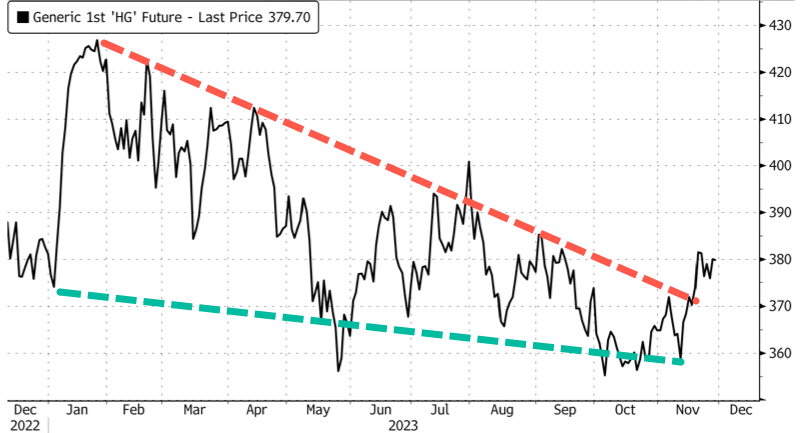
Copper futures reached a ten-week high on Wednesday following the announcement by Panama’s government to shut down a controversial $10 billion copper mine owned by First Quantum Minerals Ltd. The decision came after the Supreme Court of the Central American country declared the 20-year concession given to the Canadian mining operator was unconstitutional. 

“We have decided to unanimously declare unconstitutional the entire law 406 [granted mining concessions to First Quantum Minerals] of October 20, 2023,” Supreme Court President Maria Eugenia Lopez said on Tuesday.

Later that evening, President Laurentino Cortizo posted on social media platform X that the “transition process for the orderly and safe closure of the mine” had already begun. Production at Cobre mine has already been disrupted due to environmentalist protesters and labor unions. 

The court’s ruling and resulting shuttering of Cobre Mine is a shock to investors and the industry as a whole. The mine produces about 1.5% of the world’s copper supply. 

While many analysts on Wall Street have been forecasting a surplus of the industrial metal in 2024, the glut could be shortly wiped out if the Cobre Mine remains in limbo. 

Craig Lang, principal analyst at researcher CRU Group, called the closing of Cobre Mine a “significant event, adding uncertainty to the supply outlook.” 

“This is likely to place further downward pressure on copper concentrate market terms as smelters and traders look to cover Panama supply with alternative sources of material,” Lang said. 

Bloomberg pointed out, “There are bigger concerns in the longer term, with a broad consensus that dozens of new copper mines are needed if the world is going to meet decarbonization goals.” 

In an earlier advance, copper futures were at a ten-week high and have since traded flat late Wednesday morning. 

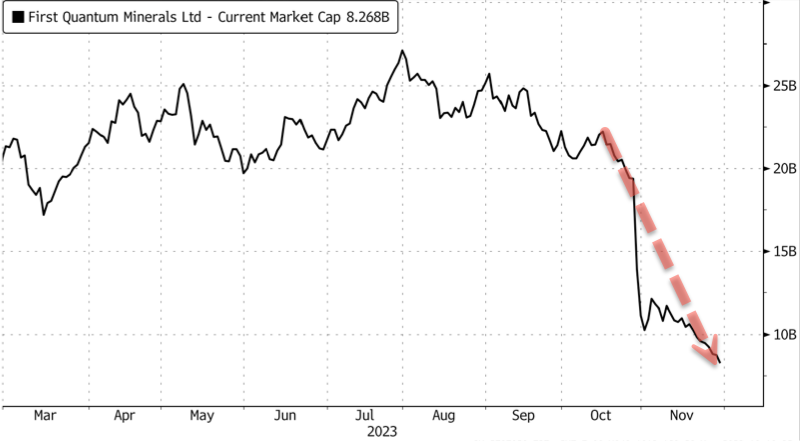
Meanwhile, the market cap of the miner has crashed 63% in about a month’s time. 

The closure of the mine has severe consequences for Panama’s fiscal outlook because the government relies on it for taxes. 

Ricardo Penfold, a managing director at Seaport Global, said Panama is running a fiscal deficit of “5% of GDP, and this will increase it by about 0.6%.”

This negative fiscal outlook forced Barclays to downgrade Panama’s bonds to underweight due to increasing uncertainty. 

And maybe billionaire mining investor Robert Friedland’s apocalyptic warning in a Bloomberg TV interview earlier this year that “copper prices might explode ten times” could be correct if supply quickly transitions into a shortage following the closure of the Panama mine.  

Tyler Durden
Wed, 11/29/2023 – 15:25

via ZeroHedge News https://ift.tt/E6KJa2X Tyler Durden

‘Confetti Dollars’ Are Coming, But Silver Will Pull “The Pin In The Gold Grenade”

‘Confetti Dollars’ Are Coming, But Silver Will Pull “The Pin In The Gold Grenade”

Via Greg Hunter’s USAWatchdog.com,

Precious metals expert and financial writer Bill Holter says the recent underreported announcement by the UBS CEO Sergio Ermotti in Switzerland that his bank might need a “rescue” is yet another sign on the short road to the end of the global Ponzi scheme backed by the US dollar reserve currency. 

Holter points out, “You’ve got a sick bank (Credit Suisse) that is being bailed out by another bank (UBS) that may turn out to be sick…”

“My question is who is going to bail out these central banks?  

You have got the Fed with a $9 trillion balance sheet.  The last time, the Fed went from $900 billion to $9 trillion.

Can the Fed now go from $9 trillion to $90 trillion? 

Who is going to bail out the Fed?  Who is going to bail out the US Treasury? 

Who is going to bail out the Bank of England, the ECB or the Bank of Japan? 

These central banks have completely blown up their balance sheet and have no ability to save anything. 

My question is who is going to save them?”

Can’t they cut interest rates again like they did in 2009?  Holter says,

“If they cut interest rates from here, you would see the dollar absolutely crash. 

The only reason the dollar has not crashed is interest rates have basically gone from 0% to 5%.   

They have done that in a year and a half which is the fastest increase in interest rates in all of history.

So, rate cuts will devalue the dollar.  Can you pay trillions of dollars borrowed in Treasury Bond back in confetti dollars?  Holter says, “Yes, you absolutely can pay back your debt in confetti.  It’s been done many, many times before as currencies get lost.”

“The US Treasury can certainly pay back in dollars, confetti dollars that certainly will have no purchasing power.

What that does is it shuts the credit spigot off to the biggest debtor in the world. 

The biggest debtor in the world is the US Treasury.  They owe more than any other entity anywhere…

I have long said this is going to be a credit event… People are not going to buy Treasuries and be paid back in monkey money.  The world is going to shun dollars and shun US Treasuries…

In short, confetti dollars are going to shut the credit markets down…Then, it’s game over because everything runs on credit. 

The financial markets run on credit, and the real economy runs on credit.  If there is no credit, nothing works.”

Holter is not surprised by the recent rise in gold. 

He also says “watch silver,”

“it is being suppressed because if silver rises uncontrollably, it will be like pulling the silver pin in the gold grenade.”

There is much more in the 40-minute interview.

Join Greg Hunter as he goes One-on-One with financial writer and precious metals expert Bill Holter for 11.28.23.

*  *  *

To Donate to USAWatchdog.com Click Here

Bill Holter’s new website is still growing in a big way.  It’s called BillHolter.com.


Tyler Durden
Wed, 11/29/2023 – 15:05

via ZeroHedge News https://ift.tt/N203IcS Tyler Durden

US Osprey Aircraft Crashes Off Japan Coast, Killing At Least One 

US Osprey Aircraft Crashes Off Japan Coast, Killing At Least One 

A US military MV-22B Osprey with six souls on board crashed into the sea in western Japan on Wednesday while on a training mission, killing at least one person, according to Reuters

The tiltrotor aircraft that can operate as a helicopter or a turboprop aircraft crashed some 2 miles from Yakushima island. This area is part of Japan’s Kagoshima prefecture and about 650 miles southwest of Tokyo. 

Local fisherman rescued three people in the surrounding waters, a representative of a regional fisheries cooperative said. 

It was reported another Osprey landed at the island’s airport on Wednesday afternoon around the time of the crash. 

Despite excellent VFR conditions (known as clear skies and light wind), witnesses told local media the troubled Osprey had an engine malfunction.

Reuters noted Japan, which also operates a fleet of Osprey aircraft, said it has no plans to ground the tiltrotor aircraft while the US military investigates the incident. 

The accident-prone aircraft has been involved in five fatal crashes since 2012, killing at least 19 people. 

Tyler Durden
Wed, 11/29/2023 – 14:45

via ZeroHedge News https://ift.tt/WgteOow Tyler Durden

Downbeat Beige Book Finds Economic Activity “Slowing”, Brings Fed One Step Closer To Rate Cuts

Downbeat Beige Book Finds Economic Activity “Slowing”, Brings Fed One Step Closer To Rate Cuts

One month after the October Beige book found “little change” in the US economy even as the outlook turned decidedly gloomier, moments ago the Fed released the latest, November, Beige Book in which we find just why the outlook darkened: according to the Fed, economic activity in the US “slowed” since the previous report, with four Districts reporting modest growth, two indicating conditions were flat to slightly down, and half (or six) noting slight declines in activity. The slowdown was visible across both Fed mandates: price increases moderated across districts (though prices remained elevated) the Beige Book notes, while demand for labor continued to ease, as most Districts reported flat to modest increases in overall employment.

According to Bloomberg, “taken at face value, that’s two-thirds of districts citing conditions that are ostensibly consistent with a mild recession.” In other words, the various regional Feds confirm that the trigger for a Fed rate cut is that much closer.

Some more details, starting with overall economic activity:

  • Retail sales, including autos, remained mixed; sales of discretionary items and durable goods, like furniture and appliances, declined, on average, as consumers showed more price sensitivity.
  • Travel and tourism activity was generally healthy. Demand for transportation services was sluggish.
  • Manufacturing activity was mixed, and manufacturers’ outlooks weakened.
  • Demand for business loans decreased slightly, particularly real estate loans.
  • Consumer credit remained fairly healthy, but some banks noted a slight uptick in consumer delinquencies.
  • Agriculture conditions were steady to slightly up as farmers reported higher selling prices; yields were mixed.
  • Commercial real estate activity continued to slow; the office segment remained weak and multifamily activity softened.
  • Several Districts noted a slight decrease in residential sales and higher inventories of available homes.

Not surprisingly, the economic outlook darkened even more, with the report warning that the outlook “for the next six to twelve months diminished over the reporting period.”

Turning to labor markets, we find that demand for labor continued to ease, as most Districts reported flat to modest increases in overall employment. Which is to be expected with the US heading fast for recession. Not surprisingly, wage growth slowed further, while layoffs rose and an even higher unemployment rate next week is virtually assured. Here are some more details:

  • The majority of Districts reported that more applicants were available, and several noted that retention improved as well.
  • Reductions in headcounts through layoffs or attrition were reported, and some employers felt comfortable letting go low performers. However, several Districts continued to describe labor markets as tight with skilled workers in short supply.
  • Wage growth remained modest to moderate in most Districts, as many described easing in wage pressures and several reported declines in starting wages.  Some wage pressures did persist, however, and there were some reports of continued difficulty attracting and retaining high performers and workers with specialized skills.

Looking at the regional anecdotes, one stood out: “a New York City-area company noted a reduction in starting salaries for recent college graduates as tech workers have become easier to find.” Translation: forget about wage growth, actual wage cuts are on deck.

Turning to prices, no surprise that here to increases “largely moderated” (even though prices remained elevated).

  • Freight and shipping costs decreased for many, while the cost of various food products increased.
  • Several noted that costs for construction inputs like steel and lumber had stabilized or even declined.
  • Rising utilities and insurance costs were notable across Districts.
  • Pricing power varied, with services providers finding it easier to pass through increases than manufacturers.
  • Two Districts cited increased cost of debt as an impediment to business growth. Most Districts expect moderate price increases to continue into next year.

Turning to the specific regional Feds, we found these summaries notable

  • Boston: Economic activity was flat or down slightly. Employment was stable but labor demand showed weakness. Results were quite mixed among manufacturers, some of whom have recently experienced an extended period of weak activity. Contacts noted an increase in loan defaults for office properties and expected further distress moving forward.
  • New York: Regional economic activity continued to weaken. Though still solid, labor market conditions cooled, and consumer spending slowed. Inflationary pressures were little changed after moderating in recent months. There were some signs of housing markets becoming more balanced in some parts of the District, though inventory remained exceptionally low.
  • Philadelphia: Business activity continued to decline slightly during the current Beige Book period. Wage and price inflation subsided significantly – but price levels remain high for many items. Consumers became yet more price sensitive, and real consumer spending declined. Employment grew modestly as labor availability improved further. Expectations for economic growth remained subdued.
  • Cleveland: The District’s economy contracted slightly in recent weeks after a long period of stability. Accompanying slower business activity, labor demand eased further, and employers reported returning to more normal wage increases and schedules. Input costs continued to trend down. Moreover, some firms noted that pricing power was reduced by weakening demand and competition.
  • Richmond: The regional economy grew slightly in recent weeks mainly due to modest increases in consumer spending. Manufacturers reported mixed activity. Underlying volumes in the transportation sector were low. Residential real estate continued to be constrained by limited inventory. Commercial real estate activity and lending demand declined. Employment increased modestly and price growth moderated slightly.
  • Atlanta: Economic activity grew slowly. Labor markets cooled, and wage pressures eased. Some nonlabor input costs, mostly in construction, decreased. Retail sales softened. New auto sales remained strong. Leisure and group travel were solid. Housing demand slowed. Banking conditions were stable. Transportation activity weakened. Energy demand rose. Agricultural conditions improved somewhat.
  • Chicago: Economic activity was up slightly. Employment increased moderately; business spending was up slightly; nonbusiness contacts saw little change in activity; consumer spending and construction and real estate activity decreased slightly; and manufacturing was down modestly. Prices and wages rose moderately, while financial conditions tightened slightly. Expectations for farm incomes in 2023 were little changed.
  • St. Louis: Economic activity has slowed slightly since our previous report. Retailers and freight transport contacts reported slowing consumer demand, particularly for high-end goods. Construction activity slowed, with multifamily in particular seeing projects delayed or cancelled due to higher rates.
  • Minneapolis: District economic activity was down slightly. Employment grew modestly but labor demand softened. Wage pressures were stable but still above average, and price pressures were modest. Consumer spending was flat as shoppers sought low-priced options, while construction and manufacturing sectors both faced challenges. Farm incomes were also lower.
  • Kansas City: Economic activity in the Tenth District declined slightly in recent weeks. Consumers were increasingly likely to “share a roof and share meals” to manage household budget challenges. Wage growth remained steady, but job gains were modest. Most firms reported plans to raise prices in coming months and noted heightened uncertainty about the outlook for commodity prices. Renewable energy activity continued to expand at a moderate pace.
  • Dallas: The Eleventh District economy expanded at a slower pace than in the previous reporting period, as growth in services stalled out, retail and home sales fell, and loan volumes declined at a faster rate. Job growth softened, and wage growth continued to normalize. Price pressures were above average in the service sector but modest in other sectors. Outlooks worsened, and uncertainty remained elevated with numerous contacts citing geopolitical instability and high interest rates as headwinds.
  • San Francisco: Economic activity softened slightly. Labor market tightness eased moderately. Wage and price pressures moderated. Retail sales were flat, and demand for manufactured products remained largely unchanged. Conditions in agriculture were mixed, while real estate activity softened somewhat. Financial sector conditions weakened further. Local communities faced high demand for support services.

And one particular highlight: The Kansas City Fed notes that “bankers cited higher debt service costs and declining borrower cash flow as key risks facing their CRE books, particularly for loans maturing in the near term. Rising funding costs persisted as deposit balances continued to shift to higher-yielding accounts, with contacts reporting strength in time deposit products.”

In other words, the Fed is now on notice that unless it cuts rates, a CRE accident is just waiting to happen.

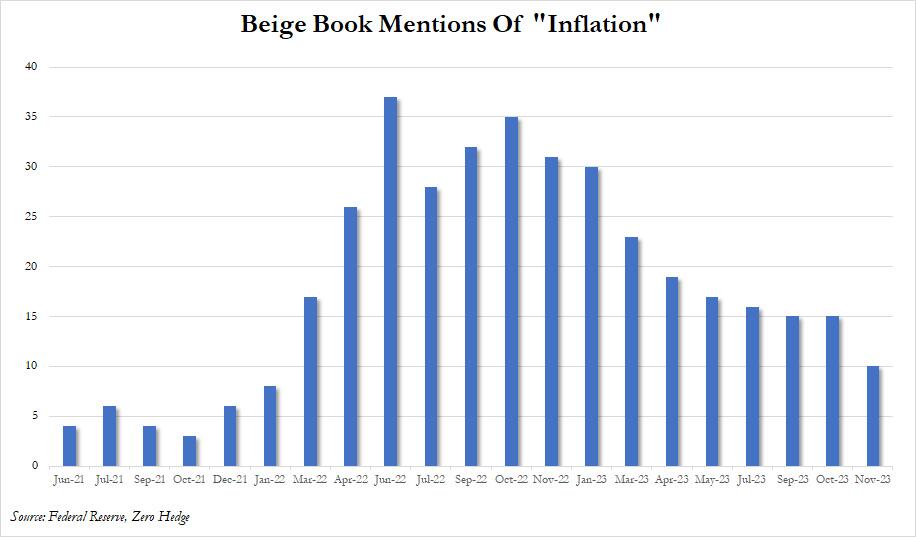
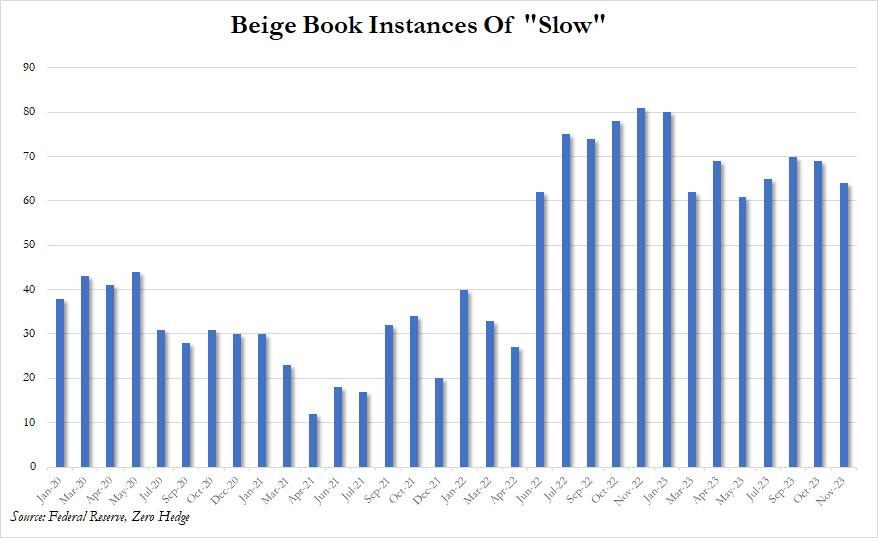
Finally, taking a visual approach to the data, we find that the mentions of inflation were the fewest since Jan 2022.

Perhaps the only silver lining in today’s data is that while we would expect mentions of “slowing” to jump in keeping with the broader report theme, what actually happened was a drop decline in the use of that word to a 5 month low, suggesting that a soft landing is still possible but only if the Fed is careful and eases into it.

More in the full Beige Book (link).

Tyler Durden
Wed, 11/29/2023 – 14:33

via ZeroHedge News https://ift.tt/NzskHOm Tyler Durden

Cigna, Humana In Merger Talks To Create New Healthcare Powerhouse  

Cigna, Humana In Merger Talks To Create New Healthcare Powerhouse  

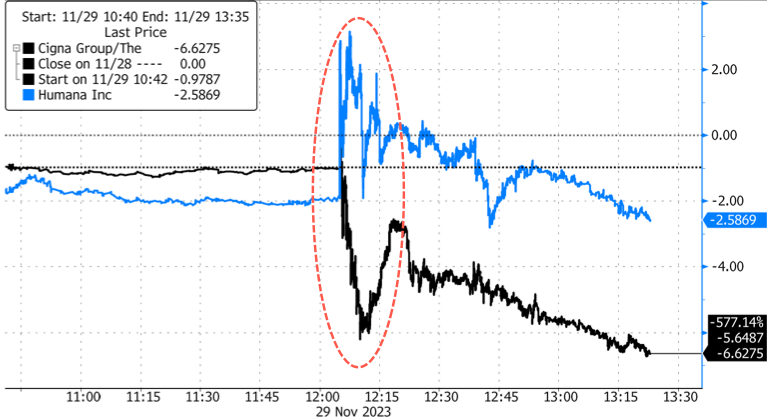
Shares of Cigna Group and Humana Inc. moved lower in the afternoon cash session following the report from The Wall Street Journal that the two healthcare companies are engaged in merger talks. 

According to people familiar with the discussions, the merger is a stock and cash deal that could be finalized by the end of the year. If talks don’t fall apart, the merger will combine Cigna’s market cap of about $80 billion and Humana’s of about $63 billion and create a new powerhouse in the health insurance industry to challenge the market dominance of UnitedHealth Group. 

Merging would allow the combined entity of Cigna/Humana to compete with industry giants UnitedHealth and CVS, propelling them into the top tier of integrated healthcare firms. Last year, Cigna’s revenues were $181 billion, which could combine its large pharmacy-benefit unit, which manages drug plans, and its strength in commercial insurance with Humana’s rapidly expanding Medicare segment, something Cigna has been pursuing. 

Humana, having generated around $93 billion in revenue last year, is the second-largest Medicare insurer, trailing only UnitedHealth. In contrast, Cigna’s current Medicare Advantage division is significantly smaller. Additionally, Humana’s substantial home-health business and its expanding network of primary-care clinics could greatly enhance Cigna’s Evernorth health services arm.

However, the proposed merger is expected to encounter antitrust challenges in an industry where regulators have previously blocked the last two significant mergers. This includes a proposed union between Cigna and Anthem, now known as Elevance Health Inc.

“A possible Cigna-Humana merger as reported by the Wall Street Journal would make strategic sense via cross benefits between the pharmacy-benefit manager (PBM) and the Medicare-focused insurer, but could face regulatory hurdles. Even if an agreement is reached, the odds of the deal closing are questionable given the size of the combination and increased federal scrutiny of PBMs and health insurers,” Bloomberg’s BI analyst Glen Losev wrote in a report. 

Shares of Cigna are down 6.5%, while shares of Humana are down 2.7%. 

A mega-deal between Cigna and Humana would be a welcoming sign for the merger and acquisition markets amid high-interest rates crushing deal flow this year. It would likely be the biggest deal of the year, exceeding Exxon Mobil’s $60 billion agreement to acquire Pioneer Natural Resources last month. 

Tyler Durden
Wed, 11/29/2023 – 14:15

via ZeroHedge News https://ift.tt/1hyVJfD Tyler Durden