“The Big Fail” – Anti-Lockdown Goes Mainstream

“The Big Fail” – Anti-Lockdown Goes Mainstream

Authored by Jeffrey Tucker via The Brownstone Institute,

It’s a shift worth marking. 

New York Magazine is featuring an article called “COVID Lockdowns Were a Giant Experiment. It Was a Failure.” The authors are two excellent journalists, Joe Nocera and Bethany McLean, who have also written a new book called The Big Fail, which I have not read but intend to.

The ascent of the book and thesis is hugely important, if only to further blunt the impact of Michael Lewis’s The Premonition, which came out in 2021 with the purpose of valorizing the absolute worst of the lockdowners. 

The worry at the time was that Lewis’s book, like The Big Short, would become a major movie that would codify lockdowns as the right way to deal with infectious disease. That does not seem to be happening, and the cleverly titled book by Nocera and McLean seems to assure that this will never happen. Thank goodness. This is progress. Be grateful when we see it. It is also a tremendous credit to all those who have been pushing the Nocera/McLean thesis since the spring of 2020. 

Lockdowns were always an impossible means of pandemic management. We knew that from a century ago. It was not even controversial. The orthodoxy in public health survived even up to a few weeks before the lockdowns began.

Out of nowhere, settled wisdom was completely upended. Suddenly, as if straight from Orwell, lockdowns became “common sense mitigation measures.”

Meanwhile this country and most other countries around the world were being utterly tortured by a crazed bureaucracy determined to master the microbial kingdom by bullying people and wrecking their businesses, schools, churches, and lives. 

If nothing else, this era proves for this generation the astonishing capacity of the human mind to undertake utterly insane policy experiments on a grand scale without the slightest evidence that they could ever succeed, even while they trample on all established norms of rights and liberties. 

This is a revelation, at least to me. We’ve never seen anything like it in our lives.

Speaking personally, this reality utterly shattered a worldview that I didn’t know I held: namely, I genuinely believed humanity was on a path, even an inevitable one, toward greater knowledge, learning, and the embrace of freedom. After March 2020, I and everyone discovered otherwise. That was both intellectually and psychologically traumatic for me and for millions of others. 

We are still figuring out how and why all this happened. In order to do that, we at least need a consensus that this was a terrible mistake. Even three and a half years later, we haven’t even had that. To be sure, it is very difficult to find defenders of lockdowns. They have mostly evaporated into the hedges. Even those who pulled the trigger and defended them at the time are all denying that they had anything to do with them. My favorite: we never had a real lockdown. 

Regardless, the mere appearance of the Nocera/McLean article takes us quite a distance to where we need to be at least for now. Yes, it is 42 months late, but we take progress wherever we can find it. 

Just some quotes from the article:

“One of the great mysteries of the pandemic is why so many countries followed China’s example. In the U.S. and the U.K. especially, lockdowns went from being regarded as something that only an authoritarian government would attempt to an example of “following the science.” But there was never any science behind lockdowns — not a single study had ever been undertaken to measure their efficacy in stopping a pandemic. When you got right down to it, lockdowns were little more than a giant experiment.”

“Unfortunately, there is no shortage of policy failures of which to take stock. We do an accounting of many of them in our new book, The Big Fail. But one that looms as large as any, and remains in need of a full reckoning in the public conversation, is the decision to embrace lockdowns. While it is reasonable to think of that policy (in all its many forms, across different sectors of society and the 50 states) as an on-the-fly experiment, doing so demands that we come to a conclusion about the results. For all kinds of reasons, including the country’s deep political divisions, the complexity of the problem, and COVID’s dire human toll, that has been slow to happen. But it’s time to be clear about the fact that lockdowns for any purpose other than keeping hospitals from being overrun in the short term were a mistake that should not be repeated. While this is not a definitive accounting of how the damage from lockdowns outweighed the benefits, it is at least an attempt to nudge that conversation forward as the U.S. hopefully begins to recenter public-health best practices on something closer to the vision put forward by [Donald] Henderson.”

You will notice the hedge here: “for any purpose other than keeping hospitals from being overrun.” Another way to put it: lockdowns are fine for rationing healthcare. There is reason to emphatically disagree. Hospitals wildly exaggerated how overrun they were. There were two hospitals in New York boroughs that had high traffic, but this was due to exigencies of ambulance contracts. The rest were largely empty as they were around the country. This was due to lockdowns that restricted medical services to Covid only even in places where there was no community spread, plus public fear of leaving the home. 

(I had a conversation last week with the head of a company that sells ventilators and diagnostic equipment to hospitals in New York. He said that in the early months of lockdown, he had never seen hospitals so empty. This was confirmation to me of what we already knew.)

This whole subject needs some serious unpacking. To my knowledge, we still don’t know where the edicts came from to lock down hospitals all over the country. That is a research project all its own. In other words, carving out an exception for “overrun” hospitals is deeply dangerous: it only incentivizes the lockdowners next time to game the reporting in a way that is favorable to more lockdowns. This is precisely what happened in the UK, where the main and even only justification for lockdowns was the rationing of healthcare services. 

So this proviso is actually dangerous in every way. 

Now we must deal with another piece of this article that is far from correct. I quote:

“As the United States gains more and more distance from the COVID pandemic, the perspective on what worked, and what did not, becomes not only more clear, but more stark. Operation Warp Speed stands out as a remarkable policy success. And once the vaccines became available, most states did a good job of quickly getting them to the most vulnerable, especially elderly nursing-home residents.”

The perspective is what we might be called the exogenous theory of the jab. The idea is that the lockdowns and masking and the whole apparatus of disease control exists in a separate system of ideological confusion, whereas the vaccine came from the outside to intervene but otherwise was not part of the planning apparatus. 

I certainly once shared this view. About the vaccine in 2020, rumored to come along at any point, I care next to nothing about it. I assumed it would be useless because my reading on the topic showed that a coronavirus is in the class of pathogens against which one cannot vaccinate. 

That aside, there is a real danger associated with attempting to vaccinate your way out of pandemic. You can create the conditions that drive mutations even more, and introduce the prospect of what’s called original antigenic sin. What I had not anticipated was that the shot would be actually deeply dangerous, much less that it would be mandated. 

The more research we do, the less plausible this theory of exogenous intervention is. From the very outset, the vaccine was planned and a huge part of the entire pandemic control agenda. And consider this question. Would it have been possible to drive the emergency use authorization, indemnify the results from any liabilities, retain patents, elicit tax funds for development, plus push innumerable institutions to mandate the shots in absence of the national emergency, the frenzy, the demoralization, and the population-wide panic? I’ve asked many people this question, and the answer is always: no way. 

There is no world in which Warp Speed would have taken hold absent the lockdowns. They are all part of the same system and policy. So, yes, it is strange for our authors to isolate the vaccine as good in the context of everything else which they label bad. Emergencies elicit bad actors and bad actions. They are all of a piece. 

At this point, most of us have become jaded about media and messaging from mainstream sources. So an easy tag to put on this important article in New York Magazine is: limited hangout. Let’s admit failure where possible, concede mistakes and disasters along the way, even while sneaking in an approving and passing remark about the thing which in the end is the most important part of the whole epoch, namely the vaccine itself. That way, the rubes will be satisfied that there is some accountability going on, even while the biggest and deepest caper of them all gets away without a scratch. 

There is no need here to chronicle the innumerable and now widely known failure of the shot. In any case, among those who still want to claim it to be a great success, their messaging is not long for this world. The evidence is too overwhelming, and felt in every part of society the world over. 

What we have with this book and article is an important step. It is just one step. Lockdowns utterly shattered the protocols of public health, settled law, and freedom itself all over the world. They wrecked myriad institutions, wrought an incredible economic and cultural crisis, demoralized the whole population, and built up a leviathan of command and control that is not only not backing down but growing ever more. Far more will be required to utterly and completely repudiate the methods and madness of our epoch. 

Tyler Durden
Mon, 11/06/2023 – 17:00

via ZeroHedge News https://ift.tt/SXRLdrs Tyler Durden
Senior Loan Officer Survery Shows Modest Improvement Even As Credit Remains Tight, Demand Weak

Senior Loan Officer Survery Shows Modest Improvement Even As Credit Remains Tight, Demand Weak

In our preview of the week’s key updates, we said that while today’s Senior Loan Officer Survey (or SLOOS) was likely the otherwise quite’s week’s main event, even if it was unlikely to be a market mover as it would – in a quarter where the 10Y yield briefly topped 5% –  signal more of the same: tighter financial conditions and weaker demand for consumer loans.

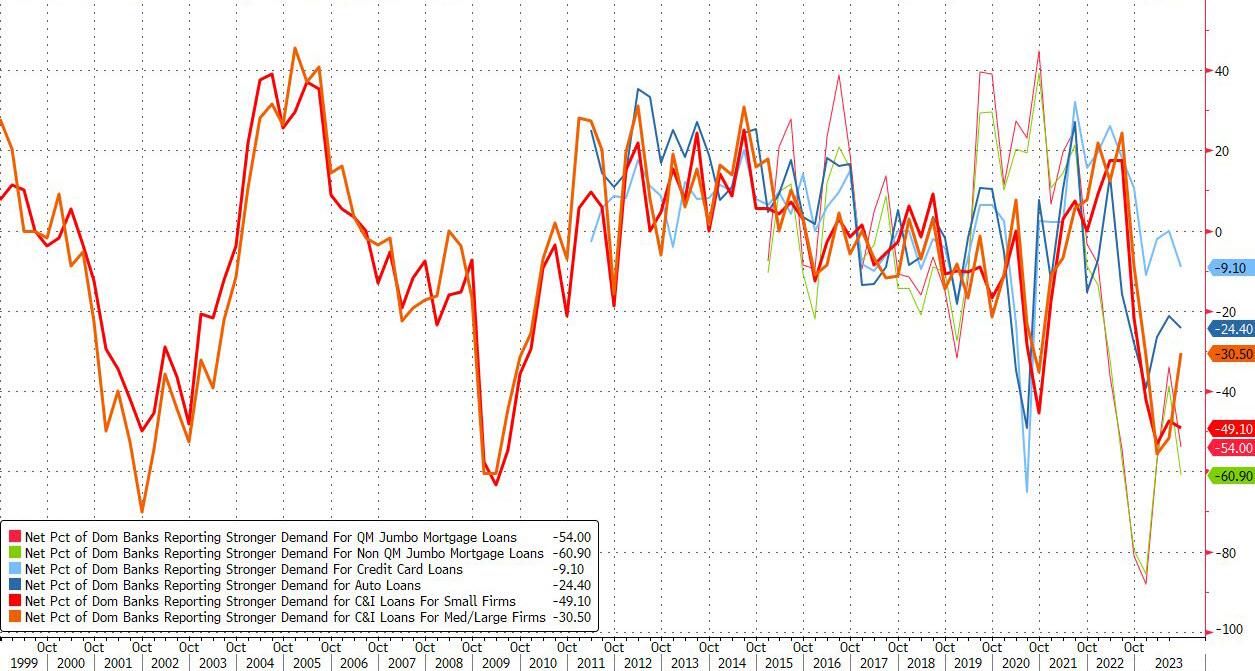
Sure enough, moments ago the Fed reported that – as expected – in Q3 the SLOOS respondents “on balance, reported tighter standards and weaker demand for commercial and industrial (C&I) loans to firms of all sizes over the third quarter. Furthermore, banks reported tighter standards and weaker demand for all commercial real estate (CRE) loan categories.”

But while the big picture remains downbeat, with both supply and demand in tight/contracting territory, the silver lining is that the underlying measures improved somewhat compared with the second quarter, which is bizarre since rates are far higher now than they were in Q2.

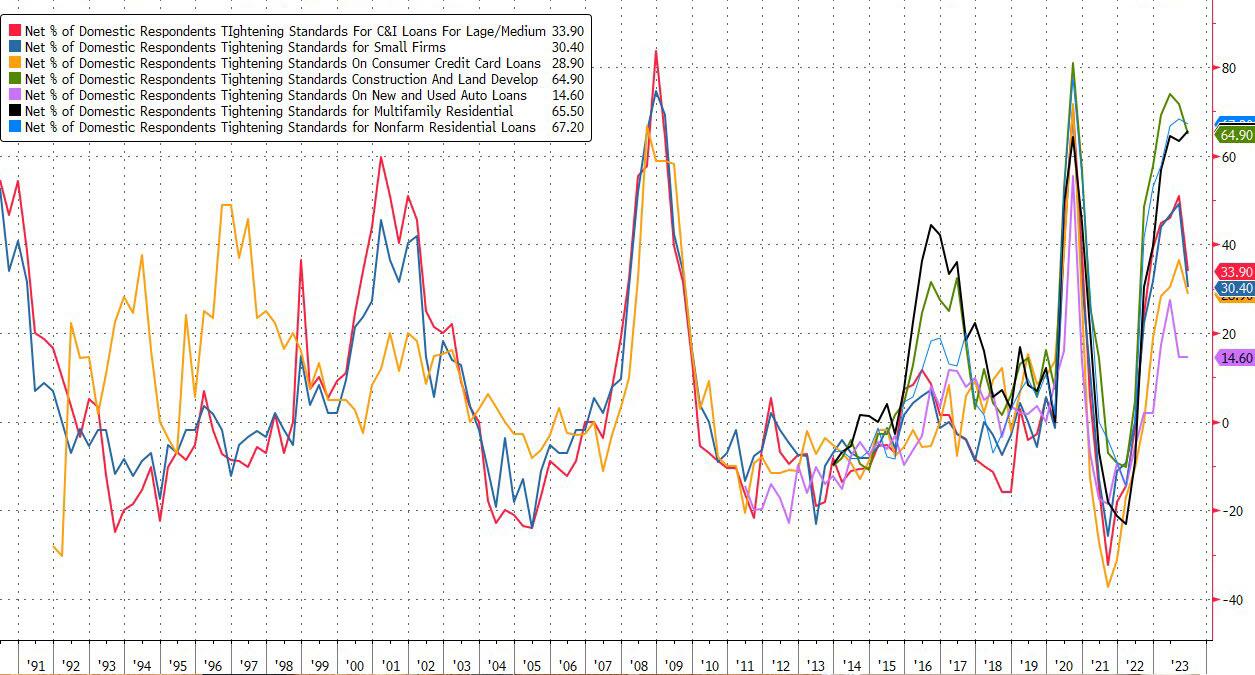
Specifically, the proportion of US banks tightening standards for the all important commercial and industrial (C&I) loans for medium and large businesses fell to 33.9%, from 50.8% in the second quarter even as some 62.7% of banks are keeping lending conditions basically unchanged. Other notable categories also posted improvements:

  • The proportion of banks reporting tightening standards for small firms fell from 49.2 to 30.4
  • The proportion of banks reporting tightening standards for consumer credit card loans fell from 36.4 to 28.9
  • The proportion of banks reporting tightening standards for construction and lend development loans rose from 63.3 to 64.9
  • The proportion of banks reporting tightening standards for new auto loans was unchanged at 14.6
  • The proportion of banks reporting tightening standards for nonfarm residential loans fell from 68.3 to 67.2

Among the banks that reported easing lending standards, the most frequently cited reasons were an improvement in the credit quality of loans and a more favorable or less uncertain economic outlook.

  • In comparison to large banks, other banks more frequently cited concerns about deposit outflows, funding costs, deterioration in or desire to improve their liquidity positions, and concerns about declines in the market value of fixed-income assets as reasons for tightening lending standards.
  • For foreign banks, major shares reported that a less favorable or more uncertain economic outlook; a deterioration in customers’ collateral values; a reduced tolerance for risk; a deterioration in the credit quality of loans; and a reduction in the ease of selling loans in the secondary market were important reasons for tightening lending standards over the third quarter.

The survey showed a modest improvement in demand for credit, with the share of banks reporting weaker demand for C&I loans among large and mid-sized firms at 30.5%, down from 51.6% in the second quarter. On the other hand, demand for both qualifying and non-qualifying Jumbo mortgage loans declined, as did demand for credit card loans and C&I loans for small firms.

Over the third quarter, banks reported tightening standards for all types of CRE loans. Such tightening was more widely reported by other banks than by large banks. Major net shares of banks reported weaker demand for all CRE loan categories, which was more widely reported by large banks than by other banks. Furthermore, a significant net share of foreign banks reported tighter standards for CRE loans, while a moderate net share of foreign banks reported weaker demand for such loans.

The October SLOOS also included a set of special questions that asked banks to assess the likelihood of approving credit card and auto loan applications by borrower FICO score (or equivalent) in comparison with the beginning of the year. Banks reported that they were less likely to approve such loans for borrowers with FICO scores of 620 and 680 in comparison with the beginning of the year, while they were more likely to approve credit card loan applications and about as likely to approve auto loan applications for borrowers with FICO scores of 720 over this same period.

The October SLOOS also included a set of special questions that inquired about banks’ reasons for changing standards for all loan categories in the third quarter of 2023. Banks most frequently cited a less favorable or more uncertain economic outlook; reduced tolerance for risk; deterioration in the credit quality of loans and collateral values; and concerns about funding costs as important reasons for tightening lending standards over the third quarter.

dollar and US 2y yields rise after the Q4 Senior Loan Officer Survey data showed “credit was not as tight as people thought”. The net percentage of domestic respondents tightening standards for C&I loans (Large and Medium sizes) dropped to 33.9 (from 50.8 in Q3), the lowest since Q3 2022. In G10, the desk saw Real Money clients buying USDSEK and USDJPY, while also buying NZDUSD. Hedge Funds were buying AUDUSD gamma and looking at mid-dated EURUSD topside structures.


Tyler Durden
Mon, 11/06/2023 – 16:40

via ZeroHedge News https://ift.tt/soSa5gy Tyler Durden

Hezbollah’s Nasrallah & The Future Of The War

Hezbollah’s Nasrallah & The Future Of The War

Authored by As’ad AbuKhalil via Consortium News,

The expectations for Hizbullah leader Hasan Nasrallah’s speech on Friday were very high; even the U.S. National Security Council’s spokesperson at the White House admitted that they too were awaiting the speech. In the Arab world there was anticipation or a general wish that Nasrallah would declare an official entry into the larger war, thereby igniting a regional conflict that would change the shape of the Middle East.

Hizbullah, unwisely, increased expectations by releasing video teasers showing Nasrallah walking or seated. Israelis and much of the world were holding their breaths. Lebanese were nervous but hopeful that Nasrallah would take their plight into consideration.

But Nasrallah does not operate in a vacuum. There is a very complex context in which he does. In the Arab world, the Western-Gulf alliance has spent billions to demonize Nasrallah and to undermine his standing in the Arab and Muslim worlds; and his standing reached new heights in the wake of the 2006 war with Israel.

Hassan Nasrallah, leader of Hezbollah, in Beirut in May 2023. Image: Shutterstock.

Hizbullah’s involvement in Syria, and the circulation of slogans that were sectarian and religious in nature, aided the Gulf regimes’ campaign against Nasrallah and the party, portraying them as purely Shiite and merely puppets of Iran. The Gulf’s mission was to push the party into a sectarian corner, and the party — through its political behavior in Lebanon — unintentionally aided that mission.

Since the Lebanese economic collapse in 2019, Hizbullah has pursued political options focusing on solidifying Shiite political ranks. This is only understandable from the perspective of the party protecting itself from a Gulf-Israel plot to instigate a Shiite, intra-sectarian, civil war.

Thus it’s not easy to assess the speech with disregard to the political context in which it took place. Nasrallah was addressing many audiences: the party’s rank-and-file, the Lebanese scene, the Arab scene, and his enemies in the West and Israel.

The video teasers before the speech would have worked if there was a dramatic announcement in the form of a major escalation or a declaration of war. When that did not materialize, it made those teasers feel hollow even though they succeeded in a form of psychological warfare against the Israeli enemy (an Israeli newspaper commented that Nasrallah succeeded in tearing the nerves of Israelis).

Hizbulllah is the first Arab political party, or even state if we add them to the mix, which devotes energy and resources to engage in psychological warfare against the Israelis. The PLO had no notion of that, and the speeches of its leaders (and of Arab leaders) were bombastic and emotional and did not rely on a base of military power and preparedness. Nasrallah is an expert on Israel; he spends hours reading about Israel and its politics and military.

Tied Hands

Nasrallah must have felt enormous pressure before the speech. For a leader who uniquely (in the history of Arab leaders and of Israel) makes decisions on the basis of a cost-benefit analysis, Nasrallah’s hands were a bit tied in Lebanon. Half of the country (at least) is under the influence of Gulf regimes and have relatives in the Gulf and fear for their expulsion (Gulf regimes remind Lebanon regularly that if Lebanon were to take stands against the Gulf regimes, those Lebanese immigrants would be expelled en masses).

Furthermore, there is an enormous U.S. media apparatus headquartered in Dubai that coordinates with Israel and Gulf countries in the war on enemies of Israel, especially those who are engaged in resistance against Tel Aviv.

Weeks before Nasrallah’s speech, journalists on the payroll of Gulf regimes and journalists who work for media funded by NATO governments and George Soros came together and promoted a petition rejecting the war between Lebanon and Israel, insisting that Lebanon is too fatigued to participate in a war against Israel. Money was mysteriously made available for those people to buy billboards sending the same message: that Hizbullah should keep Lebanon out of the war.

The movement did not spread much, but it registered with people who are worried about their living conditions, in the wake of the economic collapse and the elimination of people’s life savings. It did not help that Israeli leaders make weekly threats that they would turn Lebanon back to the pre-industrial age or that they would threaten to eliminate Lebanon altogether.

Those genocidal statements don’t get covered in the Western press, but they alarm the Lebanese population; Lebanese know full well that in war Israel targets civilians first and foremost.

Most of the casualties in Israel in the July 2006 war were combatants, while most of the casualties in Lebanon were, typically, civilians. Lebanese infrastructure is in decrepit shape and Israel in the past consistently targeted Lebanese hospitals, power stations, airports, schools, and refugee camps.

That must weigh heavily on Nasrallah’s mind when he makes the cost-benefit analysis.

But there are also the party-stalwarts who have been raised on the slogan, nay expectation, of the liberation of Palestine. They genuinely believe that Israel would reach its demise in the next war. Those supporters of the party needed to hear from their leader to understand the regional ramifications of the war.

And Nasrallah, it must be pointed out, is now probably the most senior figure in the “axis-of-resistance” in the Middle East. Even Qassim Suleimani (murdered by the U.S.) was lower in rank than Nasrallah ( footage of meetings between the two men confirm that Nasrallah was the senior person in the relationship). Photos of family mourning in Suleimani’s home show a picture of Nasrallah in the house).

Even Ayatollah Khamenei, who is the most senior religious figure in the hierarchy of the axis, defers to Nasrallah on strategic matters (Iranian officials regularly briefed Nasrallah on nuclear negotiations with the West).  

Three Signals

When it comes to war with Israel, Nasrallah is the ultimate decision maker.

So he knew expectations were high and that this was a historic moment with the Arab people unified in support of Palestine. He could not stand by or act indifferently. He has not only opened (since the Hamas attack on Israel) the front in the South where his has party lost 55 members so far in clashes with the Israeli occupation army, but he also allowed Palestinian factions (namely Hamas and Islamic Jihad) to use Lebanese territories to fire short range missiles at Israel targets.

The entire political class in Lebanon (in the form of the government and the prime minister) has said that Lebanon does not want war with Israel.

So Nasrallah did not declare war, but sent out these important signals:

  • He made it clear that the planning and the timing of the Hamas operation was entirely Hamas and Hamas alone. He said that not even allies of Hamas in Gaza (clearly a reference to Islamic Jihad) knew of the operation because Hamas maintained absolute secrecy. Iran was not involved and that was important to stress because in the Western media all Iranian allies are presented as mere puppets of Iran. The picture is more complicated. In 2011, Hamas supported the Syrian revolt against the Syrian regime although the regime provided Hamas with sanctuary and military support. That stance poisoned the relationship between Hamas and Iran, and even between Hamas and Hizbullah. Hamas later reconciled with Hizbullah, but the Hizbulalh leadership still refuses to meet with Khalid Mishal, the leader behind Hamas’ decision to support the Syrian armed rebellion (he took that decision consistent with the stance of Qatar and Turkey, with which he is very close). Moreover, even the US has finally concluded (according to CNN) that Hizbullah does not merely follow Iranian orders in its decision making.
  • Nasrallah wanted to make clear that the front from Lebanon to Syria to Gaza is one and that all members of the resistance camps will be fighting together. He made a reference to the Iraqi allies of Hizbullah.
  • Nasrallah was preparing the Lebanese for the next phases of the war. He all but made it clear that a larger war is inevitable but he did not want to be the one to announce it, thereby opening the door for the Gulf-paid media to blame him for that decision. He spoke about phases of this war and reminded the audience about Israeli losses and Hizbullah’s successes in clashes in South Lebanon.
  • Nasrallah sent a message to the U.S.: His group won’t be intimidated by the presence of the fleet in the Mediterranean and reminded the U.S. that some of those who fought against the U.S. in Lebanon in 1982-84 are still alive and trained others. He made it clear that Hizbullah would retaliate against U.S. forces if the U.S. strikes Lebanon.

It was not Nasrallah’s best speech, and it did not meet the very high expectations by many. But it achieved what he wanted from the occasion: to put the enemy on notice that Hizbullah would not rule out a major confrontation with Israel and that such eventualities are related to developments on the ground in Gaza.

Tyler Durden
Mon, 11/06/2023 – 16:20

via ZeroHedge News https://ift.tt/yJAaeRL Tyler Durden

No Malarkey: Even Democrats Think Biden Is Too Old


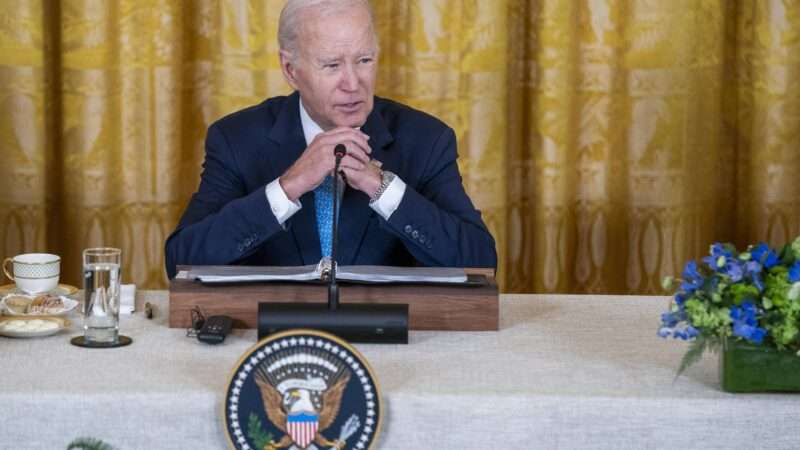
Joe Biden delivers remarks from a lectern at a White House summit | Shawn Thew - Pool via CNP / MEGA / Newscom/RSSIL/Newscom

In this week’s The Reason Roundtable, editors Matt Welch, Katherine Mangu-Ward, Nick Gillespie, and Peter Suderman assess President Joe Biden’s tanking poll numbers and parse the continuation of seething protests against the Israel-Hamas war.

1:04: New polls are bad news for Joe Biden.

15:09: Protests surge against Israel-Hamas war.

36:54: Weekly Listener Question

44:11: An executive order attempts to regulate artificial intelligence tech.

49:37: This week’s cultural recommendations

Mentioned in this podcast:

Are We Really Doing a Trump vs. Biden Rematch?” by Steven Greenhut

Both Biden and Trump Are Bad Candidates,” by John Stossel

Stop Calling Hillary Old,” by Nick Gillespie

Third Party Candidates Shouldn’t Get Their Hopes Up,” by Andy Craig

RFK Jr. Dumps Democrats, Libertarian Party Blasts RFK Jr.’s Stance on Israel,” by Robby Soave

The Real Worry Behind the Unhinged Freakout Over No Labels,” by Matt Welch

Joe Biden More Vulnerable in 2024 Primary Than Donald Trump Ever Was in 2020,” by Matt Welch

The Very Strange New Respect for Authoritarian Democrat Robert F. Kennedy Jr.,” by Matt Welch

Blinken’s Mission, Impossible,” by Robby Soave

Yascha Mounk: Avoiding the Identity Trap,” by Nick Gillespie with Yascha Mounk

Far-Left Support for Hamas is not an Aberration,” by Ilya Somin

Blaming Hamas Shouldn’t Mean Ignoring the Palestinians’ Plight,” by Bonnie Kristian

Is Restricting Pro-Israel-as-Jewish-Democracy Speech National Origin/Ethnicity Discrimination or Harassment?” by Eugene Volokh

Don’t Blame the Maine Shootings on ‘Woefully Weak’ Gun Laws,” by Jacob Sullum

Biden Issues ‘A.I. Red Tape Wishlist,'” by Ronald Bailey

Priscilla Is an Elvis Movie That Isn’t About Elvis,” by Peter Suderman

Mitt Romney, Like So Many NeverTrumpers, Was Hobbled by His Own Grubby Political Ambitions,” by Matt Welch

Consultant in Chief,” by Peter Suderman

The Appeal of the Underdog,” by Joseph A. Vandello, Nadav P. Goldschmied, and David A. R. Richards, in Personality and Social Psychology Bulletin

Send your questions to roundtable@reason.com. Be sure to include your social media handle and the correct pronunciation of your name.

Today’s sponsor:

  • Do you ever find that just as you’re trying to fall asleep, your brain suddenly won’t stop talking? Do your thoughts start racing right before bed or at other inopportune moments? It turns out, one great way to make those racing thoughts go away is to talk them through. Therapy gives you a place to do that, so you can get out of your negative thought cycles and find some mental (and emotional) peace. If you’re thinking of starting therapy, give BetterHelp a try. It’s entirely online, designed to be convenient, flexible, and suited to your schedule. Just fill out a brief questionnaire to get matched with a licensed therapist, and switch therapists any time for no additional charge. Get a break from your thoughts, with BetterHelp. Visit BetterHelp.com/roundtable today to get 10 percent off your first month.
  • Check out the new podcast The Best of Reason Magazine. Every Tuesday, listen to a curated selection of some of the best writing from Reason, read aloud to you by a robot voice modeled off Editor in Chief Katherine-Mangu Ward.

Audio production by Ian Keyser; assistant production by Hunt Beaty.

Music: “Angeline,” by The Brothers Steve

The post No Malarkey: Even Democrats Think Biden Is Too Old appeared first on Reason.com.

from Latest https://ift.tt/Irtv4MK
via IFTTT

How Vexatious Government Demands Can Lead Your Bank To Refuse To Do Business with You


frustrated customer denied by bank because of government rules | Illustration: Lex Villena; Midjourney

Dealing with big businesses whose services you need to conduct the basics of everyday economic life can be frustrating when those businesses make seemingly arbitrary decisions that cripple your ability to function in a modern economy. In general, the incentives of businesses are to, well, do business with customers.

It’s not surprising, then, that a recent New York Times story giving infuriating details of innocent Americans being cut off by their banks reveals that the real cause of the banks’ seemingly arbitrary behavior is government rules designed to make sure it knows everything it can about citizens’ banking business, to discourage big cash transactions, and to ensure businesses the government disapproves of have as difficult a time as possible without being explicitly banned.

As the Times puts it, when citizens suddenly find their banks exiling them, it’s because “a vast security apparatus has kicked into gear, starting with regulators in Washington and trickling down to bank security managers and branch staff eyeballing customers.”

The Times story highlights specific aggravating stories of Americans losing their banking and credit card services over such nonsense as regularly having cash deposits that are near, but below, the government’s legally mandated $10,000 limit that triggers filing special paperwork with the feds (despite those same businesses also frequently going over that limit and filing the necessary paperwork when they do); for getting direct deposit income from a cannabis company; for receiving frequent cash wires from your parents in Nigeria to help with your rent; for making frequent cash withdrawals in the multiple thousands to pay a contractor who wanted cash; for having a past criminal conviction for using counterfeit money; and for using a bank account to move money among a small private community loan pool for those less able to access the normal loan market.

J.D. Tuccille reported for Reason back in August about House committee investigations into how government pressure might have led banks to provide the feds with private information about January 6 protesters. As Tuccille wrote, the problem of banks conspiring with government against its customers is wider than any one incident:

“jawboning” is easily applied to any heavily regulated industry, including finance. It can also be used to encourage more than snooping, such as outright denial of service.

“According to our data, nearly 2 out of 3 people who earn money in the adult industry have lost a bank account or financial tool, and nearly 40% have had an account closed in the past year,” the Free Speech Coalition, an adult-industry trade group, reported of the results of a survey earlier this year.

While the report didn’t speculate as to the cause of the closures, the problem looks very much like a continuation of the Obama administration’s Operation Choke Point, under which federal agencies including the Department of Justice and the Federal Deposit Insurance Corporation leaned on banks to deny services to businesses which government officials just didn’t like.

Read more Reason reporting on Operation Chokepoint here.

The post How Vexatious Government Demands Can Lead Your Bank To Refuse To Do Business with You appeared first on Reason.com.

from Latest https://ift.tt/zhfYDJ9
via IFTTT

Russell 2000 & Regional Banks Slammed As Yields & Crude Rebound

Russell 2000 & Regional Banks Slammed As Yields & Crude Rebound

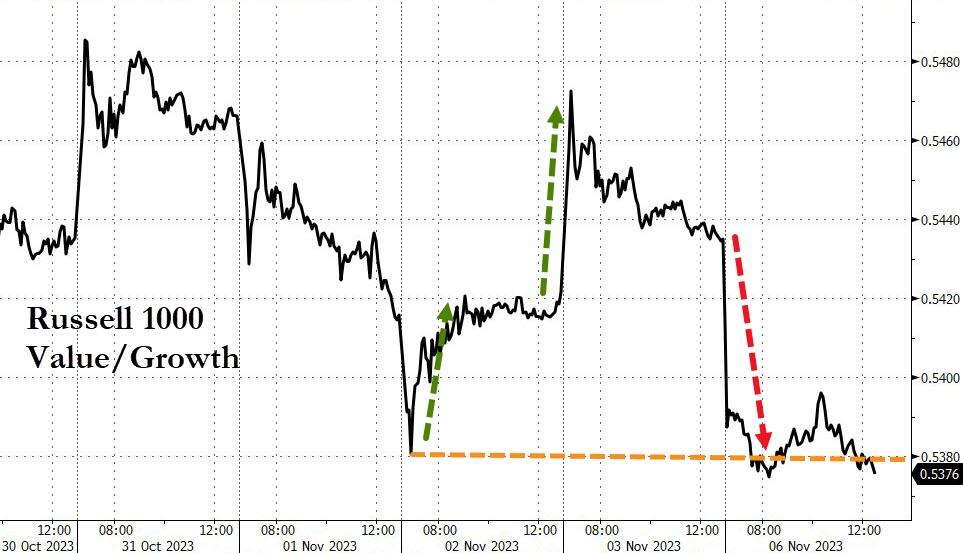
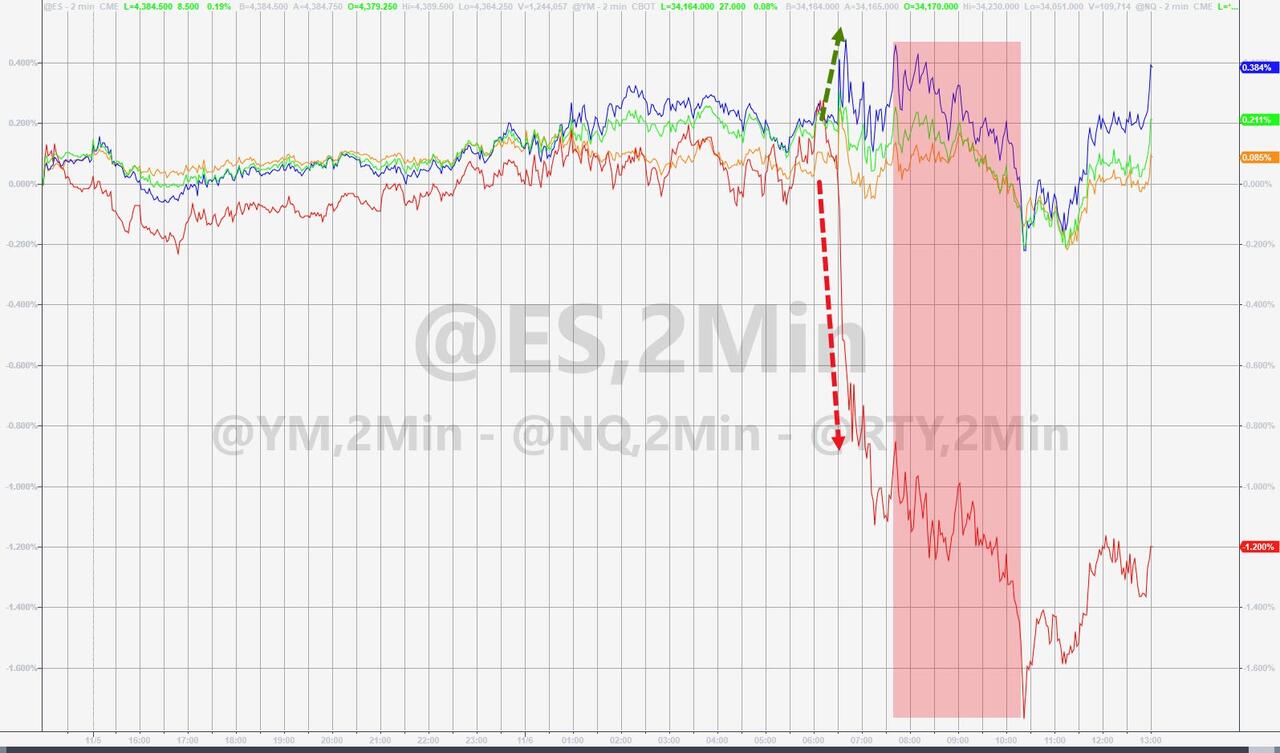
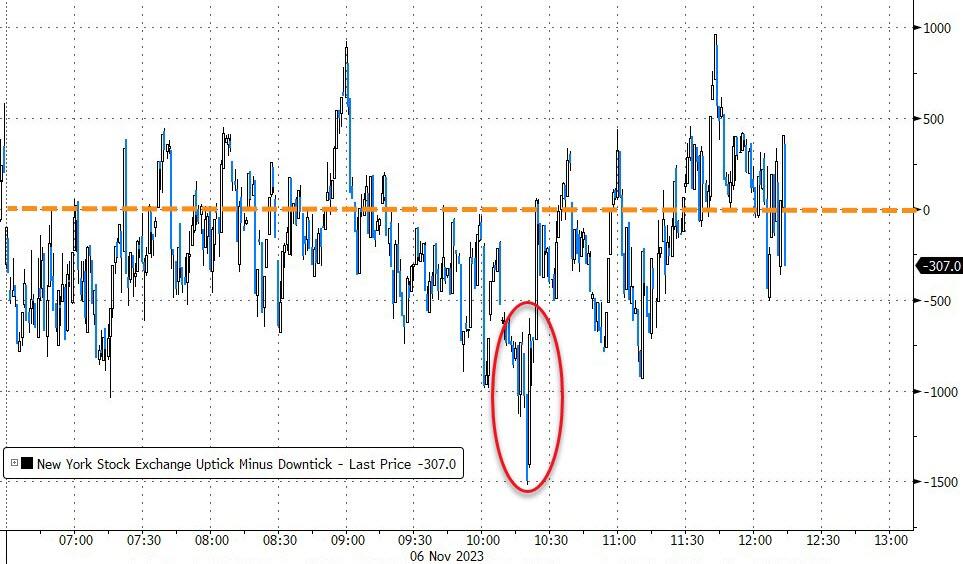
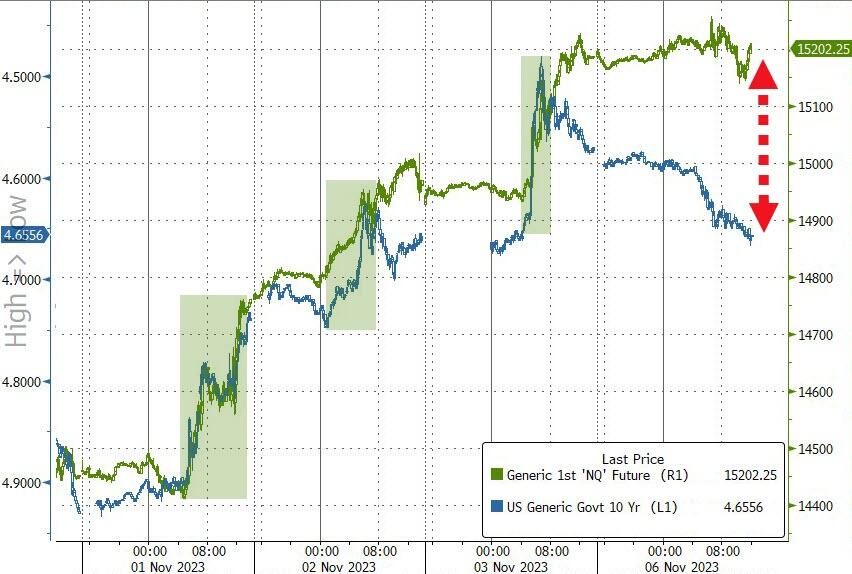
No US macro data today… and no World War 3 over the weekend… provided some early support for US equity futures but the cash open prompted growth over value purge (as small caps were clubbed like a baby seal and Nasdaq saw a modest bid)…

Source: Bloomberg

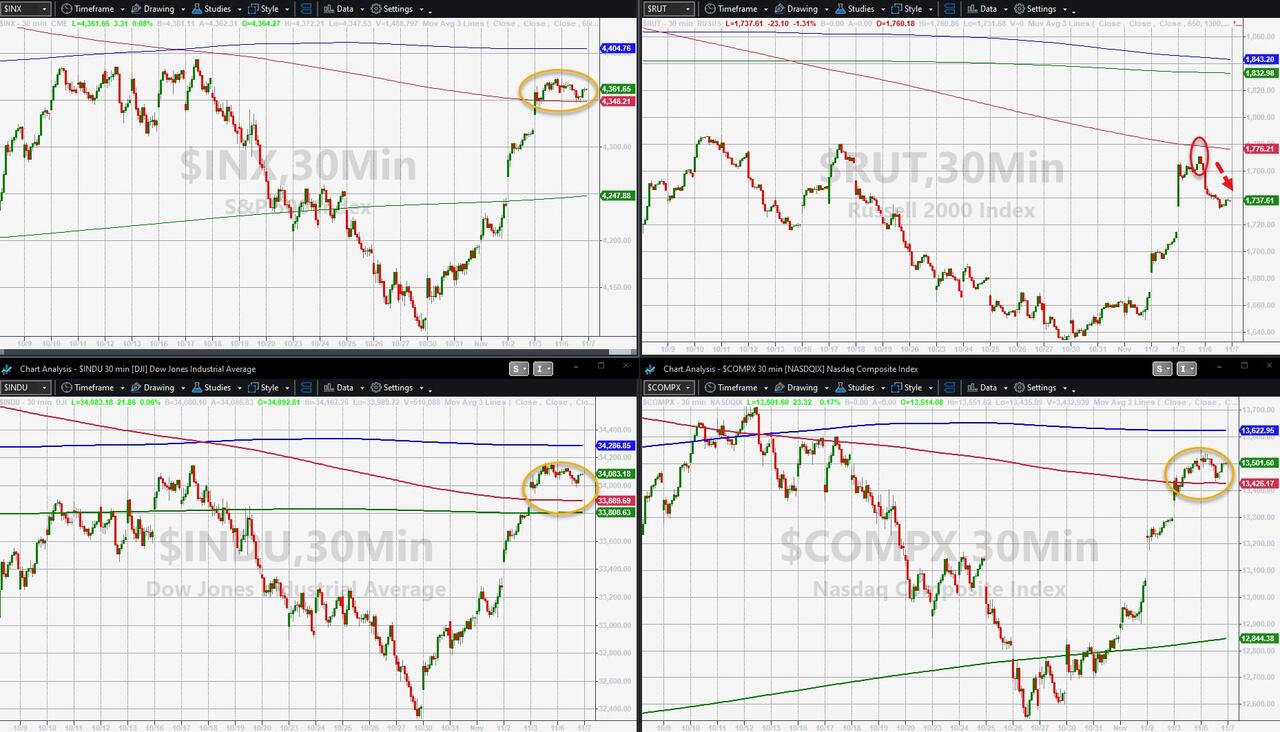
By the close, Russell 2000 was ugly while the rest of the majors found support around unch (with Nasdaq outperforming). There was a mini-melt-up in the last minute of the day….

One thing of note was that around 1300ET, a large sell program hit the market…

Source: Bloomberg

Small Caps reversed at their 50DMA (while the rest of the majors pushed above that level from Friday but couldn’t extend gains)…

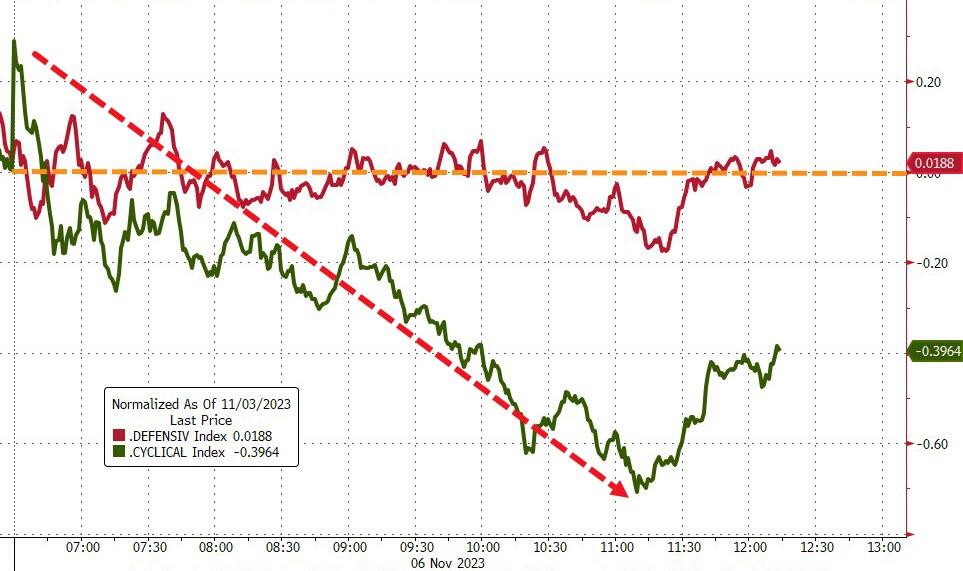
Cyclicals underperformed Defensives today…

Source: Bloomberg

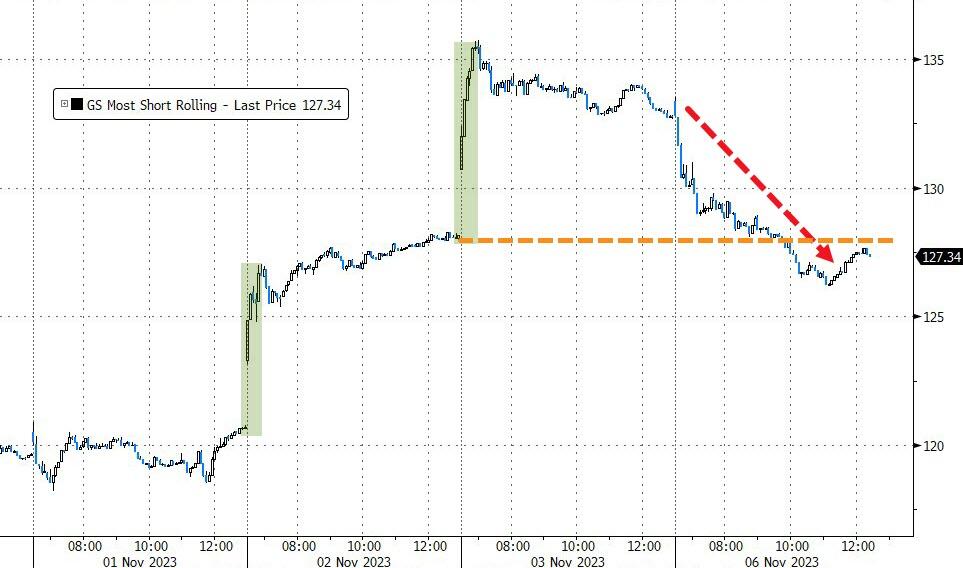
‘Most Shorted’ stocks were hammered all day as no squeeze was engineered…

Source: Bloomberg

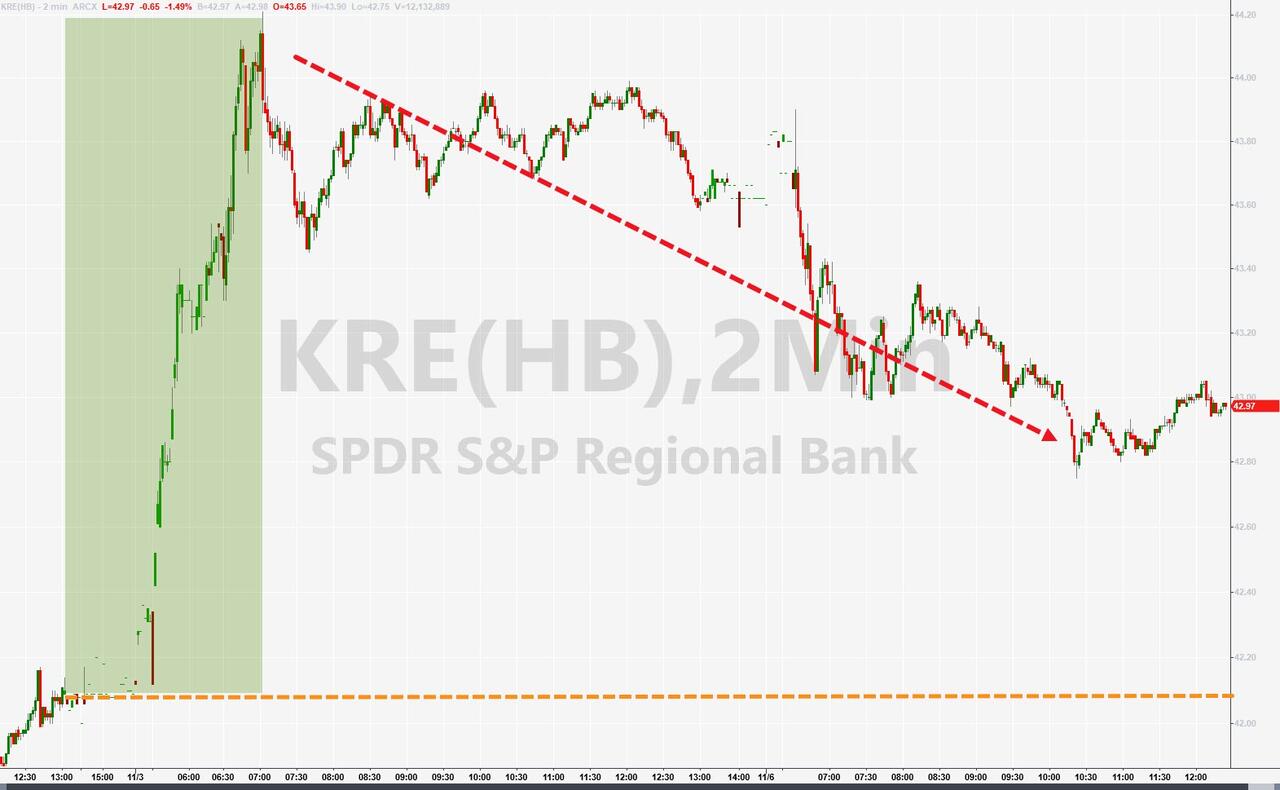
Regional Banks gave back about half of ‘guru’ Gross’ gains from Friday…

But while stocks managed to cling to gains, bonds did not…

Source: Bloomberg

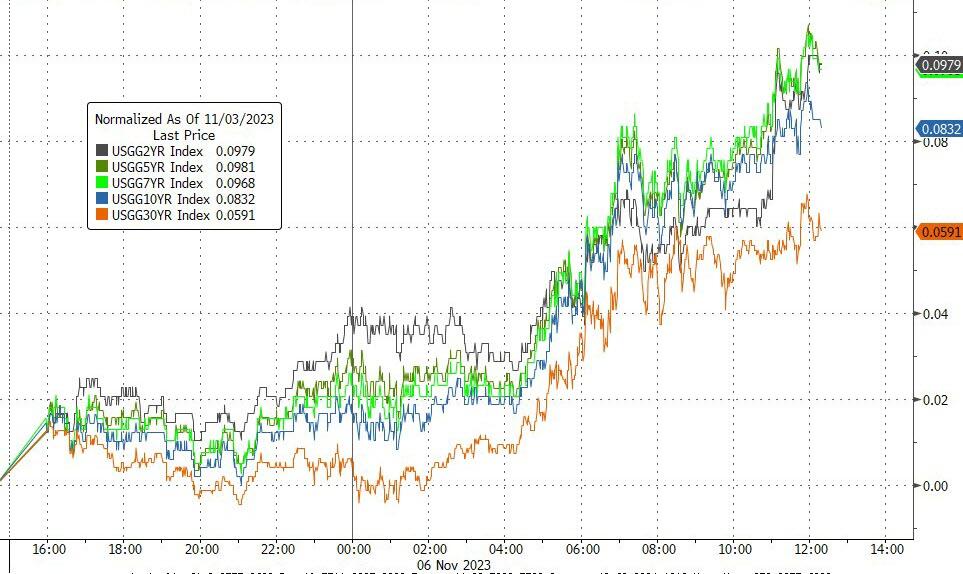
Yields were higher across the curve with the short-end underperforming (2Y +10bps, 30Y +6bps) BUT we note that the corporate bond calendar was relatively heavy today and likely drove the longer-end higher at least in some part…

Source: Bloomberg

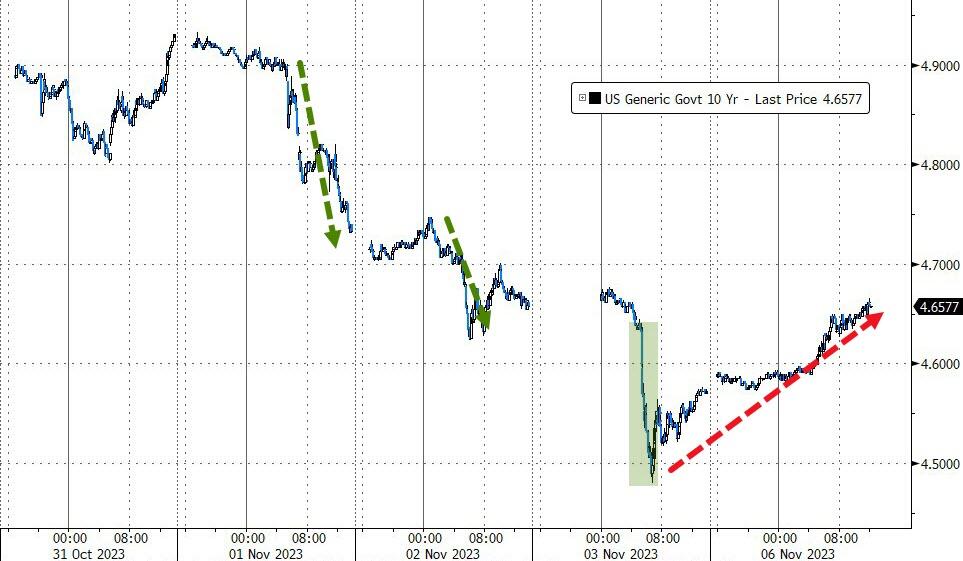
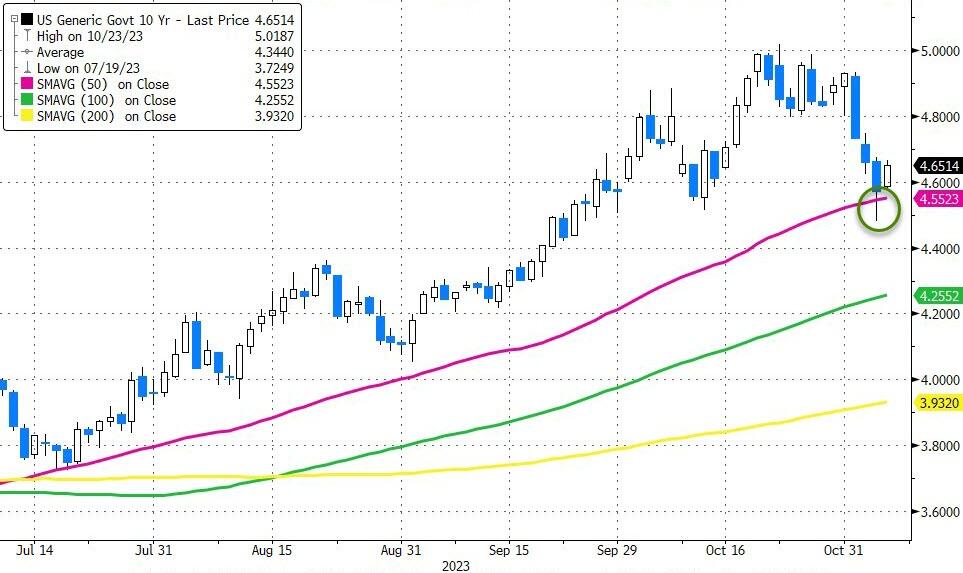
The 10Y yield erased all of Friday’s post-payrolls plunge…

Source: Bloomberg

Notably, the 10Y Yield found support at its 50DMA on Friday and extended that today…

Source: Bloomberg

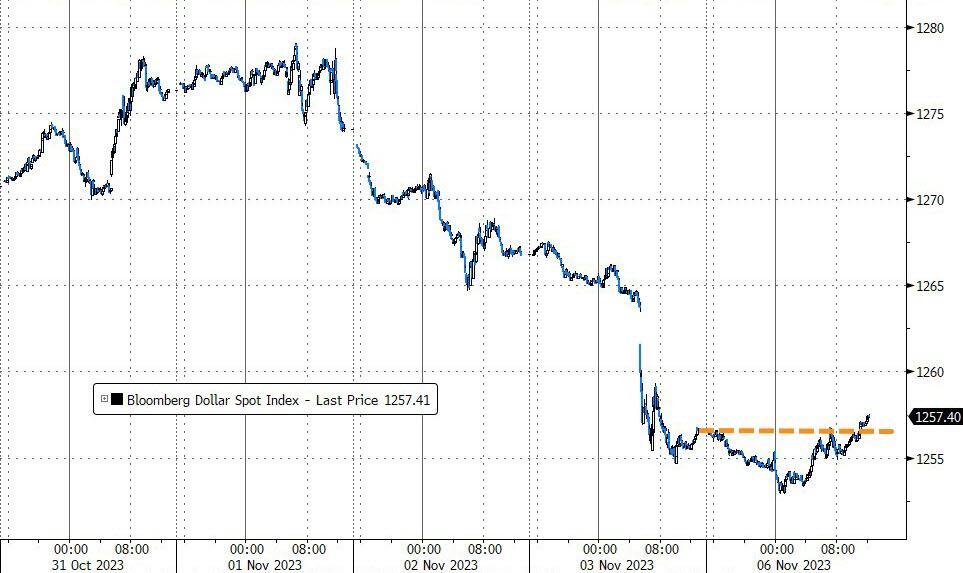
The dollar ended basically unchanged after weakness overnight was bid back during the US day session…

Source: Bloomberg

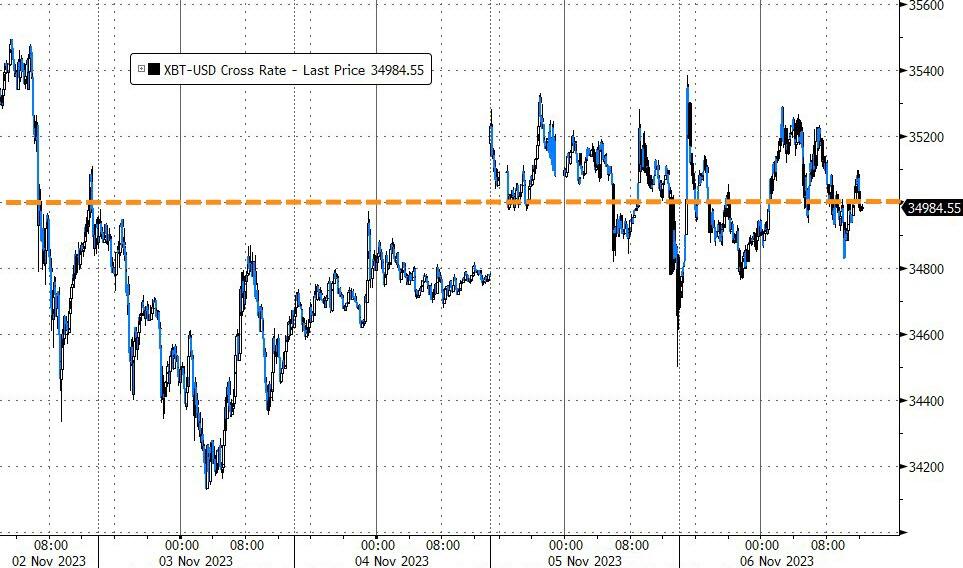
Bitcoin was marginally higher on the day, hovering around $35,000…

Source: Bloomberg

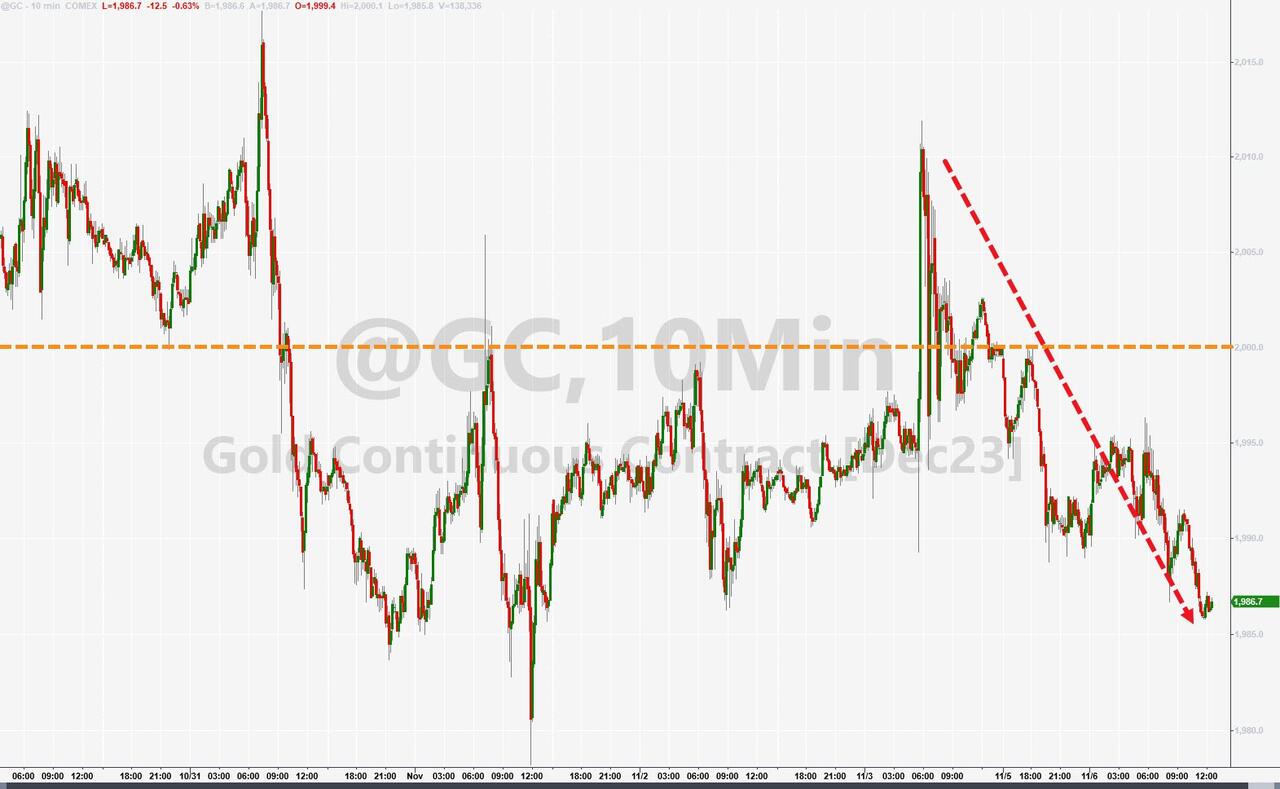
Gold leaked lower with futures unable to bounce back above $2000…

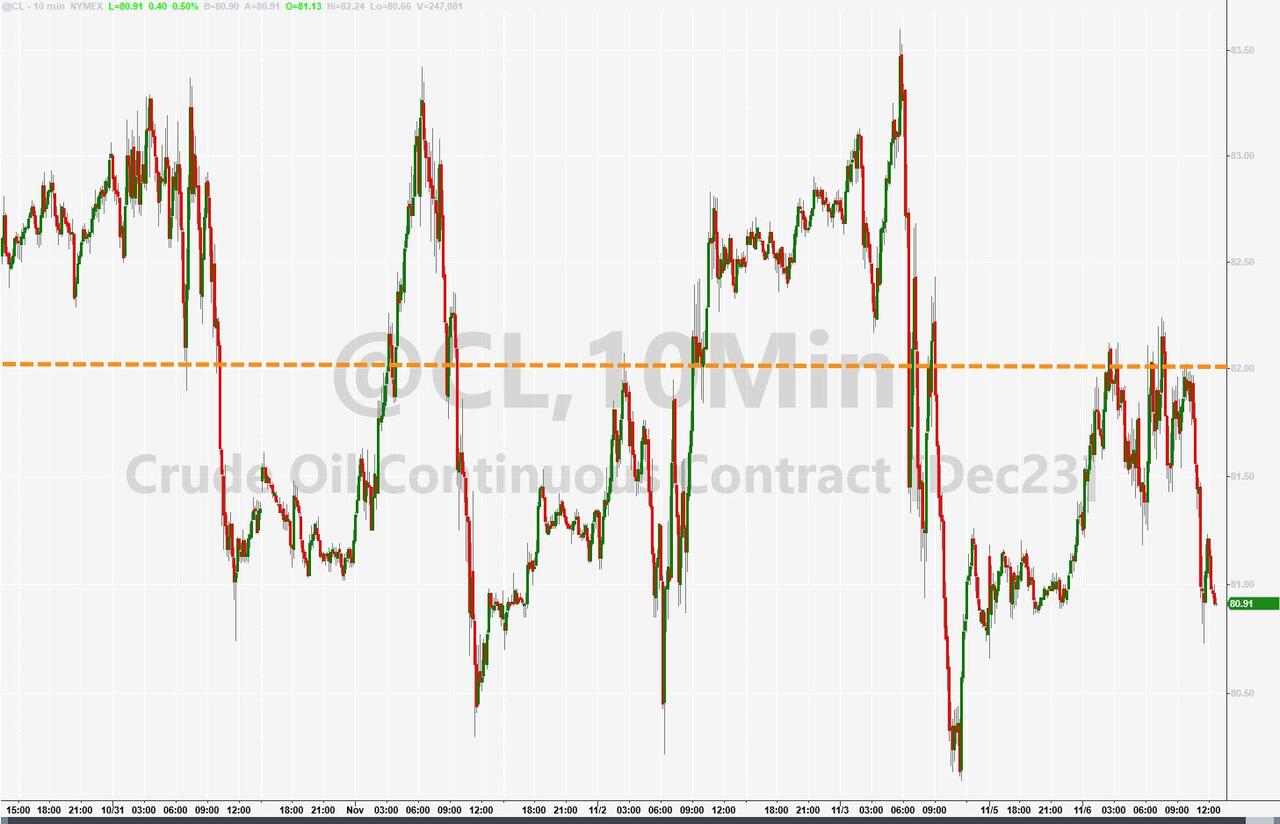
Oil managed to hold on to overnight gains, even as selling pressure pushed WTI back below $81 in the afternoon…

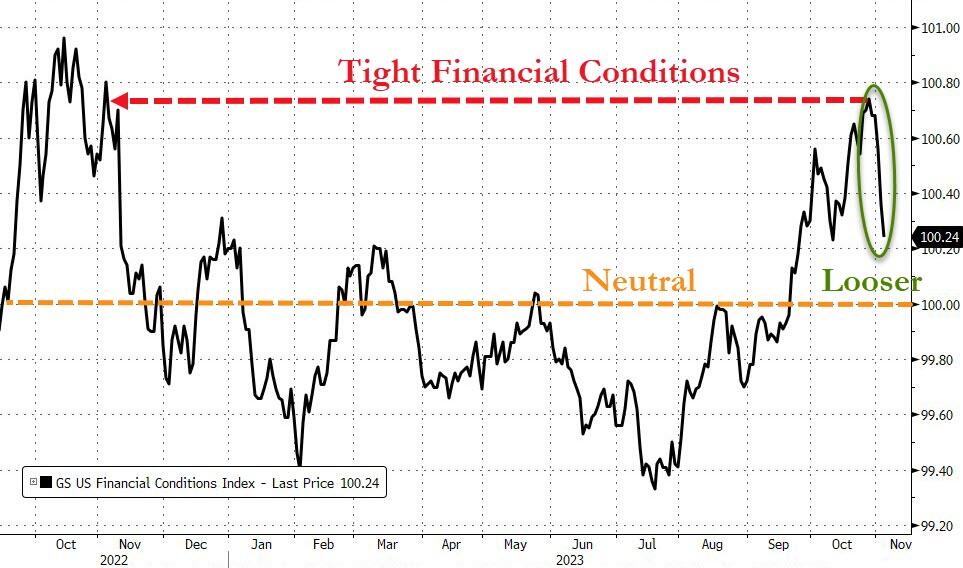
Finally, as we have detailed numerous times in the last week – be careful what you wish for when it comes to ‘tightening financial conditions’. As Bloomberg’s John Authers wrote this morning, monetary policy, Powell has reminded us, works through tightening financial conditions and deterring economic activity. That takes time to work its way through the system. Or, in the words of Milton Friedman, it has a lag. Of late, Powell has been emphasizing the work that tighter conditions – principally the higher 10-year yield – are doing for the Fed. That cheered many by suggesting that higher rates wouldn’t be necessary, and that’s probably been confirmed by the events of last week.

However, as we have highlighted, various problems remain as if it’s the market that has made conditions tighter, it follows that it can also make them looser. Buying things like credit because tight conditions mean there will be no more rate hikes is self-defeating, as it loosens conditions again.

As the Goldman Sachs financial conditions index (defined by its inventors as a weighted average of riskless interest rates, the exchange rate, equity valuations, and credit spreads, with weights that correspond to the direct impact of each variable on GDP), shows, conditions were as tight as they had been all year to start last week, and since then they’ve dropped more than half of the way toward neutral…

Source: Bloomberg

Authers echoes our views perfectly, this is a classic example of what the financier George Soros calls “reflexivity” – the capacity of markets to create their own reality, and not just reflect an external state of affairs.

In fact, the more dovish The Fed sounds (or not hawkish) and the more it mentions the market “doing its job for it via tightening financial conditions”, the more The Fed will be forced to step back into the hawkish mud and slow the market’s exuberance for fear of reigniting asset inflation (as well as ‘real’ inflation).

This is key now as, amid an avalanche of FedSpeak this week, the main speaker is Powell at the IMF conference on Thursday. Last Wednesday he talked about tighter financial conditions doing some of the Fed’s work for them. After the huge 60/40 rally since, will he still feel the same way by Thursday?

Tyler Durden
Mon, 11/06/2023 – 16:00

via ZeroHedge News https://ift.tt/oAdDHxj Tyler Durden

Watch: Antifa Guy’s Epic Fail When He Tries To Get Muslim Girls Onside With Child Sex Changes

Watch: Antifa Guy’s Epic Fail When He Tries To Get Muslim Girls Onside With Child Sex Changes

Authored by Steve Watson via Summit News,

By far the most hilarious and telling moment of the chaotic Pro-Palestine demonstrations in London this past weekend was a masked Antifa type attempting and failing to win support among some young muslim girls for child sex changes.

The encounter happened when activist Chris Elston, also known as Billboard Chris, was accosted by the black garbed Antifa guy over a sandwich board he was wearing that read “Children cannot consent to puberty blockers.”

The guy called Elston a “f**king fascist” and accused him of “enforcing the parent’s control over a person’s body,” as well as being an ‘intimidating’, and argued that “children are not being sterilised,” after Elston told him that “all the trans experts themselves will tell you” that puberty blockers are sterilising children.

The Antifa guy then bizarrely attempted to set a group of muslim women on Elston, telling them “This guy is trying to propagate anti-LGBTQ propaganda. He is trying to tell children they are not allowed be trans.” 

“Yeah, they are not,” one of the girls responded, siding with Elston much to the shock of the Antifa thug who immediately said “f*ck you” to the woman and attempted to get away from the scene.

“In some religions, you can’t do that, you have to respect that,” one of the women added, with another stating “In the three Abrahamic religions LGBTQ is forbidden.”

“In some religions, you can do that, but not in our religion. So we don’t agree with your faith,” the first girl reiterated to the ski-masked guy.

The exchange perfectly highlighted how deranged leftists are attempting and miserably failing to glom on to the protests, or riots as they probably more accurately should be labeled, to push their own usual agendas.

*  *  *

Brand new merch now available! Get it at https://www.pjwshop.com/

In the age of mass Silicon Valley censorship It is crucial that we stay in touch. We need you to sign up for our free newsletter here. Support my sponsor – Summit Vitamins – super charge your health and well being.

Also, we urgently need your financial support here.

Tyler Durden
Mon, 11/06/2023 – 15:45

via ZeroHedge News https://ift.tt/BYyzd1w Tyler Durden

Citigroup CEO’s “Project Bora Bora” Overhaul Could Result In Deep Job Cuts 

Citigroup CEO’s “Project Bora Bora” Overhaul Could Result In Deep Job Cuts 

Citigroup is on the cusp of firing thousands of workers, following through with a restructuring plan previously disclosed by Chief Executive Jane Fraser, according to CNBC. These layoffs could represent one of Wall Street’s deepest rounds of layoffs to date. 

Fraser’s reorganization plan, known internally as “Project Bora Bora,” would result in at least 10% headcount reductions to several of the bank’s major businesses, according to insiders. They noted talks are still underway and subject to change. 

“We’ll be saying goodbye to some very talented and hard-working colleagues,” the exec warned in a recent memo. 

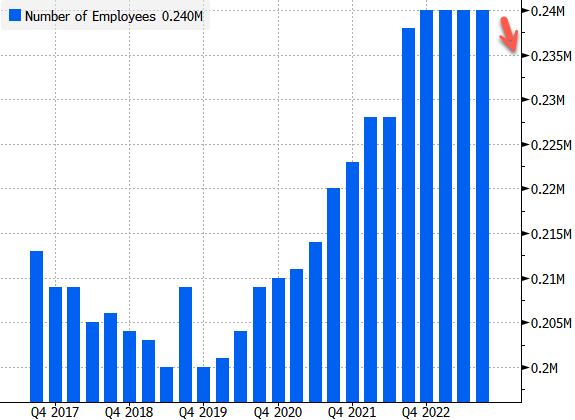
As of Sept. 30, Citigroup has 240,000 employees. The bank has added 40,000 employees since the fourth quarter of 2019. 

One Wall Street analyst told CNBC that Fraser “needs to do something big,” there is a strong possibility the job cuts could be much larger than employees expect: 

“The only thing she can do at this point is a really substantial headcount reduction.

“She needs to do something big, and I think there’s a good chance it’ll be bigger and more painful for Citi employees than they expect,” James Shanahan, an Edward Jones analyst, said. 

Fraser faces the challenges of a surge in headcount over the last several years, while competitors have been cutting jobs this year. She assumed leadership in early 2021, and since then, crucial investor metrics, such as the price-to-tangible book value ratio, trade around .49 – or about half the average of other US peers. 

One banker who recently left Citigroup told CNBC that “morale is super, super low,” and many “are saying, ‘I don’t know if I’m getting hit, or if my manager is getting hit.’ People are bracing for the worst.”

Another person familiar with Project Bora Bora said the number of layoffs would be finalized by the end of the month and could exceed 10% to “eliminate regional managers, co-heads, and others with overlapping responsibilities.” 

A Citi spokesperson told the media outlet, “We’ve acknowledged the actions we’re taking to reorganize the firm involve some difficult, consequential decisions, but they’re the right steps to align our structure to our strategy and deliver the plan we shared at our 2022 Investor Day.”

News of Citi potentially unleashing monster job cuts in the near term comes after several Wall Street firms have been laying off workers this year. Just last week, Charles Schwab reduced its workforce by 2,000, joining the ranks of UBS GroupGoldman Sachs, and several other banks that have been trimming their headcount.

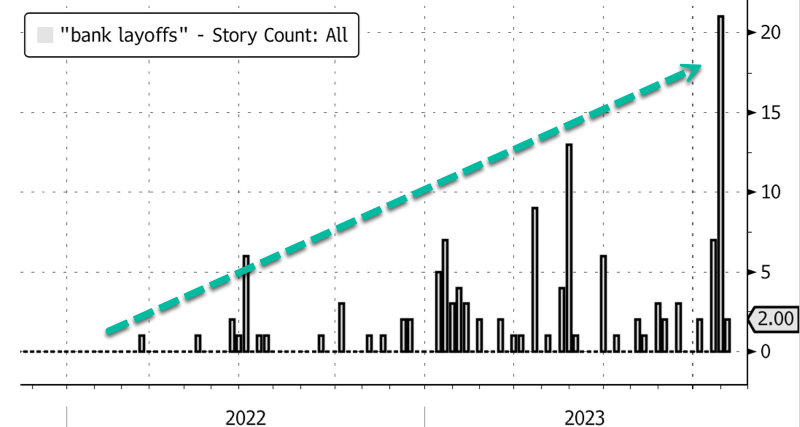
According to Bloomberg data, the number of times “bank layoffs” appear in US news stories has spiked. 

This wave of downsizing comes as banks grapple with mounting economic uncertainty ahead of 2024. 

Tyler Durden
Mon, 11/06/2023 – 15:30

via ZeroHedge News https://ift.tt/Q67NpiO Tyler Durden

China’s Strategic Export Control Upends Rare Earth Markets

China’s Strategic Export Control Upends Rare Earth Markets

Authored by Haley Zaremba via OilPrice.com,

  • China’s restriction on graphite exports could increase global battery production costs, impacting the electric vehicle industry during a pivotal time in the energy transition.

  • The U.S. and other nations are reducing reliance on China’s rare earth minerals, though China still holds a dominant position in global supply.

  • In the long term, China’s export controls may encourage the development of alternative supply sources, enhancing global energy security and market stability.

China has spent years staking out near-total domination of a laundry list of rare earth minerals with a vital and growing role in clean energy supply chains. The nation has been building up its own domestic wealth of these key primary materials while simultaneously expanding its acquisitions and influence in resource-rich developing nations in Asia, Africa, and Latin America. But now, China is limiting exports of graphite, a key material in electric vehicle batteries as well as other energy industry applications, in a move that will have reverberating implications for the global clean energy sector. 

China’s laser focus on building up its energy security to meet its near-insatiable demand for new sources of energy and electricity have given it a massive leg up in the clean energy sector on a global scale, as the West has failed to keep pace with Beijing’s breakneck investing trends. For years, Beijing has been busily outspending and out-negotiating every other country on the planet. According to figures from a BloombergNEF analysis conducted earlier this year, China was solely responsible for almost half of global spending in the renewable energy sector last year at a whopping $546 billion. That’s nearly four times what the United States spent ($141 billion) and 2.5 times what the European Union spent ($180 billion). 

Rare earth mineral markets play a key role in this spending. China is home to 34% of the world’s rare earths (with 44 million tonnes of rare earth oxide (ROE) equivalent in reserves), did 70% of global rare earth mining in 2022, and represents at least 85% of global capacity to process rare earth ores into manufacturing materials. Because of this outsized role, global markets have become dangerously reliant on Chinese supply chains in order to meet their own energy and climate goals. This isn’t just a China issue – it’s also a United States issue. As Foreign Policy recently reported, “America dropped the baton in the rare-earth race.” And now that they’re trying to catch up after years of under-investment, they’re struggling to close the gap.

However the market is changing slightly due to a combination of increased competition, particularly coming from Washington, as well as a shifting strategy on the part of Beijing. While China reported a mammoth amount of rare earth exports last year (48,728 tonnes in 2022) this marked a 0.4% downswing from the previous year. Furthermore, while the U.S. continues to rely on China for the lion’s share of its rare earth imports, that dependence is also slightly lessening, from 80% during the period of 2014 to 2017 to 74% between 2018 and 2021.

And now, doubling down on this trend, China is severely restricting graphite imports according to a statement released by China’s Ministry of Commerce (MOC) and General Administration of Customs on October 20. The translated statement said it was “optimizing and adjusting temporary export control measures for graphite items” in order to “safeguard national security and interests.”

In the immediate term, this means that graphite prices will rise, causing problems for EV battery manufacturers at a critical junction in the global decarbonization transition.

“A curb in the supply of the material originating from an important supplier that is China will increase its price and therefore the cost of production of batteries, particularly for non-Chinese producers,” Carole Nakhle, the CEO of consultancy Crystol Energy was recently quoted by Rigzone.

“However, it is that same price signal and the concern of customers about the security of supply that will also encourage the development of alternative supplies, which is desperately needed to support the security of supply for the energy transition,” she added.

China is fighting to keep up with its own ever-growing energy demand, and its own energy security interests may continue to tamper with the nation’s rare earth exports. This could be a blessing in disguise. While price shocks could cause significant issues in the short term, as the massive and unprecedented deployment of clean energy infrastructure and electric vehicles is necessary and urgent to meet global climate goals, the long-term implications of diversifying global clean energy supply chains are extremely positive. Greater diversity means greater resilience and sustainability of the global economy and shores up global energy security by correcting what is currently an extremely – and dangerously – lopsided market. 

Tyler Durden
Mon, 11/06/2023 – 15:10

via ZeroHedge News https://ift.tt/AIVNTh7 Tyler Durden

Treasury Borrowing Running At Crisis-Era Levels

Treasury Borrowing Running At Crisis-Era Levels

With the November quarterly refunding announcement now in the rearview mirror, we look to the Treasury’s borrowing outlook in historical context. As a reminder, we already gave our verdict last week…

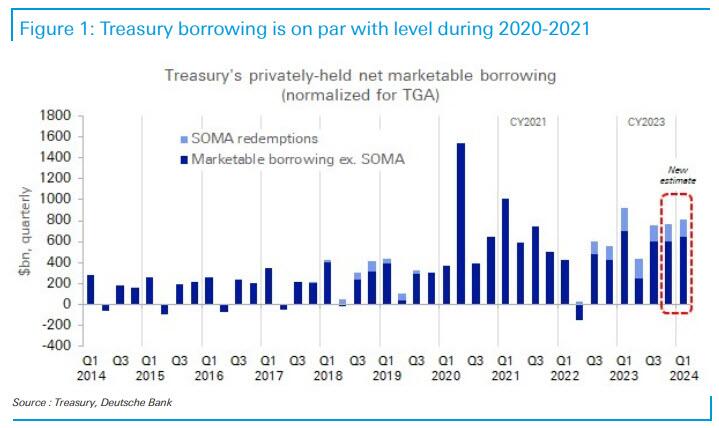
… so today we wanted to give the mic to Deutsche Bank rate strategist Steven Zeng who on Friday published a chart that takes the numbers from the Treasury’s sources and uses table with adjustments to remove the fluctuations in the TGA. This provides a cleaner comparison of quarter-by-quarter borrowing. For example, the Treasury borrowed $1.01 trillion during Q2’23, with $756bn used for financing the deficit and QT, and $254bn was “saved” in the form of a higher cash balance.

In this light, Zeng notes that the Treasury’s expected borrowing for the current and the next quarter is actually larger than Q3’s, growing by about $10 billion per month. In fact, Treasury borrowing is now on par with levels during the 2020-2021 pandemic with both weaker fiscal positions and Fed QT are contributing factors.

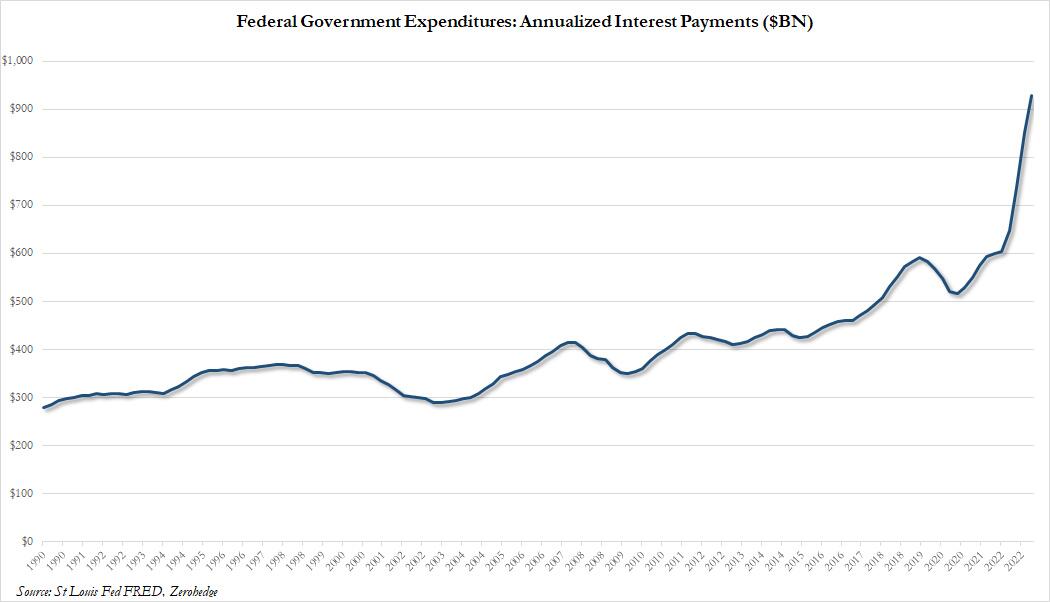
As Zeng puts it, “with a growing view that the Fed may lengthen the duration of QT, and annual deficits projected at around $1.7- $1.8 trillion over the next few years, these issues are unlikely to go away soon.” At the same time, the widening mismatch between supply and demand for Treasuries could exacerbate the issue through increased debt interest expenses.

Goldman has some even more disturbing numbers: according to the bank’s rates strategist Praveen Korapaty, his outlook for Treasury supply in 2024 shows net notional issuance of $2.4 tr, which is inclusive of both bills and coupons. Gross coupon issuance would be much larger, roughly $4.2 tr, which includes issuance to cover maturing debt.

These concerns will remain in the forefront in 2024, with the TBAC highlighting this week the linkage between term premium and fiscal sustainability…

… and that debt and debt service costs should be a consideration for policymakers.

Tyler Durden
Mon, 11/06/2023 – 14:50

via ZeroHedge News https://ift.tt/pc0Y2nk Tyler Durden