‘Terrorism Leads To Lockdowns Leads To Martial Law’ – Martin Armstrong Warns Of Deep State Plan To Hold On To Power

‘Terrorism Leads To Lockdowns Leads To Martial Law’ – Martin Armstrong Warns Of Deep State Plan To Hold On To Power

Via Greg Hunter’s USAWatchdog.com,

Legendary financial and geopolitical cycle analyst Martin Armstrong began 2023 predicting “chaos” would be coming around the world. 

We have a bloody war in Ukraine, a new conflict with Gaza and Israel, and a wide open U.S. border with the FBI predicting huge terror attacks coming to America. 

Is this kind of destabilization a coincidence or is it a Deep State globalist plan? 

Why are the demonic dark powers taking peace from the earth and forecasting big terror events coming to America?  Armstrong contends, “It is very simple.”

“Basically, we are looking at a sovereign default.  Governments are pushed to the limit at this stage.  You even had Fed Head Jay Powell come out last week and say ‘the spending is unsustainable.’ 

The Biden Administration is a complete corrupt absolute disaster.  It’s not really Biden . . . he’s just there to sign whatever they stick in front of him.

So, a debt default will tank the economy and make millions of Americans poor and broke overnight. 

Poor and broke is how revolutions and civil unrest start, especially against the government that caused all the problems. 

Armstrong contends this is why the Southern U.S. border has been wide open for the past three years. 

The Deep State corrupt Biden Administration (RINO Republicans included) want terrorists to come to America and commit awful acts of violence and murder.  Why?  Armstrong explains,

“You have Neocons pushing for war on all possible fronts…

Terrorism leads to lockdowns.  As soon as you start getting this, they will have to know what everybody is doing and where they are moving.  You are looking at ‘Papers, Please.’ …

Lockdowns are coming to America again, absolutely.  This is to prevent civil unrest. 

So, they want the terrorists to blow up some stuff. 

This gives them the excuse to effectively enforce martial law. . . . This helps the government to hold onto power.

Armstrong thinks interest rates and inflation are going to go up for a while. 

He thinks the U.S. dollar will get stronger because capital will flow to the U.S. in times of crisis and war.  Armstrong thinks Hamas has won the public relations war and is trying to isolate Israel on the world stage.  This attack is much deeper than anyone imagines. 

Armstrong says get tangible assets, and that includes gold and silver as core assets. 

He also thinks the global economy will implode, but the USA goes down last. 

Armstrong says the economy will tank in America, but it will be much worse in Blue states like New York, California and Illinois.

There is much more in the 58-minute interview.

Join Greg Hunter of USAWatchdog.com as he goes One-on-One with Martin Armstrong, financial and geopolitical cycle expert for 11.4.23.

To Donate to USAWatchdog.com, Click Here

There is some free information, analysis and articles on ArmstrongEconomics.com.

Tyler Durden
Mon, 11/06/2023 – 14:30

via ZeroHedge News https://ift.tt/MoY4Exe Tyler Durden

John Fetterman Thinks You’re Too Dumb To Understand That Vegan ‘Milk’ Isn’t Dairy


Silk soy milk cartons | Richard B. Levine

Last week, Sen. John Fetterman (D–Pa.) wrote in a viral tweet that “Pennsylvania’s dairy farmers are at the heart of our community and critical to our economy,” adding that he’s working to pass the DAIRY PRIDE Act, which would “protect our dairy farmers by prohibiting non-dairy products from using dairy names.”

However, many quickly pointed out how ridiculous the bill’s premise was. 

“John Fetterman apparently thinks consumers are morons,” responded Paul Sherman, a senior attorney at the Institute for Justice. “Everyone knows ‘almond milk’ is not a dairy product.” 

“Senator, that bill makes it illegal to market ‘coconut milk’ as ‘coconut milk,'” added Shoshana Weissmann, digital director of the R Street Institute, a libertarian think tank. “That’s moronic.”

The DAIRY PRIDE Act, which was reintroduced in March after a first attempt in 2021, would prevent plant-based products from using terms often associated with dairy in their branding. So, should the bill pass, phrases like “oat milk,” “soy yogurt,” and “plant-based cheese” will be off-limits, forcing manufacturers to resort to awkward phrases like “oat beverage” when labeling their products.

The bill was reintroduced in reaction to a February decision from the Food and Drug Administration (FDA) to allow manufacturers of most plant-based dairy alternatives to continue labeling their products as “milk.” The decision, according to the FDA’s draft guidance, was made because the agency found that consumers consistently understood that plant-based milks aren’t dairy products.

Unsurprisingly, dairy manufacturers were not so happy with the new rules—and neither were pro-dairy politicians. 

“The decision to permit such beverages to continue inappropriately using dairy terminology violates FDA’s own standards of identity, which clearly define dairy terms as animal-based products,” wrote the National Milk Producers Federation in a February statement. “We reject the agency’s circular logic that FDA’s past labeling enforcement inaction now justifies labeling such beverages ‘milk’ by designating a common and usual name.”

“For too long, plant-based products with completely different nutritional values have wrongly masqueraded as dairy,” said Sen. Jim Risch (R–Idaho) in a press release following the DAIRY PRIDE Act’s reintroduction. “This dishonest branding is misleading to consumers and a disservice to the dairy farmers who have committed their lives to making milk, cheese, yogurt, ice cream, and more nutritious products.”

However, these concerns are overblown and disguise the real motivation behind calls to limit how plant-based products are labeled: a desire to limit economic competition for dairy farmers.

According to the Plant Based Foods Institute, an industry association, 40.6 percent of U.S. households reported buying plant-based milks in 2022, and 15 percent of all milk purchased in the U.S. is now plant-based. From 2019 to 2022, dollar sales of plant-based milk increased from $2.0 billion to $2.8 billion annually. In contrast, cow milk consumption has been decreasing for decades. 

Contrary to pro-dairy talking points, it simply isn’t true that consumers are particularly confused by plant-based milk labeling. According to a 2018 survey, 75 percent of respondents understood that soy milk and almond milk don’t contain cow’s milk, while only 9 percent said that the beverages contained dairy. 

In fact, “milk” has been used to describe plant-based alternatives for centuries. According to Smithsonian magazine, recipes calling for almond “milk” were popular in medieval cookbooks, where the beverage was often used as an alternative to cow’s milk during Lent

Further, concerns that using “milk” to describe plant-based dairy alternatives could confuse consumers about the beverages’ nutritional value are equally misplaced. While it’s true that most plant-based milks (with the exception of soy milk) have much less protein and calcium per serving than cow’s milk, this information is hardly hidden from consumers—it’s printed on every product’s nutritional label. 

Even if dairy farmers and their political allies have a cow about it, plant-based milk is here to stay, and dishonest regulatory schemes are unlikely to change that.

The post John Fetterman Thinks You're Too Dumb To Understand That Vegan 'Milk' Isn't Dairy appeared first on Reason.com.

from Latest https://ift.tt/qPJ8vrs
via IFTTT

The Wildly Misleading Statistic at the Center of the FTC’s Antitrust Case Against Amazon


Amazon Prime logo on delivery truck |  Michael Kappeler/dpa/picture-alliance/Newscom

One of the central arguments in the Federal Trade Commission’s (FTC) antitrust lawsuit against Amazon is that the online retailing giant has stunted the growth of potential competition by forcing small businesses and other independent sellers to funnel their products through Amazon’s own in-house distribution system.

Much of that argument seems to hinge on a single statistic—one that top officials at the FTC have cited in interviews and on Twitter and that pops up in a newly unredacted part of the FTC’s lawsuit. There’s just one problem: that stat doesn’t say what the FTC keeps claiming it does.

To understand what it does say, first you need a bit of background.

Amazon has allegedly deprived potential competitors of the “ability to gain the scale and momentum needed to effectively compete online,” as FTC Chairwoman Lina Khan told Bloomberg TV in an interview on September 26.

In fact, the argument goes, Amazon has been so determined to squash that potential competition that in 2019 it shut down the so-called “Seller Fulfilled Prime” (SFP) program—an arrangement in which independent sellers could offer free shipping to buyers with Amazon Prime subscriptions but where the sellers remained responsible for getting the orders out the door accurately and on-time. Since the SFP program was shuttered, all independent sellers using Amazon Prime have been forced to go through Amazon’s own distribution network (known as the “Fulfillment by Amazon,” or FBA, system).

That’s evidence of anti-competitive monopoly power, according to Khan, who called the arrangement a “coercive scheme” during that same Bloomberg TV interview.

“At various points, Amazon did experiment with giving sellers more leeway to use Seller Fulfilled Prime,” she explained. “But once Amazon recognized that that would threaten its monopoly power, it switched that off, even though sellers were effectively meeting the same standards that FBA does.”

In the newly redacted part of the lawsuit, the FTC reiterates this claim—and attaches a figure to it: 95 percent. This is the key statistic.

“Amazon shut SFP down because they said deliveries weren’t on time. But new info today shows sellers using SFP met the delivery requirement set up by Amazon more than 95% of the time,” Douglass Farrar, director of public affairs for the FTC, tweeted on Thursday, along with a screenshot from the lawsuit.

In a nutshell, the FTC’s argument is that sellers using the SFP program were meeting their delivery targets 95 percent of the time, but Amazon shut the program down anyway in order to consolidate power and limit competition (even competition that was already coming through its own front door).

But, importantly, that’s not what the 95 percent statistic actually says.

Just read the line in the FTC’s own lawsuit, as helpfully screenshotted by Farrar: “Sellers enrolled in SFP met their promised ‘delivery estimate’ requirement set by Amazon more than 95% of the time in 2018.” (Emphasis added.)

That doesn’t mean those sellers were meeting the requirements of Amazon’s Prime program—it means they were meeting whatever shipping standards they set for themselves when setting up their Amazon seller account.

“It was correct to say sellers met their own estimates, but those estimates for delivery could be days, weeks or even months,” Carl Szabo, vice president at NetChoice, points out. “Customers who bought from these sellers would get their stuff at the ‘promised delivery date,’ but that date could be several days, weeks, or months later—not the two days promised under a ‘Prime’ badge.”

How many of those sellers were actually meeting the standards for Prime-level shipping? According to Amazon spokesman Tim Doyle, it was about 16 percent.

“The misleading figures the FTC points to in the complaint falsely portray how we work with sellers to meet our customers’ high expectations,” Doyle tells Reason. He says Amazon made the decision to pause new enrollment in the SFP program in 2019 because fulfillment rates were “far below the high standards and expectations our customers have for Prime.” Since then, Amazon has restructured the program and reopened it.

Rather than trying to squeeze competition and harm consumers, Amazon seems to have taken proactive steps to make sure its customers were getting the Prime-level service they had paid for. This isn’t evidence of a monopoly; it’s a demonstration of how Amazon has become so successful: by putting customers first.

This is in some ways similar to the bizarre claim the FTC made about Amazon making it too difficult for users to cancel their Prime subscriptions—a process that takes six clicks, one fewer than what’s required to submit a complaint to the FTC, as Reason previously reported.

That was at least an accurate stat—albeit a facetious one, and a pretty silly thing to base an antitrust lawsuit upon. By comparison, the inaccurate way that the FTC has used this statistic about Amazon’s SFP program cuts to the core of the agency’s lawsuit. It suggests that Khan either fundamentally misunderstands the claim she (and the FTC at large) is making, or that she is lying about what it means.

“By presenting this as some sort of ‘gotcha’ moment, the FTC is trying to suggest that SFP outperforms FBA, which is simply not true,” wrote Carl Holshouser, senior vice president of TechNet, a nonprofit that advocates for the so-called “innovation economy,” on Twitter. “The FTC, by mischaracterizing the facts of this case and continuing their efforts to undermine consumer preferences, is once again undermining their own credibility.”

Amazon didn’t kill an alternative that was working for consumers as a way to entrench its monopoly further. It shut down a program that was clearly flawed and that threatened to undermine customer confidence in the Amazon brand, reconfigured it, and now has re-opened it with better controls in place.

Then again, it’s probably no surprise that the federal government is unfamiliar with that process.

The post The Wildly Misleading Statistic at the Center of the FTC's Antitrust Case Against Amazon appeared first on Reason.com.

from Latest https://ift.tt/BZNTMDC
via IFTTT

Jordanian Air Force Conducts Unprecedented Medical Supply Airdrop Over Gaza 

Jordanian Air Force Conducts Unprecedented Medical Supply Airdrop Over Gaza 

The death toll in Gaza has surpassed 10,000 and there are a reported tens of thousands of civilians wounded after weeks of Israel’s aerial bombardment and ground assault in response to Hamas’ Oct.7 massacres against soldiers and civilians in southern Israel. 

Hamas on Monday has claimed that 250,000 houses, apartments and structures have been destroyed in the Gaza Strip thus far, and hospitals have reiterated they are fast running out fuel needed to run vital generators. Neighboring Jordan has embarked on a rare intervention in Gaza, announcing that its air force had dropped “urgent medical aid” to a Gaza hospital which has been run under Jordanian government oversight since 2009.

Jordanian Air Force C-130, illustrative: Wiki Commons

An Israeli official has told Axios that the Jordanian air drop “was conducted in coordination with Israel’s military.” This despite that the two countries whose relations are governed by a historic peace treaty have witnessed ties approaching near breaking point in the last several days.

The supplies fell via parachutes after the hospital said it is running out of medical supplies to treat thousands of wounded, and also at a moment aid convoys have been held up at the Rafah crossing with Egypt. 

Jordan’s King Abdullah II confirmed the airdrop in an early Monday statement, saying on X, “Our fearless air force personnel air-dropped at midnight urgent medical aid to the Jordanian field hospital in Gaza.”

“This is our duty to aid our brothers and sisters injured in the war on Gaza,” he added. “We will always be there for our Palestinian brethren.”

This rare coordination with Israel happened despite Jordan just five days ago moving to recall its ambassadors from Israel in protest of the “humanitarian catastrophe” in the Gaza Strip.

Jordan also has very close relations with the US military and intelligence services, yet its domestic situation is tense and delicate, given that over half of the entire Jordanian population is of Palestinian origin. The Pentagon has training bases in the country, in cooperation with Jordanian forces.

But separately, Jordanian Prime Minister Bisher Khasawneh also on Monday issued the strongest warning yet aimed at Israel from Amman. He said any move by Israel to initiate a mass displacement of Palestinians from the Gaza Strip and West Bank would be seen as a “declaration of war”.

“The continuation of the sinful aggression against the Gaza Strip, with all its crimes, constitutes a flagrant violation of international law and international humanitarian law,” Khasawneh said. And that’s when he declared:

“It is necessary to stop the impunity and protection that gives Israel the license to kill Palestinian civilians. International humanitarian law prohibits and criminalizes targeting and killing civilians without exception,” the Jordanian prime minister added.

Any attempts or creating conditions to displace Palestinians from Gaza or the West Bank are a red line and Jordan will be considered as a “declaration of war”

Since the start of the conflict last month, Jordanian officials have also warned of the potential of the conflict to spread, threatening “the security of the entire region.”

Regional stability related to unrest in Israel or on its borders has historically centered on the separate peace deals Israel has made (brokered under the US) with both Egypt and Jordan. In return, Washington pumps billions in military and foreign aid to the Egyptian and Jordanian governments.

Tyler Durden
Mon, 11/06/2023 – 14:10

via ZeroHedge News https://ift.tt/47UuZiE Tyler Durden

Sam Bankman-Badly-Needed-Reality-Check-Fried

Sam Bankman-Badly-Needed-Reality-Check-Fried

Submitted by QTR’s Fringe Finance

In the world of finance, moments that restore faith in reality are few and far between. However, if there was one such moment last week, it was the conviction of Sam Bankman-Fried. This event momentarily bolstered my confidence not just in regulators, but in the very fabric of reality.

It’s important to give credit where it’s due. Many of my readers, along with numerous individuals I follow online, continually chide regulators. Just a year ago, I echoed these sentiments when it became glaringly clear that FTX was a colossal fraud and SBF wasn’t thrown in jail overnight.

Now, a year on, I must congratulate not only the regulators but also the legal system.

Everyone’s diligence in gathering evidence and building a robust case was instrumental in securing a conviction against Bankman-Fried at trial. Prosecutors’ work was both swift (a year is lightning fast to secure a conviction) and commendable.

In addition to restoring my faith in justice and truth, Bankman-Fried’s conviction also rekindled my trust in reality.

Most of my readers are aware that my macro perspective on both markets and the economy is that, in plain terms, that we’re on the brink of something cataclysmic, which will likely lead to a fresh round of extreme quantitative easing from the Federal Reserve.

And I know it’s controversial, but my reasoning has simply come from my belief that several decades of the easiest money in history cannot then meet the fastest acceleration of interest rates in recent history without causing an explosion somewhere. In other words, my thesis for almost everything that I own is based simply on math and common sense.

And while that sounds like the simplest and likely most reasonable way to invest, we all know that the market can stay irrational longer than most people can stay solvent.

That saying became popular because the stock market, subject to micromanagement from the central bank and the government, basically does whatever the fuck it wants (technical financial term) at any and all times.

Reality doesn’t play much of a role in a market that is driven solely by passive investing, algorithms, options gamma, revenue-less garbage growth companies, insane valuations, brain-dead morons like Cathie Wood, clueless PhD economists at the central bank, Tom Lee on CNBC every day and the next round of bilge to exit the mouth of our Treasury Secretary at some bullshit fireside chat in Belgium.

In other words, it is anything but reality that has been driving the stock market, especially recently.

I’ve written at length about how frustrating it has been for me to have been short the market for the better part of the last two years while rates are rising and to have been wrong. I’ve also written about the fact that the market does generally take its obligatory plunge after rate hikes have concluded, and around the time the Fed begins to cut, which it seems we are not far off from.

But the crux of all this reasoning relies on some semblance of rational thought and reality, which has been sorely lacking over the last two years.


50% OFF ALL SUBSCRIPTIONS: Subscribe and get 50% off and no price hikes for as long as you wish to be a subscriber.


The Bankman-Fried trial has been a solitary beacon of both efficiency and reality over the last week. As the stock market continues to melt up, despite the fact that we are on the verge of World War III, at least the Bankman-Fried conviction was quick and easily reconciled in the minds of pretty much everybody who had paid attention to it or followed along with it.

Everybody knew he was guilty, everybody wanted him to be convicted, and that’s what happened.

I also, sadly, realize there is still time for a major disappointment when it comes to his sentencing. In situations like this, news outlets are always in a rush to report what the maximum sentence could be. In the case of Bankman-Fried, it’s something like 110 years. What he will be dealt may be vastly different, but one thing is for sure: he’s very likely going to spend time in prison.

Photo: Bloomberg

Even though I’m not holding my breath for the sentencing, I am encouraged by both the injection of reality and the justice of how well his case was handled.

And as I’ve written over the last month, if any of the reality of the outside world – if even an iota of it – starts to seep into the stock market the way it just seeped into Sam Bankman-Fried’s world, the shit will hit the fan quickly and, hilariously, will shock almost everybody.

I’m sure that won’t happen. Instead, the market will figure out some new way to justify insane valuations on the cusp of World War III and a reduction of the money supply. Something will likely then break, and they’ll wind up doing yield curve control and additional quantitative easing. The price of metals, which would be expected to soar, will probably remain suppressed due to paper trading, and the whole nauseating cycle can begin all over again.

But at least for today, I’m going to bask in the much sought-after reality check of the events that took place last week. At least for today, one plus one equals two again. Oh happy day.

QTR’s Disclaimer: I am an idiot and often get things wrong and lose money. I may own or transact in any names mentioned in this piece at any time without warning. Contributor posts and aggregated posts have not been fact checked and are the opinions of their authors. This is not a recommendation to buy or sell any stocks or securities, just my opinions. I often lose money on positions I trade/invest in. I may add any name mentioned in this article and sell any name mentioned in this piece at any time, without further warning. None of this is a solicitation to buy or sell securities. These positions can change immediately as soon as I publish this, with or without notice. You are on your own. Do not make decisions based on my blog. I exist on the fringe. The publisher does not guarantee the accuracy or completeness of the information provided in this page. These are not the opinions of any of my employers, partners, or associates. I did my best to be honest about my disclosures but can’t guarantee I am right; I write these posts after a couple beers sometimes. Also, I just straight up get shit wrong a lot. I mention it twice because it’s that important.

Tyler Durden
Mon, 11/06/2023 – 13:50

via ZeroHedge News https://ift.tt/weWiV4Q Tyler Durden

Newsom Signs $25 Minimum Wage Law For ALL Hospital Workers, Finds Out Afterwards It Will Cost California $4 Billion

Newsom Signs $25 Minimum Wage Law For ALL Hospital Workers, Finds Out Afterwards It Will Cost California $4 Billion

Authored by Monica Showalter via American Thinker,

Governor Hairspray doesn’t pay attention much to California’s budget numbers when he signs off on a bill. It’s as if putting on a green visor would mess up his costly coif.

So, in no surprise to the rest of us, Gavin Newsom was in for a surprise.

According to the Los Angeles Times:

SACRAMENTO —  When Gov. Gavin Newsom signed a law that set a first-in-the-nation minimum wage for healthcare workers, three words in a bill analysis foretold potential concerns about its cost: “Fiscal impact unknown.”

Now, three weeks after Newsom signed SB 525 into law — giving medical employees at least $25 an hour, including support staff such as cleaners and security guards — his administration has an estimated price tag: $4 billion in the 2024-25 fiscal year alone.

Half of that will come directly from the state’s general fund, while the other half will be paid for by federal funds designated for providers of Medi-Cal, California’s Medicaid program, according to Newsom’s Department of Finance.

SB 525 is one of the most expensive laws California has seen in years and comes as the state faces a $14-billion budget deficit that could grow larger if revenue projections continue to fall short. It was one of several labor-backed measures the Democrat-controlled Legislature passed this year in what amounted to an unusually successful run for organized labor. What lawmakers didn’t fully account for, as they scrambled in the final days of the session to broker a deal between unions and hospitals to support the bill, was how much it would cost the state — or what might have to be cut to pay for it.

So now the state gets to pay the janitors, gardeners, Mexican cleaning ladies (yes, real ones, and they live in Mexico and commute), gift shop clerks, and anyone else in the employ of a hospital, $25 an hour, no exceptions, and no matter what the value of their jobs are in the free market.

What a great way to spend the state’s revenue at a time of a $14 billion deficit. Now Newsom gets an $18 billion deficit, but when you have a billion here, a billion there, who’s counting?

Except that the Times notes that services in other areas are going to have to be cut to “pay for” these inflated wages.

Meanwhile, as far as those $25 an hour hospital cleaning jobs go, get ready for it — those menial jobs will suddenly become very politicized as to who gets one. You can bet that anyone who has such a job will be or become a very dedicated Democrat union operative and willing to do anything for them. Get ready for the beefed-up ballot-harvesting brigades, muscling unwilling voters in their homes to play ball for the Democrats.

It’s simply outrageous, and it was a completely preventable problem.

Had Newsom examined the cost and benefit of raising gardeners’ wages to $25 an hour, like any normal governor would do, he would have probably modified the bill to reasonable standards, or better still, just said ‘no.’

But this was unions we are talking about, and this one the same SEIU union Newsom succored a few weeks ago when he appointed Laphonza Butler to the Senate seat vacated by the death of Dianne Feinstein, even though she was a resident of Maryland. Newsom couldn’t find any black female Californians to take the job? Of course not.

Butler had spent most of her working career as an SEIU organizer and operative, so we can see the outlines of the pattern here, given that unions have tremendous power in the state of California.

Now they’ve left him with a $4 billion bill, which he will blithely sweep under the rug as he cuts vital services elsewhere in the state. CalFire, the mighty wildfire fighting state agency, get ready for your haircut. California Highway Patrol, get ready for budget cuts.

We all know who’s going to get the short end of the stick in this one as gardeners now make white-collar salaries.

We can also look forward to higher health insurance bills as those higher costs make their way down to the insurance agencies. Somebody’s going to be paying for it.

No wonder Californians are bailing out. California has lost 800,000 residents during these Newsom years from 2020-2023, according to CapRadio. Another chart, from the Public Policy Institute of California shows tremendous losses — noting at the end that there’s no end in sight.

Don’t we pay these politicians to consider costs and benefits of various spending measures before signing on? Normal governors look at costs before they sign the bills, not the other way? Not to Newsom. He just goes along with what unions want … and now expects that his next stop is the seat behind the desk in the Oval Office.

Tyler Durden
Mon, 11/06/2023 – 13:10

via ZeroHedge News https://ift.tt/q29mWFt Tyler Durden

Due Process Demands Stricter Standards for Restraining Orders That Negate Gun Rights


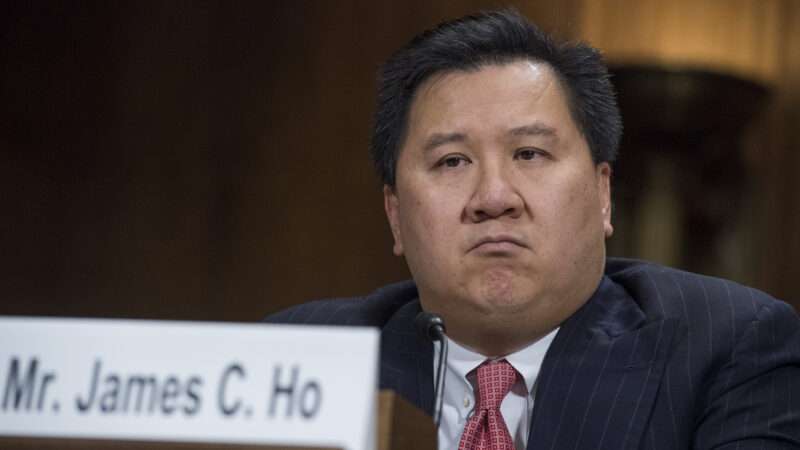
5th Circuit Judge James C. Ho | Tom Williams/CQ Roll Call/Newscom

Since 1994, federal law has prohibited gun possession by people who are subject to domestic violence restraining orders. Although that provision may seem like a commonsensical safeguard, the U.S. Court of Appeals for the 5th Circuit ruled last February that it was not “consistent with this Nation’s historical tradition of firearm regulation”—the constitutional test prescribed by the U.S. Supreme Court’s 2022 ruling in New York State Rifle & Pistol Association v. Bruen. On Tuesday, in United States v. Rahimi, the Supreme Court will consider whether the 5th Circuit was right about that.

Rahimi is primarily about the contours of the right to keep and bear arms as it was traditionally understood. But a Cato Institute brief notes that the case also raises the question of what due process requires when the government seeks to deprive someone of that right.

Under 18 USC 922(g)(8), which Congress approved as part of the Violent Crime Control and Law Enforcement Act of 1994, it is a felony, currently punishable by up to 15 years in prison, for someone to possess or receive a firearm when he is subject to a court order that restrains him from “harassing, stalking, or threatening an intimate partner” or the partner’s child or from “engaging in other conduct that would place an intimate partner in reasonable fear of bodily injury” to the partner or the partner’s child. The order must be preceded by a hearing of which the respondent “received actual notice,” and it must include either a finding that the respondent poses “a credible threat” or language that “prohibits the use, attempted use, or threatened use of physical force” that “would reasonably be expected to cause bodily injury.”

To issue an order, in other words, a judge need not conclude that the respondent actually poses a threat. To trigger the loss of gun rights, the order need only include boilerplate regarding the use of force. And as 5th Circuit Judge James C. Ho noted in his concurring opinion last February, orders that include such language are “often used as a tactical device in divorce proceedings,” “are granted to virtually all who apply,” are “a tempting target for abuse,” and in some cases have been used to disarm the victims of domestic violence, leaving them “in greater danger than before.”

Are the procedural protections specified by Section 922(g)(8) enough to guarantee the “due process” that the Fifth Amendment demands before someone can be “deprived of life, liberty, or property”? The Cato Institute, joined by the Goldwater Institute, thinks not.

When Congress enacted this provision, the Cato brief notes, the Supreme Court had not yet recognized that the Second Amendment protects an individual right to arms, which happened 14 years later in District of Columbia v. Heller. “The bare-bones framework for dispossession upon issuance of a domestic violence restraining order set forth in § 922(g)(8) evinces a legislative perception that the stakes for the gun owner are negligible and that the amount of process required to extinguish his Second Amendment rights is correspondingly minimal,” Cato says. “Thus, all that § 922(g)(8) requires is notice of the proceeding and an opportunity to participate, together with either an express finding of dangerousness or an explicit prohibition of the use or threatened use of force against an intimate partner or child.”

Now that armed self-defense has been recognized as an interest on par with other constitutional rights, Cato argues, due process clearly requires more. Currently, federal law does not require notice to the target of an order that it will deprive him of his Second Amendment rights, which he may not realize. That information is important, Cato says, because a respondent might not be inclined to contest an order that he thinks will merely forbid conduct that is “already unlawful (physically assaulting another person)” or “at the very least unethical (harassing, stalking, or threatening an intimate partner or their child).”

Respondents may also surmise, based on judges’ readiness to issue protective orders “to virtually all who apply,” that challenging them would be futile or worse. Cato notes that respondents have no right to be represented by an attorney if they cannot afford one and may end up having to pay the other side’s legal fees. In Texas, where this case originated, that obligation goes only one way: Fees are shifted to the respondents if they lose, but respondents cannot recover their fees in the (unlikely) event that they prevail.

Section 922(g)(8) not only does not require a finding that respondents are dangerous. It also does not specify a standard of proof to establish that optional element. In most states, a “preponderance of evidence” is enough, meaning the proposition is more likely than not to be true. In the context of terminating parental rights, by contrast, the Supreme Court has held that a higher standard is required: “clear and convincing evidence.”

Congress can address these deficiencies by amending the law. While the Supreme Court need not specify how that should be done, Cato says, the justices should recognize that the current procedural protections are inadequate when a “fundamental right” is at stake.

Section 922(g)(8) is “both historically anomalous and legally deficient in failing to ensure an adequate measure of procedural due process,” the brief says. “The threadbare procedures set forth in § 922(g)(8) would be considered woefully inadequate to support the abrogation of other fundamental rights,” such as the right to travel, the right to access the internet, or “the ability to petition the government for redress of grievances by attending a city council meeting.” The “right of armed self-defense,” Cato argues, “is no less important and no less entitled to an appropriate measure of procedural due process.”

The post Due Process Demands Stricter Standards for Restraining Orders That Negate Gun Rights appeared first on Reason.com.

from Latest https://ift.tt/1OStAia
via IFTTT

Senate Resolution Would Send Federal Offenders Back to Prison 3 Years After Being Released to Home Confinement


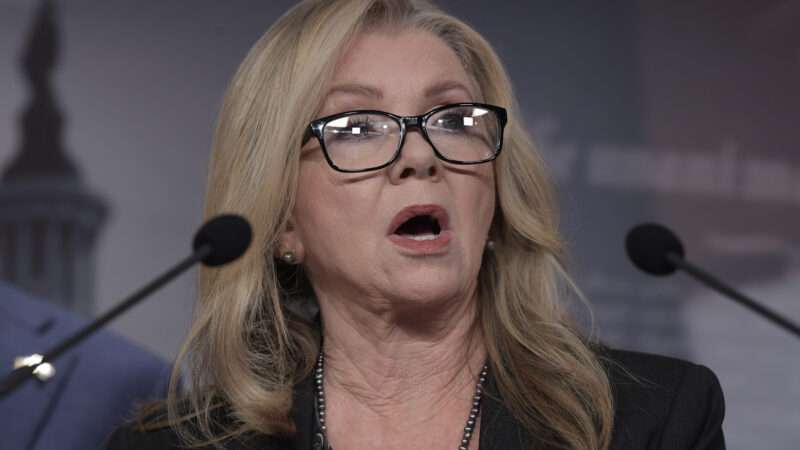
Marsha Blackburn | Lenin Nolly/Sipa USA/Newscom

A Senate resolution gaining traction among Republicans could send thousands of federal offenders back to prison three years after they were released on home confinement due to the COVID-19 pandemic.

On October 30, Sen. Marsha Blackburn (R–Ten.) introduced S.J. Res. 47, which would overturn a Justice Department rule allowing some federal offenders to remain under house arrest after the end of the government’s COVID-19 emergency declaration.

Congress initially approved the shift of at-risk inmates to their homes in its COVID-19 relief bill, the Coronavirus Aid, Relief, and Economic Security (CARES) Act. According to the Bureau of Prisons (BOP), roughly 5,700 federal offenders are serving the remainder of their sentences at home. Criminal justice reformers argue that the program has been an unqualified success, and that it would be bizarre and cruel to send people who have thrived on the outside back to federal prison three years later.

“While there are certainly plenty of legitimate issues with the BOP that merit senators focusing oversight on the Bureau, CARES Act home confinement is an example of a program that is working—rehabilitating people while holding them accountable, all while driving down costs and maintaining community safety,” says Kevin Ring, vice president of criminal justice advocacy at Arnold Ventures, a private philanthropy group.

The inmates released under the CARES Act have had an extraordinarily low recidivism rate. Of more than 11,000 inmates released to home confinement, who are subject to ankle monitors and strict rules, only 17 had been returned to prison for committing new crimes, according to the BOP. The average overall recidivism rate in the general BOP population is 43 percent.

Those released early to home confinement began to rebuild their lives and reconnect with their families. Among the success stories is Kendrick Fulton. After spending 17 years in federal prison for a nonviolent drug offense, Fulton has gotten his commercial drivers license and a steady job delivering soda.

“I was blessed to be home and not have to really rush to get a job, not have to rush to do certain things, because of my family and the support I had,” Fulton says. “But everybody doesn’t have that luxury that I have of having family.”

There was uncertainty over what would happen to Fulton and others in his situation once the pandemic was over. 

In the final days of the Trump administration, the Justice Department released a memo finding that once the federal government ended its COVID-19 emergency declaration, all of those former inmates with remaining sentences would have to report back to prison.

Criminal justice advocacy groups began pressing the Biden administration to reverse that decision. The White House initially declined to do so, instead announcing a clemency initiative that would have targeted only nonviolent drug offenders, leaving thousands of others, such as white-collar offenders, to return to prison regardless of their conduct. But last December the Justice Department reversed course and issued a new memo finding that the BOP had the discretion to leave them under house arrest for the remainder of their sentences.

“It would be a terrible policy to return these people to prison,” Attorney General Merrick Garland said, “after they have shown that they are able to live in home confinement without violations.”

This rule change angered Republicans positioning themselves as tough on crime. Sen. Tom Cotton (R–Ark.), one of the most pro-incarceration members of the Senate, wrote that the reversal “betrays victims and law-enforcement agencies that trusted the federal government to keep convicted criminals away from the neighborhoods that the offenders once terrorized.” 

Cotton has co-sponsored Blackburn’s resolution, along with 23 other Senate Republicans, such as Mike Lee (R–Utah), Ted Cruz (R–Tx.), and Minority Leader Mitch McConnell (R–Ky.). The GOP-controlled House would also have to pass the resolution to void the Justice Department’s rule.

Fulton, who has less than 50 days remaining on his sentence, says the legislators pushing the resolution are ignoring the clear evidence of how well the program is working, noting that it cost taxpayers $40,000 a year for 17 years to keep him incarcerated.

“We’re doing better than people that are all-the-way discharged, and they wanna send us back,” Fulton says. “They know the program is a success. They know it’s a win-win, and it’s saving taxpayer dollars.”

Blackburn’s office did not immediately return a request for comment.

The post Senate Resolution Would Send Federal Offenders Back to Prison 3 Years After Being Released to Home Confinement appeared first on Reason.com.

from Latest https://ift.tt/xspcrml
via IFTTT

Oil Gains As Saudi Arabia And Russia Stick To Oil Production And Export Cuts

Oil Gains As Saudi Arabia And Russia Stick To Oil Production And Export Cuts

Saudi Arabia and Russia have confirmed they will extend their voluntary production and export cuts until the end of the year in a largely expected move to keep a lid on a solid portion of global supply, OilPrice reported. The news helped reverse some of oil’s sharp losses from last week.

“This additional voluntary cut comes to reinforce the precautionary efforts made by OPEC+ countries with the aim of supporting the stability and balance of oil markets,” Reuters quoted a statement from the Saudi energy ministry as saying.

Saudi Arabia has been producing around 9 million barrels daily, effecting a voluntary reduction of some 1 million bpd. Russia, for its part, has undertaken to reduce exports by 300,000 bpd and production by half a million barrels daily.

“The additional voluntary cut is intended to strengthen the measures taken by OPEC+ countries to maintain the stability and balance of oil markets,” Deputy Prime Minister Alexander Novak said on Sunday.

Commenting on the Saudi and Russian updates, ING’s Warren Patterson and Ewa Manthey noted that this extension was expected but the market would be interested in whether the two would extend the cuts further into 2024. This might suggest the current extension was unlikely to have any immediate effect on prices but an extension into 2024 might move the benchmarks.

“Our oil balance shows that the market will be in surplus in 1Q24, which may be enough to convince the Saudis and Russians to continue with cuts through the seasonally weaker demand period of Q1,” the analysts wrote.

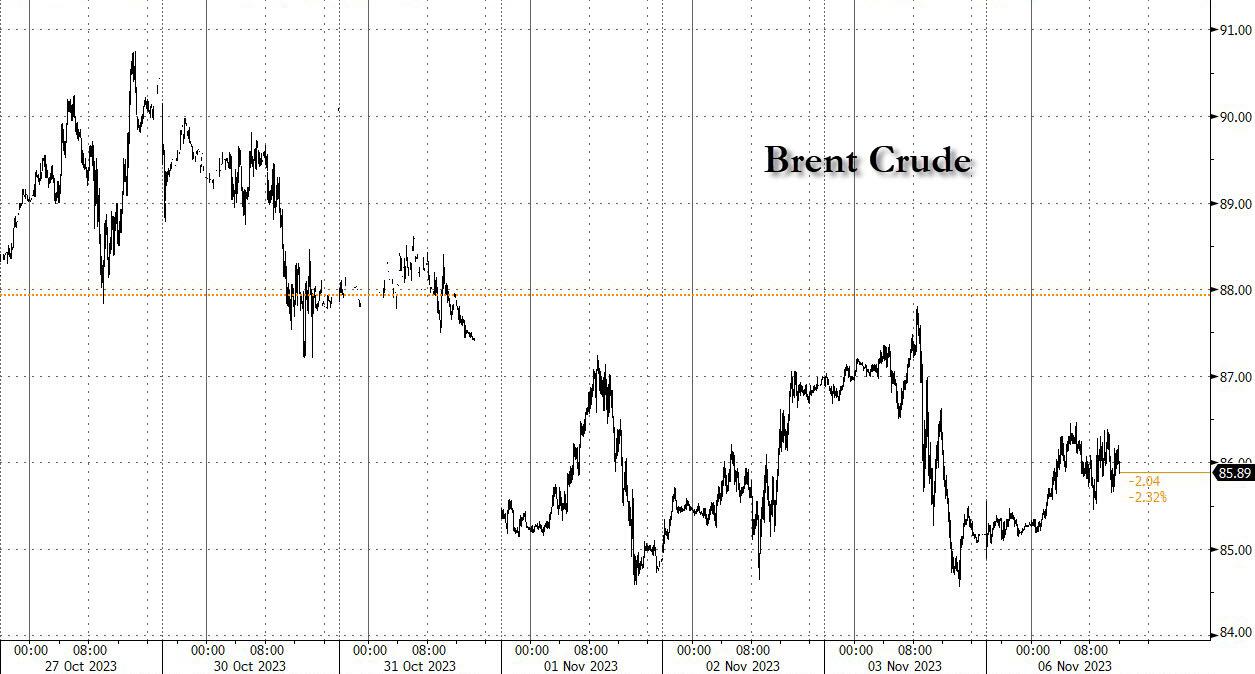
Prices moved up modestly after the Saudi and Russian announcements after both Brent and WTI booked a second losing week in a row last week. The biggest reason for the recent drop in prices looks to be the waning war premium from the war between Israel and Hamas, which appears to be contained for the time being and not a direct threat to Middle Eastern oil supply.

Tyler Durden
Mon, 11/06/2023 – 12:50

via ZeroHedge News https://ift.tt/mwiI61S Tyler Durden

$2,000 Gold Is Just The Beginning. Here’s What Happens Next…

$2,000 Gold Is Just The Beginning. Here’s What Happens Next…

Authored by Simon Black via SovereignMan.com,

Public Law 93-373 was supposed to be so boring that Congress didn’t even bother to give it a name.

You know how most laws passed by Congress have some fancy name– like the “Inflation Reduction Act” or the “USA PATRIOT Act” or some such nonsense?

Well, on November 7, 1973, US Senator James Fulbright introduced a very short bill– it was only ONE page– that didn’t even have a name. But Fulbright’s unnamed bill ended up being one of the most important pieces of legislation in US history.

By the time Fulbright introduced his bill, it had been two years since the legendary “Nixon Shock” of 1971. That was when US President Richard Nixon implemented wage and price controls, and canceled the US dollar’s convertibility into gold.

Nixon famously promised the American public that there wouldn’t be any negative consequences from his actions. Yet inflation hit 3% the following year, in 1972. Then 4.7% in 1973. Then 11.2% in 1974.

Simultaneously, gold prices around the world were surging… from $35/ounce before the Nixon Shock, to more than $170 in 1974.

But individual Americans weren’t allowed to benefit from those gains thanks to a forty year old executive order that had been signed in 1933 by then President Franklin Roosevelt.

Roosevelt’s Executive Order 6102 criminalized the private ownership of more than $100 worth of gold in the United States. Roosevelt also gave Americans just 25 days to turn over their gold to the Federal Reserve… or else face up to ten years in prison.

Naturally, plenty of Americans were outraged, and a number of lawsuits were filed claiming that Roosevelt’s order was unconstitutional.

Roosevelt was rightfully worried that the Supreme Court would overturn his order. And at a certain point he considered packing the court, i.e. appointing several sympathetic judges to the Supreme Court to ensure his victory. He also considered issuing another order which would make it illegal to sue the federal government.

Fortunately for Roosevelt, however, he didn’t have to implement any of those actions; the Supreme Court very narrowly ruled in his favor, and his Executive Order stood as law of the land for four decades… until Senator Fulbright’s no-name law was finally passed on August 14, 1974.

It went into effect the following year, and Americans were suddenly free once again to exchange their rapidly-depreciating US dollars for gold.

Unsurprisingly, gold prices started rising dramatically in the second half of the decade… from about $180 in 1975, to a whopping $850 in January 1980.

And the declining dollar was just one reason for gold’s popularity; remember, the United States suffered a deluge of troubles during the 1970s and early 1980s.

The world found out that the US President was a criminal during the Watergate scandal of 1974. Then there was the humiliating US withdrawal from Vietnam in 1975, complete with a helicopter evacuation of the American embassy in Saigon.

Iran seized 52 US citizens in 1979 and held them hostage for more than a year. Inflation raged, peaking at 13.6%. The economy stagnated and fell into recession. Troubles in the Middle East (including conflict with Israel) led to energy shortages and rising fuel prices.

Civil unrest and ‘mostly peaceful’ protests were a constant problem in the 70s and 80s.

Meanwhile, criminals rampaged across American cities, and the murder rate soared. Major cities like New York, LA, and Chicago became synonymous with violent crime.

The world stopped making sense. And gold became a safe haven from that chaos.

There’s an old saying (originally a Danish proverb) suggesting that if history doesn’t repeat, it certainly rhymes. And I think it’s obvious that we’re facing many of the same challenges today.

There are major problems in the Middle East. Energy is becoming scarce (especially in Europe). The US military suffered a humiliating withdrawal from Afghanistan. Civil unrest and crime rates are totally unacceptable. Inflation continues to rage. And the President, a.k.a. “the Big Guy” appears suspicious A.F.

Just like in the 1970s, gold represents a safe haven from this chaos. And even though it’s hovering at a near-record around $2,000, I think that there is still a long way for gold to rise.

The US national debt is now $33.7 trillion; that’s up more than HALF A TRILLION just in the month of October.

The people in charge have absolutely zero fiscal restraint. Zero responsibility. Zero sense of how destructive their actions are. They spend money and go deeper into debt as if there will never be any consequences, ever, until the end of time. They’re disgustingly ignorant, and dangerous.

The truth is that there are serious consequences to all of this debt. And we don’t have to guess what they are.

The Congressional Budget Office is already projecting that, by 2031, the US government will spend 100% of its tax revenue just on mandatory entitlements (like Social Security) and interest on the debt.

This means that, after 2031, the funding for literally everything else in government– from the US military to the light bill at the White House– will have to be funded by more debt.

That’s only 7 years away.

Then, two years later in 2033, Social Security’s primary trust fund will run out of money; this will cost the government an additional $1 trillion in additional spending each year to keep the program running. Naturally they’ll have to borrow that money too.

Eventually the national debt will become so large that simply paying interest each year will consume more than 100% of tax revenue.

The Federal Reserve will most likely attempt to bail out government by creating trillions upon trillions of dollars. But just as we saw over the past few years, such actions will most likely result in much higher inflation.

Disgusted with their financial circumstance, voters across America will likely turn to Socialist politicians who blame all the problems on the evils of capitalism, rather than their own incompetence. And with a majority of leftists running the country, they’ll only make things worse.

I also anticipate more conflict in the world, thanks in large part to the continued decline of America’s stature and reputation for strength.

It’s also quite likely that the US dollar could lose its royal status as the world’s dominant reserve currency by the end of the decade.

I don’t necessarily believe that the dollar will simply vanish from global trade. But it won’t be “King” dollar anymore. Perhaps more like “Earl” or “Viscount” dollar, alongside other currencies and exchange mechanisms– including gold.

In fact we could easily see central banks around the world ditching their US dollars and loading up on gold as part of a new, de-dollarized global financial system.

This could potentially trigger trillions of dollars worth of capital inflows into the gold market, causing a surge in gold prices.

And these are just some of the reasons why gold could still have a long, long way to rise from here.

Bear in mind that I’m not thinking about the gold price next month, or even next year. I think long-term, and my views on gold are based on trends that will likely continue to unfold over the next decade.

I’m not a ‘gold bug’. I don’t have a fanatical view about anything other than my own children. I’m not a gold speculator either.

But it’s obvious to me that in an upside down world where there are such obvious long-term threats to the US dollar, it makes sense to look for real stores of value.

And that’s why $2,000 gold could just be the beginning of a much bigger story.

PS: If you can see what is happening, and where this is all going, you understand why it is so important to have a Plan B. That’s why we published our 31-page, fully updated Perfect Plan B Guide, which you can download here.

Tyler Durden
Mon, 11/06/2023 – 12:30

via ZeroHedge News https://ift.tt/2RoJ8Os Tyler Durden