Trump: “I’m The Only One That Will Prevent World War Three”

Trump: “I’m The Only One That Will Prevent World War Three”

Authored by Steve Watson via Summit News,

During a speech at the Florida Republican Party’s “Freedom Summit” in Kissimmee Saturday, Donald Trump declared that he is the only candidate who can prevent World War Three, warning that “we are closer than anyone understands” to “obliteration.”
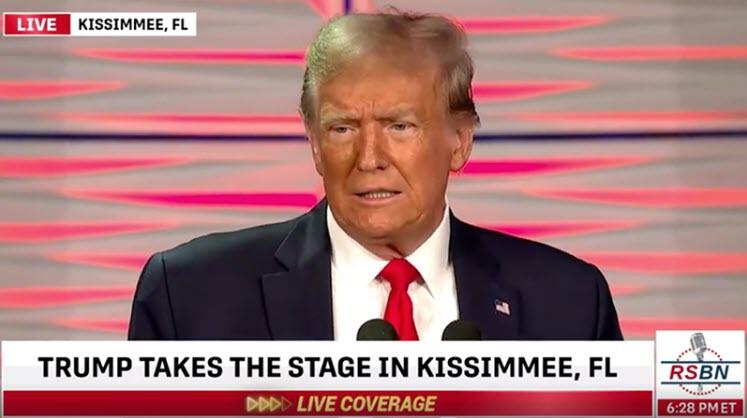
Trump also told the crowd that “When you think of it, how important elections are, you’d have millions of people alive right now if the 2020 election was not rigged. They would be alive. Ukraine, Israel. The attack would have never been made. All of these people would be alive, the cities would be thriving.”

Trump pointed to the global chaos that is now further unfolding, noting “For four straight years, under the Trump administration, I kept America safe, I kept Israel safe, and I kept the entire world safe.”

“I kept my promise and recognized Israel’s eternal capital and opened the American embassy in Jerusalem,” Trump continued, adding “I also recognized Israeli sovereignty over the Golan Heights, and really, probably most importantly, but they did nothing with it, I withdrew from the disastrous Iran nuclear deal, but they were supposed to do something with it. And you could have because Iran did not have any money.”

“What is going on. What is going on now is shocking,” Trump urged, adding “All over the planet our enemies knew that if you tried to kill our citizens we will kill you. If you spill a drop of American blood, we will spill a gallon of your blood. That is what it was, and it was not a threat, that was just the way it was going to have to be. And we do it because we want to make sure we are not starting wars. We did not have to start wars.”

Trump further noted, “In the debate with beautiful Hillary Clinton, she said, ‘Look at him. Look at the way he talks. He is going to get us into wars. He is going to start World War III.’ And I said, ‘No, no, it is the way I talked that will keep you out of World War III.’”

He continued, “To every American is petrified that Joe Biden’s catastrophic weakness will bring our country to ruin, which he has a great chance of doing, he is close to that anyway. He’s cose to economic ruin, I make you this promise, as your president, and nobody else can say it, I will restore peace through strength, and, yes, I am the only one that will prevent World War III, because we are very close to World War III.”

Trump further warned, “this will not be a First World War or a Second World War. This will be obliteration, because the level of power, of weaponry of power you have never seen anything — you do not want to see it. When they talk about global warming, because in 250 years our ocean will be one inch higher, and they never mention the power of nuclear weapons, where one madman can do damage the likes of which nobody has ever seen before. It is just crazy. It is crazy to see it, it is crazy to talk about it.”

“But I will stop it, and it will happen very quickly. There will not be a World War III, and we are closer than anyone understands. To protect our citizens from foreign threats, I will build a state-of-the-art missile defense shield. We will build that. We will build that,” Trump vowed.

He continued, “And it will be jobs for America. It will be built in America. We developed the technology, nobody else, by the way. A lot of people said we developed the technology. The technology was developed by us, and it works. You see it. Ronald Reagan wanted to do it, but at that time they did not have the technology. The concept was good, but we have unbelievable technology. It can shoot a needle out of the air, it is incredible. Would you feel a little safer, a little more comfortable if we can do that? And it is jobs, jobs in America.”

The full speech is below:

*  *  *

Brand new merch now available! Get it at https://www.pjwshop.com/

In the age of mass Silicon Valley censorship It is crucial that we stay in touch. We need you to sign up for our free newsletter here. Support my sponsor – Summit Vitamins – super charge your health and well being.

Also, we urgently need your financial support here.

Tyler Durden
Mon, 11/06/2023 – 11:10

via ZeroHedge News https://ift.tt/oSc5lri Tyler Durden

Here’s an obvious reason to own silver

By the summer of 1812, Napoleon still thought of himself as nearly invincible. He had conquered nearly all of Europe with relative ease and brought the continent’s remaining rulers under his control. He had personally lost just a single battle.

And his chief nemesis, Great Britain, had just been dragged into a new war with its former colony, the United States.

In short, things were really going his way. And the summer of 1812 would have been a great time for Napoleon to take a break, consolidate his gains, and focus on quelling internal rebellions and intrigue from within his vast, new empire.

So naturally he decided to invade Russia instead… something that no one had successfully done since Genghis Khan.

Yet Napoleon was convinced he would once again cruise to an easy victory, writing to his Foreign Minister on June 27th, “I have an army to which no modern army can be compared. . . I am in good hopes.”

Now, Napoleon was obviously a brilliant military commander, so his optimism wasn’t unjustified. He had studied other failed invasions of Russia– like Swedish King Charles XII’s futile attempt in 1708– so Napoleon knew that keeping his army well-supplied would be essential for victory.

That’s why he spent months preparing for his invasion of Russia. His generals stocked up on food, ammunition, clothing, medicine, etc., and staged them at key resupply points in eastern Europe.

But despite such intense preparations, they simply weren’t sufficient. Even someone as experienced as Napoleon managed to vastly underestimate the logistics and resource challenges to be successful.

And the end result was that Napoleon’s armies ran out of food. In fact hundreds of thousands of his soldiers died, many from disease and starvation. Morale plummeted. Confidence was shattered. And Napoleon’s enemies seized on the opportunity to unite against him.

It was a total disaster… and a major reason for it was failing to grasp just how difficult it would be to find enough resources– particularly food– to keep the operation going.

Napoleon’s ill-fated invasion of Russia is just one example of this timeless lesson from history: leaders often come up with grandiose plans and bold ideas without the slightest understanding of the resource challenges.

And one modern incarnation of this folly is the fanatical green agenda that aims to completely replace fossil fuels with renewable energy.

For argument’s sake, let’s just pretend for a moment that this is a great idea and totally worth the $100+ trillion cost, i.e. let’s assume money is no object… which is basically what the greenies believe anyhow.

Money doesn’t solve the most basic challenge of the green fantasy: where will they get all the raw materials?

Solar panels and wind turbines require a lot of resources, including basics like iron, copper, and steel. They also need some really nasty minerals, like cobalt, which are typically extracted by child labor in Africa under appalling conditions.

Wind and solar also require a host of other obscure elements like indium, terbium, dysprosium, and praseodymium; and the quantities of these minerals that will be needed to achieve renewable energy goals are far, far greater than what’s possible.

For example, producing enough solar panels to have 100% renewable energy by 2050 will require production levels of of Indium that are over 10x greater than exist today.

Ramping up Indium production by 10x is no small feat… especially when these same green fanatics simultaneously want to cancel the mining companies.

It’s ridiculous when you think about it. They want the world to be powered by solar panels. But they don’t want to prevent the mining of the essential minerals needed to produce those solar panels. It’s progressive logic at its finest!

This is why I opened today’s article talking about Napoleon’s attempted invasion of Russia; he failed because he underestimated the vast quantities of raw materials that would be required to sustain his armies.

Similarly, today’s green fanatics will fail because they are underestimating the vast quantities of raw materials that will be required to achieve their dream.

But that doesn’t mean they won’t try. Fanatics never let ignorance get in the way of a bad idea.

And this is what leads me to silver.

Silver is an essential ingredient in the production of renewable energy technology; simply put, you can’t make the energy grid renewable (on wind and solar, at least) without massive quantities of silver.

Every MegaWatt of power produced by solar panels requires 1 kilogram of silver, or one metric ton per GigaWatt (GW). And those may be very conservative estimates.

My colleague Gregor Gregersen, founder of Silver Bullion in Singapore, told me over the weekend that a recent study estimated up to 21 metric tons of silver will be needed for every GW of power.

Either way, green energy requires substantially more silver than is being mined right now.

And remember that silver production is already in a deficit at the moment, i.e. industrial and investment demand for silver ALREADY exceeds annual mining output.

Yet on top of existing demand, these completely unrealistic renewable energy goals will easily increase silver demand by another 3-5x.

This is a pretty clear growth catalyst for future silver prices…

Source

from Sovereign Man https://ift.tt/5ZB6ajr
via IFTTT

“U of Washington Faculty Search Weighed Race Inappropriately”

Friday’s Inside Higher Ed (Ryan Quinn) article reported on this:

The hiring process for a University of Washington psychology professor position titled “Diversity in Development” initially ranked a white person No. 1 out of 84 applicants, the university says in a report released this week.

But psychology department faculty members then pressured one another until the third-ranked finalist, who was Black, was given this tenure-track assistant professor job, above the white and Asian finalists, the document states. It adds that it’s unclear how candidates’ racial identities were assigned. The assistant professor accepted the job in April of this year.

The investigation, which the university posted online Tuesday, concludes that “race was used as a substantial factor in the selection of the final candidate and the hiring process,” violating a university executive order that bans considering race in hiring. Though the report itself doesn’t conclude state law was violated, university spokesman Victor Balta noted in an email to Inside Higher Ed Thursday that Washington citizens, in 1998, passed a referendum banning affirmative action in public colleges and universities.

The university announced on its website that the psychology department is now “barred from conducting searches for tenured and tenure-track faculty positions” for at least two years, “subject to review by the Provost’s Office.” It also said the department will “undergo a comprehensive review and revision of its hiring processes,” and all department members “will receive training on how to conduct searches consistent with law and policy.”

“The University is taking personnel action to address individual actions,” the institution stated. “These proceedings are confidential.” …

For more, read the whole report; here’s just one item, which the Inside Higher Ed story also discusses:

Each candidate’s itinerary originally scheduled them to meet with the same groups, including a 30-minute joint meeting with the Faculty of Color and Women Faculty groups. The candidate itinerary describes the purpose of this meeting as “an opportunity for you to meet with faculty of color and women faculty in our department to discuss the department and university climate and anything else you may be interested in discussing.”

After itineraries were sent, [redacted], a member of the Faculty of Color group, emailed [redacted] asking:

As a person who has been on both sides of the table for these meetings, I have really appreciated them. Buuut, when the candidate is White, it is just awkward. The last meeting was uncomfortable. and I would go as far as burdensome for me. Can we change the policy to not do these going forward with White faculty?

The post "U of Washington Faculty Search Weighed Race Inappropriately" appeared first on Reason.com.

from Latest https://ift.tt/0MJFB7p
via IFTTT

The Best Hope to Rein in Rent Control Is Lurking on the Supreme Court’s Docket


New York City apartments | Viocara/Dreamstime.com

Those wishing the U.S. Supreme Court would reverse its longstanding blessing of the constitutionality of rent control were dealt a harsh blow last month, when the justices decided not to take up a major challenge to New York’s extensive rent regulations.

Yet hope springs eternal.

Currently idling on the Supreme Court’s docket is another petition for a writ of certiorari from New York City landlords. This one, in the case 74 Pinehurst LLC v New York, asks the court to consider the constitutionality of a state law that limits their ability to raise rents, choose their tenants, or even withdraw their apartment from the rental housing market.

Since August, the plaintiffs’ petition has repeatedly been placed on the agenda of the justices’ weekly conferences, where they decide whether to take up cases. The justices keep putting off deciding whether to take up the case. It was last on the conference agenda on Friday, but neither that day nor this morning has the Supreme Court’s orders mentioned it.

That’s stirred some limited optimism that the court may end up taking up the case, or that one of the justices will at least produce a dissent to a denial of the landlords’ petition that will outline how a subsequent rent control challenge might make it back to the Supreme Court.     

“I suspect that one or more of the justices are taking their time to file a dissent to the denial” of cert, says Jim Burling, an attorney for the Pacific Legal Foundation. “That dissent is going to tell us what the next steps might be.”

The plaintiffs in 74 Pinehurst are challenging a series of 2019 changes made to New York’s decades-old rent stabilization law, which regulates rent increases for nearly a million apartments in the New York City area.

Prior to 2019, building owners were able to take a rent-stabilized unit off the market if they, or an immediate family member, wished to make it their personal residence. But the new amendments limited landlords to reclaiming only one rent-controlled unit for their family’s use. Any other units they owned would have to remain on the market and subject to rent stabilization regulations.

That’s caused problems for 74 Pinehurst plaintiffs Dimos and Vasiliki Panagoulias, immigrants from Greece who own a 10-unit building in the Long Island City neighborhood of New York City. The law prevents them from recovering a unit to give to their daughter, because their son already lives in the building, according to their cert petition.

The 2019 amendments also closed off a number of avenues that landlords had to “deregulate” (charge market rates) for their units and to recover the costs of repairs and capital improvements.

Both those changes helped tank the property values of rent-stabilized buildings. According to their petition, the Panagoulias’ value fell by 20 to 40 percent after the 2019 changes.

Throughout the process, the 74 Pinehurst plaintiffs, which include several other building owners, have argued that the 2019 limitations on landlords’ ability to recover a unit amount to a physical taking. The financially damaging limits on rent increases and inability to deregulate units amount to a regulatory taking, they further argue.

Very similar arguments were made by plaintiffs in a more prominent challenge to New York’s rent control scheme, Community Housing Improvement Program (CHIP) v New York.

New York’s law amounted to an “effective commandeering of private property for what is essentially perpetual rental housing,” said the plaintiff’s attorney, Andrew Pincus, to Reason in July.

That made the law a physical taking, argued Pincus. CHIP, a landlord trade association, also argued in its lawsuit that the law created a regulatory taking by slashing property values and holding rents below what was necessary to make a reasonable profit.

The CHIP lawsuit was broader than the 74 Pinehurst because it also challenged pre-2019 features of New York’s law.

Nevertheless, a U.S. District Court for the Eastern District of New York rejected both cases in a single opinion issued in September 2020. The Second Circuit Court of Appeals likewise ruled against the plaintiffs in the CHIP and 74 Pinehurst cases in February 2023.

That sweeping appeals court opinion asserted that even if New York’s rent stabilization law was forcing some building owners to operate at a loss, the fact that it wasn’t forcing all business owners to operate at a loss meant it wasn’t taking.

CHIP and the 74 Pinehurst plaintiffs both appealed to the Supreme Court in April. Supportive amicus briefs flooded in from landlord associations and pro-market think tanks.

Nevertheless, in October, the Supreme Court rejected the CHIP petition in an unsigned order. Meanwhile, Pinehurst 74 keeps rattling around on the conference schedule.

Burling speculates that some justices are attempting to avoid making another major, polarizing decision after making several controversial rulings on guns and abortion.

“The moderate wing may want to be holding their fire back,” he says.

If that’s the case, it’s yet another obstacle to what’s proven to be the very tall order of getting a rent control case before the Supreme Court.

Stretching back to the beginning of the 20th century, courts have been generally unwilling to put limits on state and local governments’ ability to regulate land use. The Supreme Court hasn’t shown much interest in getting involved in the issue either.

It doesn’t help that most rent control laws are passed in areas under liberal-leaning appeals courts. That creates fewer opportunities for split appeals court opinions that might prompt the Supreme Court to intervene.

But with the 74 Pinehurst case, there’s still a possibility that the high court might take up a challenge to rent control. And if it doesn’t, there’s a chance that a lengthy dissent might pave the way for a future case to get to the Supreme Court.

The post The Best Hope to Rein in Rent Control Is Lurking on the Supreme Court's Docket appeared first on Reason.com.

from Latest https://ift.tt/mARwuUf
via IFTTT

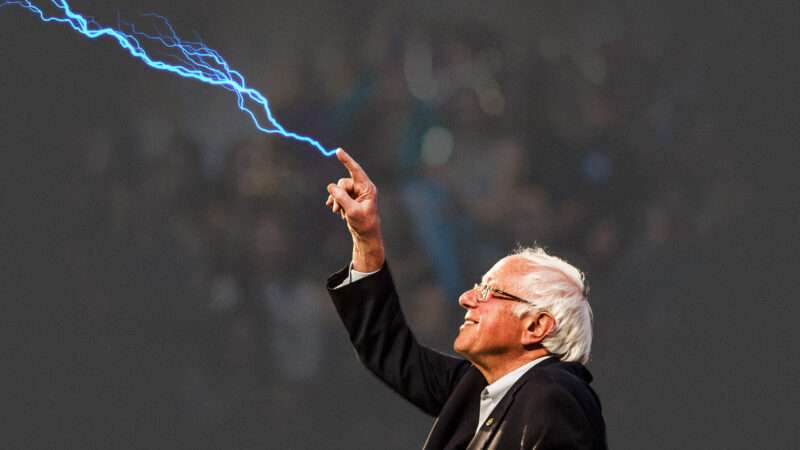
Maine Voters Will Decide on Bernie Sanders-Backed Utility Plan


Vermont Senator Bernie Sanders speaking to crowd | Illustration: Lex Villena; STACIE SCOTT/TNS/Newscom

In Maine, the progressive left is pushing a plan to seize the means of electricity production—and distribution.

Don’t expect the result to be lower energy bills.

Voters in Maine will decide Tuesday whether to authorize the creation of a new quasi-public entity to run the state’s electric utility services. If approved by a majority of voters, Maine Ballot Question 3 would allow the new Pine Tree Power Company to “purchase or acquire”—via eminent domain if necessary—the state’s existing private electric production facilities and distribution lines. The new company would be governed by a board with a mix of appointed and elected members, and it would be the first such statewide utility entity in the country.

Most of Maine is served by a pair of investor-owned utility companies: Central Maine Power and Versant Power. Advocates of the takeover—including such progressive groups as the Sierra Club and Common Dreams—say it would deal a blow to capitalist greed.

“Power belongs in the hands of the people, not greedy corporations,” Sen. Bernie Sanders (I–Vt.) declared in July when he endorsed a “yes” vote on the ballot question. “Instead of a private power system that last year sent $187 million in profits out of the country, Mainers can have cheaper, more reliable power—and help fight climate change at the same time.”

In reality, the proposal is likely to cost Maine’s electricity consumers, since the new utility collective would have to buy out the two existing utility companies—and take on their debt—at a price tag estimated to be around $10 billion. According to the Portland Press Herald, that means ratepayers would have to cover a $500 million annual debt service payment before they get a single watt of electricity.

The issue has fractured the political left. Most notably, the Maine AFL-CIO and the local chapter of the International Brotherhood of Electrical Workers, the union that represents workers for the existing utility companies, have come out against the proposal, with the latter declaring: “With politicians who have no utility experience in charge, the decisions on how to invest in the grid would be driven by thoughts of the next election, not what’s best for workers and customers over the long term.”

The unions are joined, somewhat unusually, by the Maine Chamber of Commerce, whose president has warned that the plan is “bad for businesses, bad for workers, and bad for anyone who has to pay an electric bill.”

Residents of Maine can’t be blamed if they want changes in how their state’s electric utilities operate. Central Maine and Versant ranked dead last in customer satisfaction within their respective categories in last year’s J.D. Power surveys.

But a state takeover is unlikely to solve that problem. Indeed, the best way to force those utility companies to improve is to subject them to more competition. But Ballot Question 3 will take competition out of the equation by creating a state-run monopoly and then just hoping for the best.

As with many state ballot questions, there has been scant public polling in advance of the election. An October survey by pollsters at the University of New Hampshire found that 31 percent of Maine voters planned to support the ballot initiative while 54 percent were opposed.

Maine Gov. Janet Mills, a Democrat, is probably the most prominent “no” vote. Mills vetoed a bill in 2021 that would have created the Pine Tree Power Company—a move that prompted advocates to take the issue directly to the voters in this year’s election.

In a statement to voters, Mills invoked journalist H.L. Mencken’s aphorism that “for every complex problem there is an answer that is clear, simple, and wrong.”

“Question 3 presents a rosy solution,” Mills added. “In reality, I just don’t see how it will improve our utilities or the services they provide. In fact, I fear it might just make things worse.”

The post Maine Voters Will Decide on Bernie Sanders-Backed Utility Plan appeared first on Reason.com.

from Latest https://ift.tt/LGP8ga1
via IFTTT

US In Rare Move Advertises Location Of Nuclear-Capable Submarine Near Israel

US In Rare Move Advertises Location Of Nuclear-Capable Submarine Near Israel

The US military build-up off Israel’s coast and especially Central Command’s (CENTCOM) willingness to advertise it openly, is cause for serious alarm in terms of the prospect for yet more Washington intervention in yet another major Middle East war.

In a very rare statement, CENTCOM on Sunday evening announced that an Ohio-class submarine has arrived in the region. The US submarine, which is both nuclear-powered and capable of carrying nuclear warheads, has arrived in an “area of responsibility” which includes the eastern Mediterranean, Red Sea, Persian Gulf, and Gulf of Oman. It is unknown and undisclosed precisely what types of advanced weapons it is carrying.

Getty Images

It is the most sophisticated that exists in the US Navy arsenal. Key to the secretive nature of such an advanced sub’s movements is the ability to traverse the seas undetected, without any rival or enemy powers having any idea where it is located, thus the Pentagon almost never puts out statements confirming where a nuclear sub is at any given time.

And yet CENTCOM didn’t just issue a statement, it went so far as to publish a photograph which openly advertises its more precise whereabouts. Israeli media said this is clearly to send a strong “message” to Iran and its proxies:

While the US announcement was scarce on details, it was accompanied by an image that appeared to show a submarine in Egypt’s Suez Canal.

The arrival of the submarine in the region was apparently part of the same strategy that has seen the Pentagon dispatch two carrier strike groups in order to deter Iran and its proxies — not least the Lebanon-based Hezbollah terror group — from attacking Israel amid its war against Hamas.

Ohio-class submarines are also reportedly capable of carrying up to 154 Tomahawk cruise missiles if outfitted for guided missiles, and is part of America’s “nuclear triad” of atomic weapons.

Newsweek reviews of the navy’s Ohio classification of sub capabilities as follows

The U.S. Navy’s Ohio-class offering consists of 14 ballistic missile submarines (SSBNs) and four cruise missile submarines (SSGNs), the latter converted to fire Tomahawk cruise missiles rather than their original nuclear-armed ballistic missile loadout.

One SSGN can be armed with 154 Tomahawk cruise missiles, significantly more than the number carried by U.S. guided-missile destroyers and attack submarines. Tomahawk missiles can carry up to a 1,000-pound high-explosive warhead out to around 1,500 miles.

The US military has also been showing off its significant assets in Middle East skies as well, with CENTCOM simultaneously issuing photos of B-1 bombers which are newly deployed in the area

One scenario in which the Pentagon is more likely to directly intervene in the Gaza situation militarily is if Hezbollah opens a full war front on Israel’s northern border. Hezbollah chief Hassan Nasrallah in a major Friday speech, his first since the conflict began, stressed that “all options are open on our Lebanese front” and specifically addressed the US build-up off the Lebanese and Israeli coasts, saying “Your fleet in the Mediterranean do not scare us… we are ready to face the fleet you threaten us with.” 

Iran’s foreign ministry has also issued a fresh statement warning that if a ceasefire in Gaza isn’t reached soon, and if Israel’s attacks on civilians continue to escalate, Americans in the region will be “hit hard” – no doubt a direct threat against US bases in Iraq and Syria.

Tyler Durden
Mon, 11/06/2023 – 10:50

via ZeroHedge News https://ift.tt/7uJP3HY Tyler Durden

Berkshire Cash Pile Shows What’s Wrong With Effervescent Stocks

Berkshire Cash Pile Shows What’s Wrong With Effervescent Stocks

By Ven Ram, Bloomberg markets live reporter and strategist

Last week’s rally in US stocks, stunning as it was, is as sustainable as a house of cards.

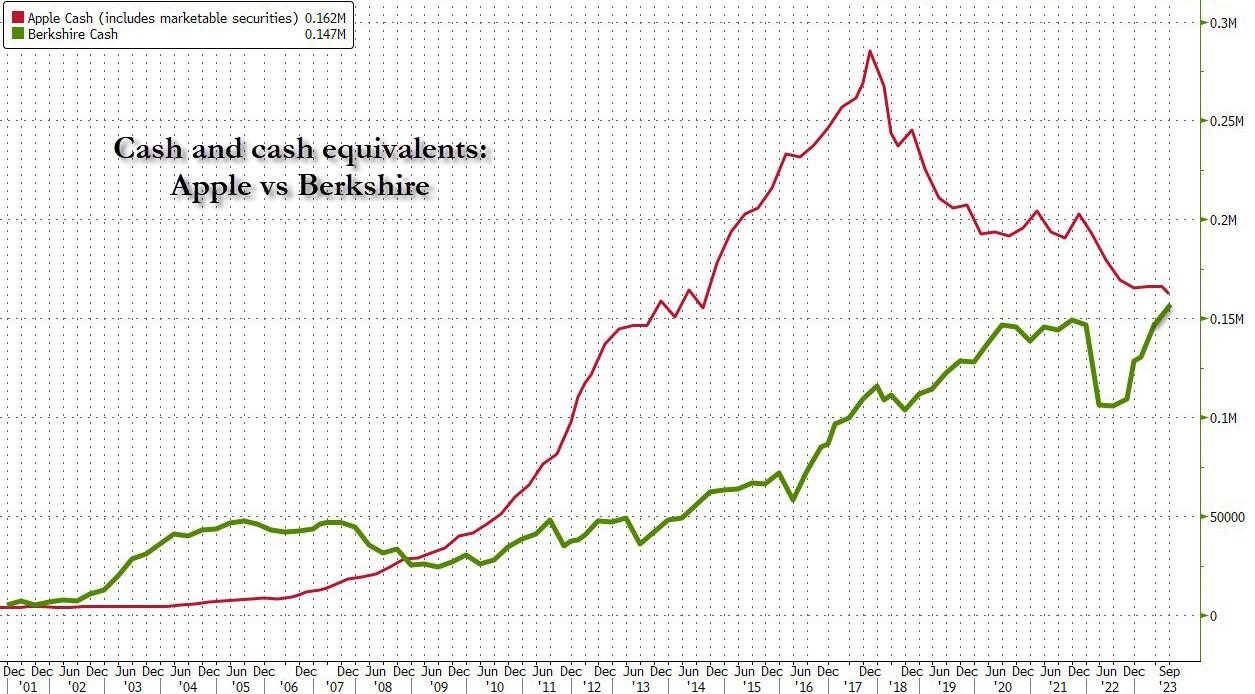
When Warren Buffett’s Berkshire Hathaway raises its cash pile by a staggering 22%+, you got to wonder what the stock markets see that one of the greatest investors of all time can’t. The conglomerate’s holdings of short-term investments via US T-bills surged some 36%, a classic view that cash and near-cash instruments are Berkshire’s best bet when nearing an inflection point in the economy.

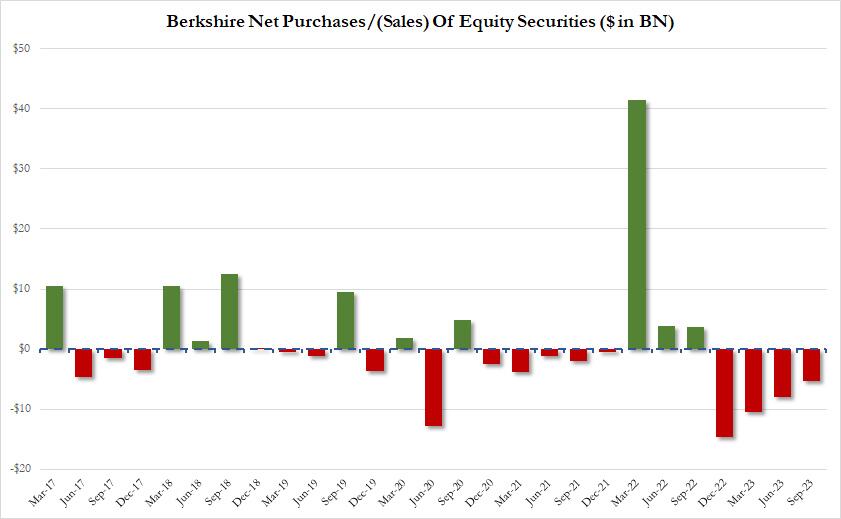
In contrast, the increase in equity investments rose by a mere 3%, while net sales of equities extended for a 4th consecutive quarter.

For some time now, stocks have been trading in a heads-I-win, tails-you-lose mode — rallying either on the premise that a robust economy will boost earnings or a weaker economy will herald rate cuts from the Fed. The Nasdaq 100 surged a stellar 6.5% last week alone, taking its advance this year to almost 40%. At current levels, the index is overvalued by 15% when you look at the index as a bunch of long-duration bonds.

The rally has effectively skewed the risk-reward profile for stocks from here. The prospective earnings yield on the Nasdaq 100 is now just around 3.7%, and the Fed will have to cut rates a long, long way from here for that number to look compelling in comparison.

As Benjamin Graham remarked, investment is most intelligent when it is most businesslike. Just now, it doesn’t look that way. If you wanted confirmation, just ask Berkshire.

Tyler Durden
Mon, 11/06/2023 – 10:30

via ZeroHedge News https://ift.tt/KlGp3W8 Tyler Durden

Watch Live: First Three Pages Of Transgender School Shooter’s Manifesto Leaked

Watch Live: First Three Pages Of Transgender School Shooter’s Manifesto Leaked

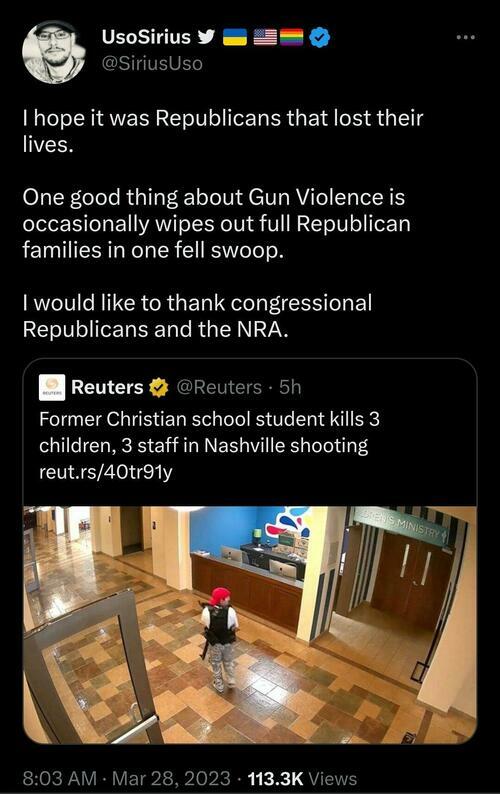
The first three pages of transgender school shooter Audrey Hale’s manifesto has been leaked to the press, following a March 27 attack that left three 9-year-olds and three adults dead – just days before a Trans Day Of Vengeance” was scheduled for April 1st.

Audrey Hale was identified by police as the assailant who opened fire at the Covenant School, killing six people.

Watch live as Stephen Crowder reveals the manifesto, going through it line-by-line:

Crowder also posted the pages:

The manifesto, which one official described as “astronomically dangerous,” was originally to set for release in May, until the Nashville Police Department (MNPD) reversed course, and said it would be released ‘soon.’

One week after the stonewalling began, the National Police Association (NPA) joined the Metropolitan Government of Nashville and Davidson County in suing for all records related to the March 27 shooting at the Covenant School in Nashville.

“We have asked for any manifestos, emails, and any communications related to the case,” Betsy Brantner Smith, spokesperson for the National Police Association, told The Epoch Times.

Tennessee resident Clata Renee Brewer working with the NPA, filed the lawsuit on May 5. Theirs is at least the second lawsuit filed over the shooting.

The FBI also denied a request for Hale’s manifesto, telling the Epoch Times that U.S. Code exempts from disclosure “records or information compiled for law enforcement records or information… could reasonably be expected to interfere with enforcement proceedings…”

Those “enforcement proceedings” were not cited in the letter. It is unclear what the enforcement proceedings could be in reference to, as the main suspect, Audrey Elizabeth Hale, died at the scene of the attack.

Leftists mocked the shooting, suggesting that the shooting wouldn’t have happened if Tennessee hadn’t passed laws against gender based surgeries and hormone treatments for minors.

Will officials release the rest?

Tyler Durden
Mon, 11/06/2023 – 10:10

via ZeroHedge News https://ift.tt/tQP6XU3 Tyler Durden

“Things Will Get Very Nasty, Very Fast”

“Things Will Get Very Nasty, Very Fast”

By Michael Every of Rabobank

Powell/Power, Nasdaq/Nasrallah

US payrolls were slightly weaker than expected across the board. 150K jobs were added vs. 180K forecast, with downwards revisions to previous months, the household survey dropping, unemployment rising a tick to 3.9%, and average earnings undershooting at 0.2% m-o-m. These data still show a tight labor market, have seen slowdowns before only to pick up again, and are out of line with the strong JOLTS job openings, low weekly jobless claims, the huge pay deals struck by the UAW union, and ISM services prices paid at 58.6 and new orders 55.5 vs. 51.8 prior. Nonetheless, global bond yields plummeted as if we had seen a negative payrolls print. The US 10-year fell to around 4.50%, the dollar dipped, commodities were up, and the S&P +0.9%, +3.9% in the last three days, the Nasdaq +1.2% and +4.8%: who needs a 10-year Treasury when you can make the same return in less than a week?

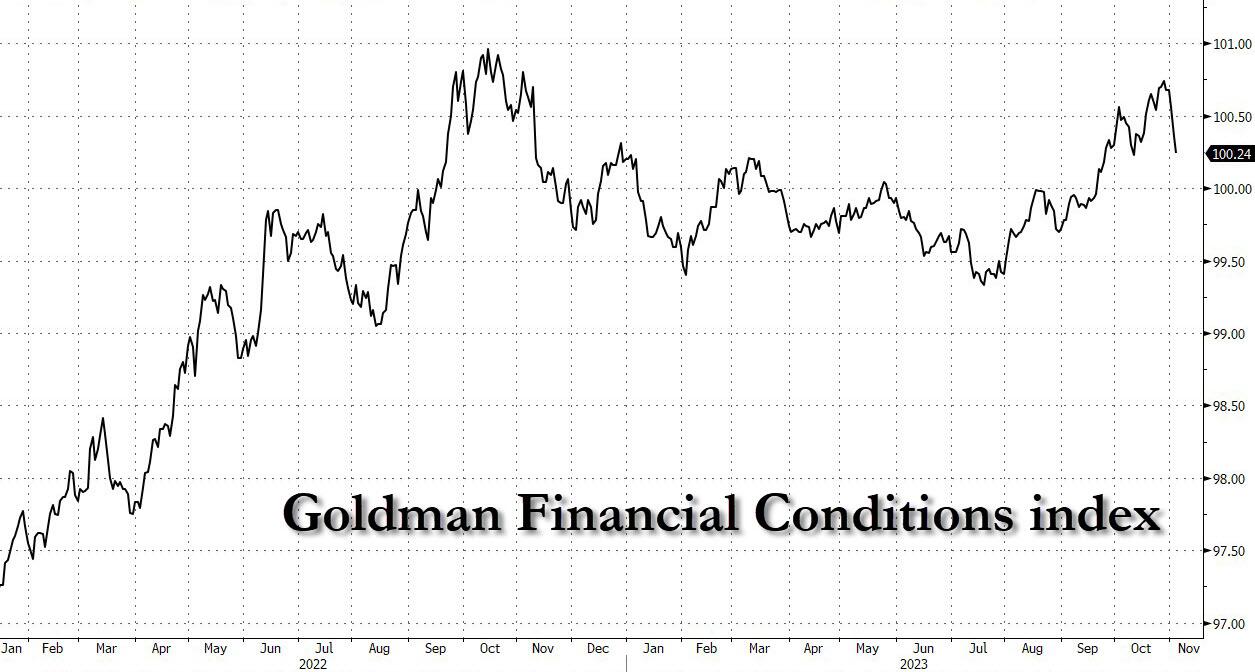
As such, the market undid much of the tightening of financial conditions which the Fed says is tightening policy for it. Keep that up and the Fed will still have to do more; and it is nowhere near doing the 100bps of rate cuts being priced in for 2024, just as they were for 2023.

Meanwhile, 30 minutes after payrolls, while we were still deep in the theology of the Bureau of Labor Statistics’ payrolls “birth/deaths” model, eyes turned to a speech from a secret bunker also wrapped in theology and deaths given by Hassan Nasrallah, leader of terrorists Hezbollah (listed as such even by the Arab League years ago). Kuwaiti media had reported prior that Iran had given him the green light to start a second front against northern Israel, the second of three dominoes (Israel > Gaza; Hezbollah > Israel; Israel/US > Iran and/or Iran > Saudi) which could trigger a regional escalation and a 2022-style energy-price spike.

Yet Nasrallah blinked. He claimed: Hamas’s 10/7 attack on Israel, while great, had nothing to do with him or Iran; he had already started a second front (with escalating ballistics exchanges seeing nearly 60 Hezbollah fighters dead); excoriated Arab governments for not doing more; wants to see tens of thousands of Israelis internally displaced away from their borders; called to attack US targets; and laid down a red line for full escalation – the Israeli elimination of Hamas. Yet that remains Israel’s –and the US and Germany’s– policy goal, so it still seems when we escalate, not if. Moreover, Israel says it will target Hezbollah after Hamas, and it can never accept permanently depopulating its current internal buffer-zones (one town in which, Kiryat Shmona, was just slammed by Hezbollah rockets).

In short, just because things looked better on Friday than feared doesn’t mean all ends well.

In fact, premature de-escalation carries its own risks of larger, longer-term problems. In central banking, we agree if wage growth fails to fall and CPI refuses to drop back to 2%, a rates pause will see ‘term premia’ rise and inflation expectations rise. That’s the 1970’s policy error. In geopolitics, dovish world leaders and Western street protests calling for a ceasefire think of the loss of civilian life, that defeating Hamas may lead Iran to trigger a wider regional war, and that whoever replaces Hamas could be even worse. However, others think allowing Hamas to recover via a ceasefire, even if the US forces Iran to back down regionally, will see Tehran and Hamas claim a geopolitical ‘win’, with a deleterious effect on US, Saudi, and UAE efforts to expand the Abraham Accords peace treaty to Israel under a US defence guarantee. In many eyes that would start the clock ticking to an even larger war – and recall Iran is close to obtaining a nuclear weapon.

This is to say that despite last week’s risk-on move on the belief that hawks have had their day, not all the hawks have, and risks continue to build that we cannot mitigate with dovish policy. Moreover, whatever we do, ‘sticking the landing’ is far harder than markets took it to be on Friday.

In the economy, if deflation now looms, things will still get very nasty, very fast given what it implies for employment and fiscal deficits; but if inflation lingers on that’s also the case, as we already see around us. In geopolitics, if regional war looms now, things will get very nasty, very fast, and so will inflation – Larry Fink and Jamie Dimon are both warning it would cause global recession, and that the present geopolitical moment looks as perilous as 1938; but if regional war is delayed, it could end up being even larger and nastier next time.

Just as we didn’t deal with our real economic problems post-2008, we are nowhere near dealing with our real geopolitical problems now. Both are now going to be vastly more expensive that if we had done so years earlier. It goes without saying that markets, global trade, and the global financial architecture will shift around as either of the above outcomes happen: how can they not?

Look at the long-read from Bloomberg today, ‘The Price of Money Is Going Up, and It’s Not Only Because of the Fed’, looking at longer-run data backing a rising neutral level of rates, whatever the Fed says. As Bas van Geffen noted in our latest Monthly Outlook, echoing a regular meme here, expect “rate hikes and acronyms”. Or look at ‘The Dollar’s Dominance is Shakier Than Ever’ by a former economic advisor to the Trump White House, which talks about intra-BRICS11 FX trade settlement (or de facto bilateral barter). Or read ‘Would an inflation tax help tame price pressures? As groupthink grips Threadneedle Street the need for novel policies is greater than ever’, which has some backing a tax on UK pay hikes above 3%: yes, that’s out of the box thinking, but why not tax asset prices too?!

Given the awful pictures we are already seeing from the Middle East (and not only there), and the awful implications of what follows, many analysts are avoiding the topic entirely, as they did Ukraine; some are trying, but failing to join all the dots; some are shrugging and saying it’s a moral-equivalent mess (including former President Obama, who publicly asked what he could have done better. “How about not empowering Iran?” is the regional chorus); and some expert views are becoming plain offensive.

A junior Israeli minister said “Nuke Gaza” (for which he was immediately suspended; and Israel’s Arab Islamist party Ra’am, present in the last government, called on one of its MPs to resign for saying not all the crimes Hamas committed on 10/7 are visible on the bodycam showreel of horrors now compiled). There is talk of huge policy shifts to the right in the West over the ability to protest and in regards to free speech, as well as policing and immigration. And on the left, former Eurodollar insiders, who already embraced Russian, Iranian, and Chinese news as more trustworthy than anything Western, are now retweeting antisemitic tropes as if this is the pathway to a global, progressive post-US financial system backed by allies like ‘Her-bollah’ and ‘Hama-X’.

In short, caveat emptor on analysis of this complex, confounding, conflated, and centrifugal issue.

My own simple take is that Friday epitomised our ‘new, new normal’ where geopolitics matters first, even if markets wrongly thought it flagged a return to the old ‘new normal’ where rate cuts are all that count.

Everyone should be able to see that power matters like Powell, and Nasrallah like the Nasdaq. Unless you are hiding in a bunker.

Tyler Durden
Mon, 11/06/2023 – 10:00

via ZeroHedge News https://ift.tt/LveTYWQ Tyler Durden

Key Events This Quiet Week: SLOOS, Consumer Sentiment And Barrage Of Fed Speakers

Key Events This Quiet Week: SLOOS, Consumer Sentiment And Barrage Of Fed Speakers

Mercifully, the week after payrolls (not to mention a barrage of central bank announcements and peak earnings season) is usually very light on US data and this is indeed the case this week as DB’s Jim Reid writes in his weekly preview. The highlight for us will probably be today’s US Senior Loan Officers Opinion Survey (SLOOS) even if it’s unlikely to be an immediate market mover. Bank lending standards are in deep recessionary territory and the longer they stay there the more risk that refinancings won’t happen (or come at a much higher cost) which will slow the economy and potentially cause accidents. For now a combination of excess savings, private markets, and the lack of need for refis could have weakened the usual impact on the economy, even with the typical lag. So the trillion dollar question is can the economy get by long enough for bank lending standards to gradually improve to normal levels? We will see if any trends emerge today at 1pm ET when the SLOOS is published.

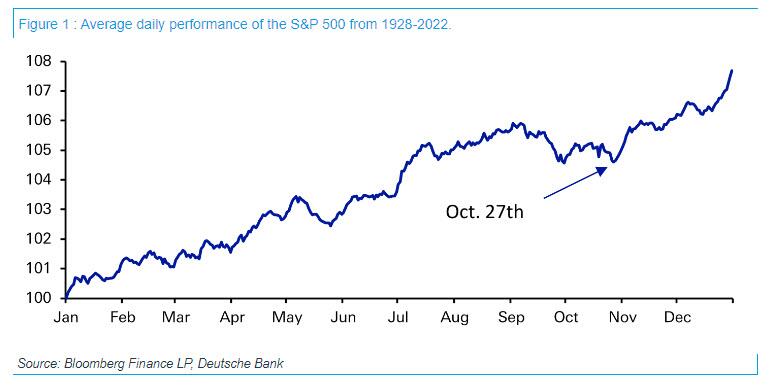
Before we continue, we take a brief detour to lay out Reid’s views on the big story of last week which, of course, was the epic rally in bonds and equities: As Reid notes, “It seems our seasonal chart we published on October 27th that basically said the bottom in US equity markets in H2 occurs on that day (using nearly 100 years of data), has picked the local lows perfectly.”

Some more observations from Reid:

The S&P 500 (+5.85%) had its best week in a year and 10 and 30yr US yields rallied -26.4bps and -24.8bps respectively and had their best week since March and January.

For Treasuries there was much talk about the QRA (quarterly refunding announcement) driving the rally. There’s no doubt that this was the initial catalyst but the rally had 4 stages. First the QRA, then the weak ISM, then the dovish Fed (all on the same day), and then finally a weak payrolls report on Friday which we’ll discuss at the end when we briefly recap the past week.

The one thing we’ll say here is that the Sahm Rule got a little closer to being triggered with US unemployment (3.9%) now 0.5pp above its lows in April. The trigger is the 3m moving average being 0.5pp above the 3m moving average lows of the last 12 months and when this happens the US economy has always been in, or about to be in, recession (using post WWII data). It is currently 0.33% above the lows. So one to watch.

The fascinating thing about markets is that the path to a hard landing is often via the appearance of a soft landing first. So we’re in this window where the data is softening but if it only ends up softens a bit, and then stabilising, then its great news. However if it’s the start of something bigger it’s not. The former scenario won out last week as you’ll see in more detail at the end in our review.

Moving onto this week, outside of the SLOOS, the week is full of Fed speak stored up from the Fed blackout period and with the FOMC being firmly behind us. Here is the line up:

  • Monday begins with a speech by Governor Cook (dove) on financial stability.
  • On Tuesday, NY Fed President Williams (dove) and Dallas Fed President Logan (hawk / voter) will moderate discussions, while Governor Waller (hawk) will speak about using economic data to understand the economy. In addition, Vice Chair of Supervision Barr (dove) will speak on financial technology, and we will hear for the first time from the new Kansas City Fed president Schmid (hawk) at an energy conference.
  • The remainder of the week will feature repeat appearances by several of these officials (Cook, Barr, and Logan), as well as closing comments by Vice Chair Jefferson (dove) on Wednesday, a discussion by Atlanta’s Bostic (dove / non-voter) and Richmond’s Barkin (neutral / non-voter) on survey data on Thursday, as well as a speech on the economy and monetary policy by interim president of the St. Louis Fed Paese.

Of the above, the main one is Powell at the IMF conference on Thursday. Last Wednesday he talked about tighter financial conditions doing some of the Fed’s work for them. After the huge 60/40 rally since, will he still feel the same way by Thursday?

Elsewhere in the US, tomorrow’s trade numbers are of minor interest and then Friday’s University of Michigan’s consumer confidence is the other main highlight with focus on the 1yr and longer-term inflation expectations. The former spiking from 3.2% to 4.2% last month and more importantly, the latter picking back up a couple of tenths.

Moving back across the pond, markets will focus on German factory orders (today) and industrial production tomorrow. Other notable indicators due include Italian retail sales (Wednesday) and industrial production (Friday), the trade balance for France (Wednesday), the ECB Consumer Expectations Survey (Wednesday), and UK monthly GDP (Friday).

In China, all eyes will be on the inflation data (Thursday) following last week’s misses on the PMIs. Current median estimates on Bloomberg suggest the CPI is expected to fall back into negative territory (-0.1% YoY vs 0.0% in September) and the PPI is also seen falling (-2.7% vs -2.5%). Prior to the inflation prints, there will also be trade balance data tomorrow.

As well as Powell speaking this week, ECB President Lagarde (Thursday) and BoE Governor Bailey (Wednesday) will all make appearances. Staying with central banks, the RBA have their latest meeting tomorrow with our economists (more here) expecting a +25bps hike.

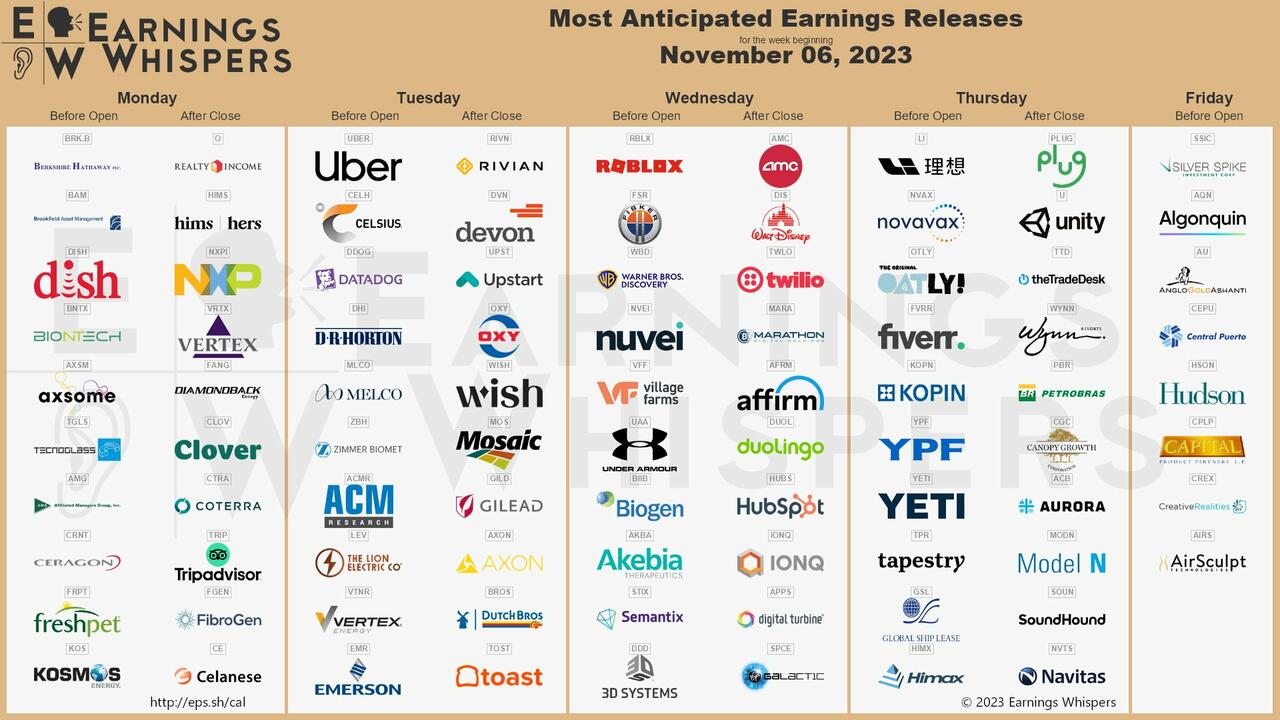
In corporate earnings, with more than 400 of the S&P 500 members having already reported, things will slow down a bit until Nvidia report on November 21st. The key names this week are in the day-by-day week ahead at the end. See our equity strategists’ global review of earnings season so far here.

Here is a day-by-day calendar of events:

Monday November 6

  • Data: UK October construction PMI, new car registrations, Japan September labor cash earnings, household spending, Italy October services PMI, Germany September factory orders
  • Central banks: BoJ’s Ueda speaks, ECB’s Holzmann and Nagel speak, BoE’s Pill speaks
  • Earnings: Vertex Pharmaceuticals, NXP Semiconductors, Diamondback Energy, BioNTech, International Flavors & Fragrances, Ryanair

Tuesday November 7

  • Data: US September trade balance, consumer credit, China October trade balance, Germany October construction PMI, September industrial production, Eurozone September PPI, Canada September international merchandise trade
  • Central banks: Fed’s Schmid and Logan speak, ECB’s Nagel speak, RBA decision
  • Earnings: Saudi Aramco, Gilead Sciences, Uber, UBS, Enel, Occidental, KKR, Engie, Coupang, Devon Energy, Klaviyo, Planet Fitness, Cava

Wednesday November 8

  • Data: US September wholesale trade sales, Japan October bank lending, September trade balance, leading index, coincident index, current account balance, Italy September retail sales, France September trade balance, current account balance, Eurozone September retail sales, Canada September building permits
  • Central banks: BoJ Summary of Opinions, ECB Consumer Expectations Survey, ECB’s Wunsch, Kazaks, Vujcic, Makhlouf, Lane and De Cos speak, BoE’s Bailey speaks, BoC Summary of Deliberations
  • Earnings: Walt Disney, Airbus, ARM, Bayer, Biogen, Corteva, adidas, Warner Bros Discovery, Take-Two Interactive, Telefonica, Vestas, Roblox, MGM Resorts, Endeavor, Maplebear, Affirm, Viasat

Thursday November 9

  • Data: US initial jobless claims, China October CPI, PPI, Japan October M2, M3, Economy Watchers Survey, France Q3 wages
  • Central banks: Fed’s Powell, Barkin, Paese and Bostic speak, ECB’s Lagarde, Villeroy and Lane speak, BoE’s Pill speaks
  • Earnings: AstraZeneca, Deutsche Telekom, Sony, Petroleo Brasileiro, Merck KGaA, Brookfield, ArcelorMittal, Illumina, Rheinmetall, Grab, Leonardo, Telecom Italia

Friday November 10

  • Data: US November University of Michigan consumer survey, October monthly budget statement, UK Q3 GDP, September monthly GDP, trade balance, industrial production, index of services, construction output, Italy September industrial production
  • Central banks: Fed’s Logan and Bostic speak, ECB’s Nagel speaks
  • Earnings: Allianz, Tokyo Electron

* * *

Finally, here is Goldman preview of the key US events, noting that the key economic data release this week is the University of Michigan’s preliminary consumer sentiment report on Friday. There are several speaking engagements from Fed officials this week, including Chair Powell; governors Cook, Barr, Waller, and Jefferson; and presidents Schmid, Williams, Logan, Bostic, and Barkin.

Monday, November 6

  • 11:00 AM Fed Governor Cook speaks: Fed Governor Lisa Cook will discuss financial stability at Duke University. Speech text and a moderated Q&A are expected. On September 22, when discussing the potential impact of AI on the economy and monetary policy, Cook said, “Empirical evidence is still patchy, but there is work showing that generative AI improves productivity in a variety of settings…Any large change in the labor force will generate disruptions and challenges that will need to be addressed to help workers adapt and thrive.”

Tuesday, November 7

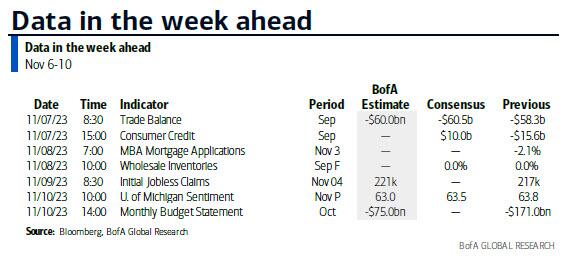
  • 08:30 AM Trade balance, September (GS -$59.2bn, consensus -$60.0bn, last -$58.3bn)
  • 09:15 AM Fed Vice Chair for Supervision Barr speaks: Fed Vice Chair for Supervision Michael Barr will discuss financial technology at the Annual DC Fintech Week hosted at the Fannie Mae headquarters. A moderated Q&A is expected. On October 2, Barr said, “I think it is likely that we are at or very near to the level that is sufficiently restrictive to bringing inflation back to 2% over time…I think we are going to be increasingly focusing on thinking about the path of interest rates over time. I think it is likely that we’ll need to keep rates up for some time in order to get inflation down to 2%. I’m confident that we’ll get there…I strongly agree with what Chair Powell has said about where we are in the tightening cycle. Given how far we have come, we are now at a point where we can proceed carefully.”
  • 09:50 AM Kansas City Fed President Schmid (FOMC non-voter) speaks: Kansas City Fed President Jeffrey Schmid will deliver opening remarks at an energy conference hosted by the Dallas and Kansas City Fed. A Q&A is not expected. Schmid began his term as president on August 21, 2023.
  • 10:00 AM Fed Governor Waller speaks: Fed Governor Christopher Waller will speak about using economic data to understand the economy at a St. Louis Fed conference. Speech text and a moderated Q&A are expected. On October 18, Waller said, “I believe we can wait, watch, and see how the economy evolves before making definitive moves on the path of the policy rate…I will be watching how these interest rates evolve in coming months to evaluate their impact on financial conditions and economic activity.” He added, “While there is some basis for expecting that inflation will continue to fall, let me remind you, as I have done repeatedly, that we have seen a string of good inflation reports evaporate multiple times in the recent past. So I will be watching the next several reports for clearer indications that inflation is on a trajectory to 2%…Although the labor market is showing signs of loosening by various metrics, it is still unusually tight. While I anticipate that it will continue to loosen, I will be watching closely to see that this remains true.”
  • 12:00 PM New York Fed President Williams (FOMC voter) speaks: New York Fed President John Williams will moderate a discussion at an event hosted by the Economic Club of New York with the dean of the Wharton School. On October 18, Williams said, “Right now, we need to keep this restrictive stance of policy in place for some time to get inflation down.” Discussing recent inflation data, he added, “We have seen big improvements but we still have a ways to go… I’m not going to declare victory.”
  • 01:25 PM Dallas Fed President Logan (FOMC voter) speaks: Dallas Fed President Lorie Logan will participate in a fireside chat at an energy conference hosted by the Dallas and Kansas City Feds. A moderated Q&A is expected. On October 9, Logan said, “If term premiums rise, they could do some of the work of cooling the economy for us, leaving less need for additional monetary policy tightening to achieve the FOMC’s objectives…If long-term interest rates remain elevated because of higher term premiums, there may be less need to raise the fed funds rate. However, to the extent that strength in the economy is behind the increase in long-term interest rates, the FOMC may need to do more. So, I will be carefully evaluating both economic and financial developments to assess the extent of additional policy firming that may be appropriate to deliver on the FOMC’s mandate.”

Wednesday, November 8

  • 05:15 AM Fed Governor Cook speaks: Fed Governor Lisa Cook will discuss financial stability at the Central Bank of Ireland Financial System Conference. Speech text and a moderated Q&A with the audience are expected.
  • 09:15 AM Fed Chair Powell speaks: Fed Chair Jerome Powell will deliver opening remarks at the Fed’s Division of Research and Statistics Centennial Conference. Speech text is expected, but a Q&A is not. We saw the November FOMC statement and Powell’s press conference as slightly dovish overall, for three reasons. First, the FOMC statement acknowledged the recent tightening in financial conditions, and Chair Powell laid out conditions that seem likely to be met under which the tightening would displace the need to hike. Second, Powell clarified that above-potential growth on its own would not be enough to warrant another rate hike and added that potential growth is currently higher than usual because labor force growth is elevated. Third, Powell downplayed the 1pp jump in one-year Michigan inflation expectations, a somewhat concerning recent data point, and said, “it’s just clear that inflation expectations are in a good place.” In response to a question about the plan for balance sheet normalization, Powell said that the FOMC is not talking about or considering changing the pace of runoff and that “it’s hard to make a case that reserves are even close to scarce at this point.”
  • 10:00 AM Wholesale inventories, September final (consensus flat, last flat)
  • 02:00 PM Fed Vice Chair for Supervision Barr speaks: Fed Vice Chair for Supervision Michael Barr will discuss the Community Reinvestment Act at the National Association of Affordable Housing Lenders annual conference. A moderated Q&A is expected.
  • 04:45 PM Fed Vice Chair Jefferson speaks: Fed Vice Chair Philip Jefferson will deliver closing remarks at the Fed’s Division of Research and Statistics Centennial Conference. Speech text is expected. On October 9, Jefferson said, “My view is that the FOMC is in a position to proceed carefully in assessing the extent of any additional policy firming that may be necessary.” He added, “I will remain cognizant of the tightening in financial conditions through higher bond yields and will keep that in mind as I assess the future path of policy.”

Thursday, November 9

  • 08:30 AM Initial jobless claims, week ended November 4 (GS 215k, consensus 220k, last 217k); Continuing jobless claims, week ended October 28 (GS 1,835k, consensus 1,830k, last 1,818k): We expect continuing claims to trend up because of residual seasonality, as we estimate seasonal distortions will exert a cumulative boost of 375k to the level of continuing claims by March.
  • 09:30 AM Atlanta Fed President Bostic (FOMC non-voter) and Richmond Fed President Barkin (FOMC non-voter) speak: Atlanta Fed President Raphael Bostic and Richmond Fed President Tom Barkin will participate in a fireside chat at the Atlanta Fed’s New Orleans branch about the importance of surveys and how survey data inform their economic outlook and policy views. A moderated Q&A with audience participation is expected. On November 3, Bostic said, “Today, my outlook is that we’re going to stay on that slow and steady and if we continue to do that then I think where we are now will be sufficiently restrictive to get us to the 2% level for inflation.” He added, “We’re going to be in sort of slow, steady growth that is methodical” in 2024. Asked when the FOMC might cut the fed funds rate, he said, “That’s down the road…We can’t wait until we are exactly at 2% to start reducing rates. It has got to be before that.” Finally, asked how long it would take to get inflation down to target: “I would say it’s going to be in the second half of next year.” Barkin said, speaking to the payrolls report on November 3, “What we saw today was data that showed a gradual lessening of the job market. I think that’s what those who would like to not see another rate hike would want to see. We’ll see what inflation comes in.” He added, “What I’ve been hearing is normalizing” and that the labor market is coming into “better balance…Supply has been getting better, demand’s coming off, particularly in places like professionals. It’s still hot in skilled trades…the gradual lessening that we’ve been expecting is continuing.” Asked about future fed funds rate moves, he said, “I don’t prejudge…We just got out of the last meeting.”
  • 12:00 PM St. Louis Fed Interim President Paese (FOMC non-voter) speaks: St. Louis Fed Interim President Kathleen O’Neill Paese will discuss the economy and monetary policy. Speech text and a moderated Q&A are expected.
  • 02:00 PM Fed Chair Powell speaks: Fed Chair Jerome Powell will participate in a panel discussion on monetary policy challenges in a global economy at the IMF’s annual research conference. A moderated Q&A is expected.

Friday, November 10

  • 07:30 AM Dallas Fed President Logan (FOMC voter) speaks: Dallas Fed President Lorie Logan will speak at the European Central Bank’s conference on money markets. Speech text and a Q&A with audience are expected.
  • 09:00 AM Atlanta Fed President Bostic (FOMC non-voter) speaks: Atlanta Fed President Raphael Bostic will speak to the Mobile Chamber of Commerce about economic mobility and challenges in the community. A Q&A with audience participation is expected.
  • 10:00 AM University of Michigan consumer sentiment, November preliminary (GS 63.5, consensus 63.5, last 63.8): University of Michigan 5-10-year inflation expectations, November preliminary (GS 2.9%, last 3.0%)

Source: DB, BofA, Goldman,

Tyler Durden
Mon, 11/06/2023 – 09:51

via ZeroHedge News https://ift.tt/OakEhI5 Tyler Durden