As Treasury Liquidity Evaporates, Last Week’s Massive Bond Rally “Was An Accident Waiting To Happen”

As Treasury Liquidity Evaporates, Last Week’s Massive Bond Rally “Was An Accident Waiting To Happen”

The ‘smart’ money may not be…

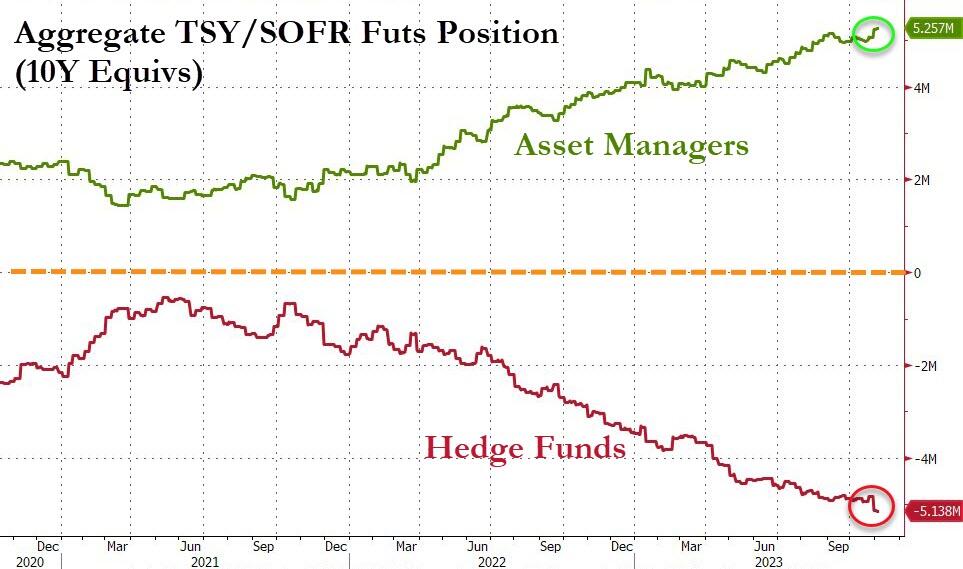
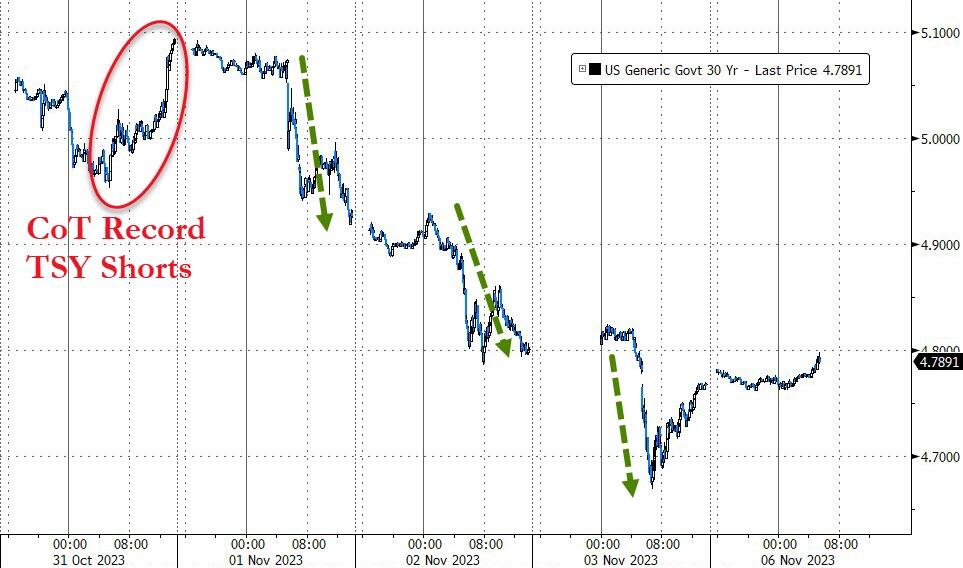
Just before US Treasury bonds saw their best week of 2023 (with the last 3 days seeing yields crash at the fastest pace since the COVID lockdowns of March 2020), hedge funds decided to add to their TSY Futures shorts (to a new record high).

Source: Bloomberg

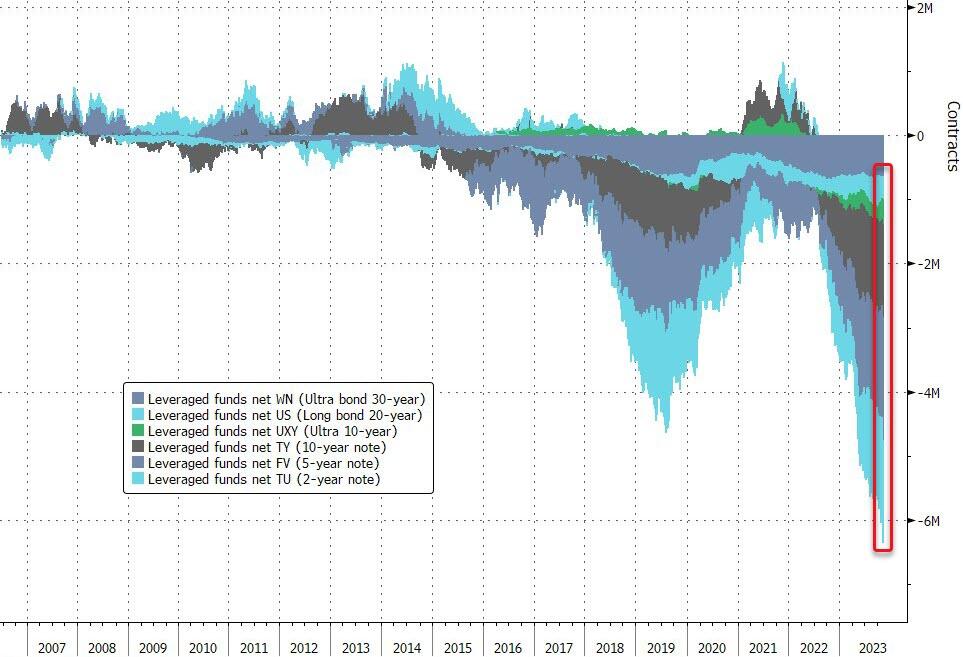
A trifecta of terrific news for treasuries – smaller-than-expected Treasury refunding, more dovish than expected Powell, weaker than expected jobs data – triggered three massive waves of buying in bond-land right as hedge funds ramped up their net short Treasury futures positions to the most in data going back to 2006, according to an aggregate of the latest CFTC as of Oct. 31.

Source: Bloomberg

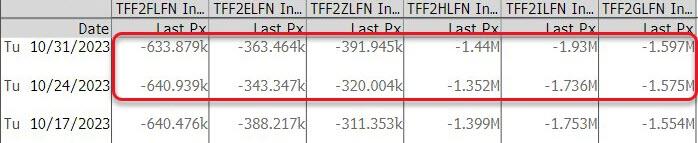
Under the hood, every Treasury future saw net short positioning increase…

Source: Bloomberg

Their timing could not have been any worse, and without doubt added to the velocity of the moves.

“It feels like short US Treasuries positioning was at an extreme last week, which was an accident waiting to happen,” said Gareth Berry, strategist at Macquarie Group Ltd. in Singapore.

“Price action in Treasuries for the past few months was a classic case of a persuasive story feeding the price action, until it went too far, leading to an overshoot which is now correcting.”

Bear in mind that a large number of those short-TSY Futs positions are tied to cash bonds via the ‘basis trade’ as we have discussed in great detail previously (here, here, and here). The scale of the moves last week in both cash and futures may have left some of those highly levered basis-traders with losses as the relative liquidity premia between the two markets gets exposed.

Source: Bloomberg

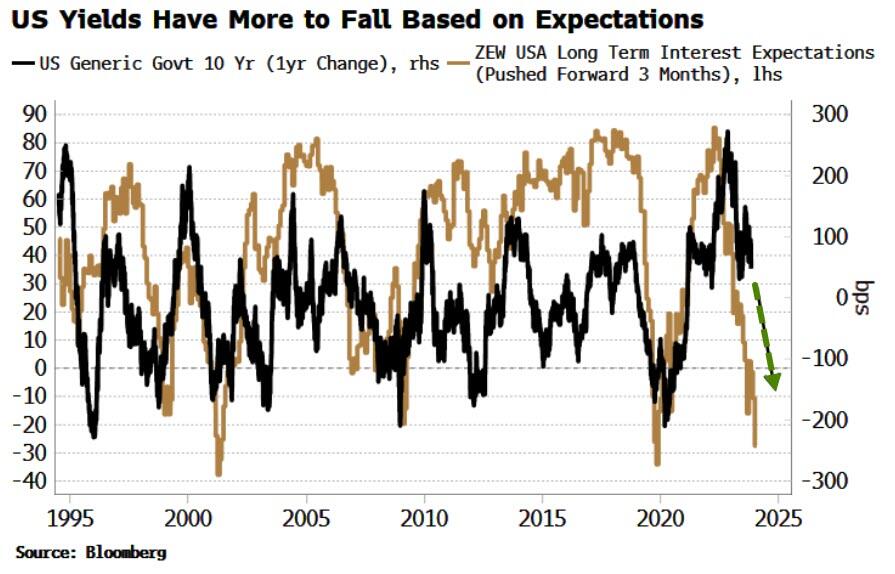
As the chart above shows, as hedgies extended their shorts, asset managers added to longs, as Bloomberg’s Simon White reports that the ZEW Survey of US long-term long-term interest rate expectations anticipates more downside for yields.

Source: Bloomberg

Most surveys for asset prices aren’t too great, but ZEW’s one for US yields is better than most, leading the annual change in US 10y yields, especially at turning points.

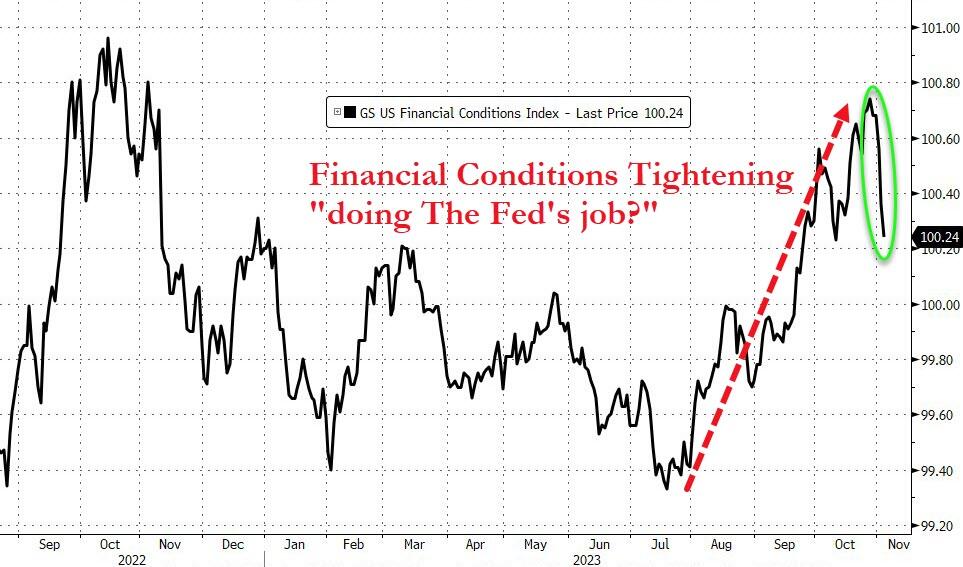
One more thing of critical importance, after The Fed specifically highlighted the market’s “tightening financial conditions” – doing it’s job for it – last week saw almost one third of the tightening of the last three months removed as conditions eased…

Source: Bloomberg

This reflexive move – after Powell’s comments – leads to the need for a more hawkish Fed to stabilize that over-easing of financial conditions which threatens to reignite asset inflation… and around we go.

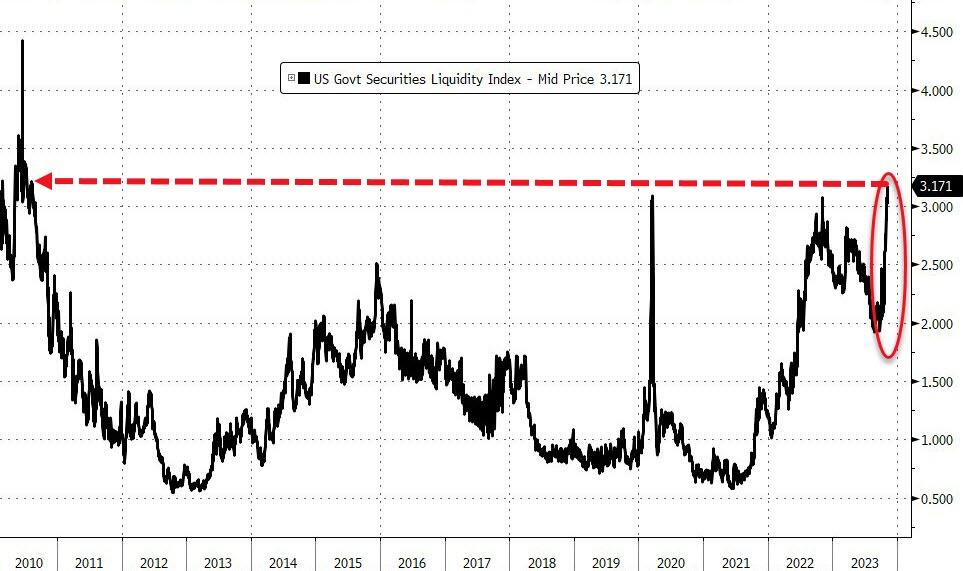
And finally, this is a major problem – and maybe the canary in the coalmine of problems with the highly-levered basis-trade discussed above.

US Treasury Liquidity is at its worst since 2010 (worse than at the peak of 2020’s yield collapse when The Fed stepped in specifically to ensure liquidity)…

Source: Bloomberg

Will Powell be forced to react again?

Tyler Durden
Mon, 11/06/2023 – 09:30

via ZeroHedge News https://ift.tt/xuVKZBI Tyler Durden

Europe’s Gas Storage Hits Record High But Winter Worries Persist

Europe’s Gas Storage Hits Record High But Winter Worries Persist

Authored by Irina Slav via OilPrice.com,

  • Europe’s gas storage is nearly full, yet this may not be sufficient for winter needs, leading to continuous LNG imports and additional storage strategies including utilizing Ukraine’s facilities.

  • Germany and other EU members have inked long-term LNG supply contracts, stretching beyond the 2050 net-zero target, indicating a realistic approach to energy needs versus idealistic energy transition goals.

  • Think-tank IEEFA warns that the EU could be over-investing in LNG import capacity as demand is projected to decline, pointing to potential mismatches between infrastructure and actual gas requirements.

Earlier this week, reports emerged that Chevron was negotiating LNG deliveries for the European Union, looking at contract terms of 15 years.

The news followed three other long-term deals that European energy companies closed with Qatar, one of the world’s largest exporters of LNG, in the past month.

Germany has installed three floating LNG import terminals over the past year or so and is now working on three more. The EU, which has emerged as the biggest importer of U.S. LNG this year, recently boasted that gas storage is almost 100% full.

Despite all this, the bloc is nowhere near ready for winter. Also, it does not seem to be prepared for an energy transition.

Media reported this month that European countries were starting to store gas in Ukraine as their own storage caverns filled up with regasified LNG bought earlier this year. Close to 30 LNG tankers are now on their way to European ports and are due to arrive by the end of the month. Those include three Russian vessels carrying liquefied gas, despite declarations the EU had given up Russian hydrocarbons.

All this suggests that the European Union’s efforts to reduce its members’ dependence on hydrocarbons have yet to start paying off. After all, EU countries have been investing robustly in new wind and solar generation capacity. And for all those investments, they are now gobbling up as much LNG as they physically can to secure electricity and heating supply for the winter. Even though storage is full.

The issue of the EU’s gas storage is an interesting one. Right now, gas in storage is at a record high. This is good news for the EU, of course, but here’s the twist: even 100% full storage capacity would not ensure supply over the winter, hence all those LNG tankers arriving this month and probably next month as well.

The problem—which is one of those problems that cannot be easily solved—is that no EU member has storage capacity equal to 100% of its demand for any meaningful period of time. This is why imports continue to be strong despite the full caverns.

This is also why the EU is storing gas in Ukraine despite the threat of war-related disruptions or storage loss. This is also why Shell, Eni, and TotalEnergies all closed long-term LNG supply deals with Qatar Energy in the past month.

Limited storage capacity and lack of local production is also the reason why, despite the assurances that there is enough gas for the winter, Germany’s electricity market regulator recently said consumption needs to remain curbed to ensure adequate supply during the winter. 

Consumption is likely to remain curbed, whatever the amount of gas in storage or new shipments of LNG. The reason: a tight global LNG market. This tightness itself is the result of Europe embracing the liquefied fuel to replace more than 100 billion cu m of Russian pipeline gas that is no longer available. Perhaps last year’s declarations that the EU can do perfectly well without any Russian gas were a bit premature. What was even more premature were arguments that the EU could do without any gas at all and rely only on wind, solar, nuclear, and hydro, possibly with some hydrogen in the mix.

The clearest signal that this is quite unlikely are those deals for Qatar LNG imports, each of which has a term of 27 years. This brings them beyond the EU’s net-zero target year, 2050. The companies that closed the deals, however, know that there is a big difference between what can be hoped for and what can realistically be achieved, and total gas independence appears to not be among the latter.

At the same time, the EU may be overstretching itself in light of its own ambitions. Pro-transition think-tank the Institute for Energy Economics and Financial Analysis said in a recent report that the EU is overbuilding LNG import capacity.

In a recent report, the IEEFA cited new LNG import capacity additions of 36.5 billion cu m since the start of 2022, adding that LNG consumption in the region had only added 4.8 billion cu m since the start of 2023 after soaring by 46.2 billion cu m last year.

The NGO also said that import capacity is set to continue expanding until it reaches 406 billion cu m in 2030, but demand for gas over the same period is set to decline to 400 billion cu m.

It’s worth bearing in mind that forecasts are not set in stone, especially when it comes to energy demand by different sources, yet it is quite reasonable to expect that high LNG prices will put a natural cap on demand in Europe. Alas, these prices would also cap economic growth, whose dependence on affordable, reliable energy Europe was reminded of over the past two years.

Tyler Durden
Mon, 11/06/2023 – 09:10

via ZeroHedge News https://ift.tt/UYptjQl Tyler Durden

Blinken’s Mission, Impossible


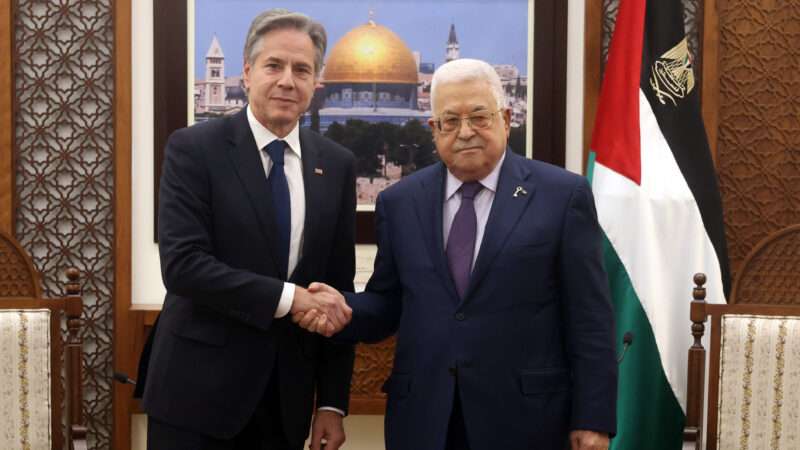
Blinken and Abbas | Thaer Ganaim/APAImages / Polaris/Newscom

Secretary of State Antony Blinken met with Palestinian President Mahmoud Abbas on Sunday. His goal was to reassure Abbas that the Biden administration is doing everything it can to limit civilian casualties as Israel continues to bomb the Gaza Strip. It is Washington’s hope that after Israel destroys Hamas—the terrorist group in charge of Gaza, and the perpetrator of the October 7 massacre that left 1,400 Israelis dead—Abbas and the Palestinian Authority could take over as the official government.

Abbas, however, has called for an immediate ceasefire in the conflict—a course of action that Jordan, Egypt, and many others in the international community have been demanding. President Joe Biden has not embraced a full ceasefire, instead preferring a “humanitarian pause” so that much needed aid can reach the people of the Gaza Strip. Israeli Prime Minister Benjamin Netanyahu has said there will be no ceasefire until and unless Hamas releases all its hostages.

Indeed, Israel ramped up its attacks over the weekend. The Palestinians against lost internet and other communication services as Israeli forces initiated another round of intense bombings in northwest Gaza aimed at killing senior Hamas leaders. Some areas of Gaza had internet restored on Monday morning.

The Palestinian death toll has risen to nearly 10,000, which puts the U.S. in a difficult position. Biden has offered unqualified support to Netanyahu, and repeatedly reaffirmed Israel’s right to defend itself against terrorism. Self-defense is well and good, but does the U.S. have a responsibility to provide Israel as many weapons and as much funding as it requires? Since World War II, the U.S. government has given more aid to Israel than to any other country in the world; does this policy really reflect America’s national security needs? How does the rest of the world view it?

Blinken reportedly received an icy reception from the U.S.’s Muslim allies in Turkey, Iraq, and elsewhere. They know that an open-ended and ever-escalating war between Israel and Hamas is bad for everyone, and that the U.S. is paying for it.

Biden’s poll numbers: They’re bad. The latest polling from The New York Times and Siena College has Biden losing to former President Donald Trump, who is well ahead in key swing states: Georgia, Michigan, Nevada, Arizona, and Pennsylvania. Prospective voters are particularly worried about Biden’s age, about national security, and about the economy; on that last question, Trump leads Biden by more than 20 points.

Tellingly, Biden is polling worse than Vice President Kamala Harris. And Trump does far worse against a generic candidate with a D next to their name.

These are big liabilities. In the 2020 Democratic primaries, one of the most compelling arguments for Biden was electability: Polls showed that he was most likely to defeat Trump in the general election. And for most of his presidency thus far, it has been evident that whatever Biden’s faults, Democrats lack a more popular alternative.

But now even the perpetually disappointing Harris seems like a better option to swing state voters. That’s quite an indictment of the incumbent.

More Twitter Files: A new installment of the Twitter Files, written by Susan Schmidt, finds that a report about Russian malfeasance on Twitter was ill-conceived and inaccurate; Twitter knew this, but was afraid to publicly challenge the prevailing narrative, particularly after Sen. Mark Warner (D–VA) started making noise about it.

Internally, Twitter’s head of trust and safety Yoel Roth slammed the report—assembled by New Knowledge, an internet research firm—as wholly flawed, and noted that some accounts labeled as Russian bots were actually authentic Americans. “Nothing to see here,” Yoth wrote to his colleagues.

The Twitter Files have documented this phenomenon again and again: national security officials, Democratic politicians, so-called disinformation experts, and the mainstream media made inaccurate claims about Russian bots in order to pressure Twitter to suppress legitimate political speech.


Scenes from Washington, D.C.

Thousands of pro-Palestinian protesters converged on the nation’s capital on Saturday, and a massive crowd formed outside the White House to chant “fuck Joe Biden.”


QUICK HITS

  • Kamala Harris’ stepdaughter is reenacting a literal plotline from Veep.

  • Jeff Bezos is leaving Seattle for Miami, and the reason why is no mystery: Washington state was trying to raise taxes specifically to bilk him to the tune of $1.44 billion.
  • Things are not going well for Ukraine in its war with Russia, and it’s only a matter of time before the country needs to negotiate with its attacker.
  • Nevertheless, Ukrainian President Volodymyr Zelensky had choice words for Russian President Vladimir Putin: He’s a “fucking terrorist.”
  • If Trump returns to office, key allies are discussing “revenge.”
  • Tucker Carlson is interviewing Julian Assange.

The post Blinken's Mission, Impossible appeared first on Reason.com.

from Latest https://ift.tt/ysAS6kW
via IFTTT

Iran Warns Americans Will Be “Hit Hard” If Gaza Ceasefire Not Reached, As CIA Director On Secretive Trip In Region

Iran Warns Americans Will Be “Hit Hard” If Gaza Ceasefire Not Reached, As CIA Director On Secretive Trip In Region

On Monday Iran’s foreign minister Hossein Amir-Abdollahian claimed that the United States is desperately seeking an end to the fighting to Gaza, despite Israel being nowhere near dismantling and destroying Hamas at the moment, which is Tel Aviv’s stated aim.

The foreign minister said that “the Americans sent us a message in the past three days saying they are are seeking a ceasefire,” according to state TV.

AFP/Getty Images

This could indeed be the behind the scenes messaging now being advanced as Secretary of State Blinken shuttles between capitals in the region, having most recently met with with Palestinian Authority President Mahmoud Abbas on Sunday. So far he’s on record as seeking a ‘humanitarian pause’ in the fighting.

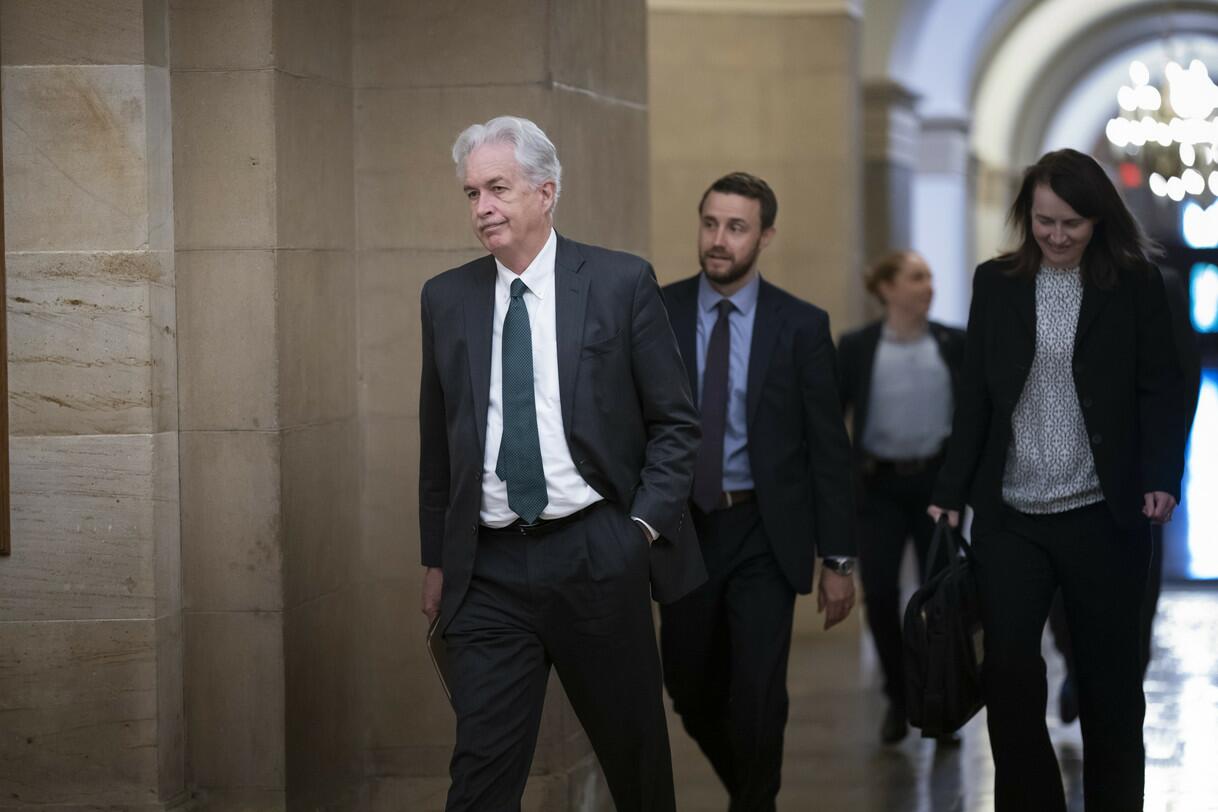
More interesting is that the White House has simultaneously dispatched CIA Director William Burns, who arrived in Israel Sunday for top level meetings. Burns will also go to Qatar, and then Jordan and the United Arab Emirates.

As with the Ukraine war, Burns is often sent to crisis spots to relay messaging that the US administration doesn’t wish to discuss publicly. This could involve further mediation to get the hostages freed, or working toward some kind of serious ceasefire agreement centered on the hostages’ freedom. 

This could be what’s behind Iran’s Monday statement claiming that the US is frantically working toward ceasefire, given also world public opinion is fast turning against Israel, as the death toll mounts – as of Monday surpassing 10,000 deaths in Gaza. Al Jazeera reports:

Palestinian Health Ministry says 10,022 people have been killed by Israeli attacks in Gaza since October 7, including 4,104 children and 2,641 women.

The ministry added that 25,408 people have also been wounded.

A US official described to Axios that Burns’ trip is to “discuss issues of mutual concern including the situation in Gaza, support for hostage negotiations, and the US commitment to continuing to deter state and non-state actors from widening the conflict between Israel and Hamas.” As for world opinion, South Africa is the latest to join a handful of Global South countries which has recalled diplomats from Israel.

Via AP

Meanwhile, in light of this Iran has ratcheted its threats and messaging aimed at Washington, after its proxy arm Hezbollah has already blamed the US for overseeing the massacres in Gaza. Tehran is now warning that the US will be “hit hard” if it can’t press Israel to a ceasefire.

“Our advice to the Americans is to immediately stop the war in Gaza and implement a ceasefire, otherwise they will be hit hard,” Iranian Defense Minister Mohammad-Reza Ashtiani was quoted as saying by the semi-official Tasnim news agency on Sunday.

But importantly it remains the the Biden administration’s official positions it so say no to ceasefire, reflected in fresh statements by Blinken in Amman:

The Arab foreign ministers that Blinken met with on Saturday in Amman – from Jordan, Egypt, Saudi Arabia, Qatar, and the United Arab Emirates – issued the same demand.

But Blinken said the U.S. would not push for one.

“It is our view now that a cease-fire would simply leave Hamas in place, able to regroup and repeat what it did on Oct. 7,” he said. Instead he said that temporary humanitarian pauses in fighting would be critical to protecting civilians, getting aid in and getting foreign nationals out “while still enabling Israel to achieve its objective, the defeat of Hamas.”

A US military build-up in the region has continued, after US bases in Syria and Iraq have been targeted by ‘Iran-backed’ militias over two dozen times, resulting in troop injuries. This new Iranian threat to hit Americans “hard” no doubt is a threat to step up these attacks further, as Hezbollah leader Hassan Nasrallah also warned just days ago in a speech.

The White House could also begin to face more pressure domestically from with within the Democratic base, considering also again the death toll on the Palestinian side has just surpassed the grim 10,000 mark, with by far most of the casualties being civilians. While Biden has emphasized over and over again his “love” and commitment for Israel, the progressive wing of his base will increasingly wield influence on the issue at popular level.

Tyler Durden
Mon, 11/06/2023 – 08:50

via ZeroHedge News https://ift.tt/zSUvwPx Tyler Durden

Trump Expected To Testify Today In New York Civil Fraud Trial

Trump Expected To Testify Today In New York Civil Fraud Trial

Authored by Michael Washburn via The Epoch Times,

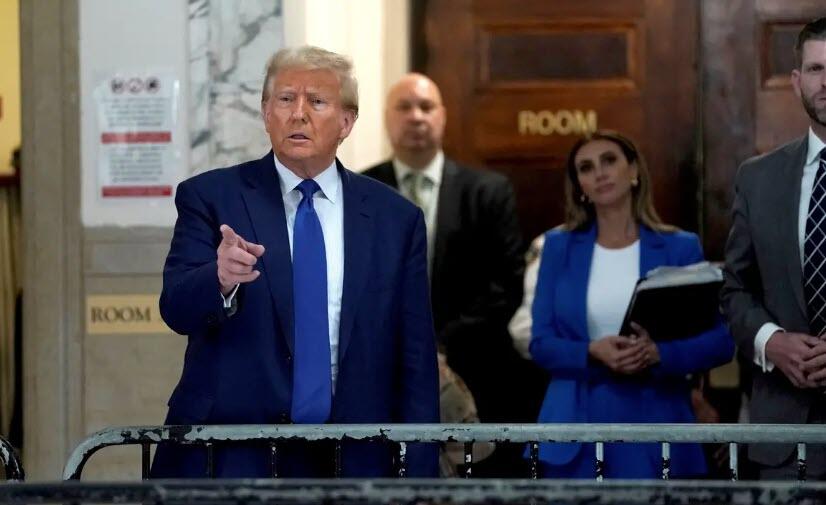
After weeks of tumultuous and bitter testimony and cross-examination in New York Attorney General Letitia James’s civil lawsuit against members of the Trump family, the star witness is expected to take the stand when the trial resumes at 10 a.m. on Nov. 6.

Assistant Attorney General Andrew Amer’s highly aggressive questioning of Donald Trump Jr. and Eric Trump on the witness stand last week was a prelude to what looks sure to be the most intensive, closely watched phase of the trial. Former President Donald Trump will appear in the civil court building at 111 Centre Street in Manhattan to testify about the truthfulness of valuations of Trump family assets in financial statements provided to Deutsche Bank and other lenders.

The former president’s sons gave lengthy testimony on the mornings of Nov. 1, Nov. 2, and Nov. 3 on often overlapping subjects. The prosecutor went over financial documents and records in painstaking detail, seeking answers from the brothers as to whether they recognized certain letters, emails, and financial statements and whether they had knowingly approved the presentation of such items to the banks for the purpose of obtaining loans on terms highly favorable to the Trump family and The Trump Organization.

Mr. Amer repeatedly grew frustrated with the brothers’ tendency to qualify their answers and demanded that they reply to his questions with a “yes” or “no.” Justice Arthur Engoron largely supported Mr. Amer in his efforts to obtain simple answers, and the judge’s perceived favoritism toward the prosecution led to a prolonged argument with Trump lawyer Christopher Kise on the afternoon of Nov. 2 and the morning of Nov. 3.

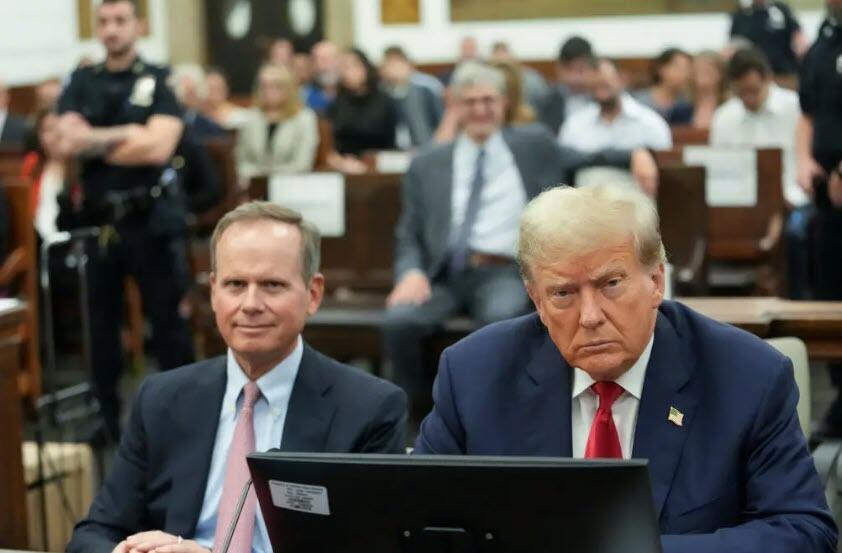
Former President Donald Trump (R) appears in the courtroom with attorney Christopher M. Kise for the third day of his civil fraud trial at the New York State Supreme Court in New York City on Oct. 4, 2023. (Mary Altafeer/Pool/Getty Images)

At many points throughout the proceedings, the brothers minimized their role in the preparation of the statements of financial condition and other documents and records and said they trusted the professional accountants and financial experts who prepared such items. Although the documents bear their signatures, they were merely acting in accordance with legal advice from people inside and outside the Trump business empire whose job was to run numbers and come up with valuations.

In essence, the brothers acknowledged their authority within The Trump Organization while portraying their role as the rubber-stamping of documents containing figures and valuations that others had compiled.

Typical of the cross-examination was a moment on Nov. 2, when Eric Trump told Mr. Amer that “people ask me questions all the time, but I never had anything to do with a statement of financial condition.”

Then, a bit later in his testimony, he said: “We had an accounting department that would sometimes work with outside entities. I did not work on a statement of financial condition; I’ve been very clear about that.”

Questions for the Former President

Mr. Amer often pursued an indirect route to getting the information he wanted, asking one of the Trump brothers a question that a third-party financial professional assigned to a given project or the former president himself might be in a better position to answer.

At one point, he asked Eric Trump whether the witness had seen one of his father’s financial statements from August 2013. At such times, Eric Trump often alluded to the sheer amount of time that had passed and said he didn’t recall the details of the document or figures he was pressed about.

He denied his involvement in appraisal work on properties and said repeatedly that Sheri Dillon, who’s now an attorney with the law firm Morgan Lewis & Bockius, handled the minutiae of such matters.

The brothers didn’t dispute their agency as executives of The Trump Organization with a significant amount of latitude when it came to signing documents whose preparation they had entrusted to others. But they fell short of claiming oversight of properties and assets that fall under their father’s ownership.

Hence, the questioning of Donald Trump Jr. and Eric Trump may have been a long warm-up for the most critical phase of the trial, when questions about who was ultimately answerable for representations made to powerful financial institutions, and for any real or alleged inflations of the value of Trump family assets, will be front and center throughout the testimony.

President Trump is expected to take the stand as soon as the new phase of the trial begins on Nov. 6.

Tyler Durden
Mon, 11/06/2023 – 08:35

via ZeroHedge News https://ift.tt/NwpAQ90 Tyler Durden

Futures Extend Last Week’s Blockbuster Rally As Oil, Yields Rise

Futures Extend Last Week’s Blockbuster Rally As Oil, Yields Rise

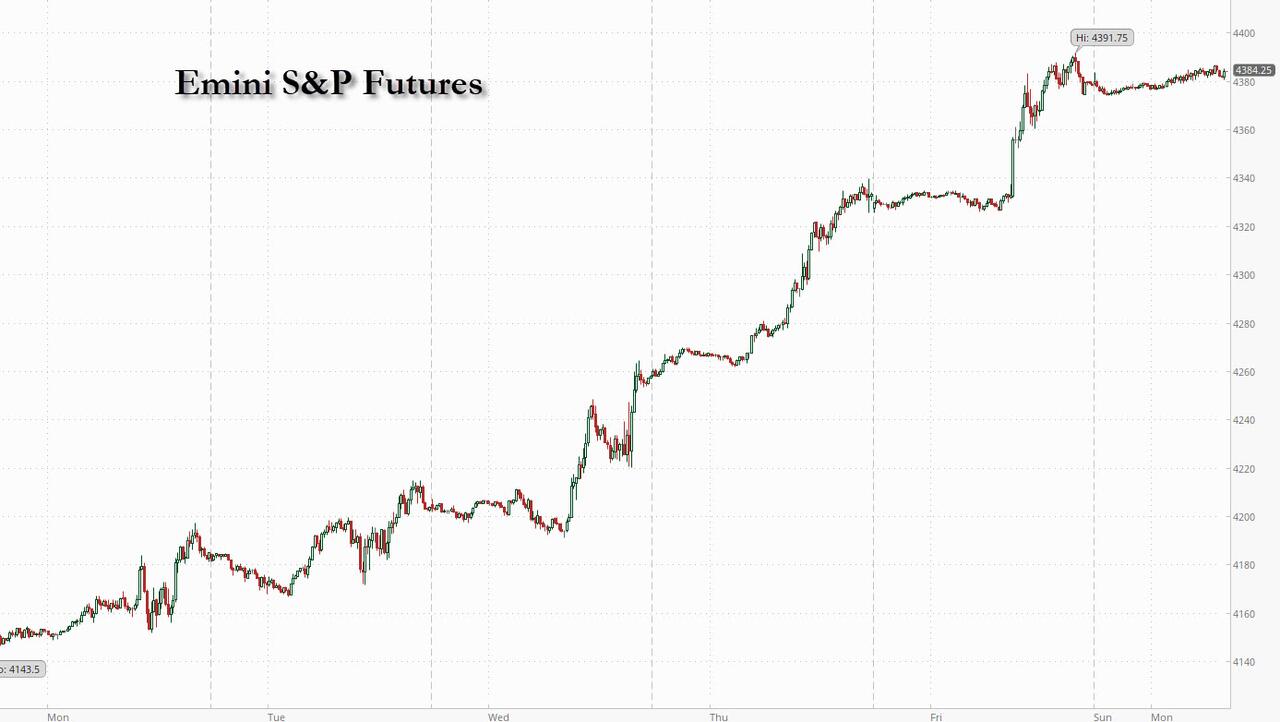
US equity futures extended gains after last week’s blockbuster rally, the biggest of the year, despite some weakness in bonds, as traders remained optimistic that US and European central banks may start cutting interest rates as soon as next year. As of 7:40am, S&P emini futures were higher by 0.2%, near top of Friday’s range, while Europe’s Estoxx 600 dropped 0.2% with materials leading declines. South Korea’s Kospi soared more than 5% after regulators banned short selling. The dollar fell for a fourth day. Crude futures rose more than 1.5% after Saudi Arabia and Russia reaffirmed they will stick with their supply curbs through year-end. Bitcoin continued its ascent, last seen above $35K, with Ethereum rising above $1900. 
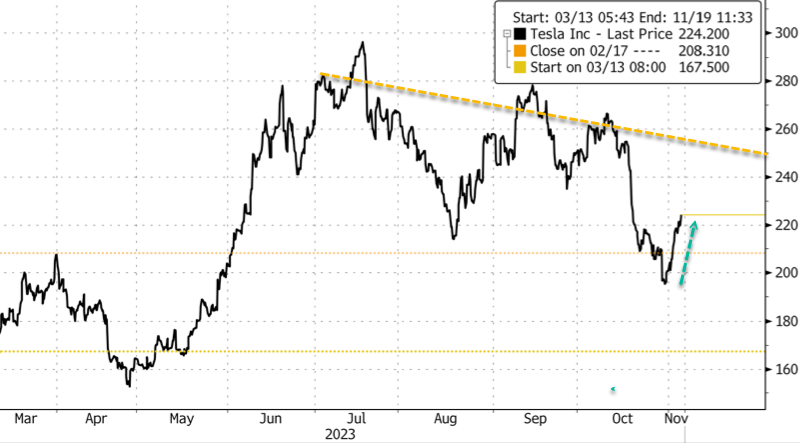
Among individual stock market movers, Ryanair jumped almost 7% after announcing its first regular dividend. Tesla rose in pre-market trading after Reuters reported the company would produce a new, more affordable electric car model in Germany. Albemarle fell 1% as UBS cut its recommendation on the lithium producer’s stock to neutral from buy. Meanwhile, Morgan Stanley slashed its price target to Street-low of $90 from $155. Here are the other notable premarket movers:

  • Apple Inc. is upgraded to accumulate from neutral at Phillip Securities, a move that comes in the wake of the iPhone maker’s recent results. Shares are down 0.3%.
  • BioNTech ADRs gain 4.7% after the vaccine maker reported a profit for the third quarter, exceeding analysts’ expectations of a loss. The firm also gave quarterly sales results that topped estimates.
  • Birkenstock has received buy-equivalent recommendations from a majority of brokers initiating coverage after the so-called quiet period for analysts at firms that participated in the initial public offering. Shares are down 0.2%.
  • Bumble slumps 7.1% after the Wall Street Journal reported that CEO Whitney Wolfe Herd is stepping down.
  • Dish Network Corp. is down as much as 13% after a satellite television company reported revenue for the third quarter that missed the average analyst estimate and said its CEO Erik Carlson will resign effective November 12.
  • Fortinet Inc. is downgraded to hold from buy at HSBC, a move that comes in the wake of the cybersecurity company’s recent results. Shares down 1.2% in premarket trading.
  • Freshpet shares are up 12% in premarket trading, after the retailer of pet products reported third-quarter results that beat expectations and raised its full-year forecast.
  • Hilton Grand Vacations falls 6% in premarket trading after the manager of timeshare resorts agreed to buy Bluegreen Vacations Holding for $75.00 per share in an all-cash transaction, representing a total enterprise value of approximately $1.5 billion, inclusive of net debt.
  • Paramount Global slides 3.5% in premarket trading after BofA double-downgrades its rating to underperform from buy, on basis of no significant asset sales on the horizon for the media company.
  • Tecnoglass Inc. shares fall 11% in premarket trading Monday after narrowing its full-year revenue outlook to a range of $835 million to $848 million, after previously forecasting between $830 million and $855 million.
  • SolarEdge Technologies falls 0.3% as Wells Fargo adds to the slew of downgrades since the solar equipment supplier’s weak revenue forecast last week, cutting to equal-weight with uncertainties seen outweighing a discounted valuation.

Global equity markets are finding firmer footing after recent US data pointed to a cooling economy, leading traders to price lower rates by June. Ten-year Treasury yields, the benchmark rate for the global cost of capital, edged higher Monday, having slid in recent weeks from the 16-year highs touched last month.

“A better-than-expected US earnings season and the peak in interest rates are all pointing towards a year-end rally,” said Julius Baer strategist, Leonardo Pellandini, echoing a view that has rapidly become consensus when as recently as two weeks ago the Wall Street outlook was that a drop below 4,000 was in the cards. Which is not to say that the permabears are giving up: according to Morgan Stanley’s Michael Wilson who has been wrong most of the year, last week’s market bounce was more of a bear market rally than the start of a sustained upswing, particularly in light of a gloomy earnings outlook and weaker macro data.

More information about how policymakers see the trajectory of inflation may come later in week, with speeches due from Federal Reserve Chair Jerome Powell and Bank of England governor Andrew Bailey.

“There’s a bit more reason for investors to be more optimistic that the Fed is probably done with rate hikes, but one should not let one’s guard down,” Vasu Menon, managing director for investment strategy for OCBC Bank Singapore, said on Bloomberg Television. “If the economy proves to be more resilient, if inflation proves to be more stubborn, bond yields could go up once again.”

Here are the latest market observations from Goldman trader Rich Privorotsky:

Massive stop in of macro risk last week. Very visible in the PB stats with a huge jump in nets and some outsized flows to buy macro products (“Global book saw largest net buying since Dec ’21”) . It was really a beta chase and that is quite evident from the record amounts IWM calls, the ballooning of SPX calls and a corresponding jump in funding spreads.

L/S scrambling to lock in gains on short alpha bets drove portfolio destruction and the unwind of momentum across the market (later parts of last week saw some of the worst systematic alpha we’ve seen all year). Non-profitable tech 2 day return = 13.5%, 99th % of the last 5 years. Amazing to see that the market’s correlation to longer dated rates only go higher on the week (rolling 60-day basically back to the highs).

If you look at cross asset price action the market traded as if it had been delivered QE with bonds up/eq up, credit tighter/bonds up, Cyc/def up/bonds up and vol down/bonds up. To some extent that’s true, the QRA did curtail some of the bond supply overhang. As the dust has settled I’m not so sure just how big of an impact this really has, net duration might be platueing very temporarily but the change is really marginal. Market took NFP as Goldilocks print with economy slowing just enough to take pressure off the rate market and yet not enough to project recession. Last week had a lot of weak data with ISM manf, ISM services both coming in light of expectations. The market is repricing forward earnings expectations lower sharply in European and slightly so in the US. GIR actually decomposed the yield moves last a with the lion share driven by a  downgrade to growth and to a lesser extent policy (see side-note).

The technicals are supportive: From here CTA are still going likely to be buying more, L/S nets have already jumped considerably after last week (more could come but think a lot of the squaring now rear view), asset mangers have length to add as the CFTC positioning  data suggests they have trimmed exposure in SPX/NDX to early summer levels (but that’s a far cry from deeply underweight levels to start the year) and vol control probably will at some point start buying again but at at a gradual pace. Vol is back to a 14 handle so any exogenous risk premia for the multiple geopolitical conflicts has slipped to zero. Ironically SPX implied vs realized still shows pretty big downside to spot vol levels. 

European stocks struggled to gain traction as bond yields pared some of Friday’s post-payrolls drop. The Stoxx 600 was modestly red after rising for five straight days. Travel and mining are the best performing sectors. Ryanair shares rise as much as 6.8%, the most since January, after the budget airline announced its first ever dividend and reported second-quarter results that analysts called solid. Here are other notable European movers:

  • Melrose Industries shares rise as much as 4.8%, the most since September, after its subsidiary GKN Aerospace signed a new agreement with GE Aerospace, widening a long-term partnership on the GEnx program
  • JD Sports rises as much as 2.4% in London as Citi initiates with a buy rating, citing that it sees Asia-Pacific representing the largest growth opportunity for sporting-goods stocks
  • Stadler Rail rises as much as 1.5% after Oddo raised its recommendation for the Swiss train maker to neutral from underperform, citing increasingly “rational” multiples after the stock’s plunge over the past two years
  • Evotec drops as much as 7.8%, as RBC downgrades the German pharma company to sector perform on major near-term uncertainty from factors including life science sector headwinds
  • K+S shares slide as much as 7.8% to a June low after the potash producer was cut to sell from neutral at UBS, citing a lack of earnings momentum and a challenging environment for the crop nutrient
  • Telecom Italia shares slip after erasing gains of as much as 5.4% at the open. The Italian carrier’s board approved a sale of its land-line network to KKR for as much as €22 billion
  • Heidelberg Materials falls as much as 3% as UBS downgrades the cement maker to neutral from buy, citing potential for larger and higher-multiple M&A activity, which could weigh on shares
  • PostNL falls as much as 13%, the steepest drop since May 2022, after third-quarter results missed estimates. A recovery in parcel volumes failed to match expectations in the third quarter
  • Oerlikon drops as much as 7.4%, after RBC cuts the polymer processing group to sector perform in note saying that third-quarter results were “sobering” and a cautious outlook won’t help investor confidence

Earlier in the session, the MSCI Asia Pacific Index advances as much as 1.9%, rallying the most since July 13, after US Treasury yields fell on Friday following data releases that showed the US service sector expanded at the weakest pace in five months, job growth moderated and the unemployment rate climbed to 3.9%.

  • Hang Seng and Shanghai Comp conformed to the gains in the region with sentiment supported by weekend comments from the Chinese Premier who stated China will soon release a plan to promote high-standard institutional opening up in the Shanghai Free Trade Zone, whilst the Finance Minister said China will accelerate the issuance and use of government bonds. Traders are also cognizant of the Chinese Trade Balance data due for release tomorrow.
  • Korea’s Kospi index surges as much as 4.1%, the most since January 2021, following the nation’s move to reimpose a full ban on short-selling for about eight months; Kosdaq +6.2%.
  • Japan’s Nikkei 225 remained comfortably above the 32,500 level and hit levels last seen at the end of September with the Industrial sectors leading the gains, whilst Final Services and Composite PMIs were revised higher from the Prelim.
  • Australia’s ASX 200 posted modest gains as the index is hindered by losses in heavyweight Energy and Mining sectors, although gold names outperformed as the yellow metal held onto recent gains, while Financials were boosted by Westpac post earnings. Participants also look ahead to tomorrow’s RBA decision in which 35/39 analysts polled by Reuters expect a 25bps rate hike.
  • Indian stocks climbed for the third straight day, reflecting the widespread gains across Asia. The S&P BSE Sensex rose 0.9% to 64,958.69 as of 03:45 p.m. in Mumbai, while the NSE Nifty 50 Index gained by a similar measure to 19,411.75. Today’s gain in the Nifty was the third-best Monday performance so far this year. The NSE metal index was the top-performing sector, with 12 of its 15 member stocks advancing on the day. All sectors except the gauge for state-run banks ended in the green.    

In FX, the Bloomberg Dollar Spot Index was flat after the index on Friday posted its worst performance since mid-July. The Japanese yen is one of the weakest G-10 currencies, falling 0.2% versus the greenback; the USDJPY was boosted by short covering by leveraged funds; the yen pared losses after Bank of Japan Governor Kazuo Ueda cautiously hinted that gradual progress is being made toward achieving the bank’s inflation target “Another soft outcome on Japanese labor cash earnings will reinforce our view that BoJ policy tightening is a distant prospect,” Kristina Clifton, Commonwealth Bank of Australia strategist, wrote in a note, referring to data due to come out on Tuesday

In rates, treasuries are slightly cheaper across the curve amid deeper losses in core European rates, partially unwinding Friday’s sharp bull-steepening rally spurred by softer-than-expected October jobs report. US yields cheaper by up to 3bp across front-end of the curve which leads losses on the day, re-flattening 2s10s spread by around 1bp into early US session; 10-year yields around 4.59% with bunds and gilts lagging by 4bp and 3bp in the sector.  Scant economic data is scheduled for this week, while auctions resume Tuesday with $48b 3-year note sale, followed by 10- and 30-year offerings Wednesday and Thursday. Powell is slated to speak Wednesday and Thursday, among more than a dozen planned appearances by Fed officials this week. Dollar IG issuance slate already includes a handful of deals; forecasts for the week suggest around $40b of issuance on deck, higher than average, during economic data drought.

In commodities, oil prices advance, with WTI rising 1.8% to trade near $81.90. Spot gold falls 0.3%.

No US economic data scheduled for the session; ahead this week are trade balance, wholesale inventories and University of Michigan sentiment

Market Snapshot

  • S&P 500 futures up 0.1% to 4,382.00
  • STOXX Europe 600 little changed at 444.09
  • MXAP up 2.0% to 159.84
  • MXAPJ up 2.2% to 499.71
  • Nikkei up 2.4% to 32,708.48
  • Topix up 1.6% to 2,360.46
  • Hang Seng Index up 1.7% to 17,966.59
  • Shanghai Composite up 0.9% to 3,058.41
  • Sensex up 0.9% to 64,930.04
  • Australia S&P/ASX 200 up 0.3% to 6,997.38
  • Kospi up 5.7% to 2,502.37
  • German 10Y yield little changed at 2.69%
  • Euro up 0.1% to $1.0745
  • Brent Futures up 1.4% to $86.04/bbl
  • Brent Futures up 1.3% to $86.01/bbl
  • Gold spot down 0.3% to $1,986.56
  • U.S. Dollar Index little changed at 104.93

Top Overnight News

  • China will further expand market access and increase imports, its premier told a trade fair in Shanghai on Sunday, amid criticism from European firms who said they wanted to see more tangible improvement in the country’s business environment. RTRS
  • China will accelerate the issuance and use of government bonds, state-run news agency Xinhua reported on Sunday citing an interview with new finance minister Lan Foan. The finance ministry will steadily promote the resolution of local government debt risk and increase efforts to better leverage the role of special bonds to boost the economy, Xinhua cited Foan as saying. RTRS
  • Foreign firms yanked more than $160 billion in total earnings from China during six successive quarters through the end of September, according to an analysis of Chinese data, an unusually sustained run of profit outflows that shows how much the country’s appeal is waning for foreign capital. WSJ
  • Chinese brokerages surged after authorities proposed to relax capital requirements for firms and signaled support for more acquisitions. BBG
  • Shares in South Korea surged on Monday morning after the country’s financial regulator issued a blanket ban on short selling to appease retail investors ahead of parliamentary elections next year. FT
  • Saudi Arabia and Russia reaffirmed that they will stick with oil supply curbs of more than 1 million barrels a day until the end of the year, even as turmoil in the Middle East roils global markets. The leaders of the OPEC+ coalition announced the plans in separate official statements on Sunday. Riyadh has slashed daily crude production by 1 million barrels and Moscow is curbing exports by 300,000 barrels, on top of earlier cuts made with fellow OPEC+ nations. BBG
  • Trump leads Biden in nearly all the important battleground states according to a new poll (Biden leads among voters under 30 by just a single point and his advantage with Hispanic voters is down to the single digits). NYT
  • Israeli troops encircled Gaza City, effectively cutting off the northern part of the strip from the south, an army spokesman said. Antony Blinken is in Turkey after making unannounced stops in the West Bank and Iraq. White House officials are frustrated at the scale of civilian casualties in Gaza. WaPo
  • Hedge funds extended short positions on Treasuries to a record, CFTC data showed — just before smaller-than-expected US bond sales and weaker jobs data spurred a rally. Also on a collision course: Money markets have raised policy-easing wagers, betting the first Fed rate cut will be in June, with 100 bps of reductions by end-2024. BBG
  • Consumer Discretionary was the most net bought sector on the US Prime book last week and saw the largest net buying since Dec ’21, driven almost entirely by long buys. Last week’s long buying in US Cons Disc ranks in the 93rd percentile vs. the past five years.

A more detailed look at global markets courtesy of Newsquawk

APAC stocks traded higher across the board following the post-NFP tailwinds from Wall Street on Friday, with sentiment in the region also boosted by South Korea announcing a ban on stock short-shelling which catapulted the KOSPI index to gain over 4%. ASX 200 posted modest gains as the index is hindered by losses in heavyweight Energy and Mining sectors, although  gold names outperformed as the yellow metal held onto recent gains, while Financials were boosted by Westpac post earnings. Participants also look ahead to tomorrow’s RBA decision in which 35/39 analysts  polled by Reuters expect a 25bps rate hike. Nikkei 225 remained comfortably above the 32,500 level and hit levels last seen at the end of September with the Industrial sectors leading the gains, whilst Final Services and Composite PMIs were revised higher from the Prelim. Hang Seng and Shanghai Comp conformed to the gains in the region with sentiment supported by weekend comments from the Chinese Premier who stated China will soon release a plan to promote high-standard institutional opening up in the Shanghai Free Trade Zone, whilst the Finance Minister said China will accelerate the issuance and use of government bonds. Traders are also cognizant of the Chinese Trade Balance data due for release tomorrow.

Top Asian News

  • China Premier said China will continue to promote opening up and market opportunities, and China will actively expand imports, and promote coordination of trading goods and services. He added China will further expand market access and remove barriers to foreign investment in manufacturing. China Premier said in the next five years, China’s imports of goods and services are expected to reach USD 17tln on cumulative terms, and China will soon release a plan to promote high-standard institutional opening up in the Shanghai Free Trade Zone, according to Reuters.
  • China’s Finance Minister said China will accelerate the issuance and use of government bonds, and China will steadily promote the resolution of local government debt risks, according to Reuters citing state media.
  • Alibaba’s (9988 HK/BABA) Ant Group has received Chinese government approval to release products powered by its ‘Bailing’ AI model to the public, according to Reuters.
  • PBoC injected CNY 18bln via 7-day reverse repos with the rate at 1.80% for a CNY 658bln net daily drain, according to Reuters.
  • China’s Shenzhen state asset regulator says if Vanke (2202 HK) faces extreme conditions it has sufficient liquidity to assist, via Reuters citing sources.
  • South Korea to ban all stock short-selling through the first half of 2024 to help create a “level playing field” for both retail investors and institutional and foreign investors, according to financial regulators cited by Reuters.
  • The Japanese government reportedly plans to submit an extra budget to Parliament on November 20th, according to Asahi.
  • BoJ Governor Ueda reiterated that Japan’s economy is recovering moderately and is likely to continue recovering and repeated that the BoJ will patiently maintain monetary easing to support economic activity, according to Reuters. He said long-term interest rates may rise somewhat, but what’s important is to look at the real interest rate that takes into account inflation expectations. He added the BoJ will continue massive bond-buying even under the new operation decided last week and will conduct nimble market operations when interest rates rise, depending on the level and speed of moves of long-term rates. He said even if long-term rates come under upward pressure, he doesn’t expect the 10-year JGB yield to sharply exceed 1%, and BoJ needs to carefully weigh the effect of the policy in stimulating the economy and the potential side-effects under YCC. Ueda said the BoJ will keep Yield Curve Control and negative short-term rates intact until the sustained achievement of 2% inflation is foreseen. Ueda said the BoJ needs to have more conviction that wages will keep rising.
  • BoJ Minutes from the September 21-22 meeting (two meetings ago) said members expressed the need to continue patiently with monetary easing to achieve the sustainable inflation target, alongside wage growth, according to Reuters.
  • Japanese government is to hold a meeting with management and labor unions this month, via Nikkei.
  • RBA Shadow Board calls for a rate hike to curb inflation, according to Canberra Times.

European bourses are in the red with trade thus far relatively cagey and contained after last week’s action and as the region awaits fresh catalysts, Euro Stoxx 50 -0.3%. Sectors are mixed with outperformance in Travel & Leisure post-Ryanair while the likes of Real Estate, Construction and Chemicals lag. Stateside, futures are modestly firmer in a continuation of Friday’s action going into a week that features numerous Fed speakers incl. Chair Powell and data prints such as Manheim & UoM; ES & NQ +0.2%. Berkshire Hathaway (BRK): Reported a +40.6% increase in Q3 operating earnings to USD 10.76bln (exp. 8.95bln), or around USD 4.96/shr per Class B share (exp. 4.42), and around USD 7,442 for each Class A share (exp. 6,625). Q3 revenue USD 93.2bln (exp. 88.1bln); Q3 insurance underwriting operating income USD 2.422bln (vs USD 1.247bln Q/Q), Q3 insurance investment income USD 2.47bln (vs 2.369bln Q/Q). Ended the quarter with USD 157.2bln of cash. Executed USD 1.1bln of share repurchases in Q3 (vs USD 1.4bln in Q2). Its outlook acknowledges challenges like the pandemic’s impact, geopolitical risks, and inflation pressures. +0.6% in pre-market trade.

Top European News

  • ECB President Lagarde said the ECB is determined to bring inflation down to 2%. “According to our projections, we will get there in 2025”, according to an interview with Greek press conducted on 30th October and released on 4th November.
  • UK PM Sunak will reportedly unveil a North Sea annual oil and gas licensing bill which will allow companies to bid yearly for new licences to drill for fossil fuels, according to the FT. “There is currently no fixed period between licensing rounds – but this would change under a bill to be announced in Tuesday’s King’s Speech… Ministers said projects would have to meet net-zero targets and claimed the policy would guarantee energy security.”, according to the BBC.
  • UK Chancellor Hunt is facing calls from Tory MPs to lower taxes after figures revealed a multi-billion GBP improvement in public finances since March’s budget, according to The Times.

FX

  • Buck continues to buckle after ‘dovish’ Fed, NFP and ISM misses as DXY slips into a softer 105.15-104.84 range, Pound, Euro and Franc all extend gains vs Dollar to form 1.2400+ triple top, probe 1.0750 and approach 0.8950 respectively.
  • EUR/USD faces decent option expiry interest below 1.0800.
  • USD/JPY capped by 21 DMA and expiries at 150.00 strike after BoJ Governor Ueda maintains that patient monetary easing is still needed.
  • Aussie prepares for likely RBA hike, with AUD/USD holding above 0.6500 and AUD/NZD cross eyeing return to 1.0900.
  • Loonie underpinned by a bounce in crude and hawkish line from BoC’s Rogers ahead of Canadian Ivey PMIs and Market Participants Survey.
  • PBoC sets USD/CNY mid-point at 7.1780 vs exp. 7.2868 (prev. 7.1796)

FX

  • Bonds hand back more of Friday’s post-payrolls and services ISM gains.
  • Bunds towards the lower end of 129.90-130.38 band alongside EGB peers after stronger than expected German factory orders and not as weak as feared EZ Sentix index.
  • Gilts and T-note near base of 94.78-95.15 and 108-02/07+ respective ranges.

Commodities

  • Crude benchmarks are firmer and have continued to climb despite a lack of fundamental updates occurring in European hours, with the move primarily a recovery from Friday’s pressure and aided by geopolitics alongside a softer USD.
  • As it stands, WTI Dec’23 and Brent Jan’24 contracts are at the top end of circa. USD 1.50/bbl parameters but remain well within Friday’s and by extensions last week’s parameters.
  • Spot gold is little changed with the overall tone a tentative one as we await fresh catalysts and continue to analyse last week’s data and potential associated Fed implications. Finally, base metals are generally firmer owing to the constructive APAC tone.
  • Saudi Arabia December OSPs: Arab Light prices maintained for Asia and the US, but large cut to NW Europe, according to Reuters: Asia +4.00/bbl (prev. +4.00/bbl) vs Oman/Dubai average, NW Europe +4.90/bbl (prev. +7.20/bbl) to Ice Brent settlement, US +7.45/bbl (prev. +7.45/bbl) vs ASCI.
  • Saudi Ministry of Energy reaffirmed that Saudi Arabia will continue the voluntary cut of 1mln BPD through December, according to the state news agency SPA.
  • Russia’s Deputy PM Novak reaffirmed Russia to continue the additional voluntary supply cut of oil and petroleum products exports by 300k BPD until the end of December this year. He said the voluntary cut decision will be reviewed next month to consider deepening the cut or increasing oil production, according to Reuters.

Geopolitics: Israel-Hamas

  • Israeli PM Netanyahu said there will be no ceasefire until hostages are returned, according to Reuters. Israel’s army says it has cut the Gaza Strip in two, according to AFP.
  • Four civilians, three of them children, were killed by an Israeli airstrike in south Lebanon on Sunday evening, according to Sky News.
  • Hezbollah said it fired multiple Grad rockets at the northern Israeli town of Kiryat Shmona in retaliation for an Israeli airstrike in South Lebanon, according to Reuters.
  • Hezbollah lawmaker Fadallah said the Israeli strike which killed children is a “dangerous development”, and will have repercussions, according to Reuters.
  • Lebanon said it will submit a complaint to the United Nations over the killing of civilians including children in an Israeli strike in South Lebanon, according to the Lebanese Foreign Minister cited by Reuters.
  • Israeli military spokesperson said their attacks in Lebanon are made based on intelligence information, according to Reuters.
  • Evacuations from Gaza to Egypt through Rafah crossing were reportedly suspended since Saturday after Israeli strikes on ambulances, according to Egyptian official sources cited by Reuters.
  • Qatar’s Foreign Ministry spokesperson said the Hamas political office in Doha will remain open so long as it can be used towards peace, and there’s no reason to close it now, and added that Qatar is working with Egypt to ensure Rafah crossing remains open, according to Reuters.
  • Egyptian Foreign Minister Shoukry says he cannot justify Israel’s actions against Palestinians as self-defence, according to Reuters.
  • Diplomatic adviser to the UAE President said Israel’s response to the October 7 attack is disproportionate, and added the Palestinian issue is an Arab issue, according to Reuters.
  • Saudi Arabia strongly condemned the statement issued by an Israeli minister regarding dropping a nuclear bomb on the Gaza Strip, according to Reuters.
  • US Central Command announced that the Ohio-class nuclear submarine has arrived in the Middle East.
  • US President Biden said “yes” when asked if there has been any progress on a humanitarian pause in Gaza, according to Reuters.
  • US Secretary of State Blinken said the US is intensely focused on bringing home hostages from Gaza. He said a humanitarian pause could advance the prospect of getting hostages back, while adding the current flow of aid to Gaza is grossly insufficient, according to Reuters.
  • US Secretary of State Blinken told Palestinian leader Abbas that the Palestinian Authority should play a central role in what comes next in Gaza, according to a Senior State Department Official cited by Reuters. Blinken made clear that Palestinians must not be forcibly displaced and reiterated US commitment to advancing dignity, and security for Palestinians and Israelis alike, according to Reuters.
  • Iran’s Defense Minister warned the US it “will be hit hard” if it does not implement a ceasefire in Gaza, according to Tasnim cited by Reuters. Iran’s Vice President said the tragedy in Gaza cannot be ignored, according to Reuters.
  • The Turkish Foreign Minister reportedly discussed the situation in Gaza with the Egyptian and Jordanian counterparts. They exchanged views on stopping attacks on civilians in Gaza and achieving an urgent ceasefire, according to a Turkish diplomatic source cited by Reuters.
  • French Foreign Minister said the humanitarian conference on November 9th will cover the respect of international law, and will call for a concrete mobilization for the civilian population in Gaza, according to Reuters.
  • TotalEnergies (TTE FP) has raised security vigilance for its operations in the Middle East, according to Reuters.

Geopolitics: Others

  • Armed factions claim to target Ain al-Assad base in Iraq with 4 missiles, according to Sky News Arabia citing their correspondent.
  • US Secretary of State Blinken in Iraq, said he had a very good and candid conversation with the Iraqi leader and said attacks on US personnel are a matter of Iraqi sovereignty and against its own interests, according to Reuters.
  • The Turkish military conducted air strikes against Kurdish militants in northern Iraq, hitting 15 targets, according to the Defense Ministry cited by Reuters.
  • Russian Defense Ministry said a new atomic submarine conducted a test launch of a Bulava intercontinental missile in the White Sea, according to Reuters.
  • Belarus Foreign Ministry summons Polish Charge D’Affaire over violation of its airspace on Nov 2nd, according to a statement.
  • Russia is moving to expand its military presence in eastern Libya, according to Bloomberg.
  • Japanese PM Kishida said Japan will continue to contribute to enhancements of Philippine security capabilities and stated that in the South China Sea, a trilateral cooperation to protect the freedom of the sea is underway, according to Reuters.
  • China’s Defense Ministry, in response to Canada accusing Chinese fighter jets of ‘unsafe interception,’ states that China’s response was professional while adding Canada’s move violates China’s laws and jeopardizes China’s security, according to Reuters.
  • Iraqi PM arrived in the Iranian capital as part of an official visit, according to Asharq News.
  • Russian President Putin has decided to run for President again in 2024, via Reuters citing sources; Russian President Putin has not announced he would run for another presidential term and no campaign yet, via Peskov.

US Event Calendar

  • Nothing major scheduled

DB’s Jim Reid concludes the overnight wrap

The week after payrolls is usually very light on US data and this rings true this week. The highlight for us will probably be today’s US Senior Loan Officers Opinion Survey (SLOOS) even if it’s unlikely to be an immediate market mover. Bank lending standards are in deep recessionary territory and the longer they stay there the more risk that refinancings won’t happen (or come at a much higher cost) which will slow the economy and potentially cause accidents. For now a combination of excess savings, private markets, and the lack of need for refis could have weakened the usual impact on the economy, even with the typical lag. So the trillion dollar question is can the economy get by long enough for bank lending standards to gradually improve to normal levels? I’m sceptical of this but we will see if any trends emerge today at 7pm London time.

The big story of last week was the epic rally in bonds and equities. It seems our seasonal chart we published on October 27th (link here), that basically said the bottom in US equity markets in H2 occurs on that day (using nearly 100 years of data), has picked the local lows perfectly. The S&P 500 (+5.85%) had its best week in a year and 10 and 30yr US yields rallied -26.4bps and -24.8bps respectively and had their best week since March and January. For Treasuries there was much talk about the QRA (quarterly refunding announcement) driving the rally. There’s no doubt that this was the initial catalyst but the rally had 4 stages. First the QRA, then the weak ISM, then the dovish Fed (all on the same day), and then finally a weak payrolls report on Friday which we’ll discuss at the end when we briefly recap the past week. The one thing we’ll say here is that the Sahm Rule got a little closer to being triggered with US unemployment (3.9%) now 0.5pp above its lows in April. The trigger is the 3m moving average being 0.5pp above the 3m moving average lows of the last 12 months and when this happens the US economy has always been in, or about to be in, recession (using post WWII data). It is currently 0.33% above the lows. So one to watch. The fascinating thing about markets is that the path to a hard landing is often via the appearance of a soft landing first. So we’re in this window where the data is softening but if it only ends up softens a bit, and then stabilising, then its great news. However if it’s the start of something bigger it’s not. The former scenario won out last week as you’ll see in more detail at the end in our review.

Moving onto this week, outside of the SLOOS, the week is full of Fed speak stored up from the Fed blackout period and with the FOMC being firmly behind us. See DB’s Brett Ryan week ahead here for more details on the Fed speakers but the main one is Powell at the IMF conference on Thursday. Last Wednesday he talked about tighter financial conditions doing some of the Fed’s work for them. After the huge 60/40 rally since, will he still feel the same way by Thursday? Elsewhere in the US, tomorrow’s trade numbers are of minor interest and then Friday’s University of Michigan’s consumer confidence is the other main highlight with focus on the 1yr and longer-term inflation expectations. The former spiking from 3.2% to 4.2% last month and more importantly, the latter picking back up a couple of tenths.

Moving back across the pond, markets will focus on German factory orders (today) and industrial production tomorrow. Other notable indicators due include Italian retail sales (Wednesday) and industrial production (Friday), the trade balance for France (Wednesday), the ECB Consumer Expectations Survey (Wednesday), and UK monthly GDP (Friday).

In China, all eyes will be on the inflation data (Thursday) following last week’s misses on the PMIs. Current median estimates on Bloomberg suggest the CPI is expected to fall back into negative territory (-0.1% YoY vs 0.0% in September) and the PPI is also seen falling (-2.7% vs -2.5%). Prior to the inflation prints, there will also be trade balance data tomorrow.

As well as Powell speaking this week, ECB President Lagarde (Thursday) and BoE Governor Bailey (Wednesday) will all make appearances. Staying with central banks, the RBA have their latest meeting tomorrow with our economists (more here) expecting a +25bps hike.

In corporate earnings, with more than 400 of the S&P 500 members having already reported, things will slow down a bit until Nvidia report on November 21st. The key names this week are in the day-by-day week ahead at the end. See our equity strategists’ global review of earnings season so far here.

Asian equity markets are rallying this morning following Western markets on Friday. The KOSPI (+4.20%) is leading the way and is trading sharply higher after South Korea reimposed a ban on short selling until the end of June 2024. Elsewhere, the Nikkei (+2.41%) is also climbing after returning from a long weekend while the Hang Seng (+1.69%), the CSI (+1.34%) and the Shanghai Composite (+0.88%) are also trading higher. US stock futures are broadly flat with US Treasuries 0-2bps higher across the curve.

Early morning data showed that Japan’s services activity expanded at the softest pace this year as the final estimate of the au Jibun Bank services PMI fell to 51.6 in October from 53.8 in September. Meanwhile, the final composite PMI was at 50.5 in October, down from 52.1 in September.

Staying in Japan, BOJ Governor Kazuo Ueda has said this morning that the central bank is gradually making progress towards its inflation target as Japanese companies are becoming more proactive in setting prices and wages. However, he added that it was still insufficient to justify a pivot away from the central bank’s ultra-loose policy.

In commodities, oil prices are gaining ground in Asia with Brent futures up +0.47%, trading at $85.29/bbl after Saudi Arabia & Russia, two top oil exporters, reaffirmed that they will continue with their oil supply cuts of more than 1 million barrels a day until the end of the year.

Looking back on last week now, Friday saw the release of US nonfarm payrolls for October. T he headline result came in below expectations at 150k (vs 180k expected), a significant drop from the revised 297k (previously 336k) in September. The unemployment rate drifted upwards to 3.9% (vs 3.8% expected), and average hourly earnings was at 0.2% (vs 0.3% expected). In sum, the data was weaker across the board, and was taken as further evidence of a cooling of the US economy and labour market.

Off the back of this, markets moved to price in meaningful and earlier cuts to the Fed rate. The rate priced in for the December 2024 meeting fell -19.8bps on Friday, and -22.3bps week-on-week, bringing the expected rate to 4.345%. In other words, c. 100bps of cuts are now priced until 2024 year-end. This Fed repricing saw the 2yr Treasury yield fall by -15.0bps on Friday, and -16.2bps over the week, reaching their lowest level since early August at 4.84%. Friday’s rally was less pronounced on the long-end, with the 10yr yield down -8.7bps and 30yr down -3.4bps. B ut longer-dated bonds outperformed over the week, with the 10yr down -26.4bps to 4.57%, and the 30yr down -24.8bps, their strongest weekly rallies since March and January respectively. Over in Europe, bonds saw slightly smaller gains, with 10yr German bunds down -18.7bps week-on-week (and -7.2bps on Friday).

The jobs data underpinned Friday’s rally in equity markets, with the S&P 500 up +0.94%. Friday marked the fifth consecutive day of gains for the index, with an overall weekly increase of +5.85%, its best week since this time last year. Tech also enjoyed a strong week, after the NASDAQ recorded a weekly gain of +6.61% (and +1.38% on Friday). But it was the small-cap Russel 2000 index that saw the largest outperformance, with a +7.56% weekly gain its largest since early 2021 (+2.71% on Friday). Friday’s rally did not falter in the face of a speech from Lebanese group Hezbollah, which emphasised that further conflict by the group would ‘depend on escalation’. On the whole, the speech was interpreted as limiting the risks an immediate broadening of the conflict. After the strong week, the VIX equity volatility measure fell -6.4pts week-on-week (and -0.8pts on Friday) to 14.9, its largest weekly decline since March 2022. Over in Europe, the STOXX 600 posted a more modest gain of +3.41% (and +0.17% on Friday).

Turning to commodities, oil prices declined for the second week in a row amid limited signs of escalation in the Middle East and softer economic data. Brent crude dropped -2.26% on Friday, and -6.18% on the week to $84.89/bbl. WTI crude fell -5.88% week-on-week (and -2.36% on Friday) to $80.51/bbl. Gold fell -0.68% on the week, but jumped +0.38% on Friday.

Finally in FX, lower rates and easing perceptions of geopolitical risk weighed on the dollar, with the broad dollar index seeing its largest daily and weekly declines since mid-July (-1.04% on Friday and -1.44% week-on-week).
Tyler Durden
Mon, 11/06/2023 – 08:20

via ZeroHedge News https://ift.tt/4qzdE02 Tyler Durden

Is Tesla Gearing Up To Produce A 25,000-Euro EV At Berlin Factory?

Is Tesla Gearing Up To Produce A 25,000-Euro EV At Berlin Factory?

Shares of Tesla in New York are higher in premarket trading after several reports said the company plans to reveal an affordable electric vehicle to be produced at its Giga Berlin-Brandenburg plant in Germany. 

Reuters spoke with a source familiar with plans to build a 25,000-euro ($26,838) car at its Berlin-Brandenburg plant. There was no further information about the production start date or any specs on the new vehicle, which is planned to be the cheapest offering for the mass EU market. Currently, Tesla’s least expensive car in Germany is the Model 3, starting at €42,990.

According to autos research firm JATO Dynamics, the average price of an EV in Europe in the first half of 2023 was around €65,000. The steep rise in auto borrowing rates plus high vehicle prices has crushed demand for EVs. 

Last Thursday, X account Gigafactory Berlin News first revealed the upcoming €25,000 EV – days before Reuters. 

EV blog InsideEVs said Tesla CEO Elon Musk visited Giga Berlin last Friday and told staff about the new affordable car. However, the blog said, “We tried to find additional confirmation of this report, but apparently, the speech was limited only to employees and there is no video.” 

Musk had long planned to make a more affordable EV. He said in 2018 that a low-cost version of a car would take three years to develop, admitting it was “really tough” to produce because of the auto industry’s economics and competition. In 2020, Musk pushed the affordable EV timeline three more years. 

Tesla shares are up 2% in premarket trading. 

The news of the affordable EV could be a move by Musk to crush competition in an ongoing price war that Tesla appears to be winning. Some EV-makers might go bankrupt in the process while they attempt to compete with Tesla. 

Tyler Durden
Mon, 11/06/2023 – 07:45

via ZeroHedge News https://ift.tt/9Vx1U3D Tyler Durden

Do Victim Impact Statements Help Promote Justice?

Professor Edna Erez and I have a new article supporting victim impact statements. It is entitled “How Victim Impact Statements Promote Justice: Evidence from the Content of Statements Delivered in Larry Nasar’s Sentencing.”  We will be presenting it at Marquette Law School later today.

In brief, we examine the 168 victim impact statements (VISs) presented at the sentencing of Larry Nassar for sex abuse.  The article culls insights about what crime victims include in their VISs through quantitative and qualitative analysis of the statements presented. We conclude that content analysis of the 168 statements provides strong support for the use of VIS in criminal cases.

Here’s the introduction:

Over the past several decades, crime victims’ rights advocates have sought to amplify the victim’s voice in the criminal justice process. A key part of that effort has been giving crime victims the right to deliver a victim impact statement (a “VIS”) at sentencing before a sentence is imposed. Today, the federal system and virtually all states allow VISs in the United States.

While VISs are now firmly entrenched in the American criminal justice landscape, the wisdom of allowing such statements is sometimes disputed. Yet many arguments for and against VISs rest not on empirical data but rather on theoretical speculation about what those statements might look like, what victims’ motives are in delivering them, or what effects the statements produce at sentencing. This reliance on speculation stems from the fact that surprisingly little is known about VISs. To be sure, anecdotal examples of particular statements have been cited by scholars, including by us. And various scholars have theorized about what VISs might usually contain. But, relatively little empirical work exists regarding VISs, either quantitative or qualitative.

This dearth of empirical research is partially explained by the difficulty in studying a “typical” VIS. Different crimes perpetrated by different offenders in different ways cause different forms of victimization. And even when the victimization stems from the same legally defined crime, the crime may take varying forms or be perpetrated in different social contexts, with different offender-victim relationships producing variable harms.8 Because each crime—and each victim—is unique, it is hard to determine whether victims’ assertions in their VISs result from their unique circumstances. And that difficulty has left scholars wondering what factors might drive victim impact statements and their content generally.

Recently, a unique data set of VISs developed. In January 2018, Michigan Judge Rosemarie Aquilina allowed 168 direct and indirect victims of former USA Gymnastics team doctor Larry Nassar (or the victims’ representatives) to all deliver VIS. The nation was riveted as Nassar’s victims explained how Nassar had sexually abused them. The resulting set of VISs is rich in details about what kinds of assertions victims make in them. Nassar committed similar crimes against each of his victims, allowing a robust research approach to answer questions about the content, motivations for, and benefits to victims of submitting VISs. Specifically, it is possible to explore the question of whether (roughly) the same crimes produce (roughly) the same VISs. This data set also has the advantage of the absence of significant utilitarian motives for submitting the VISs, such as the desire to affect the sentence. When the victims prepared and delivered their VISs, they already knew that Nassar would spend essentially the rest of his life in prison. Thus, the opportunity to present the VIS itself drove victim participation. Further, the victims essentially had complete freedom in what they discussed and to whom they addressed their statements; their statements were completed without any “guidelines or control” from criminal justice personnel, as has been the case in some other sentencing hearings.

To explore issues surrounding the content of VISs, this article relies on a thematic content analysis of the VISs presented at Nassar’s sentencing. The analysis generates both quantitative and qualitative information, focusing on such questions as why a victim chose to present a VIS, which audiences the victim was addressing, the types of harms the victim suffered, and the meaning of the opportunity to present a VIS. With those findings in hand, this article returns to the core question about VISs: Do they promote justice?

This article proceeds in seven parts. Part I provides a brief overview of the conventional understanding of VISs. The existing literature provides a general understanding of what victims say at sentencing but does not sufficiently capture the variegated experiences of victims.

Part II turns to the victims who delivered the victim impact statements analyzed here—specifically the 168 presenters (direct and indirect victims or victims’ representatives) who made statements at the Nassar sentencing.

Part III describes the methodology used to review, code, and analyze the statements’ content.

Part IV presents the quantitative and qualitative findings of the content analysis. We explore issues surrounding the victims’ reasons for delivering a VIS; the length, structure, and manner of their VISs; the victims’ descriptions of Nassar’s crimes; the apparent intended audience for the VISs; and the possible therapeutic benefits from delivering the VIS for victims.

After presenting the content analysis results, Part V explores the implications of our findings for the debate over VISs in the criminal justice process. Our findings suggest that VISs are a useful feature of criminal justice. Most of the information the victims provided went directly to relevant sentencing issues. In addition, delivering VISs appeared to produce useful therapeutic benefits for victims. The VISs also served educative and perceived fairness purposes without appearing to impair the sentencing proceedings.

Part VI summarizes some of the limitations of our study.

Part VII briefly concludes by suggesting that our findings support the conclusion that the role of crime victims in the criminal justice process should continue to expand.

You can download the whole article here.


The post Do Victim Impact Statements Help Promote Justice? appeared first on Reason.com.

from Latest https://ift.tt/KzAjnxJ
via IFTTT

Is Restricting Pro-Israel-as-Jewish-Democracy Speech National Origin/Ethnicity Discrimination or Harassment?

As I’ve written in a separate post, three Israeli students in Harvard Kennedy School Prof. Marshall Ganz’s “Organizing: People, Power, Change” course complained that Ganz had rejected their class project proposal’s description of Israel as a “Jewish democracy”:

  • When the Parties met on February 27, 2023, Professor Ganz told the Students they could not describe Israel as a “liberal-Jewish democracy” because Israel is not democratic.
  • In a March 2, 2023 email, Professor Ganz wrote that the Students’ statement of purpose was “not acceptable going forward,” and he instructed them to revise it. In a later email that night, Professor Ganz wrote, “I cannot permit [a debate of the question of ‘Jewish democracy’] to claim the very limited time and space in a class in which 116 students are enrolled to learn to practice organizing. Please find a way to describe your organizing project in terms that are respectful of others in the class.” {There is no evidence that the Students intended to debate whether Israel is a democracy in the Jewish homeland. According to Professor Ganz, certain teaching fellows sought to debate this issue, which Professor Ganz rightfully stopped.}
  • When the Students told Professor Ganz that they would not change their purpose, he told them they would be responsible for the “consequences” of their decision, and later clarified that by consequences, he meant “fulfillment of course requirements.”

A report commissioned and accepted by the Kennedy School concluded that this violated the students’ free speech rights; I discuss that in a separate post. But the report also concluded this violated Kennedy School rules forbidding “discrimination and harassment” based on national origin, ethnicity, and ancestry, which the report treated as embodying federal rules developed under Title VI of the Civil Rights Act of 1964:

[Title VI] extends to those who experience discrimination, including harassment, based on their actual or perceived: (i) shared ancestry or ethnic characteristics; or (ii) citizenship or residency in a country with a dominant religion or distinct religious identity. Likewise, the Act protects individuals from discrimination based on the country, world region, or place where a person or their ancestors come from, including membership in a religion that may be perceived to exhibit such characteristics, such as Jewish individuals…. [To violate Title VI,] “the conduct must … be considered sufficiently serious to deny or limit a student’s ability to participate in or benefit from the educational program.” Conduct can be harassing even if the offender does not intend harm, and even if the conduct is not directed at a specific target.

The report concluded that Ganz’s actions “treated the Students differently on the basis of their Israeli national origin and Jewish ethnicity and ancestry,” by “instruct[ing] the Students not to use as a purpose anything that describes Israel as a ‘Jewish democracy,’ which he did only after complaints by Muslim and Arab students.” Ganz had replied that he was focused solely on the topic, regardless of the ethnicity of the students, and would have likewise rejected a proposal from non-Jews who wanted to describe Israel as a “Jewish democracy.” But the report disagreed:

OCR’s guidance provides that “[c]onduct can be harassing even if the offender does not intend harm, and even if the conduct is not directed at a specific target.”

{On May 25, 2023, the White House released its U.S. National Strategy to Counter Antisemitism, which similarly raised concerns about college students who are treated differently on campuses based on their actual or perceived views on Israel.

On college campuses, Jewish students, educators, and administrators have been derided, ostracized, and sometimes discriminated against because of their actual or perceived views on Israel. All students, educators, and administrators should feel safe and free from violence, harassment and intimidation on their campuses. Far too many do not have this sense of security because of their actual or perceived views on Israel.

Professor Ganz’s treatment of the Students was inconsistent with guidance provided by OCR and the White House, namely that students should not be treated differently or harshly based on their views on Israel.}


Professor Ganz also favored the ethnic and political views of his Muslim and Arab students and teaching fellows over those of the Jewish Israeli Students.

Professor Ganz directed the Students to change their project after students and teaching fellows who identified as Muslim and Arab complained about the Students’ topic.

Student 3 wrote to Professor Ganz: “As you know, Israel identifies as a Jewish and democratic state and, for many Israelis like us, the idea of Jewish democracy is not just an idea. It is deeply woven within our identities as Israelis and as Jews. It is part of who we are as people.” In response, Professor Ganz admonished the Students for ignoring the “provocative nature” of their claims that Israel is a Jewish democracy. He also wrote that the matter was “not about [their] identity but about the identity of others who do not share [their] unique ethno-religious identity,” and he threatened that the Students would be responsible for the “consequences” of their decision to pursue their topic.

Professor Ganz did not intervene when he learned that his teaching fellows planned to conduct a role play demonstrating weak and powerful ways to organize people to attend a Palestinian solidarity vigil. Nor should Professor Ganz have done so: such action would be inconsistent with his obligation to uphold the principles of free speech enunciated in the Statements. Yet, Professor Ganz’s decisions to permit the teaching fellows to perform an exercise about Palestinian solidarity, however belatedly he learned of the topic, while seeking to silence the voices of the Students who sought to organize ways to improve Israel as a liberal Jewish democracy, suggests that he favored one ethnic and religious group over the other.

There is no evidence that Professor Ganz knew that a student intended to share keffiyehs with classmates as part of her effort to organize on behalf of Palestinian solidarity. Nor should he have intervened following the student’s organization, for the reasons described above. The bias arose not because Professor Ganz permitted this speech, but because he tried to silence the speech of the Students who sought to speak on behalf of their view of Israel as a Jewish democracy.

Professor Ganz’s preferential treatment of the Arab and Muslim students, who he viewed as a group oppressed by Israel, and his attempts to silence the Israeli Students, is inconsistent with the Statements’ expectations that students enjoy a learning environment free from bias.

Professor Ganz also denigrated the Students’ identities as Israelis and Jews. He compared the Students’ purpose to Christian white supremacy in an effort to demonstrate that their claim to “Jewish democracy” was “contradictory.” He also said that for some, Jewish democracy sounds like what white racist would sound like to others.

In our interview, Professor Ganz also separately stated that the Students’ description of Israel as a Jewish democracy, from the perspective of many of those in the region, was similar to “talking about a white supremacist state.” In his response, Professor Ganz wrote that he would not permit any student to organize around the topic of Judeo-Christian democracy, for the same reasons that he would not permit the Students to organize around “Jewish democracy.” While Professor Ganz’s clarification is a more generous articulation of his concerns, I credit the Students’ account about how Professor Ganz likened their purpose to white supremacy, which he also did when I interviewed him.

The cumulative effect of these acts indeed created a hostile learning environment for the Students based on their Israeli nationality and Jewish ethnicity and ancestry, and effectively denied them the opportunities of a safe learning environment in the Course. Student 1 described the “shock[]” of being subjected to antisemitism. He came to HKS to further his goal of bettering Israeli democracy in the Jewish homeland, and was left feeling, “If we can’t think about democracy here, then where would we?” Student 1 expected to take the second module of the Course but withdrew because he felt unwelcome in Professor Ganz’s learning environment.

Student 2 felt silenced by Professor Ganz. He explained feeling uncomfortable and “really not legitimate” when attending the second weekend of the Course. He described his learning experience as “extremely hindered.” Student 2 acknowledged that he and his colleagues were distracted from wholly focusing on their project because “every spare moment [they] had” was consumed with thinking about Professor Ganz’s treatment of them; Student 2 and his colleagues spent an inordinate amount of time lamenting over their shared distress about the situation in which they found themselves. Student 2 reflected, “I was writing things that I felt in those moments, how does it feel to be a person that is being canceled and the professor is going against you. It was definitely interfering with the learning experience and ability.” Student 2 elected not to take module 2 for the reasons described herein. Dropping the class late in the semester limited the option of courses Student 2 could choose from to replace the second module.

During the Course and thereafter, Student 3 suffered health problems that his physician said were exacerbated by the stress he was under. He is disappointed that the emotional distress Professor Ganz caused resulted in him dropping the second module, which he had been eager to take. Professor Ganz, in Student 3’s opinion, created an “unsafe environment” in the Course and “kind of ruined” his experience at HKS. Student 3 also remarked that he did not get the “full experience” of the Course….

Here are my tentative thoughts:

[1.] If the Kennedy School is right that Ganz’s actions were indeed “discriminatory” or “harassing,” that means that the school would be required by federal Title VI rules to restrict such actions. Likewise, employers would have such an obligation under Title VII. This, I think, is relevant to the analysis below.

[2.] The report never found that Ganz targeted the students because they were Jewish or Israeli, and indeed it seems unlikely to me. Ganz’s statement that

he was focused solely on the topic, regardless of the ethnicity of the students, and would have likewise rejected a proposal from non-Jews who wanted to describe Israel as a “Jewish democracy”

strikes me as quite credible: It appears that he, and the Muslim or Middle Eastern students whom he was trying to placate, were indeed concerned about the pro-Israel message rather than the identities of the messengers.

[3.] Now let’s consider a different hypo: An employer refuses to allow his employees to wear pro-Hamas messages, because he thinks that this will anger coworkers or customers (or just because the employer disapproves of Hamas). Assume this is a private employer, so this doesn’t violate the First Amendment, and assume that there is no relevant state statute banning discrimination based on political activity. Is this national origin or ethnicity discrimination that’s forbidden by Title VII, on the theory that it targets criticism of the government of the Palestinians in the Gaza strip?

I take it we’d say “no.” The employer is forbidding such speech by everyone, regardless of their religion, national origin, or ethnicity. Lots of supporters of Hamas are Muslim or Palestinian. There’s no reason to think the employer cares about the identity of the speaker (absent some specific evidence that the opposition to the message or the concern about disruption is a pretext for going after Muslims or Palestinians); he just doesn’t want what he sees as an evil or incendiary message. Thus, for instance, a 2022 First Circuit case rejected the claim that Whole Foods’ prohibition on “Black Lives Matter” masks (which came in the form of enforcing a hitherto unenforced general dress code when people started wearing such masks) was race discrimination: A prohibition on “advocacy for protected individuals” (e.g., members of particular racial groups, national origin groups, etc.) is not actionable discrimination.

The same would be true in lots of other contexts. A business in a part of town inhabited by many Taiwanese can’t refuse to hire people from Communist China. But if it refuses to let its employees wear pro-Communist-China messages, that’s not national origin discrimination.

Naturally, I don’t think that the Israeli political system (“Jewish democracy”) is morally equivalent to Hamas in Gaza or the Communist Chinese political system. But I think they are legally equivalent for purposes of antidiscrimination law: Discriminating based on support for each is not discriminating based on national origin or ethnicity. If banning pro-Hamas messages isn’t national origin discrimination, banning pro-Jewish-democracy messages isn’t, either.

The report takes the view that “students should not be treated differently or harshly based on their views on Israel.” I actually agree that this is good policy; but it should be viewed as a policy forbidding discrimination based on ideological viewpoint, something that Title VI doesn’t preclude. It shouldn’t be viewed as a facet of a ban on national origin discrimination. Just as treating students “differently or harshly based on their views on Hamas” isn’t discrimination based on Palestinian national origin—even if it may be a violation of academic freedom principles or free speech principles—so treating them “differently or harshly based on their views on Israel” as a “Jewish democracy.”

Likewise, consider this passage from the report:

Professor Ganz’s decisions to permit the teaching fellows to perform an exercise about Palestinian solidarity, however belatedly he learned of the topic, while seeking to silence the voices of the Students who sought to organize ways to improve Israel as a liberal Jewish democracy, suggests that he favored one ethnic and religious group over the other.

Let’s say a professor teaching the Russo-Ukrainian conflict allowed students to perform an exercise supporting Ukrainian resistance, and didn’t allow other students to present a project defending Russian nationalism and imperialism. Again, perhaps that would be improper ideological discrimination. But it suggests that he favors one ideological view over another, and not that he’s violating national origin discrimination bans by favoring “one ethnic group … over the other.” Again, I generally support both Israel and Ukraine in these conflicts, and I’m not saying that Israel is morally equivalent to Russia or that the Palestinians are morally equivalent to the Ukrainians; but, again, it is legally equivalent for purposes of determining what constitutes “discrimination” based on national origin or ethnicity.

[4.] Nor do I think this logic can be avoided, as the report tries to do, by essentially saying that rejecting pro-Israel messages is “harassing,” because it creates a “hostile environment” for Jewish and Israeli students—presumably because Jewish and Israeli students are more likely to be pro-Israel, and to take sharp criticisms of Israel personally. It may well be that Palestinian-American (or even more broadly Arab-American or Muslim-American) employees will be disproportionately upset by forbidding them from wearing pro-Hamas messages. But that can’t mean, I think, that it’s unlawful discrimination or harassment for employers to forbid the display of such messages.

[5.] This is particularly so as to the report’s treatment of some of the professors’ speech, and not just his prohibition on the student’s selection of “Jewish democracy” as a topic, as “harassment”:

Professor Ganz also denigrated the Students’ identities as Israelis and Jews. He compared the Students’ purpose to Christian white supremacy in an effort to demonstrate that their claim to “Jewish democracy” was “contradictory.” He also said that for some, Jewish democracy sounds like what white racist would sound like to others.

Again, say that Ganz sharply criticized attempts to defend the Russian government as democratic or the Chinese Communist government as democratic, and indeed questioned the legitimacy of Russian and Chinese nationhood and not just their territorial ambitions. (For instance, he might take the view that China and Russia are actually the Chinese and Russian Empires, which are wrongly governing many ethnic groups, such as the Uighurs, Tibetans, and Chechens, and that those countries should not exist, at least with their current borders.)

Many ethnic Russians and ethnic Chinese might be quite offended by that. (Some might well agree, but then again Jews and Israelis are likewise not unanimous on the view that Israel should be a “Jewish democracy.”) But again it’s a mistake—and a dangerous one, I think—to treat criticism of a country with which students might feel affinity as “discrimination” or “harassment.”

[6.] So, as I said in the other post, I tentatively agree with Harvard’s insisting on students’ being able to express their views, including pro-Israel-as-a-Jewish-democracy views, in their class projects. But I think that’s a viable free speech argument (though under broad free speech principles rather than specific free speech rules)—and it would be equally viable, I think, if it had nothing to do with various identity groups, but instead involved students who wanted to present a class project related to gun rights or school choice or free speech. It shouldn’t be made as an argument about discrimination based on national origin or ethnicity.

The post Is Restricting Pro-Israel-as-Jewish-Democracy Speech National Origin/Ethnicity Discrimination or Harassment? appeared first on Reason.com.

from Latest https://ift.tt/ZLFvQWT
via IFTTT

Harvard Kennedy School Professor’s Rejecting Students’ Class Project Discussing “Jewish Democracy” in Israel

That was the Kennedy School’s conclusion, in endorsing a report by an outside employment and education law firm (Kurker Paget LLP). Three Israeli students in Prof. Marshall Ganz’s “Organizing: People, Power, Change” course complained that Ganz had rejected their class project proposal’s description of Israel as a “Jewish democracy.” (The story seems to have been broken by the Jewish Insider [Haley Cohen] on Oct. 30.) From the report:

It is undisputed that:

  • When the Parties met on February 27, 2023, Professor Ganz told the Students they could not describe Israel as a “liberal-Jewish democracy” because Israel is not democratic.
  • In a March 2, 2023 email, Professor Ganz wrote that the Students’ statement of purpose was “not acceptable going forward,” and he instructed them to revise it. In a later email that night, Professor Ganz wrote, “I cannot permit [a debate of the question of ‘Jewish democracy’] to claim the very limited time and space in a class in which 116 students are enrolled to learn to practice organizing. Please find a way to describe your organizing project in terms that are respectful of others in the class.” {There is no evidence that the Students intended to debate whether Israel is a democracy in the Jewish homeland. According to Professor Ganz, certain teaching fellows sought to debate this issue, which Professor Ganz rightfully stopped.}
  • When the Students told Professor Ganz that they would not change their purpose, he told them they would be responsible for the “consequences” of their decision, and later clarified that by consequences, he meant “fulfillment of course requirements.”

The report concluded that this violated the Kennedy School’s rules related to student free speech:

The [Harvard Kennedy School’s and Harvard University’s Statements on Rights and Responsibilities] are replete with declarations about the importance of freedom of speech and expression. For example, the HKS Statement provides:

  • The Harvard Kennedy School is committed to advancing the public interest by training enlightened leaders and solving public problems through world class scholarship and active engagement with practitioners and decision makers. This commitment, we believe, includes training our students to lead effectively across lines of difference. That mission requires that our faculty, students, and staff be exposed to and understand a broad array of ideas, insights, and cultures. One crucial element involves attracting superlative people from diverse backgrounds and traditions who vary by their race and ethnicity, gender, gender identity, sexual orientation, nationality, religion, physical and mental abilities, political philosophy, and intellectual focus. A second essential ingredient is the creation and maintenance of an atmosphere that welcomes new ideas—even unpopular and controversial ones—and encourages an effective and active exchange of views in an environment of mutual respect.
  • The School will also develop a curriculum that deals with issues of diversity and encourages students and faculty to talk openly and effectively about difficult and highly charged issues. The School will provide professional support to faculty on how to teach these issues effectively. It will emphasize the powerful benefit of exchange of ideas. The School will seek to enlist students in efforts to make classrooms and classmates more welcoming of the unique ideas and insights that students from different backgrounds and perspectives bring….

The Course was meant to teach students how to organize others to participate in a topic close to their hearts; the Students’ articulated purpose did just this, as they explained to Professor Ganz in their March 2, 2023 email. The Students, who view Israel as the home of the Jewish people, believe that Israel’s right to exist as such should not be infringed upon; they also believe, however, that Israel must provide its Arab and Muslim citizens better access to and participation in the state’s democratic process. Although Professor Ganz describes the Students’ topic as a provocative one, their opinion is consistent with, for example, the editorial position of the New York Times. On April 1, 2023, the Editorial Board published an article, “The Fight for Israel’s Democracy Continues,” arguing that “Israel’s identity as a Jewish and democratic state,” has been threatened by Prime Minister Netanyahu’s proposed overhaul of the judiciary, which could “relegate Arab citizens to a second-class status.”

The First Amendment generally permits professors wide latitude to limit student speech to avoid controversy within the academic environment, as long as the restriction is limited to legitimate pedagogical concerns. For example, Professor Ganz could, perhaps, limit students from making hateful or inflammatory statements about Israel or Palestine that are unsupported by authoritative sources.

There is no pedagogical support, however, for Professor Ganz’s directive that the Students find another way to articulate their purpose—namely by not describing Israel as a Jewish democracy. His view that the Students’ topic was deliberately provocative is not widely supported by authoritative sources, and in fact, many authoritative sources share the Students’ view. Likewise, without doubt, many authoritative voices disagree with the Students’ position.

Reasonable people can differ as to whether the Jewish state of Israel is, or ever was, a democracy. To declare that the topic itself is unworthy of academic investigation, and that the Students’ purpose was a deliberate provocation, however, is inconsistent with the principle of free speech. Professor Ganz acknowledges that students in the Course have sought to organize around politically charged issues in the past, including ones that others in the Course might find offensive. Yet, he sought to silence the speech of Jewish Israeli students about a topic that he viewed as illegitimate, no doubt influenced by the Arab and Muslim students and teaching fellows who complained. Professor Ganz’s instruction that the Students change their topic is inconsistent with the free speech principles set forth in the Statements.

Here are my tentative thoughts, assuming the factual account in the Report is correct (note that the Report is 25 pages long, and I’ve abridged it dramatically above):

[1.] Ganz’s behavior does seem narrow-minded, and not something one should expect at a leading institution of higher learning. He was suppressing the speech of one side of an important issue—the side that does support Israel’s continued existence a Jewish democracy—in order to avoid offense to the other side. That’s not how serious, thoughtful discussion and learning in a graduate school (or an undergraduate, for that matter) should work.

[2.] I don’t think this would necessarily be a “free speech” issue in the legal sense of the term, even adapting First Amendment principles from public universities to private ones (as Harvard apparently largely chooses to do). I don’t think that students have a free speech right to have their projects approved by the instructor, or to present them to the class.

Students’ rights in class assignments are necessarily sharply limited: The professor will inevitably need to evaluate their work based on its content and sometimes its viewpoint (the evidence required for a viewpoint in science class, for instance, that rejects well-established scientific theories would likely be much greater than for viewpoints that are consistent with those theories). And a professor may well require that assignments be consistent with the professor’s views of what’s pedagogically useful: A biology professor, for instance, wouldn’t violate students’ free speech rights by requiring them to write papers applying evolutionary theory to various questions, rather than rejecting evolutionary theory, if he thinks that such a requirement will help teach them important biological principles.

A professor’s evaluation of an assignment, or requirements for an assignment, may well be too narrow-minded or too ideologically biased. But that’s a matter of academic ethics and standards rather than free speech.

[3.] This having been said, it looks like the Kennedy School is endorsing a broader meaning of free speech for its students. I think it’s entitled to do that; whatever academic freedom rights the professor has to state his own views in class, I don’t think he has an academic freedom right to impose particular viewpoint-based restrictions on his students (even though, as noted above, I think that sometimes such restrictions are inevitable). To quote the Kennedy School Dean’s endorsement of the report, which in turn quotes the School’s Statements on Diversity and of Rights and Responsibilities:

The Harvard Kennedy School is committed to advancing the public interest by training enlightened leaders and solving public problems through world class scholarship and active engagement with practitioners and decision makers. This commitment, we believe, includes training our students to lead effectively across lines of difference. That mission requires that our faculty, students, and staff be exposed to and understand a broad array of ideas, insights, and cultures. One crucial element involves attracting superlative people from diverse backgrounds and traditions who vary by their race and ethnicity, gender, gender identity, sexual orientation, nationality, religion, physical and mental abilities, political philosophy, and intellectual focus. A second essential ingredient is the creation and maintenance of an atmosphere that welcomes new ideas—even unpopular and controversial ones—and encourages an effective and active exchange of views in an environment of mutual respect.

But, wait—there’s more, having to do with a finding (which strikes me as much more dangerous) that Ganz’s actions were “discriminatory” or “harassing.” This post is long enough already, though, so I save that for another post.

The post Harvard Kennedy School Professor's Rejecting Students' Class Project Discussing "Jewish Democracy" in Israel appeared first on Reason.com.

from Latest https://ift.tt/ZOHSmhy
via IFTTT