A Little Too Much Sex on Plaintiff’s Mind?

From Kamdem-Ouaffo, PhD v. Colgate Palmolive Co., filed yesterday by Judge Claire C. Cecchi (D.N.J.); the lawsuit is a spinoff of an underlying lawsuit over “alleged misappropriation of Plaintiff’s proprietary pet food flavoring information”:

Defendants also note that, throughout his filings and in correspondence with the parties, Plaintiff has made a number of inappropriate assertions. For example, in a January 2023 email to certain of the Morgan Lewis and Naturasource Defendants, Plaintiff asserted that Defendants engaged in “abysmal sexual intercourse depravity,” and stated, “[w]e do not hesitate about denouncing improper sexual intercourse fornicators like you, and when the form of government permits we will identify improper sexual inter[co]urse fornicators like you to [ ] the government to be prosecuted and punished, including death sentence if the Jihad/Sharia law so determines.” ECF No. 40-2.

In the Colgate Action, Plaintiff made similar accusations against the Court, claiming that its prior orders have “been about SEX and MONEY, and nothing else about the laws of the United States.” Kamdem-Ouaffo v. Colgate Palmolive Co., No. 15-7902, 2023 WL 4287611, at *2 n.1 (D.N.J. June 30, 2023). In that case, Plaintiff also asserted that the Third Circuit Court of Appeals only credited his “argument to the extent that it does not conflict with the Circuit Judges’ personal financial, improper sexual intercourse, and political interests.” Id. As has been previously stated, this Court is in no way influenced by these comments and continues to liberally construe Plaintiff’s pro se pleadings and examine the relevant arguments made therein.

On a more positive note, here’s another passage from the email the judge quoted:

Common America, let me exercise my Freedom of expression and say “FUCK, AMERICA IS GOOD“! For over 10 years, I lay low and now I am seeing it for real: “FUCK, AMERICA IS GOOD, for everything one thing wrong about America, there is another one thing right about America to fix that which is wrong“! Two lowly USPTO Patent Examiners did it! “FUCK, AMERICA IS GOOD“! Long Live USPTO Patent Examiners. If There is going to be justice, it is because you Fixed America from the corruption and sexual intercourse fornication depravities of the Defendants in my lawsuit. I do not know the USPTO patent Examiners, but I wish them a long and good
life!

The post A Little Too Much Sex on Plaintiff's Mind? appeared first on Reason.com.

from Latest https://ift.tt/2aW8VKc
via IFTTT

Homeschooling Has Increased by Over 50 Percent Since 2018


Homeschooling parent and child | DPST/Newscom

Homeschooling has ballooned since the advent of the pandemic, growing by more than 100 percent in some states, according to new data from The Washington Post. While the number of children being homeschooled has declined slightly from its pandemic-era peak, the growth in the educational option has proven stable—and dramatic. 

The Post collected data from 32 states, as well as the District of Columbia, and 7,000 school districts—a dataset comprising around two-thirds of the nation’s schoolchildren. 

Nationally, since the 2017-2018 school year, homeschooling has increased by 51 percent—while private schooling has only increased by 7 percent. Based on the available data, the Post estimated that there are now between 1.9 and 2.7 million homeschooled children in the United States. 

But many states and districts saw truly staggering growth in their homeschooling population. Notably, many of these places had schools that were closed the longest during the pandemic. D.C. and New York both saw homeschooling increases of more than 100 percent, while California saw an increase of 78 percent. In Brooklyn, homeschooling in the borough’s school districts saw increases that ranged from 197 percent to a whopping 492 percent (though the total number of homeschoolers remained under 1,000 students per district.)

This growth has helped transform homeschooling into a racially and ideologically diverse movement. According to data analyzed by the Post, homeschooled students were three-quarters white in 2019. By summer 2023, less than half were white. Homeschool parents are now roughly evenly split between conservatives and liberals, while those homeschooling before the pandemic overwhelmingly identified as Republicans.

Such a rapid growth in the number and diversity of homeschooling families indicates that more and more American parents are dissatisfied with their children’s education in traditional public schools—and deciding to take matters into their own hands.

“Families who choose homeschooling less for ideological reasons and more for matters of circumstance and what meets the needs of their child in the present moment will help change our conception of what it means to be a home-schooler,” Robert Kunzman, a professor at Indiana University’s School of Education and director of the International Center for Home Education Research, told the Post.

However, not everyone is so excited about these changes.

“Policymakers should think, ‘Wow — this is a lot of kids,'” Elizabeth Bartholet, an emeritus professor at Harvard Law School told the Post “We should worry about whether they’re learning anything.”

“I can tell you right now: Many of these parents don’t have any understanding of education,” added one school board member. “The price will be very big to us, and to society. But that won’t show up for a few years.”

While it’s reasonable to want every child to get a solid education, fear of under-regulation in homeschooling makes a key faulty assumption: that children are somehow guaranteed to receive an education if they attend local public schools, or that low-performing public schools are held accountable for failing their pupils.

While allowing homeschooling carries a risk that some parents will educationally neglect their children, what often goes under-considered is that a shockingly high percentage of public schools are just as neglectful as subpar homeschool parents.

According to the National Assessment of Educational Progress Test, also called the Nation’s Report Card, only 32 percent of fourth graders could read at a “proficient” or higher level. Thirty-nine percent landed in the lowest score category “below basic.” In math, 35 percent of fourth graders scored proficient or higher.

The lows are even lower for some districts. At 23 Baltimore public schools, not a single student scored at grade level on a recent state math test. Forty percent of high schools in the city had no math-proficient students

While data around the academic performance of homeschooled kids has obvious reliability issues, existing standardized testing data tends to show significantly higher performance among homeschooled students.

While all children deserve a comprehensive education, sending a child to public schools is hardly a guarantee this will happen. It’s good news that more parents are taking their children’s educational futures into their own hands, and public school advocates’ fears about educational neglect are overblown and misdirected.

The post Homeschooling Has Increased by Over 50 Percent Since 2018 appeared first on Reason.com.

from Latest https://ift.tt/nYs07qE
via IFTTT

Why Target Date Funds Fail Investors: A $3 Trillion Delusion

Why Target Date Funds Fail Investors: A $3 Trillion Delusion

Authored by Michael Lebowitz via RealInvestmentAdvice.com,

Morningstar estimates that as of 2022, there is nearly $3 trillion invested in target date mutual funds. Per MorningstarTarget date strategies remain the investment vehicle of choice for retirement savers.

Whether retirement savers in target date funds know it or not, and we presume most don’t, they are mindlessly investing their wealth. The allocations between stocks and bonds in these funds are not based on risk or reward but solely on the calendar. Managing target date funds requires zero investment expertise, yet mutual fund and ETF managers rake in hundreds of millions of dollars a year in management fees.

The volatile market environment helps us appreciate why target date funds are foolish.

What Are Target Date Funds?

  • Barrons estimates that approximately 42% of all retirement plan dollars are in target date funds.

  • Per Investopedia, more than 75% of investors have some money in target date funds.

  • The Department of Labor claims that 70% of employers use target date funds as their default investment.

Target Funds are passive mutual funds run by simple algorithms. To be frank, the word algorithm makes their investment process seem more complicated than it is.   

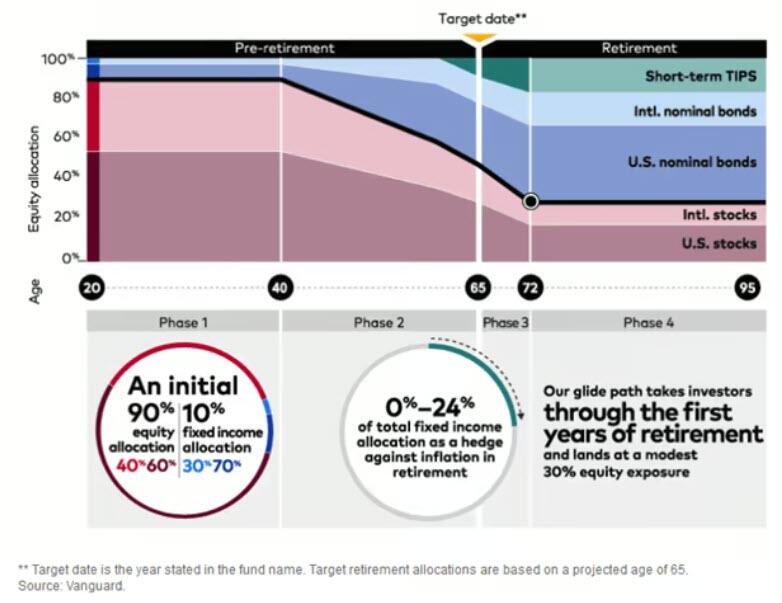
The funds with the target dates furthest in the future are almost fully allocated to stocks with a minimal allocation to bonds. As each year passes, the funds slowly allocate away from stocks and toward bonds. The stock-bond targets for the funds are based solely on the target date.

The graphic below, courtesy of Vanguard, the world’s largest manager of target date funds, shows the “glide path” of investment allocations based on age.
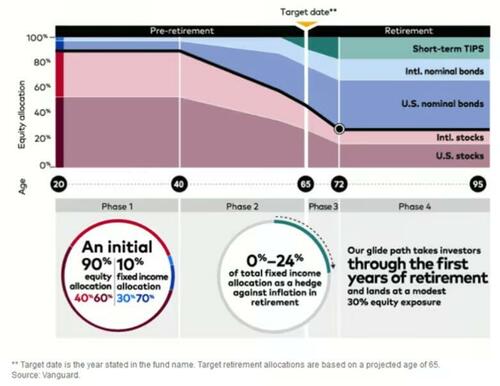
Time dictates the funds’ allocation between stocks and bonds, not the traditional metrics investors use, like potential risks, rewards, and valuations.

Do You Care About Expected Returns? 

Target date fund investors, by default, must believe that stocks will outperform bonds over the long haul. While such is often true, it is far from accurate over shorter or medium-term periods. Further, such a longer-term approach misses incredible short- to medium-term opportunities in stocks and bonds. Accordingly, target fund investors are sometimes making poor investments, which may not align with their investment goals.

To help appreciate these inherently flawed investment strategies, we ask two questions. In both questions, we ask you to allocate your retirement nest egg into A and B securities.

Question 1: 

Security A has an expected ten-year annualized total return of 6.00% with a likely range of returns of 0% to 12%. Security B has a guaranteed annualized return of 0.75%.

Question 2:

Security A has an expected ten-year annualized return of 2.50% with a likely range of returns from 7.00% to -4.50%. Security B has a guaranteed annualized return of 5.00%.

If you favored A in the first question and B in the second, expected returns and risk probabilities matter to you.

Question 1 is based on data from March 2020, when stock valuations cheapened considerably, and bond yields were among the lowest in U.S. history.

Question 2 corresponds to the current investment environment for stocks and bonds.

Questions 1 and 2 represent recent extremes of stock and bond return expectations. More importantly, they correspond to periods when target date stock and bond allocation percentages were likely inappropriate for a decent proportion of target date fund investors.

What About Today?

Let’s go into more detail on question 2 to better appreciate the current risk-reward framework for stocks and bonds. To repeat question 2:

Security A (stocks) has an expected ten-year annualized return of 2.50% with a likely range of returns from 7.00% to -4.50%. Security B (bonds) has a guaranteed annualized return of 5.00%.

Should a 2025 target date fund be heavily invested in bonds while a 2055 fund be almost solely invested in stocks in the current environment?  

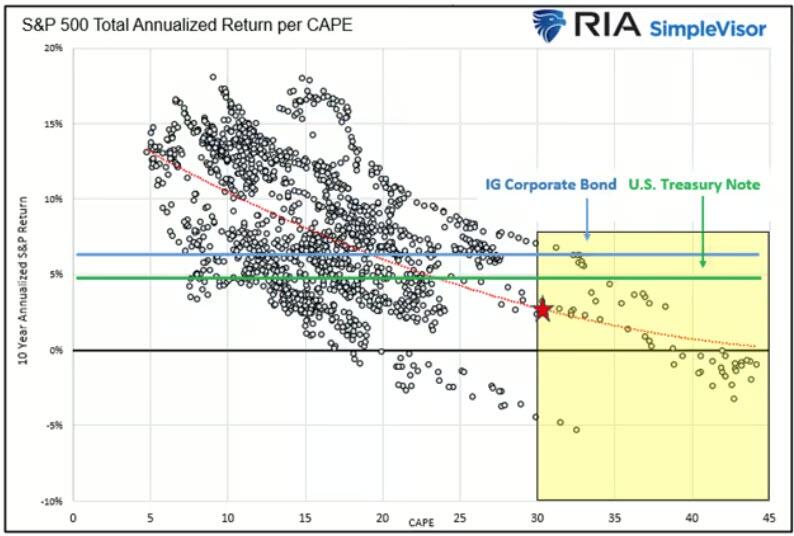
The easy way to answer is by studying the graph below. It shows every monthly instance of CAPE 10 stock valuations and the following ten-year return, including dividends. The green line shows the current ten-year UST yield (4.90%), and the blue line indicates the investment-grade corporate bond yield (6.45%).

The current CAPE, as starred, is slightly over 30. The yellow box highlights each instance when CAPE was 30 or greater.
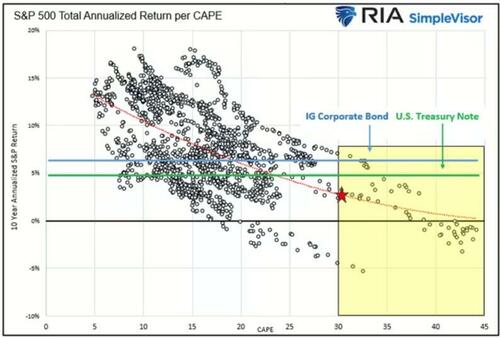
The expected annualized total return on stocks for the next ten years is 2.35%, much lower than the returns on bonds. Of all the instances in which CAPE was greater than 30, only a few of them were followed by a ten-year period in which stock returns beat Treasury bond returns. The number dwindles to one when stocks are compared to investment-grade corporate bonds.

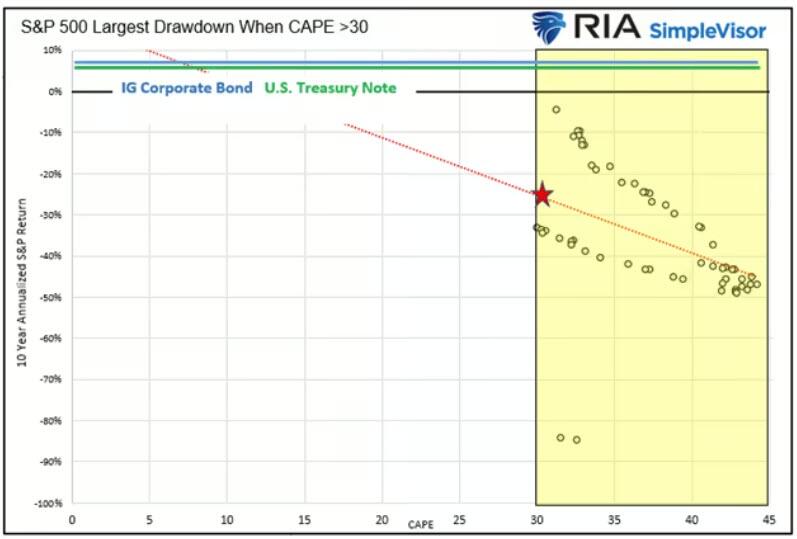
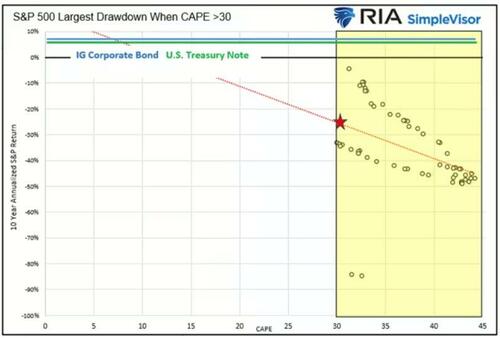
Let’s take the analysis further and focus on maximum drawdowns when CAPE was greater than 30. The following graph shows the peak percentage drawdown from the month each CAPE valuation eclipsed 30. As it shows, skewing allocations toward bonds in environments like today allows you to preserve cash and take advantage of lower stock prices.
Ten Year Forecasts Don’t Mean Ten Year Investments

Bonds are much more likely to offer a better return over the next decade than stocks. However, and this is a big issue, markets change rapidly. In a year, we could be amid a recession with bond yields at 2% and equity valuations near normal. If so, profits on bonds should be taken, and a reallocation back toward stocks would likely be appropriate.

Target date funds will not adjust for the lopsided return probabilities. Target-date funds are blind to risk and reward. Therefore, they are indifferent to what is in the best interest of their investors.

Summary

In the current environment, 25-year-olds and 75-year-olds should have increased allocations to bonds versus stocks. In target date fund terminology, the 2025 and 2050 funds should look much more alike than they do. The Vanguard 2050 fund holds under 10% of bonds and 90% of stocks. The Vanguard 2025 fund has approximately 45% of bonds and 55% of stocks.

A blind formula dictates these percentages, not basic financial investment management rules.

Investing for the long run is thoughtful. Investing without considering risks and rewards is idiotic.

Tyler Durden
Wed, 11/01/2023 – 15:20

via ZeroHedge News https://ift.tt/YJDdynk Tyler Durden

Joe Biden Snagged Another $40K In ‘Laundered’ Chinese Money From Brother’s CEFC Payment: Comer

Joe Biden Snagged Another $40K In ‘Laundered’ Chinese Money From Brother’s CEFC Payment: Comer

Remember when Democrats insisted that Trump was compromised by Russia because of some alleged loan he had in the early 90’s according to ‘several sources with knowledge’ (who never materialized)?

The same Democrats – and the same media, are of course dead silent over what’s now grown to $240,000 in laundered Chinese that ended up in Joe Biden’s pocket via his brother. We know, we know – huge shock.

On Wednesday, the House Oversight Committee revealed that President Biden received $40,000 in Chinese funds which were “laundered” through his brother, James Biden, in a “complicated financial transaction” marked as a ‘loan,’ which took place just weeks after Hunter Biden threatened the Chinese with his father’s wrath in a July 30, 2017 text message to a CEFC China Energy employee.

The alleged 2017 transfer from first brother James Biden to the future president involves the same business deal in which Joe Biden was called the “big guy” and penciled in for a 10% cut — and would be the first proven instance of the commander-in-chief getting a piece of his family’s foreign income.

The money ended up in Joe Biden’s bank account on Sept. 3, 2017, via a check labeled “loan repayment” from his younger brother, who partnered with Hunter in the venture. -NY Post

“Remember when Joe Biden told the American people that his son didn’t make money in China?” asked Oversight Committee Chairman James Comer (R-KY) in a video posted to X. ““Well, not only did he lie about his son Hunter making money in China, but it also turns out that $40,000 in laundered China money landed in Joe Biden’s bank account in the form of a personal check.”

“Even if this $40,000 check was a loan repayment from James Biden, it still shows how Joe benefited from his  family cashing in on his name — with money from China no less,” Comer continued.

Bank records released this year by Comer show that CEFC — a since-defunct reputed cog in Beijing’s “Belt and Road” foreign influence campaign — paid Hunter and James Biden at least $6.1 million in 2017 and 2018about $1 million in March 2017 shortly after Biden left office as vice president and the remainder within 10 days of Hunter’s threat invoking his dad.

A $5 million wire was sent on Aug. 8, 2017, to “Hudson West III, a joint venture established by Hunter Biden and CEFC associate Gongwen Dong,” a committee synopsis of the memo says. -NY Post

“That same day, Hudson West III sent $400,000 to Owasco, P.C., an entity owned and controlled by Hunter Biden. On August 14, 2017, Hunter Biden wired $150,000 to Lion Hall Group, a company owned by President Biden’s brother James and sister-in-law Sara Biden,” the synopsis continues.

On August 28, 2017, Sara Biden withdrew $50,000 in cash from Lion Hall Group. Later the same day, she deposited it into her and James Biden’s personal checking account. On September 3, 2017, Sara Biden cut a check to Joe Biden for $40,000 for a ‘loan repayment.'”

But hey, no more mean tweets!

Tyler Durden
Wed, 11/01/2023 – 15:00

via ZeroHedge News https://ift.tt/jxmeEfh Tyler Durden

The Party’s Over: Atlanta Fed Slashes Q4 GDP Estimate From 2.3% To 1.2%

The Party’s Over: Atlanta Fed Slashes Q4 GDP Estimate From 2.3% To 1.2%

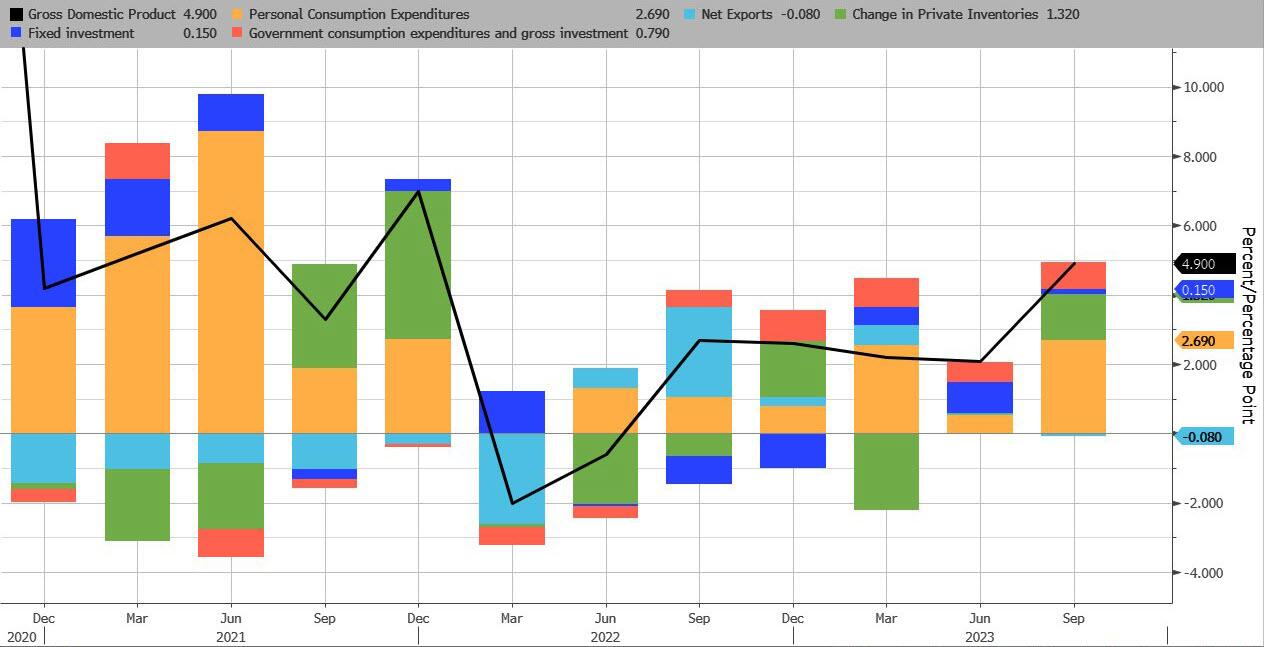
Remember when we mocked the BEA’s recent report that Q3 GDP had hit a scorching 4.9% (well above estimates) on the back of such laughably “growth” factors as surging inventories and government consumption…

… and said prepare for Bidenomics to collapse in Q4?

Well it just did, and not once but twice.

First, it was the ISM Chair Tim Fiore who earlier today said that “the past relationship between the Manufacturing PMI and the overall economy indicates that the October reading (46.7 percent) corresponds to a change of minus-0.7 percent in real gross domestic product (GDP) on an annualized basis.”  Translation: the economy is already in contraction, which would hardly be a shock since Europe is also in contraction, China’s economy is imploding and the US will never decouple from the rest of the world.

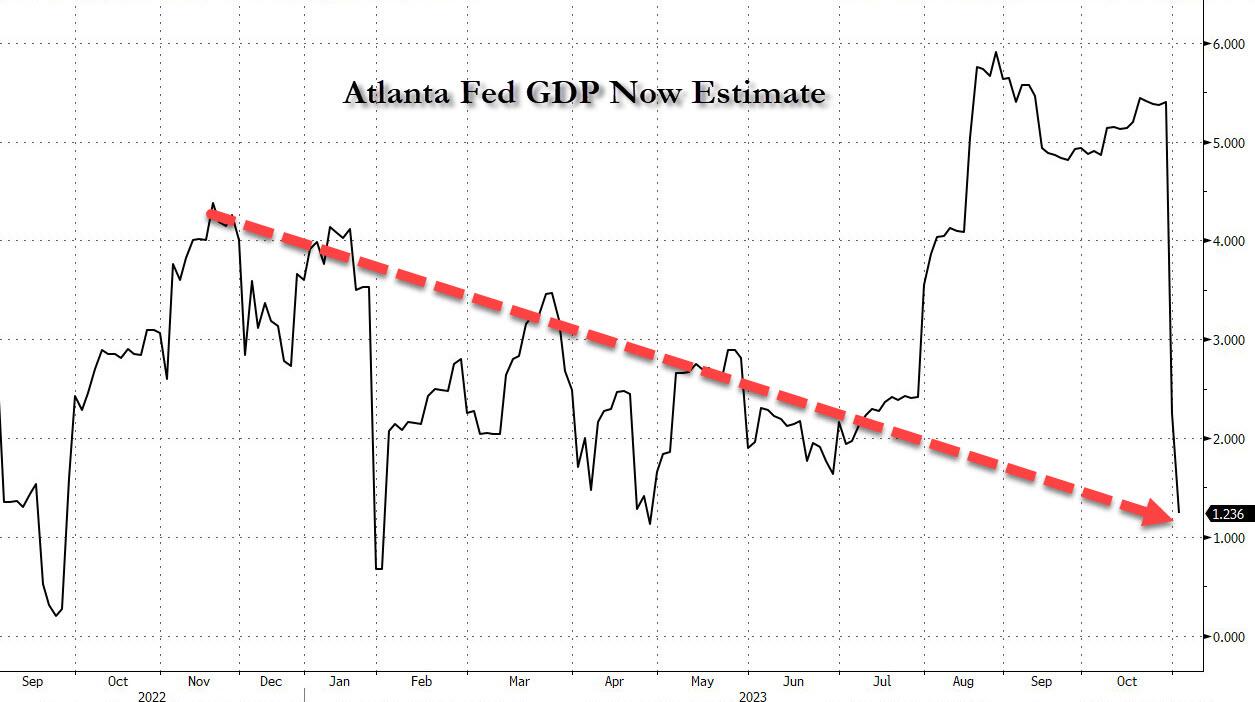
And now, it’s the same Atlanta Fed which last quarter stunned Wall Street with its 5%+ Q3 GDP estimates, and which just came out with its second Q4 GDP forecast which was a doozy: at 1.2% it was almost 50% below the Atlanta Fed’s first Q4 GDP estimate of 2.3%.

Here are the details:

The GDPNow model estimate for real GDP growth (seasonally adjusted annual rate) in the fourth quarter of 2023 is 1.2 percent on November 1, down from 2.3 percent on October 27.

After this morning’s construction spending release from the US Census Bureau and the Manufacturing ISM Report On Business from the Institute for Supply Management, the nowcasts of fourth-quarter real personal consumption expenditures growth and fourth-quarter real gross private domestic investment growth decreased from 3.0 percent and -2.2 percent, respectively, to 1.5 percent and -2.8 percent, while the nowcast of the contribution of the change in real net exports to fourth-quarter real GDP growth increased from 0.11 percentage points to 0.22 percentage points.

Bottom line: the Bidenomics trendline that was so laughably interrupted by the one-time, artificial, and debt-driven burst in Q3 GDP is back to normal…

… and the ridiculous economic “boost” that Biden tried to represent as being the normal, is now gone. Next step: recession, rate cuts, more stimmies, and so on.

Tyler Durden
Wed, 11/01/2023 – 14:41

via ZeroHedge News https://ift.tt/SjRitgy Tyler Durden

Watch Live: Fed Chair Powell Tries Not To Break Anything

Watch Live: Fed Chair Powell Tries Not To Break Anything

No change in policy rates… as expected; and a barely-changed statement, mean all eyes will be on Fed Chair Powell for the nuance leaning hawkish or dovish.

With money markets and many Fed officials believing that the Fed is done with rate-hikes, Powell will not want to rock the boat of the central bank “proceeding carefully” to let cumulative tightening continue to work through as inflation trends lower and the labor market rebalances.

His recent comments at The Economic Club of New York suggested ‘satisfaction‘ with current policy settings… with the ubiquitous caveat that they are ‘data dependent’.

Powell will be treading very carefully as, given the addition of the term “financial conditions” means anything less than the right amount of hawkishness will prompt the kind of reflexive gains in bonds and stocks that will reverse the tightening of financial conditions that he has been quietly comfortably allowing.

Will Powell be asked about the messaging of that one word?

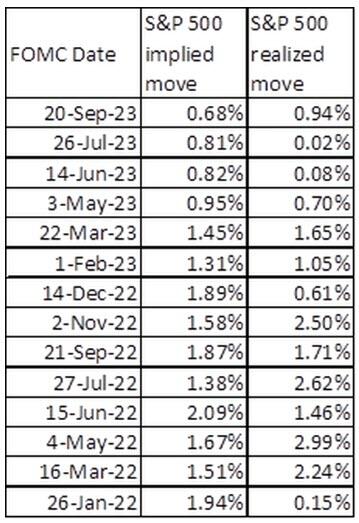
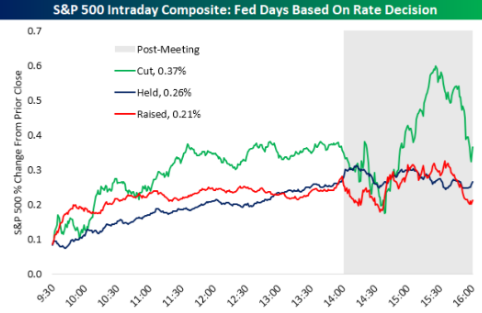
One final point before he speaks: while most expect no surprises from the Fed, the market is uneasy about something with the implied-implied move in the S&P today is 0.89%, which would make it the highest implied move since May according to Goldman.

What are they worried about?

Watch Powell’s press conference live here (due to start at 1430ET):

Tyler Durden
Wed, 11/01/2023 – 14:25

via ZeroHedge News https://ift.tt/iFvqyhT Tyler Durden

Fed Remains ‘Paused’, Acknowledges Tightening Financial Conditions Are ‘Doing Its Job’

Fed Remains ‘Paused’, Acknowledges Tightening Financial Conditions Are ‘Doing Its Job’

Tl;dr: The Fed kept rates unchanged, as expected but the addition of one word is key:

“Tighter financial and credit conditions for households and businesses are likely to weigh on economic activity, hiring, and inflation.”

Is that The Fed sending a message to Janet Yellen: “stop spending like drunken sailors.”

*  *  *

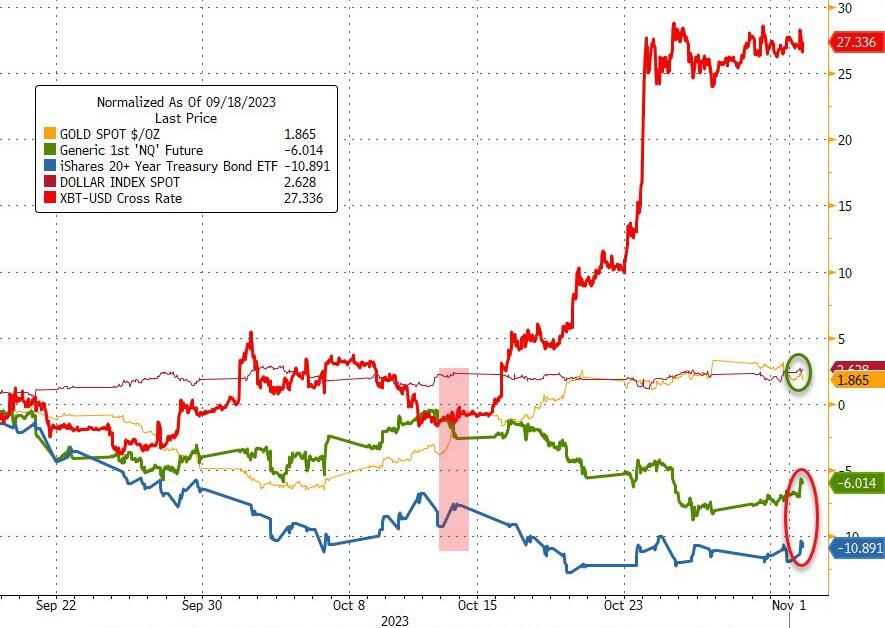
Since The Fed’s last statement and press conference on September 20th, the market’s movements (impacted by the ongoing chaos in Israel also) have been somewhat remarkable.

Bitcoin has soared higher, stocks and bonds (the latter worse than the former) have both been hammered as gold and the dollar have rallied in unison…

Source: Bloomberg

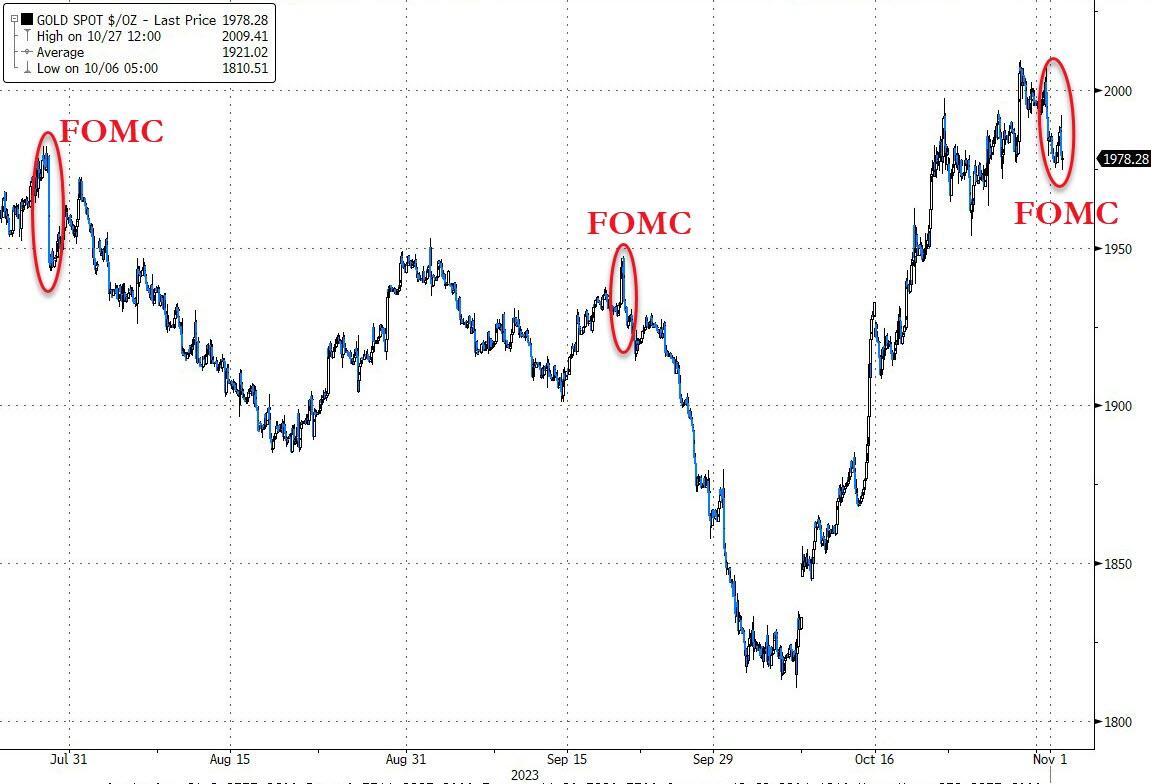
We note that Gold has been on quite a path in the last two months but is back  – again – at around the same levels as it has been for the last two FOMC meetings…

Source: Bloomberg

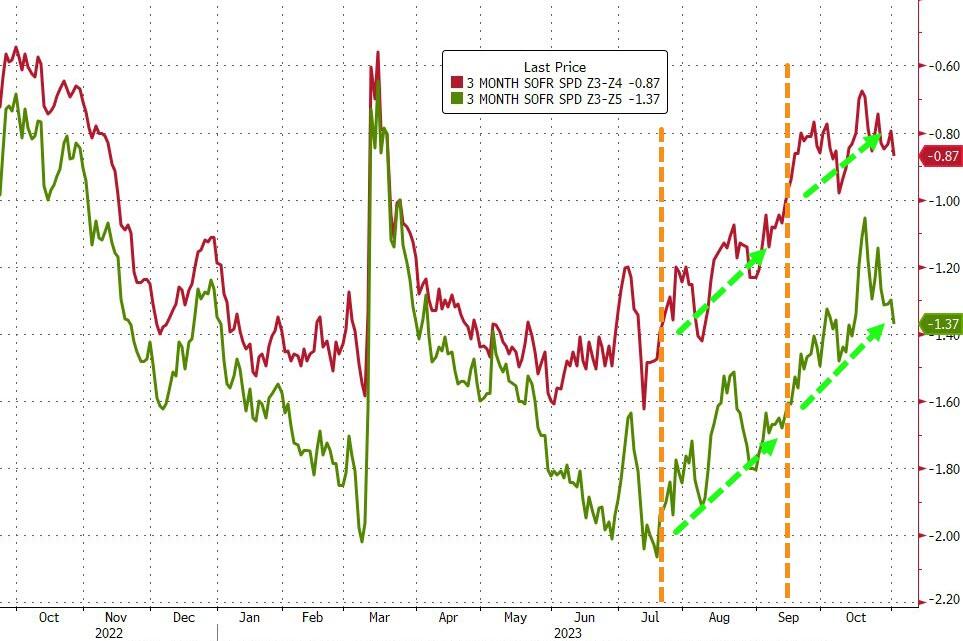
Additionally, The Fed’s jawboning of “higher for longer” is increasingly being accepted by the rates market as the SOFR spreads for Dec 2023-2024 and 2023-2025 have surged since the last FOMC…

Source: Bloomberg

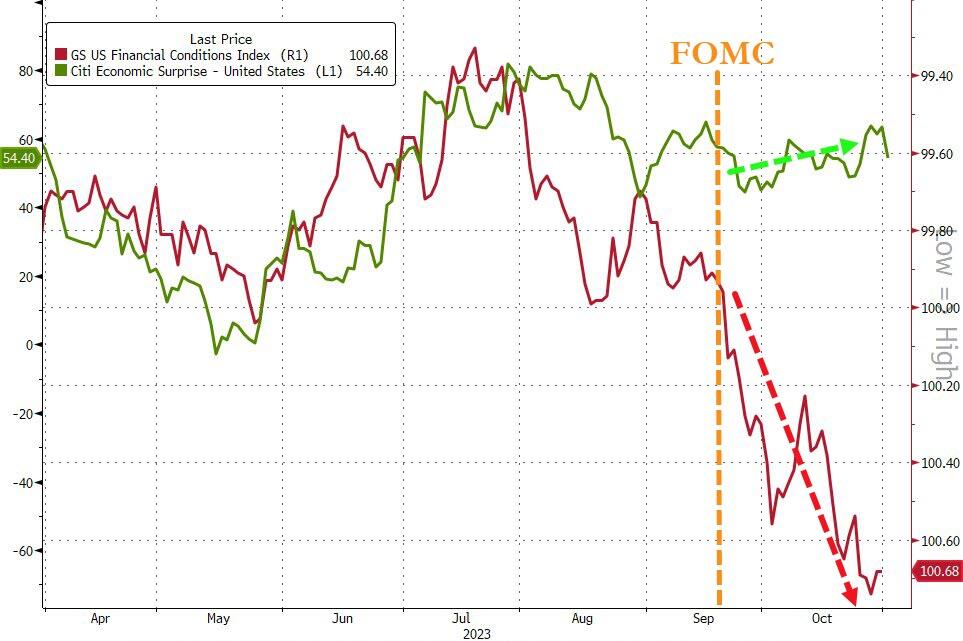
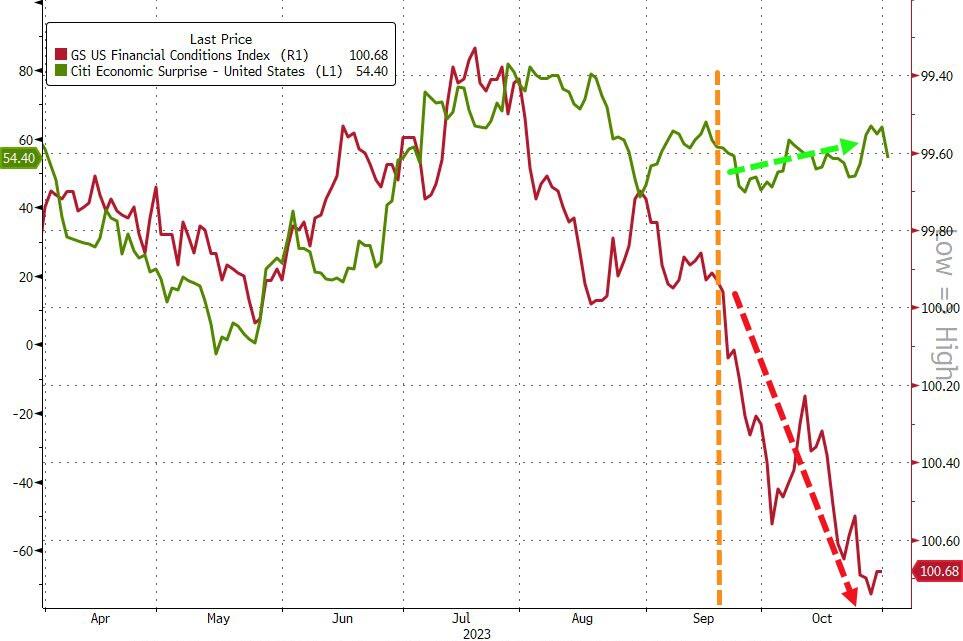
Of particular note, we have seen financial conditions tighten significantly since the last FOMC (while at the same time, macro surprise data has improved marginally – not fallen apart)…

Source: Bloomberg

Specifically, the period since the last FOMC brought some surprisingly strong readings on inflation and the economy more broadly. Here are some headline numbers:

  • Third-quarter GDP growth was a whopping 4.9%, higher than forecast and an a historic figure for the US, where growth tends to hover around 2%-3%

  • September payrolls were also strong, with employers adding 336,000 jobs, nearly double what economists had been expecting

  • A variety of inflation indicators cooled less than anticipated, or posted slight gains. The employment cost index, a broad and reliable indicator, ticked up 1.1% in the third quarter, a pace far above its pre-pandemic average of 0.7%.

However, the last chart above is of increasing relevance as the narrative that “the market is doing The Fed’s job for it” continues to keep hopes alive that Powell and his pals are done (due to this dramatic tightening).

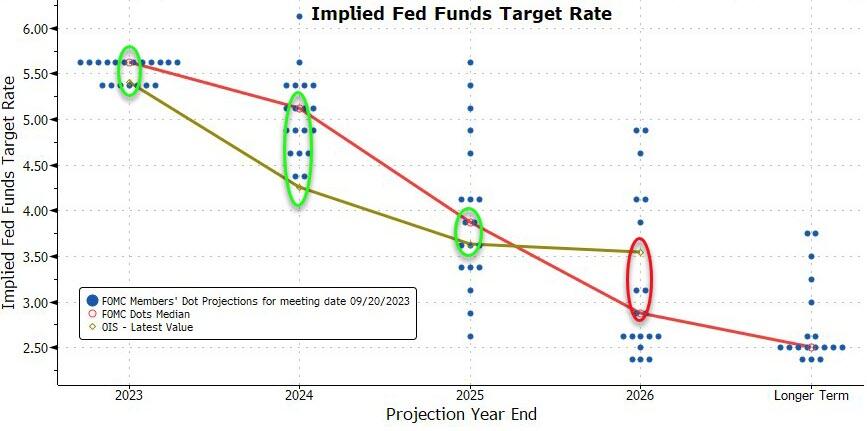
For today, expectations are for no change (0.5% odds of a rate-hike priced-in), but the market remains more dovishly priced still than The Fed’s projections (at least until 2026)…

Source: Bloomberg

The Fed statement is expected to be more or less identical to September’s.

And so, what did we get?

The Fed – as expected – left rates unchanged:

  • *FED HOLDS BENCHMARK RATE IN 5.25-5.5% TARGET RANGE

The Fed leaves more hikes on the table:

  • *FED REPEATS IT WILL ASSESS EXTENT OF ADDITIONAL POLICY FIRMING

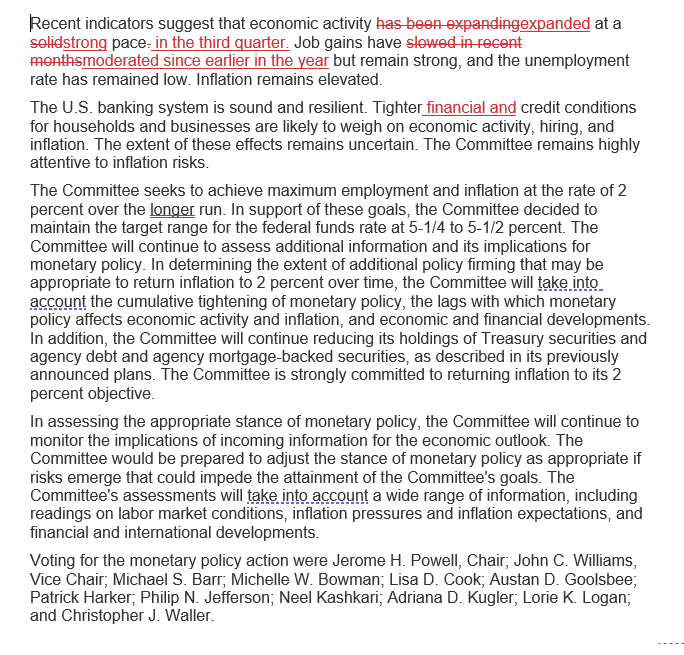
And sure enough, as we noted above, The Fed likes the market doing its job for it, specifically adding reference to tighter “financial” conditions

  • Tighter financial and credit conditions for households and businesses are likely to weigh on economic activity, hiring, and inflation.”

The message is clear:

The question we are left with is – what is the trigger for The Fed to not ‘leave the rate hike option’ on the table.

Read the full redline below:

Powell’s press conference is coming right up but we note that despite everything very much ‘as expected’, the market is uneasy and the implied-implied move in the S&P tomorrow is 0.89%, which would make it the highest implied move since May according to Goldman.

Here’s what to expect (assume a ‘hold’)

Tyler Durden
Wed, 11/01/2023 – 14:00

via ZeroHedge News https://ift.tt/0ASrIJt Tyler Durden

87% of Americans Want Politicians To Do Something Before Social Security Runs Out of Money


Social Security Medicare entitlements debt Biden Trump poll | Photo 61814688 © Kentannenbaum | Dreamstime.com

Entitlement reform has long been considered a third rail of American politics, even as the insolvency of Social Security and Medicare creeps closer.

That perception might need some reconsidering. A new poll shows that the vast majority of Americans believe policymakers should make changes as soon as possible to extend the life of America’s two old-age entitlement programs and avoid possible benefit cuts that will hit in the early 2030s if nothing is done.

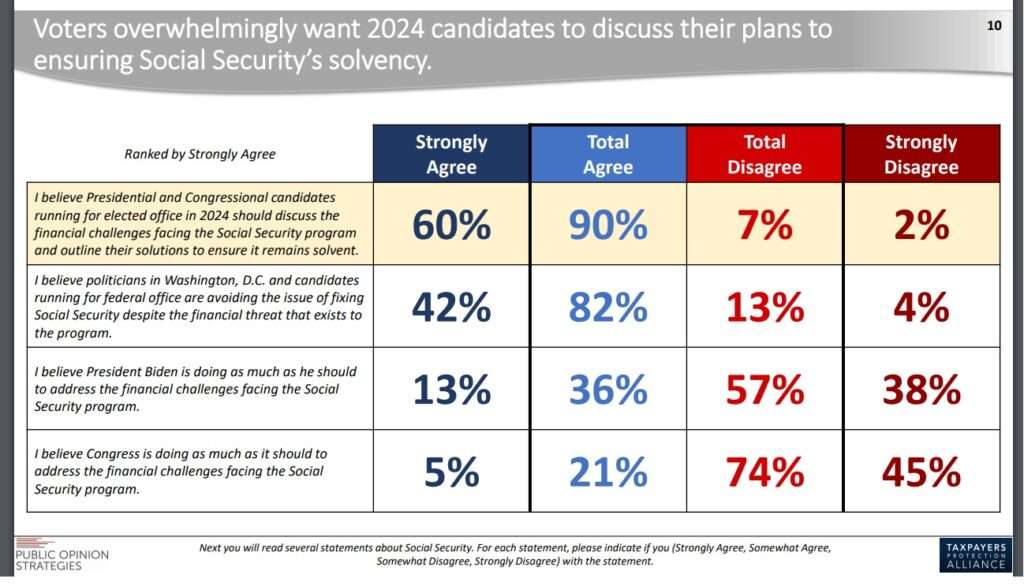
That poll, which was shared with members of Congress and staffers at a closed-door meeting on Wednesday morning and obtained by Reason, found that only 5 percent of voters say Congress and President Joe Biden should do nothing to address the looming benefit cuts that will hit Social Security when insolvency hits.

“Our polling shows that Americans are seriously worried about the solvency of these entitlement programs,” David Williams, president of the Taxpayers Protection Alliance (TPA), a free market group that sponsored the survey (it was conducted in August and included about 1,000 likely voters). “Congress can no longer continue to ignore the facts that without action, Social Security and Medicare will face deep and automatic cuts.”

Indeed, the poll suggests that many Americans have a better understanding of the crisis facing Social Security and Medicare than most elected officials seem to believe. In the survey, 87 percent of respondents agreed that action is needed to extend Social Security’s solvency and avoid benefit cuts, and 89 percent said the same thing about Medicare.

According to the trustees responsible for overseeing the two programs, Medicare’s main trust fund will be depleted by 2031 and Social Security’s reserves will be gone by 2033. Though those trust funds are largely an accounting fiction, their insolvency will trigger mandatory across-the-board cuts that will affect retirees and anyone who expects to benefit from the programs in the future. The two programs are also the primary drivers of the federal government’s future budget deficits, responsible for 95 percent of long-term unfunded obligations, according to the Treasury’s recent Financial Report. Those looming problems are contributing to the federal government’s declining credit rating and threaten America’s future economic growth.

Despite that, leading politicians on both sides of the aisle continue to promise that inaction is possible. Biden has used fictional Republican plans to cut Social Security to demagogue against the idea that reforms to the program are necessary—most notably by sparring with GOP members of Congress during this year’s State of the Union address. Meanwhile, former President Donald Trump (the leading contender to be the GOP’s presidential nominee in 2024) has repeatedly promised not to touch Social Security, and other prominent figures on the so-called “New Right” have done the same.

Realistically, the only serious approach will require some changes to existing Social Security benefits. That could mean reducing benefits for wealthier retirees or implementing across-the-board benefit reductions that would be phased in over time, allowing younger workers to offset smaller Social Security benefits with private savings. Ideally, workers would be able to opt out of Social Security altogether, so they can save and invest for their own retirement without having to pay payroll taxes.

But none of those options can begin to be considered if a critical mass of elected officials continue to ignore the problem.

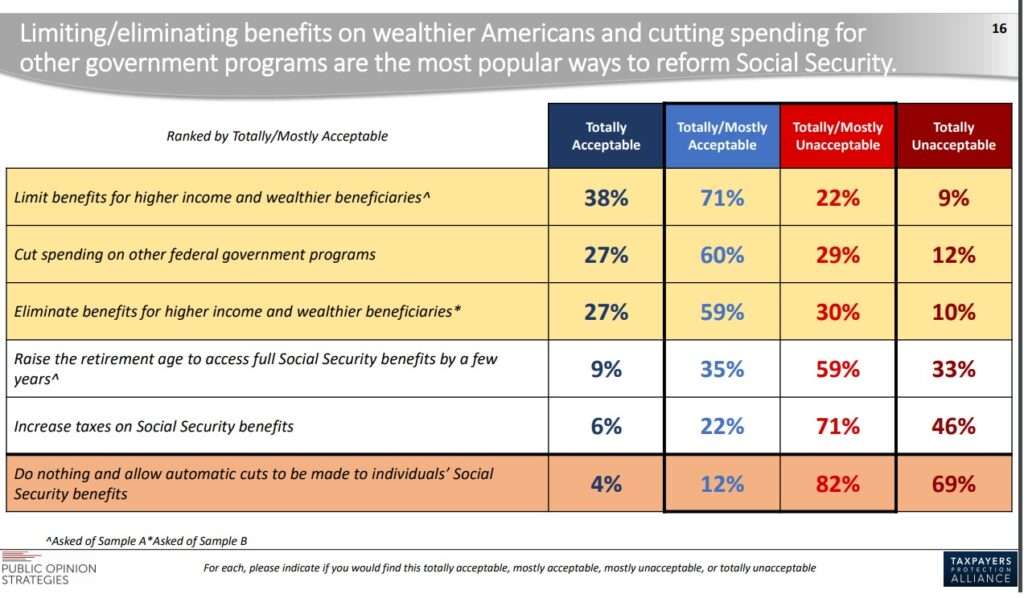
The TPA poll released Wednesday offers some insight into how more serious politicians might proceed. The poll found that 71 percent of Americans find means-testing for Social Security benefits—that is, limiting benefits for wealthier recipients—to be acceptable, while 60 percent would approve of cutting other government programs to fund Social Security.

(Source: Taxpayers Protection Alliance, Public Opinion Strategies )

When it comes to Medicare, 66 percent approve of means-testing benefits, and 84 percent are in favor of the always-popular option of reducing rampant fraud and waste within the government-run healthcare system.

Perhaps most importantly, 90 percent of voters say presidential and congressional candidates running for office in 2024 should discuss the financial challenges facing the entitlement programs. They might take note of former South Carolina Gov. Nikki Haley’s rise in the Republican primary field, which has followed her willingness to provide some straight talk about the difficult fiscal situation that the government must face.

(Source: Taxpayers Protection Alliance, Public Opinion Strategies )

Finding solutions to these highly fraught issues that voters will accept is no easy task, but it can’t start until politicians recognize that ignoring the government’s entitlement-driven debt crisis is not a real option.

The post 87% of Americans Want Politicians To Do Something Before Social Security Runs Out of Money appeared first on Reason.com.

from Latest https://ift.tt/ETC9jUx
via IFTTT

Elon Musk Exposes How Soros ‘Hijacked’ US Cities Without Changing Any Laws

Elon Musk Exposes How Soros ‘Hijacked’ US Cities Without Changing Any Laws

Elon Musk appeared on Joe Rogan’s podcast Tuesday and explained how leftists “completely controlled” Twitter and weaponized the social media platform against political opponents and anyone who disagreed with the official government narrative. The billionaire said Twitter was almost like Russian state media “Pravda.”

“The degree to which Twitter was simply an arm of the government was not well understood by the public,” Musk said.

He continued, “Republicans were suppressed at ten times the rate of Democrats. That’s because old Twitter was fundamentally controlled by the far-left.” 

Far-left elites in Washington and Silicon Valley, along with ‘fact checkers’ (think tanks) and the FBI, were able to conduct mass censorship campaigns from within Twitter, that’s until Musk bought the social media company about one year ago. 

In the conversation with Rogan, Musk then explains George Soros’ massive bet (now overseen by his son, Alexander Soros) on funding city and state district attorney elections nationwide. He said, “The value for money in local races is much higher than in national races – the lowest value for money is a presidential race.”

“Soros realized you don’t actually need to change the laws – you just need to change how they’re enforced – if nobody chooses to enforce the law – or the laws differentially enforced – it’s like changing the laws,” Musk said. 

This leaves with a new interview from one Maryland sheriff, just outside of crime-ridden Baltimore City, in Wicomico County, who drops a truth bomb about radical progressive lawmakers in the state, some of whom have likely been funded by Soros, who purposely fail to enforce law and order and only embolden criminal. 

“I’m in my 40th year of law enforcement, and I have never ever seen it this bad,” Sheriff Mike Lewis said.

Lewis continued: “I’ve never seen a government so ingrained – and quite frankly complicit – in the criminal activity taking place in our nation.” 

The sheriff is referring to all those Soros-backed candidates who won elections in Manhattan, Los Angeles, San Fransico, Portland, Baltimore, DC, New York, Philadelphia, Boston, St. Louis, and Chicago, that have transformed these areas into crime-ridden hellholes. 

The term “apocalypse” in Greek translates to “revelation,” and this is precisely what Musk and the team behind the “Twitter Files” have offered the public. Their actions have disrupted the ‘matrix’ controlled by radical leftists with an agenda to install communism. 

Tyler Durden
Wed, 11/01/2023 – 13:45

via ZeroHedge News https://ift.tt/maZwltT Tyler Durden

Schwab Announces Over 2,000 Layoffs To ‘Maintain Competitive Edge’

Schwab Announces Over 2,000 Layoffs To ‘Maintain Competitive Edge’

Update (Wednesday): 

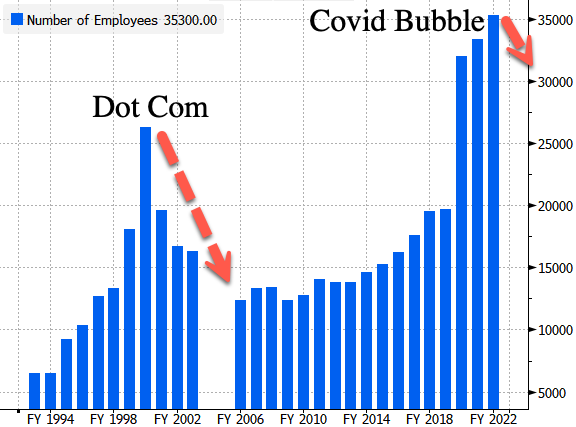
A Charles Schwab spokesperson confirmed to Bloomberg that up to 6% of its 35,900-member workforce (or about 2,154 employees) were recently laid off. 

“These were hard but necessary steps to ensure Schwab remains highly competitive, with industry-leading levels of efficiency, well into the future,” the spokesperson said in an emailed statement, adding, “We worked diligently to ensure affected employees were treated with care and respect throughout this difficult process.”

The cuts were first reported by The Wall Street Journal on Monday night (read the previous update below). 

The last time Schwab went on a hiring – then firing spree was the Dot Com bubble. It appears the pattern is repeating. 

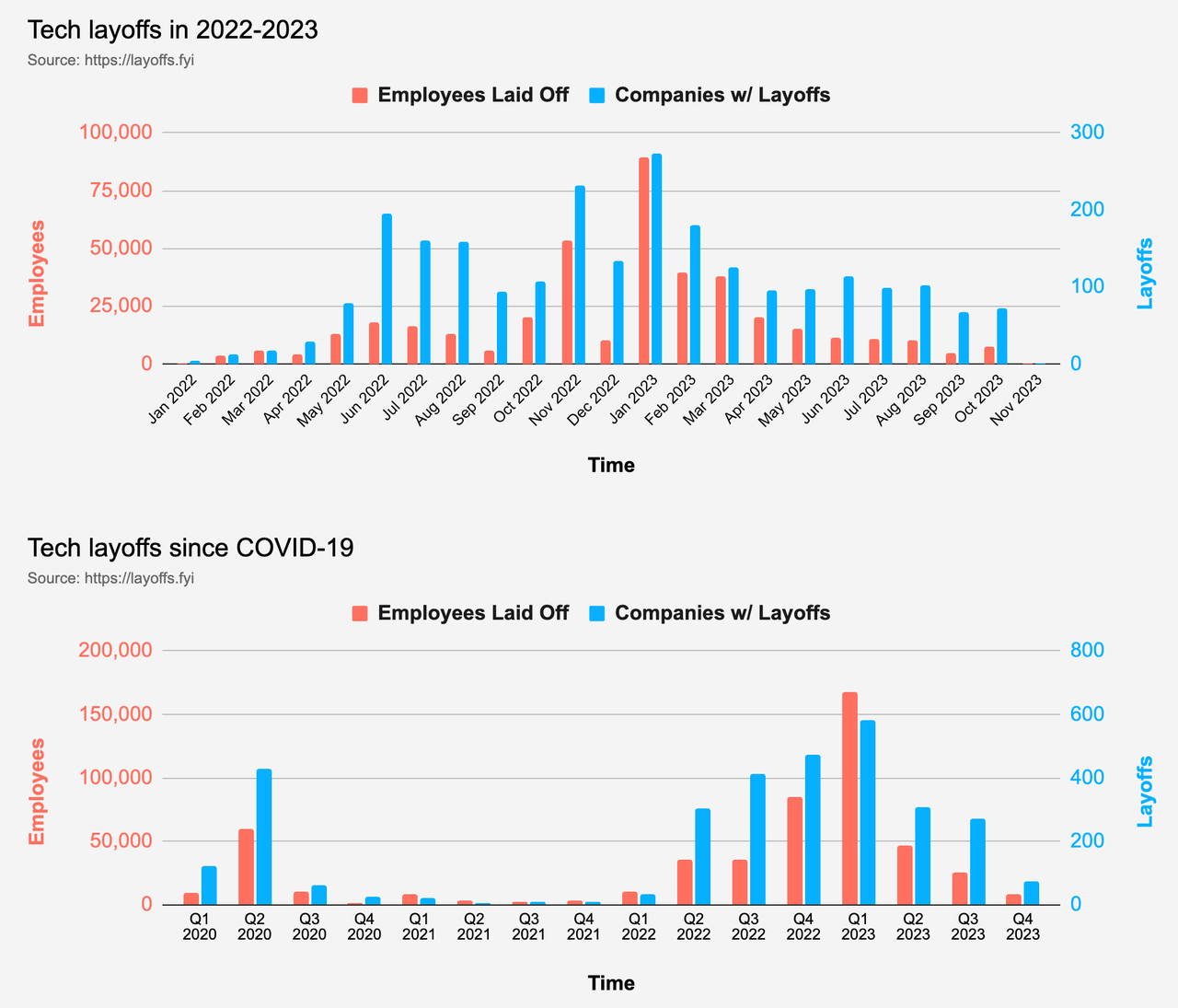
According to the layoff tracker website Layoffs.FYI, hundreds of thousands of tech employees have been fired in the last two years. 

The latest ADP print shows the labor market has slowed

*   *   * 

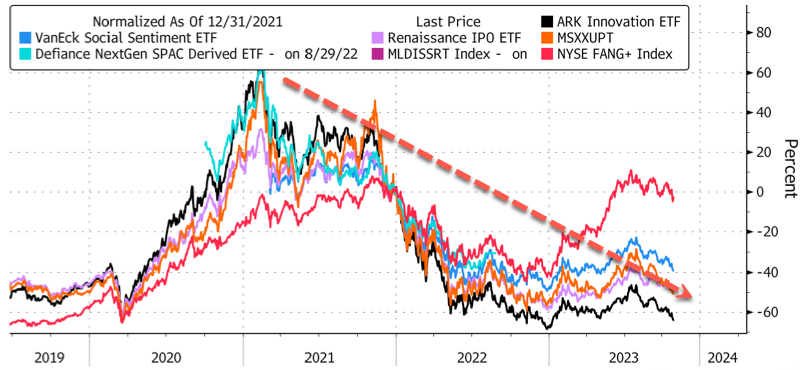
Charles Schwab, the largest publicly traded US brokerage firm, began laying off employees on Monday in an effort to streamline its business model by reducing expenses ahead of next year, which could be full of turbulence in financial markets. This comes as the market’s excitement in meme stocks, SPACs, IPOs, and crypto, which soared in 2020-21, has since plunged due to a rising interest rate environment. 

The Wall Street Journal first revealed the Schwab layoffs on Monday night:

Charles Schwab on Monday began laying off employees across the company.

Schwab, the largest publicly traded US brokerage, didn’t disclose how many employees were affected in an internal message seen by The Wall Street Journal. Some remaining employees will have new jobs or managers, according to the message.

In the message, CEO Walt Bettinger and President Rick Wurster said:

“We know this has been a challenging year, and that today was hard. We also know the work needed to come through this change even stronger than before is just beginning.” 

Perhaps trouble at Schwab comes as retail traders, badly bruised from holding worthless meme stocks, lost interest in financial markets this year. 

Besides retail’s waning interest in markets, the company has been under scrutiny from shareholders about deposit flight driven by higher interest rates. 

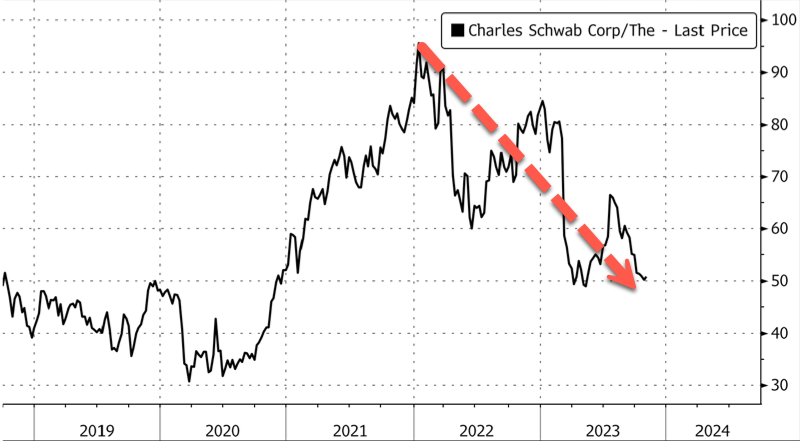
Schwab shares are down 40% since peaking at the $84 handle in March 2021. 

In August, Schwab detailed in a regulatory filing about plans to slash its headcount and downsize corporate offices to reduce operating costs. These proposed cuts are expected to save the company $500 million annually. 

The last time Schwab hired too many people was during the Dot Com bubble. We all know what happened next… 

Rumors on the anonymous jobs forum Blind said the layoffs at Schwab include “lots of people in the company’s tech division.” 

Tyler Durden
Wed, 11/01/2023 – 13:35

via ZeroHedge News https://ift.tt/cs9iZJB Tyler Durden