Tulsi Gabbard: LGBTQ+ Activists At Pro-Palestine Marches “Don’t Understand” Islamists Want To Kill Them

Tulsi Gabbard: LGBTQ+ Activists At Pro-Palestine Marches “Don’t Understand” Islamists Want To Kill Them

Authored by Steve Watson via Summit News,

Former Democratic Representative Tusi Gabbard has called out the hypocrisy of LGBTQ+ activists attending pro-Palestine marches alongside radical Islamists who literally want gay and trans people to be murdered.

Appearing on Laura Ingraham’s show Tuesday, Gabbard noted that “Democrats, they have called people like me an Islamophobe for many years just for speaking the truth about radical Islam. About the threat that this Islamism poses to the freedom and peace of security of the American people and people around the world.”

Gabbard continued, “we are so concerned about Biden’s open borders and the fact that we have got millions of people coming in who are not vetted in any way, shape, or form who have not been checked.”

Ingraham interjected, “they say you can’t call it a clash of civilisations, why not? It is a clash of civilizations. No women’s rights. No belief in pluralism. The dignity of the individual. Free expression. None of that. That’s not on the table.”

The former Congresswoman replied, “And that is the hypocrisy of seeing these LGBTQIA activists out there holding and waving the trans flags combined with the Palestinian flag.”

“That’s a new level of stupid,” Ingraham asserted.

Gabbard replied, “They don’t know and understand what this Islamist ideology is, this radical Islam ideology where they actually want to kill people. They want to kill those people specifically.”

Watch:

Related:

*  *  *

Brand new merch now available! Get it at https://www.pjwshop.com/

In the age of mass Silicon Valley censorship It is crucial that we stay in touch. We need you to sign up for our free newsletter here. Support my sponsor – Summit Vitamins – super charge your health and well being.

Also, we urgently need your financial support here.

Tyler Durden
Wed, 11/01/2023 – 13:25

via ZeroHedge News https://ift.tt/Bnm7UaT Tyler Durden

Israel Rushes Warships To Red Sea After Yemeni Houthis Launch Ballistic Missile & Drones

Israel Rushes Warships To Red Sea After Yemeni Houthis Launch Ballistic Missile & Drones

Israel has rushed warships to the Red Sea, where US naval assets are also patrolling, after Yemen’s Houthis declared “war” earlier this week. The Houthis had also reportedly launched a ballistic missile at Israel, and released a video showing the launch. In total the Houthis are believed to have attempted three drone and missile attacks on Israel. One of the initial projectiles days ago had been intercepted by a US warship off Yemen, and another was stopped as follows

The Israeli military on Tuesday used its Arrow missile defence system for the first time to intercept an “aerial threat” over the Red Sea, believed to have been a ballistic missile.

An Israeli navy missile boat seen off the coast of Eilat in the Red Sea, IDF handout.

According to newly released Israeli military images, Sa’ar-class corvettes are now patrolling near Eilat port in the Red Sea.

They will be monitoring skies over the Red Sea and around Israel after the Yemeni rebel group widely seen as backed by Iran has vowed to “help the Palestinians to victory.”

While apart from Gaza, Israel has been most focused on the Hezbollah threat on the northern border – having engaged in daily exchanges of fire with the militant group in southern Lebanon – the Yemeni action raises the specter of the situation spiraling into a broader regional war.

Sporadic fire along the occupied Golan Heights, and Israel’s attacks south of Damascus, also raises the possibility of the Gaza war spilling into Syria

According to fresh reporting in The New York Times, the Houthis are already escalating their attacks on faraway Israel:

Yemen’s Houthi militia claimed an attempted attack on southern Israel on Tuesday, saying it had launched a “large batch” of ballistic and cruise missiles as well as drones toward Israeli targets.

The Iran-backed militia carried out the attempted assault in response to what it called “brutal Israeli-American aggression” in Gaza, the Houthi military spokesman, Yahya Sarea, said on the social media platform X. Mr. Sarea said the attack was the third operation conducted by the Houthis “in support of our persecuted brothers in Palestine,” and threatened further missile and drone assaults.

The Houthis have been locked in a war with Saudi Arabia (and allies UAE & the US) since 2015. In 2014 the Shia rebel group overran the Yemeni capital of Sanaa, sparking the Saudi-UAE intervention to uphold the pro-Saudi government. Many tens of thousands have been killed over the last half-decade of fighting, with the country also on the brink of starvation. 

Disagreement persists among analysts over whether the Houthis possess missiles that could effectively reach Israel.

The US and Israel have long accused Tehran of shipping weapons to the Houthis. It’s believed that their surprisingly sophisticated missile arsenal comes from the Iranians, and these have been used to attack Saudi Arabia several times, including strikes on Saudi Aramco oil facilities.

Tyler Durden
Wed, 11/01/2023 – 13:05

via ZeroHedge News https://ift.tt/2qfeJ9i Tyler Durden

Estee Slaughter: Beauty Giant Implodes To 6 Year Low As Consumers Hit Brick Wall

Estee Slaughter: Beauty Giant Implodes To 6 Year Low As Consumers Hit Brick Wall

When we looked at the performance of consumer stocks last quarter, we found a not unexpected divergence between companies catering to lower income consumers, which have been hammered for much of 2023, and those targeting rich buyers, which – especially in the case of a handful of European luxury giants such as LVMH, Kering and Hermes  – had done tremendously well for much of the past year, making Bernard Arnault the richest man in the world, if not for long.

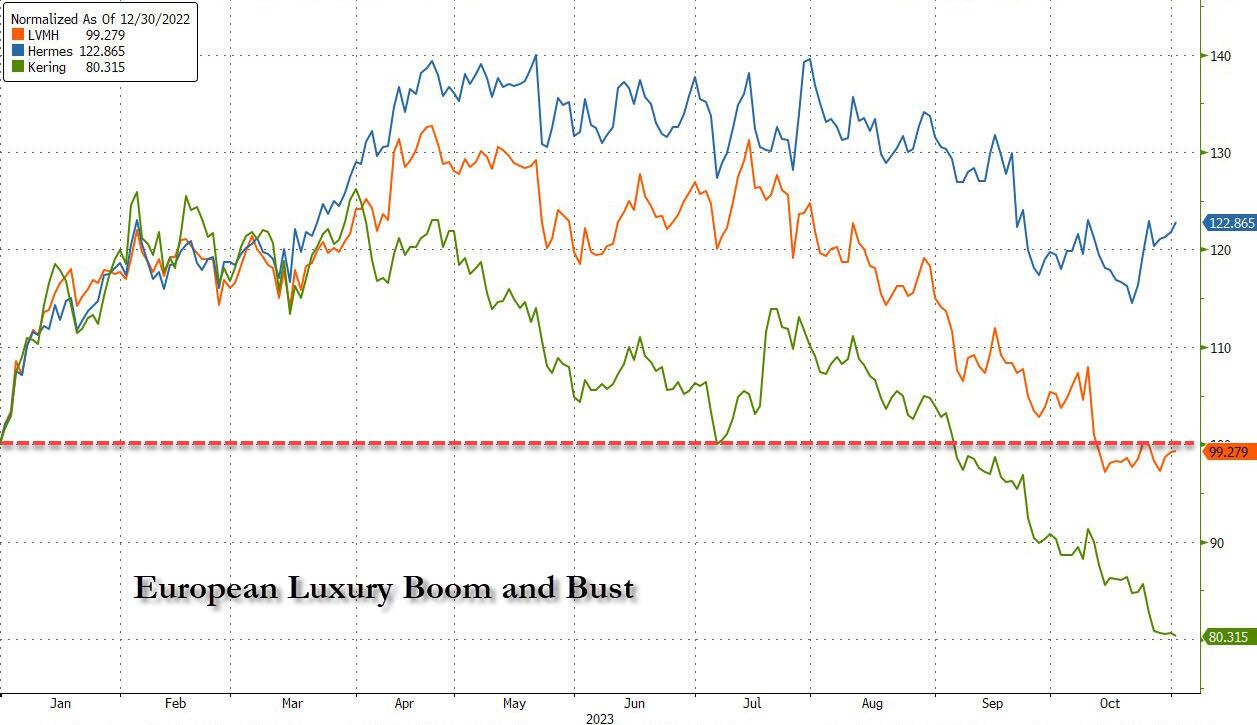
Fast forwarding to today, while we have yet to hit rock bottom when it comes to lower income cohorts, it is becoming increasingly clear that the answer to our question from May, namely “did the luxury bubble just burst” is now a resounding yes as the following boom-to-bust chart of European luxury giants LVMH, Hermes and Kering shows.

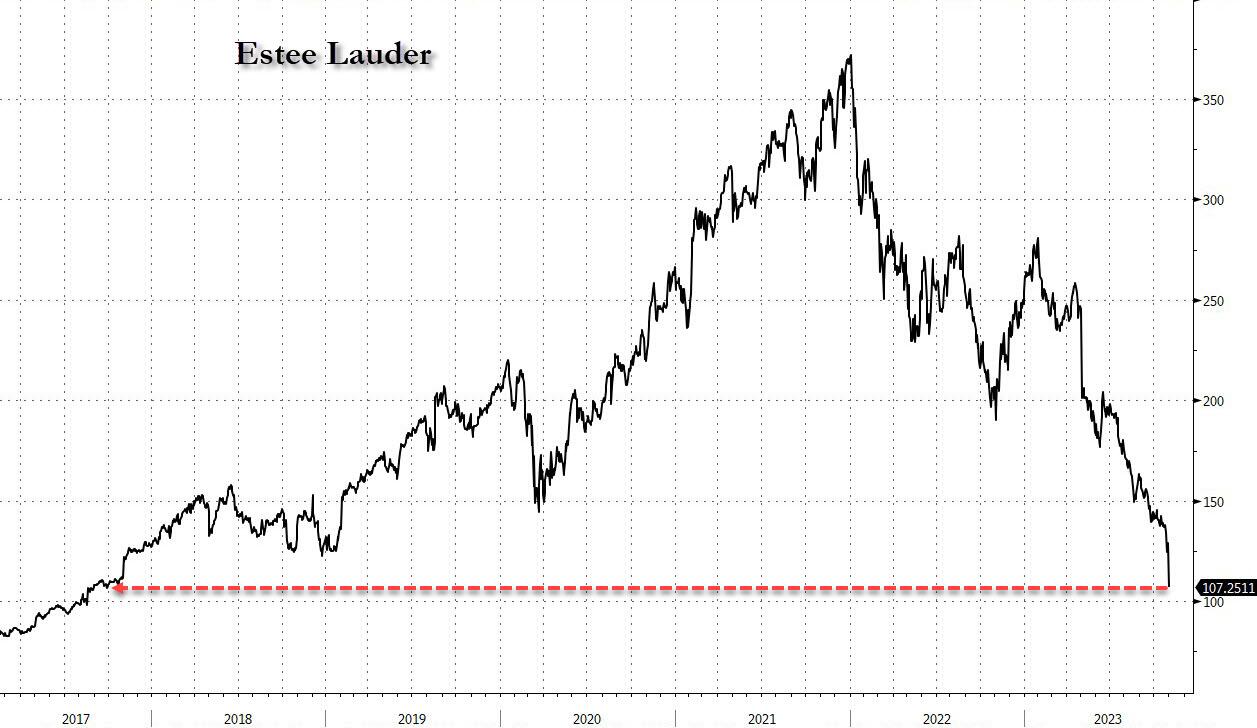
Today, the bursting of the luxury bubble took its latest casualty, Estée Lauder, whose already-battered shares plummeted even more, tumbling as much as 21%, their biggest one-day drop in history, after the beauty giant slashed its full-year outlook on troubles in China and the Middle East. The stock has lost almost half of its value in 2023 alone.

As BBG notes, the owner of the MAC and Tom Ford brands has been “floundering in its crucial travel retail business in Asia due to weaker-than-expected demand.” The continued weakness in that channel, as well as an added drag from the Israel-Hamas war, show the beauty company has failed once again to get its footing, meaning it is likely to keep ceding market share to archrival L’Oréal.

For the current fiscal year, Estée Lauder expects net sales in a range of negative 2% to positive 1% versus the prior year, while earnings are seen at $2.08 to $2.35 a share. In August, it had forecast net sales to increase between 5% to 7% and saw earnings of $3.43 to $3.70 a share.

Estée Lauder said net sales in the most recent quarter fell 10%, in line with the downbeat outlook the company forecast in August (the only positive was that the company did a +6% in the Americas vs a Consensus -2%, although that too is about to reverse now that Americans are finally paying down their student loans, credit cards are maxed out and any “excess savings” are long gone).

For the current quarter, the company now expects net sales to decrease between 9% to 11% versus a year ago and sees diluted net earnings between 47 cents and 57 cents a share. The potential risks from disruption in Israel and the Middle East are expected to have a dilutive impact of 8 cents. The company doesn’t break out what portion of revenue it generates in the region.

“The big question, like last quarter, and the one before it, will be: ‘Is this the final cut?’” Bernstein analysts led by Callum Elliott wrote in a research note.

Chief Executive Officer Fabrizio Freda said in a statement that the New York-based company lowered its fiscal 2024 outlook due to slower growth in prestige beauty in Asia travel retail and mainland China, as well as the risk of disruption to its business in Israel and elsewhere in the Middle East.

Remarkably, even though Estée Lauder had already lowered expectations in the previous quarter – after already cutting its outlook several times in the past year leading to another near record price drop back in April – the market was still caught off-guard, sending the stock down the most on record. That’s raised concerns among investors that executives don’t have a good grip on what’s happening in their business.

“We thought that this quarter could be the trough and did not expect another guidance cut,” RBC Capital Markets analyst Nik Modi wrote in a research note. “All the read thrus suggested China was weak, but we thought EL’s guidance last quarter accounted for the weakness. Clearly we were wrong.”

On a call with analysts, CEO Freda said: “We expect calendar year 2023 to be the final and, frankly, painful post-Covid reset period for the company.”

Good luck with that.

Curiously, the cosmetic industry may be the one place where lower-income consumers are holding out better then their higher-income peers. Estée Lauder’s quarterly results are in contrast to competitor L’Oréal, which said late last month that sales were up 4.5% in the three months that ended on Sept. 30. While the French beauty giant – which sells more mass-market items under brands such as Maybelline New York and L’Oréal Paris – has also been hit by the slowdown in duty-free sales in China and South Korea, the business represents a much smaller portion of its revenue versus Estée Lauder.

L’Oreal’s cheaper products have sold more briskly than items from its more expensive brands as inflation-weary consumers have become pickier. Estée Lauder, meanwhile, sells more higher-end products and on Wednesday cited the “slower-than-expected recovery of overall prestige beauty.”

Which brings us to a key question: has the consumer finally hit a brick wall? While we are confident that recent results indeed confirm that consumers are virtually tapped out, a slightly more cheerful take comes from Goldman consumer trader Scott Feiler who tries to present today’s dismal results in a slightly better light.

Here is his take on today’s earnings onslaught:

  • Bottom-Line Intact for 3Q: The magnitude of top-line upside has begun to slow, but companies have pretty continued to beat across the board on the EPS/EBITDA line for 3Q. Even the names with the biggest downward reactions this morning so far in the pre (Wayfair, EL, CCEP, GOOS) largely all beat EPS for this quarter.
  • Top-Line Upside is slowing though: While bottom-line remains intact (for 3Q at least), the top-line upside does appear to be harder to come by. See YUM, EAT, EL, GOOS etc for prints that largely saw in-line sales, even as EPS handily beat.
  • Restaurants remain a relatively bright spot in the US: YUM (+1.5% comp beat), FWRG (40 bps comp beat) and EAT (20 bps comp beat at Chili’s) are all “fine” still with still constructive commentary, even as traffic has slowed some.
  • China Unsurprisingly called out as weak: 2 of the biggest stock disappointments this morning are EL (called out incremental headwinds from a slower-than-expected recovery of overall prestige beauty in mainland China) and YUMC (said they observed softening consumer demand emerged in late September through October).
  • The 2 biggest single names in focus in our IB chats – EL and Wayfair.  
    • For EL, the guidance cut only 1 quarter in is well below any of the worst estimates we had heard. The only “positive” is the bulk of it was blamed on China (somewhat known) and the Middle East.  They did a +6% in the Americas vs a Consensus -2%, and so we think a focus on the 930AM call will be whether there were shipment benefits that helped that figure. Despite the better Americas and Jason’s note titled ““bottom perhaps finally found,” the overwhelming feedback continued to be negative this morning on lack of conviction in an EPS bottom.
    • For Wayfair, the stock dropped hard as soon as the release hit. A ton of inbounds from most asking why. Yes, revenues missed for 3Q but it was only a 1% miss vs consensus and the bogey, while margins beat by about 150 bps. The big concern here seems to be less about margins (most understand a beat was likely) and more about top-line, especially fears around 4Q. On the call, they spoke to QTD gross revenues running around flat. We think expectations were well below the consensus +5% for the full 4Q, so agree that the -10% move lower in the pre is a bit surprising. This is a shoot first, ask questions later type tape though.

Needless to say, that is hardly the kind of tape one sees at the start of bull markets.

Tyler Durden
Wed, 11/01/2023 – 12:45

via ZeroHedge News https://ift.tt/9cWuLgy Tyler Durden

House GOP Plan To Offset Israel Aid With IRS Funding Would Expand National Debt Via Reduced Enforcement: CBO

House GOP Plan To Offset Israel Aid With IRS Funding Would Expand National Debt Via Reduced Enforcement: CBO

A GOP plan to offset $14.3 billion in aid to Israel by reducing the IRS’s roughly $60 billion boost from the Inflation Reduction Act ($80 billion less negotiated cuts) would backfire and add around $30 billion to the national debt, because – according to both the CBO and the Committee for a Responsible Federal Budget (CRFB), it would reduce the amount that the agency will be able to collect via audits.

Speaker Mike Johnson

Israel, with GDP of almost half a trillion dollars and a debt-to-GDP ratio that is half of that of the United States, and a super-advanced military, still somehow needs $14.3 billion from US taxpayers in order to continue its extensive bombing campaign throughout Gaza following the October 7 Hamas terrorist attack.

While the Senate uniparty has insisted on US aid for both Israel and Ukraine (with a smattering of border security funds to mollify the America First types), House Republicans want to separate the two amid pushback from the Freedom Caucus – and pay for Israel aid by reducing the aforementioned IRS funding.

The CBO says it would decrease tax revenues by $26.7 billion, while the CFRB says it would add over $30 billion to the national debt.

Of note, the amount Congress wants to send Israel is almost precisely the amount the Trump administration wanted to secure the southern US border, which Trump said Mexico would pay for indirectly via trade deals. Instead, we’re engaged in proxy wars on at least two fronts while more than five million illegal immigrants have crossed into the United States since Biden took office.

Paying for new spending by defunding tax enforcement is worse than not paying for it at all,” said CFRB President, Maya MacGuineas, adding “Instead of avoiding new borrowing, this plan doubles down on it.”

According to Howard Gleckman, senior Urban-Brookings Tax Policy Center fellow, said it was “pretty clear” that “cutting this kind of IRS funding would actually increase the deficit.”

“Instead of being an offset, it would actually make matters worse,” he argued. “The general rule of thumb that the budget scorekeepers use is it’s about 2-to-1. So if you cut IRS funding [by $14 billion to $15 billion], you’re actually going to increase the deficit by about $30 billion.”

Whose rule of thumb? Is there anything back that statement?

A ‘non starter’ anyway

The House is expected to vote on the proposed funding on Thursday, however Democrats say it’s a “non-starter” ion the Senate.

“If Republicans had an ounce of shame they wouldn’t condition support for Israel and Ukraine on giveaways to wealthy tax cheats. Making aid to Israel and Ukraine dependent on gutting IRS enforcement funding is an absolute nonstarter,” said Sen. Ron Wyden (D-OR), the Senate Finance Committee Chair in a Tuesday statement.

Mittens echoes neocon refrain

“I don’t think you reduce the number of IRS agents then expect that you’re going to get more tax revenue,” Sen. Mitt Romney (R-UT) told The Hill.

I think reducing agents means less tax revenue,” he continued.

The Treasury Department said earlier this month that the U.S. borrowed $1.7 trillion in the one-year period ending in late September, a spike over the previous year that Biden officials partly attributed to low revenue.

The U.S. is currently running a $33 trillion debt, which spiked above its trend line during the pandemic as the government expanded major tax credit programs for lower earners and sent out checks to families while the economy was shut down.

As part of the Inflation Reduction Act (IRA) passed last year by Democrats, the IRS was given an additional $80 billion in funding over the subsequent 10 years. That allotment would have increased revenues by around $200 billion for a net deficit reduction of around $114 billion, according to a CBO analysis. –The Hill

Some Senate Republicans have endorsed the House measure, but acknowledge that the budgetary impact could pose a challenge.

“If you’re looking for a pay-for, which they clearly are, I think it’s as good as one as there could be,” said Sen. Kevin Cramer (R-ND).

“The challenge you’re gonna have is a CBO score.”

Tyler Durden
Wed, 11/01/2023 – 12:25

via ZeroHedge News https://ift.tt/alhye4J Tyler Durden

Khamenei Calls On Muslim World To ‘Stop Oil Exports’ To Israel

Khamenei Calls On Muslim World To ‘Stop Oil Exports’ To Israel

Via The Cradle,

Iran’s Supreme Leader Ali Khamenei spoke about the Gaza-Israel during a meeting with a group of students at the Imam Khomeini Hussainiyah in Tehran on Wednesday, chastising Gulf Arab states for their complicity in Israeli aggression.  

“What Muslim states must insist on is the immediate cessation of [Israeli] crimes in Gaza. They must promptly stop the bombardment of Gaza and stop the export of oil and other commodities to the Zionist regime,” Khamenei stressed.  

Image: https://khamenei.ir/

“Muslim states must not cooperate economically with the Zionist regime but denounce these catastrophes and crimes vociferously and without hesitation in all international forums,” he added.  

Khamenei also highlighted that the ongoing war is “between truth and falsehood, between the power of faith and the power of arrogance.” He added: “Of course, the power of arrogance comes with military pressure, bombardment, as well as calamities and crimes, but the power of faith will overcome all of these by God’s grace.”

Khamenei also mentioned that Gaza is a “human movement” whose influence spread outside of the Levant.  

“[The people of Gaza managed to] move the human conscience […] look what is happening in the world; in western countries, in Britain, France, Italy, and various US states, people come in large crowds to the streets and chant slogans against Israel and the US itself,” Khamenei added.  

“It was an absolute disgrace for them, which they can neither recover from nor justify,” Khamenei said. “The Muslim world should not forget that all through the critical issue of Gaza, the [parties] which stood against Islam and the oppressed Palestinian nation was [the US], France and Britain.” 

Speaking about the movements in the west, Khamenei touched on those who are blaming Iran for the protests, mockingly saying that “we see a fool coming and saying that the gathering of people in England to support the Palestinian people is the work of Iran.” 

During his talks with the students of Iran, he looked back at the role played during the 1979 takeover of the US embassy in Iran, saying, “The US was disgraced. This was the blow of the Iranian nation to the US.”

Tyler Durden
Wed, 11/01/2023 – 12:05

via ZeroHedge News https://ift.tt/W6ftQqK Tyler Durden

Pfizer To Shut Down Two Facilities Amid Major Cost Cuts

Pfizer To Shut Down Two Facilities Amid Major Cost Cuts

Authored by Jack Phillips via The Epoch Times (emphasis ours),

Pharmaceutical giant Pfizer confirmed it will be closing down two of its facilities in North Carolina amid a cost-cutting initiative after it revealed that sales of its COVID-19 vaccine and other products would see a drop.

Pfizer CEO Albert Bourla gestures during a session at the World Economic Forum annual meeting in Davos, Switzerland, on May 25, 2022. (Fabrice Coffrini/AFP via Getty Images)

The company told multiple local media outlets that it would be closing its sites in Durham and Morrisville, saying the closures are part of an effort “to operate more efficiently and effectively.”

“As part of this effort, Pfizer has decided to close the Kit Creek facility in Morrisville … and the Durham Clinical Manufacturing Facility,” the company said, according to the Triangle Business Journal. “Pfizer continues to operate its largest North Carolina facilities, including two in Sanford and one in Rocky Mount.”

It’s not clear how many workers would be impacted or laid off. The Epoch Times has contacted the company for comment Monday.

All job-related decisions will be made with transparency, compassion, and respect, and in compliance with applicable laws,” Pfizer told the News & Observer publication. And any employee who is impacted by the closures will be offered a “generous separation package,” Pfizer told ABC11 TV, or will be given the chance to apply for another position.

Morrisville Mayor T.J. Cawley suggested that some workers might be laid off, according to the paper. Multiple Pfizer employees who had worked at the two North Carolina facilities listed the hashtag OpenToWork on their LinkedIn profiles in recent days.

“Overall, I think our area is pretty well buffered from the economic downtown,” the mayor said. “Talent will always move around from company to company. We have such a strong talent pool that companies will keep coming here.”

Before the closures were confirmed by the company, a number of unnamed Pfizer workers complained on social media that they would be getting laid off soon amid the company’s cost-cutting scheme. Posts alleged that Pfizer officials held a live stream with thousands of workers to announce the cuts earlier in October.

Pfizer told Newsweek about a week ago that “we updated our plans last Friday in this release” and that “we are prepared to launch an enterprise-wide cost improvement program aligned with the longer-term revenue projections for our business. Details of this program will be shared over the coming months and as part of the full-year guidance for 2024.” Other details were not provided.

Under federal regulations, employers have to file what’s known as a WARN Notice 60 days before closing down a site that impacts at least 50 workers. As of Monday, Pfizer hasn’t filed a WARN Notice regarding layoffs, according to the News & Observer, citing the state’s Department of Commerce website.

Pfizer Lowers Guidance

About 12 million people, or around 3.6 percent of the population, have gotten one of the latest booster shots, said Dr. Mandy Cohen, director of the U.S. Centers for Disease Control and Prevention (CDC), last week.

Dr. Mandy Cohen, COO and chief of staff of the Centers for Medicare and Medicaid, testifies during House Ways and Means Committee hearing on Capitol Hill in Washington, on Nov. 3, 2015. (Mark Wilson/Getty Images)

“I think we’re on track. Would I love to see more? Of course, that’s my job as CDC director is to want more,” she told Politico.

Earlier this month, the drug giant released a report saying it would slash its profit and revenue estimates for a full year due to lower demand for COVID-19 products, including its mRNA vaccine and anti-viral drug Paxlovid.

It now expects 2023 sales of $58–61 billion, down from previous forecasts of $67–70 billion, said a report released Oct. 13. It’s down “solely due to its COVID products,” according to the report.

Sales of its COVID-19 vaccine will be about $2 billion lower than was previously forecast, the company said. It comes after the company’s updated COVID-19 booster was made available by U.S. federal regulators in September, although uptake of the latest shot appears to be slow, according to federal health data.

At the same time, Pfizer reduced its guidance for Paxlovid, an antiviral drug that targets COVID-19, by approximately $7 billion.

“We remain proud that our scientific breakthroughs played a significant role in getting the global health crisis under control,” Pfizer CEO Albert Bourla said in a statement Friday. “As we gain additional clarity around vaccination and treatment rates for COVID, we will be better able to estimate the appropriate level of supply to meet demand.”

We are in the middle of the COVID fatigue. Nobody wants to speak about COVID,” Mr. Bourla also said during a call earlier this month, according to CNBC. “We have the big anti-vaccination rhetoric.”

Over the past month or so, Pfizer’s stock has dropped about 10 percent, to just above $30 per share as of Monday morning. Rival pharma Moderna, which also produces an mRNA COVID-19 vaccine, has seen its stock drop by more than 29 percent over the past month, to $72 per share as of Monday.

Hospitalizations for COVID-19 consistently to drop over the past several weeks after rising somewhat during the summer, according to data posted weekly by the U.S. Centers for Disease Control and Prevention. Emergency room visits and case numbers have also dropped, the data show.

Tyler Durden
Wed, 11/01/2023 – 11:25

via ZeroHedge News https://ift.tt/gGV2lSO Tyler Durden

Tesla Wins Court Battles In U.S., China, Over Alleged Autopilot Fatalities

Tesla Wins Court Battles In U.S., China, Over Alleged Autopilot Fatalities

Tesla has won its battle in court over a fatal Autopilot crash that killed a California driver four years ago. 

A jury in Riverside, California sided with Tesla in a lawsuit which blamed Tesla’s Autopilot for the fatality. Passengers who had survived the accident were suing for $400 million for the death of the driver, as well as physical injury and mental anguish, Bloomberg reported this week. 

It took the jury four days of deliberation to come to its decision. 

The month-long Riverside trial centered on Micah Lee, whose 2019 Model 3 crashed into a tree in Southern California. While plaintiffs claimed an Autopilot defect caused the crash, Tesla argued Lee had been drinking and offered no proof that Autopilot was engaged, Bloomberg reported.

At the trial’s outset, Tesla’s attorneys blamed “classic human error” for the accident. They presented a video of passenger Molander stating that both she and Lee had consumed alcohol at Downtown Disney in Anaheim before the crash. 

Brian Jazaeri, Tesla’s senior litigation director, commented: “The jury’s conclusion was the right one. There was no evidence of a defect in our Autopilot technology. Tesla’s cars are well-designed and making the roads safer every day.”

Plaintiff counsel Jonathan Michaels commented: “It’s undeniable that a national lens is now focused on this pressing matter. Tesla, despite its stature, was pushed to its limits during the trial. The jury’s prolonged deliberation suggests that the verdict still casts a shadow of uncertainty.”

Talking about how the vehicle malfunctioned during the crash and sent a “excessive steering wheel angle command”, Michaels told the jury: “We know it’s not possible for a driver to have done this. We know Autopilot went crazy. We know this is a manufacturing defect.”

Tesla’s lawyer, Michael Carey, dismissed allegations of an Autopilot flaw as “hot air,” asserting that evidence shows the car’s steering was manually altered. Carey emphasized to the jury that while Tesla sympathizes with Molander and her son, the company bears no responsibility for the incident.

Separately this week, according to Shanghai Securities News and cited by Bloomberg, a Chinese court also found that Tesla was not at fault in a November 5, 2022 accident that occurred in Chaozhou in Guangdong province, which injured three people. 

Bloomberg noted the following remaining cases still pending regarding Tesla’s Autopilot:

Tyler Durden
Wed, 11/01/2023 – 11:05

via ZeroHedge News https://ift.tt/2cI9d0Y Tyler Durden

US Sends 300 More Troops To Middle East, Raising Total To 1,200

US Sends 300 More Troops To Middle East, Raising Total To 1,200

Authored by Andrew Thornebrooke via The Epoch Times,

The United States will deploy 300 additional troops to the Middle East following several new attacks on U.S. and Coalition forces in Iraq and Syria, the Pentagon has announced.

The forces will deploy to undisclosed locations in the Middle East outside of Israel, Pentagon spokesperson Brig. Gen. Pat Ryder told reporters on Oct. 31.

The move follows the deployment of 900 troops to the region last week.

While many of the troops sent last week were operating in air defense elements, the 300 now deploying will primarily focus on support tasks including communications and explosive ordnance disposal, Gen. Ryder said.

The troops are intended to help the United States prevent the Israel-Hamas War from expanding into a regional conflict, as well as to prevent further attacks on U.S. service members.

“They are intended to support regional deterrence efforts and further bolster U.S. force protection capabilities,” Gen. Ryder said.

New Attacks by Iran-Backed Groups

Gen. Ryder said that there were 27 attacks on U.S. troops by Iran-backed groups in Iraq and Syria throughout October.

“Right now, we’re tracking a total of 27 attacks,” Gen. Ryder said. “16 in Iraq, 11 in Syria.”

The Pentagon has frequently claimed that the attacks are a separate issue from the ongoing Israel-Hamas War in Gaza, but Iran and the other groups involved have stated that they will increase their attacks on U.S. troops should Israel pursue a full-fledged invasion of Gaza.

“I think it’s important to differentiate what Iranian proxies and Iran might be saying and the perspective that we bring to this,” Gen. Ryder said. “Our forces are in Iraq and Syria for one purpose, which is the enduring defeat of ISIS.”

“This is separate and distinct from the situation in Israel, between Israel and Hamas.”

The attacks in Iraq and Syria have resulted in wounds to at least 21 American service members, including 19 who were diagnosed with traumatic brain injuries. All have since returned to duty.

In addition to the growing number of rocket and drone attacks on U.S. and Coalition bases, several medium-range cruise missiles were launched by Iran-backed Houthi rebels in Yemen.

The USS Carney shot down four such missiles in the Red Sea on Oct. 19.

Pentagon leadership said that the missiles were headed north, possibly towards Israel, but that they were shot down because they were deemed a threat to the vessel.

“We cannot say for certain what these missiles and drones were targeting, but they were launched from Yemen heading north along the Red Sea, potentially toward targets in Israel,” Gen. Ryder said at the time.

The United States launched two retaliatory strikes over the weekend on facilities in Syria associated with Iran’s Islamic Revolutionary Guard Corps, which the United States designates as a terror organization.

The escalating conflict follows an unprecedented attack on Israel on Oct. 7, when Islamist terrorists murdered more than 1,400 Israelis, abducted women and children, and engaged in acts of torture.

Experts have warned that the Hamas terrorist organization, which receives funding and training from Iran, seeks to unleash an international conflict that will encourage more violence against Israel and the United States.

The Biden administration has said that it retains the right to retaliate against Iran at a time and in a manner of its own choosing.

“We know that these groups are funded, trained, and sponsored by the Iranian government,” Gen. Ryder said. “And we hold the Iranian government responsible.”

Tyler Durden
Wed, 11/01/2023 – 10:45

via ZeroHedge News https://ift.tt/3O4Re8M Tyler Durden

WTI Holds Gains After Small Crude Build, Cushing Just Off ‘Tank Bottoms’

WTI Holds Gains After Small Crude Build, Cushing Just Off ‘Tank Bottoms’

Oil prices surged overnight, recovering all of yesterday’s losses after EIA made substantial upward demand revisions in its monthly reports (again) to the highest in four years. This combined with renewed war premia amid continuing escalations in the middle east with further incursions by Israel into Gaza and threats from Iran calling for exports of oil and goods from Muslim nations to Israel to stop.

On the bright side, some foreigners and Palestinians were allowed to leave Gaza for the first time since Israel began its ground invasion on Wednesday.

Also on the bearish oil side, manufacturing in China, the world’s biggest oil importer, fell back into contraction last month.

So what will this morning’s official inventory and production data show?

API

  • Crude +1.35mm (+500k exp)

  • Cushing +375k

  • Gasoline -357k (-500k exp)

  • Distillates -2.48mm (-1.9mm exp)

DOE

  • Crude +773k (+500k exp)

  • Cushing +272k

  • Gasoline +65k (-500k exp)

  • Distillates -792k (-1.9mm exp)

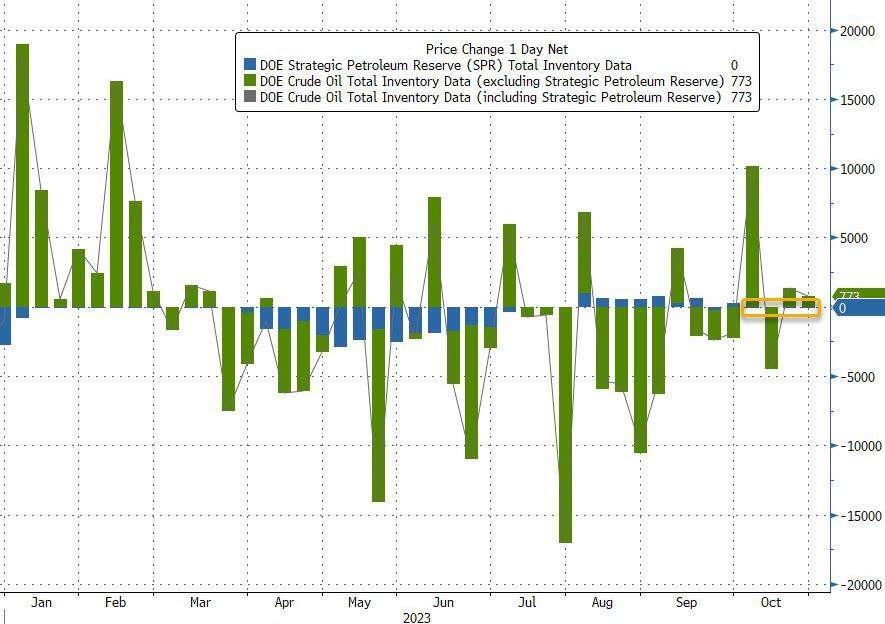
Crude inventories rose – very marginally – for the second straight week and stocks at Cushing also rose (against de minimously). Distillates saw the only notable draw – 5th week in a row…

Source: Bloomberg

The SPR was left untouched for the 4th week in a row…

Source: Bloomberg

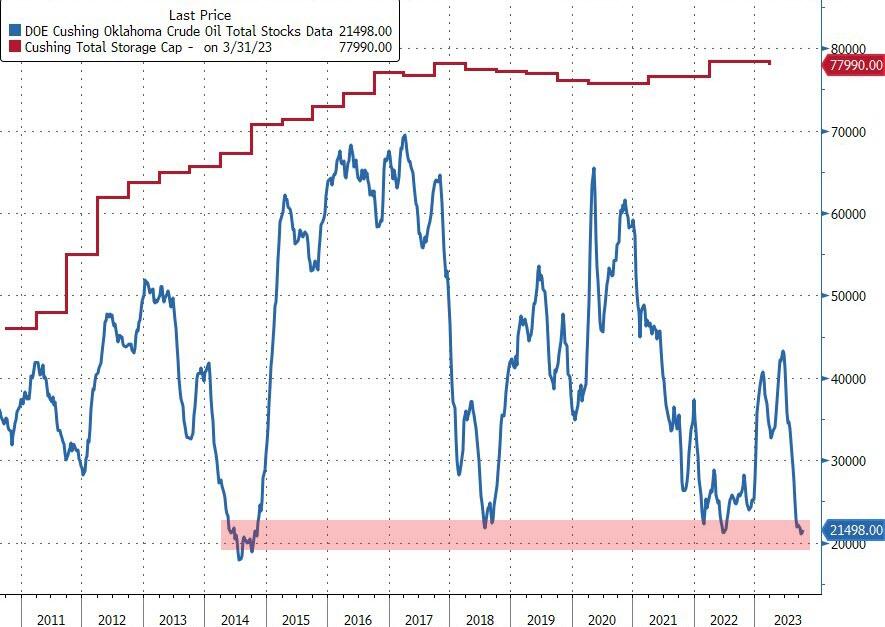
Cushing remains barely off tank bottoms…

Source: Bloomberg

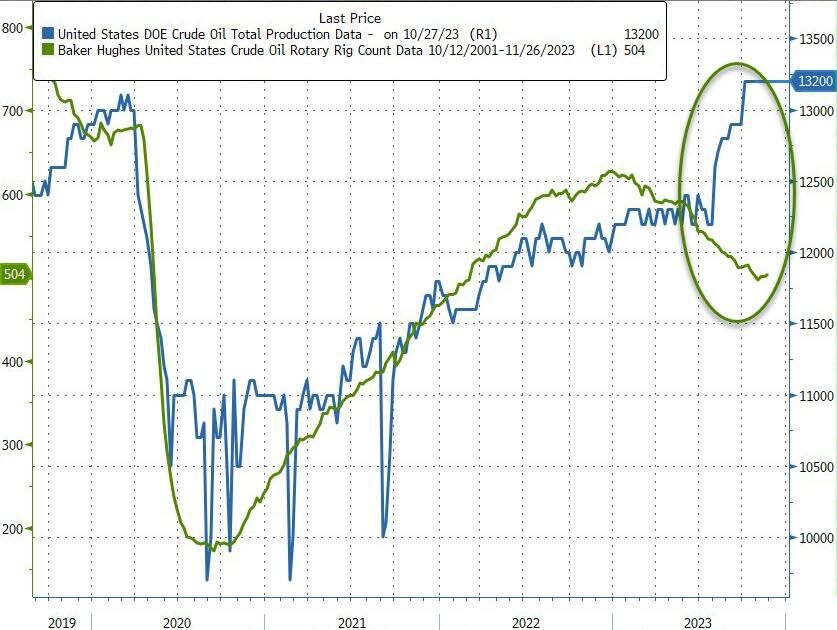
US Crude production was steady at record highs (13.2mm b/d) as the rig count trends lower…

Source: Bloomberg

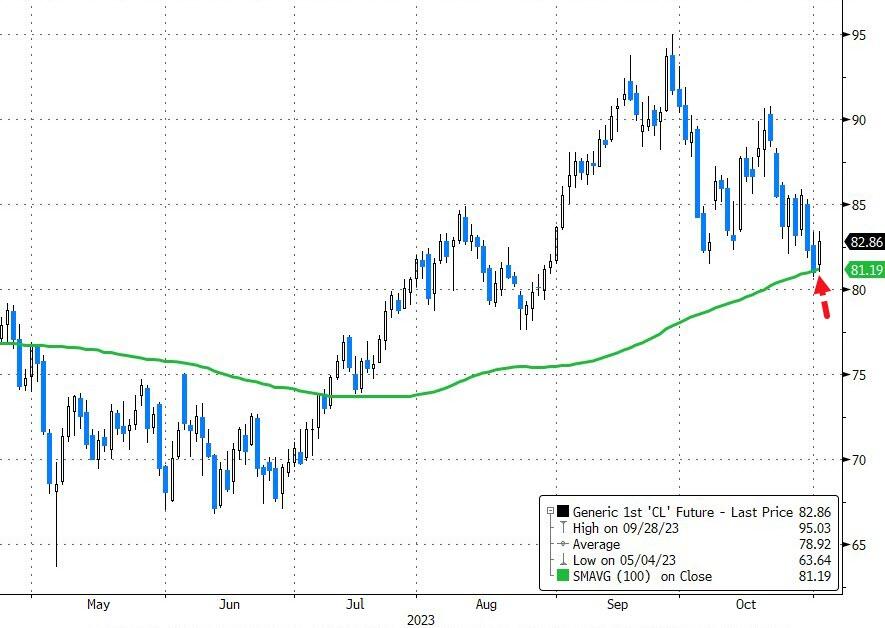
WTI was hovering around $83 and leaked lower after the print…

We note that today’s bounce in WTI occurred right the 100DMA…

Additionally, oil options are tentatively pricing in a smaller risk of escalation in the Middle East as a result of the Gaza war.

As Bloomberg reports, a rare so-called call skew emerged – and then became extreme – in oil options trading in the days after the war began. It meant traders were willing to pay more for protection against prices spiking than for insurance against a slump.

But, as the chart shows, while the skew remains, it has reduced significantly – indicating less confidence that the war will spread/escalate.

Tyler Durden
Wed, 11/01/2023 – 10:40

via ZeroHedge News https://ift.tt/F5cgwMj Tyler Durden

Capitalism Made Us All Richer. So Why Are We Unhappy?


img_1687_720 | Illustration: Lex Villena

Swedish historian Johan Norberg is author of The Capitalist Manifesto: Why the Global Free Market Will Save the World, which caught the eye of Elon Musk, who tweeted, “This book is an excellent explanation of why capitalism is not just successful, but morally right.”

Norberg wrote the book to combat a growing belief on the right and the left that libertarian values of individual autonomy, property rights, limited government, and free enterprise are failing to raise living standards and need to be ditched in favor of more centralized power and control over virtually all aspects of our lives.

A senior fellow at the Cato Institute, Norberg shows that life is actually getting better for all of us—especially the world’s poor—and that economic globalization, political liberalization, and cultural freedom are the main drivers of that improvement. He talks about how liberals and conservatives get the past wrong, why he’s not worried about China’s supposedly unstoppable economic growth, and why the cases for free trade, free expression, and more immigration need to be constantly updated and renewed. He also explains why he’s a libertarian and not an anarchist. Reason‘s Nick Gillespie spoke to Norberg in Washington, D.C., in late September. 

Watch the full video here and find a condensed transcript below. 

Reason: Many Americans are saying, “Well, you know what? Since China joined the World Trade Organization in the 21st century, we have just seen massive deindustrialization. The Midwest is beyond the Rust Belt. Everything has gone to hell in the United States.” That’s not really true, right? 

Johan Norberg: The middle class is shrinking, but that’s because it’s moving up. If you look at those indicators, and specifically, if you look at not just dollars and cents. We should do that too because it is important to lay to rest the whole idea of wage stagnation, which was really a period in the 1970s and the 1980s when many sectors had increased wages much faster than productivity. They had to scale that back or they would’ve been destroyed completely.

After 1990, we’ve seen rapid wage increases in the U.S., 30 to 60 percent depending on whether you’re taking full compensation, including nonmonetary like health insurance and stuff. Also, it’s important to mention goods and services. It’s not dollars and cents. We want to be able to buy something—most amenities that were considered luxuries just decades ago are now getting close to 100 percent distribution in the United States. People under the poverty threshold in the U.S. now have more amenities like T.V. sets, washing machines, dryers, and of course, computers and cellphones than the average American had in 1970.

It seems like not everything was destroyed. Why is that? Well, one reason is that we did deindustrialize, meaning fewer people have to work in factories to create the goods we want. We haven’t deindustrialized in an absolute sense. We produce more now than probably at any other station in America’s history, but it’s been a success story. It’s a rise in productivity, which means that we can make the goods with automation, make the goods more competitive and affordable to most people. That’s what successful countries do.

There is a great section in The Capitalist Manifesto where you talk about the myth of working in Detroit in the 1950s and how the peak of industrial workers in the United States as a share of the labor force was actually in the 1940s. It was already declining in the 1950s. Can you talk a bit about that?

Yeah, it looked good compared to the rest of the economy because it was awful working in agriculture and in domestic traditional industry. Comparatively it was better than in many other places. Now we have this kind of nostalgic, gross, tinted image of what it was like. It’s important to go back, and there are some historical projects interviewing the workers who really did the job and they’re telling us, first of all, I do this so that my son will not have to stand and work in a factory like this because it is awful. It’s dangerous, it’s dirty, and you can lose an arm or two if you’re not careful. 

Also, very insecure jobs, very rapid turnover. When I look at different cohorts, it turns out that there was one cohort in Detroit in 1953. They had fairly secure jobs, got a good decent wage, unionized, and so the whole myth of Western manufacturing is based on one city in one year. What did they get, the ones who got those best jobs? Well, adjusted for inflation, they get what you would get as a starting wage in an Amazon warehouse today. 

Is it a good thing or a bad thing that fewer men between the ages of 25 and 54 are actively in the labor force?

If people are able to work and want to work, it’s a good thing, they should. They shouldn’t be doing other things. That has been declining, but it has been declining for a very long time. That’s important to point out. This is not something that happened when China entered the World Trade Organization, and it did not happen with NAFTA. It started after the Second World War basically, and it was actually much faster. The increase in men outside of the labor force was at a much higher rate in the 1950s, ’60s, and ’70s than in this era of globalization. It tells you that there’s something else going on other than just competition. It seems like we are pretty bad at retraining and having the kind of mobility in the work force that we would want, but most of these people are then counted as disabled and they’re in various programs rather than standing in the work force.

You actually went around the United States and talked to people who were on welfare. What did you find?

Well, I learned that you have to be very smart and hardworking to be poor and unemployed in the U.S., because the systems are so incredibly complex and they come from a wide variety of sources and they’re based on different metrics. They then are also discounted and lost at various points when you make more of an income than you used to. What they told me is that it feels hopeless. It feels like there’s nothing they can do to change their situation. One of them told me that, doing the calculations from four different benefits systems, if she increases her wage from $29,000 to $30,000, many of the benefits she receives would disappear, leaving her actual take-home income cut in half, so that she just makes $15,000.  t. In a way, the marginal tax rate for the poor and unemployed is much higher than for the rich.

They know that it’s hopeless, basically, to go out there and sacrifice time, energy, and transportation costs to get a job because they notice that they don’t make money.

Is there an easy solution to that problem?

Well, I wish. Welfare’s complicated—there is no perfect social benefit system. The moment you start paying people when they are unemployed and disabled, you also subsidize it. You also buy more of it and it’s difficult to get out of it, but there are versions of a negative income tax that would at least make sure that you always keep more of what you earn. So that you don’t have to do all these calculations and feel like it seems impossible. 

Is that an argument for a universal basic income or a negative income tax? 

It seems like a UBI would be incredibly expensive if everybody’s supposed to have it or it wouldn’t help the poorest as much. Perhaps some sort of negative income tax ensures or supports wages for the poorest. It seems like a better way to go about it.

Can you quickly define what “deaths of despair” are, and what did you find when you started looking into what’s going on with that?

Well, it’s a famous and depressing concept coined by Angus Deaton and his wife Anne Case Deaton, “deaths of despair.” And they’re including various sorts of self-harm, broadly speaking. Could be drug overdoses, alcoholism, or suicide. I think when we look at it, this is kind of controversial among scholars because when you look at it might be that we’re just talking about a drug overdose epidemic, but that’s the real thing that sets this apart. What they mean and what many take away from it is that there’s something related to how people live, a sense of despair that makes them live in this kind of self-destructive way. This has increased dramatically. Why is that? Many say it’s strange as the society gets richer and more open, some blame it then on ruthless capitalism and free markets. 

As Angus Deaton points out himself, you can hear it in the very word of globalization. It’s global. It happens everywhere. All these forces, but it seems like it’s specifically happening in the U.S. rather than in other places. More economically free countries in the West have not had the same increase in deaths of despair to this extent.

Inequality is flat in the United States or declining globally. So how do you explain the “deaths of despair”? 

Well, I mean, one thing is this might be very much a drug overdose epidemic rather than anything else. Perhaps there are things related to drug laws and the unsafe drugs that are being used. So this is one angle. 

The other thing is that we know that it’s bad for your health and you shorten your life if you feel like you’re worthless; it’s impossible to change your situation. You’re not needed anywhere. This is, I think, one of the greatest challenges to modern welfare states like America’s, because it seems like economically, I mean, it’s all right. We can probably afford to have a larger group of people outside of the work force. We can pay for it all and hand them benefits and they stay at home. This sense of being rejected, not needed anywhere, and not being able to change your life circumstances.

Another accelerator supposedly in the decline of lifestyle or standards of living in the United States has to do with China. Could you talk about your view of China? 

Right. There is one unifying narrative about China that I get a lot from both the left and the right and the center, and it’s that they’re so incredibly smart. They have a plan for everything, how to invade our markets and take our jobs with the very clever industrial policy and picking certain companies, subsidizing them, and dumping their goods here and buying.

I must say the worrying implication is that so many Americans say we have to imitate them. We have to be like that in order to beat them. That’s one reason why we get the support for protectionism and industrial policy right now. They do have industrial policy. They are trying to pick winners. They’re trying to get the heavy hand of the government back into the economy. That’s a fairly new phenomenon. This started to happen around the global financial crisis and especially after Xi Jinping took power. This is not what’s making China rich. This is what risks making it poor. It’s a terrible destruction of resources that is going on. You can see that they’re handing the subsidies, the cheap credits to the least productive companies, and they become less productive once they do this. It’s very important, I think, to get the history of China’s economic rise right.

Is China still on the rise?

Oh, I think so. For sure. China had a good run. It was an impressive rise, and it happened precisely in the areas where they began to liberalize and open up big time. It was a success of market forces in China. Now that’s over. They’ve begun to retreat. The government is back in business, and that’s really undermining business, and it comes at a very bad time. 

China is still a very poor country. I mean, it’s just that it’s big, but it’s as far as the Dominican Republic or Gabon, so they would need, if they wanted to go on the trajectory of Taiwan, South Korea, Japan, under their good years, they would have to grow 5, 7 percent per capita for a couple more decades. That is not happening. 

How has widespread pessimism about the environment affected how people view their future? 

Actually, what we’ve seen again over the past two decades is one of the greatest achievements when it comes to the environment ever. I mean, it’s fairly recently we started to care about nature and about the future. Now in the past decades, we’ve reduced most of the pollutants, emissions. We are beginning to see growth of forests again in rich countries, in most countries actually around the world. We’re beginning to see rewilding going on, cleaner water in all those areas—tremendous achievements. 

Where does this happen? If you go to the Environmental Performance Index, looking at 40 different indicators of environmental conditions around the world, they point out that GDP per capita is a pretty strong explainer for what’s going on. The richer you are, the more you can also afford to care about the planet. 

We get richer and then we demand a cleaner environment, does that limit what happens in the marketplace? 

Quite right. It does. It’s not always the case. Some of this is driven by consumers and by businesses just wanting something better and cleaner, but quite often it’s also some sort of mandates or taxes.

You engage with Patrick Deneen, an American academic who’s an illiberal right-winger who says, “Liberalism has been tried and it fails and it fails partly because it generates loose connections and we don’t know how to live our lives.” Is he onto something?

I don’t think he is. He makes a very strong case rhetorically. He explains that we’re becoming increasingly separate, autonomous, nonrelational selves, replete with rights and defined by our liberty but insecure, powerless, afraid, and alone. Of course, we can all understand what he’s getting at because life is tough. 

There’s an epidemic of headlines saying that there’s a loneliness epidemic, but when researchers look at it, it’s very difficult to find something like that. Yes, we spend more time alone than we used to. There are more single households than before, but it seems like we enjoy that. It seems like actually single households and people who spend less time with others also, often say that they’re less lonely than others. It might be that we’re also choosing our relationships in ways that make them more fruitful and important to us, and we adapt them to our individual lives. 

Overall, when you really look at the data, it doesn’t seem like we are seeing a rise globally when it comes to mental illness or loneliness or anything like that. What we have been seeing is that many conditions that we saw before, we’ve started to use other terminology to describe them, often a mental illness terminology.

You were saddened, you had to lay down for two weeks. That’s what we used to say about parents when mom was feeling bad. Now it’s depression, now it’s a clinical condition, and that’s something else. For good and ill, I think we’re overdiagnosing some of these things. We might have turned too often to doctors when we should talk to a friend, but I also think this is a way in which we take some of these problems seriously for the first time. 

In my parents’ generation, they would never talk about how they felt and their mental conditions. You’d go to a doctor if you lost a leg, but you would never do it if you broke your heart or anything like that. In some ways the stigma is gone, even though it might result in over-diagnosis, it’s also a sign that we actually care and we’re trying to do something, and then we get the right therapy. Cognitive behavior therapy, it has excellent results. Doing that is not a sign of a sick society. I think it’s a sign of a healthy society.

Why are people so pessimistic about living in the time that we live in now?

Yeah, that is exactly the reason why I wrote this book, because it’s an uphill battle right now, and I’ve noticed that you tend to ruin good dinner parties by explaining that we’re not going to die, and I understand we should care about global warming. Look, 40 countries have been able to reduce carbon dioxide emissions in absolute terms while growing their economies in the past decade.

People are often invested in their problems and in the problems of the world, and it’s part of their identity and the fact that they care about it, it’s important to them. Telling them that, “Look, it’s actually better than you think,” might be threatening ironically. When you look at every single data point, if you’re talking about extinction of mammals or if you’re talking about carbon dioxide separately, if you’re talking about poverty in Bangladesh, people pay attention to those things and they listen to the data and they’re interested in the story.

Do your children seem optimistic about the future?

Well, they do come home from school and tell me that we’re going to die suffocating in plastics from the oceans as well. There is that, and I noticed that among the generation. However, I don’t know why, if it’s genetics or something else, but they tend to be on the more optimistic side than their classmates and think about solutions to things. 

For example, my oldest son is sort of always trying to make school projects about nuclear power and how we can make it cheap and safe, and this will give us unlimited energy for the future.

Do you think nuclear power is going to make a resurgence?

I think so, but we’re going to need something better. I think actually we ruined it the last time around by having the government pick nuclear power as the winner. That’s what we thought in the 1960s. Let’s just build them right now, big, expensive, because the technology wasn’t right there. It became too expensive and difficult to continue with it. Let’s hope we don’t repeat that mistake because at least on paper, there are some kind of promising, smaller-scale, cheaper solutions.

We have to be the masters of our own destinies. And I took for granted how incredible and liberating that is. Has everyone forgotten that idea? 

Yeah, I’m fond of this old Eastern European proverb: If you don’t have food, you have one problem. If you have food, you have a thousand problems. Obviously, you start to think about your life and every aspect of it, how you’re going to make sure that things work out for the best. Obviously, that’s anxiety-inducing. 

If you don’t have those options, if you don’t have those freedoms, those who say that they have the least chance to change their lives and decide what to do when it comes to education, career, and so on, then it shows up in clinical diagnosis, then it turns into mental illness. There are different versions of anxiety, and some are better than others, but I do understand the temptation. 

We come from a long prehistory of living in bands and tribes and someone telling us what to do, and sometimes it feels liberating just having that strong man telling you, “I know the answer to the question,” and it takes some novels and some research to really find out that the way in which we really create more decent societies and more fulfilled lives is not to just follow that one rule, but to find the way within us.

It’s important to point out that there are many different versions of meaning, and I think we can pick that up by looking at polls, because all these claims from Deneen and others, they’re very rarely backed up by any kind of empirical data. They just point out that you should all be miserable because how could you vulgar people ever find meaning and tackle Tuesday and bad TV shows? That’s why intellectuals shouldn’t run our lives, because they have another set of preferences than we do in another meaning of life. We can pick up in polls how people are doing in individualist societies compared to collectivist ones, rich societies compared to poor ones. No matter what intellectuals say, it shows up again and again, a very clear pattern: People say that they’re happier in rich, free societies, individualist societies. They feel less lonely than they do in poorer and less free societies, and they also think that they have more friends they can rely upon. They also say that they’re more willing to help others when they are in need. All these indicators, once you stop being so myopic and just looking at one year in the U.S. but look around the world, comparing different systems, different populations, then you see that we’re actually not in the best of possible worlds, but the best one so far.

This interview has been condensed and edited for style and clarity.

The post Capitalism Made Us All Richer. So Why Are We Unhappy? appeared first on Reason.com.

from Latest https://ift.tt/OfeIWwP
via IFTTT