Apple Slides, Drags Tech Lower After Analyst Predicts 15% Plunge In iPhone Shipments

Apple Slides, Drags Tech Lower After Analyst Predicts 15% Plunge In iPhone Shipments

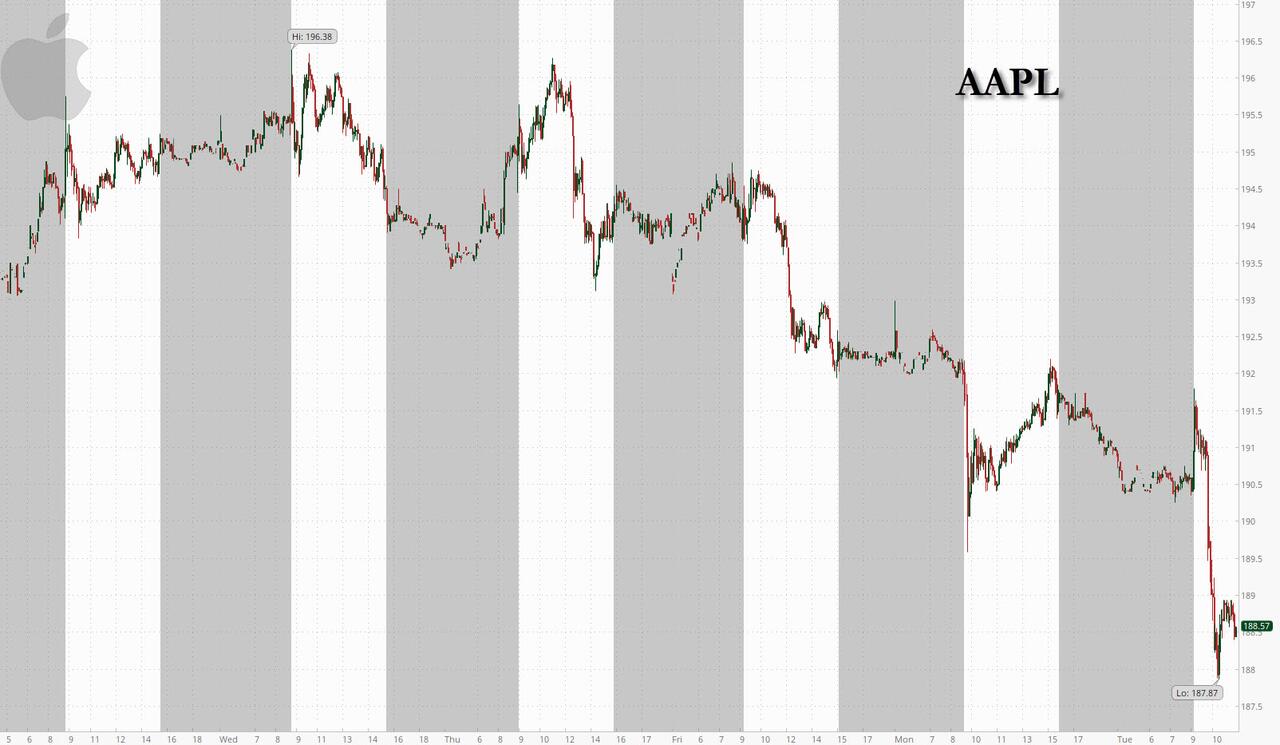
Apple stock, which on any given day is either the most or 2nd most valuable company in the world, rotating with MSFT, reversed earlier gains and slumped to session lows after widely-read TF International Securities analyst Ming-Chi Kuo (best known for gathering intelligence from his contacts in Apple’s Asian supply chain) reported that Apple has lowered its 2024 iPhone shipments of key upstream semiconductor components to about 200 million units, which correspondents to a decline of 15% year-on-year.

As a result, he notes that iPhone 15 series and new iPhone 16 series shipments will decline by 10–15% year-on-year in 1H 2024 and 2H 2024, respectively (compared to iPhone 14 series shipments in 1H 2023 and iPhone 15 series shipments in 2H 2023, respectively). Even worse, Apple’s weekly shipments in China have declined by 30–40% year-on-year in recent weeks, and this downward trend is expected to continue.

From the highly critical note:

  • My latest supply chain survey indicates that Apple has lowered its 2024 iPhone shipments of key upstream semiconductor components to about 200 million units (down 15% YoY). Apple may have the most significant decline among the major global mobile phone brands in 2024.
  • iPhone 15 series and new iPhone 16 series shipments will decline by 10–15% YoY in 1H24 and 2H24, respectively (compared to iPhone 14 series shipments in 1H23 and iPhone 15 series shipments in 2H23, respectively).
  • The iPhone faces structural challenges that will lead to a significant decline in shipments in 2024, including the emergence of a new paradigm in high-end mobile phone design and the continued decline in shipments in the Chinese market.
  • The new high-end mobile phone design paradigm includes AI (GenAI) and foldable phones. The main reason for the decline in the Chinese market is the return of Huawei and the increasing preference for foldable phones among high-end users as their first choice for phone replacement.
  • Benefiting from the higher-than-expected demand due to the high integration of GenAI functions, Samsung has revised up the shipments of the Galaxy S24 series in 2024 by 5–10%, while Apple has revised down the shipment forecast of iPhone 15 in 1H24.
  • Apple’s weekly shipments in China have declined by 30–40% YoY in recent weeks, and this downward trend is expected to continue. The main reason for the decline is the return of Huawei and the fact that foldable phones have gradually become the first choice for high-end users in the Chinese market.
  • It is expected that Apple will not launch new iPhone models with significant design changes and the more comprehensive/differentiated GenAI ecosystem/applications until 2025 at the earliest. Until then, it will likely harm Apple’s iPhone shipment momentum and ecosystem growth

Apple has yet to comment on the report (it probably won’t until it reports earnings), but the market is not too happy and AAPL stock is sliding…

… dragging the Nasdaq to session lows…

… with just hours to go until MSFT and GOOGL are set to launch the gigacap tech earnings season after the close today.

Tyler Durden
Tue, 01/30/2024 – 12:23

via ZeroHedge News https://ift.tt/6jHDe7m Tyler Durden

‘Moment Of No Return’ Imminent As Biden Has ‘Decided’ On Response, Says Iran Supplied Weapons Used In Attacks

‘Moment Of No Return’ Imminent As Biden Has ‘Decided’ On Response, Says Iran Supplied Weapons Used In Attacks

A “decision” has been made, apparently, with CBS reporting: “Biden tells reporters that he has decided on how to respond to the attack that killed US troops in Jordan.” And Sky News writes, ‘Moment of no return approaching’ as Biden weighs retaliation for soldier deaths.

Additionally, Biden said the White House sees Iran as responsible for supplying the weapons used in the drone strike on the Tower 22 base along the Jordan-Syria border, an attack which also saw over 40 American troops injured.

Image source: Eyepress Images

Admin officials have repeatedly asserted they do not seek wider war with Iran, even while direct accusations fly against Tehran, and there’s talk of military ‘options’ and warlike threats go over the airwaves.

because “pressure,” writes Bloomberg: “US President Joe Biden faces intensifying pressure to confront Iran directly after the country’s proxies killed three American soldiers in a drone strike in Jordan over the weekend, risking precisely the wider regional conflict that he’s trying to avoid.”

“A person familiar with the US position, who asked not to be identified discussing private discussions, said it was clear that a strike — which also wounded at least 34 — would force a stronger response than what the US has done so far in the weeks,” continues Bloomberg.

Currently, the reporting consensus seems to be that Biden will order major strikes against various Iranian ‘proxy’ positions especially in Iraq and Syria. In the immediate aftermath of the Sunday drone attack on the US Tower 22 base, there were reports that Iran-aligned militias were temporarily evacuating bases in the region.

Biden on the White House lawn Tuesday: “I do hold them [Iran] responsible in the sense that…

US and coalition forces could at the same time launch another major round of airstrikes against Houthi positions in Yemen, amid continued targeting of Red Sea shipping.

The only question that remains is timing… when will the bombs fly? At this point it’s a certainty. A proverbial “moment of no return” is fast approaching. Historians could look back on this pivotal moment and see it as the point at which the Gaza war spiraled into a broader Middle East enduring conflict.

Tragic as any loss of American life is, one regional analyst points out the following sure to be unpopular truth…

If you’re a superpower that can’t suffer an average rate of one dead soldier per 38 days of intense regional conflict without behaving like you’ve arrived at a 9/11-type decision point, maybe massive military entanglements in the Middle East are not for you?

Meanwhile, Iranian Foreign Ministry spokesman Nasser Kanaani has denied that Tehran was behind the drone strike and killing of Americans: “As we have clearly stated before, the resistance groups in the region are responding [to] the war crimes and genocide of the child-killing Zionist regime and… they do not take orders from the Islamic Republic of Iran,” he said.

He further asserted: “These groups decide and act based on their own principles and priorities as well as the interests of their country and people.”

* * *

Below is some commentary on the ‘dilemma’ from Rabobank…

Let’s then start Blinken – which is that the US is doing when the US Secretary of State states, “The response against Iran could be multi-levelled and come in stages and be sustained over time.” Operation Praying Mantis, where the US sank half the Iranian fleet in a day in the 1980s, it won’t be: Operation Praying Man, ‘tis. Because while the White House counts its dead, injured and loss of deterrence at the hands of Iran-backed forces –as Tehran says it didn’t do it– it’s also counting the cost of a war that would not only not be over by the 2024 election, where higher oil prices would likely mean Biden loses, but might still be going on in 2028.

Markets will therefore be relieved as Bloomberg, both accurately and ridiculously, says the US aims to find a way to bomb Iran just enough to show it’s angry without doing real damage – so ‘politesse’, not real politics. But risks remain: bomb too much – war; bomb too little – more Iran pushback until we trigger that same war; and it’s not clear if there is a sweet-spot between the two.

Tyler Durden
Tue, 01/30/2024 – 12:05

via ZeroHedge News https://ift.tt/WJIhOr6 Tyler Durden

US EV Sales Climbed 29% In Q4

US EV Sales Climbed 29% In Q4

By Charles Kennedy of OilPrice.com

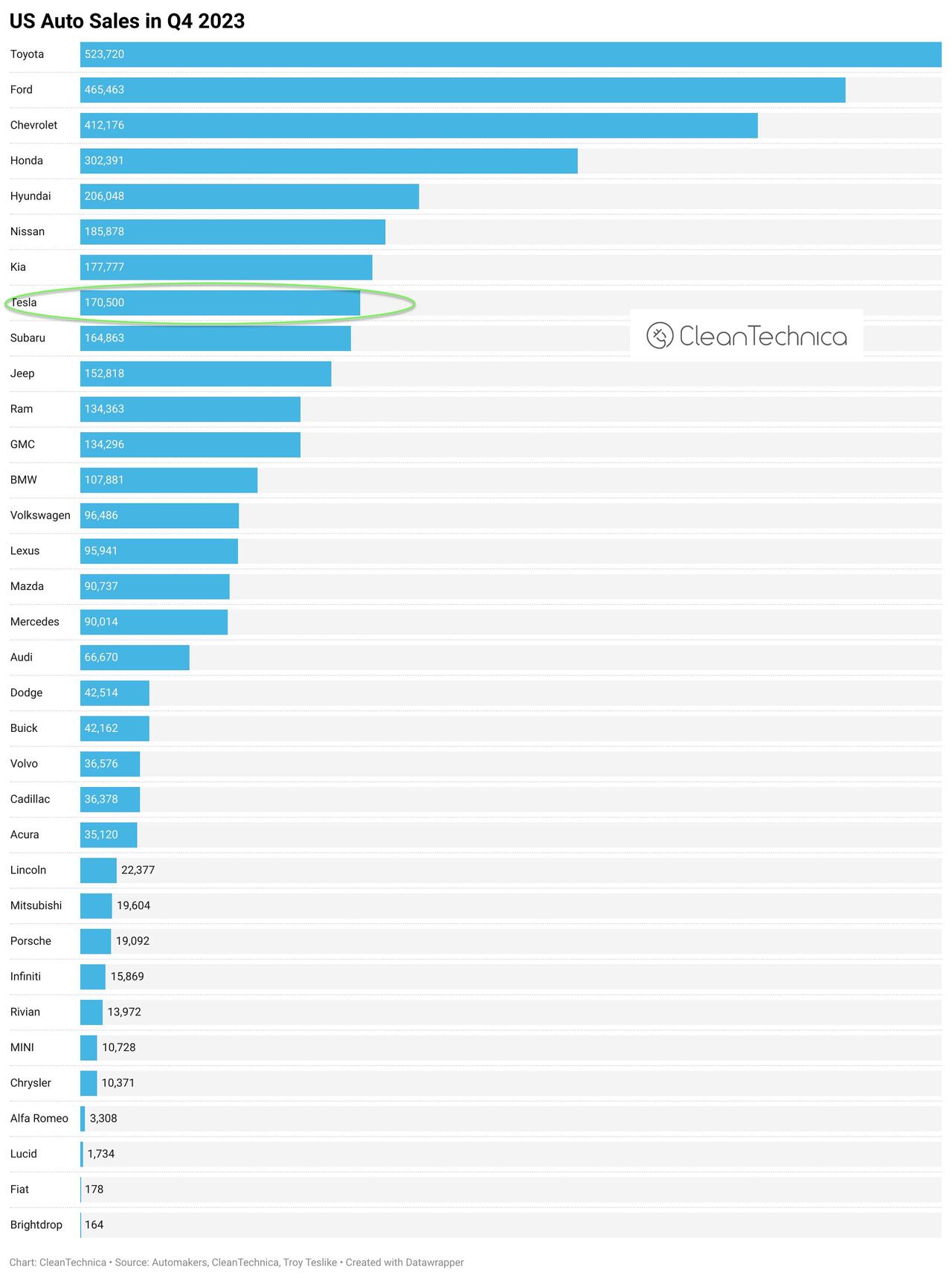
Plug-in electric vehicle sales in the United States rose by an annual 29% in the fourth quarter of the year, within the context of a much more moderate total car sales increase of 8%, Clean Technica reported.

Tesla, the biggest EV seller, ranked eighth on a list that saw Toyota at the top with close to 524,000 cars sold during the quarter, followed by Ford, Chevrolet, Honda, and Hyundai completing the top five.

The report suggests 2023 was a strong year for EVs in the United States, following an earlier report with annual sales data from Cox Automotive that said EV sales in the country had reached 1.2 million last year.

This boosted the share of electric vehicles to 7.6% of the total car market but Cox Automotive added that there has been a clear slowdown in demand for EVs, even as Clean Technica said “Don’t believe all the EV anti-hype.”

Cox Automotive, meanwhile, noted that EVs have yet to reach price parity with internal combustion engine vehicles and this was looking increasingly possible over the next few years—thanks to a selection of subsidies—but for now EVs remained quite expensive.

A recent InsideEVs report on November EV sales in the United States confirmed the slowdown in sales growth. Citing data from S&P Global Mobility, the report said that total battery electric vehicle sales in November stood at 89,527, which was a 30% annual increase, it only represented a 1.2% increase in market share—to 7.7% from 6.5% a year earlier.

That report noted that Tesla had registered a relatively modest increase in sales during the penultimate month of the year while other EV makers had seen double-digit sales growth, including Ford, with 21% higher sales in November than a year earlier. Kia and Hyundai saw a twofold increase in their EV sales in the U.S. in November.

Tyler Durden
Tue, 01/30/2024 – 11:45

via ZeroHedge News https://ift.tt/tgKpuFl Tyler Durden

A “Plan B” with an incredible view

Imagine waking up on a tropical mountain setting as the sun rises over the valley below.

You take a dip in your infinity pool before eating a breakfast complimented by fresh mango and papaya from your own garden. And the beans for your morning coffee came from a farm just down the road.

You could spend the day surfing. Or you might drive ten minutes into town to meet up with the American and British expat community that hangs out at a local bar.

During this visit, you’re relaxing on a two-week vacation. But you were especially grateful to own this home during the pandemic, when you and your family escaped here for several months to work remotely and wait out the insanity.

It’s fortunate that you had applied for legal residency a few years before, which gave you the right to enter the country, even when most governments closed their borders to tourists in 2020.

And when the time for retirement comes in a few years, the low cost of living here will help stretch your fixed income.

Is this an idyllic vacation home or a Plan B?

It’s both.

Quite often people start by traveling abroad somewhere and finding a place that they really, really enjoy spending time. At first it might just be a few days, then a few weeks.

But after several trips, they start looking at the real estate market… then eventually pull the trigger after finding an idyllic property that fits their needs.

Initially they might only use it as an occasional vacation home for a few weeks each year, renting it out to other tourists the rest of the time to generate a decent income stream.

But as the years go by and the world starts to become even more bizarre and conflict-prone, they start spending more and more time there, just to escape the madness.

Ultimately, they realize that, if things ever got truly crazy back home, they could always come here to their private safe haven. And just knowing that they have that option gives tremendous peace of mind.

This is just one way to look at a Plan B, and it’s not exactly radical or drastic. The idea is to start with something that you really enjoy… and then grow from there.

If you really like a particular destination, there’s no downside in cultivating roots there, buying a really nice, undervalued property that you love, or going through the process to establish legal residency.

Legal residency is great, because it means that you have the right to go to that country and stay indefinitely, even under extreme circumstances like COVID.

This is different from being a tourist, where you can be shut out of a country… and be limited in how long you can stay.

(Having legal residency in a foreign country also makes things a lot easier if you ever want to open a local bank account, buy a car, obtain a driver’s license, etc.)

Each country has its own residency rules. Some places are notoriously difficult to obtain residency— like the United States unless you walk across the southern border.

But most places have fairly simple requirements, and a number of countries have set up specific programs to attract foreigners who might be willing to spend some money in the country and/or buy property.

In Panama, for example, you can obtain residency by purchasing real estate for roughly $300,000. And that money goes a long way in Panama, where there’s plenty of quality property for sale between $100 and $200 per square foot.

In Mexico, you don’t even have to purchase a property to obtain legal residency; you just must prove that your income or savings meets a modest threshold.

These are just a few examples; we have a ton of other research on our website since everyone has his/her own desires and priorities.

For some, their Plan B might be a remote farm on the South Island of New Zealand. For others, a chic condo in the city center of Lisbon. And for others, a beachfront villa in Latin America or the Far East.

The world is an enormous place, and it’s full of options. Most likely there are several out there which could work for you.

Again, what we’re talking about here is not exactly a radical idea.

It’s hardly controversial to assert that there is a lot of conflict in the world… and way too many Inspired Idiots running the show.

We’ve mapped out how, in the United States for example, the government’s own baseline forecast for the next ten years estimates $20+ trillion in NEW debt. There will be consequences galore from this debt explosion.

But as we wrote yesterday, it’s not just about the dollar and the financial consequences. It’s also about personal risks stemming from ‘mostly peaceful’ protests, political clashes, culture wars, or even an actual shooting war.

These aren’t exactly long-shot risks anymore, and any rational, thinking person ought to be considering a backup plan.

Having a second residency is a great insurance policy to protect against those sorts of personal risks.

And if you choose wisely, i.e. select a place where you actually enjoy, it’s hard to imagine there’s any downside in having an additional place to go.

Source

from Schiff Sovereign https://ift.tt/7bPiFog
via IFTTT

The 2 Reasons California’s YIMBY Reforms Are Failing


Los Angeles skyline | Choneschones/Dreamstime.com

Happy Tuesday! This week’s Rent Free includes:

  • An Ohio Church countersues the city criminally charging its pastor with zoning violations.
  • Vancouver, British Columbia, approves another indigenous-owned megaproject.
  • A new report shows that America’s housing affordability problems are getting worse and spreading to more areas of the country.

But first, our lead story on the one California zoning reform that’s working out really well, and why all the others haven’t been nearly as productive.


Why Is California’s Building Boom Limited to ADUs?

California YIMBY, one of the OG YIMBY groups that advocate for zoning reform in California, has released a new report heralding the building boom kicked off by an accessory dwelling unit (ADU) reform.

Since the California Legislature got serious about eliminating local restrictions on granny flats, in-law suites, and the like in 2016, ADU production has increased by 15,000 percent. In 2022, they made up a quarter of California’s housing production, according to the report.

It’s truly a YIMBY success story. The sad fact is that it might be California’s only major YIMBY success story.

Since 2016, the California Legislature has passed dozens of bills that remove regulatory barriers to housing production. And since 2016, overall housing production has increased only modestly, according to permitting data from the state Department of Housing and Community Development (HCD). When ADUs are subtracted from the mix, permitting activity has more or less flatlined.

The state is permitting about as much housing today as it was in the 1990s, and much less than it was in the 1980s or early 2000s, according to U.S. Census Bureau numbers. (It is at least producing more than the recession-ravaged early 2010s.)

Meanwhile, indicators of the state’s housing shortage—including the ratio of rents and home prices to incomes, the percentage of cost-burdened households, measures of housing underproduction, and homelessness rates—are all flashing red.

So, what’s going on? Why haven’t other YIMBY housing laws kicked off a boom in new duplexes and transit-adjacent apartments as they have with ADUs?

I’d boil it down to two basic problems. Firstly, many YIMBY reforms have focused on handing down better bureaucratic mandates to local governments who have no interest in reforming their own housing laws. Secondly, the Legislature lards down what could be productive housing laws with endless interest group carveouts and handouts.

State Orders, Local Controls

On paper, California does have an elaborate, decades-old system requiring local governments to plan for more housing called Regional Housing Needs Assessment (RHNA).

The state hands down housing production goals to localities. Localities then produce plans called housing elements to meet those goals. Housing elements identify sites where new housing will be allowed, and outline the regulatory “constraints” on new construction localities will eliminate.

For a long time, RHNA was kind of a joke. A major focus of YIMBY reforms has been on improving the once-useless system.

New laws try to make state production goals reflect actual market demand, and ensure housing elements more realistically plan for growth. State bureaucrats more closely vet local housing elements. New state enforcement units are putting pressure on local governments to follow through with removing regulatory constraints.

The hope is that a souped-up RHNA will make all of California’s local governments more accommodating of new housing.

RHNA’s approach is premised on the idea that localities won’t do this on their own. The problem is even a souped-up RHNA still leaves them in the driver’s seat.

The state might review and certify housing elements, but localities are still the ones responsible for writing them, implementing them, and then approving individual housing projects. That leaves plenty of wiggle room for localities to loosen constraints on housing construction on paper while maintaining them in practice.

The state can theoretically strip localities out of “substantial compliance” with state housing law of state grants, force them to allow “builder’s remedy”  projects, or even petition a court to rewrite their housing element.

For all the excitement about “builder’s remedy” projects, none have actually been approved. Local governments have proven pretty adept at blocking them or forcing the developer to settle for a smaller project.

Outside the few communities purposefully thumbing their nose at the state, there’s also a  lot of legal uncertainty about when jurisdictions are actually out of “substantial compliance” with state housing law and thus subject to state remedies.

San Francisco was arguably still substantially compliant with state housing law last year when it was dragging its feet on passing reforms the state was telling the city it needed to adopt in order to meet its RHNA goals.

If the remedies for floating RHNA don’t clearly apply to San Francisco—the subject of a scathing state audit finding the city takes over three years to approve housing projects—that suggests even a reformed RHNA is kind of toothless.

Pork Barrels Full of Poison Pills

Even when the California Legislature does try to pass direct reforms forcing local governments to allow certain types of housing projects, interest group wrangling in the Legislature often ensures these bills don’t produce many new units.

New housing is a valuable thing. The groups that are in a position to say no to it aren’t keen on giving away their veto for free. As a result, state bills allowing builders to route around local zoning standards or skip environmental review end up getting loaded down with all sorts of carve-outs and poison pills.

To appease unions, state-streamlined projects have to pay union wages. To appease environmentalists, they have to be built to the highest green design standards. To appease tenant advocates, they can’t replace existing rental housing. To appease affordability advocates, they need to include money-losing affordable units. To appease NIMBYs, these projects can only go in certain areas and exceed local density caps by only so much.

At a certain point, all these special interest handouts end up eating up the value of whatever regulatory relief state law offers. When higher construction and financing costs are already putting serious headwinds on construction, these handouts are proving particularly fatal to new development.

What is to be done?

According to the California YIMBY report, ADU reform was a success because it set clear, permissive statewide standards that were binding on local governments and easy for builders to comply with.

The state should do that with all types of housing. Instead of relying on the “rickety and complicated conveyor belt” that is RHNA to hand down planning targets that local governments then try to skirt at the risk of potentially severe but legally uncertain penalties, the state could just tell local governments they have to approve certain types of housing.

And when the state does pass laws telling local governments to approve certain types of housing, those laws should come without a bunch of cost-increasing labor, affordability, and environmental provisions. Better yet, the state could directly permit housing projects without the need to trouble NIMBY local governments at all.

These are of course useless prescriptions in the same way that it’s kind of useless to say the way to lose weight is to diet and exercise. It’s no secret what the state’s problems are or what effective solutions would be.

Many YIMBY reforms keep underperforming because passing clean, effective reforms is politically impractical.

The California YIMBY report stresses that even with ADUs, housing reform is a process. It took over 30 years of marginal tweaks and fixes to get the state’s ADU laws working right. The same will likely be true for other YIMBY zoning reforms.

The trouble is that California doesn’t have 30 years to get housing policy right. Its problems are too immediate and too severe.

I’m not sure what could be done to speed up the process of reform.

Perhaps YIMBY lawmakers should gamble on politically riskier, but more impactful bills. Fewer will pass, but the ones that do will have a greater impact.

California also has a ballot initiative process that can allegedly be used to route around a special interest-captured legislature. YIMBYs haven’t really used it but they should. Offer up a ballot initiative legalizing 10-unit market-rate apartments on all residential land with no setbacks, parking requirements, impact fees, or prevailing wage mandates and see if voters go for it.

Maybe that won’t work, but the current pace of reform isn’t working either.


Ohio Church Sues City Criminally Charging Its Pastor for Zoning Violations

Last week at Rent Free we covered the case of Chris Avell, the pastor of Dad’s Place in Bryan, Ohio who’d been criminally charged with 18 violations of the city’s zoning code. The charges stem from Dad’s Place’s decision to stay open 24 hours a day and let people sleep in the church building.

In response, the church has filed a federal lawsuit against the city of Bryan and individual town officials. The church’s lawsuit argues that the city’s zoning crackdown violates the First Amendment’s religious liberty guarantees and federal law limiting the kinds of zoning restrictions states and localities can apply to churches.


Another Indigenous-Owned Mega-Project Approved in Vancouver

This week, the Vancouver City Council gave initial approval to the massive 13.5 million square foot, 13,000-unit Jericho Lands project. The development is being sponsored by MST Development Corporation, a for-profit consortium of the Musqueam Indian Band, Squamish Nation, and Tsleil-Waututh Nation.

It’s not the first indigenous-owned mega-project in the Vancouver area. The 6,000-unit Senakw project being built on Squamish reserve land has made headlines for its size and the fact its location on reserve land means it doesn’t have to comply with Vancouver’s zoning laws.

The Jericho Lands project, which will redevelop a former military base, did have to get the city’s approval. That didn’t end up being an obstacle.


New Report Shows America’s Housing Affordability Problems Widening, Deepening

A new report from Harvard’s Joint Center for Housing Studies finds that the median sale price for a single-family home was 5.6 times greater than the median income. That’s the highest ratio price-to-income ratio on record.

Coastal California remains the worst place for housing affordability, with almost all coastal metros posting price-to-income ratios above 10. Ratios nearly as high are popping up across the Mountain West, coastal Florida, and the mid-Atlantic.

This is a new development. “Price-to-income ratios that low were the norm across much of the country in prior decades. Indeed, fully two-thirds of large markets had price-to-income ratios below 3.0 as recently as 2000,” reads the report.


Quick Links

  • Montgomery County, Maryland, is considering a proposal to let religious institutions build affordable housing on their land. A number of states and cities have passed similar “Yes In God’s Backyard” laws.
  • Virginia might be the next state to replicate California’s ADU building boom. A bill in the Virginia Legislature would require localities to allow ADUs on residential land. Encouragingly, the bill forbids local parking requirements, high-impact fees, and separate utility hookups.
  • Yet another church is coming under fire from local zoning officials for letting people sleep inside.
  • The U.S. Supreme Court decided to not take up a challenge to a Seattle policy prohibiting landlords from checking rental applicants’s criminal history.
  • St. Paul is considering further tweaks to its disastrous rent control policy.
  • It turns out the real solution to high housing costs isn’t zoning reform, it’s purchasing land in the path of regular lava flows.
  • Gainesville, Florida, is taking one step forward, one step back approach to housing affordability. Its city council is considering both minimum lot size reform (which would make starter homes easier to build) and an inclusionary zoning policy (which requires builders to include money-losing units in their projects.)
  • “We really need to lean into property rights,” said Colorado Gov. Jared Polis to Colorado Public Radio on his approach to housing reform.
  • Baltimore, Maryland, revives its inclusionary zoning law.

Regulation of the Week

Portland requires people to get tree permits when removing trees on their property as well as public “street trees” in the right-of-way. The city isn’t waiving this requirement for trees that have already been blown onto people’s homes by recent winter storms.


The post The 2 Reasons California's YIMBY Reforms Are Failing appeared first on Reason.com.

from Latest https://ift.tt/hbfjy6X
via IFTTT
In Shocking Reversal, Saudi State Unexpectedly Orders Aramco To Drop Oil Capacity Expansion Plans

In Shocking Reversal, Saudi State Unexpectedly Orders Aramco To Drop Oil Capacity Expansion Plans

Oil traders were stunned this morning, when – in a huge reversal to its prior plans – the Saudi state ordered Aramco to stop work on expanding its maximum sustainable capacity to 13 million barrels daily, instead keeping it at 12 million bpd, ensuring that peak capacity will remain lower than projected rising demand for years to come, effectively pressuring oil prices much higher over the long run (unless of course the world figures out cold fusion in the next few years).

The company said in a statement today that its maximum sustainable capacity is determined by the state under a law from 2017. Aramco added that it would update its capital spending plans for the year in accordance with the new government directive in March when it announces its 2023 financial results.

Saudi Arabia currently has capacity for 12 million and is producing about 9 million a day, after it curbed output as part of OPEC+ efforts to revive the global oil market and prevent a surplus. Back in 2021, Saudi Arabia’s state oil company said it was working to boost its production capacity to 13 million barrels daily, a capacity expansion it predicted would come fully online by 2027 and in chunks, chief executive Amin Nasser said at the time.

The surprise move comes after the world’s biggest oil exporter had said in November that it was progressing “very well” with the multibillion-dollar project to boost capacity to 13 million barrels a day by 2027 as demand in China and India continues to grow.

The Saudi giant, the world’s biggest oil firm and the largest oil exporter globally, was working as fast as it could to reach that production capacity expansion, the executive said, noting that upstream investment has a long lead time.

According to Bloomberg, the change in the investment plan ordered by the Saudi government comes at a time when Aramco has significantly increased dividend payments to the state, its primary owner. The kingdom is running a fiscal deficit as it spends tens of billions of dollars on efforts to diversify the economy into areas such as sports and tourism.

The decision will take out a significant portion of the supply buffer that traders were expecting for later this decade, a gap that may be hard to fill by others. Maintaining additional spare capacity is expensive, especially when the country is already producing well below its maximum rate and demand growth is likely to slow with the energy transition.    

Ironically, Aramco’s CEO has often warned the market that the industry is underinvesting in new oil supply, which, regardless of many scenarios, will continue to be needed for decades. Well, as of today the biggest underinvestor is none other than Aramco, whose move is seen as either a draconian attempt to contain supply capacity in the face of growing Indian and Chinese demand, or – according to the bears – a signal that said demand will simply not materialize.

There is likely to be much speculation on the potential implications on global oil demand over the medium and long term,” RBC Capital Markets analyst Biraj Borkhataria said in a note. “This also marks a change in tone from one of the world’s largest oil producers at the government level.”

Borkhataria also expects the capex budget to be lowered by about $5b per year over the coming years relative to the prior guidance. Aramco will update its capital spending guidance when it announces annual results in March.

To be sure, despite extended and sizeable production cuts effected by Saudi Arabia and some of its fellow OPEC+ members, prices have remained stubbornly range-bound. This may be the reason for the new order. Alternatively, as noted above, the long-term outlook for oil demand in Riyadh may have changed.

Oil prices inched higher this week, following the latest news from the Middle East, which included a fuel tanker attack by the Yemeni Houthis and a deadly drone attack on U.S. troops. However, their gains were pared after the latest drop in Chinese stocks dented hopes that Beijing was finally getting serious about kickstarting its imploding market and economy.

The Saudi announcement will add to the list of uncertainties confronting traders. There’s no sign to the end of Israel’s war on Hamas, Houthi militants are menacing global shipping in the Red Sea, and there’s an increasing risk of Iran being dragged into the wider turmoil in the region.

Saudi Arabia’s latest move will likely have long term implications for the oil market. Curbing its growth plans would leave the kingdom with a thinner production buffer in the future in the event of supply shocks, especially in a volatile Middle East. Overall, it guarantees not only a much more volatile price but a much higher one as well, especially once the current production thrust (driven by relentless M&A) by US shale finally peaks.

European and Saudi drilling services stocks tumbled after the news of the Saudi expansion halt: Saudi-based Arabian Drilling and Ades Holding each fall as much as 10%, the most since their respective IPOs; both count Aramco among their main customers.  In Europe, Saipem shares lose as much as 9.3; %Subsea 7 -4.4%; Borr Drilling -11%; Shelf Drilling -10%.

Tyler Durden
Tue, 01/30/2024 – 11:25

via ZeroHedge News https://ift.tt/EyGSRHJ Tyler Durden

Hunter Biden Partner Says Payments From China Were Delayed Until Joe Biden Left Office

Hunter Biden Partner Says Payments From China Were Delayed Until Joe Biden Left Office

Authored by Zachary Stieber via The Epoch Times (emphasis ours),

A former partner of President Joe Biden’s son has told members of Congress that members of the Biden family were not paid by China until after the Obama administration ended.

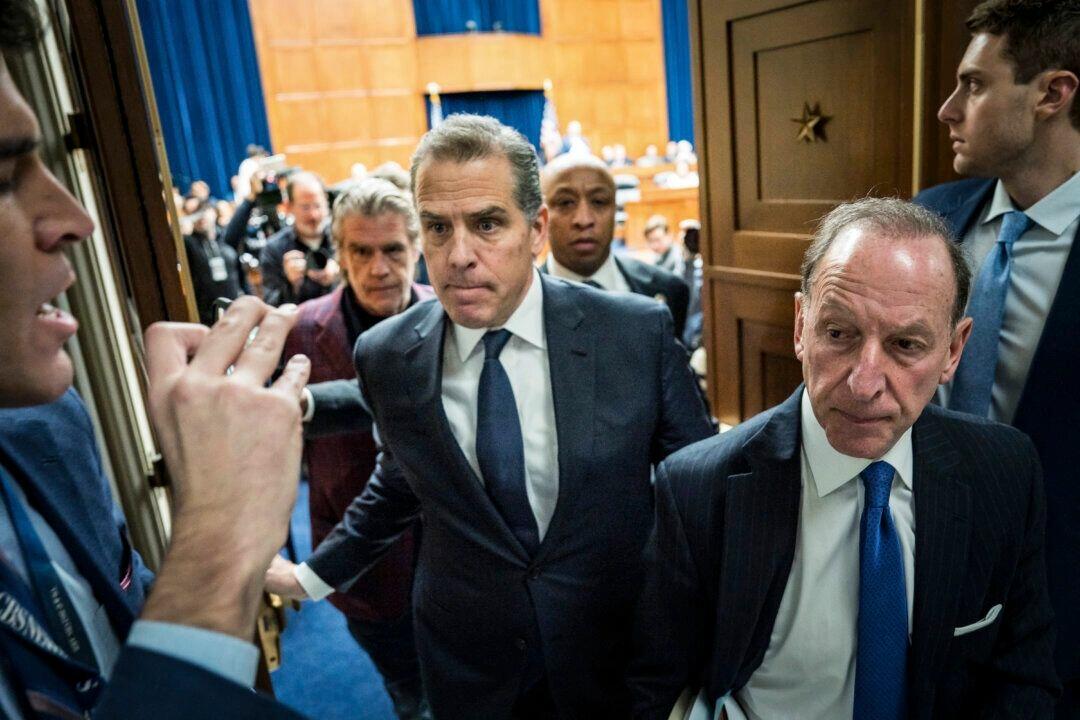
WASHINGTON, DC – JANUARY 10: Hunter Biden (C), son of U.S. President Joe Biden, and his lawyer Abbe Lowell (R) depart a House Oversight Committee meeting at Capitol Hill on January 10, 2024 in Washington, DC. The committee is meeting today as it considers citing him for Contempt of Congress. (Photo by Kent Nishimura/Getty Images)

Hunter Biden and associates started working with CEFC, a Chinese firm linked to the ruling communist party, in 2015.

But payments for the work did not start flowing until after President Biden in January 2017 departed as vice president, Rob Walker, the former partner of Hunter Biden, was said to have told members.

“Today’s interview confirmed Hunter Biden and his associates’ work with the Chinese government-linked energy company began over a year before Joe Biden left the vice presidency, but the Bidens and their associates held off being paid by the Chinese while Joe Biden was in office,” Rep. James Comer (R-Ky.), chairman of the U.S. House of Representatives Oversight Committee, said in a Jan. 26 statement.

President Biden was vice president from 2009 to 2017.

Mr. Walker, who testified behind closed doors, could not be reached.

In a prepared opening statement, Mr. Walker said that he spent years pursuing “legitimate business” with Mr. Biden and that President Biden “was never involved in any of the business activities we pursued.”

Hunter made sure there was always a clear boundary between any business and his father,” Mr. Walker said.

The White House said that Mr. Walker’s testimony had refuted Republican claims about President Biden.

Rep. Jamie Raskin (D-Md.), ranking member of the House Oversight Committee, said that “Mr. Walker reaffirmed today what we already know by now: Joe Biden was not involved in, did not profit from, and took no official actions in relation to his family’s business dealings.”

Republicans in the House are interviewing former associates of Mr. Biden as part of an impeachment inquiry. Mr. Biden has not yet sat for questions in the probe.

Mr. Walker told FBI agents in 2020 that President Biden stopped in while Mr. Walker, Mr. Biden, and Chinese businessmen were eating lunch at the Four Seasons, according to a transcript given to Congress by IRS whistleblowers. Mr. Walker also said President Biden met with CEFC officials while still vice president.

The interview with Mr. Walker confirmed that the meeting happened, Mr. Comer said in a summary. A transcript of the interview is expected to be released at a later date.

Shortly after the Obama administration ended, a Chinese company paid Mr. Biden and associates $3 million “as a ‘thank you’ for the work they did while Joe Biden was in office,” Mr. Comer added. “Members of the Biden family received payments from the Chinese deal even though they did not work on it. This is the type of swampy influence peddling the American people want us to end.”

A spokesman for Mr. Comer did not respond when asked for more details about what Mr. Walker told members.

According to records obtained by Republicans that were released before, the $3 million payment came from State Energy HK Limited, a CEFC-linked company, in March 2017.

Of the $3 million, about $1 million was transferred to different bank accounts owned by Bidens, including accounts owned by Mr. Biden and Hallie Biden, Mr. Biden’s sister-in-law, the records show.

Mr. Biden sent some of the money to President Biden’s brother, and the president’s brother and his wife sent a portion of the funds to President Biden, labeling the payment as a loan repayment, according to a timeline compiled by Republicans.

The White House and an attorney for the president’s brother have defended the money transfers, saying they were legal.

Devon Archer, a former associate of Mr. Biden, told Congress in 2023 that President Biden joined multiple calls and meetings that involved foreign business persons, including Chinese ones, although he maintained business was not discussed in President Biden’s presence.

In messages given to the FBI by Tony Bobulinski, another former associate of Mr. Hunter Biden, and made public by the group Marco Polo, Mr. Biden referred to his father as “chairman,” according to Mr. Walker. Mr. Biden wrote at one point that “my chairman gave an emphatic NO” on a business proposal.

In another set of emails obtained by House Republicans, during a discussion in 2017 of who would receive money from the CEFC deal, one associate wrote, “10 held by H for the big guy?” Mr. Bobulinski said the “big guy” referred to President Biden. Another former associate wrote to Mr. Bobulinski in a message a week later, “don’t mention Joe being involved,” adding, “it’s only when u are face to face, I know u know that but they are paranoid.”

Tyler Durden
Tue, 01/30/2024 – 11:05

via ZeroHedge News https://ift.tt/LyTaM0u Tyler Durden

Job Opening Unexpectedly Rebound Over 9 Million Even As Number Of Workers Quitting Their Job Plummets

Job Opening Unexpectedly Rebound Over 9 Million Even As Number Of Workers Quitting Their Job Plummets

After declines in job openings accelerated in the latter months of 2023, prompting economists to pat themselves on the back for predicting a soft landing and validating their expectations for Fed rate cuts, moments ago the BLS came out and spoiled the big picture when – instead of doing the market’s bidding it confirmed that it responds first and foremost to the Biden admin’s political demands – it reported that in December job openings unexpectedly rose, raising the specter of a hard landing (how can the Fed cut rates when job openings are once again rising).

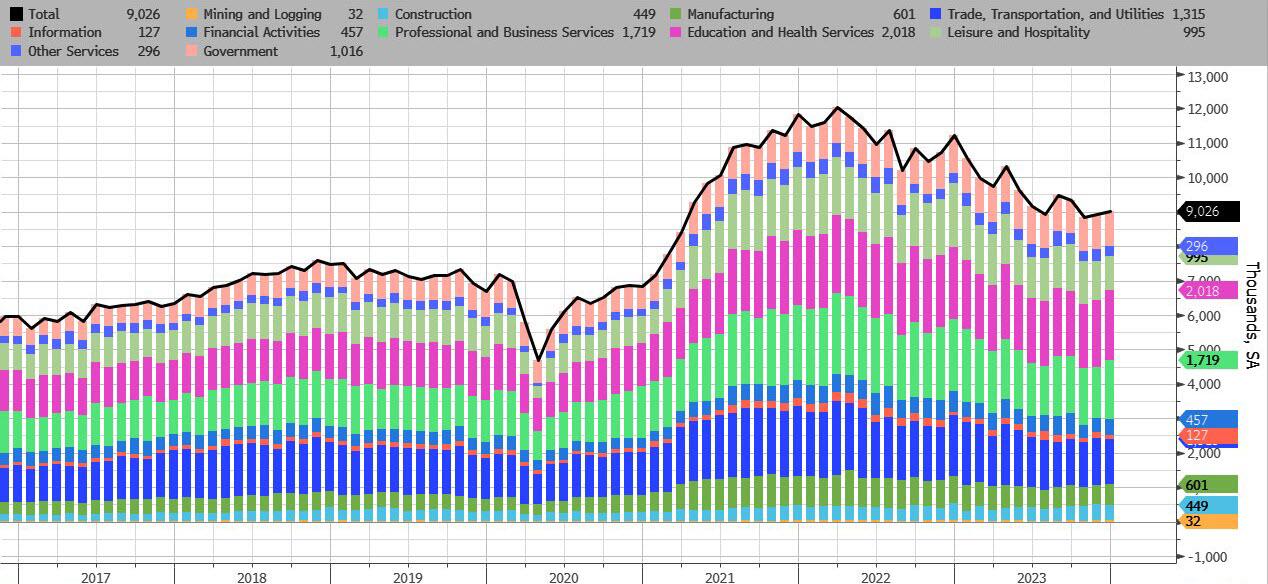
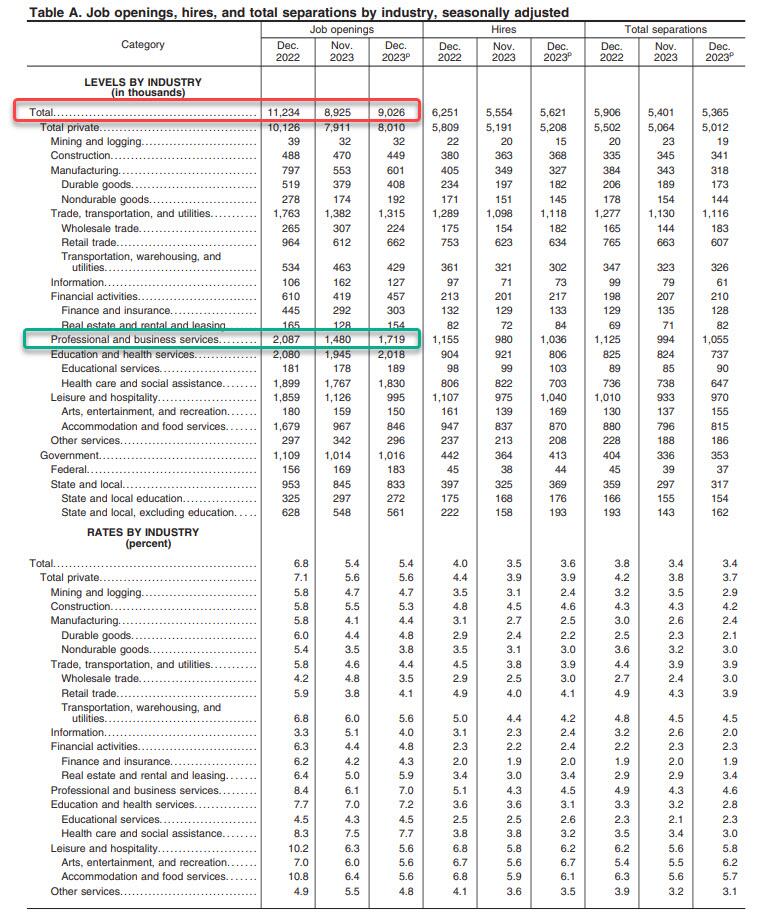
According to the Biden’s Labor Department, in December the number of job openings unexpectedly rose 101K in December to 9.026MM from an upward revised 8.925MM, meaning that the November print was not the lowest in three years as reported last month but was actually an improvement from October.

According to the BLS, in November job openings increased in professional and business services (+239,000) but decreased in wholesale trade (-83,000).

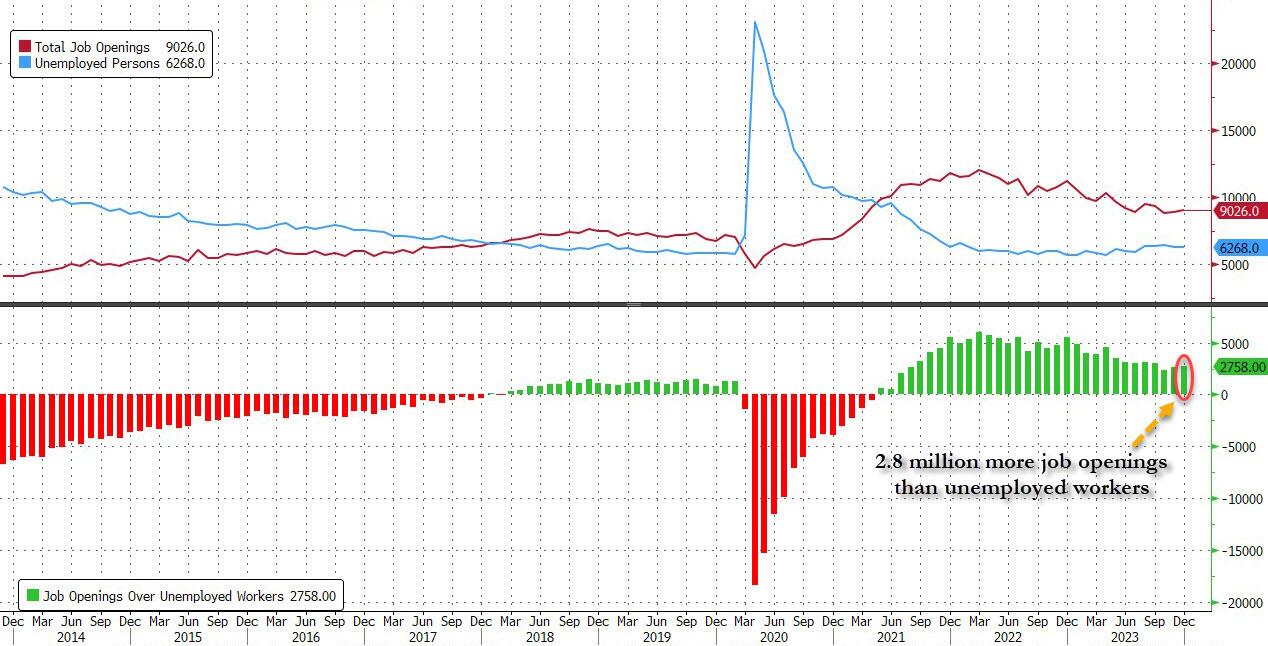
The modest increase in the number of job openings meant that in December, the number of job openings was 2.758 million more than the number of unemployed workers (which the BLS reported was 6.268 million), up modestly from last month’s 2.662 million.

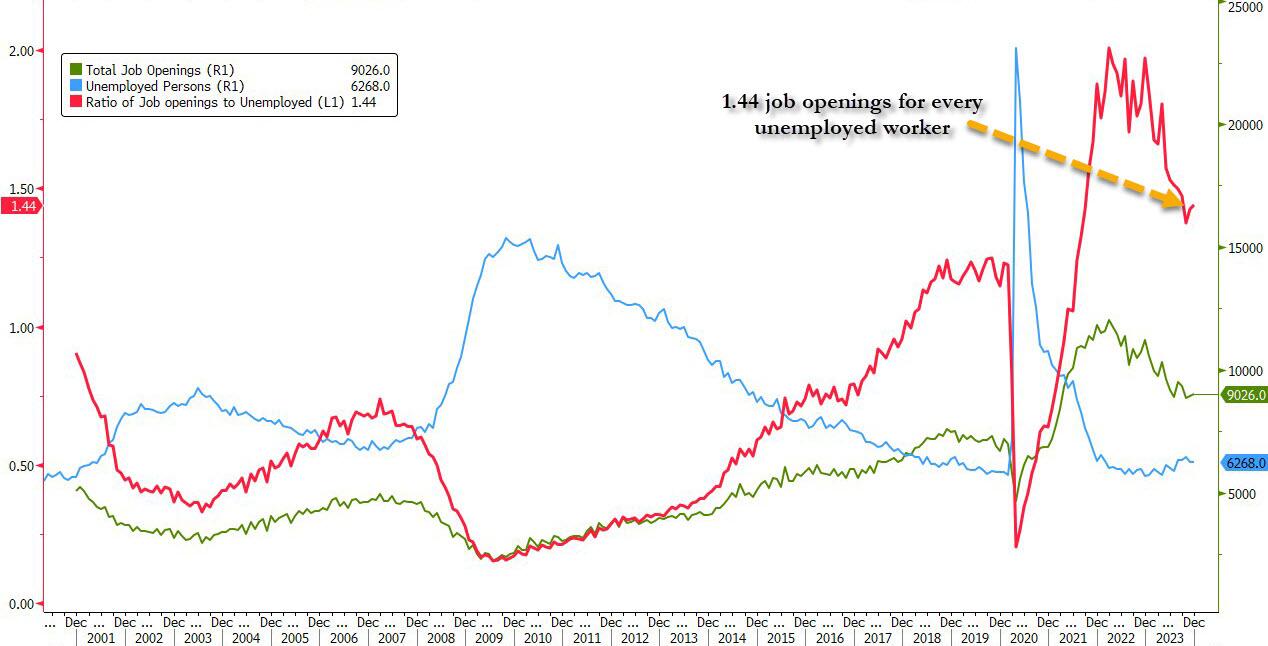
Said otherwise, in December the number of job openings to unemployed rose to 1.44, a sharp rebound from the November pre-revision print of 1.34 which was the lowest level since August 2021 and almost back to pre-covid levels of 1.3… and then everything was revised.

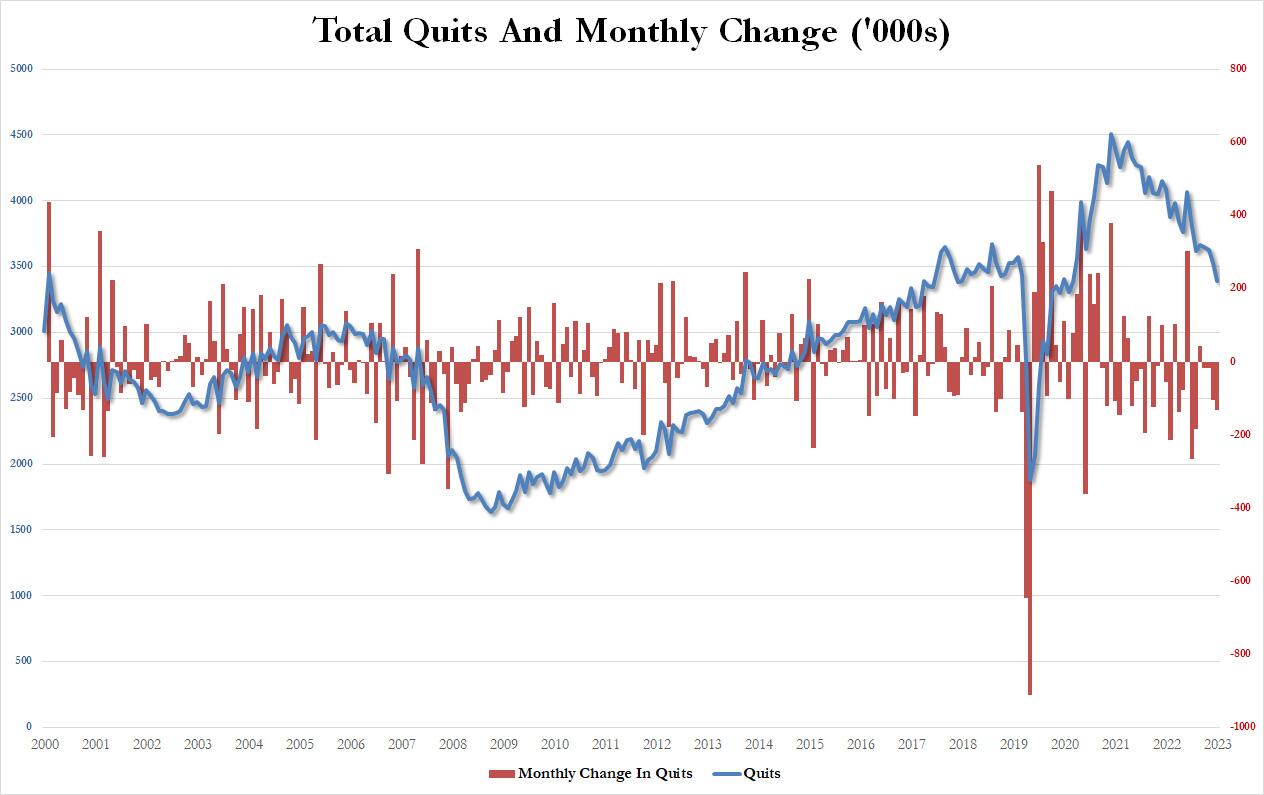
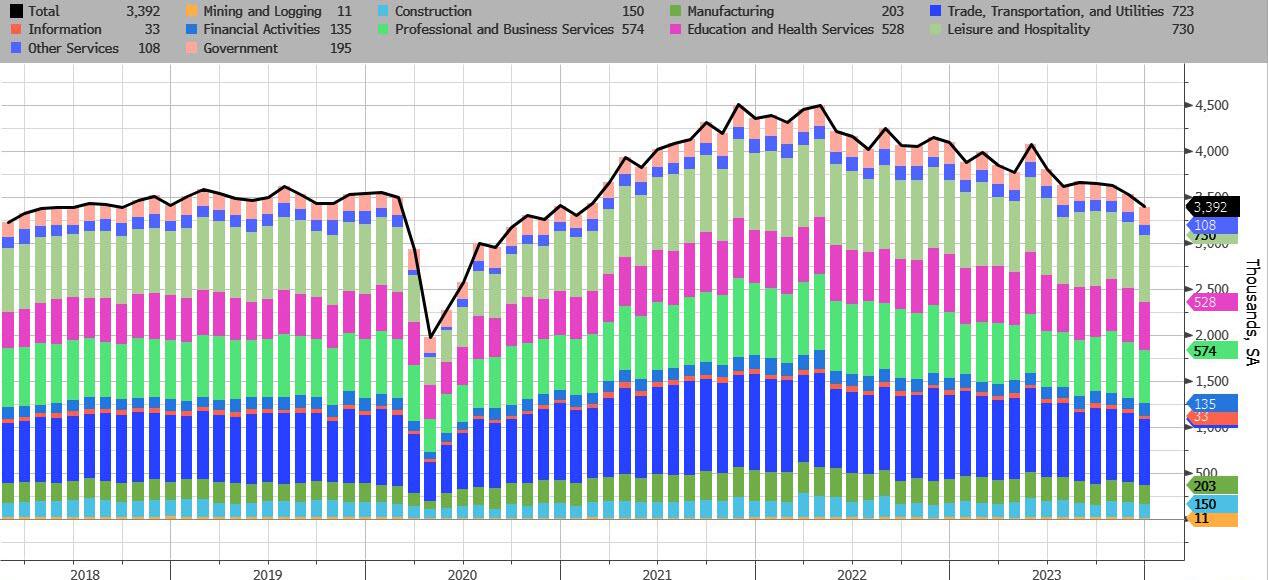
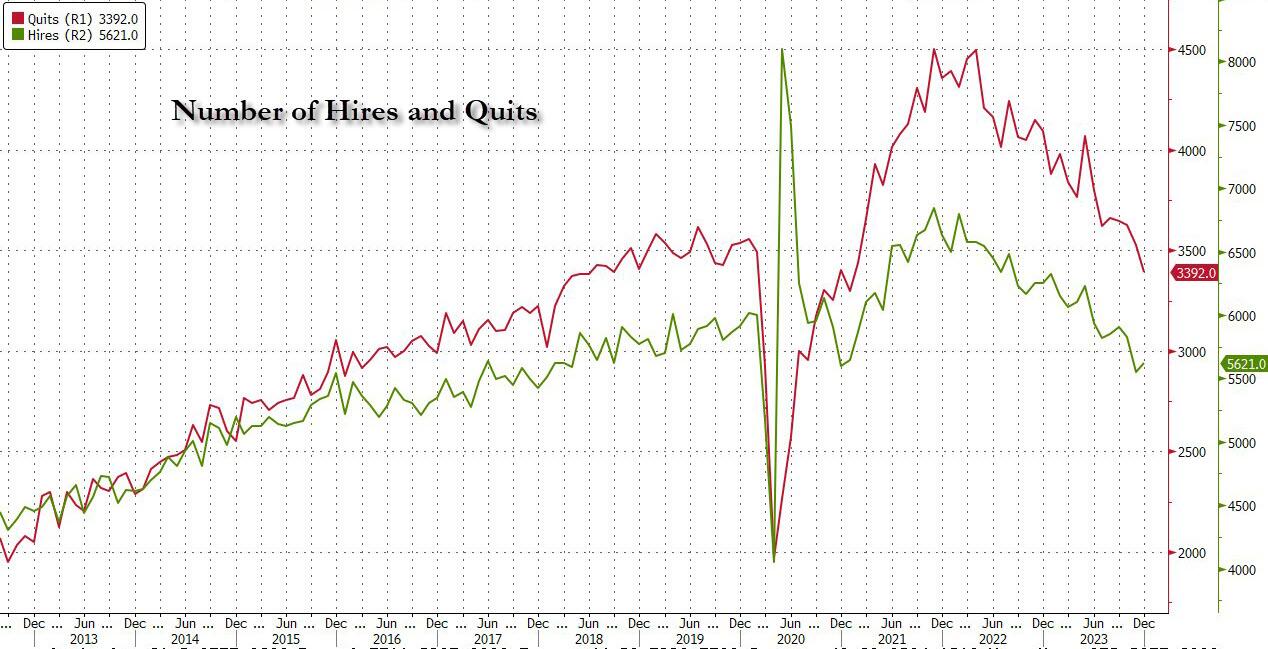
But what was more interesting than the increase in the number of job openings in December – which we are certain will be revised lower next month as has been the case with everything under the Biden admin – was the number of quits: here we find that the number of people quitting their jobs – an indicator traditionally closely associated with labor market strength as it shows workers are confident they can find a better wage elsewhere – tumbled by 132K to 3.392MM, which is below the 3.4 million level reported in Feb 2020, just before the covid shutdown.

The number of quits decreased mostly in health care and social assistance (-71,000) and in transportation, warehousing, and utilities (-35,000). The number of quits increased in wholesale trade (+63,000).

And just in case some still believe the “Bidenomics” strong jobs lie, the number of hires has also been falling, even though it managed a modest rebound in December, rising by 67K to 5.621 million, also well below the pre-covid levels.

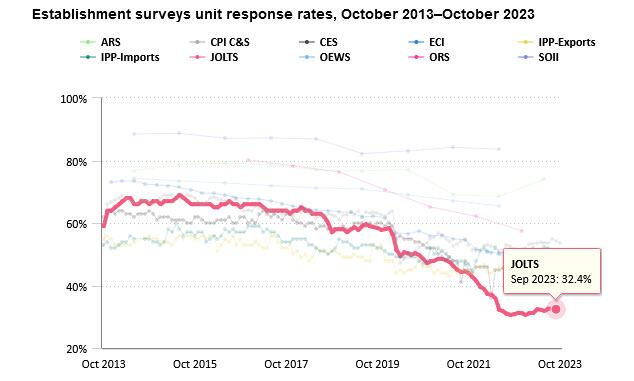
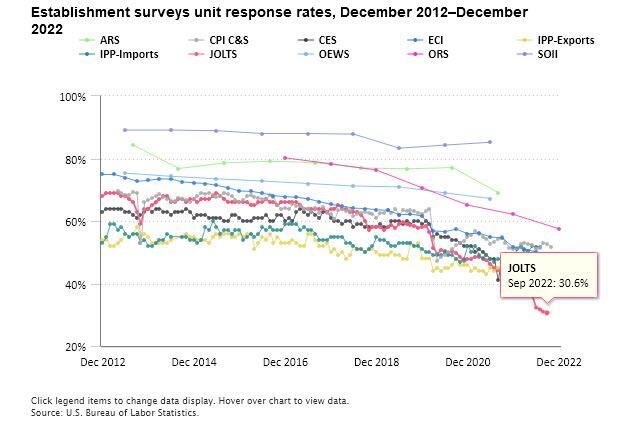
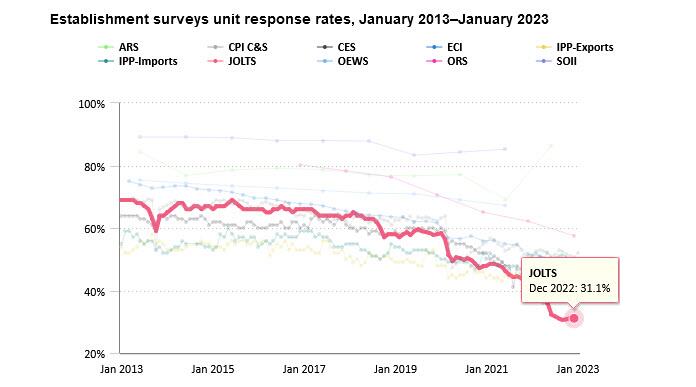
Finally, no matter what the “data” shows, let’s not forget that it is all just estimated, and it is safe to say that the real number of job openings remains still far lower since half of it – or some 70% to be specific – is guesswork. As the BLS itself admits, while the response rate to most of its various labor (and other) surveys has collapsed in recent years, nothing is as bad as the JOLTS report where the actual response rate has tumbled to a record low 32%

In other words, more than two thirds, or 70% of the final number of job openings, is estimated!

And at a time when it is critical for Biden to still maintain the illusion that at least the labor market remains strong when everything else in Biden’s economy is crashing and burning, we’ll let readers decide if the admin’s Labor Department is plugging the estimate gap with numbers that are stronger or weaker.

As for the Fed, now that the strength of the labor market once again takes precedence for Biden’s handlers, Powell is in trouble: how will he justify an even more dovish pivot than the one which sparked the biggest bear market rally in history in December, when the labor market just refuses to crack, when government wages hit record highs every single month, and when supercore inflation has now bottomed and is once again rising, not to mention home prices just hit a new all time high.

Then again, it’s an election year and we are confident that Powell will figure out a way for the no-longer-independent Fed to do just what the White House demands.

Tyler Durden
Tue, 01/30/2024 – 10:43

via ZeroHedge News https://ift.tt/0GPwCIO Tyler Durden

In Bizarre Outburst, E. Jean Carroll Goes Full “Price Is Right” Over How She’ll Spend “Trump’s Money”

In Bizarre Outburst, E. Jean Carroll Goes Full “Price Is Right” Over How She’ll Spend “Trump’s Money”

Following a bombshell $83.3 million award against Donald Trump, his rape accuser E. Jean Carroll, whose case was bankrolled by his enemies, couldn’t remember basic facts of her own claim, once described rape as “sexy,” and whose “off the rails” tweets weren’t allowed to be shown to the jury – just put on an absurd display.

When asked by MSNBC‘s Rachael Maddow on Monday night how she’ll spend “Trump’s money” to help “women’s rights,” Carroll did her best impression of a “Price is Right” winner – like rape victims do, telling Maddow: “First thing Rachel, you and I are gonna go shopping, we’re gonna get completely new wardrobes, new shoes…Rachel what do you like, Penthouse? You want France? You wanna go fishing in France? It’s yours Rachel.”

Her lawyer then nervously interjected: “That’s a joke.”

“If me fishing in France could do something for women’s rights, I would take the hit,” Maddow joked back.

Watch:

Earlier Monday, Carroll joked about turning Trump Tower into an animal sanctuary during a Monday morning interview on CNN, before snapping back to the ‘women’s rights’ script:

H/T Modernity.news

Speaking of appeals…

Trump’s attorney said in a new filing that they had discovered a connection between E. Jean Carroll’s lawyer and the judge in the case, citing a bombshell from the NY Post.

A jury awarded Carroll $83.3 million in damages from Trump last week, before The Post learned from sources that Manhattan federal Judge Lewis Kaplan was once a “mentor” to Carroll’s lawyer Roberta Kaplan (no relation), when they worked together in the early 1990s at the Paul, Weiss, Rifkin, Wharton & Garrison law firm in Midtown. 

If Your Honor truly worked with Ms. Kaplan in any capacity — especially if there was a mentor/mentee relationship — that fact should have been disclosed before any case involving these parties was permitted to proceed forward,” Habba wrote in a letter to the judge.

“This issue is particularly concerning since Plaintiff’s other lead counsel, Shawn Crowley, served as Your Honor’s law clerk, and we were previously advised that Your Honor co-officiated her wedding.”  –NY Post

And then of course there’s all those tweets Trump’s team wasn’t allowed to show…

Don’t go spending “Trump’s money” just yet, Jean…

Tyler Durden
Tue, 01/30/2024 – 10:40

via ZeroHedge News https://ift.tt/DL6znbe Tyler Durden

Just Months After “Massive Labor Deal,” UPS Announces Massive Layoffs

Just Months After “Massive Labor Deal,” UPS Announces Massive Layoffs

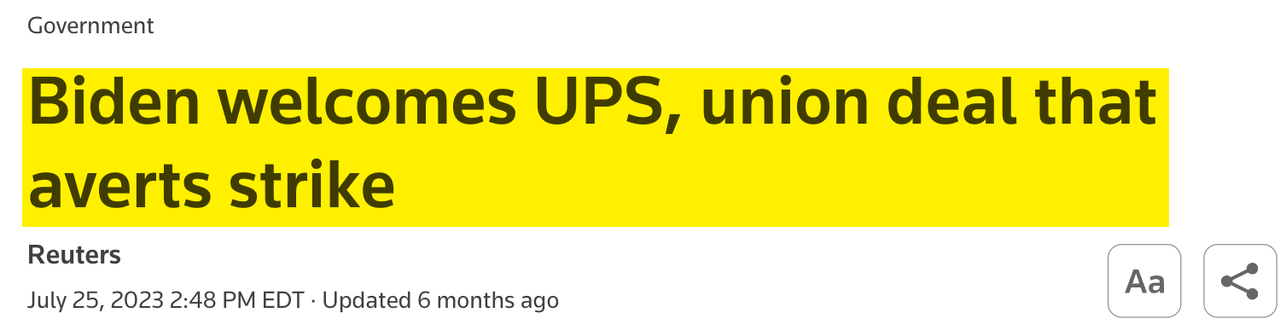
How it started: The most pro-union president in history, President Biden, applauded Teamsters and logistics company United Parcel Service last summer for agreeing on a new labor contract that would significantly boost pay. 

How it’s going: 

Five months after unionized UPS workers ratified a massive five-year labor deal that included massive pay bumps (read: here), the logistics company announced on Tuesday morning that 12,000 jobs, or about 14% of its 85,000 management jobs, would be cut. 

Chief Executive Officer Carol Tomé was quoted on an earnings call by Bloomberg as saying job reductions were due to sliding package demand and soaring union labor costs. She said the layoffs would save the company about $1 billion this year. 

“We are going to fit our organization to our strategy and align our resources against what’s wildly important,” Tomé said. She said that even after shipping volumes grow, those jobs will not come back, as “it’s a change in the way we work.” She also ordered workers to return to the office five days a week. 

“2023 was a unique and difficult year and through it all we remained focused on controlling what we could control, stayed on strategy and strengthened our foundation for future growth,” Tomé wrote in a statement

Fourth-quarter sales and 2024 guidance fell short of average analysts’ estimates due to higher labor costs and slowing package demand. 

Also, “UPS is seeking alternative strategies for its truck brokerage business, which has seen sales plummet amid a freight recession marked by declining rates and overcapacity,” Bloomberg pointed out. 

Following the labor deal with the International Brotherhood of Teamsters and UPS, delivery drivers had some of the “richest national contracts” ever, according to Teamsters General Secretary-Treasurer Fred Zuckerman. 

Thousands of UPS drivers are about to find out what the natural end result of unionized negotiated raises in a free market means for their employment. This is one development the Biden administration will ignore – and or be forced to deflect blame. 

Tyler Durden
Tue, 01/30/2024 – 10:25

via ZeroHedge News https://ift.tt/3xKHDyE Tyler Durden