Second Circuit Refers Lawyer for Disciplinary Proceedings Based on AI-Hallucinated Case in Brief

From Park v. Kim, decided today by the Second Circuit (Judges Barrington Parker, Allison Nathan, and Sarah Merriam); this is the 13th case I’ve seen in the last year in which AI-hallucinated citations were spotted:

We separately address the conduct of Park’s counsel, Attorney Jae S. Lee. Lee’s reply brief in this case includes a citation to a non-existent case, which she admits she generated using the artificial intelligence tool ChatGPT. Because citation in a brief to a non-existent case suggests conduct that falls below the basic obligations of counsel, we refer Attorney Lee to the Court’s Grievance Panel, and further direct Attorney Lee to furnish a copy of this decision to her client, Plaintiff-Appellant Park….

Park’s reply brief in this appeal was initially due May 26, 2023. After seeking and receiving two extensions of time, Attorney Lee filed a defective reply brief on July 25, 2023, more than a week after the extended due date. On August 1, 2023, this Court notified Attorney Lee that the late-filed brief was defective, and set a deadline of August 9, 2023, by which to cure the defect and resubmit the brief. Attorney Lee did not file a compliant brief, and on August 14, 2023, this Court ordered the defective reply brief stricken from the docket. Attorney Lee finally filed the reply brief on September 9, 2023.

The reply brief cited only two court decisions. We were unable to locate the one cited as “Matter of Bourguignon v. Coordinated Behavioral Health Servs., Inc., 114 A.D.3d 947 (3d Dep’t 2014).” Appellant’s Reply Br. at 6. Accordingly, on November 20, 2023, we ordered Park to submit a copy of that decision to the Court by November 27, 2023. On November 29, 2023, Attorney Lee filed a Response with the Court explaining that she was “unable to furnish a copy of the decision.” Although Attorney Lee did not expressly indicate as much in her Response, the reason she could not provide a copy of the case is that it does not exist—and indeed, Attorney Lee refers to the case at one point as “this non-existent case.”

Attorney Lee’s Response states:

I encountered difficulties in locating a relevant case to establish a minimum wage for an injured worker lacking prior year income records for compensation determination …. Believing that applying the minimum wage to in injured worker in such circumstances under workers’ compensation law was uncontroversial, I invested considerable time searching for a case to support this position but was unsuccessful….

Consequently, I utilized the ChatGPT service, to which I am a subscribed and paying member, for assistance in case identification. ChatGPT was previously provided reliable information, such as locating sources for finding an antic furniture key. The case mentioned above was suggested by ChatGPT, I wish to clarify that I did not cite any specific reasoning or decision from this case.

All counsel that appear before this Court are bound to exercise professional judgment and responsibility, and to comply with the Federal Rules of Civil Procedure. Among other obligations, Rule 11 provides that by presenting a submission to the court, an attorney “certifies that to the best of the person’s knowledge, information, and belief, formed after an inquiry reasonable under the circumstances … the claims, defenses, and other legal contentions are warranted by existing law or by a nonfrivolous argument for extending, modifying, or reversing existing law or for establishing new law.” “Rule 11 imposes a duty on attorneys to certify that they have conducted a reasonable inquiry and have determined that any papers filed with the court are well grounded in fact, [and] legally tenable.” “Under Rule 11, a court may sanction an attorney for, among other things, misrepresenting facts or making frivolous legal arguments.”

At the very least, the duties imposed by Rule 11 require that attorneys read, and thereby confirm the existence and validity of, the legal authorities on which they rely. Indeed, we can think of no other way to ensure that the arguments made based on those authorities are “warranted by existing law,” Fed. R. Civ. P. 11(b)(2), or otherwise “legally tenable.” As a District Judge of this Circuit recently held when presented with non-existent precedent generated by ChatGPT: “A fake opinion is not ‘existing law’ and citation to a fake opinion does not provide a non-frivolous ground for extending, modifying, or reversing existing law, or for establishing new law. An attempt to persuade a court or oppose an adversary by relying on fake opinions is an abuse of the adversary system.” Mata v. Avianca, Inc. (S.D.N.Y. 2023).

Attorney Lee states that “it is important to recognize that ChatGPT represents a significant technological advancement,” and argues that “[i]t would be prudent for the court to advise legal professionals to exercise caution when utilizing this new technology.” Indeed, several courts have recently proposed or enacted local rules or orders specifically addressing the use of artificial intelligence tools before the court. {See, e.g., Notice of Proposed Amendment to 5th Cir. R. 32.3, U.S. Ct. of Appeals for the Fifth Cir., https://ift.tt/1V7RXr4 [https://ift.tt/ke7mnEf] (Proposed addition to local rule: “[C]ounsel and unrepresented filers must further certify that no generative artificial intelligence program was used in drafting the document presented for filing, or to the extent such a program was used, all generated text, including all citations and legal analysis, has been reviewed for accuracy and approved by a human.”); E.D. Tex. Loc. R. AT-3(m) (“If the lawyer, in the exercise of his or her professional legal judgment, believes that the client is best served by the use of technology (e.g., ChatGPT, Google Bard, Bing AI Chat, or generative artificial intelligence services), then the lawyer is cautioned that certain technologies may produce factually or legally inaccurate content and should never replace the lawyer’s most important asset—the exercise of independent legal judgment. If a lawyer chooses to employ technology in representing a client, the lawyer continues to be bound by the requirements of Federal Rule of Civil Procedure 11, Local Rule AT- 3, and all other applicable standards of practice and must review and verify any computer-generated content to ensure that it complies with all such standards.”); Self-Represented Litigants (SRL), U.S. Dist. Ct. for the E. Dist. of Mo., https://ift.tt/ovkUmJ5 [https://ift.tt/NOzQRgG] (“No portion of any pleading, written motion, or other paper may be drafted by any form of generative artificial intelligence. By presenting to the Court … a pleading, written motion, or other paper, self- represented parties and attorneys acknowledge they will be held responsible for its contents. See Fed. R. Civ. P. 11(b).”). But such a rule is not necessary to inform a licensed attorney, who is a member of the bar of this Court, that she must ensure that her submissions to the Court are accurate.

Attorney Lee’s submission of a brief relying on non-existent authority reveals that she failed to determine that the argument she made was “legally tenable.” The brief presents a false statement of law to this Court, and it appears that Attorney Lee made no inquiry, much less the reasonable inquiry required by Rule 11 and long-standing precedent, into the validity of the arguments she presented. We therefore REFER Attorney Lee to the Court’s Grievance Panel pursuant to Local Rule 46.2 for further investigation, and for consideration of a referral to the Committee on Admissions and Grievances….

Thanks to Andy Patterson for the pointer.

The post Second Circuit Refers Lawyer for Disciplinary Proceedings Based on AI-Hallucinated Case in Brief appeared first on Reason.com.

from Latest https://ift.tt/HmuadAG
via IFTTT

Biden’s Trojan Horse Immigration Deal Would Allow Another 1.8 Million Migrants

Biden’s Trojan Horse Immigration Deal Would Allow Another 1.8 Million Migrants

Authored by Mike Shedlock via MishTalk.com,

Republican Senators are willing to sell the farm for what would be a terrible deal even if Biden elected to honor the terms…

CBS reports Biden and senators on verge of striking immigration deal aimed at clamping down on illegal border crossings

Trojan Horse Deal Details

  1. The agreement is expected to give the executive branch a new legal authority to effectively suspend asylum in between official ports of entry when migrant crossings surpass certain thresholds.

  2. The power, which Mr. Biden referred to as an authority to “shut down the border” on Friday, would be mandated after average daily migrant crossings hit 5,000 over seven days, or 8,500 in a single day.

  3. It could also be activated on a discretionary basis after average daily crossings surpass 4,000 in a week.

  4. There would also be a limit on the number of days each year the president could invoke the authority.

1: Biden already the authority to secure the border. He has no interest in doing so or he would have already done so. The administration even ripped open holes in the razor wire fence that Texas erected. If that’s not a come on in message, what is?

2: Has anyone done the math on this? 5,000 a day for 365 days is 1,825,000. There’s your trojan horse right there. We already know what’s inside.

3: Point three is a joke. What’s with this “could” stuff as if Biden would actually do it. Besides, does anyone expect a legitimate count?

4. Point four is an even bigger joke. It would limit the number of days Biden could shut the border even if he wanted to.

Huge Irony of the Deal

The irony of the deal is that the flip side is over a hundred billion in additional spending on Ukraine and Israel that should not be spent at all.

And there’s still more. Here’s bonus point five.

“While the proposal negotiated by the White House and lawmakers would penalize those who enter the U.S. illegally, it would preserve asylum at official ports of entry. In fact, it would require U.S. border officials to continue processing more than 1,400 asylum-seekers daily at these official border crossings when the “shutdown” authority is invoked, sources told CBS News.“

And how does this miracle happen? Here’s bonus point six.

“All the provisions being negotiated would require an enormous surge in personnel and resources, including detention facilities and deportation flights, to be implemented. The Biden administration has asked for $14 billion to fund border operations and hire additional asylum officers, border agents and immigration judges.”

Well, not to worry. The amazing deal Republicans negotiated would only allow 5,000 * 31 In January, March, May, July, October, and December.

My math says that’s 155,000 in those months and 150,000 in the rest except February.

What Republican dimwits negotiated these terms? These clowns are so desperate for money for Ukraine and Israel they will sign anything.

The House should kill this bill outright. But if Johnson puts it to a vote it will sail because every Democrat will back it, laughing all the way.

Denver Health at “Critical Point” as 8,000 Migrants Make 20,000 Emergency Visits

The Denver hospital system is turning away local residents because it is flooded with migrant visits.

Meanwhile, please note Denver Health at “Critical Point” as 8,000 Migrants Make 20,000 Emergency Visits

Texas Showdown

In Texas, the Supreme Court Lets Feds Cut Abbott’s Razor Wire

The swing vote, Justice Amy Coney Barrett, is a Trump nominee. Expect to hear calls of “traitor”.

There is one way to decide this issue. Vote out Biden. The ruling does help Trump.

Meanwhile, the floodgates are open.

Sanctuary Cities Seek More Money for Migrants, But is Money the Problem?

On December 30, I asked Sanctuary Cities Seek More Money for Migrants, But is Money the Problem?

I suspect you know the answer to this one. If not here it is. The more money we throw at this problem, the worse it will get.

By the way, if you have not figured this out, it’s very inflationary.

Tyler Durden
Tue, 01/30/2024 – 14:45

via ZeroHedge News https://ift.tt/t1Li5OA Tyler Durden

Russia Hit With Widespread Internet Outage Nationwide

Russia Hit With Widespread Internet Outage Nationwide

Russia’s Digital Ministry announced on messenger platform Telegram that a “technical problem” has led to widespread internet outages across the country. 

“A technical problem has arisen affecting the .RU zone, associated with the global DNSSEC* infrastructure. Specialists from the Internet Technical Center and MSK-IX are working to eliminate it,” the ministry said. 

X users say dozens of Russian websites are down:

Bloomberg reported that “the most popular local search engine Yandex.ru” and websites of large banks, including Sberbank PJSC and VTB Group, were also affected by the outage. Outages were reported across Moscow, St. Petersburg, Tatarstan, and the Sverdlovsk and Novosibirsk regions.  

The ministry continued: “The problem has now been resolved for subscribers of the National Domain Name System. Restoration work is underway. We will keep you updated on the situation.” 

Tyler Durden
Tue, 01/30/2024 – 14:05

via ZeroHedge News https://ift.tt/kG2ZeNO Tyler Durden

Javier Milei vs. Big Labor


A splitscreen with Javier Milei and union protesters | Illustration: Lex Villena

After enacting sweeping reforms in Argentina, President Javier Milei faced a major protest. Tens of thousands of people marched through the streets, hundreds of flights were grounded, and schools and businesses closed in protests to Milei’s attempt to fix the troubled South American country.  

Milei is the first self-described libertarian head of state in history. To avert economic disaster in a country facing huge deficits and a 160 percent inflation rate that has since spiked to over 211 percent, he told the country, things would likely get worse before they could get better. 

In his inauguration address on December 10, Milei acknowledged the daunting challenges ahead. “No government has received a worse inheritance than the one we are receiving. We neither seek nor desire the difficult decisions that must be made in the coming weeks. But unfortunately, we have no choice,” he explained. 

Ten days into his term, Milei issued a “mega-decree” of more than 300 executive measures. He abolished national rent control, which had caused a 75 percent drop in available apartments in Buenos Aires between 2022 and 2023. He repealed price controls, slashed subsidies, and fired more than 5,000 government employees. He allowed direct competition with Argentina’s government-owned airline, which he plans to privatize. And he defied the country’s powerful labor unions. 

Milei’s transformative agenda has encountered resistance, notably from Argentina’s largest labor union, the General Confederation of Labor, which represents about one out of every five Argentine workers. The union called for a nationwide strike on January 24, bringing portions of Buenos Aires to a standstill. 

Their main reason for protesting? Milei had issued an order ending the automatic withholding of union dues, leaving workers free to opt out of union membership. He also banned government workers in sectors like health and education from striking. While his measures were temporarily suspended by a court ruling, unions are making a show of force so that Milei’s agenda doesn’t make it through Congress.

Despite the economic challenges and opposition, Milei remains resolute in his pursuit for a freer, less regulated, and less debt-ridden Argentina. Addressing world leaders at the World Economic Forum this January, he said that the Argentina of the future will be based on libertarian principles.

“If measures are adopted that hinder the free functioning of markets, free competition, free price systems, if you hinder trade, if you attack private property the only possible fate is poverty,” Milei said. 

Yet Milei’s main political adversaries aren’t Argentina’s workers. In fact, Milei is calling for increased welfare in the short term to ease the pain for the working class during this transition to a new economic model.

As Argentine political economist Marcos Falcone told Reason, Milei’s actual adversaries are wealthy Argentines who have benefited from government largesse.

“Milei is going against crony capitalism because he is basically trying to kill the businessmen that have lived off of government support,” Falcone said. “We need to move forward. And the people need to be able to profit, you know, not just companies because of regulations and privileges.” 

In his speech at the Davos conference, Milei encouraged business owners to not be intimidated “by the political class or by the parasites who live off the state.” 

“You are heroes. You are the creators of the most extraordinary period of prosperity we’ve ever seen,” Milei continued. “Do not surrender to the advance of the state. The state is not the solution. The state is the problem itself.”

Milei faces a thicket of regulations and political resistance in Argentina. It won’t be easy to carry out Argentina’s economic transformation. We’ll have to wait and see if he picked the right chainsaw to cut through the challenges ahead. 

Photo credits: Fernando Gens/dpa/picture-alliance/Newscom; JUAN MABROMATA / GDA Photo Service/Newscom; Pepe Mateos/dpa/picture-alliance/Newscom; Franco Trovato Fuoco/dpa/picture-alliance/Newscom; Matias Baglietto/dpa/picture-alliance/Newscom; Florencia Martin/dpa/picture-alliance/Newscom; Martin Cossarini/dpa/picture-alliance/Newscom; Hannes P Albert/dpa/picture-alliance/Newscom; Carlos Smiljan / SOPA Images/Sip/Newscom; Cristobal Basaure Araya / SOPA Images/Sipa USA/Newscom; Abaca Press/Gross Frederico/Faro/Abaca/Sipa USA/Newscom; Javier Gonzalez / Xinhua News Agency/Newscom; MatíAs Baglietto/ZUMAPRESS/Newscom; Patricio Murphy/ZUMAPRESS/Newscom


Music Credits: “The Art of Loneliness” by ANBR via Artlist; “Chapter Two” by Brianna Tam via Artlist; “The Racer” by Tristan Barton via Artlist

The post Javier Milei vs. Big Labor appeared first on Reason.com.

from Latest https://ift.tt/jtNf8uC
via IFTTT

Going deep on deep fakes

This was a big week for AI-generated deep fakes. Sultan Meghji, who’s got a new AI startup of his own, walked us through four stories that illustrate how AI will lead to more confusion about what’s real and what’s not. First, a fake Biden robocall urged people not to vote in the New Hampshire primary. Second, a bot purporting to offer Dean Phillips’s views on the issues was penalized by OpenAI because it didn’t have Phillips’s consent. Third, fake nudes of Taylor Swift led to a ban on Twitter searches for her image. And, finally, podcasters used AI to resurrect George Carlin and got sued by his family for violating copyrightish law. The moral panic over AI fakery meant that all of these stories were too long on “end of the world” and too short on “we’ll live through this.”

Regulators of AI are not doing a much better job of maintaining perspective. Mark MacCarthy reports that New York City’s AI hiring law, which has punitive disparate-impact disclosure requirements for automated hiring decision engines, seems to have persuaded NYC employers, conveniently, that none of them are using automated hiring decision enginess, so they don’t have to do any disclosures. Not to be outdone, the European Court of Justice has decided that pretty much any tool to aid in decisions is an automated decision making technology subject to special (and mostly nonsensical) data protection rules.

Is AI regulation beginning to suffer from backlash? Could be. Sultan and I report on a very plausible Republican plan to attack the Biden AI executive order on the ground that its main enforcement mechanism, the Defense Production Act, simply doesn’t authorize the measures the order calls for.

In other Big Tech regulation, Maury Shenk explains the EU’s application of the Digital Markets Act to tech companies like Apple and Google. Apple isn’t used to being treated like just another tech company, and its contemptuous response to the EU’s rules for its app market could easily spur regulatory sanctions. Looking at Apple’s proposed compliance with the California court ruling in the Epic case and the European Digital Market Act, Mark says it’s time to think about price regulating mobile app stores.

Even handing out big checks to technology companies turns out to be harder than it first sounds. Sultan and I talk about the slow pace of payments to chip makers, and the political imperative to get the deals done before November (and probably before March).

Senator Ron Wyden, D-Ore. is still flogging NSA and the danger of government access to personal data. This time, he’s on about NSA’s purchases of commercial data. So far, so predictable. But he’s also misrepresenting the facts by claiming flatly that NSA buys domestic metadata, ignoring NSA’s clear statement that the metadata it buys is “domestic” only in the sense that it covers communications with one end inside the country. Communications with foreign countries that flow into and out of the U.S. have long been considered appropriate foreign intelligence targets, as witness the current debate over FISA section 702.

Maury and I review a Jim Dempsey’s effort to construct a liability regime for insecure software. His proposal looks reasonable, but Maury reminds me that he and I produced something similar twenty years ago, that is still not even close to adoption anywhere in the U.S.

I can’t help but rant about Amazon’s arrogant, virtue-signaling, and customer-hating decision to drop a feature that makes it easy for Ring doorbell users to share their videos with the police. Whose data is it, anyway, Amazon? Sadly, I’m afraid we know the answer.

It looks as though there’s only one place where hasty, ill-conceived tech regulation is being rolled back. China. Maury reports on China’s decision to  roll back video game regulations, to fire its video game regulator, and to start approving new games at a rapid clip—though only after a regulatory crackdown had knocked more than $60 billion off the value of its industry.

We close the news roundup with a few quick hits:

Finally, as a listener bonus, we hear from Rob Silvers, Under Secretary for Policy at the Department of Homeland Security and Chair of the Cyber Safety Review Board (CSRB). Under Rob’s leadership, DHS has proposed legislation to give the CSRB a legislative foundation. The Senate homeland security committee recently held a hearing about that idea. Rob wasn’t invited, so we asked him to come on the podcast to respond to issues that the hearing raised – conflicts of interest, subpoena power, choosing the incidents to investigate, and more.

Download 489th Episode (mp3)

You can subscribe to The Cyberlaw Podcast using iTunes, Google Play, Spotify, Pocket Casts, or our RSS feed. As always, The Cyberlaw Podcast is open to feedback. Be sure to engage with @stewartbaker on Twitter. Send your questions, comments, and suggestions for topics or interviewees to CyberlawPodcast@gmail.com. Remember: If your suggested guest appears on the show, we will send you a highly coveted Cyberlaw Podcast mug! The views expressed in this podcast are those of the speakers and do not reflect the opinions of their institutions, clients, friends, families, or pets.

The post Going deep on deep fakes appeared first on Reason.com.

from Latest https://ift.tt/tTvwQPF
via IFTTT

The Fed Prepares For A Bank Crisis While Telling Americans The Economy Is Strong

The Fed Prepares For A Bank Crisis While Telling Americans The Economy Is Strong

Authored by Tho Bishop via The Mises Institute,

Last Thursday, Bloomberg reported that federal regulators are preparing a proposal to force US banks to utilize the Federal Reserve’s discount window in preparation for future bank crises. The aim, notes Katanga Johnson, is to remove the stigma around tapping into this financial lifeline, part of the continuing fallout from the failures of several significant regional banks last year.

This new policy is reminiscent of the Fed’s actions during the 2007 financial crisis, where financial authorities encouraged large banks to tap into the discount window, taking loans directly from the Federal Reserve, to make it easier for distressed banks to do the same. The hesitancy from financial institutions to tap into this source of liquidity is justified. If the public believes a bank needs support from the Fed, it is rational for depositors to flee the bank. The Fed’s explicit aim is to provide cover from at-risk banks, trying to hold off bank runs that are an inherent risk in our modern fractional reserve banking system.

By strong-arming healthy banks to comply, the Fed is escalating moral hazard and leaving customers more vulnerable. They are deliberately trying to remove a signal of institutional risk.

The regulator’s concerns about bank fragility are justified. The Fed’s low-interest rate environment meant financial institutions seeking low-risk assets bought up US treasuries with very low yields. As inflationary pressures forced rates upward, the market value of these bonds decreased in favor of new, higher-yield bonds. It was this pressure that sparked the failure of Silicon Valley Bank last year.

Additionally, the state of commercial real estate is a further stress for regional banks, which are responsible for 80 percent of such mortgages. In the previous low-interest rate environment, investors viewed commercial real estate as “a haven for investors in need of reliable returns.” Unfortunately, this same period experienced major changes in consumer behavior. Online shopping, remote work, and shared office space increased at the expense of traditional brick-and-mortar locations. Covid lockdowns only further amplified these trends.

As a result, commercial real estate debt is viewed as one of the most dangerous financial assets out there today, sitting right on the balance sheets of regional banks across the country.

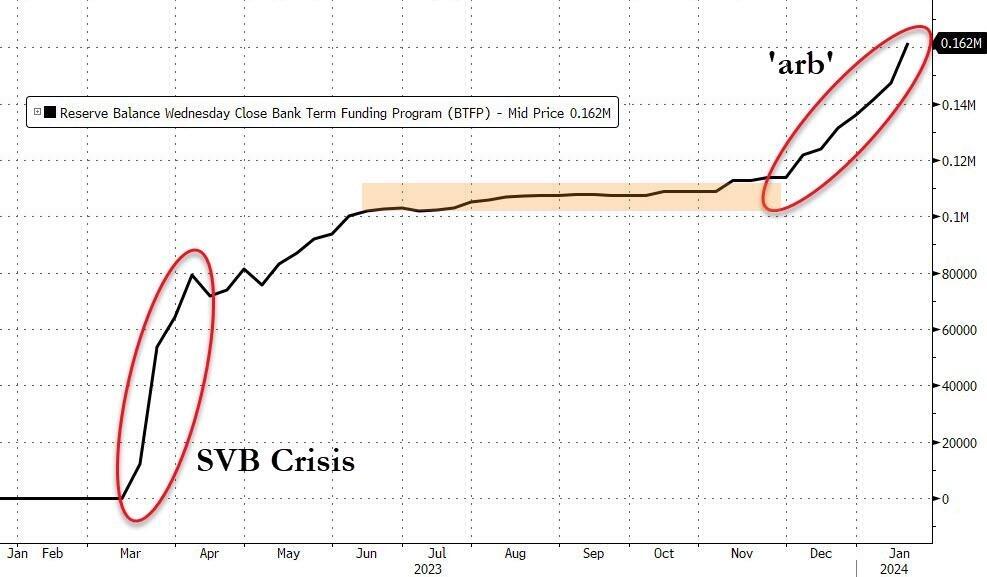
These stresses have had a major impact not only on this latest policy from federal regulators but the depth of their response to last year’s failures. Following the failure of SVB, the Fed created the Bank Term Funding Program, which allowed banks and credit unions to borrow using US Treasuries and other assets as collateral. This emergency measure reflected fears of other banks being at risk. The Fed has signaled its willingness to let this program expire in March, with the aim of transitioning banks to increasing their use of the discount window.

While the actions of the Fed and financial regulators illustrate real concerns about the health of US banks, these same institutions have projected bullish optimism about the state of the economy in public.

Fed Chairman Jerome Powell and Treasury Secretary Janet Yellen have consistently described the US economy as “robust” over the last few months, a view not shared by the majority of Americans. Additionally, Powell proclaimed victory over inflation this past December, even while the Fed’s preferred measures remain well above their 2 percent target, in stark contrast to his previous statements about the necessity to aggressively tackle inflation at the risk of it becoming normalized.

The shadow of politics obviously can’t be decoupled from the rosy statements from government officials on the economy, particularly going into a presidential election year. Another motivation for projecting economic strength, however, is to re-arm the Federal Reserve’s policy arsenal. While the projections of Fed officials for rate cuts in 2024 have been packaged as reflecting the growing strength of the US economy, the reality is that the Fed desires the option to lower rates as a response to financial distress. The Fed has proven time and time again that if given the choice between forcing Americans to suffer from the consequences of inflation or bailing out the financial system, it will choose the latter.

With the 2024 election in full swing, Americans will be consistently bombarded with political lies and false promises, not just from politicians but from government agencies and the central bank.

While we can expect another ten months of being told how strong the economy is, the actions being taken behind the scenes tell a very different story.

Tyler Durden
Tue, 01/30/2024 – 13:25

via ZeroHedge News https://ift.tt/6yzPqdg Tyler Durden

For-Profit Ed Company Adtalem Shares Fall 20% After Being Targeted By Activist Short-Seller Safkhet

For-Profit Ed Company Adtalem Shares Fall 20% After Being Targeted By Activist Short-Seller Safkhet

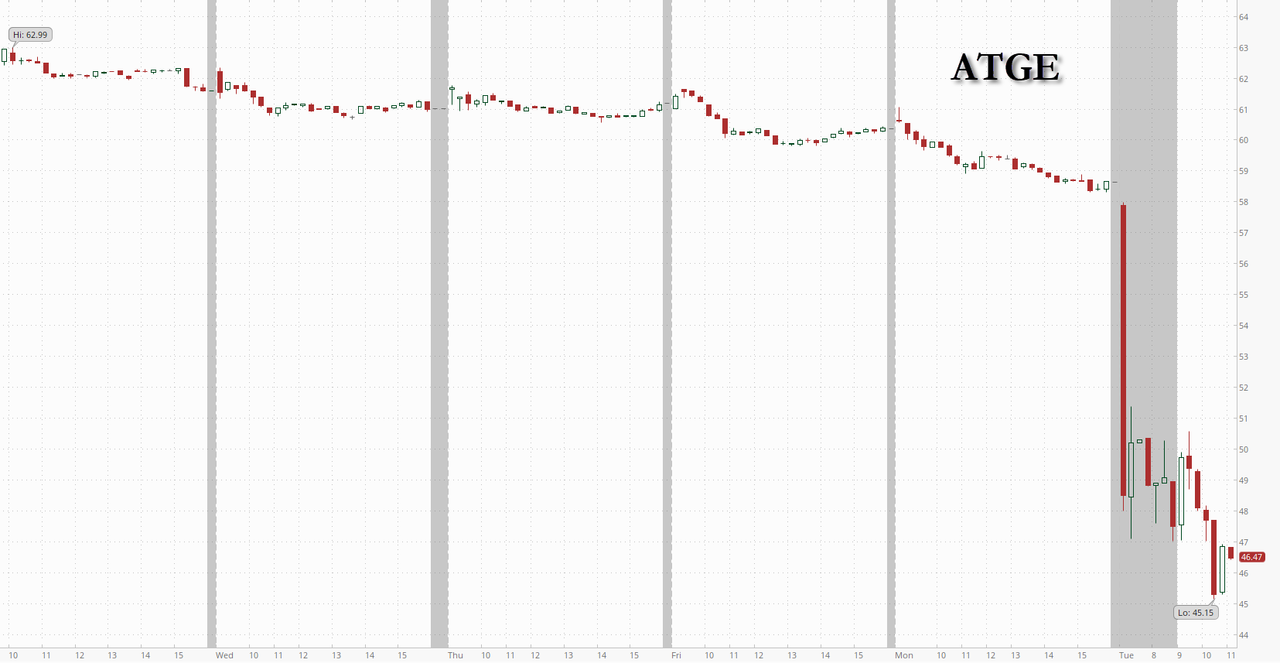
Activist short seller Safkhet Capital Management LLC said this morning that it is targeting shares of for profit education company Adtalem Global Education, claiming the company contains existential risks that aren’t priced in.

The stock was hit early in the trading session on the news and continued lower throughout the afternoon, falling about 20% by mid-day.

Safkhet may be best known for its call in 2015 against Valeant Pharmaceuticals, which eventually wound up losing more than 90% of its market cap after numerous scandals, including revenue recognition issues, were unearthed at the giant pharma rollup. 

It was also short Wirecard, which went bunk in 2020 in the midst of a chorus of allegations of fraud.

“Adtalem Global Education is a for-profit university operator that has benefited from billions in public funds, last year collectively bringing in more Title IV funding than any public, non-profit, or proprietary institution,” Safkhet wrote on X Tuesday morning. 

“After our extensive research, including interviews with former executives and students, we believe the business model is simple: fast and loose admissions made possible by aggressive and sometimes deceptive tactics.”

Safkhet said the company is “teetering towards a reckoning as nearsighted business decisions clash with historically high rates, looming regulations, and a generation of students empowered to fight back”.

“Enrollment trends show stagnation with multi-year declines in the medical and veterinary schools, now poised to deteriorate further as superior, more affordable options become available onshore,” they continued.

They also allege the Department of Education has launched an investigation into ATGE subsidiary Walden that has not yet been disclosed. 

“Expired program participation agreements across most of ATGE’s schools create the risk of greater collateral requirements and delays in the permitted drawdown of federal funds,” the firm wrote. 

“We find ATGE’s future contains far too many potentially great and existential risks which are not adequately reflected in its current value.” 

The firm also launched a website called “Debt for Degree” where you can read the full report

Adtalem didn’t immediately respond for comment to Bloomberg, the news org said in a brief Tuesday morning wrap up of the report. We will monitor the newswires for a response. 

Tyler Durden
Tue, 01/30/2024 – 13:05

via ZeroHedge News https://ift.tt/gU0X2Qi Tyler Durden

Struggling For Recruits, US Navy Lowers Education Standard

Struggling For Recruits, US Navy Lowers Education Standard

Authored by Bill Pan via The Epoch Times (emphasis ours),

The U.S. Navy said on Jan. 26 that it will start to enlist those who didn’t graduate from high school in the latest attempt to fill its ranks in the wake of a recruiting crisis that troubles every branch of the U.S. military.

Members of the US Navy welcome aircraft carrier USS Ronald Reagan as she arrives at the US Navy base in Yokosuka, a suburb of Tokyo, on Oct. 1, 2015. (Toru Yamanaka/AFP via Getty Images)

Under the new plan, Navy recruits without a high school diploma will be able to join as long as they score 50 or higher on the Armed Forces Qualification Test (AFQT), which is used to determine basic eligibility for military service. The highest possible AFQT score is 99.

Those without a General Educational Development, or GED, credential can also enlist as long as they meet the same AFQT score threshold. The GED consists of four academic subject tests—math, science, social studies, and reasoning through language arts—and passing those tests certifies that the taker has the skills and knowledge equivalent to a high school graduate.

The last time that the Navy allowed those who lacked education credentials to enlist was in 2000, according to the Chief of Naval Personnel’s office.

In a statement announcing the change, Navy officials said it is “another pathway of opportunity for previously excluded individuals to serve” and that it could fill some 500 to 2,000 empty slots at sea every year.

In addition, the new plan could help to accommodate those who struggled to graduate high school because of the COVID-19 pandemic, a period marked by widespread school closures, social isolation, and on-and-off online classes. The pandemic also forced military recruiters out of high schools, where they traditionally reach prospective candidates at events such as career day fairs.

“This policy update benefits the Navy by expanding the potential applicant pool of highly qualified and motivated future Sailors who may have been impacted by COVID-19 trends of non-traditional schooling, early exit from high school to support their family, or a variety of other individual circumstances,” Navy officials said in the statement.

Once they are in the service, sailors can take advantage of free academic skills training programs and test preparation courses to work toward a GED, according to the statement.

Sailors who enlist under this policy change can achieve personal and professional growth by earning their GED while gaining experience in cutting-edge technologies and learning professional skills that allow them to exceed their expectations while serving in the Navy,” it stated.

This isn’t the first time that the military branch loosened its requirements after barely making its recruiting goal for active-duty enlisted in Fiscal Year (FY) 2022. The Navy started FY 2023 by adjusting the maximum age for enlistment to 41 from 39 and would later raise the maximum enlistment bonus to $50,000.

It also launched a pilot program for recruits with low AFQT scores. Under the pilot program, the Navy would accept 20 percent of recruits who scored between 10 and 30 on the test, as long as they scored high enough on the Armed Services Vocational Aptitude Battery, considered a better assessment of naval recruits.

On top of those measures, the Navy introduced a program aimed at those without the body composition requirements for joining the service. Potential recruits would go through a three-week program at a Great Lakes, Illinois, boot camp, where they would get fitness help to meet the requirements.

Despite all of the efforts, the Navy failed to meet every one of its recruitment goals in FY 2023. It aimed to recruit 37,700 sailors but ended up bringing in just 30,236.

The Navy fared no better with officers or reserve personnel. In FY 2023, it missed the officer goal by 452 people, the enlisted reserve goal by 2,048, and the officer reserve goal by 773.

Because of the failure to meet its goals during the last fiscal year, the Navy has set higher goals for FY 2024. It aims to recruit 40,600 enlisted sailors, 2,807 active-duty officers, 7,629 enlisted reserve sailors, and 1,785 reserve officers.

Other service branches also have difficulty finding recruits who can meet physical and academic requirements. According to a 2022 study from the Pentagon, about 77 percent of young Americans ages 17 to 24 wouldn’t qualify for military service without some form of a waiver because of being overweight, using drugs, or having mental and physical health problems.

Tyler Durden
Tue, 01/30/2024 – 12:45

via ZeroHedge News https://ift.tt/pi701Nu Tyler Durden

Dispatch From Israel: A Soldier Dies, Strangers Gather To Mourn


Israeli soldiers in Gaza | IDF/GPO/SIPA/Newscom

Billy Joel’s “Uptown Girl” plays as you drive south out of Tel Aviv in a heavy rain. It’s incongruous with what you are driving toward, a visit with the family of Ahmad Abu Latif, the Bedouin soldier killed, along with 20 other members of the Israel Defense Forces (IDF), when the buildings on the Gaza border his company was preparing for controlled demolition were hit by RPG missiles.

Some Israelis have criticized the IDF for putting so many soldiers in one small location, essentially making them sitting ducks. You do not think any possible strategic failure behind Ahmad’s death, at age 26, will matter to his mother. You also have no idea what gift to bring her.

“How should I know?” asks the young salesman at the counter of the roadside shop in Rahav. Then: “Maybe dates.”

You carry the 5-kilo pack of dates, as big as an overnight case, past a dozen men smoking in an outdoor tent by an open brazier. That way, one indicates, pointing toward an open door. Inside, a woman is looking at you. She is wedged into the far edge of a couch, in order, you will realize during your visit, that the people who file in and out might sit beside her, as they take her hand, as they tell her, in Hebrew, Arabic, and English, that they are so sorry.

Nearly all of them are strangers to her. They have learned of Ahmad’s death and feel compelled to be of what comfort they can. It is unclear if any are succeeding. Ahmad’s mother is today’s terrible avatar; a place to which people carry their collective grief. It’s been nearly four months since the October 7 massacre and nothing is close to being settled. By the end of the day, three more IDF soldiers and an uncounted number of Gazans will have been killed, deaths you hear about on the car radio, news delivered between the DJ playing the favorite songs of individual hostages at the top of every hour, including one called “Sunbeam” that is gaily sweet and under the circumstances makes you cry.

But first you eat the dates, you drink the Turkish coffee, you listen to a sister-in-law tell you, through a translator, that Ahmad was “a golden guy, a hero, he brought the sunshine.” You learn he worked very hard; that in high school he cleaned an oncology unit at the hospital and, more recently, was a security guard at Ben Gurion University, where he would tell the students, “One day I am going to be teaching you.” His dream was to teach social sciences or maybe math, like his wife Zahara, who sits in a plastic chair beside you looking as though all the viscera has been sucked out of her. She watches over her 11-month-old daughter, named Mansoora (“Winner”) after Ahmad’s mother, and offers short nods to those who press toward her; what else can she give? Her husband has been dead four days, and you are relieved when she breaks to ignore the room, to stare at a photo of Ahmad on a phone someone has handed her.

(Nancy Rommelmann)

From the couch, a woman shows you photos of the Sea of Galilee. “Look how blue,” she says, as a little girl of maybe three runs barefoot into the room laughing and runs out again. It’s getting busy and maybe that’s good, better than the weeks and years ahead, when your son’s name is no longer in people’s mouths.

“We read about Ahmad on Facebook,” says a man in his forties. He and his friend have driven from the Golan Heights to pay their respects; they themselves had tried to reenlist, but the IDF told them no.

 “They said we’re too old,” one says. “They want to win the war.”

(Nancy Rommelmann)

“It’s so sad, she will never know her father,” says a former commander of Ahmad’s, holding Mansoora. Yes, you say, but he knew her, and you ask to hold the baby, to offer whatever safe harbor you can in 14 seconds to someone whose most pressing concern is chewing on a soda cup.

The family has been visited by five members of the Knesset and by a former prime minister. Ahmad’s older brother tells you that Ahmad was the youngest of 11 and the most devoted to their mother (“They talked ten times a day”) and also, that he wanted to unite people.

“Jews, Arabs, he didn’t care, he would be host,” he says. “Even in IDF, he says, ‘I have no place to host you? I will host you in my tank.'”

He Airdrops you a video featuring Ahmad and Cedrick Garin, a Filipino reservist killed in the same attack, a young man who’d told his mother that he could’ve taken leave but was going to let the married guys with kids go home from the front first.

The room is filling up, a soldier with his rifle slung over his shoulder holds Ahmad’s mother’s hand. One of Ahmad’s former commanders tells her, “You raised a fine boy.” And a minister of defense whose job it is to coordinate letting families know of their loved one’s deaths sits in the tent with the smoking men.

“I hope there will not be any more work,” he says to Ahmad’s father, who, before you leave, wants to show you something. He goes to his car and takes out a plaque from the university where Ahmad worked, an Employee of the Year Award his son won four years running. 

(Nancy Rommelmann)

“He was a genius guy,” he tells you, of his youngest son. “We hope, inshallah, he will be the last fallen soldier.”

An hour later, there is another.

The post Dispatch From Israel: A Soldier Dies, Strangers Gather To Mourn appeared first on Reason.com.

from Latest https://ift.tt/5nc1F6B
via IFTTT

She Was Arrested for Her Journalism. A Federal Court Says She Can’t Sue.


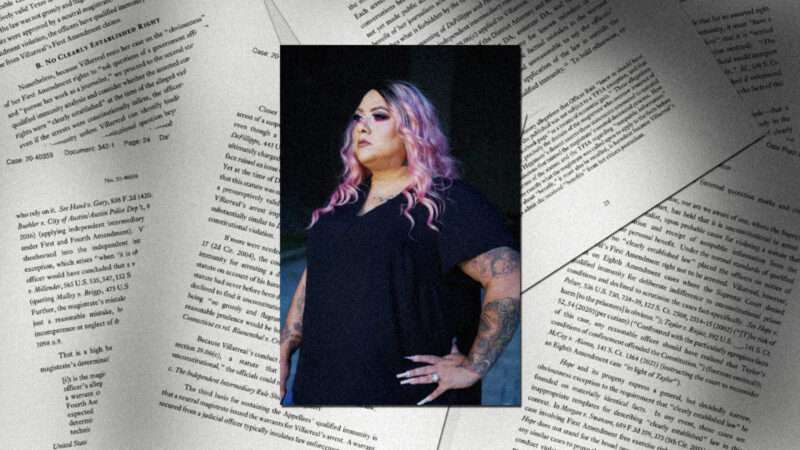
Priscilla Villearreal, also known as Lagordiloca, is seen in front of the decision from the 5th Circuit Court of Appeals | Foundation for Individual Rights and Expression; The U.S. Court of Appeals for the 5th Circuit

A journalist asked the police a few questions and was arrested by that same agency for publishing the answers.

That this happened not in China or Russia but in the U.S. may raise some eyebrows. Yet that’s the conduct a federal court greenlit last week when it ruled that law enforcement in Laredo, Texas, did not obviously violate the Constitution when officers allegedly misled a magistrate judge and arrested Priscilla Villarreal for doing basic reporting, adding another twist to a case that in some sense asks the following: Exactly who is a journalist?

In April 2017, Villarreal reported the identity of a Border Patrol agent who killed himself by jumping off of a local overpass. A few weeks later, she published the last name of a family involved in a fatal traffic accident. She confirmed both of those identities with an officer in the Laredo Police Department (LPD). In response, that department set in motion a criminal investigation—complete with subpoenas for various people’s cellphone records—that saw Villarreal arrested months later for violating an obscure Texas law, § 39.06(c), that prohibits soliciting “nonpublic information” if done “with intent to obtain a benefit.”

The supposed benefit, the government said, was followers on her Facebook page.

Villarreal’s Facebook is indeed central to her story. She is known almost ubiquitously in Laredo, where she gained popularity by livestreaming local crime scenes and traffic accidents, infusing her videos with provocative, and often-profane, commentary. Some of that reporting has been critical of law enforcement, attracting their ire and culminating, she says, in their attempt to shut her up via the criminal justice system.

It didn’t work. But it did kick off a multiyear debate over whether or not her arrest violated the Constitution, and, if so, if those officers should be shielded by qualified immunity, the legal doctrine that prevents alleged victims of abuse from bringing civil suits against state and local government actors if the way in which those employees violated the law has not yet been spelled out precisely in a prior court ruling.

After years of a legal back-and-forth, Villarreal got her answer last week from the U.S. Court of Appeals for the 5th Circuit: It was not clear that officers had violated the Constitution when they charged her criminally for her journalism, the majority ruled 9-7. But the decision, which was challenged forcefully by several dissenting judges, raises further questions about what qualifies as journalism and if those who adhere to a more traditional approach are entitled to a different set of rights.

“Villarreal and others portray her as a martyr for the sake of journalism. That is inappropriate,” wrote Judge Edith Jones. “Mainstream, legitimate media outlets routinely withhold the identity of accident victims or those who committed suicide until public officials or family members release that information publicly.”

According to Jones and the majority, a reasonable officer could not be expected to know that it is unconstitutional to bring charges against someone for asking the government questions. That obscure Texas law, Jones said, understandably supplied law enforcement with the notion that Villarreal was indeed a criminal, despite that the statute appears to have been written to discourage corruption in government, not boilerplate journalism.

The way Villarreal communicates information, however, is anything but boilerplate. She is not employed by a publication, and her livestreams are raw and unfiltered. That general spirit is summed up well in what she named her page: Lagordiloca, or “the crazy, fat lady.”

In that vein, the 5th Circuit’s decision is dripping with contempt for Villarreal’s enterprise; Jones makes little attempt to hide it. Lagordiloca’s rough-around-the-edges, muckraker approach can certainly be jarring. But one wonders if the court would have ruled the same way if Villarreal had been employed by, say, the Laredo Morning Times, where her alleged “benefit” for seeking information would arguably be more significant: a salary. It is also unclear if the police would have had the gumption to arrest her had she fit a more conventional mold.

At least in terms of the latter, Villarreal’s contention is “no.” The officers leveraged the law illegally, she maintains, to retaliate against her. Buttressing that theory is the fact that no one had ever before been prosecuted under the law Villarreal was charged with breaking. 

“Those who arrested, handcuffed, jailed, mocked, and prosecuted Priscilla Villarreal, far from having to make a snap decision or heat-of-the-moment gut call, spent several months plotting Villarreal’s takedown, dusting off and weaponizing a dormant Texas statute never successfully wielded in the statute’s near- quarter-century of existence,” wrote Judge Don Willett in dissent. “This was not the hot pursuit of a presumed criminal; it was the premeditated pursuit of a confirmed critic.”

Core to the majority’s error in judgment, Willett wrote, is a double standard that holds the most powerful people to the lowest standard and the least powerful to the highest. “While the majority says the officers could not have ‘predicted’ that their thought-out plan to lock up a citizen-journalist for asking questions would violate the First Amendment—a plan cooked up with legal advice from the Webb County District Attorney’s Office, mind you—the majority simultaneously indulges the notion that Villarreal had zero excuse for not knowing that her actions might implicate an obscure, never-used provision of the Texas Penal Code,” he wrote. “In other words, encyclopedic jurisprudential knowledge is imputed to Villarreal, but the government agents targeting her are free to plead (or feign) ignorance of bedrock constitutional guarantees.”

The alleged obviousness of the constitutional violation here—punishing someone for their speech—drives much of the dissents. In 2020, the Supreme Court reversed a ruling that awarded qualified immunity to a group of prison guards who locked an inmate, Trent Taylor, in two cells at the John T. Montford Psychiatric Facility Unit: one that was allegedly filled with “massive” amounts of human feces and the other with sewage from a clogged floor drain. The original ruling immunizing those officers had been too exacting, the high court said, when evaluating if it was clearly established that government employees should know such treatment violates a person’s right to be free from cruel and unusual punishment.

The federal court that originally handed down that myopic ruling: the U.S. Court of Appeals for the 5th Circuit.

The court’s latest ruling in Villarreal’s case “magnifies the troubling trend of police and prosecutors abusing their power to silence speech and punish speakers they dislike,” says J.T. Morris, an attorney at the Foundation for Individual Rights and Expression, who represents Villarreal. “The majority decision spurns [a] core First Amendment protection, allowing public officials to evade accountability when they jail Americans who say something the government disapproves of.”

Interestingly, there’s been a counterintuitive relationship between Villarreal’s polarizing approach and the supporters she’s united during her protracted litigation in the 5th Circuit. Among those who urged the court to rule in her favor: Alliance Defending Freedom, the conservative Christian legal advocacy group most known for defending religious liberty; the libertarian Cato Institute; the left-leaning Constitutional Accountability Center; and the far-right Project Veritas. It would be difficult to pinpoint very many topics that bring these groups together. That is, after all, the spirit behind the First Amendment: You can disagree with someone’s message but still support their right to say it.

If the First Amendment means anything, surely it means that citizens have the right to question or criticize public officials without fear of imprisonment,” wrote Judge James Ho, who previously ruled in favor of Villarreal, in dissent. “It would make no sense for the First Amendment to protect the right to speak, but not to ask questions—or the right to petition the government for a redress of grievances, but not for information.”

No matter how you feel about Villarreal and her project, however, it’s undeniable that law enforcement’s actions, while intending to silence her, expanded her platform. When reached for comment, her response was instructive.

“This is not a loss,” she told me. “I said it several times. I want to go all the way to the Supreme Court!”

The post She Was Arrested for Her Journalism. A Federal Court Says She Can't Sue. appeared first on Reason.com.

from Latest https://ift.tt/umtvb9K
via IFTTT