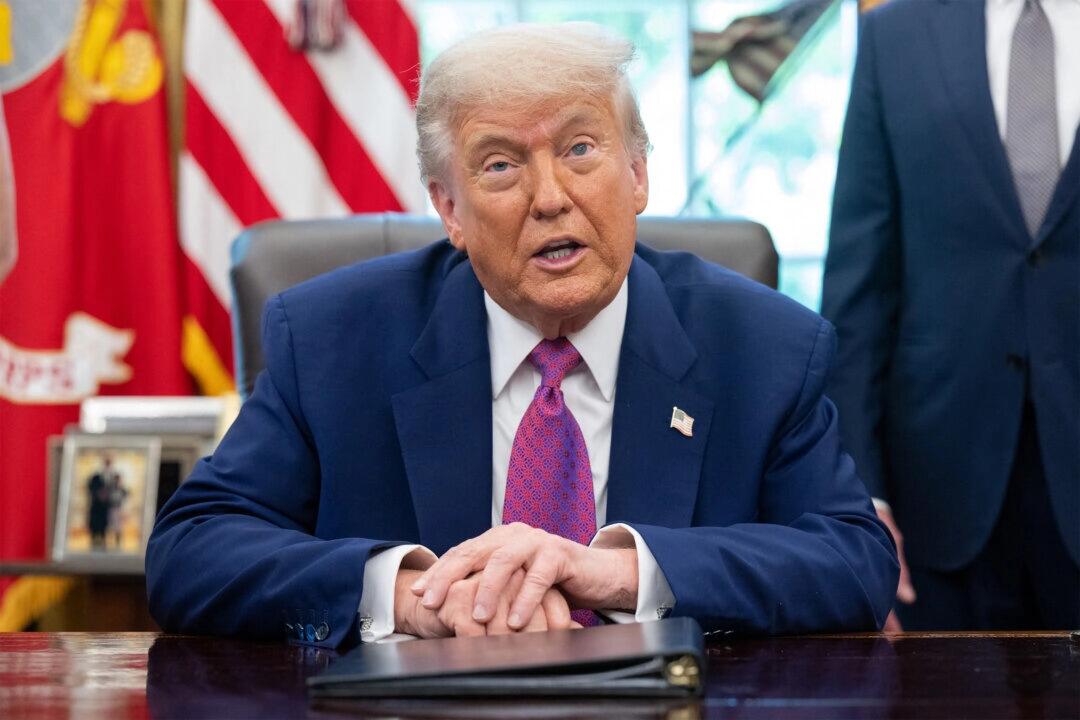
President Donald Trump on Aug. 28 proposed the cancellation of $4.9 billion in appropriated funds for foreign aid spending, using a maneuver that could effectively bypass the congressional approval process normally required to rescind the funds.
The funds were allocated to the Department of State and the U.S. Agency for International Development—which is in the process of being closed by the Trump administration—during the Fiscal Year 2025 appropriations process.
Under the Impoundment Control Act of 1974, the government must make a rescission request to Congress, which then has 45 days to approve the cancellation of appropriated funds. A “pocket rescission,” however, refers to such requests made within 45 days of the end of the fiscal year, which is Sept. 30. In these cases, the funds are withheld during the 45-day congressional review period, and if Congress doesn’t act before the fiscal year ends, the funds expire.
“Last night, President Trump cancelled $4.9 billion in America Last foreign aid using a pocket rescission,” the Office of Management and Budget, a cabinet-level agency in the Executive Office of the President, wrote on X on Aug. 29.
Pocket rescissions are uncommon, and the last one attempted was in 1983, when President Ronald Reagan sought to cut $2 million appropriated to the National Oceanic and Atmospheric Administration. Trump, during his second term, has successfully requested some rescissions from Congress. A rescissions bill canceling $9.4 billion in funding for foreign aid and public broadcasters was approved by Congress in July.
Rescission requests, when presented to Congress, may be enacted through legislation with simple majorities voting in favor in both houses, meaning that the minority has no leverage to stop or alter the process. Democrats in Congress, who are the minority in both houses, have thus protested against Trump’s rescissions, but often to no avail.
Senate Minority Leader Chuck Schumer (D-N.Y.) said in an Aug. 29 statement that the announcement of the administration’s rescissions plan “is further proof” that Trump and congressional Republicans are set on “rejecting bipartisanship and ‘going it alone’ this fall.”
The question of federal funding for initiatives is set to take center stage in national politics when Congress reconvenes on Sept. 2, when it will have just 28 days to approve 12 spending or “appropriations” bills to fund the government for fiscal year 2026. Every year since 1997, Congress has failed to pass all the bills in time, necessitating a “continuing resolution” to prolong spending at the previous year’s levels while negotiations on permanent bills continue.
It is unclear whether funds subject to a “pocket rescission” would be reactivated by a continuing resolution. The Office of Management and Budget did not immediately respond to a request for comment about the matter.
Chicago Mayor Going To War With Trump Over Possible Immigration Crackdown
Leftists in sanctuary cities and states are scrambling to stop Donald Trump’s deportation efforts, but is there anything they can realistically to to interfere with operations to remove illegal aliens from the US? Short of going to war with the federal government and a majority of the American public, the answer is no.
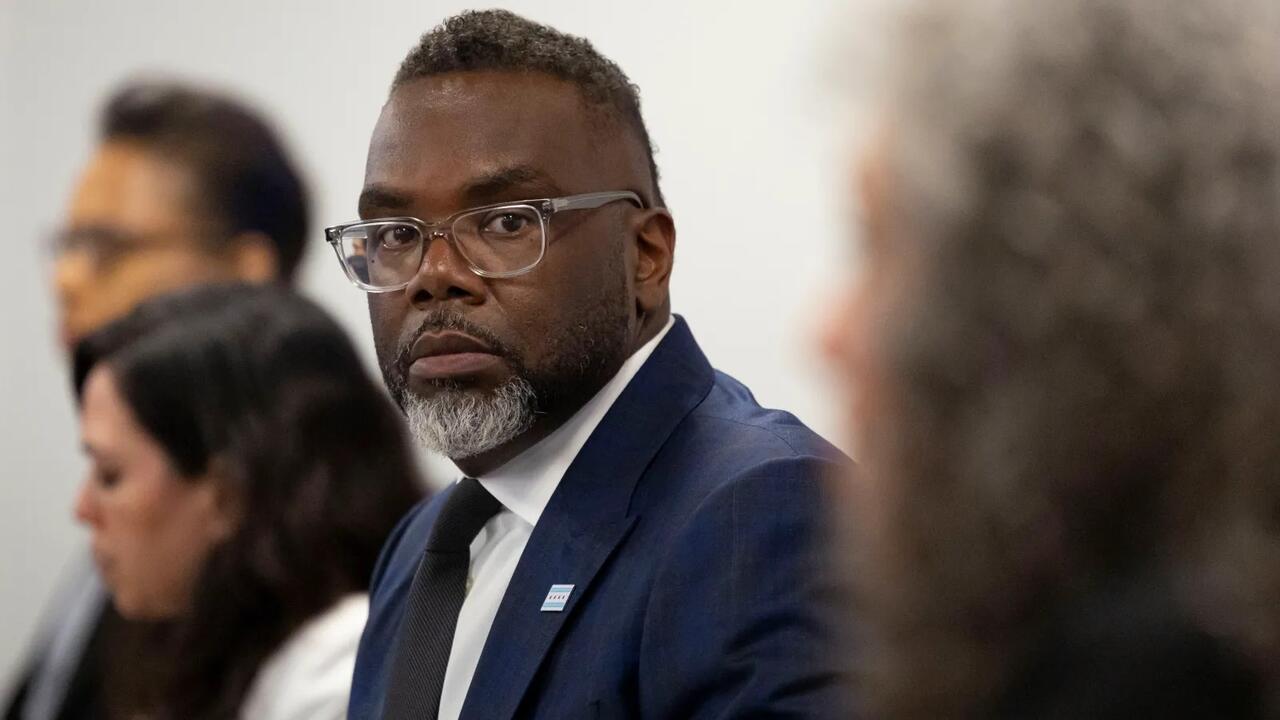
Chicago Mayor Brandon Johnson announced he is taking steps to fight President Donald Trump’s expected immigration crackdown and potential National Guard deployment in the Chicago area. Johnson signed the “Protecting Chicago” executive order on Saturday as the Trump administration prepares to conduct a major immigration enforcement operation, which could start as soon as next week.
Johnson had a glassy, wide-eyed look of fear as he signed his executive order, indicating that the far-left politician is probably aware that if he takes his interference too far he might end up in handcuffs just like the estimated 550,000 illegal migrants currently residing in Chicago.
Johnson’s order prevents any cooperation between local law enforcement and federal agents on the ground. It demands that federal agents operate without masks and that they display their names and badge numbers (an act that would expose them and their families to possible retribution by leftist activists). The mayor also directed an army of lawyers working for the city to pursue all legal and legislative avenues to bog down White House operations in the courts.
Johnson has also recently called for direct interference against ICE arrests and any National Guard presence by local activist groups.
Democrats like Johnson consistently call for actions to “defend their people” from federal sweeps, but illegal immigrants are not citizens of Chicago. They belong to no city or state, and they do not have a reasonable expectation of the same due process that Americans citizens have. Due process for an illegal immigrant under federal law is simply identifying that they are illegal, and then booting them out of the country.
This is why the Trump Administration has considerable latitude when it comes to mass deportations. Numerous Illinois officials including Governor JB Pritzker have admitted that there is very little they can do to prevent deportations. Ald. Ray Lopez, who represents the 15th Ward, believes the deployment of National Guard troops could help improve public safety and does not believe the mayor’s executive order accomplishes much.
“I believe that we already work with the federal government on multiple levels. This would be an enhancement to that, and there are safeguards in place, and there should be nothing stopping us from exploring those options. Look, if he president and mayor actually had a real conversation instead of talking at each other, maybe we could work some of this out…”
Thousands of Chicago residents, specifically in black communities, have complained about the immigration surge which has swallowed up jobs and housing in the city. Mayor Johnson’s voter base is against him.
The reason Democrats have been so insistent on defending illegal aliens is complex. First, mass immigration support the overall agenda of the political left to erase western culture and national borders in the long term.
Second, mass immigration allows blue states to gain political leverage through redistricting and the Electoral College by artificially pumping up population numbers in the census (the census does not currently distinguish between legal and illegal residents in the total population).
Third, Democrats have long sought to institute a mass amnesty bill which would make all illegals into voting citizens, thereby securing Democrat political power for generations to come.
Trump’s ICE operations are in direct conflict with the log running leftist agenda to hijack the US political system and make native born Americans into minorities in their own country. It should also be noted, for the people who whine constantly that Trump is “not doing enough”, that this is an example what his administration has to deal with on a daily basis. Democrats have chosen illegal immigration and open borders as the hill they want to die on and they are doing everything in their power to sabotage migrant removal.
In a case reminiscent of the underground prison break of Sinaloa cartel boss “El Chapo” Guzmán, a high-profile Chinese national code-named Chino — who prosecutors say trained Hispanic drug traffickers to operate on U.S. soil, and who has been described as one of the main suppliers of fentanyl and a financial architect for both the Sinaloa and Jalisco Nueva Generación cartels — has suspiciously escaped Mexican custody through a hole in a wall while under house arrest. According to President Claudia Sheinbaum, he had been on the verge of extradition to the United States.
Indictment documents identify him as Zhi Dong Zhang, born in Beijing in 1987, and describe “Chino” as approximately five feet seven inches tall, weighing 175 pounds. He bridged the Chinese and Mexican wings of cartel fentanyl networks — and, significantly, is alleged to have served as a rare operative between Mexico’s two largest rival trafficking groups, the Sinaloa and Jalisco Nueva Generación cartels.
Demonstrating the financial reach that underscores what national-security experts have told The Bureau — that Chinese networks exert significant influence over the cartels by controlling both money laundering and chemical precursor supply — Zhang was tied to “approximately 150 companies and approximately 170 bank accounts,” according to U.S. investigations.
Zhang, known also as “Brother Wang” and “Pancho,” is charged in the Northern District of Georgia with a series of narcotics and financial crimes, including conspiracy to import cocaine and fentanyl, conspiracy to distribute narcotics, and money-laundering conspiracies and monetary transactions affecting interstate and foreign commerce. The government’s 30-page detention motion, filed on July 11, 2025, lays out his alleged command role in a transnational network spanning Mexico, the United States, and China — a filing that came just weeks before Mexico extradited 26 cartel prisoners on August 12.
In the early hours of July 11, Zhang reportedly evaded National Guard members stationed outside his residence and slipped through a tunnel connecting his home in the Lomas de Padierna neighborhood to a neighboring property. According to reporting, three outsiders helped him flee — a maneuver quickly compared to El Chapo’s 2015 escape from the Altiplano prison.
Sheinbaum confirmed three weeks ago that Zhang had been “about to be extradited to the United States” when he escaped — an unusually frank admission of the diplomatic stakes.
Zhang was detained in an elite Mexico City neighborhood in October 2024 by federal forces acting on a U.S. extradition request. Despite the gravity of the charges, a Mexican judge allowed him to trade prison for guarded house arrest. The Attorney General’s Office is now investigating the guards and judicial officials assigned to protect him, Sheinbaum said.
El Universal reported that the company responsible for installing the electronic bracelet that Zhang broke free of was not certified to provide such security and that his escape bore the hallmarks of corruption and collusion.
Mexican media have reported that Zhang is allegedly responsible for trafficking more than 1,000 kilograms of cocaine, 1,800 kilograms of fentanyl, and over 600 kilograms of methamphetamine, generating an estimated $150 million annually in profits, with operations spanning the United States, Central and South America, Europe, China, and Japan.
According to U.S. court filings, Zhang directed the preparation of cocaine and fentanyl shipments in Mexico, arranged smuggling into the United States by couriers using vehicles and aircraft, and managed logistics once the drugs arrived. He also oversaw underground “stash house” cash brokerages where cartel proceeds were collected, counted, and deposited into major U.S. banks, including JPMorgan, Wells Fargo, Bank of America, and Chase. Distribution points, prosecutors allege, stretched from Georgia and California to Illinois, Ohio, Texas, North Carolina, New York, and Michigan.
In the government’s telling, Zhang functioned not only as a financier but as a corporate manager — orchestrating narcotics supply and laundering networks across multiple continents, while directing associates in Atlanta to train Hispanic couriers to make structured cash deposits into U.S. financial institutions.
A raid on one California stash house revealed “approximately 150 companies and approximately 170 bank accounts that were connected to Zhang’s organization through wire transfer records and corporate registration information,” indictment filings state, leading detectives to “approximately USD $20 million in proceeds that were deposited into bank accounts controlled by Zhang’s organization in 2020 and 2021.”
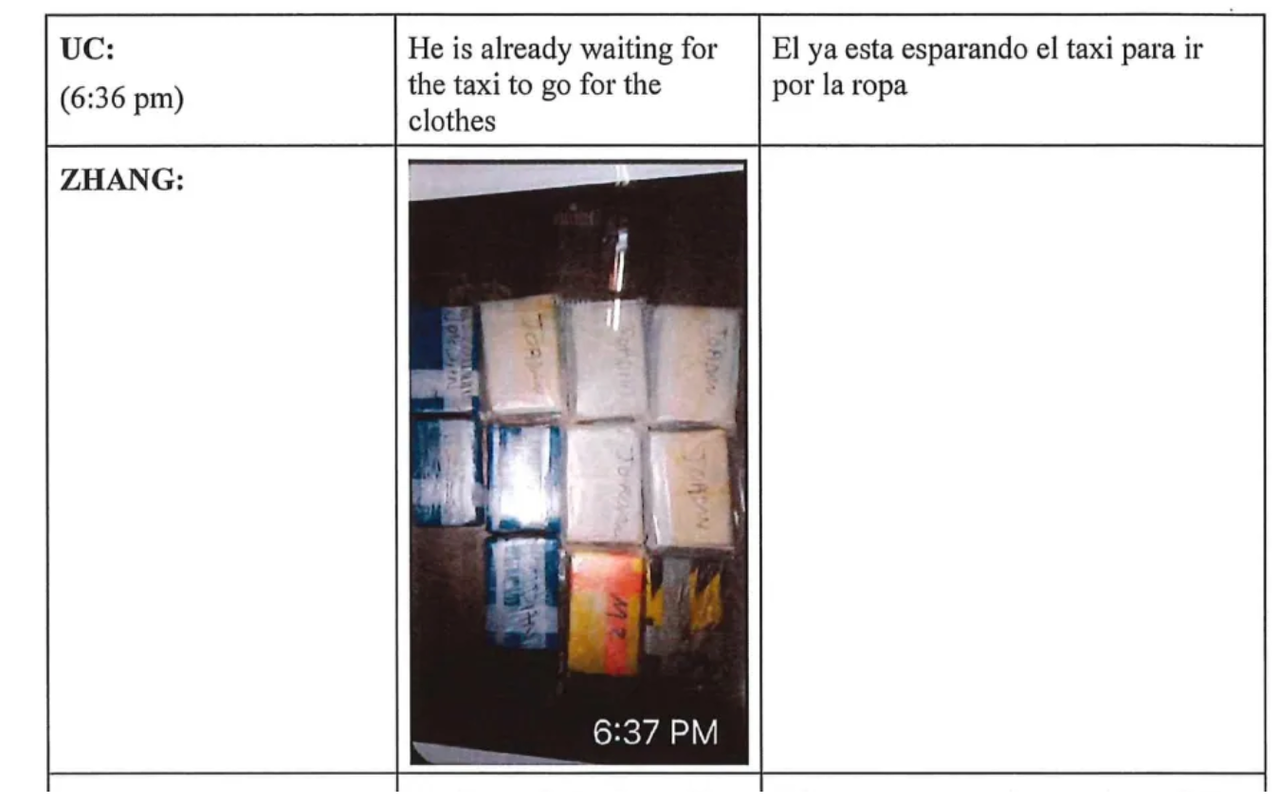
Through the interception of encrypted communications on DingTalk, WeChat, and Signal, and admissions by a cooperating conspirator, investigators learned that Zhang served as the critical bridge between two arms of his operation: a Mexican wing responsible for collecting drug proceeds directly from traffickers, and a Chinese wing tasked with laundering the money through bulk cash smuggling, bank deposits, and wire transfers. The evidence portrays Zhang in a command-and-control role, linking fentanyl suppliers in mainland China to the cartel logistics network in Mexico. U.S. national-security experts have separately warned that China’s chemical sector — including operators with Chinese Communist Party ties — has been subsidized to produce and export precursor chemicals critical to fentanyl production, providing the geopolitical backdrop to Zhang’s activities.
Experts such as former DEA Special Operations Division investigator Donald Im told The Bureauthat operators at Zhang’s level often maintain significant ties to the Chinese Communist Party — both through underground banking and money-laundering networks, and through privileged access to state-regulated precursor chemical supplies.
In an unrelated post today, responding to a New York Times investigation on Chinese election-interference networks in New York City, former CIA analyst Peter Mattis asserted that the CCP “is comfortable with criminality” and linked its operations to drug-trafficking cases. “We also have the CCP’s export of fentanyl precursors as a matter of national policy via VAT rebates,” Mattis wrote, citing U.S. congressional investigations and testimony.
California Stash Houses Reveal Cartel Cash in U.S. Banks
In March 2021, detectives raided the residence of a cooperating conspirator in Rowland Heights, California, uncovering a stunning cache of evidence that laid bare the financial backbone of Zhang’s network. Inside, authorities found hundreds of documents tied to Zhang’s organization: folders containing names, aliases, IDs, passports, corporate registrations, bank records, SIM cards, and post office keys. Many paired photographs with bank accounts investigators later confirmed as belonging to Zhang’s associates. The cache revealed at least 25 accounts used to launder cartel proceeds, anchoring the probe that traced drug money from Mexican traffickers through Zhang’s Chinese laundering arm and into the U.S. banking system.
The indictment details Zhang’s financial footprint. On July 20, 2020, $35,000 and $20,000 were deposited into JPMorgan Chase accounts and $80,000 into a Wells Fargo account, all linked to Zhang’s front company Mnemosyne International Trading, Inc.; on December 2–3, 2020, additional deposits included $35,000 into Bank of America, $65,000 into another Chase account, and $50,000 each into two more Chase accounts. Federal forfeiture schedules list seizures of more than $431,000 from a Citibank account, $145,000 from First Citizens Bank, $52,000 from Wells Fargo, and additional tens of thousands from Bank of America and Chase accounts — all alleged narcotics proceeds.
In August and September 2021, acting at Zhang’s direction, a cooperating conspirator leased five more stash houses and two vehicles across California — in Los Angeles, Rowland Heights, Diamond Bar, Alhambra, and Monterey Park — for drug and laundering operations, later training an associate known only as “Willy” to manage them.
Court records also detail surveillance of a July 2020 Atlanta operation in which $100,000 in cartel cash was delivered to one of Zhang’s associates, Jesus Miranda Cota. Authorities observed Cota make structured deposits: $35,000 into a Chase account, $80,000 into Wells Fargo, and another $20,000 into the Chase account.
In January 2022, investigators say Zhang expanded further. While in Hermosillo, Mexico, he recruited another conspirator, “CC-2,” introduced by Willy. In intercepted messages, Zhang and CC-2 discussed shipments into Atlanta, including one initially set at 15 kilograms of cocaine and one kilogram of fentanyl, later adjusted to 10 kilograms of cocaine and one kilogram of fentanyl. In these encrypted exchanges, Zhang used coded language, referring to fentanyl as “coffee” and cocaine as “food.”
Zhang is now considered a high-priority fugitive from U.S. justice. Interpol has reportedly issued a red notice.
Southwest First To Fly With Secondary Cockpit Barriers – Almost 24 Years After 9/11
Over the past year, long-unique Southwest Airlines has been announcing big changes to its boarding and checked-baggage policies that will make it much like every other airline. However, the carrier distinguished itself from the field on Friday by pioneering the use of secondary cockpit barriers — something pilots, flight attendants and 9/11 family members have been demanding since 2001.
In 2023, the FAA issued a final rule requiring that all newly-delivered commercial aircraft be equipped with a secondary barrier on the flight deck, to bolster security when the main cockpit door is opened during flight for food service and lavatory breaks. The rule only applies to new aircraft — there’s no requirement for airlines to retrofit their existing fleets. To comply with FAA regulations, the so-called “installed physical secondary barriers” mustdelay would-be hijackers from advancing into the cockpit “long enough so that an open flight deck door can be closed and locked before an attacker could reach the flight deck.”
While the original FAA deadline was set at Aug 25, 2025, last month the FAA moved the deadline back by a year, to Aug. 25, 2026. The trade group that represents major US carriers had requested a two-year delay, pointing in part to the fact that the FAA had not yet certified any secondary-barrier designs. While the Air Line Pilots Association had pressed the FAA to “reject this latest stalling tactic,” the FAA granted a postponement.
On Friday, however, an aviation-safety milestone was achieved when a Southwest flight from Phoenix to Denver used a brand-new Boeing 737 MAX 8 equipped with a secondary barrier. While Southwest’s design and location specifics haven’t been publicized, the broader concept centers on lightweight, retractable security gates that separate the passenger cabin from the area outside the cockpit door and lavatory door. “We felt like we could get it done and put it in production as soon as the aircraft was ready,” said Southwest EVP for operations Justin Jones.
Ever since terrorists took over the cockpits of four airliners on 9/11, pilot and flight attendant unions — bolstered by activism of women who became widows when their husbands were killed as they piloted airliners on 9/11 — have been pressuring Congress and the FAA to institute a secondary-barrier requirement to counter cockpit vulnerability when reinforced cockpit doors are opened in mid-flight. In the meantime, flight crews have been creating secondary barriers of their own, using galley carts to block the aisle on the front of the passenger cabin. However, as this dramatization from a CBS “Seal Team” episode demonstrates, a galley cart is far less effective than a floor-to-ceiling gate:
Last year, under pressure from investors, Southwest announced it will abandon its decades-long open-seating policy, by which passengers take whatever seat is available when their boarding group enters the plane. Assigned seats are now in force for flights on or after Jan. 27, 2026. In another move that erased a major differentiator, the Dallas-headquartered carrier next killed its “bags fly free” policy, by which all passengers could check two bags at no charge. “Free” checked bags will continue as a perk for certain ticket classes and rewards-club members.
Southwest last week announced it will stop being the airline of choice for fat people, requiring them to buy a second seat if their blubber or limbs “encroach on the neighboring seat.” That change also takes effect on Jan. 27. Southwest has been giving plus-size passengers an option of either buying an extra seat in advance and requesting a refund for it later, or asking for a free extra seat at the airport. Under the new rule, they’ll still have some chance of being refunded, but only if the flight wasn’t fully booked at departure, and only if both tickets are in the same booking class.
Tigress Osborn, executive director of the Western civilization-corroding National Association to Advance Fat Acceptance, told the New York Times the change is “devastating” for her people, lamenting that “Southwest was the only beacon of hope for many fat people who otherwise wouldn’t have been flying, and now that beacon has gone out.” If so, that could translate into fuel savings for Southwest.
Smith College product Tigress Osborn, of the National Association to Advance Fat Acceptance, finds Southwest’s new plus-size passenger rules hard to swallow
Having imposed that visual on our treasured readers, let us compassionately conclude with a stark contrast from Southwest’s glorious past:
Missouri Governor Calls Special Session For Redrawing Congressional Map
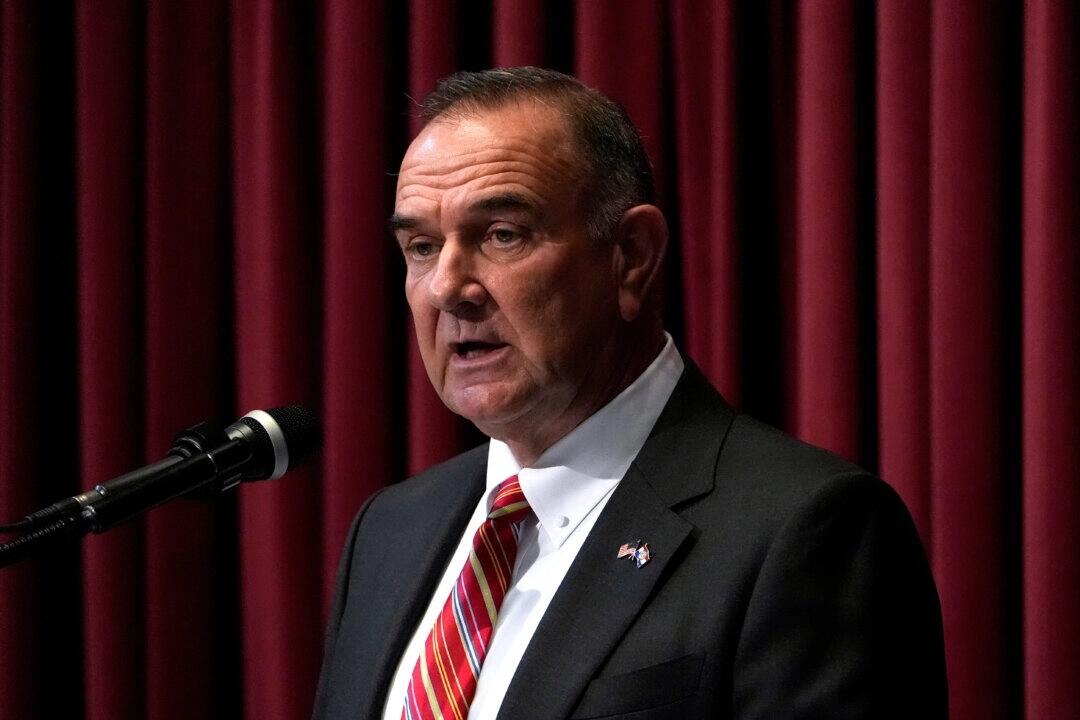
Missouri Gov. Mike Kehoe announced on Aug. 29 that he was calling state lawmakers back to the capital for a special session tasked with redrawing the congressional district lines ahead of the 2026 election.
His announcement came just hours after fellow Republican Texas Gov. Greg Abbott signed into law Texas’s new congressional voting map, setting the stage for the GOP to gain five more seats in the House of Representatives.
Scheduled to begin Sept. 3, T.J.Muscaro reports for The Epoch Timesthat Missouri’s redistricting also appears to give Republicans help in the coming midterms, as Kehoe’s proposed map looks to stretch a Kansas City-area district – currently held by Democratic Rep. Emanuel Cleaver—into Republican-leaning rural areas.
“Missouri’s conservative, common-sense values should be truly represented at all levels of government,” Kehoe said in a statement.
Cleaver is one of two current Democratic-controlled districts in the state. The other is in St. Louis, held by Rep. Wesley Bells. There are six total congressional districts in Missouri.
Cleaver decried the decision to alter his district in a statement.
“This attempt to gerrymander Missouri will not simply change district lines; it will silence voices. It will deny representation,” he said.
The state’s Democratic House Minority Leader Ashley Aune also spoke out against the change, accusing Kehoe of looking to “steal a congressional seat for Republicans.”
However, Missouri Democrats are unlikely to stop their Republican colleagues from passing the new map.
While they could filibuster in the Senate, Republicans have procedural means to shut it down, and the number of Democrats is too small for their absence to prevent a quorum.
Meanwhile, California’s Democratic Gov. Gavin Newsom is asking voters to approve a new congressional map that seeks to help his party win five seats as a response to Texas’s new map favoring Republicans.
It passed the lower state Assembly by a vote of 57–20, and then the state Senate in a 30–8 vote on Aug. 21. It was signed into law by Newsom about 30 minutes after the legislature approved it. California voters will get their say on Nov. 4.
There are redistricting movements being considered in other states as well, including Florida and Indiana, where Republicans look to gain an advantage, as well as Illinois, Maryland, and New York, where Democrats seek to further expand their foothold.
Republicans won a 220-215 majority over Democrats in the House of Representatives in 2024. Democrats will need to net three seats in November 2026 in order to reclaim the lower chamber.
Missouri’s special session will also consider a constitutional amendment that would increase the difficulty for citizen-initiated ballot measures to be approved. Current ballot measures resulted in the abortion and marijuana legislation amendments that were adopted by the state in recent years.
Almost weekly in the United Kingdom, the Netherlands, France, and Germany, a sensational assault committed by an illegal migrant — often enjoying some sort of state support or with prior arrests for the same crime — surfaces.
Until recently, European politicians and the media sought to either ignore such news or accuse those who clamored for tighter borders, more police protection, and stiffer penalties of being “racists” or “xenophobes.”
Until recently, that is.
Mass protests are now common in Britain against the Labour Party’s open borders policies and generous welfare entitlements for immigrants who arrive illegally and without authentic “political refugee” status.
Greek officials, also swamped by illegal immigration, now cite President Donald Trump’s secure border policies as new models for their own.
The majority of European immigrants now come from majority-Muslim countries in the Middle East and North Africa. Yet many arrivals seem angrier at their newfound liberal hosts than at the dictatorships they fled back home.
Europe’s immigration policies will not work in a multi-ethnic democracy.
Too many immigrants are arriving too quickly, without sufficient diversity, language fluency, skills, or familiarity with the customs and culture of their host nations. They often enter with separatist religious and cultural values antithetical to the very place they seek refuge.
Yet, there is no European plan of civic education to assimilate immigrants and teach them the rules, laws, and culture of their hosts.
It is then no surprise that what follows is ghettoization, resentment, and loud attacks on the very nation in which they seek sanctuary, denouncing it as decadent and godless.
In the past, Europe’s anemic military budgets, reliance on borrowed money, socialism, and a once-strong economy papered over these existential challenges of illegal immigration.
Or, as left-wing former German chancellor Angela Merkel once inanely said of massive illegal influxes into Europe, “Wir schaffen das” (“We can do this”).
But, of course, Merkel could not.
She offered zero plans on how to integrate, assimilate, and acculturate millions of Europe’s illegal aliens. Now, some 15 percent of Germany’s population are foreign nationals.
Unfortunately, the statist economies of high-cost Europe are stagnating.
Massive welfare outlays, coupled with a shrinking and aging native population — with a birth rate sinking below 1.4 — are finally slowing economic growth.
Current German Chancellor Friedrich Merz put the dilemma bluntly: “The welfare state as we have it today can no longer be financed with what we can economically afford.”
Yet the more socialism ossifies, the more popular culture still demands free benefits that a shrinking number of taxpayers can no longer provide.
The United States is finally taking the opposite approach of cracking down on illegal immigration, deregulating the economy, and unleashing high technology to fast-track new frontiers of artificial intelligence, robotics, cryptocurrency, and genetic engineering.
Often, Europe’s best and brightest — and frustrated — are migrating to greater opportunities and freedom in the U.S., further hampering European research and development.
Europe foolishly adopted a self-defeating energy policy to achieve net-zero emissions by subsidizing inefficient wind and solar power while ignoring or shutting down far cheaper natural gas, nuclear, and coal-powered electrical generation.
Meanwhile, China, grinning like a Cheshire cat and caring little about its carbon footprint, is eagerly exporting wind and solar systems to the suicidal West.
Yet China itself is busy building about two massive coal-fired plants a month, and the largest and most environmentally disruptive hydroelectric projects in the world.
No wonder average European electricity costs are even steeper than those in failing California. European consumers often cannot afford to turn their heaters and air conditioners on, while businesses cannot compete with industries abroad that enjoy far cheaper power.
Trump has declared that the 80-year postwar order is calcified and that the U.S. will no longer run huge trading deficits with European Union nations. Instead, it will demand symmetrical tariffs, further challenging past European mercantile profitability.
The days of Europe disarming and relying on the United States for defense are also over, given that Russian leader Vladimir Putin, for the third time in 15 years, invaded a neighboring country.
Yet Ukraine is not Chechnya or Georgia, but instead on the doorstep of Europe.
So in panic, a perennially delinquent NATO is not only promising to spend the required 2 percent of GDP on defense but also increasing arms budgets to 5% of GDP, a higher rate even than that of the U.S.
No one knows how Europeans will afford such massive rearmament.
To do so would require opening up their economies, adopting far more flexible and traditional energy policies, securing their borders, ending illegal immigration, pruning the welfare state, increasing their fertility rates, and dropping the DEI salad bowl while re-embracing the melting pot of integration and acculturation.
We will soon see whether Europeans can adopt such needed reforms, or find the necessary medicine worse than their current crippling continental disease.
Homeland’s Noem Fires 24 FEMA Employees After Data Breach
Homeland Security Secretary Kristi Noem has fired 24 workers at the Federal Emergency Management Agency (FEMA) after a cyber breach threatened national security, she announced on Aug. 29.
A cyber hacker breached FEMA systems, but no sensitive data was taken from any Department of Homeland Security (DHS) networks, the department reported. FEMA is an agency within the DHS.
FEMA’s chief information officer, chief information security officer, and 22 other IT employees allegedly responsible for the security failure were immediately terminated.
The Epoch Times’ Jill McLaughlin reports that Noem accused longtime employees of working to prevent DHS personnel from solving the problem and downplaying how bad the breach was when DHS stepped in to fix the issue.
While conducting a routine cybersecurity review, the DHS’s chief information officer discovered “significant security vulnerabilities” that gave a hacker access to FEMA’s network.
“The investigation uncovered several severe lapses in security that allowed the threat actor to breach FEMA’s network and threaten the entire Department and the nation as a whole,” the DHS reported.
Noem had ordered the review of all of FEMA’s operations and IT systems, according to DHS.
The alleged failures included an agency-wide lack of multi-factor authentication, use of prohibited legacy protocols, failing to fix known vulnerabilities, and inadequate operational visibility.
FEMA spent nearly half a billion dollars on IT and cybersecurity measures in fiscal year 2025.
News of the FEMA security breach and the firings came days after nearly 200 current and former FEMA employees signed a declaration protesting the Trump administration’s disaster response changes.
The employees published a petition to Congress, arguing FEMA is under the leadership of people “lacking legal qualifications, Senate approval, and the demonstrated background required of a FEMA Administrator.”
U.S. Secretary of Homeland Security Kristi Noem speaks after signing a letter of intent with Chilean Minister of Public Security Luis Cordero for a Biometric Identification Transnational Migrant Alert Program (BITMAP) at the Ministry of the Interior in Santiago de Chile, Chile, on July 30, 2025. Noem announced the firing of two dozen FEMA employees following the discovery of a security breach at the agency on Aug. 29, 2025. Alex Brandon-Pool/Getty Images
The employees alleged that FEMA’s senior officials and Noem hinder the agency’s mission. The declaration also told Congress that the alleged inexperience of Trump’s appointees could lead to another catastrophe similar to Hurricane Katrina in 2005, which claimed nearly 1,400 lives in New Orleans and along the Gulf Coast of Louisiana and Mississippi.
Early in his second term, Trump criticized how FEMA manages its disaster response and suggested he would consider eliminating or significantly overhauling the agency. He said it would be more efficient for states to handle such responses locally.
The president also ordered the creation of a review council for the agency, citing concerns of political bias in the wake of how it handled Hurricane Helene’s aftermath last year.
Noem said on July 13 that the Trump administration was working to remake the agency, rather than dismantle it.
A dark theory for the evening. Let’s talk about Russian strategy in Ukraine.⬇️
Looking at developments lately, specifically: (1) the Ukrainian casualty leak showing an astronomical 1.7M KIA/MIA; and (2) the Ukrainian collapse north of Pokrovsk – I thought should revisit a dark… pic.twitter.com/uOvB2gJEvX
(1) the Ukrainian casualty leak showing an astronomical 1.7M KIA/MIA; and
(2) the Ukrainian collapse north of Pokrovsk
I thought should revisit a dark thought I had a while ago, namely that, “maybe the killing itself is the point of all of this.”
I’ve said before that the Russians have fought an extraordinarily clean war in Ukraine, but it should be understood that there is a very legalistic shade on that assessment.
They’ve killed very few civilians, and Ukrainian propagandists are perpetually beclowning themselves trying to pretend that the usual single-digit handful of injured civilians that accompany the latest attack using hundreds of standoff weapons fired into city centers (producing secondary explosions visible from outer space as military targets hidden among civilian infrastructure are destroyed with surgical precision) somehow constitute gEnOCiDe rather than some of the most well-controlled warfighting in the history of the business.
There is another and far darker side to Russia’s “clean” war, however.
Let us consider the fate of the Armed Forces of Ukraine – legal combatants all, whom the Russians can and do target and kill without limit. I mentioned the casualty leak earlier, but I feel this needs to have a line drawn under it – one point seven million personnel killed or missing in action in the AFU, over the course of the war. 1.7 MILLION. Seven or eight percent of Ukraine’s prewar population, probably something like a quarter of the entire national cohort of military-aged males, dead or missing. Casualties on the scale of a genocide, sufficient to permanently cripple any postwar Ukrainian nation.
Casualties multiple times that which I assessed two years ago as sufficient to shatter the AFU based on the experience of Nazi Germany.
This brings me to the Ukrainian collapse north of Pokrovsk two weeks ago, in which a run-of-the-mill Russian attack walked through twenty kilometers of Ukrainian defensive belts and into open country.
The Ukrainian propagandists coped by whining about how the single most important front sector for the AFU had somehow “run out of infantry.”
But did the Russians throw in a mobile reserve to collapse the front and chase the AFU back to the Dniper, despite doubtless knowing full well what was going on? No, they did not – they consolidated in the breach and awaited the inevitable, panicked Ukrainian counterattack, in which they would have the opportunity to destroy Ukraine’s remaining elite troops.
Which brings me to my conclusion.
The Russians have had countless opportunities to make large advances in this war, especially recently – the Ukrainian front line is an absolute shambles and their “drone wall” tactic will falter against any serious attack. So ineffectual is the AFU that very few Russian moves at the front even face serious opposition these days, with most geolocations of Russian advances showing them already established in place and dealing with harassment by kill drones after having seized positions bloodlessly. The Russians have in fact consistently foregone breaking the front and taking swathes of ground in favor of killing the largest possible number of Ukrainian soldiers on the existing front line under the existing attritional combat dynamic.
This “tactical directive” held true even during the Battle of Sudzha-Korenevo, fought in prewar Russia. Rather than counterattacking aggressively to evict the AFU, the Russians saw the opportunity to kill gigantic numbers of Ukrainians in a trap the enemy wouldn’t be able to extract themselves from for ideological reasons, and they took it. That battle ended up being nine months of hideously lopsided butchery that broke the back of the AFU.
All of this makes observing the war more than a little maddening, but it’s a consistent pattern of behavior that begs for explanation.
So here’s my theory.
The Russian government has consistently sought to end the war via peace treaty with the existing Ukrainian government, not via regime change, outright conquest, or even killing enough of that government to find a more flexible interlocutor among the Maidanites. Putin apparently wants a treaty with Zelensky. The Russians have also consistently made demands of the Ukrainian government – and its NATO sponsors – that are absolute political nonstarters for the Maidan-era regime and which that regime, by its very nature, simply cannot accept. Russian language rights, Orthodox religious rights, demilitarization, large territorial concessions which would see the AFU surrender vast urban areas without a shot fired. And yet the Russians insist, and they’re going to continue killing Ukrainian soldiers at ever-more lopsided ratios until they get their way.
Which leads me to the brutal conclusion: Putin doesn’t want to see Ukraine conquered. He’s never publicly expressed any desire for that.
The consistent Russian policy is instead to see Ukraine – a “free” and “independent” Ukraine, having come to this impasse of its own sovereign will – utterly humiliated.
Putin wants to make Zelensky put on a suit, come groveling to the Kremlin, and sign a treaty that will see the Maidanite government surrender its arms, disgorge huge amounts of territory, and reverse every single anti-Russian policy position it ever had.
Ukrainian nationalism will be discredited overnight by the hands of those very nationalists, and the economically irrelevant, demographically shattered rump state will be sucked back into Russia’s political orbit in a matter of days.
So of course the Russians are only advancing in the most leisurely way possible.
Their goal is to place the Ukrainian government into a militarily untenable situation so as to force a flamboyantly humiliating peace treaty upon them that includes large territorial concessions beyond the line of control – the ultimate Ukrainian taboo – so as to discredit Ukrainian nationalism by the hands of the very ultranationalists who took their nation to war in the first place.
This is part of Reason‘s 2025 summer travel issue. Click here to read the rest of the issue.
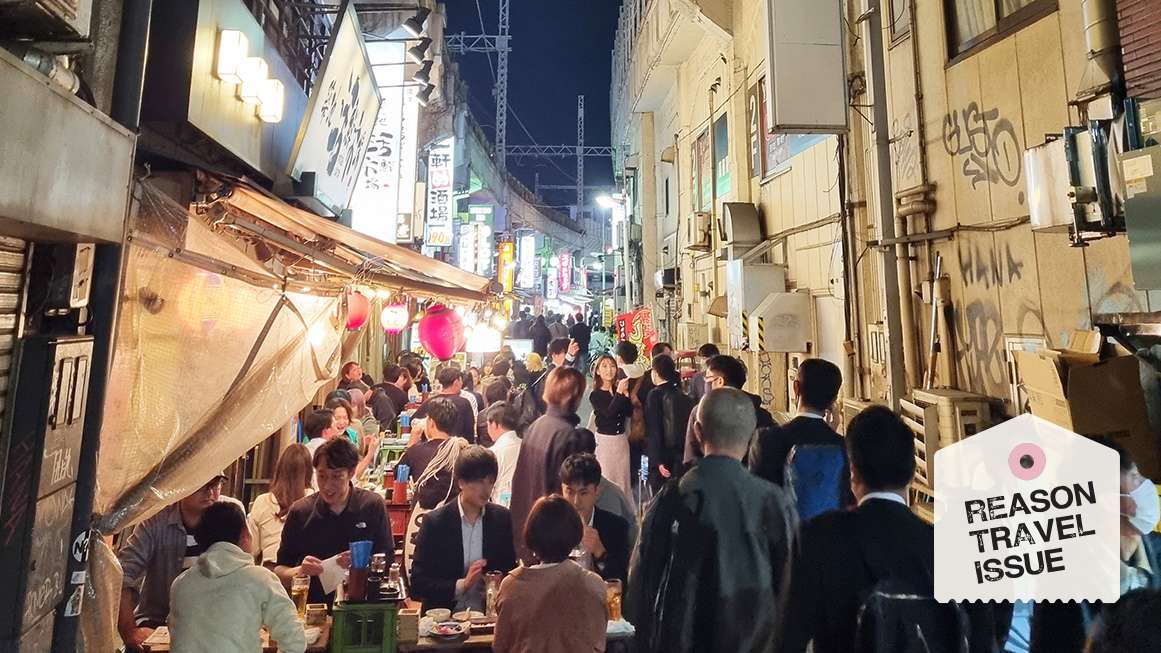
A three-story house tucked into a mere one-meter gap between tall buildings. A flower shop shaped like a triangle, wedged between a retaining wall and the sidewalk. A standing bar humming with laughter beneath the rumble of passing trains. In most cities, these spaces would be dead zones—awkward, overlooked, written off by zoning and building codes as unusable.
But in Tokyo, they bloom with life. These microspaces are amenities. They’re capitalism in the cracks, not just in form but in function.
These strange slivers often become homes for new ideas: a two-person bar, a bookstore barely wider than a fridge, a late-night shop that opens on a whim. They invite experimentation, economic as well as architectural.
Tokyo’s ability to cultivate these spaces isn’t just a cultural quirk. It’s a byproduct of a city that leaves room for improvisation, that adapts to its imperfections, and that transforms constraints into creativity. These spaces reveal what is possible when cities loosen their grip on regulations—when policy becomes an enabler, not a gatekeeper. They offer a glimpse of what urban life could look like if more places embraced flexibility.
Tokyo’s urbanism emerged more than it was planned. Most of its neighborhoods weren’t drafted in a planner’s office. They were shaped incrementally by individuals responding to need and opportunity.
Modern Tokyo is a city born from ruin. After the devastating bombings of World War II, with little funding available for formal reconstruction, residents rebuilt on their own—using salvaged materials to create homes on the ruins of old neighborhoods. Over time, the government stepped in to connect and formalize what had already taken shape. The result is a dense, oddly beautiful patchwork: irregular lots, winding streets, and spaces so small that most cities would ignore them. But Tokyo doesn’t.
There are at least three varieties of microspaces here: pet architecture, yokochos, and undertrack infills.
***
Of all of Tokyo’s urban quirks, few are as endearing—or revealing—as pet architecture.
Coined by the architectural firm Atelier Bow-Wow, the term describes buildings that are “unusually small, humorous, and charming”: little pets in a city built for human beings. Awkwardly shaped and impossibly tiny, they defy conventional notions about how much space is necessary for any given use.
You might stumble upon a rubber stamp store crammed into a leftover triangle of land between a train line and the road in Nakano. A one-meter-wide real estate office in Shimokitazawa. A tiny bakery that somehow fits between a wall and a utility pole in Koenji. These are buildings that shouldn’t exist, but they do.
In many cities, spaces like these would be rejected outright as unusable. They’d run into a wall of regulatory barriers: minimum lot sizes, minimum unit sizes, parking mandates, and zoning codes that separate uses into rigid slots—residential here, commercial there, industrial somewhere else.
Omoide Yokocho; Katarina Hall
But in Tokyo, they’re opportunities. They challenge bureaucratic assumptions about what buildings are supposed to look like. As the Atelier Bow-Wow architect Yoshiharu Tsukamoto has put it: “They illustrate unique ideas with elements of fun, without yielding to unfavorable conditions.” Pet architecture is playful, it’s resourceful, and it’s all over the city.
***
Yokocho literally means “side street” or “alleyway.” In Japan, it means something more: narrow lanes filled with tiny bars and restaurants. Usually found near train stations or commercial centers, these narrow streets range from just 1.3 to 2.8 meters wide—narrow enough to stretch out your arms and touch both walls, too tight to meet code in most U.S. cities. Inside, you’ll find bars the size of walk-in closets, seating six to 12 patrons and often run by a single staffer.
Yokochos emerged after World War II as black markets. They were improvised stalls selling basic goods. Over time these stalls became food joints and drinking dens, and eventually they were fixtures of Tokyo’s urban landscape.
The Golden Gai district in Shinjuku packs more than 200 tiny bars into six alleyways in an area smaller than a city block. (It’s the kind of setup a North American fire marshal would never allow.) Most buildings are two stories high, with steep staircases leading to completely different experiences upstairs. Want a fancy whiskey bar? It’s there. A horror movie–themed bar? Absolutely. Hospital-themed? Erotic fetish? Retro video games? A quiet library bar? They have all of the above. All unique. All impossibly small.
Nearby, on the other side of Shinjuku station, the Omoide Yokocho district is known for late-night yakitori (chicken skewers) and drinks, with around 80 shops squeezed into a single alleyway. In Shibuya, Nonbei Yokocho—or “Drunkard’s Alley”—crams 40 shops into spaces barely two meters wide. And in Ebisu, Ebisu Yokocho sits in a covered passageway built on the remnants of a former shopping center that houses izakayas (Japanese pubs) ranging from 10 to 16.5 square meters, serving everything from grilled fish to okonomiyaki to oden.
So beloved are these places that developers have recreated them inside modern buildings. Shibuya Yokocho, a sleek version inside the Miyashita Park complex, mimics the feel of the real thing, with curated chaos, shared tables, and dishes from every prefecture in Japan.
Nostalgia aside, yokochos are more than relics. Their size, affordability, and independence make them incubators for creativity and entrepreneurship.
***
Tokyo’s rail system is everywhere—and wherever there are train tracks, there are gaps. In many cities, these would be fenced off. In Tokyo, they’re filled with life.
Like yokochos, many undertrack infills began as black markets after the war. What were once dusty, makeshift stalls have since evolved into hubs of commerce and dining.
Near Ueno Station, izakayas nestle underneath and between train lines. You can sit shoulder-to-shoulder with salarymen, sip a highball, nibble on sashimi, and watch the trains pass overhead.
A few blocks from there is Ameyoko, a market wedged beneath the Yamanote Line between the Okachimachi and Ueno stations. It’s a sensory overload: cosmetics, spices, fresh seafood, and cheap street snacks packed into a narrow pulsing corridor under the tracks.
A few stops away on the Yamanote Line, in Yurakucho, rows of cozy restaurants and standing bars are tucked into the arches beneath the tracks. Some are linked by narrow alleyways that run under the railway itself, connecting one lively pocket to another. At around 6 p.m., the lights come on, the smoke rises, and the area fills with after-work revelers grabbing food and drinks before catching their train home.
What unites these undertrack infills is their uncanny ability to turn infrastructure into opportunity. Instead of ignoring the voids created by transit, Tokyo builds into them.
To understand why Tokyo looks the way it does, you have to start with zoning. Zoning laws determine what can be built and where—homes, shops, factories, or nothing at all.
In the U.S., zoning is local. Each city or county writes its own code, but most follow similar templates. Neighborhoods are typically residential, commercial, or industrial, with little room for overlap. The rules are rigid. It’s often illegal to run a small business out of your home or to build on a lot deemed too small. Any change of use typically requires hearings, permits, consultants, and months—maybe years—of paperwork. It’s a large bureaucratic system that tends to push out small, experimental, or unconventional uses.
Japan takes a different approach. The same zoning system applies nationwide, from Tokyo’s densest neighborhoods to the smallest rural town. The rules are meant to maintain the scale of buildings, preserve sunlight access, and prevent fire hazards.
Ueno; Katarina Hall
Instead of rigid land-use rules, Japan uses a set of 12 flexible zoning categories, arranged on a spectrum from residential to commercial to industrial. These are broad guidelines, not strict prescriptions. Within them, landowners are largely free to decide how to use their space.
Take Category 1, officially designated as “exclusively residential.” In practice, that doesn’t mean only homes can be built. Small shops, dental clinics, hair salons, and day cares are all permitted. What’s prohibited are large, disruptive developments. You won’t find a department store in Category 1, but you might find a ramen shop on the ground floor of someone’s home.
Each zone builds on the one before it. If something is allowed in Category 1, it’s automatically allowed in Categories 2 through 12. The only major exception is strictly industrial areas. Elsewhere, layers of possibilities build on each other, allowing for the kind of vibrant, fine-grained mixing of activities you see in Tokyo.
Japan also avoids rules that would make small-scale development impossible. There are no minimum lot sizes. Small parcels can be freely subdivided. Building heights are based on road width, not a fixed number. And it’s legal to run a business out of your house. The result is a city that allows for increasingly complex and nuanced configurations.
The rules are more like scaffolding than a straitjacket. They set the frame, but decisions are left to property owners, architects, and builders.
This flexibility has made Tokyo radically adaptable. It makes space not just for small businesses but even smaller microbusinesses. If you have an idea and a few square feet, you can start something without hearings or expensive consultants.
“There are a lot of ways in which not only zoning but other pieces of the puzzle all come together to encourage these experimental, intimate, small-scale mom-and-pop businesses,” explains Joe McReynolds, an urban studies scholar at Keio University’s Almazán Architecture and Urban Studies Laboratory. “There’s a lot of tilt in the regulations toward small businesses,” he says, from lower taxes and simpler food safety rules to the relative ease of getting a liquor license.
Gap House; Nicholas Kane
Tokyo may be unique, but you can sometimes spot a glimmer of flexibility even in cities with heavy-handed planning systems.
Take London. With its heritage protections, conservation zones, strict building codes, and endless red tape, changing the built environment there often means running an obstacle course of applications, consultations, and design reviews. Yet small-scale invention sometimes slips through.
In West London’s Bayswater conservation area, where uniform facades and historical preservation rules are the norm, you’ll find the Gap House. With a street frontage of only 2.3 meters (8 feet), this five-story home fills what was once a narrow alley between two buildings.
“My inspiration was Japan and the Netherlands,” explains the architect (and owner), Luke Tozer. “Both make good use of small bits of land.”
The project required extensive negotiation, creative diplomacy, and imaginative design work to bring neighbors and planners on board. “We ultimately convinced them of a design that could be contemporary and sympathetic to the adjoining areas without it trying to mimic them,” Tozer says. “One of our arguments was [that] it should be different because it’s obviously of its time but also we want to try and still make it clear that it is a gap.”
The result is a home that opens into a rear garden and maximizes every inch of its narrow footprint. “It required some imagination. Thinking out of the box. Good design, that’s where it comes in,” Tozer reflects. “That’s where good design adds value on tricky sites.”
The Gap House shows that even in cities bound by strict zoning and preservation overlays, there’s still room for architectural courage.
“I love the fact that in a city—even a city where you’ve got an acute housing crisis like in London—there are always bits of land that are left over, forgotten,” Tozer says.
There are cracks worth filling. But if every project demands a fight, we will never see this kind of development flourishing.
“Letting people run a little coffee shop, a little bookstore out of the ground floor of their houses, that’s the sort of thing that makes a neighborhood charming and local and lovable and livable,” McReynolds says.
That’s part of what makes Tokyo so magnetic. It’s a city where the unexpected flourishes. Walk a single block and you’ll see a narrow home tucked between buildings, a pet-sized owl café, or a triangle-shaped standing bar. It’s this patchwork—this mixture of building scales and uses—that gives the city its pulse.
Tokyo can’t be copied. Its history is unique. But we can learn from its ethos of trusting its citizens and adopting policies that enable rather than restrict. If more cities embraced the idea that flexibility breeds vitality, we might start to see cracks of our own—cracks that could be filled with opportunities.
Some laws extinguish fires; others ignite them. In Spain, a country that has mastered the art of legislating against reality, we have more of the second kind. Every time private property is violated and individual responsibility is replaced with state imposition, problems multiply. The State tends to cover a bad law with an even worse one, like trying to put out a fire with gasoline.
For decades, the 1957 Forestry Act imposed strict limits on the private management of woodlands.
Owning a forest did not mean deciding how to use it: activities were tightly regulated, and uses were subject to administrative supervision. The law’s intended to keep the land as “forest” permanently, shutting the door to any alternative use.
The result was property emptied of content, where owners bore the burdens but enjoyed few legitimate benefits.
A large share of forest fires in Spain are deliberately set. The 1957 Act did not automatically prevent burned land from being rezoned or given other uses. Much depended on urban planning discretion and later administrative decisions. In practice, this opened the door to suspicions of intentional fires, since once burned, land could lose its forest value and gain urban or agricultural interest. Each summer, as flames spread across the hills, voices pointed to urban interests lurking behind the smoke. The most infamous case was Terra Mítica, where a fire preceded the rezoning of the land to build the theme park.
No hard proof was needed for the idea to take root in public opinion: fire could be the first step to business. The problem is that for the herd of public opinion and lawmakers alike, the solution was never to confront the root of the problem or to give landowners freedom to manage their forests without needing to burn them. Instead of removing perverse incentives and letting each owner care for and profit from his land, lawmakers chose the path they know best: another legal lock.
The 2003 Forestry Act was introduced as the great modernization of the forest regime. In reality, it did not solve the root problem, since restrictions on the free use of property were maintained and even expanded. Landowners still could not manage their plots without administrative approval. The big change was the “thirty-year rule”: if woodland burns, it cannot be rezoned or given a different use for three decades. The logic was that if there was no profit after a fire, the incentive to start one would disappear. However, this measure only shifted incentives. No one would now set a fire to have land rezoned (something that, in fact, was never clearly proven), but it opened a new possibility: sabotage. Imagine a plot of land in the process of rezoning. If a competitor wanted to block it, all it would take is setting it on fire. If the flames came before the paperwork was finished, the project would be dead for thirty years.
The distorted incentives to provoke fires are only part of the problem. The other major consequence of Spain’s forestry laws lies not in why fires start, but in why they spread with such violence: decades of legal restrictions have turned forests into vast warehouses of fuel. What makes these fires national catastrophes is not only that they are sometimes deliberate, but that once they begin—whether natural or intentional—they rage out of control through woodlands abandoned by design.
A fire does not grow from a spark alone; it needs fuel. Dry biomass, fallen branches, and flammable underbrush are the real drivers of disaster. This accumulation is no accident, but the result of a legal framework that for decades has encouraged abandonment. The 2003 Act, far from solving the issue, maintained restrictions on land management and even expanded them. It limited permitted uses (article 36) and required every action to pass through technical plans and authorizations (article 37). At the same time, it imposed on owners the duty to prevent fires and keep their land in good condition (article 48), while making it an offense to cut, uproot, or even gather firewood without authorization (article 67, sections c and j).
This is a heap of contradictions: owners are told to prevent fires, but stripped of the incentives to do so, while facing costs, paperwork, and potential fines. An asset that generates expenses but no income is an asset destined for abandonment. For centuries, such cleaning never depended on bureaucrats or subsidies but on spontaneous practices that benefited both locals and owners. Shepherds brought their herds, woodcutters collected branches, and neighbors gathered fuel for their homes. All this reduced biomass while providing legitimate use. Today, those practices are punished or buried under endless authorizations.
Even setting aside the perverse incentives the law creates to provoke fires, and leaving aside the abandonment it encourages, a greater problem remains: What happens after the forest has already burned? Once the fire has spread, the 2003 Act adds a decisive obstacle. By imposing the thirty-year rule, any burned land was locked, and all incentives to restore what was destroyed disappeared. The law made no distinction between a natural fire, an accident, or arson: all were equally condemned. What owner would invest in recovering a woodland that, by law, had to remain sterile for thirty years? Instead of encouraging regeneration, the law produced the opposite effect: leaving the forest abandoned and thus perpetuating devastation.
Paradoxically, in the name of environmental protection, those with the greatest interest in conserving the land have been expelled from it.
The result is a forest effectively belonging to no one: not to the owners, who cannot manage it; not to the traditional users, who no longer benefit from it; and not to the State, which lacks the means to care for it. This is the real problem.
So each summer the ritual repeats: helicopters flying overhead, dramatic TV footage, unstoppable flames, exhausted firefighters, and politicians posing among the ashes. The scene plays out year after year, always with the same promises of reform and new commissions of study.
Meanwhile, the underbrush keeps growing, dry and ready, waiting for the next spark. The fire won’t wait, and the law won’t stop it.