On Common Good Constitutionalism: Vermeule Response to Barrett

In a recent NRO interview, Justice Amy Coney Barrett said she did not “like this common good constitutionalism movement,” suggesting it was too “results-oriented.”

At the New Digest, Professor Adrian Vermeule, author of Common Good Constitutionalism, has responded to Justice Barrett’s comments. Here is a taste:

here is a serious ambiguity in Justice Barrett’s critique.4 There is a sense of “result-oriented” that Justice Barrett would be quite right to criticize; in this sense, the judge must avoid result-orientation at all costs. This sense is captured in the federal judicial oath mandated by 28 U.SC. 453, which requires the judge to swear to “administer justice without respect to persons, and do equal right to the poor and to the rich.” The judge must show no partiality whatsoever as between the parties to the case.

But I’m not at all sure that’s what Justice Barrett means by “result-oriented.” If, as I suspect, she is drawing upon a different sense of “result-oriented” widespread in originalist writing, she means something quite different: judges interpreting the law must never take into account the consequences for the common good or public interest of the various possible interpretations. Fiat sensus primigenius, ruat caelum – let the original meaning be done, though the heavens fall.

Common good constitutionalism does indeed hold that judges interpreting the law should sometimes take into account the consequences of their interpretations for the public interest; in that sense, although only in that sense, Barrett’s charge of “result-orientation” is perfectly true. The difference between Barrett and the classical lawyer, however, is that the classical lawyer does not think it is bad for judges to be “result-oriented” in the second sense. Indeed I believe that “result-orientation” in the second sense is so firmly grounded in our legal theory and practice, from the very beginning of our republic, that any good-faith originalist ought to recognize a kind of bounded legal consequentialism as one component of her approach to adjudication.

The full essay is available here.

Justice Barrett is not the first jurist to critique common good constitutionalism. I noted Judge Bill Pryor’s critique, as well as Prof. Vermeule’s response (with Conor Casey).

The post On Common Good Constitutionalism: Vermeule Response to Barrett appeared first on Reason.com.

from Latest – Reason.com https://ift.tt/6rhdY4N
via IFTTT

British Minister: ‘Just Because You Have a Freedom Doesn’t Mean You Have To Use It’


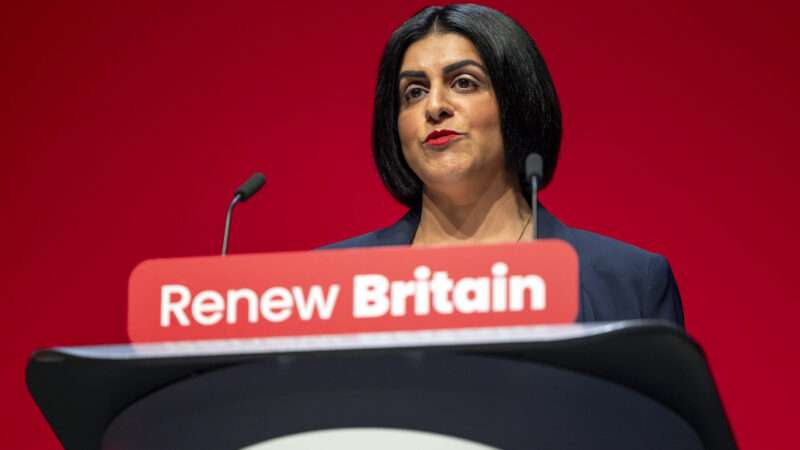
Home Secretary Shabana Mahmoud at the Labour Party Conference in Liverpool, England on Sep 29, 2025. | Abdullah Bailey / Avalon/Newscom

The British government has a very peculiar definition of freedom. In a Sunday interview with the BBC explaining new restrictions on protest, Home Secretary Shabana Mahmood implied that freedom is something the public shouldn’t exercise freely if it bothers others. And the sentiment is bipartisan.

“This is not about a ban. This is about restrictions and conditions,” Mahmood said. “Just because you have a freedom doesn’t mean you have to use it at every moment of every day,” she added.

She added that police will have to strike a “balance” between “allowing people to protest, which is an ancient freedom in this country” and “the rights of the wider community to go about their business free from intimidation and fear.”

Kemi Badenoch, leader of the opposition Conservative Party, agreed with her rival, telling the BBC in a separate interview that “we believe in free speech, but that has to be within the bounds of the law. If protests are used to intimidate, to incite hatred, then that is not protest.” Last year, the courts struck down anti-protest laws passed by a previous Conservative government.

Under Mahmood’s new protest regulations, police will be able to move, reschedule, or limit the size of protests based on the “cumulative disruption” caused by similar protests. In other words, if a movement is annoying enough to the powers that be, they can push it off the streets.

These restrictions will be enforced under the Public Order Act of 1986, which allows for six-month jail sentences and/or unlimited fines for violators.

The immediate context of the restrictions is an attempt to crack down on pro-Palestinian unrest. The British government designated Palestine Action a terrorist organization in July 2025 after its members vandalized military equipment allegedly destined for the Middle East. Under British law, even expressing verbal support for terrorism is illegal, and hundreds of people have been arrested protesting in favor of Palestine Action.

After a deadly stabbing attack on a synagogue last week, Prime Minister Keir Starmer called on protesters to stop in order to “respect the grief of British Jews.” On Saturday, police arrested 500 people in London for protesting under banners that supported Palestine Action.

But the British government has also cracked down on anti-Palestinian speech. For example, police arrested and interrogated Yorkshire man Pete North in late September for sharing a meme several months ago that said, “Fuck Palestine. Fuck Hamas. Fuck Islam. Want to protest? Fuck off to Muslim country and protest.” He was released without charge.

That crackdown seems to be a response to race riots in the summer of 2024, sparked by a wave of anti-immigrant sentiment. Starmer blamed social media for the violence. Earlier this year, British police charged anti-immigration activist Tommy Robinson for “harassment” over his actions during the unrest.

And the authorities have gone after causes across the political spectrum. Last year, a British court acquitted schoolteacher Marieha Hussain for “racially aggravated” public disorder after she was photographed holding up a placard that depicted Conservative Party politicians Suella Braverman and Rishi Sunak as coconuts, meaning that they were “brown” on the outside and “white” on the inside.

Last month, British police snatched up Irish comedian Graham Linehan at the airport for a post he made about punching trans people “in the balls.” Last year, a British court convicted anti-abortion activist Adam Smith-Connor for silently praying outside a clinic, a case that U.S. Vice President J.D. Vance brought up in a speech attacking “the retreat of Europe from some of its most fundamental values.”

British police arrest an average of 30 people per day for offensive online content, according to data obtained by The Times. Arrests have been rapidly increasing—police arrested twice as many people over their posts in 2023 than in 2017—even as convictions fall.

Although the progressive Labour Party currently holds power, some dissidents on the left are worried about the speech crackdowns, especially as polls project a blowout for Nigel Farage’s right-wing Reform Party in the 2029 election.

“Street protest that isn’t a bit of a nuisance isn’t usually effective. But any government seeking to further restrict it should think about new powers in Farragist hands,” Labour peer Shami Chakrabarti told The Guardian.

The post British Minister: 'Just Because You Have a Freedom Doesn't Mean You Have To Use It' appeared first on Reason.com.

from Latest – Reason.com https://ift.tt/rc3p2Nf
via IFTTT

Univ. of South Dakota Withdraws Planned Firing of Art Professor for Vulgar Tweet Calling Charlie Kirk a “Hate Spreading Nazi”

From today’s notice of dismissal, filed by the plaintiff’s lawyerin Hook v. Rave:

On October 3, defendants wisely abandoned their notice of intention to terminate Professor Hook for his First Amendment protected speech about a matter of substantial public interest. Defendants have returned Professor Hook to his full duties, and have not punished him in any way, nor do they seek to punish him in any way. So Professor Hook has received the relief he sought in this lawsuit, which makes this case moot. Accordingly, Professor Hook hereby dismisses it without prejudice in accordance with F. R. Civ. P. 41(a)(1)(A)(i).

Here’s my post about an earlier court decision in the case:

[* * *]

From [the Sept. 24] decision by Judge Karen Schreier (D.S.D.) in Hook v. Rave:

Hook is a tenured Professor of Art at the University of South Dakota. He has taught at the University since 2006.

In the late afternoon on September 10, 2025, while at home and off work, Hook posted the following message concerning the recent shooting and killing of Charlie Kirk to his private Facebook account:

Okay. I don’t give a flying f*** [the original reads “fuck” -EV] about this Kirk person. Apparently he was a hate spreading Nazi. I wasn’t paying close enough attention to the idiotic right fringe to even know who he was. I’m sorry for his family that he was a hate spreading Nazi and got killed. I’m sure they deserved better. Maybe good people could now enter their lives. But geez, where was all this concern when the politicians in Minnesota were shot? And the school shootings? And Capitol Police? I have no thoughts or prayers for this hate spreading Nazi. A shrug, maybe.

Approximately three hours later, while still at home and off work, Hook removed the above message and made a second post. The second post stated:

Apparently my frustration with the sudden onslaught of coverage concerning a guy shot today led to a post I mow [sic] regret posting. I’m sure many folks fully understood my premise but the simple fact that some were offended, led me to remove the post. I extend this public apology to those who were offended. Om Shanti.

Around noon on September 12, 2025, South Dakota Speaker of the House Jon Hansen [and] {also a 2026 candidate for South Dakota Governor} shared a screenshot of Hook’s first post and included the following message:

Yesterday, I was made aware of these hateful and vile comments made by a University of South Dakota professor regarding the death of Charlie Kirk and Charlie’s family. I am disgusted by his remarks, and think they are unbecoming of someone who works for and represents our University. Yesterday, after seeing the post, I immediately reached out to USD President Sheila Gestring and called on the professor to be fired. I understand that the professor is likely to be terminated from his position. I will keep you posted on the final decision. That kind of disgusting rhetoric from an employee and representative of our university directed toward a good man’s family who was recently assassinated will not be tolerated.

A few hours later, South Dakota Governor Larry Rhoden also shared a screenshot of Hook’s first post and included the following message:

When I read this post, I was shaking mad. The Board of Regents intends to FIRE this University of South Dakota professor, and I’m glad.

This individual stands in front of South Dakota students to educate them. We must not send the message to our kids that this is acceptable public discourse.

We need more Charlie Kirks on campus and less hatred like this.

Around the same time, Hook received a letter from Kelley notifying Hook of Kelley’s “intent to terminate [Hook’s] contract as Professor with The University of South Dakota.” The letter explained that the reason for Hook’s termination was due to violations of SDBOR Policies 4.4.8 and 1.6.1. SDBOR Policy 4.4.8 provides:

Neglect of duty, misconduct, incompetence, abuse of power or other actions that manifest an unfitness to discharge the trust reposed in public university faculty members or to perform assigned duties.

SDBOR Policy 1.6.1 provides:

Faculty members are members of a learned profession. When they speak or write as private citizens on matters of public concern, they must be free from institutional censorship or discipline, but their special position in the community imposes special obligations. As learned people and as educators, they should remember that the public may judge their profession and their institution by their utterances. Hence, they should at all times be accurate, show respect for the opinions of others and make every effort to indicate when they are not speaking for the institution.

The court concluded that Hook had a “fair chance” of prevailing on his First Amendment challenge to the impending firing, and therefore issued a temporary restraining order reinstating Hook from administrative leave (and blocking his firing for the next two weeks):

Because Hook spoke as a citizen and on a matter of public concern, [his speech protected unless] defendants have “produced evidence to indicate the speech had an adverse impact on the efficiency of the [University’s] operations.” If the court determines there is an adverse impact, then the court applies the balancing test laid out in Pickering v. Board of Education (1968). But “[w]here there is no evidence of disruption, resort to the Pickering factors is unnecessary because there are no government interests in efficiency to weigh against First Amendment interests.”

At this stage, defendants have failed to put on evidence that Hook’s “speech had an adverse impact on the efficiency of the [University’s] operations.” Defendants allege that in the days following Hook’s post, “hundreds of calls and message were made to the Board of Regents and/or the University of South Dakota commenting negatively regarding the comment or calling for the removal of Professor Hook.” But “[m]ere allegations the speech disrupted the workplace or affected morale, without evidentiary support, are insufficient.” See also Melton v. City of Forrest City, Ark. (8th Cir. 2025) (finding insufficient evidence of disruption where defendants only alleged that “‘several’ police officers and city-council members were upset and ‘phone lines [were] jammed’ with calls from concerned citizens”). Defendants have not demonstrated that there was any disruption to on-campus activities, Hook’s teaching lessons, or the University’s operations. And without more, “such ‘vague and conclusory’ concerns … runs the risk of constitutionalizing a heckler’s veto.” Thus, because defendants have failed to demonstrate any evidence of disruption, the court need not consider the Pickering factors at this stage….

Defendants are required to temporarily set aside their determination to place Hook on administrative leave. Defendants shall reinstate Hook’s position as a Professor of Art at the University of South Dakota, retroactive to September 12, 2025, to remain effective until the preliminary injunction hearing on Wednesday, October 8, 2025, at 9:00 a.m. in Sioux Falls Courtroom 2.

Here’s a similar, though not identical, analysis from the Third Circuit two weeks ago in the Jason Jorjani case (though at a different stage of that lawsuit), which I blogged at the time:

New Jersey Institute of Technology declined to renew a lecturer’s contract based on his private comments about race, politics, and immigration. But NJIT’s regulation of speech outside the classroom and off the campus is subject to the restraints of the First Amendment, and the school documented no disruption to its educational mission….

NJIT hired Jason Jorjani in 2015 to teach philosophy, and twice renewed his contract in 2016 and 2017. During this time, Jorjani “formed the Alt Right Corporation,” to “widen the message of his philosophy, which he describes as an affirmation of the Indo-European Tradition” and “the idea that European cultures are intimately related to those of Greater Iran and the Persianate World, Hindu India and the Buddhist East and are the sources the [sic] world’s greatest scientific, artistic and spiritual developments.” He spoke at conferences and published an essay titled “Against Perennial Philosophy” on “AltRight.com,” a website he helped found. In the essay, he argued that “human racial equality” is a “left-wing myth” and that a great “Promethean” “mentality” rests on a “genetic basis” which “Asians, Arabs, Africans, and other non-Aryan peoples” lack.

The essay also argued that, through “genetic engineering” and eugenic “embryo selection,” Iran could produce great philosophers by “restor[ing] the pre-Arab and pre-Mongol genetic character of the majority of the Iranian population within only one or two generations.” Jorjani did not discuss these outside associations with his students or colleagues, nor did he disclose them as required by NJIT policy.

Then, in 2017, a person posing as a graduate student contacted Jorjani to discuss “how the Left persecutes and silences Right wing thought in academia.” But he was working with a group called “Hope Not Hate,” whose goal is to “deconstruct[ ]” individuals it deems “fascist” or “extremist.” The two met at a pub where the undercover operative recorded their conversations, at first with Jorjani’s consent. But later, apparently assuming the recording had stopped, Jorjani commented on matters concerning race, immigration, and politics.

The meeting became a piece published by the New York Times featuring a video excerpt from Jorjani’s remarks at a conference characterizing “liberalism, democracy, and universal human rights” as “ill-conceived and bankrupt sociopolitical ideologies,” before cutting to the secretly recorded portion of Jorjani’s conversation where he predicts “[w]e will have a Europe, in 2050, where the banknotes have Adolf Hitler, Napoleon Bonaparte, Alexander the Great. And Hitler will be seen like that: like Napoleon, like Alexander, not like some weird monster, who is unique in his own category.”

The day after the Times piece was published, NJIT’s President emailed all faculty and staff, denouncing Jorjani’s statements as “antithetical” to NJIT’s “core values.” NJIT’s Dean of the College of Science and Liberal Arts sent a separate email echoing those sentiments. In the following days, NJIT received some unverified number of calls and, at most, fifty emails expressing concern about Jorjani’s recorded comments and his membership on the faculty. Faculty chimed in too, highlighting the content of Jorjani’s “Against Perennial Philosophy” essay.

Six days after the New York Times posted the article, NJIT sent a letter to Jorjani placing him on paid leave, explaining the article 1) “caused significant disruption at the university” that NJIT believed would “continue to expand,” and 2) revealed “association with organizations” that Jorjani did not disclose on his outside activity form, despite prior direction to fully update the form the preceding Spring. The letter advised Jorjani that NJIT planned to investigate whether he had violated university policies or State ethics requirements.

Fallout continued with NJIT’s Department of Biology penning a statement published in the student newspaper asserting “Jorjani’s beliefs, as revealed by his remarks, cannot help but produce a discriminatory and intimidating educational environment for [NJIT’s] diverse student body.” The Faculty Senate followed suit, releasing an “Official Faculty Senate Statement,” explaining that “NJIT is a university that embraces diversity and sees that diversity as a source of strength. The NJIT Faculty Senate finds racist pronouncements made by University Lecturer Jason Reza Jorjani to be morally repugnant. Hate and bigotry have no place on the NJIT campus.” The Department of History also joined the fray, demanding Jorjani’s termination and asserting his “published beliefs create a hostile learning environment for students of color in particular.” …

Jorjani was eventually fired, and the District Court “conclude[d] that Jorjani’s speech was not protected by the First Amendment because ‘Defendants’ interest in mitigating the disruption caused by Plaintiff’s speech … outweighs Plaintiff’s interest in its expression.’ Seeing error in that conclusion, we will vacate and remand.”

The Court of Appeals in Jorjani articulated the legal standard for when the government may discipline or fire employees based on their speech (even if it couldn’t imprison or fine ordinary citizens for their speech), pretty much the same standard as the one the District Court just applied in Hook:

“[T]o state a First Amendment retaliation claim, a public employee plaintiff must allege that his activity is protected by the First Amendment, and that the protected activity was a substantial factor in the alleged retaliatory action.” If those two requirements are satisfied, the burden shifts and the employer must show “the same action would have been taken even if the speech had not occurred.”

A public employee’s speech is protected if 1) “the employee spoke as a citizen,” 2) his “statement involved a matter of public concern,” and 3) “the government employer did not have ‘an adequate justification for treating the employee differently from any other member of the general public’ as a result of the statement he made.” In assessing the third prong, we “balance … the interests of the [employee], as a citizen, in commenting upon matters of public concern and the interest of the State, as an employer, in promoting the efficiency of the public services it performs through its employees.” Pickering v. Bd. of Ed. (1968). So “the more substantially an employee’s speech involves matters of public concern, the higher the state’s burden will then be to justify taking action, and vice versa.” …

This standard leaves considerable room for a version of the “heckler’s veto,” under which someone’s speech may be punished because it causes a hostile reaction by offended listeners. (So does the District Court’s opinion in Hook, since it prevents a “heckler’s veto” only if the hecklers are heckling only slightly, and thus in a way that doesn’t cause “any disruption to on-campus activities, Hook’s teaching lessons, or the University’s operations.”)

When the government is administering the criminal law or civil liability, such a “heckler’s veto” is generally not allowed: The government generally can’t shut down a speaker, for instance, because his listeners are getting offended or even threatening violence because they’re offended. But in the employment context, the Pickering balance often allows government to fire employees because their speech sufficiently offends coworkers or members of the public. Perhaps this stems from the judgment that employees are hired to do a particular job cost-effectively for the government, and if their speech so offends others (especially clients or coworkers) that keeping the employees on means more cost for the government than benefit, the government needn’t continue to pay them for what has proved to be a bad bargain.

Still, when it comes to public university professors, especially as to their off-the-job speech, courts have often applied the Pickering balance in a way that deliberately offers more speech protection (though perhaps not the same speech protection as ordinary citizens enjoy when it comes to the criminal law). That is what the Third Circuit did in Jorjani (though the District Court didn’t see the need to formally consider any possible special rule for university professors, since its holding as to lack of disruption would prevent the firing of pretty much any government employee). To illustrate the Third Circuit’s reasoning, I underline the passages supporting such extra protection, and italicize the passages that seem to leave open room for some sort of heckler’s veto:

NJIT’s actions do not pass the ordinary Pickering analysis on this record. The parties agree that Jorjani spoke as a private citizen on a matter of public concern. So we consider only whether the distractions NJIT identified as flowing from Jorjani’s speech outweigh interest in his discussion. They do not….

Begin with interest in Jorjani’s speech, which cannot “be considered in a vacuum” as “the manner, time, and place of the employee’s expression are relevant.” Jorjani’s speech occurred entirely outside NJIT’s academic environs. His theories, even if lacking in classical rigor, remain of public import. It matters not that his opinions do not enjoy majoritarian support, since “the proudest boast of our free speech jurisprudence is that we protect the freedom to express ‘the thought that we hate.'” Matal v. Tam (2017)….

Against that interest, we weigh NJIT’s need “as an employer” to promote “the efficiency of the public services it performs.” NJIT points only to the “disruption” that followed the publication of Jorjani’s remarks consisting of certain students’ disapproval of Jorjani’s speech, disagreement among faculty, and administrators fielding complaints. We “typically consider whether the speech impairs discipline or employee harmony, has a detrimental impact on close working relationships requiring personal loyalty and confidence, impedes the performance of the speaker’s duties, or interferes with the enterprise’s regular operations.” And we focus mostly on what happened, not what might have been, because although NJIT can act to prevent future harms, and need not “allow events to unfold to the extent that the disruption of the office and the destruction of working relationships is manifest,” it must ground predictions in reason, not speculation. The minimal evidence of disruption that NJIT cites differs little from the ordinary operation of a public university and therefore cannot outweigh interest in Jorjani’s speech.

First, there is no support for NJIT’s contention that student disapproval of Jorjani’s speech disrupted the administration of the university. Some students and alumni disagreed with Jorjani’s views. But NJIT never identified the exact number of calls or complaints made in person or writing, nor any details about the students’ concerns. And although Jorjani said that he perceived a “huge change in attitude toward [him] on the part of [his] students,” NJIT points to no objective evidence that students questioned Jorjani’s ability to teach, grade, or supervise his classes evenly, beyond one administrator recalling a student dropped Jorjani’s class. Entirely absent is any evidence of specific student protests, upheaval, or unwillingness to abide by university policies. But “in the context of the college classroom,” students have an “interest in hearing even contrarian views.” Meriwether v. Hartop (6th Cir. 2021); see also Blum v. Schlegel (2d Cir. 1994) (explaining that “the efficient provision of services” by a university “actually depends, to a degree, on the dissemination in public fora of controversial speech”). NJIT’s theory that student dissent rose to the level of disruption is simply speculative.

Second, the cited disputes among Jorjani and his colleagues are not disruption. NJIT cites the pointed letters denouncing Jorjani published by faculty in the pages of the student newspaper, but that is precisely the sort of reasoned debate that distinguishes speech from distraction. And there is no allegation these editorials, or Jorjani’s belief they were defamatory and warranted suit, interfered with the ability of other faculty to fulfill their responsibilities in research, teaching, or shared governance, or otherwise thwarted the university’s efforts to educate its students. So although challenges to “employee harmony” might pose disruption when disagreements disturb “close working relationships,” that concern is irrelevant inside the university where professors serve the needs of their students, not fellow academics. {Bauer v. Sampson (9th Cir. 2001) (“[G]iven the nature of academic life, especially at the college level, it was not necessary that Bauer and the administration enjoy a close working relationship requiring trust and respect—indeed anyone who has spent time on college campuses knows that the vigorous exchange of ideas and resulting tension between an administration and its faculty is as much a part of college life as homecoming and final exams.”).}

That leaves only NJIT’s ordinary obligation to field calls and emails, routine administrative tasks that, conceivably, might become so overwhelming in number or nature as to disrupt. But not here. The record reveals that throughout this occurrence there were “[p]ossibly” fifty emails received about Jorjani. Calls were so few that NJIT’s witness was “not sure what the number is,” and only knew “by reading some emails that so-and-so called the mother, and so-and-so called, former student called, things of that nature.” All a most minor uptick in communications, if at all, and one that required no additional staffing to support the single administrator who handled these inquiries.

While NJIT raises an “interest in providing a non-denigrating environment,” and appeals to the notion that Jorjani’s views could, theoretically, undermine the pedagogical relationship between a teacher and student, it has not pointed to anything in the record that indicates its determination was based on competence or qualifications. In essence, NJIT posits that because Jorjani offered views it disliked, the First Amendment should not apply, and it is entitled to summary judgment. We cannot agree, lest we permit “universities to discipline professors, students, and staff any time their speech might cause offense.” {And this case does not implicate a university’s “discretionary academic determinations” that entail the “review of [ ] intellectual work product” or “the qualifications of faculty members for promotion and tenure.”}

Back in the South Dakota case, James D. Leach represents Hook.

The post Univ. of South Dakota Withdraws Planned Firing of Art Professor for Vulgar Tweet Calling Charlie Kirk a "Hate Spreading Nazi" appeared first on Reason.com.

from Latest – Reason.com https://ift.tt/uJceW3P
via IFTTT
Univ. of South Dakota Withdraws Planned Firing of Art Professor for Vulgar Tweet Calling Charlie Kirk a “Hate Spreading Nazi”

From today’s notice of dismissal, filed by the plaintiff’s lawyerin Hook v. Rave:

On October 3, defendants wisely abandoned their notice of intention to terminate Professor Hook for his First Amendment protected speech about a matter of substantial public interest. Defendants have returned Professor Hook to his full duties, and have not punished him in any way, nor do they seek to punish him in any way. So Professor Hook has received the relief he sought in this lawsuit, which makes this case moot. Accordingly, Professor Hook hereby dismisses it without prejudice in accordance with F. R. Civ. P. 41(a)(1)(A)(i).

Here’s my post about an earlier court decision in the case:

[* * *]

From [the Sept. 24] decision by Judge Karen Schreier (D.S.D.) in Hook v. Rave:

Hook is a tenured Professor of Art at the University of South Dakota. He has taught at the University since 2006.

In the late afternoon on September 10, 2025, while at home and off work, Hook posted the following message concerning the recent shooting and killing of Charlie Kirk to his private Facebook account:

Okay. I don’t give a flying f*** [the original reads “fuck” -EV] about this Kirk person. Apparently he was a hate spreading Nazi. I wasn’t paying close enough attention to the idiotic right fringe to even know who he was. I’m sorry for his family that he was a hate spreading Nazi and got killed. I’m sure they deserved better. Maybe good people could now enter their lives. But geez, where was all this concern when the politicians in Minnesota were shot? And the school shootings? And Capitol Police? I have no thoughts or prayers for this hate spreading Nazi. A shrug, maybe.

Approximately three hours later, while still at home and off work, Hook removed the above message and made a second post. The second post stated:

Apparently my frustration with the sudden onslaught of coverage concerning a guy shot today led to a post I mow [sic] regret posting. I’m sure many folks fully understood my premise but the simple fact that some were offended, led me to remove the post. I extend this public apology to those who were offended. Om Shanti.

Around noon on September 12, 2025, South Dakota Speaker of the House Jon Hansen [and] {also a 2026 candidate for South Dakota Governor} shared a screenshot of Hook’s first post and included the following message:

Yesterday, I was made aware of these hateful and vile comments made by a University of South Dakota professor regarding the death of Charlie Kirk and Charlie’s family. I am disgusted by his remarks, and think they are unbecoming of someone who works for and represents our University. Yesterday, after seeing the post, I immediately reached out to USD President Sheila Gestring and called on the professor to be fired. I understand that the professor is likely to be terminated from his position. I will keep you posted on the final decision. That kind of disgusting rhetoric from an employee and representative of our university directed toward a good man’s family who was recently assassinated will not be tolerated.

A few hours later, South Dakota Governor Larry Rhoden also shared a screenshot of Hook’s first post and included the following message:

When I read this post, I was shaking mad. The Board of Regents intends to FIRE this University of South Dakota professor, and I’m glad.

This individual stands in front of South Dakota students to educate them. We must not send the message to our kids that this is acceptable public discourse.

We need more Charlie Kirks on campus and less hatred like this.

Around the same time, Hook received a letter from Kelley notifying Hook of Kelley’s “intent to terminate [Hook’s] contract as Professor with The University of South Dakota.” The letter explained that the reason for Hook’s termination was due to violations of SDBOR Policies 4.4.8 and 1.6.1. SDBOR Policy 4.4.8 provides:

Neglect of duty, misconduct, incompetence, abuse of power or other actions that manifest an unfitness to discharge the trust reposed in public university faculty members or to perform assigned duties.

SDBOR Policy 1.6.1 provides:

Faculty members are members of a learned profession. When they speak or write as private citizens on matters of public concern, they must be free from institutional censorship or discipline, but their special position in the community imposes special obligations. As learned people and as educators, they should remember that the public may judge their profession and their institution by their utterances. Hence, they should at all times be accurate, show respect for the opinions of others and make every effort to indicate when they are not speaking for the institution.

The court concluded that Hook had a “fair chance” of prevailing on his First Amendment challenge to the impending firing, and therefore issued a temporary restraining order reinstating Hook from administrative leave (and blocking his firing for the next two weeks):

Because Hook spoke as a citizen and on a matter of public concern, [his speech protected unless] defendants have “produced evidence to indicate the speech had an adverse impact on the efficiency of the [University’s] operations.” If the court determines there is an adverse impact, then the court applies the balancing test laid out in Pickering v. Board of Education (1968). But “[w]here there is no evidence of disruption, resort to the Pickering factors is unnecessary because there are no government interests in efficiency to weigh against First Amendment interests.”

At this stage, defendants have failed to put on evidence that Hook’s “speech had an adverse impact on the efficiency of the [University’s] operations.” Defendants allege that in the days following Hook’s post, “hundreds of calls and message were made to the Board of Regents and/or the University of South Dakota commenting negatively regarding the comment or calling for the removal of Professor Hook.” But “[m]ere allegations the speech disrupted the workplace or affected morale, without evidentiary support, are insufficient.” See also Melton v. City of Forrest City, Ark. (8th Cir. 2025) (finding insufficient evidence of disruption where defendants only alleged that “‘several’ police officers and city-council members were upset and ‘phone lines [were] jammed’ with calls from concerned citizens”). Defendants have not demonstrated that there was any disruption to on-campus activities, Hook’s teaching lessons, or the University’s operations. And without more, “such ‘vague and conclusory’ concerns … runs the risk of constitutionalizing a heckler’s veto.” Thus, because defendants have failed to demonstrate any evidence of disruption, the court need not consider the Pickering factors at this stage….

Defendants are required to temporarily set aside their determination to place Hook on administrative leave. Defendants shall reinstate Hook’s position as a Professor of Art at the University of South Dakota, retroactive to September 12, 2025, to remain effective until the preliminary injunction hearing on Wednesday, October 8, 2025, at 9:00 a.m. in Sioux Falls Courtroom 2.

Here’s a similar, though not identical, analysis from the Third Circuit two weeks ago in the Jason Jorjani case (though at a different stage of that lawsuit), which I blogged at the time:

New Jersey Institute of Technology declined to renew a lecturer’s contract based on his private comments about race, politics, and immigration. But NJIT’s regulation of speech outside the classroom and off the campus is subject to the restraints of the First Amendment, and the school documented no disruption to its educational mission….

NJIT hired Jason Jorjani in 2015 to teach philosophy, and twice renewed his contract in 2016 and 2017. During this time, Jorjani “formed the Alt Right Corporation,” to “widen the message of his philosophy, which he describes as an affirmation of the Indo-European Tradition” and “the idea that European cultures are intimately related to those of Greater Iran and the Persianate World, Hindu India and the Buddhist East and are the sources the [sic] world’s greatest scientific, artistic and spiritual developments.” He spoke at conferences and published an essay titled “Against Perennial Philosophy” on “AltRight.com,” a website he helped found. In the essay, he argued that “human racial equality” is a “left-wing myth” and that a great “Promethean” “mentality” rests on a “genetic basis” which “Asians, Arabs, Africans, and other non-Aryan peoples” lack.

The essay also argued that, through “genetic engineering” and eugenic “embryo selection,” Iran could produce great philosophers by “restor[ing] the pre-Arab and pre-Mongol genetic character of the majority of the Iranian population within only one or two generations.” Jorjani did not discuss these outside associations with his students or colleagues, nor did he disclose them as required by NJIT policy.

Then, in 2017, a person posing as a graduate student contacted Jorjani to discuss “how the Left persecutes and silences Right wing thought in academia.” But he was working with a group called “Hope Not Hate,” whose goal is to “deconstruct[ ]” individuals it deems “fascist” or “extremist.” The two met at a pub where the undercover operative recorded their conversations, at first with Jorjani’s consent. But later, apparently assuming the recording had stopped, Jorjani commented on matters concerning race, immigration, and politics.

The meeting became a piece published by the New York Times featuring a video excerpt from Jorjani’s remarks at a conference characterizing “liberalism, democracy, and universal human rights” as “ill-conceived and bankrupt sociopolitical ideologies,” before cutting to the secretly recorded portion of Jorjani’s conversation where he predicts “[w]e will have a Europe, in 2050, where the banknotes have Adolf Hitler, Napoleon Bonaparte, Alexander the Great. And Hitler will be seen like that: like Napoleon, like Alexander, not like some weird monster, who is unique in his own category.”

The day after the Times piece was published, NJIT’s President emailed all faculty and staff, denouncing Jorjani’s statements as “antithetical” to NJIT’s “core values.” NJIT’s Dean of the College of Science and Liberal Arts sent a separate email echoing those sentiments. In the following days, NJIT received some unverified number of calls and, at most, fifty emails expressing concern about Jorjani’s recorded comments and his membership on the faculty. Faculty chimed in too, highlighting the content of Jorjani’s “Against Perennial Philosophy” essay.

Six days after the New York Times posted the article, NJIT sent a letter to Jorjani placing him on paid leave, explaining the article 1) “caused significant disruption at the university” that NJIT believed would “continue to expand,” and 2) revealed “association with organizations” that Jorjani did not disclose on his outside activity form, despite prior direction to fully update the form the preceding Spring. The letter advised Jorjani that NJIT planned to investigate whether he had violated university policies or State ethics requirements.

Fallout continued with NJIT’s Department of Biology penning a statement published in the student newspaper asserting “Jorjani’s beliefs, as revealed by his remarks, cannot help but produce a discriminatory and intimidating educational environment for [NJIT’s] diverse student body.” The Faculty Senate followed suit, releasing an “Official Faculty Senate Statement,” explaining that “NJIT is a university that embraces diversity and sees that diversity as a source of strength. The NJIT Faculty Senate finds racist pronouncements made by University Lecturer Jason Reza Jorjani to be morally repugnant. Hate and bigotry have no place on the NJIT campus.” The Department of History also joined the fray, demanding Jorjani’s termination and asserting his “published beliefs create a hostile learning environment for students of color in particular.” …

Jorjani was eventually fired, and the District Court “conclude[d] that Jorjani’s speech was not protected by the First Amendment because ‘Defendants’ interest in mitigating the disruption caused by Plaintiff’s speech … outweighs Plaintiff’s interest in its expression.’ Seeing error in that conclusion, we will vacate and remand.”

The Court of Appeals in Jorjani articulated the legal standard for when the government may discipline or fire employees based on their speech (even if it couldn’t imprison or fine ordinary citizens for their speech), pretty much the same standard as the one the District Court just applied in Hook:

“[T]o state a First Amendment retaliation claim, a public employee plaintiff must allege that his activity is protected by the First Amendment, and that the protected activity was a substantial factor in the alleged retaliatory action.” If those two requirements are satisfied, the burden shifts and the employer must show “the same action would have been taken even if the speech had not occurred.”

A public employee’s speech is protected if 1) “the employee spoke as a citizen,” 2) his “statement involved a matter of public concern,” and 3) “the government employer did not have ‘an adequate justification for treating the employee differently from any other member of the general public’ as a result of the statement he made.” In assessing the third prong, we “balance … the interests of the [employee], as a citizen, in commenting upon matters of public concern and the interest of the State, as an employer, in promoting the efficiency of the public services it performs through its employees.” Pickering v. Bd. of Ed. (1968). So “the more substantially an employee’s speech involves matters of public concern, the higher the state’s burden will then be to justify taking action, and vice versa.” …

This standard leaves considerable room for a version of the “heckler’s veto,” under which someone’s speech may be punished because it causes a hostile reaction by offended listeners. (So does the District Court’s opinion in Hook, since it prevents a “heckler’s veto” only if the hecklers are heckling only slightly, and thus in a way that doesn’t cause “any disruption to on-campus activities, Hook’s teaching lessons, or the University’s operations.”)

When the government is administering the criminal law or civil liability, such a “heckler’s veto” is generally not allowed: The government generally can’t shut down a speaker, for instance, because his listeners are getting offended or even threatening violence because they’re offended. But in the employment context, the Pickering balance often allows government to fire employees because their speech sufficiently offends coworkers or members of the public. Perhaps this stems from the judgment that employees are hired to do a particular job cost-effectively for the government, and if their speech so offends others (especially clients or coworkers) that keeping the employees on means more cost for the government than benefit, the government needn’t continue to pay them for what has proved to be a bad bargain.

Still, when it comes to public university professors, especially as to their off-the-job speech, courts have often applied the Pickering balance in a way that deliberately offers more speech protection (though perhaps not the same speech protection as ordinary citizens enjoy when it comes to the criminal law). That is what the Third Circuit did in Jorjani (though the District Court didn’t see the need to formally consider any possible special rule for university professors, since its holding as to lack of disruption would prevent the firing of pretty much any government employee). To illustrate the Third Circuit’s reasoning, I underline the passages supporting such extra protection, and italicize the passages that seem to leave open room for some sort of heckler’s veto:

NJIT’s actions do not pass the ordinary Pickering analysis on this record. The parties agree that Jorjani spoke as a private citizen on a matter of public concern. So we consider only whether the distractions NJIT identified as flowing from Jorjani’s speech outweigh interest in his discussion. They do not….

Begin with interest in Jorjani’s speech, which cannot “be considered in a vacuum” as “the manner, time, and place of the employee’s expression are relevant.” Jorjani’s speech occurred entirely outside NJIT’s academic environs. His theories, even if lacking in classical rigor, remain of public import. It matters not that his opinions do not enjoy majoritarian support, since “the proudest boast of our free speech jurisprudence is that we protect the freedom to express ‘the thought that we hate.'” Matal v. Tam (2017)….

Against that interest, we weigh NJIT’s need “as an employer” to promote “the efficiency of the public services it performs.” NJIT points only to the “disruption” that followed the publication of Jorjani’s remarks consisting of certain students’ disapproval of Jorjani’s speech, disagreement among faculty, and administrators fielding complaints. We “typically consider whether the speech impairs discipline or employee harmony, has a detrimental impact on close working relationships requiring personal loyalty and confidence, impedes the performance of the speaker’s duties, or interferes with the enterprise’s regular operations.” And we focus mostly on what happened, not what might have been, because although NJIT can act to prevent future harms, and need not “allow events to unfold to the extent that the disruption of the office and the destruction of working relationships is manifest,” it must ground predictions in reason, not speculation. The minimal evidence of disruption that NJIT cites differs little from the ordinary operation of a public university and therefore cannot outweigh interest in Jorjani’s speech.

First, there is no support for NJIT’s contention that student disapproval of Jorjani’s speech disrupted the administration of the university. Some students and alumni disagreed with Jorjani’s views. But NJIT never identified the exact number of calls or complaints made in person or writing, nor any details about the students’ concerns. And although Jorjani said that he perceived a “huge change in attitude toward [him] on the part of [his] students,” NJIT points to no objective evidence that students questioned Jorjani’s ability to teach, grade, or supervise his classes evenly, beyond one administrator recalling a student dropped Jorjani’s class. Entirely absent is any evidence of specific student protests, upheaval, or unwillingness to abide by university policies. But “in the context of the college classroom,” students have an “interest in hearing even contrarian views.” Meriwether v. Hartop (6th Cir. 2021); see also Blum v. Schlegel (2d Cir. 1994) (explaining that “the efficient provision of services” by a university “actually depends, to a degree, on the dissemination in public fora of controversial speech”). NJIT’s theory that student dissent rose to the level of disruption is simply speculative.

Second, the cited disputes among Jorjani and his colleagues are not disruption. NJIT cites the pointed letters denouncing Jorjani published by faculty in the pages of the student newspaper, but that is precisely the sort of reasoned debate that distinguishes speech from distraction. And there is no allegation these editorials, or Jorjani’s belief they were defamatory and warranted suit, interfered with the ability of other faculty to fulfill their responsibilities in research, teaching, or shared governance, or otherwise thwarted the university’s efforts to educate its students. So although challenges to “employee harmony” might pose disruption when disagreements disturb “close working relationships,” that concern is irrelevant inside the university where professors serve the needs of their students, not fellow academics. {Bauer v. Sampson (9th Cir. 2001) (“[G]iven the nature of academic life, especially at the college level, it was not necessary that Bauer and the administration enjoy a close working relationship requiring trust and respect—indeed anyone who has spent time on college campuses knows that the vigorous exchange of ideas and resulting tension between an administration and its faculty is as much a part of college life as homecoming and final exams.”).}

That leaves only NJIT’s ordinary obligation to field calls and emails, routine administrative tasks that, conceivably, might become so overwhelming in number or nature as to disrupt. But not here. The record reveals that throughout this occurrence there were “[p]ossibly” fifty emails received about Jorjani. Calls were so few that NJIT’s witness was “not sure what the number is,” and only knew “by reading some emails that so-and-so called the mother, and so-and-so called, former student called, things of that nature.” All a most minor uptick in communications, if at all, and one that required no additional staffing to support the single administrator who handled these inquiries.

While NJIT raises an “interest in providing a non-denigrating environment,” and appeals to the notion that Jorjani’s views could, theoretically, undermine the pedagogical relationship between a teacher and student, it has not pointed to anything in the record that indicates its determination was based on competence or qualifications. In essence, NJIT posits that because Jorjani offered views it disliked, the First Amendment should not apply, and it is entitled to summary judgment. We cannot agree, lest we permit “universities to discipline professors, students, and staff any time their speech might cause offense.” {And this case does not implicate a university’s “discretionary academic determinations” that entail the “review of [ ] intellectual work product” or “the qualifications of faculty members for promotion and tenure.”}

Back in the South Dakota case, James D. Leach represents Hook.

The post Univ. of South Dakota Withdraws Planned Firing of Art Professor for Vulgar Tweet Calling Charlie Kirk a "Hate Spreading Nazi" appeared first on Reason.com.

from Latest – Reason.com https://ift.tt/uJceW3P
via IFTTT
A Third Of Countries Plagued by “Abnormally High” Food Prices – Brings Risks Of Social Unrest

A Third Of Countries Plagued by “Abnormally High” Food Prices – Brings Risks Of Social Unrest

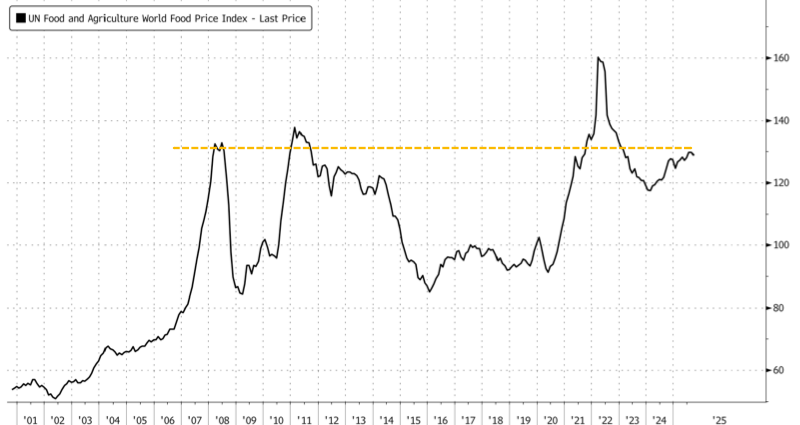
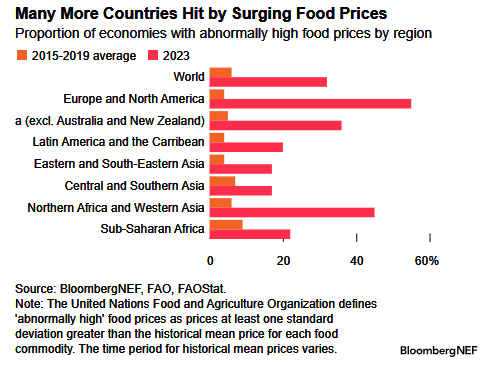
The UN’s Food and Agriculture Organization (FAO) highlights in a new report that high food prices continue to persist worldwide, citing data that shows a fivefold increase across many countries. This exponential rise makes conditions ripe for social unrest, particularly in developing or politically fragile countries. We’ve seen this story before – from the Arab Spring to the 2007-08 food crisis – and this is a reminder that global turmoil is far from over. 

BloombergNEF analyzed FAO data that highlighted adverse weather conditions in many of the world’s top farm belts, resulting in declining harvest yields. Additionally, geopolitical tensions drove up diesel and gasoline prices, exerting a broader inflationary impact on production costs. Additionally, the global phenomenon of excessive money printing has been the primary driver of inflation.

FAO indicates that 50% of countries in North America and Europe experienced abnormally high food prices in 2023, when compared to the average between 2015 and 2019. FAO defines “abnormally high” as at least one standard deviation greater than the average historical price of a given commodity in each region, as per Bloomberg.

Elevated FAO food prices globally, especially for developing or politically fragile nations, could make conditions ripe for social unrest.

Here’s the most recent historical precedent:

  • Arab Spring (2010–2011): A sharp rise in global wheat and bread prices following droughts and export bans in Russia helped ignite protests across Tunisia, Egypt, Libya, and Syria. Food price inflation was a key stressor that merged with political grievances.

  • 2007–2008 Food Crisis: Spikes in global grain prices led to riots in more than 30 countries, including Haiti, Bangladesh, Egypt, and Mozambique, where basic staples became unaffordable for large segments of the population.

What’s clear is that when food inflation outpaces income growth, that begins the countdown clock of when social instabilities emerge.

Tyler Durden
Mon, 10/06/2025 – 13:55

via ZeroHedge News https://www.zerohedge.com/commodities/third-countries-plagued-abnormally-high-food-prices-brings-risks-social-unrest Tyler Durden

Israel Rejects As ‘Brazen Lies’ Reports That Greta Thunberg Abused In Detention

Israel Rejects As ‘Brazen Lies’ Reports That Greta Thunberg Abused In Detention

Via The Libertarian Institute 

National Security Minister Itamar Ben Gvir touted Israel’s mistreatment of activists who were members of a flotilla that was attempting to bring food and baby formula to the starving people of Gaza. Allegations have been made that Israel abused Swedish activist Greta Thunberg.

Ben Gvir stated that he visited the facility where the flotilla activists were detained. Many of the ships attempting to break the Israeli blockade of Gaza were intercepted in international waters. During his trip to the Ketziot prison, Ben Gvir was filmed taunting the detained activists.

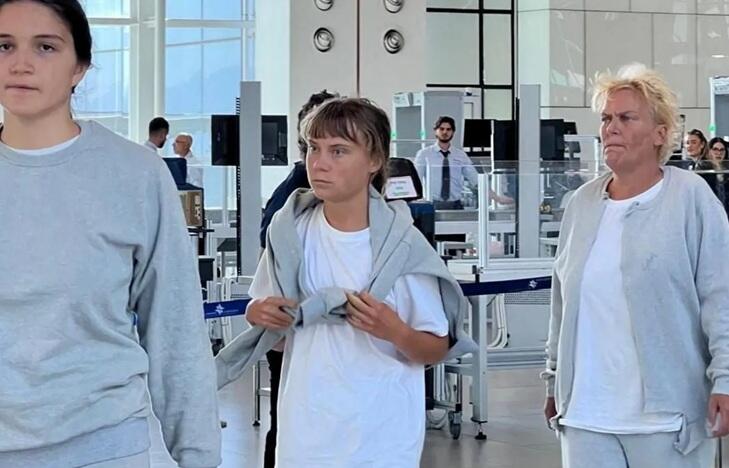
Israel’s foreign ministry posted a photo of Thunberg walking through Ben Gurion airport.

The National Security Minister said he was “proud” Israel was putting the activists in the same conditions as terrorists.

“I went to visit Ketziot prison and I was proud that we are treating the ‘flotilla activists’ as terror supporters, whoever supports terrorism is a terrorist, and deserves the conditions of terrorists,” Ben Gvir continued, “It is worthwhile for them to experience the conditions in Ketziot prison, and think twice before they come close to Israel again. That’s how it works.”

Over 400 activists who were traveling on about 50 ships were taken captive by Israeli soldiers. One of the released flotilla members claims Israel violently abused Thunberg. Turkish activist ErsinÇelik claimed Thunberg was physically based. 

“They dragged little Greta [Thunberg] by her hair before our eyes, beat her, and forced her to kiss the Israeli flag. They did everything imaginable to her, as a warning to others,” he said. 

A Swedish Foreign Ministry official said they received reports from released activists that Thunberg was forced to hold Israeli flags while pictures were taken.

Note: But none of these alleged images have emerged, only a photo with an Israeli flag in the background:

Image released by Israel’s Foreign Ministry

Italian journalist Saverio Tommasi, a released participant of the flotilla, said, “We also saw Greta Thunberg at the port, in that case with her arms tied and an Israeli flag next to her, just a mockery.”

He added, “Let’s say the mockery was part of the verbal and psychological violence they always carried out, in order to demean, ridicule and laugh in situations where there is nothing to laugh about.”

Tel Aviv claimed the allegations of abuse are “brazen lies”.

Tyler Durden
Mon, 10/06/2025 – 13:35

via ZeroHedge News https://www.zerohedge.com/geopolitical/israel-rejects-brazen-lies-reports-greta-thunberg-abused-detention Tyler Durden

Hollywood Actors Bring Back Soviet Era “Committee For The First Amendment”

Hollywood Actors Bring Back Soviet Era “Committee For The First Amendment”

A group of 550 Hollywood celebrities led by Jane Fonda (Hanoi Jane) have announced – after a decade canceling conservatives within their industry –  that they are resurrecting a Soviet era celebrity organization called the “Committee for the First Amendment” to “defend the constitutional rights” of actors and public figures from the entertainment industry. 

Laughs in Gina Carino and James Woods…

The announcement was partially inspired by the short-lived cancellation of the Jimmy Kimmel Live! show, after Kimmel spread false information on Charlie Kirk assassination suspect Tyler Robinson.  Kimmel seemed to assert that Robinson was MAGA, a lie which was being spread widely on social media by the political left in order to deflect from clear evidence that Robinson is an LGBT leftist and Antifa sympathizer. 

Democrats asserted that Kimmel was being “silenced” by the Trump Administration, a violation of his First Amendment rights.  However, the cancellation had nothing to do with Trump.  When affiliates Nexstar and Sinclair threatened to drop Kimmel’s broadcasts, ABC brought the late night show to a halt.  Compare this to censorship during the Biden era, when Democrat leaders directly pressured social media companies to silence conservatives.

Juxtapose this flowery sentiment of peace with Jane Fonda’s previous hot takes on conservatives.  The real communist revolutionary mind rises to the surface in unguarded moments:

Kimmel’s show returned after one week due to pressure from Democrats.  Democrat leaders are comparing the event to the “Red Scare” of the McCarthy Era, suggesting that Trump and Republicans are trying to shut down free speech.  To be clear, Kimmel was never censored by the government and no one has a constitutional right to a late night talk show.  Fonda argues:

“The federal government is once again engaged in a coordinated campaign to silence critics in the government, the media, the judiciary, academia, and the entertainment industry.”

In a letter published by the committee, they argue that the McCarthy era has returned:

“This Committee was initially created during the McCarthy Era, a dark time when the federal government repressed and persecuted American citizens for their political beliefs. They targeted elected officials, government employees, academics, and artists. They were blacklisted, harassed, silenced, and even imprisoned. The McCarthy Era ended when Americans from across the political spectrum finally came together and stood up for the principles in the Constitution against the forces of repression.”

“Those forces have returned. And it is our turn to stand together in defense of our constitutional rights…”

What Jane Fonda and friends don’t mention is that the Hollywood actors were rightly persecuted for their political beliefs.  Most of the people accused of being communist sympathizers were, in fact, communists working to further the dismantling of the western world.

Young Americans today are thoroughly indoctrinated by public schools, colleges and the media to believe that the “Red Scare” of the McCarthy Era was a witch hunt built on hysteria and paranoia.  Joseph McCarthy is often portrayed as a lunatic and a fear monger who used the “communist bogeyman” as a way to grow government power and silence detractors.  

As future declassified documents would eventually prove, nothing could be further from the truth.

Senator McCarthy was right and his accusations were largely accurate – Communist funded groups and subversive agents had infiltrated almost every aspect of American society from entertainment to education to industry.  The revelation was so shocking that it was ultimately covered up for decades and McCarthy became a pariah instead of a hero. 

In the 1990s, documents finally released through the Freedom of Information Act revealed Project Verona, a secret program launched in 1943 which eventually led to the breaking of Soviet encryption methods.  The information gathered from the communist regime was extensive and uncovered vast networks of Soviet spies and sympathizers working against the west. 

Though McCarthy did not have direct access to Verona, he operated on intel from Verona through FBI briefings, which most Americans at the time were not privy to.  In other words, he saw the evidence that average Americans did not get to see.  To this day, leftist journalists and academics continue to lie about McCarthy, claiming that the Verona papers “don’t vindicate his legacy” or his efforts to stop communist infiltration.

The most widely publicized aspects of the Red Scare involved Hollywood and the subversion of American media.  As we have seen in recent years, there is undeniable Marxist control over the majority of US entertainment. If it was hidden before, it certainly isn’t hidden now.  

Jane Fonda’s father, Henry Fonda, formed the original Committee for the First Amendment to protect the “Hollywood Ten”, a group of highly influential celebrities, writers, directors and producers who were accused of being members of the communist party and receiving funding from the Soviet Union.  As it turned out, eight of the ten people were confirmed communist party members.  The other two are less definitive but still suspected.

The CPUSA received extensive funding from the Soviet Union and these Hollywood notables were members of the CPUSA.  By extension, the Committee for the First Amendment included the Hollywood Ten in their membership.  After the group was unmasked, actors like Humphrey Bogart who initially defended them decided to disavow them.  The committee lasted only 6 months.

The new committee is a different animal in that it is openly woke (communist), but designed to fear monger over censorship that doesn’t exist.  Its goal appears to be the protection of purveyors of far-left propaganda from valid scrutiny.  One might wonder if the US could have avoided the mess it is in today if only people had listened to McCarthy decades ago?

Tyler Durden
Mon, 10/06/2025 – 13:15

via ZeroHedge News https://ift.tt/b7Uv5w0 Tyler Durden

Chapter 7 Individual Bankruptcy Filings Jump 15 Percent In First 9 Months Of 2025

Chapter 7 Individual Bankruptcy Filings Jump 15 Percent In First 9 Months Of 2025

Authored by Naveen Athrappully via The Epoch Times (emphasis ours),

A total of 249,152 individual Chapter 7 bankruptcy filings were made in the first nine months of this year in the United States, which is a 15 percent jump compared to the same period last year, the American Bankruptcy Institute (ABI) said in an Oct. 3 statement.

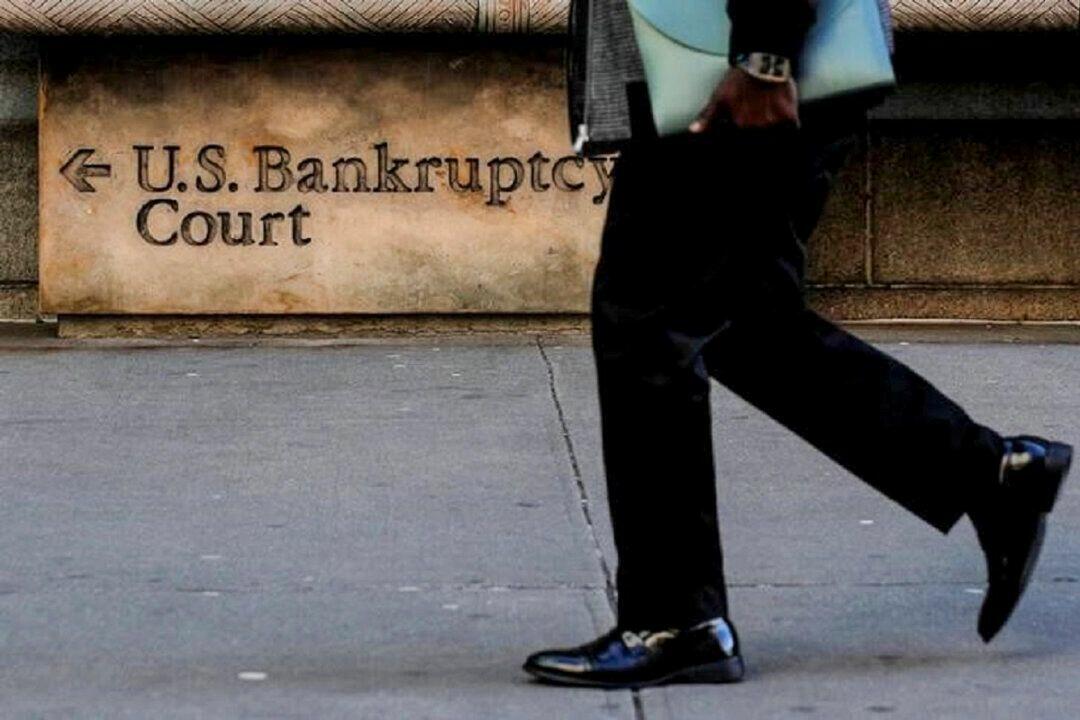
A person arrives at the U.S. District Bankruptcy Court for the Southern District of New York, on Jan. 9, 2020. Brendan McDermid/Reuters

Chapter 7 bankruptcy, also known as liquidation bankruptcy, involves a court-appointed trustee selling off an individual’s nonexempt assets to pay off creditors. It can discharge certain debts, with the individual no longer obliged to pay them.

This is different from a Chapter 13 bankruptcy, where an individual retains all assets, but has to agree on a repayment plan with creditors that can last for three to five years.

There were 149,337 individual Chapter 13 bankruptcy filings made during the first nine months of 2025, up 4 percent from the same period in 2024, ABI said.

Total individual bankruptcy filings rose 11 percent during this period, it added.

The sharp rise highlights mounting financial pressure on households, Michael Hunter, vice president of bankruptcy data provider Epiq AACER, said in the ABI statement.

“The growth in active Chapter 13 case inventory suggests more consumers are turning to bankruptcy as a necessary financial reset. We expect this upward trend to continue, with a strong likelihood of accelerating into 2026.”

There are also growing concerns about rising credit stress among Americans.

In a Sept. 24 statement, financial services company VantageScore stated that credit delinquencies rose across nearly all credit tiers and delinquency categories in August, year-over-year.

“For example, the increase in auto loan and personal loan credit delinquencies likely reflects, in part, the compounding effects of sustained inflation, consistently elevated interest rates, higher borrowing costs, and an unsteady employment picture,” said Susan Fahy, EVP and Chief Digital Officer at VantageScore.

However, the economic numbers have fared better in recent times. The inflation rate has remained between 2.3 and 3 percent since June last year, accompanied by a steady job market, which has contributed to stabilizing the economy.

The number of job openings in the United States rose by 19,000 in August to 7.27 million, according to the Bureau of Labor Statistics’s Sept. 30 Job Openings and Labor Turnover Survey report.

A Sept. 30 research report by job site Indeed characterized the labor market as a “low firing, low hiring, low churn” one.

“Limited layoffs have been a reassuring constant in the face of mounting volatility elsewhere in the economy, and the relative stability for those workers who already have a job has helped keep spending steady,” according to the report.

On the flip side, “for people seeking a job who are on the outside looking in, a lack of dynamism in the market is keeping their options limited.”

Overall Economic Optimism

Meanwhile, commercial bankruptcy filings also rose in the first nine months of 2025, ABI said in its statement.

Overall, commercial filings were up 4 percent year-over-year, with small business filings rising by 6 percent.

“With household debts climbing, lending terms tightening and geopolitical uncertainty creating challenges within supply chains, bankruptcies continue their ascent toward pre-pandemic levels,” said ABI Executive Director Amy Quackenboss.

“Families or businesses overwhelmed by growing debt loads have a financial lifeline through the bankruptcy process.”

Despite the growth in commercial bankruptcy filings, optimism among small businesses improved in August, the National Federation of Independent Business (NFIB) said in a Sept. 9 statement. NFIB’s Small Business Optimism Index rose 0.5 points in August to hit 100.8.

“Optimism increased slightly in August with more owners reporting stronger sales expectations and improved earnings,” NFIB Chief Economist Bill Dunkelberg said.

“While owners have cited an improvement in overall business health, labor quality remained the top issue on Main Street.”

The Trump administration has taken steps to assuage the challenges faced by businesses. On Sept. 30, the Small Business Administration (SBA) announced that President Donald Trump delivered “record capital” to small businesses in fiscal year 2025.

The agency guaranteed 84,400 small business loans for $44.8 billion during the 2025 fiscal year, with the majority of them approved after Trump assumed office in January, it said. These loans were under SBA’s 7(a) and 504 loan programs.

“With record loan volume, both borrowers and lenders are sending a clear signal that America First means America is growing again.”

The S&P 500 stock index has reflected the positive sentiment among investors in the economy and is currently hitting all-time highs. The index has risen nearly 39 percent from its April low as of Friday.

Businesses have also been more successful in securing contracts with foreign government buyers. In the first nine months under the Trump administration, American businesses have signed 98 such contracts valued at a “record” $170 billion, the Commerce Department’s International Trade Administration said in a Sept. 30 statement.

Tyler Durden
Mon, 10/06/2025 – 12:55

via ZeroHedge News https://ift.tt/SgEuHCU Tyler Durden

First Tricolor Subprime Meltdown, Now UBS Warns: Consumer Weakness Spreading From Low-Income To Middle-Class

First Tricolor Subprime Meltdown, Now UBS Warns: Consumer Weakness Spreading From Low-Income To Middle-Class

Restaurant spending has historically been among the first discretionary categories to decline when consumers experience economic hardship.

The picture now emerging is one of “lower-income consumer weakness spreading to at least middle-income consumers,” according to a team of UBS analysts led by Dennis Geiger. 

This comes after weeks of our reporting that highlights cracks in the subprime credit markets, especially following the collapse of subprime auto lender Tricolor Holdings, and aligns with BofA’s Michael Hartnett, who recently echoed warnings about “credit cracks” emerging.

On Monday, Geiger told clients that industry data and management discussions with public and private restaurant chains suggest weaker demand trends will likely be reflected in upcoming third-quarter earnings results. Most troubling, according to the analyst, is that weakness appears to be spreading from low-income consumers to middle-income consumers, which only echoes our earlier reports of an emerging subprime crisis with low-end consumers. 

Here is Geiger’s report 

Industry data and mgmt discussions suggest weaker end to 3Q

Industry traffic data and our latest discussions with public & private restaurant chains suggest weaker demand trends to exit 3Q, creating risk to Consensus expectations for much of the sector. Traffic data continues to suggest a slowdown for many key brands in September, with seeming pressure on avg check often likely a result of promotional activity as well as potential customer check mgmt. Our end of quarter investor discussions with restaurant mgmt / IR teams generally highlight macro and broader industry challenges, with pressure noted across a variety of sources, often including: lower income consumer weakness which appears to be spreading to at least middle-income consumers; emergence of younger consumer spending softness; and Hispanic / immigration impacts particularly in border states. That said, several companies have appeared more confident in performance given still solid underlying demand or execution of brand specific initiatives despite the difficult macro backdrop.

Demand for value at all time high and a prerequisite in current environment

Following heightened industry value activity since mid ’24, 29% of all commercial foodservice traffic in the last 12 months was driven by deals, which is the highest rate in the last 50 years, according to a report analyzing 50 years of foodservice data from Circana. Additionally, consumer-perceived value menu traffic has increased by 2% since the beginning of ’25, while overall industry traffic has declined. Value items and promotions are key for maintaining customers, with menu innovation, service, and quality as key drivers of increasing market share. Despite the importance of value offers and perceptions, a key indicator for traffic recovery is reduced reliance on deals, with value alone not a sufficient strategy for engaging customers.

Spending at smaller restaurant chains / independents slowed in September

Consumer spending at small business restaurants increased +1.2% y/y in September, per Fiserv, slower relative to growth of +1.7% y/y in August, with foot traffic increasing +0.4% (+0.4% in August). Sales gains were largely driven by bars and pubs growth (+1.6% m/m), followed by full-service restaurants (+0.3% m/m) and QSRs (+0.1% m/m vs +2.1% m/m in Aug). Foot traffic increased slightly at full-service restaurants (+0.2% m/m), while QSR foot traffic increased 0.4% sequentially (vs +1.8% m/m in Aug), implying a ~30 bps decline in average check.

Private hospitality hiring declined in Sept; still expect moderate growth in ’25

Private leisure and hospitality hiring declined in Sept, with jobs down ~19K (vs. +10K in Aug), or down ~10 bps m/m, according to ADP employment report. As of Sept, there were ~17.6MM industry employees across leisure and hospitality, or ~1.1MM above pre-pandemic levels. Despite the sequential slowdown, industry jobs growth is still better ’25 YTD (+2.8%) than ’24 (+2.4%), and we continue to expect a modest job growth in ’25.

Investor concern w/ slowing traffic trends, with focus on headwinds & outlook

Our investor discussions last week continued to highlight concerns around slowing industry demand trends and factors contributing to the traffic pressure, as well as the outlook for what could change into ’26. Investors continue to view the restaurant sector as challenging and struggle to identify compelling long opportunities, while at the same time maintaining caution around potential shorts that could snap back. Fast casual remains the segment with the most investor attention as investors see potentially significant upside for several faster growth names if trends positively inflect. Investors are also focused on which names are best to own, with the most torque, on an eventual broader recovery in industry sales trends (WING, CMG often at the top of the list). Investors are also increasingly focused on expectations into 3Q earnings, with questions around what to own into results given a large percentage of the sector is expected to miss given recent weakness. Concerns continue around slower alt data trends in September, with the recent trajectory for many brands suggesting an early read into 4Q that Consensus expectations could prove too high.

Here is where the first cracks began to appear in the consumer credit market:

Then last Thursday, BofA’s Michael Hartnett chimed in where we left off, and penned in the Zeitgeist section (read here) thatthese credit cracks are a big deal, but not big enough to put top in right now.

A

And remember what Goldman’s top consumer analyst wrote at the end of last month…

These emerging cracks in the consumer space are alarming, given that personal consumption expenditures account for 68% to 70% of U.S. GDP. Time for deeper interest rate cuts, Mr. Powell?

Tyler Durden
Mon, 10/06/2025 – 12:35

via ZeroHedge News https://ift.tt/fc7mGLi Tyler Durden

The Great Barrington Declaration At Five Years

The Great Barrington Declaration At Five Years

Authored by Jeffrey A. Tucker via The Epoch Times (emphasis ours),

Commentary

It was 8:45 a.m. and the date was Aug. 23, 2020. We were five months into the pandemic panic. The isolation and strangeness had become unbearable not only to me personally but to vast numbers. The businesses and schools were closed. Anthony Fauci of NIAID and all his media cheerleaders seemed to be the only narrative around.

The authors of the Great Barrington Declaration at the American Institute for Economic Research, (L–R) Martin Kulldorff, Sunetra Gupta, and Jay Bhattacharya, in October 2020. Taleed Brown/CC BY 4.0

Everyone was waiting for something. One day rolled into the next, marked by unbearable repetition, each turn of the clock nearly indistinguishable from the last one and the next one. Everyone seemed to be waiting for something to happen but it was not clear what that was.

I had been writing about pandemic planning for 15 years and knew that what was going on was a grave error. Indeed, from January 2020 I had warned that some people imagined that the way to battle a virus was through an elaborate duck-and-cover ritual that contradicted the whole history of public health. By mid-March, 2020, the experiment was on, and the world economy was being strangled.

The usual proponents of free enterprise and civil liberties fell silent. This was mostly for reasons of career protection. It was obvious at the time what everyone was supposed to say: listen to the science, we are all in this together, wear your mask, don’t do your own research, stop longing for your “freedumb.” Most everyone in the professional classes went along, partially because so many people enjoyed working from home and receiving vast sums from the government dropped directly in their bank accounts.

Desperate for allies in this struggle, I happened to notice a professor at Harvard was posting some sensible things. Not sure why this particular post made it through the censors but it did and I read it. I was thrilled, and decided to try my luck. That early morning, I dropped him a note on Twitter direct messaging. I invited him for dinner. He accepted.

That was the beginning of a long friendship that continues to this day. But it was also the beginning of the hardest years of our lives. Martin Kulldorff and I visited each other and I learned from him: about public health principles, natural immunity, the normal course of respiratory infection waves, how to deal with the many features of such pathogens, and so on.

It was Martin’s idea to broaden the discussion. What if we invite a group of top journalists in and offer some expert commentary? This would surely help improve their reporting. Maybe then they would stop simply echoing the crazy claims coming from the CDC and NIH. That struck me as a good idea, so I went to work on logistics. The deadline was tight: two weeks.

The problems began immediately. Not a single reporter responded to my invitation. I could not understand why. Three of the world’s top epidemiologists—Martin plus Jay Bhattacharya (now directing the NIH) and Sunetra Gupta—were coming together for their benefit. Why were they not interested in learning more about the subject they were covering for TV and newspapers?

The gathering took place anyway. I managed to get three journalists there. One was John Tamny of RealClearMarkets. Another was independent writer and researcher David Zweig. The third was a stringer for the British Medical Journal who wore a mask during the entire event and never left the room without dousing herself with hand sanitizer. I got as many warm bodies in that room as possible, if only to make the event seem less like a waste of time.

The scientists were brilliant of course. They explained epidemiological basics, such as the tradeoff pathogenic prevalence against its severity subject to latency. We learned about spread and therapeutics. They discussed the features of SARS-CoV-2, especially its huge spread in fatalities between young and old, a thousand-fold difference. It’s the older people about whom we should be worrying. We talked about the meaning of herd immunity and the means by which pathogenic endemicity would arrive in time.

The meeting came and went and we all wondered what was next. It was the scientists’ idea to write a short document centered on the principles of public health. They got busy and it was finished in one evening. The Great Barrington Declaration was born. It was signed the next day. But even then, there was the question of what came next. They had the idea of putting it online. Lou Eastman, who now works for Brownstone Institute, got busy. We snagged a domain and he built the entire site overnight.

We were open for signatories the following morning. We worked so fast that we hadn’t really prepared for the onslaught of names who signed much less the aggressive trolls who bypassed the verification system yet to be built. As soon as some fake names got through, the media lit up with attacks suggesting that the entire effort was a tissue of lies signed by fake names. We hardly slept for the weeks following as we kept up with the media onslaught, none of which we had expected.

Later it turned out that the document had gotten the attention of NIH head Francis Collins and Fauci. They had ordered a “quick and devastating takedown” of this document written by “fringe epidemiologists.” This helped make sense of the slew of articles that had appeared that told everyone not to believe anything in the declaration. It was an information war. It just so happened that we had bypassed the censors and had reached people with some sensible points in a sea of fallacy.

The very name of the document scandalized the city council of Great Barrington itself. They wrote a certified letter that called us all terrible names. We were immoral. We were anti-science. We were ruining the name of the town, exploiting its residents and attracting the wrong kind of visitors. And so on. I read it quickly and laughed, tossing it aside. Now I wished I had kept it. It would be worth something on eBay.

Only much later did I come to realize the reason this document triggered the establishment so hard. It wasn’t because it opposed lockdowns. It was because it offered the hope of getting through the conditions of pandemic through exposure and recovery, i.e. the upgrading of the immune system through natural immunity. The industry had a product to sell, one they called a vaccine, and this document was ruining their plans. After all, they had kept most of the world population locked down for fully 8 months; they wanted the shots to be the only pathway out.

Most people today will grant that the Great Barrington Declaration was completely correct. We did get through the period of pain the usual way. Everyone got the virus. Most everyone recovered. The lockdowns, the masking, the mandatory separation, the attacks on free speech and religious liberty, the crazed efforts at compliance, and the forced potion injections all did grave damage.

Meanwhile, the craziness of the times caused mass confusion over what exactly happened. The terms “case,” “infection,” and “exposure” got all mixed up so that we didn’t actually know what was what. The inaccuracies of the PCR tests created the illusion of knowledge without the reality. And the vast government subsidies for COVID deaths caused widespread misclassification. To this day, we do not actually know how many people died from COVID. Most of the charts are useless from an epidemiological point of view.

There are many lessons to draw, mostly related to how effective the statement was. Sometimes you just have to say what is true, even when it proves professionally costly. This was one of those times, and the three scientists who did this deserve eternal credit. Speaking strategically, it taught me something else: the best way to beat fake science is with real science. That’s hitting the bad guys where they are most vulnerable.

Five years later, I feel great gratitude for having been part of this effort. Those were the most painful years of our lives. We all have stories to tell. We should tell them. And remember the lessons, as we continue the research into precisely who or what was behind this calamity. The Great Barrington Declaration was, above all else, an act of profound moral courage. Even now, this is what makes a difference.

Tyler Durden
Mon, 10/06/2025 – 12:15

via ZeroHedge News https://ift.tt/CR8tXOD Tyler Durden