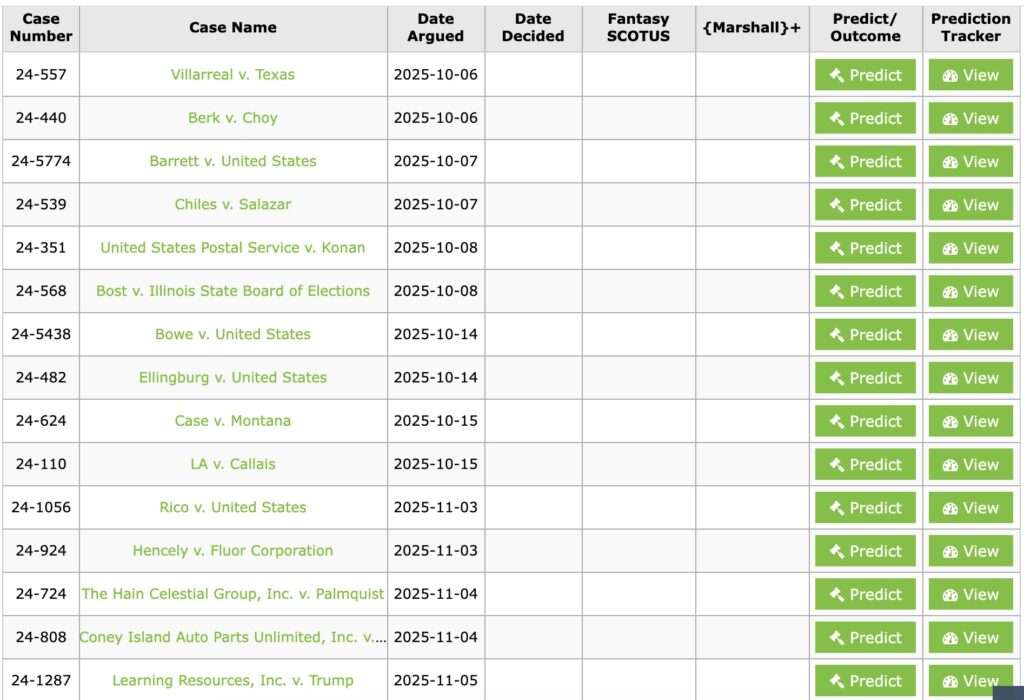
Oyez! Oyez! Oyez! The October Term 2025 of FantasySCOTUS is now in session

I am honored to open up the 17th Season of FantasySCOTUS. I launched the site back in 2009 when I was still clerking. Now, more than decade later, thousands of Court watchers have made their predictions. Sign up today at FantasySCOTUS.net to predict the outcome of all the blockbusters this term.

The post Oyez! Oyez! Oyez! The October Term 2025 of FantasySCOTUS is now in session appeared first on Reason.com.

from Latest – Reason.com https://ift.tt/8xIAF2o
via IFTTT

The Heritage Guide to the Constitution: Essay Nos. 176–200

To continue my preview of The Heritage Guide to the Constitution, which will ship on October 14, here are the authors of essays 176–200.

  • Essay No. 176: The Jury Trial Clause —Judge Kurt D. Engelhardt, Ian Brinton Hatch, & Greta Gieseke
  • Essay No. 177: The Vicinage Clause —Brian C. Kalt
  • Essay No. 178: The Informed Of Accusation (Arraignment) Clause —Judge Michael B. Brennan
  • Essay No. 179: The Confrontation Clause —John F. Bash, III
  • Essay No. 180: The Compulsory Process Clause —Judge Joel M. Carson Iii & Jefferson F. Serfass
  • Essay No. 181: The Right To Counsel Clause —Judge Lawrence Vandyke & Alexandria Overcash
  • Essay No. 182: The Civil Jury Trial Clause —Renée Lettow Lerner
  • Essay No. 183: The Re-Examination Clause —Renée Lettow Lerner
  • Essay No. 184: The Excessive Bail Clause —John F. Stinneford
  • Essay No. 185: The Excessive Fines Clause —John F. Stinneford
  • Essay No. 186: The Cruel And Unusual Punishments Clause —John F. Stinneford
  • Essay No. 187: The Ninth Amendment —Ryan Williams
  • Essay No. 188: The Tenth Amendment —Charles J. Cooper
  • Essay No. 189: The Eleventh Amendment —Ernest A. Young
  • Essay No. 190: The Twelfth Amendment —Michael T. Morley
  • Essay No. 191: The Thirteenth Amendment —Kurt T. Lash
  • Essay No. 192: The Citizenship Clause —Kurt T. Lash
  • Essay No. 193: The State Action Clause —Lee J. Strang
  • Essay No. 194: The Privileges Or Immunities Clause —Kurt T. Lash
  • Essay No. 195: The Due Process Clause —Nathan S. Chapman & Michael W. Mcconnell
  • Essay No. 196: The Equal Protection Clause —Christopher R. Green
  • Essay No. 197: The Apportionment Of Representatives Clause —Gerard N. Magliocca
  • Essay No. 198: The Insurrection Or Rebellion Clause —Gerard N. Magliocca
  • Essay No. 199: The Public Debt Clause —Gerard N. Magliocca
  • Essay No. 200: The Enforcement Clause—James C. Phillips

The post The Heritage Guide to the Constitution: Essay Nos. 176–200 appeared first on Reason.com.

from Latest – Reason.com https://ift.tt/kchWzVM
via IFTTT

Texas and Florida Have Become National Models for Using the Police State To Wage Culture War Battles


'Culture war police state' in blue letters | Photos: iStock

“Essentially, the librarians are my suspects,” the Texas police officer tells a school superintendent in the body camera footage. “If they are the ones that are choosing the books and putting them in there, you know, they’re the ones carrying the criminal liability.”

The Hood County constable was in the middle of a nearly two-year investigation of several school librarians for distributing allegedly obscene books. Local news outlet KXAS obtained the body camera footage and the nearly 800-page case file of the officer’s investigation last year, which concluded after the district attorney declined to file the charges that the constable had taken the liberty of drafting up.

No librarian has been arrested in such a case yet, in Texas or elsewhere, but the incident illustrated a larger trend: On issues such as library books, abortion, gender, and even food, the culture war is now feeding the police state.

This phenomenon started in the states, and none have pursued it with more intensity than Florida and Texas, where governors and legislatures have competed to show that they’re fighting the hardest against what they call “woke” excess and leftist hegemony. Now this style of governance—using criminal law, mass surveillance, tip lines, and the threat of police violence to wage the culture war—is going national.

This doesn’t just implicate the freedom of trans people or high schoolers who want to read Toni Morrison; it’s a danger to every American who wants to live, work, and travel without being monitored and menaced by the state.

“There’s usually some kind of boogeyman of the day that justifies the building of a very extreme and well-funded and well-resourced policing apparatus,” says Matthew Guariglia, a senior policy analyst at the Electronic Frontier Foundation (EFF), a digital rights advocacy group. And that apparatus “ends up becoming a day-to-day enforcer of the laws.”

The ‘Blueprint State’

If you trace the origins of President Donald Trump’s numerous executive orders this year on any culture war issue, it will often take you to Florida or Texas.

When the second Trump administration issued an order threatening to strip federal funding from K-12 schools that teach children “anti-American, subversive, harmful, and false ideologies” related to gender and race, it was lifting from Florida’s playbook.

Likewise, the administration’s campaign against universities on such issues as anti-Israel protests, transgender athletes, and critical race theory were all preceded by Florida, where a powerful executive branch, Republican-controlled Legislature, and conservative state Supreme Court allowed Gov. Ron DeSantis to apply intense pressure to public universities and school districts. The state has been a testing ground for the conservative movement’s policy wish list on everything from public camping bans to expanding the death penalty to gutting civilian police oversight boards.

In a June report, PEN America, a nonprofit that promotes free expression, dubbed Florida the “blueprint state” for the White House’s run of education-related executive orders. “Each of these federal actions has had a test run in Florida,” the report stated.

We’re seeing a “general intimidation of librarians,” says Sabrina Baêta, the senior program manager of PEN America’s Freedom to Read campaign. “It’s people bringing books to police headquarters and claiming that there has to be some kind of police action against it. It’s doxxing and threatening librarians and educators who are trying to do their jobs.”

One of the most recent examples occurred in June, when Hillsborough County Public Schools Superintendent Van Ayres was summoned before the State Board of Education. The board grilled Ayres about why his district hadn’t fully complied with a threatening letter from Florida Attorney General James Uthmeier and then–Florida Education Commissioner Manny Diaz Jr., demanding that it pull 55 “pornographic” and “inappropriate” books from high school library shelves. Some of the titles did indeed contain infamous amounts of sex and violence, such as Anthony Burgess’ A Clockwork Orange and Bret Easton Ellis’ American Psycho. But others were clearly chosen for their LGBT content, such asthe young adult rom-coms Margo Zimmerman Gets the Girl, by Brianna R. Shrum and Sara Waxelbaum, and This Is Kind of an Epic Love Story, by Kacen Callender, or because they frankly discuss issues like teenage drug use (Amy Reed’s Beautiful), sexual assault (Sapphire’s Push), or eating disorders (Sherry Shahan’s Skin and Bones).

Some inclusions were just bizarre. It seems unlikely that teenagers in search of a naughty thrill are cracking open The Wind-Up Bird Chronicle, Haruki Murakami’s doorstop novel of Japanese magical realism.

Ayres’ answer—that the titles were being reviewed by trained “media specialists,” which Florida now requires by law to approve all school library materials—only further incensed the board.

“Have you considered firing all your media specialists and starting from scratch with women and men who can read?” board member Grazie Pozo Christie asked. “These people that you trust to review these materials are abusing the children of your county. They’re child abusers.”

At one point during the meeting, Diaz said he wanted to “provide caution” to school officials and librarians that they “could face penalty under law and prosecution by the attorney general’s office” for stocking obscene books.

Unsurprisingly, Ayres agreed to permanently remove all 55 books from Hillsborough County school libraries. He also ordered around 600 books flagged by the Florida Department of Education in 2022 to be removed from shelves and reviewed. After seeing Ayres get put on the hot seat, other Florida school districts began pulling books off their shelves as well.

Legislatures are tempted to use criminal penalties as a lever precisely because the threat of prosecution is so effective, but in most states that have considered bills to crack down on library books, cooler heads have prevailed. The North Dakota Legislature passed a bill in April that would have prosecuted librarians for not removing explicit material from libraries; Republican Gov. Kelly Armstrong vetoed the bill, calling it “a misguided attempt to legislate morality.” Alabama and South Dakota also both introduced bills in their most recent legislative sessions that would have subjected librarians to criminal prosecution for distributing obscene materials, although the Alabama bill died and the South Dakota one was gutted and replaced with an appeals process.

Disputes over the content of school libraries can be resolved by school boards, and by other means that do not involve police investigations or probes by the state attorney general’s office, which has more important work than perusing library stacks for prurient material.

This all comes with a price tag. Tampa Bay radio station WUSF reported that it will cost Hillsborough County Public Schools roughly $345,000 in labor to finish reviewing the roughly 600 books flagged by the state. That’s an awful lot of money to make sure teenagers read fewer books.

All of that money and all of those threats might be for naught. In August, a federal judge struck down nearly every provision of the 2023 Florida law that led educators to remove thousands of books from school libraries.

Reviewing the list of books that had been pulled from shelves in Florida schools, such as On The RoadSlaughterhouse-Five, and The Bluest Eye, U.S. District Judge Kent Wetherell concluded, “None of these books are obscene.” The restrictions on them, he ruled, “are thus unreasonable in light of the purpose of school libraries.”

‘As Far as I Know, There Isn’t a Case’

In March, Maria Rojas, a Texas midwife who operated four clinics for low-income women in Harris and Waller counties, became the first person in the state arrested for allegedly providing illegal abortions.

Rojas’ case was the first opportunity for Texas Attorney General Ken Paxton’s office to flex its new criminal and civil powers under a trio of anti-abortion bills passed in 2021. The laws banned most abortions after six weeks with no exceptions for pregnancies resulting from rape or incest. They also subjected medical practitioners who perform abortions to criminal penalties, including up to life in prison and $100,000 in fines.

The proceedings against Rojas have been highly unusual, though. The state of Texas waited more than three months to formally indict her on criminal charges, leaving a 30-page arrest affidavit filed by Paxton’s office as the only evidence offered by the state outlining Rojas’ alleged crimes.

“I can’t even call it a criminal case, because as far as I know there isn’t a case,” Marc Hearron, an attorney with the Center for Reproductive Rights who is representing Rojas, said in April, while he was still waiting for the indictment.

According to Hearron, Rojas was held in jail for 10 days, forced to post a $1.4 million bond, and fitted with an ankle monitor “without even so much as actual criminal charges being filed.”

In late June, Rojas was finally indicted on 15 criminal charges: three for allegedly violating Texas’ abortion bans and 12 for allegedly practicing medicine without a license.

The state began investigating Rojas’ clinics in January, after Texas Health and Human Services received an anonymous complaint.

In addition to the criminal prosecution, Rojas is fighting a civil injunction that shut down her clinics. Her lawyers are appealing that injunction, arguing the state has offered no hard evidence that Rojas or her employees were performing abortions at the clinic.

Hearron calls the investigation and prosecution a “shocking invasion of someone’s liberty and the ability of low-income and uninsured populations to be able to access basic health care.”

The Texas Attorney General’s Office did not respond to a request for comment.

At the same time, Paxton’s office has been using the law’s civil component to target out-of-state doctors. Texas won a $100,000 judgment in February against Margaret Carpenter, a New York doctor who mailed abortion pills to Texas residents.

The state of Louisiana also indicted Carpenter on criminal charges in January for allegedly mailing abortion pills. The state attempted to extradite her, but New York refused those requests. Additionally, Louisiana is prosecuting a mother for allegedly giving her teenage daughter abortion pills she received from Carpenter.

Focusing on the relatively small number of criminal prosecutions obscures the larger impact of the law, though, which opponents say has been to put maternal health care—the women who receive it and the doctors who administer it—under a police spotlight.

ProPublica investigation published in February found that the rate of life-threatening sepsis infections for women hospitalized for pregnancy loss during their second and third trimesters rose by 50 percent after Texas’ abortion ban was enacted. Although Texas’ abortion laws have carve-outs for life-threatening complications like ectopic pregnancies, opponents of the law argue that this shows doctors are waiting until fetal heartbeats completely stop before administering care to women who are miscarrying, drastically increasing the chance of infection and other serious complications.

“There’s an ongoing maternal health care crisis because physicians, especially OB-GYNs, are terrified of being thrown in jail and prosecuted for providing basic reproductive health care,” Hearron says, “including things like miscarriage management or treatment of ectopic pregnancies.”

Already, these laws are leading to edge cases in law and bioethics. This spring, the plight of Adriana Smith captured national media attention.

Smith, a pregnant Georgia woman, developed blood clots in her brain and was brain-dead. Doctors kept her on life support because they believed they were legally obliged to try to save her fetus under Georgia’s anti-abortion law. Smith’s family was stripped of decision-making power over her.

In June, after four months of keeping Smith’s brain-dead body alive, doctors removed a premature-but-living baby boy from her. His family named him Chance.

As of late August, Chance is still alive. But the case raises fundamental questions about legal personhood, bodily autonomy, and the state’s power to commandeer them.

According to Dana Sussman of Pregnancy Justice, a maternal rights group, more than 10 bills were introduced in statehouses during this legislative cycle that would allow charges of homicide for people who obtain abortions.

Even if one believes that abortion should be outlawed, it’s worth considering whether expanding the scope of criminal penalties—their severity and who is subject to them—will bring clarity or confusion to maternal health care.

Bathroom Bans

Keeping the government out of your bedroom is an old trope. But these days the struggle is to keep the government out of the bathroom.

At least 14 states have adopted laws over the past couple years barring transgender people from using public restrooms that align with their gender identity.

In April, a judge temporarily blocked Montana’s new bathroom law from going into effect. Montana 4th Judicial District Judge Shane Vannatta wrote that the law “is motivated by animus and supported by no evidence that its restrictions advance its purported purpose to protect women’s safety and privacy.”

Only two states, however, criminalize the act: Utah and Florida. The first time someone was arrested in the U.S. for attempting to violate a transgender bathroom law, of course it happened in Florida.

Marcy Rheintgen, a 20-year-old transgender college student, was arrested in March for washing her hands in the women’s restroom of the Florida State Capitol building in Tallahassee.

Rheintgen was protesting Florida’s Safety in Private Spaces Act of 2023. The law makes it a crime for an individual to refuse to leave a restroom or changing area assigned to the opposite sex when asked to by a government employee. It applies in government buildings.

Rheintgen had sent letters to dozens of public officials and lawmakers announcing her intentions, and when she arrived there were several Capitol police officers waiting for her.

“I wanted people to see the absurdity of this law in practice,” Rheintgen told the Associated Press after her arrest. “If I’m a criminal, it’s going to be so hard for me to live a normal life, all because I washed my hands. Like, that’s so insane.”

Rheintgen wasn’t charged with violating the Safety in Private Spaces Act, but rather with a much more mundane charge of misdemeanor trespassing. That meant prosecutors wouldn’t have to untangle the untested and poorly written law. It also deprived Rheintgen the opportunity to file a civil suit challenging the statute.

Rheintgen’s arrest made national headlines, but the case against her ended quietly three months later, with barely a local news story to mark its resolution. In June, a Leon County judge granted a motion by Rheintgen’s defense attorney to dismiss the case against her after the State Attorney’s Office for Florida’s 2nd Judicial District failed to file charging documents and other information within a 90-day deadline.

“I think they messed it up on purpose because they knew this was bad publicity for them,” Rheintgen told the Tallahassee Democrat. “And they were scared of what could happen, like politically, that this would just cause a bunch of political blowback, which I think it would if I went to jail.”

Prosecutors for the state attorney’s office did not respond to requests for comment.

Again, even if one sees keeping trans people from their preferred bathrooms as a sensible policy, the immediate recourse to criminal penalties for edge cases—no one has yet been charged under Florida’s law—wastes everyone’s time and creates confusing new legal standards.

These sorts of issues are not existential threats to public order that require the full weight of the law to solve, and private actors and institutions should be able to find their way to a bathroom policy without a criminal statute to refer to.

The Blue Meanies vs. the Anti-Liberal Right

Of course, Florida and Texas lawmakers weren’t the first to draft legally dubious bills in response to social panics, nor is it a problem exclusive to Republicans.

The architects of Florida and Texas’ culture war campaigns argue that they’re just trying to even the score against a progressive regime that uses government power to enforce its ideological diktats on institutions both public and private.

It’s true that blue states have long been innovators in nanny-state nonsense, perhaps most notably on the Second Amendment, where several progressive-dominated states and large cities have persisted in illegally squelching residents’ constitutional right to bear arms.

During COVID-19 lockdowns, church congregations were prevented from meeting in person, playgrounds and beaches were closed, and children were kept home from school—while some of the politicians who ordered the lockdowns, such as California Gov. Gavin Newsom, were caught doing things like dining out at high-end restaurants.

The experience convinced an increasing number of conservatives that it was a loser’s game not to exploit every opportunity to expand and consolidate political power, small-government values be damned. The choice was between being in charge of a state of emergency or living underneath someone else’s, and they had gotten their fill of the latter.

The sheer number of bills churned out over the past few years by Florida and Texas is notable, especially in light of how petty the targets can be—drag queens, librarians, whoever might be using a certain bathroom stall. In July, Florida Attorney General Uthmeier launched a criminal investigation of a drag show at a restaurant owned by the vice mayor of Vero Beach. Uthmeier’s subpoenas for records from the restaurant include guest lists and any other information to identify patrons.

Also notable: those laws’ dismal track record in court. Federal judges, even those appointed by Trump or on conservative-leaning appeals panels, have repeatedly struck down culture-war bills championed by DeSantis and Texas Gov. Greg Abbott.

In addition to the aforementioned book ban law, judges have struck down Florida’s ban on social media for children under 14 and large portions of the state’s Individual Freedom Act of 2022, better known as the “Stop WOKE Act.”

One of the most contentious provisions of the act barred private employers from requiring employees to attend workplace training that promoted any of eight concepts that the state Legislature associated with critical race theory or diversity, equity, and inclusion initiatives.

As Jason Garcia, an independent Florida journalist, originally reported, when attorneys for the DeSantis administration defended the Stop WOKE Act at oral arguments before the U.S. Court of Appeals for the 11th Circuit in 2023, they made an argument that stunned the judges.

Judge Andrew Brasher, a Trump appointee, asked DeSantis administration attorney John Ohlendorf if a more narrowly tailored law could simply give employees the right to sue if they were distressed by workplace training materials. Ohlendorf said no: “The state, I think, has an interest in protecting people from racist and offensive speech even if they would, misguidedly, welcome it.”

Really?” Brasher interjected. “Really? That’s interesting. So the state has an interest in protecting me from hearing things that I want to hear?”

“I think so, your honor,” Ohlendorf responded. “I don’t see why whether the employee welcomes hearing that they are a morally inferior race goes to the state’s interest.”

Judge Britt Grant, another Trump appointee, asked Ohlendorf why the state, then, didn’t have an interest in protecting the residents of Skokie, Illinois, from Nazi speech, referring to the landmark 1977 Supreme Court ruling that allowed neo-Nazis to march through the heavily Jewish town.

In the audio recording of the court hearing, Ohlendorf stammers between long pauses for 10 excruciating seconds before trying to distinguish the two cases. Ohlendorf says that, unlike Skokie, Florida’s compelling interest in keeping racist speech out of the workplace is united by its interest in protecting captive audiences, such as employees, from being conscripted into listening to such speech.

This isn’t noted just for schadenfreude. It shows what an extreme power grab these laws are. The state interest claimed by Ohlendorf represents a boundless paternalism. Stripped of context, it’s indistinguishable from the leftist identitarian politics that the Stop WOKE Act purports to stand athwart.

In May, the 11th Circuit ruled against DeSantis again, upholding a lower court ruling that Florida’s drag show law is likely unconstitutional.

In that latter case, the DeSantis administration lost in court to an Orlando restaurant named Hamburger Mary’s. It was in fact the second time in as many months that Florida, the state DeSantis dubbed “where woke goes to die,” had lost in court to a patty-slinging plaintiff.

Cowboy Logic and Red Meat Politics

In April, a federal judge denied a motion by the state of Florida to dismiss a lawsuit by Upside Foods, a company producing “cultivated meat”—that is, meat grown in a tank from animal cells rather than harvested from a slaughtered animal.

Upside Foods is one of a handful of companies in the U.S. trying to scale up this new technology, which it says could supply rising consumer demand for meat protein without the need to slaughter animals. (The nascent industry prefers the term “cultivated meat” over “lab-grown” or, too unappealing to even be considered, “vat-grown.”)

The Food and Drug Administration approved Upside Foods’ chicken as safe for human consumption in 2022, but the company ran into a problem: States were banning its products before they even reached the shelves.

Seven states currently prohibit cultivated meat. Texas became the latest in June. “It’s plain cowboy logic that we must safeguard our real, authentic meat industry from synthetic alternatives,” Texas Agriculture Commissioner Sid Miller said in a press release celebrating the law.

The first state to pass a ban was—you guessed it—Florida. DeSantis signed Senate Bill 1084 into law in May 2024, making it a second-degree misdemeanor, punishable by a maximum fine of $500 and up to 60 days in jail, to manufacture or distribute “any meat or food product produced from cultured animal cells.” Businesses that violate the ban can lose their operating licenses and be slapped with fines of up to $5,000 per violation.

These bans are sops to the agriculture industry. At DeSantis’ press conference to sign the bill into law, a sign on his podium read: “SAVE OUR BEEF.” But the laws are also culture-war posturing. Red meat for the base, as they like to call it in politics.

Lawmakers’ opposition to lab-grown meat is packaged in rhetoric that often echoes the “Make America Healthy Again” (MAHA) crowd. As Reason‘s Elizabeth Nolan Brown explained in this magazine’s July cover story, the loose MAHA movement combines crunchy, back-to-the-earth foodie and wellness culture with anti-elite skepticism of public health experts on subjects such as diet and vaccines. The disparate strands of MAHA congealed in the incubator of extended COVID-19 lockdowns, not unlike chicken cells in a nutrient bath. This has led to a notable shift in right-wing food politics, which used to reflexively oppose government finger-wagging about junk food.

“Florida is fighting back against the global elite’s plan to force the world to eat meat grown in a petri dish or bugs to achieve their authoritarian goals,” DeSantis declared when he signed Florida’s law banning cultivated meat. Nebraska Gov. Jim Pillen called his state’s prohibition on cultivated meat an effort to “battle fringe ideas and groups to defend our way of life.”

In the bizarre, zero-sum logic of politicians like DeSantis and Pillen, the freedom to eat bacon harvested from a pig that was alive and sensate before it was slaughtered is contingent on consumers never being given a choice to try an alternative, and for entrepreneurs to be banned from trying to bring alternatives to the market.

Upside Foods filed a lawsuit in August 2024 alleging that Florida’s ban on cultivated meat violates the federal Constitution’s Commerce Clause because the law was enacted to shield in-state producers of conventional meat from competition from out-of-state producers of cultivated meat.

The Good Food Institute, a nonprofit that promotes the development of plant-based and cultivated meat alternatives, argues that cultivated meat could have several potential advantages over conventional meat production: It uses less arable land and resources, and it avoids some of the biggest negative externalities of industrial feedlots and slaughterhouses—disease outbreaks, heavy use of antibiotics, bacterial contamination, and noxious pollution.

If the cattle industry really couldn’t survive the competition, if consumers would buy alternatives in such numbers that it would drive old-school ranchers out of business—even as DeSantis and Pillen insist that regular, God-fearing Americans don’t want rib eye grown in a vat—then why are we better off shielding it with protectionist laws?

Not all cowboys see the logic in it. Many trade associations for beef producers support clear labeling requirements for cultivated meat but oppose outright bans. Jim Jenkins, a Nebraska cattle rancher, told the Flatwater Free Press that he thinks cultivated meat should be labeled, but adds: “In the good old United States of America, I think people should be able to compete, even if that threatens my business.”

Wyoming and South Dakota lawmakers voted down bills banning cultivated meat this year, citing free trade concerns.

Meanwhile, the bans are having a predictable effect on investor confidence. Although the cultivated meat industry has received regulatory approval for several more products, the industry raised only $139 million in 2024, its lowest amount in five years.

The Coming Panopticon

What makes the creation of new criminal statutes especially worrisome is law enforcement’s sweeping power to search and investigate targets, including across state lines.

The slow accretion of surveillance tools in the decades since 9/11, often justified for emergencies and for fighting terrorism, has enabled police to tap into vast, nationwide databases of personal information for routine investigations—facial recognition, cellphone surveillance, license plate tracking, sophisticated social media monitoring, and more.

With every new criminal statute, the reach of this network extends further.

In May, 404 Media reported that a Texas police officer accessed a private network of 83,000 automatic license plate readers (ALPRs), operated by the company Flock, to search for a woman believed to have self-administered an abortion. That search included ALPRs in states where abortion is legal, such as Washington and Illinois. The EFF called the incident “a chilling sign of how far law enforcement surveillance has encroached on personal liberties.”

“The ability for law enforcement in some states to get access to data and digital surveillance data from other states is going to be a massive problem,” says the EFF’s Guariglia. “This is just the first time we’ve seen this problem, and it will certainly happen again.”

Reproductive rights groups say that these sorts of cases are popping up more and more.

“We’re also seeing pregnancy loss as an increasingly suspect and potentially criminal act, whereas from our perspective, this is a health care medical incident, where someone needs often emergency medical care or just compassionate care,” says Pregnancy Justice’s Sussman. “But because of this post-Dobbs landscape, pregnancy loss is viewed with suspicion by law enforcement.”

Many criminal investigations originate after someone close to the person getting an abortion reports it to the police. A research report published by If/When/How, a reproductive rights group that runs a legal hotline, found “about a quarter of adult cases (26%) were reported to law enforcement by acquaintances entrusted with information, such as friends, parents, or intimate partners.”

The gigantic federal crackdown on immigration, which Florida’s government has enthusiastically participated in, has also expanded surveillance rapidly. The Trump administration is working feverishly to streamline and tap into already existing federal data on Social Security, tax records, medical records, and student debt to identify illegal immigrants.

Suncoast Searchlight, an investigative news outlet, reported that the Florida Highway Patrol also tapped into Flock’s ALPR network to aid in the state’s immigration crackdown.

The Illinois Attorney General’s Office has announced that it’s investigating whether local police violated a state law that bars them from sharing data with out-of-state agencies seeking to enforce immigration or abortion laws. But Guariglia says the current attempts to limit this sort of interstate data trafficking between law enforcement isn’t “realistically grounded in the realities of digital surveillance.”

“There aren’t enough protections, and even the protections that do exist don’t seem to be holding,” Guariglia says. “For instance, it is theoretically against the Constitution to spy on people just because of their politics. And yet that happens constantly in the United States today.”

As Guariglia warns, this technology is being deployed against constitutionally protected speech. Police departments, federal partners, and private groups surveilled pro-Palestine protests across the country using social media trackers, facial recognition, and undercover investigators. In July, Straight Arrow News reported that it had found evidence of police using cellphone surveillance technology at a protest outside an ICE field office in Washington.

The huge surveillance architecture and data-sharing networks being created now won’t go back in the box when the current crisis or the current administration is over, nor will they consider whether their targets used to have the right kind of politics.

Life During Wartime

Republicans like DeSantis—and pundits who champion these methods, such as the Manhattan Institute’s Christopher Rufo—say they are simply using the left’s playbook against it.

To hear Rufo and others tell it, they face an existential choice between fighting back with every tool available or surrendering to complete cultural and political domination by the left. Conservatism’s dedication to principles such as viewpoint neutrality and the marketplace of ideas has “rendered the Right ineffective, to the point of cementing, as opposed to contesting, the status quo of Leftist hegemony,” Rufo wrote in a manifesto outlining his tactics last year.

“The radical Left ruthlessly advances through the institutions, and the Right meekly ratifies each encroachment under the rubric of ‘neutrality,'” Rufo continued. “In view of the social and cultural wreckage this dynamic had wrought, it is not merely a matter of preference but a matter of urgency to break it.”

The problem with “wartime conservatism” and its militant leftist equivalent—although perhaps militant leftist is redundant—is that they can’t tolerate deescalation, only more power and new enemies. The front lines of the culture war will only shift, never shrink.

The supporters of scorched-earth culture warring assume the tools they’re unleashing won’t be turned against them. Or, more cynically, that they will be able to politically capitalize off abuse against their allies and keep the cycle of endless retribution going.

That may be a way to win an election or two, but it’s a long-term recipe for either a national breakdown or a complete surrender to a police state.

The post Texas and Florida Have Become National Models for Using the Police State To Wage Culture War Battles appeared first on Reason.com.

from Latest – Reason.com https://ift.tt/C8i3TN4
via IFTTT

The Uncertain Future Of UK Oil And Gas

The Uncertain Future Of UK Oil And Gas

Authored by Felicity Bradstock via OilPrice.com,

  • Labour is raising taxes and environmental standards on North Sea oil and gas while refusing to issue new licences, but insists hydrocarbons will remain part of the UK’s energy mix.

  • Wood Mackenzie research suggests up to 14 billion barrels of recoverable reserves may remain, far higher than regulator estimates, fuelling debate over future drilling.

  • The government is pushing for a just transition toward renewables while the Conservatives promise to remove net-zero requirements and maximise North Sea extraction.

Since the Labour Party came into office in the U.K. last year, many have wondered if oil and gas drilling will continue or whether we will witness an all-out shift to renewable energy. Prime Minister Kier Starmer has introduced stricter taxes on fossil fuel companies since coming into power, but has also said that oil and gas will continue as part of the energy mix for as long as it makes sense. So, as the investor environment in the U.K. North Seas becomes ever murkier, what can we expect?

In June, the U.K. government introduced stricter environmental regulations for fossil fuel companies with projects in the North Sea. Oil and gas firms must now account for the environmental impact of emissions from using or burning the fuels extracted. This follows a decision by a Scottish court earlier in the year, deeming the approval of Shell’s Jackdaw and Equinor and Ithaca Energy’s Rosebank unlawful, meaning they required reassessment by the government.

While existing oil and gas projects can continue in the North Sea, albeit with companies paying higher taxes, the government has said it would not issue any new oil and gas licences, as it invests in a shift to green. This marks a distinct move away from the energy policy of the previous Conservative government, which strongly backed U.K. oil and gas operations. Oil and gas companies operating in the North Sea are taxed at around 78 percent, including the Energy Profits Levy introduced in 2022.

During his recent visit to the U.K., United States President Donald Trump discussed the country’s oil and gas potential. Trump said, “You have a great asset here, and we spoke about it: it’s called the North Sea.”

He added, “The North Sea oil is phenomenal… I want this country to do well, and you have great assets that you’re going to start using, I believe, under this Prime Minister,” addressing Starmer.

He said that his pro-fossil fuel agenda in the U.S. had helped drive down fuel prices and slowed inflation – even though fuel prices have actually risen since Trump came to office. 

In response, Starmer said that the Labour government plans to maintain a pragmatic approach to the country’s future energy mix, continuing to use North Sea oil and gas as required. He also emphasised the importance of reducing energy costs for consumers. Starmer said, “The mix will include oil and gas for many years to come from the North Sea – we’ve been clear about that for some time. But we also need to mix that with renewables, and it’s the mix that’s really important.” 

However, some believe that the government should be supporting U.K. oil and gas more strongly, as the North Sea still shows significant potential. The research company Wood Mackenzie recently estimated that there could be up to 14 billion barrels worth of recoverable oil and gas in existing North Sea fields, which is three times bigger than the four billion barrels estimated to remain by the U.K. regulator, the North Sea Transition Authority (NSTA). The analysis was AI-powered and assessed the “recovery rates” – the proportion of oil and gas that can be viably extracted from the fields.

The report stated, If UK fields were able to match recovery factors from analogous global fields, an additional 9 percent could be recovered. If best-in-class recovery factors were matched, an additional 18 percent of recovery could be added… These scenarios would potentially add seven and 14 billion barrels of additional production, respectively, over the lives of the 100 largest fields.”

In contrast to the Labour government, the Conservative opposition recently said that it would remove all net-zero requirements on oil and gas companies drilling in the North Sea if elected. The party leader, Kemi Badenoch, said the Party has a policy of “maximising extraction” to get “all our oil and gas out of the North Sea”. This policy is aimed at driving down consumer energy bills. However, previous failures from the former Conservative government to reduce household energy costs have made many wary of the Party’s promises.

The current U.K. government has introduced an array of energy policies and financial incentives in recent months to support a green transition and aims to achieve the net-zero target by 2050, which was written into law by then-Conservative leader Theresa May in 2019. The government believes that diversifying the energy mix will not only strengthen long-term energy security but will also, ultimately, drive down energy bills.

The focus for many now is a just transition. Many in the oil and gas industry are concerned about what a sudden withdrawal from the North Sea will mean for workers and communities in the region. The government now has the potential to use the new investor interest in the green energy sector to support a just transition and ensure people do not get left behind.

Tyler Durden
Mon, 10/06/2025 – 05:00

via ZeroHedge News https://ift.tt/wCckDIg Tyler Durden

Texas and Florida Have Become National Models for Using the Police State To Wage Culture War Battles


'Culture war police state' in blue letters | Photos: iStock

“Essentially, the librarians are my suspects,” the Texas police officer tells a school superintendent in the body camera footage. “If they are the ones that are choosing the books and putting them in there, you know, they’re the ones carrying the criminal liability.”

The Hood County constable was in the middle of a nearly two-year investigation of several school librarians for distributing allegedly obscene books. Local news outlet KXAS obtained the body camera footage and the nearly 800-page case file of the officer’s investigation last year, which concluded after the district attorney declined to file the charges that the constable had taken the liberty of drafting up.

No librarian has been arrested in such a case yet, in Texas or elsewhere, but the incident illustrated a larger trend: On issues such as library books, abortion, gender, and even food, the culture war is now feeding the police state.

This phenomenon started in the states, and none have pursued it with more intensity than Florida and Texas, where governors and legislatures have competed to show that they’re fighting the hardest against what they call “woke” excess and leftist hegemony. Now this style of governance—using criminal law, mass surveillance, tip lines, and the threat of police violence to wage the culture war—is going national.

This doesn’t just implicate the freedom of trans people or high schoolers who want to read Toni Morrison; it’s a danger to every American who wants to live, work, and travel without being monitored and menaced by the state.

“There’s usually some kind of boogeyman of the day that justifies the building of a very extreme and well-funded and well-resourced policing apparatus,” says Matthew Guariglia, a senior policy analyst at the Electronic Frontier Foundation (EFF), a digital rights advocacy group. And that apparatus “ends up becoming a day-to-day enforcer of the laws.”

The ‘Blueprint State’

If you trace the origins of President Donald Trump’s numerous executive orders this year on any culture war issue, it will often take you to Florida or Texas.

When the second Trump administration issued an order threatening to strip federal funding from K-12 schools that teach children “anti-American, subversive, harmful, and false ideologies” related to gender and race, it was lifting from Florida’s playbook.

Likewise, the administration’s campaign against universities on such issues as anti-Israel protests, transgender athletes, and critical race theory were all preceded by Florida, where a powerful executive branch, Republican-controlled Legislature, and conservative state Supreme Court allowed Gov. Ron DeSantis to apply intense pressure to public universities and school districts. The state has been a testing ground for the conservative movement’s policy wish list on everything from public camping bans to expanding the death penalty to gutting civilian police oversight boards.

In a June report, PEN America, a nonprofit that promotes free expression, dubbed Florida the “blueprint state” for the White House’s run of education-related executive orders. “Each of these federal actions has had a test run in Florida,” the report stated.

We’re seeing a “general intimidation of librarians,” says Sabrina Baêta, the senior program manager of PEN America’s Freedom to Read campaign. “It’s people bringing books to police headquarters and claiming that there has to be some kind of police action against it. It’s doxxing and threatening librarians and educators who are trying to do their jobs.”

One of the most recent examples occurred in June, when Hillsborough County Public Schools Superintendent Van Ayres was summoned before the State Board of Education. The board grilled Ayres about why his district hadn’t fully complied with a threatening letter from Florida Attorney General James Uthmeier and then–Florida Education Commissioner Manny Diaz Jr., demanding that it pull 55 “pornographic” and “inappropriate” books from high school library shelves. Some of the titles did indeed contain infamous amounts of sex and violence, such as Anthony Burgess’ A Clockwork Orange and Bret Easton Ellis’ American Psycho. But others were clearly chosen for their LGBT content, such asthe young adult rom-coms Margo Zimmerman Gets the Girl, by Brianna R. Shrum and Sara Waxelbaum, and This Is Kind of an Epic Love Story, by Kacen Callender, or because they frankly discuss issues like teenage drug use (Amy Reed’s Beautiful), sexual assault (Sapphire’s Push), or eating disorders (Sherry Shahan’s Skin and Bones).

Some inclusions were just bizarre. It seems unlikely that teenagers in search of a naughty thrill are cracking open The Wind-Up Bird Chronicle, Haruki Murakami’s doorstop novel of Japanese magical realism.

Ayres’ answer—that the titles were being reviewed by trained “media specialists,” which Florida now requires by law to approve all school library materials—only further incensed the board.

“Have you considered firing all your media specialists and starting from scratch with women and men who can read?” board member Grazie Pozo Christie asked. “These people that you trust to review these materials are abusing the children of your county. They’re child abusers.”

At one point during the meeting, Diaz said he wanted to “provide caution” to school officials and librarians that they “could face penalty under law and prosecution by the attorney general’s office” for stocking obscene books.

Unsurprisingly, Ayres agreed to permanently remove all 55 books from Hillsborough County school libraries. He also ordered around 600 books flagged by the Florida Department of Education in 2022 to be removed from shelves and reviewed. After seeing Ayres get put on the hot seat, other Florida school districts began pulling books off their shelves as well.

Legislatures are tempted to use criminal penalties as a lever precisely because the threat of prosecution is so effective, but in most states that have considered bills to crack down on library books, cooler heads have prevailed. The North Dakota Legislature passed a bill in April that would have prosecuted librarians for not removing explicit material from libraries; Republican Gov. Kelly Armstrong vetoed the bill, calling it “a misguided attempt to legislate morality.” Alabama and South Dakota also both introduced bills in their most recent legislative sessions that would have subjected librarians to criminal prosecution for distributing obscene materials, although the Alabama bill died and the South Dakota one was gutted and replaced with an appeals process.

Disputes over the content of school libraries can be resolved by school boards, and by other means that do not involve police investigations or probes by the state attorney general’s office, which has more important work than perusing library stacks for prurient material.

This all comes with a price tag. Tampa Bay radio station WUSF reported that it will cost Hillsborough County Public Schools roughly $345,000 in labor to finish reviewing the roughly 600 books flagged by the state. That’s an awful lot of money to make sure teenagers read fewer books.

All of that money and all of those threats might be for naught. In August, a federal judge struck down nearly every provision of the 2023 Florida law that led educators to remove thousands of books from school libraries.

Reviewing the list of books that had been pulled from shelves in Florida schools, such as On The RoadSlaughterhouse-Five, and The Bluest Eye, U.S. District Judge Kent Wetherell concluded, “None of these books are obscene.” The restrictions on them, he ruled, “are thus unreasonable in light of the purpose of school libraries.”

‘As Far as I Know, There Isn’t a Case’

In March, Maria Rojas, a Texas midwife who operated four clinics for low-income women in Harris and Waller counties, became the first person in the state arrested for allegedly providing illegal abortions.

Rojas’ case was the first opportunity for Texas Attorney General Ken Paxton’s office to flex its new criminal and civil powers under a trio of anti-abortion bills passed in 2021. The laws banned most abortions after six weeks with no exceptions for pregnancies resulting from rape or incest. They also subjected medical practitioners who perform abortions to criminal penalties, including up to life in prison and $100,000 in fines.

The proceedings against Rojas have been highly unusual, though. The state of Texas waited more than three months to formally indict her on criminal charges, leaving a 30-page arrest affidavit filed by Paxton’s office as the only evidence offered by the state outlining Rojas’ alleged crimes.

“I can’t even call it a criminal case, because as far as I know there isn’t a case,” Marc Hearron, an attorney with the Center for Reproductive Rights who is representing Rojas, said in April, while he was still waiting for the indictment.

According to Hearron, Rojas was held in jail for 10 days, forced to post a $1.4 million bond, and fitted with an ankle monitor “without even so much as actual criminal charges being filed.”

In late June, Rojas was finally indicted on 15 criminal charges: three for allegedly violating Texas’ abortion bans and 12 for allegedly practicing medicine without a license.

The state began investigating Rojas’ clinics in January, after Texas Health and Human Services received an anonymous complaint.

In addition to the criminal prosecution, Rojas is fighting a civil injunction that shut down her clinics. Her lawyers are appealing that injunction, arguing the state has offered no hard evidence that Rojas or her employees were performing abortions at the clinic.

Hearron calls the investigation and prosecution a “shocking invasion of someone’s liberty and the ability of low-income and uninsured populations to be able to access basic health care.”

The Texas Attorney General’s Office did not respond to a request for comment.

At the same time, Paxton’s office has been using the law’s civil component to target out-of-state doctors. Texas won a $100,000 judgment in February against Margaret Carpenter, a New York doctor who mailed abortion pills to Texas residents.

The state of Louisiana also indicted Carpenter on criminal charges in January for allegedly mailing abortion pills. The state attempted to extradite her, but New York refused those requests. Additionally, Louisiana is prosecuting a mother for allegedly giving her teenage daughter abortion pills she received from Carpenter.

Focusing on the relatively small number of criminal prosecutions obscures the larger impact of the law, though, which opponents say has been to put maternal health care—the women who receive it and the doctors who administer it—under a police spotlight.

ProPublica investigation published in February found that the rate of life-threatening sepsis infections for women hospitalized for pregnancy loss during their second and third trimesters rose by 50 percent after Texas’ abortion ban was enacted. Although Texas’ abortion laws have carve-outs for life-threatening complications like ectopic pregnancies, opponents of the law argue that this shows doctors are waiting until fetal heartbeats completely stop before administering care to women who are miscarrying, drastically increasing the chance of infection and other serious complications.

“There’s an ongoing maternal health care crisis because physicians, especially OB-GYNs, are terrified of being thrown in jail and prosecuted for providing basic reproductive health care,” Hearron says, “including things like miscarriage management or treatment of ectopic pregnancies.”

Already, these laws are leading to edge cases in law and bioethics. This spring, the plight of Adriana Smith captured national media attention.

Smith, a pregnant Georgia woman, developed blood clots in her brain and was brain-dead. Doctors kept her on life support because they believed they were legally obliged to try to save her fetus under Georgia’s anti-abortion law. Smith’s family was stripped of decision-making power over her.

In June, after four months of keeping Smith’s brain-dead body alive, doctors removed a premature-but-living baby boy from her. His family named him Chance.

As of late August, Chance is still alive. But the case raises fundamental questions about legal personhood, bodily autonomy, and the state’s power to commandeer them.

According to Dana Sussman of Pregnancy Justice, a maternal rights group, more than 10 bills were introduced in statehouses during this legislative cycle that would allow charges of homicide for people who obtain abortions.

Even if one believes that abortion should be outlawed, it’s worth considering whether expanding the scope of criminal penalties—their severity and who is subject to them—will bring clarity or confusion to maternal health care.

Bathroom Bans

Keeping the government out of your bedroom is an old trope. But these days the struggle is to keep the government out of the bathroom.

At least 14 states have adopted laws over the past couple years barring transgender people from using public restrooms that align with their gender identity.

In April, a judge temporarily blocked Montana’s new bathroom law from going into effect. Montana 4th Judicial District Judge Shane Vannatta wrote that the law “is motivated by animus and supported by no evidence that its restrictions advance its purported purpose to protect women’s safety and privacy.”

Only two states, however, criminalize the act: Utah and Florida. The first time someone was arrested in the U.S. for attempting to violate a transgender bathroom law, of course it happened in Florida.

Marcy Rheintgen, a 20-year-old transgender college student, was arrested in March for washing her hands in the women’s restroom of the Florida State Capitol building in Tallahassee.

Rheintgen was protesting Florida’s Safety in Private Spaces Act of 2023. The law makes it a crime for an individual to refuse to leave a restroom or changing area assigned to the opposite sex when asked to by a government employee. It applies in government buildings.

Rheintgen had sent letters to dozens of public officials and lawmakers announcing her intentions, and when she arrived there were several Capitol police officers waiting for her.

“I wanted people to see the absurdity of this law in practice,” Rheintgen told the Associated Press after her arrest. “If I’m a criminal, it’s going to be so hard for me to live a normal life, all because I washed my hands. Like, that’s so insane.”

Rheintgen wasn’t charged with violating the Safety in Private Spaces Act, but rather with a much more mundane charge of misdemeanor trespassing. That meant prosecutors wouldn’t have to untangle the untested and poorly written law. It also deprived Rheintgen the opportunity to file a civil suit challenging the statute.

Rheintgen’s arrest made national headlines, but the case against her ended quietly three months later, with barely a local news story to mark its resolution. In June, a Leon County judge granted a motion by Rheintgen’s defense attorney to dismiss the case against her after the State Attorney’s Office for Florida’s 2nd Judicial District failed to file charging documents and other information within a 90-day deadline.

“I think they messed it up on purpose because they knew this was bad publicity for them,” Rheintgen told the Tallahassee Democrat. “And they were scared of what could happen, like politically, that this would just cause a bunch of political blowback, which I think it would if I went to jail.”

Prosecutors for the state attorney’s office did not respond to requests for comment.

Again, even if one sees keeping trans people from their preferred bathrooms as a sensible policy, the immediate recourse to criminal penalties for edge cases—no one has yet been charged under Florida’s law—wastes everyone’s time and creates confusing new legal standards.

These sorts of issues are not existential threats to public order that require the full weight of the law to solve, and private actors and institutions should be able to find their way to a bathroom policy without a criminal statute to refer to.

The Blue Meanies vs. the Anti-Liberal Right

Of course, Florida and Texas lawmakers weren’t the first to draft legally dubious bills in response to social panics, nor is it a problem exclusive to Republicans.

The architects of Florida and Texas’ culture war campaigns argue that they’re just trying to even the score against a progressive regime that uses government power to enforce its ideological diktats on institutions both public and private.

It’s true that blue states have long been innovators in nanny-state nonsense, perhaps most notably on the Second Amendment, where several progressive-dominated states and large cities have persisted in illegally squelching residents’ constitutional right to bear arms.

During COVID-19 lockdowns, church congregations were prevented from meeting in person, playgrounds and beaches were closed, and children were kept home from school—while some of the politicians who ordered the lockdowns, such as California Gov. Gavin Newsom, were caught doing things like dining out at high-end restaurants.

The experience convinced an increasing number of conservatives that it was a loser’s game not to exploit every opportunity to expand and consolidate political power, small-government values be damned. The choice was between being in charge of a state of emergency or living underneath someone else’s, and they had gotten their fill of the latter.

The sheer number of bills churned out over the past few years by Florida and Texas is notable, especially in light of how petty the targets can be—drag queens, librarians, whoever might be using a certain bathroom stall. In July, Florida Attorney General Uthmeier launched a criminal investigation of a drag show at a restaurant owned by the vice mayor of Vero Beach. Uthmeier’s subpoenas for records from the restaurant include guest lists and any other information to identify patrons.

Also notable: those laws’ dismal track record in court. Federal judges, even those appointed by Trump or on conservative-leaning appeals panels, have repeatedly struck down culture-war bills championed by DeSantis and Texas Gov. Greg Abbott.

In addition to the aforementioned book ban law, judges have struck down Florida’s ban on social media for children under 14 and large portions of the state’s Individual Freedom Act of 2022, better known as the “Stop WOKE Act.”

One of the most contentious provisions of the act barred private employers from requiring employees to attend workplace training that promoted any of eight concepts that the state Legislature associated with critical race theory or diversity, equity, and inclusion initiatives.

As Jason Garcia, an independent Florida journalist, originally reported, when attorneys for the DeSantis administration defended the Stop WOKE Act at oral arguments before the U.S. Court of Appeals for the 11th Circuit in 2023, they made an argument that stunned the judges.

Judge Andrew Brasher, a Trump appointee, asked DeSantis administration attorney John Ohlendorf if a more narrowly tailored law could simply give employees the right to sue if they were distressed by workplace training materials. Ohlendorf said no: “The state, I think, has an interest in protecting people from racist and offensive speech even if they would, misguidedly, welcome it.”

Really?” Brasher interjected. “Really? That’s interesting. So the state has an interest in protecting me from hearing things that I want to hear?”

“I think so, your honor,” Ohlendorf responded. “I don’t see why whether the employee welcomes hearing that they are a morally inferior race goes to the state’s interest.”

Judge Britt Grant, another Trump appointee, asked Ohlendorf why the state, then, didn’t have an interest in protecting the residents of Skokie, Illinois, from Nazi speech, referring to the landmark 1977 Supreme Court ruling that allowed neo-Nazis to march through the heavily Jewish town.

In the audio recording of the court hearing, Ohlendorf stammers between long pauses for 10 excruciating seconds before trying to distinguish the two cases. Ohlendorf says that, unlike Skokie, Florida’s compelling interest in keeping racist speech out of the workplace is united by its interest in protecting captive audiences, such as employees, from being conscripted into listening to such speech.

This isn’t noted just for schadenfreude. It shows what an extreme power grab these laws are. The state interest claimed by Ohlendorf represents a boundless paternalism. Stripped of context, it’s indistinguishable from the leftist identitarian politics that the Stop WOKE Act purports to stand athwart.

In May, the 11th Circuit ruled against DeSantis again, upholding a lower court ruling that Florida’s drag show law is likely unconstitutional.

In that latter case, the DeSantis administration lost in court to an Orlando restaurant named Hamburger Mary’s. It was in fact the second time in as many months that Florida, the state DeSantis dubbed “where woke goes to die,” had lost in court to a patty-slinging plaintiff.

Cowboy Logic and Red Meat Politics

In April, a federal judge denied a motion by the state of Florida to dismiss a lawsuit by Upside Foods, a company producing “cultivated meat”—that is, meat grown in a tank from animal cells rather than harvested from a slaughtered animal.

Upside Foods is one of a handful of companies in the U.S. trying to scale up this new technology, which it says could supply rising consumer demand for meat protein without the need to slaughter animals. (The nascent industry prefers the term “cultivated meat” over “lab-grown” or, too unappealing to even be considered, “vat-grown.”)

The Food and Drug Administration approved Upside Foods’ chicken as safe for human consumption in 2022, but the company ran into a problem: States were banning its products before they even reached the shelves.

Seven states currently prohibit cultivated meat. Texas became the latest in June. “It’s plain cowboy logic that we must safeguard our real, authentic meat industry from synthetic alternatives,” Texas Agriculture Commissioner Sid Miller said in a press release celebrating the law.

The first state to pass a ban was—you guessed it—Florida. DeSantis signed Senate Bill 1084 into law in May 2024, making it a second-degree misdemeanor, punishable by a maximum fine of $500 and up to 60 days in jail, to manufacture or distribute “any meat or food product produced from cultured animal cells.” Businesses that violate the ban can lose their operating licenses and be slapped with fines of up to $5,000 per violation.

These bans are sops to the agriculture industry. At DeSantis’ press conference to sign the bill into law, a sign on his podium read: “SAVE OUR BEEF.” But the laws are also culture-war posturing. Red meat for the base, as they like to call it in politics.

Lawmakers’ opposition to lab-grown meat is packaged in rhetoric that often echoes the “Make America Healthy Again” (MAHA) crowd. As Reason‘s Elizabeth Nolan Brown explained in this magazine’s July cover story, the loose MAHA movement combines crunchy, back-to-the-earth foodie and wellness culture with anti-elite skepticism of public health experts on subjects such as diet and vaccines. The disparate strands of MAHA congealed in the incubator of extended COVID-19 lockdowns, not unlike chicken cells in a nutrient bath. This has led to a notable shift in right-wing food politics, which used to reflexively oppose government finger-wagging about junk food.

“Florida is fighting back against the global elite’s plan to force the world to eat meat grown in a petri dish or bugs to achieve their authoritarian goals,” DeSantis declared when he signed Florida’s law banning cultivated meat. Nebraska Gov. Jim Pillen called his state’s prohibition on cultivated meat an effort to “battle fringe ideas and groups to defend our way of life.”

In the bizarre, zero-sum logic of politicians like DeSantis and Pillen, the freedom to eat bacon harvested from a pig that was alive and sensate before it was slaughtered is contingent on consumers never being given a choice to try an alternative, and for entrepreneurs to be banned from trying to bring alternatives to the market.

Upside Foods filed a lawsuit in August 2024 alleging that Florida’s ban on cultivated meat violates the federal Constitution’s Commerce Clause because the law was enacted to shield in-state producers of conventional meat from competition from out-of-state producers of cultivated meat.

The Good Food Institute, a nonprofit that promotes the development of plant-based and cultivated meat alternatives, argues that cultivated meat could have several potential advantages over conventional meat production: It uses less arable land and resources, and it avoids some of the biggest negative externalities of industrial feedlots and slaughterhouses—disease outbreaks, heavy use of antibiotics, bacterial contamination, and noxious pollution.

If the cattle industry really couldn’t survive the competition, if consumers would buy alternatives in such numbers that it would drive old-school ranchers out of business—even as DeSantis and Pillen insist that regular, God-fearing Americans don’t want rib eye grown in a vat—then why are we better off shielding it with protectionist laws?

Not all cowboys see the logic in it. Many trade associations for beef producers support clear labeling requirements for cultivated meat but oppose outright bans. Jim Jenkins, a Nebraska cattle rancher, told the Flatwater Free Press that he thinks cultivated meat should be labeled, but adds: “In the good old United States of America, I think people should be able to compete, even if that threatens my business.”

Wyoming and South Dakota lawmakers voted down bills banning cultivated meat this year, citing free trade concerns.

Meanwhile, the bans are having a predictable effect on investor confidence. Although the cultivated meat industry has received regulatory approval for several more products, the industry raised only $139 million in 2024, its lowest amount in five years.

The Coming Panopticon

What makes the creation of new criminal statutes especially worrisome is law enforcement’s sweeping power to search and investigate targets, including across state lines.

The slow accretion of surveillance tools in the decades since 9/11, often justified for emergencies and for fighting terrorism, has enabled police to tap into vast, nationwide databases of personal information for routine investigations—facial recognition, cellphone surveillance, license plate tracking, sophisticated social media monitoring, and more.

With every new criminal statute, the reach of this network extends further.

In May, 404 Media reported that a Texas police officer accessed a private network of 83,000 automatic license plate readers (ALPRs), operated by the company Flock, to search for a woman believed to have self-administered an abortion. That search included ALPRs in states where abortion is legal, such as Washington and Illinois. The EFF called the incident “a chilling sign of how far law enforcement surveillance has encroached on personal liberties.”

“The ability for law enforcement in some states to get access to data and digital surveillance data from other states is going to be a massive problem,” says the EFF’s Guariglia. “This is just the first time we’ve seen this problem, and it will certainly happen again.”

Reproductive rights groups say that these sorts of cases are popping up more and more.

“We’re also seeing pregnancy loss as an increasingly suspect and potentially criminal act, whereas from our perspective, this is a health care medical incident, where someone needs often emergency medical care or just compassionate care,” says Pregnancy Justice’s Sussman. “But because of this post-Dobbs landscape, pregnancy loss is viewed with suspicion by law enforcement.”

Many criminal investigations originate after someone close to the person getting an abortion reports it to the police. A research report published by If/When/How, a reproductive rights group that runs a legal hotline, found “about a quarter of adult cases (26%) were reported to law enforcement by acquaintances entrusted with information, such as friends, parents, or intimate partners.”

The gigantic federal crackdown on immigration, which Florida’s government has enthusiastically participated in, has also expanded surveillance rapidly. The Trump administration is working feverishly to streamline and tap into already existing federal data on Social Security, tax records, medical records, and student debt to identify illegal immigrants.

Suncoast Searchlight, an investigative news outlet, reported that the Florida Highway Patrol also tapped into Flock’s ALPR network to aid in the state’s immigration crackdown.

The Illinois Attorney General’s Office has announced that it’s investigating whether local police violated a state law that bars them from sharing data with out-of-state agencies seeking to enforce immigration or abortion laws. But Guariglia says the current attempts to limit this sort of interstate data trafficking between law enforcement isn’t “realistically grounded in the realities of digital surveillance.”

“There aren’t enough protections, and even the protections that do exist don’t seem to be holding,” Guariglia says. “For instance, it is theoretically against the Constitution to spy on people just because of their politics. And yet that happens constantly in the United States today.”

As Guariglia warns, this technology is being deployed against constitutionally protected speech. Police departments, federal partners, and private groups surveilled pro-Palestine protests across the country using social media trackers, facial recognition, and undercover investigators. In July, Straight Arrow News reported that it had found evidence of police using cellphone surveillance technology at a protest outside an ICE field office in Washington.

The huge surveillance architecture and data-sharing networks being created now won’t go back in the box when the current crisis or the current administration is over, nor will they consider whether their targets used to have the right kind of politics.

Life During Wartime

Republicans like DeSantis—and pundits who champion these methods, such as the Manhattan Institute’s Christopher Rufo—say they are simply using the left’s playbook against it.

To hear Rufo and others tell it, they face an existential choice between fighting back with every tool available or surrendering to complete cultural and political domination by the left. Conservatism’s dedication to principles such as viewpoint neutrality and the marketplace of ideas has “rendered the Right ineffective, to the point of cementing, as opposed to contesting, the status quo of Leftist hegemony,” Rufo wrote in a manifesto outlining his tactics last year.

“The radical Left ruthlessly advances through the institutions, and the Right meekly ratifies each encroachment under the rubric of ‘neutrality,'” Rufo continued. “In view of the social and cultural wreckage this dynamic had wrought, it is not merely a matter of preference but a matter of urgency to break it.”

The problem with “wartime conservatism” and its militant leftist equivalent—although perhaps militant leftist is redundant—is that they can’t tolerate deescalation, only more power and new enemies. The front lines of the culture war will only shift, never shrink.

The supporters of scorched-earth culture warring assume the tools they’re unleashing won’t be turned against them. Or, more cynically, that they will be able to politically capitalize off abuse against their allies and keep the cycle of endless retribution going.

That may be a way to win an election or two, but it’s a long-term recipe for either a national breakdown or a complete surrender to a police state.

The post Texas and Florida Have Become National Models for Using the Police State To Wage Culture War Battles appeared first on Reason.com.

from Latest – Reason.com https://ift.tt/C8i3TN4
via IFTTT

Brickbat: Seoul Snooping


A policeman sits, with his hat on the desk, happily typing on a computer. | Arne9001 | Dreamstime.com

A judge in South Korea sentenced police officer Shin Mo to eight months in prison, suspended for two years, for repeatedly looking up confidential case files without permission to help friends. Investigators said he accessed private information around 80 times and that he had been caught doing so before, which led to a two-month salary reduction. The court said his actions broke public trust.

The post Brickbat: Seoul Snooping appeared first on Reason.com.

from Latest – Reason.com https://ift.tt/8ulIa4g
via IFTTT

How Europe’s Cities Have Grown Since 1975

How Europe’s Cities Have Grown Since 1975

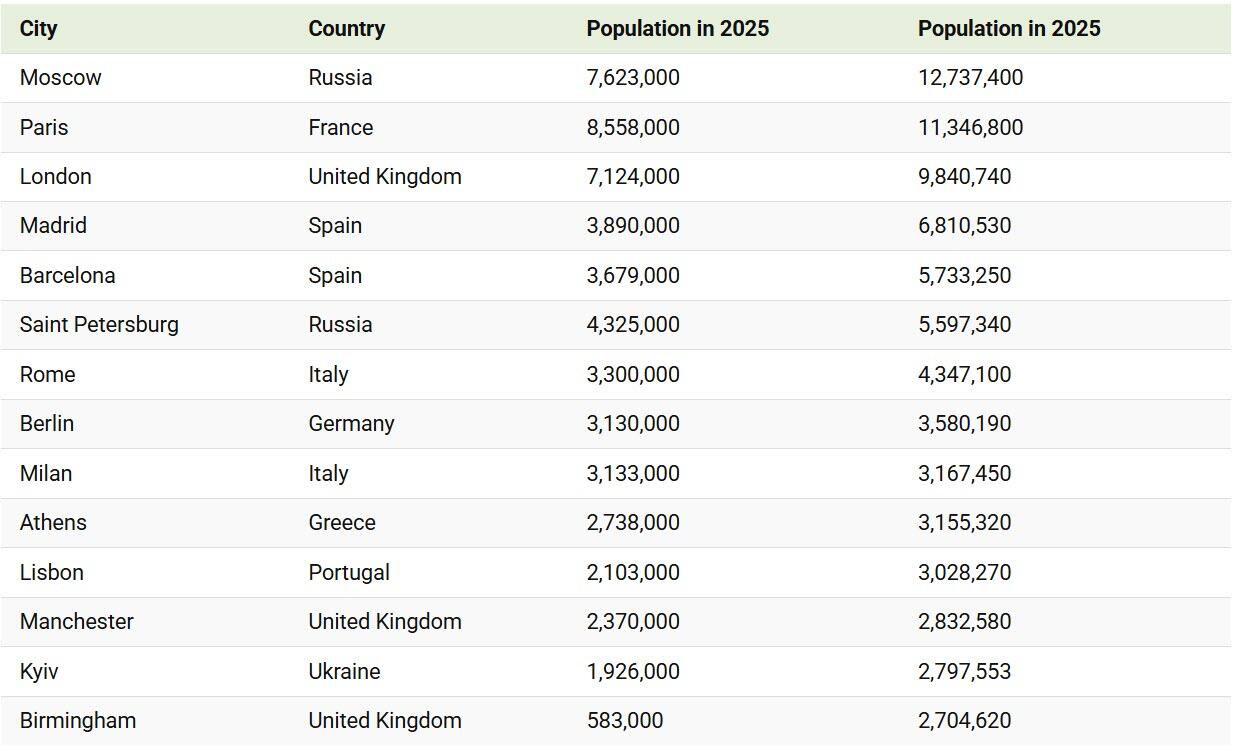
Europe’s cities have changed dramatically in size and shape since 1975. Urban areas across the continent have sprawled outward, merging into large corridors of continuous development. This visualization, via Visual Capitalist’s Marcus Lu, highlights the urban growth of major European cities, showing how population and settlement patterns have evolved.

The data for this map comes from World Population Review and Copernicus.

The Largest Urban Areas

Moscow leads as Europe’s most populous city, with over 12.7 million people projected by 2025. Paris follows closely with 11.3 million, while London ranks third with nearly 10 million. These cities have long histories of urban development and continue to expand, both in terms of area and density.

Southern Europe’s Urban Growth

Madrid and Barcelona have a combined urban population exceeding 12.5 million. Italian cities like Rome, Milan, and Naples also feature prominently, reflecting decades of steady growth tied to industry and migration.

Fast-Growing Second-Tier Cities

Several cities outside the traditional top three have seen striking increases in population since 1975. Madrid’s urban population nearly doubled from 3.9 million to 6.8 million, while Kyiv grew from 1.9 million to nearly 2.8 million. Birmingham saw the most dramatic percentage rise—from just 583,000 to over 2.7 million.

From Lisbon to Saint Petersburg, most of the featured cities experienced substantial population growth over the past five decades.

If you enjoyed today’s post, check out Ranked: European Countries With the Most Immigrants on Voronoi, the new app from Visual Capitalist.

Tyler Durden
Mon, 10/06/2025 – 04:15

via ZeroHedge News https://ift.tt/ZGITbBU Tyler Durden

Brickbat: Seoul Snooping


A policeman sits, with his hat on the desk, happily typing on a computer. | Arne9001 | Dreamstime.com

A judge in South Korea sentenced police officer Shin Mo to eight months in prison, suspended for two years, for repeatedly looking up confidential case files without permission to help friends. Investigators said he accessed private information around 80 times and that he had been caught doing so before, which led to a two-month salary reduction. The court said his actions broke public trust.

The post Brickbat: Seoul Snooping appeared first on Reason.com.

from Latest – Reason.com https://ift.tt/8ulIa4g
via IFTTT

Germany In Shock: Merz’s Media Show Vs. Economic Collapse

Germany In Shock: Merz’s Media Show Vs. Economic Collapse

Submitted by Thomas Kolbe

The collapse of the German economy is now becoming visible even in the labor market. Yet instead of pushing for a political turnaround with deregulation measures and genuine relief, the federal government limits itself to empty rhetoric and media appearances. In Berlin, PR is mistaken for economic policy—propagandistic fragments are presented as proof of achievement.

It was a week of media presence for the Chancellor. Friedrich Merz staged visibility: speeches, press conferences, appearances on German Unity Day, and the first cabinet retreat at Villa Borsig. He even tackled the new swarms of drones—with emphatic rhetoric, as if these threats, according to panicked press reports, were undermining citizens’ trust in security and airspace control—and immediately called for border measures.

Had we not learned over the past decade that border control was impossible? Wasn’t this the mantra, particularly for the CDU, during the Merkel-era invasion crisis?

But never mind. It’s not just the borders crumbling due to political inaction and a lack of will to solve problems.

Rhetorically and Physically Present

Merz was omnipresent, rhetorically and physically. At the Unity Day ceremony in Saarbrücken, the Chancellor even attempted emotional bridges with the audience.

He invoked social cohesion, called for optimism and a “new beginning,” spoke of courage, initiative, and the challenges posed by autocracies, digitalization, and geopolitical change.

Germany, Merz said, stands in Autumn 2025 at a “decisive moment” in its history, a phase that may determine the nation’s future. Despite economic and security tensions, one must “look ahead with confidence and vigor” and strive for a “new unity” in the country. Citizens should not be paralyzed by fear but, like East Germans 35 years ago, dare their own new beginning.

What was meant as an appeal to the spirit of 1989 sounded more like empty morale-boosting slogans—subtle blame-shifting that puts the burden of the crisis on ordinary citizens.

Economically Bleak

The economic outlook is so grim that even Berlin’s normally insulated news bubble cannot entirely shield the Chancellor’s office from daily shocks in the German economy.

Mild Pressure, No Consequences

Fragments of criticism from Germany’s bureaucratic and union circles appear to have reached the Chancellor’s office. Industrial CEOs complain daily about ruinous energy costs. The grotesque regulations that strangle the country are conveniently ignored—they prevent the few innovative SMEs from becoming serious competition.

Yet when companies like Bosch cut 22,000 jobs, Mercedes scraps an electric vehicle project to return to combustion engines, and entire supply chains of basic industry vanish, political action is required.

But no one dares, even verbally, to strike at the root of this civilization-destroying policy—the green agenda shared by nearly all in Berlin, except the AfD. It embodies faith in centralized power in Brussels, paving the way for the “United States of Europe,” whatever its architects may envision.

Merz and Finance Minister Lars Klingbeil—the true debt kings of our era—seriously believe that pumping a few hundred billion euros into failing projects will get the country moving again. An intellectual bankruptcy, and more: proof of structural delusion—ideological and intellectual.

Laughable “Reforms”

Merz’s response to deindustrialization and social crisis is surprisingly simple: a few media appearances, the “Made for Germany” coffee sessions, or announcing a “reform autumn” should suffice to prove the economy is turning around. It’s always the public’s bad mood, according to Merz—the eternal grumbler who simply doesn’t appreciate the hard work of policymakers.

In material terms, this government achieves nothing. In the distant future, companies might receive modest corporate tax relief—a few billion euros, laughable compared to a federal government budget of over €520 billion next year. A two-year temporary depreciation? A trivial gesture.

It is particularly cynical when the government celebrates simplified car registration or a new bureaucratic portal as groundbreaking deregulation while the administrative apparatus continues to consume billions unchecked.

For context: the ifo Institute estimates the direct and indirect costs of Germany’s bureaucracy at around €146 billion annually—over three percent of GDP.

In a country with a state share beyond 50%, this is nothing less than a confession of impotence: a document of inaction, overextension, or deliberate planning by the government—results unchanged.

Old Political Tales

Merz and Klingbeil repeat old political fables: bureaucracy will be reduced by €16 billion, eight percent of personnel cut. Believers may rejoice. Meanwhile, debates have already started about building new bureaucracies to manage the massive subsidy flows favoring green and military cronies in coming years.

Talk of deregulation is just a slogan, a hollow phrase, compulsively repeated by speechwriters. Reality: thousands of new positions at local and state levels, sold as “employment success.” Welcome to today’s political parallel universe.

It is telling that during this orchestrated week, neither the planned inheritance tax increase nor the end of spousal tax splitting proposed by Klingbeil were mentioned. All of this is media theater—distractions, smoke bombs—meant to suggest the problem has been recognized and addressed. In reality, it’s political simulation perfected to emptiness.

Actual Situation

The reality for the economy and citizens is very different. Merz allows the ever-increasing, grotesque CO₂ tax to pass without resistance—a bow to Brussels. Citizens feel the impact at the checkout as prices surge across daily essentials.

Meanwhile, municipalities respond to the green regulatory-induced economic crisis with tax hikes: the minimum business tax rate factor nationwide rises from 200 to 280 points—a costly measure that will eliminate thousands of jobs.

Since 2018, mismanaged policy has eliminated roughly 1.3 million private-sector jobs while the state created over 420,000 new public-sector positions—spinning the debt spiral ever faster.

A genuine reform would have broken this deadly cycle. It would have had the courage to finally address the migration crisis—rather than delaying debates over the migration-related citizens’ allowance through semantic smoke screens and political procrastination.

Nothing but Hot Air

Given the government’s disastrous record, one wonders: can’t they, won’t they, or aren’t they allowed? Whatever the reason for this political paralysis, Merz is the archetype of someone who simulates work with remarkable consistency—omnipresent, loud, center-stage—yet delivers nothing but hot air.

We know this game: the classic stalling tactic, backed by Berlin-Brussels consensus on the ideological agenda: social restructuring, centralized energy control, a monitored financial system, and the installation of a censored public sphere.

The media plays, channeling the 1990s, embodied by a Chancellor whose social media team reproduces tone, posture, and content from a past era, are proof. The Chancellor’s office believes it can regain air superiority over narratives and public opinion. Repeated messages, intensified public broadcaster propaganda, European censorship laws—all aimed to silence dissent and relegate serious opposition to “far-right conspiracy theories.”

In summary, this orchestrated week demonstrates once more how the political-media complex buys time by scattering sand into critics’ gears. Time to prepare the actual “reforms” underway elsewhere: a digital euro as a capital control, a UK-style digital ID, and accelerated wartime economic mobilization against an imminent Russian threat.

If this is the promised “autumn of reforms,” buckle up.

* * * 

About the author: Thomas Kolbe has worked as a journalist and media producer for clients from various industries and business associations. As a publicist, he focuses on economic processes and observes geopolitical events from the perspective of the capital markets. His publications follow a philosophy that focuses on the individual and their right to self-determination.

Tyler Durden
Mon, 10/06/2025 – 03:30

via ZeroHedge News https://ift.tt/fA4Jqh6 Tyler Durden