The Heritage Guide to the Constitution: Essay Nos. 176–200

To continue my preview of The Heritage Guide to the Constitution, which will ship on October 14, here are the authors of essays 176–200.

  • Essay No. 176: The Jury Trial Clause —Judge Kurt D. Engelhardt, Ian Brinton Hatch, & Greta Gieseke
  • Essay No. 177: The Vicinage Clause —Brian C. Kalt
  • Essay No. 178: The Informed Of Accusation (Arraignment) Clause —Judge Michael B. Brennan
  • Essay No. 179: The Confrontation Clause —John F. Bash, III
  • Essay No. 180: The Compulsory Process Clause —Judge Joel M. Carson Iii & Jefferson F. Serfass
  • Essay No. 181: The Right To Counsel Clause —Judge Lawrence Vandyke & Alexandria Overcash
  • Essay No. 182: The Civil Jury Trial Clause —Renée Lettow Lerner
  • Essay No. 183: The Re-Examination Clause —Renée Lettow Lerner
  • Essay No. 184: The Excessive Bail Clause —John F. Stinneford
  • Essay No. 185: The Excessive Fines Clause —John F. Stinneford
  • Essay No. 186: The Cruel And Unusual Punishments Clause —John F. Stinneford
  • Essay No. 187: The Ninth Amendment —Ryan Williams
  • Essay No. 188: The Tenth Amendment —Charles J. Cooper
  • Essay No. 189: The Eleventh Amendment —Ernest A. Young
  • Essay No. 190: The Twelfth Amendment —Michael T. Morley
  • Essay No. 191: The Thirteenth Amendment —Kurt T. Lash
  • Essay No. 192: The Citizenship Clause —Kurt T. Lash
  • Essay No. 193: The State Action Clause —Lee J. Strang
  • Essay No. 194: The Privileges Or Immunities Clause —Kurt T. Lash
  • Essay No. 195: The Due Process Clause —Nathan S. Chapman & Michael W. Mcconnell
  • Essay No. 196: The Equal Protection Clause —Christopher R. Green
  • Essay No. 197: The Apportionment Of Representatives Clause —Gerard N. Magliocca
  • Essay No. 198: The Insurrection Or Rebellion Clause —Gerard N. Magliocca
  • Essay No. 199: The Public Debt Clause —Gerard N. Magliocca
  • Essay No. 200: The Enforcement Clause—James C. Phillips

The post The Heritage Guide to the Constitution: Essay Nos. 176–200 appeared first on Reason.com.

from Latest – Reason.com https://ift.tt/kchWzVM
via IFTTT

Sending in the Guard


Federal agents with civilians | Peter Tsai/TNS/Newscom

Trump administration ordered the National Guard into Chicago: On Saturday morning, on the Southwest Side of Chicago in Brighton Park, two people driving cars reportedly attempted either to assault federal Border Patrol agents or to otherwise impede their work. The agents shot at one of the motorists—30-year-old Marimar Martinez, a U.S. citizen who was armed at the time—who drove herself to the hospital, was treated, and recovered.

A criminal complaint, as The New York Times summarizes it, asserts that “three Border Patrol agents who were conducting an operation in Oak Lawn, Ill., were followed by Ms. Martinez and [21-year-old Anthony Ian Santos] Ruiz. They pursued the agents’ cars, running red lights and stop signs as they did so, and eventually crossed the city line into Chicago.” The two motorists then allegedly “drove into one of the federal agents’ cars, causing the agent to lose control of the vehicle….Once the agents’ car had stopped and the agents had stepped out of it, Ms. Martinez drove her car directly at one of the agents, the complaint said, prompting him to fire five shots at her.” The Department of Homeland Security claims that Martinez was “armed with a semiautomatic weapon,z]” which has not been corroborated elsewhere.

President Donald Trump pointed to such clashes as his justification for deploying 300 National Guardsmen to Chicago over the weekend. “Amidst ongoing violent riots and lawlessness, that local leaders like [Illinois Gov. JB] Pritzker have refused to step in to quell, President Trump has authorized 300 national guardsmen to protect federal officers and assets,” said White House spokeswoman Abigail Jackson.

“It is absolutely outrageous and un-American to demand a Governor send military troops within our own borders and against our will,” Pritzker replied in a statement, adding that Defense Department officials told him to “call up your troops, or we will.”

This has “never been about safety,” said Pritzker. “This is about control.” Or maybe it’s about optics, and conveying a sense of enough-is-enough when it comes to violence by protesters.

The presence of federal agents has not improved matters. Teports emerged from Chicago over the course of the weekend indicating that federal agents—believed to be from Immigration and Customs Enforcement (ICE) and/or the Border Patrol—were shooting chemical irritants, stun grenades, and teargas at protesters (and, accidentally, at cops).

The arrival of more feds might not improve matters much. “National Guard members in Illinois would work under Title 10 of federal law,” reports The Washington Post, “prohibiting them from carrying out law enforcement duties. The mission would probably focus more narrowly on protecting federal law enforcement personnel and facilities, the officials said. It was not clear Saturday whether Guard members would carry firearms.”

“Over the past month, the Trump administration has surged federal agents into Chicago to make hundreds of arrests for immigration-related offenses,” adds the Post. “The operations have strained relations with the community and prompted continual protests outside an ICE detention center in Broadview, a Chicago suburb.”

Meanwhile, federal judges are blocking Trump’s attempts to send the National Guard into Portland, where similar skirmishes are playing out.


Scenes from New York: “Once last-resort care for midnight fevers, weekend sports injuries and car-wreck victims, the emergency room has become the doctor’s office for millions of people,” reports The New York Times in a piece covering what might have happened to 20-year-old Sam Terblanche, a Columbia student who visited the Mount Sinai Morningside emergency room twice before being discharged and dying in his dorm room.Patients come in with stomach pain, chest pain and cough; head injuries, overdoses and nonspecific complaints; depression, hypertension and hunger.”

“The first job of any emergency physician…is to identify and treat patients in need of resuscitation,” an E.R. doctor named Reuben Strayer explained to the Times. “Far more difficult to determine,” the paper adds, “is which patients are in imminent danger. This requires a rigorous, focused and nuanced assessment of every patient who is neither obviously dying nor obviously well. ‘You can take vital signs and if their vitals are reassuring and they look OK, the vast majority of them are OK. But not all of them,’ Strayer told me. The patient who looks well but is in danger is both a physician’s urgent concern and a needle in a haystack—and ‘the more “well” patients who use the E.D. as their primary care, the harder it becomes to find these needles,’ he said.” There is something profoundly broken with our health care system if people are routinely using the emergency room as a means of getting care for non-urgent conditions, which makes it harder for people in true emergencies to get the care they need.

More concisely:


QUICK HITS

  • “A federal judge has concluded that the Department of Justice’s prosecution of Kilmar Abrego Garcia on human smuggling charges may be an illegal retaliation after he successfully sued the Trump administration over his deportation to El Salvador,” reports the Associated Press. U.S. District Court Judge Waverly Crenshaw “said Abrego Garcia had shown that there is ‘some evidence that the prosecution against him may be vindictive.’ That evidence included statements by various Trump administration officials and the timeline of the charges being filed.”
  • “Sebastien Lecornu unexpectedly resigned as France’s prime minister on Monday, blaming the intransigence of the groups in the country’s fractured parliament and deepening a national political crisis,” reports Bloomberg. “His resignation came less than 24 hours after President Emmanuel Macron named a new cabinet stacked with centrist loyalists, ignoring threats from opposition parties not to appoint a continuity government. That plan immediately backfired.” At issue: France has a huge deficit and needs to either raise taxes or cut spending.
  • Temporary Protected Status recipients continue to be caught in legal limbo:

  • This year’s United Nations Climate Change Conference, also known as COP30, is being held in Belem, Brazil—on the edge of the Amazon—where high hotel prices are forcing countries’ governments to consider housing their delegations in converted love motels and in cruise ships to make ends meet (or so they say). It’s classic environmentalistbrain: a total inability to grasp second-order impacts. Of course Belem doesn’t have great capacity to host a conference of this size! The love-motel coopting was a predictable outcome.
  • Bluesky users try to get someone who doesn’t use Bluesky banned from the platform by…threatening a boycott for a product they don’t pay for. You truly can’t make this up. I will shed no tears if this platform must go the way of the dodo:

The post Sending in the Guard appeared first on Reason.com.

from Latest – Reason.com https://ift.tt/YawyeSN
via IFTTT

Did DA’s Office Retaliate Against Prosecutor, When She Was Serving as Juror, for Voting to Acquit Defendant?

That’s the issue in Hagan v. Funk, decided last Monday by Chief Judge William L. Campbell, Jr. (M.D. Tenn.); here are the allegations from the Complaint:

Plaintiff was employed as a prosecutor for the Office of the District Attorney General of the 20th Judicial District of Tennessee (“DA’s Office”) when she received a jury summons. The DA’s Office has an employee manual with a policy governing jury duty. The policy states:

Jury service is a responsibility of good citizenship, and all employees are expected to honor subpoenas for jury duty in any court. It is the office policy that employees serve rather than seek to be excused or exempted. Jury service is both a privilege and an obligation. Our court system is founded upon the right to a jury trial, and all citizens should participate in order to insure [sic] that this right is meaningful. Because jury service requires sacrifice, many citizens try to avoid this obligation. Our office should set a good example by our willingness to serve, and we should be positive about our justice system and encourage all citizens to take part.

Every employee is to notify their respective supervisor immediately upon the receipt of a jury notice so that arrangements can be made to cover the employee’s office assignments. Attorneys should also bring the matter to the attention of the judge of their court where appropriate. On each day at the conclusion of jury service, the employee shall return to work at the office, unless it is after office hours. All jury fees belong to the employee and will not affect an employee’s pay.

Upon receiving the jury summons, Plaintiff notified her supervisor as well as Defendant. Plaintiff appeared for jury service on July 15, 2024, for the case State of Tennessee v. Karlos Reynolds, 2023-B-1023. Plaintiff was juror number nine. Based on this number, she would presumptively serve on the jury unless either the Court removed her for cause or one of the parties used a peremptory challenge to remove her.

During voir dire, the trial court judge identified Plaintiff as “a lawyer in the court system” and Plaintiff stated that she knew “everyone here.” During specific questioning by the prosecutor, Plaintiff stated, “I am employed as an Assistant District Attorney. So you all are my colleagues.” Following voir dire, the prosecutor stated that Plaintiff should be struck for cause because she “works for Glenn Funk.” Judge Chappell ruled that Plaintiff should remain on the jury because “she said she could be fair, and I don’t think simply her employment with the Prosecutor’s Office makes her unfit.”

Each side used only two of its nine allotted peremptory strikes; none of the strikes was used to remove Plaintiff. Plaintiff then served as a member of the jury where she was selected as foreperson. The jury deliberated for less than one hour before returning a not guilty verdict on all counts.

Later that week, Plaintiff met with Defendant and two Deputy District Attorneys. Defendant berated Plaintiff for her jury service, expressed outrage that she was foreperson, and accused her of being unethical. Defendant specifically took issue with the jury’s returning a verdict of “not guilty,” stating that the “not guilty” verdict could strain her relationship with law enforcement officers at the Metro Nashville Police Department. Defendant told Plaintiff that she could not work as an attorney and needed to be “on leave.” On Monday, July 22, 2024, Plaintiff was formally placed on leave and told not to come to the office….

Plaintiff claims Defendant demoted her, reassigned her to non-attorney work, removed her from courtroom work, placed her on leave, and berated her in front of her superiors and colleagues in retaliation for her for serving on a jury and for voting “not guilty” during her jury service….

The court allowed plaintiff’s First Amendment claim to go forward, though note that the court just held that plaintiff had adequately pled the claim—the actual facts remain to be determined:

“Generally, the First Amendment protects a public employee’s speech if: (1) the speech was on a matter of public concern, Connick v. Myers (1983); (2) the speech was not made pursuant to the employee’s official duties, Garcetti v. Ceballos (2006); and, assuming the employee can satisfy the first two elements, (3) the employee’s interest in speaking on a matter of public concern outweighs the employer’s interest ‘in promoting the efficiency of the public services it performs through its employees,’ Pickering v. Bd. of Educ. (1968).”

Plaintiff claims Defendant retaliated against her based on her speech as a prospective juror during voir dire and as a juror in rendering a verdict of guilty in a criminal case for which her employer was the prosecutor. Defendant concedes that “an ADA is entitled to First Amendment protection in answering questions as a public employee empaneled in a jury pool and as a juror rendering a verdict.” He argues, however, that Plaintiff’s speech during her jury service was not protected speech because her interest in speaking does not outweigh Defendant’s interest in managing its offices to ensure its “employees’ official communications are accurate, demonstrate sound judgment, and promote the employer’s mission.”

Defendant’s argument encompasses the second and third prongs of the test for protected speech. First, Defendant asserts that Plaintiff’s speech in court as a private citizen summoned for jury duty was an “official communication” by an employee of the District Attorney’s office. Even if there were a reasoned basis for this assertion (and the Court can think of none), a determination that Plaintiff’s speech in connection with her jury service was pursuant to her official duties as an employee of the District Attorney’s office would require the Court to construe the allegations in the complaint in a light most favorable to the Defendant, which is plainly not the standard on a motion to dismiss. Moreover, in making this assertion, Defendant fails to address the fact specific inquiry for determining whether speech is spoken as a private citizen or as an employee.

Defendant’s next argument is that Plaintiff’s interests in speaking on the matter of her juror qualifications and rendering a verdict do not outweigh the interests of the District Attorney’s office in promoting the legal and ethical conduct of its employees. This argument is also inappropriate on a motion to dismiss. Not only would it require the Court to construe the allegations in the Complaint in a light favorable to the Defendant, consideration of Defendant’s asserted interests in limiting employee speech on these matters necessitates factual determinations and considerations of matters outside the pleadings not appropriate at this stage in the litigation.

Perhaps recognizing that a motion to dismiss is not the proper vehicle for the Court to weigh the relative speech interests of the employer and employee, Defendant asks the Court to find as a matter of law that “an ADA is not protected by the First Amendment from her employer’s scrutiny for failing to inform the court of the inherent conflict of interest created by her jury service when called to jury service in a criminal proceeding in the county in which she has sworn an oath of office to be an ADA.” In support, Defendant points to the following authority: (1) Tennessee Rules of Professional Conduct concerning conflicts of interest with regard to representation of clients and disruption of a tribunal (T.R.P.C. 1.7(a)(2) and 3.5); (2) a decision from the Tennessee Court of Criminal Appeals which has since been overruled regarding disqualification of government attorneys in criminal matters (State v. Grooms, 2020 WL 9171956, at (Tenn. Ct. App. Nov. 25, 2020), overruled by State v. Eady, 685 S.W.3d 689 (Tenn. 2024)); and (3) Justice [O’Connor’s] concurring opinion in Smith v. Phillips, 455 U.S. 209, 222 (1982), suggesting that if it is revealed post-trial that a juror is “an actual employee of the prosecuting agency” the Sixth Amendment right to an impartial jury would not allow a verdict to stand.

The Court declines to make such sweeping pronouncement concerning the relative speech interests of all district attorney employers vis-à-vis all assistant district attorneys in their employ. Not only is such a ruling not directly supported by the cited authority, as stated above, balancing these interests in the specific context of this case is not appropriate at the motion to dismiss stage, and making these fact specific determinations as to district attorneys and their employees writ large is unlikely ever to be appropriate.

{Throughout the motion to dismiss, Defendant either ignores or mischaracterizes the allegations in the complaint as stating that Plaintiff failed to notify the state trial court of her “conflict of interest” before serving on the jury when the complaint and trial transcript of the criminal court proceeding which is attached to the complaint clearly state that Plaintiff informed the trial court of her employment and that the trial judge considered whether it would be appropriate for Plaintiff to serve as a juror. This approach by Defendant is troubling, to say the least.} …

And the court also allowed plaintiff’s claim to go forward for violation of Tenn. Code Ann. § 22-4-106(d), which provides, in relevant part:

(1) No employer shall discharge or in any manner discriminate against an employee for serving on jury duty if the employee, prior to taking time off, gives the required notice pursuant to subsection (a).

(2)(A) Any employee who is discharged, demoted or suspended because the employee has taken time off to serve on jury duty is entitled to reinstatement and reimbursement for lost wages and work benefits caused by such acts of the employer….

Plaintiff is represented by Christopher W. Smith, David Randolph Smith, and Dominick Randolph Smith of David Randolph Smith & Associates.

The post Did DA's Office Retaliate Against Prosecutor, When She Was Serving as Juror, for Voting to Acquit Defendant? appeared first on Reason.com.

from Latest – Reason.com https://ift.tt/bA2CiBI
via IFTTT

The First Amendment and Restrictions on Gathering Information by Drone

From Sixth Circuit Judge John Bush’s very interesting opinion Friday respecting denial of rehearing en banc in Yoder v. Bowen:

This case involves an as-applied challenge to a Michigan law (the drone statute) that makes it illegal to “us[e] an unmanned vehicle or unmanned device that uses aerodynamic forces to achieve flight”—i.e., a drone—while “tak[ing] game or fish.” Drone Deer Recovery, a plaintiff here, offers a service where it tracks downed animals using drones and then posts the location of the animals’ carcasses online so hunters can more easily find their kill. The plaintiffs allege that the drone statute violates their First Amendment rights because it (1) is a content-based speech restriction, (2) violates the speech-inputs doctrine, and (3) unconstitutionally restricts their ability to engage in inherently expressive conduct. The panel rejected all three arguments and determined that the statute survived intermediate scrutiny.

{We have referred to a type of protected speech as “speech inputs,” but it goes by different names in different jurisdictions. The Tenth Circuit, for example, has referred to it as “the protected creation of speech,” and the Supreme Court has referred to it as “[s]peech in aid of” protected speech.}

I write separately because I have concerns about the panel’s reasoning related to the speech-inputs doctrine. The Supreme Court has indicated that “heightened scrutiny”— something more than O’Brien intermediate scrutiny—applies when the government seeks to ban the means to create speech. See Sorrell v. IMS Health Inc. (2011) (noting that a Vermont statute banning the sale of certain pharmaceutical data effectively banned certain entities from speaking with physicians and pharmaceutical companies and was therefore subject to “heightened scrutiny”).

For example, if a State enacted a statute banning the ownership of pens and paper, the statute would likely violate the First Amendment under the speech-inputs doctrine because it would restrict the ability to express thoughts through handwriting. Here, drone-obtained information may be analogous to pens and paper because it provides what the plaintiffs allege is a critical input needed for Drone Deer Recovery’s speech to hunters. But the panel declined to apply Sorrell‘s more rigorous level of review.

The panel’s error may be understandable given the confused state of the speech-inputs doctrine following Sorrell. After all, that case is far from a model of clarity. The words “heightened scrutiny” have sometimes been considered synonymous with “intermediate scrutiny.” But Sorrell also tells us that the statute at issue in that case “enact[ed] content- and speaker-based restrictions on the sale, disclosure, and use of prescriber-identifying information.” Content-based speech restrictions are normally subject to strict scrutiny. Meanwhile, Sorrell did not find the statute’s content-based speech restriction to be dispositive and proceeds to apply Central Hudson‘s commercial speech test, which is an entirely different inquiry from strict or intermediate scrutiny….

Sorrell is also unclear in the degree to which a speech input needs to be restricted before the doctrine comes into play. On the one hand, it seems like banning all pens and paper would easily violate the doctrine because that would outlaw the handwritten word. By contrast, a restriction on the use of a specific chemical in printer ink might not because printer ink still remains readily available. But Sorrell does not give us any direction on how to distinguish between the two types of regulation.

And, as a third point of confusion, the Supreme Court has never clarified how exclusively dedicated to creating speech the input must be before it receives some level of scrutiny under the First Amendment. When technology may be employed for purposes other than the generation of speech, those other uses perhaps may attenuate the level of protection for speech associated with use of the technology. Is a drone a speech input? Is a microchip inside the drone that is vital to its functioning?

Sorrell leaves more questions than answers, and the panel only added to the confusion. The panel determined that drones are not speech inputs, and then applied intermediate scrutiny anyway. But if the drones are not speech inputs, then it’s unclear why any level of scrutiny would apply

The panel seeks to distinguish this case from speech-inputs precedents because Drone Deer Recovery’s speech is not political. But the alleged wrong from prohibiting drone usage does not depend on whether the speech is political. Rather, the constitutional violation from banning a speech input arises when the restriction effectively abolishes the speech altogether. It is one thing to say that business-related speech, once expressed, may have less First Amendment protection than political speech; it is quite another thing to deprive the speaker of the means for expressing its speech in the first place….

In Sorrell, the Supreme Court held that a Vermont statute “restrict[ing] the sale, disclosure, and use of pharmacy records that reveal the prescribing practices of individual doctors” was unconstitutional because it “imposed a restriction on access to information” that could be used “in aid of pharmaceutical marketing”—i.e., it limited access to a critical speech input for pharmaceutical marketing. That case involved a statute completely divorced from politics, yet the Court still applied the speech-inputs doctrine…. So the panel was mistaken to the extent that it sought to distinguish Sorrell based on the non-political nature of Drone Deer Recovery’s speech.

{As an aside, I struggle to see how the panel’s distinction between political speech and non-political speech would matter here, given that the drone statute seems to regulate political speech as well. The drone statute would appear to apply equally to political speech. For example, the law would also foil the speech of animal rights activists who want to track down felled game and use it to protest animal cruelty—a quintessential form of political speech.}

The panel also attempted to distinguish Sorrell because the law in that case was not content neutral, given that the Sorrell statute allowed prescribing information to be used for some purposes but not others. But the drone statute similarly restricts a speech input based on the content of its use. The law forbids employing drones to obtain and deliver the location of felled game. But the law allows drones to deliver any other kind of information. For example, the statute apparently does not prohibit using drones to obtain and deliver data about the number and types of trees, the location of trails, etc. The drone statute thus regulates the speech input based on the content of speech for which the information will be employed. This is a content-based regulation much like in Sorrell.

We thus must apply Sorrell to this case. But what is the standard that Sorrell requires us to apply? I believe, based on the speech-inputs doctrine, it may be a higher level of review than the panel applied.

The panel’s rejection of the speech-inputs doctrine may portend a split between our circuit and the Fourth and Ninth Circuits. In an opinion that came down after the plaintiffs petitioned for rehearing en banc, the Ninth Circuit concluded that an ordinance banning observing sideshows (a form of reckless driving in an intersection) was unconstitutional because it inhibits “the process of creating a form of pure speech.” Garcia v. Cnty. of Alameda (9th Cir. Sept. 4, 2025). The court explained that, even though observing a sideshow might be a restriction on conduct, it was entitled to First Amendment protection because it regulated “a predicate for … recording of those events,” meaning that it essentially outlawed a speech-input. {The Supreme Court has held that newsgathering is protected under the First Amendment.} Meanwhile, the Fourth Circuit has held that a statute banning organizations from planting moles (i.e., undercover spies) in farms and slaughterhouses bans a speech input because it “prevents an undercover employee from publishing a critical article based on any notes she takes of documents or policies laid out in a breakroom.”

The statutes in Garcia and PETA are a bit afield of the facts of this case, but the panel’s reasoning may be difficult to square with those cases. If observing employees in a slaughterhouse or watching reckless drivers in an intersection are speech inputs governed by Sorrell, then it would appear that observing animals via a drone would also be such a speech input. To be sure, the panel might say PETA involved political speech because the plaintiff was an animal rights advocacy group. But the plaintiff in Garcia was a transportation reporter, and there is no indication from that case that he was engaged in political speech.

If this case began and ended as a hunting-with-drones precedent, it perhaps would not be worth delving so deeply into the panel’s rationale for its decision. But I worry that the panel’s opinion may be interpreted to diminish First Amendment protection more broadly, including for academics and journalists.

Consider how the panel’s reasoning could be employed to diminish academic freedom. Many academic studies rely on recorded interviews. A State could theoretically enact a statute banning the recording of interviews between a healthcare provider and a patient. This prohibition would make it unlawful, for example, to use recorded interviews in a study examining whether psychologists can convince children to remember traumatic events that did not happen. Such a study could radically change the way we consider witness testimony in many criminal trials. And yet, employing reasoning similar to the panel’s rationale here, a State’s transparent attempt to stifle that research could be subject to mere O’Brien intermediate scrutiny because (1) a psychology paper is not political speech, and (2) the statute only restricts employment of a particular technology (a recording device) that can be analogized to the drone usage in this case.

The potential effects of the panel’s reasoning could be similarly problematic for journalists. Consider a statute that bans audio or video recorded interviews altogether. If a journalist wanted to document, for example, eyewitness accounts of athletes who gambled on their own games, this statute would effectively ban that form of journalism that relates to a non-political topic. And yet, even though journalism (muckraking in particular) is one of the First Amendment’s central concerns, a statute restricting these journalists’ recordings would be subject only to O’Brien intermediate scrutiny simply because (1) the interview does not involve political speech and (2) the law did not ban the interview itself but only particular ways of recording the interview. Using the rationale advanced to defend the drone statute—that the drone statute only bans a particular technology to gather information but leaves in place traditional methods for tracking killed prey—one could argue that banning video and audio recordings of interviews is acceptable because the journalist can still use the traditional pen-and-paper method to memorialize those interviews.

These two hypotheticals cover academic research and journalism—areas that are supposed to receive the highest levels of First Amendment protection, even when they do not implicate political speech. See, e.g., Fla. Star v. B.J.F., 491 U.S. 524, 541 (1989) (applying strict scrutiny to statute limiting a journalist’s ability to publish the name of a sexual assault victim); Keyishian v. Bd. of Regents (1967) (“Our Nation is deeply committed to safeguarding academic freedom, which is of transcendent value to all of us and not merely to the teachers concerned. That freedom is therefore a special concern of the First Amendment.”). And yet, under the panel’s reasoning, they may receive only O’Brien intermediate scrutiny—with significant consequences, indeed.

That said, although I have concerns about the panel’s opinion, I do not think that this case is a viable candidate for rehearing en banc. The panel’s reasoning stems from a difficult-to-interpret Supreme Court opinion, and we are powerless to modify the directives from a controlling Supreme Court opinion in any way. So all that is left to do is wait for further guidance from the Supreme Court.

I cannot blame the panel opinion for its attempt to sort through confusing Supreme Court precedent. After all, Sorrell appears to call for O’Brien intermediate scrutiny, strict scrutiny, and Central Hudson scrutiny, all at the same time. Thus, three people could theoretically argue in favor of each separate standard of review, and Sorrell would provide equally strong support for each position. But I am still concerned that the panel’s reasoning in this case might cause problems down the road. Ultimately, I hope that the Supreme Court will give plenary consideration to this case or one like it to clarify the parameters of the speech-inputs doctrine.


The post The First Amendment and Restrictions on Gathering Information by Drone appeared first on Reason.com.

from Latest – Reason.com https://ift.tt/9DUAZKx
via IFTTT

AMD Soars After Striking Multi-Billion Chip Deal With Nvidia

AMD Soars After Striking Multi-Billion Chip Deal With Nvidia

The epic “circle jerk” continues (read how this works at the end of the note )…

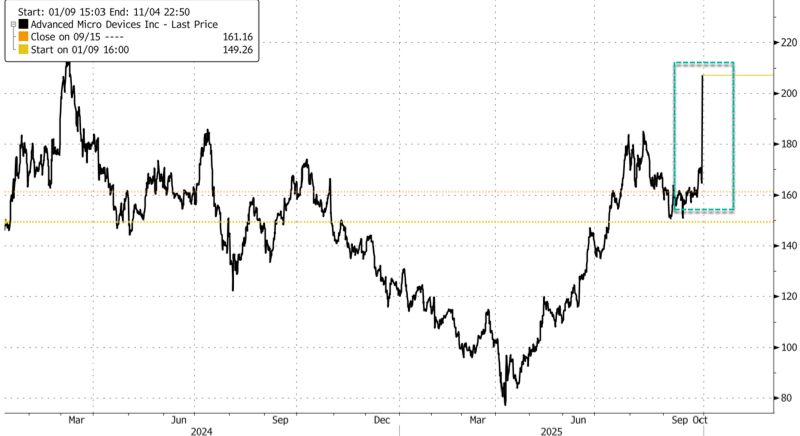
Shares of Advanced Micro Devices surged in premarket trading after the company announced a multi-year partnership with OpenAI to roll out next-generation AI infrastructure. The first 1-gigawatt deployment of AMD Instinct MI450 GPUs is scheduled to begin in the second half of 2026.

AMD and OpenAI have signed a definitive agreement establishing AMD as a core compute partner for OpenAI.

Well, that solves it. Won’t be Intel…

The partnership begins with the Instinct MI450 series and rack-scale AI solutions designed for data centers that power OpenAI’s chatbots.

Here’s the structure of the deal:

  • Equity component: AMD granted OpenAI a warrant for up to 160 million AMD shares, vesting with deployment and performance milestones tied to capacity expansion (1 GW → 6 GW), AMD share-price thresholds, and OpenAI rollout goals.

AMD CFO Jean Hu said in a statement, “Our partnership with OpenAI is expected to deliver tens of billions of dollars in revenue for AMD while accelerating OpenAI’s AI infrastructure buildout,” adding, “This agreement creates significant strategic alignment and shareholder value for both AMD and OpenAI and is expected to be highly accretive to AMD’s non-GAAP earnings-per-share.”

“This partnership is a major step in building the compute capacity needed to realize AI’s full potential,” OpenAI CEO Sam Altman stated. He noted, “AMD’s leadership in high-performance chips will enable us to accelerate progress and bring the benefits of advanced AI to everyone faster.”

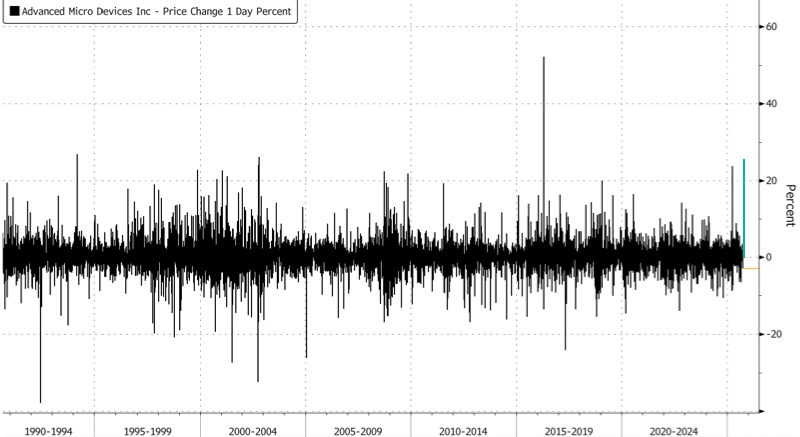
AMD shares in New York jumped as much as 25%.

What this also means is that despite the now explicit backing (and investment) of the White House, Intel failed to win this deal which makes it clear who the real Alphas are in the chip space. Surprisingly, in a sign of brief market rationality, NVDA stock is actually lower this morning (we doubt it lasts) as AMD takes away tens if not hundreds of billions in future chip revenue from the world’s largest company. 

If AMD gains hold above 23.8% (April 9, 2025) through the end of the cash session, this would mark the largest daily increase since the 52.3% jump on April 22, 2016. 

Related, and a must-read (spoiler alert: some of the nation’s top data center financiers weren’t too happy we called it a “circle jerk” ): The Stunning Math Behind The AI Vendor Financing “Circle Jerk”

. . . 

Tyler Durden
Mon, 10/06/2025 – 07:56

via ZeroHedge News https://ift.tt/2Micj5l Tyler Durden

Samsung’s Smart Fridge Turns Your Kitchen Into An Ad Billboard

Samsung’s Smart Fridge Turns Your Kitchen Into An Ad Billboard

Samsung Family Hub refrigerators are being transformed into a digital ad billboard right in your own kitchen with a new software update, according to a new report. Like it or not, owners of these premium models, priced between $1,700 and over $3,300, will now see ads on the refrigerator’s front-facing monitor whenever it sits idle. 

Android Authority spoke with a Samsung spokesperson who confirmed that an over-the-air software update will serve as an ad pilot program on Family Hub refrigerators, adding that the ads will “offer promotions and curated advertisements” designed to “strengthen the everyday value” of its home appliances for customers.

Here is the full statement from the Samsung spokesperson about the new ad program:  

Samsung is committed to innovation and enhancing every day value for our home appliance customers. As part of our ongoing efforts to strengthen that value, we are conducting a pilot program to offer promotions and curated advertisements on certain Samsung Family Hub refrigerator models in the U.S. market.

As a part of this pilot program, Family Hub refrigerators in the U.S. will receive an over-the-network (OTN) software update with Terms of Service (T&C) and Privacy Notice (PN). Advertising will appear on certain Family Hub refrigerator Cover Screens. The Cover Screen appears when a Family Hub screen is idle. Ad design format may change depending on Family Hub personalization options for the Cover Screen, and advertising will not appear when Cover Screen displays Art Mode or picture albums.

Advertisements can be dismissed on the Cover Screens where ads are shown, meaning that specific ads will not appear again during the campaign period.

Here is Android Authority’s first take on the ad infestation that Samsung is about to unleash in the kitchen: 

It’s still unclear which exact refrigerators are getting the ad infestation, but Samsung’s current Family Hub-equipped lineup in the US starts at $1,800 and goes all the way up to $3,500. It doesn’t seem like users can entirely turn off ads, which is a shame. Disconnecting the fridge from the internet might stop the ads, but you will also inevitably lose out on several smart features you paid for. If you have a Samsung refrigerator with a door display, let us know in the comments how your experience has been with them, and how you feel about ads coming to them.

Let’s hope that with the arrival of humanoid robots in homes – likely by the end of this decade or early 2030s – these bots don’t become the ultimate ad trackers that bombard consumers with targeted ads on other devices inside their own homes. We suspect an incoming ad infestation is creeping into vehicle infotainment systems, which is why it might be wise to buy an old Mercedes diesel from the 1970s or 1980s, with cassette players and essentially no chips, to preserve some peace of mind ahead of the 2030s. Also, the feds can’t remotely brick old cars.  

Tyler Durden
Mon, 10/06/2025 – 07:45

via ZeroHedge News https://ift.tt/15vsY9e Tyler Durden

French Prime Minister Abruptly Resigns After Just Three Weeks As Local Politics Enters “Very Dangerous Territory”

French Prime Minister Abruptly Resigns After Just Three Weeks As Local Politics Enters “Very Dangerous Territory”

French Prime Minister Sébastien Lecornu abruptly resigned on Monday morning, just three weeks after his appointment, preempting what appeared to be an inevitable ousting. Lecornu was expected to unveil his policy agenda before the National Assembly on Tuesday, but both the Socialist Party and the National Rally had warned that without a drastic policy shift, they would trigger a no-confidence vote. French bonds and stocks slumped on the emerging political crisis. 

President Emmanuel Macron’s office issued a one-sentence statement, confirming that Macron had accepted the resignation of Lecornu. This comes amid turmoil over the composition of his cabinet, a coalition of centrists and conservatives. 

Lecornu told reporters his resignation was primarily due to the inability to compromise across the political spectrum: “I was ready to compromise, but each political party wanted the other political party to adopt its entire program.”

He told reporters in the courtyard of the Matignon Palace, the prime minister’s headquarters, that he had spent weeks trying to forge a viable path forward with politicians, unions, and social partners from both political sides, but had achieved no breakthroughs. 

Jean Garrigues, one of France’s top political historians, told local media that Macron will likely be forced to dissolve the National Assembly once again. 

“A fresh dissolution might lead to an increase of seats for the National Rally in the lower house, but it’s unlikely that they’ll get an outright majority,” Garrigues stated in the interview. 

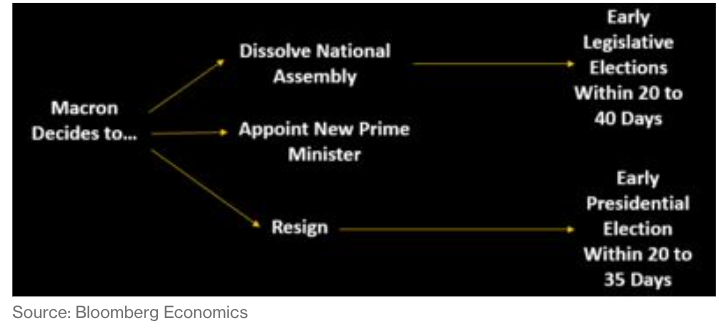
UBS analyst Simon Penn provided clients with the three possible pathways for Macron to move forward: 

  1. He can try another technocrat type

  2. He can call a general election

  3. He can quit and call a full presidential election

The Bloomberg Economics team provided readers with the visualization. 

Penn warned that France is entering a dangerous political environment:

French PM Lecornu has resigned less than a month after he was appointed (Sept. 9). On face value Lecornu looks to have quit before he was forced out. He was due to present his policy proposals to the National Assembly on Tuesday, but leaders of the Socialist and National Rally had already warned that unless there was a total change in direction they would call a vote of no confidence immediately after Lecornu stopped speaking.

Furthermore, the press and public reaction to the appointment of a near unchanged cabinet from the Bayrou administration has been somewhat scornful. President Macron has attempted three times to try for the same policies and failed three times. As the famous quote from Jean-Claude Juncker goes: “We all know what to do, but we don’t know how to get re-elected once we have done it.”

The latest failure puts French politics into very dangerous territory – more so than the markets seem to be pricing. The lessons of the UK in the 1970s are worth bearing in mind – a government in the early 70s attempting what today would be described as austerity; failing and being replaced by socialist policy, that today might be described as populist. It took mass strikes, power blackouts and an IMF bailout before UK voters were willing to accept the necessary medicine that came in the form of the 1979 Thatcher government.

Meanwhile, across other Wall Street desks this morning, analysts are desperately trying to make sense of the political turmoil and what comes next. Barclays analysts expect parliamentary elections, adding that a Macron resignation is “unlikely.”

Political turmoil sent the CAC 40, the benchmark French stock market index, down 1.5% by early afternoon trading in Paris. French bonds also dropped. 

More market commentary from UBS analyst Justinus Steinhors: “The Euro Stoxx 50 falls 80bp, retreating from highs. Yields jump on political turmoil: in France, PM Lecornu resigns after less than four weeks in office.”

Alexandre Baradez, chief market analyst at IG in Paris, warned, “What’s new this morning is the beginning of contagion from France to the rest of the European banking sector. The drop of the sector is 100% linked to France. Given that banks have outperformed the markets so much, all the elements are aligned for some profit-taking on these stocks.”

Allianz CIO and Chief Economist Ludovic Subran told Bloomberg that it’s not the time to panic.

Lecornu’s resignation makes him the shortest-serving prime minister in the history of France’s Fifth Republic, founded by Charles de Gaulle in 1958.

Tyler Durden
Mon, 10/06/2025 – 07:34

via ZeroHedge News https://ift.tt/mdFlWo8 Tyler Durden

CDC Says 98 People Sickened In Norovirus Outbreak On Royal Caribbean Ship

CDC Says 98 People Sickened In Norovirus Outbreak On Royal Caribbean Ship

Authored by Jack Phillips via The Epoch Times (emphasis ours),

An outbreak of norovirus sickened 98 people on a Royal Caribbean cruise ahead of its final destination in Miami, said the Centers for Disease Control and Prevention on Sept. 30.

Royal Caribbean Cruises liner Serenade of the Sea leaves the access channel from Le Havre harbour, France, on May 8, 2019. Jean-Francois Monier/AFP via Getty Images

The outbreak on the cruise line’s Serenade of the Seas was reported to the health agency over the past weekend. Around 94 passengers onboard the ship reported being ill, along with four crew members.

More than 2,700 passengers and crew members are on board the ship, the CDC says. According to a cruise tracking service, the Serenade of the Seas departed San Diego on Sept. 19 and is slated to arrive in Miami on Thursday, as it made stops in Mexico, Costa Rica, Panama, and Colombia.

The “causative agent” was listed by the CDC as norovirus, a group of viruses that can cause severe diarrhea and vomiting. The primary symptoms listed by the agency on the ongoing outbreak were vomiting and diarrhea.

In response to the norovirus outbreak, Royal Caribbean said that it will increase cleaning and disinfection procedures on board the ship, collect stool specimens for testing, isolate crew and passengers who have symptoms, and consult with the CDC on its procedures and reporting cases to the agency.

Responding to the CDC’s report, a spokesperson for the cruise operator told The Epoch Times on Thursday that “the health and safety of our guests, crew, and the communities we visit are our top priority,” adding that the company’s staff “implement rigorous cleaning procedures, many of which far exceed public health guidelines.”

So far in 2025, there have been 19 gastrointestinal outbreaks on cruise ships. Fourteen of those outbreaks were caused by norovirus, according to the CDC.

An outbreak of the virus in July also impacted Royal Caribbean line Navigator of the Seas, which sickened 141 people out of more than 5,100 passengers and crew, the agency said.

Health officials say that symptoms of norovirus include vomiting, diarrhea, and nausea. The virus also spreads easily through contaminated food or surfaces, or through close contact.

Symptoms of the virus generally start 12 to 48 hours after exposure, the Mayo Clinic says. Symptoms such as vomiting and diarrhea tend to last one to three days.

While most people recover without treatment, some people—such as older adults or young children—have to seek medical attention due to dehydration caused by vomiting and diarrhea, the clinic also says.

The CDC says that there are around 2,500 reported outbreaks of norovirus each year, and the virus usually spreads when infected individuals spread it to others via direct contact.

In a normal year, according to the CDC, norovirus causes between 19 million and 21 million cases of vomiting and diarrhea, 109,000 hospitalizations, and 900 deaths across the United States. The virus is associated with about 495,000 emergency department visits, mostly in younger children.

“Norovirus can be especially challenging to control on cruise ships because of the close living quarters, shared dining areas, and rapid turnover of passengers,” the agency says. When the ship docks, norovirus can be brought on board in contaminated food or water; or by passengers who were infected while ashore.”

Norovirus can also persist on surfaces for days or weeks and is resistant to many common disinfectants, officials say.

Tyler Durden
Mon, 10/06/2025 – 06:30

via ZeroHedge News https://ift.tt/asG6r2B Tyler Durden

Second Amendment Violated by Seizure of Firearms License from Alleged Domestic Violence Victim

From Tuesday’s opinion by Judge Aida Delgado-Colón (D.P.R.) in Ramos-Cruz v. P.R., granting summary judgment to plaintiff on her Second Amendment claim:

The Court draws the following factual findings from the parties’ admissions on the record and those statements of proposed facts submitted by plaintiff that comply with L. Civ. R. 56….

On November 19, 2022, after an argument with her husband, plaintiff left her residence in Ceiba and went to Luquillo where she called the police to make a report against him for domestic violence. At the Luquillo Police Station, PRPB [Puerto Rico Police Bureau] agents seized plaintiff’s firearms license [a seizure that apparently made it illegal for her to acquire new guns -EV]. The agents then travelled to plaintiff’s house, where her father-in-law was present, and proceeded to enter the home, where they seized her weapons and ammunition. This was done without her permission and without a court order, pursuant to Article 2.13 of [Puerto Rico Weapons Act]. The next day, on November 20, 2022, an ex parte temporary restraining order was entered in plaintiff’s favor and against her husband….

Article 2.13… reads, in relevant part, as follows:

Any law enforcement officer shall temporarily seize the license, firearms, and/or ammunition of a citizen if he has grounds to believe that the firearms license holder has used or shall use said firearms and ammunition unlawfully to harm other persons; for uttering threats to commit a crime; for stating the intention to commit suicide; for repeatedly demonstrating negligence or carelessness in handling the firearm; when it is believed that the firearms license holder has a mental illness, is considered to be a habitual drunkard, or is addicted to controlled substances; or in any other situation of grave risk or danger that warrants the seizure.

The record before the Court shows that none of the enumerated exceptions applied to plaintiff’s situation when she sought assistance from the PRPB. Rather, the PRPB effectuated the seizure pursuant to the last, broadly worded clause: “in any other situation of grave risk or danger that warrants the seizure.” …

Defendant argues that Rahimi stands for the proposition that “dangerousness” is a proper basis on which to disarm an individual. The statute at issue in that case was 18 U.S.C. § 922(g)(8), which bars a person from possessing a firearm … when a court, after the subject is given notice and an opportunity to be heard, makes the finding of “dangerousness” or explicitly proscribes the use of force…. [But] Article 2.13 allows a police officer to make the determination of dangerousness prior to any judicial process and based on his or her subjective appreciation of a situation’s dangerousness….

The summary judgment record (such as it is) suggests that plaintiff was dispossessed of her firearm and firearms license solely because she (i) she was a firearms owner, and (ii) sought the government’s protection against her husband in a domestic violence dispute. According to the uncontested material facts on record, which the Court reads in the light most favorable to the non-movant defendants, plaintiff is a citizen of the United States, employed as a private security officer, and had legally obtained and possessed a firearms license, firearms, and ammunition. She exercised her right to seek a protective order against her husband as an alleged victim of domestic violence under Puerto Rico law.

After taking her complaint and being informed of the presence of firearms in the house, the PRPB went to the residence to detain her husband and seized several firearms. The PRPB also seized and retained plaintiff’s weapons license. No warrant was ever issued for the seizure of either. Even after plaintiff withdrew her domestic violence complaint against her husband and repeatedly requested the return of her firearms and weapons license, she was refused. {Strikingly, after having also seized the alleged aggressor’s firearms, the PRPB promptly returned them to him.} The PRPB retained both her firearms and license until on or about October 15, 2024, when they were returned to plaintiff. This happened a month and a half after she commenced the present action against defendants, on August 31, 2024.

As the record stands, plaintiff’s only relevant characteristic is being a purported victim of domestic violence who seeks a protective order. Rahimi involved the exact opposite situation: the disarmament applied to the person against whom a domestic violence restraining order has been issued. The Supreme Court found that the surety and going armed laws justified disarming a person “who poses a credible threat to the physical safety of another,” and a person against whom a domestic violence restraining order has been issued is such a person. It stretches logic to find that the putative victim of domestic abuse can be disarmed under the same standard.

{Of course, a person who exercises his or her right to keep and bear a firearm for self-defense purposes may be thought of, in the abstract, as posing a credible threat of physical harm against his or her aggressor. But that defies the logic behind the Second Amendment—the use of firearms in self-defense is at the core of the constitutional right. It would be unreasonable to justify disarmament under this premise.}

When interpreted holistically, Article 2.13 suggests that its residual “grave risk or danger” clause only means to refer to situations like the ones immediately listed before it. That is, applying the ejusdem generis canon of statutory construction, “grave risk or danger” should be interpreted to extend to situations similar to when “the firearms license holder has used or shall use said firearms and ammunition unlawfully to harm other persons; for uttering threats to commit a crime; for stating the intention to commit suicide; for repeatedly demonstrating negligence or carelessness in handling the firearm; when it is believed that the firearms license holder has a mental illness, is considered to be a habitual drunkard, or is addicted to controlled substances ….”

All these instances evince a risk of danger to the person, to others, or to the community at large. Therefore, any circumstance posing a “grave risk or danger” should be comparable to the listed ones, if not already encompassed by these. To say that an alleged domestic abuse victim with a firearm presents a situation of comparable risk or danger to a drunk, a drug addict, or a mentally ill individual with a gun is, to put it mildly, unreasonable.

In sum, Rahimi would likely justify upholding Puerto Rico laws disarming persons against whom an accusation of domestic violence has been made. See, e.g., P.R. Laws. Ann. t. 8, § 621 (temporarily disarming a person against whom a court issues a restraining order). However, it is a stretch to say that because Rahimi validated a federal disarmament statute based on a person’s dangerousness to others, the broad, subjective criteria provided for in Article 2.13 … is ipso facto constitutional….

Osvaldo Sandoval-Báez (Legitima Defensa PR) and Jose M Prieto Carballo (JPC Law Office) represent plaintiff.

The post Second Amendment Violated by Seizure of Firearms License from Alleged Domestic Violence Victim appeared first on Reason.com.

from Latest – Reason.com https://ift.tt/GNOwTi3
via IFTTT