Oregon Court Strikes Down Trump’s Federalization of National Guard

The court’s opinion, available here, has some powerful language regarding the President’s deployment of national guard troops to protect “War-ravaged Portland,” as Trump called it on Truth Social.  Worth a look.

This case involves the intersection of three of the most fundamental principles in our constitutional democracy. The first concerns the relationship between the federal government and the states. The second concerns the relationship between the United States armed forces and domestic law enforcement. The third concerns the proper role of the judicial branch in ensuring that the executive branch complies with the laws and limitations imposed by the legislative branch. Whether we choose to follow what the Constitution mandates with respect to these three relationships goes to the heart of what it means to live under the rule of law in the United States. . . .

Plaintiffs bring claims alleging that Defendants’ actions violate (1) the statutory authority granted the President in 10 U.S.C. § 12406, (2) Oregon’s sovereign rights as protected in the Tenth Amendment, (3) the Posse Comitatus Act, (4) the Administrative Procedures Act, and (5) the separation of powers, as well as the Militia and Take Care Clauses of the U.S. Constitution. . . .

For the reasons discussed below, this Court finds that Plaintiffs are likely to succeed on their claim that the President’s federalization of the Oregon National Guard exceeded his statutory authority under 10 U.S.C. § 12406 and was ultra vires. In addition, because Section 12406 defines the scope of Congress’s constitutional delegation to the President to federalize the National Guard, Plaintiffs are likely to succeed on their claim that the President exceeded his constitutional authority and violated the Tenth Amendment. . . .

Under 10 U.S.C. § 12406, the President may federalize National Guard service members if: (1) the United States, or any of the Commonwealths or possessions, is invaded or is in danger of invasion by a foreign nation; (2) there is a rebellion or danger of a rebellion against the authority of the Government of the United States; or (3) the President is unable with the regular forces to execute the laws of the United States.

In Newsom II, the Ninth Circuit held that 10 U.S.C. § 12406 does not “preclude[] judicial review of the President’s determination that a statutory precondition exists.” However, a reviewing court must give “a great level of deference to the President’s determination that a predicate condition exists.”  A court “review[s] the President’s determination to ensure that it reflects a colorable assessment of the facts and law within a ‘range of honest judgment.'” At the same time, the Executive’s “exercise of his authority to maintain peace” must be “conceived in good faith, in the face of the emergency and directly related to the quelling of the disorder or the prevention of its continuance.”

In this case, and unlike in Newsom II, Plaintiffs provide substantial evidence that the protests at the Portland ICE facility were not significantly violent or disruptive in the days—or even weeks—leading up to the President’s directive on September 27, 2025. The record evidence establishes that while disruption outside the Portland ICE facility peaked in June of 2025, federal and local law enforcement officers were able to “quell[] . . . the disorder.” As of September 27, 2025, it had been months since there was any sustained level of violent or disruptive protest activity in Portland. During this time frame, there were sporadic events requiring either PPB monitoring or federal law enforcement intervention, but overall, the protests were small and uneventful.

This deployment of additional federal law enforcement officers reduced the level of disorder between June and September to the point that in the immediate days leading up to the federalization order, around twenty or fewer protesters gathered outside the ICE Facility and “FPS indicated no issues or criminal reports.” On September 26, the eve of the President’s directive, law enforcement “observed approximately 8–15 people at any given time out front of ICE. Mostly sitting in lawn chairs and walking around. Energy was low, minimal activity.” It is clear that “the regular forces,” i.e. FPS and additional federal law enforcement, were able to execute the laws of the United States. . . . 

“[A] great level of deference” is not equivalent to ignoring the facts on the ground. As the Ninth Circuit articulated, courts must “review the President’s determination to ensure that it reflects a colorable assessment of the facts and law within a ‘range of honest judgment.'” Here, this Court concludes that the President did not have a “colorable basis” to invoke § 12406(3) to federalize the National Guard because the situation on the ground belied an inability of federal law enforcement officers to execute federal law. The President’s determination was simply untethered to the facts. . . . 

[T]he following “key characteristics” provide the boundaries for what constitutes a “rebellion”: First, a rebellion must not only be violent but also be armed. Second, a rebellion must be organized. Third, a rebellion must be open and avowed. Fourth, a rebellion must be against the government as a whole—often with an aim of overthrowing the government—rather than in opposition to a single law or issue. Here, the protests in Portland were not “a rebellion” and did not pose a “danger of a rebellion,” especially in the days leading up to the federalization. As discussed above, Defendants presented evidence of sporadic violence against federal officers and property damage to a federal building. Defendants have not, however, proffered any evidence demonstrating that those episodes of violence were part of an organized attempt to overthrow the government as a whole, and therefore, Defendants have failed to show that the President had a colorable basis to conclude that Section 12406(2) was satisfied.

Furthermore, this country has a longstanding and foundational tradition of resistance to government overreach, especially in the form of military intrusion into civil affairs. “That tradition has deep roots in our history and found early expression, for example, in . . . the constitutional provisions for civilian control of the military.” Laird v. Tatum, 408 U.S. 1, 15 (1972); see also James Madison, Address to the Constitutional Convention (1787), reprinted in 1 Records of the Federal Convention of 1787, at 465 (“A standing military force, with an overgrown Executive will not long be safe companions to liberty. The means of defence [against] foreign danger, have been always the instruments of tyranny at home.”). This historical tradition boils down to a simple proposition: this is a nation of Constitutional law, not martial law. Defendants have made a range of arguments that, if accepted, risk blurring the line between civil and military federal power—to the detriment of this nation.

The post Oregon Court Strikes Down Trump's Federalization of National Guard appeared first on Reason.com.

from Latest – Reason.com https://ift.tt/zlN8CUe
via IFTTT

Oregon Court Strikes Down Trump’s Federalization of National Guard

The court’s opinion, available here, has some powerful language regarding the President’s deployment of national guard troops to protect “War-ravaged Portland,” as Trump called it on Truth Social.  Worth a look.

This case involves the intersection of three of the most fundamental principles in our constitutional democracy. The first concerns the relationship between the federal government and the states. The second concerns the relationship between the United States armed forces and domestic law enforcement. The third concerns the proper role of the judicial branch in ensuring that the executive branch complies with the laws and limitations imposed by the legislative branch. Whether we choose to follow what the Constitution mandates with respect to these three relationships goes to the heart of what it means to live under the rule of law in the United States. . . .

Plaintiffs bring claims alleging that Defendants’ actions violate (1) the statutory authority granted the President in 10 U.S.C. § 12406, (2) Oregon’s sovereign rights as protected in the Tenth Amendment, (3) the Posse Comitatus Act, (4) the Administrative Procedures Act, and (5) the separation of powers, as well as the Militia and Take Care Clauses of the U.S. Constitution. . . .

For the reasons discussed below, this Court finds that Plaintiffs are likely to succeed on their claim that the President’s federalization of the Oregon National Guard exceeded his statutory authority under 10 U.S.C. § 12406 and was ultra vires. In addition, because Section 12406 defines the scope of Congress’s constitutional delegation to the President to federalize the National Guard, Plaintiffs are likely to succeed on their claim that the President exceeded his constitutional authority and violated the Tenth Amendment. . . .

Under 10 U.S.C. § 12406, the President may federalize National Guard service members if: (1) the United States, or any of the Commonwealths or possessions, is invaded or is in danger of invasion by a foreign nation; (2) there is a rebellion or danger of a rebellion against the authority of the Government of the United States; or (3) the President is unable with the regular forces to execute the laws of the United States.

In Newsom II, the Ninth Circuit held that 10 U.S.C. § 12406 does not “preclude[] judicial review of the President’s determination that a statutory precondition exists.” However, a reviewing court must give “a great level of deference to the President’s determination that a predicate condition exists.”  A court “review[s] the President’s determination to ensure that it reflects a colorable assessment of the facts and law within a ‘range of honest judgment.'” At the same time, the Executive’s “exercise of his authority to maintain peace” must be “conceived in good faith, in the face of the emergency and directly related to the quelling of the disorder or the prevention of its continuance.”

In this case, and unlike in Newsom II, Plaintiffs provide substantial evidence that the protests at the Portland ICE facility were not significantly violent or disruptive in the days—or even weeks—leading up to the President’s directive on September 27, 2025. The record evidence establishes that while disruption outside the Portland ICE facility peaked in June of 2025, federal and local law enforcement officers were able to “quell[] . . . the disorder.” As of September 27, 2025, it had been months since there was any sustained level of violent or disruptive protest activity in Portland. During this time frame, there were sporadic events requiring either PPB monitoring or federal law enforcement intervention, but overall, the protests were small and uneventful.

This deployment of additional federal law enforcement officers reduced the level of disorder between June and September to the point that in the immediate days leading up to the federalization order, around twenty or fewer protesters gathered outside the ICE Facility and “FPS indicated no issues or criminal reports.” On September 26, the eve of the President’s directive, law enforcement “observed approximately 8–15 people at any given time out front of ICE. Mostly sitting in lawn chairs and walking around. Energy was low, minimal activity.” It is clear that “the regular forces,” i.e. FPS and additional federal law enforcement, were able to execute the laws of the United States. . . . 

“[A] great level of deference” is not equivalent to ignoring the facts on the ground. As the Ninth Circuit articulated, courts must “review the President’s determination to ensure that it reflects a colorable assessment of the facts and law within a ‘range of honest judgment.'” Here, this Court concludes that the President did not have a “colorable basis” to invoke § 12406(3) to federalize the National Guard because the situation on the ground belied an inability of federal law enforcement officers to execute federal law. The President’s determination was simply untethered to the facts. . . . 

[T]he following “key characteristics” provide the boundaries for what constitutes a “rebellion”: First, a rebellion must not only be violent but also be armed. Second, a rebellion must be organized. Third, a rebellion must be open and avowed. Fourth, a rebellion must be against the government as a whole—often with an aim of overthrowing the government—rather than in opposition to a single law or issue. Here, the protests in Portland were not “a rebellion” and did not pose a “danger of a rebellion,” especially in the days leading up to the federalization. As discussed above, Defendants presented evidence of sporadic violence against federal officers and property damage to a federal building. Defendants have not, however, proffered any evidence demonstrating that those episodes of violence were part of an organized attempt to overthrow the government as a whole, and therefore, Defendants have failed to show that the President had a colorable basis to conclude that Section 12406(2) was satisfied.

Furthermore, this country has a longstanding and foundational tradition of resistance to government overreach, especially in the form of military intrusion into civil affairs. “That tradition has deep roots in our history and found early expression, for example, in . . . the constitutional provisions for civilian control of the military.” Laird v. Tatum, 408 U.S. 1, 15 (1972); see also James Madison, Address to the Constitutional Convention (1787), reprinted in 1 Records of the Federal Convention of 1787, at 465 (“A standing military force, with an overgrown Executive will not long be safe companions to liberty. The means of defence [against] foreign danger, have been always the instruments of tyranny at home.”). This historical tradition boils down to a simple proposition: this is a nation of Constitutional law, not martial law. Defendants have made a range of arguments that, if accepted, risk blurring the line between civil and military federal power—to the detriment of this nation.

The post Oregon Court Strikes Down Trump's Federalization of National Guard appeared first on Reason.com.

from Latest – Reason.com https://ift.tt/zlN8CUe
via IFTTT

Unplanned Flaring Event Reported At Chevron’s El Segundo Refinery Following Explosion

Unplanned Flaring Event Reported At Chevron’s El Segundo Refinery Following Explosion

Chevron’s 285,000 b/d El Segundo refinery in Los Angeles County suffered a major fire late Thursday, the cause of which remains unclear amid mounting speculation on X. Although the blaze was extinguished by Friday afternoon, multiple unplanned flare events have been reported since then, indicating potential issues with refining production or equipment failures in critical units. The longer the disruption at one of the most critical refineries on the West Coast continues, the greater the potential impact on Southern California fuel prices – a region home to major military installations and key port infrastructure, which only raises the question about energy security and whether this incident was an industrial accident or something more deliberate

In recent days, the Segundo refinery has experienced multiple unplanned flare events, which typically indicate a process upset or equipment malfunction that requires operators to burn off excess hydrocarbons for safety reasons. 

Flarings occur when refinery systems (like compressors, distillation units, or heat exchangers) suddenly fail or pressure builds up unexpectedly. To prevent explosions or toxic gas releases, the flare system activates and burns the gases instead of a vented release. 

Some of the typical causes of flare events:

  • Compressor or pump failure 

  • Power outage or voltage drop 

  • Sudden feedstock quality change

  • Overpressure event in distillation or cracking units 

  • Instrumentation/control system malfunction

There’s been no word from El Segundo refinery officials about the cause of the two unplanned flare events, and no official statement has yet been released on what triggered Thursday night’s explosion at the facility.

On Friday, Bloomberg cited Wood Mackenzie, which said shutdowns include a 60,000 b/d catalytic reformer, a 45,000 b/d hydrocracker, a 73,000 b/d fluid catalytic cracker (FCC), and two hydrogen plants. The fire began in the convection section of a furnace tied to the Hydrocracker/ISOMAX complex. This area of the refinery produces diesel and jet fuel.

Goldman analyst Adam Wijaya warned clients on Friday that “$8 gasoline concerns are very real for CA” following the fire at the refinery (read report). 

In a separate note, Goldman analyst James McGeoch noted: What looks like a large fire at CVX’s el Segundo refinery in California. 280kbpd nameplate, around 100kbpd of gasoline and the same jet/diesel. Cali is quite a contained mkt but if it’s offline for a while it’ll have some spillover to broader mid-west US (+BP) and global jet (+ve REP).

The refinery is situated in the heart of Southern California’s military-industrial complex, located down the street from major military bases, and fuels the Port of Los Angeles and the Port of Long Beach, two ports that handle 40% of all U.S. containerized imports

We asked a very simple question: “Is someone sabotaging it?” 

Tyler Durden
Sun, 10/05/2025 – 20:25

via ZeroHedge News https://ift.tt/3lw4X9Y Tyler Durden

Three-Dimensional Geopolitical Chess

Three-Dimensional Geopolitical Chess

Authored & Submitted by Terry Cowan

Okay, reach for your tin foil hats and let’s stroll down the Conspiratorial Rabbit Trail. Ready, Everyone? Here goes:

When the Special Military Operation began in early 2022, during the 8th year of fighting in Ukraine, the new aspect of the conflict was cast strictly in terms of Democracy vs. Autocracy; valiant Ukraine holding back the onslaught of Russian tyranny; or the defense of Western democratic values against dark barbarism from the East; or the Rules-Based International Order against the forces of Chaos, etc. etc. No one talks that way today, unless it is Kalla Kallas, or the Lithuanian prime minister, Keith Kellogg, or cringingly recently by King Charles III. I suppose Anthony Blinken would, if he had access to a microphone. But he doesn’t.

The problem is, of course, that liberal democracy did not turn out to be the Fukuyamaian End of History that it was purported to be. (In February 2022, before my current views had quite solidified, I distinctly remember thinking, however, “Oh, History is back.”) The decline of democracy, so-stated, is most pronounced where its horn is tooted the most: Europe. Orwell predicted rightly, all political animals are equal, but some political animals are more equal than others. Don’t ask questions in Romania. Or Moldova. Running as an AfD candidate in Germany can get you fitted for a coffin in no time flat. And don’t even get me started on the U.K., where the governing elites are certifiably insane, and whose Prime Minister I’ve recently heard characterized as Tony Blair’s sock-puppet.

Real political expression can often seem more vibrant in the vilified countries–Russia, Hungary, Slovakia–though it may not translate to real political options. But no matter, dissent is decidedly not welcome in the European Parliament. Just ask Georgia what happens when you try to chart an independent course, based on your own country’s national interest. And of course, there is that bastion of freedom itself, Ukraine, where, if you are a man under 60 years of age, you don’t dare emerge from your flat, even if wheelchair-bound.

A friend characterized it thusly: “Ukraine is being not so much governed, as torn up at her beleaguered roots, by a bloodthirsty power-drunk drug-addicted neoliberal narcissist clown.” A clown, I might add, who is still allowed to address the United Nations. Anyone, (Simon Tisdall in today’s Guardian, for example) still repeating the Democracy vs. Tyranny narrative is simply not a serious person; to be avoided at cocktail parties and whose blatherings are to be dismissed out of hand.

As any reader here knows, I prefer Realist interpretations, best stated by John Mearsheimer, to-wit: Projection of Western hegemony vs. Russia’s “Red Line” (Eastward expansion of NATO vs. Russia’s defense of their Western border.) Realism rejects the view of NATO as a benign defensive alliance, which collapses in the face of even a cursory view of actual history. Russians had good reasons for viewing it as an existential threat directed at them, which of course it was.

The eastward march of NATO, the coup d’etat of 2014, the creeping NATOization of Ukraine in late 2021—all in the face of repeated, consistent, and increasingly urgent warnings from Moscow–do not need to be recounted again here. The real agenda was not, of course, the incorporation of what was demonstrably the most corrupt nation in Europe into NATO, but rather the destablization of Russia itself. For the Empire of the West, regime change is always on the agenda. Always. And so it will be until the Empire falls.

The idea, it seems, was always to overthrow the Russian government and/or oversee the establishment of a compliant one (a la Ukraine), and perhaps break the country up into more manageable bits. Once this was accomplished, we could turn our full attention to China. If this was indeed the plan, it has been a failure of yet unimagined and colossal magnitude that it indeed heralds the death of the Empire itself. Or so I thought.

Tin-foil hats secured? Consider this: What if the ultimate plan was never to defeat Russia at all? For it has rarely been done; the Golden Horde almost pulled it off some 800 years ago, and Sweden scored some victories for a season over 400 years ago. We expect such fantastical thinking from the EU elites (and Fredreich Merz, who raises no alarms by speaking of rearming Germany again.) But I would expect there to be at least a few objective students of History within the bowels of our Permanent State. Rather, what if the immediate plan is the the defeat of Europe, not Russia; reducing it to permanent vassal state status? There are three main ways in which this is being accomplished:

  1. Ditch the inexpensive Russian oil that had been the foundation of Europe’s prosperity in recent decades. Beginning with their destruction of NordStream, this lengthy cutting-off-of-the-nose-to-spite-the-face is now nearly complete. The governing elites (save Hungary, Slovakia and Turkey) have convinced themselves that they will get cooties if they use “cheap Russian oil.” Instead they have opted for much more expensive fuel from us, and from…the Russians, after it has been first filtered through India. This is decimating economies and leaving many people struggling to survive. But no matter, their moral purity and “European values” are intact.

  1. Deplete all European weapons stockpiles, throwing them heedlessly into the Black Hole of Ukraine. Of course the European elites cannot shake their Ukraine addiction because a) Zelensky wants more and they cannot refuse their creation, who might get angry with them; and b) they believe if Russia defeats Ukraine, they will come after Europe next. On the second point, one should ask for some empirical evidence. Unfortunately, there is none. Russia seems single-mindedly intent on securing its western border, and displays no apparent interest in what lies beyond. Indeed, what does Russia want with the meager crumbs of Europe, when a sumptious feast is being laid in the East? No matter, this story continues to be repeated to justify the ongoing bankrupting of Europe. They cannot manufacture the weapons Zelensky demands, so they must buy overpriced weaponry from the United States. And so, the engines of Empire are stoked. (One side point: NATO buying weapons from the U.S. is largely the U.S./NATO buing weapons from the U.S. Look for this twist to change, if it ever comes to it.)

  1. As the President has made clear in recent pronouncements, Europe will bear ALL the cost for prolonging the war. Nothing prevents any one of the European governing elites from picking up the phone and calling the Kremlin, and beginning a dialogue. But that will never happen. The war must go on in the vain hope of eventually, somehow, tricking the U.S. into a long-lasting commitment to Europe (through Ukraine.) So what looms ahead for Europe? Certainly not prosperity. Civil unrest and bankruptcy seem on order, as Europe settles-in to being part American vassal-state, part “open-air museum.”

So, if this is the plan, I must say that it is succeeding beyond anyone’s wildest imagination. And the Russians have been exceedingly helpful. Russian tanks rolling across the steppes in traditional fashion would have alarmed Europeans and galvanized a true, unified response. Instead, Moscow pursues a slow and steady war of attrition, one that a) churns up the Ukrainian army, b) protects its own soldiers, and c) doesn’t unduly alarm the Europeans (despite their paranoid rhetoric.) For those of us who review the battle lines every day, there is no great sweep of territory underway (leading neocon dead-enders Lindsay Graham and Keith Kellogg to assert that the line is stalemated and/or Ukraine is actually winning.)

The Russians move forward, one field at a time. They protect their troops, the casualty figures whispered from Zelensky to Kellogg to DJT are works of upside-down fantasy fiction. The Russian army resists directly assaulting a town, preferring to encircle it with giant pincher movements. I’ve watched it again and again, and is now being played out in Povrovsk, Kostyantynivka, Siversk, and Kupyansk. Of course, Zelensky allows no retreat, ever. And so, they more or less fight to the last Ukrainian, in the killing fields of these cauldrons. By some estimates, Ukraine has lost 1.7 million men. Another 250,000 have deserted.

Donald Trump’s recent Truth Social post is a curious piece in this scenario. If he meant what he said, then that does not speak well for him; showing him to be either be a fool or, as has been judged by some, as simply believing the last person he talked to; in this case, a 7-minute conversation with Zelensky. But, as is almost universally understood now (even by European leaders, in private), this was a work of deep sarcasm. But that is troubling as well. There is no diplomacy here. And there is no courage, only manipulation and evasion. I give DJT credit for often being shrewd, but he is never courageous, too given to trying to please everyone.

He deduces that since some claim Ukraine is winning, then the U.S. is not needed anymore; that Europe can supply whatever arms they do need, and that the U.S. will be happy to sell those weapons to them. In short, the U.S. has no strategic interest in this conflict, and leaves it to the European continent to sort out. This could have been stated straight-forwardly, repeatedly, beginning on 20 January 2025. DJT thinks Ukraine’s coming defeat will thus be blamed on Europe (I’m not too sure of that). The United States has its own problems, but in this scenario, will emerge in much better shape than the Europeans, responsible for the hollowed-out husk of Ukraine.

Tyler Durden
Sun, 10/05/2025 – 19:50

via ZeroHedge News https://ift.tt/WG6dhMp Tyler Durden

“We’re At A Tipping Point” – Trucking Industry Facing “Horrible” Rates, Tariffs, Werner CEO Says

“We’re At A Tipping Point” – Trucking Industry Facing “Horrible” Rates, Tariffs, Werner CEO Says

By Noi Mahoney of FreightWaves,

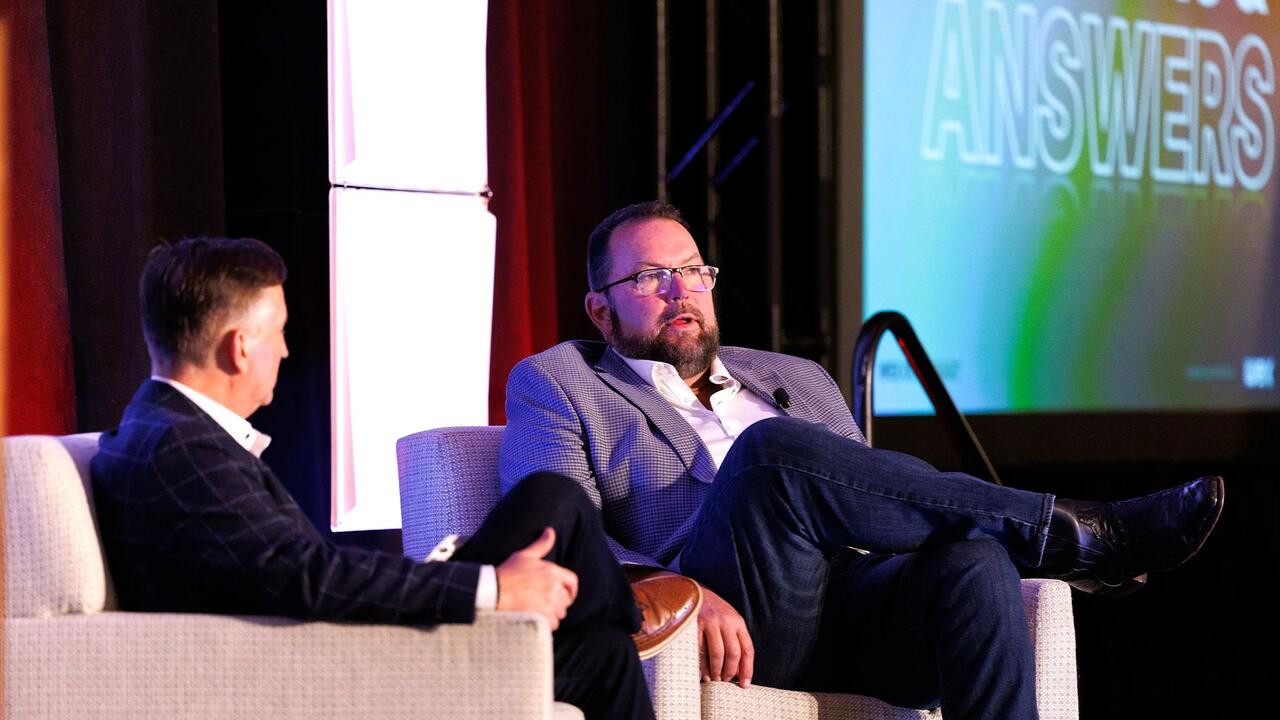
At the WEX OTR Summit, Derek Leathers, chairman and CEO of Werner Enterprises, warned of tight capacity and higher operating costs in the trucking industry.

“We’re at a tipping point,” Leathers told attendees. “Capacity is leaving the market little by little. The industry needs significant rate increases to sustain itself. This isn’t just about survival — it’s about making sure trucking can continue to deliver America’s goods safely and reliably in the years ahead.”

WEX, a global commerce platform that simplifies the business of running a business, held its summit Wednesday through Friday in San Antonio, Texas.

The event brought together over 150 leaders from the over-the-road trucking industry for two days of insight, innovation and collaboration.

With the theme of “The Road Ahead,” this year’s summit features keynotes, and strategic discussions on the trends shaping transportation, including fuel management, fraud protection, payments technology and more.

The second day of the conference featured a keynote address from Leathers, who cited weak rates, new tariffs, driver shortages and cargo theft as key risks — even as nearshoring fuels U.S.–Mexico trade growth.

Leathers, whose company is one of the largest U.S. trucking and logistics providers, noted that freight rates have been challenging in recent years, leaving many small carriers unable to reinvest in equipment or operations.

Omaha-based Werner Enterprises was founded in 1956 and has around 8,000 trucks and over 24,000 trailers. The company provides service across North America.

“What’s going on in the freight environment right now? Obviously, rates have been depressed, and although it is stable, they are stably horrible for the most part over the last several years, well below people’s operating costs in many cases. At a minimum, not a reinvestable rate level,” Leathers said.

Tim Hampton, left, general manager and senior vice president of WEX over-the-road and WEX Capital, and Derek Leathers, the chairman and CEO of Werner, during the presentation, “State of the Road: Navigating the Economy and Opportunities Ahead” on Thursday

With Class 8 truck orders at historic lows and OEMs scaling back production, he predicted it could take years to rebuild manufacturing capacity, leading to higher truck prices “at the time we can least afford for them to be more expensive.”

Tariffs squeeze supply chains

Tariffs were another key focus of his address. Leathers cautioned that only about half of the tariff impact has reached consumers so far, with the rest absorbed by suppliers and retailers — a strain he expects will increasingly filter through the supply chain. 

He also raised concerns over new tariffs on trucks made in Mexico, despite USMCA’s trade protections, arguing they will further inflate equipment costs.

“On the truck side, two thirds of all or three fourths of all truck makers actually exist and make their trucks in Mexico. If I had been betting on this stage a year ago, I would have lost that bet because I would have said that USMCA would supersede and that there would be no additional tariffs on trucks from our neighbors. Clearly that is not the case as we stand here today,” Leathers said.

Leathers also highlighted the industry’s growing safety and compliance challenges, including renewed enforcement of English-language proficiency rules for CDL holders and the scrutiny of B-1 visa drivers operating cross-border routes. 
Nearshoring strengthens U.S.–Mexico trade

Looking at broader trends, he pointed to nearshoring as a lasting shift that will deepen U.S.–Mexico trade ties. Werner already moves more than 300 cross-border loads daily, a number he expects to grow as U.S. companies boost investment in Mexico.

“Mexico is the only neighboring country or even nearshoring option that actually has good demographics,” Leathers said. “Very few places in the world do and Mexico actually does have as many people coming into the population. as they’re losing from the population and that’s true for the next 10 to 20 years.”

Cargo theft and supply chain security

Beyond the macroeconomic headwinds, Leathers also addressed rising cargo theft, calling it a “terrifying” trend fueled by organized crime. He urged shippers and carriers to strengthen vetting and technology safeguards to protect supply chains.

“Cargo theft has continued to rise. I think when you see a population that feels underdressed, that’s when risky behavior seems to always increase over time,” Leathers said.

“I think this is an area where not having proper vetting of every single man or woman on the road makes a difference. We know factually speaking from the FBI and others, there are in fact many criminal organizations outside the United States that are heavily involved in this work. There are organizations inside the U.S. as well, but the numbers are staggering.”

Trucking leaders say data will drive sustainable freight

Executives from FedEx, J.B. Hunt, and NFI Industries said the trucking industry’s path to sustainability hinges on efficiency and data-driven reporting, as customers and regulators press for greater transparency.

Speaking at the “Driving Green with Data: Executive Insights on Sustainability and Reporting” panel on Thursday, FedEx Express executive Mickey Black highlighted the company’s pledge to reach carbon neutrality by 2040. 

“That commitment gave the entire organization a clear mandate,” Black said.

J.B. Hunt’s Jared Mounce outlined the carrier’s 32% greenhouse gas intensity reduction target by 2034, stressing that intensity goals better reflect efficiency as freight volumes grow.

NFI’s Alexa Branco emphasized the importance of tracking fuel consumption, idling, and emissions intensity to prove ROI and prepare for stricter reporting.

Panelists agreed shippers increasingly require emissions reporting in contracts, some now demanding lane- or package-level detail.

Sarah Booth, director, Sawatch Labs; Alexa Branco, director of sustainability, NFI Industries; Mickey Black, managing director global vehicles and surface fuel, FedEX; Jerrod Mounce, vice-president of energy & sustainability, J.B. Hunt at the WEX OTR Summit in San Antonio, Texas on Thursday. 

Tyler Durden
Sun, 10/05/2025 – 18:40

via ZeroHedge News https://ift.tt/NeAo3Ji Tyler Durden

Nearly One-Third Of EV Charging Attempts Fail, Report Finds

Nearly One-Third Of EV Charging Attempts Fail, Report Finds

By Thomas Wasson of FreightWaves

A newly released report by ChargerHelp! shows that while 64% of Americans now live within two miles of an electric vehicle charging station, nearly one-third of charging attempts fail. Despite charging infrastructure showing 98.7% to 99% uptime rates, only 71% of charging attempts actually succeed, according to the 2025 EV Charging Reliability Report.

The report analyzed more than 100,000 sessions across 2,400 chargers. The report argues that instead of focusing on site uptime statistics, the first-time charge success rate (FTCSR) provides a more accurate measure of the driver experience.

“Uptime tells us if a charger is available, but it doesn’t tell us if a driver can actually plug in and get a charge on the first attempt,” said Kameale Terry, CEO of ChargerHelp!, in an interview with FreightWaves. “First-time charge success captures the real driver experience, and by centering on this metric, the industry can close the gap between availability and usability and build the trust needed for mass adoption.”

The complexity of EV charging stems from multiple software systems that must work in harmony, explained Terry, who has nearly a decade of experience in the space.

“Charging stations and electric vehicles are literally computers,” Terry said. “It’s all about these handshakes and how one software understands another software. If you’ve ever been in the software space, then you probably know that sometimes software doesn’t really understand one another.”

When any of these systems sends out firmware or software updates, compatibility issues can arise. As Terry notes, “Sometimes it may create a bit of a wrinkle in that system … maybe the vehicle itself, the battery management system, doesn’t really understand what the charging station is asking of it.”

These technical barriers create real-world problems for EV operators. In one example, a fleet driver might arrive at a station showing a green “available” indicator, only to find that after plugging in, the station fails to initiate authentication or begins the process but returns to the available screen without completing a charge.

Unlike Tesla’s vertically integrated system, most charging infrastructure involves multiple companies developing separate software components for vehicles, hardware, charge management systems, payment processing and connectors. This fragmentation creates interoperability challenges that directly impact consumers.

The report also identified trends in infrastructure aging. Success rates drop from 85% after the first year at new stations to approximately 70% after three years. This often happens because older hardware cannot be upgraded to newer protocols without significant equipment replacement.

“With older stations, some architecturally inside the unit itself cannot be upgraded to the new protocol,” Terry explained. “You would actually have to deploy a new piece of equipment into that unit in order to update it.”

This creates an added wrinkle for site owners using legacy infrastructure. While new vehicles are tested with current charging stations before deployment, they aren’t typically tested with older charging infrastructure, creating potential compatibility gaps.

Another challenge is regulatory oversight limitations. Unlike gasoline pumps, which undergo regular inspections by state authorities, EV charging stations face limited regulatory supervision. While weights and measures departments do monitor publicly deployed charging stations, their focus is primarily on ensuring consumers receive the electrons they’re paying for, not overall system reliability.

“Even if the station isn’t functioning at all, you wouldn’t get your sticker. They’re more so making sure that you’re not cheating the consumer,” Terry explained, adding that private fleet charging infrastructure falls outside this regulatory framework entirely.

The report recommends three key industry improvements: adopting FTCSR as a central metric, implementing preventive maintenance programs rather than relying on short-term hardware fixes, and establishing a collaborative industry approach to standardize protocols and share data.

Despite these challenges, Terry remains optimistic about the future. “It’s a solvable problem,” she said. “Even gas cars, switching from the horse and buggy to gasoline cars … was not an easy thing. But somebody figured it out. We got roadways, we got vehicles, and now we’re inside of this new kind of transition.”

Tyler Durden
Sun, 10/05/2025 – 17:30

via ZeroHedge News https://ift.tt/gLS2yst Tyler Durden

All Talked Out?

All Talked Out?

By Peter Tchir of Academy Securities

This is not something I can say every day, but I feel “all talked out.” 

We just concluded our annual Annapolis Geopolitical Summit. Turnout was amazing as the summit grows year after year. We covered a range of topics, with not only our Generals and Admirals (ret.) contributing, but also the influence from our former CIA officers and some of the industry specialists who participated in the summit was keenly felt. Clients were also able to share their insights.

Prior to the summit, I had the pleasure of having dinner in DC with the Under Secretary of War, Tony Tata, which was incredibly interesting.

I’m on my way to Toronto to take my father to watch the Blue Jays play the Yankees. Then off to Chicago and Milwaukee as we have numerous meetings and events planned. A really exciting time here.

So Many Narratives

If you missed last weekend’s Meandering Through the Narratives, that is worth a gander. We covered the i-shaped economy. Something we think will gain traction as being more “accurate” than either the K or k-shaped economy.

Russia’s frozen € reserves. That is the new twist as the administration (and potentially Europe) ramps up their pushback on Putin. This could be a pivotal moment for Europe (and the bond market).

A few of the topics deserve a bit more time.

Peace Through Strength

Peace Through Strength remains a theme. Our GIG (Geopolitical Intelligence Group) had a lot of thoughts on the 10-points announced in Quantico on Tuesday and the overall messaging. I think we are all digesting it, but my quick takeaways were:

  • Some GIG members who I thought would have been against much of what occurred, were not, and vice versa.
  • The points listed, in and of themselves, were not overly controversial.
  • One risk, that was pointed out multiple times, is that while physical fitness, etc., is important, much of what drives a modern military is “brain power” and we would be remiss to create a culture that pushes out brain power. Nothing in particular happened on that front, but it is something to think about.
  • While a “corporate rebranding” comparison remains valid, maybe some of the messaging and tone was possibly “more aggressive” than necessary?
  • There was little support for the “enemy within” tone as the GIG, collectively, views the military (from senior officers to the lowest ranking soldier) as working together for the good of the services and the country.

ProSec

Production for Security. You might be surprised by how many tickers are being thrown at me. Every day it seems (because it probably is every day) that someone is sending me a new ticker to look at as a candidate for what we have been calling ProSec™. In last weekend’s report we wanted to make it clear, that yes, like many, we have concerns about longer-term ramifications and would like to see governance issues more clearly defined, but for now, keep investing on the basis of this admin taking new approaches to jump-start technologies and industries deemed critical to national security (which can also be described as critical to preparing for trade negotiations once again with China a couple of years down the road).

It is fun to watch (and fun to learn about) as these tickers are tossed our way, and also fun to profit from this view that hasn’t caught on (at least not as a slogan), but is working extremely well.

Electron Production

The shift from molecules to electrons, which Mike Rodriguez (our Head of Sustainable Finance and a decorated Marine) helped me to use as a phrase, is “blowing up.”

Every serious conversation about AI and Data Centers “devolves” or “evolves” into a conversation about electron production (electricity for us “luddites”).

Electricity production came up during almost every conversation at the summit.

We had clients who helped us and provided information that we have just started to digest (and probably won’t really complete our review until after today’s baseball game). This is in addition to the copious work Mike Rodriguez has done and continues to do. 

I could keep going on now, but I’m not well enough prepared, and quite frankly, I am “talked out” so expect more on this later in the week.

Cyber

Cyber came up in interesting ways at the summit. Everyone “knows” about cyber risk. Everyone is “doing something” about cyber risk. But are we doing anywhere close to enough?

How do public and private entities work together to protect each other?

A lot of “wins” go undocumented, for good reason, so the fears may be overly inflated. Adequacy of response – true deterrence – was discussed in detail. 

I was a little surprised by the focus on cyber, but maybe because it is morphing from an “everyone knows” to “everyone is really trying to figure it out” stage.

Space

On the final day of the summit, we hosted a “war game.” It is an interesting opportunity to “role play” and think about things. One “twist” that was given to one of the groups, was a Chinese missile “knocking out” a U.S. satellite. 

Space as both an investment opportunity and a domain of war, is something we bring up periodically, but need to focus on more.

Government Shutdown

We suggested people Prepare for an Extended Shutdown. We are getting some pushback that a deal could come as early as this week. Given the sources, it is plausible, but I’m still in the camp that this is going to drag on, and we are going to see some “surprising” announcements. In my view, the people saying, “this will end soon” are playing “politics as usual” or following “traditional norms” and I’m not convinced that is the right way to look at things.

Bottom Line

I managed to fill 2 pages while being “talked out.”  lot is going on and this seems like an ideal time to develop scenarios for the major themes so you can react as they evolve!

Tyler Durden
Sun, 10/05/2025 – 16:20

via ZeroHedge News https://ift.tt/yORlnbD Tyler Durden

Goldman On NatGas: “From US Congestion Concerns To Tight 2026” 

Goldman On NatGas: “From US Congestion Concerns To Tight 2026” 

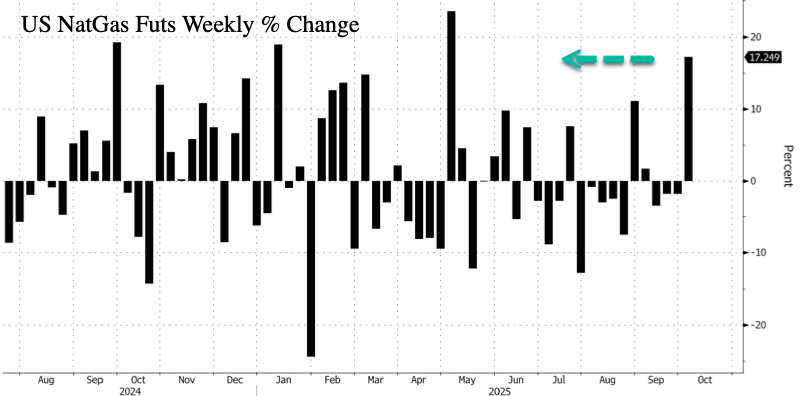
U.S. natural gas futures surged 17.3% last week, the largest weekly gain since early May. Goldman Sachs analysts offered context for the rally, noting that the market narrative has shifted “from U.S. storage congestion fears to tightening 2026 supply.”

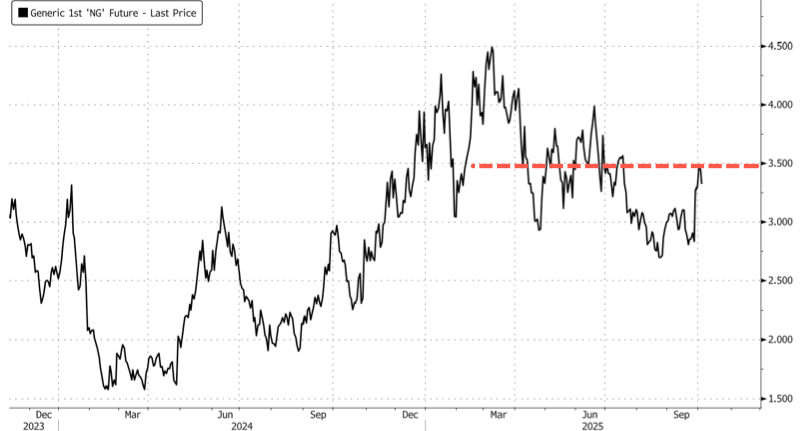
A team of Goldman analysts led by Samantha Dart, senior energy strategist, explained that the jump in NatGas prices last week to nearly $3.5/mmBtu was largely due to the roll into the November “winter” contract, which carries stronger heating demand and lower storage congestion risk. 

$3.5/mmBtu resistance.

Dart explained that even beyond the rollover effect, two bullish forces supported the rally:

  • First, while the market seemed to be pricing in concerns that Gulf storage would face a congestion event over the past several weeks, such an event does not seem to have materialized. Henry Hub cash prices have held relatively well in the period, consistent with manageable weekly storage injections (Exhibit 2 and Exhibit 3). The weakest point for cash prices in the period, but which still held above $2.70/mmBtu, was the long Labor Day weekend, when demand softness from the holiday was exacerbated by significantly milder-than-average weather.

  • Second, U.S. liquefaction demand for gas has increased recently, with Venture Global’s Plaquemines’ gas pull now approaching its 3.6 Bcf/d capacity, while gas demand at Cheniere’s Corpus Christi expansion appears to have also stepped up (Exhibit 4). This has taken total U.S. gas demand for LNG exports to over 16.5 Bcf/d this week, the highest level since early August, and likely to rise sustainably above 17 Bcf/d by mid-Oct, when we expect Cove Point to return from maintenance.

  • On net, salt storage, which are the highest deliverability facilities in the U.S., has remained at a manageable level, including an atypical withdrawal last week reported today by the EIA. We note this may be offset next week by a combination of increasing production and reduced pipeline exit flows from the Gulf (largely driven by maintenance events), which could temporarily weigh on U.S. gas prices from current levels. However, we believe we are quickly approaching a period when the market’s focus will more sustainably shift towards 2026 tightness concerns. This is illustrated by the Cal26 strip settling this week above $4/mmBtu for the first time in two months. We maintain our $4.00/$4.60/mmBtu Nov-Dec25/Cal26 Henry Hub forecasts.

Dart’s chartpack:

*pic

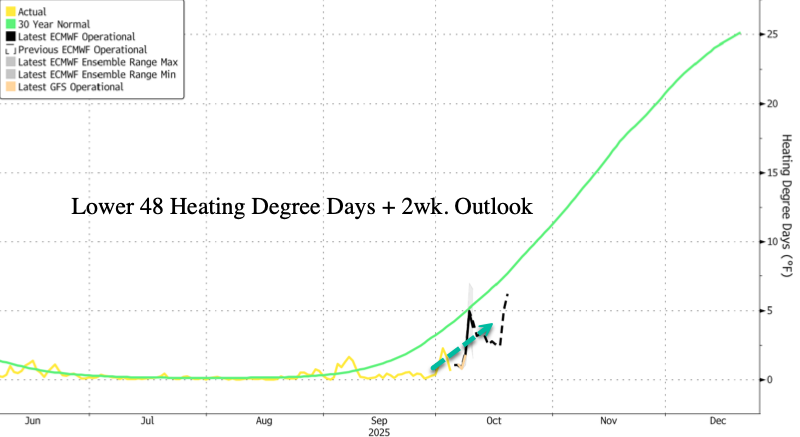
Separately, the heating season is just around the corner, with about 42% of U.S. households (the top source, especially in the Midwest and Northeast)using NatGas for heating. 

Here comes the heating season. 

. . . 

Tyler Durden
Sun, 10/05/2025 – 15:45

via ZeroHedge News https://ift.tt/tO3e7si Tyler Durden

Gordon S. Wood Weighs in on Akhil Reed Amar’s Born Equal: Remaking America’s Constitution, 1840-1920

On September 16, Yale Law professor Akhil Reed Amar published Born Equal: Remaking America’s Constitution, 1840-1920, the second volume of an in-progress three-volume history of America’s constitutional project from 1760 to the present day. The first volume, The Words That Made Us: America’s Constitutional Conversation, 1760-1840, was published in 2021. I much liked both volumes (more on that below), and I’m delighted to report that America’s greatest historian of the Founding era, Gordon S. Wood, has recently publicly praised them as well.

Wood wrote a detailed review of Born Equal that he read aloud at a September 19 Yale Law School conference on originalism that I organized; Wood labeled Born Equal “wonderful” and went on to say that,

[I]t is the most extraordinary kind of history that I have read…. [Akhil] has paid tribute to the power of equality in our political and constitutional lives as no other historian ever has.

The complete transcript of Wood’s glowing remarks may be found here, and may well be published in more polished form in the months ahead.

Kirkus Reviews awarded Born Equal a rare and much-coveted Kirkus Star and The Wall Street Journal ran a rave review by Adam J. White. The New York Times review by Jeff Shesol was generally favorable, but criticized Akhil’s staunch defense of originalism. Read Born Equal and decide for yourself!

As I mentioned, I liked both volumes very much. Back in 2021 I described The Words That Made Us as:

[A] masterpiece [that] reveals Akhil Amar to be the greatest constitutional historian of his generation. He brilliantly shows, for example, how George Washington got everything he wanted at the Philadelphia Constitutional Convention, while geniuses like Madison, Hamilton, Wilson, and Franklin all came up short. This book will be the canonical account of the birth of our Constitution and our early years as a nation for decades to come.

And here is what I said about Born Equal:

Akhil Reed Amar is the most accomplished scholar of his age cohort in both law and history because he writes superb books like Born Equal, which will change the minds of everyone across the political spectrum from Federalist Society members to Bernie Sanders leftists. The history told in this book goes to the very core of what it means to be an American citizen and to understanding our Constitution. Amar knows, that for all our faults, the United States is, as President Ronald Reagan called it, “A Shining City on a Hill.” This book brilliantly proves that Ronald Reagan was right! Born Equal is one of the most important books ever written.

Akhil and I have been close friends for decades, and we have co-taught an originalism seminar at Yale Law School for many years. I’m glad that others share my view as well.


The post Gordon S. Wood Weighs in on <i>Akhil Reed Amar's Born Equal: Remaking America's Constitution, 1840-1920</i> appeared first on Reason.com.

from Latest – Reason.com https://ift.tt/U79S1oP
via IFTTT

US Postal Service Mail Carrier Shot By Amazon Driver

US Postal Service Mail Carrier Shot By Amazon Driver

By Eric Kullisch of FreightWaves

A U.S. Postal Service worker was shot in the face during an altercation Friday afternoon in Everett, Washington, and a rival package delivery driver is in custody, according to local police and a postal inspector.

The incident took place at the West Mall Place Apartments. The victim was transported to Providence Hospital with a gunshot wound, the Everett Police Department said in a Facebook post. He was transferred to Harbor View Medical Center in critical condition, Seattle TV station KOMO reported

Neighbors said the shooter was an Amazon delivery driver, according to KOMO and social media posts. TV footage showed an Amazon vehicle and USPS van behind police crime-scene tape and the Amazon van being towed away later.

“USPS workers don’t let people in the area when they have the mailboxes open. The Amazon driver didn’t particularly like that, they got into an argument, which escalated to a shoving match, which escalated to the Amazon driver shooting the USPS guy in the freaking eye!!! Then he sat there calmly and waited for the cops to show up and claimed self defense,” a poster named Rich Ryan said on Facebook.

KOMO quoted a U.S. postal inspector as saying the mail carrier was confronted by an individual and the carrier was shot in the face. 

The U.S. Postal Inspection Service and the FBI are also investigating the case. The suspect was booked into Snohomish County jail, KOMO said.

Tyler Durden
Sun, 10/05/2025 – 15:10

via ZeroHedge News https://ift.tt/VeFp0Dj Tyler Durden