These Are The Cities With The Highest Grocery Prices Worldwide

These Are The Cities With The Highest Grocery Prices Worldwide

U.S. grocery prices have spiked 29% since 2020, putting strain on consumers’ wallets.

This impact has been felt across global cities, as supply shortages, extreme weather events, and pandemic-era inflation have pushed prices higher. But where in the world do customers face the highest prices overall?

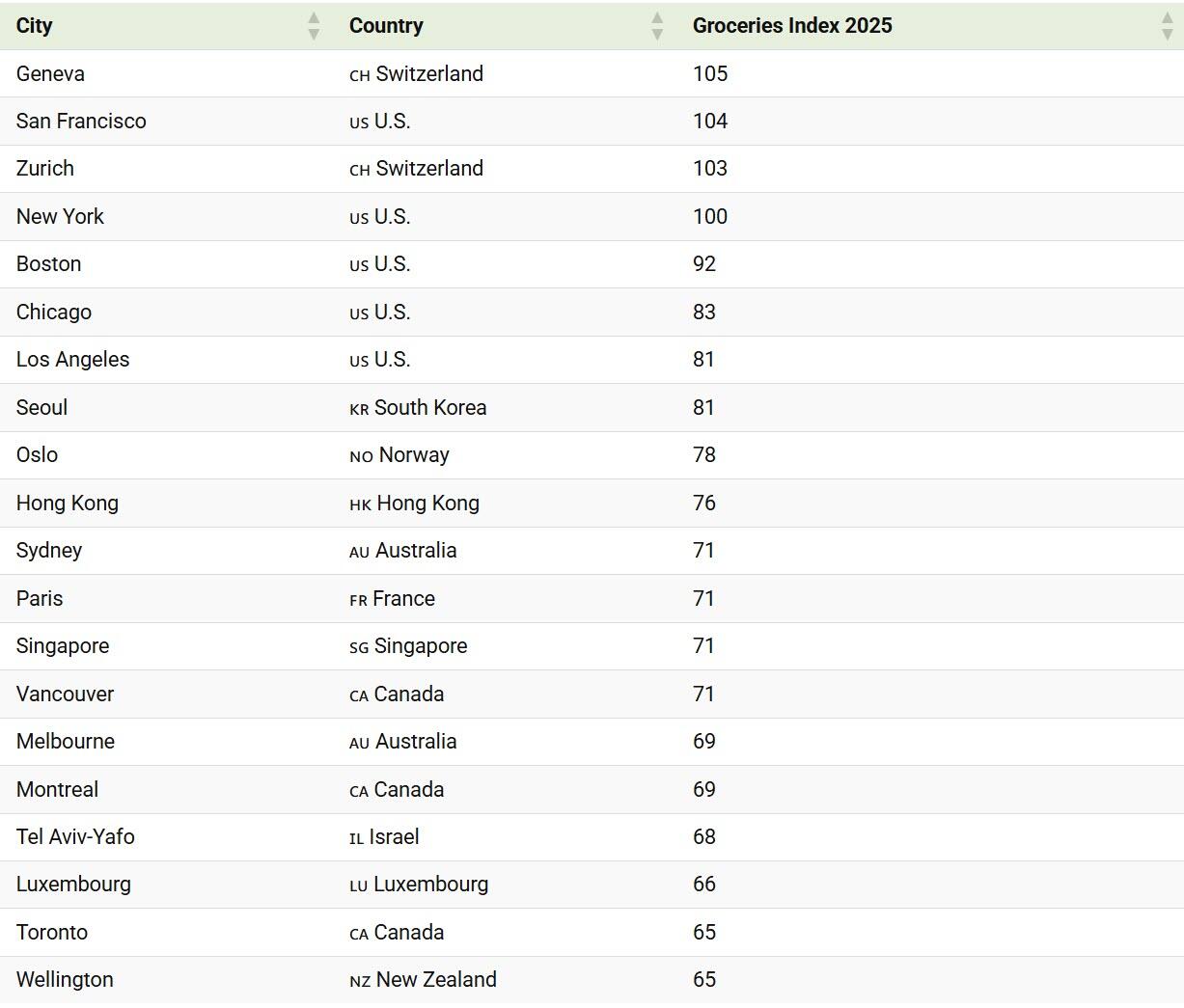
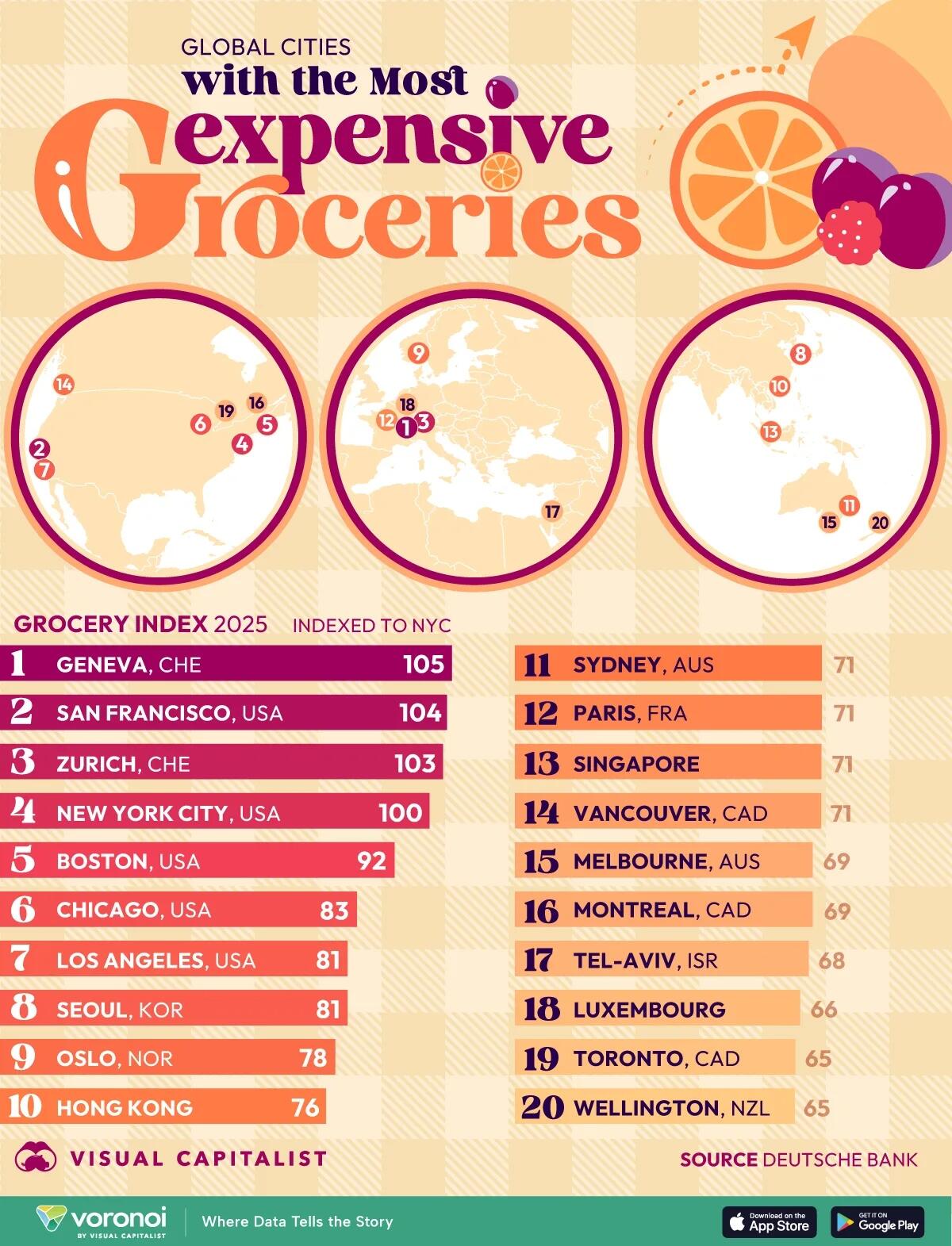
This graphic, via Visual Capitalist’s Dorothy Neufeld, shows the cities with the most expensive grocery prices, based on data from Deutsche Bank.

Grocery Prices in Geneva are the Highest Globally

Below, we show the grocery price index in 2025, reflecting the average cost of groceries in U.S. dollars using New York City as a benchmark:

Switzerland is home to two of the top three most expensive cities for grocery prices, with Geneva seeing prices 5% higher than in New York City.

San Francisco ranks second globally, with prices rising 19% since 2020. A combination of high real estate prices and strong wages are among the key drivers behind expensive grocery costs. Last year, consumers in California spent on average $298 per week on groceries, outpacing New York’s $266 in spending.

Coming in at eighth place is Seoul, driven by currency fluctuations and weak economic conditions, leading consumers’ purchasing power to be among the worst in the OECD.

Grocery costs in Paris, meanwhile, are nearly 30% lower than in New York City, a level similar in Sydney, Singapore, and Vancouver.

To learn more about this topic, check out this graphic on the U.S. cities with the most expensive grocery costs in 2025.

Tyler Durden
Sat, 10/04/2025 – 12:15

via ZeroHedge News https://ift.tt/G9ZhFqm Tyler Durden

“The Math Is The Math”: Gold Is Your Financial Protection Against This Madness

“The Math Is The Math”: Gold Is Your Financial Protection Against This Madness

Via Greg Hunter’s USAWatchdog.com,

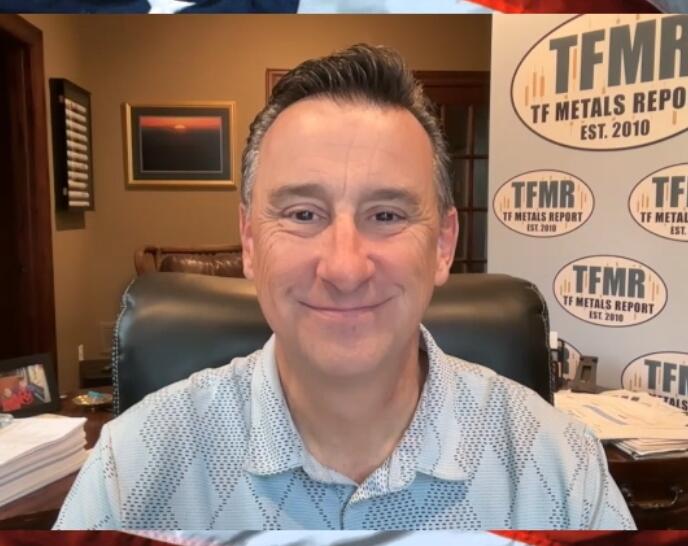
Financial writer, market analyst and precious metals expert Craig Hemke predicted at the beginning of 2025 that the US dollar would have a “vast devaluation.” 

One look at the explosive record setting gold and silver price gains and you can see this was a correct prediction, especially with the yellow metal. 

Hemke says, “It’s not that the gold is going up.  The gold is not changing.  Gold is gold.  What is changing is the amount of dollars it takes to buy that ounce…” 

The dollar is devaluing against gold.  That’s how people need to look at it.  Gold is your financial protection against this madness where we are just going to keep printing more and more dollars trying to service this incredible debt.  We are recording this on the last day of the fiscal year. 

The US is going to run a $2 trillion deficit over the fiscal year.  It’s only getting worse, and the dollars it takes to service that debt is growing.  You just have incredible devaluation of what your dollar can buy.  I just want to point this out:  An ounce of gold is now $3,800–to buy one ounce. 

You go back 10 years ago, and it was $1,100 to buy one ounce of gold.  You go back 5 years ago, and it took $2,000 to buy an ounce of gold.  The gold is not changing.  What is changing is the amount of dollars it takes to acquire it.

Hemke contends there are many things driving the price of gold and silver higher.  A few of the big drivers include: 

  • Central banks have been buying record amounts of gold since 2022, and they continue to do so. 

  • The Fed is on record basically saying that it will buy Treasuries (print money) in 2026 to make sure interest rates will not rise.  (They call it yield curve control.)  

  • Hemke also says there is rapid depletion of physical gold and silver to the point that they may start running out and will be unable to deliver physical metal. 

  • Stablecoin is coming online to create demand for Treasuries. 

  • There is talk of revaluing the gold in Fort Knox to a much higher price to make the government’s balance sheet look healthier. 

The list goes on, and Hemke says, “The math is the math, and that’s why I can feel so confident about this…” 

“There is $2 trillion in new debt, and we are now just north of $37 trillion.  It takes $1 trillion a year to simply service that debt. . .. This is extraordinarily bullish for gold and silver.

You are basically enshrining negative real interest rates, which is what they are trying to do.  In a sense, you are trying to pay off yesterday’s debt with cheaper dollars of tomorrow.  That’s how they got us out of the massive debt to GDP hole after World War II, and that’s why they are going to try it again.  It’s a massive devaluation of the currency.  It’s bullish for all hard assets, not just gold and silver.”

In closing, Hemke says, “This system of leverage, non-allocated accounts and hypothecation has held sway now for almost 50 years.  It’s that system that is dying…”

”  The price (of gold and silver) is going to go up regardless.  Again, it’s not the gold or silver going up in value, it is the purchasing power of the dollar that is declining.  I know some people are saying that silver is up to $48 again, and it’s going back to $18.  I say probably not.  They are telling you what is coming next year. . .. There are a lot of reasons why the price of gold and silver . . . can go considerably higher from here, and you don’t want to miss out.

There is much more in the 48-minute interview.

Join Greg Hunter of USAWatchdog.com as he goes One-on-One with Craig Hemke of the popular website TFMetalsReport.com 9.30.25.

Tyler Durden
Sat, 10/04/2025 – 11:40

via ZeroHedge News https://ift.tt/Gyhjl5d Tyler Durden

Court Especially Concerned About Hallucinations in Criminal Defense Lawyer’s Filings

From California Court of Appeal Justice Judith McConnell, writing for the court Thursday in People v. Alvarez; the lawyer involved has been licensed in California for 54 years:

[A filing in this case] included a quotation attributed to In re Benoit (1973) 10 Cal.3d 72, 87–88, but the purported quote did not exist in the case. Attorney Siddell later clarified that it was not a direct quotation because he modified it “to incorporate broader principles.”

The opposition also included a citation to a case that does not exist: People v. Robinson (2009) 172 Cal.App.4th 452. Counsel additionally cited two cases that do not address the issues for which they were cited: People v. Jones (2001) 25 Cal.4th 98 and People v. Williams (1999) 77 Cal.App.4th 436….

At [a] hearing [after the matter was discovered], Attorney Siddell apologized for failing to verify the legal citations and sources included in his motion and explained that this failure resulted from feeling rushed. He reported he had taken courses regarding artificial intelligence (AI) and was aware that AI could hallucinate cases, but he did not verify the accuracy of any citations. He explained he relies on staff to help draft motions and briefs, but he recognized it is his responsibility to check the caselaw before submitting documents to the court. He said in the future he would “trust but verify” research provided through the use of AI….

The Second Appellate District recently published Noland v. Land of the Free, L.P., discussing the impact of the improper use of AI. We agree with our colleagues that “there is nothing inherently wrong with an attorney appropriately using AI in a law practice,” but attorneys must check every citation to make sure the case exists and the citations are correct….

The conduct here is not as egregious as what occurred in Noland. But it is particularly disturbing because it involves the rights of a criminal defendant, who is entitled to due process and representation by competent counsel. Courts are obligated to ensure these rights are protected.

When criminal defense attorneys fail to comply with their ethical obligations, their conduct undermines the integrity of the judicial system. It also damages their credibility and potentially impugns the validity of the arguments they make on behalf of their clients, calling into question their competency and ability to ensure defendants are provided a meaningful opportunity to be heard. Thus, criminal defense attorneys must make every effort to confirm that the legal citations they supply exist and accurately reflect the law for which they are cited. That did not happen here.

Attorney Siddell admitted to violating his professional duty by including a hallucinated citation and misrepresenting the law provided in other opinions…. Attorney Siddell voluntarily withdrew from representation, and new counsel was appointed to protect the defendant’s rights, but his unprofessional behavior cost the court time and resources.

Because we conclude Attorney Siddell has violated a Rule of Professional Conduct, we are required to “take appropriate corrective action.” In line with this obligation, we are publishing this order. Further, consistent with the notion that sanctions should deter future improper behavior, we issue a sanction in the amount of $1,500 to be paid by Attorney Siddell individually to the Fourth District Court of Appeal, Division One. This monetary sanction will also reimburse the court for a small portion of the time and resources expended on this issue.

We direct the Clerk of this court to notify the State Bar of the sanctions against Attorney Siddell.

Thanks to Irwin Nowick for the pointer.

The post Court Especially Concerned About Hallucinations in Criminal Defense Lawyer's Filings appeared first on Reason.com.

from Latest – Reason.com https://ift.tt/LSXYaUA
via IFTTT

The Supreme Court Will Hear Another Home Equity Theft Takings Case


A house is seen with $100 bills falling behind it
Illustration: Lex Villena; Oblachko

In Tyler v. Hennepin County (2023), a unanimous Supreme Court ruled that “home equity theft” is unconstitutional. If the government forecloses on a property for nonpayment of taxes or other debts, it can only keep as much of the value of the land as is necessary to repay the debt in question. The rest belongs to the property owner. Otherwise, the Court ruled, there would be a violation of the Takings Clause of the Fifth Amendment, which bars taking of private property without payment of “just compensation” (see my analysis of the ruling here).

After Tyler, I did not think the home equity theft issue would return to the Supreme Court anytime soon. But, yesterday, the Court decided to hear Pung v. Isabella County. In this case, Isabella County, Michigan seized the late Timothy Pung’s house because he supposedly failed to pay some $2200 in taxes and fees (his estate claims he didn’t actually owe this money). They then sold the property at auction for about $76,000; the County kept the $2200 it thought it was owed and transferred the remaining funds (about $73,800) to Pung’s estate.

But the usual standard for takings compensation, according to longstanding Supreme Court precedent, is “fair market value” – the price a property would fetch if sold on the open market. And Pung’s estate argues the fair market value here is actually $194,400 (the value at which the county itself assessed that value for property tax purposes).

If a seizure of home equity after foreclosure is a taking – as Tyler v. Hennepin County rightly held – then I think the estate is obviously right. The property taken is the residual value of the home (after delinquent taxes and other debts are repaid). And that may be more than the government got from the highest bidder at the auction.

To be sure, the highest bid at the auction is relevant evidence of fair market value. But it is not always the only evidence that must be considered. The government could potentially do a poor job of marketing the property, and end up accepting a below-market value price. That’s especially likely if, as is usually the case, they have no incentive to maximize value, so long as they secure enough to repay the debt that supposedly justified the foreclosure in the first place.

Here, it seems clear the auction price was indeed subpar. We know that because the winning bidder quickly resold the property for $195,000 (very close to the Pung estate’s $194,400 estimate of the fair market value). That suggests the County was either incompetent at marketing the property or just didn’t care to make a serious effort.

The lower court ruling by the US Court of Appeals for the Sixth Circuit held there is no taking here. But it is largely based on previous circuit precedent, which offers little in the way of analysis on this point. Tyler makes clear that a property owner subject to tax foreclosure “must render unto Caesar what is Caesar’s, but no more.” Here, Caesar pretty obviously did take a lot more, even if he wasn’t able to appropriate its full value for himself.

In addition to considering the Takings Clause issue, the Supreme Court will also weigh the question of whether this kind of home equity theft violates the Excessive Fines Clause of the Eighth Amendment. The Court need not decide that issue if they rule in favor of Pung on the Takings Clause question. In Tyler, the Supreme Court similarly chose to rely on the Takings Clause, and did not to decide the Excessive Fines Clause issue. In a concurring opinion, Justice Neil Gorsuch (joined by Justice Ketanji Brown Jackson), argued that home equity theft does indeed violate the Excessive Fines Clause, as well as the Takings Clause.

I hope – and tentatively expect – that the Supreme Court will reverse the Sixth Circuit and rule that the Pung estate is entitled to fair market value compensation. I doubt the Court would have chosen to hear this case just to affirm the lower court decision. There is no split between circuits here of a kind that might lead the justices to take a case to resolve it.

Pung is somewhat unusual, in recent years, in being a major Takings Clause case that reached the Supreme Court, but was litigated by conventional private counsel, rather than by one of the major property rights public interest firms, such as the Institute For Justice and the Pacific Legal Foundation (which litigated Tyler). Philip L. Ellison, the Michigan attorney representing the Pung estate, wrote a strong cert petition that must have persuaded the justices to take the case.

Regardless of how the case got to the Court, the property rights community will surely support the victimized owner here. I myself intend to file an amicus brief, and I suspect I will not be alone in that.

The post The Supreme Court Will Hear Another Home Equity Theft Takings Case appeared first on Reason.com.

from Latest – Reason.com https://ift.tt/V4E5Jx3
via IFTTT

Odd Cross-Jurisdictional Unsealing Twist Related to Jordan Neely Case

From Southerland v. Bragg, decided Friday by Magistrate Judge Gabriel Gorenstein (S.D.N.Y.):

The complaint in this case seeks to obtain judicial records (and possibly other records) relating to Jordan Neely, who as a child was a witness at the New Jersey trial that resulted in plaintiff’s conviction for murder. Over a decade later, Neely was the victim in a prosecution brought in New York against Daniel Penny, which resulted in an acquittal. Under a New York State statute, Criminal Procedure Law § 160.50, that acquittal in turn resulted in the sealing of the records in the criminal case against Penny (and thus of any documents therein that relate to Neely). Plaintiff’s complaint seeks to have this Court unseal the New York state court records in the Penny case to obtain any records relating to Neely….

Plaintiff has filed “motion to unseal” the records in the Penny case, to which defendants have responded. This Court of course has power to seal and unseal its own records in accordance with applicable legal standards. But in this motion to unseal, plaintiff is not asking the Court to unseal a document that was filed on the docket in the case before it.

Instead, the motion asks this Court to unseal the New York state court records in the Penny case: that is, plaintiff seeks the unsealing of the very records that he seeks to obtain through the filing of the complaint. Whether the Court has power to order production of those records will be decided in due course as part of its consideration of the merits of this case. In the meantime, there is no basis for the Court to unseal those same records in response to a “motion to unseal.”

Plaintiff’s citation for authority to unseal, N.Y. Criminal Procedure Law § 160.50, further demonstrates the infirmity of this request given that § 160.50 addresses the power of “the court” to seal or unseal—plainly referring to the court in the criminal case, not some other court. Plaintiff’s other citation[s] to authority—relating to various aspects of discovery—are completely irrelevant as the discovery rules do not authorize a court to afford a litigant the ultimate relief sought in the case. Accordingly, the motion to unseal is denied. This denial is of course without prejudice to plaintiff’s right to continue litigating the merits of this case….

Defendants have [also] moved to stay discovery in this case pending the decision on their planned motion to dismiss or in the alternative for summary judgment—an application that plaintiff opposes. “[U]pon a showing of good cause a district court has considerable discretion to stay discovery pursuant to Fed. R. Civ. P. 26(c).” …

[G]iven that plaintiff has already sought to obtain the documents in the Penny case through a motion to unseal, we can assume that plaintiff would seek to obtain those documents. Plaintiff has already served interrogatories on defendants about the documents in the Penny case. Further, in his opposition, plaintiff states that he “seeks several subpoena’s [sic] to assist in his search for the truth behind Jordan Neely’s ‘reported’ mental illness issues.” The breadth of discovery weighs against allowing discovery to proceed given that it encompasses obtaining the very documents at issue in this case or critical information about those documents. If it turns out that plaintiff is not entitled to the documents based on the lack of merit of his complaint, plaintiff will have obtained the relief he sought in the complaint through the subterfuge of discovery.

For these same reasons, serious prejudice would result from allowing discovery to proceed. The public interest embodied in the Criminal Procedure Law § 160.50 will have been defeated through plaintiff’s use of the discovery process even if the Court finds his complaint lacks merit.

Finally, as to the strength of the motion, defendants make persuasive arguments that the complaint will have to be dismissed on a number of grounds, including the argument that the only possible constitutional claim against the defendants would be a claim of a Brady violation and that no such violation is possible since they were not the parties that prosecuted plaintiff in New Jersey. There are also significant comity issues given that plaintiff has elected not to pursue obtaining the documents from the trial court in the Penny case. In sum, [the] factors support a stay of discovery.

For Southerland’s latest substantive challenge to his conviction, see State v. Southerland, decided two weeks ago by the N.J. intermediate appellate court, as well as the 2015 appeal in that case:

The State developed the following proofs at trial. The victim, C.N., lived in Bayonne with her fourteen-year-old son, J.N. Defendant and C.N. met in 2002 when they were in law school together and, in December 2005, defendant moved into C.N.’s apartment. J.N. described the relationship between C.N. and defendant as “crazy,” explaining that they used to “fight every day.” In January 2007, defendant moved to Texas, but he returned to the apartment in late March 2007.

On the morning of April 4, 2007, C.N. did not wake J.N. for school as she usually did. He got dressed and went to C.N.’s bedroom to say goodbye. The door was closed and, as he approached, J.N. testified that defendant stepped in front of the door, and prevented him from going inside. J.N. then left the apartment. He did not hear any sounds coming from inside C.N.’s bedroom that morning, nor had he heard anything unusual the previous night. J.N. stated he usually stayed in his room in the evening playing videogames and watching television.

When J.N. returned home from school at approximately 4:00 p.m., defendant was in the apartment, but C.N. was not there. J.N. asked defendant about C.N., and defendant told the child he had not seen the victim. J.N. noticed that a white blanket and some of his mother’s personal “accessories” were missing from C.N.’s bedroom.

J.N. testified that defendant gave him some money to buy food at a take-out restaurant and then followed the child there on a bicycle. When they returned home, defendant stated he had to leave because his aunt was “sick[,] … in the hospital, tied to a machine, she’s getting ready to die[.]” Defendant took “all his stuff with him” when he left. J.N. testified defendant used to borrow a Silver Kia from someone he identified as “his aunt” and, after defendant left that night, he never saw defendant or the car again.

Defendant’s friend, C.V., testified that defendant borrowed her 2001 Kia on April 3, 2007 and, when he returned it in the early evening on April 5, it had two flat tires. Defendant stayed at C.V.’s home until April 9, when she drove him to a train station.

J.N. notified his school of his mother’s disappearance and, two or three days later, he went to his grandmother’s house in New York City to tell her C.N. was missing.

On the morning of April 7, 2007, a New York City Department of Transportation employee found the body of a woman inside a black duffel bag along the Henry Hudson Parkway in New York, about twenty-five miles from Bayonne. The employee testified he did not see the bag when he cleaned the area the previous day. New York City police officers retrieved the body and began an investigation….

Corey S. Shoock represents the New York officials.

The post Odd Cross-Jurisdictional Unsealing Twist Related to Jordan Neely Case appeared first on Reason.com.

from Latest – Reason.com https://ift.tt/IGFCpVq
via IFTTT

Promised Recession… So Where Is It?

Promised Recession… So Where Is It?

Authored by Lance Roberts via RealInvestmentAdvice.com,

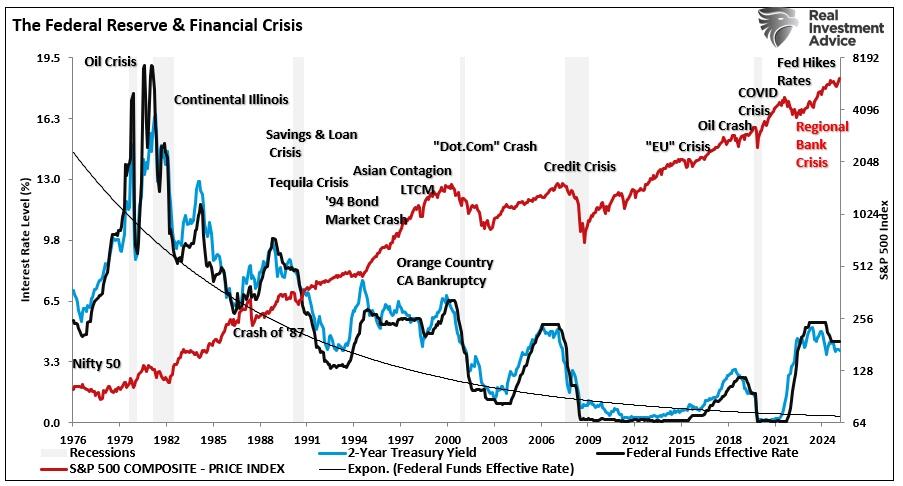
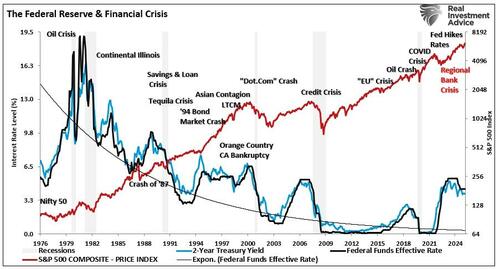
Over the past three years, the economic conversation has been a “promised recession.” If you read the headlines, tracked economist surveys, or even listened to Wall Street strategists, you would have assumed a downturn was imminent. Many investors, bloggers, and YouTubers have had a “parade of horribles” promising a recession is just on the horizon.The logic was simple enough. The Federal Reserve aggressively hiked rates from near zero, inflation spiked to four-decade highs, the yield curve inverted for the longest stretch on record, manufacturing surveys collapsed, and stocks entered a bear market in 2022. Historically, those conditions have been reliable precursors to economic pain.

And yet, here we are, late into 2025, and the U.S. economy is still standing. Not only standing, but GDP remains broadly positive, unemployment is relatively low, and equity markets sit at record highs. If the “promised recession” were near, none of that would be the case, and for many investors, the “recession that never came” has been one of the great surprises of this cycle.

But does that mean we’ve escaped it altogether? Or is the downturn still lurking, delayed by policy distortions and fiscal largesse?

I want to tackle that question today because how we answer it matters for portfolio strategy. Both the recession and the no-recession cases have merit. Each has its own probabilities, risks, and market implications.

Why a Recession Still Looks Plausible

Let’s start with the bear case.

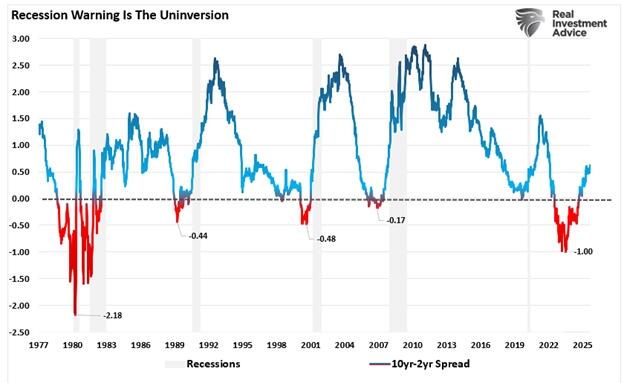
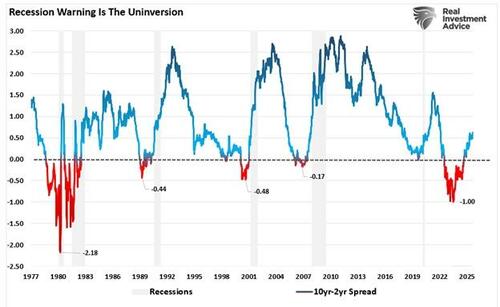
History tells us that a recession almost always follows when the yield curve inverts, well, technically, it is when it UN-inverts. Nonetheless, since the 1960s, every sustained inversion has been followed by an economic contraction, sometimes quickly, sometimes with a lag. The inversion that began in 2022 was the deepest and longest we’ve ever experienced. If that signal still carries weight, it is logical that we should expect economic weakness to emerge.
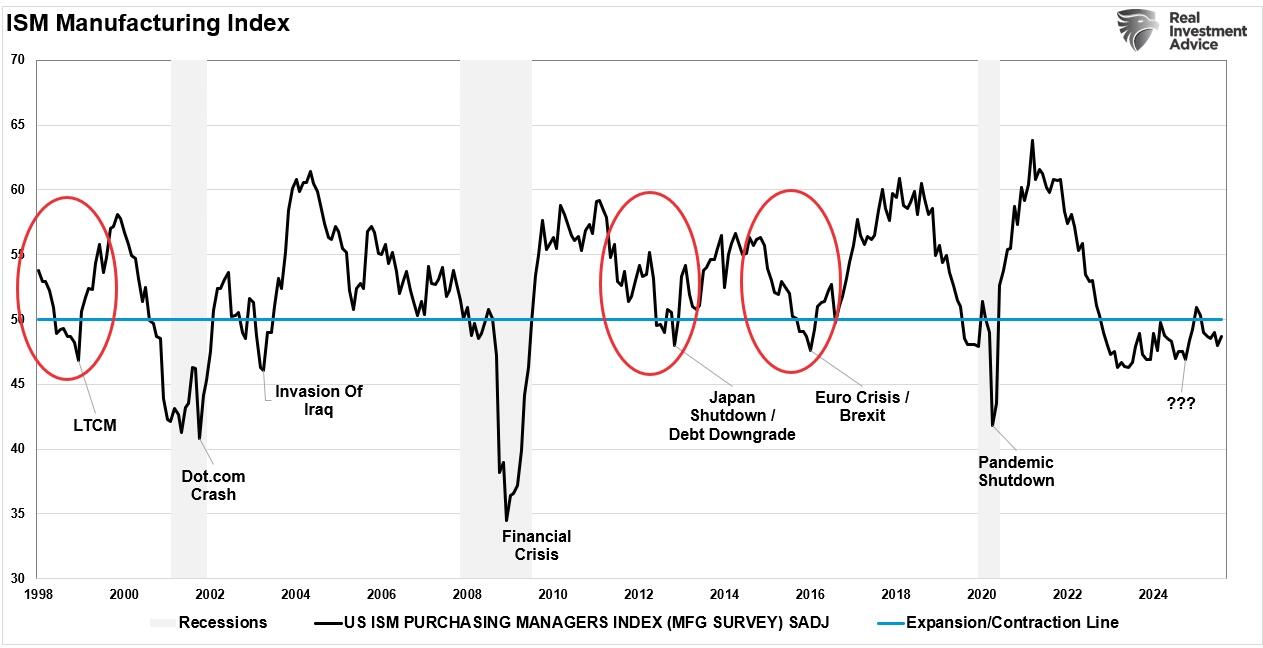
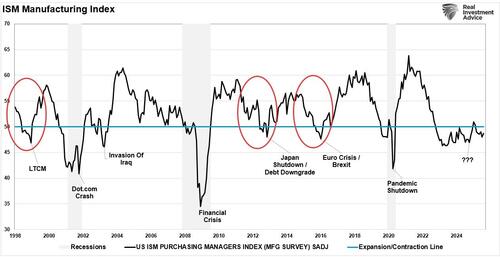
Further, manufacturing activity has been in contraction territory for most of the past three years. The ISM Manufacturing Index, long viewed as a leading indicator, recorded 26 straight months below 50 through early 2025, briefly perked up, and then rolled back into contraction again. Historically, that kind of persistent weakness doesn’t happen in a vacuum. It usually shows up in corporate earnings, hiring, and consumer confidence.
In addition, the role of Fed tightening has been added. Monetary policy famously operates with “long and variable lags.” The most aggressive hiking cycle in four decades would always take time to filter through credit markets, household spending, and corporate balance sheets. Post-pandemic distortions and massive fiscal deficits may have extended the lag, but we should expect that the effect hasn’t been repealed.
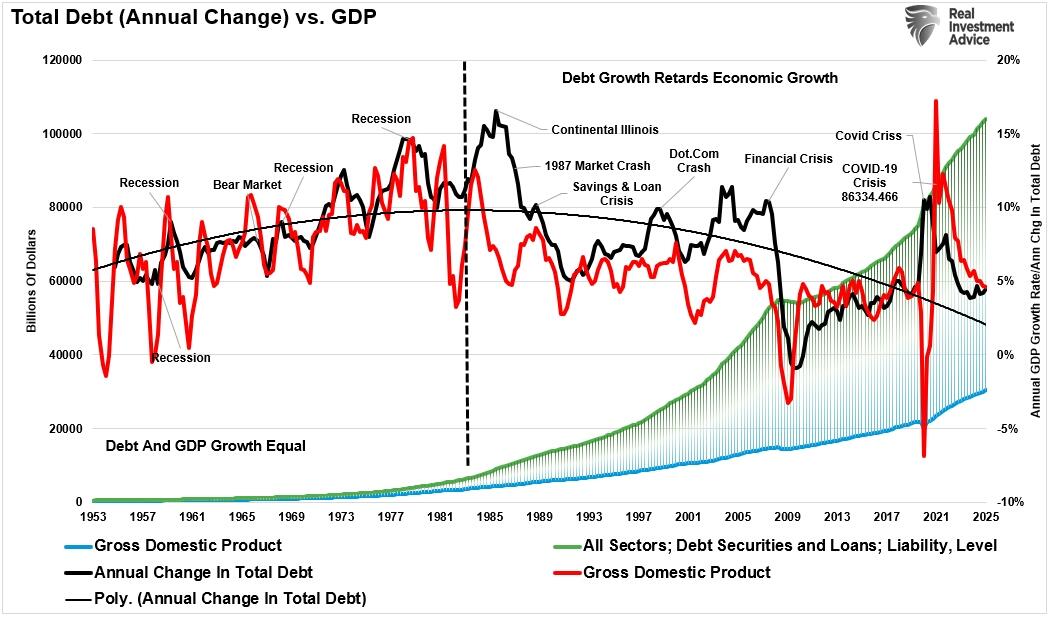
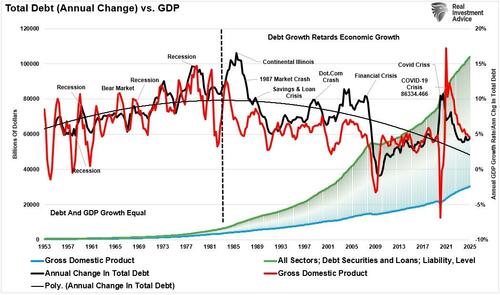
And speaking of deficits, that’s another issue. Washington has effectively been running crisis-level stimulus despite a growing economy. Federal spending has helped mask underlying weakness. But it’s also raised debt-to-GDP ratios to levels that will eventually constrain fiscal policy. The “sugar high” from deficit-financed growth is not permanent, particularly since debt detracts from economic growth in the long term.
Finally, valuations, as we discussed recently. Equity markets are priced for perfection, with mega-cap tech leading the charge. That means if growth does falter, even modestly, the downside could be amplified by the simple reality of stretched multiples.

Taken together, these factors suggest the recession call wasn’t wrong so much as early. The patient looks healthy today, but the test results show underlying conditions that can’t be ignored.

If we were to assign a probability of a recession in the next 12-18 months, it is likely somewhere around 55%.

Why the Economy Might Dodge It

Now, let’s give the bulls their due and explain why they were right to dismiss the “promised recession.”

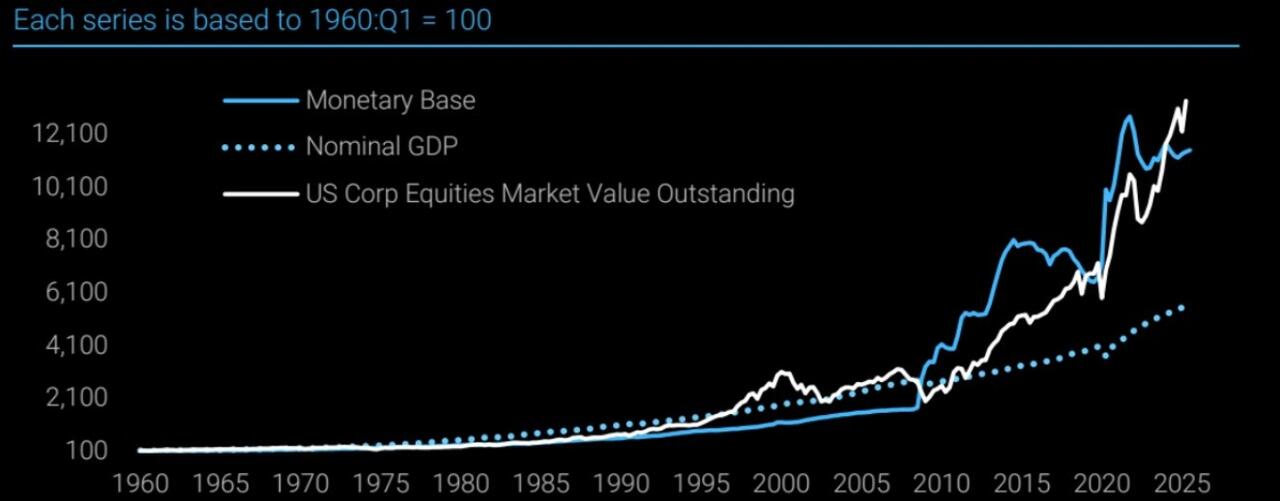
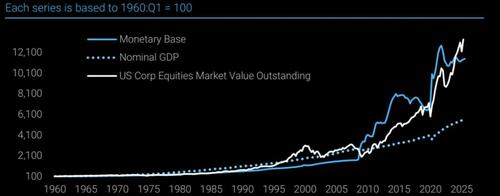
The biggest reason we haven’t fallen into recession is simple: spending. Both consumers and the government have been more resilient than expected, and the massive amount of liquidity injected into the economy following the pandemic has created enormous distortions to economic data. The huge surge in the monetary base has not fueled the “wealth effect” in the economy, but has sustained activity.
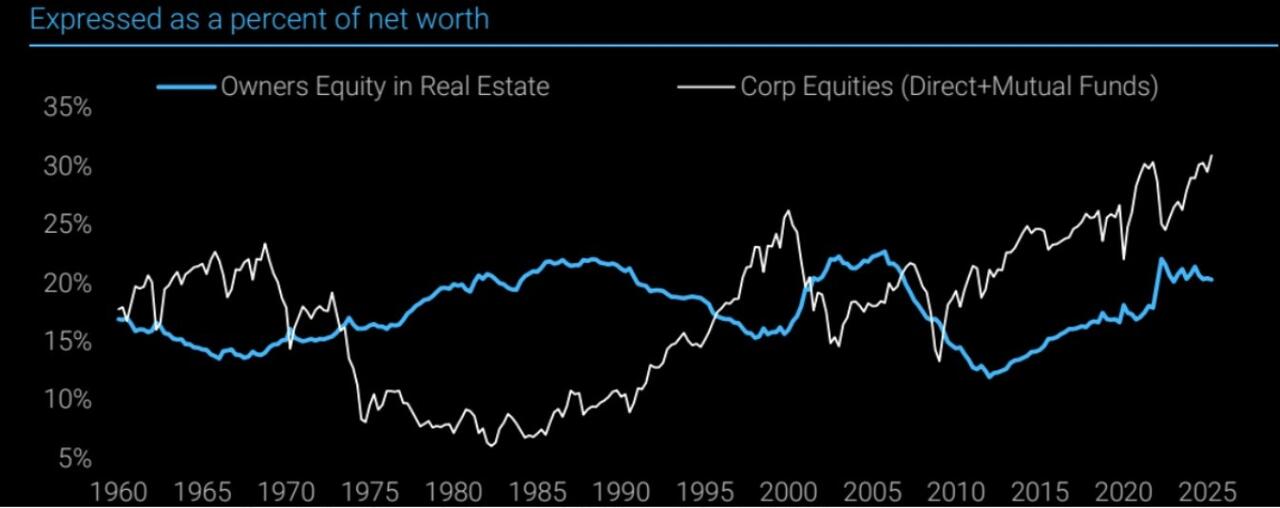
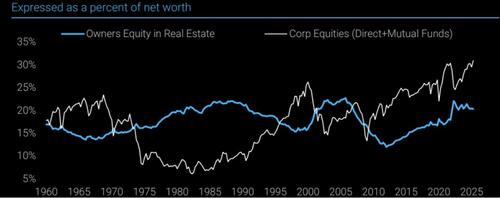
Despite higher interest rates, households benefited from excess savings built up during the pandemic, increased wealth from housing and markets, and a historically tight labor market kept nominal wages elevated. As such, people kept spending and went further into debt, which kept GDP afloat.
Meanwhile, government deficits have poured unprecedented amounts of cash into the system outside of a crisis period. Infrastructure projects, industrial policy initiatives, and entitlement spending have all provided ongoing support. In effect, Washington has been running “emergency stimulus” permanently, which has kept normal recessionary factors from occurring.

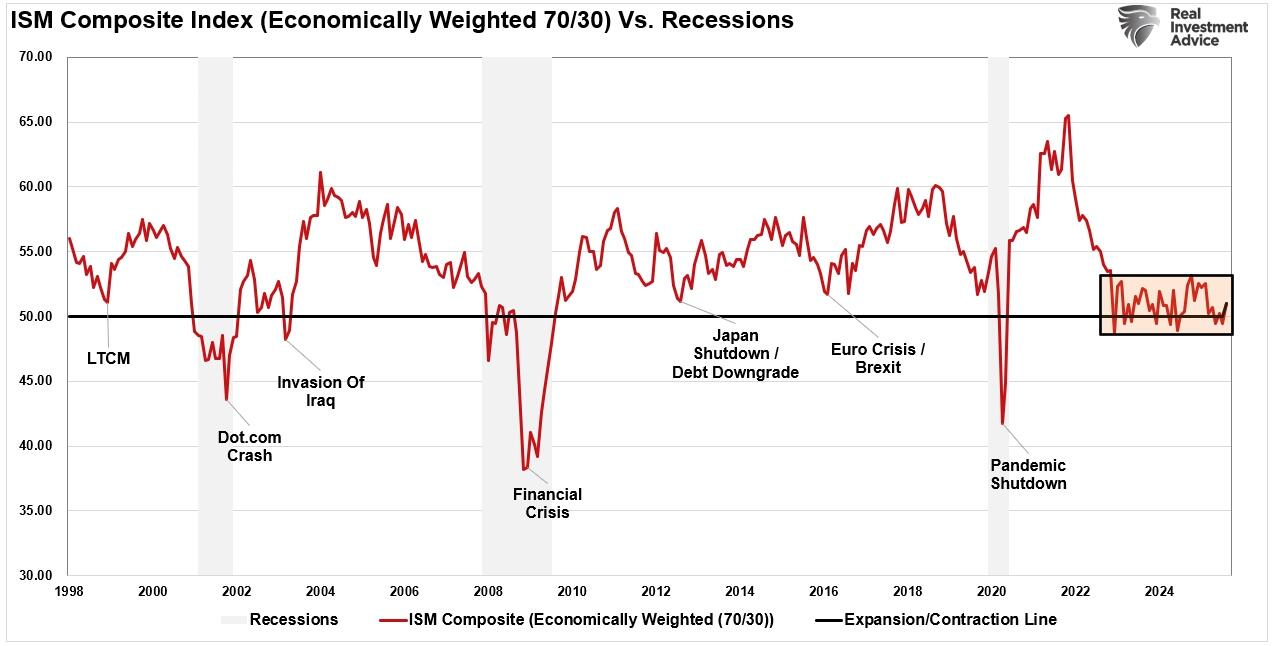
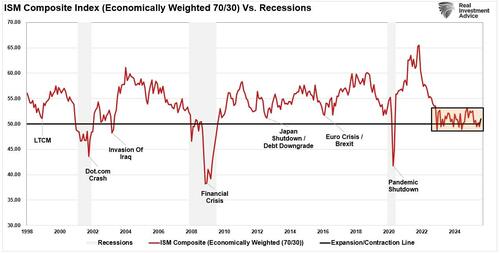
Second, the nature of the economy itself has shifted. The U.S. is far more services-driven today than in past cycles. Manufacturing weakness is notable, but it only represents about 30% of the economy today versus nearly 70% in the 70s. Given that it is a much smaller factor in the economy, it is services that we should focus on, and while weak, they have not been in recessionary territory. The chart below, an economically weighted composite of ISM Services and Manufacturing, shows that recession risks are elevated, but no recession is likely at the moment.
Third, corporate America has adapted remarkably well. Companies took advantage of ultra-low rates in 2020–2021 to refinance debt. Their balance sheets are stronger overall, and many firms have locked in cheap financing for years. That reduced the immediate pressure of higher Fed funds rates. However, such is not likely the case for smaller and mid-capitalization companies, and the risk of a rise in bankruptcies is not zero when they must refinance their debt. That could weaken economic growth but is not necessarily a guaranteed recessionary outcome.

Finally, the Federal Reserve itself has shown a willingness to pivot quickly. After hiking aggressively, the Fed began cutting in September, signaling that “risk management” and preventing unnecessary economic damage were priorities. Whether you agree with it or not, that backstop has provided psychological support to markets and businesses alike.

The bulls argue that these structural and policy supports could allow the U.S. to avoid a traditional recession altogether. Growth may slow, productivity gains (particularly from AI and automation) may cushion margins, and the expansion could grind on longer than skeptics expect.

But that is also not a guarantee, and the assigned probability of “no recession” in the next 12-18 months at 45%.

What This Means for Markets

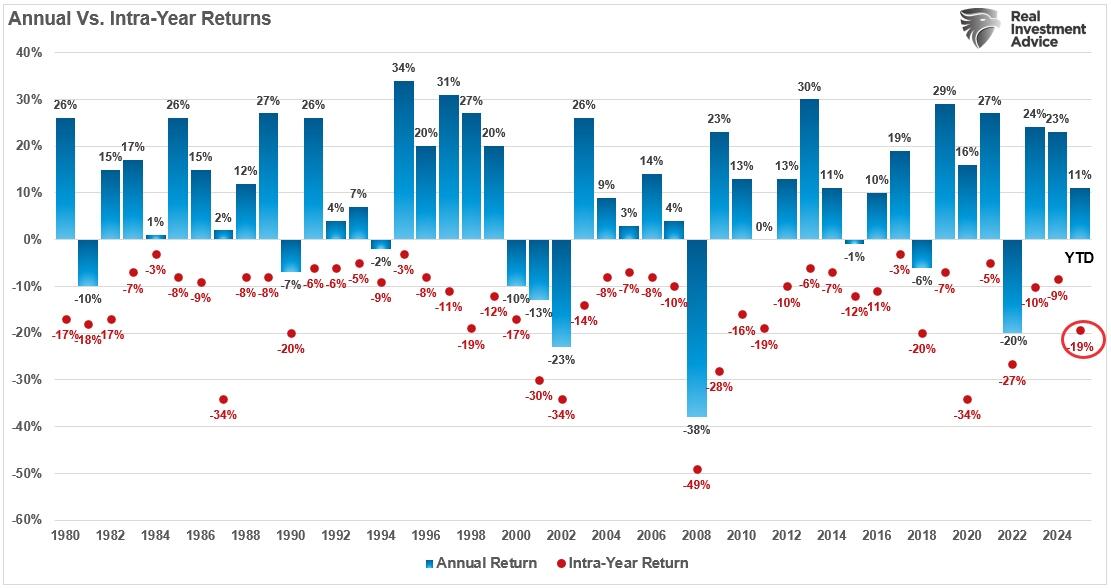
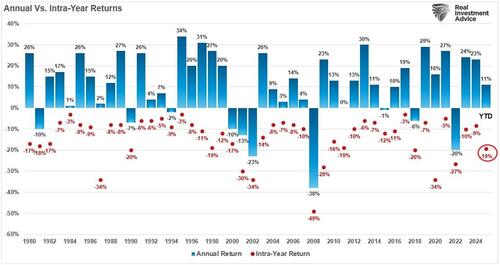
For investors, the probabilities matter less than the preparation. Whether the economy slips into recession or not, the implication is that volatility will remain elevated, and risk management is essential. It also does not mean the financial markets can’t experience a 5, 10, or 20% correction outside the “promised recession.”

If the recession scenario plays out, equity valuations will likely compress, earnings estimates will fall, and risk assets will reprice lower. Defensive sectors, like utilities, staples, and healthcare, could outperform. Treasury bonds, ironically left for dead in 2022, would likely provide ballast as yields decline in a flight to safety.

If the no-recession scenario materializes, markets may not be “all clear” either. Corrections occur annually and can impact portfolio performance and investor psychology. With much of the “soft landing” narrative already priced in, the risk of correction is elevated. The S&P 500 is trading at multiples historically reserved for periods of strong, broad-based growth, leaving little margin of safety. Even modest disappointments could trigger corrections.
I always return to risk management here. As I’ve written many times, investing is not about making bold predictions but instead aligning portfolios to probabilities, protecting against the downside, and participating in the upside when it comes.

Today, that means remaining cautious even as markets cheer new highs. It means trimming exposure where valuations are stretched, holding a healthy allocation to cash and fixed income, and being selective in equity exposure. It means acknowledging that both outcomes—recession and no recession—are plausible and positioning accordingly.

Let’s also step back and acknowledge the broader lesson. Economists have a terrible track record at calling recessions.

  • In 2007, two-thirds didn’t see one coming.

  • In 2022, two-thirds thought one was imminent.

Both times, they were wrong. Why? Because the economy is not a machine that spits out predictable results. It’s a complex, adaptive system shaped by human behavior, policy distortions, and unforeseen shocks. Models can tell us what should happen, but a “promised recession” or not, reality often finds a way to surprise us.

That doesn’t mean we ignore the indicators. Yield curves, manufacturing surveys, and credit spreads all have information content. But it does mean we treat them as part of a broader mosaic, not as gospel.

As an investor, humility is key. The market doesn’t owe us clarity. The job is not to know the future with certainty, but to navigate the uncertainty with discipline.

So forget about a “promised recession” and focus on what matters.
Tyler Durden
Sat, 10/04/2025 – 10:30

via ZeroHedge News https://ift.tt/7Ntr5q6 Tyler Durden

Mapping America’s Consumers: Median Household Income By Retailer

Mapping America’s Consumers: Median Household Income By Retailer

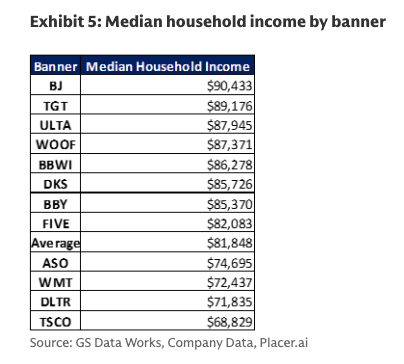
Goldman analysts examined twelve companies (all within the GS coverage) with high exposure to middle-income consumers, including Walmart, Best Buy, Target, BJ’s Wholesale Club, Tractor Supply, Academy Sports + Outdoors, Dick’s Sporting Goods, Ulta Beauty, Petco, Bath & Body Works, Five Below, and Dollar Tree. 

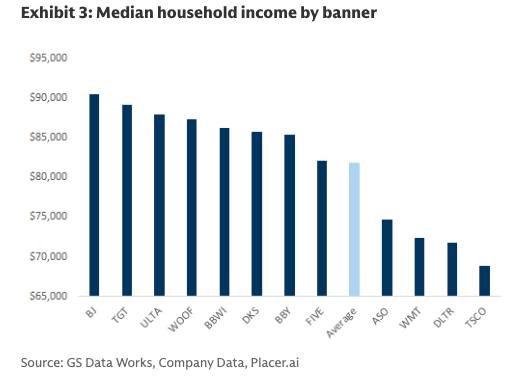
Using GS Data Works, company data, and Pace.AI, analysts led by Kate McShane determined the median household income by retailer, finding an average of about $81,848 across the retailers in the GS universe. 

Breakdown: 

  • The average household income across the group is $81,848.

  • Highest Income: BJ’s Wholesale Club, at $90,433

  • Lowest Income: Tractor Supply at $68,829

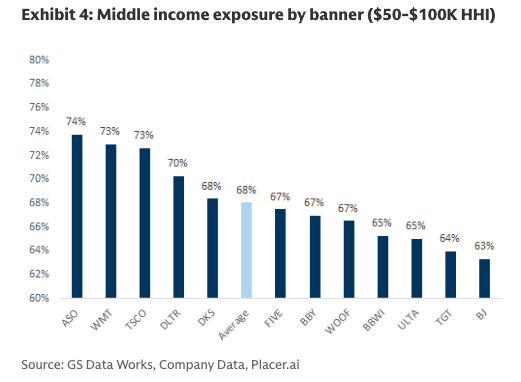
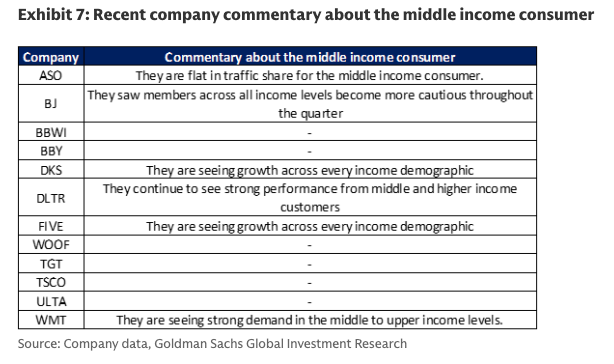
Although the 12 companies vary in their relative exposure to the middle-income cohort, all maintain very high exposure levels (63%–74%) and are positioned to benefit from the tailwinds.

Breakdown: 

  • Highest middle-income exposure: Academy Sports + Outdoors, Walmart, Tractor Supply, Dollar Tree, and Dick’s Sporting Goods. These firms also have the lowest household incomes (except Dick’s).

  • Lowest middle-income exposure: BJ’s Wholesale Club, Target, Ulta Beauty, Petco, and Bath & Body Works. These firms have the highest average household incomes.

Median household income by retailer.

Latest commentary from executives at the twelve companies on the middle-income consumer.

The full note offers deeper insights into middle-income consumers. ZeroHedge Pro Subs can access this in the usual place

Tyler Durden
Sat, 10/04/2025 – 09:55

via ZeroHedge News https://ift.tt/SftkqPD Tyler Durden

All Currencies Will Be Stablecoins By 2030: Tether Co-Founder

All Currencies Will Be Stablecoins By 2030: Tether Co-Founder

Authored by Brian Quarmby via CoinTelegraph.cvom,

Tether co-founder Reeve Collins expects “all currency” to become stablecoins by 2030 as part of a broader shift that will see all forms of finance go onchain. 

“All currency will be a stablecoin. So even fiat currency will be a stablecoin. It’ll just be called dollars, euros, or yen,” said Collins in a wide-ranging interview during Token2049 in Singapore. 

“A stablecoin simply is a dollar, euro, yen, or, you know, a traditional currency running on a blockchain rail by 2030,” he added. 

Collins argues that stablecoins will be the primary method for transferring money within the next five years, as the benefits of tokenized assets have become too compelling for traditional finance to ignore.

“Probably before that, because you’re still going to use dollars. But it depends on what your definition of stablecoin is. The definition of stablecoin is essentially that you’re moving money on a blockchain,” he added. 

US crypto shift was the best thing to happen

Collins said that the best thing to ever happen to the crypto market was the positive “shift in stance” toward the sector by the US government this year.

Tether co-founder Reeve Collins. Source: Cointelegraph.

He argued that many large TradFi firms were too afraid to enter the industry out of fear of government scrutiny, and while there is still some gray area surrounding the industry, it’s a very different ball game these days.

The Tether co-founder stated that this shift has opened the “floodgates,” with the traditional finance world scrambling to enter the crypto sector and blockchain-based stablecoins being a key focus due to their inherent utility.
 
“Every large institution, every bank, everyone wants to create their own stablecoin, because it’s lucrative and it’s just a better way to transact. And so those floodgates are open, and what it’s going to lead to is that soon, there won’t be CeFi and DeFi,” he said.

“There’ll be applications that do things, move money, give loans, do investments, and it will be a mix of the kind of the old, traditional style investments, and then the DeFi types of investments.”

The tokenization narrative is strong

Collins said tokenized assets offer far greater transparency and efficiency than non-tokenized assets — given that they can be moved quickly across the globe without middlemen — which in turn offers more potential upside.

“That is why the tokenization narrative is so big, because everyone realizes the increase in the utility that you get from a tokenized asset versus a non-tokenized asset is so significant that even the same two assets, just once they’re moved onchain, since the utility increases, that means the return increases.” 

Downsides of going fully onchain

However, Collins acknowledged there were also risks to such a monumental shift in global finance, such as the security of blockchain bridges, smart contracts and crypto wallets.

Crypto hacks and social engineering are also key issues that need to be addressed, he said, though he emphasized that overall levels of security are “improving.”

“And so the old trade off is still going to remain there… which is if you want to be fully in control … you can do that, but it’s technically complex,” said Collins.

“If you want to trust a third party like you do traditionally with banks, there are a lot of those services like the custodial versus non-custodial, so that those services will get more robust, and people will have more options moving forward. So yes, there are always risks in technology,” he concluded. 

Tyler Durden
Sat, 10/04/2025 – 09:20

via ZeroHedge News https://ift.tt/CuL7VtH Tyler Durden

Court Especially Concerned About Hallucinations in Criminal Defense Lawyer’s Filings

From California Court of Appeal Justice Judith McConnell, writing for the court Thursday in People v. Alvarez; the lawyer involved has been licensed in California for 54 years:

[A filing in this case] included a quotation attributed to In re Benoit (1973) 10 Cal.3d 72, 87–88, but the purported quote did not exist in the case. Attorney Siddell later clarified that it was not a direct quotation because he modified it “to incorporate broader principles.”

The opposition also included a citation to a case that does not exist: People v. Robinson (2009) 172 Cal.App.4th 452. Counsel additionally cited two cases that do not address the issues for which they were cited: People v. Jones (2001) 25 Cal.4th 98 and People v. Williams (1999) 77 Cal.App.4th 436….

At [a] hearing [after the matter was discovered], Attorney Siddell apologized for failing to verify the legal citations and sources included in his motion and explained that this failure resulted from feeling rushed. He reported he had taken courses regarding artificial intelligence (AI) and was aware that AI could hallucinate cases, but he did not verify the accuracy of any citations. He explained he relies on staff to help draft motions and briefs, but he recognized it is his responsibility to check the caselaw before submitting documents to the court. He said in the future he would “trust but verify” research provided through the use of AI….

The Second Appellate District recently published Noland v. Land of the Free, L.P., discussing the impact of the improper use of AI. We agree with our colleagues that “there is nothing inherently wrong with an attorney appropriately using AI in a law practice,” but attorneys must check every citation to make sure the case exists and the citations are correct….

The conduct here is not as egregious as what occurred in Noland. But it is particularly disturbing because it involves the rights of a criminal defendant, who is entitled to due process and representation by competent counsel. Courts are obligated to ensure these rights are protected.

When criminal defense attorneys fail to comply with their ethical obligations, their conduct undermines the integrity of the judicial system. It also damages their credibility and potentially impugns the validity of the arguments they make on behalf of their clients, calling into question their competency and ability to ensure defendants are provided a meaningful opportunity to be heard. Thus, criminal defense attorneys must make every effort to confirm that the legal citations they supply exist and accurately reflect the law for which they are cited. That did not happen here.

Attorney Siddell admitted to violating his professional duty by including a hallucinated citation and misrepresenting the law provided in other opinions…. Attorney Siddell voluntarily withdrew from representation, and new counsel was appointed to protect the defendant’s rights, but his unprofessional behavior cost the court time and resources.

Because we conclude Attorney Siddell has violated a Rule of Professional Conduct, we are required to “take appropriate corrective action.” In line with this obligation, we are publishing this order. Further, consistent with the notion that sanctions should deter future improper behavior, we issue a sanction in the amount of $1,500 to be paid by Attorney Siddell individually to the Fourth District Court of Appeal, Division One. This monetary sanction will also reimburse the court for a small portion of the time and resources expended on this issue.

We direct the Clerk of this court to notify the State Bar of the sanctions against Attorney Siddell.

Thanks to Irwin Nowick for the pointer.

The post Court Especially Concerned About Hallucinations in Criminal Defense Lawyer's Filings appeared first on Reason.com.

from Latest – Reason.com https://ift.tt/LSXYaUA
via IFTTT

The Supreme Court Will Hear Another Home Equity Theft Takings Case


A house is seen with $100 bills falling behind it
Illustration: Lex Villena; Oblachko

In Tyler v. Hennepin County (2023), a unanimous Supreme Court ruled that “home equity theft” is unconstitutional. If the government forecloses on a property for nonpayment of taxes or other debts, it can only keep as much of the value of the land as is necessary to repay the debt in question. The rest belongs to the property owner. Otherwise, the Court ruled, there would be a violation of the Takings Clause of the Fifth Amendment, which bars taking of private property without payment of “just compensation” (see my analysis of the ruling here).

After Tyler, I did not think the home equity theft issue would return to the Supreme Court anytime soon. But, yesterday, the Court decided to hear Pung v. Isabella County. In this case, Isabella County, Michigan seized the late Timothy Pung’s house because he supposedly failed to pay some $2200 in taxes and fees (his estate claims he didn’t actually owe this money). They then sold the property at auction for about $76,000; the County kept the $2200 it thought it was owed and transferred the remaining funds (about $73,800) to Pung’s estate.

But the usual standard for takings compensation, according to longstanding Supreme Court precedent, is “fair market value” – the price a property would fetch if sold on the open market. And Pung’s estate argues the fair market value here is actually $194,400 (the value at which the county itself assessed that value for property tax purposes).

If a seizure of home equity after foreclosure is a taking – as Tyler v. Hennepin County rightly held – then I think the estate is obviously right. The property taken is the residual value of the home (after delinquent taxes and other debts are repaid). And that may be more than the government got from the highest bidder at the auction.

To be sure, the highest bid at the auction is relevant evidence of fair market value. But it is not always the only evidence that must be considered. The government could potentially do a poor job of marketing the property, and end up accepting a below-market value price. That’s especially likely if, as is usually the case, they have no incentive to maximize value, so long as they secure enough to repay the debt that supposedly justified the foreclosure in the first place.

Here, it seems clear the auction price was indeed subpar. We know that because the winning bidder quickly resold the property for $195,000 (very close to the Pung estate’s $194,400 estimate of the fair market value). That suggests the County was either incompetent at marketing the property or just didn’t care to make a serious effort.

The lower court ruling by the US Court of Appeals for the Sixth Circuit held there is no taking here. But it is largely based on pre-Tyler circuit precedent, which offers little in the way of analysis on this point. Tyler makes clear that a property owner subject to tax foreclosure “must render unto Caesar what is Caesar’s, but no more.” Here, Caesar pretty obviously did take a lot more, even if he wasn’t able to appropriate its full value for himself.

In addition to considering the Takings Clause issue, the Supreme Court will also weigh the question of whether this kind of home equity theft violates the Excessive Fines Clause of the Eighth Amendment. The Court need not decide that issue if they rule in favor of Pung on the Takings Clause question. In Tyler, the Supreme Court similarly chose to rely on the Takings Clause, and did not to decide the Excessive Fines Clause issue. In a concurring opinion, Justice Neil Gorsuch (joined by Justice Ketanji Brown Jackson), argued that home equity theft does indeed violate the Excessive Fines Clause, as well as the Takings Clause.

I hope – and tentatively expect – that the Supreme Court will reverse the Sixth Circuit and rule that the Pung estate is entitled to fair market value compensation. I doubt the Court would have chosen to hear this case just to affirm the lower court decision. There is no split between circuits here of a kind that might lead the justices to take a case to resolve it.

Pung is somewhat unusual, in recent years, in being a major Takings Clause case that reached the Supreme Court, but was litigated by conventional private counsel, rather than by one of the major property rights public interest firms, such as the Institute For Justice and the Pacific Legal Foundation (which litigated Tyler). Philip L. Ellison, the Michigan attorney representing the Pung estate, wrote a strong cert petition that must have persuaded the justices to take the case.

Regardless of how the case got to the Court, the property rights community will surely support the victimized owner here. I myself intend to file an amicus brief, and I suspect I will not be alone in that.

The post The Supreme Court Will Hear Another Home Equity Theft Takings Case appeared first on Reason.com.

from Latest – Reason.com https://ift.tt/V4E5Jx3
via IFTTT