Link Between Transgenderism And Violence In Spotlight

Link Between Transgenderism And Violence In Spotlight

Authored by Darlene McCormick Sanchez via The Epoch Times (emphasis ours),

A combination of ideology, social media, mental health disorders, and medication may be influencing recent trends in violence and radicalization among those who identify as transgender, according to experts.
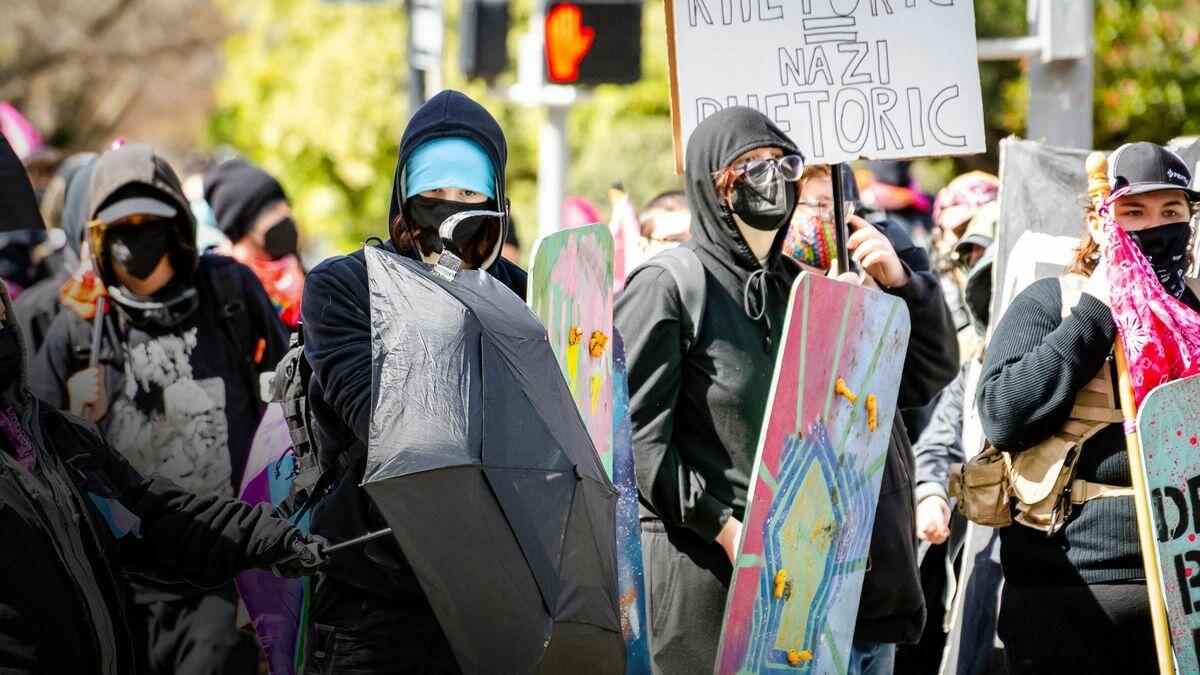
Antifa activists gather in Sacramento, Calif., on March 28, 2023. John Fredricks/The Epoch Times

“My general feeling is that we’re seeing more of it … not for any one factor, but because of several factors all convening, and they’re all amplified by the political rhetoric,” said C. Alan Hopewell, a Fort Worth neuropsychologist.

When people struggling with their sexual identity are prescribed hormones to change their bodies, it impacts the way they think, he told The Epoch Times.​

Hopewell said that combining hormones, medication, and intense online pressure can create a dangerous situation.

Since 2018, there have been at least six high-profile shootings at schools and businesses involving individuals who identified as transgender or were described as gender-confused.

Two were mass shootings, which are defined by the Crime Prevention Research Center as the killing of four or more people in a single incident that’s not gang-related or related to some other crime.

Last year, Anderson Lee Aldrich, a man who identifies as nonbinary, was sentenced to 55 concurrent life sentences for the 2022 shooting of five people at an LGBT nightclub in Colorado Springs, Colorado.

In 2023, 28-year-old Audrey Hale, a woman who identified as a man, opened fire at the Covenant School in Nashville. Three 9-year-olds and three adults were gunned down before police shot and killed Hale.

Robert Westman, who changed his name to Robin, killed two children and wounded 21 others before killing himself at Annunciation Catholic Church in Minneapolis this August. The 23-year-old left a manifesto saying he “was tired of being trans” and scrawled anti-Christian messages and the words “kill Donald Trump” on weapons.

Likewise, members of the Zizians, described as a cult-like group largely made up of transgender individuals, have been mentioned in connection with the death of a woman during an attack on a California landlord in November 2022, the landlord’s subsequent killing, and the deaths of a Pennsylvania couple.

Most recently, the Zizians have been linked to a highway shootout in Vermont that left a U.S. Border Patrol agent dead.

In Texas, Cameron Arnold, also known as Autumn Hill, and Bradford Morris, also known as Meagan Morris, were charged with the attempted murder of federal agents in connection with an ambush of an Immigration and Customs Enforcement (ICE) officer at the Prairieland ICE detention facility in July.

Police block a road after a shooting involving a U.S. Border Patrol agent on Interstate 91 near Coventry, Vt., on Jan. 20, 2025. Experts say ideology, social media, mental health disorders, and medication may be driving recent trends in violence and radicalization among people who identify as transgender. WCAX via AP

Both suspects were members of an Antifa-affiliated group and both identified as transgender, according to the Department of Homeland Security.

Court proceedings recently revealed that the man arrested for allegedly plotting to kill Supreme Court Justice Brett Kavanaugh in 2022 identified as a woman.

Tyler Robinson, the alleged killer of Turning Point USA’s Charlie Kirk on Sept. 10, was romantically involved with a transgender partner whose picture in a “furry” suit has been widely distributed online.

Friends reported that Robinson delved into a “dark” internet culture, Utah Gov. Spencer Cox said on Sept. 14.

Messages on the cartridges in a rifle found by police in a wooded area after Kirk’s shooting gave insight into the shooter’s motive.

According to court documents, the phrase on one cartridge contained a reference to online furry and roleplay culture. Another read “Hey fascist! Catch!” and featured arrow symbols that may have referred to a sequence of controller moves that unleash a bomb in the video game “Helldivers 2.”

Robinson’s mother told investigators that over the past year or so, Robinson’s political beliefs had been leaning to the left, “becoming more pro-gay and trans-rights oriented,” according to the documents.

President Donald Trump said on Sept. 15, “It looks like he became radicalized on the internet.”​

The FBI is investigating other possible accomplices in the assassination of the conservative influencer.

Ideology and Violence

When asked whether the FBI should be investigating transgender extremism, Trump told reporters on Sept. 21: “Something seems to be going on, but you can’t make that statement yet. We’re looking at it very closely.”

Groups such as Armed Queers of Salt Lake City, a militant anti-fascist group that wiped its social media presence after Kirk’s assassination, and Trans Army have come under public scrutiny.

Armed Queers spoke on “queer resistance” at the University of Utah in 2023. The group, which calls itself a revolutionary LGBT organization that defends “oppressed people,” is led by Ermiya Fanaeian, a transgender activist whose parents were Iranian immigrants. Fanaeian identifies as a “trans woman of color.”
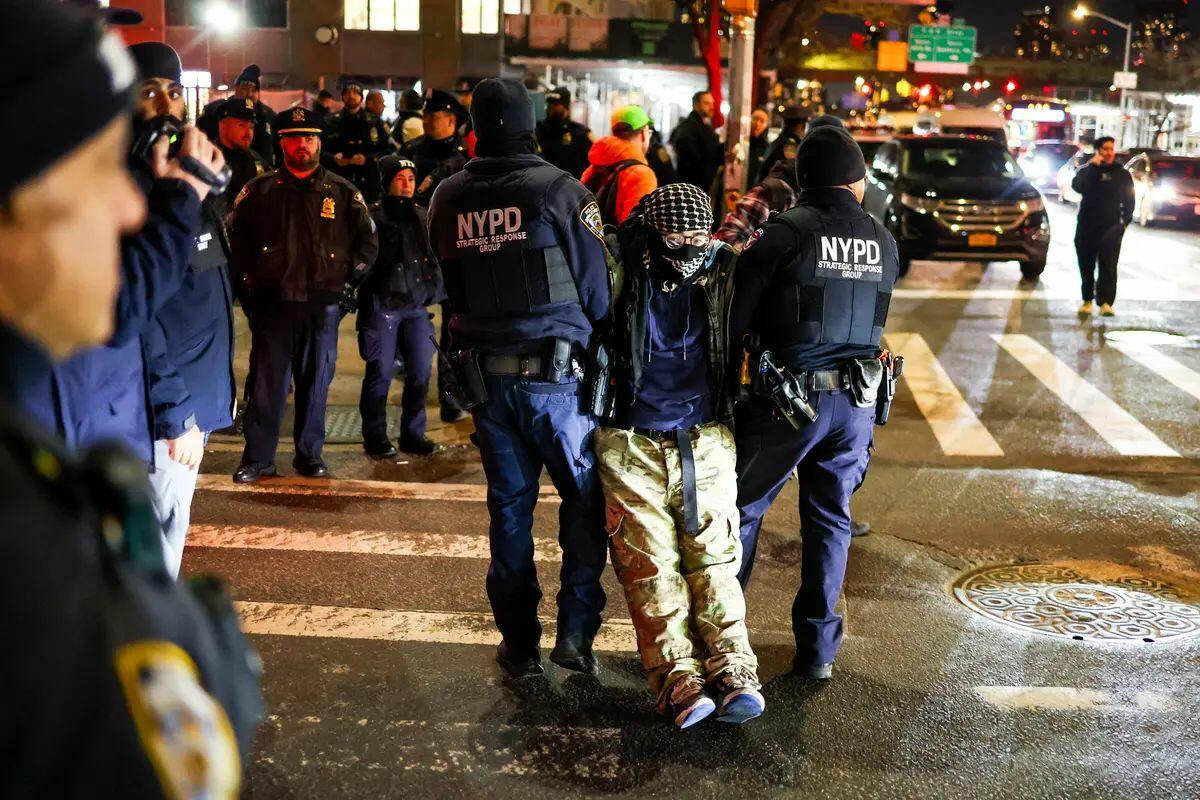
New York police arrest a protester during a pro-transgender demonstration in New York City on Feb. 3, 2025. President Donald Trump recently said his administration is examining possible transgender extremism in the country. Charly Triballeau/AFP via Getty Images

Rep. Anna Paulina Luna (R-Fla.) said in an X post that the socialist group is now under FBI investigation in connection with Kirk’s slaying. She noted alleged funding links between the group and the Chinese Communist Party.

The Trans Army, which offers “guides, toolkits, and counterinsurgency strategies to survive and fight back” denied the group was anything but peaceful, after journalist Andy Ngo posted on X that the organization was training for a “paramilitary insurrection against the U.S. government.”

The group said in an online statement, ​“The recent portrayal of the Trans Army initiative as a violent revolutionary force fundamentally misinterprets the organization’s intent, purpose, and advocacy.

​Trump designated Antifa as a domestic terrorist group on Sept. 22 and signed a presidential memorandum on Sept. 25 with the aim of dismantling left-wing terrorism networks in the United States.

The memorandum stated that recent political violence, including anti-ICE shootings and assassinations, did not have organic origins.

“Instead, it is a culmination of sophisticated, organized campaigns of targeted intimidation, radicalization, threats, and violence designed to silence opposing speech, limit political activity, change or direct policy outcomes, and prevent the functioning of a democratic society,” the president said.

The memorandum directed the National Joint Terrorism Task Force to investigate, prosecute, and disrupt entities and people engaged in political violence and intimidation designed to suppress lawful political activity or obstruct the rule of law.

President Donald Trump signs an executive order in the Oval Office on Sept. 25, 2025. Days earlier, the president designated Antifa a domestic terrorist group and later signed a memorandum to dismantle left-wing terrorism networks in the United States. Andrew Harnik/Getty Images

Hormones and Mental Health

Dr. Lauren Schwartz, an Oklahoma psychiatrist, cautioned against the assumption that transgender individuals are inherently violent.

I would be very cautious to link it directly to a violent act, of something like murdering someone or assassinating someone,” she told The Epoch Times.

Schwartz said individuals experiencing gender confusion are already vulnerable, and affirming their beliefs does not appear to improve their situation. Instead, she noted, their conditions may worsen.

“Steroids, and testosterone specifically … I do think all of them put these kids and young adults in horribly compromised medical situations, even if it has nothing to do with harm to others,” she said.

While the number of mass killings involving transgender individuals is small, some experts say that the proportion appears statistically high.

A testosterone ampoule is displayed at a hospital in Santiago, Chile, on Jan. 8, 2020. Claudio Reyes/AFP via Getty Images

​“If you look at mass public shootings since 2018, what you find is about 5 percent of the mass public shooters were trans individuals, and given that their share of the population is about 0.7 percent, they’re obviously overrepresented,” John Lott, president of the Crime Prevention Research Center, told The Epoch Times.

Read the rest here…

Tyler Durden
Fri, 10/03/2025 – 22:15

via ZeroHedge News https://ift.tt/zaXdLkB Tyler Durden
America’s Sober Revolution Marches On: NielsenIQ Data Charts Continued Decline In Alcohol Sales

America’s Sober Revolution Marches On: NielsenIQ Data Charts Continued Decline In Alcohol Sales

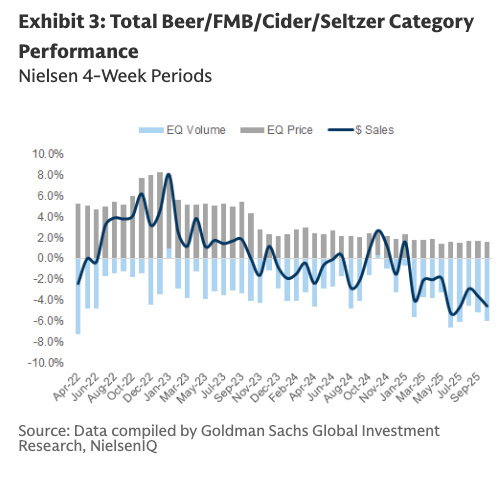
Reaffirming that the sober revolution in America is continuing full steam ahead into fall, a new Goldman report shows total alcoholic beverage sales fell 3.9% in the two weeks ending September 20, consistent with prior 4-week and 12-week declines. 

There’s a lot to unpack in Goldman’s alcoholic beverage trends note, which cites NielsenIQ data through September 20. A team of analysts led by Bonnie Herzog wrote the report. Here’s the breakdown:

Overall U.S. Market

  • Total alcoholic beverage sales fell -3.9% in the 2 weeks ending 9/20/25, consistent with prior 4- and 12-week declines.

  • Volume remained under pressure (-3.0%), while pricing slipped slightly (-0.7%).

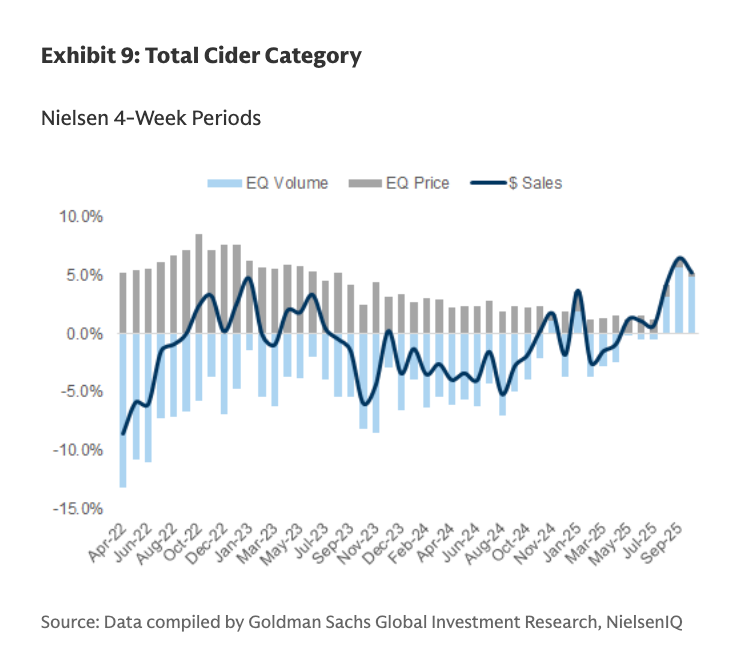
  • Spirits and Cider were the only categories avoiding volume contraction.

Beer Category

  • Beer sales declined -3.8%, driven by a -5.2% volume drop, partially offset by +1.5% pricing.

  • Modelo: Sales down -3.5% on weaker volumes (-4.6%) but modest price growth (+1.2%).

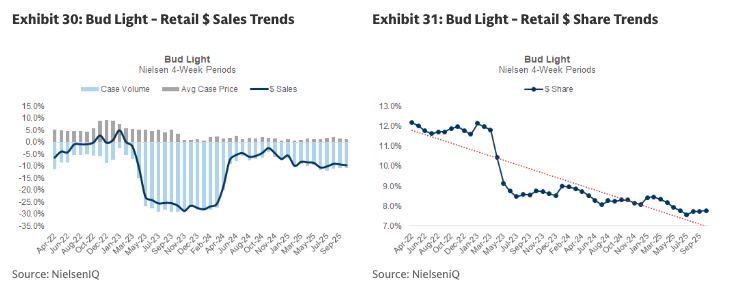
  • Bud Light: Sales fell -8.9%, losing 44 bps market share to 7.7%.

  • Michelob ULTRA: Grew +2.5%, gaining 55 bps market share to 9.0%.

  • Coors Light & Miller Lite: Both declined (-4.6% and -7.8%), with share erosion.

Flavored Malt Beverages (FMBs)

  • FMB sales fell -6.8%.
  • Twisted Tea: Sales dropped -12.8%, though market share edged higher.

  • Simply Spiked: Severe weakness continued (-32.0%).

  • Hard Seltzers: Down -5.7%, led by Truly (-13.6%) with share loss.

Ready-to-Drink (RTD)

  • Cocktails Strong growth continued: Spirit-based RTDs: +23.1% Wine-based RTDs: +28.5%

Promotions

  • Promotional spend moderated slightly to 18.5% of sales (from ~18.6–18.7%).

Herzog’s team published an extensive chartbook visualizing the NielsenIQ data, underscoring a “sober revolution” that has gained momentum since the Covid lockdowns. Gen-Z sober behaviors are also changing the drinking landscape.

The charts line up with Gallup’s latest survey showing (read report), for the first time in the poll’s 90-year history, that a majority of Americans now view even moderate alcohol consumption as harmful to one’s health.

Bud Light sales remain depressed after a transgender TikTok in early 2023 nuked the brand. 

Hmmm.

Related:

For the full 75 charts and tables on the latest U.S. alcohol trends, ZeroHedge Pro Subs can access the report in the usual spot.

Tyler Durden
Fri, 10/03/2025 – 21:50

via ZeroHedge News https://ift.tt/exvG37M Tyler Durden

7 Midlife Money-Traps That Could Drain Your Wealth

7 Midlife Money-Traps That Could Drain Your Wealth

Authored by Mike Donghia via The Epoch Times (emphasis ours),

Being able to identify financial traps can help make security in your midlife and beyond a breeze.

The Epoch Times/Shutterstock

When you’re young, the central money problems to solve are how to grow your income and begin to invest so the magic of compounding is on your side.

As you approach retirement, the challenge shifts to managing health care costs and transitioning your investments to a stable phase, allowing you to draw on them.

What about the midlife years when life is busy and the demands on your time are at their all-time high? What is the most innovative way to approach your finances during this season?

As I enter my mid-30s, I am firmly entering the exciting midlife years with a career and a large family to care for. After years of having to closely manage our money, a bit of breathing room has finally emerged. However, I’m convinced the key to this season in life is avoiding the money traps that so easily entangle otherwise intelligent people.

Midlife can last for around three decades—a long time to see your career and investments grow if you’ve set yourself up that way. That much time also means plenty of opportunities to get off track and blow your blessings on trivial mistakes.

7 Common Midlife Money Traps

There are several ways we can fall into financial trappings. Becoming aware of them can help us avoid their ill effects.

1. Allowing Your Spending to Increase With Rising Income

Our default human behavior is to spend nearly everything we make. As your income grows, your expenses grow proportionally, as if by some inexplicable magic. It happens without even thinking about it, but means your rate of savings never increases. The opportunity cost is significant because that money could be invested conservatively and grow over time to meet larger needs that will surely arise down the road.

2. Not Diversifying Your Investments

There comes a season in many people’s lives where they get the idea that they can invest their own money better than the average professional. Generally, people who get the investing itch end up concentrating their investments into what they see as “sure bets” instead of diversifying and accepting normal rates of growth. Sometimes you’ll get lucky and this will work out, but more often you’ll be unlucky and see painful drawdowns. For most non-experts, it’s a trap to avoid.

3. Underestimating the Impact of Inflation

Another type of person views the stock market and other investments as risky and therefore avoids them altogether due to fear. They read about the volatility in the news or hear about friends or family losing money, and want to stay as far away as possible. What they often fail to account for is the slow, draining effect that inflation can have over decades. With just three decades of 2 percent inflation, your original amount is worth about half of what it was at the start. The moral is: Don’t let fear keep your money from earning interest— find a local advisor that can help you make wise investments.

4. Carrying High-Interest Credit Card Debt

Credit card debt is a trap, and possibly the main reason, besides health care expenses, that people end up in bankruptcy. Avoid at all costs. Aim to make it through your entire midlife years without ever paying a dime of credit card interest. For one, if you have a substantial emergency fund, it should never really be needed. If you do need a loan for any reason, there are much cheaper sources that any bank or credit union can point you toward.

5. Falling for Get-Rich-Quick Schemes

We all know the dangers of the midlife crisis and the irrational decisions it can lead people to make. Sometimes we feel “behind” on our financial journey and want to make up for lost time in one fell swoop. When it comes to money, always assume there’s no additional upside without additional risk, and your midlife is not the time to be ratcheting up the risks you’re willing to take. It’s far safer to find a source of side income if you want or need to grow your savings faster.

6. Not Building an Emergency Fund During Good Times

Many of the problems mentioned in the above list can be avoided by making it a priority to build an emergency fund and add to it over time. Having cash on hand, or money that you can quickly and easily convert to cash, is one of the best safety nets you can build for yourself. While many people advocate for three to six months of expenses, I say to aim even higher in your midlife—up to 12 or even 24 months so that you can weather any financial storm.

7. Buying Too Much House or Too Nice a Car

One of the most common traps people fall into when they finally start having some extra dough is looking around and seeing how they stack up to their peers. Not wanting to appear behind, many upgrade their lifestyle with bigger homes and newer, higher-status vehicles. I’m not against spending your well-earned money, but be careful that you’re doing so thoughtfully, and with the bigger picture of your financial goals in mind.

Tyler Durden
Fri, 10/03/2025 – 21:25

via ZeroHedge News https://ift.tt/PjYAyZm Tyler Durden

“The Floor Fell Out”: LA’s Entertainment Industry Is In Full Collapse

“The Floor Fell Out”: LA’s Entertainment Industry Is In Full Collapse

Hollywood’s middle class is collapsing, according to a new report from the Wall Street Journal.

Production has slowed to historic lows, jobs are vanishing, and longtime workers are leaving Los Angeles in droves.

Animator Brian Mainolfi, who once worked with Chuck Jones and on Disney films like Mulan, hasn’t had steady work since 2024. His only income is $350 a week teaching three hours away. “By the end of the year if I don’t have something, I’m going to have to apply to a big-box store or a grocery store,” said the 54-year-old, now burning through savings.

Production manager Pixie Wespiser, 62, who has worked on 36 shows including Night Court, said: “This is the first year since 1989 that I haven’t had a show to work on. I look around and I see so many people who are seriously suffering.”

Oscar-winning sound mixer Thomas Curley hasn’t worked since April 2024. What he misses most is the teamwork: “Feeling like you’re part of a team that’s making something that can provide joy for millions…that level of purpose is a really hard thing to let go of.”

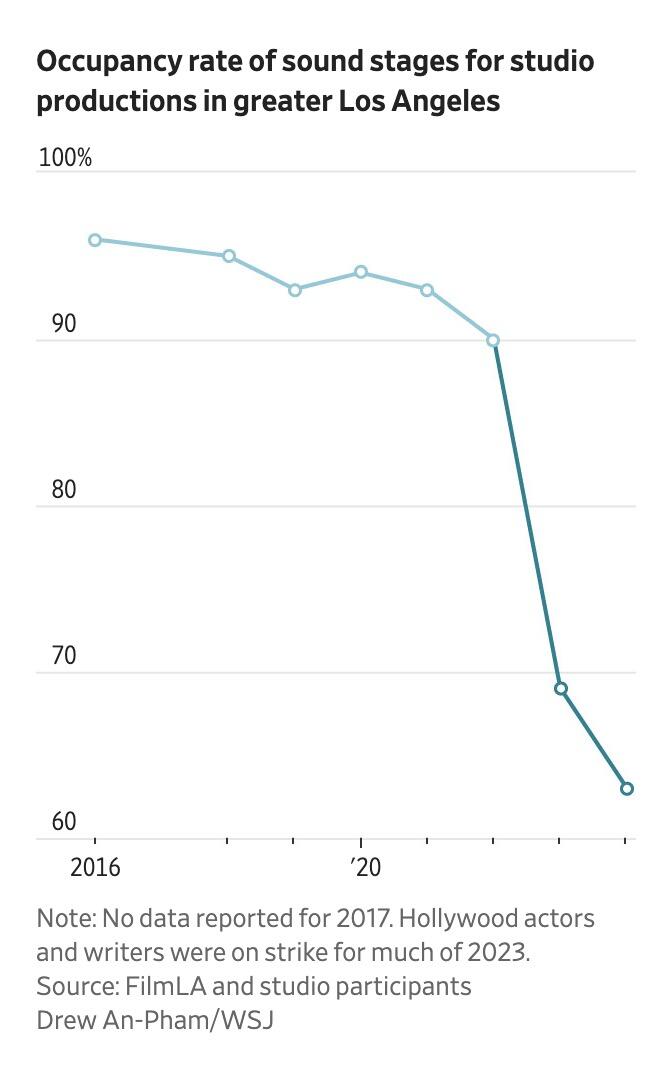
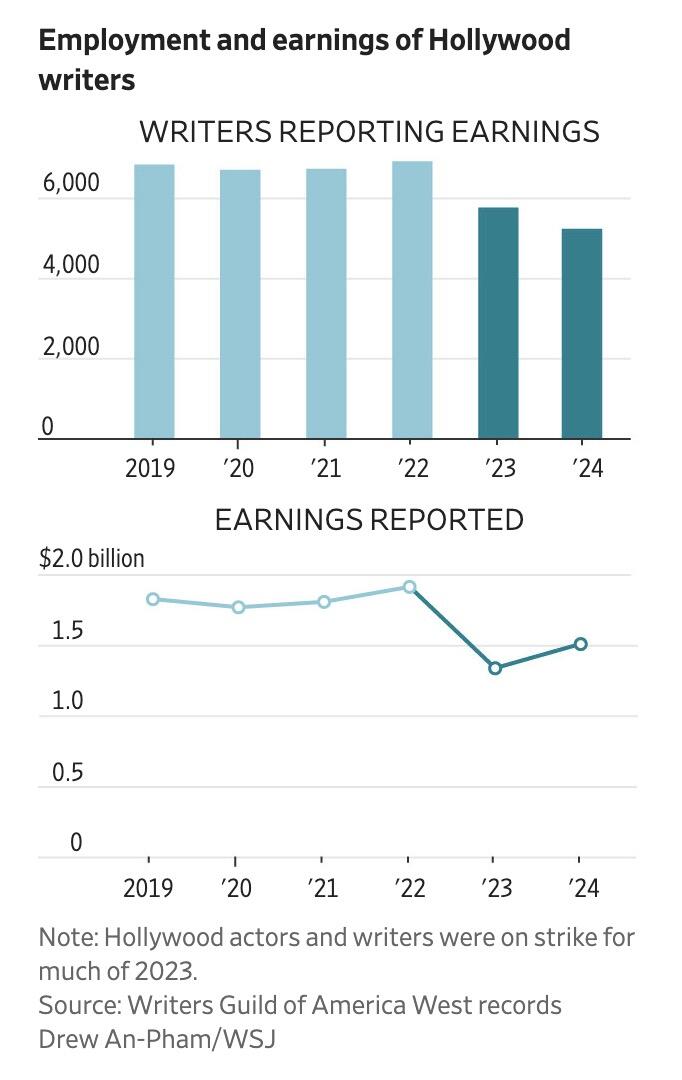
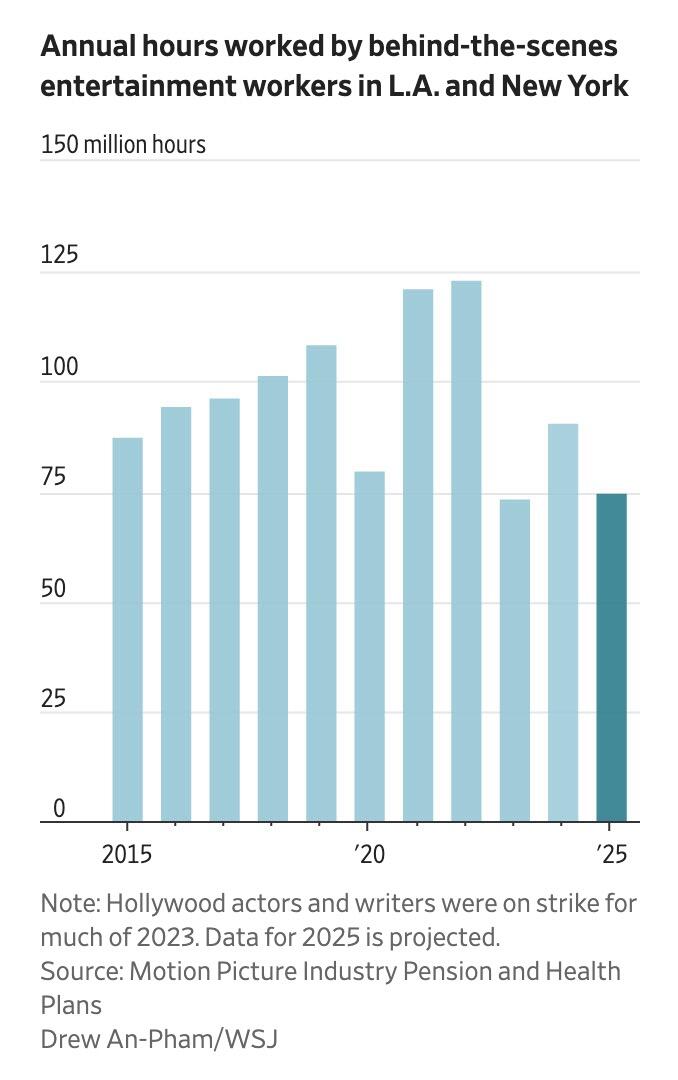
The downturn began after the 2023 writers’ and actors’ strikes. Streamers, once in a content arms race, slashed spending to chase profitability. Nearly 30 percent fewer big-budget productions began in 2024 compared with 2022, and this year is down another 13 percent.

FilmLA reports that production in the region hit its lowest point, outside the pandemic, since at least 1995. Los Angeles County motion picture jobs fell from 142,000 in 2022 to about 100,000 by the end of 2024. Unemployment in L.A. is higher than state and national averages, worsened by wildfires and a housing crunch. With cheaper options abroad and new fears about AI replacing artists, recovery looks distant.

The Journal writes that the collapse has rippled far beyond film sets. Local businesses that once relied on entertainment workers are shuttering. Cookie shop owner Courtney Cowan, whose Milk Jar Cookies once thrived on studio orders, shut down in early 2024 and declared bankruptcy. “It’s not dramatic to say that the result has been personal financial ruin,” she said.

Some industry veterans are leaving the city altogether. Former assistant director Susan Hellman, who worked on shows like Entourage, sold her Venice home and moved to Florida after months without work. Animator Rachel Long, who built her career on series like BoJack Horseman, retrained as a phlebotomist. “I went from drawing blood to drawing blood,” she jokes, though her new job pays a fraction of her old salary.

California has expanded its film tax credits, and some producers are lobbying for federal ones. But studios continue to chase lower costs in Canada, Europe, and beyond. Producer Steven Paul, shooting The Last Firefighter in Los Angeles, admitted it cost far more than filming overseas but insisted, “If we’re going to say we want to bring production back to America, I can’t be the one filming everywhere in the world.” For thousands of workers, though, that fight may come too late.

As one writer put it: “It felt like the floor fell out.”

Tyler Durden
Fri, 10/03/2025 – 21:00

via ZeroHedge News https://ift.tt/XFixKYJ Tyler Durden

How Social Media Is Warping People’s Relationship With Violence

How Social Media Is Warping People’s Relationship With Violence

Authored by Petr Svab via The Epoch Times,

Easy access to an endless stream of violence, combined with encouragement of violence on social media, is distorting people’s attitudes toward it, an issue that is difficult to solve through automation, according to experts.

Violence has always been a part of the human experience but has never been available in such quantities for entertainment, they said.

In contrast with movies and video games, which show fictional violence, social media provides anyone the ability to see real violence with effectively no restrictions on age. It’s often presented as entertainment, with flippant, crass, or cynical commentary and mixed with other random content described in online parlance as “brain rot,” according to Jeffrey Blevins, professor of media and journalism at the University of Cincinnati and an expert on social media content.

Also, political divisions have resulted in the casting of large segments of society as sub-human, leading to the suggestion that they deserve violence, according to Andrew Selepak, an associate professor of media and communications at the University of Florida who specializes in social media research.

Although most social media platforms restrict graphic or violent content, some such content slips past the filters, and other content that rides the edge of what platforms allow continues to make it through.

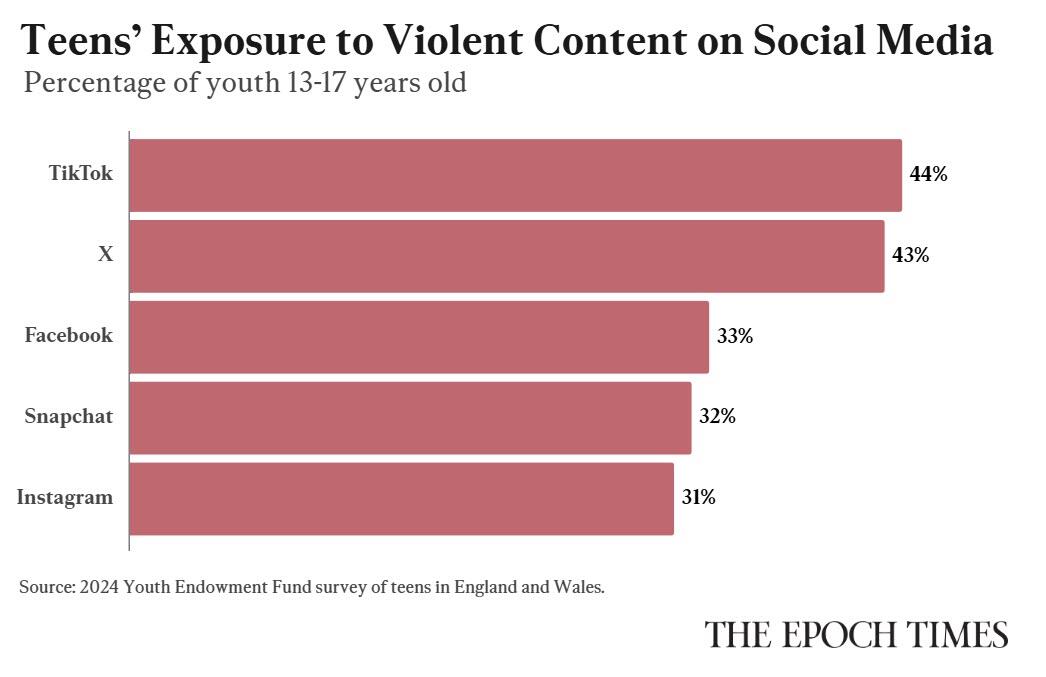
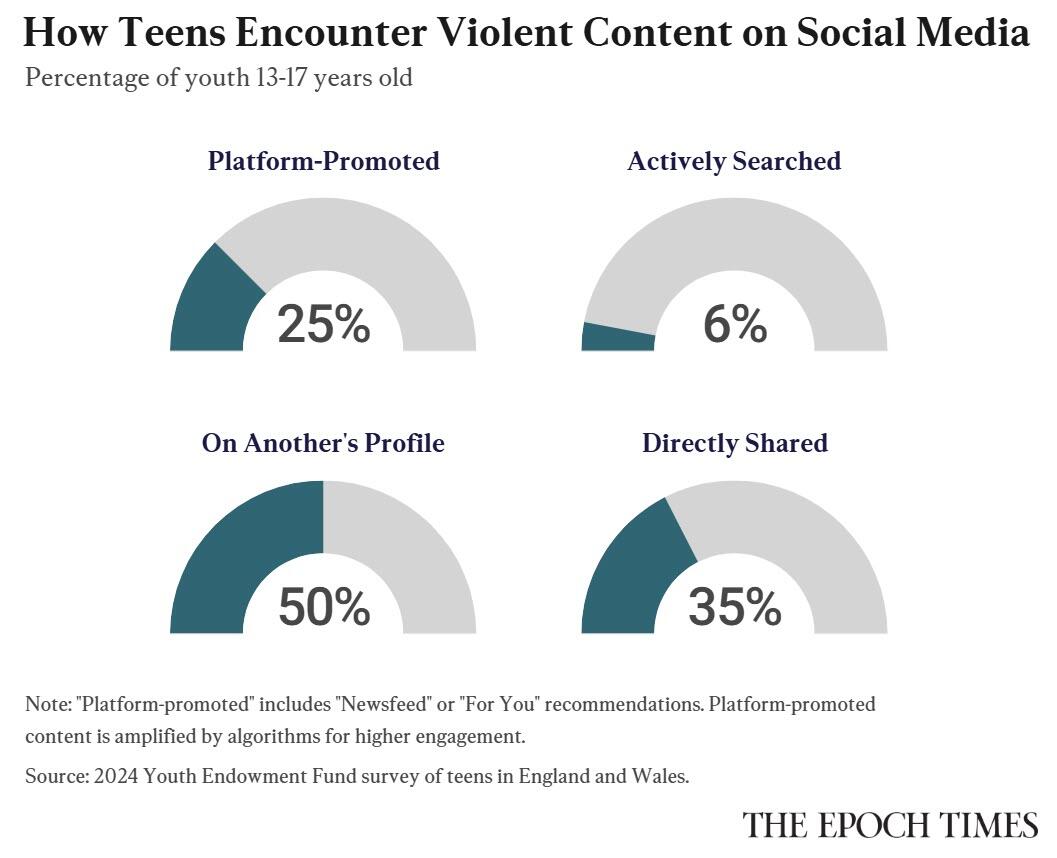
Some 70 percent of youth aged 13 to 17 see real-world violence on social media, according to a 2024 Youth Endowment Fund survey of teens in England and Wales. TikTok users reported the highest exposure at 44 percent of respondents in the preceding 12 months. X users followed at 43 percent, although less than a quarter of respondents reported using the platform. Facebook, Snapchat, and Instagram weren’t far behind, with exposure rates of 31 percent to 33 percent.

The recent assassination of conservative commentator Charlie Kirk was “sadly, an interesting case study,” Blevins said. The extremely graphic videos of the incident were seen by millions of people on social media despite platform restrictions.

Too Much

Research literature has talked for years about the issue of “desensitization” by repeated exposure to violence in digital media.

In real life, Americans overall have been fortunate enough to only sporadically experience violence on a personal level, according to Selepak.

“We don’t experience violence every day, multiple times a day, in the real world; but on social media, especially because people are spending hours each day [on those platforms], you can be exposed to it for hours each day repeatedly,” he said.

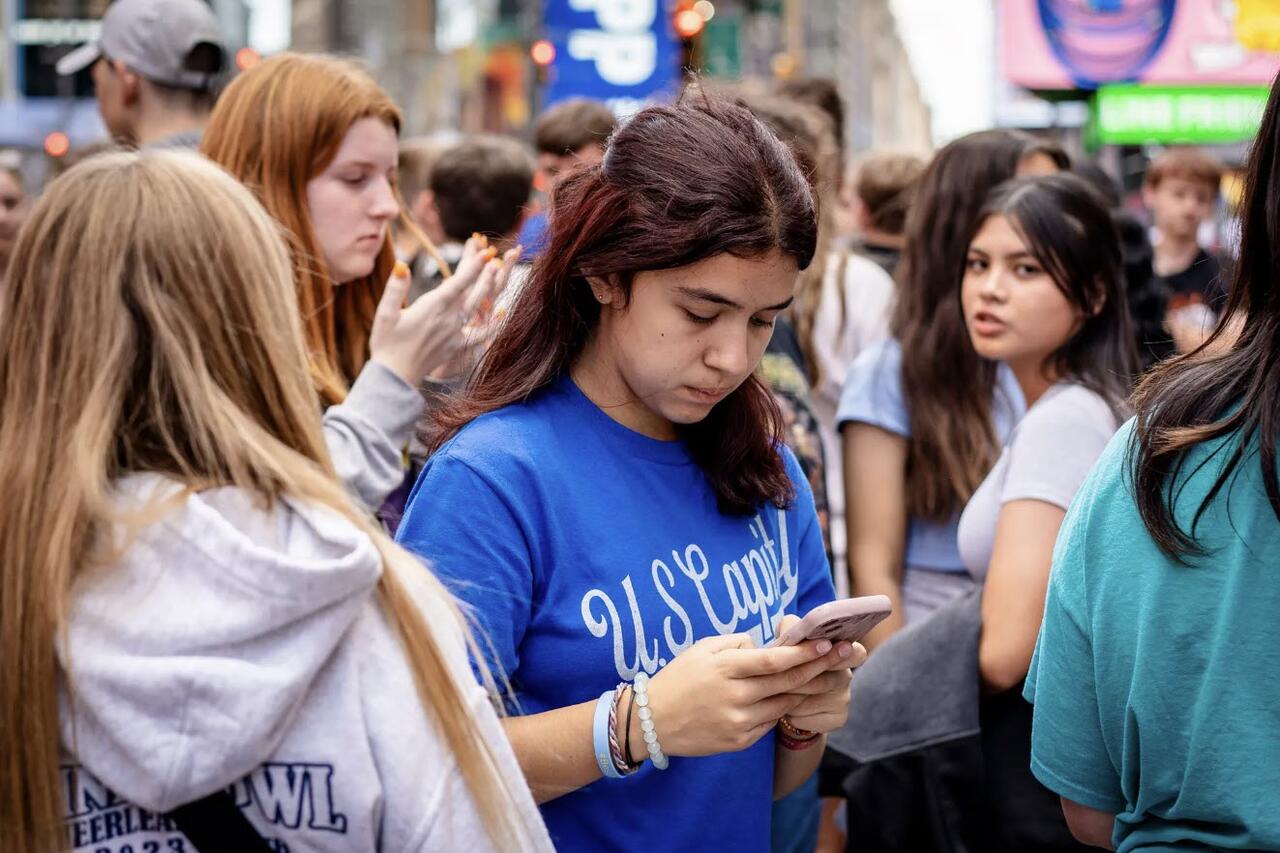
A young woman uses a cell phone in New York City on June 10, 2024. Experts warn that the flood of violent imagery on social media is distorting people’s attitudes toward violence. Samira Bouaou/The Epoch Times

“Outside of people engaged in war, there’s never been an equivalent to this in human history.”

Even those with the most real-life exposure to violence, such as first responders, often see only its aftermath, which leads them to appreciate its destructive consequences.

Online, on the other hand, a person can easily get pulled into watching a near-endless stream of real-world violence detached from its consequences, Selepak said.

A major issue is the use of algorithms to personalize content for each user, the experts agreed. Once a person stumbles upon a few videos of a certain kind, the algorithm picks up on the apparent preference and supplies more. Even if the platform restricts graphic violence, there’s plenty of borderline content that makes it through yet is still brutal—and it’s exactly the borderline content that often goes viral.

“Content that does anger us, that does upset us, that is upsetting content, we’ll spend more time consuming that, commenting on it, engaging with it, which leads to that content, based on the algorithm, then being more visible to more people, because it’s getting so much engagement,” Selepak said.

And restricting such content would hurt the platforms’ bottom line, he pointed out.

“The platforms make money by how much time we spend on there, seeing ads,” Selepak said.

Further complicating the issue is that violent content has real information value in some contexts.

However, algorithms lack the ability to make such distinctions because they lack human sensibility to begin with.

“Algorithms are really good with content, but certainly not context and ethics,” Blevins said. “They don’t necessarily come with that moral compass.”

Selepak concurred.

“The algorithm doesn’t necessarily care what we’re consuming. It just wants us to consume,” he said.

Conflict Magnifier

Social media doesn’t just expose people to violence; it also facilitates it.

In the UK survey, 16 percent of respondents admitted to engaging in violence in the preceding 12 months, and about two-thirds said social media played a role, “including online arguments leading to in-person violence, comments exacerbating conflicts and children saying things online that they wouldn’t say face-to-face.”

A 2021 paper based on dozens of interviews with mostly black young people found that “small” and “petty” arguments on social media can easily turn into serious real-life conflicts and physical altercations.

Women with their cell phones in New York City on June 10, 2024. Experts say social media serves as a forum for groups promoting violence, despite platform restrictions. Samira Bouaou/The Epoch Times

“Adolescents expressed keen awareness that social media as a context intensifies interpersonal peer conflict,” the paper reads.

“Adolescents often do not go online with the intention to fight. Rather, as they are acutely aware, social media is a unique environment that amplifies and changes experience of conflict.”

Calls for Violence

Beyond visual gore, social media provides a forum for violence advocacy. The experts refrained from singling out any particular political group but highlighted the significant volume of such content, despite various platform restrictions.

“If you’re interested in a particular ideology or a particular group or a particular phenomenon, start a fresh account … feed in those keywords, and just watch what the algorithm feeds you,” Blevins said. “It could be eye-popping.”

With algorithms constantly recommending more similar content, people using those platforms can easily gain the impression that an extreme or fringe position is normal and commonplace, the experts warned.

There’s also a new phenomenon of “sycophantic” personal artificial intelligence chatbots that affirm the user’s beliefs to an unhealthy degree, Blevins said.

Then there’s content that doesn’t call for violence outright but provides indirect justification for it.

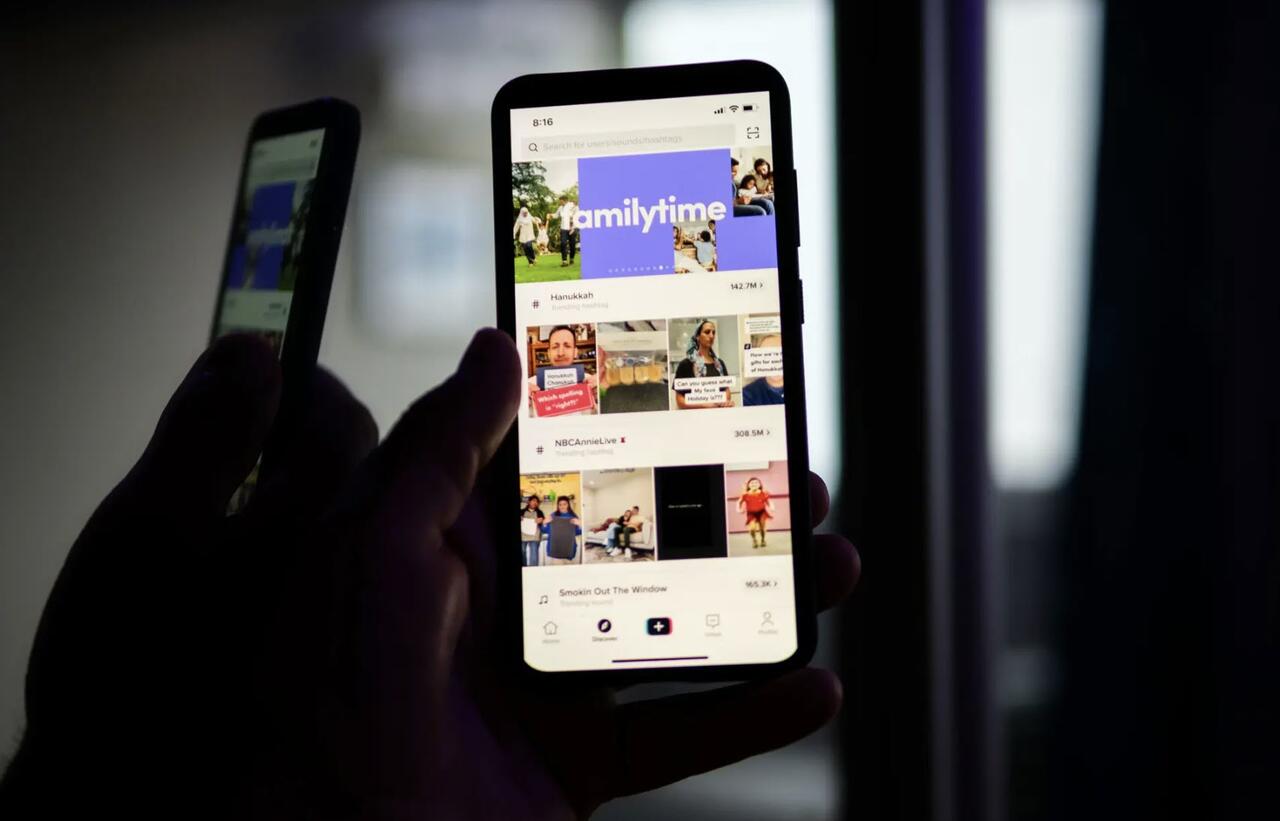
A man holds a phone displaying the TikTok app in a file photo on Aug. 11, 2024. A 2024 survey of teens in England and Wales found that 44 percent of TikTok users reported seeing violent content in the past year. Oleksii Pydsosonnii/The Epoch Times

“If you’re on Meta or YouTube, X as well as TikTok, there’s this constant drumbeat of one side is fascist and Nazis and what we would consider the absolute worst of the worst of humankind,” Selepak said.

“That kind of dehumanization, and the repeated presentation of that dehumanization, can make violence or accepting violence against that group much more possible.”

Attitude Change

With a growing body of research showing the negative effects of social media, at least in its current form, public opinion toward it has been shifting as well.

Almost 80 percent of American high schoolers said they use social media multiple times per day, and nearly a third reported that they used it more than once per hour, according to a 2023 survey by the Centers for Disease Control and Prevention.

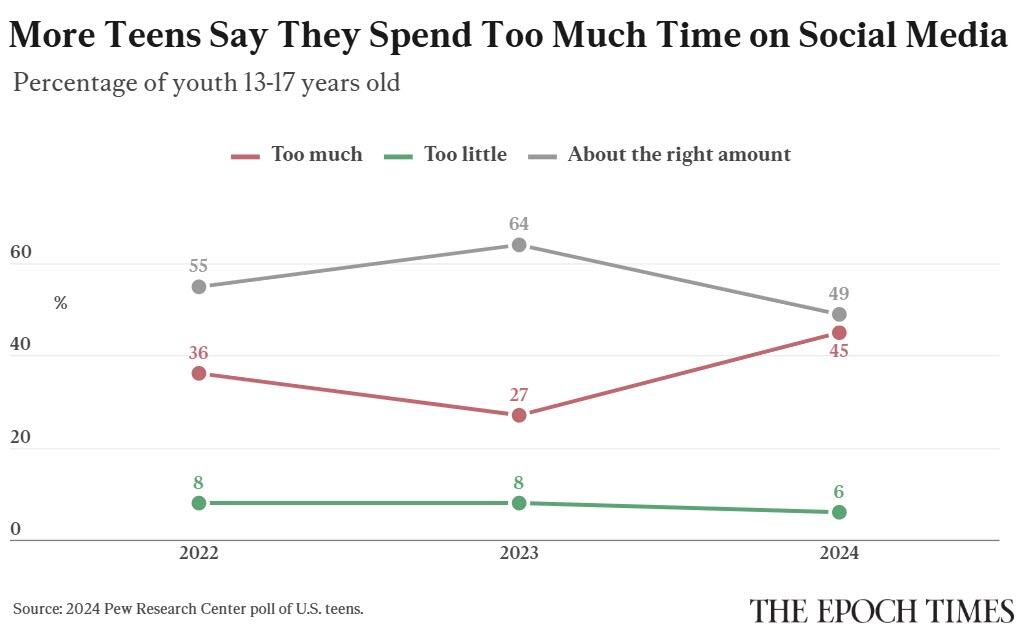
But almost half of teenagers said in a Pew Research poll last year that they spend too much time on social media, up from only about a quarter in 2023.

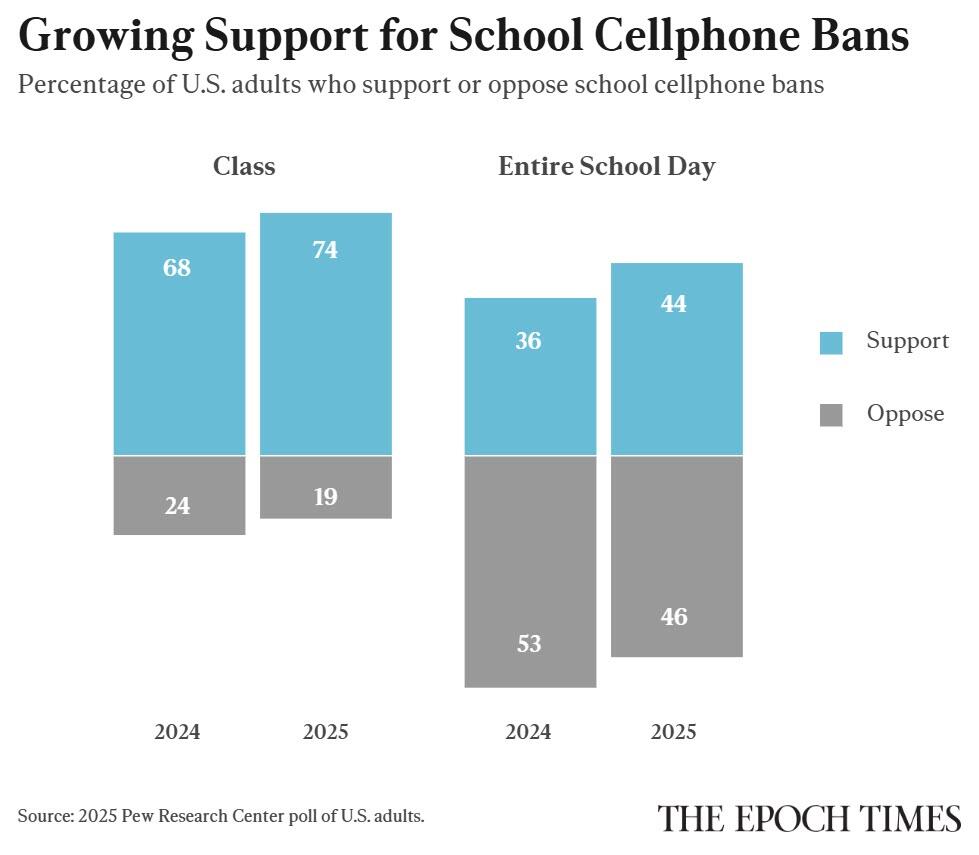
Also, Americans overall seem to be moving closer to the position that children shouldn’t have cellphones, not just during class, but during the entire school day. In 2024, 36 percent supported all-day bans; earlier this year, support for all-day cellphone bans was at 44 percent, according to a Pew Research poll.

*  *  *

Views expressed in this article are opinions of the author and do not necessarily reflect the views of ZeroHedge.

Tyler Durden
Fri, 10/03/2025 – 20:35

via ZeroHedge News https://ift.tt/uRHySdG Tyler Durden

Top 11 Universities in the U.S. (1935)

From the Atlantic in 1935, by Edwin Embree (see also yesterday’s Atlantic Time-Travel Thursdays (Jake Lundberg) item yesterday discussing this):

How does one go about appraising the scholarly eminence of universities? In the first place, one may take the lists of the most distinguished scientists as published in American Men of Science and in somewhat similar records for the other branches of learning and tabulate the centres of concentration of these most eminent scholars. Second, since creative scholarship finds expression ultimately in publication, it is possible through the scientific journals to appraise the scholarly output of the several university faculties. The third and probably the soundest method is to rely on appraisals of the relative eminence of the several departments of universities made by competent scholars in each field. [More details omitted. -EV] …

While I have based my ratings on authoritative findings, most of which are matters of published record, I must in the end assume personal responsibility for the judgments. With all these considerations and reservations in mind, here is my rating of American universities in the order of their scholarly eminence: —

1. Harvard
2. Chicago
3. Columbia
4. California
5. Yale
6. Michigan
7. Cornell
8. Princeton
9. Johns Hopkins
10. Wisconsin
11. Minnesota

The post Top 11 Universities in the U.S. (1935) appeared first on Reason.com.

from Latest – Reason.com https://ift.tt/joGTwNz
via IFTTT

The Courage To Stand Alone In An Age Of Cowards

The Courage To Stand Alone In An Age Of Cowards

Authored by Maureen Steele via American Greatness,

The bravest souls are rarely the loudest in the room, but they are often the most misunderstood.

In an age when conformity is dressed up as virtue and applause is the currency of self-worth, those who refuse to play by the script become lightning rods. They provoke discomfort simply by existing in truth. They trigger the insecure, unsettle the complacent, and disturb the carefully curated illusions of the fake.

We like to imagine that the pressure to conform ends with adolescence, with the awkward teenage years when belonging matters more than authenticity. But Solomon Asch’s conformity experiments in the 1950s proved otherwise. In a simple exercise—identifying which line matched another in length—he planted actors in the room to all give the same obviously wrong answer. Time and again, the lone real participant abandoned the truth they could plainly see with their own eyes and went along with the group. Three out of four conformed at least once. Not because they were fooled, but because they did not want to stand out. The fear of sticking out, of being “that person,” overpowered reality itself.

And here is the sobering part: that experiment never ended.

It repeats itself every day in classrooms, workplaces, media echo chambers, and politics.

People choose the safety of the crowd over the solitude of truth. They surrender what they know is real because they do not want the chill of unpopularity or the sting of rejection. The applause comes cheap, but the price of dissent feels unbearable.

Pair that with Stanley Milgram’s obedience studies in the 1960s—where 65 percent of participants willingly administered what they thought were lethal shocks to another person simply because an authority told them to—and you see the bleak pattern. Obedience to authority and conformity to the crowd are the twin forces that crush truth. And yet, every turning point in history has been authored by those who resisted both—the prophets, the dissidents, the whistleblowers, and the reformers.

To live this way is to accept loneliness as a companion. It is to endure suspicion, ridicule, and rejection, not because one is wrong but because one refuses to settle for the comforting lie. Truth costs dearly, but its reward is integrity: an internal compass that does not lose its bearing when the crowd veers off course.

Applause fades. It always does.

What endures is the quiet, steady force of those who never sold out, never bent, and never exchanged their essence for acceptance. They may never be fully understood in their time, but they will always be remembered as the ones who saw clearly, stood firmly, and lived bravely.

*  *  *
Reminder, grab your meat by Sunday for Monday delivery… 

In stock; Steak Lover’s Bundle, Great American Grill Out, Favorites Trio: Beef, Chicken & Pork

Tyler Durden
Fri, 10/03/2025 – 19:45

via ZeroHedge News https://ift.tt/AlD1dnZ Tyler Durden

Top 11 Universities in the U.S. (1935)

From the Atlantic in 1935, by Edwin Embree (see also yesterday’s Atlantic Time-Travel Thursdays (Jake Lundberg) item yesterday discussing this):

How does one go about appraising the scholarly eminence of universities? In the first place, one may take the lists of the most distinguished scientists as published in American Men of Science and in somewhat similar records for the other branches of learning and tabulate the centres of concentration of these most eminent scholars. Second, since creative scholarship finds expression ultimately in publication, it is possible through the scientific journals to appraise the scholarly output of the several university faculties. The third and probably the soundest method is to rely on appraisals of the relative eminence of the several departments of universities made by competent scholars in each field. [More details omitted. -EV] …

While I have based my ratings on authoritative findings, most of which are matters of published record, I must in the end assume personal responsibility for the judgments. With all these considerations and reservations in mind, here is my rating of American universities in the order of their scholarly eminence: —

1. Harvard
2. Chicago
3. Columbia
4. California
5. Yale
6. Michigan
7. Cornell
8. Princeton
9. Johns Hopkins
10. Wisconsin
11. Minnesota

The post Top 11 Universities in the U.S. (1935) appeared first on Reason.com.

from Latest – Reason.com https://ift.tt/joGTwNz
via IFTTT

“The same result that we reached in May is appropriate here.”

I noted in my recent Civitas column that it is rare for a single judge to be reversed by the Supreme Court twice in the same case. Yet, it has happened again. The latest installment is Noem v. TPA Alliance, Part II. The Court states the issue plainly:

In March of this year, the United States District Courtfor the Northern District of California entered a preliminary order postponing the effective date of the Secretary of Homeland Security’s decision to remove “temporary protected status” (TPS) from Venezuelan nationals living in the United States. See 8 U. S. C. §1254a; 5 U. S. C. §705. In May, this Court stayed that order while the Governmentappealed. The United States Court of Appeals for the Ninth Circuit ultimately affirmed the District Court’s preliminary order. Last month, the District Court entered final judgment in respondents’ favor, holding unlawful and settingaside the Secretary’s actions effectuating her decision—namely, her vacatur of a pending extension of TPS for Venezuelan nationals, and her termination of that status itself. See 5 U. S. C. §706(2). (The District Court also concluded that the Secretary unlawfully vacated a TPS extension for Haitian nationals. The Government now seeks to stay theportions of the District Court’s judgment pertaining to Venezuela, but not Haiti. See Application 7, n. 6.) The application for stay presented to JUSTICE KAGAN and by her referred to the Court is granted. Although the posture of the case has changed, the parties’ legal arguments and relative harms generally have not. The same result that we reached in May is appropriate here.

Justice Jackson, in dissent, laments how the Court did not use its “opinion-writing capacity.” Given that this case took less than ten days to resolve, from start to finish, I don’t think the Court found the matter particularly difficult. Justices Kagan and Sotomayor did not join Jackson’s dissent.

At some point, lower courts will get the memo of how the emergency docket works.

The post "The same result that we reached in May is appropriate here." appeared first on Reason.com.

from Latest – Reason.com https://ift.tt/lkSFRPC
via IFTTT

Regulatory Rollbacks Begin To Combat California’s Housing Crisis

Regulatory Rollbacks Begin To Combat California’s Housing Crisis

Authored by Carey Wedler via The Epoch Times (emphasis ours),

California is home to numerous profitable industries, but many of the state’s residents struggle to survive under the weight of big government. Case in point: excessive regulations have suffocated the state’s housing market and led to some of the nation’s highest rents and most expensive homes.

Panoramic view of a neighborhood in Anaheim, California. Nancy Pauwels/Shutterstock

In contrast, metro areas in the South, particularly in Texas, are leading in the construction of new apartment buildings this year. Austin hosted nearly double the number of new units as Los Angeles, which is larger tin both geographic and population size. One of the reasons for the South’s housing boom is its less-restrictive regulatory environment. According to Doug Ressler, a senior analyst and manager of business at Yardi Matrix, a real estate data firm, “Southern metros typically offer streamlined approval processes and fewer regulatory hurdles, making it easier to bring multi-family projects to market.” Notably, Texas lawmakers further relaxed the state’s land zoning laws earlier this year to allow for more housing construction.

Californians have long been victims of government overreach. Has the tide begun to turn?

Earlier this summer, members of the heavily Democratic state legislature voted to roll back CEQA, the California Environmental Quality Act, for certain building projects. The law, passed in 1970 and signed by then-Governor Ronald Reagan, mandates that developers consider environmental impacts when proposing construction projects. CEQA requires government agencies tasked with approving building projects to conduct reviews based on potential environmental threats, including those to nearby water, air, flora, and fauna. CEQA also allows members of the public to file lawsuits to block projects based on environmental concerns.

The law has faced widespread criticism, as builders say it contributes to making housing construction too expensive and time-consuming. But faced with staggering housing shortages and skyrocketing costs, the Democrat-dominated state legislature and Governor Gavin Newsom instituted unprecedented reforms at the end of June.

The reforms removed the CEQA review for certain types of developments, effectively “exempting or streamlining infrastructure projects, including high-speed rail; community water and sewer systems; certain types of daycare centers, health clinics and food banks, wildfire risk reduction projects; and ‘advanced manufacturing’ located in industrial zones,” Deborah Sivas, co-director of Stanford University’s Environmental Law Clinic, told ABC News.

Perhaps most significantly, the reforms grant an exemption for “infill” housing construction projects. Infill housing generally refers to urban housing built in and around existing developments. CEQA restrictions previously created a huge hurdle to building infill housing in densely populated areas where it is most needed. The reformed CEQA will unblock most new infill housing developments, which is expected to expand the state’s housing supply.

CEQA advocates have argued the law is not a significant impediment to the housing supply, claiming few CEQA lawsuits actually target housing projects. But others disagree with this assessment.

Nick and Daniel Yost, a father and son who are both environmental attorneys and activists, have pointed out that “The mere threat of a CEQA lawsuit is enough to stifle new housing developments since such suits can add substantial time, cost and risk for builders who already face daunting construction costs.” Lawsuits don’t actually have to be filed to disincentivize developers from starting new projects.

Further, according to a 2018 analysis by veteran attorney Jennifer Hernandez published in the University of California Law Environmental Journal, the most frequent targets of CEQA lawsuits have been housing projects—specifically multifamily construction projects in urban areas. Referring to her previous research on the effects of the law, she wrote that “CEQA lawsuits were most often aimed at infill housing (especially multifamily apartments in urbanized areas).”

She also noted that projects generally viewed as good for the environment often become CEQA targets, as “more transit projects were challenged than roadway and highway projects combined, and that the most frequent ‘industrial’ targets challenged were clean energy facilities like solar and wind projects.” Additionally, even some environmental advocates have taken issue with CEQA’s detrimental effects on the environment. As Nick and Daniel Yost noted, CEQA restrictions on infill housing can force construction projects into open and agricultural spaces.

Further, many CEQA lawsuits are actually efforts to weaponize the law for non-environmental interests. A 2022 paper by attorney Noah DeWitt published in Pepperdine University’s law journal argued that “the wrong people have discovered the right ways to make CEQA serve their own interests—interests that demote the environment to a secondary concern.” Developers seek to stymie projects that may compete with their own business. Unions are also known to threaten CEQA suits if developers do not hire their workers.

NIMBYs (“Not In My Backyard”) also leverage CEQA—not to protect the environment but to limit new housing developments in their communities. Such applications of the law have harmed the poor and minorities, who suffer the most from rampant housing shortages. As DeWitt notes, CEQA tactics are used to keep such groups out of certain areas, and bear a “strange resemblance to the sorts of racially based tactics used to keep minorities out of white communities in the 1960s.”

CEQA perfectly encapsulates a key flaw of progressive governance: the “fix” for one problem often creates another. An ideology attempting to serve many high-minded ideals will quickly damage some cherished cause by seeking another. CEQA’s costs have become so high that some Democrats are willing to compromise. Even so, others in the legislature staunchly opposed these CEQA reforms, insisting that reforms should also prioritize the construction of low-income housing. The endless appetite for controlling and tinkering—in this case, in the name of helping the disadvantaged—has virtually ensured such dire, if unintended, outcomes.

This fracture within the California legislature highlights an emerging attitude in left-leaning ideology: the “abundance agenda.”

The term aligns with the popular book, “Abundance,” by authors Ezra Klein and Derek Thompson. This mindset acknowledges that bureaucracy and administrative excesses have created serious barriers to prosperity and innovation, from housing to infrastructure and energy. Klein called out progressives in a New York Times piece earlier this year, writing:

“It has become too hard to build, and too expensive to live, in the places where Democrats govern. It is too hard to build homes. It is too hard to build clean energy. It is too hard to build mass transit. The problem isn’t technical: We know how to build apartment complexes and solar panel arrays and train lines. The problem is the rules and the laws and political cultures that govern construction in many blue states.”

Unsurprisingly, a 2024 UC Berkeley survey found more than half of California voters agreed that “it is difficult to access at least some essential goods and services.” Limiting the question to finding suitable housing at an affordable price, almost half said they strongly agree, reflecting, the scholars summarized, “the severity of the state’s decades-in-the-making housing crisis.”

Some skeptics of the CEQA rollback are not defenders of the law, but worry rolling it back may not have much effect. Some builders have said the reforms may provide more freedom and speed up timelines, but that “plenty of barriers to home construction remain in California,” citing “bureaucratic delays, high labor and materials costs, strict liability laws, and environmental regulations.” Further, while the Pacific Research Institute, a free-market research organization, praised the reforms, it highlighted new instances of bureaucratic red tape built into them.

The state’s CEQA rollback is a vital step toward solving at least some of the many problems California’s big government has created. But there is a long way to go, if legislators intend to help the people most hurt by decades of excessive regulation.

From the American Institute for Economic Research (AIER)

Tyler Durden
Fri, 10/03/2025 – 18:55

via ZeroHedge News https://ift.tt/jiP5XTg Tyler Durden