Shocker: Soros-Backed Tides Foundation Funding Wikipedia

Shocker: Soros-Backed Tides Foundation Funding Wikipedia

X user DataRepublican, also known as Jennica Pounds, who leads DOGE-adjacent efforts in an open-source capacity, has delved deeper into the dark-money-funded NGO world. Her latest target: George Soros and one of the largest soft-power projects of the 1990s, called the Muskie Fellowship program. 

But the focus here is not the Muskie Fellowship program, but rather her question: “This is straight off the Federal Register. Now ask yourself why Wikipedia doesn’t mention the Soros Foundation.” 

She added, “And fun fact — Soros had further grants for these graduates of the Muskie fellowship program. Hard to interpret this as something other than using our taxpayer funds to educate his minions.” 

Responding to Pounds’ thread, X user Leigh Marcotte suggested that Wikipedia’s omission of the Soros Foundation from the Muskie Fellowship program entry may be linked to Soros-backed pass-through grants to the Wikimedia Foundation.

Marcotte explained:

Wikipedia may omit Soros from search results because Tides, an OSF pass-through, grants funds to the Wikimedia Foundation, which operates

Wikipedia and related projects like Wikimedia Commons and Wiktionary. Wikimedia provides infrastructure, funding, and support to keep Wikipedia free and accessible.

Per its 2023 Form 990, Tides Advocacy awarded $3,176,116 to Wikimedia Foundation for general support.

This may explain why Grok increasingly makes errors when fact-checking conservatives’ posts on Soros funding

For context, the Wikimedia Foundation is a nonprofit organization that operates and supports Wikipedia and other projects. 

Marcotte’s post was even read by Elon Musk, who replied, “Noted.” 

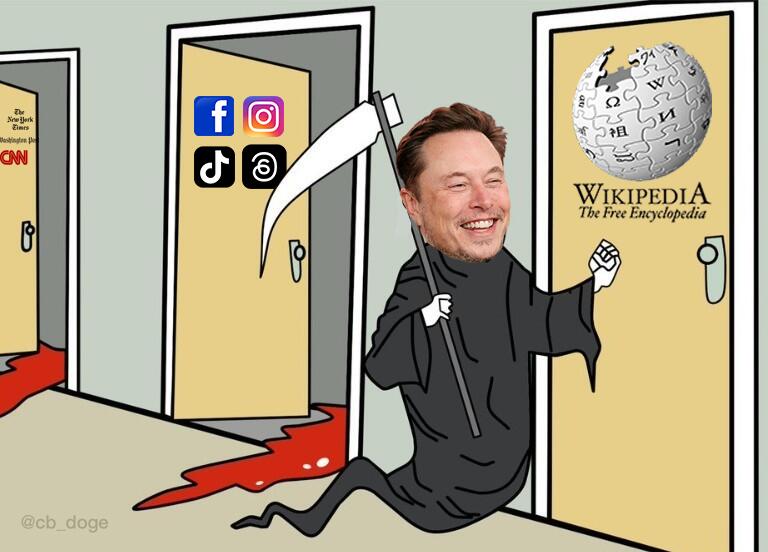
Earlier this week, Muk revealed plans to launch “Grokipedia” as a move to counter the world’s largest online encyclopedia, Wikipedia, which has been hijacked by left-wing activists who manipulate narratives and silence dissenting viewpoints. 

We are building Grokipedia @xAI . Will be a massive improvement over Wikipedia. Frankly, it is a necessary step towards the xAI goal of understanding the Universe,” Musk wrote on X.

The reliability of OpenAI’s ChatGPT and even xAI’s Grok comes into question given Wikipedia’s designation of “reliable source”… 

And then there’s this. 

Related:

The broader message is that the fight for narrative control continues. Wikipedia has received funding (as per the report above) from dark-money NGOs, which undermines credibility and, most importantly, raises questions about the reliability of chatbots that pull information from Wikipedia entries. This may help explain why Musk is preparing to launch a competing “Grokpedia.” The pursuit of truth, or the effort to seize narrative control from the Deep State, marches on.

Tyler Durden
Fri, 10/03/2025 – 18:30

via ZeroHedge News https://ift.tt/DLKjTqC Tyler Durden

California Ends Kamala Harris’s Truancy Law Punishing Parents

California Ends Kamala Harris’s Truancy Law Punishing Parents

Authored by Jill McLaughlin via The Epoch Times (emphasis ours),

California parents will no longer face arrest if their children miss school following Gov. Gavin Newsom’s Oct. 1 decision to approve legislation repealing Kamala Harris’s truancy law.

A school bus heads toward downtown Los Angeles on June 9, 2025. John Fredricks/The Epoch Times

The 2011 law that the former vice president sponsored when she served as the state’s attorney general made it a misdemeanor for parents if their children were chronically truant by missing 10 percent or more of school days, starting in kindergarten.

The law punished parents with a fine of up to $2,000 or one year in county jail. At the time, she said the bill was an “effective strategy” to reduce chronic elementary school truancy and a smart approach to crime prevention.

This week, Newsom signed into law Assembly Bill 461 to end the criminalization of truancy for parents and remove the 2011 law from the state’s penal code. Newsom did not explain why he signed AB 461 in his press release about legislation decisions on Oct. 1. The bill, one of 105 bills signed into law that day, takes effect on Jan. 1.

The bill’s author, Assemblyman Patrick Ahrens, a Silicon Valley Democrat, called the truancy law a “failed policy.”

“Thank you to Gov. Newsom for signing my bill to repeal this failed policy of criminalizing struggling California families for their children missing school,” Ahrens said in a statement. “Fining or imprisoning parents did nothing to get kids the education and support they need.”

While California’s truancy law remained on the books for more than a decade, school districts were becoming less likely to enforce the punitive measures against parents, according to EdSource, a nonprofit educational resource focused on the state’s school systems.

The first arrests under the law were of five parents in Orange County in 2011. The parents were handcuffed and taken to Orange County Jail before being released on their own recognizance for ignoring repeated requests to get their children to school.

While parents have been arrested in California under the truancy law, it was unclear how many cases resulted in criminal charges. Most school districts instead went beyond the law to reach out to parents with emails, letters, and phone calls to resolve truancy problems, according to the California District Attorney’s Association.

The new law was sponsored by End Child Poverty California, Service Employees International Union (SEIU) California, and the Western Center on Law and Poverty. Several justice and parent organizations, including the California State Parent-Teacher Association (PTA), also supported it.

“No parent wants their child to miss out on critical learning opportunities in school; repeated unexcused absences are a sign families may be in need of support to secure a doctor’s note or to address bullying at school,” SEIU California stated.

The Western Center on Law and Poverty also expressed gratitude for the change.

“This outdated and ineffective strategy criminalizes families rather than offering support,” the organization said in a statement. “This bill will assist families who may be facing challenges, such as fear of deportation, poverty, and mental health challenges.”

The Epoch Times reached out to Harris and received no response by publication time.

Tyler Durden
Fri, 10/03/2025 – 18:05

via ZeroHedge News https://ift.tt/lML7w4c Tyler Durden

“The same result that we reached in May is appropriate here.”

I noted in my recent Civitas column that it is rare for a single judge to be reversed by the Supreme Court twice in the same case. Yet, it has happened again. The latest installment is Noem v. TPA Alliance, Part II. The Court states the issue plainly:

In March of this year, the United States District Courtfor the Northern District of California entered a preliminary order postponing the effective date of the Secretary of Homeland Security’s decision to remove “temporary protected status” (TPS) from Venezuelan nationals living in the United States. See 8 U. S. C. §1254a; 5 U. S. C. §705. In May, this Court stayed that order while the Governmentappealed. The United States Court of Appeals for the Ninth Circuit ultimately affirmed the District Court’s preliminary order. Last month, the District Court entered final judgment in respondents’ favor, holding unlawful and settingaside the Secretary’s actions effectuating her decision—namely, her vacatur of a pending extension of TPS for Venezuelan nationals, and her termination of that status itself. See 5 U. S. C. §706(2). (The District Court also concluded that the Secretary unlawfully vacated a TPS extension for Haitian nationals. The Government now seeks to stay theportions of the District Court’s judgment pertaining to Venezuela, but not Haiti. See Application 7, n. 6.) The application for stay presented to JUSTICE KAGAN and by her referred to the Court is granted. Although the posture of the case has changed, the parties’ legal arguments and relative harms generally have not. The same result that we reached in May is appropriate here.

Justice Jackson, in dissent, laments how the Court did not use its “opinion-writing capacity.” Given that this case took less than ten days to resolve, from start to finish, I don’t think the Court found the matter particularly difficult. Justices Kagan and Sotomayor did not join Jackson’s dissent.

At some point, lower courts will get the memo of how the emergency docket works.

The post "The same result that we reached in May is appropriate here." appeared first on Reason.com.

from Latest – Reason.com https://ift.tt/lkSFRPC
via IFTTT

New York Targets Bitcoin Mining With Proposed Tax Hike Bill

New York Targets Bitcoin Mining With Proposed Tax Hike Bill

Authored by Frank Corva via BitcoinMagazine.com,

Yesterday, two members of the New York State (NYS) Senate introduced Senate Bill 8518 (S8518), which imposes excise taxes on digital asset mining using the proof-of-work consensus mechanism, making it even more difficult than it already is for bitcoin miners to operate in the state.

S8518, which was co-sponsored by Liz Krueger (D) and Andrew Gounardes (D), stipulates that bitcoin and digital asset miners in the state will pay increased taxes based on the amount of energy that they use.

The rates are as follows:

  • 0 cents per kilowatt-hour (kWh) for every kWh less than or equal to 2.25 million kWh per year

  • 2 cents per kWh for every kWh between 2.25 million and 5 million kWh per year

  • 3 cents per kWh for every kWh between 5 million and 10 million kWh per year

  • 4 cents per kWh for every kWh between 10 million and 20 million kWh per year

  • 5 cents per kWh for every kWh over 20 million kWh per year

The proposed taxes will not apply to miners who utilize renewable energy sources, as defined by Section 66-P of NYS public service law, to power their facilities. The mining facility would also have to “not [be] operated in conjunction with an electric corporation’s transmission and distribution facilities,” according to the bill.

The bill also stipulates that all taxes, interest, and penalties collected as a result of this potential law be used to subsidize energy customers enrolled in NYS energy affordability programs.

The introduction of this bill comes approximately one year after NYS’ digital asset mining moratorium expired. The moratorium banned any digital asset mining that required the use of fossil fuels.

Now that bitcoin mining companies can technically operate in the state again, they will likely think twice about doing so, as the increased taxes will likely cause these companies to look to set up facilities elsewhere in the U.S..

This new bill is just another in a series of bad regulatory proposals from Democratic lawmakers and bureaucrats in NYS that disincentivize the Bitcoin and crypto companies from setting up in NYS.

Instead of thinking about the jobs that the bitcoin mining industry could bring to upstate New York, home to a number of cities and regions that suffer from poverty in this post-industrial era, Democrats seem more hellbent on sticking it to bitcoin miners.

Tyler Durden
Fri, 10/03/2025 – 17:15

via ZeroHedge News https://ift.tt/9JjgAaG Tyler Durden

“Cancel Netflix” Google Searches Erupt After Musk Urges Parents To Protect Kid From “Groomer” Shows 

“Cancel Netflix” Google Searches Erupt After Musk Urges Parents To Protect Kid From “Groomer” Shows 

Momentum in Netflix cancellations hype and internet searches accelerated by the end of the week after Elon Musk and large X accounts, including Chaya Raichik’s “Libs of TikTok”, urged Americans to cancel subscriptions over what they described as pro-transgender messaging pushed by far-left elites to corrupt youth. Netflix appears to be aligning with the broader left-wing indoctrination agenda also present in public schools run by progressive activists, where children are radicalized with wokeism and Marxism and, by their teenage years, transformed into purple-haired “woke warriors” for the Democratic Party.

On Monday, the campaign against Netflix began with Libs of TikTok’s post that highlighted that Dead End: Paranormal Park, created by Hamish Steele and produced by Blink Industries in partnership with Netflix Animation, and distributed by Netflix, created woke propaganda aimed at kids as young as seven years old. The post has since been viewed 33 million times. 

Following Libs of TikTok’s viral post, Elon Musk amplified the cancellation movement, telling his quarter-billion followers to “Cancel Netflix for the health of your kids.”

And again. 

And again. 

And again. 

Netflix is grooming our children,” Musk said. 

By early Friday, Musk, whose fortune briefly hit a half-trillion dollars earlier this week, told followers, “Netflix is deliberately choosing to pay people to create sexualized content for children. Freedom of speech should be respected, but this is PAID speech. Netflix is going out of their way and reaching into their wallet to push this.”

X users en masse followed Musk’s lead, amplifying the call to “cancel” Netflix over pro-trans propaganda targeting youth. This created a massive multiplier effect, spreading the message to an even broader audience.

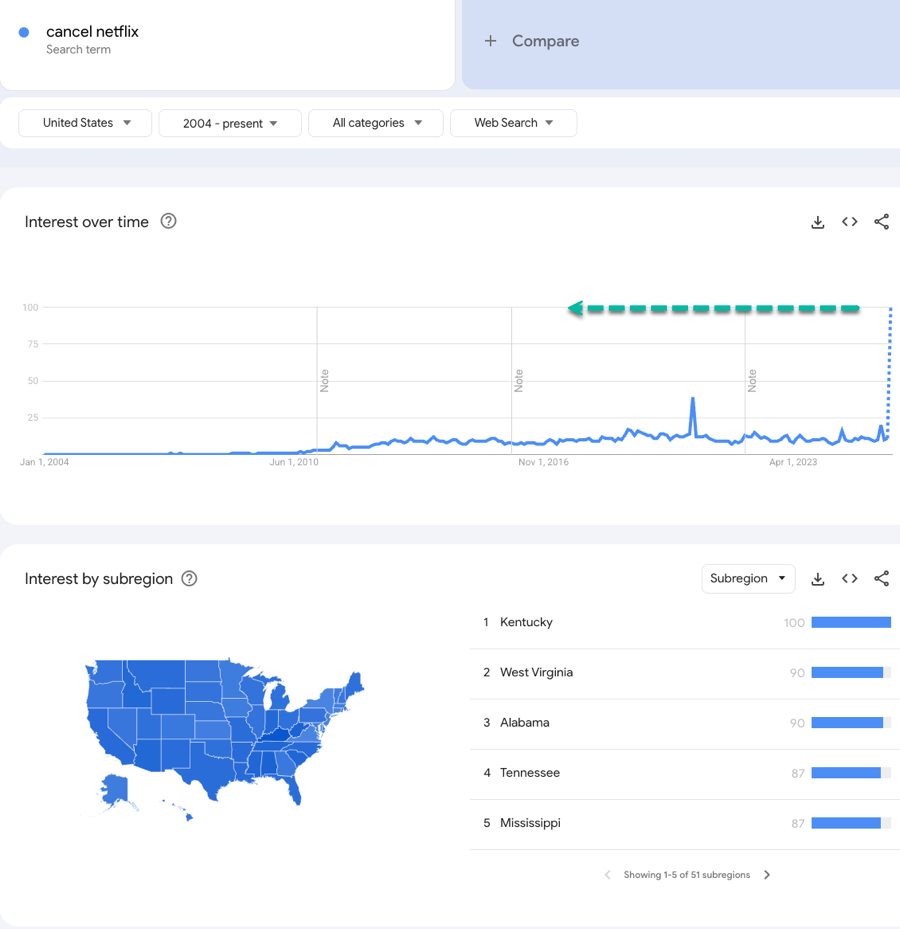
By Friday morning, Google Search trend data shows an eruption in “cancel Netflix” searches …

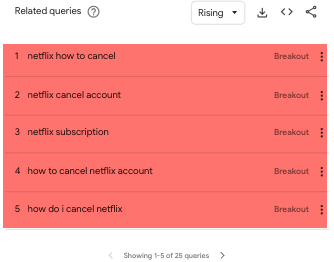
Related queries.

For Musk, the topic of “saving humanity” is deeply personal. He has previously stated he was “tricked” into authorizing trans-related medical treatment for one of his children. Maybe this explains his hate for woke media. 

However, there may also be an underlying motive here: with X (the “everything app”) and soon Grokipedia, Musk and his allies in the America First movement, along with tech investors, appear intent on seizing further control of cultural narratives.

The aim: erode messaging power from Democrats and their Marxist-aligned allies, who support indoctrination programs of young kids from the TV to the classroom that transform the youth into the Democratic Party’s woke warriors by their teenage years.

To win the culture war, Musk and his allies need further narrative control. That could only suggest the evolution of the X platform could soon be a video streaming component. First discredit Netflix, then roll out a competing, non-woke alternative. That’s how the game is played.

Just remember, the woke mind virus doesn’t build; it destroys. That’s why this toxic propaganda is aimed at the youth, while Democrats push globalist, nation-destroying agendas. Trump is attempting to reverse this anti-American agenda.

Tyler Durden
Fri, 10/03/2025 – 16:50

via ZeroHedge News https://ift.tt/10xZPG2 Tyler Durden

Higher Ed Bottoms Out

Higher Ed Bottoms Out

Authored by James Howard Kunstler,

“There are so many disgusting animals in public life that we have allowed to fraternize with the rest of society to our absolute peril.”

– Aimee Terese on “X”

Harvard, apparently, can never learn.

It has made itself the poster-child for all the failures of contemporary education, including the racketeering around endowments, government grant grifts, race and gender hustles, and intellectual surrender to ideas that would make medieval astrologasters burst out laughing.

Case in point: the university lately announced the hiring of a Boston-area drag-queen to teach a course in the spring semester of 2026 about the TV show known as Ru Paul’s Drag Race. The show features contestants vying for prizes and crowns based on “Charisma, Uniqueness, Nerve, and Talent” (C.U.N.T.). Get the picture? Reach into your Jungian psychology tool-bag.

This backwater of the arts was identified some years ago by the literary pop-star Susan Sontag as “camp” derived from the French se camper “to pose in an exaggerated fashion” depicting “unnatural artifice.” Camp is the theatrical cousin of kitsch, which is the celebration of bad taste, with histrionic overtones of exaggerated sentimentality.

Please understand: when you are watching drag-queens, you are not really seeing men posing as women. You are seeing men portraying women as monsters. You might surmise that these are men who labor under “mommy issues.” The giveaway is that they often banter onstage humorously about their male genitalia, and sometimes even attempt sneaky displays of such, which opens that behavior to interesting interpretations.

Harvard’s drag-queen du jour demonstrates all that nicely. Kareem Khubchandani, his legal name, is a professor of theater, dance, and performance studies at Tufts University.

Drag Queen LaWhore Vagistan a.k.a. Kareem Khubchandani

He also teaches “Studies in Race, Colonialism, and Diaspora.” As a drag star, he goes by the stage-name LaWhore Vagistan. This is how he describes himself to the news media: “[M]y preferred pronouns are ‘she’ or ‘aunty.’ I chose ‘LaWhore’ because my family traces its origins to Pakistan: Lahore is an important city in Pakistan, and well, I’m a bit of a whore. And Vagistan because I see the subcontinent as one, big, beautiful Vag … istan.”

Of course, his fascination with female genitalia, of seeing a whole nation in that guise, is a bit odd considering that A) he is a homosexual performer who is ostensibly not attracted to female sexual characteristics and lacks experience with them, and B) he is a male of the species who does not possess such organs himself. Therefore, on what basis would he have gained so much knowledge of female genitalia and developed such a powerful obsession around them as to imagine the whole country of his ancestors that way? Possibly, it has something to do with mommy. . . something that made her appear. . . unforgettably monstrous.

We will probably never know the answer to these quandaries, and they are somewhat secondary to the main question of Mr. Khubchandani’s employment in this connection at Harvard where young minds get molded to become the future managerial class of our nation. Other questions do present, though. For instance, did Harvard’s President Alan Garber know about this hire and sign off on it, and how would he say it fits Harvard’s mission? Or Provost John Manning? Or Hopi E. Hoekstra, Dean of the Faculty of Arts and Sciences? Or Harvard’s Board of Governors?

All this underscores an important lesson that America has apparently managed to unlearn, something that we once knew quite well: that marginal behavior belongs on the margins, not in the center of our national life.

The celebration of vulgarity for its own sake is arguably not the highest aspirational ideal for the best-and-the-brightest of our society, however amusing it might be in their hours of leisure, when people are free to pursue whatever lights their imaginations.

It also raises the question as to why would highly-educated women, say, the female faculty and admins at Harvard, virtually all PhDs, certified geniuses in their fields, go along with such a garish display of farcical disrespect for the female of the species, being officially showcased as part of Harvard’s curriculum? Do they see themselves as monsters who deserve mockery and objurgation? Do they enjoy watching a man enact such degrading psychodrama so as to diminish his manhood altogether? Does it signify some sort of conclusive triumph over “the Patriarchy?” (And how much of a good thing is that?)

Harvard happens to have a Psychology Department, including a PhD program in Clinical Science, Social Psychology, and Cognition, Brain, and Behavior, under chairman Matthew K. Nock, PhD. His official Harvard bio states:

“Nock’s research is aimed at advancing the understanding of why people behave in ways that are harmful to themselves, with an emphasis on suicide and other forms of self-harm. . . to better understand how these behaviors develop, how to predict them, and how to prevent their occurrence.”

Perhaps President Garber should ask Dr. Nock to audit LaWhore Vagistan’s upcoming course to see, for instance, how it speaks to the epidemic of transgender violence currently plaguing the USA. We need all the insight we can get.

*  *  *

Best sellers at ZH Store this week:

  • IQ Colostrum – 25% IgG from first milking of grassfed cows

Tyler Durden
Fri, 10/03/2025 – 16:25

via ZeroHedge News https://ift.tt/PT04cOU Tyler Durden

Immigration Judge Rejects Kilmar Abrego Garcia’s Asylum Bid

Immigration Judge Rejects Kilmar Abrego Garcia’s Asylum Bid

Authored by Aldgra Fredly via The Epoch Times,

An immigration judge in Maryland on Oct. 1 rejected a motion filed by Kilmar Abrego Garcia’s attorneys to reopen his 2019 petition for asylum in the United States.

Abrego Garcia, an illegal immigrant from El Salvador, was deported to his homeland in March by the Trump administration and was later returned to the United States under a Supreme Court order.

He had initially sought asylum in 2019 but was denied. Abrego Garcia’s attorneys petitioned the immigration court in August to reconsider his asylum case, citing concerns that he could be deported to Uganda.

In an Oct. 1 ruling, the immigration judge in Baltimore denied the request but gave Abrego Garcia 30 days to appeal the decision with the Board of Immigration Appeals.

The Department of Homeland Security (DHS) hailed the ruling in a social media post, saying that it affirms Abrego Garcia’s removal from the country.

“With today’s ruling, Kilmar Abrego Garcia’s final order of removal stands,” DHS stated. “His lawyers tried to fight his removal from the U.S. but one thing is certain, this Salvadoran man is not going to be able to remain in our country.”

The Epoch Times reached out to Abrego Garcia’s attorney for comment but did not receive a response by publication time.

Abrego Garcia, who illegally entered the United States in 2011 and stayed in Maryland, was accused of being a member of the foreign terrorist organization MS-13. He was deported to El Salvador alongside other deportees in March despite a 2019 immigration court order granting withholding of removal to his homeland due to safety concerns.

The Salvadoran national was returned to the United States in June under a Supreme Court order and held in custody on charges of immigrant smuggling, stemming from a 2022 traffic stop, to which he has pleaded not guilty.

The administration has indicated that Abrego Garcia could be deported to a third-party country, naming the African nation of Uganda as the possible destination.

Abrego Garcia’s attorneys argued that Abrego Garcia risked persecution or torture if sent to Uganda. ICE then changed the destination country to Eswatini, another African nation with which Abrego Garcia has no ties, according to an email shared by DHS last month.

“That claim of fear is hard to take seriously, especially given that you have claimed (through your attorneys) that you fear persecution or torture in at least 22 different countries,” ICE stated in its email.

U.S. District Judge Paula Xinis ruled in August that Abrego Garcia must remain in the country until she holds a hearing on Oct. 6.

Tyler Durden
Fri, 10/03/2025 – 15:45

via ZeroHedge News https://ift.tt/IjkzesE Tyler Durden

Afghan Man Freed After Viral Arrest and Over 100 Days in ICE Custody


10-3-25-v1-a | Illustration: Eddie Marshall | Midjourney; #AfghanEvac

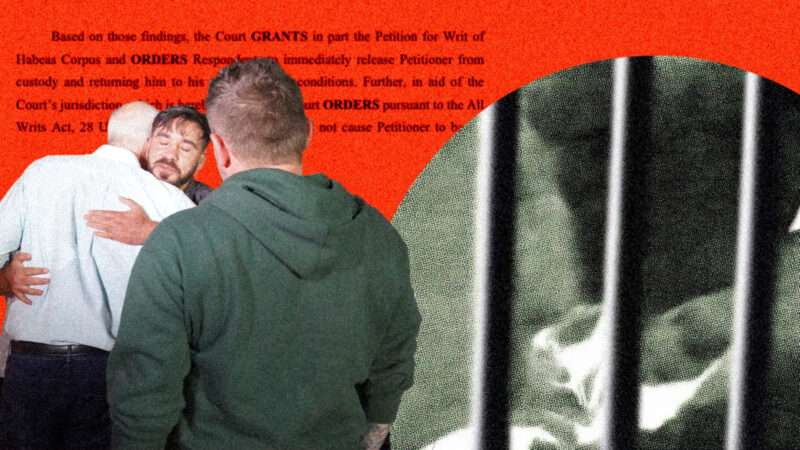
After a video of his arrest by masked Immigration and Customs Enforcement (ICE) agents went viral in June, Afghan Sayed Naser was released on September 26 following 106 days of detention.

On July 17, Naser’s attorney Brian McGoldrick filed a petition for a writ of habeas corpus requesting his immediate release. McGoldrick argued that “attempts to detain, transfer, and deport [Naser] are arbitrary and capricious and in violation of the law.”

According to court documents shared with Reason, the government opposed the petition, but Judge Gonzalo Curiel of the Southern District of California scheduled a hearing of Naser’s habeas petition on September 25. McGoldrick told Shawn VanDiver, president of #AfghanEvac, that during the hearing, Curiel was “very inquisitive” and sounded “very friendly to our position.”

On September 26, Curiel put out a summarized opinion ordering Naser’s immediate release. Curiel found that Naser “could not have been legally subjected to and detained” given his status at the time of his arrest, and that by revoking Naser’s parole without providing notification, the government had denied “his due process rights.”

In an October 2 press conference, McGoldrick said that Naser was released at 9:45 p.m. last Friday, and added, “we’ve been celebrating ever since.” Naser expressed gratitude for all the Americans who supported his case, telling assembled press that his time in detention was “the hardest piece of my life.” “I thought that the time is stopped,” Naser said, adding that every day felt “like a month.” 

When asked if his ordeal had changed his mind about wanting to be an American citizen, Naser replied, “I still believe in America. I do not feel betrayed. I feel hopeful because of how many Americans stood up for me when I was arrested.”

McGoldrick also expressed gratitude for Naser’s supporters, particularly the volunteers who filmed Naser’s arrest, saying that without their documentation, “nobody would know what happened.”

Following Naser’s release, Curiel has restored the terms of the parole Naser received when he legally entered the U.S. through the CBP One App in July 2024. Curiel has also ordered that “Respondents shall not cause [Naser] to be re-detained during the pendency of his removal proceedings without prior leave of this Court.”

Now, Naser and McGoldrick must return to square one and prepare his asylum claim once more before a new judge in San Diego immigration court.

The Taliban murdered Naser’s brother in 2023. A Special Immigrant Visa applicant who had worked with U.S. forces for two years during the Afghanistan War, Naser fled to Brazil in April 2024 and made his way to the U.S.-Mexico border. Like many parolees who utilized the CBP One App to claim asylum, Naser was told that his parole was revoked in a letter from the Department of Homeland Security in April.

It was after presenting his asylum case in immigration court in June that Naser was arrested. The government said that Naser’s notice to appear had been “improvidently issued,” but provided no further information about their allegation. On June 26, a federal judge dismissed Naser’s asylum case, which placed him in expedited removal proceedings.

While Naser’s release is a positive development, McGoldrick said he is now representing another Afghan, Habib, who is currently in ICE custody.

Like Naser, Habib had entered the U.S. on parole in 2024. McGoldrick says that Habib had received work authorization and had filed an asylum claim when he was arrested on September 19. McGoldrick explained that Habib had been performing a delivery at a U.S. military base in California when base personnel noticed that he had a limited license.

According to McGoldrick, base personnel called military police to the scene, and Habib was told that he could not depart the base until ICE arrived and took him into custody.

Habib has a wife and two young children. With no money coming in, McGoldrick reports that Habib’s wife cannot afford rent and is facing eviction. McGoldrick is working pro bono on Habib’s case and filed a habeas petition for his release on September 29.

After Naser’s release, VanDiver noted that while the judicial system has been successful in achieving assistance for Afghans in detention, the U.S. cannot go about rectifying “just one case at a time. We need Congress, companies, and citizens to step up.”

The post Afghan Man Freed After Viral Arrest and Over 100 Days in ICE Custody appeared first on Reason.com.

from Latest – Reason.com https://ift.tt/PS8UK5v
via IFTTT

European Nations Again Consider Using Frozen Russian State Assets to Fund Ukraine’s War Effort

The Bank of Russia. (NA)


European Union nations are once again considering ways to use the $300 billion Russian state assets frozen in Western nations (mostly in Europe) to help Ukraine:

European Union leaders on Wednesday weighed a new scheme to provide longer-term financial and military support to Ukraine using hundreds of billions of dollars in frozen Russian assets held in Europe.

The plan — which Moscow has described as “theft” — is a fresh sign of the EU’s determination to push ahead alone with support for Ukraine without the United States. Under President Donald Trump the U.S. no longer sends financial aid to Ukraine, and little so far in the way of weapons.

Ukraine’s budget and military needs for 2026 and 2027 are estimated to total around 130 billion euros ($153 billion). The EU has already poured in 174 billion euros since the war started in February 2022.

The biggest pot of ready funds available is through frozen Russian assets. Most of it is held in Belgium – around 194 billion euros as of June – and outside the EU in Japan, with around $50 billion, and the U.S., U.K. and Canada with lesser amounts.

The plan currently under consideration would use the funds to back a loan that Ukraine would only have to repay if Russia pays an equivalent amount in war reparations. I have long advocated just simply confiscating the Russian state assets and giving them to Ukraine (e.g. here, here, and here). But the EU loan plan is almost as good, inasmuch as the practical effects are likely to be very similar. Unless Russia pays reparations (which seems unlikely), the confiscated state assets will ultimately be used to repay the loan, and Ukraine will not be held liable for it.

Last year, Congress enacted the REPO Act, which authorized the president to confiscate the approximately $6 billion in Russian state assets frozen in the US and transfer them to Ukraine. But neither Biden nor Trump has acted on it. In recent weeks, Trump has been rhetorically tougher on Russia than before, but I am not optimistic that these words will be backed by deeds. He can start to prove me wrong by using the REPO Act authority.

In a November 2023 post, I addressed a range of different objections to confiscating Russian state assets, including 1) claims that it would violate property rights protections in the US and various European constitutions, 2) sovereign immunity arguments, 3) arguments that it would be unfair to the Russian people, 4) slippery slope concerns, and 5) the danger of Russian retaliation. Every point made there remains relevant today. Stephen Rademaker, former chief counsel to the House Committee on Foreign Affairs, has a helpful recent Washington Post article further addressing the retaliation point.

The post European Nations Again Consider Using Frozen Russian State Assets to Fund Ukraine's War Effort appeared first on Reason.com.

from Latest – Reason.com https://ift.tt/KHYrf6y
via IFTTT

SCOTUS Will Consider a Challenge to Hawaii’s Default Rule Against Guns on Private Property Open to the Public


A handgun in a belt holster | Michael Tefft/Flickr

The Supreme Court on Friday agreed to hear a Second Amendment challenge to a Hawaii law that bans guns on private property open to the public without the owner’s “express authorization.” The case, Wolford v. Lopez, involves one of several attempted end runs around the Court’s 2022 ruling in New York State Rifle & Pistol Association v. Bruen, which upheld the constitutional right to carry guns in public for self-defense without demonstrating a “special need.”

Several states, including New York, Hawaii, California, Maryland, and New Jersey, responded to Bruen by making carry permits easier to obtain but much harder to use. They banned guns from long lists of “sensitive places” that covered a lot of territory, which in many cases made it impractical to legally exercise the right that the Supreme Court had recognized.

The broadest of those restrictions was a default rule that people could not carry guns on private property, including businesses open to the public, unless they had the owner’s explicit permission. Under Hawaii’s law, that requires “unambiguous written or verbal authorization” or “clear and conspicuous signage.”

Last year in Wolford v. Lopez, the U.S. Court of Appeals for the 9th Circuit deemed that rule “consistent with this Nation’s historical tradition of firearm regulation”—the constitutional test prescribed by Bruen. “The Second Amendment encompasses the right to bear arms not only in publicly owned spaces, but also on private property that is generally open to the public,” the appeals court conceded. “Equally clear, however, is the right of a private property owner to exclude others, including those bearing arms.”

The 9th Circuit found historical precedent for Hawaii’s restriction in two sets of colonial or state laws enacted in the 18th and 19th centuries. It identified four laws that “prohibited the carry of firearms onto subsets of private land, such as plantations or enclosed lands.” It also noted two laws, enacted by New Jersey in 1771 and Louisiana in 1865, that it read as prohibiting “the carrying of firearms onto any private property without the owner’s consent.”

The record “contains no evidence whatsoever that these laws were viewed as controversial or constitutionally questionable,” the appeals court said. “Instead, they were viewed as falling well within the colony’s or the State’s ordinary police power to regulate the default rules concerning private property.” It concluded that “the Nation has an established tradition of arranging the default rules that apply specifically to the carrying of firearms onto private property” and that “Hawaii’s modern law falls well within the historical tradition.”

That decision contradicted the reasoning of Antonyuk v. James, a 2023 decision in which the U.S. Court of Appeals for the 2nd Circuit rejected a similar rule that New York legislators imposed after Bruen. New York’s law banned gun possession on private property when the owner “has not permitted such possession by clear and conspicuous signage indicating that the carrying of firearms, rifles, or shotguns on their property is
permitted or has otherwise given express consent.”

In defense of that provision, New York cited the same early laws on which Hawaii relied in Wolford. “We assume without deciding that the State’s analogues demonstrate a well-established and representative tradition of creating a presumption against carriage on enclosed private lands, i.e., private land closed to the public,” the 2nd Circuit said. “But we do not agree that these laws support the broader tradition the State urges. These analogues are inconsistent with the restricted location provision’s default presumption against carriage on private property open to the public.”

Those early laws, the appeals court said, were not “relevantly similar” to New York’s provision in motivation and scope. “At least three of the State’s proffered analogues were explicitly motivated by a substantially different reason (deterring unlicensed hunting) than the restricted location regulation (preventing gun violence),” the 2nd Circuit noted. “What is more, none of the State’s proffered analogues burdened Second Amendment rights in the same way as [New York’s law]. All of the State’s analogues appear to, by their own terms, have created a default presumption against carriage only on private lands not open to the public.”

Two of those laws referred to “premises” as well as “lands.” But “as it has been developed thus far, the historical record indicates that ‘land,’ ‘improved or inclosed land’ and ‘premises or plantations’ would have been understood to refer to private land not open to the public,” the 2nd Circuit said. “The State has produced no evidence that those terms were in fact otherwise understood to apply to private property open to the public or that the statutes were in practice applied to private property open to the public.”

The appeals court emphasized the broad scope of New York’s rule. “Given that most spaces in a community that are not private homes will be composed of private property
open to the public,” it said, “the restricted location provision functionally creates a universal default presumption against carrying firearms in public places, seriously burdening lawful gun owners’ Second Amendment rights. That burden is entirely out of step with that imposed by the proffered analogues, which appear to have created a presumption against carriage only on private property not open to the public.”

The plaintiffs in Wolford, three residents of Maui and the Hawaii Firearms Coalition, argue that the 2nd Circuit got it right, while the 9th Circuit got it wrong.  “To be sure, private-property owners may decide to exclude people from their property,” they say in their Supreme Court petition. “But that power resides with the property owner, not the government. There is no comparable historical—or even modern-day—tradition of allowing the government to create a no-carry default rule for private property open to the public.”

The post SCOTUS Will Consider a Challenge to Hawaii's Default Rule Against Guns on Private Property Open to the Public appeared first on Reason.com.

from Latest – Reason.com https://ift.tt/wmDIfd0
via IFTTT