Afghan Man Freed After Viral Arrest and Over 100 Days in ICE Custody


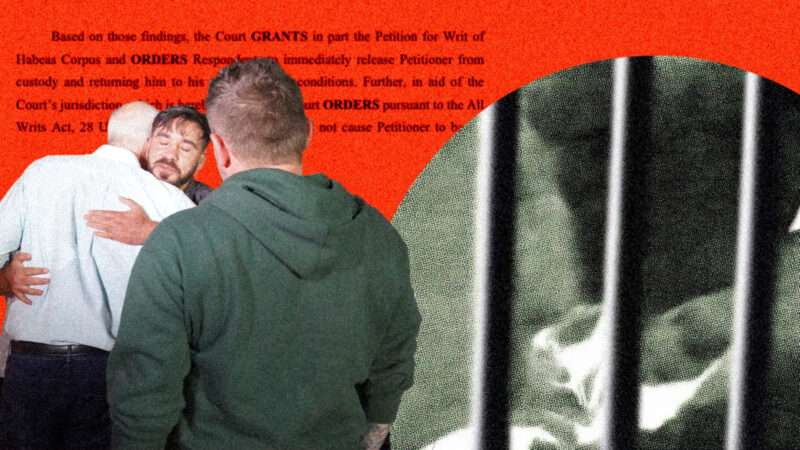
10-3-25-v1-a | Illustration: Eddie Marshall | Midjourney; #AfghanEvac

After a video of his arrest by masked Immigration and Customs Enforcement (ICE) agents went viral in June, Afghan Sayed Naser was released on September 26 following 106 days of detention.

On July 17, Naser’s attorney Brian McGoldrick filed a petition for a writ of habeas corpus requesting his immediate release. McGoldrick argued that “attempts to detain, transfer, and deport [Naser] are arbitrary and capricious and in violation of the law.”

According to court documents shared with Reason, the government opposed the petition, but Judge Gonzalo Curiel of the Southern District of California scheduled a hearing of Naser’s habeas petition on September 25. McGoldrick told Shawn VanDiver, president of #AfghanEvac, that during the hearing, Curiel was “very inquisitive” and sounded “very friendly to our position.”

On September 26, Curiel put out a summarized opinion ordering Naser’s immediate release. Curiel found that Naser “could not have been legally subjected to and detained” given his status at the time of his arrest, and that by revoking Naser’s parole without providing notification, the government had denied “his due process rights.”

In an October 2 press conference, McGoldrick said that Naser was released at 9:45 p.m. last Friday, and added, “we’ve been celebrating ever since.” Naser expressed gratitude for all the Americans who supported his case, telling assembled press that his time in detention was “the hardest piece of my life.” “I thought that the time is stopped,” Naser said, adding that every day felt “like a month.” 

When asked if his ordeal had changed his mind about wanting to be an American citizen, Naser replied, “I still believe in America. I do not feel betrayed. I feel hopeful because of how many Americans stood up for me when I was arrested.”

McGoldrick also expressed gratitude for Naser’s supporters, particularly the volunteers who filmed Naser’s arrest, saying that without their documentation, “nobody would know what happened.”

Following Naser’s release, Curiel has restored the terms of the parole Naser received when he legally entered the U.S. through the CBP One App in July 2024. Curiel has also ordered that “Respondents shall not cause [Naser] to be re-detained during the pendency of his removal proceedings without prior leave of this Court.”

Now, Naser and McGoldrick must return to square one and prepare his asylum claim once more before a new judge in San Diego immigration court.

The Taliban murdered Naser’s brother in 2023. A Special Immigrant Visa applicant who had worked with U.S. forces for two years during the Afghanistan War, Naser fled to Brazil in April 2024 and made his way to the U.S.-Mexico border. Like many parolees who utilized the CBP One App to claim asylum, Naser was told that his parole was revoked in a letter from the Department of Homeland Security in April.

It was after presenting his asylum case in immigration court in June that Naser was arrested. The government said that Naser’s notice to appear had been “improvidently issued,” but provided no further information about their allegation. On June 26, a federal judge dismissed Naser’s asylum case, which placed him in expedited removal proceedings.

While Naser’s release is a positive development, McGoldrick said he is now representing another Afghan, Habib, who is currently in ICE custody.

Like Naser, Habib had entered the U.S. on parole in 2024. McGoldrick says that Habib had received work authorization and had filed an asylum claim when he was arrested on September 19. McGoldrick explained that Habib had been performing a delivery at a U.S. military base in California when base personnel noticed that he had a limited license.

According to McGoldrick, base personnel called military police to the scene, and Habib was told that he could not depart the base until ICE arrived and took him into custody.

Habib has a wife and two young children. With no money coming in, McGoldrick reports that Habib’s wife cannot afford rent and is facing eviction. McGoldrick is working pro bono on Habib’s case and filed a habeas petition for his release on September 29.

After Naser’s release, VanDiver noted that while the judicial system has been successful in achieving assistance for Afghans in detention, the U.S. cannot go about rectifying “just one case at a time. We need Congress, companies, and citizens to step up.”

The post Afghan Man Freed After Viral Arrest and Over 100 Days in ICE Custody appeared first on Reason.com.

from Latest – Reason.com https://ift.tt/PS8UK5v
via IFTTT

European Nations Again Consider Using Frozen Russian State Assets to Fund Ukraine’s War Effort

The Bank of Russia. (NA)


European Union nations are once again considering ways to use the $300 billion Russian state assets frozen in Western nations (mostly in Europe) to help Ukraine:

European Union leaders on Wednesday weighed a new scheme to provide longer-term financial and military support to Ukraine using hundreds of billions of dollars in frozen Russian assets held in Europe.

The plan — which Moscow has described as “theft” — is a fresh sign of the EU’s determination to push ahead alone with support for Ukraine without the United States. Under President Donald Trump the U.S. no longer sends financial aid to Ukraine, and little so far in the way of weapons.

Ukraine’s budget and military needs for 2026 and 2027 are estimated to total around 130 billion euros ($153 billion). The EU has already poured in 174 billion euros since the war started in February 2022.

The biggest pot of ready funds available is through frozen Russian assets. Most of it is held in Belgium – around 194 billion euros as of June – and outside the EU in Japan, with around $50 billion, and the U.S., U.K. and Canada with lesser amounts.

The plan currently under consideration would use the funds to back a loan that Ukraine would only have to repay if Russia pays an equivalent amount in war reparations. I have long advocated just simply confiscating the Russian state assets and giving them to Ukraine (e.g. here, here, and here). But the EU loan plan is almost as good, inasmuch as the practical effects are likely to be very similar. Unless Russia pays reparations (which seems unlikely), the confiscated state assets will ultimately be used to repay the loan, and Ukraine will not be held liable for it.

Last year, Congress enacted the REPO Act, which authorized the president to confiscate the approximately $6 billion in Russian state assets frozen in the US and transfer them to Ukraine. But neither Biden nor Trump has acted on it. In recent weeks, Trump has been rhetorically tougher on Russia than before, but I am not optimistic that these words will be backed by deeds. He can start to prove me wrong by using the REPO Act authority.

In a November 2023 post, I addressed a range of different objections to confiscating Russian state assets, including 1) claims that it would violate property rights protections in the US and various European constitutions, 2) sovereign immunity arguments, 3) arguments that it would be unfair to the Russian people, 4) slippery slope concerns, and 5) the danger of Russian retaliation. Every point made there remains relevant today. Stephen Rademaker, former chief counsel to the House Committee on Foreign Affairs, has a helpful recent Washington Post article further addressing the retaliation point.

The post European Nations Again Consider Using Frozen Russian State Assets to Fund Ukraine's War Effort appeared first on Reason.com.

from Latest – Reason.com https://ift.tt/KHYrf6y
via IFTTT

SCOTUS Will Consider a Challenge to Hawaii’s Default Rule Against Guns on Private Property Open to the Public


A handgun in a belt holster | Michael Tefft/Flickr

The Supreme Court on Friday agreed to hear a Second Amendment challenge to a Hawaii law that bans guns on private property open to the public without the owner’s “express authorization.” The case, Wolford v. Lopez, involves one of several attempted end runs around the Court’s 2022 ruling in New York State Rifle & Pistol Association v. Bruen, which upheld the constitutional right to carry guns in public for self-defense without demonstrating a “special need.”

Several states, including New York, Hawaii, California, Maryland, and New Jersey, responded to Bruen by making carry permits easier to obtain but much harder to use. They banned guns from long lists of “sensitive places” that covered a lot of territory, which in many cases made it impractical to legally exercise the right that the Supreme Court had recognized.

The broadest of those restrictions was a default rule that people could not carry guns on private property, including businesses open to the public, unless they had the owner’s explicit permission. Under Hawaii’s law, that requires “unambiguous written or verbal authorization” or “clear and conspicuous signage.”

Last year in Wolford v. Lopez, the U.S. Court of Appeals for the 9th Circuit deemed that rule “consistent with this Nation’s historical tradition of firearm regulation”—the constitutional test prescribed by Bruen. “The Second Amendment encompasses the right to bear arms not only in publicly owned spaces, but also on private property that is generally open to the public,” the appeals court conceded. “Equally clear, however, is the right of a private property owner to exclude others, including those bearing arms.”

The 9th Circuit found historical precedent for Hawaii’s restriction in two sets of colonial or state laws enacted in the 18th and 19th centuries. It identified four laws that “prohibited the carry of firearms onto subsets of private land, such as plantations or enclosed lands.” It also noted two laws, enacted by New Jersey in 1771 and Louisiana in 1865, that it read as prohibiting “the carrying of firearms onto any private property without the owner’s consent.”

The record “contains no evidence whatsoever that these laws were viewed as controversial or constitutionally questionable,” the appeals court said. “Instead, they were viewed as falling well within the colony’s or the State’s ordinary police power to regulate the default rules concerning private property.” It concluded that “the Nation has an established tradition of arranging the default rules that apply specifically to the carrying of firearms onto private property” and that “Hawaii’s modern law falls well within the historical tradition.”

That decision contradicted the reasoning of Antonyuk v. James, a 2023 decision in which the U.S. Court of Appeals for the 2nd Circuit rejected a similar rule that New York legislators imposed after Bruen. New York’s law banned gun possession on private property when the owner “has not permitted such possession by clear and conspicuous signage indicating that the carrying of firearms, rifles, or shotguns on their property is
permitted or has otherwise given express consent.”

In defense of that provision, New York cited the same early laws on which Hawaii relied in Wolford. “We assume without deciding that the State’s analogues demonstrate a well-established and representative tradition of creating a presumption against carriage on enclosed private lands, i.e., private land closed to the public,” the 2nd Circuit said. “But we do not agree that these laws support the broader tradition the State urges. These analogues are inconsistent with the restricted location provision’s default presumption against carriage on private property open to the public.”

Those early laws, the appeals court said, were not “relevantly similar” to New York’s provision in motivation and scope. “At least three of the State’s proffered analogues were explicitly motivated by a substantially different reason (deterring unlicensed hunting) than the restricted location regulation (preventing gun violence),” the 2nd Circuit noted. “What is more, none of the State’s proffered analogues burdened Second Amendment rights in the same way as [New York’s law]. All of the State’s analogues appear to, by their own terms, have created a default presumption against carriage only on private lands not open to the public.”

Two of those laws referred to “premises” as well as “lands.” But “as it has been developed thus far, the historical record indicates that ‘land,’ ‘improved or inclosed land’ and ‘premises or plantations’ would have been understood to refer to private land not open to the public,” the 2nd Circuit said. “The State has produced no evidence that those terms were in fact otherwise understood to apply to private property open to the public or that the statutes were in practice applied to private property open to the public.”

The appeals court emphasized the broad scope of New York’s rule. “Given that most spaces in a community that are not private homes will be composed of private property
open to the public,” it said, “the restricted location provision functionally creates a universal default presumption against carrying firearms in public places, seriously burdening lawful gun owners’ Second Amendment rights. That burden is entirely out of step with that imposed by the proffered analogues, which appear to have created a presumption against carriage only on private property not open to the public.”

The plaintiffs in Wolford, three residents of Maui and the Hawaii Firearms Coalition, argue that the 2nd Circuit got it right, while the 9th Circuit got it wrong.  “To be sure, private-property owners may decide to exclude people from their property,” they say in their Supreme Court petition. “But that power resides with the property owner, not the government. There is no comparable historical—or even modern-day—tradition of allowing the government to create a no-carry default rule for private property open to the public.”

The post SCOTUS Will Consider a Challenge to Hawaii's Default Rule Against Guns on Private Property Open to the Public appeared first on Reason.com.

from Latest – Reason.com https://ift.tt/wmDIfd0
via IFTTT

Short Circuit: An Inexhaustive Weekly Compendium of Rulings from the Federal Courts of Appeal

Please enjoy the latest edition of Short Circuit, a weekly feature written by a bunch of people at the Institute for Justice.

New case! Armed, masked ICE agents in Alabama have twice arrested Florida-born U.S. citizen Leo Venegas at work, each time barging onto active construction sites and violently detaining Latinos (while leaving everyone else alone) and each time continuing to detain Leo after he showed them his REAL ID. This week, we filed a class action on behalf of Leo and thousands of others similarly situated, challenging the warrantless entries, preemptive detentions, and continued detentions. Click here to learn more.

New on the Unpublished Opinions podcast: The panel ruminates over favorite features of the U.S. Constitution, proposes amendments, and discusses the dangers of viewing rights through a partisan lens.

  1. The FBI investigated a woman, monitoring her travel, recording her private conversations, and seizing a trove of materials from her house, including family photos. Fox News aired and published a series of stories about the investigation—including the photos and other materials from the FBI. Woman: the Privacy Act prohibits the FBI from disclosing these records, and it hurt my business bigly. Identify the leaker. Journalist: The First Amendment reporter’s privilege means I don’t have to. D.C. Circuit: It’s only a qualified privilege, which is overcome here because the info is crucial to the case, and she tried every reasonable alternative to get it. Cough up the name.
  2. “Not all conspiracies are created equal.” A line from a John le Carré novel? No, it’s from a Third Circuit imbroglio concerning a U.S. permanent resident and father of four who dabbled in a bit of passport fraud with some collaborators. Is the crime serious enough to warrant deportation and is his evidence strong enough to demonstrate he will be subject to torture if returned to Nigeria? The court says it’s too early to tell, but the immigration judge applied the wrong standards. Remanded.
  3. A Delta flight attendant saw a man comforting a 13-year-old girl on a turbulent flight and concluded that the man was sexually assaulting and trafficking the child. She reports the incident to the pilot; police meet the plane when it lands and take the man for questioning in the airport. Whoops, it’s his daughter, and nothing untoward happened. He sues. Delta: Child abuse reports are generally immune from liability. Man: Only if those reports are made to the state’s Department of Social Services. Fourth Circuit: The statute isn’t sufficiently clear for us to opine. Virginia Supreme Court, help?
  4. West Virginia property owner fails to pay real estate taxes, leading to the local sheriff’s selling a tax lien on her property. Notices are sent to her, but all are returned undeliverable. Yikes! Did a shlub in the state auditor’s office violate her due-process rights by not doing more to identify her actual address? Fourth Circuit: Qualified immunity.
  5. Gov’t employee dies, after which his wife and mother each lay claim to his Federal Employees’ Group Life Insurance proceeds. Mother: He executed a beneficiary-designation form naming me in 2007. Wife: But he executed a subsequent one naming me in 2013. District court: The wife’s form isn’t in the man’s personnel file, so she’s out of luck. Fifth Circuit (unpublished): Okay, but there’s evidence her form was in fact received by his employer, including testimony from a supervisor who personally witnessed the man deliver it to HR. To trial the case must go.
  6. In which the Fifth Circuit holds that a prisoner had no clearly established right to receive post-deprivation process after the prison withheld some of the money he earned selling handmade belts (assertedly to cover taxes and overhead), but also goes out of its way to note that it says nothing about claims for pre-deprivation process or claims under the takings clause, which nobody properly raised.
  7. Michigan student with a history of behavior issues is suspected of having a gun at school based on a report from a fellow student the day before that he had brought a gun to school and overheard comments from the student himself about owning a gun. After a search of the student’s locker and backpack turns up nothing, a teacher has him lift his shirt and pull down his pants (but not underwear) to prove he isn’t armed. A year later, the student sues. Sixth Circuit (over a dissent): Qualified immunity for the teacher.
  8. Depending on which medieval theologian you pal around with, “fact sheets” and sincerely held religious beliefs may seem to be in tension with each other. Apparently not for the manager of the Oak Ridge National Laboratory in Tennessee, though, which tried to dissuade a man from seeking a religious accommodation from a COVID-19 shot mandate by instructing him about how all kinds of religious leaders said the vaccine was A-OK and providing him with a “fact sheet” detailing how cell lines from aborted fetuses are used in all manner of medical marvels. District court: I’m not going to address the Title VII religious questions because there was no materially adverse employment action. Sixth Circuit: That was based on our circuit’s now-overturned precedent. Remanded for the merits.
  9. Soliciting a minor for sex is gross and wrong and criminal—but it does not, the Eighth Circuit holds, affect interstate commerce just because you made your gross solicitation while sitting in a car that was manufactured out of state.
  10. Tax litigation strategies may not constitute high comedy, but for a potential exception get a load of how the IRS tried to justify taxing 3M on $23.7 mil in royalty income from its Brazilian subsidiary instead of the $5.1 mil “3M do Brasil Ltda.” actually mailed back to its mothership. The Eighth Circuit tells us that once Loper Bright entered the world the “shifting sands of administrative law brought a change in the IRS’s position” and a slew of knee-slapping antics ensued worthy of a Benny Hill chase.
  11. Allegation: After giving birth, woman who’d been involuntarily admitted to Reno, Nev. hospital is allowed to leave (against medical advice) in such a fragile state that she dies several hours later near the hospital entrance. Hospital: We acted in good-faith compliance with the relevant laws. Ninth Circuit: That’s a defense you can raise at trial, not an immunity from suit. No collateral review even though you are a state actor.
  12. Mexican national invokes the Convention Against Torture, arguing that his “indigenous heritage, gang-related tattoos, multiple deportations, mental illnesses, and substance-abuse disorder put him at high risk of persecution and torture” if he is deported. Ninth Circuit: The Board of Immigration Appeals’ one-sentence dismissal of these arguments wasn’t enough. It has to give a reasoned explanation. Dissent: This guy has been on the run for three years, his lawyer doesn’t know where he is, and he was arrested on serious weapons and assault charges just last year. “This case cries out for application of the fugitive disentitlement doctrine.”
  13. In 2020, Colorado voters approved a proposition that created a dedicated source of public funding for voluntary, universal preschool. Participating schools may receive funds only if they sign a nondiscrimination agreement that prohibits them from basing enrollment decisions on, among other things, a child’s (or the child’s family’s) religious affiliation, sexual orientation, or gender identity. Two Catholic parishes challenge the nondiscrimination requirement as a violation of religious liberty and free association. Tenth Circuit: Nope.
  14. Oklahoma lawyer has one clever trick for getting around state requirement that medical-marijuana businesses have 75% Oklahoma ownership. Tenth Circuit: Not clever enough.

Victory! Under Virginia’s “barrier crimes” law, people with convictions for any of 176 crimes are banned, usually for life, from working as substance-abuse counselors. Which is irrational in any number of ways, not least that—until this week—it barred people like IJ client Melissa Brown, who is a highly qualified and effective substance-abuse counselor, because of a 20-plus-year-old conviction for robbery committed while in the throes of addiction herself. For the other ways the law flunks the rational-basis test, we commend this week’s federal district court decision holding as much to your attention. Huzzah! And click here to learn more.

The post Short Circuit: An Inexhaustive Weekly Compendium of Rulings from the Federal Courts of Appeal appeared first on Reason.com.

from Latest – Reason.com https://ift.tt/oB5tnyi
via IFTTT

Defending the Summary Execution of Suspected Drug Smugglers, Trump Declares an ‘Armed Conflict’


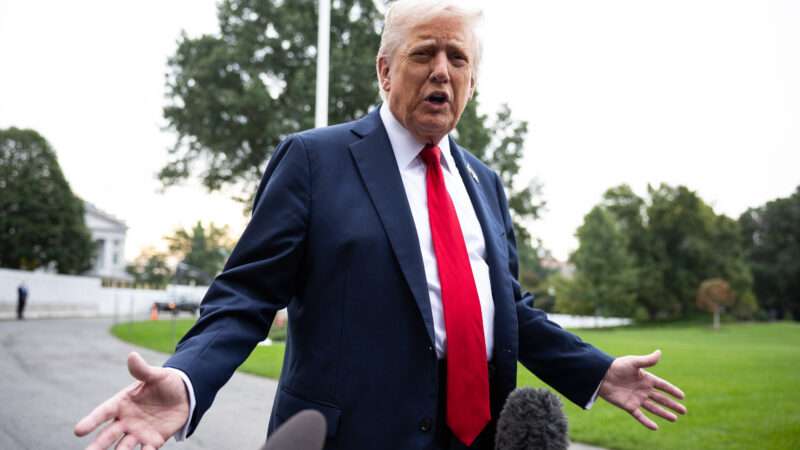
President Donald Trump speaks to reporters on the South Lawn of the White House | CNP/AdMedia/Sipa/Newscom

This week, President Donald Trump sought to justify his new policy of summarily executing suspected drug smugglers by declaring that his targets are “unlawful combatants” in an “armed conflict” with the United States. But that terminology, which Trump deployed in a notice to Congress, does not change the reality that he has authorized the military murder of criminal suspects who pose no immediate threat of violence.

So far, Trump has ordered three attacks on speedboats in the Caribbean Sea that he said were carrying illegal drugs, killing a total of 17 people. The first attack was a September 2 drone strike that killed 11 people on a boat that reportedly “appeared to have turned around before the attack started because the people onboard had apparently spotted a military aircraft stalking it.” On September 15, U.S. forces blew up another speedboat in the Caribbean, killing three people whom Trump described as “confirmed narcoterrorists from Venezuela.” Four days later, Trump announced a third attack that he said killed three people “affiliated with a Designated Terrorist Organization” who were “conducting narcotrafficking.”

Contrary to Trump’s implication, that designation does not turn murder into self-defense. “The State Department designation merely triggers the government’s ability to implement asset controls and other economic sanctions under the International Emergency Economic Powers Act (IEEPA), the Immigration and Nationality Act (INA) and other statutes,” Georgetown law professor Marty Lederman noted after the first attack on a suspected drug boat. “It has nothing to do with authorizing [the Defense Department] to engage in targeted killings…which is why the U.S. military doesn’t go around killing members of all designated Foreign Terrorist Organizations.”

According to White House spokeswoman Anna Kelly, Trump’s literalization of the war on drugs is fully consistent with international law. “The president acted in line with the law of armed conflict to protect our country from those trying to bring deadly poison to our shores,” she told The New York Times this week. “He is delivering on his promise to take on the cartels and eliminate these national security threats from murdering more Americans.”

That framing is logically, morally, and legally nonsensical. The truth is that Americans like to consume psychoactive substances that legislators have deemed intolerable, and criminal organizations are happy to profit from that demand. The fact that Americans who use illegal drugs sometimes die as a result—a hazard magnified by the prohibition policy that Trump is so eager to enforce—does not transform the people who supply those drugs into murderers.

If it did, alcohol producers and distributors, who supply a product implicated in an estimated 178,000 deaths a year in the United States, would likewise be guilty of murder. And by Trump’s logic, they would be subject to the death penalty based on nothing more than the allegation that they were involved in the alcohol trade.

There is obviously something wrong with an argument that would justify the execution of brewers, vintners, distillers, liquor store owners, and bartenders based on their complicity in alcohol-related deaths. Even during national alcohol prohibition, the government did not treat bootleggers as murderers, even when they were smuggling booze into the United States, which according to Trump’s reasoning posed a deadly threat to “national security.”

The current drug prohibition regime is more severe in several respects, but it still deploys the death penalty only in rare cases. Federal law authorizes the execution of people who commit murder in the course of drug trafficking. It also notionally allows the death penalty for drug trafficking involving very large quantities: at least twice the amounts that trigger a mandatory life sentence, which are in turn 300 times the amounts that trigger a mandatory 10-year sentence.

Those death-penalty thresholds include 600 grams of LSD, three kilograms of methamphetamine, six kilograms of PCP, 60 kilograms of heroin, 300 kilograms of cocaine, and 60,000 kilograms of marijuana. But no death penalties have been imposed under these provisions, and it is not clear whether they would be constitutional.

In the 2008 case Kennedy v. Louisiana, the Supreme Court held that the Eighth Amendment’s ban on “cruel and unusual punishment” precludes execution except for “crimes that take the life of the victim.” But the Court added that it was not addressing “crimes defining and punishing treason, espionage, terrorism, and drug kingpin activity, which are offenses against the State.”

Trump has made no secret of his desire to execute drug dealers, and he thinks he has found a legal way of doing that without seeking new legislation or going to the trouble of arresting and trying suspects. The trick, he thinks, is to equate drug smuggling with violent aggression, define drug interdiction as an “armed conflict,” and treat suspected drug smugglers as “unlawful combatants” who can be killed at will, regardless of whether they are actually engaged in violence.

The Bush and Obama administrations tried something similar with alleged terrorists, which provoked considerable debate about the scope of the government’s asserted license to kill, especially as it pertained to U.S. citizens on U.S. soil. But in that case, Congress had authorized military action against Al Qaeda and its allies, and the targets were accused of plotting literal attacks on Americans.

In this case, by contrast, there is no such congressional authorization, and Trump deemed his targets worthy of assassination simply because they allegedly were trying to supply Americans with politically disfavored intoxicants. Calling them “narcoterrorists,” as the Trump administration habitually does, cannot supply a moral or legal justification for killing them in cold blood without anything resembling due process.

Drug cartels “illegally and directly cause the deaths of tens of thousands of American citizens each year,” Trump’s notice to Congress says. The president therefore has “determined” that drug cartels are “nonstate armed groups” whose actions “constitute an armed attack against the United States,” the notice adds. “Based upon the cumulative effects of these hostile acts against the citizens and interests of the United States and friendly foreign nations, the president determined that the United States is in a noninternational armed conflict with these designated terrorist organizations.”

Geoffrey Corn, formerly the U.S. Army’s senior adviser on the law of war, told the Times that Trump has not established the “hostilities” required for an “armed conflict” against the United States because (as the Times dryly puts it) “selling a dangerous product is different from an armed attack.” In Corn’s view, “This is not stretching the envelope. This is shredding it. This is tearing it apart.”

Former State Department lawyer Brian Finucane is “not surprised that the administration may have settled on such a theory to legally backfill their operations.” But among other problems with that theory, he said, “it is far from clear that whoever they are targeting is an organized armed group such that the U.S. could be in a [noninternational armed conflict] with it.”

Cardozo Law School professor Gabor Rona calls Trump’s policy “utterly unprecedented.” If the people whose deaths Trump ordered “were running illicit drugs destined for the United States, the proper—and entirely feasible and precedented—response would have been interdiction, arrest, and trial,” Rona writes. “The Trump administration’s summary execution/targeted killing of suspected drug dealers, by contrast, is utterly without precedent in international law. In fact, there is precedent for considering such attacks, when committed on a widespread or systematic basis, to be a crime against humanity. Former Philippine President Rodrigo Duterte is currently facing charges in the International Criminal Court for exactly that reason.”

Trump, however, is a big fan of Duterte, who likened himself to Adolf Hitler while urging the murder of drug offenders. During his first term, Trump bragged about his “great relationship” with Duterte, who he said was doing “a great job” in tackling substance abuse. Now Trump seems bent on copying Duterte’s bloodthirsty example.

The post Defending the Summary Execution of Suspected Drug Smugglers, Trump Declares an 'Armed Conflict' appeared first on Reason.com.

from Latest – Reason.com https://ift.tt/D21ZNRg
via IFTTT

Hegseth Announces 4th Deadly Strike On ‘Narco-Terrorist’ Boat Off Venezuela 

Hegseth Announces 4th Deadly Strike On ‘Narco-Terrorist’ Boat Off Venezuela 

Pentagon chief Pete Hegseth announced Friday another military strike on an alleged drug-smuggling boat off Venezuela which killed four people.

This marks at least the fourth such attack, and after President Trump formally notified Congress this week that the US was entering a “non-international armed conflict” with drug cartels. Hegseth made clear on social media, “These strikes will continue until the attacks on the American people are over!!!!”

USS Sampson (DDG 102), a U.S. Navy missile destroyer. via Anadolu Agency

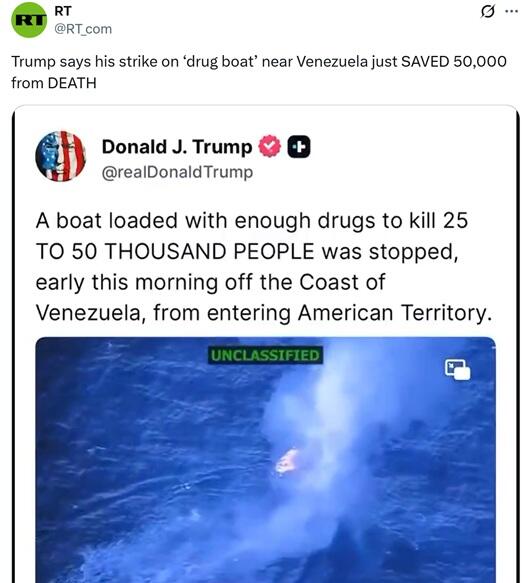
Hegseth affirmed in a social media post that he had directed the latest strike on Trump’s orders, and released overhead drone video of the attack.

“The strike was conducted in international waters just off the coast of Venezuela while the vessel was transporting substantial amounts of narcotics – headed to America to poison our people,” Hegseth said on X.

“Our intelligence, without a doubt, confirmed that this vessel was trafficking narcotics, the people onboard were narco-terrorists, and they were operating on a known narco-trafficking transit route,” he added.

Trump’s rationale for the attacks in the aforementioned memo states the cartels are “non-state armed groups” whose actions smuggling drugs “constitute an armed attack against the United States”.

As for Hegseth, his post claimed the boat was “affiliated with Designated Terrorist Organizations” – however there remains a legal dispute as to whether merely labeling a cartel as an FTO automatically warrants military action, and without warning or attempt to intercept the vessel.

In particular the administration has essentially declared war on the Tren de Aragua cartel, and says it is cooperating with the Maduro government, which Caracas has rejected, and so the presence of the cartel’s members in the US is a “predatory incursion” by a foreign nation.

The new footage of the Friday (presumably) drone attack…

The Washington Examiner on Thursday said that war could be on the horizon. The publication “understands that military planners believe the assembled forces are now sufficient to seize and hold key strategic facilities such as ports and airfields on Venezuelan territory (the Washington Examiner is withholding some details for national security reasons).” And for now it appears the occasional attack on small alleged drug boats will continue.

Tyler Durden
Fri, 10/03/2025 – 15:20

via ZeroHedge News https://ift.tt/6yQR21k Tyler Durden

Trust In Media Among Americans Hits Record Low: Gallup Survey

Trust In Media Among Americans Hits Record Low: Gallup Survey

Authored by Zachary Stieber via The Epoch Times,

Trust in media among Americans has hit a record low, according to a Gallup survey released on Oct. 2.

Just 28 percent of adults told Gallup that they have a great deal or fair amount of trust in the media.

That’s a decline from 31 percent in 2024, 32 percent in 2023, 40 percent in 2020, and a peak of 72 percent in 1976, shortly after Gallup first started asking about trust in the media in 1972.

In the latest survey, carried out Sept 2–26, 8 percent of respondents said they have a great deal of confidence in mass media, such as newspapers and television, to report the news fully, accurately, and fairly.

Twenty percent said they have a fair amount of confidence, 36 percent of respondents said they have not very much confidence, and 34 percent said they have none at all.

When divided by party affiliation, Republicans were the most likely to say they do not have confidence in the media. Sixty-two percent of Republican respondents said they have no confidence, and 30 percent said they have little confidence. Just 5 percent expressed a fair amount of confidence in the press, with the remaining 3 percent expressing a great deal of confidence.

Among independents, 7 percent said they have a great deal of trust in the media, 21 percent said they have a fair amount of trust, 38 percent said they have not very much trust, 32 percent said none at all, and 2 percent said they did not know.

Most Democrats—51 percent—have a great deal or fair amount of confidence in the media. While that was a majority of Democrat respondents, it is also a tie for the record low among Democrats. Thirty-nine percent said they have a little trust, 9 percent said they have no trust, and 1 percent said they were not sure.

Older adults were more likely to express trust in the media. Thirty-seven percent of adults aged 55 and older said they have a great deal or fair amount of trust in the media, compared to 21 percent of people aged 35 to 54 and 24 percent of younger adults.

“With confidence fractured along partisan and generational lines, the challenge for news organizations is not only to deliver fair and accurate reporting but also to regain credibility across an increasingly polarized and skeptical public,” Gallup stated.

The survey from September was conducted over the telephone with adults living in all 50 states and the District of Columbia. The results are based on a random sample of 1,000 respondents. The margin of sampling error was plus/minus 4 percent.

Tyler Durden
Fri, 10/03/2025 – 15:00

via ZeroHedge News https://ift.tt/KStx2hp Tyler Durden

“Huge Red Flag” – Chanos Joins Growing Crowd Questioning Subprime Credit In “The Golden Age Of Fraud”

“Huge Red Flag” – Chanos Joins Growing Crowd Questioning Subprime Credit In “The Golden Age Of Fraud”

In a 2020 Lunch with the FT interview, Jim Chanos said financial markets were in “the golden age of fraud”.

On Thursday he said this phenomenon had “done nothing but gallop even higher” since he made the remark. 

And now, as we have been highlighting recently, the dominoes may have started falling…

Beneath the surface of what’s been a remarkably resilient US economy, a series of small shocks in the world of consumer credit have combined to rock companies that service financially-vulnerable Americans, raising major questions about the true strength of the supposedly omniscient consumer’s health.

Following the collapse of Tricolor Holdings (a subprime auto lender), and weak second-quarter results from CarMax; we have seen car parts supplier First Brands Group

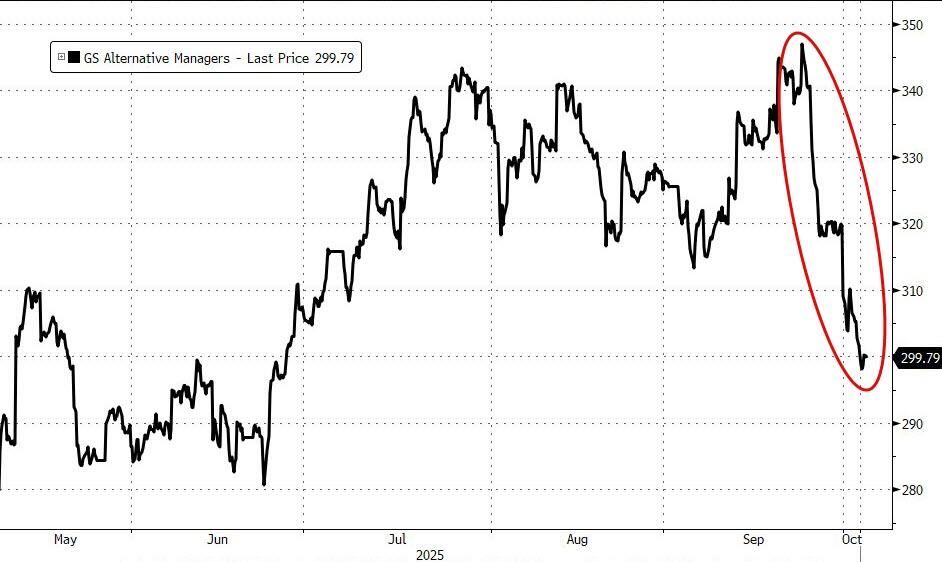
…wrongfooting investors further with payments company Klarna and buy-now, pay-later firm Sezzle also suffering declines alongside the ‘Alts’ market and private credit

And as alternative asset managers tumble, The FT reports that 67 year old Chanos likened the near $2tn private credit apparatus fuelling Wall Street’s lending boom to the packaging up of subprime mortgages that preceded the 2008 financial crisis, due to the “layers of people in between the source of the money and the use of the money”.

“With the advent of private credit . . . institutions [are] putting money into this magical machine that gives you equity rates of return for senior debt exposure,” he said, adding that these high yields for seemingly safe investments “should be the first red flag”.

In the case of Tricolor and First Brands, questions (though no official allegations) have been raised about the substantial use of off-balance sheet financing and the possibility of rehypothecation of invoices (pledging collateral multiples times).

Chanos said:

“We rarely get to see how the sausage is made.”

Indeed, but one cut and the guts come spilling out

“The opaqueness is part of the process,” Chanos said.

“That’s a feature not a bug.”

The ‘opaqueness’ surprised many, as we detailed previously

Nevertheless, while traders can’t pin down the driver of the weakness in ‘Alts’, The FT concludes that several large banks have also been caught up in the collapse, including JPMorgan Chase and Fifth Third, which are exposed to losses on hundreds of millions of dollars’ worth of auto loans.

A second investor who has since sold their position in packaged-up Tricolor loans said they had no idea how potential financial irregularities went unnoticed by JPMorgan Chase, one of the banks that underwrote debt offerings.

“That’s the shocking part of it,” the investor said. “JPMorgan is one of the most sophisticated lenders in the entire world. How the hell could they have missed this?”

JPMorgan declined to comment.

Tyler Durden
Fri, 10/03/2025 – 14:40

via ZeroHedge News https://ift.tt/EDJAX3R Tyler Durden

Illegal Immigrants And Federal Health Benefits: What To Know

Illegal Immigrants And Federal Health Benefits: What To Know

Authored by Lawrence Wilson via The Epoch Times,

Republicans and Democrats offer competing claims about whether people who entered the country unlawfully are benefiting from Medicaid.

“The law prohibits undocumented immigrants from getting payments from Medicare, Medicaid, or the ACA. There’s no money, not a penny of federal dollars that are going there,” Senate Minority Leader Chuck Schumer (D-N.Y.) said on Sept. 30.

Yet Republicans say millions of people who entered the country illegally do receive federal health benefits.

“By some estimates, 20 million illegal aliens came [here] from every country, all around the world,” House Speaker Mike Johnson (R-La.) told reporters on Oct. 2, referring to the years of the Biden administration.

“[Democrats] gave them all this parole status so that they could get enrolled onto taxpayer benefits.”

The war of words has erupted during a government shutdown because of Democrats’ demand that all health-related portions of the One Big Beautiful Bill Act (OBBB) be repealed as part of a continuing funding resolution.

The dispute is over competing visions for the scope of government-funded health. Democrats favor a more expansive list of noncitizens who can apply for federal benefits. Republicans, through the OBBB, have shortened the list considerably.

Here’s a look at which immigrants can now apply for Medicaid, and how that’s set to change in 2026.

Qualified Aliens

Under current federal law, “qualified aliens” can apply for federal benefits. This category includes people lawfully admitted for permanent residence.

Generally, there is a five-year waiting period before eligibility begins, though most states waive that for immigrant children and pregnant women.

Parolees are also qualified aliens. Federal law gives the director of Homeland Security the discretion to release them into the United States temporarily, “only on a case-by-case basis for urgent humanitarian reasons or significant public benefit.”

More than 2.8 million people were paroled into the country between February 2021 and January 2025, according to the Department of Homeland Security. Parolees are eligible for Medicare, Medicaid, or the ACA Marketplace after one year.

Immigrants who are granted asylum or refugee status are also qualified aliens. They have no waiting period.

Qualified aliens also include people who are under an order of deportation that has been withheld, come from certain designated countries, are victims of domestic violence, are victims of sex trafficking, are members of certain Indian tribes, or certain others.

Asylum Seekers

More than 1.7 million people applied for asylum in the United States from 2021 through 2024. Until Oct. 1, there was no fee for applying for asylum, and immigrants could do so at a port of entry, via the CBP One app, or after entering the country unlawfully.

Asylum seekers are not counted as qualified aliens, but some states have found a workaround to enroll them. For example, California requires asylum seekers to document that they have applied for Temporary Protected Status to enroll in Medicaid.

Temporary Protected Status allows people from countries experiencing humanitarian emergencies, armed conflict, or natural disasters to remain in the United States. This status is granted to immigrants from 12 countries, but those from other countries may apply.

Most states also require immigrants to have an Employment Authorization Document to apply for Medicaid. That document is issued by the U.S. Customs and Immigration Service after a five-month waiting period.

The Social Security Administration automatically mails a Social Security Card to those granted an Employment Authorization Document. More than 4 million noncitizens obtained Social Security cards between January 2021 and March 2025, according to Antonio Gracias, formerly with DOGE.

Lawfully Present

Under current rules, a person must be “lawfully present” in the United States to enroll in Medicaid, CHIP, or the ACA Marketplace.

This category, as defined by the ACA Marketplace, includes all qualified aliens and a few other groups.

Lawfully present immigrants include temporary residents with work visas or student visas, lawful temporary residents, and people under deferred action or deferred enforced departure.

As of August 2025, Deferred Action for Childhood Arrivals (DACA) recipients are no longer eligible for Marketplace coverage.

As of December 2024, 19 states require Medicaid or ACA Marketplace enrollees to have a qualified alien status, not a lawfully present status.

Republican Changes

Republicans have consistently pointed out that many of the people who now qualify for benefits may have entered the country illegally and been allowed to stay temporarily only because of a severe backlog of immigration cases.

In October 2023, the height of the immigration surge, some 2 million people were awaiting immigration hearings with fewer than 700 judges available to hear them.

The OBBB narrows the list of those eligible for federal health benefits to include only U.S citizens, lawful permanent residents, certain Cubans and Haitians in the United States, and those living here under a prior agreement with the Federated States of Micronesia and the Republic of the Marshall Islands.

That portion of the law takes effect on Oct. 1, 2026.

“We’re not going to incentivize illegal immigration,” Johnson said.

“We voted against this,” Schumer said. “We’ve tried to undo it three times. And the American people are going to be totally on our side.”

A fourth Senate vote on this matter is expected today, Oct. 3.

Tyler Durden
Fri, 10/03/2025 – 14:20

via ZeroHedge News https://ift.tt/1PXGItK Tyler Durden

Short Circuit: An Inexhaustive Weekly Compendium of Rulings from the Federal Courts of Appeal

Please enjoy the latest edition of Short Circuit, a weekly feature written by a bunch of people at the Institute for Justice.

New case! Armed, masked ICE agents in Alabama have twice arrested Florida-born U.S. citizen Leo Venegas at work, each time barging onto active construction sites and violently detaining Latinos (while leaving everyone else alone) and each time continuing to detain Leo after he showed them his REAL ID. This week, we filed a class action on behalf of Leo and thousands of others similarly situated, challenging the warrantless entries, preemptive detentions, and continued detentions. Click here to learn more.

New on the Unpublished Opinions podcast: The panel ruminates over favorite features of the U.S. Constitution, proposes amendments, and discusses the dangers of viewing rights through a partisan lens.

  1. The FBI investigated a woman, monitoring her travel, recording her private conversations, and seizing a trove of materials from her house, including family photos. Fox News aired and published a series of stories about the investigation—including the photos and other materials from the FBI. Woman: the Privacy Act prohibits the FBI from disclosing these records, and it hurt my business bigly. Identify the leaker. Journalist: The First Amendment reporter’s privilege means I don’t have to. D.C. Circuit: It’s only a qualified privilege, which is overcome here because the info is crucial to the case, and she tried every reasonable alternative to get it. Cough up the name.
  2. “Not all conspiracies are created equal.” A line from a John le Carré novel? No, it’s from a Third Circuit imbroglio concerning a U.S. permanent resident and father of four who dabbled in a bit of passport fraud with some collaborators. Is the crime serious enough to warrant deportation and is his evidence strong enough to demonstrate he will be subject to torture if returned to Nigeria? The court says it’s too early to tell, but the immigration judge applied the wrong standards. Remanded.
  3. A Delta flight attendant saw a man comforting a 13-year-old girl on a turbulent flight and concluded that the man was sexually assaulting and trafficking the child. She reports the incident to the pilot; police meet the plane when it lands and take the man for questioning in the airport. Whoops, it’s his daughter, and nothing untoward happened. He sues. Delta: Child abuse reports are generally immune from liability. Man: Only if those reports are made to the state’s Department of Social Services. Fourth Circuit: The statute isn’t sufficiently clear for us to opine. Virginia Supreme Court, help?
  4. West Virginia property owner fails to pay real estate taxes, leading to the local sheriff’s selling a tax lien on her property. Notices are sent to her, but all are returned undeliverable. Yikes! Did a shlub in the state auditor’s office violate her due-process rights by not doing more to identify her actual address? Fourth Circuit: Qualified immunity.
  5. Gov’t employee dies, after which his wife and mother each lay claim to his Federal Employees’ Group Life Insurance proceeds. Mother: He executed a beneficiary-designation form naming me in 2007. Wife: But he executed a subsequent one naming me in 2013. District court: The wife’s form isn’t in the man’s personnel file, so she’s out of luck. Fifth Circuit (unpublished): Okay, but there’s evidence her form was in fact received by his employer, including testimony from a supervisor who personally witnessed the man deliver it to HR. To trial the case must go.
  6. In which the Fifth Circuit holds that a prisoner had no clearly established right to receive post-deprivation process after the prison withheld some of the money he earned selling handmade belts (assertedly to cover taxes and overhead), but also goes out of its way to note that it says nothing about claims for pre-deprivation process or claims under the takings clause, which nobody properly raised.
  7. Michigan student with a history of behavior issues is suspected of having a gun at school based on a report from a fellow student the day before that he had brought a gun to school and overheard comments from the student himself about owning a gun. After a search of the student’s locker and backpack turns up nothing, a teacher has him lift his shirt and pull down his pants (but not underwear) to prove he isn’t armed. A year later, the student sues. Sixth Circuit (over a dissent): Qualified immunity for the teacher.
  8. Depending on which medieval theologian you pal around with, “fact sheets” and sincerely held religious beliefs may seem to be in tension with each other. Apparently not for the manager of the Oak Ridge National Laboratory in Tennessee, though, which tried to dissuade a man from seeking a religious accommodation from a COVID-19 shot mandate by instructing him about how all kinds of religious leaders said the vaccine was A-OK and providing him with a “fact sheet” detailing how cell lines from aborted fetuses are used in all manner of medical marvels. District court: I’m not going to address the Title VII religious questions because there was no materially adverse employment action. Sixth Circuit: That was based on our circuit’s now-overturned precedent. Remanded for the merits.
  9. Soliciting a minor for sex is gross and wrong and criminal—but it does not, the Eighth Circuit holds, affect interstate commerce just because you made your gross solicitation while sitting in a car that was manufactured out of state.
  10. Tax litigation strategies may not constitute high comedy, but for a potential exception get a load of how the IRS tried to justify taxing 3M on $23.7 mil in royalty income from its Brazilian subsidiary instead of the $5.1 mil “3M do Brasil Ltda.” actually mailed back to its mothership. The Eighth Circuit tells us that once Loper Bright entered the world the “shifting sands of administrative law brought a change in the IRS’s position” and a slew of knee-slapping antics ensued worthy of a Benny Hill chase.
  11. Allegation: After giving birth, woman who’d been involuntarily admitted to Reno, Nev. hospital is allowed to leave (against medical advice) in such a fragile state that she dies several hours later near the hospital entrance. Hospital: We acted in good-faith compliance with the relevant laws. Ninth Circuit: That’s a defense you can raise at trial, not an immunity from suit. No collateral review even though you are a state actor.
  12. Mexican national invokes the Convention Against Torture, arguing that his “indigenous heritage, gang-related tattoos, multiple deportations, mental illnesses, and substance-abuse disorder put him at high risk of persecution and torture” if he is deported. Ninth Circuit: The Board of Immigration Appeals’ one-sentence dismissal of these arguments wasn’t enough. It has to give a reasoned explanation. Dissent: This guy has been on the run for three years, his lawyer doesn’t know where he is, and he was arrested on serious weapons and assault charges just last year. “This case cries out for application of the fugitive disentitlement doctrine.”
  13. In 2020, Colorado voters approved a proposition that created a dedicated source of public funding for voluntary, universal preschool. Participating schools may receive funds only if they sign a nondiscrimination agreement that prohibits them from basing enrollment decisions on, among other things, a child’s (or the child’s family’s) religious affiliation, sexual orientation, or gender identity. Two Catholic parishes challenge the nondiscrimination requirement as a violation of religious liberty and free association. Tenth Circuit: Nope.
  14. Oklahoma lawyer has one clever trick for getting around state requirement that medical-marijuana businesses have 75% Oklahoma ownership. Tenth Circuit: Not clever enough.

Victory! Under Virginia’s “barrier crimes” law, people with convictions for any of 176 crimes are banned, usually for life, from working as substance-abuse counselors. Which is irrational in any number of ways, not least that—until this week—it barred people like IJ client Melissa Brown, who is a highly qualified and effective substance-abuse counselor, because of a 20-plus-year-old conviction for robbery committed while in the throes of addiction herself. For the other ways the law flunks the rational-basis test, we commend this week’s federal district court decision holding as much to your attention. Huzzah! And click here to learn more.

The post Short Circuit: An Inexhaustive Weekly Compendium of Rulings from the Federal Courts of Appeal appeared first on Reason.com.

from Latest – Reason.com https://ift.tt/oB5tnyi
via IFTTT