Republicans Are Walking Into A Trap On Section 230 Repeal

Republicans Are Walking Into A Trap On Section 230 Repeal

Authored by Yael Ossowski via RealClearPolitics,

Among political conservatives, there is no hotter potato at the moment than the civil liability protections afforded by Section 230 to online operators. Unless Republicans learn to love it again and reject the censorship lawfare complex favored by Democrats, they risk dooming our tech leaders and everyone who uses their products to the sharks circling our legal system.

The twenty-six words tucked into the Communications Decency Act of 1996 shielded publishers from liability so they could host and moderate content and still allow a wide range of speech without fear of lawsuits. Since then, Section 230 has evolved to be one of the most powerful legal shields in the nation against civil litigation in U.S. courts. This gave the early digital economy the guardrails it needed to thrive by incentivizing creatives and disruptors to bring their big ideas to life.

Nothing ices a good idea like the fear of a lawsuit.

Yet, to be a rising star in the Republican Party today conveys some kind of fealty to the idea that Section 230 is antiquated – a relic of the early Internet that has outlasted its usefulness.

Last month, Sen. Josh Hawley (R-MO) called on his colleagues to “fully repeal Section 230” to cut the knees of AI companies and thwart their LLM training models. “Open the courtroom doors. Allow people to sue who have their rights taken from them, including suing companies and actors and individuals who use AI,” said Hawley.

He’s joined in these efforts by fellow Republican Sens. Lindsey Graham and Marsha Blackburn, not to mention Democratic Sens. Dick Durbin and Amyâ?¯Klobuchar.

According to the Section 230 Legislation Tracker maintained by Lawfare and the Center on Technology Policy at UNC-Chapel Hill, there have already been 41 separate bills aimed at curbing some aspects of the law by both Democrats and Republicans in the last two sessions.

The principal motivation for Democrats, including former presidential candidate Hillary Clinton, has always been to force censorship of social media platforms to stop “disinformation,” a pretext for muting opposing views. The coordination of Democratic officials pressuring platforms to censor, as revealed in the Twitter Files, proves this beyond dispute.

To highlight the irony, we should remember that President Donald Trump is not only the chief executive of the United States, but also the owner of a social media platform that currently enjoys broad Section 230 protections afforded to any online publisher.

A wish to cripple Section 230 means making Truth Social a target as much as YouTube or Instagram. We should harbor no illusions that right-leaning media publications, podcasters, and websites would be the first to be kneecapped in a post-Section 230 world. Can MAGA and the GOP swallow that pill?

In that scenario, it will be the millions of Americans who currently enjoy freedom of speech online that will lose out. It’s the tens of millions of Americans turning to AI tools to become more productive, create value, and build the next great economic engines of our time who will be harmed by dismantling Section 230.

If Republicans want to cement American dominance in technological innovation, they will have to abandon this devil’s dance on gutting Section 230 liability protections. This is a censorship trap laid by Democrats to benefit them once they return to power.

The premise of broad civil liability protection for platforms is a core principle that has and should be applied to producers across America’s innovative stack, whether it’s oil and gas firms fending off dubious climate cases or artificial intelligence firms building the tools that are the key to America’s present economic dominance.

For one, Republicans should follow the lead of Sen. Ted Cruz (R-TX), who has rightly intimated that Section 230 likely applies to AI chatbots where many Americans are now getting their information. Legislation to further clarify this would alleviate thousands of hours of courtroom battles and millions awarded to plaintiff attorneys, all too keen to make their millions suing AI companies.

Forcing platforms to spend their time fending off trial lawyers circling their offices will not only hasten censorship on American internet platforms, but it will also require it. There is no business model for online connection with liability protection removed.

If Section 230 falls and every online dispute is dragged into court, it won’t be Big Tech that pays the price – it will be Americans whose speech and livelihoods hang in the balance.

Yaël Ossowski is deputy director of the Consumer Choice Center, a global consumer advocacy group.

Tyler Durden
Fri, 10/31/2025 – 17:00

via ZeroHedge News https://ift.tt/mxdN15e Tyler Durden
After Prez Urges ‘TRUMP CARD’, Mike Johnson Warns Democrats Will Wreak Havoc If GOP Kills Filibuster

After Prez Urges ‘TRUMP CARD’, Mike Johnson Warns Democrats Will Wreak Havoc If GOP Kills Filibuster

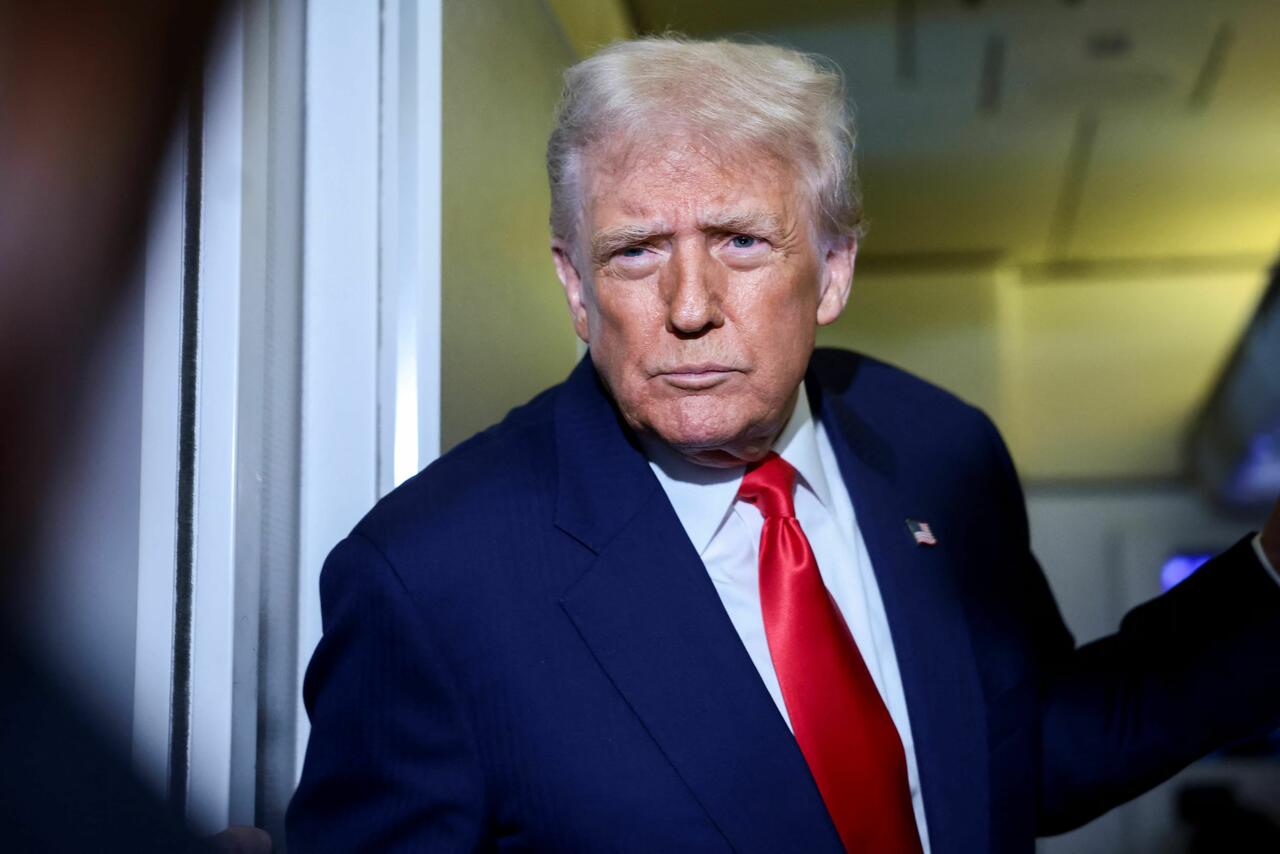
President Trump is pounding the table for Senate Republicans to “play their TRUMP CARD” – demanding they scrap the chamber’s 60-vote filibuster rule to push through a stopgap bill to end the government shutdown. But despite the former president’s fiery Truth Social post Thursday night, GOP senators – wary of detonating the so-called “nuclear option” – are crickets. 

U.S. President Donald Trump speaks to members of the media on board Air Force One en route to the U.S., October 30, 2025. REUTERS/Evelyn Hockstein

Fresh off a trip to Asia, Trump said he faced questions overseas about why “powerful Republicans allowed” Democrats to shut down the government – and called on his party to act fast. “It is now time for the Republicans to play their ‘TRUMP CARD,’ and go for what is called the Nuclear Option – Get rid of the Filibuster, and get rid of it, NOW!” he wrote.

Under current Senate rules, most legislation, including funding measures, requires 60 votes to advance. Republicans hold just 53 seats, and while a few Democrats have occasionally sided with them on procedural votes, others, like Sen. Rand Paul (R-Ky.), have defected in the opposite direction. That math leaves Trump’s call a political long shot.

Johnson’s caution: “If the shoe was on the other foot…”

At a Friday press conference, House Speaker Mike Johnson (R-LA) didn’t directly break with Trump but made clear he’s wary of tampering with one of the Senate’s oldest guardrails.

The filibuster has traditionally been viewed as a very important safeguard,” Johnson said. “If the shoe was on the other foot, I don’t think our team would like it.

Johnson warned that eliminating the rule could pave the way for Democrats to grant statehood to Washington, D.C., and Puerto Rico – adding two likely Democratic senators – or ram through sweeping gun bans and other progressive priorities. He described Trump’s Truth Social broadside as “another expression of frustration, of the anger that has been felt, the anger by the President.”

Senate Republicans draw the line

Many Senate Republicans, especially veterans of the chamber, fear that once the filibuster is gone, there’s no going back. They say the rule forces both sides to seek compromise — and protects whichever party ends up in the minority.

The filibuster forces us to find common ground in the Senate. Power changes hands, but principles shouldn’t,” Sen. John Curtis (R-UT) wrote Friday, calling himself a “firm no” on eliminating it.

Senate Majority Leader John Thune (R-SD) – who has made preserving the legislative filibuster a central part of his leadership – also isn’t budging. “Leader Thune’s position on the importance of the legislative filibuster is unchanged,” a spokesman said Friday.

Thune has already faced pressure from the right, including Rep. Marjorie Taylor Greene (R-Ga.), to cave to Trump’s demands. But he and other Republicans insist that the short-term gain of reopening the government with a simple-majority vote isn’t worth the long-term fallout.

Even if Thune wanted to change course, he likely lacks the votes. Several Senate Republicans have said they won’t go along with any effort to end the 60-vote rule through the nuclear option — a parliamentary maneuver that lets the majority change Senate precedent with a simple majority.

Advocates of the move claim it could be narrowly written to apply only to spending bills. But critics warn that in practice, any change to the Senate’s precedents would effectively kill the filibuster for all legislation – opening the floodgates to one-party rule whenever control flips.

“It would be a drastic move for such a limited win as a stopgap spending bill,” one GOP aide told reporters.

Trump’s long-running feud with the filibuster

This isn’t the first time Trump has tried to “neuter” the filibuster. During his first term, he repeatedly urged then-Majority Leader Mitch McConnell (R-KY) to nuke it. McConnell, who made masterful use of the rule to stall Democratic priorities for years, refused.

Democrats, for their part, tried to kill the filibuster themselves in 2022 to pass election-law changes – but failed when Sens. Joe Manchin ( D-West VA) and Kyrsten Sinema (I-AZ) joined Republicans in opposition.

For now, Trump’s push appears to be more about political pressure than practical policy. Johnson and Senate GOP leaders are holding the line, warning that once the filibuster is gone, there’s no putting the genie back in the bottle.

Tyler Durden
Fri, 10/31/2025 – 16:40

via ZeroHedge News https://ift.tt/9ikDWcT Tyler Durden

California Couple Faces $1 Million in Fines for Code Violations Committed by Their Home’s Previous Owner


Corinne and Doug Thomas on their property | Institute for Justice

A California couple is staring down stratospheric fines after their property allegedly ran afoul of local cannabis code violations. The kicker, however, is that the previous owner is to blame for the infractions.

That has not deterred Humboldt County, California, from levying $1 million in civil penalties against Corrine and Doug Thomas, who bought the home in the Northern California redwood forest after their home in Los Angeles County was destroyed by a wildfire. Six days after moving in, the government sent the property a notice—addressed to the former owner, Summerville Creek LLC—outlining violations pertaining to a structure in the Thomas’ backyard. According to court documents, that included “violation of the commercial cannabis land use ordinance; construction of a building or structure in violation of building, plumbing, and electrical codes; and, facilities or activities in violation of the commercial cannabis land use ordinance.”

The county assessed penalties at $12,000 a day for up to 90 days. To circumvent that, the couple would have to demolish the problematic structure in question, which would cost them $180,000, plus fines and fees. The couple appealed. But per county policy, the fines pile up while they wait for a hearing, which can take years. After a 10-day window, the 90-day clock starts, with penalties ballooning as time goes by.

So how does the county know who has allegedly broken the law? “Humboldt implemented a system to enforce cannabis-permitting violations that relies primarily on grainy satellite images,” wrote attorneys for Thomas in a writ of certiorari to the Supreme Court. The effort, they say, is part of the government’s desire to cash in on cannabis after the state legalized the drug.

“Code-enforcement officers scour the images for what looks like unpermitted development on a property (e.g., a greenhouse, a building, a graded flat of land, or trees removed without a permit on record),” they write. “The County then presumes, without any evidence or further investigation, that the landowner must have developed their property without a permit because they were growing cannabis. In Humboldt’s view, there’s just no other reason that someone might not buy a permit before building a shed, a barn, or a greenhouse in the rural countryside.” 

In that vein, the Institute for Justice, a public interest law firm, is also representing Blu Graham, who was hit with fines for cannabis-related violations when he says the only thing he’s ever grown on his property are vegetables for his restaurant; as well as Rhonda Olson, who faces $7.4 million in fines—also for a previous owner’s conduct—on a $60,000 property she bought to develop housing.

Most recently, the plaintiffs asked the Supreme Court to reconsider one of the major roadblocks to achieving a just outcome in Humboldt County: the Seventh Amendment right to a jury trial in civil cases, which the government is not providing here, and which the Supreme Court long ago ruled is not enforceable against the States. Instead, the government conducts administrative hearings, where the odds are grim.

The Court this month declined to intervene, though Justice Neil Gorsuch released a statement urging that the justices should consider the issue at some point down the line. “Surely, those who founded our Nation,” he wrote, “considered the right to trial by jury a fundamental part of their birthright.” Meanwhile, the plaintiffs’ fight will continue in the lower court after the U.S. Court of Appeals for the 9th Circuit revived the suit late last year citing the Eighth Amendment, which prohibits excessive fines and fees.

The post They Face $1 Million in Fines—for Someone Else's Code Violations appeared first on Reason.com.

from Latest – Reason.com https://ift.tt/vqQuWVR
via IFTTT

Dark Tidings

Dark Tidings

Authored by James Howard Kunstler,

“. . . the fake news isn’t reporting on Operation Arctic Frost. It’s not that they’re trying to cover it up. . . but that they actually think it was totally normal and legitimate.”

 – Hans Mahncke

Surely you’ve noticed in recent years just how gruesome the Halloween townscape has become with our competitive yard displays of giant skeletons, shrieking ghouls, corpses seeming to emerge from the crabgrass, and miscellaneous body parts strewn about the property. The symbolism seems pretty overt: America yearns to become a death cult.

The world has seen this before and it generally doesn’t end well. Something in their equivalent of the zeitgeist drove the Aztecs to sharply ramp-up the scale of their human sacrifices in the years just before Hernán Cortés came to their capital city, Tenochtitlán. Bernal Diaz, a foot-soldier in Cortés’s legion, later wrote:

I remember that they had in a plaza, where there were some shrines, so many places of dead skulls, which could be counted, according to the concert as they were set, that when they appeared they would be more than one hundred thousand; and I say again about one hundred thousand. And in another part of the square were as many rows of bones without meat, bones of the dead, that could not be counted; and they had in many beams many heads hanging from one part to another. And keeping those bones and skulls were three priests, who, as we understood, were in charge of them. . . . “

Cortés had arrived in Mexico in April of 1519 with an expeditionary force of about 500 soldiers and by August of 1521, it was all over. He defeated the empire of a million Aztecs and commenced the systematic demolition of their monuments, including the horrifying great rack-of-skulls (tzompantli) where they displayed their thousands of trophies.

“Sculpture of the skull rack in the Zocolo, site of the great Aztec temple, Mexico City.

Something — more precisely, some cabal of somebodies — is attempting to systematically demolish the social scaffold of our country now. It can’t just be the Soros network of NGOs. The best we can do to identify the central animating agent is the Deep State or Blob, a malignancy within our own organs of national management. It’s shaping up as a kind of American Armageddon, a battle between the forces of darkness and light, death and life. The battle has been going on for at least ten years, since Mr. Trump invaded the body politic — rather like when Cortés entered Mexico and set off a chain of events that ended the cruel and despotic culture embedded there. We’re acting out something along those lines now.

The death cult is vividly on display in our time and place. Minneapolis is poised to elect the skeletal-looking Somali Omar Fateh as its next mayor. The once-emblematic city of Garrison’s Keillor’s “above average,” relentlessly “nice” prairie folk was wrecked in 2020 in tribute to BLM’s patron saint, George Floyd, and has never recovered, written off as a national sacrifice zone for the sake of diversity, equity, and inclusion. Omar Fateh styles himself as a “Democratic Socialist.” This is the next new thing.

Omar Fateh on Right

Likewise, New York City is about to elevate the Ugandan Marxist Jihadi (and self-styled Democratic Socialist) Zohran Mamdani into the top job at city hall. As usual with this brand of insurrectionists — that is, persons bent on destroying our society — the label is yet another language game meant to scramble your brain.

You have probably not failed to notice the incessant recital of the phrase “our democracy” by Democratic Party field marshals starting with “Joe Biden” in the final months of his, uh, late performance. “Our democracy” has nothing to do, really, with citizen participation in governance. The phrase is a cover for their desperate power-seeking — for instance, the “nomination” of Kamala Harris with zero democratic voting procedure — in the service of preserving a vast empire of rackets that siphon taxpayer dollars into multitudinous NGOs and countless government programs that provide jobs and free stuff to an ever-growing class of parasitic dependents in the party’s thrall.

So, the next ploy upcoming will be the sequel to the “No Kings” demos of recent months: “The Fall of the Trump Fascist Regime” mass protest event planned for Washington, DC, on November 5, following election day. The stated idea is to surround the White House with millions of shrieking “Resistance” warriors to exorcise President Trump. The unstated idea is to provoke the president to invoke the Insurrection Act and thus, supposedly, demonstrate that he is a tyrant to their satisfaction.

More likely, if things get out of hand and violence erupts, the Resistance warriors and their Antifa shock troops — sure to be on-hand — will only prove that they are the actual insurrectionists. In which case, this time, expect arrests and indictments of the folks behind the extravaganza, with the prospect of pretty harsh penalties. (Are you listening, Norm Eisen, Mary McCord, and friends?)

Meanwhile, the emerging scandal around the “Arctic Frost” scheme executed under “Joe Biden’s” DOJ to harass and persecute his admin’s political adversaries, takes shape as “worse than Watergate,” in the words of Senate Judiciary Committee chair Charles Grassley. Fresh evidence about this nefarious activity only reinforces the developing seditious conspiracy case that will be prosecuted out of the Southern District of Florida encompassing the entirety of treasonous acts from RussiaGate forward amounting to a long-running coup that never did manage to succeed, no matter how they keep at it.

Ghouls on display on East 71st Street in Manhattan today (Credit: Truman Verdun)

You know the names of most of the major players involved, and ever more members of the supporting cast, lodged in the Deep State, are being revealed daily. Think of them when you see the ghouls and skeletons on display in America’s yards this Halloween eve.

*  *  *

Saturday, November 1, is the official publication date for my new book, the novel Look I’m Gone, live on Amazon tomorrow. To celebrate, I offer readers an amusing excerpt from the book which you can find here at this link.

Tyler Durden
Fri, 10/31/2025 – 16:20

via ZeroHedge News https://ift.tt/2sUkL86 Tyler Durden

Republicans’ Surprising Performances In Key Governor Races

Republicans’ Surprising Performances In Key Governor Races

Authored by J.T. Young via RealClearPolitics,

Virginia’s and New Jersey’s gubernatorial races show the Republican candidates currently matching or beating Donald Trump’s past presidential margins. This is big for these state races and for gauging the overall country’s mood. It could be bigger still if it presages a Republican threat to Democrats’ “second blue wall” in 2026 and 2028.

In Virginia, the Republican, Lt. Gov. Winsome Earle-Sears, has been trailing the Democrat, former Congresswoman Abigail Spanberger, by double digits as recently as the beginning of October. Before Republican Glenn Youngkin upset Democrat Terry McAuliffe’s bid for a second term in 2021, four of Virginia’s previous five governors had been Democrats. No Republican presidential candidate has won Virginia since 2004

In New Jersey, the Republican, former state representative Jack Ciattarelli, has been trailing the Democrat, former Congresswoman Mikie Sherrill, by double digits as recently as the beginning of September. In presidential elections, no Republican has won New Jersey since 1988

Reasonable expectations would consider both states comfortable for Democrats in this year’s gubernatorial races: Neither state has been won by a Republican presidential candidate in over 20 years; this year’s Democrat gubernatorial candidates hold sizable leads; and off-year elections historically go against the party holding the presidency.   

However, polls have shown both races tightening dramatically in their final weeks.

Averaging the polls in RealClearPolitics’ list of gubernatorial races since mid-October, we get Democrat Spanberger with just a 6.9 percentage point lead in Virginia, and Democrat Sherrill with 4.6 percentage point lead in New Jersey. Democrats’ leads have been cut roughly in half in New Jersey and sharply reduced in Virginia.

While noteworthy on their own, these results are even more so when you look at how President Trump performed in these states. Over the last three presidential elections, Trump lost Virginia by an average of 6.9 percentage points. In 2024, Trump lost New Jersey by 5.9 percentage points; over the last three presidential elections, he lost New Jersey by an average of 11.6 percentage points.

In Virginia, Earle-Sears is matching Trump’s average over the last three presidential elections. In New Jersey, Ciattarelli is running ahead of President Trump’s 2024 margin and at less than half of Trump’s three-election deficit average there.    

This is remarkable for several reasons. For one, while much is made of Trump’s job approval being negative (45.3%-51.7% in RCP’s 10/23 national polling average), Trump’s favorability rating is higher at -8.3% than either the Republican Party’s (-12%) or the Democrat Party’s (-24.3%). Yet Republicans’ Virginia and New Jersey gubernatorial candidates appear to be matching or outperforming them all. 

Democrats will excuse their gubernatorial candidates’ weakening positions on local issues that are sapping momentum late in these races. In Virginia, Spanberger is being hurt by fallout from the revelation of Democrat attorney general nominee Jay Jones’ violent texting and reckless driving conviction. In New Jersey, Sherrill has been hurt by her involvement in a cheating scandal while she was at the U.S. Naval Academy. 

Yet Trump, as Democrats constantly point out, is also a divisive figure who fails to rally all his base or appeal to moderates. In 2024, exit polling showed Trump losing 9% of conservatives and 58% of moderates. In other words, if the Democrat gubernatorial candidates are performing below the party’s potential, Trump too has also performed below his apparent potential. 

Looking to the 2026 and 2028 elections, there is a lot to glean from Republicans’ closing performances in Virginia and New Jersey. Both states are in the “second blue wall,” those states Democrats depend on to be presidentially competitive, but which Harris won by 10 percentage points or less (Maine, New Hampshire, New Jersey, Virginia, Minnesota, and New Mexico: 50 electoral votes). Without these states and the seven swing states Harris lost in 2024, Democrats become irrelevant in presidential contests. 

Republicans are holding their own in the two biggest electoral vote states in this “second blue wall.” They are doing so without Donald Trump on the ballot (which helps them), yet with him in the White House (which hurts them). 

If Republicans are now matching or outperforming what Trump did in 2024 in these six states, it bodes well for them holding control of Congress in 2026. This would deny Democrats a platform for attacking Trump during his term’s last two years, something they vigorously did after the 2018 midterms. It bodes even better for Republicans’ chances in 2028 and for their nominee outperforming Trump, cementing control of the seven swing states and breaking into Democrats’ “second blue wall.”

Tyler Durden
Fri, 10/31/2025 – 15:45

via ZeroHedge News https://ift.tt/cTzMIJw Tyler Durden

“Chilling Opportunity” Theme Heats Up: Goldman Forecasts Liquid Cooling To Dominate Data Centers

“Chilling Opportunity” Theme Heats Up: Goldman Forecasts Liquid Cooling To Dominate Data Centers

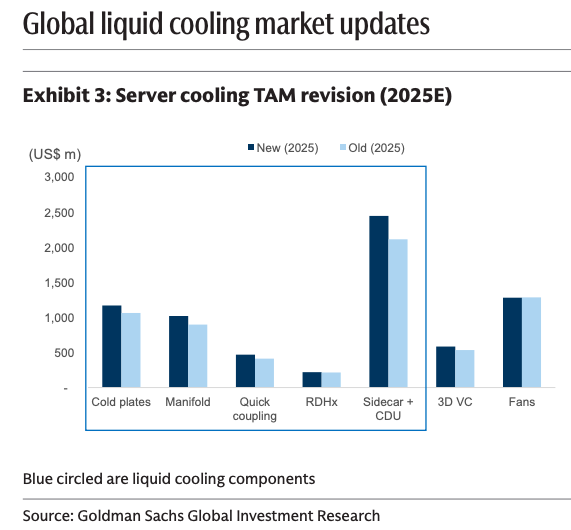
Building on the “Chilling Opportunity” theme around data-center cooling and the rapid rise of liquid-cooling systems in AI server racks, Goldman analysts have raised their 2025-26 global server-cooling market estimates and introduced a new 2027 forecast, reflecting surging demand tied to the accelerating AI data center buildout.

Goldman analysts, led by Allen Chang, penned a note to clients on Thursday, highlighting that liquid-cooling adoption is rapidly accelerating across data centers amid growing demand for higher compute and the accompanying rise in power consumption.

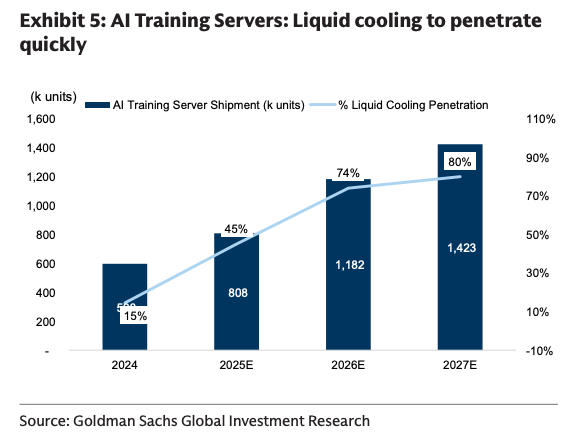
Chang modeled liquid cooling penetration to reach 15% / 45% / 74% / 80% (2024–27E) for AI training servers, 1% / 15% / 17% / 20% for AI inferencing servers, and 0% / 4% / 6% / 8% for general and high-performance computing servers. 

Since Chang’s July 2025 report, he raised his Global Server Cooling TAM forecasts by +9% for 2025 and +16% for 2026, to $7.9 billion and $14.0 billion, representing +111% and +77% year-over-year growth, respectively, noting that the upward revision is mostly because of stronger demand for high-power AI servers. It’s very simple: more power equals more compute, which means more liquid cooling.  

AI Training Servers: Liquid cooling to penetrate quickly

Chang’s note builds on the chilling opportunity theme:

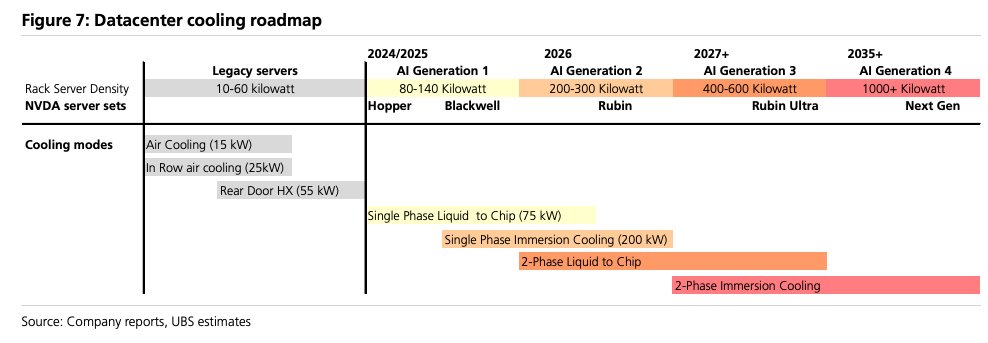
UBS analyst Joshua Spector showed clients in June a roadmap through 2035 illustrating how AI server rack power consumption could surge to as much as 1,000 kilowatts per unit, compared with legacy servers currently running between 10 and 60 kilowatts, and first-generation AI servers consuming around 80 to 140 kilowatts.

More compute equals more power … and by now, you know what that means: higher demand for liquid cooling. 

ZeroHedge Pro Subs can view the full note in the usual place.

Tyler Durden
Fri, 10/31/2025 – 15:25

via ZeroHedge News https://ift.tt/ONs8KXf Tyler Durden

SpaceX Could Win Contract To Build 600 Satellites For Secret “Milnet” Network Powering Trump’s Golden Dome Shield

SpaceX Could Win Contract To Build 600 Satellites For Secret “Milnet” Network Powering Trump’s Golden Dome Shield

Elon Musk’s SpaceX is set to win the contract to build a multi-billion-dollar satellite constellation in low Earth orbit (LEO), called MILNET, to support President Trump’s Golden Dome missile-defense shield.

According to the Wall Street Journal, citing people familiar with the new space program, funding for the so-called “air moving target indicator” system was included in the tax-and-spending bill that Trump signed in July, though it wasn’t publicly linked to SpaceX or any other contractor. 

The Musk-led company could build as many as 600 satellites designed to track hypersonic missiles, aircraft, and drones that threaten the U.S. and parts of the Western Hemisphere, as the Trump administration pushes ahead with “Monroe Doctrine 2.0,” better known to readers as “hemispheric defense“, an investing theme we’ve outlined countless times this year.

The traction that SpaceX has gained with the coming satellite fleets is another sign of the company’s growing influence in U.S. national security,” the WSJ reported, something Democrats, their billionaire funders, and unhinged politicians have been furious about and even waged a color-revolution-style operation against Musk’s companies earlier this year, which only resulted in Tesla vehicles being firebombed. 

Trump’s Golden Dome missile defense shield is estimated to cost $175 billion, but some Wall Street analysts suggest the price tag could cost many billions more. Operational timing of the new defense shield is slated for the end of Trump’s second term. 

Other defense firms, including Anduril, Palantir, Lockheed Martin, Northrop Grumman, and L3Harris, have also proposed technologies for Golden Dome. Goldman analysts have been very bullish on L3Harris (read report). Lawmakers such as Sen. Rick Scott warned that Trump’s missile shield project risks “vendor lock” and called for more competition to prevent overreliance on a single contractor. 

In mid-June, Breaking Defense first reported that the Space Force contracted SpaceX to build MILNET “hybrid mesh network”… 

The network will use terminals created by SpaceX for its Starshield satellites being configured for military use, which also can link into SpaceX’s commercial Starlink constellation. The Starshield terminals have more encryption than those sold to consumers for Starlink access,” Breaking Defense wrote in a report, citing comments from Col. Jeff Weisler, Delta 8 commander, over the summer. 

As the Trump administration rushes to secure the Western Hemisphere amid a world fracturing into a bipolar state and undergoing one of the biggest military reposturings in a generation, we recently noted: What good is the Golden Dome when China’s “assassin’s mace” hybrid warfare strategy, designed to exploit U.S. vulnerabilities from within, has been underway for years?

Tyler Durden
Fri, 10/31/2025 – 14:45

via ZeroHedge News https://ift.tt/5nXk1di Tyler Durden

iRobot Faces Bankruptcy After Elizabeth Warren Helped Kill $1.65 Billion Amazon Merger


Sen. Elizabeth Warren (D–Mass.) and a Roomba robot vacuum by iRobot. | Illustration: Eddie Marshall | ctrl.blog | Midjourney

A struggling American manufacturer may soon face bankruptcy. This was not just the result of low sales, but of government regulators butting in.

Online retail giant Amazon announced in August 2022 that it had agreed to purchase iRobot, makers of Roomba robot vacuums, for $1.65 billion. The acquisition would expand Amazon’s footprint in the smart home market, after it previously purchased video doorbell company Ring.

The following month, the Federal Trade Commission (FTC) opened an investigation into the merger. Sen. Elizabeth Warren (D–Mass.) and several Democrats in the House of Representatives sent a letter to then-FTC Chair Lina Khan, saying “the FTC should use its authority to oppose the Amazon–iRobot transaction.”

The letter alleged that rather than compete directly with iRobot—whose products accounted for 75 percent of the smart vacuum marketplace at the time—Amazon was simply trying to buy its way in. “Rather than compete in a fair marketplace on its own merits,” the lawmakers warned, “Amazon is following a familiar anticompetitive playbook: leveraging its massive market share and access to capital to buy or suppress popular products.”

The European Commission—the governing body of the European Union—soon launched its own investigation. Commissioners later signaled that, among their objections, a merger “may restrict competition in the market for robot vacuum cleaners.”

“Amazon may have the ability to foreclose iRobot’s rivals,” the commission added, either by excluding them from its online marketplace or by “degrading their access to it.”

In January 2024, Amazon and iRobot jointly announced the termination of the deal, seeing “no path to regulatory approval in the European Union.” iRobot then announced it would cut 31 percent of its workforce; the company had hemorrhaged money while waiting for the deal to close, and it reported losing as much $285 million the previous year.

Since then, its outlook has not improved. “There is substantial doubt about the Company’s ability to continue as a going concern for a period of at least 12 months,” iRobot announced in March.

“Last week the last remaining counterparty to a potential sale transaction withdrew from the process following a lengthy period of exclusive negotiations, and we currently are not in advanced negotiations with any alternative counterparties to a potential sale or strategic transaction,” it noted last week in a regulatory filing. If things don’t improve, “we may be forced to significantly curtail or cease operations and would likely seek bankruptcy protection.”

After this news broke, iRobot’s stock price fell 33 percent. If the company went under, as ZDNet reported earlier this year, “existing Roomba models would continue to work, but they would be offline and function in a limited manner.” Owners of its products—50 million sold worldwide, according to the company—would be unable to get product support, replacement parts, or software updates.

Of course, companies fail all the time, leaving customers in the lurch with any tech support or warranty issues. But this story is a bit different, in that iRobot had a path back from bankruptcy that government officials ruined.

While Amazon and iRobot blamed Europe for scuppering their deal, U.S. regulators played a part: Margrethe Vestager, European Commission executive vice president in charge of competition policy, said in a statement after the termination of the deal that the commission was in “close contact” with the FTC during the investigation. Nathan Soderstrom, FTC associate director for merger analysis, said the FTC was “pleased that Amazon and iRobot have abandoned their proposed transaction.”

And Warren and the other lawmakers must have been pleased that, as they asked of the FTC, a regulatory body prevented the deal from going through. (Notably, iRobot is headquartered in Massachusetts, Warren’s home state; if the company shuts down, a substantial portion of those who lose jobs could be her constituents.)

But who cares if Amazon did buy iRobot and put Roomba at the top of all search results? People are still free not to buy them, or to go somewhere else. Grocery stores routinely prioritize their own private label products, which carry higher profit margins. And while iRobot was certainly the innovator in the space, dozens of companies now make and sell their own robot vacuums.

Besides, Roomba is no longer the dominant force it once was. “While iRobot…maintains its leading position in the North America, its global shipments decreased by 6.7% in 2024, and its market share fell by 2.6%, resulting in an overall share of 13.7%,” Paul Lamkin wrote at Forbes in March. “The company has struggled to keep pace with the rapidly evolving competitive landscape,” and “there are concerns as to whether [its new product lineup] will be enough to reverse its current trajectory.”

It’s no secret why: Other companies simply make better products. On its list of the best robot vacuums, Wirecutter makes a point to explain “why we don’t currently recommend vacuums from iRobot,” citing poor functionality and “rampant” complaints about the company’s customer service. (It recommends offerings by Roborock and Eufy, brands that have launched in the last decade or so.)

Perhaps an acquisition could have improved the product line, with Amazon—which recently reported free cash flow of $31 billion—able to invest heavily in R&D. Instead, iRobot was forced to die a slow and painful death because government regulators thought they knew better than consumers.

The post iRobot Faces Bankruptcy After Elizabeth Warren Helped Kill $1.65 Billion Amazon Merger appeared first on Reason.com.

from Latest – Reason.com https://ift.tt/WLI7Eca
via IFTTT

Short Circuit: An Inexhaustive Weekly Compendium of Rulings from the Federal Courts of Appeal

Please enjoy the latest edition of Short Circuit, a weekly feature written by a bunch of people at the Institute for Justice.

At SCOTUSblog, IJ’s John Wrench tells a tale of white coats and black robes: How a 1927 eugenics-era decision warns against swapping judicial scrutiny for “medical consensus”—and how that lesson could shape a free speech case at the Supreme Court.

If you were to break into the National Archives, these days you’d see a sad, though sadly inevitable sight: While portions of the Constitution are still bold and easy to read, the words of the Declaration are fading. Anyhoo, over at the Home of the Brave, IJ’s Anya Bidwell and Patrick Jaicomo say that our Founding ideals are under threat.

New on the Short Circuit podcast: Is sharing your password at work a federal crime?

  1. Is the noble tomato fruit or vegetable? Is the bat bird or beast? Is the warden of the Donald W. Wyatt Detention Facility in Central Falls, R.I., acting under color of state law or federal? First Circuit: On that last vexing question, we hold that it’s at least plausible the warden was acting under color of state law. So a former detainee’s Section 1983 suit against him may proceed.
  2. Puerto Rican utility officials don’t like town’s mayor, so for years they decline to provide the town with potable water, even though residents pay for it. The utility blames infrastructure issues but no steps are taken to upgrade; during one shutoff, water is restored by simply flipping a few switches at the water treatment plant. District court: Troubling! But political retaliation is a First Amendment issue, and these residents brought due-process claims. First Circuit: These allegations are conscience shocking. Case undismissed.  
  3. In 2006, tanker carrying 300k barrels of No. 6 fuel oil runs aground off the coast of Puerto Rico, disturbing a soccer-field-size swath of coral but (phew!) not spilling oil. Feds: The tanker’s owner must pay $1.4 mil more to restore the coral. District court: Yeah, pay up. First Circuit (interlocutorily): Maybe not. Liability depends on (among other things) whether there was in fact a “substantial threat” of a spill, and we can’t just defer to the feds on that. To discovery this must go.
  4. A lot of people these days have very strong opinions about what does or does not constitute an “insurrection.” Courtesy of the Second Circuit, you can apply them to something different for a change: Whether Citgo’s insurer is on the hook for over 930k barrels of crude seized by the Maduro regime.
  5. New York man is convicted in 2022 on charges of securities fraud, making false filings with the SEC, and improperly influencing the conduct of audits. This comes as a real surprise because in 2021 he was acquitted on charges that he conspired to do all those things. A double-jeopardy violation? Second Circuit: Yes. (Ed.: But he really went looking for trouble with an alias like “Sealed Defendant 1.”)
  6. Outside of school hours and not on school grounds, Livingston Manor, N.Y. high school senior stages a photo of a friend putting their knee on his neck. It’s posted to social media with the caption “Cops got another.” Social media is not pleased. And though he quickly deletes it, the post goes viral. He’s suspended and misses out on fun senior class activities. Was that constitutional? District court: Totally, as even though the speech was away from school it caused a substantial disruption. Second Circuit: The “disruption” was a short assembly and student-led demonstration. Constitutional the punishment was not.
  7. Allegation: In 1998, after Brooklyn, N.Y. man is convicted of one drug murder and acquitted of another, the feds mark him down as a double murderer. The court orders the mistake corrected, but it’s not, resulting in elevated restrictions and even physical injuries from being placed with more dangerous inmates. Feds: Shucks, but we told him to send the requisite pre-litigation paperwork to the wrong office. His FTCA claims can’t go. Third Circuit (over a dissent): Case undismissed.
  8. West Virginia municipalities sue opioid distributors, alleging promiscuous pill-pushing got residents hooked and constituted a public nuisance. District court: State common law doesn’t allow this sort of lawsuit. Fourth Circuit (2024): Would the West Virginia Supreme Court please tell us who’s right on that dispositive state law question? West Virginia Supreme Court (2025): No, thank you. Fourth Circuit (2025): Fine, we predict that these claims are viable under state law, and remand for the district court to try again.
  9. After surgeon blows the whistle on Texas Children’s Hospital for secretly running a youth transgender program that was to have been closed down, he’s indicted for violating HIPAA and faces a decade in prison plus $250k in fines. The feds drop the charges, however, and the surgeon tries to get the criminal discovery materials in the hands of his civil counsel, by way of modifying a protective order. District court: No. Fifth Circuit: Yes. Any concern about the presence of protected grand jury material is purely speculative, and a reasonless district-court decision gets no deference. Dissent: This risks a grave violation of grand jury secrecy.
  10. Between election years, Tarrant County, Tex. redraws commissioners’ districts, making it so about 10 percent of voters who were to cast ballots in 2026 must wait until 2028 when it’s their new district’s turn. Affected voters sue. Fifth Circuit: No PI. Federal courts can’t hear purely partisan gerrymander claims, there’s no evidence of intentional race discrimination, and this is mere vote postponement natural to redistricting in a staggered election system.
  11. How hard is it to validly allege that a medical specialty board is doing an antitrust in the Seventh Circuit? According to the dissent in this lawsuit against the American Board of Psychiatry and Neurology, much harder than necessary.
  12. Iowa purports to make it a crime for aliens who have illegally reentered the United States to be present in Iowa, even if the federal government is still figuring out whether they can stay here. Can the affected parties sue under the Supremacy Clause? Eighth Circuit: There’s no cause of action under the Supremacy Clause, but history, tradition, and precedent say you can sue in equity to prevent the enforcement of an unconstitutional law. Preliminary injunction affirmed.
  13. Ninth Circuit: Look, you’re not going to achieve anything by shouting “you can’t tell me what to do, you’re not my dad (and your proceedings structurally violate the Constitution)” at the NLRB, and so you don’t have to exhaust your constitutional claims by raising them in front of an agency that can’t do anything about them. That said, your arguments are wrong and the NLRB can totally tell you what to do. (The panel does not address whether the NLRB is your dad, but the staff here at Short Circuit thinks you can figure that out on your own.)
  14. Allegations: Same-sex couple splits their time between the U.S. and Saudi Arabia (one of them is Saudi), though they hide their relationship because Saudi Arabia deems it a capital offense. At a Riyadh airport, a Lufthansa agent sends their marriage certificate to Lufthansa HQ—info that makes its way to the Saudi gov’t. They haven’t returned to Saudi Arabia since. They sue in California state court. Lufthansa removes to federal court. Ninth Circuit: Sit down and buckle your seatbelt for our flight through the minimum contacts test, under which we find that personal jurisdiction exists. Dissent: All the relevant activity occurred in Saudi Arabia, making the connection to California tenuous, at best, making jurisdiction unreasonable.
  15. Wyoming law defines “hemp” in a way that arguably conflicts with federal law. Can the affected parties sue under the Supremacy Clause? Tenth Circuit: Binding circuit precedent says no, though we will note, in this four-page-long footnote, that binding circuit precedent is totally bogus and that history, tradition, and precedent say you should be able to sue in equity to prevent the enforcement of an unconstitutional law.
  16. Florida inmate alleges prison officials delayed physician-prescribed treatment for gallstones, leaving him in agony for many months. Deliberate indifference to his medical needs in violation of the Eighth Amendment? Eleventh Circuit (unpublished): As we held last year, the only inmates who can bring that kind of claim are dead inmates.
  17. Feds try to deport a Chilean man, claiming a crime that he committed qualified him for removal under the agency’s reading of the relevant statute. In 2022, the Eleventh Circuit agrees, but, after overturning Chevron, SCOTUS says to take another look. Eleventh Circuit (2025): He still loses, but it’s hard to figure out why. So we’re gonna go full seriatim.
  18. And in en banc news, the Second Circuit will not reconsider its decision that noncitizens being detained by ICE must eventually get a bond hearing. Judge Nardini respectfully dissents joined by four colleagues (who separately dissent somewhat less respectfully.)
  19. And in more en banc news, the Fourth Circuit will not reconsider its decision that federal courts have subject-matter jurisdiction over solvent debtors. Six judges disagree, and a dissental by Judge King argues that Article I does not give Congress the power to provide bankruptcy protection to a company created by the “Texas Two-Step” whereby Georgia-Pacific spun off its asbestos liabilities.
  20. And in further en banc news, the Fifth Circuit will reconsider its decision granting a preliminary injunction to a student group that wanted to host a drag show at West Texas A&M University to raise money for the Trevor Project. Judge Ho wrote a dissent from the original panel decision that your summarist can only describe as extraordinar-a-scathing.
  21. And in additional en banc news, the Ninth Circuit will reconsider its decision that a Hollywood producer who had over $1 mil in cash seized by Nevada highway patrol at a roadside traffic stop lacks standing to challenge the forfeiture of the money.

First Amendment victory! For over a decade, IJ client Leda Mox has taught equine massage (which is a real thing that is very beneficial for horses) to hundreds of horse owners, veterinarians, and aspiring equine masseuses. In 2023, however, Minnesota officials demanded that she either shut down or comply with expensive and cumbersome licensing requirements for “private career schools”—requirements that do not apply to many other kinds of schools. But Leda’s teaching is speech, and if the gov’t wants to restrict speech it needs to have a really good reason. The state has never even attempted to provide one, instead insisting that Leda doesn’t have standing and that the case is moot. (“We didn’t do anything to you and now we’ve stopped.”) So we’re excited to say that this week a federal district judge brushed aside the procedural shenanigans and told the state to knock it off. Click here to learn more.

The post Short Circuit: An Inexhaustive Weekly Compendium of Rulings from the Federal Courts of Appeal appeared first on Reason.com.

from Latest – Reason.com https://ift.tt/cgK0DLw
via IFTTT

iRobot Faces Bankruptcy After Elizabeth Warren Helped Kill $1.65 Billion Amazon Merger


Sen. Elizabeth Warren (D–Mass.) and a Roomba robot vacuum by iRobot. | Illustration: Eddie Marshall | ctrl.blog | Midjourney

A struggling American manufacturer may soon face bankruptcy. This was not just the result of low sales, but of government regulators butting in.

Online retail giant Amazon announced in August 2022 that it had agreed to purchase iRobot, makers of Roomba robot vacuums, for $1.65 billion. The acquisition would expand Amazon’s footprint in the smart home market, after it previously purchased video doorbell company Ring.

The following month, the Federal Trade Commission (FTC) opened an investigation into the merger. Sen. Elizabeth Warren (D–Mass.) and several Democrats in the House of Representatives sent a letter to then-FTC Chair Lina Khan, saying “the FTC should use its authority to oppose the Amazon–iRobot transaction.”

The letter alleged that rather than compete directly with iRobot—whose products accounted for 75 percent of the smart vacuum marketplace at the time—Amazon was simply trying to buy its way in. “Rather than compete in a fair marketplace on its own merits,” the lawmakers warned, “Amazon is following a familiar anticompetitive playbook: leveraging its massive market share and access to capital to buy or suppress popular products.”

The European Commission—the governing body of the European Union—soon launched its own investigation. Commissioners later signaled that, among their objections, a merger “may restrict competition in the market for robot vacuum cleaners.”

“Amazon may have the ability to foreclose iRobot’s rivals,” the commission added, either by excluding them from its online marketplace or by “degrading their access to it.”

In January 2024, Amazon and iRobot jointly announced the termination of the deal, seeing “no path to regulatory approval in the European Union.” iRobot then announced it would cut 31 percent of its workforce; the company had hemorrhaged money while waiting for the deal to close, and it reported losing as much $285 million the previous year.

Since then, its outlook has not improved. “There is substantial doubt about the Company’s ability to continue as a going concern for a period of at least 12 months,” iRobot announced in March.

“Last week the last remaining counterparty to a potential sale transaction withdrew from the process following a lengthy period of exclusive negotiations, and we currently are not in advanced negotiations with any alternative counterparties to a potential sale or strategic transaction,” it noted last week in a regulatory filing. If things don’t improve, “we may be forced to significantly curtail or cease operations and would likely seek bankruptcy protection.”

After this news broke, iRobot’s stock price fell 33 percent. If the company went under, as ZDNet reported earlier this year, “existing Roomba models would continue to work, but they would be offline and function in a limited manner.” Owners of its products—50 million sold worldwide, according to the company—would be unable to get product support, replacement parts, or software updates.

Of course, companies fail all the time, leaving customers in the lurch with any tech support or warranty issues. But this story is a bit different, in that iRobot had a path back from bankruptcy that government officials ruined.

While Amazon and iRobot blamed Europe for scuppering their deal, U.S. regulators played a part: Margrethe Vestager, European Commission executive vice president in charge of competition policy, said in a statement after the termination of the deal that the commission was in “close contact” with the FTC during the investigation. Nathan Soderstrom, FTC associate director for merger analysis, said the FTC was “pleased that Amazon and iRobot have abandoned their proposed transaction.”

And Warren and the other lawmakers must have been pleased that, as they asked of the FTC, a regulatory body prevented the deal from going through. (Notably, iRobot is headquartered in Massachusetts, Warren’s home state; if the company shuts down, a substantial portion of those who lose jobs could be her constituents.)

But who cares if Amazon did buy iRobot and put Roomba at the top of all search results? People are still free not to buy them, or to go somewhere else. Grocery stores routinely prioritize their own private label products, which carry higher profit margins. And while iRobot was certainly the innovator in the space, dozens of companies now make and sell their own robot vacuums.

Besides, Roomba is no longer the dominant force it once was. “While iRobot…maintains its leading position in the North America, its global shipments decreased by 6.7% in 2024, and its market share fell by 2.6%, resulting in an overall share of 13.7%,” Paul Lamkin wrote at Forbes in March. “The company has struggled to keep pace with the rapidly evolving competitive landscape,” and “there are concerns as to whether [its new product lineup] will be enough to reverse its current trajectory.”

It’s no secret why: Other companies simply make better products. On its list of the best robot vacuums, Wirecutter makes a point to explain “why we don’t currently recommend vacuums from iRobot,” citing poor functionality and “rampant” complaints about the company’s customer service. (It recommends offerings by Roborock and Eufy, brands that have launched in the last decade or so.)

Perhaps an acquisition could have improved the product line, with Amazon—which recently reported free cash flow of $31 billion—able to invest heavily in R&D. Instead, iRobot was forced to die a slow and painful death because government regulators thought they knew better than consumers.

The post iRobot Faces Bankruptcy After Elizabeth Warren Helped Kill $1.65 Billion Amazon Merger appeared first on Reason.com.

from Latest – Reason.com https://ift.tt/WLI7Eca
via IFTTT