Short Circuit: An Inexhaustive Weekly Compendium of Rulings from the Federal Courts of Appeal

Please enjoy the latest edition of Short Circuit, a weekly feature written by a bunch of people at the Institute for Justice.

At SCOTUSblog, IJ’s John Wrench tells a tale of white coats and black robes: How a 1927 eugenics-era decision warns against swapping judicial scrutiny for “medical consensus”—and how that lesson could shape a free speech case at the Supreme Court.

If you were to break into the National Archives, these days you’d see a sad, though sadly inevitable sight: While portions of the Constitution are still bold and easy to read, the words of the Declaration are fading. Anyhoo, over at the Home of the Brave, IJ’s Anya Bidwell and Patrick Jaicomo say that our Founding ideals are under threat.

New on the Short Circuit podcast: Is sharing your password at work a federal crime?

  1. Is the noble tomato fruit or vegetable? Is the bat bird or beast? Is the warden of the Donald W. Wyatt Detention Facility in Central Falls, R.I., acting under color of state law or federal? First Circuit: On that last vexing question, we hold that it’s at least plausible the warden was acting under color of state law. So a former detainee’s Section 1983 suit against him may proceed.
  2. Puerto Rican utility officials don’t like town’s mayor, so for years they decline to provide the town with potable water, even though residents pay for it. The utility blames infrastructure issues but no steps are taken to upgrade; during one shutoff, water is restored by simply flipping a few switches at the water treatment plant. District court: Troubling! But political retaliation is a First Amendment issue, and these residents brought due-process claims. First Circuit: These allegations are conscience shocking. Case undismissed.  
  3. In 2006, tanker carrying 300k barrels of No. 6 fuel oil runs aground off the coast of Puerto Rico, disturbing a soccer-field-size swath of coral but (phew!) not spilling oil. Feds: The tanker’s owner must pay $1.4 mil more to restore the coral. District court: Yeah, pay up. First Circuit (interlocutorily): Maybe not. Liability depends on (among other things) whether there was in fact a “substantial threat” of a spill, and we can’t just defer to the feds on that. To discovery this must go.
  4. A lot of people these days have very strong opinions about what does or does not constitute an “insurrection.” Courtesy of the Second Circuit, you can apply them to something different for a change: Whether Citgo’s insurer is on the hook for over 930k barrels of crude seized by the Maduro regime.
  5. New York man is convicted in 2022 on charges of securities fraud, making false filings with the SEC, and improperly influencing the conduct of audits. This comes as a real surprise because in 2021 he was acquitted on charges that he conspired to do all those things. A double-jeopardy violation? Second Circuit: Yes. (Ed.: But he really went looking for trouble with an alias like “Sealed Defendant 1.”)
  6. Outside of school hours and not on school grounds, Livingston Manor, N.Y. high school senior stages a photo of a friend putting their knee on his neck. It’s posted to social media with the caption “Cops got another.” Social media is not pleased. And though he quickly deletes it, the post goes viral. He’s suspended and misses out on fun senior class activities. Was that constitutional? District court: Totally, as even though the speech was away from school it caused a substantial disruption. Second Circuit: The “disruption” was a short assembly and student-led demonstration. Constitutional the punishment was not.
  7. Allegation: In 1998, after Brooklyn, N.Y. man is convicted of one drug murder and acquitted of another, the feds mark him down as a double murderer. The court orders the mistake corrected, but it’s not, resulting in elevated restrictions and even physical injuries from being placed with more dangerous inmates. Feds: Shucks, but we told him to send the requisite pre-litigation paperwork to the wrong office. His FTCA claims can’t go. Third Circuit (over a dissent): Case undismissed.
  8. West Virginia municipalities sue opioid distributors, alleging promiscuous pill-pushing got residents hooked and constituted a public nuisance. District court: State common law doesn’t allow this sort of lawsuit. Fourth Circuit (2024): Would the West Virginia Supreme Court please tell us who’s right on that dispositive state law question? West Virginia Supreme Court (2025): No, thank you. Fourth Circuit (2025): Fine, we predict that these claims are viable under state law, and remand for the district court to try again.
  9. After surgeon blows the whistle on Texas Children’s Hospital for secretly running a youth transgender program that was to have been closed down, he’s indicted for violating HIPAA and faces a decade in prison plus $250k in fines. The feds drop the charges, however, and the surgeon tries to get the criminal discovery materials in the hands of his civil counsel, by way of modifying a protective order. District court: No. Fifth Circuit: Yes. Any concern about the presence of protected grand jury material is purely speculative, and a reasonless district-court decision gets no deference. Dissent: This risks a grave violation of grand jury secrecy.
  10. Between election years, Tarrant County, Tex. redraws commissioners’ districts, making it so about 10 percent of voters who were to cast ballots in 2026 must wait until 2028 when it’s their new district’s turn. Affected voters sue. Fifth Circuit: No PI. Federal courts can’t hear purely partisan gerrymander claims, there’s no evidence of intentional race discrimination, and this is mere vote postponement natural to redistricting in a staggered election system.
  11. How hard is it to validly allege that a medical specialty board is doing an antitrust in the Seventh Circuit? According to the dissent in this lawsuit against the American Board of Psychiatry and Neurology, much harder than necessary.
  12. Iowa purports to make it a crime for aliens who have illegally reentered the United States to be present in Iowa, even if the federal government is still figuring out whether they can stay here. Can the affected parties sue under the Supremacy Clause? Eighth Circuit: There’s no cause of action under the Supremacy Clause, but history, tradition, and precedent say you can sue in equity to prevent the enforcement of an unconstitutional law. Preliminary injunction affirmed.
  13. Ninth Circuit: Look, you’re not going to achieve anything by shouting “you can’t tell me what to do, you’re not my dad (and your proceedings structurally violate the Constitution)” at the NLRB, and so you don’t have to exhaust your constitutional claims by raising them in front of an agency that can’t do anything about them. That said, your arguments are wrong and the NLRB can totally tell you what to do. (The panel does not address whether the NLRB is your dad, but the staff here at Short Circuit thinks you can figure that out on your own.)
  14. Allegations: Same-sex couple splits their time between the U.S. and Saudi Arabia (one of them is Saudi), though they hide their relationship because Saudi Arabia deems it a capital offense. At a Riyadh airport, a Lufthansa agent sends their marriage certificate to Lufthansa HQ—info that makes its way to the Saudi gov’t. They haven’t returned to Saudi Arabia since. They sue in California state court. Lufthansa removes to federal court. Ninth Circuit: Sit down and buckle your seatbelt for our flight through the minimum contacts test, under which we find that personal jurisdiction exists. Dissent: All the relevant activity occurred in Saudi Arabia, making the connection to California tenuous, at best, making jurisdiction unreasonable.
  15. Wyoming law defines “hemp” in a way that arguably conflicts with federal law. Can the affected parties sue under the Supremacy Clause? Tenth Circuit: Binding circuit precedent says no, though we will note, in this four-page-long footnote, that binding circuit precedent is totally bogus and that history, tradition, and precedent say you should be able to sue in equity to prevent the enforcement of an unconstitutional law.
  16. Florida inmate alleges prison officials delayed physician-prescribed treatment for gallstones, leaving him in agony for many months. Deliberate indifference to his medical needs in violation of the Eighth Amendment? Eleventh Circuit (unpublished): As we held last year, the only inmates who can bring that kind of claim are dead inmates.
  17. Feds try to deport a Chilean man, claiming a crime that he committed qualified him for removal under the agency’s reading of the relevant statute. In 2022, the Eleventh Circuit agrees, but, after overturning Chevron, SCOTUS says to take another look. Eleventh Circuit (2025): He still loses, but it’s hard to figure out why. So we’re gonna go full seriatim.
  18. And in en banc news, the Second Circuit will not reconsider its decision that noncitizens being detained by ICE must eventually get a bond hearing. Judge Nardini respectfully dissents joined by four colleagues (who separately dissent somewhat less respectfully.)
  19. And in more en banc news, the Fourth Circuit will not reconsider its decision that federal courts have subject-matter jurisdiction over solvent debtors. Six judges disagree, and a dissental by Judge King argues that Article I does not give Congress the power to provide bankruptcy protection to a company created by the “Texas Two-Step” whereby Georgia-Pacific spun off its asbestos liabilities.
  20. And in further en banc news, the Fifth Circuit will reconsider its decision granting a preliminary injunction to a student group that wanted to host a drag show at West Texas A&M University to raise money for the Trevor Project. Judge Ho wrote a dissent from the original panel decision that your summarist can only describe as extraordinar-a-scathing.
  21. And in additional en banc news, the Ninth Circuit will reconsider its decision that a Hollywood producer who had over $1 mil in cash seized by Nevada highway patrol at a roadside traffic stop lacks standing to challenge the forfeiture of the money.

First Amendment victory! For over a decade, IJ client Leda Mox has taught equine massage (which is a real thing that is very beneficial for horses) to hundreds of horse owners, veterinarians, and aspiring equine masseuses. In 2023, however, Minnesota officials demanded that she either shut down or comply with expensive and cumbersome licensing requirements for “private career schools”—requirements that do not apply to many other kinds of schools. But Leda’s teaching is speech, and if the gov’t wants to restrict speech it needs to have a really good reason. The state has never even attempted to provide one, instead insisting that Leda doesn’t have standing and that the case is moot. (“We didn’t do anything to you and now we’ve stopped.”) So we’re excited to say that this week a federal district judge brushed aside the procedural shenanigans and told the state to knock it off. Click here to learn more.

The post Short Circuit: An Inexhaustive Weekly Compendium of Rulings from the Federal Courts of Appeal appeared first on Reason.com.

from Latest – Reason.com https://ift.tt/cgK0DLw
via IFTTT

Bessent: China “Made A Real Mistake” By Threatening To Curb Rare Earth Exports

Bessent: China “Made A Real Mistake” By Threatening To Curb Rare Earth Exports

US Treasury secretary Scott Bessent says Beijing “made a real mistake” by threatening to curb rare earth exports, according to a new report from Financial Times. 

Bessent told Financial Times in a new interview that the US will secure alternative supplies within “12 to 24 months” and also said of China’s threat: “China has alerted everyone to the danger. They’ve made a real mistake. It’s one thing to put the gun on the table. It’s another thing to fire shots in the air.”

Bessent spoke after Donald Trump and Xi Jinping met in South Korea, saying the two leaders had found an “equilibrium” in their trade relationship. Despite recent disruptions triggered by China’s rare earths controls, he believes Beijing can no longer use these minerals as leverage: “I don’t think they’re able to do it now because we have offsetting measures.”

FT writes that the summit followed months of heightened tariffs and retaliatory export restrictions. According to Bessent, Chinese officials were “slightly alarmed by the global backlash” to their latest measures. He said his talks with vice-premier He Lifeng helped preserve a one-year truce: “ceteris paribus, we have reached an equilibrium”.

Bessent described a respectful and pragmatic tone between Trump and Xi, including a lighter exchange about the timing of a potential Beijing visit: “‘It’s very cold in January and February, why don’t we push it back to April?’”

Under the agreement, China will delay its rare earth policy, boost US soybean purchases and permit US control of TikTok. On TikTok, Bessent said: “Everything’s ironed out … we should see a transaction very soon.” The US will postpone blacklisting thousands of Chinese entities, while Trump will cut some fentanyl-related tariffs in return for a crackdown on precursor chemicals. “Fentanyl occupied a lot of the discussion,” he noted.

Bessent rejected the idea that Washington can no longer push for structural reform in China. He argued that US tariffs have diverted Chinese exports to other developed markets: “We’ve set a standard, and I wouldn’t be surprised if the rest of the world doesn’t follow.”

Highlighting US advantages — from “the world’s premier military” to leadership in technology — he said Trump is “cementing and expanding these strengths, and the Chinese know this.”

Bessent expects the deal to hold: “There will naturally be some bumps . . . but I think we have much better communication channels now.”

The Trump administration has made reshoring manufacturing and securing critical materials a central priority, arguing the US became dangerously dependent on foreign supply chains — particularly China. Through tariffs, investment incentives, and stricter controls on technology transfers, the administration has tried to push companies to relocate production of vital goods such as semiconductors, electric-vehicle components and defence materials back to the US or friendly allies.

As we have documented on Zero Hedge, rare earth minerals — crucial for electronics, batteries and advanced weaponry — have been a major focus. After China signaled willingness to restrict access, the administration accelerated efforts to develop domestic mining and processing, diversify suppliers, and build strategic reserves. 

Tyler Durden
Fri, 10/31/2025 – 14:05

via ZeroHedge News https://ift.tt/KnvGw3D Tyler Durden

Chinese Companies Are Betting That The Trump-Xi Truce Will Not Last

Chinese Companies Are Betting That The Trump-Xi Truce Will Not Last

By Bas van Geffen, Senior Macro Strategist at Rabobank

The ECB’s policy decision did not spook markets yesterday. The deposit rate was left at 2% for the third time in a row. Only limited new information had come out since September, and therefore policymakers saw no reason to adjust their policy stance when they also deemed this unnecessary last month.

Looking ahead, Lagarde left all options open, but the ECB president did conclude that downside risks have lessened somewhat. We would add that the doves’ case for another rate cut in December is too.

In September, the ECB had already concluded that the risks to the economic outlook had become more balanced. Yesterday, Lagarde noted that the EU-US trade deal, the ceasefire in the Middle East, and the US-China agreement that was announced shortly before the ECB’s decision “have mitigated some of the downside risks.”

These risks haven’t disappeared completely, though. The agreement between Presidents Trump and Xi sounded more like another short-term ceasefire than a path towards something more long-term. Bloomberg reports that Chinese companies are betting that the truce will not last.

Beijing will not tighten its export restrictions on critical minerals for a year, and China will buy “large amounts” of US soybeans. Trump declared it a big victory. According to the US president, the two countries have settled their differences and there is now “no roadblock at all on rare earth.” However, as we read it, China has agreed to pause additional restrictions on rare earth exports; not to roll back existing export controls. So, industry shortages may not disappear as quickly as Trump expects.

On paper, the deal gives markets a year of respite. But that hardly seems enough for the US (and Europe!) to secure their own, parallel, supply chains for these minerals – even as Chinese export restrictions lead to more coordination among the West. The G7 energy ministers agreed to launch a Critical Minerals Production Alliance that will “secure transparent, democratic, and sustainable critical mineral supply chains across the G7.” So far there are few details, but this initiative was undoubtedly given fresh impetus following China’s decision last month.

This new alliance comes on top of national initiatives. The US government is actively taking stakes in companies involved in critical minerals. And earlier this week, EC President Von der Leyen announced a RESourceEU plan that comes on top of Europe’s Critical Raw Materials Act. Nonetheless, reducing the dependence on China is something that will take considerable time.

Until that day, the US may still feel that China is squeezing some of these supply chains. Again, yesterday’s deal does not require China to accelerate its exports from the current drip feed. So, a new escalation could come back to haunt markets earlier than expected. But as long as the US remains reliant on Chinese supplies of critical minerals, Xi holds a trump card.

This week’s deal illustrates that well. Trump touted it as a big win, but the US president did make quite a few concessions in return. Import tariffs on Chinese goods will be lowered and additional port fees on Chinese ships will be rolled back. The US will also roll back changes in the entity list, which imposed trade sanctions on companies that are at least 50% owned by a Chinese entity.

Despite these delays, some of the damage may already be done. These changes to the US sanctions list were arguably part of the reason for the Dutch government to cease control of a chipmaker, leading to a fallout between the EU and China. In response, Beijing blocked the export of Nexperia’s chips that are made in China. That has the global auto industry scared for chip shortages.

In short, trade tensions and geopolitical risks remain. But so far, these have not affected the Eurozone economy as much as feared. The economy expanded 0.2% q/q in the third quarter, beating expectations of near-stagnation. The Eurozone economy has thus shown greater resilience to the US trade war than we had anticipated, but we believe that the full impact of the tariffs has yet to materialise in the coming quarters.

Over the medium term, domestic demand remains a key driver of growth in the euro area – and that may actually be partly instigated by shifts in global trade and geopolitics. Capital investments in France and Germany picked up, while the Netherlands reported stronger exports of machinery and equipment – is this a sign that Europe is shifting to more local purchases?

On that note, Germany is reportedly considering paying telecom operators to replace Chinese equipment in their networks with alternatives.

Tyler Durden
Fri, 10/31/2025 – 13:45

via ZeroHedge News https://ift.tt/54mjBbu Tyler Durden

Ex-FBI Chief James Comey Seeks Dismissal of Indictment

Ex-FBI Chief James Comey Seeks Dismissal of Indictment

Authored by Aldgra Fredly via The Epoch Times,

Lawyers for Former FBI Director James Comey have asked the court to dismiss two federal charges filed against him over his alleged false statements to Congress in 2020, arguing that his testimony was truthful.

In a motion filed, Comey’s lawyers argued that Sen. Ted Cruz’s (R-Texas) questions could not form the basis for his indictment because they were “fundamentally ambiguous” and that Comey’s answers to his questions were “literally true” and therefore cannot sustain a conviction.

His lawyers argued that the questions posed by Cruz, which prompted Comey’s alleged false testimony during the Senate Judiciary Committee in 2020, were lengthy and confusing, according to the legal filing.

“Specifically, after speaking for more than a minute, Senator Ted Cruz asked Mr. Comey to recall statements he had made three years earlier and to simultaneously address statements that Senator Cruz incorrectly claimed were made by Andrew McCabe, the former Deputy Director of the Federal Bureau of Investigation (FBI),” the motion stated.

“In doing so, Senator Cruz never indicated that he wanted Mr. Comey to address the statements or activities of any person except for McCabe.”

Comey’s lawyers argued that while the government has the authority to prosecute witnesses who misled investigators by giving materially false answers to clear questions, it cannot “create confusion by posing an imprecise question and then seek to exploit that confusion by placing an after-the-fact nefarious interpretation on the ensuing benign answer.”

“Indeed, basic due process principles in criminal law require that the questioner frame his questions with clarity so that a witness does not have to guess,” the lawyers stated in the motion.

“Fundamental to any false statement charge are both clear questions and false answers. Neither exists here.”

The Epoch Times has reached out to the Department of Justice (DOJ) for comment, but did not receive a response by publication time.

The DOJ charged Comey in September with one count of making a false statement to Congress and one count of obstruction in a criminal case, which carry potential prison time.

Comey also filed two additional motions on Oct. 20, alleging that the Trump administration brought a vindictive and selective prosecution and relied on an illegally appointed prosecutor.

The motions alleged that President Donald Trump sought to bring a case against one of his political opponents after multiple investigations, even though prosecutors previously said there was insufficient evidence. Comey argued that in allegedly doing so, the Trump administration violated multiple aspects of the Constitution, including the due process and appointments clauses.

Tyler Durden
Fri, 10/31/2025 – 13:10

via ZeroHedge News https://ift.tt/VkWah5b Tyler Durden

How Opioid Settlement Money Turned Into a $600K Party Fund


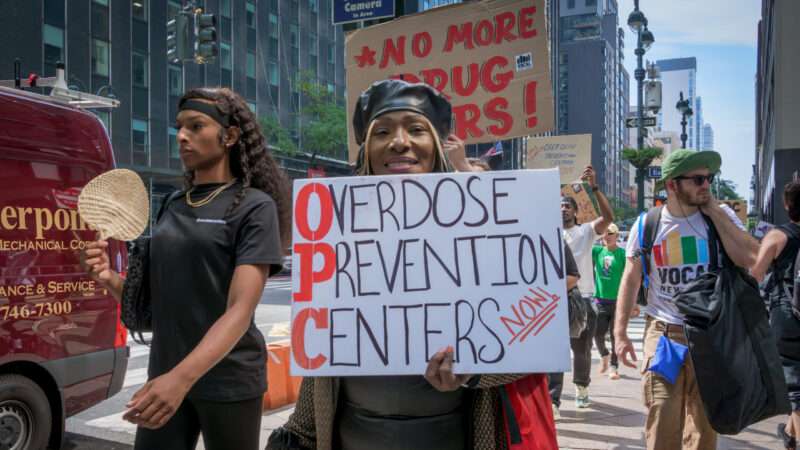
Protester holding sign saying 'Overdose Prevention Centers' | Erik McGregor/Sipa USA/Newscom

The town of Irvington in Essex County, New Jersey, was hit hard by the opioid crisis. In 2023, the county recorded 459 drug overdose deaths, 401 of them opioid-related—the most deaths of any county in the state. Despite this predicament, Irvington officials spent most of their more than $1 million share of opioid settlement funds not on treatment, prevention, or recovery programs, but on a pair of summer concerts with DJs, luxury trailers, and catered food.

A flyer promoting Irvington’s 2024 opioid awareness concert pictured Mayor Tony Vauss. (New Jersey Office of the State Comptroller)

The town billed the concerts as “Opioid Awareness Day,” but they appeared designed more to promote awareness of Mayor Tony Vauss. His name topped the event’s promotional materials, and, as the State Comptroller later noted, “no opioid-related information appeared on stage, though two large posters of Mayor Vauss flanked it.” 

Those two concerts cost the township more than $630,000, according to the comptroller’s investigation, with much of that money going to Antoine Richardson, a DJ who was put on Irvington’s payroll following Vauss’ election in 2014. Richardson already drew an annual salary of nearly $180,000, plus full benefits, for a job called “Keyboarding Clerk 1” with no set hours. The investigation revealed that businesses owned by Richardson’s immediate family collected about $370,000 in related contracts for the concerts.

Beyond a few opioid-related “pamphlets printed from the internet” and a small table stocked with a handful of Narcan, the investigation found that there was virtually no health programming. Richardson told investigators that before his DJ set, he told the crowd to “stay clean” and “say no to drugs”—and that each performing artist said something to the effect of, “Kids, stay in school, stay away from drugs.”   

Irvington, New Jersey, is not an isolated case. Across the country, state and local governments are receiving approximately $50 billion in the next decade from settlements with opioid manufacturers, distributors, and retailers—including Johnson & Johnson, CVS, and Walmart—to remediate the overdose crisis. 

The settlements offered governments significant discretion in how to spend the money. Exhibit E of the national agreement lays out a non-exhaustive list of recommended uses—such as expanding treatment access, supporting harm reduction programs, and improving data collection—but leaves enforcement entirely up to the states. The settlements do not stipulate formal penalties for misuse; there are no clawback provisions or reporting requirements in place. 

States were required to draft a Memorandum of Agreement (MOA) with their municipalities, outlining how funds are allocated and specifying any reporting requirements. New Jersey’s MOA and state law require expenditures to be “evidence-based” or “evidence-informed,” which is what led to the city of Irvington’s trouble. Whether any of that money will be recovered—or whether officials will face consequences—remains to be seen.

Elsewhere, misuse has taken subtler forms. In Indiana’s Scott County, settlement dollars were used to pay staff salaries, freeing up local funds for other priorities. In West Virginia, more than half of all settlement spending last year went toward police vehicles, jail bills, and salaries, while only six percent supported treatment and recovery. These practices, known as supplantation, enable local governments to use new money to replace existing funds, effectively turning settlement dollars into general revenue. 

The pattern mirrors the infamous failure of the 1998 Tobacco Master Settlement Agreement. According to a Government Accountability Office report, states received more than $50 billion from tobacco companies between 2000 and 2005, but only 30 percent went to health care and smoking prevention. The rest was absorbed into state budgets, debt service, and infrastructure projects. 

Some states even securitized their future settlement payments, trading decades of public health funding for an upfront lump sum, and forfeiting long-term funding streams that could sustain treatment and prevention infrastructure in exchange for short-term priorities. The same practice is already being discussed for opioid settlements.

When governments are entrusted with funds to address a crisis that has claimed more than 800,000 lives since 1999, they carry a moral obligation to act accordingly. Every dollar wasted is a dollar not spent on expanding access to treatment, distributing naloxone, or building recovery infrastructure. The outcomes of the tobacco settlement provide clear lessons for the use of opioid settlement funds: Absent binding guardrails and rigorous transparency, both state and local governments face strong incentives to divert or front-load funds in ways that undermine their intended purpose.

The post How Opioid Settlement Money Turned Into a $600K Party Fund appeared first on Reason.com.

from Latest – Reason.com https://ift.tt/Mcqil4t
via IFTTT

How Opioid Settlement Money Turned Into a $600K Party Fund


Protester holding sign saying 'Overdose Prevention Centers' | Erik McGregor/Sipa USA/Newscom

The town of Irvington in Essex County, New Jersey, was hit hard by the opioid crisis. In 2023, the county recorded 459 drug overdose deaths, 401 of them opioid-related—the most deaths of any county in the state. Despite this predicament, Irvington officials spent most of their more than $1 million share of opioid settlement funds not on treatment, prevention, or recovery programs, but on a pair of summer concerts with DJs, luxury trailers, and catered food.

A flyer promoting Irvington’s 2024 opioid awareness concert pictured Mayor Tony Vauss. (New Jersey Office of the State Comptroller)

The town billed the concerts as “Opioid Awareness Day,” but they appeared designed more to promote awareness of Mayor Tony Vauss. His name topped the event’s promotional materials, and, as the State Comptroller later noted, “no opioid-related information appeared on stage, though two large posters of Mayor Vauss flanked it.” 

Those two concerts cost the township more than $630,000, according to the comptroller’s investigation, with much of that money going to Antoine Richardson, a DJ who was put on Irvington’s payroll following Vauss’ election in 2014. Richardson already drew an annual salary of nearly $180,000, plus full benefits, for a job called “Keyboarding Clerk 1” with no set hours. The investigation revealed that businesses owned by Richardson’s immediate family collected about $370,000 in related contracts for the concerts.

Beyond a few opioid-related “pamphlets printed from the internet” and a small table stocked with a handful of Narcan, the investigation found that there was virtually no health programming. Richardson told investigators that before his DJ set, he told the crowd to “stay clean” and “say no to drugs”—and that each performing artist said something to the effect of, “Kids, stay in school, stay away from drugs.”   

Irvington, New Jersey, is not an isolated case. Across the country, state and local governments are receiving approximately $50 billion in the next decade from settlements with opioid manufacturers, distributors, and retailers—including Johnson & Johnson, CVS, and Walmart—to remediate the overdose crisis. 

The settlements offered governments significant discretion in how to spend the money. Exhibit E of the national agreement lays out a non-exhaustive list of recommended uses—such as expanding treatment access, supporting harm reduction programs, and improving data collection—but leaves enforcement entirely up to the states. The settlements do not stipulate formal penalties for misuse; there are no clawback provisions or reporting requirements in place. 

States were required to draft a Memorandum of Agreement (MOA) with their municipalities, outlining how funds are allocated and specifying any reporting requirements. New Jersey’s MOA and state law require expenditures to be “evidence-based” or “evidence-informed,” which is what led to the city of Irvington’s trouble. Whether any of that money will be recovered—or whether officials will face consequences—remains to be seen.

Elsewhere, misuse has taken subtler forms. In Indiana’s Scott County, settlement dollars were used to pay staff salaries, freeing up local funds for other priorities. In West Virginia, more than half of all settlement spending last year went toward police vehicles, jail bills, and salaries, while only six percent supported treatment and recovery. These practices, known as supplantation, enable local governments to use new money to replace existing funds, effectively turning settlement dollars into general revenue. 

The pattern mirrors the infamous failure of the 1998 Tobacco Master Settlement Agreement. According to a Government Accountability Office report, states received more than $50 billion from tobacco companies between 2000 and 2005, but only 30 percent went to health care and smoking prevention. The rest was absorbed into state budgets, debt service, and infrastructure projects. 

Some states even securitized their future settlement payments, trading decades of public health funding for an upfront lump sum, and forfeiting long-term funding streams that could sustain treatment and prevention infrastructure in exchange for short-term priorities. The same practice is already being discussed for opioid settlements.

When governments are entrusted with funds to address a crisis that has claimed more than 800,000 lives since 1999, they carry a moral obligation to act accordingly. Every dollar wasted is a dollar not spent on expanding access to treatment, distributing naloxone, or building recovery infrastructure. The outcomes of the tobacco settlement provide clear lessons for the use of opioid settlement funds: Absent binding guardrails and rigorous transparency, both state and local governments face strong incentives to divert or front-load funds in ways that undermine their intended purpose.

The post How Opioid Settlement Money Turned Into a $600K Party Fund appeared first on Reason.com.

from Latest – Reason.com https://ift.tt/Mcqil4t
via IFTTT

The Left’s incompetent Nazi

Leftists certainly have an interesting command of the English language.

Minnesota governor Tim Walz, former VP Kamala Harris, Illinois governor JB Pritzker, etc. among many others have routinely referred to their political opponents— ranging from Trump, Trump’s voters, and conservatives in general as “Nazis”.

Multiple CNN “experts” have called Trump a Nazi. Ditto for PBS News, the New York Times, and countless other media outlets.

AOC called republicans “Nazi sympathizers”. Bernie Sanders referred to Trump’s 2024 campaign as “Nazi-like”.

This past June, more than 400 scholars (including 31 Nobel laureates) penned an open letter entitled “Against the return of fascism”, effectively labeling Trump and the MAGA movement a revival of fascism.

A local school board member in Virginia referred to Charlie Kirk as a Nazi, saying “we used to be OK with shooting Nazis.”

Joy Reid even portrayed a desire for lower income taxes as Nazi ideology.

In short, if you’re for limited government, lower taxes, and free speech, you’re a Nazi. If you wear a red hat, you’re a Nazi. If you like law and order, or believe that violent criminals should be jailed to protect the innocent, you’re a Nazi.

Bizarrely, if you support Israel’s right to defend itself, somehow (according to Leftist logic) you’re a Nazi.

But if you are a Democrat Senate candidate with a literal Nazi tattoo across your chest? Well, that’s just an innocent little mistake. Chalk it up to a misunderstanding.

Graham Platner, the hardcore Leftist running for US Senate in Maine, endorsed by Bernie Sanders, had a Totenkopf tattoo for over a decade, before recently having it covered once it became a campaign issue.

The Totenkopf is a particular skull and crossbones used by a unit of SS Nazi concentration camp guards during World War II.

Platner claims he “didn’t know” the symbol was associated with Nazis when he got it 18 years ago. Yet acquaintances dispute this, saying he used to regularly end up with his shirt off at a bar in DC when he was student at George Washington University, and told people it was his Totenkopf.

It strains credibility that someone firmly entrenched in hardcore Leftist politics, with all their talk of anti-fascism and punching Nazis, would not have learned of the association for nearly two full decades.

But it hasn’t hurt him with young Democrats. According to a recent poll, over half of 18 to 29 year-olds still support Platner after learning of his tattoo. His poll numbers have barely moved.

This makes perfect sense, when you consider their stand—and Platner’s—on Palestine and Israel.

According to his campaign website, “I stand with all people seeking peace, democracy, and self-determination. In this moment, that means a clear-eyed condemnation of the Gaza genocide…”

Ah yes, “peace, democracy”: hallmarks of the Hamas reign of terror over Gaza.

But honestly, as ridiculous as this all is, it’s not even the biggest problem with Platner.

A much bigger threat to the US compared to Nazi tattoos and support for Hamas terrorists is that he is yet another simpleton who lacks even a basic understanding of nearly every major issue America faces.

For example, Platner’s own campaign website declares that the reason the US is becoming unaffordable is because “we have a government by, of, and for billionaires, who are building a ‘billionaire economy’ that none of us can afford.”

That’s a great tagline that plays well to his Leftist base. And certainly, affordability is the number one issue for many voters.

LOTS of people with low skill jobs are being left behind. Even white collar workers with six-figure household incomes are starting to feel the squeeze.

Pointing out problems is easy. It’s the solutions that need to be coherent.

Yet Platner merely rages against “billionaires” without actually explaining what he means. HOW exactly are billionaires making the economy unaffordable? WHO are the billionaires that are doing this?

Walmart, for example, is owned by billionaires. Yet in their earnings calls the company routinely announces price rollbacks to help make groceries more affordable. More strikingly, Walmart’s gross profit margin is actually down compared to its pre-pandemic, pre-inflation norm.

This doesn’t sound like a bunch of billionaires trying to stick it to the little guy. This sounds more like a great American business in tune with the needs of its consumers and trying to make food more affordable.

There are plenty of other examples in a variety of different industries of billionaires trying to bring costs down, ranging from technology to healthcare to energy to real estate.

Yet Platner maintains an almost cartoonish view of capitalism, complete with mustache-twirling billionaire super-villains.

And his ‘solutions’ are the same old idiotic socialist talking points: breaking up “monopolies”, federal intervention in the housing market, forcing companies to allow workers to unionize, wealth taxes, etc.

ALL of these ideas will only make life LESS affordable for Americans.

Breaking up large corporations eliminates efficiencies which reduce consumer prices.

Federal housing initiatives are what created soaring home prices to begin with.

Unions have become protectionist rackets that enrich union leaders, while putting up barriers to entry for new workers and unskilled labor.

And wealth taxes will almost certainly reduce productivity and innovation.

Naturally Platner offers no real explanations about what is actually behind America’s price inflation: too much government spending which generates negative returns on capital. Too many regulations which strangle business and hamper efficiency.

No. They want overly simplistic explanations: it’s all the billionaires’ fault.

(He also wants to “ban billionaires buying elections”. Does he mean George Soros, who has single-handedly financed an entire army of Leftist politicians?)

I’m an investor and entrepreneur myself, so I tend to look at the government through the lens of business.

Think of the US President as the CEO of America. The Senate and the House are like two separate Boards of Directors. And the responsibility of any Board member is to ensure that management is working to benefit the owners of the business— in this case, the citizens of the United States.

In any serious company, Board members are honest, experienced professionals who have some domain expertise in various aspects of the business— perhaps finance, technology, legal, etc.

And sometimes, if a business is in a very unique situation (like a pending bankruptcy), the Board might recruit members with unique expertise, i.e. someone who understands bank restructuring.

This is what America needs— ‘Board members’, i.e. Senators and House Representatives, who are honest professionals with valuable domain expertise who can objectively and fairly represent the interests of American citizens.

Given America’s looming debt crisis, one of the most important areas of expertise needed in the House and Senate is FINANCE. America needs people in Congress who understand debt, the bond market, central banking, reserve currency dynamics, and macroeconomic issues.

Platner doesn’t have a clue about any of that stuff. So not only would he be NOT helpful, he’ll be yet another destructive influence.

America has a lot of problems— the debt challenge being the biggest one. All of these problems are solvable. But given the cadre of complete and utter morons that the Left keeps electing, from AOC to Jasmine Crockett to Zohran Mamdani to Omar Fateh in Minneapolis, to now potentially Graham Platner, it’s getting harder to think they’re going to be able to fix it.

Source

from Schiff Sovereign https://ift.tt/KdhoGOu
via IFTTT

Trump’s National Guard Plan Edges the U.S. Closer to a Permanent Federal Police Force


10-31-25-v1-a | Illustration: Eddie Marshall | Defense Visual Information Distribution Service | Jpldesigns | Dreamstime.com | Midjourney

The Pentagon is directing every state and U.S. territory to create “quick reaction forces” within their National Guards, which will be trained to respond to civil disturbances and emergencies, according to a recently leaked memo obtained by The Guardian

The memo instructs the National Guard Bureau to train these forces in riot control tactics, rapid deployment procedures, and the use of nonlethal weapons. The federalized forces will complement the National Guard Reaction Forces, which have existed for decades to provide emergency relief, reports The Washington Post

Most states and territories (excluding Washington, D.C.) will supply 500 National Guard members. These units are expected to fully mobilize within 24 hours of activation, with an initial contingent of roughly 200 troops that will be pulled from the guard’s unit that specializes in chemical and nuclear disaster response, ready by New Year’s Day. By April, the new quick reaction force will reach 23,500 soldiers strong, according to the Post

These new forces could signal the Trump administration’s readiness to expand federal control over local policing, with one anonymous Pentagon official telling the Post that the administration is “revising plans for the employment of [National Guard Reaction Forces] to guarantee their ability to assist federal, state and local law enforcement in quelling civil disturbances.”

Critics see the move as establishing a permanent, federally coordinated crowd-control infrastructure. Janessa Goldbeck, a Marine veteran and CEO of Vet Voice Foundation, told The Guardian that the memo represents “an attempt by the president to normalize a national, militarized police force.”

It’s unclear whether the new order—or any future deployments under it—would pass legal muster. Federal law generally prohibits the use of federal troops in civilian law enforcement, while the Insurrection Act allows exceptions only under narrow circumstances.

The Trump administration’s prior efforts to federalize National Guard units for use in cities such as Portland, Oregon, and Chicago have already faced legal challenges and pushback from state officials. In Portland, state and local officials won a temporary restraining order blocking the activation of federal troops, though this was later overturned by an appellate court. On Wednesday, a federal trial to determine the legality of Trump’s guard deployment began. In Chicago, a federal appeals panel said the administration’s justification for deployment did not meet the threshold of a rebellion or danger of a rebellion required under federal law, writing that “political opposition is not rebellion,” the Chicago Sun Times reports. These rulings suggest that any future use of the new “quick reaction” units for civilian crowd control could invite comparable constitutional scrutiny.

States are expected to submit compliance reports to the National Guard Bureau by March. It remains unclear if pending legal challenges against the Trump administration will allow this plan to be realized. However, one thing is clear: The administration’s federalization of law enforcement doesn’t seem to be going anywhere.

The post Trump's National Guard Plan Edges the U.S. Closer to a Permanent Federal Police Force appeared first on Reason.com.

from Latest – Reason.com https://ift.tt/4hqRHFo
via IFTTT

Trump’s National Guard Plan Edges the U.S. Closer to a Permanent Federal Police Force


10-31-25-v1-a | Illustration: Eddie Marshall | Defense Visual Information Distribution Service | Jpldesigns | Dreamstime.com | Midjourney

The Pentagon is directing every state and U.S. territory to create “quick reaction forces” within their National Guards, which will be trained to respond to civil disturbances and emergencies, according to a recently leaked memo obtained by The Guardian

The memo instructs the National Guard Bureau to train these forces in riot control tactics, rapid deployment procedures, and the use of nonlethal weapons. The federalized forces will complement the National Guard Reaction Forces, which have existed for decades to provide emergency relief, reports The Washington Post

Most states and territories (excluding Washington, D.C.) will supply 500 National Guard members. These units are expected to fully mobilize within 24 hours of activation, with an initial contingent of roughly 200 troops that will be pulled from the guard’s unit that specializes in chemical and nuclear disaster response, ready by New Year’s Day. By April, the new quick reaction force will reach 23,500 soldiers strong, according to the Post

These new forces could signal the Trump administration’s readiness to expand federal control over local policing, with one anonymous Pentagon official telling the Post that the administration is “revising plans for the employment of [National Guard Reaction Forces] to guarantee their ability to assist federal, state and local law enforcement in quelling civil disturbances.”

Critics see the move as establishing a permanent, federally coordinated crowd-control infrastructure. Janessa Goldbeck, a Marine veteran and CEO of Vet Voice Foundation, told The Guardian that the memo represents “an attempt by the president to normalize a national, militarized police force.”

It’s unclear whether the new order—or any future deployments under it—would pass legal muster. Federal law generally prohibits the use of federal troops in civilian law enforcement, while the Insurrection Act allows exceptions only under narrow circumstances.

The Trump administration’s prior efforts to federalize National Guard units for use in cities such as Portland, Oregon, and Chicago have already faced legal challenges and pushback from state officials. In Portland, state and local officials won a temporary restraining order blocking the activation of federal troops, though this was later overturned by an appellate court. On Wednesday, a federal trial to determine the legality of Trump’s guard deployment began. In Chicago, a federal appeals panel said the administration’s justification for deployment did not meet the threshold of a rebellion or danger of a rebellion required under federal law, writing that “political opposition is not rebellion,” the Chicago Sun Times reports. These rulings suggest that any future use of the new “quick reaction” units for civilian crowd control could invite comparable constitutional scrutiny.

States are expected to submit compliance reports to the National Guard Bureau by March. It remains unclear if pending legal challenges against the Trump administration will allow this plan to be realized. However, one thing is clear: The administration’s federalization of law enforcement doesn’t seem to be going anywhere.

The post Trump's National Guard Plan Edges the U.S. Closer to a Permanent Federal Police Force appeared first on Reason.com.

from Latest – Reason.com https://ift.tt/4hqRHFo
via IFTTT

Britain’s Prince Andrew Taken Down by Epstein and Chinese Spy Scandals


Prince Andrew (center) at a memorial service in St. Paul's Cathedral, London, UK. 7 July 2015. | JRAA/ZDS/WENN/Newscom

It’s not every day that a royal becomes a commoner. But Buckingham Palace announced on Thursday that Andrew, formerly known as Prince Andrew, would now be an ordinary citizen known as Andrew Mountbatten Windsor. He will also lose his taxpayer-funded digs at the Royal Lodge and move to a private home. The palace’s press release added that Windsor “continues to deny the allegations against him.”

The allegations in question have to do with Windsor’s ties to two different foreigners: American pedophile Jeffrey Epstein, who died in 2019, and Chinese businessman Yang Tengbo, whom the British government accuses of espionage. After Windsor was accused of participating in Epstein’s sexual abuses and gave an interview that made things look even worse for him, the prince reportedly turned toward Yang for a potential fresh start in China.

However, the British government banned Yang from Britain in 2023 on the grounds that he committed “covert and deceptive activity” on behalf of the Chinese government. Yang, who denies those allegations, sued the British government and lost in 2024, leading to a series of revelations about Windsor’s Chinese outreach. 

Reporting by Reason revealed that Windsor had been in contact with Epstein much later than he admitted, and that he had been trying to work with Beijing on sensitive matters earlier than believed. In leaked emails, Epstein told one of his business partners that Windsor had told him about an idea to start a “personel [sic] protection co in beijing” in 2015.

Those emails made it to the front page of the Sunday Times, the British newspaper of record, which noted that Windsor had claimed to cut off contact with Epstein in 2010. The Times independently verified many details from the emails. Another newspaper, The Express, called the story the “nail in the coffin” for Windsor’s attempts to stay in the palace.

Yet that wouldn’t be the last compromising story to come out about the former prince. The Telegraph revealed that Windsor had met three times in 2018 and 2019 with Cai Qi, a Chinese official accused of running a spy ring in Britain. Two different newspapers obtained an email from Windsor to Epstein in 2011 stating that “we are in this together” and “we’ll play some more soon!!!!”

The BBC reported that Windsor had hosted Epstein at a party in the Royal Lodge in 2006, two months after Florida authorities issued a warrant for Epstein’s arrest. Windsor’s other guests included Epstein accomplice Ghislaine Maxwell and Harvey Weinstein, an American movie producer convicted of sexual assault in a separate scandal that kicked off the #MeToo movement.

The woman who accused Windsor of sex abuse, Virginia Giuffre, died in April 2025. But her memoir, which includes many graphic details about her encounter with Windsor, was published posthumously this month.

The series of leaks and revelations turned into a major headache for King Charles III. Two weeks ago, Windsor announced that Andrew was giving up some of his titles after a “discussion with the king,” although he would remain Prince Andrew. On Monday, a heckler confronted King Charles about the royal family’s “cover up.” A few days later, the king began a “formal process” to remove the prince.

“This normal girl from a normal family has taken down a prince. We are so proud of her,” Giuffre’s brother, Sky Roberts, told the BBC. “The U.S. government hold the key to the larger scope of the Jeffrey Epstein case. The U.K. is setting an example for what the US should be doing right now,” he added.

The post Britain's Prince Andrew Taken Down by Epstein and Chinese Spy Scandals appeared first on Reason.com.

from Latest – Reason.com https://ift.tt/jfvOLUh
via IFTTT