China’s C919 Jet Faces Delays Despite Big Airline Orders
For once, something China relies on the US for to build is the problem, and not the other way around…
Deliveries of China’s first narrowbody jet, the C919, appear to be lagging, with financial reports from the country’s top three airlines raising questions about engine supply, the South China Morning Post wrote this week.
Air China and China Eastern each received only one aircraft in the first half of the year despite targeting 10 additions in 2025. China Southern, which expected 12 deliveries this year, reported “financially leased” just three by June, without noting ownership.
Flightradar24 data shows higher totals: Air China and China Southern with five C919s each, and China Eastern with 11. Future plans remain ambitious – Air China expects 10 deliveries in 2026 and 2027, while China Eastern projects nine this year, then 10 each in 2026 and 2027.
SCMP writes that the jet’s maker, Comac, aims to challenge Airbus and Boeing, and says over 2 million passengers have flown on the model since its May 2023 debut. But analysts warn of pressure on engine supplies. “Comac has stockpiled some engines and key systems … these buffers cover months of production rather than years,” aviation advisory IBA said.
Independent analyst Li Hanming added: “GE is concerned about the delivery of Leap engines,” noting Comac’s “very low profile.” The LEAP-1C is jointly produced by GE and France’s Safran. While the Trump administration briefly suspended engine sales earlier this year, the ban was lifted in July.
IBA cautioned that reliance on US-made modules is a “strategic vulnerability.”
Some analysts argue demand in China isn’t urgent. Civil aviation data shows utilisation rates at 8.9 hours per aircraft in 2023 versus the global average of 9.3. “I’d say there is no need for capacity at the moment,” said Dennis Lau of Asian Sky Group. “There are plenty of aircraft floating around in China.”
Outside China, Comac has sold its smaller C909 (formerly ARJ21) in Southeast Asia but is still seeking approval for the C919. IBA predicts “more measured growth” than Comac’s stated targets.
Alberta has proposed to build a new oil pipeline to the British Columbia coast that could carry up to 1 million barrels daily of crude oil, to be exported to Asian markets.
The Calgary Herald reported the provincial government was ready to commit C$14 million to early planning for the project, with Premier Danielle Smith expressing hope the project could get federal approval as early as next month.
Opposition, however, has been swift. The Premier of British Columbia said that “The problem that we have is Smith continues to advance a project that is taxpayer-funded, has no private sector proponent, is not a real project and is incredibly alarming to British Columbians, especially First Nations along the coast,” as quoted by Global News.
Indeed, a representative of several coastal First Nations said they would not support a new pipeline project “now or ever,” according to a report by CBC News. “This is not something that we would ever support,” Marylin Slett told the publication.
“There is no project that … we would ever support the lifting of that moratorium,” referring to a ban on oil tankers for northern British Columbia ports.
“I think coastal provinces have a special obligation to be generous and make sure we’re creating access to ports for all of our products,” Alberta’s Smith said.
The Alberta government has been pushing for new oil pipeline capacity to expand Canadian oil’s access to international markets for a while now, but British Columbia’s government has been against it from the start.
“The only way that pipeline across the north gets built is if the government of Alberta and the federal government pony up tens of billions of tax dollars to build it,” B.C. Premier David Eby said in September, as quoted by Bloomberg, estimating the potential price tag of such an infrastructure project at some $C$60 billion, equal to around $43 billion.
FICO Spikes On Plan To Go Direct To Lenders, Upends Experian, Equifax, TransUnion
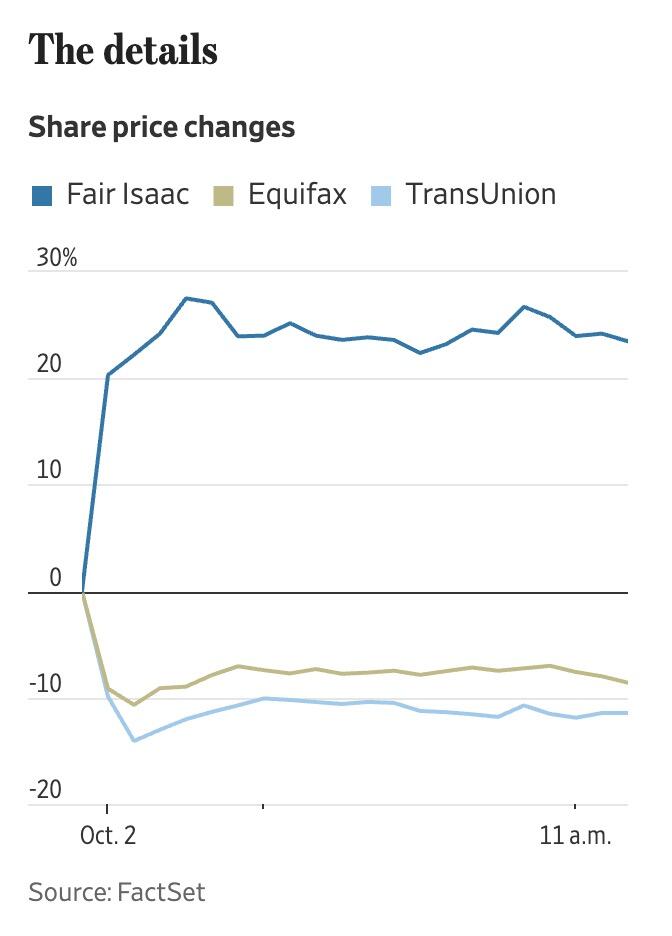
Fair Isaac shares surged today after announcing a plan that bypasses the big three credit bureaus – Experian, Equifax, and TransUnion – in providing its credit scores directly to mortgage lenders.
Until now, mortgage resellers had to purchase FICO scores through the bureaus, who added markups of about $10 per score, according to the Wall Street Journal. FICO will now sell directly, offering lenders either a flat $10 fee or $4.95 per score plus a $33 closing fee. The company said the new closing charge replaces reissue fees but didn’t disclose the prior cost.
WSJ writes that the change threatens a long-standing revenue stream for the bureaus. “We believe this change adds substantial uncertainty to a sector that has already been undergoing heightened volatility amid a series of potential regulatory changes,” wrote UBS analyst Kevin McVeigh.
The move follows pressure from regulators to reduce costs in an unaffordable housing market. Earlier this year, the FHFA authorized lenders to use VantageScore—developed by the three bureaus—for government-backed loans, challenging FICO’s dominance.
FHFA Director Bill Pulte called FICO’s plan a “first step” and urged bureaus to “take similar creative and constructive actions” while pressing VantageScore to ensure “they are competitive, in every way, including but not limited to costs.”
Industry reactions were cautiously positive. TD Cowen analysts called the change “politically positive.” Mortgage Bankers Association chief Bob Broeksmit said it was a “step in the right direction” but warned it “remains to be seen” whether it will meaningfully lower costs.
“I think the scientific establishment blindly defending the U.S. vaccine schedule is incorrect,” Dr. Vinay Prasad, director of the FDA’s Center for Biologics Evaluation and Research, told the Free Press in an interview published Sept. 29. “It is possible that our schedule is suboptimal.”
The FDA is part of the Department of Health and Human Services (HHS). Another HHS division, the Centers for Disease Control and Prevention, sets the immunization schedule, which contains more vaccines and doses than many other countries, such as Denmark.
“I’ve seen some pundits claim that Denmark can get away with a different schedule because they’re a smaller country,” Prasad said. “That’s illogical. Denmark is connected to all of Europe. It would be like arguing that Boston could have a different vaccine schedule than the rest of the Eastern Seaboard if we made it its own nation.”
Susan Monarez, who headed the CDC until she was recently fired, told a congressional committee last month that HHS Secretary Robert F. Kennedy Jr. said during a private meeting that the vaccine schedule would be changing.
Monarez said she would only sign off on changes if she were presented with evidence backing them, and said she was not.
“The childhood vaccine schedule has been vetted and validated through science and evidence,” Monarez said.
If children receive vaccines when recommended by the schedule, they receive multiple shots across multiple visits.
President Donald Trump in a Sept. 22 briefing said that parents should space out vaccines.
“I think the president has a deeper point about the evidence to support combination and concomitant administration. By background, combination vaccines combine two or more into a single vial or shot, while concomitant administration means administering two or more at the same visit. Historically, FDA has had stronger levels of evidence for combination than concomitant administration, but that is changing,” Prasad told the Free Press.
“We are planning new guidance to raise the bar for concomitant administration, and we have a paper now submitted in a medical journal.”
Measles, Hepatitis B Vaccines
Trump also proposed delaying the hepatitis B vaccine, which is currently on the immunization schedule at three doses in early childhood, or two doses for adolescents, and taking separate vaccines against measles, mumps, rubella, and chickenpox rather than combination vaccines.
Also recently, advisers to the CDC recommended the agency remove the measles, mumps, rubella, and chickenpox vaccine from the schedule for children younger than 4 years of age, emphasizing a different vaccine that targets measles, mumps, and rubella, due to an elevated risk of febrile seizures. Advisers also considered delaying the first dose of the hepatitis B vaccine regimen, but ultimately tabled the decision to explore whether to alter or remove the entire regimen. The CDC has not yet acted on the advice.
“I think the president is 100 percent correct that it is prudent to take the chickenpox shot separately,” Prasad said.
He said that Trump and the Advisory Committee on Immunization Practices (ACIP) were right to question whether hepatitis B shots should be administered to babies born to mothers who tested negative for hepatitis B, noting that some other countries do not give the vaccine to such children.
ACIP is also examining the cumulative impact of the vaccination schedule, advisers said in June.
Trump’s comments drew criticism from some, including the American Academy of Pediatrics.
“Pediatricians know firsthand that children’s immune systems perform better after vaccination against serious, contagious diseases like polio, measles, whooping cough and hepatitis B. Spacing out or delaying vaccines means children will not have immunity against these diseases at times when they are most at risk,” the academy said in a statement.
Prasad said that Trump was offering personal advice and not trying to compel anyone to follow that advice. When asked whether Trump’s comments would drive vaccine hesitancy, Prasad said people are getting fewer vaccines due to the imposition of COVID-19 vaccine mandates during the pandemic.
“We will have more vaccine hesitancy for a generation. The president’s comments are not the driver of what we are seeing,” he said.
Prasad rejoined the FDA in August, several weeks after resigning. He had left the agency after some of his past comments were recirculated, including remarks about supporting Democrats.
“The FDA is steadfast in its commitment to rigorous, gold-standard science in the approval of vaccines, ensuring that every decision reflects the highest standards of safety and effectiveness. Science requires continual review and adaptation; when health recommendations become outdated or no longer align with the latest evidence, it is the responsibility of public health officials to make the necessary changes,” an HHS spokesperson told The Epoch Times in an email on Wednesday.
“Dr. Prasad’s comments underscore the open-mindedness that true gold-standard science demands, and that the health of our citizens depends upon. At this time, HHS and FDA cannot comment on potential future policy changes.”
Russia Has Upgraded Missiles To Successfully Evade Ukraine’s Patriots
We’ve been documenting how more and more US Patriot missile batteries have been showing up in Ukraine, as even Israel has of late openly acknowledged sending one, with more said to be on the way.
But it hasn’t taken long for Russia to respond by upgrading its ballistic missile systems to evade Ukrainian air defenses, including US-supplied Patriot systems, according to a report by the Financial Times on Thursday. The report, which cites Ukrainian and US officials, details that the modifications affect both the Iskander-M short-range ballistic missiles and the air-launched Kinzhal missiles.
These have ranges of up to around 300 miles, with the upgraded missiles now said to be capable of performing sharp maneuvers or steep dives as they approach their targets, making them significantly more difficult to intercept.
One Ukrainian official admitted the development to be a “game-changer for Russia” – as cited in Financial Times. Western intel sources further conceded a noticeable drop in successful interceptions by Ukraine’s air defenses as a result.
“Ukraine’s ballistic missile interception rate improved over the summer, reaching 37 per cent in August, but it plummeted to 6 per cent in September, despite fewer launches, according to public Ukrainian air force data compiled by the London-based Centre for Information Resilience and analyzed by the Financial Times,” the report underscores.
A notable successful Russian strike which was able to evade significant air defenses was on August 28, when a major facility for the manufacture of Turkish-made Bayraktar drones was hit, in what many analysts said at the time sent a clear message to Ankara.
And during an attack wave on September 18, Ukraine’s Air Force reported – somewhat unusually – that all four Iskander missiles launched that day bypassed Patriot defenses entirely. Such had become a ‘pattern’ over the summer.
These prior instances in the summer saw Ukraine’s air defenses at times down merely one missile out of seven or more, and that the intercept rate was previously consistently higher.
An American Patriot surface-to-air missile lies on the streets in Kiev:
Also of note in the fresh report is the feedback that major defense makers are getting in real-time. “Ukraine shares Patriot engagement data with the Pentagon and the air defense system’s US manufacturers, said the western and Ukrainian officials,” FT writes.
“Virginia-based Raytheon makes the Patriot system, while Maryland-based Lockheed Martin produces the system’s interceptor missiles,” the report continues, describing that “The data is used to make updates needed to keep pace with Russia’s adjustments, but one official said those improvements often lagged behind Moscow’s evolving tactics.”
The 2024 auction results led to double-digit electric bill increases for some utility customers in PJM’s footprint, which covers parts of 13 Mid-Atlantic and Midwest states and the District of Columbia.
PJM holds capacity auctions to help ensure that it has adequate power supplies to meet future needs. In the last auction, PJM bought capacity for a one-year period that starts on June 1. The grid operator is preparing to hold its next auction in early December to buy capacity for a year beginning on June 1, 2027.
Monitoring Analytics contends it is “misleading” to say that PJM’s recent capacity market results simply reflect tightening supply and demand.
“The current conditions are not the result of organic load growth,” it stated. “The current conditions in the capacity market are almost entirely the result of large load additions from data centers, both actual historical and forecast.”
Also, the “extreme uncertainty” in data center load forecasts is unprecedented and “raises questions about the meaning of clearing a capacity auction based on those forecasts,” Monitoring Analytics said.
In June, the market monitor recommended requiring new data centers to supply their own generation instead of tapping into existing power supplies in PJM.
“The impact of the uncertain forecast of data center load on other customers would be limited or eliminated” by the requirement, Monitoring Analytics said in the report.
PJM is in the middle of a fast-track stakeholder process to develop new rules for adding large data centers to its system with a goal of filing a proposal before the end of the year at the Federal Energy Regulatory Commission.
As part of the process, PJM is proposing to bolster its load forecasting for data centers and other large loads, according to an Oct. 1 presentation from PJM staff. Under the proposal, state utility commissions could review and provide feedback on large load adjustments before they are included in PJM’s load forecast.
Utilities would also have to ask if any data center proposals in their service territory are duplicative proposals. Staff suggested requiring large load customers to post financial security for the capacity they plan to buy in an auction.
On the issue of a price cap and floor for PJM’s capacity auctions, the last auction would have been $3.2 billion, or 20%, higher except for a cost cap that grew out of an agreement between the grid operator and Pennsylvania Gov. Josh Shapiro, a Democrat, according to the market monitor’s report.
The impact of data center development on PJM’s auction results will increase sharply in the 2028/2029 base capacity auction scheduled for June, when the maximum and minimum price caps in the agreement expire, Monitoring Analytics said.
Separately, the Union of Concerned Scientists this week found that utility ratepayers in PJM will pay about $4.4 billion for data center-related transmission projects that were approved in 2024 with similar results expected this year.
Six Thematic Takeaways, Buy-Rated Stocks From Goldman’s Global Sustainability Forum
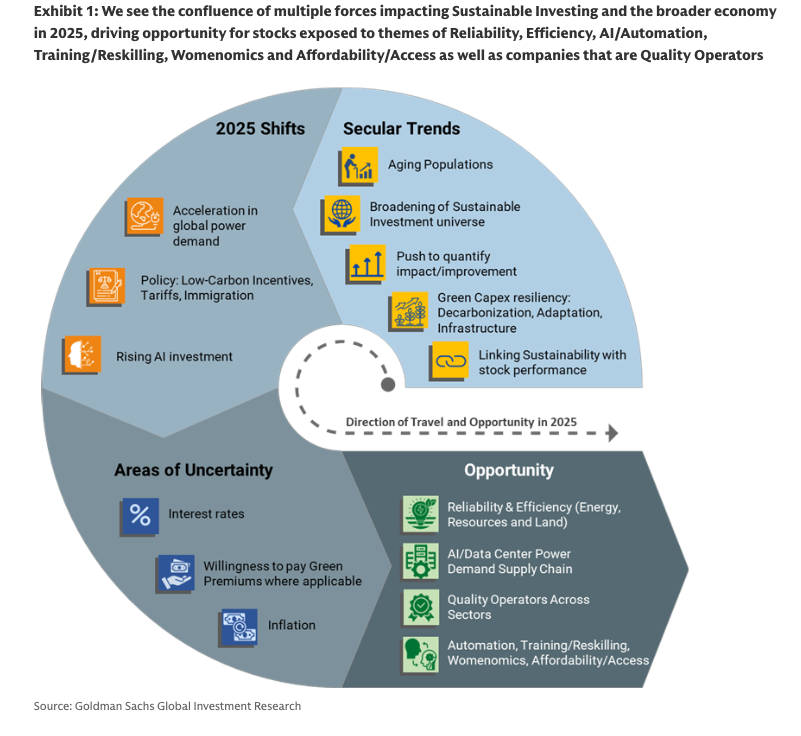
Goldman Sachs hosted its 2025 Global Sustainability Forum in New York, outlining key takeaways on sustainable investing strategies in a rapidly evolving world where reliability and aging demographics dominate and act as tailwinds.
Reliability — prioritized investments, including infrastructure and efficiency solutions, towards keeping the power on, water running and water clean amid surging demand, aging infrastructure and more extreme temperatures/weather events.
Aging Populations in developed markets, which are opening opportunities for labor access as a competitive advantage.
“We continue to see multiple themes, strategies and stocks that we believe will supersede policy/macro uncertainty, and we expect that if Sustainable fund performance improves, AUM penetration will follow,” a team of Goldman analysts led by Brian Singer penned in a note on Monday morning.
Singer and his team outlined the presenting institutions at the Forum (Buy-rated stocks in bold):
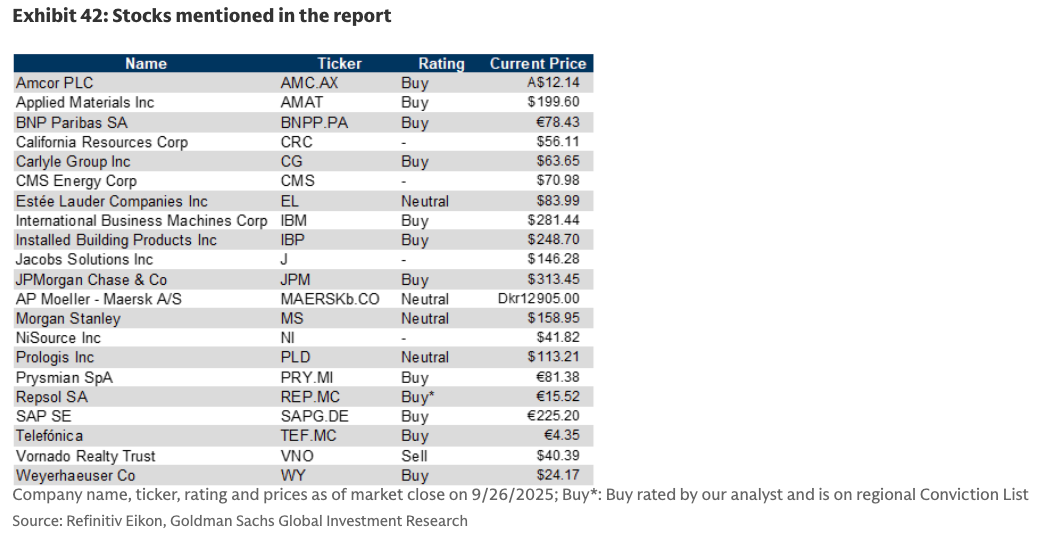
Amcor, Applied Materials, BNP Paribas, California Resources, Carlyle, CMS Energy, CPP Investments, Estée Lauder, Federal Reserve Bank of Dallas, IBM, Installed Building Products, Jacobs Solutions, Japan GX Acceleration Agency, J.P. Morgan, LRQA, Maersk, Morgan Stanley Investment Management, New York State Teachers’ Retirement System, NYC Bureau of Asset Management, NiSource, osapiens, Prologis, Prysmian, Putnam Investments, Repsol, SAP, Telefónica, Temasek, Vornado, Water Asset Management, Weyerhaeuser.
The event reinforced optimism around investable themes that transcend macroeconomic uncertainty, with continued optimism driven by:
Investable thematic opportunities that supersede uncertainty.
Maturation of Sustainable Investing via a greater embrace of nuance towards more performance and investability-linked approaches.
Potential for a more favorable (or less unfavorable) cyclical backdrop.
Four Forum takeaways on the direction of Sustainable Investing:
Sustainability as Investability: Asset manager and corporate focus is shifting from “what’s needed to achieve Sustainable Development Goals” towards “what’s on track and what’s likely,” elevating measurable risk factors, returns implications and preservation of asset value.
Real Economy Impact: Shift from “Reducing Financed Emissions” to “Financing Reduced Emissions.”
Optimism on Sustainability opportunities in private markets.
Corporates remain committed to Sustainable metrics despite recent quieting.
Six Forum thematic takeaways
Accelerating power demand growth, product availability driving All-of-the-Above energy sourcing, with long-term nuclear optimism.
Labor and reskilling is increasingly a potential constraint and differentiator.
AI a disruptor of labor markets and power markets as investors/corporates seek confidence in the extent of AI’s Sustainability benefits.
Adaptation focus increasing — both physical risk and investable opportunities.
Increased confidence in the Reliability (of power and water) theme, with Reliability prioritized over affordability and both reliability/affordability prioritized over decarbonization.
US renewables outlook bullish through 2028, more in debate afterwards. Exhibit 1: We see the confluence of multiple forces impacting Sustainable Investing and the broader economy in 2025, driving opportunity for stocks exposed to themes of Reliability, Efficiency, AI/Automation, Training/Reskilling, Womenomics and Affordability/Access as well as companies that are Quality Operators
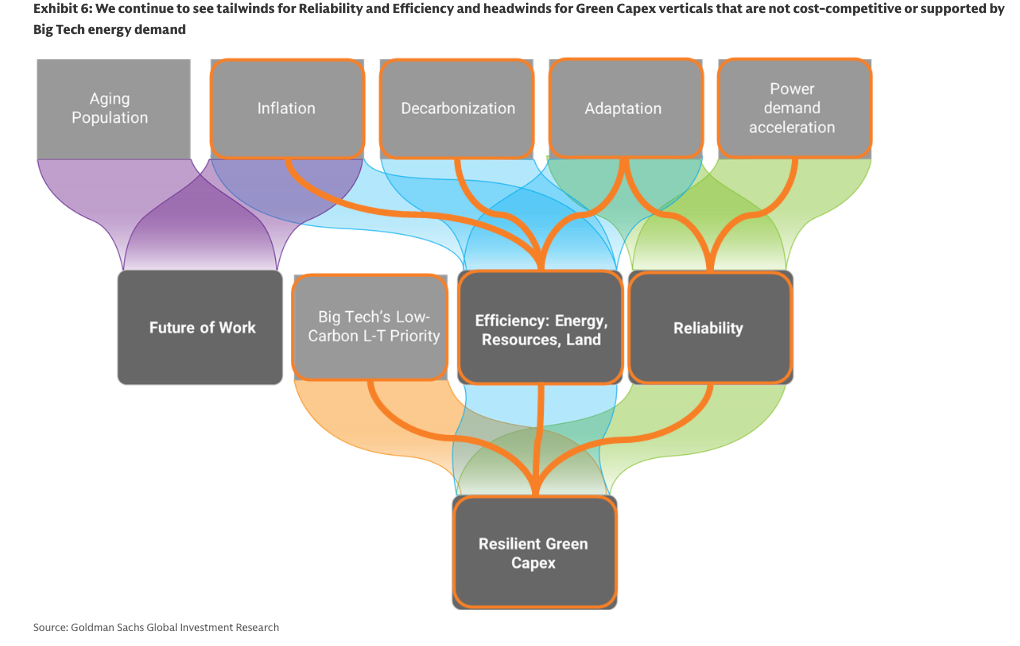
Putting it all together…
Tailwinds for Reliability and Efficiency and headwinds for Green Capex
What the analysts said they learned at the Forum:
In the US, companies generally expect strong renewables investment to continue through 2028. However, there were mixed views as to whether we would see a material step down post 2028 when IRA incentives sunset. Companies appeared more positive on utility-scale solar and battery storage than onshore/offshore wind.
Stocks mentioned in the report.
The full report, with additional charts and detail, is available to ZeroHedge Pro Subs.
Contrary to earlier expectations, global demand for fuel oil has jumped the most since 2019 as longer routes to avoid the Houthi threat around the Red Sea and the surge in shadow fleet numbers have contributed to higher fuel oil use in the shipping industry, analysts tell Reuters.
Ship owners have installed the so-called scrubbers to reduce emissions from fuel oil use instead of significantly boosting the use of marine gasoil and low-sulfur fuel oil (LSFO), according to industry experts.
In the past two years, the geopolitical situation has also contributed to higher fuel oil demand. Vessels began avoiding the Red Sea at the end of 2023 amid Houthi attacks on commercial shipping. That has made the voyage via the Cape of Good Hope in Africa much longer and requires higher fuel oil volumes per trip.
Moreover, a growing number of very old vessels are joining the so-called shadow fleet to transport Russian, Iranian, and Venezuelan oil and oil products. These tankers are inefficient and burn higher fuel oil volumes.
The shadow fleet has expanded significantly since 2023 as the West banned Russian oil imports unless priced below a price cap.
The shadow fleet accounts for about 17% of all in-service oil tankers in the ocean today, according to the research firm S&P Global Market Intelligence. The average age of the shadow vessels is around 20 years, compared with 13 years for the overall global oil fleet.
“Many of these vessels will be proverbial rust buckets that are more than 15 and, in some cases, even older than 20 years,” Eugene Lindell at consultancy FGE told Reuters.
These oil ships are less fuel-efficient and travel on long-haul routes, which further boosts their fuel oil consumption, Lindell added.
Additionally, the major Middle Eastern oil producers, led by Saudi Arabia, use and import growing volumes of fuel oil, including from Russia, as they burn oil for power generation and look to free more of their crude output for exports.
Since being reelected, President Donald Trump has falsely claimed his tariffs will reduce the national debt. Trump is now taking this marketing pitch to sell another one of his economic policies: government ownership in private companies.
On Wednesday, the Energy Department announced that the government will be taking a 5 percent stake in Canadian mining firm Lithium Americas and a 5 percent stake in Thacker Pass, the company’s lithium mining project in Nevada. This equity stake builds on a $2.26 billion loan from the Biden administration Energy Department to the company last year to “help finance the construction of facilities for manufacturing lithium carbonate” at Thacker Pass, which has the largest confirmed lithium reserves in North America. The deal, according to Energy Secretary Chris Wright, will ensure “better stewardship of American taxpayer dollars.”
The White House has taken this messaging further. “This is a creative solution by the president of the United States to tackle our nation’s crippling debt crisis,” White House press secretary Karoline Leavitt said on Wednesday. “The president is focused on how can the United States government make more money, how can we make our country wealthy and rich again? Cutting some of these unique, creative deals with companies around the world and here at home is just one way that the president is seeking to do that.”
These types of “creative deals” have become a hallmark of the second Trump administration. Since Trump’s return to the White House, the federal government has taken a “golden share” of U.S. Steel, granted export licenses to American chipmakers in exchange for a cut of the revenue generated from their sales, and, more recently, became the largest shareholder of Intel by taking a 10 percent stake in the company (worth about $9 billion at the time of acquisition and $17 billion today).
The deals have been justified as a way to protect America’s economic and national security interests, and the Lithium Americas announcement is no different. “It’s in America’s best interest to get that mine built,” Wright toldBloomberg. “Lithium Americas needs to raise some more capital so the mine is financially sound….We’re leaning in with a large amount of debt capital, so it’s just a more commercial transaction.”
Like the other government stakes before it, the economic justification for this deal is flimsy. At the time of the initial Energy Department loan in 2024, global lithium demand was experiencing unprecedented growth, which has continued and is expected to continue as the use of semiconductors, electric vehicles, and renewable energy sources becomes ubiquitous. With the mine expected to produce 400,000 metric tons of battery-grade lithium carbonate each year and generate over $2 billion in revenue (according to a January estimate), there is no reason why taxpayers need to finance a project that the market seems to think will be profitable.
The White House’s argument that this will tackle the “crippling debt crisis” could be even flimsier. Scott Lincicome, vice president of general economics at the Cato Institute, tells Reason that taking a 5 percent stake in a $2 billion project is a “rounding error for our debt problem.” The national debt currently stands at over $30 trillion held by the public. Lincicome points out that “the only way to get money back is by selling the stake, which [the Energy Department] doesn’t plan on doing.” At the end of the day, he adds, this deal has less to do with addressing the national debt and “everything to do with exercising more control over private businesses.”
The White House has made several questionable claims to justify Trump’s takeover of the economy. Arguing that a government stake in an already federally backed project will shrink the national debt could be its weakest argument yet.
Your Hot Tea May Come With A Splash Of Microplastics
There’s nothing quite like a Saturday morning ritual, brewing a pot of green tea and settling into the study with a favorite read, whether it’s “The Creature From Jekyll Island” or “Controligarchs” or a collection of declassified briefings on China’s irregular warfare against the West, or even ZeroHedge lifestyle pieces via Watches of Espionage. While many reach for tea hoping its antioxidants will deliver a health and brain boost, new research suggests a hidden and very dark downside: those generic store-bought tea bags may be a far bigger source of microplastics than previously realized.
Researchers at the University of Birmingham published a new study analyzing 31 different beverages, including coffee, tea, juices, sodas, and energy drinks, and found microplastics in every single one. The biggest disappointment was the discovery of the highest concentrations of microplastics in hot beverages, such as tea and coffee.
Lead researcher Professor Mohamed Abdallah from the University of Birmingham told The Independent, “We noted that a lot of research in the microplastics sphere is focusing on drinking water – tap water, bottled water – and we’ve also released a paper from the UK on water. But we realised that people don’t only drink water during their day. You drink tea, coffee, juices…”
“We found a ubiquitous presence of microplastics in all the cold and hot drinks we looked at. Which is pretty alarming, and from a scientific point of view suggests we should not only be looking at water, we should be more comprehensive in our research because other sources are substantial,” Abdallah explained.
Abdallah and his team found that heat significantly increased plastic shedding from packaging, with polypropylene and PET among the most common polymers found in the drinks.
“This supports previous studies indicating that heat increases microplastic release from packaging materials, thereby suggesting that hot beverages pose a greater risk of microplastic exposure than cold beverages,” the researchers wrote in the report.
He added: “We’re consuming millions of teas and coffees every morning so it’s something to definitely look at. There should definitely be legislative action from the government and also from international organisations to limit human exposure to microplastics … they’re everywhere.”
Other research suggests that microplastics’ impact on health is very damning:
And now, back to tea. Real tea is great – just not the kind laced with glue, ink, or plastics (in other words, most brands on grocery store shelves). That’s why we went out of our way to track down the best microplastics-free option. We found it in Kindred Harvest, and we’ve just added it to the ZeroHedge Store.
Every product we curate is something we personally use – because we know our readers demand the same standards.