Department Of Energy Cancels Another $7.6 Billion In Energy Project Funding

Department Of Energy Cancels Another $7.6 Billion In Energy Project Funding

By Irina Slave of OilPrice.com,

The U.S. Department of Energy has canceled $7.6 billion in funding for previously approved energy projects on the grounds that they would not produce any palpable benefits for Americans.

The canceled projects are 223 in total, approved by various agencies from the Department of Energy during the previous administration. Per this one, however, “these projects did not adequately advance the nation’s energy needs, were not economically viable, and would not provide a positive return on investment of taxpayer dollars.”

“On day one, the Energy Department began the critical task of reviewing billions of dollars in financial awards, many rushed through in the final months of the Biden administration with inadequate documentation by any reasonable business standard,” Energy Secretary Chris Wright said.

The Department of Energy reported that 26% of all the projects canceled were awarded between Election Day, in November 2024, and Inauguration Day, in January this year.

“President Trump promised to protect taxpayer dollars and expand America’s supply of affordable, reliable, and secure energy. Today’s cancellations deliver on that commitment. Rest assured, the Energy Department will continue reviewing awards to ensure that every dollar works for the American people,” Wright added.

This is not the first project cancellation since the new administration took over. Earlier this year, the DoE canceled another 24 energy projects worth over $3.7 billion in government funding. The list, by the way, included a project proposed by Exxon for the production of low-carbon hydrogen at a petrochemicals facility.

Meanwhile, the government shutdown that began yesterday has paused approvals for new wind and solar projects, although oil and gas leases are still on schedule, according to the Bureau of Ocean Energy Management. The agency said it would use carryover funds to maintain work on “priority conventional energy projects,” including offshore drilling in the Gulf of Mexico and Alaska, even as more than 70% of its staff are furloughed.

Tyler Durden
Thu, 10/02/2025 – 18:05

via ZeroHedge News https://ift.tt/3DbMpfn Tyler Durden

Copper Highest In Year On Supply Disruptions Collide With AI And Power Grid Demand

Copper Highest In Year On Supply Disruptions Collide With AI And Power Grid Demand

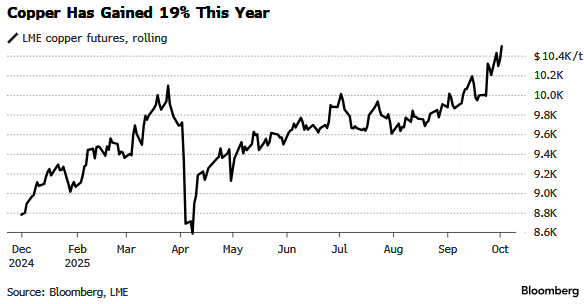
Copper futures on the London Metal Exchange rose above $10,500 a ton – the highest since May 2024 – driven by a mix of investing themes, macro tailwinds, and worsening supply outlook. 

Freeport-McMoRan’s (FCX) recent force majeure declaration at Indonesia’s giant Grasberg mine, the world’s second-largest copper source, adds to mounting disruptions already squeezing the market. Add growing demand from AI data centers and grid upgrades, and the shiny industrial metal looks poised for further upside.

Last week, Goldman’s commodity specialist James McGeoch called the Grasberg mine incident a “black swan event”… The full note can be read here


The Grasberg mine open pit

The Grasberg mine incident highlights the copper market’s vulnerability to global supply shocks and is just the latest disruption to the industry. It follows Hudbay Minerals’ disclosure last month that it was shutting operations at a mill at its Constancia mine site in Peru due to ongoing social unrest.

Supply woes for the industrial metal are colliding with rising demand for “The Next AI Trade” and “Powering Up America” themes, and more recently, Goldman told clients that the power grid is a “vulnerable link in energy security.”

In other words, analysts Lina Thomas and Daan Struyven told clients last week, “The need to invest in the power grid – a vulnerable link in the energy supply chain – and the associated metals demand boost are becoming more acute with the rise of AI, geopolitical tensions, and the shift to hybrid warfare.” 

Both analysts pointed out that with AI and defense putting the power grid at the center of energy security, copper is the new oil. 

“Such grid upgrades are metals-intensive: we expect grid and power infrastructure to drive ~60% of global copper demand growth through the end of the decade, adding the equivalent of another US to global demand and underpinning our bullish copper price forecast of $10,750/t by 2027,” they said. 

With that being said. Copper prices are marching higher.

. . . 

Tyler Durden
Thu, 10/02/2025 – 17:40

via ZeroHedge News https://ift.tt/yS0V5nm Tyler Durden

How To Broker A Gerrymandering Ceasefire

How To Broker A Gerrymandering Ceasefire

Authored by Andy Jackson via RealClearWire,

The United States is in the middle of another round of the redistricting wars. 

This latest battle began in late August. The Texas legislature approved maps that will likely result in five additional Republicans being elected to Congress. In response, the California legislature passed a plan that would likely result in five Republicans being replaced with Democrats. The California plan is subject to voter approval in November.

Those appear to be just the opening salvos in the mid-decade redistricting fight, as other states look to jump into the fray

It is time for a ceasefire.

But how?

Many redistricting reform advocates have focused on changing who draws the maps. They have called for redistricting commissions to take that responsibility away from state legislatures.

Commissions are not a panacea, however. They are often unaccountable, with members usually serving temporarily and not subject to being fired, recalled, or defeated for reelection. They can also be manipulated by partisan groups that infiltrate hearings pretending to be ordinary citizens.

Nor do commissions guarantee states protection from lawsuits. For example, a group of citizens successfully sued the Michigan Independent Citizens Redistricting Commission for racial gerrymandering in 2023. 

More important than the “who” of redistricting is the “what.” What are the standards being used to draw districts?

On the heels of the last midterm election, I co-authored a comprehensive report on limiting gerrymandering for North Carolina, but its criteria can be applied to any state.

Those criteria can be divided into two broad categories. The first is that districts should be tied to local communities. Statewide considerations, such as creating maps with the “correct” partisan balance, should not subsume local interests. To that end, states must be required to minimize splitting counties, municipalities, and voting precincts. Districts should also be as compact as possible, consistent with keeping political communities whole. Many states follow those criteria in word but bend them to partisan considerations in practice.

Second, the use of partisan data, such as voter registration numbers and election results, should be banned. Partisan data is helpful only for those seeking to reach some predetermined goal regarding the partisan distribution of legislative seats or to ensure that certain districts elect candidates from a favored party. While gerrymandering has been with us for centuries, the advent of computer mapping programs and the data fed into them made gerrymandering the precision weapon it is today.

Additionally, maps should be drawn openly on computers that the public can view in person and online, and mid-decade redistricting should be banned absent a court order.

Redistricting reform should also be implemented nationwide. That can be done in two ways. The first is through an act of Congress, putting conditions on how states draw congressional districts.

One weakness of that approach is that the Elections Clause of the Constitution permits Congress to alter the rules only for electing U.S. representatives, so redistricting for state legislative districts would be unaffected.

Another approach would be an interstate compact. The compact would have a trigger clause to go into effect only if states representing a majority of congressional districts join and those districts are roughly evenly split between Democrats and Republicans.

Either approach would involve federal courts as an enforcement mechanism. While the United States Supreme Court pointed out in Rucho v. Common Cause that “federal courts are neither equipped nor authorized to apportion political power as a matter of fairness,” they would have an appropriate role in ruling on violations of federal law or liability for breaking interstate compacts. That court presence would force states to adhere to redistricting standards, including those they are already supposed to be following.

However we arrive at a truce in the redistricting wars, we should seek it before the 2028 presidential election. The president’s party usually suffers in midterm elections. The last pre-redistricting midterm election in 2010, during Barack Obama’s first term, led to Republican dominance of the redistricting process. 

We have little idea of how that pendulum might swing before 2028. That uncertainty should incentivize both sides to reach an agreement out of fear that the other side could dominate redistricting in 2031 without such a deal. 

It won’t be easy to convince partisan politicians to put down their map-drawing arms, but it is worth the effort to get the high-tech redistricting wars behind us.

Andy Jackson is the director of the Civitas Center for Public Integrity at the John Locke Foundation in Raleigh, N.C.

Tyler Durden
Thu, 10/02/2025 – 17:15

via ZeroHedge News https://ift.tt/NSuAce8 Tyler Durden

The White House Thinks Taking Partial Ownership of a Canadian Mining Company Will Reduce the National Debt


10-2-25-v2-c | Illustration: Eddie Marshall | Midjourney

Since being reelected, President Donald Trump has falsely claimed his tariffs will reduce the national debt. Trump is now taking this marketing pitch to sell another one of his economic policies: government ownership in private companies. 

On Wednesday, the Energy Department announced that the government will be taking a 5 percent stake in Canadian mining firm Lithium Americas and a 5 percent stake in Thacker Pass, the company’s lithium mining project in Nevada. This equity stake builds on a $2.26 billion loan from the Biden administration Energy Department to the company last year to “help finance the construction of facilities for manufacturing lithium carbonate” at Thacker Pass, which has the largest confirmed lithium reserves in North America. The deal, according to Energy Secretary Chris Wright, will ensure “better stewardship of American taxpayer dollars.”

The White House has taken this messaging further. “This is a creative solution by the president of the United States to tackle our nation’s crippling debt crisis,” White House press secretary Karoline Leavitt said on Wednesday. “The president is focused on how can the United States government make more money, how can we make our country wealthy and rich again? Cutting some of these unique, creative deals with companies around the world and here at home is just one way that the president is seeking to do that.”

These types of “creative deals” have become a hallmark of the second Trump administration. Since Trump’s return to the White House, the federal government has taken a “golden share” of U.S. Steel, granted export licenses to American chipmakers in exchange for a cut of the revenue generated from their sales, and, more recently, became the largest shareholder of Intel by taking a 10 percent stake in the company (worth about $9 billion at the time of acquisition and $17 billion today)

The deals have been justified as a way to protect America’s economic and national security interests, and the Lithium Americas announcement is no different. “It’s in America’s best interest to get that mine built,” Wright told Bloomberg. “Lithium Americas needs to raise some more capital so the mine is financially sound….We’re leaning in with a large amount of debt capital, so it’s just a more commercial transaction.”

Like the other government stakes before it, the economic justification for this deal is flimsy. At the time of the initial Energy Department loan in 2024, global lithium demand was experiencing unprecedented growth, which has continued and is expected to continue as the use of semiconductors, electric vehicles, and renewable energy sources becomes ubiquitous. With the mine expected to produce 400,000 metric tons of battery-grade lithium carbonate each year and generate over $2 billion in revenue (according to a January estimate), there is no reason why taxpayers need to finance a project that the market seems to think will be profitable. 

The White House’s argument that this will tackle the “crippling debt crisis” could be even flimsier. Scott Lincicome, vice president of general economics at the Cato Institute, tells Reason that taking a 5 percent stake in a $2 billion project is a “rounding error for our debt problem.” The national debt currently stands at over $30 trillion held by the public. Lincicome points out that “the only way to get money back is by selling the stake, which [the Energy Department] doesn’t plan on doing.” At the end of the day, he adds, this deal has less to do with addressing the national debt and “everything to do with exercising more control over private businesses.”

The White House has made several questionable claims to justify Trump’s takeover of the economy. Arguing that a government stake in an already federally backed project will shrink the national debt could be its weakest argument yet.

The post The White House Thinks Taking Partial Ownership of a Canadian Mining Company Will Reduce the National Debt appeared first on Reason.com.

from Latest – Reason.com https://ift.tt/TqgMrSp
via IFTTT

“Blatant Fraud”: USCIS Operation Uncovers Fraud In 44% Of Pending Immigration Cases In Minneapolis

“Blatant Fraud”: USCIS Operation Uncovers Fraud In 44% Of Pending Immigration Cases In Minneapolis

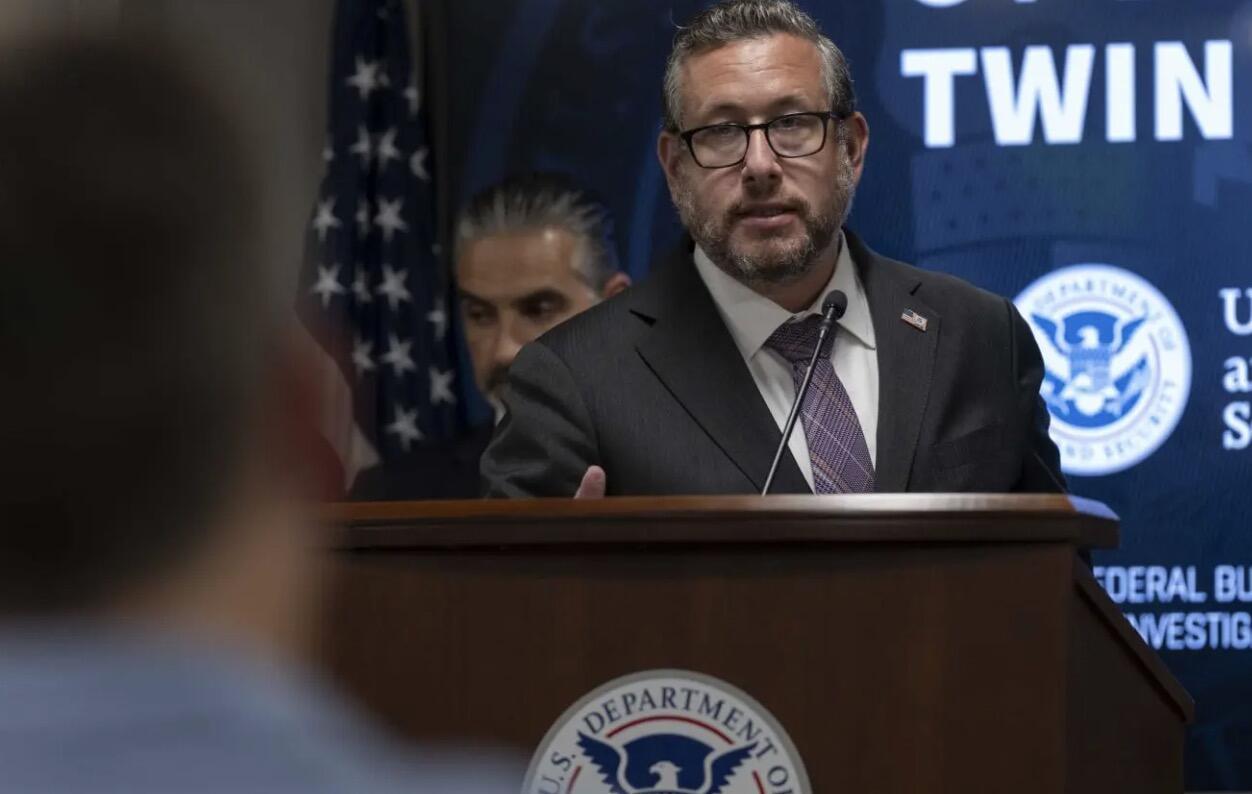
U.S. Citizenship and Immigration Services (USCIS), working with U.S. Immigration and Customs Enforcement (ICE) and the FBI, has announced the results of Operation Twin Shield, a large-scale fraud detection effort conducted across Minneapolis-St. Paul from September 19 to 28. Minneapolis is home to one of the largest Somali communities in the U.S., reflected in the election of Ilhan Omar, a Somali-American who became the first refugee and one of the first Muslim women elected to Congress.

The operation marked the first targeted surge of its kind, with immigration officers investigating more than 1,000 pending cases flagged for fraud or ineligibility concerns, according to U.S. Citizenship and ImmigrationUSCIS said officers carried out over 900 site visits and interviews, uncovering fraud, non-compliance, or security issues in 275 cases—about 44 percent of those reviewed.

As of now, USCIS has issued Notices to Appear or referred 42 cases to ICE, with four individuals taken into custody. The agency expects those numbers to increase as administrative investigations are completed. The effort focused on marriage and family-based petitions, employment authorizations, and certain parole requests, in line with Executive Order 14161, which emphasizes protecting the United States from terrorist, national security, and public safety threats.

USCIS announced in a release this week that officials said the operation exposed a wide range of schemes. In one case, a man admitted to paying $100 for a falsified Kenyan death certificate to claim a marriage had ended; his spouse, still alive and living in Minneapolis with their five children, was very much present.

Another case involved the son of a known or suspected terrorist who overstayed his visa and had previously been denied multiple immigration benefits for marriage fraud. A petitioner confessed to marriage fraud only hours after swearing during a USCIS interview that her marriage was genuine. In yet another case, an immigrant manipulated an elderly U.S. citizen spouse in a fraudulent marriage that also involved elder abuse.

“USCIS is declaring an all-out war on immigration fraud. We will relentlessly pursue everyone involved in undermining the integrity of our immigration system and laws. With help from ICE and the FBI, USCIS’ Operation Twin Shield was a tremendous success—hundreds of bad actors will be held accountable,” said USCIS Director Joseph B. Edlow.

“Immigration fraud undermines the integrity of our lawful immigration system, harms those who follow the law, and poses risks to national security and public safety. Under President Trump, we will leave no stone unturned.”

According to USCIS, this is the first time the agency has deployed resources at this scale in one geographic region. Officials emphasized that, unlike during the Biden administration, immigration officers are now empowered to thoroughly vet applicants as required by law and to pursue immigration fraud wherever it is encountered.

Tyler Durden
Thu, 10/02/2025 – 16:50

via ZeroHedge News https://ift.tt/ynhWEYl Tyler Durden

Generals Gathered In Their Masses…

Generals Gathered In Their Masses…

Authored by Daniel McAdams via The Ron Paul Institute,

On Tuesday we observed one of the strangest spectacles of our time. President Trump and his “Secretary of War,” Pete Hegseth, called a mandatory meeting of all the top brass in the US military. Some 800+ general officers, admirals, and the like gathered at Marine Corps Base Quantico in Virginia for a doubleheader talk from Hegseth and Trump.

Because such an event is nearly unprecedented – at least in peacetime – the days leading up to the meeting were increasingly filled with speculation and even dread.

Tensions between the US and Russia are soaring over reports that the Trump Administration may provide and assist in the launching of Tomahawk missiles – capable of both hitting Moscow and of carrying nuclear weapons. The Putin Administration pointed out the obvious: such weapons would require the active participation of US intelligence as well as trained US or NATO personnel and should they be used would bring Russia and the US/NATO to a state of war. It is a war that, given both US and Russian nuclear doctrine, could very quickly rise to the level of an exchange of nuclear weapons and total destruction.

Likewise, media reports and observers of the movement of military equipment have been raising a red flag over the past several days on the massive movement of US fighter jets and aerial refueling tankers from the US toward the Middle East. Observers point out the similarity to the days leading up to the US attack on Iran in late June, just over three months ago. With Israeli president Benjamin Netanyahu in town earlier this week, has President Trump been talked into again joining Israel in its war on its neighbors?

Additionally, US warships have been gathered off the coast of Venezuela for weeks and at least three speedboats accused of running narcotics have been blown out of the water by the US military. The New York Times reported on stepped up US efforts to overthrow the Venezuelan government and install a new leader (as the Trump team attempted and failed in his first term). Media outlets are reporting that the Trump Administration is even considering military strikes deep inside Venezuela, which would of course be unprovoked acts of war.

What to expect of the gathering of the generals? Many of us waited at the edge of our seats.

What we were able to see was a pair of not particularly well-prepared – and less well-received – speeches by Trump and Hegseth on transforming the US military into a “MAGA” force and the evils of late middle-aged rotundity among senior military personnel. The crass treatment of America’s tip military officers – whether some deserved criticism or not – will likely have an effect opposite of what was intended.

The pauses in the pre-prepared speeches meant to allow for applause were met with stony silence.

Fat-shaming and chest-pounding is not the way to go about building esprit de corps in the US military. Especially when such a dressing-down was broadcast to the rest of the country via live video hook-up.

But what if some of our initial sense of dread was not misplaced? In his essential Sonar21 blog, former CIA officer Larry Johnson wonders whether there was a (very) public message delivered to conceal a secret and more dangerous message.

First Johnson quotes Yves Smith of the Naked Capitalist blog:

After Charlie Kirk, perhaps I have become too fond of complicated theories.

But it’s ludicrous to have called so many senior guys in for such a silly agenda. A stern memo and/or video sessions would have done. 

So the big stoopid meeting, IMHO was to cover for a smaller gathering that had to be done in person. And where whoever was summoned would be a big tell as to what the focus was.

Johnson then signals his agreement with the speculation:

No, Yves… I think you nailed it. Besides the massive US naval force parked off the coast of Venezuela, we are now hearing that US tanker aircraft are flying to the Middle East via England. We saw the same phenomena in the days preceding the June 24 attack on Iran.

If the Trump administration is planning a coordinated attack on Venezuela and Iran, the commanders of USCENTCOM and USSOUTHCOM would be involved. While the plans for such attacks could have been discussed over a SVTCS (i.e., Secure Video Teleconferences), those sessions usually have dozens of straphangers watching. If you want to keep close hold on such planning, you do it in person. If the CENTCOM and SOUTHCOM commanders had been called to Washington alone, the odds are high that someone would have reported this. With the presence of the US naval force off the coast of Venezuela and the movement of US aircraft towards the Persian Gulf, this likely would have attracted unwanted attention…

What Larry Johnson writes here makes a good deal of sense. Even in Trump World, spending millions of dollars to publicly dress-down the US military makes little sense. A memo or video hook-up would have been far more effective and less disruptive.

Was the real purpose of this spectacle to hold a secret side meeting to give orders for an impending, multi-continental war? We’ll know soon…

*  *  *

Tyler Durden
Thu, 10/02/2025 – 16:25

via ZeroHedge News https://ift.tt/xE0aPmv Tyler Durden

Fifth Circuit Will Rehear Alien Enemies Act Case En Banc

AI-generated image.

Earlier this week the US Court of Appeals for the Fifth Circuit decided to grant an en banc rehearing in W.M.M. v. Trump. The panel decision in that case ruled that Trump’s invocation of the Alien Enemies Act of 1798 was illegal, because illegal migration and drug trafficking and other activities of the Venezuelan drug gang Tren de Aragua do not qualify as a war, “invasion,” or “predatory incursion.” The AEA can only be used to detain and deport immigrants when one of these extraordinary conditions, or a threat thereof, exists.The case will now be reheard by all 17 active Fifth Circuit judges.

In an amicus brief I coauthored in the case on behalf of the Brennan Center, the Cato Institute, and others, we argue that “invasion” and “predatory incursion” require a military attack, and that courts should not defer to presidential assertions that these extraordinary conditions exist. As James Madison put it in addressing this issue, “invasion is an operation of war.”

Otherwise, the AEA and the Constitution’s grant of extraordinary emergency powers when an “invasion” exists could be invoked by the president anytime he wants, thereby creating grave dangers to civil liberties and to the separation of powers. For example, the Constitution states that, in the event  of “invasion,” the federal government can suspend the writ of habeas corpus, thereby authorizing indefinite detention without due process – not only of recent immigrants, but also US citizens.

Prominent conservative Judge Andrew Oldham wrote a lengthy dissent to the panel decision, arguing that the definition of “invasion” and other terms in the AEA is left to the unreviewable discretion of the executive. I outlined some key flaws in his argument here. In a solo concurring opinion in United States v. Abbott, a previous Fifth Circuit en banc case, Judge James Ho, another well-known conservative, similarly argued  the definition of “invasion” is an unreviewable “political question,” left to the determination of the executive, and also of state governments (under Ho’s approach, they too can claim and “invasion” exists whenever there is illegal migration or drug smuggling). I criticized Judge Ho’s reasoning here.

Both Ho’s approach and Oldham’s would give the president (and, in Ho’s case, also state governments) unlimited authority to declare an “invasion” at any time, and thereby wield sweeping authority to undermine civil liberties and the separation of powers. The federal government could use this power to detain and deport even legal immigrants, and to suspend the writ of habeas corpus (including for US citizens). Under the Constitution, in the event of “invasion” state governments can “engage in war” even without congressional authorization. I wrote about the dangers of that in greater detail here, as well as in the amicus brief.

Such vast unilateral authority goes against the text and original meaning of both the Constitution and the Alien Enemies Act. British violations of the writ of habeas corpus were one of the main grievances that led to the American Revolution, and the Founding Fathers did not intend to give the president  the power to replicate those abuses anytime he might want.

I will have more to say about these issues as the AEA litigation continues in this case and in other cases currently before various federal courts. We will likely file an updated version of our amicus brief before the en banc Fifth Circuit.

The post Fifth Circuit Will Rehear Alien Enemies Act Case En Banc appeared first on Reason.com.

from Latest – Reason.com https://ift.tt/L4JCjkd
via IFTTT

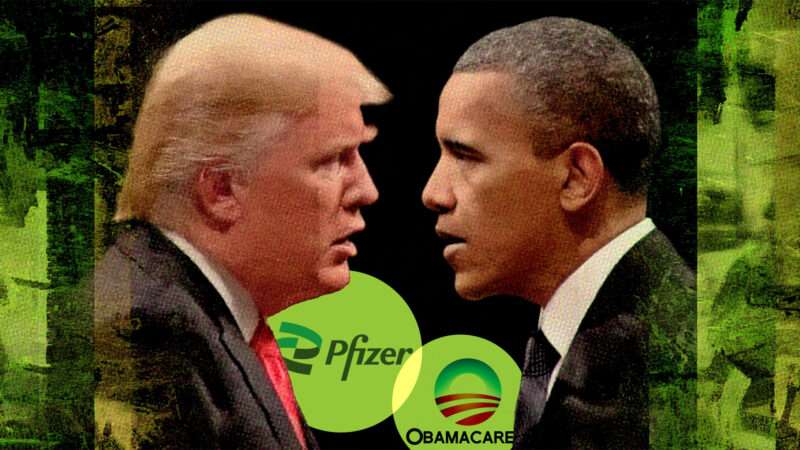
TrumpRx Is Obamacare in Trump’s Handwriting


Picture of Donald Trump facing a picture of Barack Obama | Eddie Marshall | Midjourney

This week, President Donald Trump announced the next in a long line of vanity projects: TrumpRX, a forthcoming, federally branded website where Pfizer sells steeply discounted drugs in exchange for a three-year exemption from his proposed 100 percent tariffs on imported pharmaceuticals. Imagine a strip mall furniture store with a permanent, flashy 70-percent-off sale, masking the fact that prices were inflated in the first place. TrumpRx, slated to launch in early 2026, is no different—a government-run platform that promises savings while hiding costs.

But this isn’t just another Trump-branded vanity project like the ill-fated Trump Steaks or Trump University. It’s a wild pivot in right-leaning political thought on health care, and it’s a gut punch for those who see where this road leads.

Flash back to 2016: Trump hammering the Affordable Care Act, calling it a “disaster” and suggesting that the government’s only role should be to ensure these companies have “plenty of money.” He was channeling what economists had long warned: Government-run health care distorts markets, creates perverse incentives, and collapses under its own weight. Now, the president is embracing the very heavy-handed tactics he once trashed.

What is TrumpRx?

TrumpRx isn’t healthcare reform or even a program in any real sense. It’s a carve-out for one company. Under the agreement, Pfizer will list a large share of its primary care and select specialty drugs at deep discounts on a federal site that redirects patients to Pfizer’s direct-to-consumer checkout. 

Examples of savings floated by the administration include Xeljanz (list price of $6,073/month) for arthritis and other conditions at about 40 percent off, Eucrisa (list price of $692) for eczema at $162 on TrumpRx, and newer brands like Zavzpret for migraines and Duavee for symptoms of menopause, included in the mix. In return, Pfizer receives a three-year grace period from the pharmaceutical tariffs while pledging $70 billion in U.S. manufacturing and research and development.

It’s a protection racket in reverse. The president rattles his tariff saber, Pfizer pays its tribute in the form of price cuts, and voilà, TrumpRx is born.

Who Does This Help?

The savings are shaky because that money has to come from somewhere. Part of it, certainly, is just the market advantage of being exempted from a 100 percent tax that all your competitors are forced to pay. Any savings beyond that will be carved out of something else—less research, higher prices on other drugs, or hidden costs buried elsewhere in the system. 

And for most people, the ‘discounts’ aren’t really discounts. Roughly 90 percent of Americans are insured, and their co-pays are almost always cheaper than TrumpRx’s cash prices. Medicaid patients already get the steepest rebates—more than 60 percent off by law—so TrumpRx adds little there. That leaves the approximately 27 million uninsured Americans. 

But even for the uninsured, the math falls apart: A $6,000 arthritis drug at “half price” is still $3,000 in cash, a stretch on any budget. Eucrisa at $162 on TrumpRx beats few insurance copays. And $499/month for Wegovy (semaglutide) on TrumpRx compares poorly to the $25 many insured patients now pay. And all of this bypasses the way Americans actually get prescriptions. CVS, Walgreens, and the rest are cut out entirely, replaced by a federally branded coupon pop-up that punts you to a manufacturer’s checkout page. TrumpRx looks like a deal, but in practice, it helps almost no one.

Obamacare Déjà Vu

If this sounds familiar, it’s because the blueprint was drawn a decade ago. Washington shoved through the Affordable Care Act (ACA) with the same central-planning arrogance, resting on monopolistic dealmaking and government-dictated price regulation

Trump was one of the ACA’s loudest critics. He called it a “disaster” and “virtually useless” in 2017, and was still posting “Obamacare sucks” in 2023. He was, for all his bluster, correct.

But he never took the time to understand the economics of the mistake, and now, he’s repeating it. TrumpRx employs the same toolkit: One company receives favorable treatment, the government demands discounts in exchange for tariff protection, and Washington exerts raw power with no regard for the consequences. This leads to squeezed margins, less research, smaller generic drugs being driven out, and higher prices in the long run.

The very hallmarks of Obamacare will now be repackaged in Trump’s flamboyant font and splashed across a Trumpian website. And where the ACA at least feigned some homage to competition, creating a “marketplace” of options, Trump’s brand picks a single winner.

A Surrender of Principle

The problem isn’t just hypocrisy. Nor is it merely the absurdity of the federal government running what looks like a late-night Amazon scam site. The real problem is what it represents in the long war against socialized medicine. For decades, those who opposed socialized medicine fought a grinding war of attrition. Now it’s seeped into every school, bar, and Thanksgiving table. The momentum behind universal healthcare is moving through the zeitgeist like a Labubu meme.

In this existential tug-of-war, we held a death grip on the premise that markets, not Washington, deliver innovation and lower costs. Slowly, painfully, that grip has loosened. Obamacare pulled the rope through our hands a bit. Now, TrumpRx threatens to rip it out completely.

TrumpRx isn’t just bad policy—it’s a surrender of principle. It cedes ground, conceding that drug prices need government fiat to be “affordable” and that picking winners is sound economics. It’s HealthCare.gov with Trump’s name on it instead.

Once you concede that Washington can strong-arm markets into submission, the case for competition weakens. TrumpRx doesn’t solve America’s drug-pricing crisis; it’s a tariff-driven coupon site with all the dignity of a clearance sale. If Trump wants to run healthcare like a strip mall furniture store, he may find the banners soon read, “Going out of business.”

The post TrumpRx Is Obamacare in Trump's Handwriting appeared first on Reason.com.

from Latest – Reason.com https://ift.tt/FC38i5x
via IFTTT
Gavin Newsom Loves AI Satire Now!


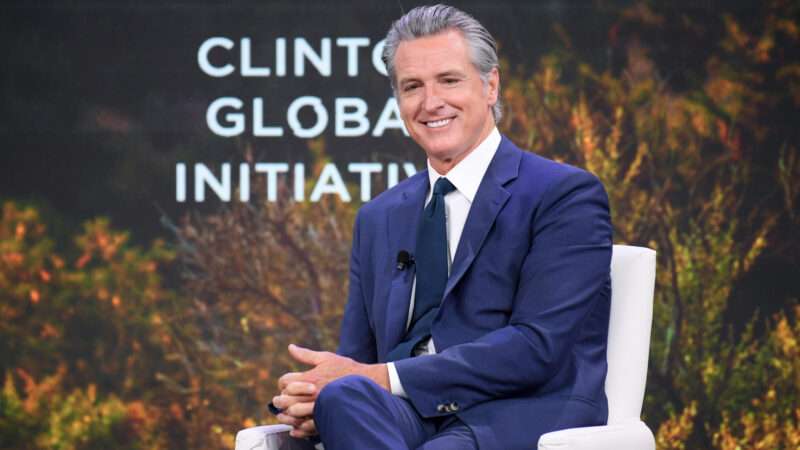
Gavin Newsom | Efren Landaos/Sipa USA/Newscom

It looks like California Gov. Gavin Newsom has learned to stop worrying and love fake, AI-generated political satire videos—or at least, he loves them enough to share one on X.

Newsom has discovered a meme streak that is positively Trump-ian as of late, and now constantly publishes troll-ish posts on social media, with the aim of getting under the president’s skin and also calling attention to himself; he seems to be succeeding on this second goal, and is currently arguably the front-runner for the Democratic presidential nomination in 2028.

Here was his latest contribution: a heavily manipulated video of Vice President J.D. Vance discussing the government shutdown. (Note the squeaky voice and cartoonish wardrobe embellishments.)

There’s nothing wrong with this, of course. Newsom is free to use his own speech to belittle Trump, Vance, or anyone else. The irony, however, is that Newsom adamantly tried to prevent other people from doing something incredibly similar.

Indeed, Newsom is a major advocate of legislation to criminalize so-called deep fakes: convincing misrepresentations of other people on social media. In the midst of Kamala Harris’s 2024 presidential campaign, Elon Musk retweeted a fake, AI-engineered video of Harris appearing to admit to being a DEI pick; the video used AI to accurately mimic her voice. Newsom wrote on X that this should be illegal, and shared that he would soon be banning the practice in California. Sure enough, the governor signed the deep fake bill into law a few weeks later.

Unfortunately for Newsom, the First Amendment broadly protects political satire, even if the underlying speech is wrong or misleading. And so a federal judge struck down the law—just in time for Election Day—noting that it “hinders humorous expression and unconstitutionally stifles the free and unfettered exchange of ideas.”

Now that the governor is enjoying channeling his inner troll, perhaps he has gained more appreciation for this right. One can perhaps argue that the optics of the Vance video make it much more obviously fake than the sound from the Harris video, but this is a difference of distinctions. It’s key that the widest possible latitude be given to speech that makes fun of politicians, as there is no kind of expression more obviously protected by the First Amendment.


This Week on Free Media

I’m joined by Amber Duke and Niall Stanage to process the news of the week. Check out the Free Media YouTube channel, which now features news collaborations with Duke, Stanage, and also Reason‘s Andrew Heaton.


Worth Watching

I am hard at work on the novel I vowed to write two weeks ago: In fact, I’ve actually already written about 18,000 words. I imagine it will be at least 100,000 words when I’ve finished. It feels really refreshing to be working on a creative project again. Last night I stayed up way, way too late writing it, as I realized very suddenly that I was going to reveal a notable side character as evil, and I was determined to make it to the scene where he outs himself.

The post Gavin Newsom Loves AI Satire Now! appeared first on Reason.com.

from Latest – Reason.com https://ift.tt/TzOjZ6r
via IFTTT

Fifth Circuit Will Rehear Alien Enemies Act Case En Banc

AI-generated image.

Earlier this week the US Court of Appeals for the Fifth Circuit decided to grant an en banc rehearing in W.M.M. v. Trump. The panel decision in that case ruled that Trump’s invocation of the Alien Enemies Act of 1798 was illegal, because illegal migration and drug trafficking and other activities of the Venezuelan drug gang Tren de Aragua do not qualify as a war, “invasion,” or “predatory incursion.” The AEA can only be used to detain and deport immigrants when one of these extraordinary conditions, or a threat thereof, exists.The case will now be reheard by all 17 active Fifth Circuit judges.

In an amicus brief I coauthored in the case on behalf of the Brennan Center, the Cato Institute, and others, we argue that “invasion” and “predatory incursion” require a military attack, and that courts should not defer to presidential assertions that these extraordinary conditions exist. As James Madison put it in addressing this issue, “invasion is an operation of war.”

Otherwise, the AEA and the Constitution’s grant of extraordinary emergency powers when an “invasion” exists could be invoked by the president anytime he wants, thereby creating grave dangers to civil liberties and to the separation of powers. For example, the Constitution states that, in the event  of “invasion,” the federal government can suspend the writ of habeas corpus, thereby authorizing indefinite detention without due process – not only of recent immigrants, but also US citizens.

Prominent conservative Judge Andrew Oldham wrote a lengthy dissent to the panel decision, arguing that the definition of “invasion” and other terms in the AEA is left to the unreviewable discretion of the executive. I outlined some key flaws in his argument here. In a solo concurring opinion in United States v. Abbott, a previous Fifth Circuit en banc case, Judge James Ho, another well-known conservative, similarly argued  the definition of “invasion” is an unreviewable “political question,” left to the determination of the executive, and also of state governments (under Ho’s approach, they too can claim and “invasion” exists whenever there is illegal migration or drug smuggling). I criticized Judge Ho’s reasoning here.

Both Ho’s approach and Oldham’s would give the president (and, in Ho’s case, also state governments) unlimited authority to declare an “invasion” at any time, and thereby wield sweeping authority to undermine civil liberties and the separation of powers. The federal government could use this power to detain and deport even legal immigrants, and to suspend the writ of habeas corpus (including for US citizens). Under the Constitution, in the event of “invasion” state governments can “engage in war” even without congressional authorization. I wrote about the dangers of that in greater detail here, as well as in the amicus brief.

Such vast unilateral authority goes against the text and original meaning of both the Constitution and the Alien Enemies Act. British violations of the writ of habeas corpus were one of the main grievances that led to the American Revolution, and the Founding Fathers did not intend to give the president  the power to replicate those abuses anytime he might want.

I will have more to say about these issues as the AEA litigation continues in this case and in other cases currently before various federal courts. We will likely file an updated version of our amicus brief before the en banc Fifth Circuit.

The post Fifth Circuit Will Rehear Alien Enemies Act Case En Banc appeared first on Reason.com.

from Latest – Reason.com https://ift.tt/L4JCjkd
via IFTTT