White House Puts Vance At Helm To ‘Drive [Shutdown] Fight Home’

White House Puts Vance At Helm To ‘Drive [Shutdown] Fight Home’

Authored by Philip Wegmann via RealClearPolitics,

Historically, no one really wins a government shutdown. But JD Vance might. In the 24 hours after Senate Democrats voted against a continuing resolution to keep the federal lights on, the vice president quickly became the face of the White House counterargument.
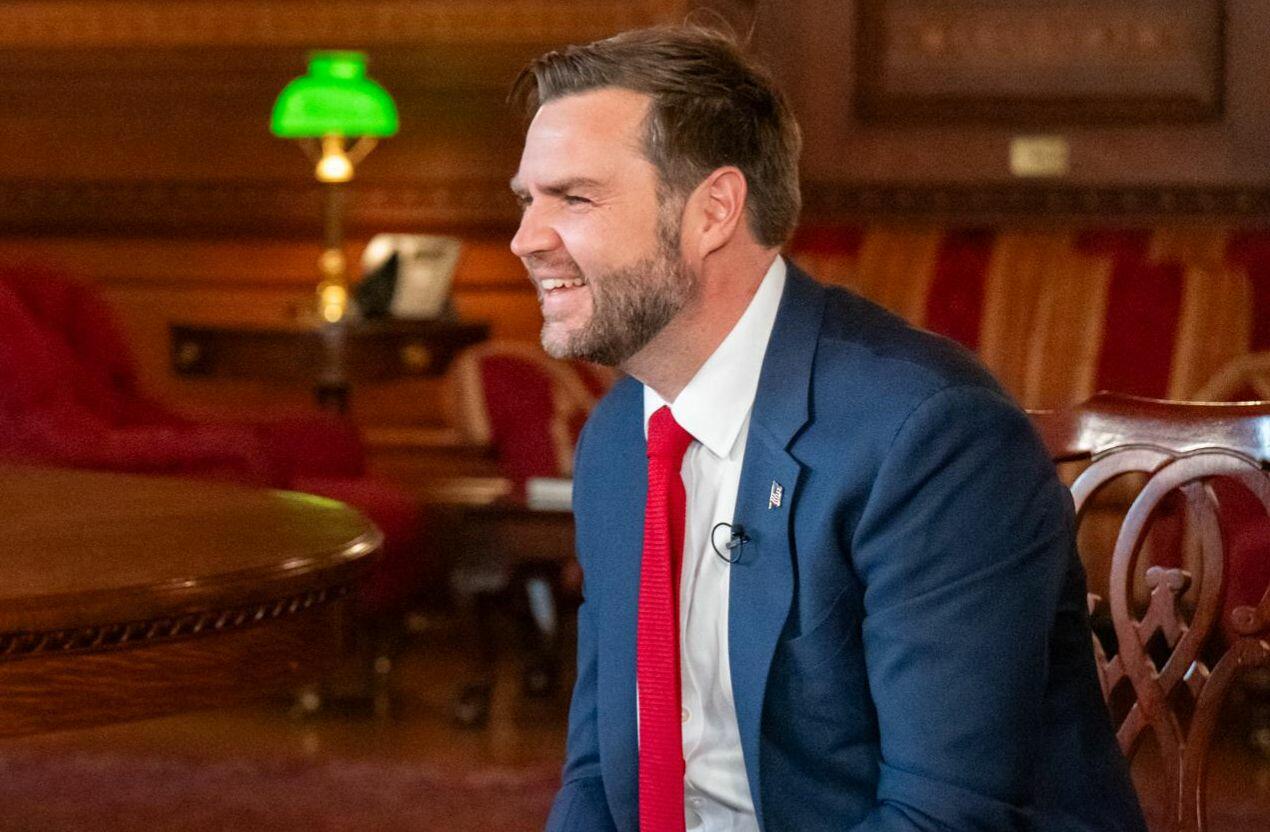
Vance began the day on Fox and Friends to blast Democrats for taking the government “hostage.” By midmorning, he was rallying the MAGA base during an appearance on The Ben Shapiro Show, where he predicted that Democratic resolve was “cracking.” In the afternoon, the vice president made a surprise appearance in the White House briefing room.

Reporters were only tipped off moments before when an advance staffer set up the ceremonial flag of the vice president behind the podium. According to sources familiar with the day’s planning, White House Press Secretary Karoline Leavitt invited Vance to meet the press in person.

The shutdown may amount to the first real crisis of the second Trump administration. The White House feels they have the upper hand because they are not the ones who caused it and because they have an ace up their sleeve in Vance.

Another source familiar with the strategy told RealClearPolitics that the vice president “is widely known as the administration’s bulldog, a natural, excellent messenger, maintains good relationships with his former Senate colleagues, and served in the Senate throughout multiple government funding debates.”

It only makes sense for Vance to help President Trump drive this fight home,” they added. And if Vance succeeds as the administration’s point man in that debate, it could go a long way towards further cementing the expectation that Trump’s apprentice will become his MAGA heir.

But the squabble in question is a little different than the normal brinksmanship over government funding, in large part because of who currently occupies the Oval Office. At the heart of the battle is a policy dispute over extending Obamacare subsidies and restoring Medicaid cuts that Republicans made in the One Big Beautiful Bill, the president’s marquee domestic policy achievement.

Trump alleges that, in exchange for keeping the government open, Democrats are demanding that the federal government provide healthcare to illegal immigrants. Democrats counter that Republicans are lying because illegal immigrants cannot receive Medicare or Medicaid. As part of the OBBB, Republicans put up additional barriers to ensure, in large part, that non-citizens do not receive those benefits. They say that if the subsidies were restored, then millions of immigrants, who entered the U.S. illegally but were paroled by the Biden administration, would again have access to taxpayer-funded healthcare.

Washington Sen. Patty Murray, the ranking Democrat on the Senate Appropriations Committee, pushed back:Undocumented immigrants are not eligible to enroll in federally funded health coverage under existing law or Democrats’ funding proposal – but millions of American citizens will see their health care premiums double next year if Republicans keep refusing to act.”

As thorny as it is complicated, the fight centers around who exactly is “lawfully present” in the U.S. In short, Republicans made “lawfully present” immigrants ineligible for Obamacare subsidies, and now Democrats want to roll back that restriction. Into that thorny briar patch enters Vance.

“They say, ‘We’re not actually trying to give healthcare benefits to illegal aliens,’” Vance said of Democrats during his Fox News interview. “And here’s why it’s not true.” The vice president then pointed to two Biden-era actions, one that made immigrants eligible for emergency healthcare at hospitals and another that granted parole and Obamacare subsidies to millions of immigrants.

So it’s not something that we made up,” he added. “It’s not a talking point. It is in the text of the bill that they initially gave to us to reopen the government. It’s preposterous for them to run away from it now.

Procedural fights over funding the government do not normally move voters to the polls. But Trump has forced the political fight into the cultural zeitgeist when he posted an AI-generated video of House Minority Leader Hakeem Jeffries, complete with a fake mustache and sombrero. The Democrat called the images “racist” and “bigoted.” Vance laughed them off.

I’ll tell Hakeem Jeffries right now, I make this solemn promise to you that if you help us reopen the government, the sombrero memes will stop,” the vice president told reporters. “And I’ve talked to the president of the United States about that.”

More than memes, the debate could have future political implications for Vance. The fight isn’t just about turning the lights back on. Longstanding conservative orthodoxy could shift in the process. The White House has told Democrats that they are willing to negotiate over Obamacare premiums but only after the government is reopened.

“Hopefully we can convince the president and others we can’t do that,” Sen. Ron Johnson, a Wisconsin Republican, told National Review of the possibility of continuing the Democratic extension of Obamacare subsidies. “I know people like me are vastly outnumbered here.”

Asked if the party that ran on repealing Obamacare for decades would actually extend Obamacare subsidies, Vance told RCP that the administration wants to ensure citizens have access to healthcare and “we are willing to have that conversation.”

“But I think it’s important to bracket that health care policy conversation,” the vice president clarified, “because it’s separate from the government shutdown.”

For now, the vice president is front and center in the shutdown conversation. Democrats have concluded as much. This includes California Gov. Gavin Newsom, a potential Vance opponent in the coming 2028 presidential election. A sign of the current digital discourse: Newsom posted a deep-fake video of Vance dressed like and sounding like an Oompa Loompa.

Tyler Durden
Thu, 10/02/2025 – 15:45

via ZeroHedge News https://ift.tt/ipSo7xQ Tyler Durden
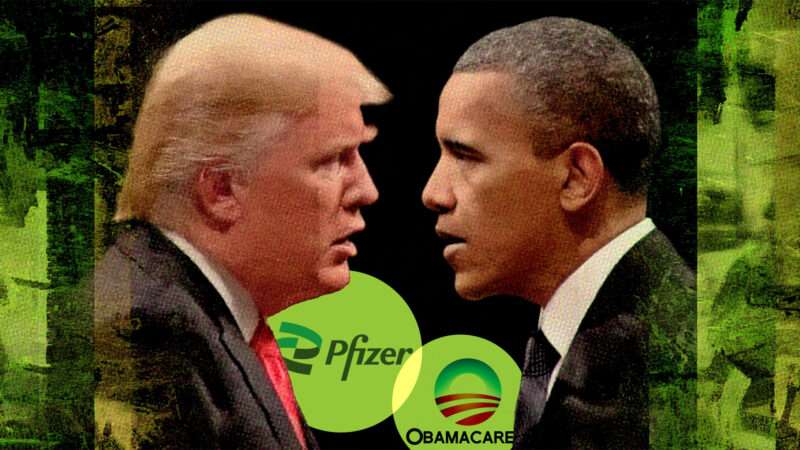
TrumpRx Is Obamacare in Trump’s Handwriting


Picture of Donald Trump facing a picture of Barack Obama | Eddie Marshall | Midjourney

This week, President Donald Trump announced the next in a long line of vanity projects: TrumpRX, a forthcoming, federally branded website where Pfizer sells steeply discounted drugs in exchange for a three-year exemption from his proposed 100 percent tariffs on imported pharmaceuticals. Imagine a strip mall furniture store with a permanent, flashy 70-percent-off sale, masking the fact that prices were inflated in the first place. TrumpRx, slated to launch in early 2026, is no different—a government-run platform that promises savings while hiding costs.

But this isn’t just another Trump-branded vanity project like the ill-fated Trump Steaks or Trump University. It’s a wild pivot in right-leaning political thought on health care, and it’s a gut punch for those who see where this road leads.

Flash back to 2016: Trump hammering the Affordable Care Act, calling it a “disaster” and suggesting that the government’s only role should be to ensure these companies have “plenty of money.” He was channeling what economists had long warned: Government-run health care distorts markets, creates perverse incentives, and collapses under its own weight. Now, the president is embracing the very heavy-handed tactics he once trashed.

What is TrumpRx?

TrumpRx isn’t healthcare reform or even a program in any real sense. It’s a carve-out for one company. Under the agreement, Pfizer will list a large share of its primary care and select specialty drugs at deep discounts on a federal site that redirects patients to Pfizer’s direct-to-consumer checkout. 

Examples of savings floated by the administration include Xeljanz (list price of $6,073/month) for arthritis and other conditions at about 40 percent off, Eucrisa (list price of $692) for eczema at $162 on TrumpRx, and newer brands like Zavzpret for migraines and Duavee for symptoms of menopause, included in the mix. In return, Pfizer receives a three-year grace period from the pharmaceutical tariffs while pledging $70 billion in U.S. manufacturing and research and development.

It’s a protection racket in reverse. The president rattles his tariff saber, Pfizer pays its tribute in the form of price cuts, and voilà, TrumpRx is born.

Who Does This Help?

The savings are shaky because that money has to come from somewhere. Part of it, certainly, is just the market advantage of being exempted from a 100 percent tax that all your competitors are forced to pay. Any savings beyond that will be carved out of something else—less research, higher prices on other drugs, or hidden costs buried elsewhere in the system. 

And for most people, the ‘discounts’ aren’t really discounts. Roughly 90 percent of Americans are insured, and their co-pays are almost always cheaper than TrumpRx’s cash prices. Medicaid patients already get the steepest rebates—more than 60 percent off by law—so TrumpRx adds little there. That leaves the approximately 27 million uninsured Americans. 

But even for the uninsured, the math falls apart: A $6,000 arthritis drug at “half price” is still $3,000 in cash, a stretch on any budget. Eucrisa at $162 on TrumpRx beats few insurance copays. And $499/month for Wegovy (semaglutide) on TrumpRx compares poorly to the $25 many insured patients now pay. And all of this bypasses the way Americans actually get prescriptions. CVS, Walgreens, and the rest are cut out entirely, replaced by a federally branded coupon pop-up that punts you to a manufacturer’s checkout page. TrumpRx looks like a deal, but in practice, it helps almost no one.

Obamacare Déjà Vu

If this sounds familiar, it’s because the blueprint was drawn a decade ago. Washington shoved through the Affordable Care Act (ACA) with the same central-planning arrogance, resting on monopolistic dealmaking and government-dictated price regulation

Trump was one of the ACA’s loudest critics. He called it a “disaster” and “virtually useless” in 2017, and was still posting “Obamacare sucks” in 2023. He was, for all his bluster, correct.

But he never took the time to understand the economics of the mistake, and now, he’s repeating it. TrumpRx employs the same toolkit: One company receives favorable treatment, the government demands discounts in exchange for tariff protection, and Washington exerts raw power with no regard for the consequences. This leads to squeezed margins, less research, smaller generic drugs being driven out, and higher prices in the long run.

The very hallmarks of Obamacare will now be repackaged in Trump’s flamboyant font and splashed across a Trumpian website. And where the ACA at least feigned some homage to competition, creating a “marketplace” of options, Trump’s brand picks a single winner.

A Surrender of Principle

The problem isn’t just hypocrisy. Nor is it merely the absurdity of the federal government running what looks like a late-night Amazon scam site. The real problem is what it represents in the long war against socialized medicine. For decades, those who opposed socialized medicine fought a grinding war of attrition. Now it’s seeped into every school, bar, and Thanksgiving table. The momentum behind universal healthcare is moving through the zeitgeist like a Labubu meme.

In this existential tug-of-war, we held a death grip on the premise that markets, not Washington, deliver innovation and lower costs. Slowly, painfully, that grip has loosened. Obamacare pulled the rope through our hands a bit. Now, TrumpRx threatens to rip it out completely.

TrumpRx isn’t just bad policy—it’s a surrender of principle. It cedes ground, conceding that drug prices need government fiat to be “affordable” and that picking winners is sound economics. It’s HealthCare.gov with Trump’s name on it instead.

Once you concede that Washington can strong-arm markets into submission, the case for competition weakens. TrumpRx doesn’t solve America’s drug-pricing crisis; it’s a tariff-driven coupon site with all the dignity of a clearance sale. If Trump wants to run healthcare like a strip mall furniture store, he may find the banners soon read, “Going out of business.”

The post TrumpRx Is Obamacare in Trump's Handwriting appeared first on Reason.com.

from Latest – Reason.com https://ift.tt/FC38i5x
via IFTTT

American Eagle CEO Says Company Stands Behind Sydney Sweeney Ads

American Eagle CEO Says Company Stands Behind Sydney Sweeney Ads

Authored by Haika Mrema via The Epoch Times (emphasis ours),

American Eagle Outfitters’ chief executive has defended the retailer’s ad campaign featuring actress Sydney Sweeney, saying the company will not retreat in the face of public criticism.

You can’t run from fear,” CEO Jay Schottenstein said in a recent interview with The Wall Street Journal. “We stand behind what we did.”

The campaign, which launched in late July, spotlighted the 27-year-old actress, best known for her roles in “Euphoria” and “The White Lotus,” modeling the brand’s denim line.

The promotional tagline, “Sydney Sweeney Has Great Jeans,” played on a double meaning. In one video, Sweeney remarked, “Genes are passed down from parents to offspring, often determining traits like hair color, personality and even eye color. My jeans are blue.”

The wordplay drew accusations from some critics who claimed the ads carried undertones of racism, sexism, or eugenics. The company declined to alter or withdraw the campaign.

Schottenstein, an Orthodox Jew, said he was surprised by such associations. He noted that his own family had endured the impact of Nazi Germany and said that if he and his team felt the campaign would be offensive in that way, “we never would’ve done it.”

In response to the criticisms, Schottenstein instructed his leadership team to remain calm, refrain from public comment, and assign a small group to monitor online reaction. American Eagle also hired an outside firm to poll customers about their response to the campaign.

The strategy appears to have benefited the company. Between July and September, the campaign helped attract nearly 1 million new customers, as reported by the Journal.

Popular items linked to Sweeney—including a cinched denim jacket and a wide-leg jean featuring a butterfly design—sold out within days. The company also reported an uptick in sales growth beginning in August, reversing earlier declines.

Some marketing experts said American Eagle’s decision to remain consistent set it apart from other corporations that have scaled back campaigns after online criticism. “By sticking to their guns, they gained customers,” said Susan Cantor, CEO of branding firm Sterling Brands.

The campaign also drew national attention beyond the retail world. President Donald Trump praised Sweeney and the ads in a post on Truth Social, calling it the “hottest” campaign running.

“Sydney Sweeney, a registered Republican, has the ‘HOTTEST’ ad out there,” the post read. “It’s for American Eagle, and the jeans are ‘flying off the shelves.’ Go get ‘em Sydney!”

American Eagle has continued building on the momentum, announcing a partnership with NFL player Travis Kelce, who is engaged to pop star Taylor Swift, weeks after Sweeney’s campaign launch.

Tyler Durden
Thu, 10/02/2025 – 15:20

via ZeroHedge News https://ift.tt/yTS3GzQ Tyler Durden

MMT RIP – Good Riddance

MMT RIP – Good Riddance

By Tom Teague of The Manhattan

Modern Monetary Theory is a macroeconomic theory developed in the early 1990s. It maintains that governments that issue their own currency are not financially constrained in the same way as households or businesses. According to MMT, governments can create money and spend as they see fit; taxes serve primarily as a tool to control inflation and create demand for the currency. MMT also emphasizes that government spending should aim to ensure full employment.

Putatively heterodox to most economists, MMT has often been quietly promoted as a back door to central planning. It is analogous to Critical Race Theory in that it is referenced everywhere, yet often denied when challenged. Although no major central bank has formally adopted it, MMT’s logic aligns with the behavior of many major central banks since the Global Financial Crisis.

During the GFC, the financial system nearly collapsed under excessive leverage to the housing market and a series of black swan events. The aftermath provided a platform for the political left—who had been sidelined by the fall of Communism—to return to power and lay the foundations for a new vision of society. This shift promoted “stakeholder” capitalism: an economy to be guided by elites seeking less greed, greater inclusivity, and more environmental focus. (See the World Economic Forum.)

New rules were implemented for Europe’s financial institutions, particularly insurance companies and pension funds. Post-GFC, European insurers were governed under Solvency II and III. Under these regimes, there was a zero risk-weight for government bonds and large capital charges for corporate bonds, equities, infrastructure, and securitizations. This forced a major reallocation of asset holdings in the insurance sector (which controls €9.5 trillion in assets) toward government bonds, and away from risk assets. Pension funds—managing another ~€10 trillion—were also affected by these regulations and incentivized to shift toward “safe” government bonds, though to a somewhat lesser extent. The result was a significant shift from the private sector to the public sector, greatly benefiting European governments that could now borrow more cheaply. This process arguably helped finance the ‘Great European Project,’ but at the expense of private sector vitality.

This regulatory drift toward government bonds did not stop in Europe. In the U.S., the Dodd-Frank Act and Basel III were implemented, which encouraged banks and other regulated institutions to hold Treasuries rather than risk assets. While these rules had a significant impact on banks’ balance sheets, their effect on insurance companies and pension funds was less direct. Basel III’s risk weightings granted U.S. Treasuries and MBS very low charges, while company loans, equities, private credit, and various securitizations faced 100% or higher risk charges. Notably, the risk weight for equities held on bank balance sheets increased from 100% to 250%.

Basel III’s greatest impact did not come from the risk weights alone, but from higher total capital requirements, new capital buffers, and the liquidity coverage ratio—all of which further favored government bonds and reinforced the preference for “safe assets.” In practice, this crowded out private sector lending and investment, even if risk weights themselves did not always change dramatically.

It is understandable that, following the near-collapse of the financial system, regulators sought to promote stability. Yet, the net effect of these efforts was to encourage lending to governments and discourage lending to the private sector—ironic, given that the crisis was rooted in regulatory failures to prevent excessive leverage in U.S. housing.

In the post-GFC era, governments—enjoying lower bond yields and greater regulatory power—found themselves in a position to expand spending. Using debt to solve problems and bail out economies became the norm. The crucial question is whether this shift was intentional, or merely a byproduct of circumstances. Given recent government agendas to “rebuild capitalism,” focus on climate initiatives, and promote forced equality (including through immigration), it seems unlikely to be accidental.

Government spending relative to GDP has accelerated in recent years. In the U.S., this figure grew from 35% in 2018 to 39.7% in 2024, peaking at 47% in 2020 during Covid (compared to less than 20% pre-GFC). In the EU, government spending hovered around 46.5% of GDP in 2015–2019, and surged to 52.9% during Covid. In Japan, government spending is normally about 40% of GDP and reached 47.1% during the pandemic. We have entered an age where governments use cheap borrowing to centrally plan economies.

A peculiar relationship has now evolved between central banks and governments. As government spending grows, central banks are increasingly tasked with protecting the government’s ability to borrow at low cost, instead of focusing on stimulating the private sector. Ambiguity arises when governments create jobs by expanding already bloated agencies, placing them in competition with the private sector. The result is a zero-sum game between the government and the private sector. Rather than fostering private sector growth, governments and central banks have tilted toward active intervention and control.

In 2017–2018, the Trump administration implemented deregulatory measures and passed the Tax Cuts and Jobs Act, aiming to boost private sector business investment, productivity, and job growth. In response, Chairman Powell raised rates four times in 2018, moving the Fed Funds rate from 1.5% in March to 2.5% by December. The Fed’s rationale was to preempt inflation from an overheating economy—even as core inflation hovered near the 2% target. By Q4 2018, fears of tightening led to a major stock market correction.

In the past year, global bond yields have increased as markets become less tolerant of central planning and begin to price in weaker growth. German Bund yields have moved from 2.1% to 2.75% on the 10-year. In Japan, the 10-year JGB yield has climbed from 0.75% to 1.64%. Investors are realizing: 1) government spending is not effectively growing the economy (if it ever intended to), and 2) underinvestment in the private sector, due to energy costs, regulation, and offshoring, has eroded growth potential. Ultimately, the private sector must generate the taxes that service government debt.

Enter the Scully Curve: an economic concept positing a relationship between government spending (relative to GDP) and economic growth. The curve, named after Gerald Scully, argues for an optimal spending level—typically 24–32% of GDP for industrialized economies. For each additional 1% of government spending above this range, GDP growth may decrease by 0.1–0.2%; if spending rises to 45–50% of GDP, a 0.5–1.5% reduction in growth can be expected. This weakening of the private sector ultimately leads to doubts about debt repayment and undermines the argument that “the government can do it better.”

Central banks, often in concert with fiscal authorities, may now raise rates to combat inflation resulting from deficit spending—which in turn lifts borrowing costs for businesses, crowds out private investment, and distorts market signals. Studies from the post-2008 period reveal that sustained high rates in Europe suppressed private sector recovery and channeled capital into sovereign bonds.

MMT was a prescriptive idea for more central planning, and it has left a profound mark on government debt markets and private sector growth in the West. Now, as economies confront a world of high spending and low growth, there is increasing urgency to reverse course. Populist leaders, most notably Trump, are calling for shrinking government and deregulation to unleash pent-up private sector demand. The U.S., uniquely among major economies, may still have the capacity to grow out of the MMT legacy.

Tyler Durden
Thu, 10/02/2025 – 15:00

via ZeroHedge News https://ift.tt/p708gGa Tyler Durden

Trump, Bessent Hit Back At China’s Ag Purchase Pivot, Promise Farm Support Next Week

Trump, Bessent Hit Back At China’s Ag Purchase Pivot, Promise Farm Support Next Week

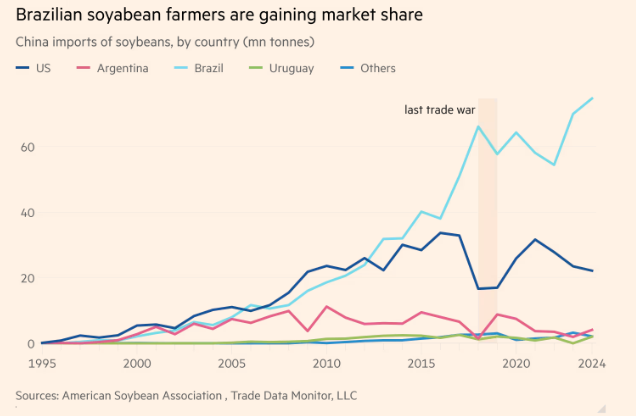
Following last week’s news of China’s massive shift away from American farmers in favor of Brazilian ones, the Trump administration is seeking financial support to mitigate the impact on U.S. farmers and plans to address the issue in upcoming trade talks with Beijing.

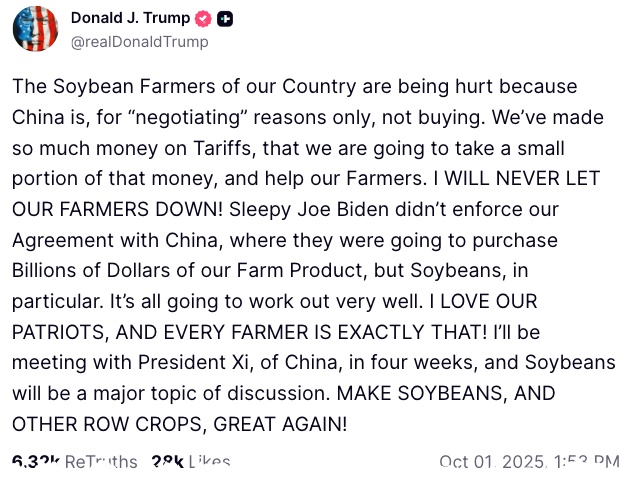
On Wednesday, President Trump wrote on Truth Social that U.S. farmers are “being hurt because China is, for negotiating reasons only, not buying,” adding, “We’ve made so much money on Tariffs, that we are going to take a small portion of that money, and help our Farmers.”

In fact, Beijing’s pivot to ag purchases in Brazil is merely one way to target Trump’s farm base, with hopes that the hybrid pressure campaign will force his supporters to push the president into concessions in the trade war. Trump, however, has stated that he would use tariff revenue to cushion American farmers.

Source: Financial Times 

Related:

Earlier today, Treasury Secretary Scott Bessent said U.S. farmers could see an announcement on a “substantial support” package as soon as Tuesday. 

Trump noted in the Truth Social post above that he will be meeting with Chinese President Xi Jinping in four weeks and will make Soybeans a “major topic of discussion.” 

. . . 

Tyler Durden
Thu, 10/02/2025 – 14:40

via ZeroHedge News https://ift.tt/c5A6ax7 Tyler Durden

Gavin Newsom Loves AI Satire Now!


Gavin Newsom | Efren Landaos/Sipa USA/Newscom

It looks like California Gov. Gavin Newsom has learned to stop worrying and love fake, AI-generated political satire videos—or at least, he loves them enough to share one on X.

Newsom has discovered a meme streak that is positively Trump-ian as of late, and now constantly publishes troll-ish posts on social media, with the aim of getting under the president’s skin and also calling attention to himself; he seems to be succeeding on this second goal, and is currently arguably the front-runner for the Democratic presidential nomination in 2028.

Here was his latest contribution: a heavily manipulated video of Vice President J.D. Vance discussing the government shutdown. (Note the squeaky voice and cartoonish wardrobe embellishments.)

There’s nothing wrong with this, of course. Newsom is free to use his own speech to belittle Trump, Vance, or anyone else. The irony, however, is that Newsom adamantly tried to prevent other people from doing something incredibly similar.

Indeed, Newsom is a major advocate of legislation to criminalize so-called deep fakes: convincing misrepresentations of other people on social media. In the midst of Kamala Harris’s 2024 presidential campaign, Elon Musk retweeted a fake, AI-engineered video of Harris appearing to admit to being a DEI pick; the video used AI to accurately mimic her voice. Newsom wrote on X that this should be illegal, and shared that he would soon be banning the practice in California. Sure enough, the governor signed the deep fake bill into law a few weeks later.

Unfortunately for Newsom, the First Amendment broadly protects political satire, even if the underlying speech is wrong or misleading. And so a federal judge struck down the law—just in time for Election Day—noting that it “hinders humorous expression and unconstitutionally stifles the free and unfettered exchange of ideas.”

Now that the governor is enjoying channeling his inner troll, perhaps he has gained more appreciation for this right. One can perhaps argue that the optics of the Vance video make it much more obviously fake than the sound from the Harris video, but this is a difference of distinctions. It’s key that the widest possible latitude be given to speech that makes fun of politicians, as there is no kind of expression more obviously protected by the First Amendment.


This Week on Free Media

I’m joined by Amber Duke and Niall Stanage to process the news of the week. Check out the Free Media YouTube channel, which now features news collaborations with Duke, Stanage, and also Reason‘s Andrew Heaton.


Worth Watching

I am hard at work on the novel I vowed to write two weeks ago: In fact, I’ve actually already written about 18,000 words. I imagine it will be at least 100,000 words when I’ve finished. It feels really refreshing to be working on a creative project again. Last night I stayed up way, way too late writing it, as I realized very suddenly that I was going to reveal a notable side character as evil, and I was determined to make it to the scene where he outs himself.

The post Gavin Newsom Loves AI Satire Now! appeared first on Reason.com.

from Latest – Reason.com https://ift.tt/TzOjZ6r
via IFTTT

ACLU Sues ICE To Release Records Of Detainment Facilities

ACLU Sues ICE To Release Records Of Detainment Facilities

Authored by Naveen Athrappully via The Epoch Times (emphasis ours),

The American Civil Liberties Union (ACLU) filed a lawsuit against Immigration and Customs Enforcement (ICE), seeking to compel the agency to disclose records related to specific operations, according to the complaint filed on Oct. 1.

ICE agents charge toward protesters outside an ICE detention facility in Portland, Ore., on Sept. 1, 2025. John Rudoff/Reuters

The lawsuit, filed jointly by the ACLU and its Virginia and North Carolina affiliates in the District Court for the Southern District of New York, concerns the Freedom of Information Act (FOIA).

According to the lawsuit, ICE issued a Request for Information (RFI) on May 28, seeking information on available detention facilities capable of housing single adult populations to support the agency’s Washington Field Office.

An RFI is issued to gather information regarding services or products from suppliers, and in the case of ICE, it wanted information on detection facilities. While ICE owns five detention facilities, it relies on private prison companies and other facilities to detain a majority of people in its custody, the lawsuit said.

On Aug. 8, plaintiffs submitted an FOIA request to ICE, asking for records of responses to the agency’s RFI.

The FOIA “was enacted to facilitate public access to government documents,” the lawsuit said.

The lawsuit added that the basic purpose of FOIA is to “ensure an informed citizenry, vital to the functioning of a democratic society, needed to check against corruption and to hold the governors accountable to the governed.”

With this aim in mind, the FOIA statute requires that federal agencies such as ICE disclose records within 20 working days, the lawsuit said.

An additional 10-day extension for processing may be provided under certain circumstances.

However, “more than 30 working days have passed” since plaintiffs filed the request, and there has been no response from ICE with regard to providing the records, the complaint said, adding that the statutory time period has elapsed.

Plaintiffs have exhausted all administrative remedies regarding ICE’s failure to respond to the Request,” the complaint stated.

ACLU and its affiliates asked the court to order ICE to process and release the necessary records.

The ACLU lawsuit comes amid protests and instances of violence against ICE’s immigration enforcement operations and the officials carrying them out.

On Sept. 24, a gunman opened fire at the ICE Dallas building. While no law enforcement officers were injured in the attack, two detainees died.

On Sept. 26, ICE’s processing facility at Broadview, Illinois, saw clashes between protestors and federal agents. In a letter to the Department of Homeland Security (DHS), Broadview Mayor Katrina Thompson said residents approached her looking for help due to chemicals being allegedly used by federal agents near the ICE facility.

The DHS said in a Sept. 26 statement that some of the rioters had arrived with fireworks and gas masks, with one apprehended carrying a gun.

These lawless rioters began chanting ‘Arrest ICE, Shoot ICE,’” the department said.

Since ICE launched Operation Midway Blitz in early September, targeting criminal illegal aliens in Illinois, “rioters have assaulted law enforcement, thrown tear gas cans, slashed tires of cars, blocked the entrance of the building, and trespassed on private property,” DHS said.

The Epoch Times reached out to the agency for comment, but did not receive a response by publication time.

Efforts to Unmask ICE Officers

In California, Gov. Gavin Newsom signed into law the No Secret Police Act (SB 627) on Sept. 20.

The act bans local and federal law enforcement, including ICE personnel, from wearing ski masks and other such “extreme masks,” according to a Sept. 20 statement from the office of California state Sen. Scott Wiener, lead author of the bill.

The bill was backed by a coalition of immigrant and civil rights groups. While the DHS asked Newsom to veto the bill, the governor opted not to do so, said the statement.

“The No Secret Police Act is a bold step that builds on a remarkable record of leadership defending our immigrant communities and democracy itself,” Wiener said.

In its Sept. 26 statement, DHS said that ICE officers were facing “a more than 1,000 percent increase in assaults against them.”

In a Sept. 26 X post, Bill Essayli, acting attorney for the Central District of California, criticized Newsom’s decision, accusing him of being “confused” with regard to his role under the U.S. Constitution.

Newsom “oversees California, not federal agencies. He should review the Supremacy Clause,” Essayli wrote.

“California’s law to ‘unmask’ federal agents is unconstitutional, as the state lacks jurisdiction to interfere with federal law enforcement. I have directed federal agencies to disregard this state law and adhere to federal law and agency policies,” Essayli said.

Tyler Durden
Thu, 10/02/2025 – 14:00

via ZeroHedge News https://ift.tt/a6P2fmC Tyler Durden

Trump To Cancel Biden-Era Green Energy Grants, but Only for Blue States


President Donald Trump and former President Joe Biden. | Illustration: Eddie Marshall | Midjourney

This week, amid a government shutdown, President Donald Trump and his administration are trying to capitalize on the situation. “Trump has made clear he’s looking to use this opportunity to make more permanent cuts to the federal work force and its many, many functions,” writes Reason‘s Liz Wolfe.

A week before the shutdown, a memo from the Office of Management and Budget (OMB) advised federal agencies to prepare for permanent reductions in workforce, rather than simply furloughing employees who are then reinstated—with back pay—when the shutdown inevitably ends.

The administration also seems keen to rescind federal funds awarded under President Joe Biden, like the billions of dollars in clean energy grants to states in the Inflation Reduction Act (IRA) and the Infrastructure Investment and Jobs Act (IIJA).

This would be a good idea, if it were applied smartly. Instead, the administration seems to prefer dinging members of the opposing political tribe rather than effecting any sort of across-the-board changes.

“Nearly $8 billion in Green New Scam funding to fuel the Left’s climate agenda is being cancelled,” OMB Director Russell Vought wrote Wednesday in a post on X. While there is not yet an official announcement, he added that there would be “more info to come” from the Department of Energy. Vought said the newly rescinded funds would come from terminating projects in California, Colorado, Connecticut, Delaware, Hawaii, Illinois, Maryland, Massachusetts, Minnesota, New Hampshire, New Jersey, New Mexico, New York, Oregon, Vermont, and Washington.

If it feels like those 16 states have something in common, it’s true: All voted for then-Vice President Kamala Harris, Trump’s opponent, in the 2024 election. In fact, other than Maine, Rhode Island, and Virginia, Vought’s list includes every single state that didn’t go for Trump.

Trump would be justified in wanting to rescind all such grants. Instead, he’s apparently content to let states who voted for him keep the cash. This naked partisanship is unseemly, but unfortunately par for the course under Trump. It’s also particularly ironic, since red states were much bigger beneficiaries of Biden-era grants.

“The Biden administration has announced hundreds of billions of dollars in infrastructure projects since the passage of several landmark government funding bills,” CNBC’s Rebecca Picciotto wrote in May 2024. “Several of the biggest awards went to battleground states that will be pivotal to the 2024 presidential election between President Joe Biden and former President Donald Trump, including Pennsylvania, Arizona and Michigan.” (Biden exited the race in July 2024.)

Picciotto noted that the 10 largest recipients of Biden-era funding were California, Texas, New York, Florida, Pennsylvania, Illinois, Arizona, Maryland, Ohio, and Michigan. Vought targeted only four of those 10 for rescission, leaving tens of billions of “Green New Scam” dollars in red states.

“Growth from post-IRA projects…is particularly pronounced in Republican-led districts and states in the South,” according to an August 2024 report from E2, a nonpartisan group that advocates for clean energy. “Nearly 60 percent of the announced projects—representing 85 percent of the investments and 68 percent of the jobs—are in Republican congressional districts.”

“Five states are home to 20 or more projects: Michigan, Georgia, South Carolina, Texas and North Carolina,” the report noted. “Six others are home to at least 10: Ohio, Tennessee, California, New York, Indiana and Arizona.” Of those 11 states, only California and New York went for Harris—and only those two will see cuts under Vought’s proposal.

Studies often find that Republican states receive more government assistance than states that vote Democrat. “Using non-adjusted and population-weighted numbers, the federal government provides 8 percent more in benefits to red states than to blue states,” according to a May 2025 article from the Milken Institute Review. “But taking [cost-of-living adjustments] into consideration, this gap widens significantly: red states receive 23 percent more from the federal government than blue states.”

These programs can also take a more sinister form, where lawmakers dole out federal grants for states based on favoritism. “My own research on the way stimulus spending was allocated showed that the party affiliation of a congressional district’s representative was a factor,” George Mason University economist Veronique de Rugy wrote in 2013, about the 2009 federal stimulus bill. “Districts represented by Democrats got more money than districts represented by Republicans, even controlling for variables such as state capital, income, and unemployment.”

As CNBC’s Picciotto noted last year, after the states with the largest economies—California, Texas, New York—billions of federal dollars went to swing states that Biden would need if he hoped to win reelection. Now that those states handed Trump the election, he’s apparently content to let them keep that cash.

The post Trump To Cancel Biden-Era Green Energy Grants, but Only for Blue States appeared first on Reason.com.

from Latest – Reason.com https://ift.tt/5gUAidy
via IFTTT

Autism Research Doesn’t Need Washington’s Help


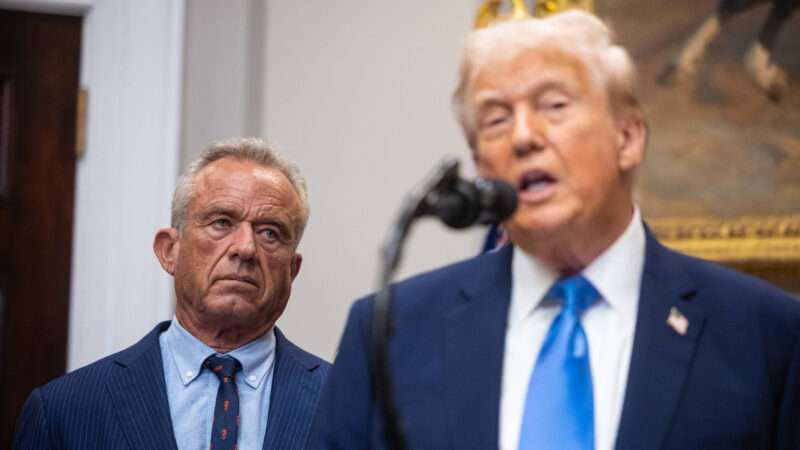
Donald Trump and Robert F. Kennedy Jr. | CNP/AdMedia/SIPA/Newscom

At a well-attended press event in September, Health and Human Services Secretary Robert F. Kennedy Jr. announced a “bold” new initiative to identify the causes and treatments for autism. Citing research suggesting a possible link between taking acetaminophen during pregnancy and neurodevelopmental disorders, including autistic spectrum disorder (ASD), the initiative included the National Institutes of Health spending $50 million more on research into acetaminophen and other possible environmental causes of what Kennedy called an “epidemic” of autism.

Set aside the fact that the so-called epidemic of autism does not result from a surge in actual cases but from a broadening of the diagnosis over the past 50 years—from what psychiatrists in the 1970s called a form of childhood schizophrenia, marked by early social withdrawal, impaired language, and rigid, repetitive behaviors, to today’s ASD. This new understanding includes highly capable, sometimes gifted individuals who simply interact with others in unusual or atypical ways. Additionally, because social, educational, and health care services are now more accessible to children with ASD, increased parental awareness and more screening by pediatricians, school psychologists, and educators have led to greater detection. 

That nuance seems lost on Kennedy, who treats autism as if it were an infection or a tumor. But government bureaucrats don’t usually do nuance very well.

The scientific research Kennedy cited to support his suspicion of acetaminophen’s role was all conducted by clinical researchers, unconnected to this administration or political agendas. This behavior isn’t unique to Kennedy. Politicians of every stripe can’t resist the urge to hitch themselves to science, claiming breakthroughs that are already underway or steering research toward pet causes.

For example, President Donald Trump signed an executive order to “unlock cures for pediatric cancer” by allocating $100 million in federal funds to improve the use of artificial intelligence (AI) in cancer research. But, AI is already transforming medical research by analyzing genomics, imaging, and clinical records to improve diagnostics, accelerate drug discovery, and tailor treatments for patients. This progress results from technological advancement and necessity, not government intervention. The government can, at best, influence the pace; at worst, it distorts progress for political show. Trump’s executive order wasn’t about leadership—it was about wanting to be seen at the front of the parade. 

When the government involves itself in the scientific debate—usually through funding initiatives—it distorts researchers’ agendas and direction. 

Medical scientist Terence Kealey sees the food pyramid as a textbook case of government distorting science. When the 1977 Senate Select Committee on Nutrition and Human Needs adopted Ancel Keys’ unproven theory linking saturated fat to heart disease, it encouraged Americans to replace fats with carbs. That policy change contributed to the rise of trans fats and coincided with increasing rates of obesity and diabetes. Kealey argues that when the government involves itself in research, it doesn’t just fund science—it influences it, often in ways that mislead the public.

The food pyramid illustrates the disastrous consequences that can result when diet policy is hijacked by politicians. The same risk looms now with autism research: Will the White House’s suspicion of acetaminophen skew inquiry away from more valuable discoveries? The “fact sheet” that White House Press Secretary Karoline Leavitt issued, titled “Evidence Suggests a Link Between Acetaminophen, Autism,” would certainly lead readers to draw that conclusion.

The fact sheet cites five “studies” to support its claim. Two of them, a “Harvard study” and a “Mount Sinai study,” are actually the same study—one of the authors was part of Harvard’s faculty and the other was affiliated with the Mount Sinai School of Medicine. A third study examined acetaminophen levels in the meconium (stool) of newborns, which makes it hard to determine the timing and duration of exposure. The remaining two studies had similar limitations and involved cohorts that might not be representative of the population. 

The fact sheet also cited a “consensus statement” by clinicians urging their colleagues to be cautious and judicious when recommending acetaminophen to pregnant patients with fever, to which the American College of Obstetrics and Gynecology responded, “The authors are not recommending anything counter to what is already done by obstetrician-gynecologists when prescribing acetaminophen for a given clinical condition.” In other words, “Thanks, we’ve got this.”

Glaringly absent from Leavitt’s fact sheet was a crucial study from Sweden, published in 2024,  which followed nearly 2.5 million children born in Sweden between 1995 and 2019, using sibling controls. It found “no evidence that acetaminophen use during pregnancy was associated with autism…or intellectual disability.” Its conclusion stated that acetaminophen during pregnancy was “not associated with children’s risk of autism, ADHD, or intellectual disability.”

As the saying goes, “He who pays the piper calls the tune.” President Dwight D. Eisenhower cautioned that “public policy could itself become the captive of a scientific-technological elite.” That warning rings true today: Researchers who depend on federal grants know their chances for funding shrink if their work runs counter to the prevailing narrative.

Kealey argues that government funding of science is not only unnecessary but often counterproductive. He points to history, where science thrived under private patronage and market demand long before bureaucracies took over. Public funding, he says, crowds out private investment, replacing risk-taking with conformity and steering research toward politically advantageous or “safe” projects. Instead of speeding up discovery, government agencies slow it down by forcing scientists to chase grants rather than pursue ideas. According to Kealey, status, recognition, and peer competition naturally drive innovation, and when left alone, markets and private actors are more than capable of supporting it.

What we know so far about the link between prenatal acetaminophen and autism—that it remains inconclusive—is based on independent clinical studies not influenced by a government agenda. Without government interference, these studies might find definitive proof that prenatal acetaminophen causes ASD, or they could lead to dead ends, encouraging scientists to explore other possibilities. Scientific research is a process of trial and error.

In a free society, government has a limited but legitimate role in public health: protecting people when one person’s actions threaten the lives or safety of others. Too often, however, government directs research and policy toward personal health decisions that individuals can make for themselves, with expert advice if they choose. 

When a public health agency issues opinions on personal health, those opinions quickly gain the force of mandates—disclaimers notwithstanding. History shows how badly this can go, from the food pyramid fiasco to the heavy-handed COVID-19 response that silenced dissent. Good public health policy requires humility, precision, and honesty. If we want a healthier future for our children, we must reject ready-made conclusions and insist on evidence over ideology. When the state dictates both the questions science asks and the answers it offers, it converts knowledge into propaganda and health into a matter of politics.

We don’t need Washington to endorse a favored theory or influence the outcome; we need honest, independent science that can follow the evidence wherever it leads. The Swedish study that challenges the acetaminophen story shows researchers are capable of figuring this out without political interference. Parents deserve straight answers, not government-produced fiction. 

So thanks for the offer, Mr. Secretary—but when it comes to understanding autism, we’ve got this.

The post Autism Research Doesn't Need Washington's Help appeared first on Reason.com.

from Latest – Reason.com https://ift.tt/fY473oy
via IFTTT

Trump To Cancel Biden-Era Green Energy Grants, but Only for Blue States


President Donald Trump and former President Joe Biden. | Illustration: Eddie Marshall | Midjourney

This week, amid a government shutdown, President Donald Trump and his administration are trying to capitalize on the situation. “Trump has made clear he’s looking to use this opportunity to make more permanent cuts to the federal work force and its many, many functions,” writes Reason‘s Liz Wolfe.

A week before the shutdown, a memo from the Office of Management and Budget (OMB) advised federal agencies to prepare for permanent reductions in workforce, rather than simply furloughing employees who are then reinstated—with back pay—when the shutdown inevitably ends.

The administration also seems keen to rescind federal funds awarded under President Joe Biden, like the billions of dollars in clean energy grants to states in the Inflation Reduction Act (IRA) and the Infrastructure Investment and Jobs Act (IIJA).

This would be a good idea, if it were applied smartly. Instead, the administration seems to prefer dinging members of the opposing political tribe rather than effecting any sort of across-the-board changes.

“Nearly $8 billion in Green New Scam funding to fuel the Left’s climate agenda is being cancelled,” OMB Director Russell Vought wrote Wednesday in a post on X. While there is not yet an official announcement, he added that there would be “more info to come” from the Department of Energy. Vought said the newly rescinded funds would come from terminating projects in California, Colorado, Connecticut, Delaware, Hawaii, Illinois, Maryland, Massachusetts, Minnesota, New Hampshire, New Jersey, New Mexico, New York, Oregon, Vermont, and Washington.

If it feels like those 16 states have something in common, it’s true: All voted for then-Vice President Kamala Harris, Trump’s opponent, in the 2024 election. In fact, other than Maine, Rhode Island, and Virginia, Vought’s list includes every single state that didn’t go for Trump.

Trump would be justified in wanting to rescind all such grants. Instead, he’s apparently content to let states who voted for him keep the cash. This naked partisanship is unseemly, but unfortunately par for the course under Trump. It’s also particularly ironic, since red states were much bigger beneficiaries of Biden-era grants.

“The Biden administration has announced hundreds of billions of dollars in infrastructure projects since the passage of several landmark government funding bills,” CNBC’s Rebecca Picciotto wrote in May 2024. “Several of the biggest awards went to battleground states that will be pivotal to the 2024 presidential election between President Joe Biden and former President Donald Trump, including Pennsylvania, Arizona and Michigan.” (Biden exited the race in July 2024.)

Picciotto noted that the 10 largest recipients of Biden-era funding were California, Texas, New York, Florida, Pennsylvania, Illinois, Arizona, Maryland, Ohio, and Michigan. Vought targeted only four of those 10 for rescission, leaving tens of billions of “Green New Scam” dollars in red states.

“Growth from post-IRA projects…is particularly pronounced in Republican-led districts and states in the South,” according to an August 2024 report from E2, a nonpartisan group that advocates for clean energy. “Nearly 60 percent of the announced projects—representing 85 percent of the investments and 68 percent of the jobs—are in Republican congressional districts.”

“Five states are home to 20 or more projects: Michigan, Georgia, South Carolina, Texas and North Carolina,” the report noted. “Six others are home to at least 10: Ohio, Tennessee, California, New York, Indiana and Arizona.” Of those 11 states, only California and New York went for Harris—and only those two will see cuts under Vought’s proposal.

Studies often find that Republican states receive more government assistance than states that vote Democrat. “Using non-adjusted and population-weighted numbers, the federal government provides 8 percent more in benefits to red states than to blue states,” according to a May 2025 article from the Milken Institute Review. “But taking [cost-of-living adjustments] into consideration, this gap widens significantly: red states receive 23 percent more from the federal government than blue states.”

These programs can also take a more sinister form, where lawmakers dole out federal grants for states based on favoritism. “My own research on the way stimulus spending was allocated showed that the party affiliation of a congressional district’s representative was a factor,” George Mason University economist Veronique de Rugy wrote in 2013, about the 2009 federal stimulus bill. “Districts represented by Democrats got more money than districts represented by Republicans, even controlling for variables such as state capital, income, and unemployment.”

As CNBC’s Picciotto noted last year, after the states with the largest economies—California, Texas, New York—billions of federal dollars went to swing states that Biden would need if he hoped to win reelection. Now that those states handed Trump the election, he’s apparently content to let them keep that cash.

The post Trump To Cancel Biden-Era Green Energy Grants, but Only for Blue States appeared first on Reason.com.

from Latest – Reason.com https://ift.tt/5gUAidy
via IFTTT