Autism Research Doesn’t Need Washington’s Help


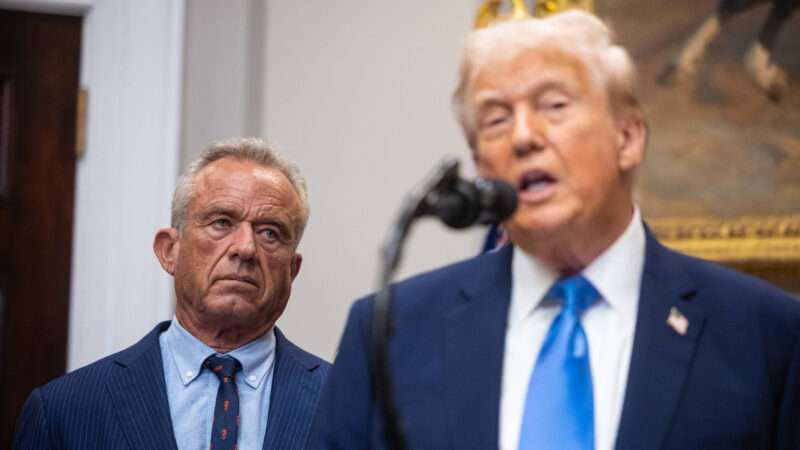
Donald Trump and Robert F. Kennedy Jr. | CNP/AdMedia/SIPA/Newscom

At a well-attended press event in September, Health and Human Services Secretary Robert F. Kennedy Jr. announced a “bold” new initiative to identify the causes and treatments for autism. Citing research suggesting a possible link between taking acetaminophen during pregnancy and neurodevelopmental disorders, including autistic spectrum disorder (ASD), the initiative included the National Institutes of Health spending $50 million more on research into acetaminophen and other possible environmental causes of what Kennedy called an “epidemic” of autism.

Set aside the fact that the so-called epidemic of autism does not result from a surge in actual cases but from a broadening of the diagnosis over the past 50 years—from what psychiatrists in the 1970s called a form of childhood schizophrenia, marked by early social withdrawal, impaired language, and rigid, repetitive behaviors, to today’s ASD. This new understanding includes highly capable, sometimes gifted individuals who simply interact with others in unusual or atypical ways. Additionally, because social, educational, and health care services are now more accessible to children with ASD, increased parental awareness and more screening by pediatricians, school psychologists, and educators have led to greater detection. 

That nuance seems lost on Kennedy, who treats autism as if it were an infection or a tumor. But government bureaucrats don’t usually do nuance very well.

The scientific research Kennedy cited to support his suspicion of acetaminophen’s role was all conducted by clinical researchers, unconnected to this administration or political agendas. This behavior isn’t unique to Kennedy. Politicians of every stripe can’t resist the urge to hitch themselves to science, claiming breakthroughs that are already underway or steering research toward pet causes.

For example, President Donald Trump signed an executive order to “unlock cures for pediatric cancer” by allocating $100 million in federal funds to improve the use of artificial intelligence (AI) in cancer research. But, AI is already transforming medical research by analyzing genomics, imaging, and clinical records to improve diagnostics, accelerate drug discovery, and tailor treatments for patients. This progress results from technological advancement and necessity, not government intervention. The government can, at best, influence the pace; at worst, it distorts progress for political show. Trump’s executive order wasn’t about leadership—it was about wanting to be seen at the front of the parade. 

When the government involves itself in the scientific debate—usually through funding initiatives—it distorts researchers’ agendas and direction. 

Medical scientist Terence Kealey sees the food pyramid as a textbook case of government distorting science. When the 1977 Senate Select Committee on Nutrition and Human Needs adopted Ancel Keys’ unproven theory linking saturated fat to heart disease, it encouraged Americans to replace fats with carbs. That policy change contributed to the rise of trans fats and coincided with increasing rates of obesity and diabetes. Kealey argues that when the government involves itself in research, it doesn’t just fund science—it influences it, often in ways that mislead the public.

The food pyramid illustrates the disastrous consequences that can result when diet policy is hijacked by politicians. The same risk looms now with autism research: Will the White House’s suspicion of acetaminophen skew inquiry away from more valuable discoveries? The “fact sheet” that White House Press Secretary Karoline Leavitt issued, titled “Evidence Suggests a Link Between Acetaminophen, Autism,” would certainly lead readers to draw that conclusion.

The fact sheet cites five “studies” to support its claim. Two of them, a “Harvard study” and a “Mount Sinai study,” are actually the same study—one of the authors was part of Harvard’s faculty and the other was affiliated with the Mount Sinai School of Medicine. A third study examined acetaminophen levels in the meconium (stool) of newborns, which makes it hard to determine the timing and duration of exposure. The remaining two studies had similar limitations and involved cohorts that might not be representative of the population. 

The fact sheet also cited a “consensus statement” by clinicians urging their colleagues to be cautious and judicious when recommending acetaminophen to pregnant patients with fever, to which the American College of Obstetrics and Gynecology responded, “The authors are not recommending anything counter to what is already done by obstetrician-gynecologists when prescribing acetaminophen for a given clinical condition.” In other words, “Thanks, we’ve got this.”

Glaringly absent from Leavitt’s fact sheet was a crucial study from Sweden, published in 2024,  which followed nearly 2.5 million children born in Sweden between 1995 and 2019, using sibling controls. It found “no evidence that acetaminophen use during pregnancy was associated with autism…or intellectual disability.” Its conclusion stated that acetaminophen during pregnancy was “not associated with children’s risk of autism, ADHD, or intellectual disability.”

As the saying goes, “He who pays the piper calls the tune.” President Dwight D. Eisenhower cautioned that “public policy could itself become the captive of a scientific-technological elite.” That warning rings true today: Researchers who depend on federal grants know their chances for funding shrink if their work runs counter to the prevailing narrative.

Kealey argues that government funding of science is not only unnecessary but often counterproductive. He points to history, where science thrived under private patronage and market demand long before bureaucracies took over. Public funding, he says, crowds out private investment, replacing risk-taking with conformity and steering research toward politically advantageous or “safe” projects. Instead of speeding up discovery, government agencies slow it down by forcing scientists to chase grants rather than pursue ideas. According to Kealey, status, recognition, and peer competition naturally drive innovation, and when left alone, markets and private actors are more than capable of supporting it.

What we know so far about the link between prenatal acetaminophen and autism—that it remains inconclusive—is based on independent clinical studies not influenced by a government agenda. Without government interference, these studies might find definitive proof that prenatal acetaminophen causes ASD, or they could lead to dead ends, encouraging scientists to explore other possibilities. Scientific research is a process of trial and error.

In a free society, government has a limited but legitimate role in public health: protecting people when one person’s actions threaten the lives or safety of others. Too often, however, government directs research and policy toward personal health decisions that individuals can make for themselves, with expert advice if they choose. 

When a public health agency issues opinions on personal health, those opinions quickly gain the force of mandates—disclaimers notwithstanding. History shows how badly this can go, from the food pyramid fiasco to the heavy-handed COVID-19 response that silenced dissent. Good public health policy requires humility, precision, and honesty. If we want a healthier future for our children, we must reject ready-made conclusions and insist on evidence over ideology. When the state dictates both the questions science asks and the answers it offers, it converts knowledge into propaganda and health into a matter of politics.

We don’t need Washington to endorse a favored theory or influence the outcome; we need honest, independent science that can follow the evidence wherever it leads. The Swedish study that challenges the acetaminophen story shows researchers are capable of figuring this out without political interference. Parents deserve straight answers, not government-produced fiction. 

So thanks for the offer, Mr. Secretary—but when it comes to understanding autism, we’ve got this.

The post Autism Research Doesn't Need Washington's Help appeared first on Reason.com.

from Latest – Reason.com https://ift.tt/fY473oy
via IFTTT

Josh Hawley and Democrat Allies Target AI With New Legal and Regulatory Regime


An illustration of Sen. Josh Hawley (R–Mo.) in front of a man on horseback charging at a windmill, featuring the names of major AI companies on its blades | Illustration: Eddie Marshall | Gage Skidmore | Wikimedia Commons

For years, Democratic lawmakers have been sounding the alarm about the potential danger of AI. An increasing number of Republicans are beginning to echo these warnings.

On Tuesday, Sen. Josh Hawley (R–Mo.) introduced the AI LEAD Act. The bill, cosponsored by Sen. Dick Durbin (D–Ill.), “would classify AI systems as products, allowing for liability claims when an AI system causes harm.” Hawley said the bill will allow “parents—and any consumer—[to] sue when AI products harm them or their children.” The bill makes AI developers liable for “failure to exercise reasonable care [that’s] a proximate cause of harm,” which includes “mental or psychological anguish, emotional distress, or distortion of a person’s behavior that would be highly offensive to a reasonable person.”

While the First Amendment currently shields social media platforms from a duty of care regarding the speech that their algorithms direct to users, free speech protections for AI companies are legally ambiguous. However, Garcia v. Character Technologies and Raine v. OpenAI—two cases in which teenagers took their own lives after building intimate “relationships” with chatbots—could soon provide clarity as to whether AI companies have a duty of care.

The AI LEAD Act isn’t the only AI legislation Hawley introduced this week. On Monday, he and Sen. Richard Blumenthal (D–Conn.) introduced the Artificial Intelligence Risk Evaluation Act. The bill would require advanced AI developers like OpenAI and xAI to submit all relevant information about their large language models to the Energy Department for testing and approval before deployment.

The bill, if passed, would create the Advanced Artificial Intelligence Evaluation Program in the Energy Department and charge it with “systematically collec[ing] data on the likelihood of adverse AI incidents,” which include threats to critical infrastructure, loss-of-control scenarios,  and “a significant erosion of civil liberties, economic competition, and healthy labor markets.” Ominously, the bill also requires the program to determine “the potential for controlled AI systems to reach artificial superintelligence” and to recommend measures, “including potential nationalization,” to manage or prevent this from happening.

Advanced AI developers must in turn provide the underlying code, training data, model weights, interface engine, and either “detailed information regarding the…advanced artificial intelligence system” to the energy secretary upon request. Those developers that deploy their systems without first complying with the program would face a $1 million daily fine.

Dean Ball, senior fellow at the Foundation for American Innovation, describes the bill as “a federally mandated veto point on the future of AI.” Hawley said on X that “Congress can’t allow American jobs…to take a back seat to AI,” and that he’s introducing the bill “to ensure AI works for Americans, not the other way around.” While Hawley seems to believe that AI is taking American jobs, the likelihood of imminent substitution is overblown.

Both bills would compel AI developers and deployers to invest more time and resources bubble-wrapping their tools before making them available to the public—time and resources that could otherwise go to maintaining American AI dominance. It’s unlikely that either bill will pass as written, but Republican support for these measures could signal that Congress is willing to tighten the screws on the industry, which would set America back in the global AI race.

The post Josh Hawley and Democrat Allies Target AI With New Legal and Regulatory Regime appeared first on Reason.com.

from Latest – Reason.com https://ift.tt/CQHA4Kg
via IFTTT

Turning the Government Shutdown Into a Fight About the Filibuster Is a Terrible Idea


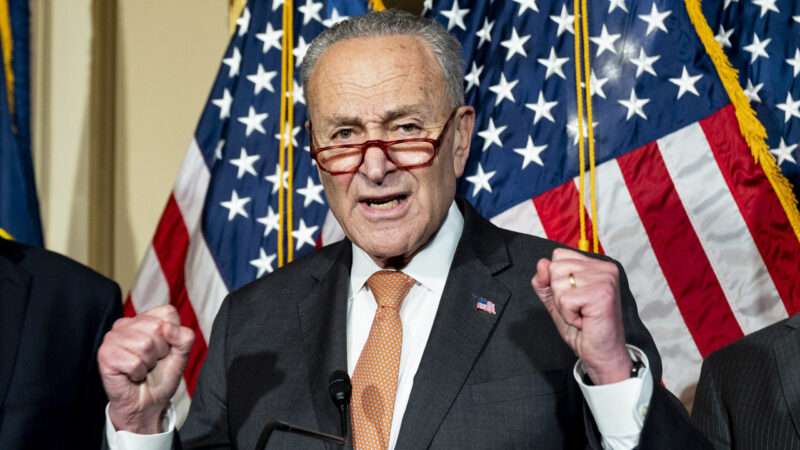
Senate Majority Leader Chuck Schumer | Michael Brochstein/Zuma Press/Newscom

Democrats’ stated reason for opposing Republicans’ “clean” continuing resolution to keep the government open is that the spending bill doesn’t extend expiring Obamacare premium subsidies or roll back recent restrictions on migrants receiving government health care subsidies.

Liberal commenters have asserted a second, strategic reason why Democrats shouldn’t provide the 60 votes necessary to pass a “clean” continuing resolution: There’s no guarantee that Republicans won’t turn around and cut spending supported by Democrats once the government is reopened.

“It takes 60 votes to pass appropriations legislation, but only 50 votes to pass a rescission package clawing appropriations back,” writes Matt Yglesias in a Slow Boring post yesterday. “Trump is now asking Democrats to provide cross-party votes for appropriations that they can unilaterally backtrack on and not even offering verbal promises to refrain from doing this. This is why the government is shutting down.

The potential upside of Democrats sticking to their guns on the shutdown, he says, is that Republicans will eventually decide to nuke the filibuster and pass a continuing resolution with a mere majority to reopen the government.

To be blunt, I don’t think any part of this argument makes much sense.

Firstly, the Trump administration is using the current shutdown as a legal justification to eliminate employees and cancel discretionary grants to Democratic states.

The actual legality of these moves might be tenuous. But the administration’s case that it does have the power to cut spending and fire employees unilaterally is made stronger by a government shutdown.

So, if the point of the shutdown is to prevent the Trump administration from cutting funding to Democratic priorities, it’s doing the opposite.

Secondly, the odds that the Trump administration and a mere majority of Congressional Republicans will turn around and cut a bunch of spending included in a Democrat-supported continuing resolution seem minimal.

It would require Republicans to vote to eliminate spending they had just approved. Even in our increasingly shameless politics, that would open them up to charges of hypocrisy and dirty dealing.

Moreover, Congressional Republicans just do not have much of an appetite for actually cutting spending. This isn’t speculation. We know this.

Recall that the second Trump administration spent its early honeymoon phase giving a chainsaw-wielding Elon Musk carte blanche to shred the federal bureaucracy.

The fiscal results of this blitz boiled down to the White House proposing a $9.5 billion rescission package, which Congressional Republicans whittled down to $8.9 billion.

Any dollar of federal spending that’s cut is welcome, particularly if we’re eliminating public broadcasting and the most frivolous foreign aid programs. Still, in the context of the $1.8 trillion federal discretionary budget that Congress is currently fighting over, these cuts are minuscule.

Even in their DOGEiest moment, a Republican-controlled Congress was willing to cut roughly half a percent of that spending.

Odds that they’ll get Democratic support to reopen the government now, and then discover a bunch more line items they want to cut with party-line votes seem slim indeed.

Guarding against that unlikely outcome by shutting down the federal government, thus giving an excuse (and legal cover) for the Trump administration to cut spending without any Congressional oversight, makes no sense on Democrats’ own terms.

The slightly more sophisticated case for Democrats’ shutdown politics is that this, at last, could convince Republicans to eliminate the hated filibuster.

Liberals have obviously long viewed the filibuster as a primary impediment to their various plans to expand the size and scope of the federal government. Eliminating it would also end the allegedly illogical arrangement whereby it takes more votes to approve spending than it does to cut it, the argument goes. If Republicans can be convinced to nuke it to end the current shutdown, so much the better.

I, of course, get why liberals don’t like the filibuster. Still, it’s not inherently ridiculous to require more votes to spend money than to not spend it.

Our entire constitutional system is premised on the idea that it should be harder for government to do something than not do something, or to stop doing something. States require supermajorities to raise taxes, not cut taxes. Grand juries have to sign off on prosecutors filing charges, not them dropping charges.

A built-in bias against government claiming new powers and spending more money is an important safeguard of liberty.

That should be abundantly clear in this present moment, when the Trump administration experiments with new and interesting forms of lawless executive overreach every day. That liberals would see now as the time to goad Republicans into ending the filibuster, thereby ceding any countermajoritarian check they have on the GOP-controlled White House and Congress, is insane.

It’s regrettable that Democrats are using this shutdown to push for an extension of distortionary health insurance subsidies that were always supposed to be temporary.

I’d much rather see them condition their support for reopening the government on the Trump administration stopping its most authoritarian initiatives, from intimidating broadcast networks to fighting the drug war with drone strikes.

That would productively shift the conversation about the shutdown to the White House’s worst abuses of power, most of which are also quite unpopular. It’s the best tool they have to get the Trump administration to change course on its most ham- and iron-fisted tactics.

In contrast, Democrats saying that they’ll just not vote for any spending bills in the hopes of eliminating the filibuster seems unwise from their own self-interested perspective and dangerous for the country as a whole.

The post Turning the Government Shutdown Into a Fight About the Filibuster Is a Terrible Idea appeared first on Reason.com.

from Latest – Reason.com https://ift.tt/jzBueUs
via IFTTT

The Justice Department’s Targeting of George Soros Is a Serious Scandal


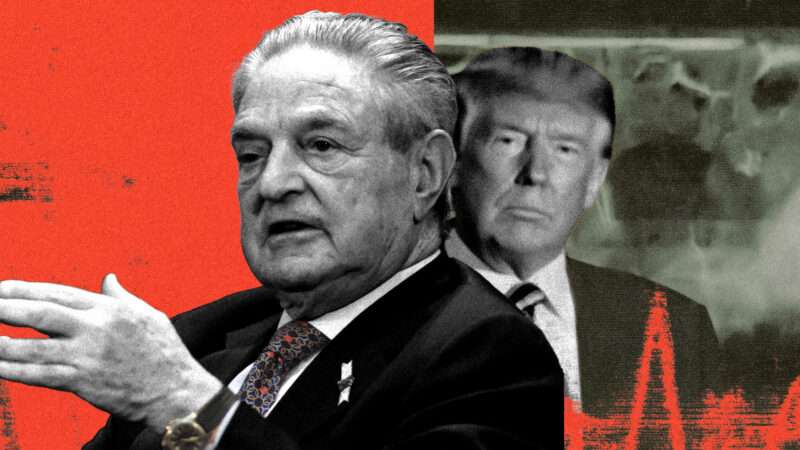
A black and white photo of billionaire financier George Soros against a red background on the left and President Donald Trump against a black background on the right. | Illustration: Eddie Marshall | EyePress News | EYEPRESS | Newscom | Midjourney

In May 2013, then–President Barack Obama gave a press conference in which he expressed dismay at a recent report out of his administration. “If in fact IRS personnel…were intentionally targeting conservative groups,” he said, “then that’s outrageous. And there’s no place for it.” He later promised to get to the bottom of “these failures,” which he called “​​intolerable and inexcusable,” and insisted that those involved be held to account. “Regardless of how this conduct was allowed to take place,” he said, “the bottom line is, it was wrong.” 

These remarks followed a disclosure by the IRS that organizations with right-coded terms such as tea party and patriots in their names had been subjected to heightened scrutiny when applying for tax-exempt status. This targeting of groups on the basis of their political views was all but universally recognized to be an abuse of governmental power. As an American Civil Liberties Union (ACLU) representative put it, “Even the appearance of playing partisan politics with the tax code is about as constitutionally troubling as it gets.” 

Reactions were swift and nonpartisan. The acting commissioner of the IRS was forced to resign, the official at the center of the controversy was placed on administrative leave, multiple investigations were launched, and the mainstream media covered it as a scandal. MSNBC’s Rachel Maddow criticized the administration, as did a number of Democratic members of Congress. 

It later emerged that the IRS had also scrutinized groups with names featuring left-coded keywords, such as occupy and medical marijuana, leading many progressive and mainstream commentators to dismiss the initial reporting as overblown. Conservatives countered with evidence suggesting that right-leaning groups were disproportionately affected, both numerically (they were more likely to be flagged for review than were left-leaning or ambiguously ideological groups) and in terms of the amount of follow-up information requested and the length of delays experienced.

In the end, an inquiry by the Treasury Department inspector general concluded that “the IRS used inappropriate criteria that identified for review organizations applying for tax-exempt status based upon their names or policy positions instead of indications of significant potential political campaign intervention.” It did not explicitly find that conservatives had been targeted, but during President Donald Trump’s first term the IRS settled a pair of lawsuits brought by more than 40 conservative groups alleging mistreatment. 

The extent to which one end of the political spectrum was treated unfairly continues to be contested (and is in some ways a matter of subjective interpretation), but it’s worth pausing to notice what the disagreement isn’t about.

The position of left-of-center commentators was, in short, that the supposed scandal had turned out to be a nothingburger. Conservatives weren’t actually targeted at all. Because the initial report left out the fact that groups of a variety of ideological persuasions had received scrutiny, it created the mistaken impression that conservatives had been singled out—presumably for political reasons—when that wasn’t true. 

The argument was not that selectively targeting one’s political opponents is fine, because elections have consequences. The argument was not that the IRS is an executive-branch agency, which places it under the direct command of the president, who therefore has the rightful authority to order any group to be audited at any time for whatever reason he, the chief executive, might deem appropriate. (Recall that there was never any evidence that Obama even had knowledge of what the IRS was up to—and that when he was told, he immediately condemned it.) And the argument was not that activities like criticizing the president or supporting anti-government protests, which the Tea Party and Occupy movements both did, count as anti-American behaviors that invite a crackdown and justify the use of any and all tools available to the state.

Yet these are precisely the sorts of arguments some conservatives are making today in order to rationalize Trump’s attacks on individuals and groups he doesn’t like. Frequently, those rationalizations are couched in the not entirely unreasonable argument that Republicans are merely taking up the weapons that Democrats have long used against them. But there are limits to the comparison.

On September 25, The New York Times reported on a directive issued by a “senior Justice Department official” to “more than a half dozen U.S. attorneys’ offices,” instructing them “to draft plans to investigate a group funded by George Soros, the billionaire Democratic donor who President Trump has demanded be thrown in jail.” In multiple ways, this represents a flagrant violation of the rule of law and norms of justice, and in each of them, the situation departs markedly from Obama-era alleged malfeasance.

First and most obviously, the call to investigate Soros’ group is part of a pattern in which Trump is not just overseeing executive branch operations but personally weighing in on the substantive exercise of state power and even forcibly overruling those tasked with impartially implementing the law. At least until recently, it was widely recognized that presidents are political actors motivated by political concerns—exactly the types of concerns that are not supposed to enter into decisions about, say, whom the Department of Justice (DOJ) investigates and prosecutes. 

Trump has disregarded the expectation that presidents remain at arm’s length so as to prevent partisan considerations from implicitly or even inadvertently bleeding over into tasks that must be nonpolitical if the system is to maintain its credibility. Even if he were not intentionally weaponizing the DOJ against his political opponents, his direct involvement would be a red flag. Again, nothing of the kind can be said of Obama and the IRS.

Second is the fact that Trump is weaponizing the federal bureaucracy against his political opponents—explicitly so. As I documented just before the last election, he has repeatedly called for his rivals and critics to be arrested and jailed. For what, exactly? His minions will figure that out later. 

This reverses the order of operations that characterizes a legitimate system of justice. As the conservative lawyer (and DOJ alum) Gregg Nunziata pointed out, “The government investigates crimes, finds those responsible, and prosecutes them. Trump would have the government investigate his enemies, find crimes, and prosecute them. This is quite literally a mortal threat to all our liberties.” 

To begin with a target—particularly one you’ve chosen for political reasons—and then go looking for misdeeds to punish is a perversion of due process. The perception that that’s what was happening is what made the IRS scandal a scandal. The Soros case, where a high-ranking official is asking his subordinates to come up with a reason to subject a major donor from the other party to law enforcement action (as opposed to observing wrongdoing and following the facts from there), is just as scandalous. That it’s happening in broad daylight, without shame or apology, makes it immeasurably more destructive to the legal and social order.

Finally, the ostensible rationale in this case is one that should be troubling to civil libertarians and anyone else who cares about free speech. The call to investigate Soros’ Open Society Foundations followed immediately on the heels of a report by Ryan Mauro of the Capital Research Center, a conservative advocacy group, which faults the foundation for having “poured over $80 million into groups tied to terrorism or extremist violence” and recommends “various accountability actions, including federal investigations and prosecutions, U.S. State Department and Treasury Department sanctions, revocations of tax-exempt statuses of Open Society and its grantees by the Internal Revenue Service, congressional investigations, and civil lawsuits.” 

A closer examination shows that those supposed ties to terrorism include an awful lot of First Amendment–protected activity. For example, Mauro claims that Open Society has given millions of dollars to grantees “that have endorsed terrorist attacks like those on October 7, 2023, and/or are directly linked to foreign terrorist groups or their known front groups.” In many cases, grant recipients are considered to have links to terrorism merely for having downplayed (in the author’s view) the atrocities perpetrated by Hamas.  

Consider this Instagram post by the progressive group 18 Million Rising, which urges “our Asian American community to join in support” for the “Palestinian people rising up against 75+ years of Israeli settler colonial violence and occupation.” It features a painting of a crying mother and child bearing the words “From the river to the sea Palestine will be free.” 

That phrase is deeply offensive to many supporters of Israel, and understandably so. But it’s still a phrase—that is to say, a textbook instance of political expression. While it’s fine to criticize groups who express ideas you find abhorrent (just as it was fine to criticize people who celebrated the assassination of Charlie Kirk), using the coercive power of the state to punish such speech is another matter. And punishing someone for having a financial relationship with someone else who has expressed unsavory views is even less defensible. 

In some cases, the supposed terrorist sympathizer is multiple steps removed from the grantmaking institution: According to the Capital Research Center, some grant recipients do not themselves support terrorism and may even have condemned Hamas’ attack on Israel, but mere association with activists who have sided with the Palestinians is presented as reason enough to turn the U.S. government against the Open Society Foundations. 

A related claim is that Soros has funded groups such as the Movement for Black Lives that “engage in or materially assist violence, property destruction, economic sabotage, harassment, and other criminality” here in the U.S. Yet few of the report’s examples of objectionable behavior involve actual violence, and a considerable number amount to petty infractions and mild civil disobedience. To treat things like “using false IDs” and “revealing the identities of government agents” as “acts of domestic terrorism,” as Mauro seems to do, is dubious in the extreme. To further include legal actions, such as posting bail and providing legal defenses to arrested protestors, or saying nice things about the Chinese Communist Party, ought to set off alarm bells for all those concerned with preserving a free society.

When laws are broken, perpetrators need to be brought to justice. It’s fair to think that prosecutors should be doing more to respond to genuine violence, property destruction, and actions that egregiously interfere with the normal functioning of society, such as shutting down roads and bridges. But stretching the definition of “domestic terrorism” and allowing it to become an all-purpose pretextual weapon for ideologues in positions of power to use against their enemies is a massive strategic misstep in addition to being unjust.

Imagine if Democrats went after a think tank that gave a prize to Tucker Carlson because Carlson has sided with Russia over Ukraine and platformed Holocaust revisionism. Or if donors to an international pro-life organization were accused of funding the criminal activities of foreign elements because some of the group’s members have been arrested for praying outside U.K. abortion clinics. Is this really a path conservatives want to go down? How does the right think things will play out next time left-wing activists—the kind who like to accuse Christian traditionalists of perpetuating a genocide against LGBT bodies—have the ear of White House senior staff?

The Capital Research Center accuses Soros of “a systemic pattern of empowering groups that glorify violence and destabilize societies.” This is exactly the kind of language that might be turned against any movement protesting entrenched injustices, from the civil rights demonstrations of the 1960s to the March for Life today.

Conservatives once understood all of this. In the wake of the IRS scandal, Bradley A. Smith, a Republican former chairman of the Federal Election Commission, reflected in an op-ed on the “lesson on abuse of power” to be learned from that experience. “The real problems are first, the president and leaders in Congress should not use their power to pressure the bureaucracy to do their partisan bidding,” he wrote, “and second, if you give government the tools to regulate political speech, the government will weaponize them for partisan gain by the party in power. No ‘criminal’ behavior is necessary.”

The post The Justice Department's Targeting of George Soros Is a Serious Scandal appeared first on Reason.com.

from Latest – Reason.com https://ift.tt/2LCm80k
via IFTTT

Josh Hawley and Democrat Allies Target AI With New Legal and Regulatory Regime


An illustration of Sen. Josh Hawley (R–Mo.) in front of a man on horseback charging at a windmill, featuring the names of major AI companies on its blades | Illustration: Eddie Marshall | Gage Skidmore | Wikimedia Commons

For years, Democratic lawmakers have been sounding the alarm about the potential danger of AI. An increasing number of Republicans are beginning to echo these warnings.

On Tuesday, Sen. Josh Hawley (R–Mo.) introduced the AI LEAD Act. The bill, cosponsored by Sen. Dick Durbin (D–Ill.), “would classify AI systems as products, allowing for liability claims when an AI system causes harm.” Hawley said the bill will allow “parents—and any consumer—[to] sue when AI products harm them or their children.” The bill makes AI developers liable for “failure to exercise reasonable care [that’s] a proximate cause of harm,” which includes “mental or psychological anguish, emotional distress, or distortion of a person’s behavior that would be highly offensive to a reasonable person.”

While the First Amendment currently shields social media platforms from a duty of care regarding the speech that their algorithms direct to users, free speech protections for AI companies are legally ambiguous. However, Garcia v. Character Technologies and Raine v. OpenAI—two cases in which teenagers took their own lives after building intimate “relationships” with chatbots—could soon provide clarity as to whether AI companies have a duty of care.

The AI LEAD Act isn’t the only AI legislation Hawley introduced this week. On Monday, he and Sen. Richard Blumenthal (D–Conn.) introduced the Artificial Intelligence Risk Evaluation Act. The bill would require advanced AI developers like OpenAI and xAI to submit all relevant information about their large language models to the Energy Department for testing and approval before deployment.

The bill, if passed, would create the Advanced Artificial Intelligence Evaluation Program in the Energy Department and charge it with “systematically collec[ing] data on the likelihood of adverse AI incidents,” which include threats to critical infrastructure, loss-of-control scenarios,  and “a significant erosion of civil liberties, economic competition, and healthy labor markets.” Ominously, the bill also requires the program to determine “the potential for controlled AI systems to reach artificial superintelligence” and to recommend measures, “including potential nationalization,” to manage or prevent this from happening.

Advanced AI developers must in turn provide the underlying code, training data, model weights, interface engine, and either “detailed information regarding the…advanced artificial intelligence system” to the energy secretary upon request. Those developers that deploy their systems without first complying with the program would face a $1 million daily fine.

Dean Ball, senior fellow at the Foundation for American Innovation, describes the bill as “a federally mandated veto point on the future of AI.” Hawley said on X that “Congress can’t allow American jobs…to take a back seat to AI,” and that he’s introducing the bill “to ensure AI works for Americans, not the other way around.” While Hawley seems to believe that AI is taking American jobs, the likelihood of imminent substitution is overblown.

Both bills would compel AI developers and deployers to invest more time and resources bubble-wrapping their tools before making them available to the public—time and resources that could otherwise go to maintaining American AI dominance. It’s unlikely that either bill will pass as written, but Republican support for these measures could signal that Congress is willing to tighten the screws on the industry, which would set America back in the global AI race.

The post Josh Hawley and Democrat Allies Target AI With New Legal and Regulatory Regime appeared first on Reason.com.

from Latest – Reason.com https://ift.tt/CQHA4Kg
via IFTTT

Turning the Government Shutdown Into a Fight About the Filibuster Is a Terrible Idea


Senate Majority Leader Chuck Schumer | Michael Brochstein/Zuma Press/Newscom

Democrats’ stated reason for opposing Republicans’ “clean” continuing resolution to keep the government open is that the spending bill doesn’t extend expiring Obamacare premium subsidies or roll back recent restrictions on migrants receiving government health care subsidies.

Liberal commenters have asserted a second, strategic reason why Democrats shouldn’t provide the 60 votes necessary to pass a “clean” continuing resolution: There’s no guarantee that Republicans won’t turn around and cut spending supported by Democrats once the government is reopened.

“It takes 60 votes to pass appropriations legislation, but only 50 votes to pass a rescission package clawing appropriations back,” writes Matt Yglesias in a Slow Boring post yesterday. “Trump is now asking Democrats to provide cross-party votes for appropriations that they can unilaterally backtrack on and not even offering verbal promises to refrain from doing this. This is why the government is shutting down.

The potential upside of Democrats sticking to their guns on the shutdown, he says, is that Republicans will eventually decide to nuke the filibuster and pass a continuing resolution with a mere majority to reopen the government.

To be blunt, I don’t think any part of this argument makes much sense.

Firstly, the Trump administration is using the current shutdown as a legal justification to eliminate employees and cancel discretionary grants to Democratic states.

The actual legality of these moves might be tenuous. But the administration’s case that it does have the power to cut spending and fire employees unilaterally is made stronger by a government shutdown.

So, if the point of the shutdown is to prevent the Trump administration from cutting funding to Democratic priorities, it’s doing the opposite.

Secondly, the odds that the Trump administration and a mere majority of Congressional Republicans will turn around and cut a bunch of spending included in a Democrat-supported continuing resolution seem minimal.

It would require Republicans to vote to eliminate spending they had just approved. Even in our increasingly shameless politics, that would open them up to charges of hypocrisy and dirty dealing.

Moreover, Congressional Republicans just do not have much of an appetite for actually cutting spending. This isn’t speculation. We know this.

Recall that the second Trump administration spent its early honeymoon phase giving a chainsaw-wielding Elon Musk carte blanche to shred the federal bureaucracy.

The fiscal results of this blitz boiled down to the White House proposing a $9.5 billion rescission package, which Congressional Republicans whittled down to $8.9 billion.

Any dollar of federal spending that’s cut is welcome, particularly if we’re eliminating public broadcasting and the most frivolous foreign aid programs. Still, in the context of the $1.8 trillion federal discretionary budget that Congress is currently fighting over, these cuts are minuscule.

Even in their DOGEiest moment, a Republican-controlled Congress was willing to cut roughly half a percent of that spending.

Odds that they’ll get Democratic support to reopen the government now, and then discover a bunch more line items they want to cut with party-line votes seem slim indeed.

Guarding against that unlikely outcome by shutting down the federal government, thus giving an excuse (and legal cover) for the Trump administration to cut spending without any Congressional oversight, makes no sense on Democrats’ own terms.

The slightly more sophisticated case for Democrats’ shutdown politics is that this, at last, could convince Republicans to eliminate the hated filibuster.

Liberals have obviously long viewed the filibuster as a primary impediment to their various plans to expand the size and scope of the federal government. Eliminating it would also end the allegedly illogical arrangement whereby it takes more votes to approve spending than it does to cut it, the argument goes. If Republicans can be convinced to nuke it to end the current shutdown, so much the better.

I, of course, get why liberals don’t like the filibuster. Still, it’s not inherently ridiculous to require more votes to spend money than to not spend it.

Our entire constitutional system is premised on the idea that it should be harder for government to do something than not do something, or to stop doing something. States require supermajorities to raise taxes, not cut taxes. Grand juries have to sign off on prosecutors filing charges, not them dropping charges.

A built-in bias against government claiming new powers and spending more money is an important safeguard of liberty.

That should be abundantly clear in this present moment, when the Trump administration experiments with new and interesting forms of lawless executive overreach every day. That liberals would see now as the time to goad Republicans into ending the filibuster, thereby ceding any countermajoritarian check they have on the GOP-controlled White House and Congress, is insane.

It’s regrettable that Democrats are using this shutdown to push for an extension of distortionary health insurance subsidies that were always supposed to be temporary.

I’d much rather see them condition their support for reopening the government on the Trump administration stopping its most authoritarian initiatives, from intimidating broadcast networks to fighting the drug war with drone strikes.

That would productively shift the conversation about the shutdown to the White House’s worst abuses of power, most of which are also quite unpopular. It’s the best tool they have to get the Trump administration to change course on its most ham- and iron-fisted tactics.

In contrast, Democrats saying that they’ll just not vote for any spending bills in the hopes of eliminating the filibuster seems unwise from their own self-interested perspective and dangerous for the country as a whole.

The post Turning the Government Shutdown Into a Fight About the Filibuster Is a Terrible Idea appeared first on Reason.com.

from Latest – Reason.com https://ift.tt/jzBueUs
via IFTTT

Trump Approves Giving Ukraine Intel For Missile Strikes Deep Inside Russia

Trump Approves Giving Ukraine Intel For Missile Strikes Deep Inside Russia

The Kremlin is downplaying reports out of the Wall Street Journal and Reuters which cite unnamed US officials to say the Trump White House has quietly reversed policy on providing Ukraine with intelligence to assist in hitting long-range targets on Russian territory. The entrenched narrative is that the US under Trump had resisted this, and that it was Biden who had really put in place the American intelligence-sharing apparatus in Ukraine.

Specifically, as The Wall Street Journal reports, “The U.S. will provide Ukraine with intelligence for long-range missile strikes on Russia’s energy infrastructure, American officials said, as the Trump administration weighs sending Kyiv powerful weapons that could put in range more targets within Russia.”

But Moscow’s response has been unexpectedly calm and cool, with a statement describing that nothing in fact has change, highlighting that US intelligence had already been flowing to Kiev for a long time.

Kremlin spokesman Dmitry Peskov said: “The US transmits intelligence to Ukraine on a regular basis online. The supply and use of the entire infrastructure of Nato and the US to collect and transfer intelligence to Ukrainians is obvious.”

In the opening months of Trump’s second term, the president got the warring sides to agree to a halt on attacking each other’s energy sites. Though it held for perhaps weeks, it didn’t take long for the moratorium to break down.

Ukraine especially has used it as a tactic to try and bring Russia’s war machine to its knees. And there are recent reports showing some degree of success in inflicting economic pain.

“President Trump recently signed off on allowing intelligence agencies and the Pentagon to aid Kyiv with the strikes. U.S. officials are asking North Atlantic Treaty Organization allies to provide similar support, these people said,” WSJ continues, marking the first such instance of Trump openly greenlighting Ukrainian strikes on Russia with long-range missiles.

The question of providing Tomahawks still remains an open one, and the Kremlin has said it would be “surprised” if the White House allowed such a serious escalation. Still, J.D. Vance early this week said the administration is seriously looking at the European request.

“The expanded intelligence-sharing with Kyiv is the latest sign that Trump is deepening support for Ukraine as his efforts to advance peace talks have stalled,” WSJ adds.

International estimates are that thus far during the war Ukraine has struck a whopping 21 out of Russia’s 38 refineries, some of them more than once, which has proven costly – also as sanctions have made it hard to find parts for quick repairs.

This alleged ‘policy change’ may be the direct result of heightened lobbying from Zelensky and the Europeans. After Zelensky was in New York last week for the UN General Assembly, Trump wrote on social media, “After getting to know and fully understand the Ukraine/Russia Military and Economic situation and, after seeing the Economic trouble it is causing Russia, I think Ukraine, with the support of the European Union, is in a position to fight and WIN all of Ukraine back in its original form.” But this was also a way of simply handing off the bulk of the war effort to the Europeans, which itself could prove highly dangerous, even if Trump wants to washing his hands of it.

Tyler Durden
Thu, 10/02/2025 – 13:40

via ZeroHedge News https://ift.tt/SUDupN6 Tyler Durden

The Justice Department’s Targeting of George Soros Is a Serious Scandal


A black and white photo of billionaire financier George Soros against a red background on the left and President Donald Trump against a black background on the right. | Illustration: Eddie Marshall | EyePress News | EYEPRESS | Newscom | Midjourney

In May 2013, then–President Barack Obama gave a press conference in which he expressed dismay at a recent report out of his administration. “If in fact IRS personnel…were intentionally targeting conservative groups,” he said, “then that’s outrageous. And there’s no place for it.” He later promised to get to the bottom of “these failures,” which he called “​​intolerable and inexcusable,” and insisted that those involved be held to account. “Regardless of how this conduct was allowed to take place,” he said, “the bottom line is, it was wrong.” 

These remarks followed a disclosure by the IRS that organizations with right-coded terms such as tea party and patriots in their names had been subjected to heightened scrutiny when applying for tax-exempt status. This targeting of groups on the basis of their political views was all but universally recognized to be an abuse of governmental power. As an American Civil Liberties Union (ACLU) representative put it, “Even the appearance of playing partisan politics with the tax code is about as constitutionally troubling as it gets.” 

Reactions were swift and nonpartisan. The acting commissioner of the IRS was forced to resign, the official at the center of the controversy was placed on administrative leave, multiple investigations were launched, and the mainstream media covered it as a scandal. MSNBC’s Rachel Maddow criticized the administration, as did a number of Democratic members of Congress. 

It later emerged that the IRS had also scrutinized groups with names featuring left-coded keywords, such as occupy and medical marijuana, leading many progressive and mainstream commentators to dismiss the initial reporting as overblown. Conservatives countered with evidence suggesting that right-leaning groups were disproportionately affected, both numerically (they were more likely to be flagged for review than were left-leaning or ambiguously ideological groups) and in terms of the amount of follow-up information requested and the length of delays experienced.

In the end, an inquiry by the Treasury Department inspector general concluded that “the IRS used inappropriate criteria that identified for review organizations applying for tax-exempt status based upon their names or policy positions instead of indications of significant potential political campaign intervention.” It did not explicitly find that conservatives had been targeted, but during President Donald Trump’s first term the IRS settled a pair of lawsuits brought by more than 40 conservative groups alleging mistreatment. 

The extent to which one end of the political spectrum was treated unfairly continues to be contested (and is in some ways a matter of subjective interpretation), but it’s worth pausing to notice what the disagreement isn’t about.

The position of left-of-center commentators was, in short, that the supposed scandal had turned out to be a nothingburger. Conservatives weren’t actually targeted at all. Because the initial report left out the fact that groups of a variety of ideological persuasions had received scrutiny, it created the mistaken impression that conservatives had been singled out—presumably for political reasons—when that wasn’t true. 

The argument was not that selectively targeting one’s political opponents is fine, because elections have consequences. The argument was not that the IRS is an executive-branch agency, which places it under the direct command of the president, who therefore has the rightful authority to order any group to be audited at any time for whatever reason he, the chief executive, might deem appropriate. (Recall that there was never any evidence that Obama even had knowledge of what the IRS was up to—and that when he was told, he immediately condemned it.) And the argument was not that activities like criticizing the president or supporting anti-government protests, which the Tea Party and Occupy movements both did, count as anti-American behaviors that invite a crackdown and justify the use of any and all tools available to the state.

Yet these are precisely the sorts of arguments some conservatives are making today in order to rationalize Trump’s attacks on individuals and groups he doesn’t like. Frequently, those rationalizations are couched in the not entirely unreasonable argument that Republicans are merely taking up the weapons that Democrats have long used against them. But there are limits to the comparison.

On September 25, The New York Times reported on a directive issued by a “senior Justice Department official” to “more than a half dozen U.S. attorneys’ offices,” instructing them “to draft plans to investigate a group funded by George Soros, the billionaire Democratic donor who President Trump has demanded be thrown in jail.” In multiple ways, this represents a flagrant violation of the rule of law and norms of justice, and in each of them, the situation departs markedly from Obama-era alleged malfeasance.

First and most obviously, the call to investigate Soros’ group is part of a pattern in which Trump is not just overseeing executive branch operations but personally weighing in on the substantive exercise of state power and even forcibly overruling those tasked with impartially implementing the law. At least until recently, it was widely recognized that presidents are political actors motivated by political concerns—exactly the types of concerns that are not supposed to enter into decisions about, say, whom the Department of Justice (DOJ) investigates and prosecutes. 

Trump has disregarded the expectation that presidents remain at arm’s length so as to prevent partisan considerations from implicitly or even inadvertently bleeding over into tasks that must be nonpolitical if the system is to maintain its credibility. Even if he were not intentionally weaponizing the DOJ against his political opponents, his direct involvement would be a red flag. Again, nothing of the kind can be said of Obama and the IRS.

Second is the fact that Trump is weaponizing the federal bureaucracy against his political opponents—explicitly so. As I documented just before the last election, he has repeatedly called for his rivals and critics to be arrested and jailed. For what, exactly? His minions will figure that out later. 

This reverses the order of operations that characterizes a legitimate system of justice. As the conservative lawyer (and DOJ alum) Gregg Nunziata pointed out, “The government investigates crimes, finds those responsible, and prosecutes them. Trump would have the government investigate his enemies, find crimes, and prosecute them. This is quite literally a mortal threat to all our liberties.” 

To begin with a target—particularly one you’ve chosen for political reasons—and then go looking for misdeeds to punish is a perversion of due process. The perception that that’s what was happening is what made the IRS scandal a scandal. The Soros case, where a high-ranking official is asking his subordinates to come up with a reason to subject a major donor from the other party to law enforcement action (as opposed to observing wrongdoing and following the facts from there), is just as scandalous. That it’s happening in broad daylight, without shame or apology, makes it immeasurably more destructive to the legal and social order.

Finally, the ostensible rationale in this case is one that should be troubling to civil libertarians and anyone else who cares about free speech. The call to investigate Soros’ Open Society Foundations followed immediately on the heels of a report by Ryan Mauro of the Capital Research Center, a conservative advocacy group, which faults the foundation for having “poured over $80 million into groups tied to terrorism or extremist violence” and recommends “various accountability actions, including federal investigations and prosecutions, U.S. State Department and Treasury Department sanctions, revocations of tax-exempt statuses of Open Society and its grantees by the Internal Revenue Service, congressional investigations, and civil lawsuits.” 

A closer examination shows that those supposed ties to terrorism include an awful lot of First Amendment–protected activity. For example, Mauro claims that Open Society has given millions of dollars to grantees “that have endorsed terrorist attacks like those on October 7, 2023, and/or are directly linked to foreign terrorist groups or their known front groups.” In many cases, grant recipients are considered to have links to terrorism merely for having downplayed (in the author’s view) the atrocities perpetrated by Hamas.  

Consider this Instagram post by the progressive group 18 Million Rising, which urges “our Asian American community to join in support” for the “Palestinian people rising up against 75+ years of Israeli settler colonial violence and occupation.” It features a painting of a crying mother and child bearing the words “From the river to the sea Palestine will be free.” 

That phrase is deeply offensive to many supporters of Israel, and understandably so. But it’s still a phrase—that is to say, a textbook instance of political expression. While it’s fine to criticize groups who express ideas you find abhorrent (just as it was fine to criticize people who celebrated the assassination of Charlie Kirk), using the coercive power of the state to punish such speech is another matter. And punishing someone for having a financial relationship with someone else who has expressed unsavory views is even less defensible. 

In some cases, the supposed terrorist sympathizer is multiple steps removed from the grantmaking institution: According to the Capital Research Center, some grant recipients do not themselves support terrorism and may even have condemned Hamas’ attack on Israel, but mere association with activists who have sided with the Palestinians is presented as reason enough to turn the U.S. government against the Open Society Foundations. 

A related claim is that Soros has funded groups such as the Movement for Black Lives that “engage in or materially assist violence, property destruction, economic sabotage, harassment, and other criminality” here in the U.S. Yet few of the report’s examples of objectionable behavior involve actual violence, and a considerable number amount to petty infractions and mild civil disobedience. To treat things like “using false IDs” and “revealing the identities of government agents” as “acts of domestic terrorism,” as Mauro seems to do, is dubious in the extreme. To further include legal actions, such as posting bail and providing legal defenses to arrested protestors, or saying nice things about the Chinese Communist Party, ought to set off alarm bells for all those concerned with preserving a free society.

When laws are broken, perpetrators need to be brought to justice. It’s fair to think that prosecutors should be doing more to respond to genuine violence, property destruction, and actions that egregiously interfere with the normal functioning of society, such as shutting down roads and bridges. But stretching the definition of “domestic terrorism” and allowing it to become an all-purpose pretextual weapon for ideologues in positions of power to use against their enemies is a massive strategic misstep in addition to being unjust.

Imagine if Democrats went after a think tank that gave a prize to Tucker Carlson because Carlson has sided with Russia over Ukraine and platformed Holocaust revisionism. Or if donors to an international pro-life organization were accused of funding the criminal activities of foreign elements because some of the group’s members have been arrested for praying outside U.K. abortion clinics. Is this really a path conservatives want to go down? How does the right think things will play out next time left-wing activists—the kind who like to accuse Christian traditionalists of perpetuating a genocide against LGBT bodies—have the ear of White House senior staff?

The Capital Research Center accuses Soros of “a systemic pattern of empowering groups that glorify violence and destabilize societies.” This is exactly the kind of language that might be turned against any movement protesting entrenched injustices, from the civil rights demonstrations of the 1960s to the March for Life today.

Conservatives once understood all of this. In the wake of the IRS scandal, Bradley A. Smith, a Republican former chairman of the Federal Election Commission, reflected in an op-ed on the “lesson on abuse of power” to be learned from that experience. “The real problems are first, the president and leaders in Congress should not use their power to pressure the bureaucracy to do their partisan bidding,” he wrote, “and second, if you give government the tools to regulate political speech, the government will weaponize them for partisan gain by the party in power. No ‘criminal’ behavior is necessary.”

The post The Justice Department's Targeting of George Soros Is a Serious Scandal appeared first on Reason.com.

from Latest – Reason.com https://ift.tt/2LCm80k
via IFTTT

North Koreans Ordered To Identify Women With “Un-Socialist” Breasts

North Koreans Ordered To Identify Women With “Un-Socialist” Breasts

Authorities in North Korea have been ordered to identify women with “un-socialist” and “bourgeois” breast implants, The Telegraph reports, citing local media.

Illustration: Sanjeev Das

Undercover agents are now groping for ‘enhanced’ women, as well as for doctors who perform the cosmetic procedures, primarily around the city of Sariwon, with perpetrators facing potential detention in the country’s notorious labor camps.

Suspected women will be “taken to hospitals to undergo medical examinations to ascertain whether any procedures have taken place,” a tough job for whoever has to do it. 

The controversy bounced into the headlines after a dropout medical student was busted performing the surgery out of his home. During his trial, prosecutors displayed his surgical devices, along with imported Chinese silicone breasts and bundles of cash. 

The Telegraph reports:

The city’s residents, who had turned out to attend the public hearing, watched as the women and the doctor were dragged out onto an open stage, where they stood with their heads bowed for the proceedings.

The two women told prosecutors and the presiding judge that they had undergone the surgeries because they “wanted to improve their bodies”.

The judge called the breast augmentation surgery an “un-socialist act” and said one of the defendants “had no intention of being loyal to the organisation and group, but was obsessed with vanity and ended up becoming a poisonous weed that was eating away at the socialist system”.

A source, who refused to give their name out of fear, revealed to Daily NK: “Among the residents who watched the trial, there were voices of criticism such as ‘doctors do all kinds of things for money,’ but at the same time, there were also sympathetic comments such as ‘Isn’t he doing such things because he has no way to make a living?'”

Question of the day – and this is very serious as we are trying to raise awareness… are these unsocialist Korean breasts?

All pics via Instagram

How about these? (unrelated… because dry skin is the worst)

And these?

Unsocialist AI breasts? DELETE!

Wait, what???

Clearly we have some BIG fans of IQ Male Enhancement and our Waxed Canvas HatUnless Sanj is up to his old tricks.

So anyway… Kim’s directive follows a pattern of measures targeting Western cultural influence in North Korea, including the execution of young citizens for listening to K-pop and a ban on commonplace terms such as “hamburger” and “ice cream.”

Would she be targeted for Western cultural influence?

The situation in the isolated nation was detailed in a recent United Nations report, which documented that North Korea’s secret police are conducting public executions for offenses including watching foreign films or sharing South Korean television dramas. The report cited one case in which a 22-year-old man from South Hwanghae province was publicly executed in 2022 for listening to 70 South Korean songs and distributing three films, actions deemed violations of the regime’s restrictive laws. Defectors have suggested these public executions serve to “block people’s eyes and ears,” using fear to maintain control over the population.

Tyler Durden
Thu, 10/02/2025 – 13:00

via ZeroHedge News https://ift.tt/q1efA43 Tyler Durden

US Businesses Sign Record 98 Contracts Worth $170 Billion With Foreign Government Buyers

US Businesses Sign Record 98 Contracts Worth $170 Billion With Foreign Government Buyers

Authored by Naveen Athrappully via The Epoch Times (emphasis ours),

American businesses signed 98 contracts valued at $170 billion with foreign government buyers during the first nine months of the Trump administration, the Department of Commerce’s International Trade Administration (ITA) said in a Sept. 30 statement.

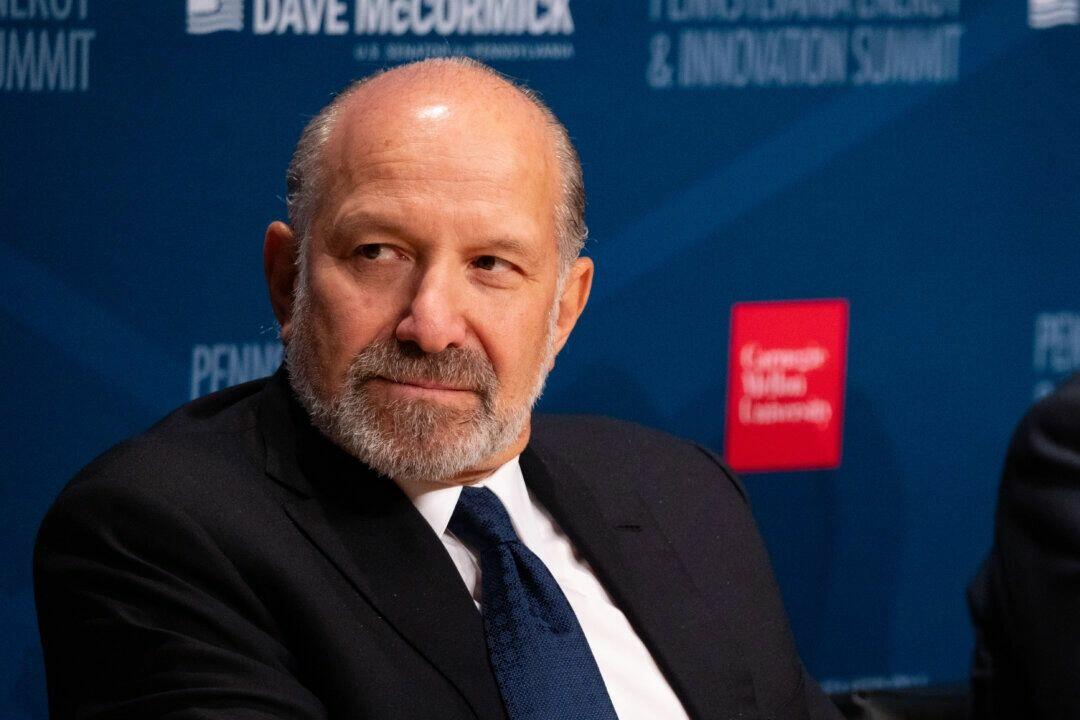
U.S. Secretary of Commerce Howard Lutnick speaks at the Pennsylvania Energy and Innovation Summit at Carnegie Mellon University in Pittsburgh on July 15, 2025. Samira Bouaou/The Epoch Times

The record $170 billion in contracts signed with foreign government buyers so far in 2025 vastly surpasses the $12 billion in contracts signed during the same period in 2021,” ITA said.

The contracts are expected to support 589,000 American jobs and ensure $144 billion worth of made-in-USA exports.

“The record-breaking U.S. business wins under President Trump’s leadership reflect an unwavering commitment to rebuilding U.S. industry for the American worker,” Commerce Secretary Howard Lutnick said.

“With record business deals abroad, America is strong again, and together with the American worker, President Trump is transforming the U.S. economy, rebalancing our global trade, and restoring America’s place in the world.”

In terms of value, the U.S. aerospace and defense sector inked $153 billion in contracts with foreign government entities, which is expected to keep the American industrial base strong, according to ITA.

Roughly $5 billion in deals have been signed that will strengthen energy security in the country, especially in the oil, gas, and nuclear sectors.

According to ITA, more than $800 million in contracts have been signed in the information technology sector. In the safety and security equipment sector, more than $600 million worth of deals have been entered, thereby countering untrusted tech and unfair tactics of foreign adversaries.

“In the first nine months of the Trump Administration, ITA advocacy has worked tirelessly to win contracts to support hundreds of thousands of American jobs,” said Commerce Undersecretary William Kimmitt.

We will continue to be an unrelenting advocate around the world in support of American workers.

The sharp uptick in business performance comes amid concerns about the state of the U.S. economy over the coming months.

In a Sept. 18 statement, think tank The Conference Board said that its leading economic index fell by 0.5 percent in August from the previous month, suggesting a near-term decline in the economy.

This was the largest monthly fall since April, according to Justyna Zabinska-La Monica, senior manager of business cycle indicators at the think tank.

“Overall, the LEI suggests that economic activity will continue to slow. A major driver of this slowdown has been higher tariffs, which already trimmed growth in H1 2025 and will continue to be a drag on GDP growth in the second half of this year and in H1 2026,” Zabinska-La Monica said.

Despite these projections, GDP growth has increased in the recent second quarter, signaling a strengthening of the economy.

In the first quarter of 2025, GDP contracted by 0.6 percent, according to the Bureau of Economic Analysis. However, in the second quarter, the first full quarter under the Trump administration, GDP grew by 3.8 percent, higher than initial estimates of 3 percent.

“America’s economic resurgence under President Trump continues: revised data show even stronger real GDP growth of 3.8 percent in Q2 2025 thanks to the Trump agenda of tax cuts, deregulation, tariffs, and energy abundance,” White House deputy press secretary Kush Desai wrote in an X post on Sept. 25.

A Sept. 24 statement from the Chamber of Commerce said that small business confidence continued to climb in the third quarter, according to a survey of small business owners.

“This quarter’s Index reflects a resilient small business community that’s cautiously optimistic about the economy,” said Tom Sullivan, vice president of small business policy at the chamber.

“But high costs are still holding many back from expanding and investing.”

Among the respondents. 46 percent said inflation was the biggest challenge, while 34 percent blamed the cost of goods and services as the most significant roadblock to expansion.

The economic outlook improved among respondents, with 40 percent saying the U.S. economy was in good health.

Tyler Durden
Thu, 10/02/2025 – 12:40

via ZeroHedge News https://ift.tt/UCbTxM2 Tyler Durden