Government Shutdowns Are an Example of Congress Doing Its Job

When the government shut down for a few weeks in October 2013, then-President Barack Obama made sure to blame conservative Republicans for refusing to pass any short-term spending bill that included Obamacare insurance subsidies.

“The only thing preventing people from going back to work and basic research starting back up, and farmers and small business owners getting their loan…is that Speaker John Boehner won’t even let the bill get a yes-or-no vote, because he doesn’t want to anger the extremists in his party,” said Obama in a mid-shutdown speech.

Today, it’s Democrats who are refusing to vote for short-term funding bills to reopen the government so long as they don’t include an extension of enhanced Obamacare insurance subsidies that are set to expire at the end of 2025.

Now, President Donald Trump’s White House is accusing radical Democrats of inflicting misery and dysfunction on the country.

The shutdown instigated by “Radical Left lunatics” will cause “critical food assistance for low‑income women, infants, and children [to] lapse. Americans will experience travel delays and disruptions to Social Security services,” reads a White House email sent out this afternoon.

The consistent rhetoric around government shutdowns, even if the parties and issues are reversed, betrays a common view of Congress’ role in our constitutional design: Lawmakers should shut up and fund the government. When they don’t do that, and the government shuts down, they’ve failed to do their job.

This view couldn’t be more backwards about how our constitutional scheme, with its separate branches, divided powers, and limits on the power of the executive and majority parties, is supposed to work.

The whole reason for Congress having the power of the purse and holding regular votes on how much money to give the president to spend is to give it the opportunity to say no sometimes.

Congress exercising its power to say no to funding requests and shutting down the government is an example of it doing its job, not an example of it failing to do its job.

There’s obviously a functional purpose served by Congress periodically voting on government spending. This creates regular opportunities for lawmakers to evaluate the performance of programs and propose to reform, expand, or abolish them.

More importantly, there’s a political and constitutional purpose served by regular appropriations votes. It gives the Congress leverage to discipline an executive branch that might be behaving lawlessly or abusing the constitutional rights of Americans.

The Senate’s filibuster likewise gives the minority party the ability to check the power of the majority party in Congress from rubber stamping executive abuses when they control both Congress and the White House.

Not a day goes by that a leading Democrat does not accuse Trump of acting in a lawless and authoritarian manner, whether because of Immigration and Customs Enforcement raids, National Guard deployments, intimidation of broadcast media companies, or more.

There’s a lot of merit to Democrats’ complaints on those fronts. If they take their own rhetoric seriously, they should be refusing to fund the government, absent some credible concessions from the White House.

Doing otherwise would be at best a tacit admission that they don’t believe their own rhetoric. At worst, it would be a dereliction of duty.

To be sure, not every government shutdown is initiated for wise or worthwhile reasons.

Democratic demands in the run-up to this shutdown were notably not about the Trump administration backing off its most authoritarian initiatives. Instead, they’re about demanding that “temporary” health insurance subsidies be automatically extended.

The relatively low stakes of that ask, and the fact that a lot of Republicans are eager to extend those subsidies as well, means that this government shutdown will likely be a short one. Because it’s not aimed at the most destructive Trump administration policies, it’ll be a relatively unproductive shutdown as well.

Still, the fact that the shutdown occurred at all is an increasingly rare example of Congress managing to fulfill its constitutional role of checking the executive. It’s not an example of it failing to do its job.

The post Government Shutdowns Are an Example of Congress Doing Its Job appeared first on Reason.com.

from Latest – Reason.com https://ift.tt/oPlY8Nd
via IFTTT

Caleb Nelson’s Originalist Critique of Unitary Executive Theory

NA

The Supreme Court seems likely to embrace “unitary executive” theory (UET) in its upcoming case in Trump v. Slaughter, at least in so far as that theory mandates that the president have the power to fire lower-level executive branch officials with any significant policy discretion. It already strongly hinted in that direction in its May “shadow docket” decision in Trump v. Wilcox (though it also suggested the Federal Reserve is an exception to the rule).

Prominent originalist legal scholar Caleb Nelson (University of Virginia) recently posted an originalist critique of UET. Here’s an excerpt:

Aside from its provisions about impeachment,… the Constitution does not specifically address the removal of officers in the executive branch (which, for this purpose, includes the enormous variety of agencies that administer an enormous variety of statutes in an enormous variety of ways).  Who gets to fire them and for what reasons?

It would be natural to conclude that as with other issues relating to the structure of the executive branch, Congress has broad authority to address this topic by statute.  Given the range of tasks that Congress can authorize different officers to perform (entering into contracts, making grants, issuing licenses, conducting formal adjudications, participating in the promulgation of regulations, and more), and given the variety of things that different statutes require or allow these officers to consider (including legal constraints, technical or scientific expertise, the evidence introduced in adjudicative proceedings, and more), one might not expect a one-size-fits-all approach.  For sensible policy reasons, Congress might decide that the President should be able to remove many officers or even lower-ranking employees at will, but that other officers or employees should be removable only for defined causes and through defined processes.  In my view, the Necessary and Proper Clause lets Congress make these judgment calls as it enacts particular statutes that structure particular agencies.

The Supreme Court, however, has interpreted Article II of the Constitution to address the topic of removal itself. Although the case law is still in flux, the Court appears to be moving toward a sweepingly pro-President position: most officers who participate in the exercise of executive power must be removable at will by the President or his direct subordinates….

As Nelson notes, the text of the Constitution does not indicate that the president has any specific removal authority. And, as the rest of his article describes, historical evidence is at best ambiguous on this score, and may well point to the conclusion that Congress can determine the scope of removal authority.

I, myself, have a different set of originalist reservations about UET, which I most recently outlined earlier this year:

If the executive branch still wielded only the relatively narrow range of powers it had at the time of the Founding, the case for the unitary executive would be pretty strong…. Unfortunately, however, the current scope of executive authority goes far beyond that. To take just one noteworthy example, the president now presides over a vast federal law-enforcement apparatus, much of it devoted to waging the War on Drugs (which accounts for the lion’s share of federal prosecutions and prisoners). Under the original meaning of the Constitution – and the dominant understanding of the first 150 years of American history – the federal government did not have the power to ban in-state possession and distribution of goods. That’s why it took a constitutional amendment to establish federal alcohol Prohibition in 1919…. Immigration is another field where the executive now wields vast power, despite the fact that, as James Madison and others pointed out, the original meaning of the Constitution actually did not give the federal government any general power to restrict migration into the United States….

The same holds true for a great many other powers currently wielded by the executive branch. The original Constitution does not authorize the federal government to regulate nearly every aspect of our lives, to the point where we have so many federal laws that a  majority of adult Americans have violated federal criminal law at some time in their lives (to say nothing of civil law).

There is nothing originalist about giving the president such unconstitutional powers. If “executive” power is the power to “execute” federal laws authorized by the original meaning of the Constitution, it does not apply to powers that have no such authorization. The only way to truly enforce the original meaning in such cases is to remove such authority from federal hands altogether. But if we cannot or will not do that, there is no reason to think that giving the power to the president is any better – from an originalist point of view – than lodging it somewhere else. Either way, someone in the federal government will be wielding power that they are not supposed to have under the original meaning of the Constitution.

If we are not going to enforce the original scope of federal power, then we also should not enforce the (possibly) unitary original distribution of that authority. Concentrating such vast power in the hands of one man would actually run counter to the Framers’ objective of promoting separation of powers, and avoiding excessive concentration of power in any one person.

Later in my piece, I criticize the “political accountability” rationale for UET. As I explain, accountability through Congress is just as good as that through the executive, perhaps more so; though neither actually works particularly well, given the combination of vast federal powers and widespread voter ignorance about many of the functions of government. At the very least, accountability rationales can’t justify giving one man sweeping authority that goes beyond anything envisioned at the Founding.

Nelson hints at a similar concern about concentration power near the end of his article:

If most of what the federal government currently does on a daily basis is “executive,” and if the President must have full control over each and every exercise of “executive” power by the federal government (including an unlimitable ability to remove all or almost all executive officers for reasons good or bad), then the President has an enormous amount of power—more power, I think, than any sensible person should want anyone to have, and more power than any member of the founding generation could have anticipated.

I am an originalist, and if the original meaning of the Constitution compelled this outcome, I would be inclined to agree that the Supreme Court should respect it until the Constitution is amended through the proper processes.  But both the text and the history of Article II are far more equivocal than the current Court has been suggesting.  In the face of such ambiguities, I hope that the Justices will not act as if their hands are tied and they cannot consider any consequences of the interpretations that they choose.

I agree. Whether these or any other considerations stay the hand of the Supreme Court remains to be seen.

The post Caleb Nelson's Originalist Critique of Unitary Executive Theory appeared first on Reason.com.

from Latest – Reason.com https://ift.tt/XdwcIPn
via IFTTT

Government Shutdowns Are an Example of Congress Doing Its Job

When the government shut down for a few weeks in October 2013, then-President Barack Obama made sure to blame conservative Republicans for refusing to pass any short-term spending bill that included Obamacare insurance subsidies.

“The only thing preventing people from going back to work and basic research starting back up, and farmers and small business owners getting their loan…is that Speaker John Boehner won’t even let the bill get a yes-or-no vote, because he doesn’t want to anger the extremists in his party,” said Obama in a mid-shutdown speech.

Today, it’s Democrats who are refusing to vote for short-term funding bills to reopen the government so long as they don’t include an extension of enhanced Obamacare insurance subsidies that are set to expire at the end of 2025.

Now, President Donald Trump’s White House is accusing radical Democrats of inflicting misery and dysfunction on the country.

The shutdown instigated by “Radical Left lunatics” will cause “critical food assistance for low‑income women, infants, and children [to] lapse. Americans will experience travel delays and disruptions to Social Security services,” reads a White House email sent out this afternoon.

The consistent rhetoric around government shutdowns, even if the parties and issues are reversed, betrays a common view of Congress’ role in our constitutional design: Lawmakers should shut up and fund the government. When they don’t do that, and the government shuts down, they’ve failed to do their job.

This view couldn’t be more backwards about how our constitutional scheme, with its separate branches, divided powers, and limits on the power of the executive and majority parties, is supposed to work.

The whole reason for Congress having the power of the purse and holding regular votes on how much money to give the president to spend is to give it the opportunity to say no sometimes.

Congress exercising its power to say no to funding requests and shutting down the government is an example of it doing its job, not an example of it failing to do its job.

There’s obviously a functional purpose served by Congress periodically voting on government spending. This creates regular opportunities for lawmakers to evaluate the performance of programs and propose to reform, expand, or abolish them.

More importantly, there’s a political and constitutional purpose served by regular appropriations votes. It gives the Congress leverage to discipline an executive branch that might be behaving lawlessly or abusing the constitutional rights of Americans.

The Senate’s filibuster likewise gives the minority party the ability to check the power of the majority party in Congress from rubber stamping executive abuses when they control both Congress and the White House.

Not a day goes by that a leading Democrat does not accuse Trump of acting in a lawless and authoritarian manner, whether because of Immigration and Customs Enforcement raids, National Guard deployments, intimidation of broadcast media companies, or more.

There’s a lot of merit to Democrats’ complaints on those fronts. If they take their own rhetoric seriously, they should be refusing to fund the government, absent some credible concessions from the White House.

Doing otherwise would be at best a tacit admission that they don’t believe their own rhetoric. At worst, it would be a dereliction of duty.

To be sure, not every government shutdown is initiated for wise or worthwhile reasons.

Democratic demands in the run-up to this shutdown were notably not about the Trump administration backing off its most authoritarian initiatives. Instead, they’re about demanding that “temporary” health insurance subsidies be automatically extended.

The relatively low stakes of that ask, and the fact that a lot of Republicans are eager to extend those subsidies as well, means that this government shutdown will likely be a short one. Because it’s not aimed at the most destructive Trump administration policies, it’ll be a relatively unproductive shutdown as well.

Still, the fact that the shutdown occurred at all is an increasingly rare example of Congress managing to fulfill its constitutional role of checking the executive. It’s not an example of it failing to do its job.

The post Government Shutdowns Are an Example of Congress Doing Its Job appeared first on Reason.com.

from Latest – Reason.com https://ift.tt/oPlY8Nd
via IFTTT

Goldman Flags Coffee Demand Risks As Youth Unemployment Rises 

Goldman Flags Coffee Demand Risks As Youth Unemployment Rises 

Goldman analysts find that a softening labor market, slowing traffic at major QSR chains, and intensifying competition are raising investor concerns about ready-to-drink (RTD) and specialty coffee demand. Since Gen Z is a key driver of RTD coffee at QSRs, the analysts highlight several “swing factors” to watch that could influence demand from this younger cohort.

We are observing rising investor concerns about the coffee category’s macro and competitive backdrop,” a team of analysts led by Christine Cho wrote in a note on Tuesday. 

Cho listed some of those key pressure points: 

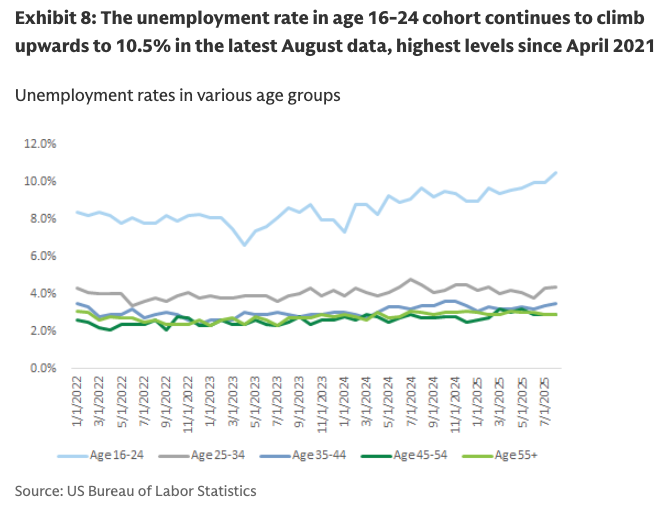
  1. Softening labor-market data, which is notable given that younger consumers have been a key growth engine for coffee and beverages in recent years;

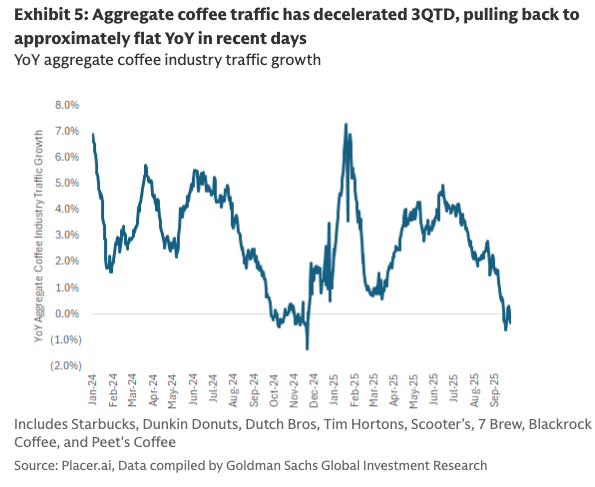
  2. Signs of 3QTD traffic deceleration across the broader coffee market; and

  3. QSR brands’ stepped up focus on beverage opportunities (i.e., MCD’s new beverage test in hundreds of stores in the US and Taco Bell’s plans to open 30 Live Mas Cafes by the end of the year).

Here’s more: 

We have observed a modest uptick in SBUX’s foot traffic trends in the top 3 coffee markets post the fall menu launch on Aug 26 vs. some deceleration in BROS’ trends as per our latest Placer data analysis, and while it’s early, McDonald’s has gained 80 bps share of foot traffic in Colorado from 9/1-9/25/25 since the launch of its beverage tests on Sep 2 (Exhibit 4). We believe there are a number of key swing factors to watch for over the next few months including Gen Z spending intentions, Starbucks’ launch of protein beverage / cold foam platform on Sep 29 and whether that influences net purchase intentions. That said, we maintain our Neutral ratings on SBUX and BROS as we await more clarity in these trends.

How will increased coffee/beverage competition impact existing market players?

On July 24, McDonald’s announced a CosMc’s-inspired beverage test across 500+ restaurants in Colorado, Wisconsin, and surrounding areas as consumers, particularly the Gen Z cohort, prefer cold beverages (link). This reflects a broader shift toward beverages we’ve seen across the restaurant industry as brands aim to capitalize on shifting coffee preferences (~40% of LSR offerings are now cold), with Taco Bell (Live Mas Cafe) and Chick-fil-A (Daybright) also testing beverage concepts and Wendy’s launching cold brew coffee in August. Additionally, Jack in the Box announced the return of bigger cup sizes (25% more ounces) starting October 1 amid the stepped up value narrative across the industry. We think this could translate to intensifying competition in the coffee market especially for Dutch Bros, given that the brand has differentiated itself through its unique iced beverages and preference among younger consumers.

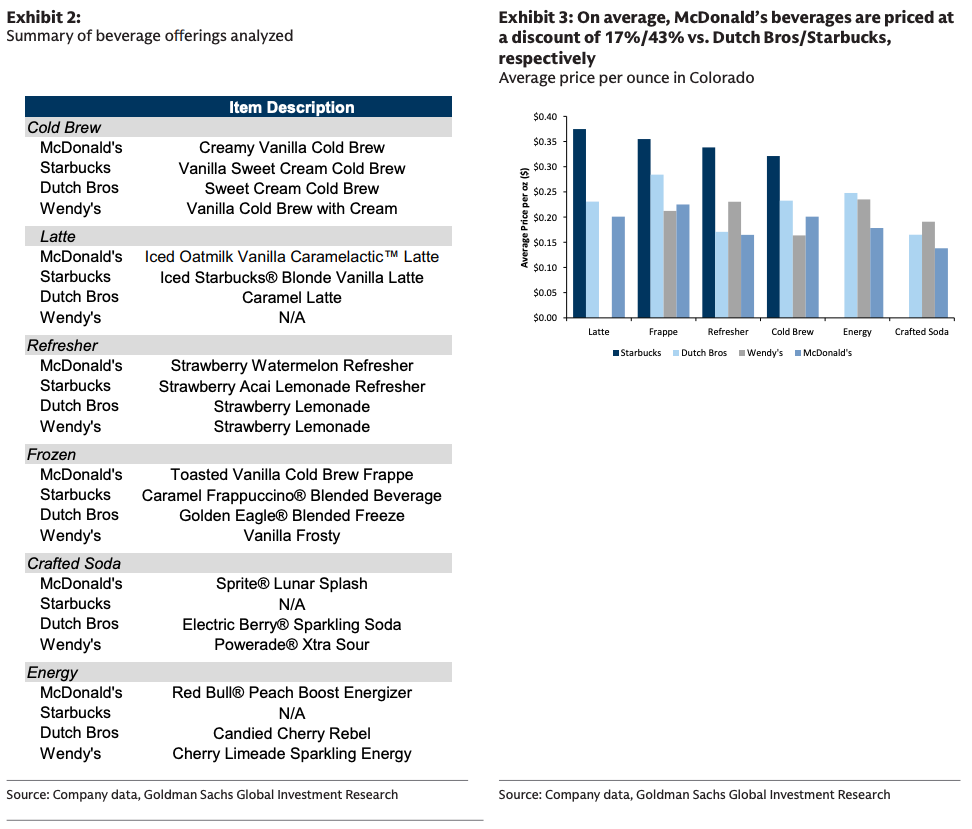
McDonald’s beverages per ounce are priced at a discount of high teens/low 40% on average vs. Dutch Bros/Starbucks, respectively, based on our analysis of menu pricing for an array of offerings across 11 cities in Colorado as a way to assess which brands offer strong value in an increasingly competitive environment (Exhibit 3). Notably, Starbucks did not have any comparable offerings for two of the six categories analyzed, as the company aims to reduce operational complexity through a simplified menu, and offered the most expensive option across the remaining four categories.

For cash-strapped consumers, McDonald’s offers the best RTD prices (at least in Colorado).

Coffee demand remains dismal. 

Given that Gen Z significantly drives coffee demand, analysts point to rising youth unemployment as a potential factor behind the slump in sales.

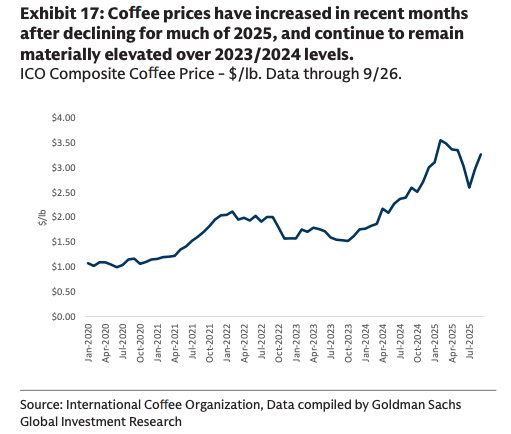
And soaring coffee bean prices don’t help with price affordability

The takeaway is that the coffee market is facing mounting macroeconomic headwinds and intensifying competition, just as unemployment among Gen Zers ticks higher. A soft labor market, slowing traffic, and aggressive QSR beverage rollouts (McDonald’s, Taco Bell, Chick-fil-A, Wendy’s) are eroding demand momentum. Starbucks still commands premium pricing but risks losing share to cheaper, value-oriented rivals like McDonald’s

ZeroHedge Pro Subs can access the full note, with all the charts and deeper analysis, in the usual spot.

Tyler Durden
Wed, 10/01/2025 – 15:40

via ZeroHedge News https://ift.tt/K8n0HhW Tyler Durden

Amazon Launches Cheap Grocery Brand As Value War With Walmart Heats Up 

Amazon Launches Cheap Grocery Brand As Value War With Walmart Heats Up 

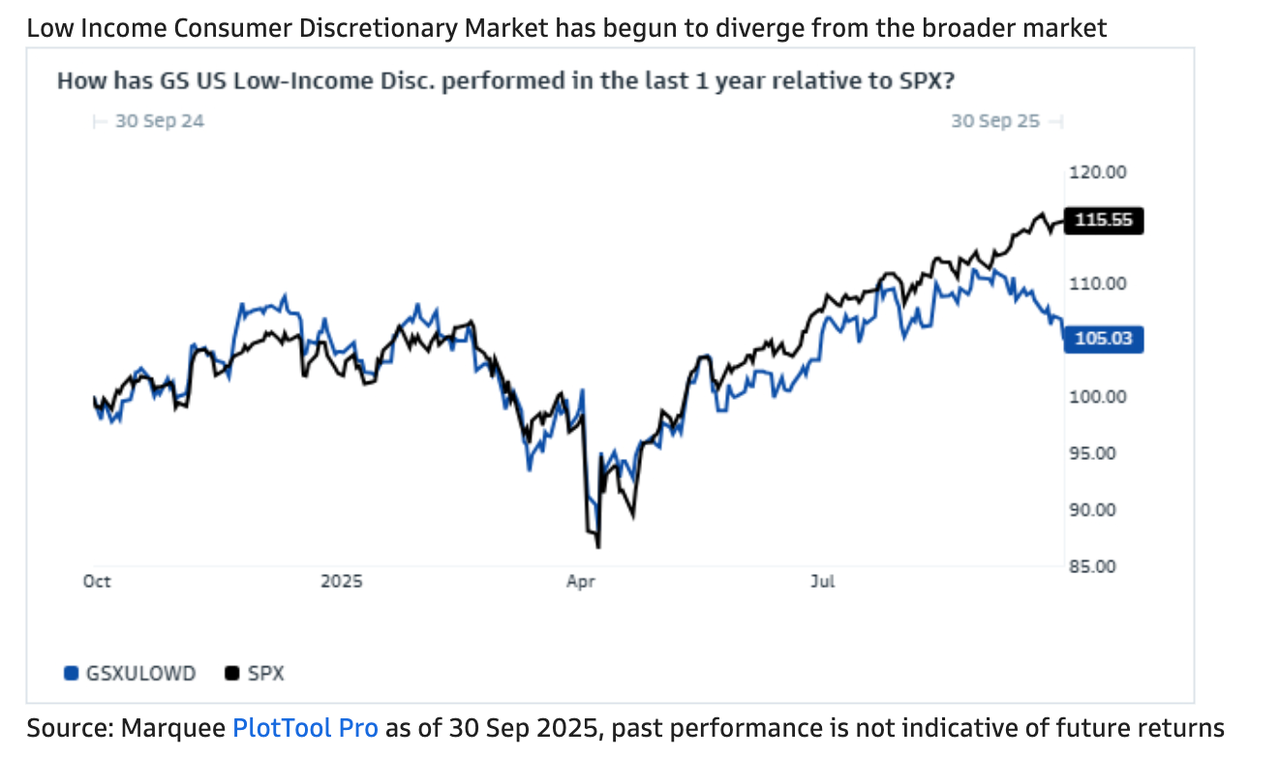
Value wars between Amazon and Walmart to attract cash-strapped consumers are heating up late in the year. Amazon announced on Wednesday morning the launch of a new private-label line called “Amazon Grocery,” which spans more than 1,000 products and is largely priced under $5. The timing couldn’t be better, as our attention has shifted to a storm brewing in the low-income consumer world.

Amazon Grocery will be a direct competitor to Walmart, Aldi, and other value grocery chains, offering affordable private-label goods amid ongoing value wars (read report). The new line will feature dairy, fresh produce, meat, snacks, and pantry staples priced under $5, an easy hook for low-income consumers. Another selling point: more than 1,000 items can be delivered straight to consumers’ doors, saving them the time and hassle of driving to the supermarket and pushing a cart down the aisles. 

“The extensive selection includes everything from milk and olive oil to fresh produce, meat and seafood, with most products priced under $5, offering exceptional value to customers,” Amazon wrote in a press release. 

“With Amazon Grocery, we’re simplifying how customers discover and shop our extensive private label food selection while maintaining the quality and value our customers expect and deserve,” Jason Buechel, Vice President of Amazon Worldwide Grocery Stores and Chief Executive Officer at Whole Foods Market, wrote in a press release

Buechel noted, “During a time when consumers are particularly price-conscious, Amazon Grocery delivers more than 1,000 quality grocery items across all categories that don’t compromise on quality or taste – from fresh food items to crave-worthy snacks and pantry essentials – all at low, competitive prices that help customers stretch their grocery budgets further.”

Amazon has long operated a large online grocery business, selling household basics, paper products, and cleaning supplies. In recent years, it has doubled down on physical retail through Whole Foods Market, Amazon Fresh supermarkets, and convenience stores. 

The timing of Amazon Grocery comes at a critical moment, following the sudden collapse of subprime auto lender Tricolor Holdings and CarMax’s earnings miss, which has shifted our focus onto the financial health of low-income consumers as cracks begin to appear.

This week, Goldman’s consumer sector specialist, Scott Feiler, and financials sector specialist, Christian DeGrasse, both noted that low-income trades are under pressure, pointing to Tricolor and CarMax as potential drivers that have set off alarm bells among investors.

Tyler Durden
Wed, 10/01/2025 – 15:20

via ZeroHedge News https://ift.tt/QIkmz8V Tyler Durden

Caleb Nelson’s Originalist Critique of Unitary Executive Theory

NA

The Supreme Court seems likely to embrace “unitary executive” theory (UET) in its upcoming case in Trump v. Slaughter, at least in so far as that theory mandates that the president have the power to fire lower-level executive branch officials with any significant policy discretion. It already strongly hinted in that direction in its May “shadow docket” decision in Trump v. Wilcox (though it also suggested the Federal Reserve is an exception to the rule).

Prominent originalist legal scholar Caleb Nelson (University of Virginia) recently posted an originalist critique of UET. Here’s an excerpt:

Aside from its provisions about impeachment,… the Constitution does not specifically address the removal of officers in the executive branch (which, for this purpose, includes the enormous variety of agencies that administer an enormous variety of statutes in an enormous variety of ways).  Who gets to fire them and for what reasons?

It would be natural to conclude that as with other issues relating to the structure of the executive branch, Congress has broad authority to address this topic by statute.  Given the range of tasks that Congress can authorize different officers to perform (entering into contracts, making grants, issuing licenses, conducting formal adjudications, participating in the promulgation of regulations, and more), and given the variety of things that different statutes require or allow these officers to consider (including legal constraints, technical or scientific expertise, the evidence introduced in adjudicative proceedings, and more), one might not expect a one-size-fits-all approach.  For sensible policy reasons, Congress might decide that the President should be able to remove many officers or even lower-ranking employees at will, but that other officers or employees should be removable only for defined causes and through defined processes.  In my view, the Necessary and Proper Clause lets Congress make these judgment calls as it enacts particular statutes that structure particular agencies.

The Supreme Court, however, has interpreted Article II of the Constitution to address the topic of removal itself. Although the case law is still in flux, the Court appears to be moving toward a sweepingly pro-President position: most officers who participate in the exercise of executive power must be removable at will by the President or his direct subordinates….

As Nelson notes, the text of the Constitution does not indicate that the president has any specific removal authority. And, as the rest of his article describes, historical evidence is at best ambiguous on this score, and may well point to the conclusion that Congress can determine the scope of removal authority.

I, myself, have a different set of originalist reservations about UET, which I most recently outlined earlier this year:

If the executive branch still wielded only the relatively narrow range of powers it had at the time of the Founding, the case for the unitary executive would be pretty strong…. Unfortunately, however, the current scope of executive authority goes far beyond that. To take just one noteworthy example, the president now presides over a vast federal law-enforcement apparatus, much of it devoted to waging the War on Drugs (which accounts for the lion’s share of federal prosecutions and prisoners). Under the original meaning of the Constitution – and the dominant understanding of the first 150 years of American history – the federal government did not have the power to ban in-state possession and distribution of goods. That’s why it took a constitutional amendment to establish federal alcohol Prohibition in 1919…. Immigration is another field where the executive now wields vast power, despite the fact that, as James Madison and others pointed out, the original meaning of the Constitution actually did not give the federal government any general power to restrict migration into the United States….

The same holds true for a great many other powers currently wielded by the executive branch. The original Constitution does not authorize the federal government to regulate nearly every aspect of our lives, to the point where we have so many federal laws that a  majority of adult Americans have violated federal criminal law at some time in their lives (to say nothing of civil law).

There is nothing originalist about giving the president such unconstitutional powers. If “executive” power is the power to “execute” federal laws authorized by the original meaning of the Constitution, it does not apply to powers that have no such authorization. The only way to truly enforce the original meaning in such cases is to remove such authority from federal hands altogether. But if we cannot or will not do that, there is no reason to think that giving the power to the president is any better – from an originalist point of view – than lodging it somewhere else. Either way, someone in the federal government will be wielding power that they are not supposed to have under the original meaning of the Constitution.

If we are not going to enforce the original scope of federal power, then we also should not enforce the (possibly) unitary original distribution of that authority. Concentrating such vast power in the hands of one man would actually run counter to the Framers’ objective of promoting separation of powers, and avoiding excessive concentration of power in any one person.

Later in my piece, I criticize the “political accountability” rationale for UET. As I explain, accountability through Congress is just as good as that through the executive, perhaps more so; though neither actually works particularly well, given the combination of vast federal powers and widespread voter ignorance about many of the functions of government. At the very least, accountability rationales can’t justify giving one man sweeping authority that goes beyond anything envisioned at the Founding.

Nelson hints at a similar concern about concentration power near the end of his article:

If most of what the federal government currently does on a daily basis is “executive,” and if the President must have full control over each and every exercise of “executive” power by the federal government (including an unlimitable ability to remove all or almost all executive officers for reasons good or bad), then the President has an enormous amount of power—more power, I think, than any sensible person should want anyone to have, and more power than any member of the founding generation could have anticipated.

I am an originalist, and if the original meaning of the Constitution compelled this outcome, I would be inclined to agree that the Supreme Court should respect it until the Constitution is amended through the proper processes.  But both the text and the history of Article II are far more equivocal than the current Court has been suggesting.  In the face of such ambiguities, I hope that the Justices will not act as if their hands are tied and they cannot consider any consequences of the interpretations that they choose.

I agree. Whether these or any other considerations stay the hand of the Supreme Court remains to be seen.

The post Caleb Nelson's Originalist Critique of Unitary Executive Theory appeared first on Reason.com.

from Latest – Reason.com https://ift.tt/XdwcIPn
via IFTTT

Eliminating The Voting Rights Act Asymmetry

As a practical matter, the Voting Rights Act helps one political party and hurts the other party. When a Republican legislature draws a gerrymandered map, Democrats will claim that the map harms African American or Hispanic voters. But when a Democratic legislature draws a gerrymandered map, Republicans will have a hard time raising a Section 2 claim that the map harms White voters. Illinois could gerrymander all Republican districts off the map, without any meaningful legal challenges. But if Mississippi or Louisiana tried to gerrymander all the Democratic districts off the map, there would be immediate legal challenges. Indeed, these southern states are forced to create “opportunity” districts to ensure minority voters can elect Democratic politicians.

This is the asymmetry of the Voting Rights Act. Because African American and Hispanic voters tend to vote for Democratic politicians, Democrats will benefit from VRA claims. By contrast, because White voters tend to vote for Republican politicians, Republicans will less likely benefit from VRA claims. What is the upshot? Gerrymandered maps in the South drawn by Republican legislatures are routinely blocked under the VRA, while gerrymandered maps in the North drawn by Democratic legislatures are far more likely to survive.

This asymmetry is not a bug of modern Voting Rights Act jurisprudence. It is a feature. Is it any wonder that Republican groups are lining up behind Louisiana in Callais to weaken, if not nullify Section 2?  And is it any wonder why Democratic groups are fighting to save Section 2?

Nick Stephanopoulos has a post at the Election Blog that explains what might happen if the Callais challenge is successful:

A final feature of the SG’s proposal is that it would doom most Section 2 claims in areas where most minority voters are Democrats and most white voters are Republicans. In these areas—which notably include much of the South—an additional minority-opportunity district can usually be drawn only at the cost of an existing Republican district. This swap of an old Republican district for a new minority-opportunity district, however, is exactly what the SG’s proposal would prevent.

But what is the status quo now? Currently, Democratic voters in the South benefit from the VRA, while Republican voters in the North do not. Much turns on what the baseline is.

I see a similar argument over mid-decade redistricting. If Texas redistricts, then California should redistrict as well. Fair elections, the argument goes, depends on red states not having an advantage over blue states. But this is precisely what the VRA accomplishes: burdening red states, but not burdening blue states.

Callais would eliminate the asymmetry. Going forward, neither party would benefit from a VRA bonus. Critics may charge that this approach is unfair or unjust, but I think that doesn’t fully recognize that for decades, the VRA would typically only help one side of the political spectrum. It is no longer 1964. As Shelby County explained more than a decade ago, “things have changed dramatically.”

I’m not convinced the sky will fall after Callais. We were told the sky would fall after Rucho v. Common Cause, and it didn’t. Now both parties are seeking to engage in overt partisan gerrymandering. I think most predictions of doomsday fail to account for how political groups respond to new dynamics.

The post Eliminating The Voting Rights Act Asymmetry appeared first on Reason.com.

from Latest – Reason.com https://ift.tt/BtUdz5J
via IFTTT

In 107 Days, Kamala Harris Unleashes Criticism on Biden. Honestly, It’s Relatable.

107 Days, by Kamala Harris, Simon & Schuster, 304 pages, $30

“Tariffs are a tax on everyday Americans,” writes Kamala Harris in 107 Days, the former vice president’s new book on her experiences from the time then-President Joe Biden dropped out of the 2024 presidential election through the night she lost to now-President Donald Trump. On the same page, she refers to Ross Ulbricht—the man who spent years in prison for running a website—as a “fentanyl dealer.”

It’s a good example of the kind of whiplash you might get while reading this book.

From the get-go, 107 Days offers ample reminders of what people find irritating about Harris. The scenes she conjures feel down-to-earth—making pancakes and doing puzzles with her nieces when she first gets the dropping-out news from Biden—but also somehow stage-managed. (Phony.) She makes a point of mentioning how she would not stand up from a table until Biden did and twice calls herself a “stickler” for rules and for punctuality. (Hall monitor.) She glosses over, rather than reckons with, parts of her prosecutorial career that haven’t aged well, portraying herself as a pure defender of women, children, and the working man. (Hypocrite; Cop.)

But there are also reminders of what people like about Harris. She uses spicy language. She seems idealistic but also pragmatic. She is capable of a deadpan sort of humor. And she doesn’t hold back when it comes to her rocky relationship with the Bidens or her dismay about the way Joe Biden handled both his presidential race and hers.

A scene near the beginning features Harris watching Biden’s infamously bad debate against Trump. After the event is over, one of her advisers hands her post-debate talking points that include the idea that Biden won. “Are you kidding me?” Harris writes.

I don’t think I would have continued beyond the first few pages if it weren’t for this. Throughout the book, there is a hilarious undercurrent of disappointment in, disbelief at, and sometimes barely concealed rage about Biden, with whom she describes her relationship as “complicated.”

For instance, her husband, Doug Emhoff, complains that Biden gave her “shit jobs” for four years as vice president after Jill Biden allegedly pulled him aside on July 4, 2024, for a loyalty check. She describes the mantra of those around the Bidens during Joe’s early days in the 2024 campaign: “‘It’s Joe and Jill’s decision.’ We all said that, like a mantra, as if we’d all been hypnotized. Was it grace, or was it recklessness? In retrospect, I think it was recklessness.” She details a scene when Biden put on a MAGA hat during a September 11 event:

And then I glanced across to the far side of the room, where Joe was sharing a joke with some guys in MAGA hats. One of them took his hat off and offered it to Joe.
Don’t take it.
He took it.
Don’t put it on.
He put it on.
Cameras clicked. Within hours, the picture was all over: Joe Biden in a MAGA hat, with the caption ‘Biden endorses Trump over Harris.’

I’ve been a vociferous critic of Harris in the past, and I’m sure I will continue to be one in the future. This book is a constant litany of policies she enacted or wanted to enact that range from bad to disastrous. And even if we put policy aside, I can never like Harris for the simple reason that she started a dishonest prosecution of Backpage that would later form the basis for a federal prosecution that ultimately ended in a good man taking his own life.

But reading this book, I did—for the first time—find Harris to be relatable (and, occasionally, amusing). She comes across more like a real person than she did in her first book, The Truths We Hold, or than she generally has when in the spotlight.

Reading 107 Days, I got the same suspicion that I did reading some old newspaper pieces about Harris or, ever so occasionally, in clips of her on the campaign trail: that there is a person here who can be bitingly funny, endearingly dorky, a little weird, and actually fun to be around. It’s a person unlike the Harris whom we usually see, and it makes me wonder if part of Harris’ whole problem has been a mismatch between her personality and the persona she’s chosen to project.

In any event, much of Harris’ new book is downright boring: a play-by-play of her campaign stops, lists of people she met, some surface-level notes about what they talked about or how she felt. It absolutely did not need to be 300 pages long. To keep with the conceit of an entry for every day of her campaign, we get a lot of fluff about what diner she stopped at or labor union she spoke to or church she visited, plus a whole lot of puffery about fighting for truth and justice and the American people.

There is also at least one glaring inaccuracy beyond the Ulbricht business: She claims that 350 transgender people, including 15 kids, were murdered in America in 2024. In fact, the Human Rights Campaign is aware of 32 “transgender and gender-expansive people whose lives were…taken through violent means” in the U.S. that year, only one of them a minor. Harris may be citing a report from Trans Europe and Central Asia, which pinpointed 350 murders around the world.

Occasionally we get something more interesting—behind-the-scenes notes on some of the campaign’s more memorable decisions, interviews, and dramas. There is the moment when Trump challenges the idea that she is black and she rejects her staff’s decision to push back. (“Are you fucking kidding me?” she recalls herself saying. “Today he wants me to prove my race. What next? He’ll say I’m not a woman and I’ll need to show my vagina?”)

There are her interviews with three potential V.P. picks, during which Pennsylvania Gov. Josh Shapiro seems to have ruined his chances by saying he would want to be in the room with her for every decision. (“A vice president is not a copresident. I had a nagging concern that he would be unable to settle for a role as number two and that it would wear on our partnership,” she writes.) There is her disappointment with herself for answering a question about what she would have done differently from Biden by saying there wasn’t anything that came to mind. (“Why. Didn’t. I. Separate. Myself. From. Joe. Biden?” she writes, noting that a member of her campaign team told her bluntly afterward that “people hate Joe Biden” and reflecting why it took her so long to grasp that she really needed to reinforce the differences between them.) She mentions how her debate prep partner dressed up as Trump and stayed in character during the breaks. How on the debate stage she was going to introduce herself to Trump—who had made a big deal of not knowing how to pronounce her name—by saying “It’s pronounced KA-mala,” but decided at the last moment not to. (“It felt bitchy,” she says.) She also describes how close she came to calling Trump “this motherfucker” on stage.

I know this apparent candor is calculated, but that doesn’t mean there’s nothing to learn here. All politician memoirs are political fictions, readable as a sort of meta-text: Why is this bit being included? What is this person trying to say about themselves? 107 Days seems desperate to convey that Harris is not Biden, was not responsible for Biden, and would have done things differently than Biden. In all of this, I believe her, though I also believe the differences would be a mixed bag of bad and good. Harris also seems eager to convey that she did all she could during the campaign and that, while she suffered from some bad personal and campaign choices, she was also constrained by the hand she was dealt, including the weirdness of running against someone like Trump. That seems fair enough.

But intended or not, there is another message that stands out, and it’s that Harris is still really angry—about Biden and his people, about Trump and his lies, and about the hand we’ve all been dealt. Whether intended or not, I think that’s perhaps the most relatable message of all.

The post In <em>107 Days</em>, Kamala Harris Unleashes Criticism on Biden. Honestly, It's Relatable. appeared first on Reason.com.

from Latest – Reason.com https://ift.tt/M4Fb7l0
via IFTTT

Eliminating The Voting Rights Act Asymmetry

As a practical matter, the Voting Rights Act helps one political party and hurts the other party. When a Republican legislature draws a gerrymandered map, Democrats will claim that the map harms African American or Hispanic voters. But when a Democratic legislature draws a gerrymandered map, Republicans will have a hard time raising a Section 2 claim that the map harms White voters. Illinois could gerrymander all Republican districts off the map, without any meaningful legal challenges. But if Mississippi or Louisiana tried to gerrymander all the Democratic districts off the map, there would be immediate legal challenges. Indeed, these southern states are forced to create “opportunity” districts to ensure minority voters can elect Democratic politicians.

This is the asymmetry of the Voting Rights Act. Because African American and Hispanic voters tend to vote for Democratic politicians, Democrats will benefit from VRA claims. By contrast, because White voters tend to vote for Republican politicians, Republicans will less likely benefit from VRA claims. What is the upshot? Gerrymandered maps in the South drawn by Republican legislatures are routinely blocked under the VRA, while gerrymandered maps in the North drawn by Democratic legislatures are far more likely to survive.

This asymmetry is not a bug of modern Voting Rights Act jurisprudence. It is a feature. Is it any wonder that Republican groups are lining up behind Louisiana in Callais to weaken, if not nullify Section 2?  And is it any wonder why Democratic groups are fighting to save Section 2?

Nick Stephanopoulos has a post at the Election Blog that explains what might happen if the Callais challenge is successful:

A final feature of the SG’s proposal is that it would doom most Section 2 claims in areas where most minority voters are Democrats and most white voters are Republicans. In these areas—which notably include much of the South—an additional minority-opportunity district can usually be drawn only at the cost of an existing Republican district. This swap of an old Republican district for a new minority-opportunity district, however, is exactly what the SG’s proposal would prevent.

But what is the status quo now? Currently, Democratic voters in the South benefit from the VRA, while Republican voters in the North do not. Much turns on what the baseline is.

I see a similar argument over mid-decade redistricting. If Texas redistricts, then California should redistrict as well. Fair elections, the argument goes, depends on red states not having an advantage over blue states. But this is precisely what the VRA accomplishes: burdening red states, but not burdening blue states.

Callais would eliminate the asymmetry. Going forward, neither party would benefit from a VRA bonus. Critics may charge that this approach is unfair or unjust, but I think that doesn’t fully recognize that for decades, the VRA would typically only help one side of the political spectrum. It is no longer 1964. As Shelby County explained more than a decade ago, “things have changed dramatically.”

I’m not convinced the sky will fall after Callais. We were told the sky would fall after Rucho v. Common Cause, and it didn’t. Now both parties are seeking to engage in overt partisan gerrymandering. I think most predictions of doomsday fail to account for how political groups respond to new dynamics.

The post Eliminating The Voting Rights Act Asymmetry appeared first on Reason.com.

from Latest – Reason.com https://ift.tt/BtUdz5J
via IFTTT

U.S. Housing Heat Map Signals Ongoing Deceleration As Buyers Wait For Lower Rates

U.S. Housing Heat Map Signals Ongoing Deceleration As Buyers Wait For Lower Rates

New residential housing construction momentum continued cooling in August, with permits under pressure nationally, particularly in the South and West. Builders are managing inventory tightly while awaiting further Federal Reserve interest rate cuts to hopefully revive demand, with Midwest markets standing out as relative outperformers. Many buyers remain sidelined by affordability woes, as elevated mortgage rates and high home prices crush demand, and a softening labor market now adds to the challenges. 

A team of Goldman analysts, led by Susan Maklari, penned a note on Tuesday that provides a heat map for the nation’s housing market, showing that falling housing permits signal the real estate market shifted into a lower gear. Builders are more cautious in late year, buyers are waiting for the Fed Chair Powell to unleash another round of interest rate cuts, and home price growth has stalled. The Midwest is holding up, but the South and West markets are softening the fastest. 

Here are the key takeaways from Maklari’s note on the national housing market outlook

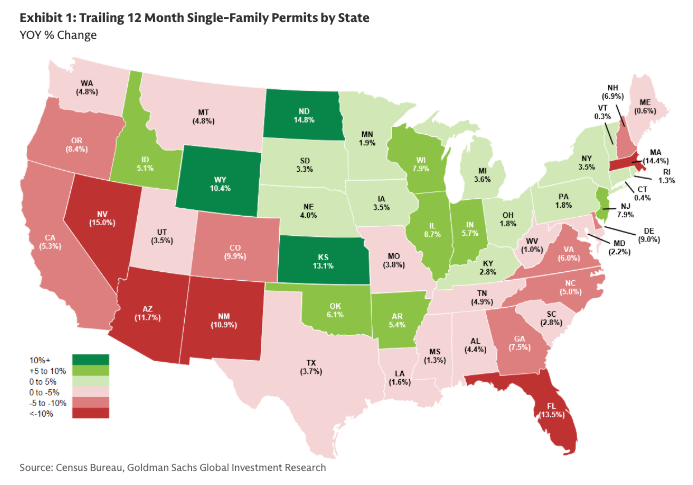
  • Permits Slow: On a trailing 12-month basis, single-family permits fell 5% YoY in August (vs -3% in July, +14% a year ago).

  • Buyers Hesitant: Traffic hasn’t translated into sales as buyers wait on potential Fed cuts and worry about employment, especially at the entry level.

  • Inventory Management: Builders are keeping inventory light heading into 2026 as cycle times shorten.

  • Spec Homes Rising: Completed specs hit their highest since July 2009.

  • Home Values Flat: Zillow shows national prices flat YoY, with only 1 state seeing >5% gains. Florida (-5%), Arizona (-3%), and California/Colorado/Georgia/Texas (-2% each) declined, while Utah and Virginia rose +2%.

  • Macro View: Expect demand volatility through year-end, but rates cuts (two 25bps forecast in 2025) could spark a rebound. Top picks: MTH, DHI.

Instead, buyers are waiting out the potential for further Fed rate cuts while increased concerns around employment give some pause, especially in the entry-level. Given conditions and greater flexibility as cycle times shorten, builders are looking to enter 2026 with less inventory, suggesting permits will remain under pressure through year-end, at least. We also note completed single-family specs are at their highest level since July 2009,” Maklari wrote in the note. 

Geographical breakdown:

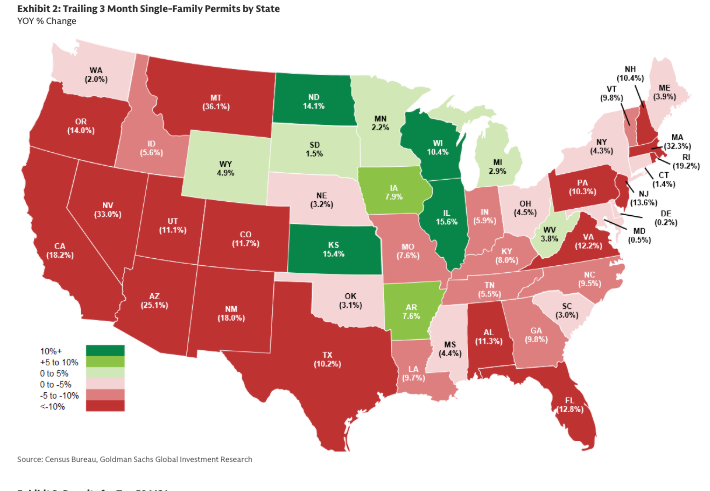
  • Activity Moderates on a Rolling 3-Month Basis Led by Nevada, Arizona, and California: Single-family permits for the 3-months ended August fell 10% YOY compared to an 8% decrease in July and a 1% decline a year ago. They were flat vs the comparable pre-pandemic period. Looking at the largest new home markets, the deceleration was led by Nevada, down 33% YOY, followed by Arizona off 25% and California down 18%. Nationally, we note 11 states were flat to up vs 17 last month. This comes as builders look to align starts with demand, while focusing on profitability and cash generation. As such, we expect permits will remain under pressure.

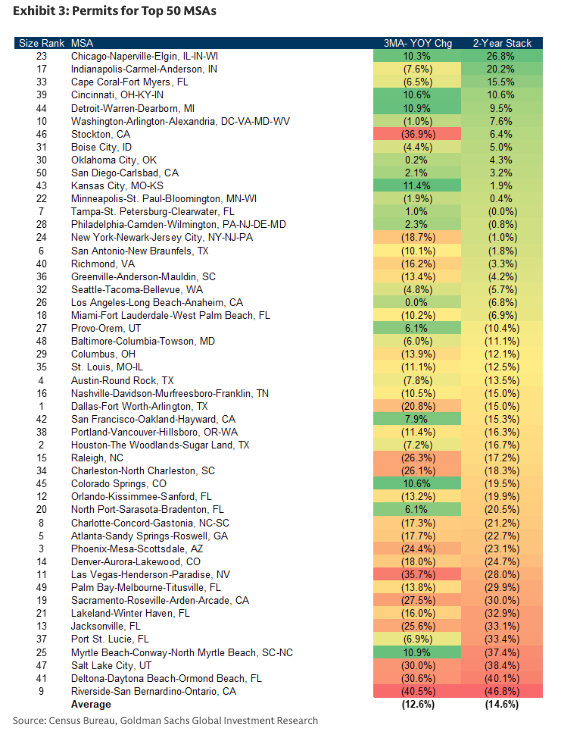
  • Southern Markets Lead MSA Level Declines Offset by Gains in the Midwest: Permits in the top 50 MSAs declined 13% YOY for the 3 months ended August vs down 11% in July and -2% a year ago. On a YOY basis, Kansas City, MO, Detroit, MI, and Myrtle Beach, SC (+11% each) showed the greatest gains while Riverside, CA (-40%), Stockton, CA (-37%), and Las Vegas, NV (-36%) lagged. On a 2-year stacked basis, growth was led by Chicago, IL (+27%), Indianapolis, IN (+20%), and Cape Coral, FL (+16%). We highlight 4 of the top 10 MSAs are in Midwest, with the South and West largely underperforming, on a 2-year stack basis.

Trailing 12 Month Single-Family Permits by State

Trailing 3 Month Single-Family Permits by State

Permits for Top 50 Cities

Zillow Single-Family Home Value Index

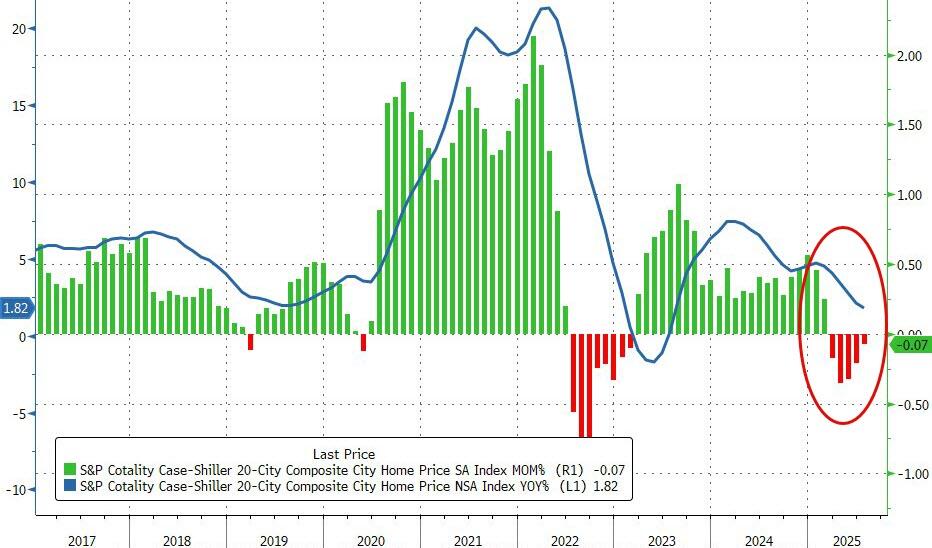
Goldman’s note on the cooling real estate market comes the same day Case-Shiller data for July (read report) showed national home prices declined for the fifth straight month.

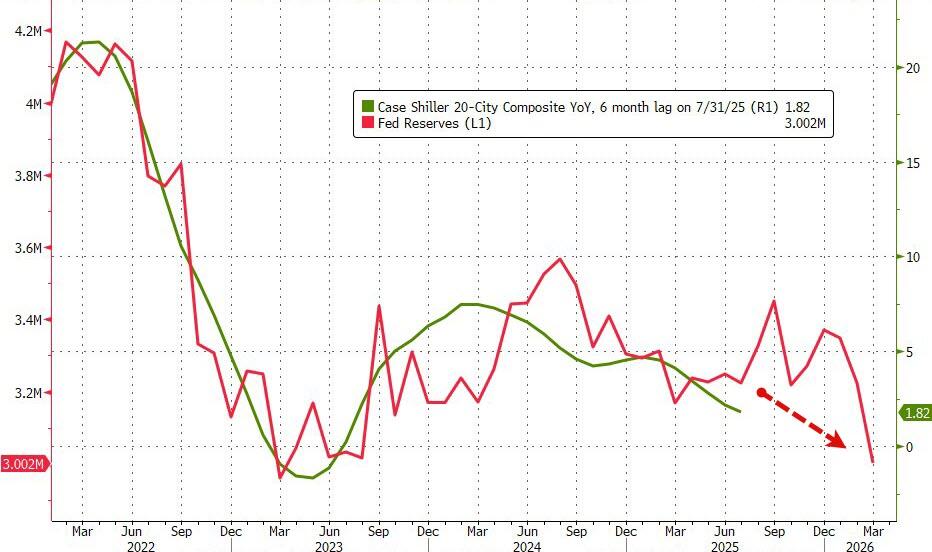
As we highlighted in our report, home price changes tend to track closely with bank reserves at the Fed on a six-month lag, and this only implies prices could decelerate in the new year following a brief rebound. 

ZeroHedge Pro Subs can read the complete report in the usual place

Tyler Durden
Wed, 10/01/2025 – 15:00

via ZeroHedge News https://ift.tt/zcRNL7r Tyler Durden