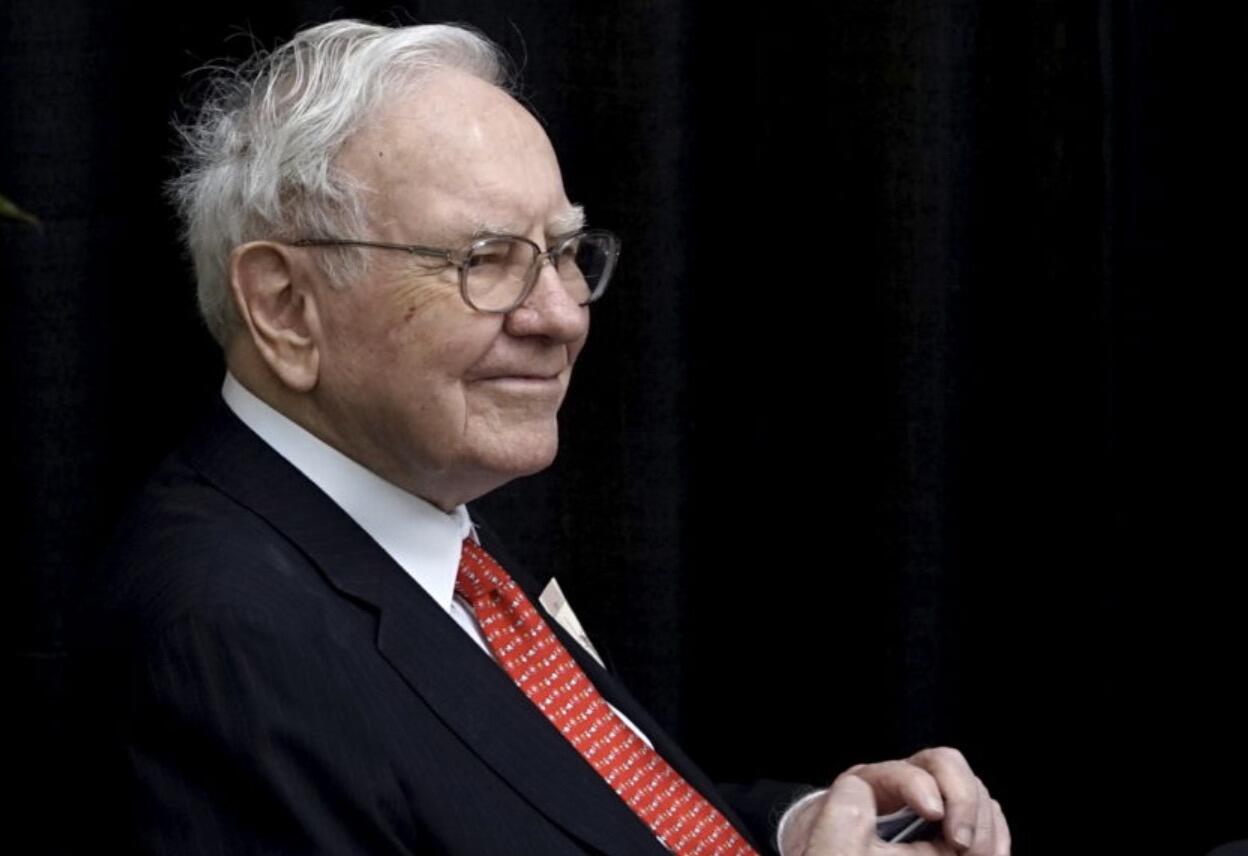
Buffett’s Berkshire Near $10 Billion Deal For Occidental’s Chemical Unit

Buffett’s Berkshire Near $10 Billion Deal For Occidental’s Chemical Unit

Warren Buffett’s Berkshire Hathaway – which we have been following and watching take, then increase its stake in Occidential Petroleum for years – has finally tipped its hand at what it’s end game with the company could be.

While many had speculated Buffett would eventually take all of Occidental private, Berkshire is instead in advanced talks to buy Occidental’s petrochemical business, OxyChem, for about $10 billion, according to the Wall Street Journal.

A deal could be finalized within days and would mark Berkshire’s largest acquisition since 2022.

Occidental, best known for its oil-and-gas operations, is valued at roughly $46 billion and already counts Berkshire as its biggest shareholder. OxyChem, which makes chemicals used in water treatment, battery recycling, and paper production, generated nearly $5 billion in sales in the year through June.

WSJ writes that if completed, this would be Buffett’s second major chemicals bet. Back in 2011, Berkshire purchased Lubrizol for close to $10 billion. His last large deal was the $11.6 billion takeover of insurer Alleghany in 2022.

Buffett’s ties to Occidental date to 2019, when he invested $10 billion in preferred shares to help CEO Vicki Hollub outbid Chevron for Anadarko. While that transaction burdened Occidental with debt and drew fire from Carl Icahn, Buffett steadily accumulated shares and now owns about 28% of the company. Occidental has since been selling assets and repaid $7.5 billion of debt as of August.

Meanwhile, Berkshire is flush with a record $344 billion in cash and Treasurys. As Buffett put it earlier this year: “Berkshire will never prefer ownership of cash-equivalent assets over the ownership of good businesses, whether controlled or only partially owned.”

Energy assets, especially in oil and gas, still look cheap in today’s market and continue to believe relatively unloved as the market continues its focus on tech and AI. We wouldn’t be surprised to see more take-private or merger activity follow this deal.

Tyler Durden
Wed, 10/01/2025 – 17:40

via ZeroHedge News https://ift.tt/nIHmcP3 Tyler Durden

The Bizarre Postcard Opinion Striking Down The Trump Visa Policies

The Bizarre Postcard Opinion Striking Down The Trump Visa Policies

Authored by Jonathan Turley,

Judge William Young has had a distinguished career since his appointment by President Ronald Reagan in 1985, including serving as Chief Judge of the United States District Court for the District of Massachusetts.

At 85, his career includes notable cases such as the Boston Strangler and the Shoe Bomber. However, his 161-page opinion declaring the Trump Administration in violation of the First Amendment over visa denials is nothing short of bizarre. 

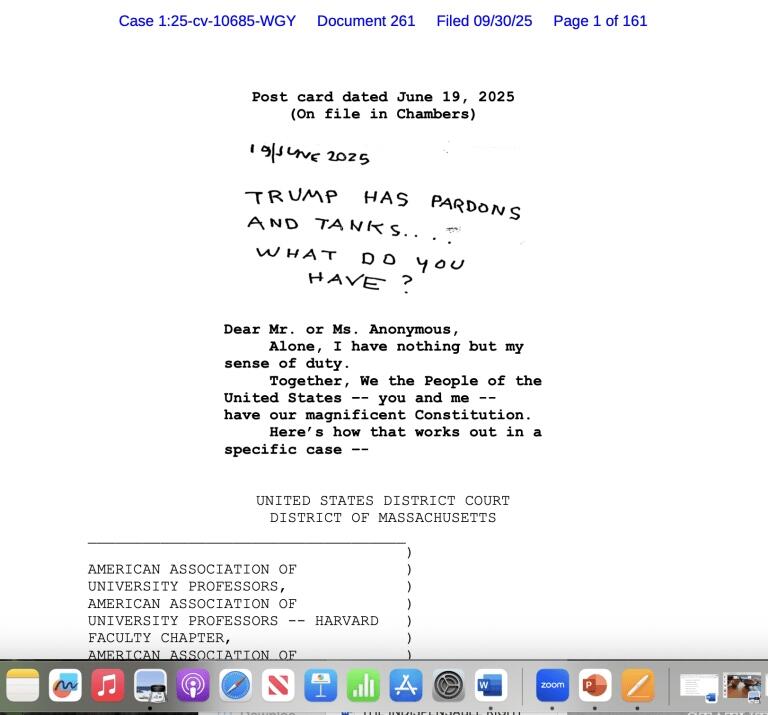
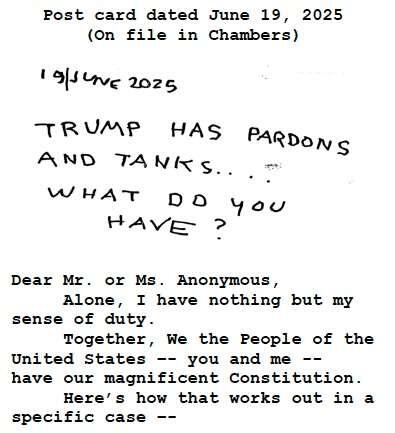
It starts as a type of letter to an anonymous person who sent the judge a postcard.

Here is how the caption appeared in

Here is a closer image:

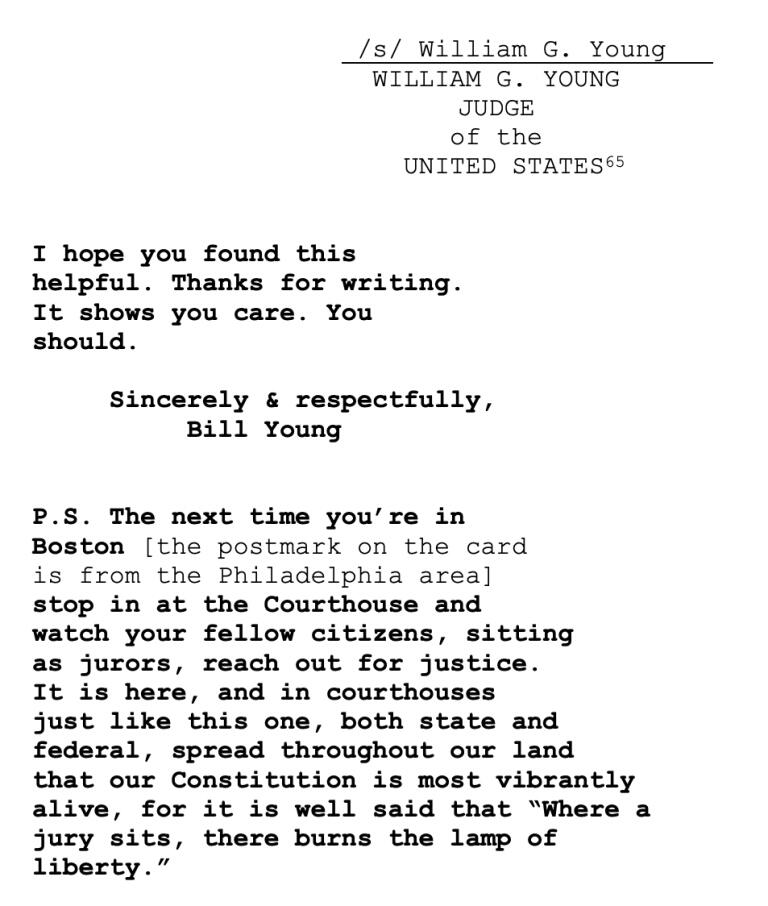
The opinion then ends with this conclusion:

With all due respect to Judge Young (who warrants considerable respect after his remarkable career), the captioning and conclusion are improvisational, impulsive, and injudicious. The court injected a political dialogic element in an opinion with sweeping implications for our constitutional system.

I have previously disagreed with some of these measures and agree with some points in this opinion. For those currently in this country, I have long supported free speech protections. That said, I expect that the Administration has the advantage on visa applicants outside of the country. The courts are already working to sort this out and it is likely to result in a split resolution. However, the tenor and odd elements of this opinion take away from these points.

It is an example of yielding to impulse, a problem that I have previously addressed with district court judges after the Trump inauguration.

The trend has even reached the Supreme Court on occasion.

Take District Court Judge Tanya Chutkan, an Obama appointee who had previously presided over Trump’s election interference case. Chutkan was criticized for failing to recuse herself from that case after she made highly controversial statements about Trump from the bench. In a sentencing hearing of a Jan. 6 rioter in 2022, Chutkan said that the rioters “were there in fealty, in loyalty, to one man — not to the Constitution.” She added then, “[i]t’s a blind loyalty to one person who, by the way, remains free to this day.” That “one person” was still under investigation at the time and, when Trump was charged, Chutkan refused to let the case go.

Chutkan later decided to use the bench to amplify her own views of the pardons and Jan. 6. She proclaimed that the pardons could not change the “tragic truth” and “cannot whitewash the blood, feces and terror that the mob left in its wake. And it cannot repair the jagged breach in America’s sacred tradition of peacefully transitioning power.”

Chutkan’s colleague Judge Beryl Howell, also an Obama appointee, lashed out at Trump’s actions, writing, “[T]his Court cannot let stand the revisionist myth relayed in this presidential pronouncement.”

Other judges have engaged in extrajudicial commentary from the bench that undermines the integrity of the court system and their own authority.

The bizarre captioning and conclusion in this case is another such example. It only served to undermine the opinion itself and the legal points raised by the court. It may have been cathartic, but it was also tedious and prejudicial. It has a certain chest-pounding element that is neither necessary nor compelling for a court to insert into an opinion.

Judge Young would be wise to issue a corrected opinion without the novel captioning and conclusion . . . and simply send a postcard to this curious penpal.

*  *  *

Need a daily drink to boost your brain? Get 3+ and subscribe for 20% off… 

Tyler Durden
Wed, 10/01/2025 – 17:15

via ZeroHedge News https://ift.tt/ZiCgS2L Tyler Durden

Trump Inks Article-5 Style Defense Deal With Qatar After ‘Apology’ Over Israel’s Doha Bombing

Trump Inks Article-5 Style Defense Deal With Qatar After ‘Apology’ Over Israel’s Doha Bombing

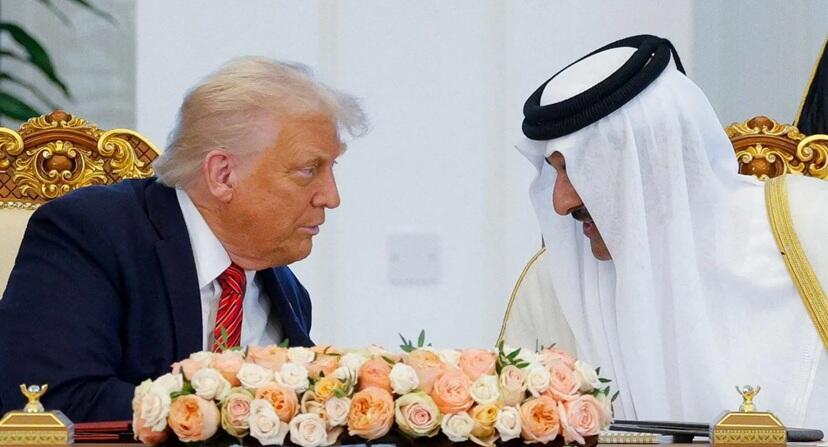
The US and Qatar have signed an unprecedented agreement which is similar to Article 5 in NATO, in which an attack on Qatar is considered a threat to the security of the US.

The robust security guarantees are spelled out in the deal posted to the White House website on Wednesday: “The United States shall regard any armed attack on the territory, sovereignty, or critical infrastructure of Qatar as a threat to the peace and security of the United States.”

“In the event of such an attack, the United States shall take all lawful and appropriate measures including diplomatic, economic, and if necessary, military, to defend the interests of the United States and of Qatar,” it adds.

Via Reuters

This is a clear vow to “guarantee the security and territorial integrity of the state of Qatar against external attack.” Is this what the White House is calling America First policy? 

Of course, the United States already has a significant military base, the sprawling Al Udeid Air Base, located west of Doha, which is defended by Patriot missile batteries.

But now presumably this American air defense shield will extend over the whole of the tiny oil and gas monarchy’s territory.

Already the past year has seen active US intercepts of missiles sent by Iran, and yet last month’s Israeli attack on a Hamas office in Doha was allowed by US defenses.

But this new major security deal appears part of Trump’s ‘regret’ to Qatar in the wake of that controversial attack, which killed five top Hamas negotiators and a Qatari security guard.

Trump on Monday while hosting Israeli Prime Minister Benjamin Netanyahu made him apologize to Qatar’s leaders in a somewhat humiliating phone call and photo op, later published by the White House…

As for US-Qatar relations, they were deepened especially during the decade-plus long war of regime change against Assad. Qatar even hosted FSA and jihadi training camps, reportedly ran by the CIA and likely American special forces.

Ultimately, the US-Gulf-Israel axis is still strong, despite the Gaza war, which is also what this new defense pact demonstrates. Some analysts are saying it further prepares the US-Gulf axis for the next round of fighting with Iran. For example Mideast observer Kevork Almassian writes:

Make no mistake: this is about the future U.S./Israeli war with Iran. Consider the implications: if Iran retaliates against Qatar for hosting U.S. and Israeli operations, Washington can immediately declare that an attack on Qatar is an attack on U.S. interests. From there, it’s a short step to claim: Attack on Qatar = attack on the U.S. = attack on a NATO member = Article 5 triggered.

This is indeed recipe for more US quagmires and foreign interventionism in the Middle East, and Congress remains silent, as has become typcial.

Tyler Durden
Wed, 10/01/2025 – 16:50

via ZeroHedge News https://ift.tt/e5nIdPS Tyler Durden

ICE Arrests More Than 400 Illegal Immigrants In Week-Long Operation In Central Florida

ICE Arrests More Than 400 Illegal Immigrants In Week-Long Operation In Central Florida

Authored by Aldgra Fredly via The Epoch Times (emphasis ours),

More than 400 illegal immigrants were arrested during a week-long immigration enforcement operation in central Florida last week, Immigration and Customs Enforcement (ICE) said on Sept. 30.

The badge of a U.S. Immigration and Customs Enforcement officer in Hawthorne, Calif., on March 1, 2020. Lucy Nicholson/Reuters

ICE said that the operation, carried out between Sept. 22 and Sept. 26, targeted illegal immigrants with “outstanding criminal warrants” and those who are subject to deportation.

Many of these individuals illegally remained in Florida and have gone on to wreak havoc in our local neighborhoods,” ICE Enforcement and Removal Operations Miami Field Office Director Garrett Ripa said in a statement.

ICE said that all the detainees will be subject to removal proceedings in accordance with federal immigration law.

The operation was led by ICE Miami in coordination with U.S. Customs and Border Protection (CBP) and multiple local law enforcement agencies, including the Florida Highway Patrol and the Florida National Guard, according to the agency.

Florida is leading nationwide in 287(g) partnerships, with 327 agreements currently in place, according to the Department of Homeland Security (DHS). The agreements allow local law enforcement agencies to carry out certain immigration duties, including identifying and processing removable illegal immigrants who face criminal charges.

DHS Assistant Secretary Tricia McLaughlin praised the operation in central Florida, noting that the detainees included individuals convicted of criminal offenses such as “lewd and lascivious behavior, battery, domestic violence, prostitution, vehicle theft, hit and run, and driving under the influence.”

This was another successful operation to arrest the worst of the worst with our Florida state and local partners and can serve as a blueprint nationwide,” McLaughlin said, calling on other states to follow suit.

The Trump administration has ramped up efforts to arrest and deport illegal immigrants across the country.

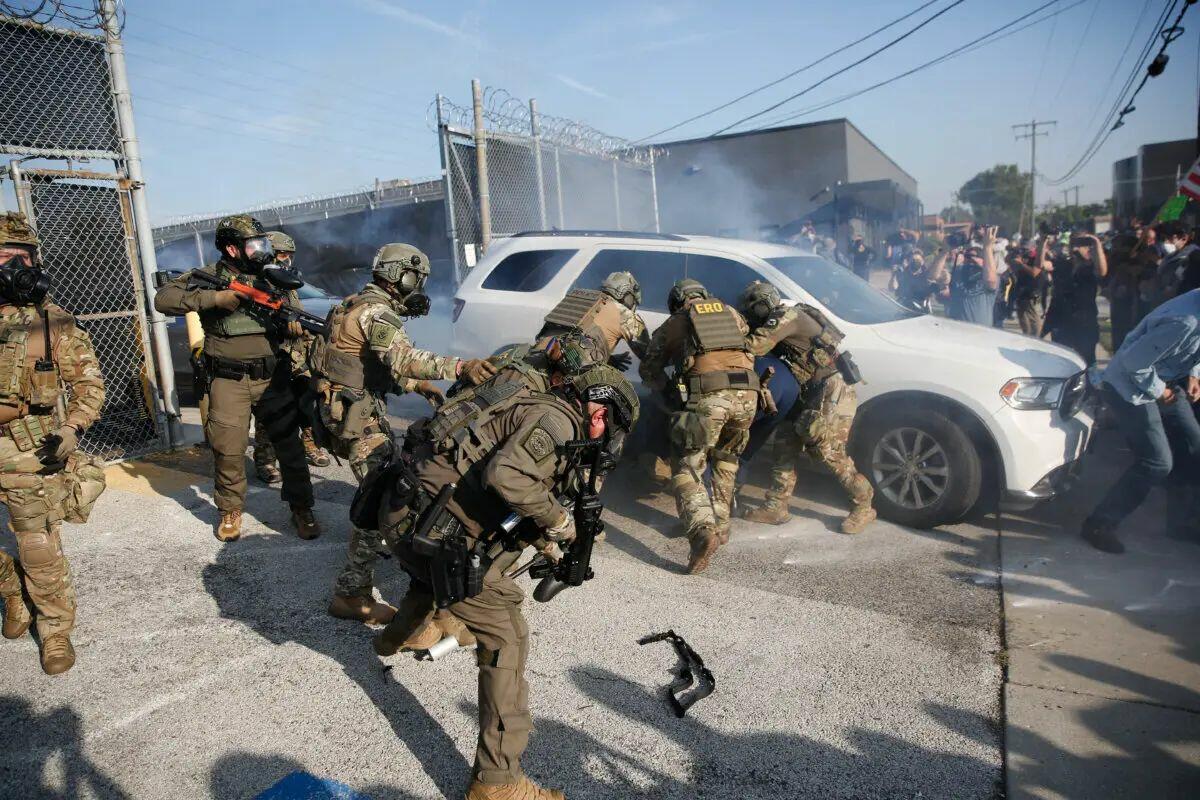
Federal law enforcement officers are confronted by demonstrators outside an Immigration and Customs Enforcement processing center in Broadview, Ill., on Sept. 19, 2025. Ocavio Jones/AFP via Getty Images

The DHS said on Sept. 23 that federal immigration authorities have removed more than 2 million illegal immigrants since President Donald Trump took office.

That figure includes an estimated 1.6 million illegal immigrants who voluntarily self-deported, and more than 400,000 who were removed, according to the department.

After taking office on Jan. 20, Trump signed an executive order aimed at securing the United States’ borders, directing his administration to build barriers at the border, deter and prevent the entry of illegal immigrants, remove “promptly all aliens who enter or remain in violation of federal law,” and pursue criminal charges “against illegal aliens who violate the immigration laws.”

The order said the United States has seen a “large-scale invasion at an unprecedented level” over the past four years, with millions of illegal immigrants entering the country, including potential terrorists, foreign spies, members of cartels, and other hostile actors with malicious intent.

Stuart Liess contributed to this report.

*  *  *

For Him // For Her // Save the planet

Tyler Durden
Wed, 10/01/2025 – 16:25

via ZeroHedge News https://ift.tt/5WkOUSr Tyler Durden

Reagan-Appointed Judge Slams Trump’s Crackdown on Pro-Palestinian Students

President Donald Trump often channels former President Ronald Reagan, down to his signature slogan, “make America great again.” But Judge William Young, who was appointed by Reagan himself, cited Reagan’s legacy as a total rebuke to Trump’s ruling philosophy. “Freedom is a fragile thing and it’s never more than one generation away from extinction,” Young wrote in a ruling filed on Tuesday, quoting a speech by Reagan.

“I’ve come to believe that President Trump truly understands and appreciates the full import of President Reagan’s inspiring message—yet I fear he has drawn from it a darker, more cynical message,” Young warned. “I fear President Trump believes the American people are so divided that today they will not stand up, fight for, and defend our most precious constitutional values so long as they are lulled into thinking their own personal interests are not affected.”

Young’s ruling came in response to one of the Trump administration’s signature policies, its attempts to shut down Palestinian solidarity protests by deporting Palestinian students and their supporters. The American Association of University Professors and the Middle East Studies Association sued a few days after the arrest of Columbia University graduate student Mahmoud Khalil, arguing that the policy violates freedom of speech, both by intimidating foreign academics in America and preventing American academics “from hearing from, and associating with, their noncitizen students and colleagues.”

Ruling that administration officials indeed “acted in concert to misuse the sweeping powers of their respective offices to target non-citizen pro-Palestinians for deportation primarily on account of their First Amendment protected political speech,” Young promised to hold a hearing on the specific measures he will order. He wrote that “it will not do simply to order the Public Officials to cease and desist in the future,” given the current political environment.

What seems to have set off Young was a postcard from a hater: “Trump has pardons and tanks…What do you have?” Young attached a photocopy of the postcard to the top of his ruling, and dedicated the ruling to disproving the writer. “Alone, I have nothing but my sense of duty. Together, We the People of the United States—you and me—have our magnificent Constitution. Here’s how that works out in a specific case,” he wrote, inviting the letter writer to visit his courthouse at the end of the ruling.

The ruling itself meticulously outlined how several different activists—Khalil, Rümeysa Öztürk, Mohsen Mahdawi, Yunseo Chung, and Badar Khan Suri—were targeted for deportation and how the administration justified it, both internally and publicly. Although Secretary of State Marco Rubio repeatedly claimed in the media that the deportations were meant to target “riots” on campus, Young shows that the students were often targeted based on their opinions alone, with vague chains of association linking them to violent protests.

For example, the Department of Homeland Security noted in an intelligence analysis that “Hamas flyers” were handed out during a March 2025 protest that Khalil and Chung attended. But as Young pointed out, there was “neither an allegation nor evidence” that either Khalil or Chung themselves were involved in distributing the flyers.

In another case, Öztürk was a member of Graduate Students for Palestine. Because that group cosigned a call for boycotting Israel with Students for Justice in Palestine, a group that was banned from Tufts University for allegedly using violent imagery, the Department of Homeland Security’s intelligence analysts tried to tie Öztürk to Students for Justice in Palestine, which she was not a member of. Young, exasperated, called the logic “hard to follow.”

He wrote that “there is no evidence that Öztürk did anything but co-author an op-ed that criticized the University’s position on investments with Israel, that she criticized Israel, and that the organization of which she was member joined in that criticism with an organization that was banned on Tufts campus, with which she was not affiliated.”

Particularly striking was the way that the administration used anonymous online blacklists as a basis for investigation. In March 2025, the Department of Homeland Security ordered its intelligence office to review all 5,000 names on Canary Mission, a controversial website that lists allegedly antisemitic students, Assistant Director Peter Hatch testified. The office also relied on names provided by Betar, an Israeli nationalist organization that has bragged about getting its opponents deported, Hatch testified.

“Those names that were passed up the chain of command by the investigating subordinates were almost universally approved for adverse action, and, again, the reasons for being passed up the chain of command included any form of online suggestion that one was ‘pro-Hamas,’ including Canary Mission’s own anonymous articles,” Young wrote.

The judge directly addressed Rubio’s claim that, because a visa or green card is a privilege, the government has unlimited power to remove non-citizens.

“This Court in part must agree: non-citizens are, indeed, in a sense our guests. How we treat our guests is a question of constitutional scope, because who we are as a people and as a nation is an important part of how we must interpret the fundamental laws that constrain us. We are not, and we must not become, a nation that imprisons and deports people because we are afraid of what they have to tell us,” he wrote.

And, Young argued, the decision to go after students for activism they did before Trump took office made the policy especially “arbitrary” and “capricious.” Students across America “have all been made to understand that there are certain things that it may be gravely dangerous for them to say or do, but have not been told precisely what those things are,” he wrote, noting that many of the arrests were designed to be as intimidating as possible.

Immigration and Customs Enforcement (ICE) agents snatched Öztürk off the street while wearing masks. “ICE goes masked for a single reason—to terrorize Americans into quiescence,” Young wrote, calling ICE officials “disingenuous, squalid and dishonorable” for trying to argue otherwise. “In all our history we have never tolerated an armed masked secret police. Carrying on in this fashion, ICE brings indelible obloquy to this administration and everyone who works in it,” he added, citing Abraham Lincoln.

Young moved from a discussion of the case into a broadside against the way immigration enforcement is used in America.

“ICE has nothing whatever to do with criminal law enforcement and seeks to avoid the actual criminal courts at all costs. It is carrying a civil law mandate passed by our Congress and pressed to its furthest reach by the President. Even so, it drapes itself in the public’s understanding of the criminal law though its ‘warrants’ are but unreviewed orders from an ICE superior and its ‘immigration courts’ are not true courts at all but hearings before officers who cannot challenge the legal interpretations they are given,” he wrote.

The Department of Homeland Security responded publicly to Young’s ruling—ironically, by accusing him of dangerous speech. “It’s disheartening that even after the terrorist attack and recent arrests of rioters with guns outside of ICE facilities, this judge decides to stoke the embers of hatred,” department spokeswoman Tricia McLaughlin said in a statement, accusing Young of “smearing and demonizing federal law enforcement.”

The post Reagan-Appointed Judge Slams Trump's Crackdown on Pro-Palestinian Students appeared first on Reason.com.

from Latest – Reason.com https://ift.tt/PzjYg7H
via IFTTT
Here’s Why Trump’s Plan To Tax International Films Won’t Work

President Donald Trump announced on Monday that he will place a 100 percent tariff on movies made outside of the United States. “Our movie making business has been stolen from the United States of America by other countries,” the president wrote in a post on Truth Social. “In order to solve this long time, never-ending problem, I will be imposing a 100% Tariff on any and all movies that are made outside of the United States.” 

Monday’s announcement did not provide much detail about how Trump’s plan would work. However, a plan presented to Trump earlier this year by actor and Special Ambassador to Hollywood Jon Voight to “Make Hollywood Great Again” could offer insight into the president’s line of thinking. As Deadline reports, the plan suggested placing a tariff “on that production equal to 120% of the value of the foreign incentive received.” For instance, if a production shot overseas received $50 million in government assistance, it would face a $60 million tariff from the United States. 

Whatever direction the president takes, it is sure to face legal challenges. The plan would essentially amount to placing a tariff on a service, rather than a good, reports ABC7 News. And as the Office of the United States Trade Representative points out, “services are not subject to tariffs.” 

But even if these films were deemed as “goods,” past court rulings would indicate that the president would have trouble imposing tariffs on these products. In 2020, the president invoked the International Emergency Economic Powers Act (IEEPA) to prohibit the use of TikTok in the United States. The order was ultimately blocked by courts, which determined that IEEPA does not allow the president to restrict personal communications that don’t involve a transfer of value, or regulate the export or import of informational materials, which include films, literature, and other forms of media. 

Imposing these tariffs under other laws that Trump has invoked to levy tariffs, including Section 232 of the Trade Expansion Act—which allows the president to impose duties on goods that undermine national security—is unlikely to pass legal muster. It’s hard to argue that allowing Americans to watch Paddington in Peru, which was filmed in the U.K. and Peru, is a danger to the United States. As the global strategy firm Capstone writes, invoking Section 232 over movie imports “would make any tariff action ripe for legal challenges,” as it stretches national security authority beyond its intended domain.

The idea also faces some practical challenges and real-world contradictions. International film markets make up more than 70 percent of the U.S. film industry’s box office revenue. As Heeyon Kim, an assistant professor at Cornell University, points out: “Tariffs and likely retaliatory measures from other countries could result in billions in lost earnings, impacting not only major studios but also thousands of jobs in production, marketing, and distribution.”

Moreover, modern film production is deeply globalized. An American-made movie might be financed in the U.S., shot in multiple countries, use post-production in India, and employ an international cast and crew. That makes any clear line between “foreign” and “domestic” nearly impossible to define or enforce.

It’s unclear how much of Trump’s film plan can be enforced, what studios it would target, or whether it could actually achieve anything meaningful beyond a simple political headline. As with many of Trump’s trade ideas, the symbolism appears to matter more than the substance. 

The post Here's Why Trump's Plan To Tax International Films Won't Work appeared first on Reason.com.

from Latest – Reason.com https://ift.tt/R4exnPa
via IFTTT

A Government Shutdown Isn’t Really a Shutdown. Most Federal Employees Are Still Working and Will Get Paid.

Congressional Republicans and Democrats failed to pass a continuing resolution to maintain government funding at current levels on Tuesday. As a result, the federal government “shut down” on Wednesday morning. Some federal services and agencies might be put on hold, but the vast majority of the federal government, including all of its mandatory wealth transfers and obligatory payments, will remain unaffected.

During the shutdown, agencies that don’t fund themselves or haven’t received additional funding via a standalone bill must furlough non-excepted employees and stop their non-essential operations. Employees who render “essential services related to national security and public safety, like inpatient and emergency medical care, air traffic control, law enforcement, border security, disaster aid, and power grid maintenance” are excepted employees who will continue working (though these services may face disruptions), according to Rep. Ami Bera (D–Calif.). Also excepted are the 2.07 million “active-duty military personnel, as well as reserve component personnel on federal active duty, [who] must continue to report and carry out assigned duties,” explains the Center for Strategic and International Studies (CSIS). However, nearly 407,000 of the roughly 741,000 civilians employed by the Defense Department are expected not to be furloughed, as they are either excepted or not funded through annual appropriations.*

In addition to nearly 3 million Americans, uniformed and civilian, working for the Pentagon, there were 2.91 million non-military federal employees in August, per the latest data provided by the Bureau of Labor Statistics (which, like the Bureau of Economic Analysis, is not one of the agencies spared the shutdown’s effects). Of these, the Congressional Budget Office estimates that 750,000 could be furloughed each day of the shutdown, at a daily cost of $400 million.

During a government shutdown, the largest expenditures are nondiscretionary and, as such, remain untouched: These include entitlement programs like Social Security, Medicare, and Medicaid, as well as interest payments on the debt. Altogether, mandatory spending and net interest payments made up 74 percent of the federal budget in FY 2024. Meanwhile, thanks to the funding provided by the One Big Beautiful Bill Act, the Defense Department, the Department of Homeland Security, and the Federal Aviation Administration are also unaffected, according to The Washington Post.

If a government shutdown were what it sounds like, libertarians and supporters of small government would have reason to celebrate. But it’s not: The biggest contributors to the deficit are largely unaffected. Meanwhile, hundreds of thousands of federal employees are on vacation, not rendering services to the taxpayer. While this vacation is technically unpaid, it’s only so for the time being: After the 2018 government shutdown, Congress passed the Government Employee Fair Treatment Act of 2019, which requires all federal employees who are furloughed or required to work without pay during a shutdown to receive back pay once federal funding resumes.

The lion’s share of government spending is utterly unaffected by the legislature failing to pass a spending bill, and that’s the real problem: The federal government is on autopilot, and its profligacy has the country slouching toward a fiscal crisis that Congress appears entirely unwilling to steer us away from.

* CORRECTION: The original version of this article misstated the conditions under which civilian employees of the Defense Department continue working during a government shutdown.

The post A Government Shutdown Isn't Really a Shutdown. Most Federal Employees Are Still Working and Will Get Paid. appeared first on Reason.com.

from Latest – Reason.com https://ift.tt/F9C3ZYz
via IFTTT

Reagan-Appointed Judge Slams Trump’s Crackdown on Pro-Palestinian Students

President Donald Trump often channels former President Ronald Reagan, down to his signature slogan, “make America great again.” But Judge William Young, who was appointed by Reagan himself, cited Reagan’s legacy as a total rebuke to Trump’s ruling philosophy. “Freedom is a fragile thing and it’s never more than one generation away from extinction,” Young wrote in a ruling filed on Tuesday, quoting a speech by Reagan.

“I’ve come to believe that President Trump truly understands and appreciates the full import of President Reagan’s inspiring message—yet I fear he has drawn from it a darker, more cynical message,” Young warned. “I fear President Trump believes the American people are so divided that today they will not stand up, fight for, and defend our most precious constitutional values so long as they are lulled into thinking their own personal interests are not affected.”

Young’s ruling came in response to one of the Trump administration’s signature policies, its attempts to shut down Palestinian solidarity protests by deporting Palestinian students and their supporters. The American Association of University Professors and the Middle East Studies Association sued a few days after the arrest of Columbia University graduate student Mahmoud Khalil, arguing that the policy violates freedom of speech, both by intimidating foreign academics in America and preventing American academics “from hearing from, and associating with, their noncitizen students and colleagues.”

Ruling that administration officials indeed “acted in concert to misuse the sweeping powers of their respective offices to target non-citizen pro-Palestinians for deportation primarily on account of their First Amendment protected political speech,” Young promised to hold a hearing on the specific measures he will order. He wrote that “it will not do simply to order the Public Officials to cease and desist in the future,” given the current political environment.

What seems to have set off Young was a postcard from a hater: “Trump has pardons and tanks…What do you have?” Young attached a photocopy of the postcard to the top of his ruling, and dedicated the ruling to disproving the writer. “Alone, I have nothing but my sense of duty. Together, We the People of the United States—you and me—have our magnificent Constitution. Here’s how that works out in a specific case,” he wrote, inviting the letter writer to visit his courthouse at the end of the ruling.

The ruling itself meticulously outlined how several different activists—Khalil, Rümeysa Öztürk, Mohsen Mahdawi, Yunseo Chung, and Badar Khan Suri—were targeted for deportation and how the administration justified it, both internally and publicly. Although Secretary of State Marco Rubio repeatedly claimed in the media that the deportations were meant to target “riots” on campus, Young shows that the students were often targeted based on their opinions alone, with vague chains of association linking them to violent protests.

For example, the Department of Homeland Security noted in an intelligence analysis that “Hamas flyers” were handed out during a March 2025 protest that Khalil and Chung attended. But as Young pointed out, there was “neither an allegation nor evidence” that either Khalil or Chung themselves were involved in distributing the flyers.

In another case, Öztürk was a member of Graduate Students for Palestine. Because that group cosigned a call for boycotting Israel with Students for Justice in Palestine, a group that was banned from Tufts University for allegedly using violent imagery, the Department of Homeland Security’s intelligence analysts tried to tie Öztürk to Students for Justice in Palestine, which she was not a member of. Young, exasperated, called the logic “hard to follow.”

He wrote that “there is no evidence that Öztürk did anything but co-author an op-ed that criticized the University’s position on investments with Israel, that she criticized Israel, and that the organization of which she was member joined in that criticism with an organization that was banned on Tufts campus, with which she was not affiliated.”

Particularly striking was the way that the administration used anonymous online blacklists as a basis for investigation. In March 2025, the Department of Homeland Security ordered its intelligence office to review all 5,000 names on Canary Mission, a controversial website that lists allegedly antisemitic students, Assistant Director Peter Hatch testified. The office also relied on names provided by Betar, an Israeli nationalist organization that has bragged about getting its opponents deported, Hatch testified.

“Those names that were passed up the chain of command by the investigating subordinates were almost universally approved for adverse action, and, again, the reasons for being passed up the chain of command included any form of online suggestion that one was ‘pro-Hamas,’ including Canary Mission’s own anonymous articles,” Young wrote.

The judge directly addressed Rubio’s claim that, because a visa or green card is a privilege, the government has unlimited power to remove non-citizens.

“This Court in part must agree: non-citizens are, indeed, in a sense our guests. How we treat our guests is a question of constitutional scope, because who we are as a people and as a nation is an important part of how we must interpret the fundamental laws that constrain us. We are not, and we must not become, a nation that imprisons and deports people because we are afraid of what they have to tell us,” he wrote.

And, Young argued, the decision to go after students for activism they did before Trump took office made the policy especially “arbitrary” and “capricious.” Students across America “have all been made to understand that there are certain things that it may be gravely dangerous for them to say or do, but have not been told precisely what those things are,” he wrote, noting that many of the arrests were designed to be as intimidating as possible.

Immigration and Customs Enforcement (ICE) agents snatched Öztürk off the street while wearing masks. “ICE goes masked for a single reason—to terrorize Americans into quiescence,” Young wrote, calling ICE officials “disingenuous, squalid and dishonorable” for trying to argue otherwise. “In all our history we have never tolerated an armed masked secret police. Carrying on in this fashion, ICE brings indelible obloquy to this administration and everyone who works in it,” he added, citing Abraham Lincoln.

Young moved from a discussion of the case into a broadside against the way immigration enforcement is used in America.

“ICE has nothing whatever to do with criminal law enforcement and seeks to avoid the actual criminal courts at all costs. It is carrying a civil law mandate passed by our Congress and pressed to its furthest reach by the President. Even so, it drapes itself in the public’s understanding of the criminal law though its ‘warrants’ are but unreviewed orders from an ICE superior and its ‘immigration courts’ are not true courts at all but hearings before officers who cannot challenge the legal interpretations they are given,” he wrote.

The Department of Homeland Security responded publicly to Young’s ruling—ironically, by accusing him of dangerous speech. “It’s disheartening that even after the terrorist attack and recent arrests of rioters with guns outside of ICE facilities, this judge decides to stoke the embers of hatred,” department spokeswoman Tricia McLaughlin said in a statement, accusing Young of “smearing and demonizing federal law enforcement.”

The post Reagan-Appointed Judge Slams Trump's Crackdown on Pro-Palestinian Students appeared first on Reason.com.

from Latest – Reason.com https://ift.tt/PzjYg7H
via IFTTT
Here’s Why Trump’s Plan To Tax International Films Won’t Work

President Donald Trump announced on Monday that he will place a 100 percent tariff on movies made outside of the United States. “Our movie making business has been stolen from the United States of America by other countries,” the president wrote in a post on Truth Social. “In order to solve this long time, never-ending problem, I will be imposing a 100% Tariff on any and all movies that are made outside of the United States.” 

Monday’s announcement did not provide much detail about how Trump’s plan would work. However, a plan presented to Trump earlier this year by actor and Special Ambassador to Hollywood Jon Voight to “Make Hollywood Great Again” could offer insight into the president’s line of thinking. As Deadline reports, the plan suggested placing a tariff “on that production equal to 120% of the value of the foreign incentive received.” For instance, if a production shot overseas received $50 million in government assistance, it would face a $60 million tariff from the United States. 

Whatever direction the president takes, it is sure to face legal challenges. The plan would essentially amount to placing a tariff on a service, rather than a good, reports ABC7 News. And as the Office of the United States Trade Representative points out, “services are not subject to tariffs.” 

But even if these films were deemed as “goods,” past court rulings would indicate that the president would have trouble imposing tariffs on these products. In 2020, the president invoked the International Emergency Economic Powers Act (IEEPA) to prohibit the use of TikTok in the United States. The order was ultimately blocked by courts, which determined that IEEPA does not allow the president to restrict personal communications that don’t involve a transfer of value, or regulate the export or import of informational materials, which include films, literature, and other forms of media. 

Imposing these tariffs under other laws that Trump has invoked to levy tariffs, including Section 232 of the Trade Expansion Act—which allows the president to impose duties on goods that undermine national security—is unlikely to pass legal muster. It’s hard to argue that allowing Americans to watch Paddington in Peru, which was filmed in the U.K. and Peru, is a danger to the United States. As the global strategy firm Capstone writes, invoking Section 232 over movie imports “would make any tariff action ripe for legal challenges,” as it stretches national security authority beyond its intended domain.

The idea also faces some practical challenges and real-world contradictions. International film markets make up more than 70 percent of the U.S. film industry’s box office revenue. As Heeyon Kim, an assistant professor at Cornell University, points out: “Tariffs and likely retaliatory measures from other countries could result in billions in lost earnings, impacting not only major studios but also thousands of jobs in production, marketing, and distribution.”

Moreover, modern film production is deeply globalized. An American-made movie might be financed in the U.S., shot in multiple countries, use post-production in India, and employ an international cast and crew. That makes any clear line between “foreign” and “domestic” nearly impossible to define or enforce.

It’s unclear how much of Trump’s film plan can be enforced, what studios it would target, or whether it could actually achieve anything meaningful beyond a simple political headline. As with many of Trump’s trade ideas, the symbolism appears to matter more than the substance. 

The post Here's Why Trump's Plan To Tax International Films Won't Work appeared first on Reason.com.

from Latest – Reason.com https://ift.tt/R4exnPa
via IFTTT

A Government Shutdown Isn’t Really a Shutdown. Most Federal Employees Are Still Working and Will Get Paid.

Congressional Republicans and Democrats failed to pass a continuing resolution to maintain government funding at current levels on Tuesday. As a result, the federal government “shut down” on Wednesday morning. Some federal services and agencies might be put on hold, but the vast majority of the federal government, including all of its mandatory wealth transfers and obligatory payments, will remain unaffected.

During the shutdown, agencies that don’t fund themselves or haven’t received additional funding via a standalone bill must furlough non-excepted employees and stop their non-essential operations. Employees who render “essential services related to national security and public safety, like inpatient and emergency medical care, air traffic control, law enforcement, border security, disaster aid, and power grid maintenance” are excepted employees who will continue working (though these services may face disruptions), according to Rep. Ami Bera (D–Calif.). Also excepted are the 2.07 million “active-duty military personnel, as well as reserve component personnel on federal active duty, must continue to report and carry out assigned duties,” explains the Center for Strategic and International Studies (CSIS). However, nearly 407,000 of the roughly 741,000 civilians employed by the Defense Department are expected not to be furloughed, as they are funded through annual appropriations or otherwise exempted.

In addition to nearly 3 million Americans, uniformed and civilian, working for the Pentagon, there were 2.91 million non-military federal employees in August, per the latest data provided by the Bureau of Labor Statistics (which, like the Bureau of Economic Analysis, is not one of the agencies spared the shutdown’s effects). Of these, the Congressional Budget Office estimates that 750,000 could be furloughed each day of the shutdown, at a daily cost of $400 million.

During a government shutdown, the largest expenditures are nondiscretionary and, as such, remain untouched: These include entitlement programs like Social Security, Medicare, and Medicaid, as well as interest payments on the debt. Altogether, mandatory spending and net interest payments made up 74 percent of the federal budget in FY 2024. Meanwhile, thanks to the funding provided by the One Big Beautiful Bill Act, the Defense Department, the Department of Homeland Security, and the Federal Aviation Administration are also unaffected, according to The Washington Post.

If a government shutdown were what it sounds like, libertarians and supporters of small government would have reason to celebrate. But it’s not: The biggest contributors to the deficit are largely unaffected. Meanwhile, hundreds of thousands of federal employees are on vacation, not rendering services to the taxpayer. While this vacation is technically unpaid, it’s only so for the time being: After the 2018 government shutdown, Congress passed the Government Employee Fair Treatment Act of 2019, which requires all federal employees who are furloughed or required to work without pay during a shutdown to receive back pay once federal funding resumes.

The lion’s share of government spending is utterly unaffected by the legislature failing to pass a spending bill, and that’s the real problem: The federal government is on autopilot, and its profligacy has the country slouching toward a fiscal crisis that Congress appears entirely unwilling to steer us away from.

The post A Government Shutdown Isn't Really a Shutdown. Most Federal Employees Are Still Working and Will Get Paid. appeared first on Reason.com.

from Latest – Reason.com https://ift.tt/F9C3ZYz
via IFTTT