New in Civitas: Trump Is Refighting The “War” That Congress and the Burger Court “Waged” Against President Nixon

Civitas has published my new essay, titled Trump Is Refighting The “War” That Congress and the Burger Court “Waged” Against President Nixon. This essay brings together several threads about Trump, the Roberts Court, the Burger Court, and the fallout from Watergate.

Here is a snippet:

The epochs of constitutional law in the twentieth century are well known. During the so-called Lochner Era in the early twentieth century, the Court carefully scrutinized federal and state economic regulations. The New Deal Court reversed course and largely deferred to these laws. The Warren Court is well known for expanding civil and criminal rights, while reinforcing democratic processes. The Burger Court, if it is remembered at all, unleashed Roe v. Wade (1973) on our polity. But over the ensuing three years, the Burger Court decided three landmark cases that drastically and hastily transformed the structure of the federal government. All of these decisions resulted directly from the Watergate scandal. First, United States v. Nixon (1974) permitted a federal prosecutor to issue a subpoena to President Nixon to produce the Watergate Tapes. Second, Train v. City of New York (1975), found that President Nixon could not “impound,” or withhold certain funding. Third, Buckley v. Valeo (1976) largely upheld the Federal Election Campaign Act, as well as the Federal Election Commission that enforces the Act.

There is a fourth decision that bears mentioning. The Ethics in Government Act (1978) created the independent counsel statute as a means to prevent future Watergates. This provision empowered a prosecutor to investigate the executive branch with sweeping authority and broad independence. The Rehnquist Court upheld this statute in Morrison v. Olson (1988) over the vigorous and legendary dissent of Justice Antonin Scalia.

The Supreme Court has already taken steps to deconstruct many of these precedents. Citizens United v. FEC (2010), followed by McCutcheon v. FEC (2014), more or less rendered Buckley a nullity, as vast amounts of money can now indirectly flow to the political process. Both Republican and Democratic politicians have benefited from these rulings. Trump v. United States (2024) granted President Trump broad immunity from criminal prosecutions and scaled back the import of the Watergate Tapes case. I have called on the Court to reconsider United States v. Nixon, which was an early manifestation of lawfare. And this term, the Supreme Court is poised to undermine Morrison by overruling Humphrey’s Executor v. FEC, a New Deal era precedent that upheld so-called “independent” agencies.

I write that the Supreme Court’s recent decision in the AIDS Vaccine Coalition case should not be viewed as a narrow, one-off. Rather:

This ruling is part of a series of cases in which the Court is scaling back Congress’s efforts to control the presidency in the wake of Watergate. An entire structural edifice of government was created to constrain the executive. And the Roberts Court is now dismantling those structures.

I think this framing helps to understand why Justice Kagan referred to Congress as waging a “war” against President Nixon:

In dissent, Justice Kagan charged that the majority misread the Nixon-era statute. But more importantly, Kagan faulted the conservatives for ignoring the context in which the Impoundment Control Act arose. She reminded everyone that the “ICA [was] enacted after Congress waged war with President Nixon over impoundments.” Kagan added that “Congress w[o]n its confrontation with the President.” It is unconventional for a Supreme Court opinion to describe Congress as waging a war and winning a confrontation with the president. Supreme Court Justices are not political commentators.  Yet Kagan, perhaps unintentionally, identified the reason why so much of constitutional law went awry.

Trump is now successfully refighting that war.

The post New in Civitas: <i>Trump Is Refighting The "War" That Congress and the Burger Court "Waged" Against President Nixon</i> appeared first on Reason.com.

from Latest – Reason.com https://ift.tt/oFGPLuX
via IFTTT

Trump: Government Shutdown Could Do ‘A Lot of Good’

Welcome to the club: President Donald Trump says “a lot of good” might come from the government shutdown.

“We can get rid of a lot of things that we didn’t want and they’d be Democrat things,” Trump told the press on Tuesday. “They just don’t learn. So we have no choice. I have to do that for the country.”

I don’t think he’s totally wrong. And now we’re getting what he wants (what we all want?) since the federal government shut down at the start of today—though, to be clear, this is a misnomer, since shutdowns are always just partial, with “essential” government services preserved and most employees just furloughed, granted back pay later on once the government reopens. (“The worst that happens is that some people are inconvenienced for a few days,” writes Reason‘s J.D. Tuccille, “as the only things that really cease to function are public-facing operations such as parks and offices—deliberately so, to maintain the illusion that something important is happening.”)

“In back-to-back Senate votes that reflected how acrimonious the funding dispute has become, each party blocked the other’s stopgap spending proposal, just as they had earlier in the month,” reports The New York Times. “On a 55-to-45 vote, the G.O.P. plan, which would extend funding through Nov. 21, fell short of the 60 needed for passage. Republicans also blocked Democrats’ plan, which would extend funding through the end of October and add more than $1 trillion in health care spending, in a 47-to-53 vote.”

This time, a shutdown might be different since Trump has made clear he’s looking to use this opportunity to make more permanent cuts to the federal work force and its many, many functions. An Office of Management and Budget memo says that “agencies are directed to use this opportunity to consider Reduction in Force (RIF) notices for all employees in programs, projects, or activities (PPAs) that satisfy all three of the following conditions: (1) discretionary funding lapses on October 1, 2025; (2) another source of funding, such as H.R. 1 (Public Law 119-21) is not currently available; and (3) the PPA is not consistent with the President’s priorities.…Once fiscal year 2026 appropriations are enacted, agencies should revise their RIFs as needed to retain the minimal number of employees necessary to carry out statutory functions.” This type of directive is not customarily given out, and indicates that the president is looking at the shutdown rather differently than have past presidents in recent memory.

Certain benefits will continue to be administered: Social Security, Medicare, Medicaid, and assistance for Veterans. The Supplemental Nutrition Assistance Program will not be affected initially, but could be if the shutdown goes on for a long time. The federal Women, Infants and Children (WIC) program will not be able to accept any new applicants starting today. In the past, “inspections of chemical factories, power plants, oil refineries and water treatment plants were disrupted because the Environmental Protection Agency furloughed most of its employees in charge of monitoring pollution and compliance,” reports the Times. “Some routine food safety inspections also stopped.”

National parks have previously had their operations hobbled; open-air sites will probably stay open but visitors centers or other areas that need staffing will shut down. The Department of the Interior says that restrooms will be cleaned and garbage will be collected, per NBC News—possibly a Trump directive aimed at ensuring there’s no malicious compliance from federal employees, performatively making quality of services worse so that public sentiment sours on the shutdown, the way it did during the 34-day 2019 shutdown, during his first term. (“A government shutdown would leave our parks understaffed and vulnerable, putting our most cherished places and millions of visitors at risk. If a national park has a gate or door, it must be locked until a funding deal is reached and our parks can be staffed and protected,” said the National Parks Conservation Association in a statement on Monday, calling the impact of former shutdowns “disastrous.”)

Nobody yet knows the extent of the cuts, both temporary and permanent, but this is a huge opportunity for Trump to reevaluate what’s truly in the interest of the American people. I’m hoping for TSA abolition. What’s on your wish list?


Scenes from New York: Spotted in Gravesend yesterday.


QUICK HITS

  • Yesterday, President Donald Trump addressed top military brass at Quantico and told them part of their mission would now be to fight “the enemy within” with some troops deploying in American cities. “San Francisco, Chicago, New York, Los Angeles, they’re very unsafe places and we’re gonna straighten them out one by one,” said the president. “This is going to be a major part for some of the people in this room. That’s a war too. It’s a war from within.” Defense Secretary Pete Hegseth also addressed the assembled troops, mostly talking about the lowering of certain physical standards for members of the military by previous administrations.
  • Louisiana Governor Jeff Landry asked for the president to deploy the National Guard to New Orleans, citing high crime rates there. (“New Orleans residents recall how the national guard was sent into their city in 2006 in the name of crime control,” notes The Guardian. “That happened on the orders of the Democratic Louisiana governor at the time, the late Kathleen Blanco, in the wake of an infamous quintuple murder—victimizing five teenagers—as New Orleans slogged through rebuilding from the deadly federal levee failures which devastated it during Hurricane Katrina in 2005.”)
  • “The US Federal Trade Commission sued to block a partnership to make Zillow Group Inc. the exclusive provider of information on apartment rentals offered by Rocket Companies Inc.‘s Redfin,” reports Bloomberg. “In a complaint filed in Virginia federal court, the FTC said the partnership would reduce the number of websites offering apartment listings, leaving consumers with fewer places to search for and driving up the price for buildings that want to advertise.” This is a little ridiculous: Zillow already owns StreetEasy (used by pretty much all New Yorkers to find apartments), Hotpads, and Trulia. And “in 2020, the FTC blocked CoStar Group Inc. from buying the company that then maintained Rent.com and ApartmentGuide.com. That company was later acquired by Redfin in 2021. Rocket acquired Redfin earlier this year.”
  • This whole thread is interesting, on the recent (buckle up) Ezra Klein x Ta-Nehisi Coates interview that’s been making the rounds, receiving lots of warranted criticism that the Democratic Party seems incapable of both self-reflection and understanding their opponents in any meaningful way:

  • I am actually 100 percent fine with this, she understands the plan perfectly:

The post Trump: Government Shutdown Could Do 'A Lot of Good' appeared first on Reason.com.

from Latest – Reason.com https://ift.tt/nytsRol
via IFTTT

ICE Arrested a U.S. Citizen—Twice—During Alabama Construction Site Raids. Now He’s Suing.

An Alabama construction worker is challenging the Trump administration’s warrantless construction site raids after he says he was arrested and detained by federal immigration agents—twice—despite being a U.S. citizen with a valid ID in his pocket.

In a federal civil rights lawsuit filed today in the Southern District of Alabama, Leo Garcia Venegas is seeking to stop “dragnet raids” that target Latinos like himself, without any probable cause besides their ethnicity. 

“It feels like there is nothing I can do to stop immigration agents from arresting me whenever they want,” Venegas said in a press release by the Institute for Justice, a public interest law firm that filed the suit on his behalf. “I just want to work in peace. The Constitution protects my ability to do that.”

Venegas and the Institute for Justice argue that Department of Homeland Security (DHS) policies allow immigration agents to illegally raid private construction sites, detain workers without reasonable suspicion, and continue detaining them even after they offer evidence of citizenship or legal status. All of this, they say, violates the Fourth Amendment’s protections against unreasonable searches and seizures.

“Armed and masked federal officers are raiding private construction sites in Alabama, detaining whoever they think looks undocumented, and ignoring proof of citizenship,” Jared McClain, an attorney for the Institute for Justice, said in the press release. “That’s unconstitutional, and this case seeks to bring that practice to an end.”

Venegas was detained twice in May and June during raids on private construction sites where he was working. In both instances, the lawsuit says, masked immigration officers entered the private sites without a warrant and began detaining workers based solely on their apparent ethnicity.

On May 21, Venegas was working on a concrete crew at a construction site in Baldwin County, Alabama, when immigration officers hopped the fence into the site. According to the suit, “The officers ran right past the white and black workers without detaining them and went straight for the Latino workers.”

The officers tackled Venegas’ brother, who was also on the crew, and Venegas began filming the scene on his cell phone. One of the officers then approached Venegas and said, “You’re making this more complicated than you want to.”

Immediately after, the officer grabbed Venegas and began wrestling him to the ground. Another construction worker also took cell phone video of the two brothers’ arrests, which shows the agent struggling with Venegas who repeatedly yells, “I’m a citizen.”

Two other officers joined in to subdue Venegas, telling him to “Get on the fucking ground.”

Watch the Institute Justice’s video on the case, which includes footage of the arrest:

According to the suit, the officers retrieved Venegas’ REAL ID from his pocket, but they called it fake, kept him handcuffed, and detained for more than an hour in the Alabama summer sun, until an officer agreed to run his social security number.

Then on June 12, Venegas was working in a nearly finished house when ICE agents cornered him in a bedroom and ordered him to come with them. Venegas was marched outside to the edge of the subdivision where he was working to have his immigration status checked. According to the lawsuit, two other U.S. citizens had been rounded up with him. Again, officers said his REAL ID could be fake and detained for 20 to 30 minutes before releasing him.

The Institute for Justice says in its lawsuit on Venegas’ behalf that this sort of behavior is “no accident.” It’s explicit DHS policy.

“Under DHS’s challenged policies, immigration officers are authorized to presume that construction workers on private property are undocumented based only on their demographic profile and occupation, and can disregard evidence to the contrary—like Leo’s telling them he’s a citizen and presenting a REAL ID.”

The lawsuit asks the court to block enforcement of the policy and award damages to Venegas, as well as a proposed class of similar plaintiffs, for violations of Fourth Amendment rights.

Venegas is one of many documented cases of U.S. citizens being violently detained and arrested during indiscriminate federal immigration sweeps. The Institute for Justice is also representing George Retes, an Army veteran and U.S. citizen. Retes says he was pepper-sprayed, dragged out of his car and thrown on the ground during a July raid on a legal marijuana company in California. Despite being a citizen, he alleges he was detained by ICE for three days, during which he says he was kept in solitary confinement, not allowed a phone call or lawyer, and never presented before a judge.

On August 20, five U.S. citizens in Southern California filed a lawsuit against the Department of Homeland Security over their arrests by immigration agents. One of the plaintiffs, Cary Lopez Alvarado, was nine months pregnant when ICE and U.S. Border Protection agents arrested and shackled her. She alleges she went into labor prematurely as a result of her wrongful arrest and assault.

Earlier this month, the Supreme Court gave its blessing to just this kind of racial profiling by immigration officers, overturning a ruling by the Ninth Circuit Court of Appeals that found the Trump’s administration was likely violating the Fourth Amendment rights of citizens by seizing them based solely on factors such as “apparent race or ethnicity.” 

Justice Brett Kavanaugh released a concurring opinion in which he waved away concerns that allowing such profiling would lead to citizens and legal residents being unduly harassed.

“As for stops of those individuals who are legally in the country, the questioning in those circumstances is typically brief,” Kavanaugh wrote, “and those individuals may promptly go free after making clear to the immigration officers that they are U. S. citizens or otherwise legally in the United States.”

Whatever world Kavanaugh is describing, it’s not the one that Venegas lives in.

“The raids continue in the neighborhoods,” Venegas says in the Institute for Justice video. “I live in fear every day that when I get to work it will happen again.”

DHS did not immediately respond to a request for comment.

The post ICE Arrested a U.S. Citizen—Twice—During Alabama Construction Site Raids. Now He's Suing. appeared first on Reason.com.

from Latest – Reason.com https://ift.tt/qTfPnoX
via IFTTT

New in Civitas: Trump Is Refighting The “War” That Congress and the Burger Court “Waged” Against President Nixon

Civitas has published my new essay, titled Trump Is Refighting The “War” That Congress and the Burger Court “Waged” Against President Nixon. This essay brings together several threads about Trump, the Roberts Court, the Burger Court, and the fallout from Watergate.

Here is a snippet:

The epochs of constitutional law in the twentieth century are well known. During the so-called Lochner Era in the early twentieth century, the Court carefully scrutinized federal and state economic regulations. The New Deal Court reversed course and largely deferred to these laws. The Warren Court is well known for expanding civil and criminal rights, while reinforcing democratic processes. The Burger Court, if it is remembered at all, unleashed Roe v. Wade (1973) on our polity. But over the ensuing three years, the Burger Court decided three landmark cases that drastically and hastily transformed the structure of the federal government. All of these decisions resulted directly from the Watergate scandal. First, United States v. Nixon (1974) permitted a federal prosecutor to issue a subpoena to President Nixon to produce the Watergate Tapes. Second, Train v. City of New York (1975), found that President Nixon could not “impound,” or withhold certain funding. Third, Buckley v. Valeo (1976) largely upheld the Federal Election Campaign Act, as well as the Federal Election Commission that enforces the Act.

There is a fourth decision that bears mentioning. The Ethics in Government Act (1978) created the independent counsel statute as a means to prevent future Watergates. This provision empowered a prosecutor to investigate the executive branch with sweeping authority and broad independence. The Rehnquist Court upheld this statute in Morrison v. Olson (1988) over the vigorous and legendary dissent of Justice Antonin Scalia.

The Supreme Court has already taken steps to deconstruct many of these precedents. Citizens United v. FEC (2010), followed by McCutcheon v. FEC (2014), more or less rendered Buckley a nullity, as vast amounts of money can now indirectly flow to the political process. Both Republican and Democratic politicians have benefited from these rulings. Trump v. United States (2024) granted President Trump broad immunity from criminal prosecutions and scaled back the import of the Watergate Tapes case. I have called on the Court to reconsider United States v. Nixon, which was an early manifestation of lawfare. And this term, the Supreme Court is poised to undermine Morrison by overruling Humphrey’s Executor v. FEC, a New Deal era precedent that upheld so-called “independent” agencies.

I write that the Supreme Court’s recent decision in the AIDS Vaccine Coalition case should not be viewed as a narrow, one-off. Rather:

This ruling is part of a series of cases in which the Court is scaling back Congress’s efforts to control the presidency in the wake of Watergate. An entire structural edifice of government was created to constrain the executive. And the Roberts Court is now dismantling those structures.

I think this framing helps to understand why Justice Kagan referred to Congress as waging a “war” against President Nixon:

In dissent, Justice Kagan charged that the majority misread the Nixon-era statute. But more importantly, Kagan faulted the conservatives for ignoring the context in which the Impoundment Control Act arose. She reminded everyone that the “ICA [was] enacted after Congress waged war with President Nixon over impoundments.” Kagan added that “Congress w[o]n its confrontation with the President.” It is unconventional for a Supreme Court opinion to describe Congress as waging a war and winning a confrontation with the president. Supreme Court Justices are not political commentators.  Yet Kagan, perhaps unintentionally, identified the reason why so much of constitutional law went awry.

Trump is now successfully refighting that war.

The post New in Civitas: <i>Trump Is Refighting The "War" That Congress and the Burger Court "Waged" Against President Nixon</i> appeared first on Reason.com.

from Latest – Reason.com https://ift.tt/oFGPLuX
via IFTTT

DEA Arrests 670, Seizes Nearly 77,000 Kilograms Of Drugs In Operation Targeting Notorious Cartel

DEA Arrests 670, Seizes Nearly 77,000 Kilograms Of Drugs In Operation Targeting Notorious Cartel

Authored by Travis Gillmore via The Epoch Times (emphasis ours),

WASHINGTON—The Drug Enforcement Administration (DEA) arrested 670 individuals and seized nearly 77,000 kilograms of narcotics during a five-day operation targeting a Mexican drug trafficking organization, according to an agency statement on Sept. 29.

Drug Enforcement Administration agents seized nearly 77,000 kilograms of illegal drugs during a weeklong operation targeting the Jalisco New Generation Cartel, the agency announced on Sept. 29, 2025. Courtesy of Drug Enforcement Agency

Agents sought to dismantle the Jalisco New Generation Cartel, designated as a foreign terrorist organization in February with an executive order from President Donald Trump for its role in orchestrating illegal drug distribution.

Let this serve as a warning: DEA will not relent,” agency administrator Terrance Cole said in a statement.

Every arrest, every seizure, and every dollar stripped from [the cartel] represents lives saved and communities protected. This focused operation is only the beginning—we will carry this fight forward together until this threat is defeated.”

The cartel operates across the globe in at least 40 countries, with tens of thousands of individuals helping produce, manufacture, and distribute dangerous narcotics, according to the DEA.

Cole said the operation, which ran from Sept. 22 through Sept. 26, involved collaboration between DEA agents in 23 domestic and seven foreign divisions, a Department of Homeland Security Task Force, other federal agencies, and state and local law enforcement partners.

Investigations led to the seizure of nearly 100 kilograms of fentanyl—enough to kill about 50 million people, by the agency’s calculations.

More than 1.1 million counterfeit pills were seized, along with more than 6,000 kilograms of methamphetamine, almost 23,000 kilograms of cocaine, and 33 kilograms of heroin.

Photos from the agency’s Atlanta office show tables piled high with confiscated packages filled with seized narcotics. Another image shows roughly 300,000 counterfeit pills, pressed in a variety of colors, seized in New York.

Approximately $19 million in cash and currency was recovered, and the agency estimated the value of assets impounded at nearly $30 million.

Also confiscated were 244 firearms, officials said.

Hundreds of cartel members and associates were detained, but the group’s leaders have eluded capture.

The U.S. Department of State is offering a $15 million reward for information that leads to the apprehension of co-founder Nemesio Rubén Oseguera Cervantes, known as El Mencho.

Oseguera Cervantes was indicted in the United States in 2017, and again subsequently on multiple occasions, for conspiracy to commit drug trafficking crimes.

According to the State Department, he has also allegedly been involved in assassination attempts on Mexican government officials.

Drug Enforcement Administration agents display approximately 300,000 counterfeit pills seized in an operation targeting the Jalisco New Generation Cartel in September 2025. Courtesy/Drug Enforcement Administration

Among other groups that have been designated foreign terrorist organizations by the federal government are the Noreste cartel—previously known as Las Zetas—the Sinaloa cartel, Tren de Aragua, and Mara Salvatrucha, better known as MS-13.

The terrorist designations “expose and isolate” suspects and provide law enforcement with more leverage to investigate and disrupt transnational criminal networks, according to the State Department.

Travis
Wed, 10/01/2025 – 09:20

via ZeroHedge News https://ift.tt/5OMwPfe Travis

Reddit Plunges On New Traffic Data Suggesting ChatGPT “Massively Reduced Citations” 

Reddit Plunges On New Traffic Data Suggesting ChatGPT “Massively Reduced Citations” 

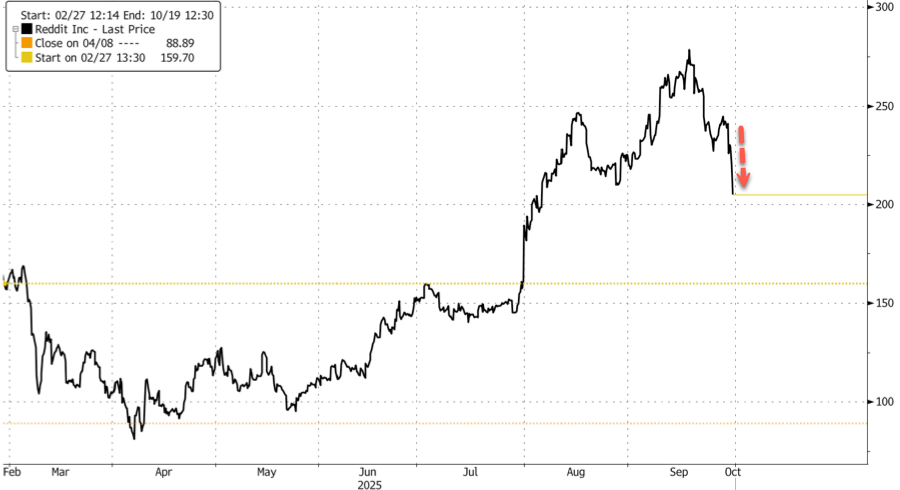
Reddit shares are sinking in New York premarket trading, and if the losses hold into the cash session, it would mark the steepest decline in six months. The drop comes after new Similarweb data indicated that ChatGPT has either scaled back or completely stopped using Reddit as a source for answer generation. Who would have ever guessed that relying on Reddit posts to generate chatbot answers was a brilliant idea?

Several X users are citing Similarweb data that shows Reddit’s collapsing web traffic. This includes one X user by the name of “Bert Tian” who states:

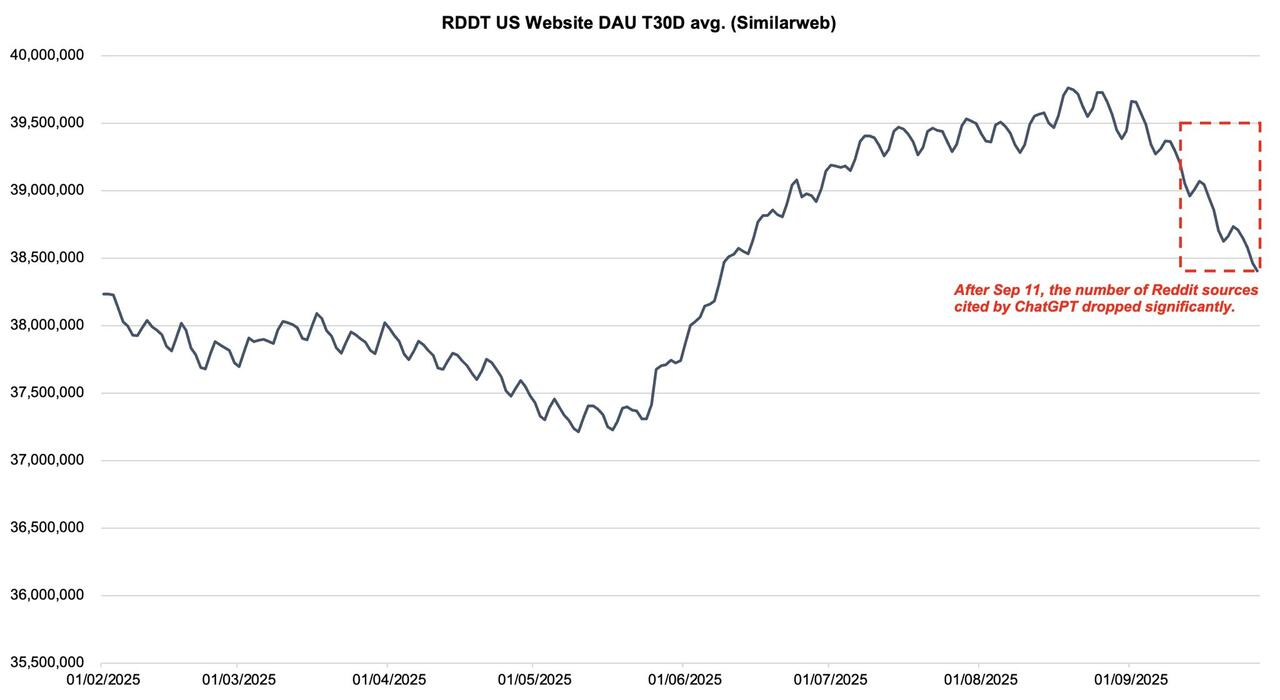
$RDDT US Website DAU (source @Similarweb ) has dropped sharply after ChatGPT massively reduced Reddit citations — traffic is now even close to early-year levels.

Multiple data vendors are all picking up the shift in ChatGPT citation patterns. Reasons still unclear, but one guess is that ChatGPT may be limiting web search for free accounts as a cost-cutting move to push monetization.

Tian posted an image showing Reddit’s U.S. daily active users on a 30-day average, indicating that around September 11 was the point when Reddit sources cited by ChatGPT dropped sharply.

Source: X user Bert Tian

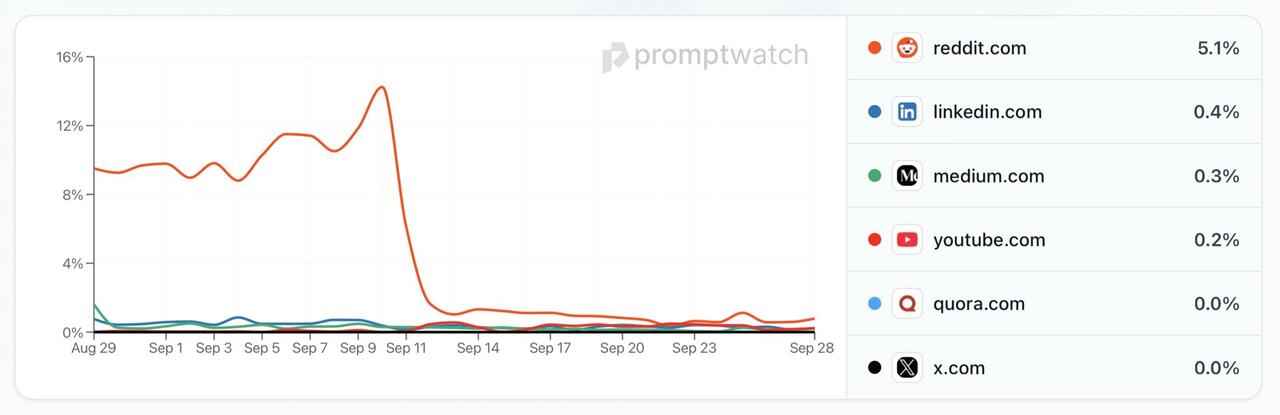
Tian was quoting another X user by the name of “Andrea Bosoni,” who pointed out:

Apparently ChatGPT is not using Reddit much anymore for their answers. I guess they realized that what random people say can’t be considered a trusted source after all. You can all stop spamming it with your fake brand mentions now.

Source: Andrea Bosoni

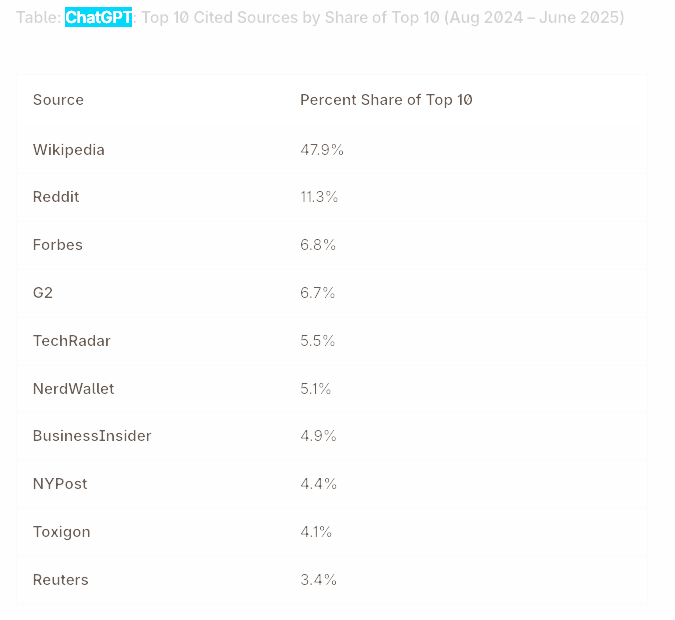
TryProfound blog cited a dataset between August 2024 and June 2025 that showed Reddit accounts for 11.3% of ChatGPT’s citations within its top 10 most-cited sources.

Source: TryProfound

Reddit shares dropped as much as 13% in premarket trading. If losses hold through the cash session, this would mark the largest decline since early March.

So, ChatGPT relies heavily on Wikipedia and Reddit… enough said. That’s why Elon Musk revealed on Tuesday his plans to launch “Grokpedia.”


Tyler Durden
Wed, 10/01/2025 – 09:00

via ZeroHedge News https://ift.tt/JlKEImN Tyler Durden

Trump: Government Shutdown Could Do ‘A Lot of Good’

Welcome to the club: President Donald Trump says “a lot of good” might come from the government shutdown.

“We can get rid of a lot of things that we didn’t want and they’d be Democrat things,” Trump told the press on Tuesday. “They just don’t learn. So we have no choice. I have to do that for the country.”

I don’t think he’s totally wrong. And now we’re getting what he wants (what we all want?) since the federal government shut down at the start of today—though, to be clear, this is a misnomer, since shutdowns are always just partial, with “essential” government services preserved and most employees just furloughed, granted back pay later on once the government reopens. (“The worst that happens is that some people are inconvenienced for a few days,” writes Reason‘s J.D. Tuccille, “as the only things that really cease to function are public-facing operations such as parks and offices—deliberately so, to maintain the illusion that something important is happening.”)

“In back-to-back Senate votes that reflected how acrimonious the funding dispute has become, each party blocked the other’s stopgap spending proposal, just as they had earlier in the month,” reports The New York Times. “On a 55-to-45 vote, the G.O.P. plan, which would extend funding through Nov. 21, fell short of the 60 needed for passage. Republicans also blocked Democrats’ plan, which would extend funding through the end of October and add more than $1 trillion in health care spending, in a 47-to-53 vote.”

This time, a shutdown might be different since Trump has made clear he’s looking to use this opportunity to make more permanent cuts to the federal workforce and its many, many functions. An Office of Management and Budget memo says that “agencies are directed to use this opportunity to consider Reduction in Force (RIF) notices for all employees in programs, projects, or activities (PPAs) that satisfy all three of the following conditions: (1) discretionary funding lapses on October 1, 2025; (2) another source of funding, such as H.R. 1 (Public Law 119-21) is not currently available; and (3) the PPA is not consistent with the President’s priorities.…Once fiscal year 2026 appropriations are enacted, agencies should revise their RIFs as needed to retain the minimal number of employees necessary to carry out statutory functions.” This type of directive is not customarily given out, and indicates that the president is looking at the shutdown rather differently than have past presidents in recent memory.

Certain benefits will continue to be administered: Social Security, Medicare, Medicaid, and assistance for Veterans. The Supplemental Nutrition Assistance Program will not be affected initially, but could be if the shutdown goes on for a long time. The federal Women, Infants and Children (WIC) program will not be able to accept any new applicants starting today. In the past, “inspections of chemical factories, power plants, oil refineries and water treatment plants were disrupted because the Environmental Protection Agency furloughed most of its employees in charge of monitoring pollution and compliance,” reports the Times. “Some routine food safety inspections also stopped.”

National parks have previously had their operations hobbled; open-air sites will probably stay open but visitors centers or other areas that need staffing will shut down. The Department of the Interior says that restrooms will be cleaned and garbage will be collected, per NBC News—possibly a Trump directive aimed at ensuring there’s no malicious compliance from federal employees, performatively making quality of services worse so that public sentiment sours on the shutdown, the way it did during the 34-day 2019 shutdown, during his first term. (“A government shutdown would leave our parks understaffed and vulnerable, putting our most cherished places and millions of visitors at risk. If a national park has a gate or door, it must be locked until a funding deal is reached and our parks can be staffed and protected,” said the National Parks Conservation Association in a statement on Monday, calling the impact of former shutdowns “disastrous.”)

Nobody yet knows the extent of the cuts, both temporary and permanent, but this is a huge opportunity for Trump to reevaluate what’s truly in the interest of the American people. I’m hoping for TSA abolition. What’s on your wish list?


Scenes from New York: Spotted in Gravesend yesterday.


QUICK HITS

  • Yesterday, President Donald Trump addressed top military brass at Quantico and told them part of their mission would now be to fight “the enemy within” with some troops deploying in American cities. “San Francisco, Chicago, New York, Los Angeles, they’re very unsafe places and we’re gonna straighten them out one by one,” said the president. “This is going to be a major part for some of the people in this room. That’s a war too. It’s a war from within.” Defense Secretary Pete Hegseth also addressed the assembled troops, mostly talking about the lowering of certain physical standards for members of the military by previous administrations.
  • Louisiana Governor Jeff Landry asked for the president to deploy the National Guard to New Orleans, citing high crime rates there. (“New Orleans residents recall how the national guard was sent into their city in 2006 in the name of crime control,” notes The Guardian. “That happened on the orders of the Democratic Louisiana governor at the time, the late Kathleen Blanco, in the wake of an infamous quintuple murder—victimizing five teenagers—as New Orleans slogged through rebuilding from the deadly federal levee failures which devastated it during Hurricane Katrina in 2005.”)
  • “The US Federal Trade Commission sued to block a partnership to make Zillow Group Inc. the exclusive provider of information on apartment rentals offered by Rocket Companies Inc.‘s Redfin,” reports Bloomberg. “In a complaint filed in Virginia federal court, the FTC said the partnership would reduce the number of websites offering apartment listings, leaving consumers with fewer places to search for and driving up the price for buildings that want to advertise.” This is a little ridiculous: Zillow already owns StreetEasy (used by pretty much all New Yorkers to find apartments), Hotpads, and Trulia. And “in 2020, the FTC blocked CoStar Group Inc. from buying the company that then maintained Rent.com and ApartmentGuide.com. That company was later acquired by Redfin in 2021. Rocket acquired Redfin earlier this year.”
  • This whole thread is interesting, on the recent (buckle up) Ezra Klein x Ta-Nehisi Coates interview that’s been making the rounds, receiving lots of warranted criticism that the Democratic Party seems incapable of both self-reflection and understanding their opponents in any meaningful way:

  • I am actually 100 percent fine with this, she understands the plan perfectly:

The post Trump: Government Shutdown Could Do 'A Lot of Good' appeared first on Reason.com.

from Latest – Reason.com https://ift.tt/nytsRol
via IFTTT

Tylenol Maker Said In Internal Emails Evidence Of Link To Autism ‘Starting To Feel Heavy’

Tylenol Maker Said In Internal Emails Evidence Of Link To Autism ‘Starting To Feel Heavy’

Authored by Zachary Stieber via The Epoch Times (emphasis ours),

The manufacturer of Tylenol was keeping tabs on research into the drug and neurodevelopmental issues such as autism, and concluded in 2018 that evidence of a link between them was becoming significant, according to newly disclosed documents.

Tylenol lines the shelves of a store in Brandon, Miss., on Sept. 24, 2025. John Fredricks/The Epoch Times

In a Feb. 8, 2018, email obtained by The Epoch Times, Rachel Weinstein, director of epidemiology at Johnson & Johnson subsidiary Janssen, wrote, “The weight of evidence is starting to feel heavy to me.”

Weinstein was emailing Jesse Berlin, Johnson & Johnson’s global head of epidemiology, about a review that concluded that nine studies suggested that use of acetaminophen—the active ingredient in Tylenol—by pregnant women was linked to autism and other neurodevelopmental issues in the women’s children.

Weinstein said that Janssen had been discussing with a neurologist about how acetaminophen could be beneficial.

But now we’ve added the studies in prenatal exposure and neurodev [sic] outcome,” she said.

Berlin wrote that he read the review and that “there appears to be some specificity of the association.” While he took issue with how some papers did not analyze other drugs, “at least one study looked separately at specific indications and the association didn’t go away,” he said.

Johnson & Johnson was the maker of Tylenol for years. In 2023, a newly created company called Kenvue took over the Tylenol brand and other consumer brands.

“These documents show we were doing exactly the right thing,” a spokesperson for Kenvue told The Epoch Times in an email. “We have continuously evaluated the science, and there is no credible evidence that taking acetaminophen causes autism.”

‘Difficult Options’

Dr. Jørn Olsen of Aarhus University in Denmark and other researchers in 2014 released an observational study that determined maternal acetaminophen use during pregnancy was linked to a higher risk of attention-deficit/hyperactivity disorder-like behavioral problems or hyperkinetic disorders in their children.

Weinstein, in an email, told Olsen that the study had strengths but wondered whether the researchers had tried assessing any association between other drugs pregnant women take, such as aspirin, and the disorders. Olsen, in a brief reply, said the researchers planned to look at those drugs in future studies.

Weinstein forwarded the email to the company’s consumer medical safety division.

“Recall that we have ruled out the possibility of conducting a database study of our own because other existing databases would be underpowered to detect the same effect that the Danish study found, due to the lack of a large enough database,” she wrote in her email.

She asked whether the question for the company was whether there was a willingness to support Olsen “up to a reasonable amount with the provision that the investigator has final say on publication but the sponsor can review and comment on the manuscript prior to publication.”

Weinstein told Berlin that there were several options, including funding Olsen. They could also try to replicate Olsen’s study, conducted in Denmark, with Norwegian data on prescriptions and diagnoses, and by including other drugs.

The outcome of such a study is unknown. We could end up confirming the Danish findings, for example,” she said.

She later drafted a note to Olsen that initially said Johnson & Johnson would be happy to work with him on additional research. Berlin in response proposed revisions. But Weinstein then told Berlin she was having second thoughts on engaging Olsen.

“Do we really need to stick our neck out and make this offer? Would we be surprised if the new analyses confirmed or did not confirm the existing studies?” she asked.

Berlin responded: “I’m trying to think through what we would do based on what we learn. I don’t have a huge problem abandoning this, if that’s where we end up after talking.”

Weinstein, who is now retired, could not be reached for comment. Berlin, now a professor at Rutgers University, did not respond to a request for comment.

Internal slides from around the time of the emails, obtained by The Epoch Times, stated that the company declined to pursue a collaboration with Danish researchers in part because executives were unsure about “the value to pregnant consumers,” who might be presented with “difficult options” such as “don’t use anything if you have a fever.”

Lawyer: ‘Irresponsible’

The emails came to light in lawsuits brought by women who say they should have been warned by Johnson & Johnson and retailers about the risks of neurodevelopmental problems associated with acetaminophen products.

The women have pointed to papers such as a 2020 prospective study in Canada that found an increased risk of ADHD among children born to women who used acetaminophen while pregnant.

“Drugmakers have a legal and ethical obligation to continually investigate the safety of their products. Yet despite recognizing the heavy weight of the scientific evidence years ago, Kenvue scientists made a deliberate decision not to ’stick our necks’ out to commission further research,” Ashley Keller, senior partner at law firm Keller Postman, which is representing the women in multiple cases, told The Epoch Times via email.

“The reason for that irresponsible choice is obvious. The company didn’t study the question for fear they would not like the answer. But pregnant moms deserve answers, and protecting a multi-billion dollar drug franchise is no excuse for ostrich-like corporate misbehavior.”

The emails were first reported by the Daily Caller and drew the attention of the White House and the Department of Health and Human Services.

Government officials recently warned the public that Tylenol use during pregnancy may be associated with autism in children born to the mothers.

‘We Have Been Looking at It’

Weinstein said in a 2023 deposition that it would be unethical to run a randomized, controlled trial seeking to figure out whether there was a link between in utero acetaminophen exposure and neurodevelopmental problems. It would be good to do “more tightly controlled” observational studies, or research utilizing sources such as medical claims databases, she said.

Weinstein also said that Johnson & Johnson had been tracking literature on the topic for nearly a decade, including epidemiological, safety, and preclinical studies.

She said that the company has “essentially done a systematic review,” or an analysis of strong studies on the matter.

She said the company would be publishing the review but did not know when.

Internal slides from 2018, obtained by The Epoch Times, described the results of a company analysis of 16 studies regarding prenatal exposure to acetaminophen and neurodevelopmental disorders.

The slides stated that individual observational studies “show a somewhat consistent association of increased occurrence of neurodevelopmental outcomes with prenatal exposure,” with strengths including some studies being prospective. Limitations included researchers measuring children at different ages, such as 18 months and seven years.

A 2022 internal Kenvue slide deck stated that 12 studies featuring clinically diagnosed endpoints were analyzed. The studies were “too limited in methodological or analytical design to draw conclusions regarding a causal relationship between prenatal acetaminophen use and adverse neurodevelopmental outcomes in children,” and therefore, if acetaminophen is used as directed, it is safe to use during pregnancy, the slide deck stated.

A review coauthored by Kenvue scientists and funded by Kenvue was published by Critical Reviews in Toxicology in February.

The authors of the review said that they reviewed preclinical studies and determined that the data “demonstrates no consistent evidence of adverse effects following developmental exposure to acetaminophen at therapeutic and/or non-systemically toxic doses on the structure and function of the nervous system, including neuroanatomical, neurotransmission, and behavioral endpoints.”

Labeling Change

Other documents labeled the effort to study the matter Project Cocoon, stated that Weinstein was involved, and listed as the mission of the project “to protect acetaminophen.”

One slide stated, “Courage: We don’t need a label change.”

The label of Tylenol has long stated, “If pregnant or breastfeeding, ask a health professional before use.”

In 2017, one document showed that the company changed its internal label to add, “This product should not be used during pregnancy or lactation unless the potential benefit of treatment to the mother outweighs the possible risks to the developing fetus/nursing infant.”

When asked in a 2023 deposition about whether the change means doctors could give patients guidance on potential risks of developmental outcomes, Leslie Shur, Johnson & Johnson’s director of pharmacovigilance, replied, “and the risk of, in the case of fever … of not treating.”

The U.S. Food and Drug Administration said on Sept. 22 that it has started the process to change the label for Tylenol and other acetaminophen-containing products “to reflect evidence suggesting that the use of acetaminophen by pregnant women may be associated with an increased risk of neurological conditions such as autism and ADHD in children.

Regulators said a causal relationship has not been established and noted that acetaminophen is the only over-the-counter drug available to treat fevers in pregnancy.

The FDA in 2014 had decided to take no regulatory action, following advice from reviewers. In 2016, FDA reviewers said, “With growing evidence for adverse neurodevelopmental outcomes being associated with in utero [acetaminophen] exposure, even in the absence of proof of a causal relationship, it would be appropriate for FDA to bring this issue to the attention of consumers and health care providers through one of the communication avenues available to the agency.”

Reviewers in 2019 said data indicated that prenatal acetaminophen exposure “is not necessary completely benign for the fetus” and “it would be desirable for the agency to communicate this message to healthcare providers and pregnant women, considering that acetaminophen is so commonly used by women during their pregnancies, and that many perceive acetaminophen to be risk-free.”

Court Cases

U.S. District Judge Denise Cote dismissed the federal multidistrict litigation over acetaminophen in 2024, after finding that experts offered by the plaintiffs misrepresented the results of studies.

The case was appealed and is set for oral argument before an appeals court on Nov. 17, after being delayed from a date in early October.

Keller and other attorneys in a recent filing alerted the court to the government’s move to update Tylenol’s label. The filing noted that government officials quoted one of the plaintiffs’ witnesses, Dr. Andrea Baccarelli, dean of the faculty at the Harvard TH Chan School of Public Health, who said that, in his expert opinion, “there is a causal relationship” between prenatal acetaminophen exposure and neurodevelopmental disorders.

“Expert opinion that is sound enough to persuade every Senate-confirmed federal scientist easily clears Rule 702(d)’s bar,” or the rule governing expert witnesses in litigation, they wrote. Attorneys for Kenvue told the court that statements from the government and Baccarelli “confirm that the existing evidence does not support a causal relationship.”

In California, a state judge in May turned away a similar case, concluding that evidence on the link between prenatal acetaminophen exposure and autism is “profoundly uncertain and conflicting.”

The judge also wrote that slides and other internal documents showed “candid internal discussion,” which she described as “positive corporate behavior.”

An appeal in that case is ongoing.

Tyler Durden
Wed, 10/01/2025 – 08:40

via ZeroHedge News https://ift.tt/szmbqUR Tyler Durden

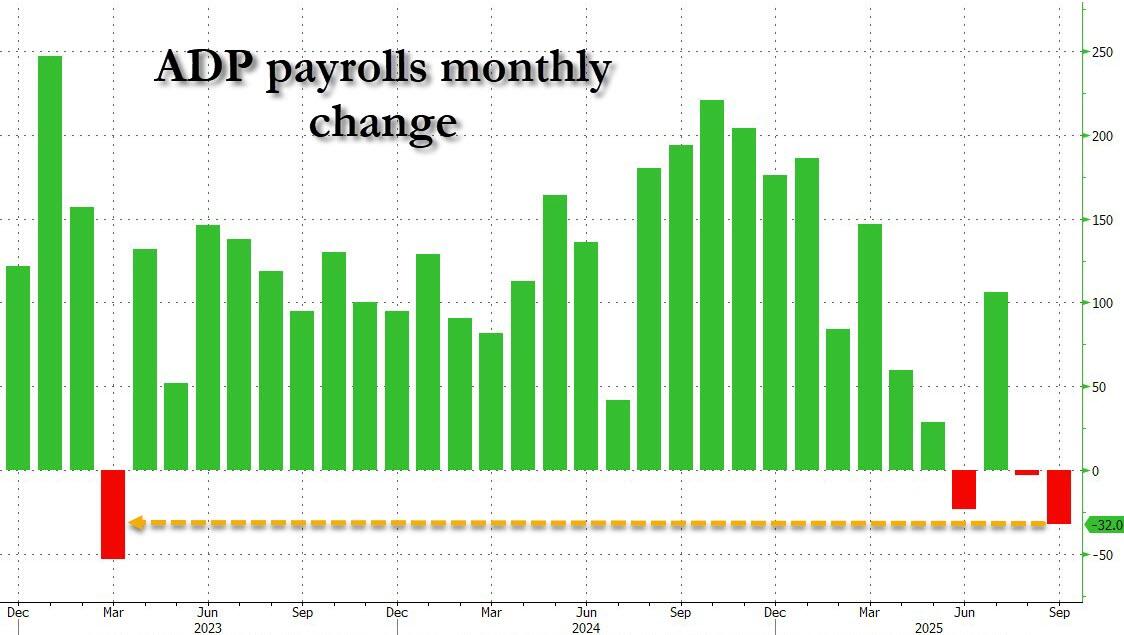
ADP Payrolls Unexpectedly Crater To -32,000, Worst Since March 2023 And Below All Estimates

ADP Payrolls Unexpectedly Crater To -32,000, Worst Since March 2023 And Below All Estimates

Ahead of today’s ADP print we said that traders will be especially focused on the otherwise unreliable number, since the government shutdown which hit at midnight means that this Friday’s payrolls report will likely not happen. Well, if that is the case, the market – and Fed – may well be expecting a jumbo 50bps rate cut again in 3 weeks, because moments ago ADP reported that in September, the US private sector shed 32,000 jobs, the worst print since March 2023…

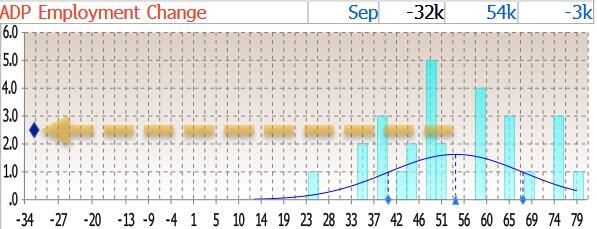
… and far below the lowest estimate; in fact the print was a 6 sigma miss to estimates of which Pantheon’s +25K was  the lowest.

Adding to the confusion is that the original number was actually well higher, at 11K, but after the ADP conducted its annual preliminary rebenchmarking of the National Employment Report in September based on the full-year 2024 results of the Quarterly Census of Employment and Wages (which as a reminder eliminated 911K jobs from the Biden regime that were never actually there), there was a reduction of 43,000 jobs in September compared to pre-benchmarked data. The trend was unchanged; job creation continued to lose momentum across most sectors.

“Despite the strong economic growth we saw in the second quarter, this month’s release further validates what we’ve been seeing in the labor market, that U.S. employers have been cautious with hiring,” said ADP chief economist Nela Richardson. 

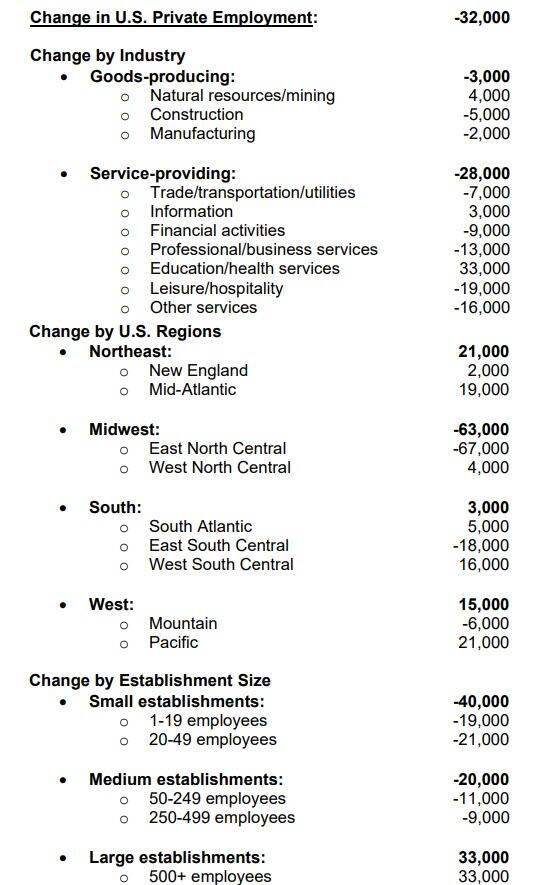
As shown in the next chart, the decline was broad-based…

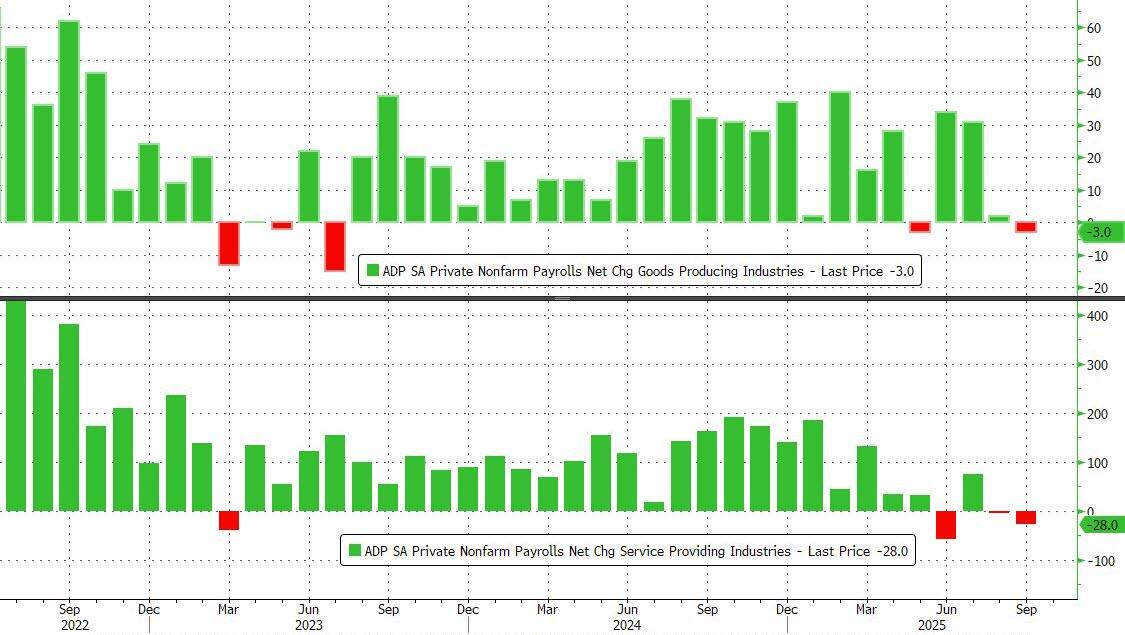
… with both goods and service producing sectors seeing a slide in jobs.

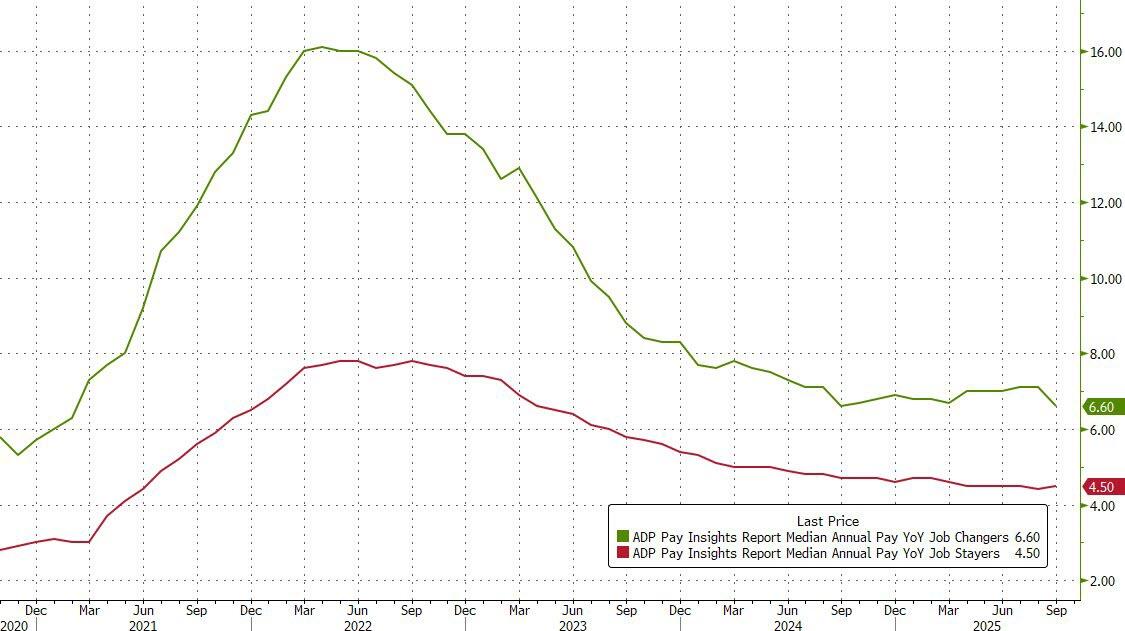
Looking at wages, job Stayers’ saw incomes post a modest improvement, rising from 4.4% (which was the slowest pace of growth since June 2021) to 4.5%, while ‘job changers’ are still seeing higher and rising incomes, although in September this number slumped to 6.6% from 7.1%.

And so, with Friday’s payrolls delayed and with ADP traditionally viewed as an unreliable source of information, expect data hungry traders to scour the interwebs for every possible third party provider of employment and labor data in hopes of figuring out just how bad the labor slide truly is. 

Tyler Durden
Wed, 10/01/2025 – 08:33

via ZeroHedge News https://ift.tt/IV8L6oz Tyler Durden

Futures Drop, Gold Jumps As US Government Shutdown Begins

Futures Drop, Gold Jumps As US Government Shutdown Begins

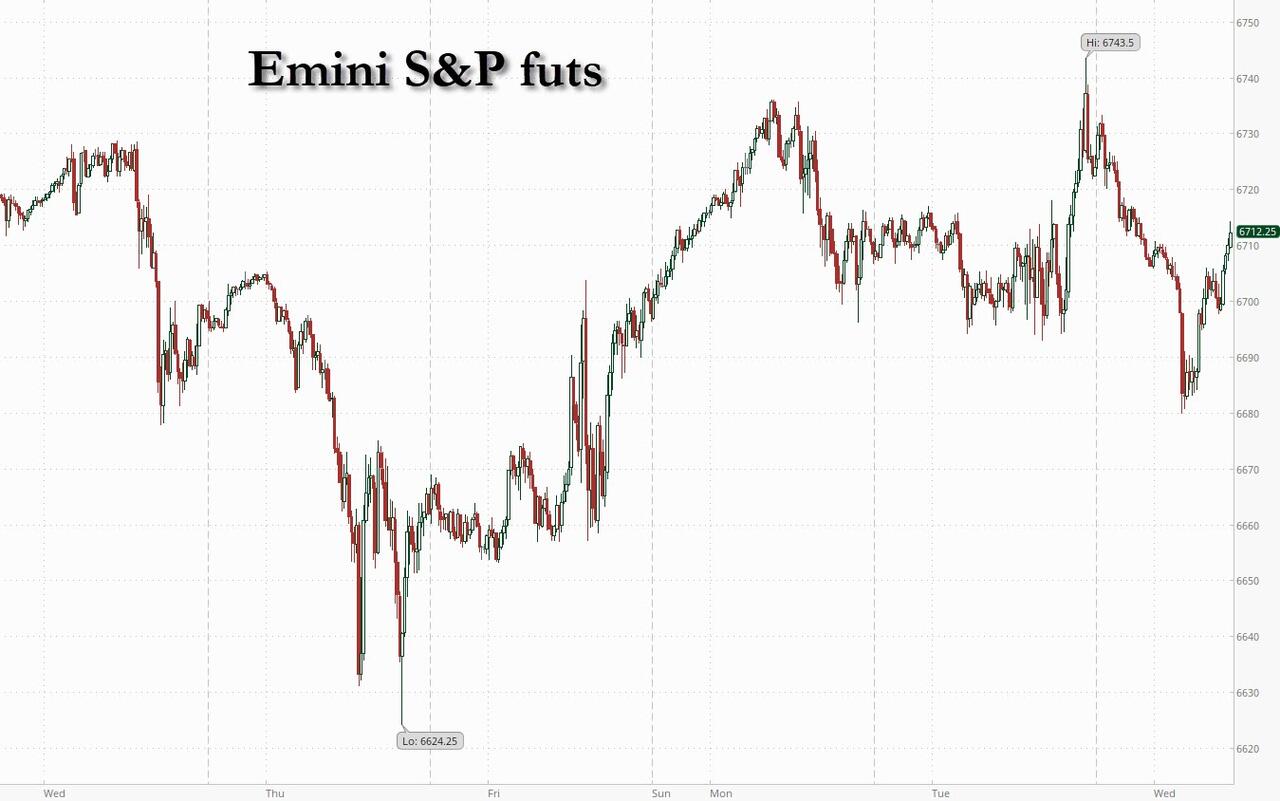
US stock futures are weaker to start the new quarter but have cut overnight losses by more than a third, as the first US government shutdown in nearly seven years begins. The first shutdown during Trump 1.0 lasted 3 days and the second shutdown 35 days: how long will this one last? As of 8:00am ET, S&P futures are down 0.4%, but well off session lows while Nasdaq futures drop 0.5%. Gold futures, up almost 1%, continue their advance toward $4,000. Pre-mkt, we are seeing a risk-off tone in US assets, including USD weakness, helping buttress international markets where Eurostoxx 50 set a new intraday ATH led by health care and communication sectors. Mag7 names are mostly lower with Semis also pressured; NKE gains 3% post solid earnings. The yield curve is twisting steeper. Commodities are weaker ex-Precious Metals with silver outperforming gold. With Friday’s NFP release all but certain to be delayed, ADP takes on heightened importance today; we also receive ISM-Mfg, construction spending, vehicle sales, and mtge applications. 
In premarket trading, Magnificent Seven stocks are all lower (Apple -0.3%, Amazon -0.7%, Tesla -0.3%, Nvidia -0.5%, Alphabet -0.7%, Meta Platforms -0.7%, Microsoft -0.7%)

  • AES Corp. (AES) rises 14% as BlackRock’s Global Infrastructure Partners LP is in advanced talks to acquire the power company, according to people familiar with the matter.
  • Corteva (CTVA) inches 1% higher after announcing plans to separate into two independent companies, one comprising its current crop protection business and the other its current seed business.
  • Lithium Americas (LAC) rises 32% after Secretary of Energy Chris Wright told Bloomberg TV that the US government agreed to acquire a stake in the company.
  • Marvell Technology Inc. (MRVL) falls 2.5% after TD Cowen cut its recommendation on the chipmaker to hold from buy, citing limited visibility in a key vertical.
  • Nike (NKE) climbs 3% after the sneaker retailer reported first-quarter revenue that beat the average analyst estimate, a sign its focus around specific sports such as running and basketball are starting to pay off.
  • Sunrun Inc. (RUN) rises 5% after Jefferies raised its recommendation on the solar energy company to buy, citing cash and growth potential.
  • Veeco Instruments (VECO) rises 4% after announcing plans to merge with Axcelis Technologies (ACLS). Axcelis falls 1.7%.

In corporate news, Apple says it did nothing wrong in choosing to partner with OpenAI — rather than Musk’s xAI — when it added generative AI to its iPhone operating system. Goldman Sachs is said to be among a cohort of financial firms planning to open offices in Kuwait. Lithium Americas shares surged after Secretary of Energy Chris Wright told Bloomberg TV that the US government agreed to acquire a stake in the company.

The US government shut down after a midnight funding deadline as Trump and Congressional Democrats clashed over health-care spending. With important economic reports now on hold, traders fear the loss of visibility will leave markets in the dark on the outlook for monetary policy. Fiona Boal, global head of equities at S&P Dow Jones Indices, said investor concern would focus on how long the shutdown may last, the disruption to economic data and potential job cuts. 
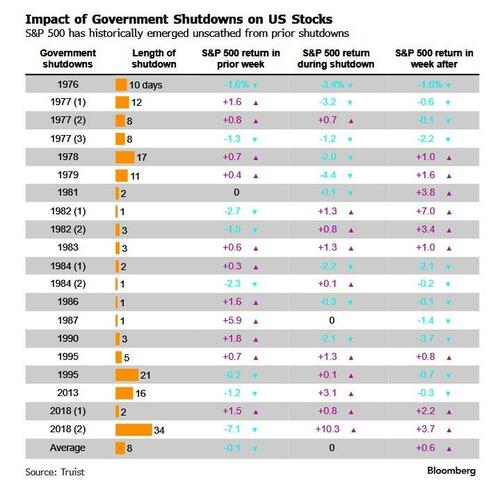
 

The Congressional Budget Office estimates that about 750,000 employees will be furloughed at a cost per day of $400 million in lost compensation. The Trump administration’s plan to fire federal workers outright could also drive jobless claims higher at a time when employment already looks fragile.

“Government shutdowns in the US are rarely market-moving in and of themselves, but the timing matters,” said Nina Stanojevic, investment specialist at St James’s Place. “This one comes at a point where the Fed is data dependent. The absence of clean data can increase volatility.”

While the next Federal Reserve meeting is still four weeks away, policymakers might have to make decisions on an unclear picture, with the labor market softening and inflation hovering above target.

“In that case, a rate cut is likely to happen, but the uncertainty may lead to a change in expectations and increased volatility,” said Daniela Sabin Hathorn, senior market analyst at Capital.com. Money markets are currently pricing in a 90% chance of a quarter-point cut this month, and almost a 70% probability of another by year-end.

Shutdown aside, which according to many won’t have a negative impact on risk assets, traders will be wondering if technology can continue to provide upside momentum for the overall market as the final quarter of 2025 begins. Compared to earlier this year, the Magnificent 7 have had less of a role in recent gains, with some investors looking to the AI supply chain rather than the major names. 

Still, the AI buzz is alive and well. There’s about $7 trillion of investment needed to finance the rapid growth of AI, according to Hadley Peer Marshall, CFO at Brookfield Asset Management. The equity buying spree has left aggregate positioning just above neutral, meaning there is still dry powder for more chasing or dip buying into typically positive fourth-quarter seasonality, according to Barclays strategists. 

On the policy front, the Fed’s Logan said policymakers should be cautious about considering additional rate cuts while inflation remains above target and the labor market relatively balanced. Meanwhile, Taiwan has pushed back on a US request to move chip production stateside to cover half of America’s demand. 

Unlike the US, European stocks gained 0.4%, driven mostly by pharmaceutical stocks as Pfizer’s drug pricing deal provides relief on the industry’s outlook. Here are some of the biggest movers on Wednesday:

  • Greggs shares rally as much as 13% after the baker said trading improved in August and September and that its cost inflation outlook has improved, helping it to reiterate its full-year expectations.
  • European drugmakers rise following Pfizer’s drug-pricing agreement with US President Donald Trump, which JPMorgan analysts say could be a potential bellwether for the sector and “reassure investors over a broadly manageable impact.”
  • Ambu shares advance as much as 11% after the Danish health-care equipment maker increased its five-year revenue target and reiterated its Ebit margin goal for the fiscal year ending September 2028.
  • Pirelli shares rose as much as 2.4% in Milan after Reuters reported that Chinese shareholder Sinochem might consider selling its stake in the Italian tire maker.
  • Arcadis jumps as much as 9.1%, after the provider of consulting and engineering services started repurchasing its own shares.
  • Soitec shares rise much as 7.7% after the wafer maker said CEO Pierre Barnabé would step down due to personal reasons.
  • Pharming shares rise as much as 7.1% after the Dutch biopharmaceutical company said its supplemental new drug application for leniolisib to treat a rare primary immunodeficiency in children was granted priority review by the US FDA.
  • European sportswear stocks are on the move after US peer Nike reported better-than-expected first-quarter sales.
  • Tate & Lyle falls as much as 11.5%, dropping to the lowest since July 2009, after the ingredients company said in a pre-close statement that it experienced a slowdown in market demand as the first half progressed.
  • European defense stocks are falling on Wednesday as EU leaders meet informally in Copenhagen to discuss how to deal with the threat posed by drone incursions into the bloc’s airspace.
  • Flutter UK shares fall as much as 5.4%, extending steep declines on Tuesday amid concern over the competitive threat posed by prediction platforms being offered by the likes of Robinhood and Kalshi.

Earlier in the session,  Asian stocks were mixed, as gains in South Korea, India and Taiwan were overshadowed by declines in Japanese shares on concerns over the impact of a US government shutdown. Hong Kong and Chinese markets were shut for holidays.  The MSCI Asia Pacific Index held steady, as gains in the likes of TSMC and Samsung balanced out declines in stocks like Mitsubishi UFJ Financial Group and BHP Group. Japanese and Australian blue chips weighed most heavily on the regional benchmark. Most other markets traded in the green. Japan’s monetary policy is moving in the opposite direction as the world generally moves toward easing. Stocks edged higher as the central bank left its benchmark interest rate unchanged, while signaling there may be scope to ease in coming months to support an economy taking a hit from US tariffs. Australian shares fell for a second day after the Reserve Bank left its key interest rate unchanged.

In FX, the Bloomberg Dollar Spot Index fell 0.1% to take losses into a fourth day. The shutdown threatens to delay key economic reports used to gauge the Federal Reserve’s path on interest-rate cuts; the yen is outperforming and the Swiss franc lagging.

In rates, treasuries are mixed with the curve steeper as US day begins after plying small ranges overnight. Treasury front-end and belly yields are about 1bp richer on the day with long end cheaper by about 1bp, steepening 5s10s, 5s30s spreads by 1.3bp and 2.4bp; US 10-year is 2bps lower near 4.13% with bunds and gilts in the sector trading slightly cheaper. European bonds weaker, with German 10-year yields up three basis points. US Treasuries are little changed. Eurozone inflation quickened in September, in line with economist expectations. IG dollar issuance slate is scant and a subdued session is expected amid the government shutdown. September’s $207.5 billion haul was the fifth-highest month on record and this year’s highest by a $21 billion margin. Focal points of US session include ADP’s private-sector payrolls data, which may hold more sway than usual as the shutdown threatens to delay the release of Thursday’s weekly jobless claims and the monthly jobs report slated for Oct. 3.

In commodities, oil prices wiped out an earlier rise to extend declines into a third session, Brent sliding below $66/barrel and WTI slipping under $62. Gold is extending its run, up by $34 and putting $3,900/oz in sight.

Looking at today’s calendar, US economic data slate includes September ADP employment change (8:15am), September final S&P Global US manufacturing PMI (9:45am), September ISM manufacturing and August construction spending (10am). Fed speaker slate includes Barkin (12:15pm) and Goolsbee (5pm).

Market Snapshot

  • S&P 500 mini -0.5%
  • Nasdaq 100 mini -0.6%
  • Russell 2000 mini -0.5%
  • Stoxx Europe 600 +0.5%
  • DAX +0.3%
  • CAC 40 +0.3%
  • 10-year Treasury yield little changed at 4.15%
  • VIX +0.5 points at 16.82
  • Bloomberg Dollar Index -0.1% at 1198.96
  • euro +0.1% at $1.1747
  • WTI crude -0.9% at $61.81/barrel

Government Shutdown

  • The US government officially went into shutdown, with a majority of operations halted after no funding deal was reached in the Senate, marking the first shutdown since 2018.
  • House and Senate GOP leaders will hold a 10:00ET/15:00BST news conference Wednesday, according to Politico, citing sources.
  • Top Overnight News
  • The US government shut down at midnight for the first time since 2019 — and the third under Donald Trump — after Democrats blocked a Republican stopgap funding package. There were no signs of a resolution forthcoming. BBG
  • The White House pulled the nomination of EJ Antoni to lead the BLS. Brian Quintenz is also no longer Trump’s pick to chair the CFTC, after weeks of speculation about his stalled candidacy. BBG
  • Republican lawmakers said that China won’t begin purchasing US agricultural products anytime soon after a closed-door briefing. As part of the fallout from Trump’s trade war, China has yet to book a single shipment of US soybeans this season, fueling anxiety among farmers as this year’s harvest moves ahead. China is the world’s largest soybean importer. BBG
  • US trade representative Jamieson Greer has warned that Washington will continue to hit its trading partners with tariffs even if some are ruled illegal by the Supreme Court later this year. The Supreme Court is set to hear cases brought by businesses challenging Trump’s use of emergency powers to impose tariffs in the first week of Nov. FT
  • Taiwan pushed back on a US request to move chip production stateside to cover half of America’s demand. BBG
  • Japan’s business sentiment among large manufacturers improved for a second straight quarter, according to the Tankan survey. South Korea’s adjusted exports fell 6.1% year on year in September. BBG
  • India’s central bank kept its policy rate unchanged (5.5%) as U.S. tariffs continued to cloud the South Asian economy’s outlook, while signaling that it remains open to further easing. WSJ
  • Eurozone inflation for Sept is right inline with expectations, including headline at +2.2% (up from +2% in Aug) and core at +2.3% (same as Aug), a development that’s a modest relief given the German CPI on Tues ran ahead of expectations. BBG
  • Fed’s Logan (2026 voter) said the Fed will be cautious in any further reductions and that the US may need additional labour market slack to reach the 2% inflation target. She noted resilient consumption and business investment show policy is only modestly restrictive, adding that inflation expectations cannot be taken for granted and that financial conditions are now a tailwind, further evidence that policy is modestly restrictive. Logan said it is unclear how much further the Fed can cut before hitting neutral and warned that even excluding tariff impacts, inflation may be as high as 2.4%, driven by non-housing services, according to Reuters.
  • Fed to ease Morgan Stanley’s (MS) capital requirements following a review: BBG 
  • US Energy Secretary said the US government is taking an equity stake in Lithium Americas (LAC), via Bloomberg TV; US DoE to take a 5% stake in Lithium Americas (LAC): ZH 
  • BlackRock’s (BLK) GIP is said to be nearing USD 38bln takeover of utility AES (AES): FT 
  • Nike Inc (NKE) Q1 2026 (USD): EPS 0.49 (exp. 0.27), Revenue 11.72bln (exp. 11.00bln). Gross margin decreased 320bps to 42.2%, primarily due to lower average selling price, reflecting higher discounts and channel mix, as well as higher tariffs in North America. CFO said tariffs will cost approximately USD 1.5bln, higher than the prior estimate of around USD 1bln, and expects Q2 revenue to fall by low single digits versus estimates of a 3.1% decline, according to Reuters. Shares rose 4.5% after hours.

Trade/Tariffs

  • US Deputy Secretary of State encouraged investment from South Korea, with the US and South Korea holding a working group on visas for South Korean businesses investing in the US, according to a statement.
  • South Korea and the US released a joint statement on a foreign exchange policy agreement, pledging to avoid manipulating exchange rates to gain an unfair competitive advantage. The statement did not mention a bilateral currency swap or South Korea’s state-run pension fund. Both sides agreed that FX market intervention should be reserved for combating excessive volatility and would be considered for both disorderly depreciation and appreciation. They also agreed to exchange FX intervention operations on a monthly basis and said any macroprudential or capital flow measures will not target exchange rates, according to Reuters.
  • Taiwan rejected a US request to produce half of its chips locally, according to Bloomberg.
  • Japanese Economy Minister Akazawa said they will operate a USD 550bln US-bound investment without causing FX impact, suggesting USD 550bln is the range where there is no FX impact, according to Reuters.
  • European Commission is reportedly looking to sign the EU-Mercosur partnership agreement on December 5th, via Politico citing diplomats.
  • European Commission reportedly plans to raise import tariffs on foreign steel to similar levels as US and Canada, via Reuters citing sources; expected to lift the steel import tariff level to 50%.

A more detailed look at global markets courtesy of Newsquawk

APAC stocks traded mixed following modest gains on Wall Street, with focus on the length of the US government shutdown after the Senate rejected the House-passed CR, whilst Chinese participants were away for Golden Week. ASX 200 fluctuated between small gains and losses, supported by gold miners at the top of the index, while Energy and Tech lagged. BHP came under pressure after China banned its iron ore cargoes amid a pricing dispute. Nikkei 225 underperformed as the regional laggard despite a relatively mixed BoJ Tankan Survey. KOSPI was modestly firmer after above-forecast trade data, whilst reports suggested the US and South Korea agreed to establish a visa desk for Korean firms investing in the US. The two sides also issued a joint statement on foreign exchange policy, though it did not mention a bilateral currency swap or South Korea’s state-run pension fund. Nifty 50 traded flat and was little changed as the RBI kept its repo rate unchanged at 5.50% as expected in a unanimous decision, maintaining a neutral policy stance. Hang Seng and Shanghai Comp were shut for Golden Week and will return next Thursday.

Top Asian News

  • A BoJ official, following the Tankan Survey, said firms were divided on how they viewed the impact of US tariffs. Some suggested the US-Japan deal has reduced uncertainty and improved the business outlook, while others saw a worsening outlook, according to Reuters.
  • RBI kept its repo rate unchanged at 5.50%, as expected, in a unanimous decision, maintaining a neutral policy stance, with 2026 CPI now seen at 2.6% (prev. 3.1%). RBI Governor noted the Indian economy shows strength and headline inflation has significantly moderated. He said rationalisation of GST will have a sobering impact on inflation while stimulating consumption and growth, and added that tariffs will moderate exports. He highlighted the global economy is proving more resilient than anticipated but the outlook remains clouded amid elevated policy uncertainty, according to Reuters.

European bourses largely firmer, Euro Stoxx 50 +0.3%. Regional outperformance seen in the FTSE 100 +0.7% and SMI +1.5% on account of gains for Healthcare names after Pfizer’s pricing deal. More broadly, sectors are mixed. Energy initially firmer but has succumbed to fresh pressure in the underlying benchmarks, Tech lags and drags on the DAX 40 +0.4%. Numerous individual movers of note, but not changing the macro picture: Puma & Adidas firmer after Nike (+3.2% pre-market); BNP Paribas hit by Bloomberg reports of changes to Basel rules – see European updates for more.

Top European News

  • BoE’s Mann says that UK monetary policy is relatively loose, via Bloomberg TV. Adds that tighter interest rates would not currently be appropriate.

FX

  • USD falters on shutdown concerns. Given the shutdown, alternative labour reports to Friday’s currently-cancelled Payrolls will draw greater importance. DXY delved as low as 97.46 (lowest since 24th Sept) before recovering modestly across the European morning.
  • JPY tops the G10 leaderboard, USD/JPY briefly slipped below 147.00. Support for the Yen is partially a by-product of its safe-haven appeal as the US government enters into shutdown. Additionally, the Yen is also being bolstered by the Japanese Tankan survey, which was mixed/in-line, but ultimately viewed by markets as not being enough to derail expectations of a BoJ rate hike next month.
  • Sterling and Euro both firmer vs the USD. Sterling unaffected by BoE’s Mann or the regions PMIs, no move in the EU on its data either including Flash HICP. GBP/USD surpassed its 50DMA @ 1.3463 with focus on a test of 1.35 to the upside while EUR/USD got as high as 1.1778 before fading as the USD came off worst.
  • Antipodeans diverge with AUD unable to capitalise on the softer USD with the risk tone capping and with attention on the regions PMIs (revised lower) and Tuesday’s reporting around iron ore cargoes. Kiwi unaffected by the latter points and as such is a touch firmer NZD/USD looking to the 200-DMA at 0.5844.

Fixed Income

  • Treasuries are currently holding around the unchanged mark, though the benchmark has posted losses of a handful of ticks at worst this morning. Unable to materially benefit from the deteriorating risk tone, though the complex is off worst in a narrow 112-12 to 112-16+ band.
  • As a reminder, in 2018 Fitch warned that an extended shutdown could spark a downgrade to the US’ AAA rating (currently AA+). Since, we have seen the major agencies all warn about increasing US budgetary and general fiscal risks, a point that becomes more acute during a shutdown.
  • Narrative similar for Bunds, hit a 128.24 low early doors but lifted off this as the European morning progressed. However, the benchmark was sent back to lows after a particularly weak 2035 auction, continuing the deteriorated trend of such outings.
  • Gilts lag, hit by the FTSE 100 extending to highs given pharmaceutical outperformance and reports in the Guardian that Chancellor Reeves will be lifting the two-child benefit cap. Removing the cap would cost the exchequer around GBP 3.5bln/yr. Benchmark lower by 30 ticks at worst, but is off its 90.54 trough.

Commodities

  • Crude was initially contained after the OPEC Secretariat’s pushback to reports around a 500k BPD production adjustment by the OPEC 8. Since, a bout of pronounced selling pressure has emerged. No clear or overt fresh fundamental driver behind the move, though it is potentially a function of increased attention on Saudi Arabian Oil Co. cutting benchmark prices of LPG by more than forecast.
  • As it stands, WTI and Brent are currently holding modestly in the red but off lows in respective USD 61.62-62.89/bbl and USD 65.32-66.57/bbl parameters.
  • Spot gold has rebounded from the profit taking seen on Tuesday, climbing across the European morning as the risk tone got hit by the government shutdown. While the general risk tone is off worst, XAU is yet to lose its allure and remains near its latest ATH of USD 3895/oz.
  • 3M LME Copper is marginally firmer but veering towards the lower end of the day’s current USD 10.26-10.36k band. Focus primarily on the overarching macro narrative as outlined above. While only modest, the fact the space is firmer during the broader market pressure we are seeing and with China away for Golden Week is notable.

Geopolitics: Middle East

  • Yemen’s Houthis said they attacked the Dutch-flagged ship Minervagracht with a cruise missile, according to Reuters.
  • IRGC says “The range of missiles will be increased to any point Tehran deems necessary in response to European demands to restrict Iran’s missile capabilities”, via Sky News Arabia.
  • Hamas has informed mediators of the need to provide international guarantees for a complete Israeli withdrawal and ensure that the ceasefire is not violated, Sky News Arabia citing sources.

Geopolitics: Russia-Ukraine

  • Ukrainian President Zelensky warned the situation at the Zaporizhzhia nuclear power plant is critical, noting that Russian shelling is obstructing efforts to restore external power supply and that one backup diesel generator has stopped working, according to Reuters.
  • The IAEA said it is engaging with both sides of the military conflict to restore off-site power at Ukraine’s Zaporizhzhia nuclear power plant, according to Reuters.
  • Finnish President Stubb said, on potential US sanctions on Russia, that US President Trump is moving from the “carrot” to the “stick”, via Politico; when asked what the “stick” would be, he said a “driver”.
  • European leaders will not agree on the latest Russian sanctions today, via Radio Free Europe’s Jozwiak; hopes that European ambassadors can get a green light on Friday.
  • Italy’s Energy Minister Fratin says the EU has not reached a deal to ban Russian LNG before 2028 due to some countries not having alternative suppliers.

US Event Calendar

  • 7:00 am: Sep 26 MBA Mortgage Applications, prior 0.6%
  • 8:15 am: Sep ADP Employment Change, est. 50.5k, prior 54k
  • 9:45 am: Sep F S&P Global U.S. Manufacturing PMI, est. 52, prior 52
  • 10:00 am: Sep ISM Manufacturing, est. 49, prior 48.7
  • 10:00 am: Sep ISM Prices Paid, est. 62.7, prior 63.7
  • 10:00 am: Aug Construction Spending MoM, est. -0.1%, prior -0.07%

DB’s Jim Reid concludes the overnight wrap

As it’s the start of Q4, Henry will shortly be releasing our latest performance review for Q3. It was a strong quarter overall, with global equities and bonds advancing. In part, that was driven by ongoing resilience on the growth side, as the tariff impact wasn’t as negative as many feared at the start of July. But the Fed’s move to cut rates in September offered further support, particularly for US Treasuries, which in turn pushed gold prices to their strongest monthly performance since 2011 and the S&P 500 to its best September in 15 years. However, it wasn’t all good news, and fiscal fears in Europe put long-end bonds under fresh pressure there, particularly in France. See the full report in your inboxes shortly.

With Q4 underway, all eyes are now on the US government shutdown, which has just begun as we go to press, marking the first in the US in almost seven years — and the third one during President Trump’s administration. Last minute attempts at a funding deal that could muster the necessary 60 votes in the Senate failed yesterday, with a 55-45 vote on a stopgap bill that had been earlier approved by the Republican-controlled House. Three Democrats voted for the bill and all but one Republican. There are no signs of an imminent compromise between the White House and the Democrats, and the Republican leadership in the Senate suggested that any further votes may not take place until after the Yom Kippur holiday on Thursday. Earlier in the day, President Trump reiterated the threat of dismissing “a lot” of federal workers during the shutdown, though it’s not clear how well formed or implementable such plans are.

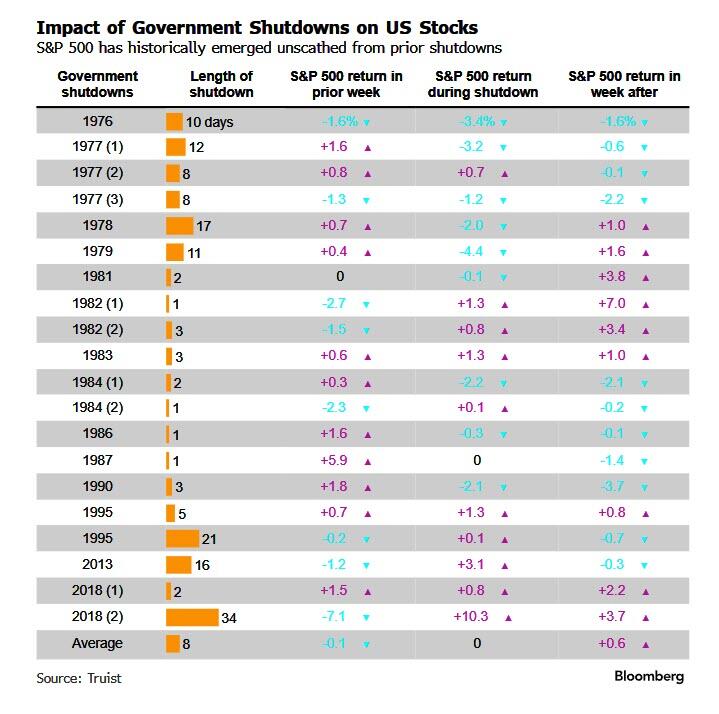
Interestingly, we looked in yesterday’s chart of the day at this (link here), and found that markets historically have taken shutdowns in their stride. In fact, the S&P 500 rose in the last 6 shutdowns, and 10yr Treasury yields came down in the last 5. Clearly there were other factors in operation as well in these periods, but it shows that for markets at least, the usual pattern is to look through what’s happening.

In practical terms, a big impact for this week is that we’re flying blind on the economic data front. So as it stands, we won’t get a jobs report on Friday, as the BLS aren’t releasing new data. Contrary to our prior expectations the Labor Department yesterday said we won’t see US jobless claims in the shutdown either. We thought we might see it released as the States compile the data. The BLS produce the CPI report on October 15th too, so if we’re shut down for long, that could be affected as well. That isn’t out of the question, as the last shutdown in 2018-19 (also under Mr Trump) lasted for a record 35 days. So other measures, like the ADP’s report of private payrolls today, could well take on added significance until we get the BLS numbers again.  

Markets brushed off some initial shutdown jitters yesterday, with the S&P 500 (+0.41%) recovering to close less than 0.1% from its all-time high, while the NASDAQ (+0.30%) and the Dow Jones (+0.18%) also advanced. So overall investors remained hopeful that the issues will be sorted over the coming days, with little wider impact on the economy or earnings. The Mag-7 (+0.11%) were mixed with Nivida (+2.60%) reaching another all-time high, but Meta (-1.21%) and Amazon (-1.17%) losing ground.

Earlier in the day, sentiment had taken a bit of a hit from some underwhelming US data. The Conference Board’s consumer confidence indicator fell by more than expected in September, down to a five-month low of 94.2 (vs. 96.0 expected). Moreover, the latest JOLTS report offered further momentum on that front, because it showed ongoing weakness in the labour market into August. For instance, the quits rate of those voluntarily leaving their job fell to 1.9%, which is the lowest since December, and suggests that people are less confident in their prospects. Plus the job openings number ticked up a bit more than expected, rising to 7.227m (vs. 7.2m expected). So that saw investors price in more rate cuts over the months ahead, with 83bps priced in by June 2026, up +2.2bps on the day. Front-end Treasuries rallied following the weaker data, with 2yr yields closing -1.3bps lower at 3.61%, but this was accompanied by a decent curve steepening with 10yr and 30yr yields up +1.1bps and +2.7bps to 4.15% and 4.73% respectively.

Those moves came as Fed speakers were mostly non-committal on the likely pace of rate cuts. Boston Fed President Collins “It may be appropriate to ease the policy rate a bit further this year – but the data will have to show that”, while Dallas Fed President Logan suggested that “there may be relatively little room to make additional rate cuts”. And Vice Chair Jefferson avoided any signal on the policy path, noting that “both sides of our mandate are under pressure”.
Over in Europe, the focus was on the latest inflation numbers, although they didn’t lead to a big market reaction.

Admittedly, the German numbers surprised on the upside, with the EU-harmonised measure ticking up to +2.4% in September (vs. +2.2% expected). However, that was counteracted by a downside surprise from France, where inflation rose by less-than-expected to +1.1% (vs. +1.3% expected). So in aggregate, the numbers didn’t have big implications for the Euro Area-wide print, which is out later this morning, and wasn’t seen as affecting the ECB’s reaction function.
That backdrop meant sovereign bond yields were little changed across Europe, with yields on 10yr bunds (+0.4bps), OATs (+0.2bps) and BTPs (+0.1bps) barely increasing. However, there was a stronger performance for equities, with the STOXX 600 (+0.48%) closing at one-month high, and the UK’s FTSE 100 (+0.54%) moved up to a record high.
In the commodity space, Brent oil prices fell by another -1.40% to $67.02/bbl amid reports that OPEC+ will discuss accelerating the reversal of remaining production cuts at their meeting on October 5. Reuters suggested that the next production increase in November could be 2-3 times larger than the +137kbbl/day due in October.

Asian equity markets are quiet, due to holidays in China and Hong Kong for National Day. Markets in mainland China will remain closed until the middle of next week. Throughout the region, Japanese stocks are underperforming, with the Nikkei and the Topix declining by -0.80% and -1.27% respectively, driven by concerns over potential interest rate hikes after a survey showed increasing confidence among the country’s largest manufacturers (details below). Elsewhere, the S&P/ASX 200 (-0.15%) is edging lower again after the RBA struck a hawkish tone on forward guidance yesterday. The KOSPI (+0.86%) is bucking the regional negative trend.

Coming back to Japan, sentiment among the country’s major manufacturers has shown improvement for the second consecutive quarter, increasing by 1 point to +14 compared to the results from June. The index for large non-manufacturers has held steady at 34, close to its peak level since the early 1990s. In addition, large enterprises across various sectors intend to raise their business investments by 12.5% for the current fiscal year, an increase from the previously projected 11.5%. Markets are pricing in around a 70% chance of a hike in October with two big events to come later this week. A speech from Governor Ueda on Friday and the conclusion of the LDP leadership election over the weekend.  

To the day ahead now, and data releases from the US include the ISM manufacturing, and the ADP’s report of private payrolls for September. In the Euro Area, we’ll get the flash CPI print for September. And globally, there’s the September manufacturing PMIs as well. From central banks, we’ll hear from ECB Vice President de Guindos, the ECB’s Kazimir, Kocher, Simkus, Nagel, the Fed’s Barkin, and the BoE’s Mann.


Tyler Durden
Wed, 10/01/2025 – 08:14

via ZeroHedge News https://ift.tt/dcUADTZ Tyler Durden