NASA’s Artemis Program Is a Monument to Government Waste. It Can Only Go Up From Here.


NASA's Artemis II Space Launch System rocket and Orion spacecraft are pictured from below, rising up at a diagonal angle. | IMAGO/Joel Kowsky / NASA via CNP /MediaPunch/IMAGO/MediaPunch/Newscom

If the pending Artemis II mission is successful, it will not just send Americans around the moon and back for the first time in more than half a century—it will send them further than any human being has traveled into space. If the rest of the Artemis program proceeds on schedule, astronauts will return to the lunar surface by the end of the decade.

That’s been a long time coming. The government has been working to get Americans back on the moon since the Bush administration created the Constellation program in the mid-2000s. Wondering why it’s taking so long, given that the original moon mission required only seven years? The answer involves the familiar forces of government inefficiency and pork barrel congressional politics.

How We Got Here

After the space shuttle Columbia disintegrated while reentering the atmosphere in 2003, the Bush administration decided to shift the space program away from the Space Shuttle program. The result was the more targeted, purpose-driven Constellation program, which focused on completing the International Space Station and laying the groundwork for a “return to the Moon no later than 2020.” This, officials hoped, would be a stepping stone toward a crewed mission to Mars not long afterward.

By the time President Barack Obama took office, the Constellation program was already on the way to cancellation; the new administration declared the program over budget, behind schedule, and lacking in innovation.” When the Shuttle program retired in 2011, no vehicle was set to take its place. So in 2010, Congress mandated that several legacy aerospace companies create the Space Launch System (SLS), both to take over the missions that the shuttle had been servicing and to provide for future space missions.

As development began on the rocket, the projected budget cost through 2017 was $18 billion, a number that would soon start growing. Early in development, each launch was projected to cost $500 million, a number very optimistic in hindsight: According to the White House’s 2026 budget proposal, an SLS launch costs about $4 billion. Through last year, the total cost of the program has exceeded $60 billion.

The SLS program isn’t just way over budget. It’s way behind schedule too. Congress told it to fly by 2016, but the first launch didn’t come until 2022. The second launch will be Artemis II.

When the first Trump administration started the Artemis program in 2017, the vision was to send Americans to the moon and then Mars. As the program developed, officials set a goal of having humans on the moon again by 2024. In April 2021, SpaceX won the bidding process to build the Human Landing System—the lunar lander that would deliver the astronauts to the moon’s surface. Blue Origin then sued NASA over losing out to SpaceX, and NASA had to pause work until the lawsuit ended. The suit was resolved in November, at which point SpaceX and NASA returned to work. 

Infrastructure issues plagued Artemis, with repairs spanning months. Rocket launches require good weather, and launch windows can be tight, so a few days of bad weather can postpone a launch by weeks or months.

After Jared Isaacman became NASA administrator last year, the Artemis mission schedule underwent substantial structural changes. Artemis III, which had been set to be the mission that would send astronauts to our satellite’s surface, has now become Artemis IV, scheduled for 2028; the new Artemis III will test on-orbit capabilities but will stay in low Earth orbit. Further missions down the line are supposed to begin assembly of a U.S. lunar base. The current slate of missions run through Artemis X, projected to have a 2035 launch date.

Why the Delays?

Government programs are notorious for delays and for budget bloat, but the issues with Artemis have far exceeded the typical disruptions.

Like many spaceflight programs over the years, Artemis is a pork barrel project. Legislators with a NASA presence back home—or a large space company—have an incentive to put more money in the program to get a larger slice for their constituents. That’s a recipe for spending money where it will make politically powerful people happy rather than where it’s needed to get a job done.

This doesn’t just affect governments. It affects private companies that contract with the government. Before SpaceX mastered reusability and high launch cadence, there was little incentive for businesses like Boeing even to launch at all. These companies’ contracts with NASA were cost-plus contracts—that is, they’d get paid for the costs of development and other program necessities, not just to perform a service for the government. That encourages contractors to hire as much as possible and work as slowly as possible, so that every year Congress gives them additional money for their program costs. And as a contractor overhires, it devolves from a fast, lean operation to a slow and bloated one where the simplest decisions need approval from many departments.

The Artemis program has also seen bloat in unnecessary mission components. Consider the Lunar Gateway, which until its cancellation this month was a planned lunar space station that was supposed to support astronauts on the moon. Over $3 billion has been spent on this project so far, though it’s not clear that a lunar space station is actually necessary to fulfill the Artemis program’s stated goals. If anything, the Lunar Gateway felt like a solution in search of a problem: NASA officials keep speculating about possible uses for it (a propellant depot! a refueling station for Mars missions!), even though it is by no means necessary for either reaching the moon or building a base there.

Adding more missions to a program has meant upgrading the rocket with even more add-ons. The Space Launch System, unlike SpaceX’s launch vehicles, is not a reusable vehicle, so the rocket needs to be rebuilt every mission. The authorities have announced plans to add further components for those future tasks, adding power to the rocket and allowing for much more cargo on each trip to the moon. These capabilities may be useful, but building out SLS this way requires even more money from American taxpayers and adds years in development time. The biggest beneficiaries are Boeing, Aerojet Rocketdyne, Northrop Grumman, and the United Launch Alliance.

Congressional interference has also played a role in mismanaging Artemis. Certain senators from key NASA states were adamant that SLS be chosen over SpaceX for the Artemis missions. Legislators could be forgiven for choosing a government rocket program over an upstart like SpaceX a decade ago, when the company had not yet actualized reusability or a strong flight cadence. But every year since has made it more astounding that legislators still put their hand on the scale in favor of SLS.

Consider the orbital propellant depot debacle of the mid-2010s. The United Launch Alliance was pioneering research into orbital propellant depots, which could be used to refuel spacecraft in orbit. These depots could enable trips to Mars and beyond, since those missions would no longer be limited by the amount of fuel a rocket can fill on Earth, nearly all of which is lost trying to escape our planet’s gravitational pull. But SLS, being an expendable rocket, had no use for propellant depots, and Boeing pressured the government to cancel this research. Notoriously, then–Sen. Richard Shelby—a Republican from Alabama, where SLS development takes place—threatened to cancel NASA funding if he heard the agency mention “orbital propellant depots” ever again.

New Blood

The rise of China may eventually give those legislators, bureaucrats, and contractors a greater sense of urgency. Beijing has grand plans for the moon, some of them military and some scientific, and it’s becoming more and more of a toss-up as to which nation will land people there next. After Congress passed the Wolf Amendment in 2011, barring the U.S. from cooperating with China in space, China built and launched its own space station. Washington is still dominant in the launch sector, thanks to SpaceX, but China has been quickly closing the gap with its own launch company ecosystem.

While China’s space industry is hardly a free market, the government tends to spend its money more broadly than picking a handful of favorite contractors; instead of a singular entity akin to SpaceX, several robust competitors are approaching a regular launch cadence. Were it not for SpaceX, China would have surpassed the United States in space already.

One bright spot for Artemis fans is the new NASA administrator, Jared Isaacman. In the few months since the Senate confirmed him in December 2025, Isaacman has completely revamped many lagging programs that have been sluggish and has given the agency a morale boost. Many NASA chiefs have been afraid of upsetting Congress by limiting SLS flights or cancelling unnecessary projects, but Isaacman seems genuinely interested in cutting the waste. On February 26, NASA cancelled the development of the Block 1B, Exploration Upper Stage, and Block 2 configurations, looking to maintain a steady schedule for NASA programs. March 24 saw the cancellation of the Lunar Gateway, shifting those resources to the neglected Artemis lunar base.

With moves like that, Artemis might actually manage to get back on budget and on schedule—or as close to on-budget and on-schedule as NASA can manage.

The post NASA's Artemis Program Is a Monument to Government Waste. It Can Only Go Up From Here. appeared first on Reason.com.

from Latest – Reason.com https://ift.tt/zWJsypf
via IFTTT

EEOC May Subpoena Penn’s Records as to “Jewish-Related Organizations” (and Others) in Investigation of Anti-Semitic Harassment at Penn

From Judge Gerald Pappert (E.D. Pa.) yesterday in EEOC v. Univ. of Pa.:

Based on public statements by the University of Pennsylvania’s president and others affiliated with the school that individuals had been subject to antisemitism on Penn’s campus, United States Equal Employment Opportunity Commissioner Andrea K. Lucas issued in December of 2023 a charge that Penn engaged in a pattern or practice of harassment of Jewish employees in violation of Title VII of the Civil Rights Act of 1964. In July of 2025, the EEOC issued an administrative subpoena to gather evidence relevant to that charge.

The EEOC viewed this as a “garden variety” use of one of its common investigative methods, where it seeks contact information for possible victims of the employer’s alleged misconduct or witnesses thereto. But unlike investigations into, for example, sexual harassment or racial discrimination, the subpoena sought information pertaining to people’s faith, making its requests more intrusive and calling for greater sensitivity, something the EEOC now acknowledges.

One of those requests in particular sought, among other things, lists of school groups and organizations “related to the Jewish religion,” including personal contact information for Penn employees in those groups. Though ineptly worded, the request had an understandable purpose—to obtain in a narrowly tailored way, as opposed to seeking information on all university employees, information on individuals in Penn’s Jewish community who could have experienced or witnessed antisemitism in the workplace. Penn resisted the subpoena on various grounds and when the parties could not resolve their differences, the EEOC filed this subpoena enforcement action.

Penn and other groups and associations the Court permitted to intervene significantly raised the dispute’s temperature by impliedly and even expressly comparing the EEOC’s efforts to protect Jewish employees from antisemitism to the Holocaust and the Nazis’ compilation of “lists of Jews.” Such allegations are unfortunate and inappropriate. They also obfuscate the Court’s limited role and the discrete legal issues before it. And the EEOC no longer seeks any employee’s specific affiliation with a particular Jewish-related organization on campus….

The EEOC’s subpoena … seeks, among other things, (1) the names of employees who reported antisemitic harassment to Penn; (2) the Jewish-related organizations on campus and the private contact information (personal phone number, email address and mailing address) of the employee members in each organization; (3) the private contact information of employees in Penn’s Jewish Studies Program; (4) the private contact information of employees who participated in Penn’s March 2024 listening sessions on antisemitism; and (5) the private contact information of employees who received a Penn survey on antisemitism.

The court rejected (among other things) the argument that the subpoena unconstitutionally interfered with employees’ privacy:

Penn argues the affected employees have a [constitutionally protected] privacy interest in (1) their mailing addresses and personal phone numbers and (2) the fact that they participated in Penn’s listening sessions on antisemitism and received a Penn survey on antisemitism. But this information is unlike a person’s medical records, prescription medications, HIV diagnosis, sexual identity, or debts and salary [citing cases related to each -EV]. While such materials may reveal “intimate facts of a personal nature,” mailing addresses, phone numbers, participation in a campus event and receipt of a school survey do not….

Penn also argues its employees have a privacy interest in the fact that they have affiliations with Jewish-related organizations on campus and the Jewish Studies Program. But Penn does not show that this information is even private. Information is private if it is “general[ly] unavailab[le]” and a person “treat[s]” it as “confidential.” Penn offers no argument as to whether its employees’ mere affiliation with Jewish-related organizations and the Jewish Studies Program is generally unavailable, or whether the employees treat this information as confidential. And as the EEOC points out, the Jewish Studies Program lists its faculty and staff members’ names and pictures on its public-facing website. Penn doesn’t respond to this. {The EEOC cannot rely on the work contact information of employees listed on the Jewish Studies Program’s website. It seeks the employees’ personal information because it wishes to contact them without Penn monitoring any communications.}

Finally, respondents argue the affected employees have a privacy interest in both their private contact information and the fact that they are in some Jewish-related organization on campus because disclosure will create a “serious safety risk.” Information may be protected if disclosure threatens “personal security.” In Kallstrom v. City of Columbus (6th Cir. 1998), for example, three undercover officers testified against gang members in a criminal case. During trial, the City of Columbus disclosed the officers’ names and addresses along with the names and addresses of the officers’ relatives. Because the gang had a “propensity for violence” and would “likely … seek revenge,” the Sixth Circuit held substantive due process protected the officers’ personal information.

Respondents offer no evidence to show enforcement of the subpoena would create a “substantial risk of serious bodily harm.” They refer first to Nazi Germany. Penn, for example, argues “allowing regimes to collect lists of Jewish people has not boded well for their safety.” And the intervenors assert the EEOC seeks to “establish a central registry of the University’s Jews” which may result in “frightening implications” based on “historical echoes.” But comparing the EEOC’s investigation into antisemitism at Penn with Nazi Germany is counterproductive, as counsel acknowledged by attempting to backtrack from such analogies.

Respondents next believe the EEOC may publicly disclose the affected employees’ information which may lead to acts of private violence. But … respondents offer no evidence to show a reasonable probability the affected employees’ information will become public. And they offer no evidence to show that, if their information did become public, the affected employees would face a credible risk of harm. They state the Nation’s “political environment” is “saturated with unvarnished hate, including antisemitism.” But this “generalized” statement “fall[s] well short of the [requisite] substantial, direct, and individualized risk of bodily harm.” …

Title VII protects against “unauthorized disclosure” of the information. A “statutory penalty for unauthorized disclosures” is sufficient to safeguard employee information submitted to the Government. Under Title VII, it is “unlawful for any officer or employee of the Commission to make public in any manner whatever any information obtained by the Commission pursuant to its authority … prior to the institution of any proceeding … involving such information.” …

Penn argues the EEOC is “not immune to data breaches.” But “data breaches are a possibility any time the Government stores information.” NASA v. Nelson (2011). The “mere possibility that security measures will fail provides no proper ground for a broad-based attack on government information-collection practices.”

Respondents also argue the Department of Government Efficiency coerced the Social Security Administration to share private information with it in violation of federal law. Given this, they suggest DOGE may coerce the EEOC to share the affected employees’ information.  There is no evidence to support this argument. Nothing in the record shows how DOGE coerced the Social Security Administration to share information, what information the Social Security Administration shared or what federal law the Social Security Administration violated. The Court has no grounds upon which to conclude respondents have a reasonable justification for its purported fears.

The intervenors also argue the current presidential administration has “made an unprecedented push to share data across the federal government,” and in support, cite a March 2025 executive order. The order directs agency heads to, consistent with law, ensure that federal officials designated by the President or agency heads shall have access to, among other things, unclassified agency records and data. Nothing indicates the EEOC is required to share information it gathers during an investigation with other federal agencies.

Finally, the intervenors argue the affected employees’ information may “fall into the wrong hands” within the Government because two online articles reported that current administration officials have ties to antisemites. National Public Radio, for example, reported that a White House official worked on Andrew Tate’s legal team and attended a Nick Fuentes rally. And the New York Times reported this same official said in a text message that he had a “Nazi streak.” These are unserious political arguments, not serious legal ones which, as counsel admitted, undercut her position.

For similar reasons, the court rejected the argument that “the subpoena infringes the affected employees’ right to associate with Jewish-related organizations on campus”:

Respondents believe enforcement of the subpoena would make the affected employees less likely to participate in the Jewish-related organizations on Penn’s campus to which they belong…. [But even if this requires that the subpoena decision be judged under “exacting scrutiny,”] the EEOC satisfies it.

Under exacting scrutiny, there must be a substantial relation between the subpoena and an important governmental interest, and the governmental interest must “reflect the seriousness of the actual burden” imposed on the affected employees. The subpoena must also be narrowly tailored to the interest it promotes.

The EEOC has an important interest in investigating the charge of discrimination. When the EEOC issues a subpoena pursuant to a valid pattern-or-practice charge, it acts in the public interest to investigate allegations of systemic discrimination in the workplace.

There is a substantial relation between the EEOC’s interest and its subpoena. Commissioner Lucas alleges Penn subjected Jewish faculty, staff and other employees to a hostile work environment based on religion. The subpoena seeks contact information for employees in Jewish-related organizations because they are reasonably likely to have information relevant to the charge.

The EEOC’s interest reflects the actual burden imposed on the affected employees’ ability to associate with Jewish-related organizations on campus. The EEOC is no longer asking Penn to disclose any affected employee’s membership in a particular organization. In compelled-disclosure cases, the Government usually compels organizations to reveal information about their members or supporters. Or the Government might compel an individual to disclose the particular organizations to which he belongs or supports. That is no longer the case here.

Thus, while respondents assert that disclosing an employee’s membership in a specific Jewish-related organization may reveal whether he or she is a Zionist or an anti-Zionist, or whether he or she supports or opposes specific political positions, these burdens are misplaced. Because information provided in response to the subpoena will not reveal any employee’s affiliation with a specific organization, it does not impose a burden akin to the one imposed in the typical compelled-disclosure scenario.

Next, the subpoena does not require Penn to publicly disclose the affected employees’ information, which “reduce[s] the burden” imposed. And as explained, respondents fail to show a reasonable probability the EEOC will disclose the information to the public….

The intervenors propose two alternatives that they assert would address, in equal measure, the EEOC’s interest in investigating Commissioner Lucas’s charge. They contend Penn could tell its employees of the EEOC’s investigation and provide them with contact information for the EEOC. Or, they argue, the EEOC could invite Penn employees to contact it through a hotline.

These alternatives are “inadequate.” The first forces the EEOC to speak through Penn. “Messages from [the] EEOC to employees filtered through an employer always risk creating confusion, fear, and mistrust among recipients.” And the EEOC makes a valid point when it says the proposal is “unlikely to yield” any reports of harassment because there is a significant risk employees will be less likely to approach the EEOC if they are told to do so by their employer.

Both proposals, moreover, prohibit the EEOC from contacting potential victims or witnesses of harassment directly. Putting the burden on employees to come forward on their own defeats the point of a commissioner’s charge of discrimination. Commissioner Lucas issued the charge based on publicly available information, so employees did not have to come forward and accuse Penn of wrongdoing.

The EEOC seeks to investigate the charge by contacting potential victims or witnesses of harassment and informing them of their rights. Employees may refuse to participate in the investigation, but the EEOC needs the opportunity to talk to them directly to learn if they have evidence of discrimination….

And the court rejected, for similar reasons, the claims that the subpoena would violate academic freedom, the Religious Freedom Restoration Act, or the Free Exercise Clause.

Debra M. Lawrence represents the EEOC.

The post EEOC May Subpoena Penn's Records as to "Jewish-Related Organizations" (and Others) in Investigation of Anti-Semitic Harassment at Penn appeared first on Reason.com.

from Latest – Reason.com https://ift.tt/TPQxGFK
via IFTTT

NASA’s Artemis Program Is a Monument to Government Waste. It Can Only Go Up From Here.


NASA's Artemis II Space Launch System rocket and Orion spacecraft are pictured from below, rising up at a diagonal angle. | IMAGO/Joel Kowsky / NASA via CNP /MediaPunch/IMAGO/MediaPunch/Newscom

If the pending Artemis II mission is successful, it will not just send Americans around the moon and back for the first time in more than half a century—it will send them further than any human being has traveled into space. If the rest of the Artemis program proceeds on schedule, astronauts will return to the lunar surface by the end of the decade.

That’s been a long time coming. The government has been working to get Americans back on the moon since the Bush administration created the Constellation program in the mid-2000s. Wondering why it’s taking so long, given that the original moon mission required only seven years? The answer involves the familiar forces of government inefficiency and pork barrel congressional politics.

How We Got Here

After the space shuttle Columbia disintegrated while reentering the atmosphere in 2003, the Bush administration decided to shift the space program away from the Space Shuttle program. The result was the more targeted, purpose-driven Constellation program, which focused on completing the International Space Station and laying the groundwork for a “return to the Moon no later than 2020.” This, officials hoped, would be a stepping stone toward a crewed mission to Mars not long afterward.

By the time President Barack Obama took office, the Constellation program was already on the way to cancellation; the new administration declared the program over budget, behind schedule, and lacking in innovation.” When the Shuttle program retired in 2011, no vehicle was set to take its place. So in 2010, Congress mandated that several legacy aerospace companies create the Space Launch System (SLS), both to take over the missions that the shuttle had been servicing and to provide for future space missions.

As development began on the rocket, the projected budget cost through 2017 was $18 billion, a number that would soon start growing. Early in development, each launch was projected to cost $500 million, a number very optimistic in hindsight: According to the White House’s 2026 budget proposal, an SLS launch costs about $4 billion. Through last year, the total cost of the program has exceeded $60 billion.

The SLS program isn’t just way over budget. It’s way behind schedule too. Congress told it to fly by 2016, but the first launch didn’t come until 2022. The second launch will be Artemis II.

When the first Trump administration started the Artemis program in 2017, the vision was to send Americans to the moon and then Mars. As the program developed, officials set a goal of having humans on the moon again by 2024. In April 2021, SpaceX won the bidding process to build the Human Landing System—the lunar lander that would deliver the astronauts to the moon’s surface. Blue Origin then sued NASA over losing out to SpaceX, and NASA had to pause work until the lawsuit ended. The suit was resolved in November, at which point SpaceX and NASA returned to work. 

Infrastructure issues plagued Artemis, with repairs spanning months. Rocket launches require good weather, and launch windows can be tight, so a few days of bad weather can postpone a launch by weeks or months.

After Jared Isaacman became NASA administrator last year, the Artemis mission schedule underwent substantial structural changes. Artemis III, which had been set to be the mission that would send astronauts to our satellite’s surface, has now become Artemis IV, scheduled for 2028; the new Artemis III will test on-orbit capabilities but will stay in low Earth orbit. Further missions down the line are supposed to begin assembly of a U.S. lunar base. The current slate of missions run through Artemis X, projected to have a 2035 launch date.

Why the Delays?

Government programs are notorious for delays and for budget bloat, but the issues with Artemis have far exceeded the typical disruptions.

Like many spaceflight programs over the years, Artemis is a pork barrel project. Legislators with a NASA presence back home—or a large space company—have an incentive to put more money in the program to get a larger slice for their constituents. That’s a recipe for spending money where it will make politically powerful people happy rather than where it’s needed to get a job done.

This doesn’t just affect governments. It affects private companies that contract with the government. Before SpaceX mastered reusability and high launch cadence, there was little incentive for businesses like Boeing even to launch at all. These companies’ contracts with NASA were cost-plus contracts—that is, they’d get paid for the costs of development and other program necessities, not just to perform a service for the government. That encourages contractors to hire as much as possible and work as slowly as possible, so that every year Congress gives them additional money for their program costs. And as a contractor overhires, it devolves from a fast, lean operation to a slow and bloated one where the simplest decisions need approval from many departments.

The Artemis program has also seen bloat in unnecessary mission components. Consider the Lunar Gateway, which until its cancellation this month was a planned lunar space station that was supposed to support astronauts on the moon. Over $3 billion has been spent on this project so far, though it’s not clear that a lunar space station is actually necessary to fulfill the Artemis program’s stated goals. If anything, the Lunar Gateway felt like a solution in search of a problem: NASA officials keep speculating about possible uses for it (a propellant depot! a refueling station for Mars missions!), even though it is by no means necessary for either reaching the moon or building a base there.

Adding more missions to a program has meant upgrading the rocket with even more add-ons. The Space Launch System, unlike SpaceX’s launch vehicles, is not a reusable vehicle, so the rocket needs to be rebuilt every mission. The authorities have announced plans to add further components for those future tasks, adding power to the rocket and allowing for much more cargo on each trip to the moon. These capabilities may be useful, but building out SLS this way requires even more money from American taxpayers and adds years in development time. The biggest beneficiaries are Boeing, Aerojet Rocketdyne, Northrop Grumman, and the United Launch Alliance.

Congressional interference has also played a role in mismanaging Artemis. Certain senators from key NASA states were adamant that SLS be chosen over SpaceX for the Artemis missions. Legislators could be forgiven for choosing a government rocket program over an upstart like SpaceX a decade ago, when the company had not yet actualized reusability or a strong flight cadence. But every year since has made it more astounding that legislators still put their hand on the scale in favor of SLS.

Consider the orbital propellant depot debacle of the mid-2010s. The United Launch Alliance was pioneering research into orbital propellant depots, which could be used to refuel spacecraft in orbit. These depots could enable trips to Mars and beyond, since those missions would no longer be limited by the amount of fuel a rocket can fill on Earth, nearly all of which is lost trying to escape our planet’s gravitational pull. But SLS, being an expendable rocket, had no use for propellant depots, and Boeing pressured the government to cancel this research. Notoriously, then–Sen. Richard Shelby—a Republican from Alabama, where SLS development takes place—threatened to cancel NASA funding if he heard the agency mention “orbital propellant depots” ever again.

New Blood

The rise of China may eventually give those legislators, bureaucrats, and contractors a greater sense of urgency. Beijing has grand plans for the moon, some of them military and some scientific, and it’s becoming more and more of a toss-up as to which nation will land people there next. After Congress passed the Wolf Amendment in 2011, barring the U.S. from cooperating with China in space, China built and launched its own space station. Washington is still dominant in the launch sector, thanks to SpaceX, but China has been quickly closing the gap with its own launch company ecosystem.

While China’s space industry is hardly a free market, the government tends to spend its money more broadly than picking a handful of favorite contractors; instead of a singular entity akin to SpaceX, several robust competitors are approaching a regular launch cadence. Were it not for SpaceX, China would have surpassed the United States in space already.

One bright spot for Artemis fans is the new NASA administrator, Jared Isaacman. In the few months since the Senate confirmed him in December 2025, Isaacman has completely revamped many lagging programs that have been sluggish and has given the agency a morale boost. Many NASA chiefs have been afraid of upsetting Congress by limiting SLS flights or cancelling unnecessary projects, but Isaacman seems genuinely interested in cutting the waste. On February 26, NASA cancelled the development of the Block 1B, Exploration Upper Stage, and Block 2 configurations, looking to maintain a steady schedule for NASA programs. March 24 saw the cancellation of the Lunar Gateway, shifting those resources to the neglected Artemis lunar base.

With moves like that, Artemis might actually manage to get back on budget and on schedule—or as close to on-budget and on-schedule as NASA can manage.

The post NASA's Artemis Program Is a Monument to Government Waste. It Can Only Go Up From Here. appeared first on Reason.com.

from Latest – Reason.com https://ift.tt/zWJsypf
via IFTTT
LVMH Posts Biggest Quarterly Drop Since Dot-Com; UBS Sees Luxury Opportunity

LVMH Posts Biggest Quarterly Drop Since Dot-Com; UBS Sees Luxury Opportunity

LVMH, the owner of Louis Vuitton, Christian Dior, Fendi, Bvlgari, Moët & Chandon, and dozens of other luxury brands, just posted its worst quarter since the dot-com bust era, making it the worst-performing European luxury stock this year as demand for luxury handbags, shoes, watches, perfumes, and wines continues to soften amid an intensifying Middle East conflict.

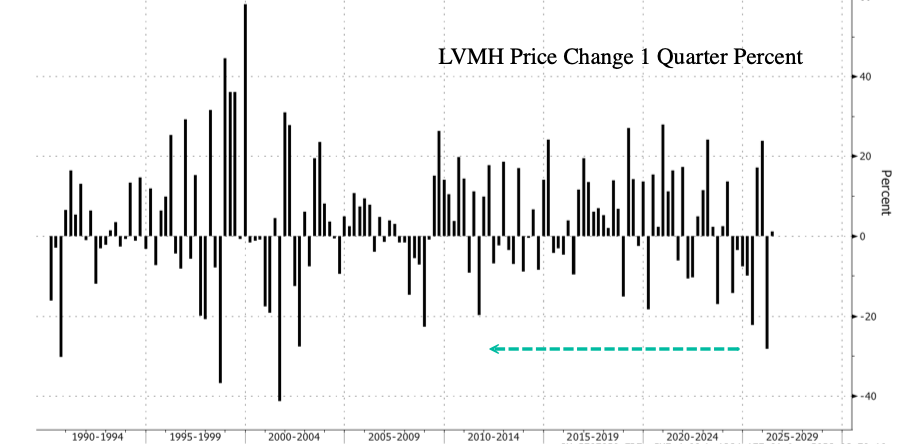
LVMH shares in Paris tumbled 28% in the first quarter, exceeding quarterly declines seen during Covid and the 2008 financial crisis, but not surpassing the 41% third-quarter decline in 2001. Peers Richemont fell 20%, and Hermès slid 25% in the quarter.

“Elevated global uncertainty has generated significant investor anxiety, particularly among those who had been anticipating a long-awaited recovery in luxury demand this year. This has driven a sharp sector de-rating across luxury,” UBS analyst Zuzanna Pusz wrote in a note for clients on Tuesday. 

Pusz said geopolitical uncertainty in the Middle East has largely driven de-rating across luxury stocks, leaving sector valuations roughly 15 percentage points below their long-term average relative to the broader market.

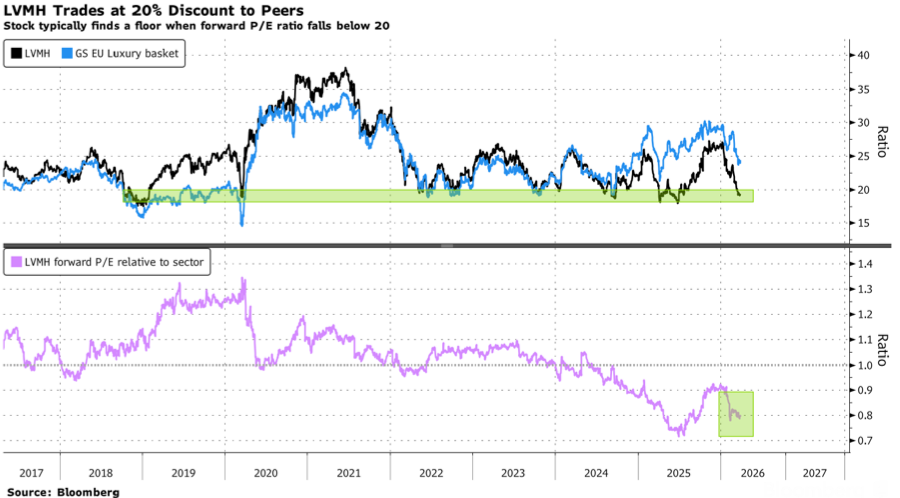
The selloff also reflects LVMH’s mounting problems: soft January guidance, greater exposure to more cash-strapped consumers, and continued weakness in its wines and spirits business, especially Hennessy. As a result, the stock now trades at a 20% discount to its peers.

Pusz noted that, despite the grim outlook for luxury, she has not yet seen clear evidence of a real demand slowdown, particularly in Asia, according to recent channel checks.

She added, “Against a backdrop of very negative market sentiment and depressed valuations, we think that even modest Q1 beats could be disproportionately rewarded. Fundamentally, we continue to expect sequential improvement for most companies, though selectivity remains critical. CFR and LVMH are our top picks.” 

The Goldman Sachs basket of European luxury stocks (GSXELUXG Index) appears to have found support at 2022 trading levels.

Meanwhile, LVMH CEO Bernard Arnault’s fortune has plummeted by $55.4 billion over the past quarter, the largest drop among the world’s 500 richest people.

LVMH has become more than a luxury stock, it’s now a barometer of global confidence,” John Plassard, head of investment strategy at Cité Gestion, said. “The issue is not the Middle East exposure itself, but what it signals: uncertainty, pressure on the wealth effect, and fear of a broader slowdown.”

Professional subscribers can read the full UBS “European Luxury” note here at our new Marketdesk.ai portal

Tyler Durden
Wed, 04/01/2026 – 07:45

via ZeroHedge News https://ift.tt/9Yh8pKM Tyler Durden

The “Good News” Is Always The Same: The Stock Market Is Up… Until It Isn’t

The “Good News” Is Always The Same: The Stock Market Is Up… Until It Isn’t

Authored by Charles Hugh Smith via OfTwoMinds blog,

Cloaking a fake “market” with artifice to maintain its asymmetrical distribution of wealth and income also cloaks its detachment from the real world.

I often refer to the dynamics of self-correction and self-liquidation. Systems that use feedback to rebalance extremes are self-correcting: rather than accelerate as they approach a cliff, they slow down and reorganize to avoid runaway self-reinforcing feedback (i.e. positive feedback), a.k.a. run to failure.

Some things are self-liquidating by design. A mortgage, for example, is intended to be self-liquidating: the monthly payments reduce and eventually extinguish the debt.

Other systems become self-liquidating when artifice becomes the “solution” for those seeking to lock the system down to maintain their share of the spoils. This is the inevitable consequence when a culture veers into the black-hole spiral of moral decay, where integrity is dissolved by maximizing self-interest by any means available.

Responding to real-world feedback threatens to reduce insiders’ share of the spoils, and to make sure this doesn’t happen, insiders steer the system away from the real world, creating an artificial, synthetic representation of the system that relies not on real-world feedback but on signals and symbolism that can be engineered to serve the interests of those holding the levers of power and influence.

To those benefiting from a system, corrective feedback is anathema because it reduces their share of the spoils. The “solution” is various forms of artifice that maintain the illusion that the system is stable and responsive to the interests of all, when in fact it’s been locked in a configuration that benefits the few at the expense of the many.

Self-serving artifice comes in many forms: the gaming of statistics to put lipstick on the real-world pig, the TACO Trade–announce some fabrication as a pending agreement with magical powers, virtue-signaling legislation that changes nothing in how the spoils are being distributed, grandiose claims of technological innovations–innovations that just happen to be owned by a handful of corporations–that will benefit everyone, and so on.

This substitution of artifice for authenticity relies heavily on signals and symbolism. Rather than attempt to manipulate all the complexities of the real-world economy, the stock market is now the signal for the entire economy: if stocks are going up, the economy is good.

This elevation of the stock market as the one true indicator rests on an entire universe of symbolic meanings and mythologies. The stock market is the invisible hand, the magic mechanism of price discovery, the engine of growth that rewards innovation and ingenuity while enriching us all with fabulous new technologies, the perpetual-motion device that makes America the greatest generator of prosperity in history, and so on.

Like all good cons, there is some truth buried beneath the hype. An unmanipulated market does indeed have the potential to reward innovation and ingenuity and generate widespread prosperity.

But the whole point of these mythologies is to cloak a manipulated market in the finery of an authentic market. This bewitchment is akin to the Emperor’s New Clothes: a fabrication, a tale, that takes on a life of its own as a mass delusion.

Cloaking a fake “market” with artifice to maintain its asymmetrical distribution of wealth and income also cloaks its detachment from the real world. This is how systems veer into Model Collapse and self-liquidation: the artificial representations, the reliance on easily faked signals and euphoria-inducing mythologies collapse once they collide with reality.

Which brings us to the present, where the stock market has become the economy, the driver of wealth and prosperity as the top 10% who own the majority of stocks can spend freely enough to employ the bottom 90% and pay the taxes needed to fund an out-of-control state sector that lavishes subsidies on every class to stave off a reckoning.

Here is reality: all credit-asset bubbles are inherently unstable and so they pop. While the timing isn’t predictable, the collapse of what is intrinsically self-liquidating is entirely predictable.

Here is the Emperor’s New Clothing version of mass delusion: the Everything Bubble is permanent and will never pop, and if it does, some agency with god-like powers will rush to the rescue.

But self-liquidating systems are not permanent. Their internal dynamics guarantee the end-game is extinguishment. Here is a projection of the Everything Bubble based on bubble symmetry and scale invariance: what goes up will come down on a similar trajectory.

That the Emperor is buck-naked should not surprise us, but awakening from mass delusion is by its very nature a stunning surprise.

These dynamics are drawn from my Revolution Trilogy.

*  *  *

My book Investing In Revolution is available at a 10% discount ($18 for the paperback, $24 for the hardcover and $8.95 for the ebook edition). Introduction (free)Check out my updated Books and FilmsBecome a $3/month patron of my work via patreon.comSubscribe to my Substack for free

Tyler Durden
Wed, 04/01/2026 – 07:20

via ZeroHedge News https://ift.tt/36y4lCe Tyler Durden

China’s Sci-Fi Boom Drives Record Revenue Growth

China’s Sci-Fi Boom Drives Record Revenue Growth

Public interest in science fiction is rapidly rising in China, alongside the country’s push toward technological advancement.

A new report says revenues hit a record in 2025 while related online searches surged by over 200%, according to the South China Morning Post.

According to data released at the China Science Fiction Convention and reported by Xinhua, total industry revenue reached 126.1 billion yuan (US$18.2 billion), marking a 15.7% year-on-year increase.

The report also noted expanding global influence for Chinese sci-fi intellectual property.

Video games continue to dominate the sector, contributing more than 60% of total earnings.

Sci-fi titles alone brought in 77.91 billion yuan and performed well internationally.

As Wu Yan put it, “Overall, sci-fi games still account for the lion’s share of the market.”

He added that younger audiences favor immersive, interactive formats, where games still outpace other media in both popularity and scale.

The SCMP writes that other segments are also growing. Sci-fi derivatives jumped 179.4% to 7.07 billion yuan, driven largely by original IP and new formats like AI-powered designer toys. Film and TV revenues rose 21.6% to 8.16 billion yuan, while literature generated 5.19 billion yuan.

The industry’s rise builds on earlier breakthroughs in the 2010s, when Liu Cixin’s The Three-Body Problem gained global recognition, followed by blockbuster adaptations like The Wandering Earth and its sequel.

Emerging trends include increased use of artificial intelligence in short- and mid-length video production, as well as growth in offline experiences. Wu noted, “Offline experience projects, such as sci-fi theme parks, have also been very attractive in recent years, similarly because of the first-hand experience [they provide].”

This momentum is reflected in sci-fi tourism, which grew 13.8% to 27.77 billion yuan, with theme parks remaining central. Meanwhile, a newly tracked segment—sci-fi technical equipment—generated 24.74 billion yuan in revenue.

Tyler Durden
Wed, 04/01/2026 – 06:55

via ZeroHedge News https://ift.tt/tU9WKDv Tyler Durden

America Has Gone More Than a Year Without a Surgeon General. Has Anyone Noticed?


Casey Means smiling with a red background | Casey Means

On Sunday, Jerome Adams, who served as surgeon general during President Donald Trump’s first term, publicly criticized Casey Means, Trump’s current nominee for the position. Adams pointed to her lack of an active medical license, her limited qualifications to lead the U.S. Public Health Service Commissioned Corps, and her views on vaccine safety and efficacy.

Later that day, Trump suggested he might withdraw the nomination and submit a different one. This follows an earlier false start: During the transition in late 2024, Trump nominated Jeanette Nesheiwat but pulled her nomination in May 2025 after critics pointed out discrepancies in her résumé.

In the meantime, Americans have gone over 430 days without a “nation’s doctor,” as the surgeon general is often called—and few, if any, have noticed. That should raise a more fundamental question: not who should serve as surgeon general, but whether we need one at all.

The surgeon general and the U.S. Public Health Service Commissioned Corps are vestiges of a bygone era—institutions that persist not because they are essential, but because they have never been seriously reconsidered. Today, federal public health activity is dominated by sprawling agencies like the Centers for Disease Control and Prevention (CDC) and the National Institutes of Health. The surgeon general’s role has diminished to mainly a national spokesperson, issuing advisories that are more symbolic than practical—and that can become a platform for unnecessary political and cultural conflicts.

The Commissioned Corps, for its part—formally led by the surgeon general, though ultimately overseen by the assistant secretary for health—maintains the trappings of a uniformed service but performs functions that largely overlap with those carried out by other federal, state, and local health agencies. However well-intentioned, they add another layer to an already crowded public health apparatus. The past 430 days have offered an unintentional experiment—and the results are telling: The system continues to function just fine without a surgeon general.

In a Cato Institute policy analysis, my colleagues and I examined the origins and evolution of the surgeon general’s office and the U.S. Public Health Service Commissioned Corps. These institutions trace their roots to the late–19th century Marine Hospital Service, when a centralized, uniformed medical service played a practical role in caring for merchant seamen and controlling the spread of infectious diseases at ports of entry. At the time, a national “chief physician” and a deployable medical corps made sense. But over the decades, as public health responsibilities expanded and were dispersed across a wide array of federal, state, and local agencies, those original functions were absorbed—and often superseded—by larger and more specialized institutions. What remains today is not a critical node in the public health system, but a legacy structure whose original purpose has long since been overtaken.

As we documented in that analysis, the redundancy isn’t theoretical—it shows up in how the system actually operates. The surgeon general no longer exercises meaningful public health authority; those responsibilities have been absorbed by agencies like the CDC and the Food and Drug Administration, leaving the office largely as a platform for issuing advisories. Meanwhile, the roughly 6,000-member Public Health Service Commissioned Corps is spread across the federal bureaucracy, often in roles only loosely connected to public health and frequently duplicating work performed by civilian employees. 

The result is a system with overlapping roles, diffused accountability, and higher costs—government estimates suggest Corps officers can cost more than comparable civilian staff, and a Department of Health and Human Services analysis has estimated that eliminating the Commissioned Corps could reduce personnel costs by roughly 15 percent—without delivering anything that couldn’t be handled more directly through existing agencies. As a uniformed service, Corps officers also receive many of the same benefits as members of the armed forces, including veterans’ benefits, adding more to the taxpayer burden.

And the office itself is hardly indispensable. President Lyndon Johnson effectively eliminated the position during his administration. Unfortunately, in 1979 the breakup of the Department of Health, Education, and Welfare into the Department of Health and Human Services and the Department of Education caused the position’s resurrection. That history makes something clear: The surgeon general is not a cornerstone of the public health system; it’s a legacy position that persists largely because no one has seriously asked whether it still needs to exist.

None of this is to question the dedication of the professionals who have served as surgeon general or in the Commissioned Corps. But public institutions should not exist simply because they always have. The past 430-plus days have provided an unintentional test, and the results are hard to ignore: The system continues to function without a surgeon general, and the Corps’ responsibilities can be absorbed by existing agencies or performed more efficiently through civilian hiring. Rather than restarting a debate over who should fill these roles, Congress and the White House should ask a more practical question: Do these positions still need to exist at all?

The post America Has Gone More Than a Year Without a Surgeon General. Has Anyone Noticed? appeared first on Reason.com.

from Latest – Reason.com https://ift.tt/gYQI96q
via IFTTT

On the Original Legal Meaning of “Subject to the Jurisdiction Thereof”

There has been some originalist debate of late about the proper reading of the Citizenship Clause of the Fourteenth Amendment. The fate of the Trump administration’s executive order excluding new categories of individuals from birthright citizenship depends to a significant degree on whether there is any historical support for the revisionist interpretation of the constitutional text. The Supreme Court is hearing oral arguments on this issue today.

One recent suggestion in support of a restrictionist reading of the Citizenship Clause is that the requirement that individuals be both born within the United States and “subject to the jurisdiction” of the United States should be understood to have an allegiance component. This “allegiance-based” reading of “subject to the jurisdiction” is said to better capture the original meaning of Fourteenth Amendment. If the allegiance-based theory is correct then the longstanding understanding of the constitutional text is wrong and the administration’s executive order is somewhat more plausibly consistent with the Constitution — and a large number of people should not properly be regarded as natural-born citizens of the United States.

In a new paper, I examine, along with a co-author (James Heilpern), whether “subject to the jurisdiction” would have had a familiar legal meaning to lawyers in the mid-nineteenth century, and if so what that original public meaning might have been. A comprehensive survey of judicial opinions, statutes, treaties, legislative debates, and legal treatises provides a clear answer to this question. These were commonly used terms with a well-known meaning in 1866 when the Fourteenth Amendment was drafted.

As a piece of legal text, “subject to the jurisdiction” was neither ambiguous nor obscure. Its meaning would have been straightforward and familiar in the community of legal interpreters charged with understanding and implementing the constitutional text, not to mention the draftsmen who incorporated this language into the Constitution.

The original public meaning of the phrase “subject to the jurisdiction” of the United States simply meant land, people, and objects within the governing authority of the United States and placed under its laws and judicial proceedings. Such jurisdiction was frequently shared and concurrent such that individuals could simultaneously be subject to the governing authority of the United States and to some other governmental power. Such jurisdiction could be triggered by a variety of factors, but the most common was simple presence within the territory governed by the United States. An individual’s allegiance to the United States might well trigger extraterritorial jurisdiction when such an individual was abroad and outside the territorial jurisdiction of the United States, but allegiance was never a necessary condition to making one subject to the jurisdiction of the United States.

There are, of course, complexities about how such a legal rule might apply in particular situations, and lawyers sometimes disagreed about particular applications then as they would now. It is also possible that the drafters of the Fourteenth Amendment chose to use this conventional legal language in a very unconventional way and meant something unusual and surprising by this phrase. This paper does not explore the implications of this legal rule for Trump’s executive order and does not examine the evidence for an unconventional usage in this particular case. The paper does, however, demonstrate that the 39th Congress that drafted the Fourteenth Amendment routinely used this legal language in the conventional way in other contexts.

American lawyers in 1866 would have known what “subject to the jurisdiction” of the United States meant. That original public meaning of this piece of lawyerly text is consistent with the conventional understanding of that text. The original public meaning will not be helpful to the Trump administration’s case.

The new paper — “Subject to the Jurisdiction” as Legal Text — can be found here.

The post On the Original Legal Meaning of "Subject to the Jurisdiction Thereof" appeared first on Reason.com.

from Latest – Reason.com https://ift.tt/GhYeKL5
via IFTTT

America Has Gone More Than a Year Without a Surgeon General. Has Anyone Noticed?


Casey Means smiling with a red background | Casey Means

On Sunday, Jerome Adams, who served as surgeon general during President Donald Trump’s first term, publicly criticized Casey Means, Trump’s current nominee for the position. Adams pointed to her lack of an active medical license, her limited qualifications to lead the U.S. Public Health Service Commissioned Corps, and her views on vaccine safety and efficacy.

Later that day, Trump suggested he might withdraw the nomination and submit a different one. This follows an earlier false start: During the transition in late 2024, Trump nominated Jeanette Nesheiwat but pulled her nomination in May 2025 after critics pointed out discrepancies in her résumé.

In the meantime, Americans have gone over 430 days without a “nation’s doctor,” as the surgeon general is often called—and few, if any, have noticed. That should raise a more fundamental question: not who should serve as surgeon general, but whether we need one at all.

The surgeon general and the U.S. Public Health Service Commissioned Corps are vestiges of a bygone era—institutions that persist not because they are essential, but because they have never been seriously reconsidered. Today, federal public health activity is dominated by sprawling agencies like the Centers for Disease Control and Prevention (CDC) and the National Institutes of Health. The surgeon general’s role has diminished to mainly a national spokesperson, issuing advisories that are more symbolic than practical—and that can become a platform for unnecessary political and cultural conflicts.

The Commissioned Corps, for its part—formally led by the surgeon general, though ultimately overseen by the assistant secretary for health—maintains the trappings of a uniformed service but performs functions that largely overlap with those carried out by other federal, state, and local health agencies. However well-intentioned, they add another layer to an already crowded public health apparatus. The past 430 days have offered an unintentional experiment—and the results are telling: The system continues to function just fine without a surgeon general.

In a Cato Institute policy analysis, my colleagues and I examined the origins and evolution of the surgeon general’s office and the U.S. Public Health Service Commissioned Corps. These institutions trace their roots to the late–19th century Marine Hospital Service, when a centralized, uniformed medical service played a practical role in caring for merchant seamen and controlling the spread of infectious diseases at ports of entry. At the time, a national “chief physician” and a deployable medical corps made sense. But over the decades, as public health responsibilities expanded and were dispersed across a wide array of federal, state, and local agencies, those original functions were absorbed—and often superseded—by larger and more specialized institutions. What remains today is not a critical node in the public health system, but a legacy structure whose original purpose has long since been overtaken.

As we documented in that analysis, the redundancy isn’t theoretical—it shows up in how the system actually operates. The surgeon general no longer exercises meaningful public health authority; those responsibilities have been absorbed by agencies like the CDC and the Food and Drug Administration, leaving the office largely as a platform for issuing advisories. Meanwhile, the roughly 6,000-member Public Health Service Commissioned Corps is spread across the federal bureaucracy, often in roles only loosely connected to public health and frequently duplicating work performed by civilian employees. 

The result is a system with overlapping roles, diffused accountability, and higher costs—government estimates suggest Corps officers can cost more than comparable civilian staff, and a Department of Health and Human Services analysis has estimated that eliminating the Commissioned Corps could reduce personnel costs by roughly 15 percent—without delivering anything that couldn’t be handled more directly through existing agencies. As a uniformed service, Corps officers also receive many of the same benefits as members of the armed forces, including veterans’ benefits, adding more to the taxpayer burden.

And the office itself is hardly indispensable. President Lyndon Johnson effectively eliminated the position during his administration. Unfortunately, in 1979 the breakup of the Department of Health, Education, and Welfare into the Department of Health and Human Services and the Department of Education caused the position’s resurrection. That history makes something clear: The surgeon general is not a cornerstone of the public health system; it’s a legacy position that persists largely because no one has seriously asked whether it still needs to exist.

None of this is to question the dedication of the professionals who have served as surgeon general or in the Commissioned Corps. But public institutions should not exist simply because they always have. The past 430-plus days have provided an unintentional test, and the results are hard to ignore: The system continues to function without a surgeon general, and the Corps’ responsibilities can be absorbed by existing agencies or performed more efficiently through civilian hiring. Rather than restarting a debate over who should fill these roles, Congress and the White House should ask a more practical question: Do these positions still need to exist at all?

The post America Has Gone More Than a Year Without a Surgeon General. Has Anyone Noticed? appeared first on Reason.com.

from Latest – Reason.com https://ift.tt/gYQI96q
via IFTTT