Israel Says Preparing For Escalation With Iran, Didn’t Know Deal Was Close: ‘Series Of Targets Ready’

Israel Says Preparing For Escalation With Iran, Didn’t Know Deal Was Close: ‘Series Of Targets Ready’

Wednesday saw yet another early morning Axios ‘scoop’ that within hours of being issued proved premature and too out front, given talk of Iran and the US being ‘close’ to a deal was quickly denied by Tehran and even President Trump quickly acknowledged it’s “too soon” to plan peace talks with Iran.

But the headline of “US and Iran closing in on one-page memo to end war” was enough to raise alarm bells in Israel, which has insisted that the conflict must end with a nuclear-free Iran.

Maj. Gen. Eyal Zamir, via IDF/TOI

“Israel was unaware that US President Donald Trump was close to reaching an agreement with Iran to end the fighting and open the Strait of Hormuz,” an Israeli official told Army Radio soon after the optimistic peace deal headlines went international.

“We were preparing for an escalation,” the official said. Indeed the last couple weeks of stalled Pakistan-mediated talks have seen several reports out of Israel saying the Netanyahu government is waiting for the ‘green light’ from Washington to renew the aerial bombing campaign, which took place over prior 38 days as part of Operation Epic Fury.

But as of Tuesday Secretary of State Marco Rubio announced that Epic Fury was ending, and that Project Freedom – to open the Strait of Hormuz – is the new focus. But even after that President Trump in the evening announced a ‘pause’ to allow negotiations to proceed.

So there has been much confusion and contradictory signaling out of Washington to say the least. Tehran has meanwhile made clear its “finger is on the trigger” – but Israel is also saying the same thing.

For example, IDF Chief of Staff Lt. Gen. Eyal Zamir on Wednesday made it known that military has a “series of targets” ready to strike in Iran at the moment the war resumes.

“Cooperation with the United States military and coordination continue at all times, and we are monitoring the situation,” he stated during a visit to southern Lebanon, where Israel ground forces are occupying territory.

“In Iran, we have a further series of targets ready for attack. We are on high alert to return to an intense and broad campaign that will allow us to deepen our achievements and further weaken the Iranian regime,” Zamir said further.

As for anti-Hezbollah operations, and despite the Lebanon ceasefire officially in effect, the top military general said: “We will seize every opportunity to deepen the blow to Hezbollah and its continued weakening.”

None of this bodes well for a lasting ceasefire in Lebanon, also as the broader Iran ceasefire is certainly on shaky ground, given this week’s cross-Gulf attacks on UAE out of the Islamic Republic.

Tyler Durden
Wed, 05/06/2026 – 10:15

via ZeroHedge News https://ift.tt/OXSLmCI Tyler Durden

U.S. Gasoline Tops $4.50 As “Shock & Awe” Level Approaches

U.S. Gasoline Tops $4.50 As “Shock & Awe” Level Approaches

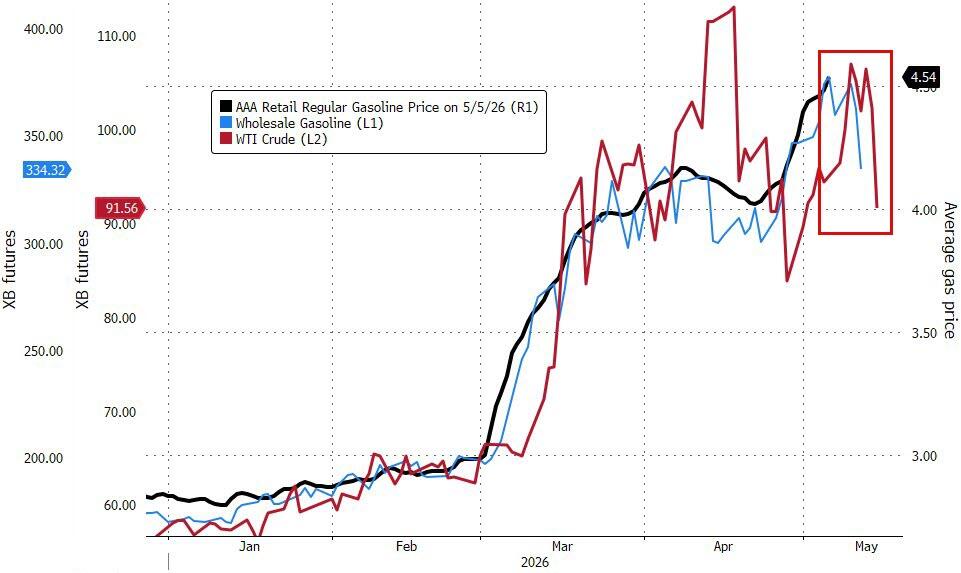
WTI futures plunged more than 11% to the $90-a-barrel level after Axios reported earlier this morning that the U.S. is nearing a preliminary agreement with Iran to end the war. The sharp decline suggests traders are beginning to price in a potential geopolitical de-escalation and the potential reopening of the Hormuz chokepoint.

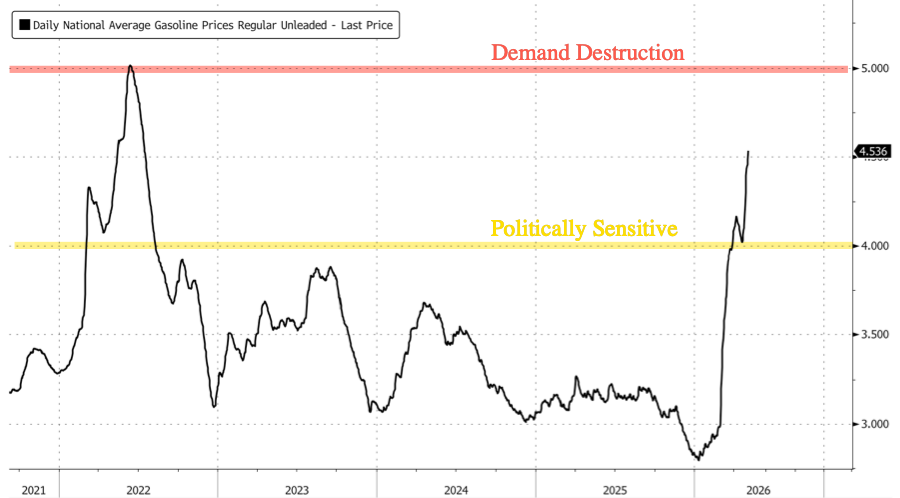
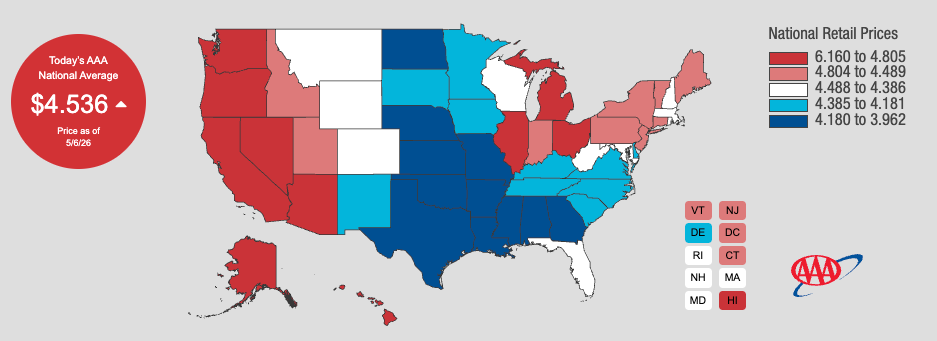
At the pump, however, the latest AAA data as of Wednesday morning show that the national average for regular 87-octane gasoline has climbed to $4.50 a gallon, the highest level since July 2022.

There will be a lag. Even if the Trump administration and Tehran formalize a deal in the near term, the immediate result will not be a collapse in gas and diesel pump prices, but rather an approaching peak.

Lower crude prices typically take a few weeks to work through wholesale markets, inventories, distribution networks, and retail outlets before meaningful declines in gas and diesel are visible at pump stations to consumers.

During a Monday press conference, Trump said he expects the price of gasoline to drop “substantially” following the end of the US-Iran war.

“I see it going down very substantially when this is over, I think very rapidly too, at levels that you’ve never seen because there’s a lot of energy out there, ships all over the world that are loaded up with it,” Trump said.

“They can’t do much with it because they got kidnapped by a pretty evil place. But we’re taking care of it.”

Last week, Trump said pump prices would “come crashing down as soon as this war is over.”

GasBuddy analyst Patrick De Haan warned that the $5-a-gallon threshold is typically the “shock and awe” level that triggers demand destruction.

With the national average for gas already near $4.50 a gallon, and California prices above $6, the political and consumer pressure backdrop for the Trump administration has intensified in recent weeks.

The administration now appears to be pushing hard for a near-term Iran resolution ahead of Memorial Day weekend, one of the largest U.S. driving periods of the year after Thanksgiving.

Tyler Durden
Wed, 05/06/2026 – 09:40

via ZeroHedge News https://ift.tt/AyUMKr4 Tyler Durden

Treasury Refunding: No Changes To Auction Sizes; Bessent Keeps “At Least” In Forward Guidance

Treasury Refunding: No Changes To Auction Sizes; Bessent Keeps “At Least” In Forward Guidance

In our preview to this morning‘s Quarterly Refunding Statement, we said that we do not expect major changes and that, at most, the treasury might adjust its statement language to soften the forward guidance on possibly futures increase in coupon auction sizes with one likely change would be dropping “at least” while retaining the expectation for unchanged coupon sizes over “the next several quarters” (recall Deutsche Bank said it expects nominal coupon increases beginning in February 2027). 

Overnight, JPMorgan agreed, writing that while the current auction calendar will leave Treasury well financed through FY27, “we do not think it will be adequate to meet the widening funding gap from FY27 and onward, and we continue to project a series of coupon auction increases beginning in February 2027.” Accordingly, like DB, JPM also expected the Treasury to remove “at least” from the statement that “Treasury anticipates maintaining nominal coupon and FRN auction sizes for at least the next several quarters.” The bank said that If its expectations are realized, “we think this could push intermediate yields higher.”

Well, moments ago the Treasury published its latest Quarterly Refunding Announcement, and contrary to prevailing expectations, it refused to make even a gentle hint at rising coupon sizes by keeping the “at least” language from the abovementioned statement, instead keeping it as is, or rather as was: 

Based on current projected borrowing needs, Treasury anticipates maintaining nominal coupon and FRN auction sizes for at least the next several quarters

In other words, the US Treasury signaled again that it’s still comfortable using Yellen’s Activist Treasury Issuance playbook to issue Bills, and not increase coupon issuance, to meet escalating government borrowing needs, even as warnings emerge about the strategy’s risks.

Ahead of the QRA, dealers were divided heading into the so-called quarterly refunding release on whether it might alter its guidance. Outsize US fiscal deficits make an expansion in longer-dated auctions practically inevitable at some stage. The department on Monday boosted its estimate for net borrowing this quarter amid lower net cash flows.

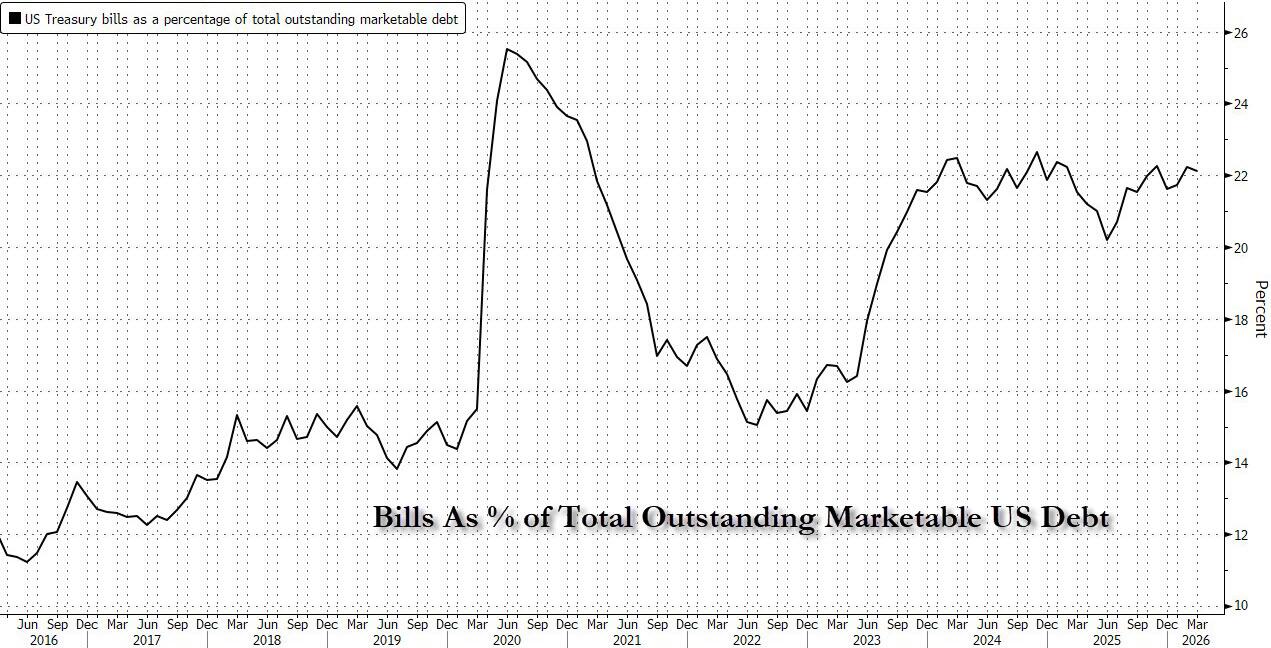
US debt managers have been using the same forward guidance since early 2024, in a policy that’s steadily boosted the share of bills of total debt outstanding (to roughly 22% from 14% before covid). The International Monetary Fund cautioned last month that this leaves federal debt costs more vulnerable to sudden swings in rates and shifts in sentiment, because auctions are more frequent.

And sure enough, with no changes to the forward guidance:

  • *TREASURY YIELDS EDGE LOWER AFTER UNCHANGED GUIDANCE ON AUCTIONS

The rest of the statement was also in line with expectations, with the Treasury stating “it believes its current auction sizes leave it well positioned to address potential changes to the fiscal outlook and to the size and composition of the SOMA portfolio.” It added that it was monitoring SOMA purchases of Treasury bills and growing demand for Treasury bills from the private sector.  And, as before, looking ahead the treasury continues to evaluate potential future increases to nominal coupon and FRN auction sizes, with a focus on trends in structural demand and potential costs and risks of various issuance profiles. 

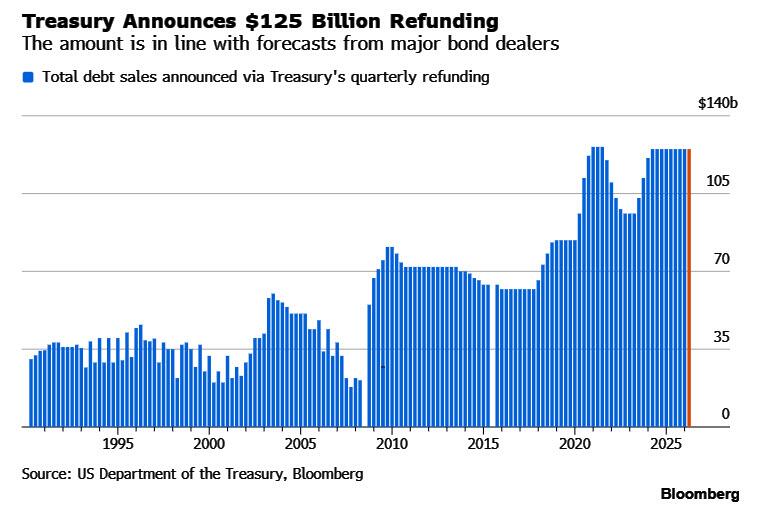
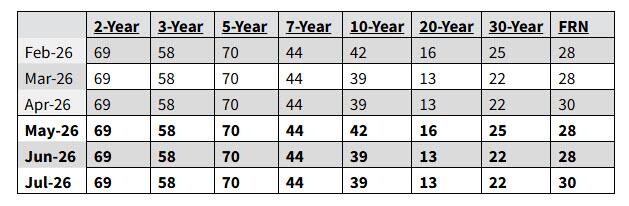
Looking at the actual refunding auctions next, the Treasury’s refunding debt sales will total $125 billion, unchanged from the sum unveiled in February and in line with the expectations of Wall Street bond dealers.

Treasury also maintained guidance on coupon sizes for the coming quarters. Refunding issuance to raise new cash of approximately $41.7BN (offering $125BN to refund $83.3BN).

  • Treasury to sell $58bn of 3-year notes on May 11
  • Treasury to sell $42bn of 10-year notes on May 12
  • Treasury to sell $25bn of 30-year bonds on May 13

The table below presents the actual auction sizes for the February to April 2026 quarter and the anticipated auction sizes for the May to July 2026 quarter: 

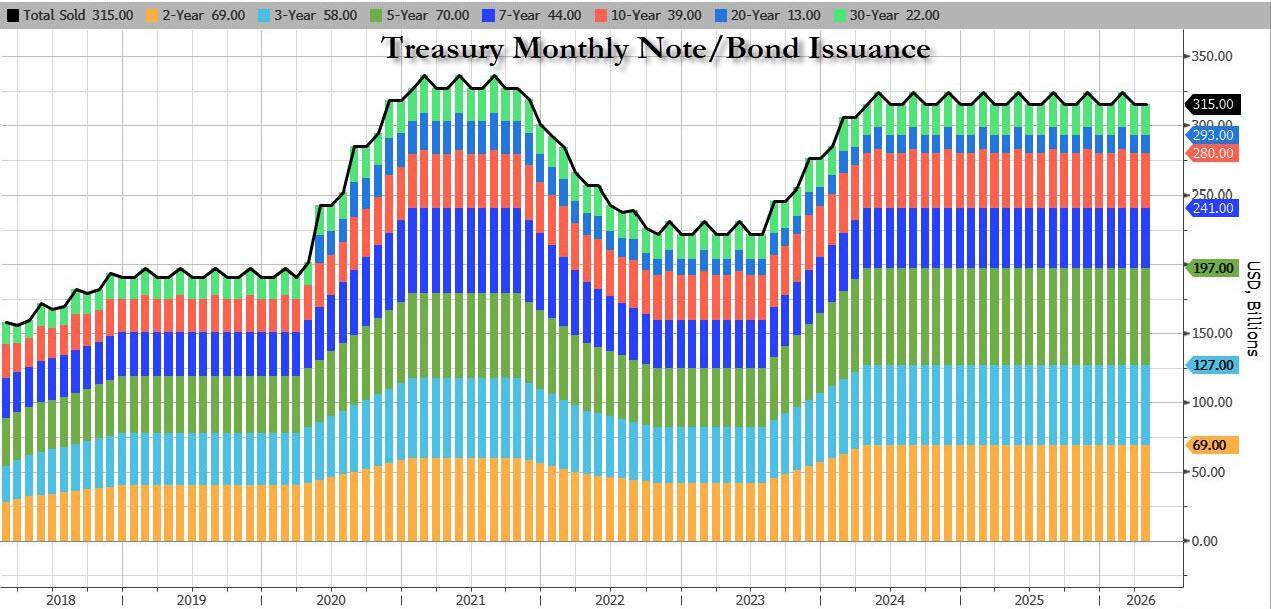
The total compares to a peak of $126BN first reached in Feb. 2021; auction sizes across the curve began rising in 2018 to finance tax cuts and surged in 2020 to finance the federal pandemic response, and to give the Fed’s QE X securities to buy.

Here are some other highlights from the Refunding report: 

Bills

  • Treasury expects to further increase offering sizes of shorter-dated benchmark bills over the coming weeks and, in late-May, anticipates issuing a short-dated CMB to meet the peak liquidity needs at the end of May due to maturing coupon securities.
  • Given projections for receipts associated with the mid-month corporate and non-withheld tax date, Treasury expects to implement modest reductions to short-dated bill auction sizes during the month of June. 
  • Thereafter, in July, Treasury anticipates incrementally increasing bill auction sizes across the curve.  As always, Treasury will continue to evaluate near-term borrowing needs and assess additional adjustments to bill auction sizes as appropriate

TIPS

  • Treasury plans to maintain the 10-year TIPS reopening this May at $19 billion; the five-year TIPS reopening in June at $24 billion; and the 10-year TIPS new issue at $21 billion in July

20-year

  • Treasury is modifying settlement timing for 20-year bond reopening auctions.
  • From the reopening auction scheduled for June 16th, 20-year reopening auctions will settle on the Friday of the auction week, while new issues will continue to settle at month end.

Buybacks (lowers cash management buybacks in 1mth-2-year, maintains liquidity support buybacks)

  • Expects to purchase up to USD 38bln in off-the-run securities across buckets for liquidity support (unchanged) and up to USD 25bln in the 1-month to 2-year maturity bucket for cash management purposes (prev. USD 75bln in Q1).

Cash Balance

  • Treasury is assuming a $900 billion cash balance at the end of June.
  • Treasury estimates that the size of the Treasury General Account (TGA) could peak at $1 trillion (plus or minus $50 billion) in late July.  This figure is consistent with Treasury’s long-standing cash balance policy and is driven by the large outflows expected to occur at that time. 

TBAC Minutes

  • Director Pietrangeli says while current issuance sizes are adequate to cover expected borrowing needs for the remainder of FY2026 (prev. Treasury is slightly overfunded in FY2026)
  • The median primary dealer forecast for privately-held net marketable borrowing implies a USD 1.3tln funding shortfall in FY2027-28 based on current coupon auction sizes and bill supply (prev. saw USD 1.1trln).
  • Debt Manager Jensen says dealers generally anticipate that nominal coupon auction sizes might next increase in early CY2027 (prev. late CY 2026 or CY early 2027), and expect Treasury to modify its forward guidance several quarters ahead of such a change.
  • The TBACCommittee unanimously recommended that Treasury maintain nominal coupon, FRN, and TIPS auction sizes at current levels
  • TBAC continues to believe that increases in coupon issuance could be warranted in FY2027 and discussed potential changes to the forward guidance for Treasury to consider
  • Committee had a “healthy debate” whether Treasury should consider investing excess cash in the overnight Treasury repo market to generate investment returns while “maintaining prudent risk management and avoiding market disruptions”
    • Key design choices mentioned by Committee members include the time of day that Treasury deploys cash into the repo market, the specific market segment that Treasury would invest in (e.g., triparty, centrally cleared), and Treasury’s required return
    • Presenter stressed that the economic viability of investing in the repo market is dependent on the spread between the rate Treasury earns on repo investments and the Federal Reserve’s interest on reserve balances rate (IORB)
    • Committee agreed that while there are potential economic returns from such investments, their size and economic viability depend on the market environment and monetary policy, and that additional study is warranted regarding operational and implementation considerations
  • Committee discussed the expansion of central clearing in Treasury securities market and the presenter reviewed key areas of progress by both the industry and regulators since the extension of the implementation deadlines, noting the recent increase in central clearing activity
  • Presenter highlighted recent requests for exemptions related to certain inter-affiliate and extraterritorial transactions as key outstanding issues to resolve
  • Presenter concluded that, although the industry has made steady progress, some operational and implementation challenges remain as the market transitions to expanded central clearing

Tyler Durden
Wed, 05/06/2026 – 09:24

via ZeroHedge News https://ift.tt/jJxAXmv Tyler Durden

NANO Nuclear Soars On Strategic MOU With Supermicro For Powering AI Data Centers 

NANO Nuclear Soars On Strategic MOU With Supermicro For Powering AI Data Centers 

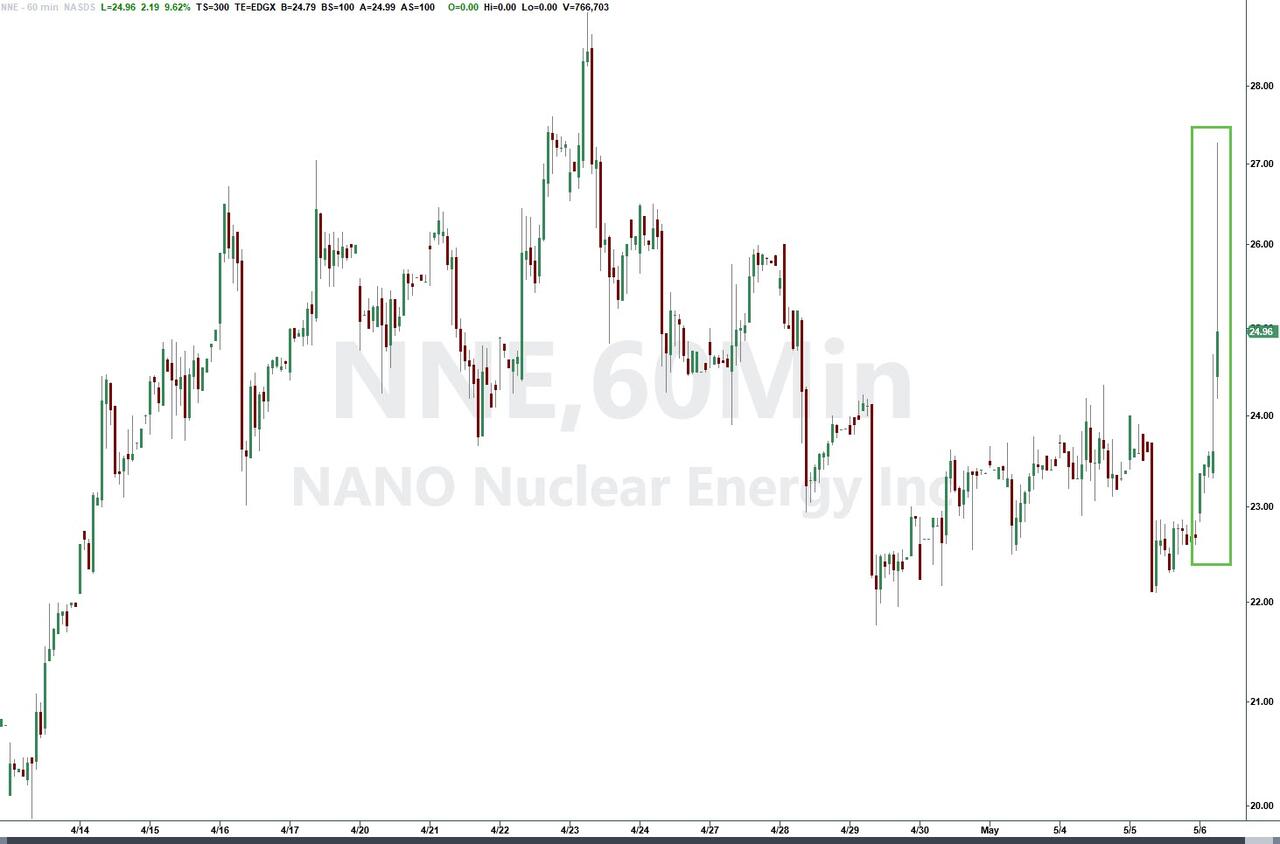
NANO Nuclear and Supermicro have agreed to explore the integration of NANO’s KRONOS microreactor system with Supermicro’s AI server and data center platforms for scalable nuclear-powered solutions. The news of the strategic collaboration – a critical moment in the integration of alternative energy source within the AI rollout – sent the stock soaring in pre-market

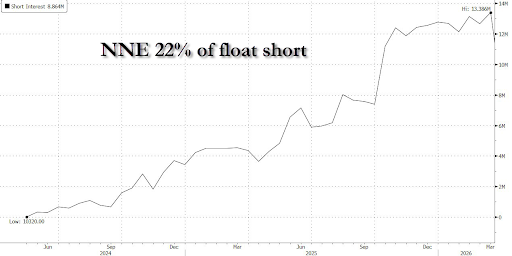
We anticipate the shorts are also taking notice with over 22% of shares loaned out

“The AI revolution is fundamentally an energy challenge,” said Jay Yu, Chairman and President of NANO Nuclear, “and we believe nuclear power is the only scalable solution capable of meeting that demand.”

Through this MOU, NANO Nuclear and Supermicro will explore opportunities to:

  • Deploy NANO Nuclear’s microreactors to provide dedicated, on-site nuclear power for data centers.
  • Integrate Supermicro’s AI server racks, cooling systems, and infrastructure with nuclear-powered energy solutions.
  • Develop joint go-to-market strategies for hyperscale, enterprise, and edge data center customers.
  • Enable a new class of self-powered, grid-independent AI infrastructure.

“This is exactly where the future is heading compute and power becoming a unified solution,” said James Walker, Chief Executive Officer of NANO Nuclear. “By aligning with Supermicro, NANO Nuclear is stepping directly into the center of one of the fastest growing and most capital-intensive markets in the world.”

By partnering with Supermicro, NANO Nuclear gains direct alignment with a company at the forefront of the AI infrastructure buildout, providing:

  • Access to global data center customers and hyperscale operators.
  • Integration pathways with state-of-the-art AI hardware ecosystems.
  • A channel into one of the fastest-growing sectors of the global economy.

NANO is able to lean into their significant progress of deploying a KRONOS microreactor at the University of Illinois. The company recently submitted their construction permit application for the project and is well into the site preparation phase.

The company has also made strides with new partnerships in the Asian market, and has an agreement with BaRupOn for up to 1 GW of KRONOS microreactors for a data center campus in Texas. 

Tyler Durden
Wed, 05/06/2026 – 09:00

via ZeroHedge News https://ift.tt/IwG5BT8 Tyler Durden

OpenAI Co-Founder Greg Brockman Defends Company’s For-Profit Pivot… And His Own $30 Billion Payday

OpenAI Co-Founder Greg Brockman Defends Company’s For-Profit Pivot… And His Own $30 Billion Payday

Authored by Beige Luciano-Adams via The Epoch Times,

In the second week of a high-profile jury trial that could have profound impact on the race for artificial intelligence, OpenAI president Greg Brockman rejected allegations that he and other co-founders betrayed the company’s philanthropic mission and illegally enriched themselves by flipping the non-profit lab into a for-profit corporation.
Tesla CEO Elon Musk in 2024 sued Brockman and CEO Sam Altman, alleging they bilked him of $38 million in donations then restructured as a for-profit corporation by exclusively licensing their flagship product to Microsoft—betraying a founding mission to operate as an open-source charity that would counter the risks of profit-driven AI.

OpenAI and Microsoft deny the allegations, arguing that Musk abandoned the company in 2018 to start his own for-profit competitor, xAI, when other founders rejected his bid to take full control of the operation.

“I think we’ve been very consistent on the mission,” Brockman told a federal court in Oakland.

“If you look at what we’ve accomplished—currently the foundation has $150 billion worth of OpenAI equity value. That’s something we’ve built through hard blood, sweat, and tears through all this time since Elon left.”

The company’s nonprofit foundation has a 27 percent stake in OpenAI’s for-profit corporation; Microsoft, which has invested more than $13 billion since 2019, owns 26 percent.

Called as an adverse witness for the plaintiff, Brockman over two days May 4–5 offered testimony outlining an alternate narrative and timeframe than the one Musk presented the week prior.

Brockman also attempted to add context to what he has claimed were “cherrypicked” segments of his personal diary, unsealed during the discovery process.

He often spoke in incomplete sentences, punctuated by stock phrases like, “We were solving for the mission.”

Arguably, this had less zing to it than, “You can’t just steal a charity”—a phrase Musk favored in his own testimony.

‘Morally Bankrupt’

Musk’s attorney Steven Molo grilled Brockman on a series of diary entries from 2017 and 2018, a time of intense negotiations with Musk over the future structure of the company.

In one from 2017, Brockman muses, “It’d be wrong to steal the nonprofit from [Musk] and turn it into a B-Corp without him—doing so would be pretty morally bankrupt.”

Brockman denied this contradicted his commitment to OpenAI’s mission. “I think I meant it would actually serve the mission, but it would be hard to look at yourself in the mirror,” he told the court.

Under cross-examination, he explained he was referring to the idea of voting Musk off the board of directors, which he had considered at the time.

“It had been made clear to us,” he said, “that if we didn’t come to [Musk’s] terms, he was going to start an AGI competitor.”

Artificial General Intelligence (AGI) is the hypothetical point at which digital intelligence reaches or surpasses human cognitive abilities and can operate autonomously.

Some, including Musk, believe we have already achieved an early version of it, and that AGI advancement in the wrong hands poses the greatest existential threat to humanity. Musk testified that this threat was the express motivation for creating OpenAI as an open-source, nonprofit lab.

From late 2017 to early 2018, Musk, Altman, Brockman, and Ilya Sutskever, another OpenAI co-founder and its former chief scientist, floated various ideas as they debated how to fund the project at a competitive level.

Musk, the main donor, rejected an even equity split among the four co-founders, instead proposing a deal that would give him majority stake, to be diluted as more investors joined.

Brockman said he and Sutskever were willing to accept Musk being CEO and having a majority stake. “But the one thing we could not accept was to hand him unilateral total control over the AGI.”

Musk was the wrong man for the job, according to Brockman.

“Look, he knows rockets, he knows electric cars, he did not and I believe does not know AI,” Brockman said of the Tesla and SpaceX CEO.

“And Ilya and I did not think he was going to spend the time required to actually get good at it.”

Brockman alleged Musk “didn’t recognize that spark” in early language models underlying the GPT technology. “It was there, a working version, we could see the promise. … We really needed someone running the company that had that effect.”

Molo pressed the witness, pointing to emails from Musk proposing a 16-person board for the new corporation, in which Musk would have a 25 percent influence.

“This is the man you’re saying wanted to be the AI tyrant and have absolute and total control?” Molo probed.

“He wanted a board, and conducted in a way you were not familiar with because you didn’t have the experience of corporate governance, did you?”

Brockman acknowledged, “Definitely, this is something I was new to,” but maintained that there was never a real plan for Musk to relinquish control.

In a January 2018 email to Musk and others, Brockman stressed that a moral high ground was “our best tool,” and to maintain it, the company should endeavor to remain a nonprofit. “AI is going to shake up the fabric of society, and our fiduciary duty should be to humanity.”

But back in November 2017, Molo pointed out that Brockman’s diary entries show he was worried about how it would look if the founders continued to say they were committed to a nonprofit while planning to convert to a for-profit.

“Cannot say that we are committed to the nonprofit. Don’t wanna say that we’re committed. If three months later we’re doing b-corp then it was a lie,” Brockman wrote. “Can’t see us turning this into a for-profit without a very nasty fight.”

When Musk issued an ultimatum in 2018 to “either go do something on your own or continue with OpenAI as a nonprofit,” Brockman said he was “devastated.”

“It felt like we were so close to something that could actually succeed at the mission … and it was all blown up.”

$30 Billion Question

Molo accused Brockman of plotting to use OpenAI to become a billionaire, this time referencing journal entries made six days after he’d told Musk he wanted to continue to fundraise for the nonprofit, in which he asks, “What will take me to $1 billion?”

“There’s a lot of context here,” Brockman said. “It was expression of a frustration, not a plan.”

He described it as a “fork in the road,” where he would either accept Musk’s terms or part ways with him.

The road without Musk led Brockman to a $30-billion equity stake in OpenAI’s for-profit corporation. But Brockman said it was not about the money: “I think I’d be happy with either of those routes,” he said in court.

Molo pounced. Why then, if he was “good with a billion,” would Brockman not donate the extra $29 billion to the nonprofit to which he had a fiduciary duty?

“That was really about picking between these two roads … which one will I actually be happy with? … Feel enthusiastic getting out of bed, and do [sic] the work every day?” Brockman said.

“It takes $30 billion to get you out of bed in the morning, but $1 billion doesn’t get you out of bed?” Molo asked. “You had a fiduciary duty. … You took the assets from the nonprofit, you moved them into the for-profit to create this money-making machine that resulted in you having $30 billion.”

Implying that he raided the charity to enrich himself was “a deep mischaracterization,” Brockman said.

Molo also grilled Brockman on a commitment he made to donate $100,000 to the nonprofit but never delivered—and on billions in deals that OpenAI has secured with at least three other companies in which Brockman has an ownership stake.

The plaintiff’s attorney also highlighted a 2017 “side deal” in which Altman gave Brockman around $10 million of equity in the company holding assets of his personal family office.

When pressed, Brockman said he didn’t conceal this from Musk.

“Elon’s time was relatively hard to get, there were a lot of decisions to make that we weren’t able to broadcast to him,” he told the jury.

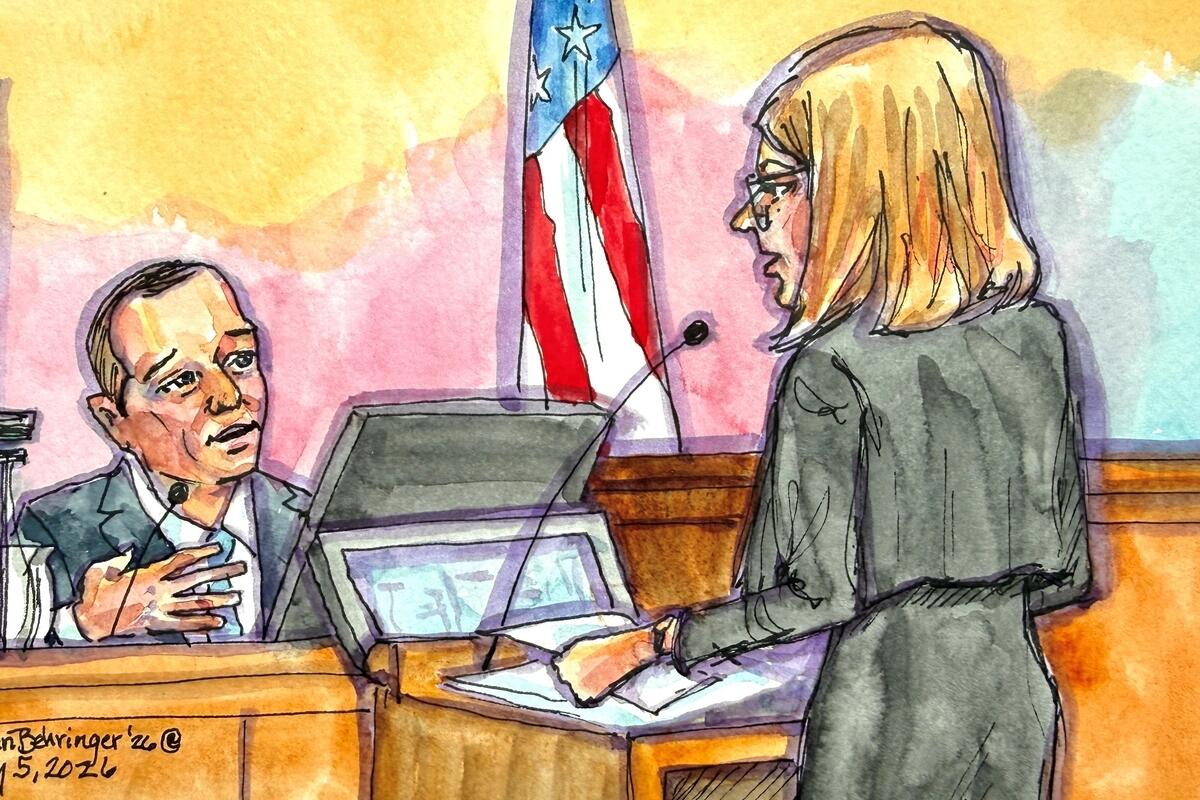
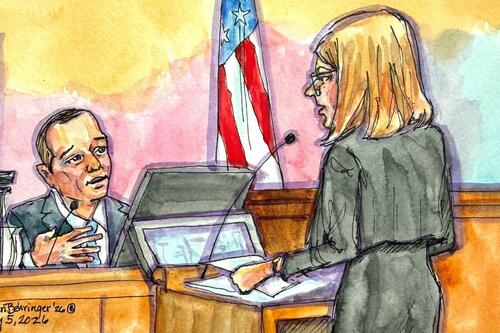
Sam Altman listens as OpenAI President Greg Brockman testifies during Elon Musk’s lawsuit trial over OpenAI’s for-profit conversion before U.S. District Judge Yvonne Gonzalez Rogers at a federal courthouse in Oakland, Calif., on May 4, 2026, in a courtroom sketch. Vicki Behringer/Reuters

Origins

Under cross-examination, Brockman told a story about the beginnings of OpenAI—from which Musk was conspicuously absent.

The spark, he said, began at a small dinner party in Menlo Park, where attendees considered whether it was too late to create an AI lab that could compete with Google’s Deep Mind project—at the time, the world leader in AI. That was in July 2015.

Musk was there, Brockman said, but the real catalyst was an agreement between himself and Altman, the same night, that “this was the most important thing we could imagine doing.”

He got to work, acting along with Altman as “the main drivers” of the project.

By November, they had assembled a list of 10 names for an “offsite” event in Napa Valley, nine of whom ended up joining OpenAI’s team. “It was an amazing day of creative energy, people really clicked,” Brockman said. So much so that, as their van remained stalled in traffic for 1.5 hours, “no one noticed because the conversation was so good.”

Brockman said he had no contact with Musk between the dinner and the offsite. “I expected he would donate,” he said of the Tesla founder, suggesting his role was relegated to little more than closing calls and occasional advice.

Under re-direct, Molo challenged this characterization.

“I know he wasn’t in the van with you guys on the highway, but he was instrumental in founding and kickstarting OpenAI, was he not?” Molo said, noting that Musk provided the dominant funding, vision, and leveraged his formidable relationships to recruit talent and resources.

Mission Creep

Brockman also denied that Musk was concerned with open-sourcing the company’s technology, or keeping it as a non-profit forever.

By the time the company made its public launch in December 2015, Brockman said, Musk was already considering they might need to add a for-profit corporation in order to be competitive. But the Tesla CEO’s concurrent pledge to donate $1 billion never materialized.

Musk donated an estimated $38 million to OpenAI from 2015 through 2020.

OpenAI’s mission statement, posted in 2015, notes a goal of advancing digital intelligence “in the way that is most likely to benefit humanity as a whole, unconstrained by a need to generate financial return.”

Brockman edited the original, in which Musk had used the word “unencumbered.”

“I understood this as a lack of constraint, we had a lot of freedom. We had not made commitments,” Brockman said Monday.

In 2023, the year Microsoft invested $10 billion in OpenAI’s for-profit subsidiary (the company restructured in 2025 to its current form, a public benefit corporation), Brockman wrote the board with a proposed change to the OpenAI charter, indicating he had been “wrong at times” about the original set up, and that “we’ve grown to regard capitalism not as a constraint, but instead, as a positive force,” according to evidence presented by Musk’s attorneys.

The Board never approved the updated charter, but Musk’s team argues it articulates a marked shift—away from OpenAI’s mission.

“No way Microsoft is giving that as a donation in any kind of charitable way,“ Musk testified last week, recalling his thoughts at the time. ”This is a bait and switch.”

Realizing that the non-profit would be “subservient” to the for-profit, he said, “This is when I thought there had been a breach of charitable trust.”

Brockman testified he never made any commitments to Musk that OpenAI would remain a nonprofit, nor that it would continue to open source its technology.

Musk is asking that OpenAI be reverted to a nonprofit, that more than $100 billion in damages be returned to it, and that Altman and Brockman be removed from their leadership roles.

U.S. District Judge Yvonne Gonzalez Rogers Judge Yvonne Gonzalez Rogers told the jury on May 5 that she expects all evidence to be presented by early next week, at which point they may begin their deliberation.

Tyler Durden
Wed, 05/06/2026 – 08:45

via ZeroHedge News https://ift.tt/2fQhJPp Tyler Durden

Trump’s Bluff to Iran Didn’t Work


A container ship in the Strait of Hormuz | Illustration: Midjourney/MODIS Land Rapid Response Team/National Aeronautics and Space Administration (NASA)/Wikimedia Commons

Project Freedom was over before it started. On Sunday night, President Donald Trump announced the U.S. military initiative to guide ships out of the Persian Gulf, where they have been trapped since the U.S.-Iranian war closed the Strait of Hormuz a month ago. On Tuesday night, Trump declared that Project Freedom was “paused” and the U.S. would keep up its blockade of Iranian ports.

The next morning, Trump confusingly wrote that the blockade will be lifted if “Iran agrees to give what has been agreed to, which is, perhaps, a big assumption,” and threatened bombing “at a much higher level and intensity than it was before” if the deal falls through.

U.S. officials told Axios early on Wednesday morning that they are ready to accept a framework for new peace talks. Iran would gradually reopen the strait while the U.S. lifts its blockade, and both sides would have 30 days to negotiate a detailed agreement, which would restrict Iran’s nuclear program in exchange for lifting U.S. economic sanctions. Disarming Iran’s missile forces, which the Trump administration had named as a major war goal, does not seem to be on the table at all.

Those terms were the same ones that Iran had proposed last week. Trump rejected them just before announcing Project Freedom.

A lot has happened in the days since then. The U.S. Navy escorted a ship through the strait and sank several Iranian speedboats harassing shipping. Iran bombed an oil export terminal in the United Arab Emirates and shot a cruise missile at a cargo ship trying to pass through Hormuz, wounding several Filipino sailors. The shipping industry simply did not trust U.S. assurances. Zero ships transited the strait on Tuesday, and dozens of ships actually sailed further away from the strait.

“The security of shipping and energy transport has been jeopardized by the United States and its allies by violating the ceasefire and imposing a blockade,” Iranian Speaker of Parliament Mohammad Bagher Ghalibaf, the country’s head negotiator, stated when Project Freedom began. After it ended, the Iranian navy announced the possibility of “safe, stable passage” through the strait under “new protocols.” A new Iranian government website was created for ship owners to pay ransom.

Despite telling Americans to be patient with the war, Trump himself has been fairly impatient. From the beginning of the war through the current ceasefire, he has repeatedly tried to find one weird trick that will make Iranian leaders fold instantly, saying publicly and privately that it will only take a few days. Iranian leaders, feeling cornered, have instead responded by escalating in return. The result has been a choice between counterescalating at an increasing cost to the U.S. or making concessions to Iran that Trump said he would not make.

After the first round of peace talks in early April didn’t get the results he wanted, Trump ordered the U.S. Navy to turn back all shipping out of Iranian ports. The goal was not only to cut off Iran’s export revenues, but also to force it to shut off its oil wells, a process that could cause permanent damage. Trump’s advisers clearly gave him an overly optimistic timeline. “They say they only have about three days left before that happens. And when it explodes, you can never rebuild it the way it was,” Trump told Fox News two weeks ago.

While the blockade is doing real damage to Iranians’ livelihoods and has led Iran to cut oil production, it didn’t cause the catastrophic collapse within days that Trump was promised. Iran experienced a similar export cut during the coronavirus pandemic and spent the last half-decade overhauling its infrastructure in preparation for another shut-in situation. Still, Trump was confident enough to turn down Iran’s proposal this weekend and try reopening Hormuz by force.

“I will soon be reviewing the plan that Iran has just sent to us, but can’t imagine that it would be acceptable in that they have not yet paid a big enough price for what they have done to Humanity, and the World, over the last 47 years,” Trump said on Saturday. He wanted Iran to surrender on vengeful terms.

Project Freedom instead made the shipping situation in the strait more uncertain and gave Iran a chance to assert its control again. Most alarmingly for countries in the region, the Trump administration declared that Iran bombing the United Arab Emirates was not a ceasefire violation. Less than two hours later, Iranian forces fired at the United Arab Emirates again.

At this point, the 30-day proposal for peace talks is not a bad deal for the United States. It would stop the immediate threat to Americans’ well-being (the closure of the strait) and create a path to resolving the long-term risk to world security (Iran’s nuclear program). But the latter problem was something Iran was already willing to negotiate away before the war, and the former problem didn’t exist at all. Thousands of lives and millions of livelihoods were destroyed to get back to square one.

“Our preference is for these straits to be opened to the way they’re supposed to be open, back to the way it was: Anyone can use it, no mines in the water, nobody paying tolls,” Secretary of State Marco Rubio told reporters on Tuesday. “That’s what we have to get back to and that’s the goal here.”

The post Trump's Bluff to Iran Didn't Work appeared first on Reason.com.

from Latest – Reason.com https://ift.tt/DnG1QsZ
via IFTTT

Restricting Speech By Purportedly Protecting Children

While governments around the world have imposed speech restrictions to fight misinformation and hate speech, they also have attempted to curb free speech for a less controversial reason: protecting children. But many of these restrictions stem from vague, unspecified, or speculative harms and corral wide swaths of speech that do not harm children. Censoring speech in the name of protecting children is not a terribly new phenomenon, especially in authoritarian countries. In 2012, for instance, Russia’s parliament passed a law allowing the country’s media censorship agency to unilaterally blacklist websites and take them offline, without any court approval. The lawmakers’ justification was protecting children from online harm, but civil liberties groups correctly predicted that the government would use these powers to curb far more speech. In recent years, such efforts have moved beyond authoritarian countries and taken hold in Western democracies.

The United States has seen repeated attempts to curb speech in the name of saving the children. Although they have failed, governments have continued to try over many decades. In 1969, the US Supreme Court struck down the Des Moines, Iowa, school district’s ban on black armbands worn to protest the Vietnam War, writing that “state-operated schools may not be enclaves of totalitarianism.” In 1997, the Supreme Court invalidated much of the Communications Decency Act, which criminalized the online transmission of “indecent” content to minors, writing that the “interest in encouraging freedom of expression in a democratic society outweighs any theoretical but unproven benefit of censorship.” And in 2011, the court struck down a California law that banned sales of “violent video games” to minors, writing that the First Amendment does not give the government “a free-floating power to restrict the ideas to which children may be exposed.”

The moral panic did not stop with those cases. Across the country, states are scrambling to address the harms associated with minors’ use of social media. Many high-profile commentators and politicians have criticized social media for harming the mental health of teenagers, though there is substantial debate as to whether they have presented sufficient evidence of causation. In May 2023, then-Surgeon General Vivek Murthy issued an advisory on social media and youths’ mental health: “The most common question parents ask me is, ‘Is social media safe for my kids?’ The answer is that we don’t have enough evidence to say it’s safe, and in fact, there is growing evidence that social media use is associated with harm to young people’s mental health.”

States have stepped in to try to regulate social media. Among the highest profile recent attempts is Utah’s Minor Protection in Social Media Act, which the state legislature enacted in March 2024. The Utah law requires social media companies to “implement an age assurance system to determine whether a current or prospective Utah account holder on the social media company’s social media service is a minor.” For minors who have accounts, social media companies must impose a number of restrictions, including setting “default privacy settings to prioritize maximum privacy,” limiting direct messaging abilities, disabling search engine indexing of their profiles, and limiting a minor’s ability to share content with others. Those privacy settings cannot be changed without verifiable parental consent. The law also requires social media companies to disable functions that “prolong user engagement” for minors, such as autoplay functions.

The Utah law does not apply to all platforms, however. It only restricts “social media companies,” which it defines as a “public website or application” that mainly displays content created by users, permits those individuals to create public accounts, allows them to “interact socially with each other,” provides them with lists of other users with whom they are connected, and lets them post content that others can see. The law explicitly states that cloud storage and email is excluded from the definition of “social media company.

Why did the Utah legislature see the need to impose such limits on minors’ use of social media? In its findings, the legislature discussed the negative mental health impacts of “the addictive design features of certain social media services” and asserted that the platforms “are designed without sufficient tools to allow adequate parental oversight, exposing minors to risks that could be mitigated with proper parental involvement and control.” The legislature rationalized that it has “enacted safeguards around products and activities that pose risks to minors,” such as medications and cars. Missing from the state’s justification was the acknowledgement that unlike, say, car safety regulations, Utah’s social media law involves First Amendment–protected speech. Not surprisingly, the technology trade group NetChoice, along with Utah residents, sued the state, alleging that the law violates the First Amendment.

Central to NetChoice’s case was the argument that the statute’s definition of “social media company” would lead to over-regulation of protected speech. “Using a vague content-, speaker-, and viewpoint-based definition of ‘social media company,’ the Act imposes restrictions on certain websites’ ability to disseminate and facilitate the speech of their users,” NetChoice wrote in its motion for a preliminary injunction blocking the law. “Yet there is a fundamental mismatch between the State’s putative goals in regulating certain means of disseminating speech, and the Act’s haphazard regulation of certain websites. The Act does not regulate many websites across the Internet that use the same means of disseminating speech the Act restricts, while simultaneously burdening many websites that do not use those means at all.”

On September 10, 2024—less than a month before the law was set to go into effect—Utah federal judge Robert J. Shelby issued a preliminary injunction blocking the law. Speech regulations are particularly difficult to justify under the First Amendment if they are “content based.” And Shelby concluded that the Utah law is content based, because it only applies to platforms that the law “singles out [as] social media companies” and does not apply to other platforms.

Content-based speech regulations survive First Amendment challenges only if they are narrowly tailored to serve compelling state interests. Shelby concluded that Utah fell short of making that case, writing that although he “is sensitive to the mental health challenges many young people face,” the state has not “provided evidence establishing a clear, causal relationship between minors’ social media use and negative mental health impacts.” And even if Utah had a compelling interest, Shelby stated, the law is not narrowly tailored to advance that goal. He suggested that parents — not the government — should be the arbiters of the content their children see and share on social media: “While Defendants present evidence suggesting parental controls are not in widespread use, their evidence does not establish parental tools are deficient. It only demonstrates parents are unaware of parental controls, do not know how to use parental controls, or simply do not care to use parental controls.”

Shelby also questioned the efficacy of the Utah law, noting that it “ultimately preserves minors’ ability to spend as much time as they want on social media platforms.” That weakens the state’s argument that the act is necessary to combat excessive use of social media. Conversely, Shelby found that the law blocks far more protected speech than necessary to achieve its goals: “Specifically, Defendants have not identified why the Act’s scope is not constrained to social media platforms with significant populations of minor users, or social media platforms that use the addictive features fundamental to Defendants’ well-being and privacy concerns.” Utah has appealed the ruling to the Tenth Circuit.

Speech restrictions in the name of child safety are not limited to the state level. Throughout 2024, members of Congress advocated for various versions of the Kids Online Safety Act, which would impose a duty of care on online platforms to “prevent and mitigate” online harms to children, with enumerated harms including eating disorders, suicide, and substance abuse. Senator Richard Blumenthal (D-CT), the bill’s sponsor, defended the duty of care as a standard requirement in many sectors. “Companies in every other industry in America are required to take meaningful steps to prevent users of their products from being hurt, and this simply extends that same kind of responsibility to social media companies, too,” he said on his website.

But, like the Utah law, the federal proposal could cause platforms to over-censor legitimate educational materials about those topics, out of fear of liability. In a July 2024 letter to lawmakers, civil liberties groups, including the ACLU and the Electronic Frontier Foundation (EFF), noted the bill’s free-speech problems: “One common concern among these diverse groups is the Duty of Care requirements that may cause companies to take down content to avoid liability. This could lead to aggressive filtering of content by companies preventing access to important, First Amendment–protected, educational and even lifesaving content.”

Such threats to free speech are not limited to the United States. In 2023, the United Kingdom’s Parliament approved the 300-page Online Safety Act, a sweeping set of mandates for online platforms. Among the most troubling, from a free-speech perspective, is a duty of care for preventing harms to children, including the vagueness of the law’s requirements and the delegation of broad enforcement powers to Ofcom, the UK’s communications regulator.

The duty of care is not the only concerning aspect of the UK law. It also allows Ofcom to compel platforms to search for illegal content, something that the Electronic Frontier Foundation says poses a real threat to the viability of end-to-end encryption. As the EFF wrote in 2023, “Such a backdoor scanning system can and will be exploited by bad actors. It will also produce false positives, leading to false accusations of child abuse that will have to be resolved. That’s why the OSB is incompatible with end-to-end encryption—and human rights.”

Another troubling aspect of the UK law is its requirement that websites verify the age of users, to block “harmful” online content from minors. As the EFF noted, “To prevent minors from accessing ‘harmful’ content, sites will have to verify the age of visitors, either by asking for government-issued documents or using biometric data, such as face scans, to estimate their age. This will result in an enormous shift in the availability of information online, and pose a serious threat to the privacy of UK internet users.” Such invasive verification practices threaten the ability of both minors and adults to access the internet anonymously.

Because the UK Online Safety Act is still being implemented, it is unclear the full extent to which the government would use the law to censor speech. But in a November 2024 policy paper, the UK’s Secretary of State for the Department for Science, Innovation, and Technology Peter Kyle indicated plans for expansive use of the new legal powers. For instance, Kyle wrote that “the growing presence of disinformation poses a unique threat to our democratic processes and to societal cohesion in the United Kingdom and must be robustly countered. Services should also remain live to emerging information threats, with the flexibility to quickly and robustly respond, and minimize the damaging effects on users, particularly vulnerable groups.” Kyle did not indicate precisely how the government might work with (or pressure) platforms to deal with misinformation. Nor did he say who determines what is “disinformation” or suggest ways to counter it. That vagueness is precisely the harm that such laws have. They empower large bureaucracies to claim sweeping mandates to decide what sorts of content are too harmful to be on the internet.

Excerpted from The Future of Free Speech: Reversing the Global Decline of Democracy’s Most Essential Freedom by Jacob Mchangama and Jeff Kosseff. Copyright 2026. Published with permission of Johns Hopkins University Press.

The post Restricting Speech By Purportedly Protecting Children appeared first on Reason.com.

from Latest – Reason.com https://ift.tt/hwY3UdG
via IFTTT

Damned if You Do


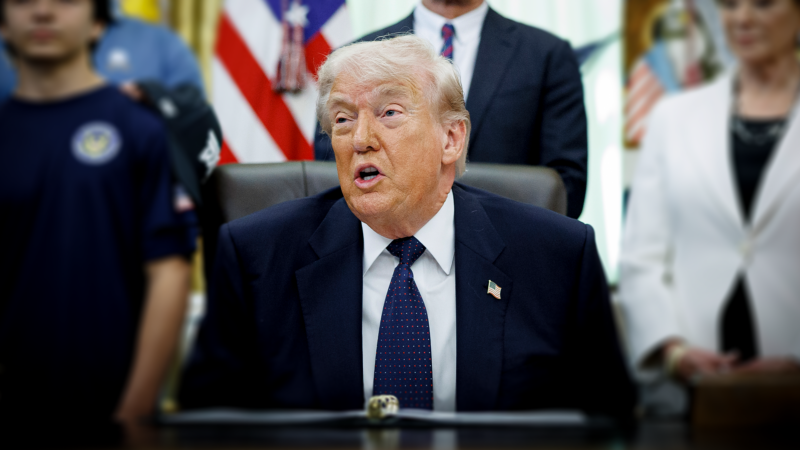
United States President Donald J Trump speaks before signing a proclamation inside the Oval Office at The White House in Washington, on May 5, 2026. | AdMedia/Newscom

“Below the threshold”:  At a Pentagon briefing yesterday following Iran’s attacks on the United Arab Emirates, the chairman of the Joint Chiefs of Staff told reporters that our adversary’s actions were “below the threshold of restarting major combat operations.” This shows laudable restraint; it seems the U.S. is interested in shepherding shipping vessels out of the Strait of Hormuz without being pulled back into combat, despite all of Iran’s taunts. (Iran’s foreign minister said “the U.S. should be wary of being dragged back into quagmire by ill-wishers” and “so should the UAE.” I wonder who those mysterious ill-wishers might be!)

The New York Times has warped this restraint into “White House Insists Iran War Is Over, Even While Missiles Fly”—implying that defense officials are delusional vs. choosing not to respond with maximum force to Iran’s provocation. (“The White House is turning to rhetorical leaps as President Trump tries to put the biggest political crisis of his presidency behind him,” writes the Times‘ David E. Sanger.)

President Donald Trump had said, rather clearly, that the ceasefire would be considered violated if the Strait of Hormuz were blocked. But things aren’t always so binary, and sometimes you say things as part of a negotiating tactic. It’s probably good that Trump has started to move away from some of his initial objectives (like regime change) and that the administration seems opposed to being dragged into a protracted conflict.

Naturally, as I was writing this, Trump went off and tweeted this. Never a dull moment, never a coherent strategy to analyze. It’s possible the restraint I was lightly lauding ends up not being restraint at all, alas:


The new war on drugs: Health Secretary Robert F. Kennedy Jr. has opened up a new front in the war on drugs. No, not psychedelics—he tends to support those. The new Public Enemy No. 1 is selective serotonin reuptake inhibitors. Yesterday, RFK Jr. announced a few federal initiatives aimed at reducing the prescription of SSRIs like  Zoloft, Lexapro, and Prozac.

About one in six American adults takes SSRIs. Women in every age group tend to be more likely than men to be SSRI users. Use (among adults) has gone up in recent years, rising from about 13 percent (2015–2018) to a little over 16 percent today. The rate of use among both teens and adults increased by almost 400 percent between 1988–1994 and 2005–2008, according to a 2011 review. That number has only risen since.

“Psychiatric medications have a role in care, but we will no longer treat them as the default, we will treat them as one option, to be used when appropriate, with full transparency and with a clear path off when they are no longer needed,” said Kennedy at a summit on mental health and overmedicalization. Side effects discussed by Kennedy, and long reported by users, include a numbing, dulling effect during use as well as difficulty withdrawing.

“We may take issue with this blanket ‘overprescribing’ hypothesis that underpins the secretary’s statements,” Marketa Wills, the chief executive and medical director of the American Psychiatric Association, told The New York Times (rather predictably) in the wake of Kennedy’s comments. “There is probably overprescribing and underprescribing in all parts of medicine, and mental health care is no different. And there are people who still can’t access care at all who need it.” (That last sentence is always thrown in, no matter the subject, isn’t it? Like a tic.)

Interestingly, Kamala Harris’ stepdaughter, Ella Emhoff, went on a whole diatribe on this subject six months ago. She said she’s been on antidepressants for at least the last decade, “fifteen years probably”—which would mean she started taking them at age 11, or at age 16 at the latest (if her decade calculation is more accurate). She said she worried about the lack of research done on long-term dependence and noted intense withdrawal symptoms.

You know the cultural consensus is shifting when Ella Emhoff and RFK Jr. start agreeing.


Scenes from New York: Fascinating report out from the Institute for Family Studies on how childhood independence started to disappear and what’s to be done about it. Some assembled thoughts here:


QUICK HITS

  • A cruise ship that set off from Ushuaia, Argentina, to go explore Antarctica and make its way up to the Canary Islands is now implementing containment measures off the coast of Cape Verde due to the spread of hantavirus aboard the ship. Three people have died so far. This whole situation sucks not only for the people on board, some of whom are infected with hantavirus (which is gotten from rodent droppings and urine), but also for the cruise ship industry overall, which had experienced a bit of a rebound since pandemic cruise ship lockdowns.
  • How new tech is changing (ruining?) fishing and hunting. (“We’re about ethical hunting,” Tony Schoonen, chief executive of the Boone and Crockett Club, tells The Wall Street Journal. “And that argues for self-restraint by the hunter when it comes to technology.”)
  • “The Education Department has opened a civil rights investigation into whether Smith College, the women’s school in Northampton, Mass., violated anti-discrimination laws by allowing transgender students to enroll,” reports The New York Times.
  • Labor market improving? “Employers hired 5.55 million people in March, a stunning rise of 655,000 from February,” reports Axios. “In another positive sign for the job market, the quits rate ticked up, with 125,000 more Americans voluntarily leaving their jobs—a small move but a sign of greater confidence in finding work elsewhere.” Still, job openings numbers dropped and layoffs surged a bit, so it’s a mixed bag.
  • Delta tries penny-pinching.
  • It’s happening:

  • New Ehrlich just dropped:

The post Damned if You Do appeared first on Reason.com.

from Latest – Reason.com https://ift.tt/jrZUMzQ
via IFTTT

Corning Shares Erupt On Nvidia Deal To Supercharge Fiber Optics Output By 10x

Corning Shares Erupt On Nvidia Deal To Supercharge Fiber Optics Output By 10x

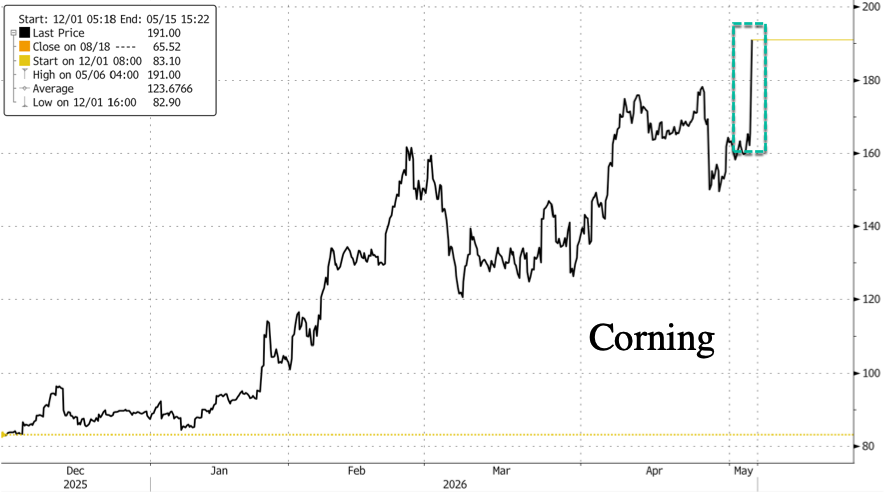
U.S.-based glass company Corning soared in premarket trading in New York after announcing a new mega deal with Nvidia to expand manufacturing capacity for fiber optic production used in AI data centers.

Corning will increase its U.S.-based optical connectivity manufacturing capacity by 10x and expand its U.S. fiber production capacity by more than 50% to meet the accelerating demand driven by AI factory buildouts,” Nvidia wrote in a press release. 

The expansion includes three new manufacturing plants in North Carolina and Texas and is expected to create more than 3,000 high-paying U.S. jobs.

In a filing, Corning disclosed that Nvidia is making a $500 million equity-linked investment.

Under the deal, Corning issued Nvidia two warrants:

  • Traditional warrant: Nvidia can buy up to 15 million Corning shares at $180 per share.

  • Pre-funded warrant: Nvidia can buy up to 3 million Corning shares at a nominal exercise price of $0.0001 per share.

Both warrants are exercisable immediately and expire within three years, unless earlier triggered by the termination of the partnership agreement or a major M&A transaction.

Nvidia noted, “Corning’s expanded capacity will supply the optical connectivity hyperscale data centers use to deploy NVIDIA-accelerated computing at scale.” 

In premarket trading, Nvidia shares are up 2.4%, while Corning shares are ripping higher, up 20%.

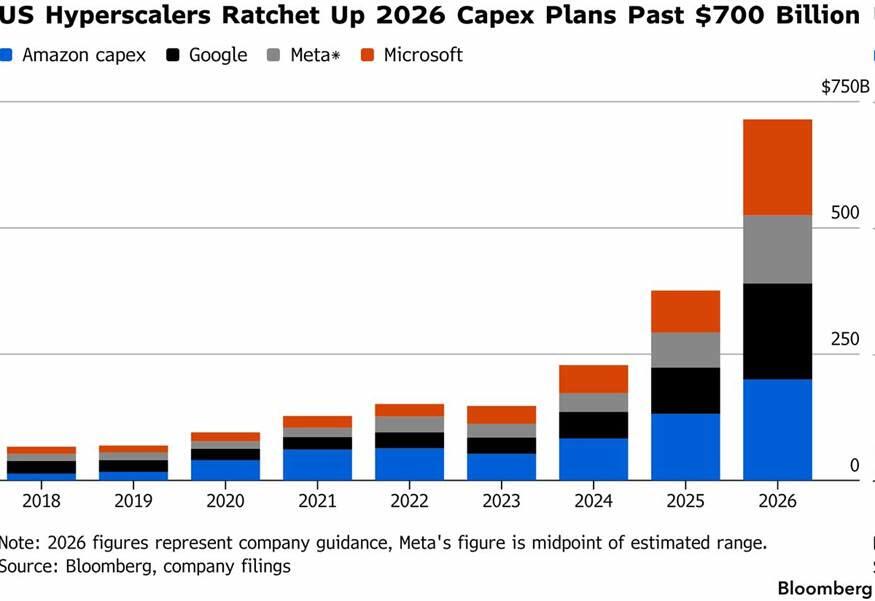
The Corning-Nvidia deal to expand fiber-optic production to supply data centers comes as hyperscalers are set to spend $700 billion this year alone on data center buildouts.

UBS trader Robert Ruple told clients last week that “there was a mixed bag of hyperscaler prints that leaned generally constructive and nothing he would call out that really shifts the narrative. Most critical was that Microsoft, Alphabet, and META all lifted capex forecasts, which should be enough to keep the AI thesis in play.” Read the full note here.

However, we must point out: “Banks Are Choking”: The AI Debt Bubble Has Started To Burst … 

Tyler Durden
Wed, 05/06/2026 – 08:30

via ZeroHedge News https://ift.tt/s9U4FMX Tyler Durden

Deja Vu All Over Again: Futures Surge, Oil Tumbles On Iran Deal Optimism, Tech Rally

Deja Vu All Over Again: Futures Surge, Oil Tumbles On Iran Deal Optimism, Tech Rally

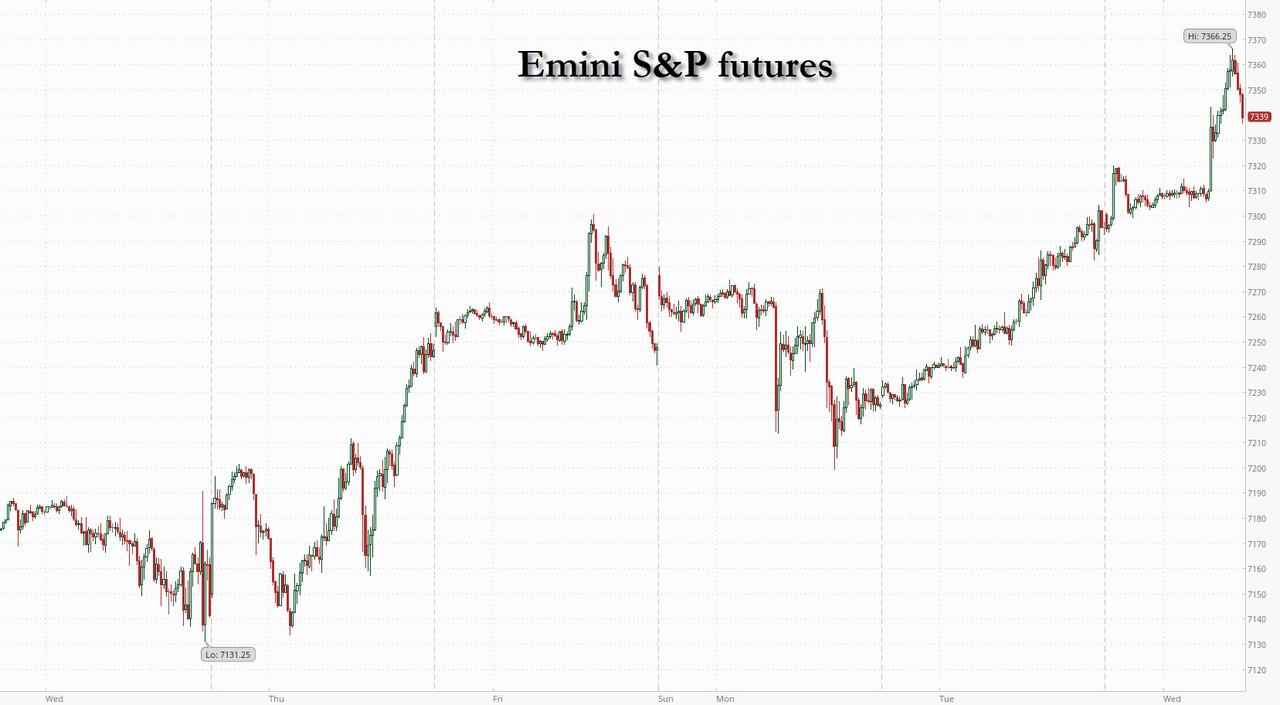
US equity futures are up big this morning and making fresh all time highs, led by tech companies, while oil prices and bond yields fell sharply on optimism that the US and Iran are nearing a peace deal. As of 8:00am Nasdaq 100 futures jumped 1.7% while those for the S&P 500 gained 1%, with both gauges set to build on record highs. Iran is evaluating a new proposal from the US to end their near 10-week war, according to an Axios report. If Tehran accepts the terms, it will lead to a gradual reopening of Hormuz and lifting of the American blockade on Iranian ports. Brent tanked 11% to below $98 a barrel. That comes as US gasoline prices topped $4.50 a gallon for the first time since July 2022. The yield on 10-year Treasuries dropped eight basis points to 4.35%. In the UK, the rate on two-year UK gilts tumbled 17 basis points. The dollar hit the lowest level since February, while gold topped $4,700 an ounce. Bitcoin rose for a seventh straight day. US economic data calendar slate includes April ADP employment change at 8:15am. Fed speaker slate includes Musalem (9:30am) and Goolsbee (1pm)

In premarket, most Mag 7 names are higher: Alphabet (GOOGL) climbs 1.6% after the Information reported that AI startup Anthropic plans to spend about $200 billion with Google over five years (Amazon +1%, Apple -0.5%, Nvidia +2.5%, Meta +0.5%, Microsoft +0.1, Tesla +0.6%)

  • Miners, cruise operators and airline companies gain, while energy and fertilizer stocks fall, after a report on the US and Iran nearing a one-page memorandum of understanding to end the war.
  • Semiconductor, power equipment and data center stocks rally after solid results from Advanced Micro Devices and Super Micro — in a sign of robust end-to-end artificial intelligence-related demand.
  • Advanced Micro Devices (AMD) rallies 19% after the chipmaker gave an outlook that is stronger than expected, a sign of robust AI-related demand.
  • Alphatec Holdings (ATEC) sinks 16% after the medical device company posted sales for the first quarter that disappointed Wall Street. TD Cowen calls the report a “tough start to 2026.”
  • Apollo Global (APO) rises 3% after the alternative asset manager eclipsed $1 trillion of assets under management on record first-quarter inflows and reported earnings that beat Wall Street estimates.
  • Compass Inc. (COMP) gains 31% after the real estate brokerage platform reported first-quarter revenue that beat average analyst estimates. The firm’s second-quarter revenue forecast is ahead of consensus.
  • CVS Health (CVS) rises 5% after the health insurer boosted its adjusted earnings per share guidance for the full year. The firm also posted adjusted profit and comparable sales for the first quarter that topped the average analyst estimate.
  • Geo Group (GEO) gains 11% after the private correctional facilities company boosted its adjusted Ebitda guidance for the full year, with the guidance beating the average analyst estimate.
  • Klaviyo (KVYO) falls 18% after announcing Amanda Whalen will step down from her role as CFO. The application software company reported first-quarter results that beat expectations and the outlook was raised on key metrics.
  • Kraft Heinz Co. (KHC) rises 2% after reporting quarterly sales that beat Wall Street expectations, as higher prices and the company’s investments in its lagging brands helped boost North American sales.
  • Primoris Services (PRIM) slumps 31% after the construction and engineering services company cut its adjusted earnings per share guidance for the full year.
  • Super Micro Computer Inc. (SMCI) leaps 13% after the company reported improved margins and gave a profit forecast that suggested it’s controlling the costs of getting powerful AI servers into customers’ hands.
  • TransMedics (TMDX) falls 21% after the medical equipment firm reported adjusted earnings per share that fell short of Wall Street’s expectations. It also reaffirmed its revenue forecast for the full year.
  • Uber Technologies (UBER) gains 9% after providing a better-than-expected forecast for bookings, signaling that robust demand from US commuters and travelers will offset impact from geopolitical tensions in the Middle East.
  • Veracyte (VCYT) rises 14% after the diagnostics firm reported revenue for the first quarter that beat the average Wall Street analyst estimate.

In other corporate news, Novo Nordisk’s new Wegovy obesity pill fueled sales in the first quarter and the drugmaker said this year’s proft and sales declines won’t be as bad as previously expected. BMW expects profitability to remain broadly stable this year as the automaker offsets a downturn in China with robust sales in Europe. Samsung reached a $1 trillion market valuation after shares more than quadrupled over the past year on booming demand for AI chips. And the FT reported that China’s main chip-sector investment fund is in discussions to lead a fundraising round for DeepSeek at a valuation of about $45 billion. 

Risk assets soared and oil tumbled, as geopolitical and micro tailwinds fueled risk-on sentiment broadly across the market. On Geopolitics, Brent tanked 11% to below $98 a barrel following an Axios report that US & Iran are working on a memorandum that would set a framework for more nuclear talks (and said US expects Iranian responses on key points in the next 48 hours). Here are the details from the Axios report:

  • A Pakistani source has confirmed that the US and Iran are closing in on a one-page memorandum to end their conflict, Reuters reports.
  • US and Iran are reportedly closing in on one-page memo to end war, Axios reported citing officials; White House believes it is close to an agreement to end the war and establish a framework for detailed nuclear negotiations.
  • MoU details, as it stands: Declare an end to the war in the region and the start of a 30-day period of negotiations, which could occur in Geneva or Islamabad. Iran committing to a moratorium on nuclear enrichment (at least 12-15 years). US agreeing to lift sanctions and release billions in frozen Iranian funds. Both sides lifting restrictions through the Strait of Hormuz, to occur gradually during the 30-day negotiation.
  • If talks collapsed, US forces could restore the blockade or resume military action.
  • Uranium Component: The duration of the moratorium is being actively negotiated. Sources suggest at least 12yrs and one suggesting 15yrs is likely; Iran sought five, the US wanted 20. Suggested that Iran would agree to its highly enriched uranium being removed from Iran, potentially to the US.
  • Timeline: Iran is expected to respond within 48 hours. While nothing has been agreed upon, sources indicate this is the closest the parties have been to a deal since the war began.
  • Issues: Some US officials remain sceptical that even an initial deal will be reached. Fractures within the Iranian leadership.

Separately, last night Trump paused “Project Freedom” in the Strait citing “great progress” towards an agreement. 

“The market continues to price in de-escalation and an easing in supply constraints,” said Geoff Yu, senior macro strategist at BNY. “The road ahead is bumpy, but the direction of travel seems clear.”

AI euphoria is also helping the rally. Alphabet is up in premarket trading after the Information reported Anthropic plans to spend about $200 billion with Google over five years. AMD was priced for perfection ahead of results, but managed to deliver, with shares soaring after the chipmaker gave robust predictions for longer-term growth. That’s adding to nerves about how Nvidia will retain its grip on the AI processor market in the face of intense competition.  

Meanwhile, looking under the hood, while both US stock benchmarks are set to extend Tuesday’s record highs, the S&P 500 Equal-Weight Index hasn’t posted a new high since February. This thin leadership is raising “yellow flags” for Goldman Sachs strategist Ben Snider, while Barclays’ Emmanuel Cau also noted earlier that stocks seem “increasingly disconnected from signals coming from the rates and oil markets.”

In politics, voters in Ohio handily backed Trump ally Vivek Ramaswamy’s bid to be the Republican nominee for governor, while Democrat Sherrod Brown will get another shot at returning to the Senate after being defeated in 2024. Ken Griffin said he plans to make Citadel’s Miami tower even bigger after New York Mayor Zohran Mamdani name-checked the billionaire in his pledge to charge more taxes on second homes.

In private credit, Oaktree Capital cut the value of one of its funds by almost 4% as the firm marked down its software assets. A New Mountain Capital private credit fund that sold almost half-a-billion-dollars of assets at a discount earlier this year and used some of the cash to scoop up beaten-down loans says the strategy is already paying off.

Elsewhere in geopolitics, China’s Foreign Minister Wang Yi urged Iran to keep negotiating in pursuit of a lasting truce with the US, as he hosted Tehran’s top diplomat just days before Trump is scheduled to arrive in Beijing. The clash between Trump and Pope Leo XIV has flared up again, complicating a delicate diplomatic mission by Marco Rubio to the Vatican this week.

Looking at earnings, of the 375 S&P 500 companies to have reported so far this earnings season, 84% have beaten analysts’ forecasts, while 11% have missed.

In Europe, the Stoxx 600 is up 2.3% with breadth strong. Mining and automobile shares are leading gains, while energy and utilities stocks are the biggest laggards. Here are the biggest movers Wednesday:

  • The Stoxx 600 basic resources sector rallied as much as 4% as gold and copper edged higher after US President Donald Trump touted progress on a final agreement with Iran
  • Novo Nordisk shares jump as much as 9.2%, the most since Dec. 23, after the Danish drugmaker raised its 2026 guidance ranges for adjusted sales and adjusted operating profit
  • Demant surges as much as 17%, the most since October 2008, after the firm delivers sales ahead of consensus expectations in the first quarter
  • Pandora shares rise as much as 11%, continuing a rally from March’s 3.5-year low, after the Danish jewelry maker’s first-quarter Ebit margins beat estimates, partly due to a change in the timing of certain costs
  • Kongsberg shares rise as much as 11%, their steepest jump since February, after the Norwegian defense technology firm posted what Morgan Stanley called strong results across all metrics
  • Diageo shares gain 6.6% after the British maker of Johnnie Walker and Guinness reported organic net sales for the third quarter that beat analyst estimates and maintained its full-year guidance
  • Vestas shares rise as much as 2% as the Danish wind turbine maker reported 1Q Ebit before significant items that beat the average analyst estimate
  • Equinor declined as much as 6.3%, its biggest drop since April 17 after the energy company reported total revenue for the first quarter that missed the average analyst estimate
  • Wolters Kluwer falls as much as 14%, the most since 2003, after 1Q results that were broadly in line but did little to resolve the AI debate that has weighed heavily on the stock
  • Orsted shares drop 4.4% after the Danish wind farm operator reported 1Q Ebitda that beat the average analyst estimate, while after-tax profit missed

Tech optimism saw the Kospi hit another record high in APAC trade as Samsung joined the $1 trillion valuation club.  Asian stocks jumped to a record, with technology shares leading gains after positive company forecasts reinforced confidence in continued growth tied to artificial intelligence. The MSCI Asia Pacific Index gained as much as 2.6% to a record high, with Samsung Electronics, SK Hynix and MediaTek providing the biggest boosts. Equities in South Korea, Thailand and China led the advances, while Japan’s market was closed for a holiday. Chinese stocks posted gains after the market reopened after a five-day holiday, with tech shares leading the rally. The government estimated more than 1.5 billion passenger trips took place during the break, while box office grew to 758 million yuan ($111 million). Sentiment was also lifted by improvement in a private gauge of services activities in April. Investors will also keep their eyes on the expected summit between Presidents Xi Jinping and Donald Trump next week for potential signs of easing tensions.

In FX, the Bloomberg Dollar Spot index is down 0.8% as expectations of a Fed hike by year-end have been fully unwound.  The yen surged after a 4th consecutive intervention by the BOJ/MOF but a large portion of the initial dip in USD/JPY has retraced.      

In rates, sovereign bonds are rallying around the world and treasuries hold a strong bid in early US session, with futures on session highs amid a slump in oil prices after Axios reported Washington and Tehran are working on a memorandum that would set a framework for further nuclear talks, with nothing agreed upon yet. Subsequent reports indicated Iran is evaluating a new US proposal to end the war. US front-end and intermediate yields dropped at least 10bp, long-end yields about 7bp, steepening 2s10s and 5s30s spreads by 3bp-4bp; 10-year fell 9bp to 4.33%. Fed-dated OIS contracts flipped back to pricing in chance of a rate cut this year, with around 6bp of easing priced in for September, and trimmed pricing for a rate hike in 2027. Treasury quarterly refunding announcement at 8:30am, with consensus expectation for unchanged coupon auction sizes, however some banks anticipate new forward guidance, shortening the time frame for stability from “at least the next several quarters” IG dollar issuance slate includes three deals so far. Six names priced $5.25 billion on Tuesday with issuers paying less than 2bps in new issue concessions on deals that were 7.2 times covered — nearly double the year-to-date average. At least two borrowers elected against moving forward

Measures of US corporate-credit risk improved in the opening minutes of trading, with the gauge for high-grade notes at its tightest in over two months. The environment coming into the US session was already positive for debt capital markets, with investment-grade spreads matching their tightest level since Feb. 20 on Tuesday and leveraged-loan prices at their highest level since then. Though there have been 15 high-grade bond sales to start the week, just $13.6 billion has been raised

In commodities, crude prices are sliding with Brent down over 9% and just below the $100/bbl mark. Spot gold and silver post respective gains of 3.4% and 6.5%. Bitcoin is higher by 0.7%.

US economic data calendar slate includes April ADP employment change at 8:15am. Fed speaker slate includes Musalem (9:30am) and Goolsbee (1pm)

Market Snapshot

  • S&P 500 mini +0.9%,
  • Nasdaq 100 mini +1.2%,
  • Russell 2000 mini +1.5%
  • Stoxx Europe 600 +2.2%,
  • DAX +2.4%,
  • CAC 40 +2.5%
  • 10-year Treasury yield -7 basis points at 4.35%
  • VIX -0.7 points at 16.72
  • Bloomberg Dollar Index -0.7% at 1187.12,
  • euro +0.7% at $1.1769
  • WTI crude -6.6% at $95.52/barrel

Top Overnight News

  • The White House believes it’s getting close to an agreement with Iran on a one-page memorandum of understanding to end the war and set a framework for more detailed nuclear negotiations. Axios
  • Trump posts: If Iran agrees to deal, the blockade of the Hormuz Strait will be lifted. “If they don’t agree, the bombing starts, and it will be, sadly, at a much higher level and intensity than it was before. “
  • Donald Trump earlier said he would pause US efforts to move ships through the Strait of Hormuz as he seeks an agreement with Iran, citing “great progress.” The blockade on Iranian ports remains. BBG
  • Chinese Foreign Minister Wang Yi met w/his Iranian counterpart on Wed and called for a swift reopening of Hormuz. BBG
  • China Is Still Supplying Drone Factories in Iran, Russia Despite U.S. Sanctions. Obscure Chinese companies are openly shipping dual-use goods such as engines and batteries, defying American controls. WSJ
  • The US will implement its 25% tariffs on cars and trucks from the EU “relatively soon” if the bloc doesn’t swiftly ratify a long-delayed trade deal, the American ambassador to the bloc Andrew Puzder said. BBG
  • China’s biggest state-backed semiconductor investment vehicle is in talks to lead the financing of DeepSeek’s first fundraising that could value the AI group at about $45bn. FT
  • Novo shares jumped as its new Wegovy pill boosted sales, and the company guided to a smaller-than-expected revenue decline this year. The oral version had the best US launch of any GLP-1. BBG
  • Alphabet outperformed its Magnificent Seven peers premarket after the Information reported that Anthropic plans to spend about $200 billion with Google over five years. BBG
  • The yen hit a two-month high, spurring fresh intervention speculation. BBG
  • While both US stock benchmarks are set to extend Tuesday’s records highs, the S&P500 Equal-Weight Index hasn’t posted a new high since February. BBG

Axios report on MOU between the US and Iran

  • A Pakistani source has confirmed that the US and Iran are closing in on a one-page memorandum to end their conflict, Reuters reports.
  • US and Iran are reportedly closing in on one-page memo to end war, Axios reported citing officials; White House believes it is close to an agreement to end the war and establish a framework for detailed nuclear negotiations.
  • MoU details, as it stands: Declare an end to the war in the region and the start of a 30-day period of negotiations, which could occur in Geneva or Islamabad. Iran committing to a moratorium on nuclear enrichment (at least 12-15 years). US agreeing to lift sanctions and release billions in frozen Iranian funds. Both sides lifting restrictions through the Strait of Hormuz, to occur gradually during the 30-day negotiation.
  • If talks collapsed, US forces could restore the blockade or resume military action.
  • Uranium Component: The duration of the moratorium is being actively negotiated. Sources suggest at least 12yrs and one suggesting 15yrs is likely; Iran sought five, the US wanted 20. Suggested that Iran would agree to its highly enriched uranium being removed from Iran, potentially to the US.
  • Timeline: Iran is expected to respond within 48 hours. While nothing has been agreed upon, sources indicate this is the closest the parties have been to a deal since the war began.
  • Issues: Some US officials remain sceptical that even an initial deal will be reached. Fractures within the Iranian leadership.

Other Iran News

  • US President Trump posted that Project Freedom will be paused for a short period to see whether or not the agreement with Iran can be finalised and signed, blockade will remain in full effect.
  • Journalist Mallick posted “…i would not be surprised if there is an incoming Iranian proposal to Washington via Islamabad, soon.”. Full post:”As what I understand, while the ball largely lies in Iranian court when it comes to US – Iran negotiations, i would not be surprised if there is an incoming Iranian proposal to Washington via Islamabad, soon.”.
  • Iranian and Saudi Arabian Foreign Ministers held a phone call; stressed continuing diplomacy and prevent escalation of tensions.
  • Iranian President Pezeshkian said US demands from Iran are impossible and unattainable.
  • US Secretary of State Rubio spoke with Russia’s Foreign Minister Lavrov, in which the US-Russia relationship, Russia-Ukraine war and Iran was discussed.
  • Iranian Foreign Ministry Spokesperson denies the UAE’s accusation that Iran fired missiles and drones at it, stating that Iran’s defensive actions were exclusively directed at the US, according to a statement. UAE is cooperating with the US and Israel against Iran.
  • Israeli Ambassador said relations with the UAE are growing.
  • IRGC denies any involvement with the attacks on the UAE earlier in the week.
  • Pakistan’s PM thanks the US President for pausing Project Freedom, in response to a request from Pakistan and Saudi Arabia, among others.
  • “Iraqi Prime Minister-designate Ali al-Zaidi held a telephone conversation with US Secretary of War Hegseth about bilateral relations in various fields”, Tasnim reported.
  • The two US commercial ships that crossed the Strait of Hormuz on Monday had military security aboard, NBC reported citing sources.
  • A French bulk carrier was hit by a cruise missile in the waters near the UAE, CBS reported citing officials.
  • CMA CGM confirms a vessel was the target of an attack on Tuesday while it was crossing the Strait of Hormuz.

A more detailed look at global markets courtesy of Newsquawk

Asia-Pac stocks traded entirely in the green, following on from the gains stateside and the positive update from President Trump, stating that Project Freedom is to be paused for a short time to see whether or not the agreement with Iran can be finalised and signed. ASX 200 neared last week’s peak of 8787, rebounding after two consecutive days of losses. The bounce was supported by Financials and Industrials, while Energy lagged as oil prices fell. KOSPI surged at the open, breaking the 7000 handle, and even activated the buy-side sidecar within the first 5 minutes of trade. Tech giants helped the surge in the index, with Samsung Electronics (+15%) being the latest Co. to join the USD 1tln market cap group. Shanghai Comp. and Hang Seng followed the positive risk-on tone as Shanghai returned from holidays. CK Hutchison gained after the Co. agreed to sell its 49% stake in VodafoneThree, while Wuliangye Yibin underperformed after a double downgrade at Goldman Sachs. On the data front, RatingDog services PMI beat estimates, which further supported the indices.

Top Asian News

  • China’s Foreign Minister Wang Yi held talks with Iranian Foreign Minister Araghchi, Xinhua reported.
  • BHP (BHP AT) CFO said new investors are buying into the Co. on copper exposure and AI demand.
  • KOSPI sidecar activated after KOSPI 200 futures rise by 5%.

European bourses are stronger across the board, buoyed by optimism surrounding US-Iran peace. Opened higher as markets reacted to Trump’s decision to temporarily pause “Project Freedom”, and then took another leg higher to make fresh peaks on an Axios report which suggested that the US and Iran are closing in on an MoU to end the conflict. European sectors are entirely in the green, except for Energy and Utilities; the latter, unsurprisingly, is hampered by losses in underlying oil prices. The top of the pile consists of Basic Resources (lifted by strength in metals prices), Autos and Consumer Products. The Autos sector has been driven higher by post-earning strength in BMW (+5%, beat exp. but faced fierce price competition in China) and Continental (+5.5%, Q1 results topped exp. and confirmed guidance). The Consumer Products sector has benefited from gains in jewellery-name Pandora (+9%) after Q1 revenue beat estimates, but did experience weakness across North America and Europe.

Top European News

  • EU PPI MoM (Mar) M/M 3.4% vs. Exp. 3.3% (Prev. -0.7%, Low. 0.8%, High. 3.7%).
  • EU PPI YoY (Mar) Y/Y 2.1% vs. Exp. 1.8% (Prev. -3%, Low. -0.5%, High. 2.1%).
  • EU S&P Global Composite PMI Final (Apr) 48.8 vs. Exp. 48.6 (Prev. 50.7).
  • EU S&P Global Services PMI Final (Apr) 47.6 vs. Exp. 47.4 (Prev. 50.2).
  • UK S&P Global Services PMI Final (Apr) 52.7 vs. Exp. 52 (Prev. 50.5).
  • UK S&P Global Composite PMI Final (Apr) 52.6 vs. Exp. 52.0 (Prev. 50.3).

FX

  • Snapshot: G10s are stronger against the USD this morning, to varying degrees. Antipodeans outperform, given the risk tone; JPY is also towards the top of the pile, following likely intervention overnight. SEK is a touch weaker vs EUR, after a cooler-than-expected inflation report, but is unlikely to shift the dial for the Riksbank on Thursday.
  • DXY is weaker this morning, and currently trades at the lower end of a 97.79 to 98.34 range. Pressure facilitated by the risk-on mood, amidst optimism surrounding progress towards US-Iran peace. This stems from a post from the POTUS, who announced that the US would pause Project Freedom to allow time for negotiations to occur. The move lower was then exacerbated after an Axios report suggested that the US and Iran are closing in on an MoU to end the conflict. In its current form, it would declare and end to the war with Iran. Potential JPY intervention also facilitating the pressure this morning
  • Focus overnight was on USD/JPY, where an aggressive move lower took the pair to a 155.00 handle, before bouncing back towards 156.00. There is currently no confirmation that the move was intervention, but markets should begin to get some details on recent moves late in the Japanese session. Time will tell whether these attempts of intervention proves effective, given the volatile nature of the Middle Eastern conflict. A near-term resolution will help the USD/JPY trundle lower, a factor which Japanese Officials would probably require to achieve any lasting strength in the JPY.

Central Banks

  • ECB’s Cipollone said the EZ inflation trend is moving towards adverse.
  • ECB Wage Tracker: 2026 annual 2.282% (prev. 2.270%). Q1 1.847% (prev. 1.887%). Q2 2.131% (prev. 2.10%). Q3 2.553% (prev. 2.521%). Q4 2.597% (prev. 2.574%).
  • BoE Governor Bailey said we must be mindful of risks of private credit.
  • NAB sees the RBA hiking in June to take the cash rate to 4.60%.
  • RBNZ Governor Breman said banks are resilient under stress tests.
  • RBNZ Financial Stability Report: New Zealand’s financial system is resilient and well positioned to support households and businesses even if economic conditions soften. The global risk environment has worsened over the past six months, as conflict in the Middle East threatens world energy supply.
  • PBoC set USD/CNY mid-point at 6.8562 vs exp. 6.8160 (prev. 6.8628).
  • BoK official said inflation is seen higher in May and are closely monitoring inflation trend as uncertainty is high over the Middle East situation.

Fixed Income

  • Unsurprisingly, a bullish start for fixed income as the marked energy retreat has allowed yields to ease. Pressure in energy facilitated by a) Trump pausing Project Freedom to allow time for negotiations, b) Axios report suggested US-Iran are close to an MoU. (See geopols section for details).
  • USTs to a 110-28+ peak, with gains of 15 ticks and breaching Monday’s WTD 110-26+ best. For the US, aside from geopols, we are attentive to ADP ahead of NFP on Friday; ADP is seen at 79k from 62k, vs a 73k (prev. 178k) consensus for Friday’s Payrolls. Additionally, we get the full Treasury Quarterly Refunding announcement after Monday’s projections, before remarks from Fed’s Musalem (2028) and Goolsbee (2027).
  • Bunds post gains in excess of 80 ticks and currently hold just off a 125.88 peak. A high that printed in proximity to the above geopolitical updates this morning, and after a slew of Final PMIs, which were subject to modest revision. Of note for policymakers, the ECB’s latest wage tracker showed upside across the year. Though, the ECB will at this stage likely welcome the relatively modest level of upside and particularly that the Q4-2026 figure remains shy of the 2.709% reported in February.
  • Gilts gapped higher by 48 ticks before climbing another 30 ticks to an 87.32 peak, notching a new high for the week, but remain shy of last week’s 87.03 closing price. Potentially capping a return to and test of that level is the ongoing scrutiny around PM Starmer, as UK press continues to brief that the challenge against Starmer is increasing, with the Welsh Labour leader seemingly primed to call for Starmer to step down on Friday and reports that the party is working to get Burnham back in the Commons.
  • Germany sells EUR 2.662bln vs exp. EUR 3.5bln 2.50% 2032 Bund Auction: b/c 2.4x (prev. 1.1x), avg. yield 2.8% (prev. 2.78%), retention 23.94%.

Commodities

  • Energy on the backfoot after US President Trump paused Project Freedom to allow time for talks and potential progress with Iran. An update that weighed on crude overnight, sending WTI below USD 100/bbl and Brent beneath USD 108/bbl. Thereafter, the complex took another hit after an Axios report which suggested that the US and Iran are closing in on an MoU to end the conflict (see geopols section for details).
  • As it stands WTI Jun’26 and Brent Jul’26 are holding towards session lows at USD 93.96/bbl and USD 101.46/bbl, respectively. Brent now eyes USD 100/bbl to the downside, and a further leg lower could see a retest of the low from 27th April 2026, at USD 99.58/bbl.
  • Gold is benefiting from the energy and USD downside, XAU as high as USD 4,708/oz, matching its 21 DMA. Base metals are also firmer, cheering the general risk tone and welcoming the return of Mainland China. 3M LME Copper above USD 13.2k, with gains in excess of USD 150 as things stand.
  • China has ordered its oil refineries that purchase crude from Tehran not to comply with or enforce US sanctions on Iranian oil, CNN reported.
  • Australia’s PM Albanese said that they are to lift minimum stockpiles of every type of fuel by around 10 days, the fuel reserve is to be around 1 billion litres and the package is to cost more than AUD 10bln.
  • Weekly private inventory data (bbls): Crude -8.1mln (exp. -2.8), Gasoline -6.1mln (exp. -1.7mln), Distillates -4.6mln (exp. -2mln), Cushing -1.1mln.

Trade/Tariffs

  • Chinese Foreign Ministry Spokesperson Lin said China and the US are in communication on Trump’s trip.
  • US Ambassador Puzder wants the US-EU trade agreement to be agreed on before July, Bloomberg TV.
  • US Envoy to India said Indian companies plan to invest over USD 20.5bln in the US tech, manufacturing and pharmaceuticals.

US Event Calendar


d


Tyler Durden
Wed, 05/06/2026 – 08:28

via ZeroHedge News https://ift.tt/xDY5Bwt Tyler Durden