Saudi Arabia Public Investment Fund To Stop Funding LIV Golf After 2026 Season
LIV Golf is preparing to inform players and staff that its main financial backer, Saudi Arabia’s Public Investment Fund, will stop funding the league after the 2026 season, according to Golfweek. The announcement—expected midweek—would open the door for CEO Scott O’Neil to pursue new investment to keep the tour running.
Since launching in 2022 as a challenger to the PGA Tour, the circuit has reportedly burned through more than $5 billion while failing to gain meaningful U.S. viewership. Broadcast deals with The CW Network and later Fox did little to improve ratings.
Uncertainty around funding has been building. In April, O’Neil acknowledged the league is only financed through this season, saying future survival depends on securing new backers—even as he publicly maintained LIV is in its best position yet.
Golfweek writes that the timing aligns with a broader shift by PIF, led by Yasir Al-Rumayyan, toward prioritizing domestic projects over global spending.
LIV did manage to lure big names like Phil Mickelson, Dustin Johnson, Bryson DeChambeau, and Jon Rahm with lucrative deals. Still, its team-based, no-cut format struggled to resonate broadly, despite pockets of success overseas and moments like Anthony Kim’s brief resurgence.
Efforts to align with the PGA Tour—including a 2023 framework agreement that followed LIV’s antitrust lawsuit—ultimately stalled, even with involvement from Donald Trump.
Recent player movement has added to the uncertainty, with figures such as Brooks Koepka and Patrick Reed stepping away from LIV competition.
With only a handful of events remaining this season, LIV Golf now faces mounting pressure to secure fresh funding—or risk folding after 2026.
On Wednesday, the Supreme Court decided Callais. The last paragraph of the opinion stated:
The judgment of the District Court is affirmed, and thesecases are remanded for proceedings consistent with this opinion.
It is so ordered.
Well, it is not ordered right away. Under the Court’s rules, the remand does not happen immediately. In this 2020 post, I described the process by which judgments are actually entered. Conflicts over the timing of the judgments have arisen in high profile cases, including Bush v. Gore, Boumediene, Trump v. Vance, Trump v. Mazars, DHS v. Regents, Whole Woman’s Health v. Jackson, and others. Of course, after Obergefell was decided, jurisdictions outside the Sixth Circuit immediately issued marriage licenses to gay couples, even though they were bound by injunctions. Whatever, love won!
The private plaintiffs in Trump v. Callais have asked the Supreme Court to issue the judgment forthwith. Louisiana has taken no position on the request, because the issuance of the judgment is irrelevant:
The State notes that the Court’s May 15, 2024 Order also states that, “[i]n the event jurisdiction is noted or postponed, this order will remain in effect pending the sending down of the judgment of this Court.” That language can be read to conflict with the cited language above, which requires automatic termination of the Order if the lower court’s judgment is affirmed. That potential conflict, however, has no bearing here because, whether the Order is already terminated or will be terminated when this Court sends down the judgment, nothing prevents Louisiana from adopting a constitutional map and process consistent with this Court’s decision right now.
Louisiana is correct. The District Court did not issue an injunction. The Supreme Court affirmed the District Court’s judgment. Nothing prohibits Louisiana from following the Supreme Court’s decision as a precedent, even if there is no issued judgment. Moreover, once Louisiana adopts new maps in the next week or so, this entire dispute will be mooted.
On Wednesday, the Supreme Court decided Callais. The last paragraph of the opinion stated:
The judgment of the District Court is affirmed, and thesecases are remanded for proceedings consistent with this opinion.
It is so ordered.
Well, it is not ordered right away. Under the Court’s rules, the remand does not happen immediately. In this 2020 post, I described the process by which judgments are actually entered. Conflicts over the timing of the judgments have arisen in high profile cases, including Bush v. Gore, Boumediene, Trump v. Vance, Trump v. Mazars, DHS v. Regents, Whole Woman’s Health v. Jackson, and others. Of course, after Obergefell was decided, jurisdictions outside the Sixth Circuit immediately issued marriage licenses to gay couples, even though they were bound by injunctions. Whatever, love won!
The private plaintiffs in Trump v. Callais have asked the Supreme Court to issue the judgment forthwith. Louisiana has taken no position on the request, because the issuance of the judgment is irrelevant:
The State notes that the Court’s May 15, 2024 Order also states that, “[i]n the event jurisdiction is noted or postponed, this order will remain in effect pending the sending down of the judgment of this Court.” That language can be read to conflict with the cited language above, which requires automatic termination of the Order if the lower court’s judgment is affirmed. That potential conflict, however, has no bearing here because, whether the Order is already terminated or will be terminated when this Court sends down the judgment, nothing prevents Louisiana from adopting a constitutional map and process consistent with this Court’s decision right now.
Louisiana is correct. The District Court did not issue an injunction. The Supreme Court affirmed the District Court’s judgment. Nothing prohibits Louisiana from following the Supreme Court’s decision as a precedent, even if there is no issued judgment. Moreover, once Louisiana adopts new maps in the next week or so, this entire dispute will be mooted.
The COVID-19 pandemic marked a dramatic shift in workplace dynamics, as working from home suddenly became the norm for millions of workers in the United States and across the globe.
As Statista’s Felix Richter notes, this transformation offered employees newfound flexibility, enabling them to manage their time more effectively, eliminate commutes, facilitate childcare and often achieve a better work-life balance. Remote work also allowed for a customized work environment, fostering comfort and productivity for many.
However, traditional office settings continue to hold unique advantages, which is why, six years later, more and more employers have called their workers back to the office for most days of the week. Offices facilitate in-person collaboration, spontaneous brainstorming and social interaction, all of which are challenging to replicate virtually. Additionally, the structured environment of an office can provide clearer boundaries between work and personal life, reducing distractions and helping employees switch off when at home.
According to Statista Consumer Insights, 1 in 5 American employees still worked from home regularly in 2025, while 43 percent of respondents regularly worked in a company office.
In many cases, hybrid models combining the benefits of both setups have emerged, catering to diverse employee preferences and living situations and striking a balance between the benefits and disadvantages of both working from home and in the office.
L3Harris’ Missile Business Files To Go Public As Trump’s War Economy Prepares For Launch
We have been diligently tracking the Trump administration’s war-economy mobilization across the homeland, from the rise of so-called “war unicorns” favored by the Department of War to Trump officials talking with GM, Ford, GE Aerospace, and Oshkosh about converting underused civilian industrial capacity into weapons production. The signal to investors is becoming hard to miss: the Trump administration is preparing to expand the defense industrial base at scale to refill depleted weapons stockpiles.
Whether through venture-backed defense startups, legacy defense primes, or redirected auto and heavy-manufacturing capacity, the White House’s war policies point toward a major weapons-production boom on the horizon.
With that in mind, L3Harris Technologies has confidentially filed a draft S-1 with the SEC for a proposed IPO of its Missile Solutions business, or MSL.
L3Harris is now preparing for an IPO, as the SEC privately reviews the draft registration statement and may send comments or request changes. This occurs before the IPO roadshow begins.
Last week, L3Harris announced it had closed a $1 billion investment from the DoW into MSL, which will be used to “accelerate research and development, and increase production capacity for critical national security technologies.”
“This strategic partnership with the Department of War is a testament to the critical role L3Harris plays in our national security,” L3Harris CEO Christopher Kubasik wrote in a statement.
Kubasik noted, “The investment will allow us to accelerate innovation and enhance our ability to deliver the advanced capabilities our warfighters need to deter and defeat emerging threats. We are proud to partner with the DoW to ensure the resilience of our defense industrial base for years to come.”
MSL will be a direct play on the DoW ramping up orders for PAC-3, THAAD, Tomahawk, and Standard Missile systems, given that the two theaters of conflict across Eurasia, Ukraine-Russia and U.S.-Iran, are draining key missile stockpiles.
Aircraft Carrier Strike Group To Leave Middle East, Reducing Footprint Amid Iran War
Currently there are three American aircraft carrier groups in Middle East waters and near Iran in the context of Operation Epic Fury. By comparison, at the height of the Bush-ordered US invasion of Iraq in 2003, there were six total carrier groups – which were responsible for most of the large tomahawk missile strikes on Baghdad.
Amid the current extended ceasefire between the US and Iran (and including Israel), there are indicators that Washington is not preparing for a ground invasion of the Islamic Republic anytime soon. First and foremost is that the USS Gerald R. Ford is set to return to the United States after nearly a year deployed in wartime operations – as it was previously in the Caribbean focused on Venezuela ops.
Defense officials have newly told The Washington Post the carrier will leave the Middle East in the coming days and head back to Naval Station Norfolk, Virginia.
The publication confirms, “The aircraft carrier USS Gerald R. Ford will depart the Middle East and begin the sail for home in coming days, multiple U.S. officials said, an expected relief for roughly 4,500 sailors who have been deployed for 10 months – but a loss of significant firepower as peace talks between the United States and Iran stagnate.”
Its departure will leave the USS George H.W. Bush and the USS Abraham Lincoln in the Arabian Sea as the US Navy continues efforts to enforce a blockade on Iranian ports. Recent operations have seen dozens of Iranian vessels intercepted, even as others breached the blockade, with CENTCOM in a recent update saying that over 40 vessels have been turned back or intercepted.
There’s still as yet no clear sign of imminent breakdown of the Iranian government or society, amid what’s turned into a prolonged economic siege war – even though President Trump declared days ago that the Islamic Republic is ‘fractured’ and ‘collapsing’.
The US retains additional carrier strike groups elsewhere, including the USS Dwight D. Eisenhower and the USS Theodore Roosevelt, which remain available for potential deployment later this year.
The longer the Iran conflict drags on, the more likely it is that additional carrier groups could head toward Mideast regional waters, including patrolling the Mediterranean, near Israel.
The Ford’s return follows a record deployment exceeding 300 days that spanned the Caribbean, Europe, and the Middle East. Most recently, it had to undergo significant repairs – first in Cyprus and then at port in Croatia, for what’s been described as a laundry room fire and persistent maintenance problems during its extended mission.
(Reuters) – A U.S. naval blockade of Iranian ports has shrunk Tehran’s oil exports, stranding a growing stockpile of crude on tankers as Iranian storage sites run out of space, shipping data showed and analysts said.
With some vessels switching off tracking systems and U.S.…
The crew has been described as overstretched and exhausted, while there are reports the carrier has come under Iranian attack – though which the Pentagon has repeatedly denied posed any real threat.
Massive Lithium Lode In Appalachia Could Power 130 Million EVs: USGS
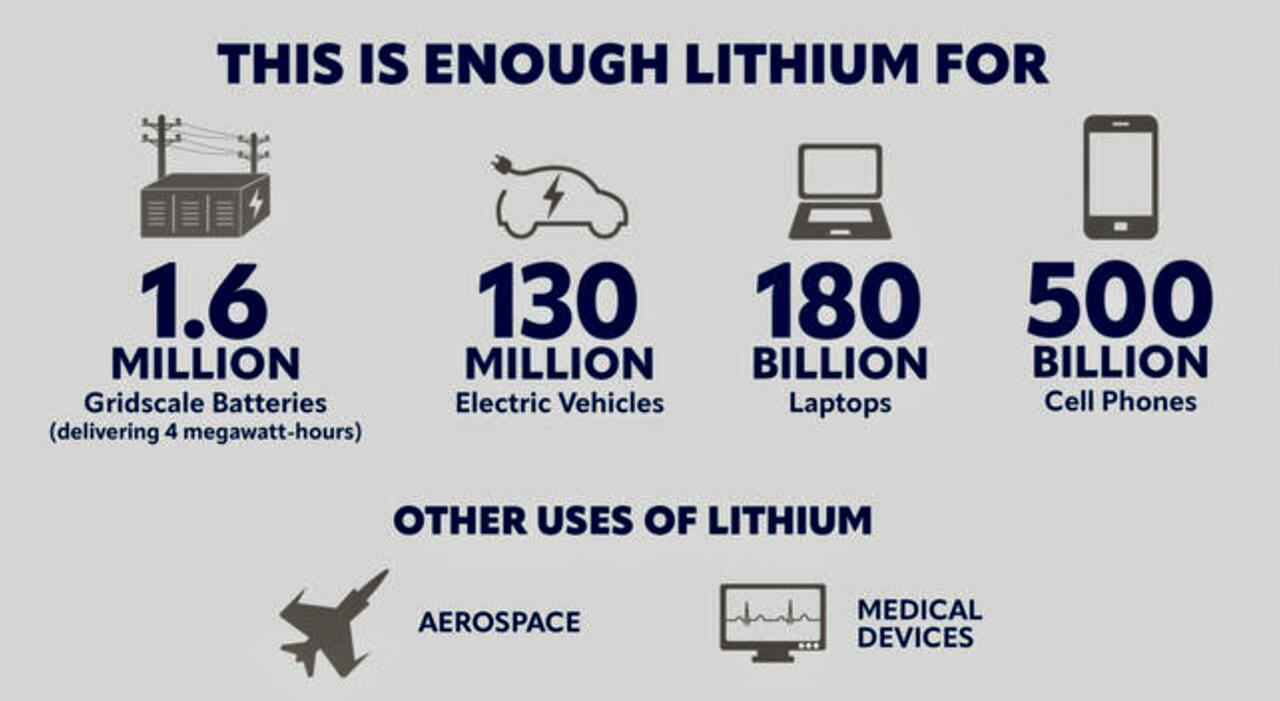
America’s worrisome dependency on foreign sources of lithium could become a thing of the past: About 328 years’ worth of last year’s lithium imports is buried in Appalachia, according to a new analysis published by the US Geological Survey (USGS). That’s about 2.3 million metric tons of undiscovered but economically recoverable lithium — aka “white gold.”
“This research shows that the Appalachians contain enough lithium to help meet the nation’s growing needs – a major contribution to U.S. mineral security, at a time when global lithium demand is rising rapidly,” said USGS Director Ned Mamula. “The United States was the dominant world producer of lithium three decades ago, and this research highlights the abundant potential to reclaim our mineral independence.” Today, Australia is the top producer, and China in second place — however, China boasts about 60% of the world’s lithium refining capacity for batteries.
The deposits are spread over a large swath of territory. The southern Appalachians — primarily the Carolinas — have about 1.43 million metric tons, while the northern Appalachians hold 900,000 metric tons, most of it in Maine, New Hampshire and Vermont, USGS says. Added up, it’s enough to put the requisite lithium in 130 million electric vehicles, or a thousand years worth of laptop production.
USGS project global lithium production capacity will double over the next three years. In April, Finland became the first European country to host the full continuum of lithium production, from an open-pit mine that produces battery-grade lithium hydroxide, to a refinery. “The €783 million project is operated by Keliber Oy, a Finnish mining and battery-materials company,” EuroNews reported.
Today, there’s only one operating lithium mine in America: the Albemarle Silver Peak Mine in Nevada. Earlier this week, environmentalists sued to stop exploratory drilling in Oregon near the Nevada border. The US Bureau of Land Management had given the green light for HiTech Minerals to set up 168 drill sites over five years, on a 7,200-acre expanse of public land. The plaintiffs include “Great Old Broads for Wilderness.” In a 2024 analysis, USGS concluded that brines in southwest Arkansas’ Smackover Formation hold 5 to 19 million metric tons of lithium, but didn’t determine what proportion is economically recoverable.
To say the more-promising Appalachian deposits were created a long time ago is an understatement. “Lithium-rich pegmatites in the northern Appalachians formed from the same geologic forces that built the mountains more than 250 million years ago,” explained the USGS, a Department of the Interior organization and the country’s largest water, earth and biological science mapping organization. “The high heat and pressure during the mountain-building caused some of the deeper crustal rocks to melt, and some of these magmas were rich in lithium.”
Hershey CEO Says GLP-1 Boom Fuels Demand For Gum And Mints
Hershey reported first-quarter sales and earnings that exceeded Bloomberg-tracked analyst expectations, driven by higher candy prices and resilient consumer demand.
Beyond the earnings report, CEO Kirk Tanner made one very notable comment in prepared remarks: demand for gum and mints remains strong, with the category benefiting from “functional snacking” tailwinds tied to GLP-1 adoption.
“We’ve also seen strong demand for gum and mint products as the category benefits from functional snacking tailwinds, including GLP-1 adoption,” Tanner said.
GLP-1 drugs suppress appetite and slow digestion, so it appears that many users who no longer want a full calorie-packed snack or meal are gravitating toward gum and mints instead.
That is an unexpected positive for Hershey, a company best known for Reese’s, Kit Kat in the U.S., Almond Joy, Mounds, York, Twizzlers, and other confectionery brands.
While weight-loss drugs have raised concerns about reduced calorie intake and lower food purchases, Hershey’s gum and mint portfolio appears to be benefiting from a shift toward lower-calorie gum and mints.
Tanner told analysts on the earnings call, “It is a treat, not a meal,” adding that the company is spending a lot of time researching the expanding use of GLP-1 drugs and incorporating that into its outlook. “The confection category is relatively insulated compared to other food categories.”
Here Come The Cancellations: Brookfield-Backed Compass Pulls Out From Major Northern Virginia Data Center Project
Compass Datacenters has decided to withdraw from its plan to develop a major data-center corridor in Northern Virginia after spending years pursuing approvals and investing tens of millions of dollars, according to Bloomberg.
The company ultimately concluded the project wasn’t feasible due to mounting legal challenges, stricter regulations, and weakening political support, particularly around tax incentives.
This move highlights a broader shift in how communities and policymakers are responding to data-center projects. Local residents have increasingly raised concerns about issues like energy consumption, environmental impact, and potential effects on property values. As a result, companies in the industry are finding it more difficult, expensive, and time-consuming to gain approval for new developments.
Bloomberg writes that the proposed project was part of a larger effort to expand Northern Virginia’s role as a global hub for data centers. However, conflicts over land use, public notice procedures, and zoning approvals led to court rulings that invalidated key permissions. Faced with the prospect of prolonged legal battles and uncertain outcomes, Compass chose to step back.
The situation also reflects growing political sensitivity around how much support these developments should receive. Debates over tax breaks and incentives have made officials more cautious, while organized community opposition has become more influential in shaping decisions. Together, these pressures are forcing companies to rethink where and how they expand.
Meanwhile, another developer involved in the broader plan is still considering whether to continue challenging the rulings, showing that while some companies are retreating, others may continue pushing forward despite the growing resistance.
Recall days ago we wrote that half of US data centers scheduled for 2026 would be cancelled or delayed. We wrote then that the outlook for the US AI revolution looks increasingly more dim.
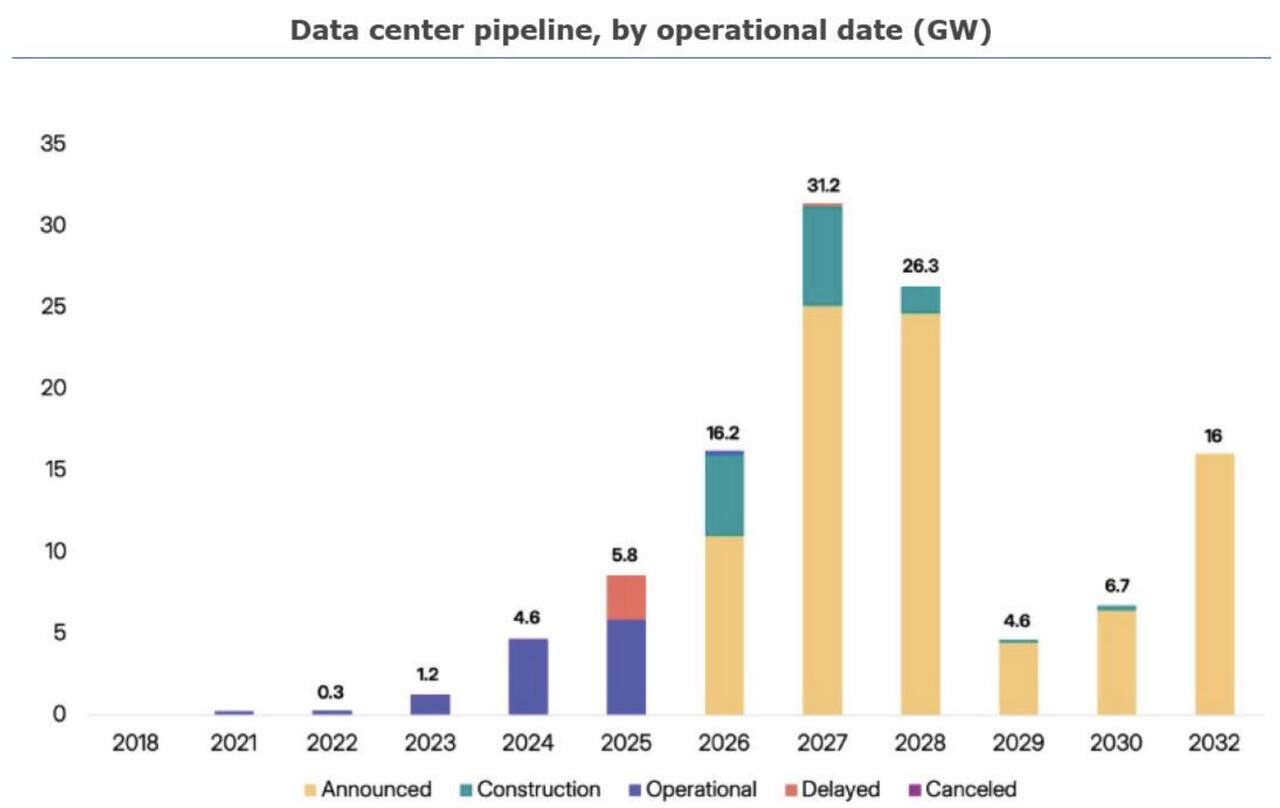
That’s because, as Canaccord Genuity analyst George Gianarikas writes, “the American data center boom is hitting a formidable wall of logistical friction.” He is referring to the latest outlook by Sightline Climate, which is also reinforced by recent articles from Bloomberg and others, and reveals a sobering reality for 2026: nearly half of the nation’s planned 16-gigawatt capacity faces cancellation or delay, with only 5 gigawatts currently under construction.
This inertia stems from a volatile mix of local permitting hurdles, community resistance, and a desperate reliance on overextended global supply chains for critical components like transformers and helium.
That’s right: half.
That’s right: despite $700BN+ of expected 2026 hyperscaler capex, nearly half of the data centers scheduled to begin operations in the US in 2026 “will either face delays or outright cancellations.”
The data, which comes from Sightline Climate’s 2026 Data Center Outlook, suggests that just 30% – 50% of the ~16 GW of planned US capacity for the year will face risks, with only ~5 GW currently under construction!
By 2027, the gap between ambition and reality widens further, as a mere fraction of the announced 21.5 gigawatts has actually broken ground. Worse, according to Futurism, data centers slated to open in 2027 are progressing far more slowly than anticipated. “Only about 6.3 gigawatts worth of computing infrastructure are actually under construction, compared to 21.5 announced gigawatts.”
And then visibility drops to virtually nothing beyond 2028 as uncertainty increases materially in the outer years. According to the article, “things get even dodgier in the coming years, with the vast majority of data centers planned for launch between 2028 and 2032 having yet to even break ground. There are a further 37 gigawatts of planned infrastructure which haven’t even received a firm completion date, only 4.5 [gigawatts] of which have actually begun work.”
This trend suggests an increasingly uncertain future for the industry, where power constraints and grid instability cast long shadows over projects slated through 2032.
Beijing is moving to tighten its grip on tens of millions of gig workers—an increasingly vital but volatile segment of China’s labor force—prompting warnings from analysts that the effort could deepen social tensions rather than contain them.
On April 26, China’s top leadership bodies, the General Office of the Chinese Communist Party (CCP) and the State Council, released new guidelines via Chinese state media Xinhua News Agency, calling for stronger management of what the CCP describes as the country’s “new employment groups.”
The directive, while only now made public, is dated Oct. 29 last year. It calls for increased adherence to Xi Jinping’s political doctrine and urges workers to “listen to and follow the Party.”
Using vague language, it also mentions plans for “a working mechanism characterized by top-to-bottom coordination” by the year 2027, with further objectives coming within another three to five years, including that “ideological and political guidance will be more forceful.”
The move comes as Beijing seeks to assert tighter control over the fast-growing gig workforce that now numbers about 84 million people—roughly one-fifth of China’s employed population—according to a February analysis in “Qiushi,” a CCP propaganda magazine.
Vast, Hard-to-Control Workforce
China defines “new employment groups” as workers that are engaged in flexible, platform-based jobs tied to the digital economy. They include food delivery riders, couriers, ride-hailing drivers, e-commerce workers, and livestream hosts, many of whom are young job seekers drawn by low barriers to entry but who face long hours, unstable incomes, and limited labor protections.
The category overlaps with China’s broader concept of flexible employment, which includes part-time workers and the self-employed. By 2025, officials estimated that more than 200 million people fell into that broader grouping, according to state media Xinhua News Agency.
Despite their size, these workers often lack access to social benefits and operate outside traditional labor structures, making them difficult to organize and, from the CCP’s perspective, difficult to control, according to U.S.-based China current affairs commentator Wang He.
Wang told The Epoch Times the new directive reflects mounting concern within the CCP about the political risks posed by this group. He said the policy is about extending state control.
“The CCP sees this [as a segment of the workforce] that cannot be allowed to drift beyond Party oversight,” he said. “The priority is political control.”
Wang said that in recent years, China has already expanded surveillance systems and grassroots governance networks. The latest policy signals an effort to integrate gig workers more fully into that framework, while reinforcing the Party’s authority over both society and the government.
“This group is young, mobile, and highly connected through the internet,” he said. “Their ability to voice grievances is stronger than many other groups.”
Signs of Discontent
Incidents over the past year have underscored those concerns.
In December, hundreds of delivery riders in Changsha, China, gathered to protest restrictions on access to a residential compound. Videos circulating online showed one participant dressed in a yellow cape, prompting a heavy police response.
More recently, from late March to early April, delivery workers in Chongqing, China, staged a multi-day strike, protesting falling pay rates and what they described as exploitative platform practices.
Such episodes, while localized, have raised alarms among some experts about the potential for broader unrest.
Xu Zhen, a senior professional in China’s capital markets, told The Epoch Times that disputes involving delivery workers have increasingly become flashpoints for social instability.
“The CCP is trying to consolidate various tools of social control, through Party branches in platform companies and even intervention in algorithms,” he said. “But it’s not clear these measures will work.”
The official guidelines also promised better services and legal protections for gig workers, including efforts to solve “practical difficulties” and “enhance ideological and political work.”
Critics say such language is often more rhetorical than substantive.
Wang said the promise to protect rights and provide services is largely a façade.
In practice, many gig workers struggle to access social insurance or other benefits, leaving them effectively marginalized within China’s labor system, according to Wang. Local governments, already under fiscal strain, may lack the resources—or the incentive—to expand support.
Expanding Party Reach
The policy also reflects a broader institutional shift.
In 2023, Beijing established a new Central Social Work Department tasked with strengthening social stability and expanding CCP influence across a wide range of sectors, from industry associations to private enterprises and grassroots organizations.
Earlier this month, the CCP also announced a campaign via Chinese state media People’s Daily targeting industry associations, again stressing the need for stronger party leadership.
Taken together, Wang said the measures point to a deepening emphasis on control amid economic uncertainty and rising social pressures, raising questions about whether tighter oversight will ensure stability or fuel further discontent.
Ning Haizhong and Luo Ya contributed to this report.