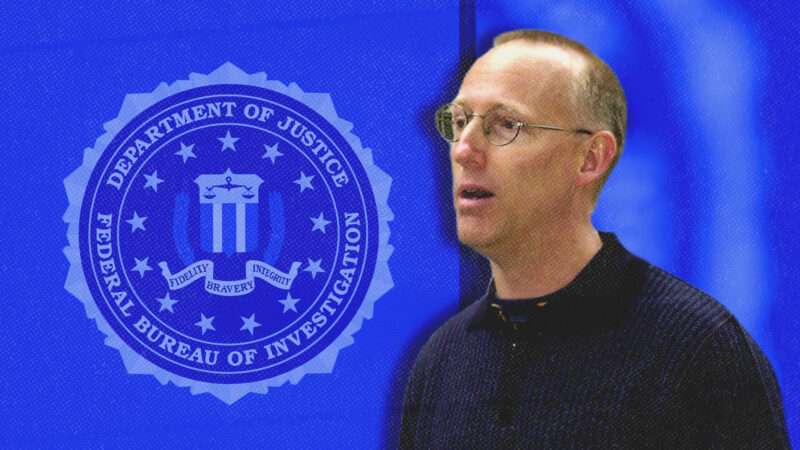
Most Americans knew the late Scott Adams for Dilbert, his beloved comic strip about an office worker and his dimwitted colleagues. Later in life, Adams became known as a kind of right-wing shock jockey. But the cartoonist caught the FBI’s attention for something a little bit different: the sex crimes investigation into former Rep. Matt Gaetz (R–Fl.) and a bizarre blackmail scheme that grew out of it.
The FBI released its files on Adams last week, five months after his death, in response to a Freedom of Information Act (FOIA) request from Reason. The records include the heavily redacted results of a background check and a request to Twitter—the social media network later renamed X—to preserve Adams’ account data, including his private messages.
The investigation into Adams seems to have begun in the spring of 2021, when he was entangled in the Gaetz scandal. On March 30, 2021, The New York Times reported that Gaetz was under federal investigation for having sex with an underage teenager. Gaetz claimed that he was actually the victim of blackmail, and the federal investigation focused on the extortionists.
Three days later, The American Conservative published screenshots of a text conversation between Adams and Jake Novak, a former journalist who was then working on the media staff of the Israeli consulate in New York. (The Israeli consulate later told Politico that Novak’s involvement in the Gaetz case “was not in any way, shape or form a part of his role at the consulate.”)
Novak wrote to Adams that the investigation into Gaetz “is screwing up my efforts to free Bob Levinson,” a former FBI agent who disappeared in 2013 while conducting an unauthorized mission for the CIA in Iran. “Gaetz’s dad was secretly finding [sic] us. So I’m very much wanting this to be untrue. I’ve got a commando team leader friend of mine nervously waiting for wire transfers to clear,” Novak explained. He claimed that Gaetz’s extortion claim “burned” Bob Kent, a private investigator involved in the efforts to free Levinson.
Those efforts were unlikely to succeed. The federal government declared in 2020 that Levinson had died in Iranian captivity.
In a CNN interview, Kent acknowledged that he asked Gaetz’s father for money to help rescue Levinson, but denied making any “threats” or “demands.” A few months later, Florida businessman Stephen Alford—whom prosecutors called Kent’s “associate“—pleaded guilty to making “materially false promises” of a pardon for Gaetz in exchange for funding the Levinson mission. Kent and Novak were not charged with crimes.
Years later, a congressional investigation concluded that Gaetz had indeed paid a 17-year-old girl for sex, though the federal government declined to prosecute him.
Adams never quite gave a satisfying explanation for why he was involved in the case. “Jake [Novak] and I shared an interest in the mechanics of persuasion, and in interesting business/political stories in general. Most often the stuff with a persuasion or Israel angle. That was our initial connection…people often tell me their scoops before they hit the news just to build credibility. Might have been that,” he told Politico.
The FBI files do little to shed light on that mystery, but they do put some of Adams’ old comments in a new light. “Do you think they looked at my personal data because I ever had a conversation with somebody from another country? Probably. And I can’t find that out, can I? If I sued the government, could I find out if they looked at my data? I could FOIA the FBI,” he said in a 2022 livestream. It turns out that the answer to these questions was yes.
The post Why did the FBI Want <i>Dilbert</i> Creator Scott Adams' Twitter Data? appeared first on Reason.com.
from Latest – Reason.com https://ift.tt/21MUwdR
via IFTTT