In a special America 250 issue, Reason takes a look back at our country’s founding people and ideas. Read more here.

The American Revolution took place in Indian country.
This is true in two senses. First, the physical landscape of the Revolution—the fields and forests through which troops marched and fought—was shaped by the continent’s original inhabitants. Second, and more important, the mental landscape of the Revolution, from its originating conflicts to its military tactics to the Founders’ ideas about freedom and the role of government, was also shaped by the continent’s original inhabitants.
Before the arrival of Europeans, New England had been inhabited for at least 11,000 years. Those first peoples didn’t like biting insects, thorny underbrush, and poison ivy. They did like berries, nuts, and tubers. Regular burning of undergrowth helped get rid of the bad stuff and promote the good stuff. Natives set fires in spring or fall, when dampness made the flames easy to control. Centuries of burning transformed big swaths of the eastern forest into woodlands so open and parklike that John Smith, of Pocahontas fame, boasted he could gallop a horse through them.
Native villages clustered around New England’s many rivers. Cornfields and gardens filled the riverbanks and drifted back into fire-maintained mosaics of berry fields and orchards. Threaded through this edible landscape was a network of trails—although trails may be the wrong term to describe roadways that were as much as 10 feet wide and many miles long.
With the British came epidemic diseases, especially smallpox, that depopulated the villages. Warfare further cleared the land. Settlers erected their new homes atop the old, their fields on land already cleared for farms. The first 50 colonial villages in New England were built on the sites of emptied native settlements. The roads among them were constructed over native roads.
Much as the Thirty Years’ War in Europe was fought on the geography created by the Roman Empire, the Revolution was fought on the geography created by native people. When Gen. Benedict Arnold went to capture Fort Ticonderoga, he marched along an ancient Indigenous trade route between Massachusetts Bay and the upper Hudson Valley. Today that road is Route 2, the “Mohawk Trail,” the main highway across northern Massachusetts. On their final, victorious march to Yorktown, the army led by Gen. George Washington and French Gen. Rochambeau went down the King’s Highway, a network of widened native roads that linked the 13 colonies. Yorktown itself had been one of the capitals of Tsenacommacah (Powhatan Confederacy), the native imperium encountered by the English at Jamestown, the first permanent English settlement in North America. And so on.
In a way that is difficult to imagine now, natives and newcomers lived cheek-by-jowl during the colonial era. Settlers in New England smoked tobacco, planted corn, carried wampum to trade, wore moccasins and deer hide to travel, and fished in canoes (rather than coracles). Indians cooked with steel knives and bowls, cut wood with European axes, and sometimes adopted Christianity. Cultural appropriation was two-way and rampant, and it moved at giddy speed.
As the decades went by, mingling hardened into acrimony, but the mutual influences remained. When natives and newcomers came to blows, Indians carried English weapons but attacked in their own style, with surprise raids by small parties darting in from the trees—what the missionary John Eliot called “the skulking way of war.” In the first big “Indian war,” the Pequot War of 1636–38, colonists shocked by Indigenous military victories ended up adopting their opponents’ tactics wholesale. “God pleased to show us the vanity of our military skill, in managing our arms, after the European mode,” Eliot wrote with chagrin. Fifty years later came King Philip’s War (1675–78). This time, the English waged war like natives—and won decisively.
The lessons carried over to the Revolution. “They did not fight us like a regular army, only savages, behind trees and stone walls,” one British soldier complained after the opening Battle of Lexington and Concord. The colonists, he wrote, are “full as bad as the Indians.” After the war, British Lt. Thomas Anburey grumbled that the rebels, infected by “the Indian’s idea of war,” “delight more by murdering from the woods, walls and houses, [rather] than in shewing any genius or science in the art military.”
Both sides wanted the powerful Haudenosaunee (Iroquois) to fight on their side. In May 1775, the colonial militia leader Ethan Allen begged them to “Join with me and my Warriors”—the Green Mountain Boys, as his guerrilla force was known. “I know how to shute and ambush just like Indian and want your warriors to come and see me and help me fight Regulars. You know they Stand all along close Together Rank and file and my men fight as so as Indians Do.” The Haudenosaunee, a league of six Indigenous nations, was leery of involvement in what it saw as a foreign civil war. But individual members were drawn in on both sides, splitting the confederacy. Swept into the fight alongside them were another dozen native societies.
The contribution of native-style warfare—and natives themselves—to the Revolution should not be exaggerated. Washington was leery of both Indians and their tactics. Throughout the conflict, he sought to fight European-style, with massed armies blasting away at each other in open fields—although he did sometimes look for soldiers who were, as he put it, “accustomed to the irregular kind of wood-fighting practiced by the Indians.” Gradually he warmed to working with such allies as the Iswa (Catawba) and Lënapeyok (Lenape), but he relied on them only for specialized roles—scouting, spying, and safeguarding the frontier—rather than as infantry troops in pitched battles.
If natives’ impact on the battleground was limited, their impact on the war’s origins, political and intellectual, was enormous.
A turning point occurred in 1763. In January, European nations signed the Treaty of Paris, which ended the Seven Years’ War between Britain and France (and their respective allies). Dismaying the war-weary British government, Pontiac’s Rebellion erupted barely four months later. It was a monthslong, broad-scale assault by a coalition of native nations on British forces in Michigan and the Ohio Valley. (“Pontiac” was the English name for Obwaandi’eyaag, who led the Odawa, or Ottawa, in Michigan.)
NATIVE LANDS ESTABLISHED BY PROCLAMATION OF 1763
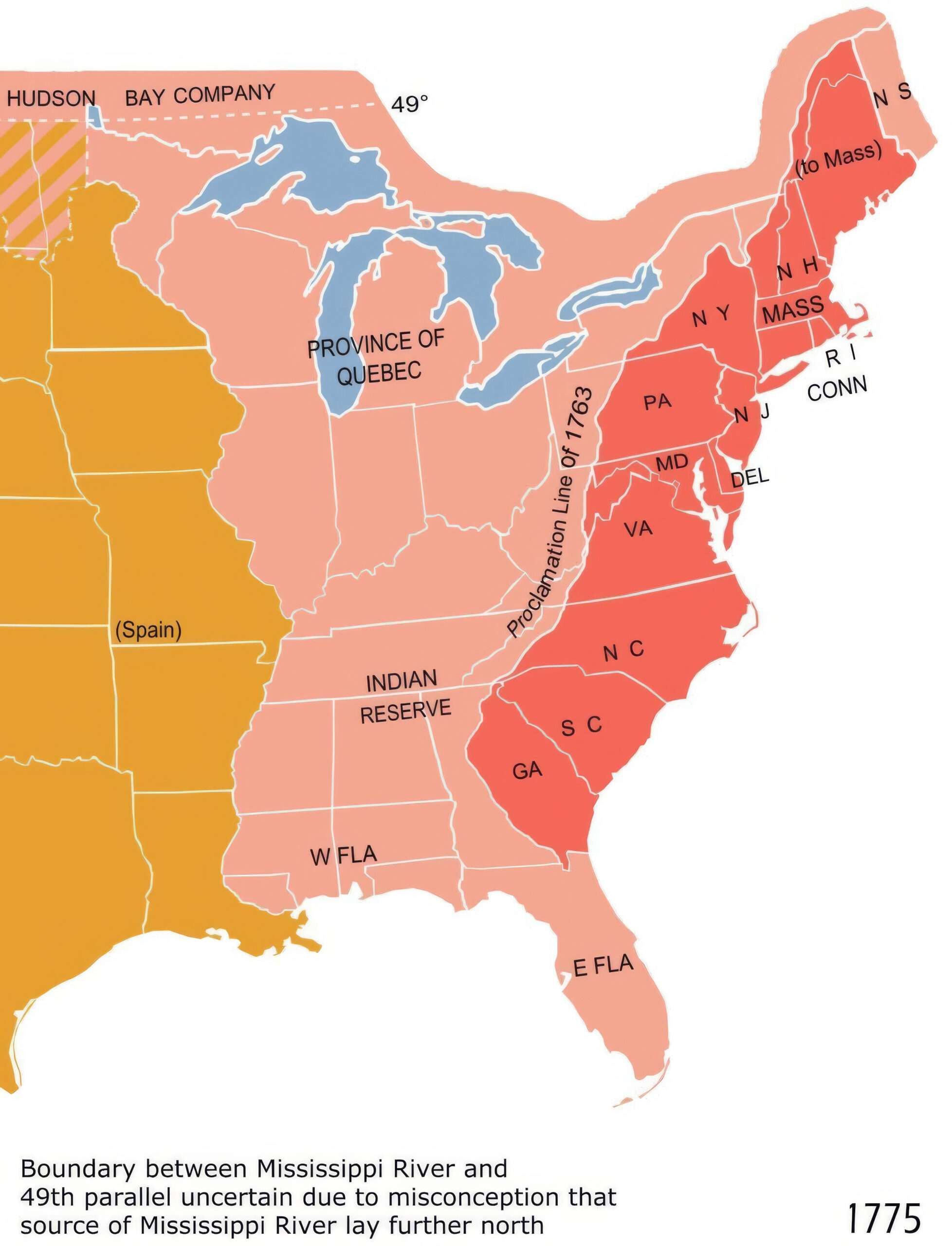
In October, seeking to defuse what was becoming a long and costly conflict, King George III banned colonists from moving into land west of the Appalachians. The royal proclamation gave natives permanent title to what had been the eastern half of France’s American holdings—all of the land between the Mississippi River and the crest of the Appalachian Mountains, plus the western half of Georgia, all of Florida, and a big chunk of Canada. It blocked off an area of something like 600,000 square miles.
Leave aside natives’ annoyance at being “given” title to land they had occupied for generations. Colonists reacted with fury. From their point of view, the king was taking back the free land he had promised them—the reason that many had left their homelands, the goal of fighting the Seven Years’ War. Worse, he was giving it to “savages.”
Nowhere was the anger more volcanic than in Pennsylvania, through which many migrants had intended to move into the rich Ohio Valley. Even as the conflict with Pontiac continued, tensions rose between Pennsylvania’s colonists and their government in Philadelphia. Settlers harassed soldiers ordered to enforce the king’s proclamation. Pennsylvania’s legislature, Benjamin Franklin moaned, was under siege by a “mad armed Mob.”
British Gen. Thomas Gage and Pennsylvania Gov. John Penn initiated peace talks with Pontiac in March 1765. The negotiators left Philadelphia with a caravan of more than 80 packhorses loaded with goods as guarantees of London’s words. Viewing the talks as a sellout, a backwoods militia known as the “Black Boys” raided the supply train, attacked English forts, and kidnapped English soldiers. Penn convened a grand jury to charge the Black Boys. It refused to indict them.
Encouraged, the Black Boys seized much of western Pennsylvania, controlling traffic through the area, assaulting British forces, even issuing their own passports. The conflict continued until July 1776, when Pennsylvania, after a constitutional convention dominated by the Black Boys, became the first colony to establish an independent government, one intended to be responsive to the popular will. It was the first big revolt against British authorities—a dress rehearsal in miniature for the Revolution that was to follow.
Anger about Pontiac’s rebellion and the Proclamation of 1763 bubbled into the Declaration of Independence. When the Declaration decries the king’s support of “the inhabitants of our frontiers, the merciless Indian Savages,” it is referring to his attempts to compromise with the native coalition in the Ohio Valley. And when the Declaration denounces the king’s measures to “prevent the population of these States”—that is, to discourage immigration to the colonies—by “raising the conditions of new Appropriations of Lands,” it is talking about the Proclamation.
The Revolution had causes other than the Proclamation: taxation, trade controls, forcing colonists to house troops, and so on. One of the most important was one of the most intangible: the rebels’ beliefs about freedom, liberty, and governance. These, too, were deeply entwined with North America’s original inhabitants.
The first European ventures into North America occurred as Enlightenment figures such as John Locke, Jean-Jacques Rousseau, and Voltaire were questioning Europe’s absolute monarchies, state religions, and rigid class rules. All of these thinkers were fascinated by the recently revealed existence of Native Americans—living, breathing products of societies with wholly different social, political, and spiritual traditions. All of them made Indians central to their work.
None of these thinkers were ethnographers in the modern sense. The “natives” featured in their work mainly are foils—convenient human illustrations for ideas. Consider the protagonist of Voltaire’s popular novella L’Ingénu (1767). A naive young man, half-French and half-Wendat (Huron), he was less an actual character than a vehicle for the author to mock French hypocrisy and corruption. Locke, interested in the origins of society, used Indians in his work as examples of early human development, preserved as if in amber. (“In the beginning,” he wrote, “all the world was America.”) Rousseau had similar views. The difference was that Locke didn’t think much of these supposedly primitive societies and Rousseau admired them.
At the same time, other Europeans actually were interested in native life—and drew lessons from it. Again and again, foreign visitors to New England and Quebec described their inhabitants as having vastly more personal liberty and autonomy than Europeans. “They imagine that they ought by right of birth, to enjoy the liberty of wild ass colts, rendering no homage to anyone whatsoever,” wrote Paul Le Jeune, a Jesuit missionary in France’s Canadian colony from 1632 to 1649. “They have reproached me a hundred times because we fear our Captains [nobles and kings], while they laugh at and make sport of theirs.”
Unlike Locke, Rousseau, and Voltaire, Le Jeune had a conception of native life that was basically accurate. As he reported, native rulers had little formal authority; they had to persuade others to follow their ideas. The Haudenosaunee, for example, have a tadadaho, who presides over the Grand Council, which itself was comprised of male leaders of the league’s six member nations. Tadadaho is traditionally a lifetime appointment, like a king, but the role is more like today’s speaker of the House—someone who shapes the agenda but must marshal the support of the other representatives to make anything happen. Even if the tadadaho won the Grand Council’s backing, he could not act without the approval of a second, all-female council, traditionally formed of clan mothers.
Unlike European kings and nobles, Haudenosaunee leaders could be deposed if their people lost faith in them (although this was relatively uncommon). They had to have the consent of the governed and worked hard to keep it. Were the colonists who rebelled against King George and established a republic inspired by this? Surely not directly. But it seems clear that the colonists on the Atlantic seaboard were imbued with views about freedom that were strikingly different from those of their ancestors, and that they identified those views with native people.
Europeans at the time widely believed in the “Great Chain of Being,” in which society was organized by divine mandate into a rigid social hierarchy. At the top was the king, whose authority was endowed by God. One rung below him was the nobility, whose noble blood made them superior to the merchants and peasants below. So important was the social ladder that European nations had sumptuary laws prohibiting commoners from passing themselves off as their betters by donning their attire—in England, for instance, only the nobility could wear beaver-felt hats. Failing to kowtow to people of superior status was a violation of the Christian order. It was sinful, unthinkable, unnatural.
The Wendat, Haudenosaunee, and other northeastern Indigenous groups thought all that was hooey, and they loudly told this to the Europeans. They “brand us for slaves, and call us miserable souls, whose life is not worth having, alleging that we degrade ourselves in subjecting ourselves to one man [the king] who possesses all the power,” reported the Baron de Lahontan, who spent nine years in French Canada. De Lahontan’s accounts of his American sojourn, translated into half a dozen languages, include a 1703 book of “dialogues” with a Wendat leader, Kondiaronk, who scoffed at European pretensions. “I have the absolute disposal of myself, I do what I please,” Kondiaronk told de Lahontan. The baron, he said, was a fool for “choos[ing] rather to be a French slave than a free Huron.”
The appeal of native freedom was anything but theoretical. The Swedish botanist Pehr Kalm spent three years in the Northeast and returned with a best-selling account of colonial life. When Indians captured settlers in war, Kalm reported, most “never wanted to return….They found the Indians’ independent way of life preferable to that of the European.” Similarly chagrined observations came from Benjamin Franklin. By the time of the Revolution, wrote the aristocratic settler John Hector St. John, “thousands” of Europeans had joined native societies, “and we have no examples of even one of those Aborigines having from choice become Europeans!”
An instinctive dislike of overweening hierarchy is lodged deep in the U.S. character. Some of that surely is because settlers came to the Americas already dissatisfied with what Europe offered them. But one cannot dismiss the impact of seeing other, freer ways of life up close.
When the colonists swarmed the docks of Boston for the Boston Tea Party, they began a call for liberty that led to the Revolution. What did those colonists do to announce their quest for freedom? They disguised themselves as Indians.
The post Native Americans Taught Colonists How To Fight—and To Live Without Kings appeared first on Reason.com.
from Latest – Reason.com https://ift.tt/Z4A5eQ9
via IFTTT