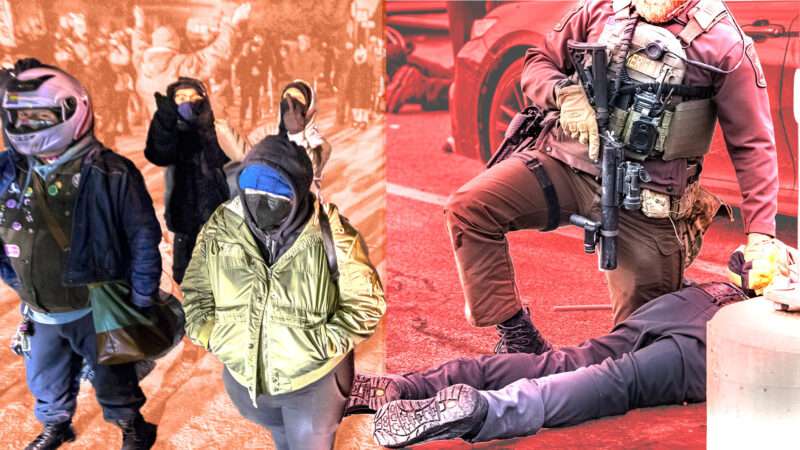
Last week, the Department of Justice (DOJ) announced the indictment of 15 Minnesota activists. The charges included conspiracy to injure or impede a federal officer, which carries a penalty of up to six years in prison.
According to the indictment, the activists are members of “an organization dedicated and committed to direct action against federal law and immigration enforcement.” It further alleges that they are part of the loose assemblage of antifascist activists known as antifa.
In a statement, the White House called the indictment a “crushing blow” to “the violent anarchist network.” Instead, it seems like another example of the Trump administration taking a overly heavy hand against people the administration doesn’t like.
Prosecutors say the defendants acted collectively to obstruct federal law enforcement officers moving in or out of the Bishop Henry Whipple Federal Building in the Minneapolis–St. Paul area. (The Trump administration deployed federal immigration officers to the city last year, in what it called Operation Metro Surge. As CNN reported in January, the Whipple building “is home base for the immigration proceedings at the heart of the crackdown in the state.”)
According to the indictment, protesters set up roadblocks in an attempt to obstruct federal immigration officers traveling in or out of the building.
While roadblocks may be illegal—not to mention annoying—they don’t constitute violence, or a conspiracy to use violence, against a federal officer, like the indictment claims. “It’s really hard for me to come up with anything they were talking about doing that would be actually using force against an officer,” said Josh Esmay, deputy director of the Legal Rights Center. “Setting up a blockade is not using force.”
The indictment also lists numerous instances of lawful conduct as “overt acts” taken “in furtherance of the conspiracy,” such as warning people when immigration officers are nearby.
“In the indictment, the DOJ appears to argue that involvement in rapid-response networks is illegal because they ‘identify and harass’ federal agents to prevent them from ‘performing their official duties,'” Elizabeth Weill-Greenberg writes at The Appeal. “Rapid-response networks alert community members to ICE’s presence so volunteers can monitor, protest, and film officers’ actions—all activities that are protected by the First Amendment, despite the administration’s assertions to the contrary.”
“I looked through the indictment at all the things that include my name, and I seem to be indicted for holding meetings,” one defendant told the judge, according to The New York Times.
Indeed, while the indictment details acts of violence, it never alleges the defendants were directly involved. And while it goes to great lengths to establish that certain defendants were members or affiliated with antifa, group memberships are not illegal.
At a press conference announcing the indictment, U.S. Attorney Daniel Rosen struggled to justify the charges. When asked how he or the Department of Justice define antifa, Rosen spoke in circles, saying a strict definition was beyond the “scope” of the indictment, but “we have plenty of people who self-identify in that way, and you might want to ask them that question.”
He also declined multiple times to say whether any officers were actually injured as a result of the defendants’ actions.
“We have a group of people who quite deliberately got together, planned violence, used violence,” Rosen said, then added that “whether or not they actually, at the end of the day, caused bodily harm is not the measure of whether or not they committed a serious federal crime.”
“We certainly want to prosecute people who are actively involved in a plot against the United States government to interfere with federal government functions,” Richard Painter, who served as chief White House ethics lawyer under President George W. Bush, told Courthouse News. “But there’s also such a thing as peaceful protest, [and] people have the right to assemble outside a federal building.”
Rosen is likely desperate for a win: As MPR News reported, “In December and January, federal prosecutors charged 36 people, mostly protesters, with assaulting or impeding federal immigration agents.” But Rosen’s office “has dropped 18 of the 36 cases entirely, including three with prejudice meaning they can’t file them again. Another 11 cases have been effectively dropped through non-prosecution agreements.”
In one particular case, Rosen’s office charged Julio Cesar Sosa-Celis with assaulting a law enforcement officer, saying he had used a shovel against a federal immigration officer who then had to shoot him. The charges were later dropped when the officer admitted he lied.
At Rosen’s press conference, multiple reporters cited this sketchy history and asked how this case would fare any better. His answers were vague and unconvincing: “Read the indictment, and you’ll understand the full magnitude of this case,” he told one reporter. “You watch how this case plays out, you watch how the evidence plays out, and the evidence will prove it all out,” he told another.
While it’s certainly possible that the evidence will bear out the prosecution’s case, it already resembles the Trump administration’s established pattern of prosecuting people for disfavored but protected speech.
Last year, President Donald Trump issued an executive order “designating Antifa as a domestic terrorist organization,” citing a “pattern of political violence designed to suppress lawful political activity and obstruct the rule of law.”
As Reason‘s Matthew Petti wrote at the time, this made little practical difference: The U.S. has no formal designation for domestic terrorist organizations.
But Trump also issued a National Security Presidential Memorandum (NSPM-7), which said “common threads” among antifascist terrorists included “anti-Americanism, anti-capitalism, and anti-Christianity,” and “hostility towards those who hold traditional American views on family, religion, and morality.”
In December, then-Attorney General Pam Bondi issued a memo on implementing NSPM-7. She directed “all federal law enforcement agencies” to “compile a list of groups or entities engaged in acts that may constitute domestic terrorism,” which she defined to include “organized rioting, looting, doxing” and “conspiracies to impede or assault law enforcement.”
Rosen’s office specifically cited NSPM-7 when announcing the indictments.
“While we do not yet have all of the information about these charges, the criminal prosecution of observers and protestors should be carefully scrutinized for retaliatory motives,” the ACLU of Minnesota said in a statement. “Prosecution of a small number of people as punishment for exercising their First Amendment rights can chill people from exercising those same rights. Given this administration’s history of misrepresenting the facts regarding their conduct toward observers and protestors during Operation Metro Surge, Minnesotans should demand transparency and reserve judgement until we fully understand the facts in this case.”
“This indictment appears to be going way overboard, using a sledgehammer to address what might have been some infractions, some violations of the law by some individuals,” Painter added.
The post DOJ Case Against Minneapolis Antifa Groups Has Concerning First Amendment Implications appeared first on Reason.com.
from Latest – Reason.com https://ift.tt/OCqgMY3
via IFTTT