Both Parents Work Full-Time In Majority Of Families, Census Data Show

Both Parents Work Full-Time In Majority Of Families, Census Data Show

Authored by Zachary Stieber via The Epoch Times,

Both parents work full-time in more than half of couples with children under 18, according to newly analyzed data.

Fifty-two percent of couples comprised of a mother and father work full-time jobs as of 2025, according to the Pew Research Center analysis of data from the U.S. Census Bureau released on June 16.

That percentage is an increase from 46 percent in 2015 and 31 percent in 1975.

Black mothers are still the most likely to be in a couple where both she and the father work, according to an analysis broken down by race. Sixty percent of black mothers are in such a partnership, down slightly from 64 percent in 2000.

Majorities of white, 54 percent, and Asian, 52 percent, women with children are for the first time in couples comprised of two working parents. Hispanic women are still more likely to be in a couple with only one working parent.

Mothers with lower levels of education are the most likely to be in a couple in which the dad works full-time, and the mom is not employed, according to the analysis.

That figure was 30 percent for mothers with, at most, some college education, compared to 21 percent for mothers with bachelor’s degrees and 11 percent for mothers with postgraduate degrees.

Across all couples with minor children, the percentage in which the father works full-time and the mother is not employed declined from 42 percent in 1975 to 23 percent in 2025.

In another 15 percent of couples, the father works full-time and the mother works part-time. In five percent, the father works part-time or is not employed, and the mother has a full-time job. And in the remaining five percent, there is some other arrangement.

Many parents view their family’s financial situation as positive, according to a Pew survey conducted in March, provided the mother works at least part-time. For parents in couples where the dad works full time, and the mother does not have a job, only 19 percent said their financial situation is positive, and 41 percent said it is negative.

Adults in those couples were the most likely to say that the work arrangement was positive for their children’s well-being. Eighty-five percent did. Just 49 percent of parents in couples where both mothers and fathers work full-time answered the same.

Some 52 percent of the respondents also said their job makes it harder to be a good parent, and 45 percent said that being a parent has made it difficult to advance at work.

Additionally, 62 percent of mothers who work full-time expressed frustration with balancing work and family responsibilities, compared with 47 percent of fathers who work full-time.

Tyler Durden
Thu, 06/18/2026 – 10:00

via ZeroHedge News https://ift.tt/1aMXLmj Tyler Durden

“The Impact was Devastating”: Chicago’s Cross-Burning Was Set By Liberal, Anti-Trump Protester

“The Impact was Devastating”: Chicago’s Cross-Burning Was Set By Liberal, Anti-Trump Protester

Authored by Jonathan Turley,

After the Southern Poverty Law Center scandal of actually funding and encouraging racist protests, it appears that at least one individual has created his own orchestrated racist incident.

In Chicago (where Jussie Smollett committed his infamous racist hoax), a burning cross was denounced by Mayor Brandon Johnson as a sign of the racism in society.

Johnson, however, refused to address the fact that the cross burning was actually the work of an anti-Trump liberal student.

University of Illinois senior Merlin Lu said it was never intended as a racist symbol, but the question is whether it could still be charged as a hate crime.

In posting a reward for the culprit soon after the incident, Rev. Michael Pfleger declared that “this bold rise of racism must be condemned by every race, faith community, and Chicagoan as was done with the swastika and treated as a hate crime.”

It turns out that this was not evidence of the rise of racism but another possible hoax.

Lu bizarrely claimed that he was unaware that a burning cross had racist connotations and insisted that there was no racist message intended.

Others suspected that this was a type of false-flag effort to outrage the left.

Johnson later denounced the incident as a “symbol of hatred is one that we must continue to reject, and I wholeheartedly reject it. I can’t speak to anyone’s motives; I can only speak to the impact, and the impact was devastating.”

It seems curious that Johnson would not “speak to motives” when he knows that this was set by a leftist radical.

The question is whether it is still a hate crime under Illinois law. Under Section 12-7.1, the law states:

(a) A person commits hate crime when, by reason of the actual or perceived race, color, creed, religion, ancestry, gender, sexual orientation, physical or mental disability, citizenship, immigration status, or national origin of another individual or group of individuals, regardless of the existence of any other motivating factor or factors, he or she commits assault, battery, aggravated assault, intimidation, stalking, cyberstalking, misdemeanor theft, criminal trespass to residence, misdemeanor criminal damage to property, criminal trespass to vehicle, criminal trespass to real property, mob action, disorderly conduct, transmission of obscene messages, harassment by telephone, or harassment through electronic communications as these crimes are defined in Sections 12-1, 12-2, 12-3(a), 12-7.3, 12-7.5, 16-1, 19-4, 21-1, 21-2, 21-3, 25-1, 26-1, 26.5-1, 26.5-2, paragraphs (a)(1), (a)(2), and (a)(3) of Section 12-6, and paragraphs (a)(2) and (a)(5) of Section 26.5-3 of this Code, respectively.

The notable language is “regardless of the existence of any other motivating factor or factors.” The inclusion of property damage could allow a charge to be brought.

The case could rekindle the debate over intent for threats. Many professors and pundits on the left have long argued that the standard should be how a message is received rather than how it is intended. That issue arose in the decision in Counterman v. Colorado, 600 U.S. 66 (2023), concerning the standard for the “true threats” exception to the First Amendment. In an opinion written by Justice Elena Kagan, the Court reversed the conviction. While rejecting an “objective” standard, the Court declared that such cases had to be based on evidence of the defendant’s state of mind under a “subjective standard.” Accordingly, the government must prove recklessness, but not necessarily intent: “The State must show that the defendant consciously disregarded a substantial risk that his communications would be viewed as threatening violence.”

Recklessness would be a dangerous standard for the defense of Merlin Liu. He insists that he was entirely clueless about what a burning cross represents in our culture. Yet, if Chicago does not bring a hate crime charge, it could be cited in future cases in suggesting that intent or “motivating factors” do matter in such cases.

I have favored stronger scienter or intent standards in true threat cases. It seems like a hate crime should, at a minimum, also be based on an intent to cause such alarm or fear. That does not mean that Liu’s defense of ignorance will work. However, in my view, prosecutors should have to show more than how others perceive a protest.

Unlike Johnson, the prosecutors and the Court will have to “speak to motivations” before this case is concluded.

Jonathan Turley is a law professor and the New York Times best-selling author of “Rage and the Republic: The Unfinished Story of the American Revolution.”

Tyler Durden
Thu, 06/18/2026 – 09:20

via ZeroHedge News https://ift.tt/wbH8ZXf Tyler Durden

The Most Interesting Supreme Court Opinion Line-Up You Will See This Year

Today the Supreme Court decided T.M. v. University of Maryland Medical System Corp., a case concerning the application of the Rooker-Feldman doctrine, under which federal district court review of state court decisions is generally barred.

The justices split 5-4 on the application of the doctrine here. Justice Sotomayor wrote for the Court. She summarized the issue in T.M. this way:

Under what has become known as the Rooker-Feldman doctrine, federal district courts lack jurisdiction over “cases brought by state-court losers complaining of injuries caused by state-court judgments rendered before the district court proceedings commenced and inviting district court review and rejection of those judgments.” Exxon Mobil Corp. v. Saudi Basic Industries Corp., 544 U. S. 280, 284 (2005). This case asks whether this rule bars suit when the state court judgment at issue is subject to further review in state appellate proceedings. A straightforward application of the logic and reasoning underlying Rooker-Feldman leads to one conclusion: It does. Because this suit falls within the narrow doctrine’s limits, the Court of Appeals for the Fourth Circuit properly affirmed its dismissal.

The line-up this decision produced is what is particularly interesting. Justice Sotomayor was joined by Justices Thomas, Alito, Kavanaugh, and Jackson. (Justice Thomas also wrote a separate concurrence, defending Rooker “as an original matter.”)

Justice Barrett dissented, joined by the Chief Justice and Justices Kagan and Gorsuch. Her opinion begins:

Twenty years ago, this Court held that the Rooker-Feldman doctrine is “confined” to the procedural circumstances of the two cases from which the doctrine draws its name. Exxon Mobil Corp. v. Saudi Basic Industries Corp., 544 U. S. 280, 284, 291 (2005); see Rooker v. Fidelity Trust Co., 263 U. S. 413 (1923); District of Columbia Court of Appeals v. Feldman, 460 U. S. 462 (1983). In “both cases,” we emphasized, the federal action was brought “after the state proceedings ended.” Exxon, 544 U. S., at 291. Seven Courts of Appeals took us at our word, refusing to apply Rooker-Feldman when the underlying state action remained pending. They were right to hold the line. Because the Court has chosen to relax it, I respectfully dissent.

Her dissent concludes:

The upshot of today’s decision is that the Court has muddied waters that were hardly clear to begin with. That is unfortunate, because there was a better path available: treating Rooker-Feldman as “the §1257 Rule.” VanderKodde, 951 F. 3d, at 409 (Sutton, J., concurring). Doing so would have been both clearer and more faithful to Exxon.

Still, the news is not all bad. Although the Court expands Rooker-Feldman beyond Exxon‘s line, it repeatedly emphasizes that the doctrine is “narrow.” See ante, at 1, 7, 8, 18. Courts should not lose sight of that message. In the end, Rooker-Feldman has been given an inch—it should not be allowed to take a mile.

T.M. was not the only decision today to produce an interesting lineup. The Court was unanimous in the judgment in United States v. Hemani–a potentially important Second Amendment case–but split on the rationale. Justice Gorsuch wrote for the Court. Justice Alito wrote separately, only concurring in the judgment and was joined by Justice Kagan. (Yes, you read that correctly.) Justices Thomas and Jackson also authored concurring opinions.

The post The Most Interesting Supreme Court Opinion Line-Up You Will See This Year appeared first on Reason.com.

from Latest – Reason.com https://ift.tt/5YOpybQ
via IFTTT

Americans Still Believe in the Founding—and Want Schools To Teach Capitalism


Figures on a boat looking at money | Illustration: Midjourney

As the 250th anniversary of the signing of the Declaration of Independence nears, it looks like Americans overwhelmingly approve of their country’s cardinal principles.

That’s the top-line finding from a recent survey conducted by the American Enterprise Institute (AEI) about the legacy of America’s founding. While its results did reflect a generational divide—baby boomers were much friendlier to the Founding than Gen Z—73 percent of the younger generation still agreed that “the founders deserve respect…for how they set up the United States.” And 74 percent of Gen Z respondents agreed that “studying the political principles of the founding fathers can help inform our decisions today.”

Support for Founding principles was also impressively robust across party lines: 92 percent of Republicans and 77 percent of Democrats said that it was “more important than ever to teach all kids the history of the founding fathers.”

But though the sentiment is generally popular, its specific implementations tend to be rather controversial. In Florida, a recently devised A.P. U.S. History alternative, which casts the Founding and its Enlightenment-influenced classical liberalism in a rosier light, has been characterized by the media as an “anti-woke” reaction and a specifically “conservative” reform. 

The AEI survey also revealed surprisingly broad support for capitalism. Among 5,306 respondents, 82 percent said it was “very” or “somewhat important” to teach about “the benefit of free market capitalism” in high schools. Only 4 percent said that it should not be taught.

The result stands in stark contrast with other recent polling on the popularity of capitalism. For instance, a Gallup survey from last September found that just 54 percent of Americans have a positive opinion of the economic system, down from 61 percent in 2010.

There have been other prominent indications that Americans’ faith in the free market could be slipping. New York City, for instance, elected a self-avowed socialist for mayor, who used his inauguration speech to decry “the frigidity of rugged individualism.” (Washington, D.C., may soon follow in NYC’s footsteps.)

Still, not all of the AEI survey results tell a story of Americans eager to “accentuat[e] positive views of America.” Among parents surveyed in 1998, 50 percent said they would be upset if their children’s teacher “constantly criticized America’s economic and political system”—this year, only 32 percent agreed.

But beneath the malaise, it would seem that Americans are fundamentally committed to the values and freedoms of the Founding. “Much has changed since the late 1990s,” the AEI report reads, but “still, most Americans in 2026 report that they are familiar with our founding documents and endorse long-standing civic ideals such as freedom of speech, freedom of religion, and equal opportunity.”

The post Americans Still Believe in the Founding—and Want Schools To Teach Capitalism appeared first on Reason.com.

from Latest – Reason.com https://ift.tt/zYJKLH3
via IFTTT

Who Can’t Afford Food?


Grocery receipt | Illustration: Adani Samat/Envato

What affordability discourse gets wrong: “Nearly half of U.S. families couldn’t afford basic necessities in 2024, report finds,” reads an NPR headline from last week. “Half of Americans can’t afford to dine out or vacation in a cost of living crisis,” reads a Fortune headline from a few months ago. Meanwhile, Axios reports that “sewer socialism” is catching on across the country, describing it as an approach that “focuses on expanding government programs for the public good, like affordable housing, child care and public transportation.”

Technically, “sewer socialism” is a very old term that’s just being co-opted now to refer more vaguely to an almost New Deal sensibility: a “universal everything,” as opposed to means-tested social safety net preference. (“Sewer socialism” has historically referred to the good governance of the nitty-gritty unsexy things that cities provide: sanitation (thus the name), public housing, utilities, and streets.) But it’s true that something is afoot, related to both cost of living and quality of life—especially in urban areas—and that the policy discourse muddies a few issues by jumbling them together. Call it what you want.

“It’s like, yeah, good job reading the polls that tell you that affordability is the number one issue. Do you understand why that is the case? It’s because people can’t f–king afford to eat, so of course that’s their main issue,” Democratic strategist Jesse Lehrich told Axios. This argument crops up over and over again—that a substantial portion of Americans can’t afford essentials—and is increasingly used to justify all manner of state intervention. But is it at all true?

“A real but small share of Americans are in genuinely miserable financial situations. They have more bills than they can pay. They are one missed paycheck from eviction. They frequently have literally zero money. The unemployable woman with the worthless degree from the fraudulent for-profit college is in this category. So is the 58-year-old who got laid off from a manufacturing job, exhausted his savings, can’t get hired anywhere, and watches his wife work double shifts at Walmart,” write Aaron Brown, Michael Mendelson, and Clifford Asness for The Dispatch. “These people need money. The institutions that make their lives worse—the for-profits that produce unemployable graduates, and the medical billing systems designed to confuse people into paying twice—need to be regulated or eliminated. Both of those statements are true, and neither is in serious political dispute.” They continue:

“The second problem is the squeezed-talent class, and it’s harder to explain because the people involved look fine on paper. Picture a 32-year-old physician married to a 32-year-old software engineer. Combined household income, $400,000. They cannot buy a house in San Francisco or Boston or New York within a sane commute of their jobs. They cannot afford to have three kids, pay for childcare, and put them in decent schools. They are doing every single thing the meritocratic American dream told them to do, and the dream is not being delivered. Their parents, at the same age, with worse credentials and lower real incomes, owned a house and had three kids on one salary. Something is broken here, and it isn’t their fault, and it isn’t fixed by transfers. Giving this couple a $5,000 childcare credit doesn’t move the needle on $4 million houses—and worse, by raising effective demand for childcare without doing anything about the supply, the credit makes childcare more expensive for the people behind them in line. The right tends to dismiss this couple as coastal-elite complainers. The left tends to dismiss them because they’re already in the top 5 percent of incomes. Both are wrong. This is a talent-allocation problem of the first order, and a country pays a real price when its most productive young people can’t form families or live near their work. These two problems require completely different policy responses.”

Note that the squeezed-talent class is also distinct (though sometimes overlapping) from the “why-should-I-live-within-my-means” types: The people who came of age as millennial lifestyle subsidies were expiring, who never really learned how to budget or sacrifice, who believed upward mobility would be available to them too, but became rather accustomed to a high standard-of-living in childhood and weren’t able to build on it much in adulthood (or even meet it at all).

“A lot of people set their goal as how can I have the same experience as ordering out, only at home? and the answer is you can’t!” comments The Washington Post‘s Megan McArdle. “The current generation is earning more at their age than previous generations did at their age; when you combine the fact that they have more income, and more opportunities to spend that income on food, and that all of us really love something delicious at the end of a hard day of work, food is one of the easiest things to indulge yourself with. And, on an individual, per-indulgence basis, it’s one of the cheapest.”

“The problem is people are sufficiently rich to eat a lot of takeout, but they aren’t necessarily sufficiently rich to be financially healthy (or physically healthy) if they do so,” adds McArdle. It’s partly a problem of high costs, and partly a problem of high expectations (to the extent that it’s a problem at all). And it’s also partly a problem of real gains in quality of life being obscured and taken for granted.

Each set of needs requires different public policy solutions. And I’d argue that last group doesn’t need a public policy solution at all—just a remedial home economics class (or, in their eyes, a socialist to save them).

Memorandum signed at Versailles: “The Islamic Republic of Iran and the United States, together with their allies in the current war, declare upon the signing of this Memorandum of Understanding an immediate and permanent end to the war on all fronts, including Lebanon, and undertake that from now on they will not launch any hostile action against each other, and will refrain from the threat or use of force against each other,” reads a draft of the memo, reported by Bloomberg. President Donald Trump signed the memorandum in Versailles, France, yesterday. “The agreement lifts the U.S.-imposed naval blockade of Iranian ports and, most crucially, grants Iran waivers to begin exporting its oil even before the negotiation of a final agreement on its nuclear program,” reports The New York Times. 

The more complicated issues will get hammered out over the coming weeks, starting tomorrow, when American delegates meet with their Iranian counterparts in Switzerland. “This time, the Iranians will come to the table armed with valuable knowledge: They can survive the worst the Americans can throw at them,” speculates Yaroslav Trofimov over at The Wall Street Journal.President Trump and Israeli Prime Minister Benjamin Netanyahu gambled that their fierce campaign of airstrikes, launched on Feb. 28 and lasting 40 days, would overthrow Iran’s theocratic regime, or at the very least force it to make major concessions. None of that happened, despite the killing of much of Iran’s senior leadership, including Supreme Leader Ayatollah Ali Khamenei, and the decimation of the country’s navy, air force and other military assets.”


Scenes from New York: Yesterday, an 18-year-old Indian tourist died after falling from a horse-drawn carriage in Central Park when the horse bolted. Some are advocating for carriage-horses to be regulated away, following the accident.


QUICK HITS

  • “The Trump administration’s budget office has redirected $352 million that was intended in part for Secret Service training and recruitment to what it described as security measures at the White House, a government database shows,” reports The Washington Post.
  • “It’s been quaint this week to see the G7—that talking shop for downwardly mobile world powers, plus the US—follow the White House’s Anthropic bombshell by issuing a draft communique pledging to ‘discuss’ the opportunities and risks of AI for the financial sector,” writes Lionel Laurent at Bloomberg.
  • New, must-listen Ross Douthat episode: “JD Vance on the Morality of the Trump Administration.” His description: “I asked the vice president what is Christian about this White House.”
  • “Los Angeles County saw the largest decline of any county in the United States in 2025, according to new census data published on March 26,” reports KTLA. “Nearly 54,000 people moved out of L.A. County between July 1, 2024 and July 1, 2025, U.S. Census data shows.”
  • Who says romance is dead?

The post Who Can't Afford Food? appeared first on Reason.com.

from Latest – Reason.com https://ift.tt/um0htoZ
via IFTTT

Who Can’t Afford Food?


Grocery receipt | Illustration: Adani Samat/Envato

What affordability discourse gets wrong: “Nearly half of U.S. families couldn’t afford basic necessities in 2024, report finds,” reads an NPR headline from last week. “Half of Americans can’t afford to dine out or vacation in a cost of living crisis,” reads a Fortune headline from a few months ago. Meanwhile, Axios reports that “sewer socialism” is catching on across the country, describing it as an approach that “focuses on expanding government programs for the public good, like affordable housing, child care and public transportation.”

Technically, “sewer socialism” is a very old term that’s just being co-opted now to refer more vaguely to an almost New Deal sensibility: a “universal everything,” as opposed to means-tested social safety net preference. (“Sewer socialism” has historically referred to the good governance of the nitty-gritty unsexy things that cities provide: sanitation (thus the name), public housing, utilities, and streets.) But it’s true that something is afoot, related to both cost of living and quality of life—especially in urban areas—and that the policy discourse muddies a few issues by jumbling them together. Call it what you want.

“It’s like, yeah, good job reading the polls that tell you that affordability is the number one issue. Do you understand why that is the case? It’s because people can’t f–king afford to eat, so of course that’s their main issue,” Democratic strategist Jesse Lehrich told Axios. This argument crops up over and over again—that a substantial portion of Americans can’t afford essentials—and is increasingly used to justify all manner of state intervention. But is it at all true?

“A real but small share of Americans are in genuinely miserable financial situations. They have more bills than they can pay. They are one missed paycheck from eviction. They frequently have literally zero money. The unemployable woman with the worthless degree from the fraudulent for-profit college is in this category. So is the 58-year-old who got laid off from a manufacturing job, exhausted his savings, can’t get hired anywhere, and watches his wife work double shifts at Walmart,” write Aaron Brown, Michael Mendelson, and Clifford Asness for The Dispatch. “These people need money. The institutions that make their lives worse—the for-profits that produce unemployable graduates, and the medical billing systems designed to confuse people into paying twice—need to be regulated or eliminated. Both of those statements are true, and neither is in serious political dispute.” They continue:

“The second problem is the squeezed-talent class, and it’s harder to explain because the people involved look fine on paper. Picture a 32-year-old physician married to a 32-year-old software engineer. Combined household income, $400,000. They cannot buy a house in San Francisco or Boston or New York within a sane commute of their jobs. They cannot afford to have three kids, pay for childcare, and put them in decent schools. They are doing every single thing the meritocratic American dream told them to do, and the dream is not being delivered. Their parents, at the same age, with worse credentials and lower real incomes, owned a house and had three kids on one salary. Something is broken here, and it isn’t their fault, and it isn’t fixed by transfers. Giving this couple a $5,000 childcare credit doesn’t move the needle on $4 million houses—and worse, by raising effective demand for childcare without doing anything about the supply, the credit makes childcare more expensive for the people behind them in line. The right tends to dismiss this couple as coastal-elite complainers. The left tends to dismiss them because they’re already in the top 5 percent of incomes. Both are wrong. This is a talent-allocation problem of the first order, and a country pays a real price when its most productive young people can’t form families or live near their work. These two problems require completely different policy responses.”

Note that the squeezed-talent class is also distinct (though sometimes overlapping) from the “why-should-I-live-within-my-means” types: The people who came of age as millennial lifestyle subsidies were expiring, who never really learned how to budget or sacrifice, who believed upward mobility would be available to them too, but became rather accustomed to a high standard-of-living in childhood and weren’t able to build on it much in adulthood (or even meet it at all).

“A lot of people set their goal as how can I have the same experience as ordering out, only at home? and the answer is you can’t!” comments The Washington Post‘s Megan McArdle. “The current generation is earning more at their age than previous generations did at their age; when you combine the fact that they have more income, and more opportunities to spend that income on food, and that all of us really love something delicious at the end of a hard day of work, food is one of the easiest things to indulge yourself with. And, on an individual, per-indulgence basis, it’s one of the cheapest.”

“The problem is people are sufficiently rich to eat a lot of takeout, but they aren’t necessarily sufficiently rich to be financially healthy (or physically healthy) if they do so,” adds McArdle. It’s partly a problem of high costs, and partly a problem of high expectations (to the extent that it’s a problem at all). And it’s also partly a problem of real gains in quality of life being obscured and taken for granted.

Each set of needs requires different public policy solutions. And I’d argue that last group doesn’t need a public policy solution at all—just a remedial home economics class (or, in their eyes, a socialist to save them).

Memorandum signed at Versailles: “The Islamic Republic of Iran and the United States, together with their allies in the current war, declare upon the signing of this Memorandum of Understanding an immediate and permanent end to the war on all fronts, including Lebanon, and undertake that from now on they will not launch any hostile action against each other, and will refrain from the threat or use of force against each other,” reads a draft of the memo, reported by Bloomberg. President Donald Trump signed the memorandum in Versailles, France, yesterday. “The agreement lifts the U.S.-imposed naval blockade of Iranian ports and, most crucially, grants Iran waivers to begin exporting its oil even before the negotiation of a final agreement on its nuclear program,” reports The New York Times. 

The more complicated issues will get hammered out over the coming weeks, starting tomorrow, when American delegates meet with their Iranian counterparts in Switzerland. “This time, the Iranians will come to the table armed with valuable knowledge: They can survive the worst the Americans can throw at them,” speculates Yaroslav Trofimov over at The Wall Street Journal.President Trump and Israeli Prime Minister Benjamin Netanyahu gambled that their fierce campaign of airstrikes, launched on Feb. 28 and lasting 40 days, would overthrow Iran’s theocratic regime, or at the very least force it to make major concessions. None of that happened, despite the killing of much of Iran’s senior leadership, including Supreme Leader Ayatollah Ali Khamenei, and the decimation of the country’s navy, air force and other military assets.”


Scenes from New York: Yesterday, an 18-year-old Indian tourist died after falling from a horse-drawn carriage in Central Park when the horse bolted. Some are advocating for carriage-horses to be regulated away, following the accident.


QUICK HITS

  • “The Trump administration’s budget office has redirected $352 million that was intended in part for Secret Service training and recruitment to what it described as security measures at the White House, a government database shows,” reports The Washington Post.
  • “It’s been quaint this week to see the G7—that talking shop for downwardly mobile world powers, plus the US—follow the White House’s Anthropic bombshell by issuing a draft communique pledging to ‘discuss’ the opportunities and risks of AI for the financial sector,” writes Lionel Laurent at Bloomberg.
  • New, must-listen Ross Douthat episode: “JD Vance on the Morality of the Trump Administration.” His description: “I asked the vice president what is Christian about this White House.”
  • “Los Angeles County saw the largest decline of any county in the United States in 2025, according to new census data published on March 26,” reports KTLA. “Nearly 54,000 people moved out of L.A. County between July 1, 2024 and July 1, 2025, U.S. Census data shows.”
  • Who says romance is dead?

The post Who Can't Afford Food? appeared first on Reason.com.

from Latest – Reason.com https://ift.tt/um0htoZ
via IFTTT

Continuing Jobless Claims Hit 3-Month-Highs

Continuing Jobless Claims Hit 3-Month-Highs

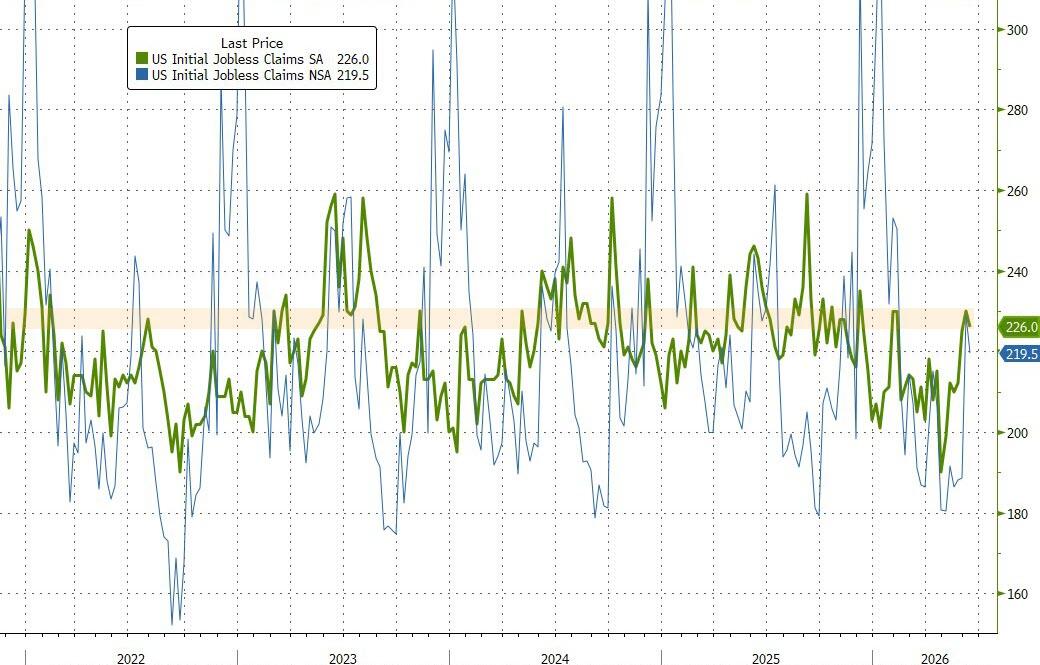
The number of Americans filing for unemployment benefits for the first time fell from 230k (4 month highs) to 226k (vs 225k exp) last week – elevated but still within the range of the last four years

Source: Bloomberg

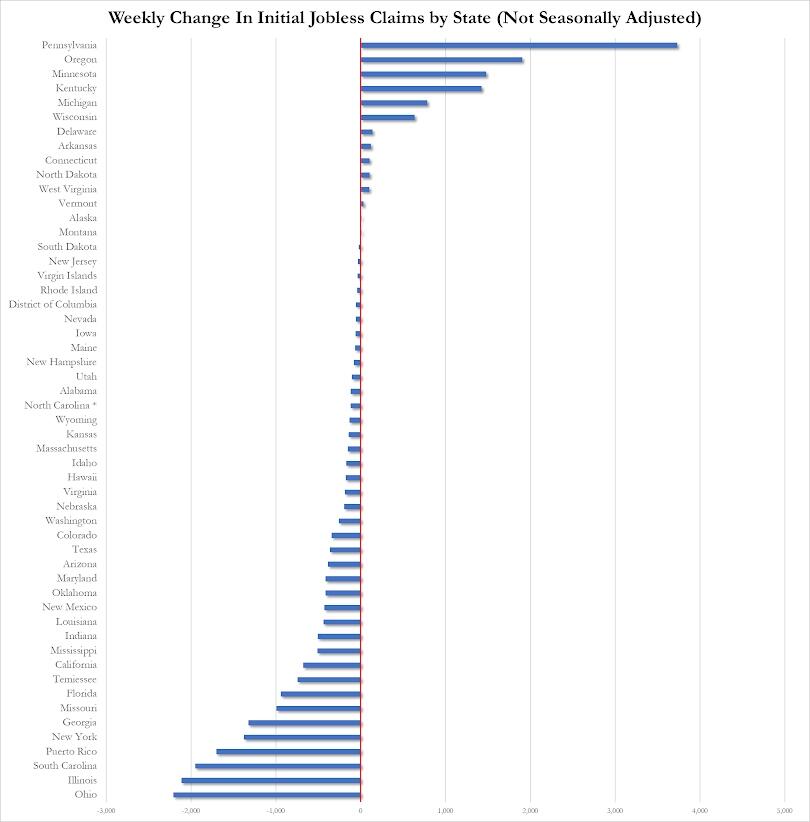
Pennsylvania and Oregon saw the largest rise in initial claims last week while Ohio and Illinois saw the biggest decline…

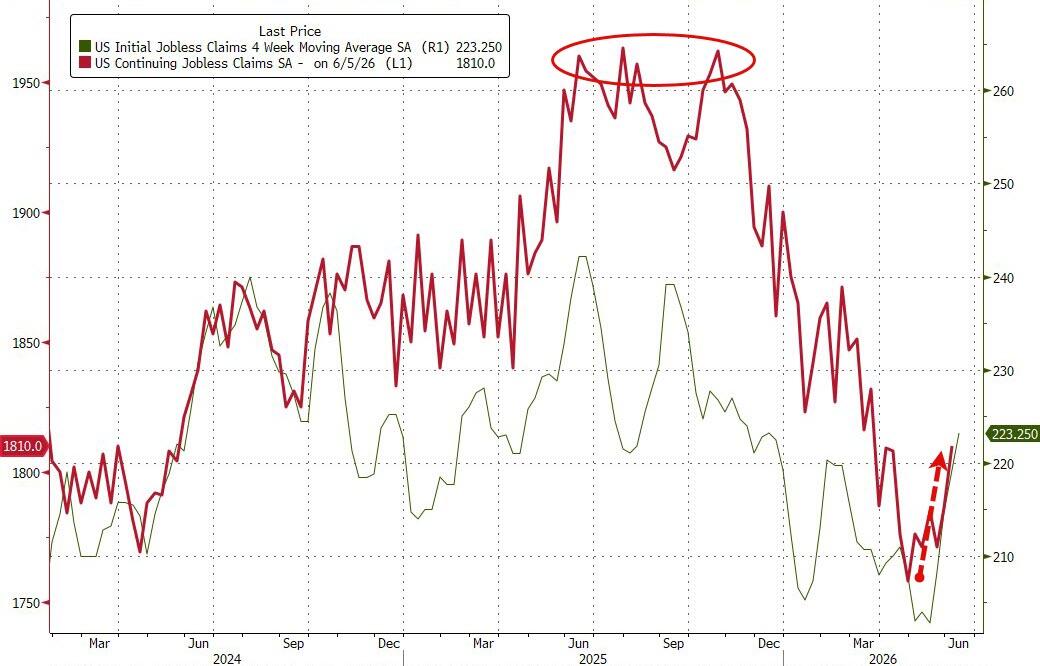
Meanwhile, continuing jobless claims rose back above 1.8 million Americans – the highest print in 3 months – but still well off cycle highs near 2 million in Q4 2025

Source: Bloomberg

The bottom line is that while initial claims are rising, they remain low by historical standards and continue to run below year-ago levels, reinforcing the more hawkish ‘labor market is resilient’ framework introduced yesterday.

Tyler Durden
Thu, 06/18/2026 – 08:36

via ZeroHedge News https://ift.tt/b1yezOK Tyler Durden

Futures Rise, Oil Drops As Market Prices In Iran Deal For Yet Another Day

Futures Rise, Oil Drops As Market Prices In Iran Deal For Yet Another Day

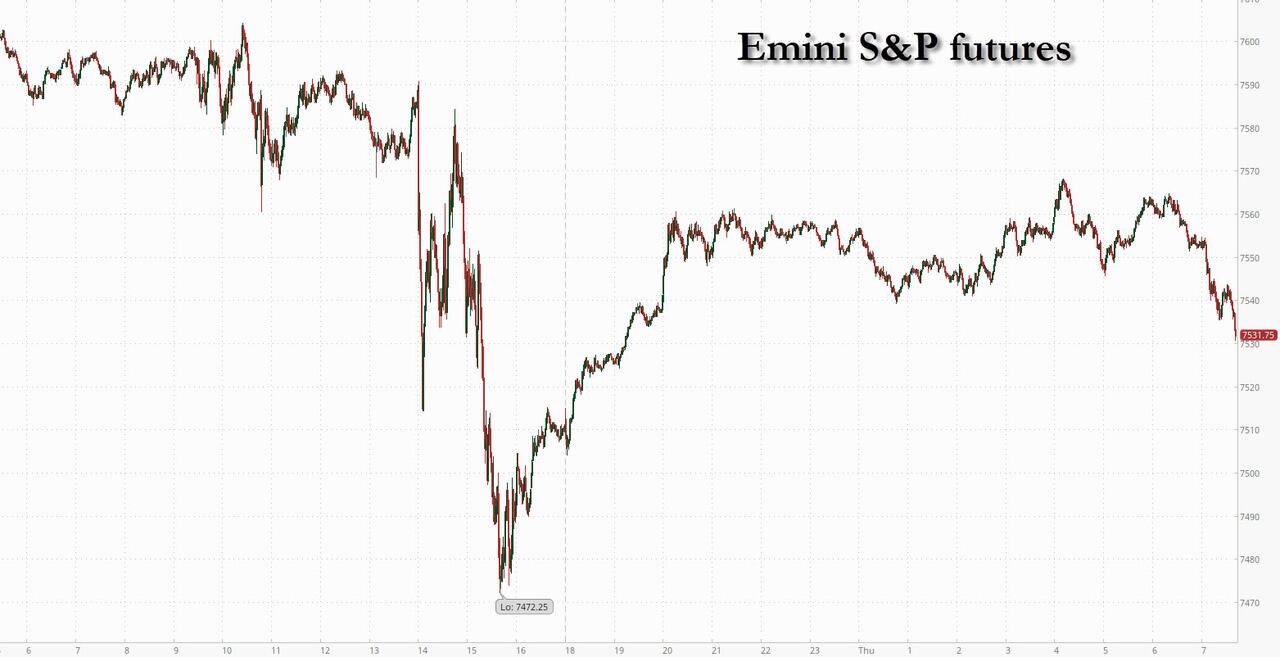
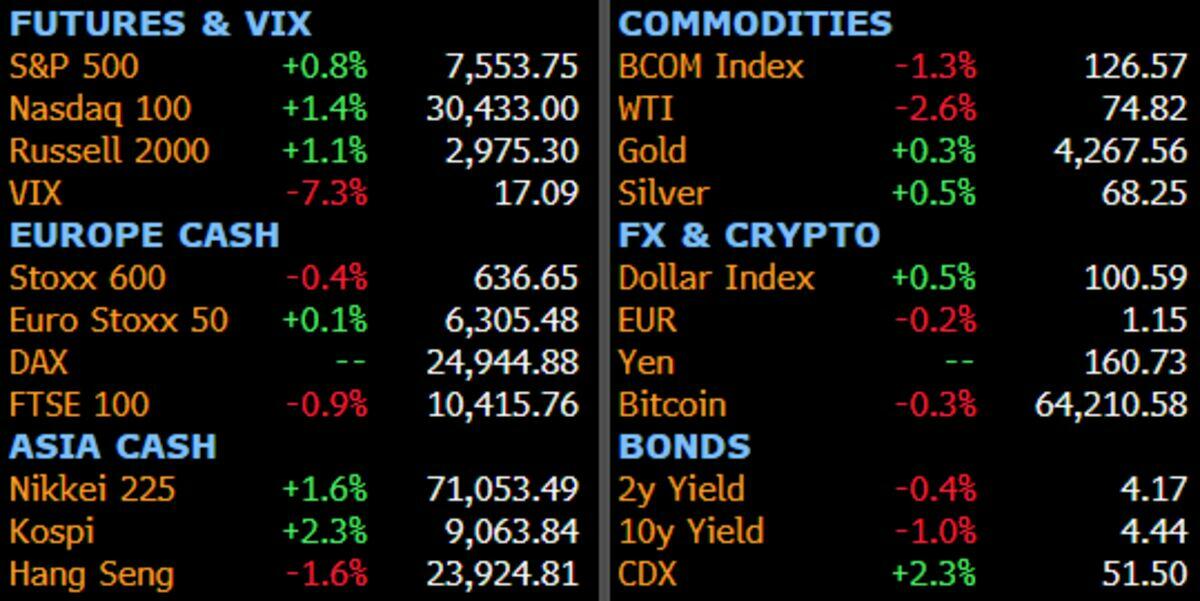
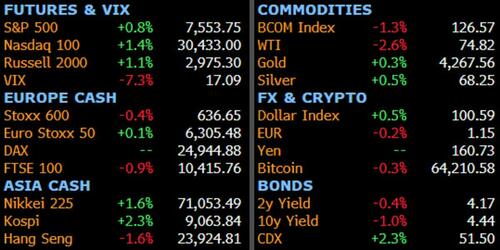
Futures rebounded from the post-FOMC selloff, and oil prices fell as Trump signed the Iran MOU two days early to end the war in the Middle East (in the symbolic Palace of Versailles of all place) and some energy shipments began to transit the Strait of Hormuz. As usual, tech led the parade higher. As of 8:00am ET, S&P futures were up 0.6%, but off overnight session highs, partly unwinding a more than 1% decline after Kevin Warsh signaled the Fed may have to raise interest rates this year to contain inflation; Nasdaq gained 1.3%; pre-market all Mag 7 are higher led by AMZN (+1.2%), META (+1.1%) and NVDA (+1.1%), reversing some of yesterday’s losses. Intel shares jumped more than 8% in premarket trading after Trump said the firm struck a chipmaking deal with Apple (a rehash of previous news but to this Pavolvian market, everything seems to be brand new). Overnight, the biggest headline was that the US/Iran MOU was officially in effect (final deal within 60 days, waiver for Iran to export oil, a $300bn reconstruction fund, terminating all types of sanction, per Axios). Bond yields are lower led by the long-end of the curve as 2y is still anchored by Fed commentary yesterday; 2y and 10y are -1bp and -4bp lower, respectively, the 10Y trading at 4.46%. The USD continues to climb with the DXY adding 53bp this morning. Brent slid 1.4% to around $78.50 a barrel and touched its lowest level since the start of the war while WTI fell -2.6% to $74.78; precious metals are largely flat this morning. US economic data calendar includes weekly jobless claims, June Philadelphia Fed business outlook (8:30am), May Leading Index (10am) and April TIC flows (4pm)
In premarket trading Mag 7 stocks are mostly higher (Nvidia +1%, Meta +0.5%, Tesla +0.3%, Amazon +0.2%, Microsoft -0.2%, Alphabet -0.5%).

  • Apple Inc. (AAPL) is up 0.6% after CEO Tim Cook told the Wall Street Journal that the iPhone maker plans to raise prices on its products to offset the increasing costs of memory and storage chips.
  • SpaceX (SPCX) falls 1.7%, set to extend the previous session’s drop, as it wraps up its first week as a public company following a record-breaking listing.
  • Accenture (ACN) tumbles 11% after the IT services company gave a revenue forecast for the fourth quarter that fell short of Wall Street’s expectations.
  • Albemarle Corp. (ALB) is up 1.8% after Citi raised its recommendation to buy from neutral on expected higher lithium prices.
  • Enphase Energy (ENPH) rises 4.1% after Barclays raised the recommendation on the company to equal-weight from underweight, citing its push into selling solid-state transformers to data centers.
  • Hive (HIVE) is up 15% after its subsidiary BUZZ High Performance Computing announced a partnership with Bell Canada, Cohere and Hypertec to build AI infrastructure in Canada.
  • Iren Ltd. (IREN) gains 3.3% as Jefferies initiated coverage of the Bitcoin miner and data center operator with a recommendation of buy on artificial intelligence data center demand.
  • Pfizer (PFE) is down 1.6% after the drugmaker said Chief Financial Officer Dave Denton will step down and leave the company on Aug. 15 for a professional opportunity in consumer goods outside the pharmaceutical industry.
  • Rumble (RUM) jumps 15% after the online video network platform said it plans to operate two core business units: video platform Rumble and cloud and AI-infrastructure business Quake AI, formerly Northern Data.

Four big June events are now in the rear view mirror — the first FOMC of the Warsh era, an Iran deal, the SpaceX’s IPO, and the first CPI print over 4% in 3 years. And yet, nothing appears able to dent the ongoing market meltup which is driven entirely by massive debt-funded capex spending into a handful of chip stocks.  

Ahead of the last trading day of the week for US markets, the peace deal is reducing the risk of further energy-supply disruptions. Stocks have largely shrugged off the turmoil and continued to notch record highs on the back of relentless enthusiasm for AI. Equity markets have come through the tests posed by the debut of SpaceX, Kevin Warsh’s first meeting as Fed chair and the US-Iran peace deal fairly unscathed, said Raphael Thuin, head of capital market strategies at Tikehau.

“With the MOU now signed, there’s reason to believe that we may be close to or past peak inflation,” Thuin said. “The market will be able to concentrate on earnings again, like for Micron next week.”

Bond investors, however, face the prospect of lingering risks that may keep the higher-for-longer rates narrative intact. Even though US gasoline prices have dipped below $4 a gallon for the first time since March, energy costs have only been one factor in keeping inflation stubbornly above the Fed’s target.

US gasoline prices dipped below $4 a gallon for the first time since March, providing relief to consumers after global supply disruption sent fuel costs soaring. In contrast, inflation pressures are likely to hit people in the pocket if they want to buy a new iPhone later this year, with Apple’s Tim Cook telling the Wall Street Journal that the company plans to raise prices to offset surging memory and storage chip costs

Despite lower oil prices, front-end Treasury yields remained at their highest level since February 2025, with traders cementing bets for a September US rate hike. In the UK, the yield on two-year gilts jumped six basis points to 4.2%, while the Bank of England kept guidance that it “stands ready to act” on inflation and left its key rate unchanged. The dollar extended gains.

A quick look back at the Fed decision: Wednesday’s Fed decision marked the fourth consecutive meeting in which policymakers left rates unchanged. Officials described economic growth as “solid” and highlighted strong productivity gains and capital investment, while making clear that inflation has become a greater concern than labor-market weakness. Warsh has been critical of over-communication and poor forecasting by the Fed, and the new regime is moving away from explicit forward guidance – investors can no longer rely on central bank signals and will have to price in policy uncertainty. The S&P 500 has historically faced challenges following changes in leadership at the Fed.  

“Half the committee is expecting rate hikes this year, which is a real shot across the bow at the market,” said Bob Michele, chief investment officer and global head of fixed income at JPMorgan Asset Management. “I think they’re getting ready for rate hikes.”

As for SpaceX, the company is seemingly sucking retail investors back into equities, flows into US equity ETFs have risen rapidly, notching the second highest-ever monthly flow, Bloomberg notes. Based on the price target of an initiation of coverage by Arete analyst Andrew Beale, SpaceX gets an implied $5.3 trillion valuation by end of 2027.

European stocks are missing out on the rally, with the Stoxx 600 down by 0.4%, dragged lower by the mining and autos sectors. Here are the biggest movers Thursday:

  • Edenred shares soar as much 18%, hitting their highest level since early November, after the payment solutions firm confirmed it has been approached by investment funds in the wake of a report of takeover interest from BC Partners
  • Generali shares rose as much as 3.3%, the most in 14 months, after newspaper Il Sole 24 Ore reported that UniCredit has informally proposed exchanging a 10% stake held by the Del Vecchio family holding Delfin in the insurer with its own shares
  • Oxford Instruments rises as much as 4.4% as Peel Hunt upgrades to buy from add and installs a new Street-high price target, based on durability of growth and scope for further operating leverage
  • Man Group shares rise as much as 3.4% to the highest since 2011 as BNP Paribas analysts upgrade their rating on the hedge fund manager to outperform from neutral and raise their target price
  • Informa shares rise as much as 3% as Morgan Stanley said the company has navigated the first five months of its financial year well, with strong results from its Live B2B Events and Academic Markets units
  • SSP advances as much as 5.1%, to the highest in eight weeks, after Davy initiates on the airport-focused food and beverage outlet operator with an outperform recommendation and 225p price target
  • Skistar climbs as much as 11%, the most since March 2025, after reporting third-quarter results which DNB Carnegie says show good cost mitigation and decent future pre-bookings
  • Tesco shares fall as much as 3.7% to their lowest level in two weeks after the UK’s biggest supermarket reported earnings which missed analyst expectations for like-for-like sales
  • Carrefour drops as much as 6.6% as JPMorgan places the French supermarket operator on a negative catalyst watch, saying first-half results on July 23 “might turn out to be a downgrade event”

Earlier in the session, Asian stocks rose as oil prices eased after President Donald Trump signed an interim peace deal with Iran to reopen the Strait of Hormuz. The MSCI Asia Pacific Index climbed as much as 0.8% to set an intraday record, boosted by gains in tech names including SK Hynix and Samsung Electronics. South Korea led advances in the region, with shares also rising in Taiwan and Japan. Crude prices continued to fall after Trump said a memorandum of understanding with Iran has taken effect, helping to ease inflation concerns for energy importing countries and offsetting hawkish signals from the Federal Reserve. A gauge of tech shares in Asia rose to a new high.Elsewhere in Asia, central banks in Indonesia and the Philippines — two economies hit hard by the sharp increase in global oil prices following the Iran war — both hiked their policy rates on Thursday. Indonesian stocks held losses, while Philippine shares pared gains.

In FX, the Bloomberg Dollar Spot Index reverses an earlier decline, sending the euro below $1.15. The BOE, Switzerland, and Norway’s central banks all held rates. 

In rates, treasuries curve-flattening sparked by Wednesday’s hawkish Fed meeting extends as 2-year rises back toward highest levels since February 2025 — and within 25bp of the 10-year — while 30-year is more than 6bp lower on the day. Treasury 2-year is more than 2bps cheaper on the day while 10-year is nearly 3bp richer near 4.46% after touching 4.44% during London morning. US 2s10s and 5s30s spreads are 5bp and 6bp tighter respectively, after narrowing 8bp and 11bp to multi-month lows Wednesday. UK front-end underperforms, holding losses after Bank of England held interest rates at 3.75% as it said the recent fall in oil prices was “encouraging.” UK 2-year, 6bp cheaper on the day, had muted reaction to Bank of England policy announcement decided by 7-2 vote.

In commodities, WTI crude oil futures are down 2%, off session lows after Iranian President Masoud Pezeshkian released details on the text of the memorandum of understanding ending US attacks. Brent slid 1.4% to around $78.50 a barrel and touched its lowest level since the start of the war as three laden oil vessels controlled by Saudi Arabia’s state tanker giant switched on their signals in the Gulf of Oman after being stuck inside the Persian Gulf since the conflict began. 

US economic data calendar includes weekly jobless claims, June Philadelphia Fed business outlook (8:30am), May Leading Index (10am) and April TIC flows (4pm)

Market Snapshot
Top Overnight News

  • An impending wave of oil that’s been trapped inside the Strait of Hormuz is set to be unleashed on Asia, suddenly swamping a region that had managed to make up for lost supply in recent weeks. BBG
  • The average price of U.S. gasoline fell below $4 a gallon on Thursday for the first time in months, after Iran and the United States signed a preliminary agreement to cease hostilities for 60 days and reopen the Strait of Hormuz. The national average for a gallon of regular gasoline fell to a fraction of a penny below $4, down from $4.03 the day before, according to the AAA motor club. NYT
  • The MSCI China Index is on the cusp of a bear market, pressured by weakness in tech and consumer stocks. Alibaba and Tencent were the biggest drags on the day. BBG
  • The Bank of England held interest rates at 3.75% as it said the recent fall in oil prices was “encouraging.” Two of the nine policymakers voted for an immediate quarter-point hike over concerns of persistent inflation: BBG
  • The SNB left its key rate at zero as expected and said it retained its heightened readiness to sell the franc. Separately, the Swiss government trimmed its growth predictions for 2026 and next year, while slightly raising its inflation outlook. BBG
  • Brussels has opened communication channels with the Kremlin in recent weeks to scope out the potential for talks to end the war in Ukraine, as European capitals debate whether to engage directly with Russian President Vladimir Putin. FT
  • Norges Bank left its policy rate unchanged at 4.25%, as expected, but said it would likely be necessary to hike at one of the forthcoming meetings. Norges Bank
  • The U.K.’s unemployment rate inched down in the three months through April while wage growth remained flat, with continued weakness in the labor market reinforcing expectations that the Bank of England will keep interest rates on hold. WSJ
  • Microsoft Corp. has built a big business selling AI models to Chinese companies despite the growing rivalry between the US and China over artificial intelligence. ByteDance Ltd. has generally been Microsoft’s biggest AI customer in recent years, largely using OpenAI models, and is on track to spend more than $1 billion a year on Microsoft AI and cloud services. BBG
  • U.S. President Donald Trump said in a Truth Social post on Thursday that Apple has agreed to work with Intel to design and manufacture its ‌chips in the United States. RTRS

Iran Headlines

  • Technical talks between the US and Iran will be held in Zurich on Friday, Al Hadath reported citing sources. Talks will include the legal aspects related to lifting Iranian sanctions, the issue of frozen funds and the Iranian nuclear file. Qatar, Pakistan, Turkey, and Saudi Arabia will also attend the talks. An unannounced negotiation session will discuss issues related to Lebanon and Hezbollah.
  • The fifth round of US-Iran negotiations will discuss Israel’s withdrawal along with a timetable for the experimental zone, Al Hadath reported citing a Lebanese source. The source added that the US-Iranian agreement will intensify pressure on Israel to gradually withdraw and that there will be no retreat from restricting weapons to the state and deploying the army in the south. Lebanon is proceeding with direct negotiations with Israel.
  • Swiss Foreign Ministry confirmed that the US and Iran will meet on Friday for initial talks on MoU execution.
  • The Swiss government, following the Iranian commentary, said the plan as it stands is still for the US, Iran, Pakistan and Qatar to meet on Friday in Switzerland to commence talks.
  • US War Secretary Hegseth said they are to review where the right place for basing is, when the Strait of Hormuz opens and are prepared to resume strikes and blockade if Iran does not comply with MoU.
  • US official said the Iran MoU was signed digitally on Sunday by US VP Vance and Iranian Speaker Ghalibaf, which was witnessed by US President Trump, while the US official said Iran MoU was signed on Wednesday by US President Trump and Iranian President Pezeshkian.
  • US official says that Iran is to arrange safe, no-charge passage through Strait of Hormuz for 60 days, according to CNBC.
  • Iranian Foreign Ministry spokesperson Baghaei said the MoU between the US and Iran was decided to be signed digitally, while the plan for negotiating teams in Geneva remains in place, but there will be no signing ceremony in Switzerland. Baghaei stated that the 60-day period had started and that Israel’s continued attacks on Lebanon would be regarded as a breach of commitments, while he also commented that the US has begun lifting the blockade on Iranian ships and that no enriched nuclear material will be sent abroad, and the dilution of nuclear material remains an option. Furthermore, he said Iran will reciprocate if the US fails to honour commitments, and that Iran is to charge fees for Strait of Hormuz safety services, as well as stated that Iran and Oman are to manage the Strait of Hormuz security, and noted that Switzerland talks with the US are not yet certain.
  • Iranian Foreign Ministry spokesman said Israel’s continued attacks on Lebanon would be regarded as a breach of commitments. The spokesman also said that the 60-day period starts today, according to the text.
  • Iranian Parliament Speaker and top negotiator Ghalibaf said the Strait of Hormuz will not return to pre-war conditions, but this does not mean acting against international laws or maritime navigation, while he added that payment for services through the Strait of Hormuz has been established in the MoU and that USD 300bln has been allocated to be invested in Iran, part of which will be spent on reconstruction. Furthermore, he said Iran’s action is contingent on US compliance, with Iran to pursue action-for-action policy, as well as separately commented that Tehran can target ships entering Hormuz if needed, and that Tehran has sovereign rights to charge Hormuz tolls.
  • Source on Telegram posted that several IRGC boats were engaged in unspecified activity in the Strait of Hormuz, and that a US ship broadcast a warning message in Persian to tell them to cease operations and return to port, or else the US Navy would attack them.
  • An Israeli official said Israel has no intention of backing down on its positions and are holding stubborn negotiations with the US over its presence in southern Lebanon.
  • Israeli military operations reportedly continue in Lebanon despite the MoU, while Israel opposes Lebanon ceasefire terms in the US-Iran agreement, according to Al Jazeera.

A more detailed look at global markets courtesy of Newsquawk

APAC stocks traded mixed as the region reflected on recent key events, including the hawkish FOMC and Fed chair Warsh’s first presser, in which the Fed kept rates unchanged, removed forward guidance, emphasised price stability, and provided hawkish dot plots. This triggered selling in stocks, treasuries and gold, while it boosted the dollar and yields, with money markets now fully pricing in an October hike. Nonetheless, some of the moves have since been pared, to varying degrees, as oil prices gradually declined following the announcement that the US and Iran have signed the MoU for ending the war, which is now in effect, but with the planned talks on Friday in Switzerland, said to not yet be certain. ASX 200 was subdued with most sectors in the red and the declines were led by tech and miners.
Nikkei 225 extended on record highs to surpass the 71,000 level as manufacturers benefited from lower oil prices and optimism of the reopening of shipping in the Strait of Hormuz. KOSPI rallied and breached the 9,000 level for the first time amid strength in Samsung and SK Hynix. Hang Seng and Shanghai Comp were lower with underperformance in Hong Kong as the hawkish FOMC and increased prospects of a rate hike this year, pressured the local benchmark, given that any rate hike in the US would force the HKMA to move in lockstep with the Fed to defend the USD/HKD peg.

Top Asian News

  • Japan’s chief cabinet secretary Kihara said the Japanese government is monitoring FX markets closely and will respond to FX moves as needed.

European bourses (STOXX 600 -0.5%) start Thursday’s session on a mixed footing despite the US and Iranian presidents digitally signing the MoU. Germany’s DAX 40 (+0.1%) is the clear outperformer, while the FTSE 100 (-0.8%) is the laggard as multiple companies trade ex-dividends. European sectors highlight a negative bias. Technology (+0.3%), Industrial Goods & Services (+0.6%) and Telecoms (+0.1%) are the only sectors in the green. To the bottom lies Optimised Personal Care (-1.8%), Basic Resources (-1.9%), and Autos (-1.3%).

Top European News

  • Germany’s Ifo cut its German economic growth forecast for 2027 to 0.8% (prev. exp. 1.2%). Inflation expected at 2.9% this year and 2.7% in 2027.
  • Swiss Government cuts its 2026 GDP growth forecast to 0.9% (prev. 1.0%) and 2027 GDP growth forecast to 1.6% (prev. 1.7%, long-term avg. 1.8%).

FX

  • G10s were initially mixed against a lacklustre USD. However, as the morning progressed, the Dollar found some strength and surpassed the highs made post-FOMC; today’s peak is at 100.63. USD/JPY aggressively sold off earlier in the session from 160.80 to 160.48 but has since pared entirely.
  • GBP was initially flat, but now posts modest losses against the USD. The BoE announcement is due today, where the MPC is widely expected to keep rates on hold in a 7-2/8-1 vote split as recent data and energy moderation support the narrative that bank rate is restrictive. With markets assigning a 95% probability of no-change today, attention will be on the vote split. While consensus is for 7-2/8-1, hawkish dissent from Chief Economist Pill and potentially one or two more policymakers remains possible, and would likely spur a hawkish reaction. In addition to the BoE, GBP will also digest results of the Makerfield by-election which will likely see Labour candidate Burnham emerge as the winner, and challenge incumbent Starmer.
  • Norges Bank was broadly as expected with a fleeting kneejerk lower in NOK, the unwinding of tightening bets by c. 15% of market participants. The 2026 core CPI view was maintained and the 2027 one was trimmed modestly, as expected, while forecasts and commentary still show that inflation is “too high” and the Governor outlined that new information shows “inflation pressures are slightly stronger than we had anticipated earlier”. As such, the Norges Bank points to tightening ahead, roughly in line with market expectations. EUR/NOK +0.3%.
  • SNB kept rates unchanged in a mostly as-expected meeting. EUR/CHF is firmer today, potentially surrounding the fact that commentary around energy/raw materials suggests that the new forecasts do not account for the moderation in energy seen recently; over the medium term, sparking a return to concerns around inflation being too low in Switzerland. As such, EUR/CHF -0.2%.

Fixed Income

  • Global fixed benchmarks are trading on either side of the unchanged mark, with price action lacklustre since the European cash open. It appears that fixed benchmarks are taking a breather following this week’s hefty declines in yields, which comes amidst sustained pressure in the energy complex. On the geopolitical front, US-Iran have signed the MoU, which means the Strait of Hormuz is theoretically open for ships to pass through, whilst the US blockade will also be lifted.
  • USTs (-2 ticks) trades within a 109-09+ to 109-20+ range, and well off the lows seen overnight, which stemmed from a hawkish Fed on Wednesday. A full recap can be found on the headline feed, but in brief, the unchanged policy was accompanied by hawkish dot plots and the removal of the easing bias. From a yield perspective, the US 2s10s curve is flatter post-Fed, and currently holding around 27.5bps, a level not seen since Liberation Day (2nd Apr 2025). This has unsurprisingly been led by the short-end, following the hawkish Fed. However, should inflation begin to ease later this year, there is some chance that the spread begins to widen once again, with short-end yields reflecting a less hawkish Fed. The long end may also be affected, with focus on Chair Warsh announcing a dedicated task force to review the Bank’s balance sheet. Any hints of an acceleration of the roll-off would undoubtedly lead to a considerably steeper curve.
  • Bunds (-9 ticks) and Gilts (U/C) trade in line with peers. Focusing on UK paper, traders will await the BoE this afternoon and then the start of the Makerfield by-election. In brief, the BoE is expected to keep rates on hold at 3.75%, with a mixed vote split. Some see in a range of 8-1 to 6-3. Thereafter, attention shifts to domestic politics, whereby a Burnham victory could see him launch a leadership challenge; for reference, he is viewed as the worst candidate for Gilts. There is a full preview in the Research Suite for those interested.
  • France sells EUR 13.999bln vs exp. EUR 12-14bln 2.40% 2029, 3.25% 2032, 2.00% 2032 and 3.00% 2034 OAT.
  • Spain sells EUR 5.83bln vs exp. EUR 5-6bln 3.00% 2033, 3.40% 2036 and 4.90% 2040 Bono.

Commodities

  • Crude futures are softer, with WTI Aug’26 slipping below the USD 75/bbl mark (USD 73.42-75.75/bbl range) while Brent Aug’26 oscillates around a USD 78/bbl handle (USD 77.10-79.06/bbl band). US and Iranian leaders signed the MoU digitally, which has weighed on the energy complex. The deal allows for the immediate resumption of Iranian oil exports and possible access to a USD 300bln development programme, backed by sanctions waivers and unfreezing overseas funds. In exchange, Iran will never produce nuclear weapons. The MoU also confirmed earlier reporting that Iran’s nuclear file will be deferred to talks for 60 days.
  • More recently, reporting by Al Hadath noted technical talks between the US and Iran will begin in Zurich on Friday, in which the legal aspects related to lifting Iranian sanctions, the issue of frozen funds and the Iranian nuclear file will be discussed. Attention remains on whether Israel will back away from fighting Hezbollah in southern Lebanon. An Israeli official said that Israel has no intention of backing down on its positions and is holding stubborn negotiations with the US over its presence in southern Lebanon. However, energy benchmarks were unreactive following those comments.
  • Spot gold has slightly pared back Wednesday’s losses which were driven by a hawkish Fed meeting. After dipping to a trough of USD 4219/oz yesterday, the yellow metal ventured higher throughout the Asia-Pac session and reached USD 4330/oz at best this morning.
  • 3M LME Copper gapped lower and fell to a trough of USD 13.67k/t post-FOMC. In brief, the Fed held rates unchanged at 3.50-3.75%, however, the SEP highlighted a hawkish bias. 3M LME Copper has since traded rangebound, holding in a USD 13.67k-13.78k/t band.
  • Persian Gulf Petrochemical Industries CEO said 89% of damaged petrochemical units returned to production, and the process of redesigning and strengthening production capacity is underway, ISNA reported.
  • Three Saudi Arabian-flagged supertankers laden with a combined 6mln barrels of crude sailed through the Strait of Hormuz on Thursday, according to shipping data.
  • China’s State Planner said effective at midnight June 18th, domestic gasoline and diesel prices will be cut by CNY 515/t and CNY 495/t, respectively.

Central Banks

  • The Bank of England held interest rates at 3.75%, as expected, as it said the recent fall in oil prices was “encouraging,” Two of the nine policymakers voted for an immediate quarter-point hike over concerns of persistent inflation. The committee lowered its estimate of peak inflation to 3.25% in the fourth quarter of this year, below the 3.6% it had projected in April.
  • The SNB held rates unchanged at 0.00%, as expected. The Bank stated that the readiness to intervene in FX is higher and that monetary policy is appropriate to keep inflation within the range consistent with price stability. On inflation, the Bank stated that medium-term inflationary pressure, however, is virtually unchanged compared with the last monetary policy assessment.
  • SNB Chairman Schlegel said that monetary policy continues to have an expansionary effect. Geopolitical uncertainty remains, risks of strong upward pressure on the CHF remains. “If necessary, we therefore have an increased willingness to intervene…” in FX.
  • The Norges Bank held rates unchanged at 4.25%, as expected. The Bank stated that it will likely be necessary to raise the policy rate further at one of the forthcoming monetary policy meetings. Governor Bache stated in the release that inflation is too high and that new information indicates that inflation pressures are slightly stronger than we had anticipated earlier. The Bank’s MPR was also revised higher, forecasting just above 4.5% at the end of 2026.

Ukraine geopol

  • Russia’s Defence Ministry said 555 Ukrainian drones were shot down over Russian areas overnight, according to IFX.
  • Russia attacked Kyiv with missiles and explosions heard in the capital, while it was separately reported that several Moscow airports have halted flights and Moscow’s mayor announced that drones hit an oil refinery in a massive attack, according to TASS.

US Event Calendar

  • 8:30 am: Jun 13 Initial Jobless Claims, est. 225k, prior 229k
  • 8:30 am: Jun Philadelphia Fed Business Outlook, est. 10, prior -0.4
  • 8:30 am: Jun 6 Continuing Claims, est. 1789k, prior 1795k
  • 10:00 am: May Leading Index, est. 0.1%, prior 0.1%
  • 4:00 pm: Apr Total Net TIC Flows, prior 150.7b
  • 4:00 pm: Apr Net Long-term TIC Flows, prior 81.3b

DB’s Jim Reid concludes the overnight wrap

Kevin Warsh’s first appearance as Fed Chair yesterday proved to be a momentous one, with a hawkish dot plot and Warsh’s inflation-fighting rhetoric leaving a sense that rate hikes are firmly under consideration. This shift led investors to fully price in a Fed hike by October, with the repricing weighing on risk assets and sending the S&P 500 -1.21% lower. However, futures are erasing most of this decline overnight following news yesterday evening that US and Iranian leaders signed an MoU to end the war.

Starting with the Fed, while the FOMC held rates steady for the fourth meeting in a row, the updated dot plot saw nine of eighteen participants pencil in at least one hike by year-end, and six expecting two hikes or more. A much-shortened post-meeting statement not only dropped the earlier dovish-leaning forward guidance but also included an unambiguous commitment to “deliver price stability”. Warsh then focused on inflation-fighting credibility in his press conference. At the outset he acknowledged the now 5-year-long upside miss on inflation, before repeatedly noting the importance of the Fed delivering on its “price stability” mandate. So, while the new Chair eschewed any policy guidance, including by not submitting his own forecast to the dot plot, he did not push back against the hawkish dot plot signal and did not lean into any potential dovish arguments. Separately, Warsh announced the establishment of task forces in five areas, including communications and the Fed balance sheet.

In all, the meeting left an undeniably more hawkish Fed tone. While our US economists maintain their baseline view that the Fed is likely to keep rates steady, they note that a Fed that does not rely on forward guidance might prove to be nimbler, setting up the potential for earlier rate hikes than anticipated. 

That shifting Fed rhetoric led to a dramatic fed funds repricing, with chances of a September hike rising from 36% to 80% by yesterday’s close and 38bps of hikes being priced in by year-end (+17.2bps on the day). In turn, 2yr Treasury yields (+13.1bps) saw their largest increase in over a year to a 15-month high of 4.19%. However, the 10yr yield was up by a more moderate +4.9bps while 30yr yields actually ended the day -1.2bps lower. That marked the sharpest daily flattening in the Treasury curve since April 9 last year, when Trump paused the Liberation Day tariffs following a sell-off in Treasuries.

The sharp Fed repricing weighed on risk assets, with the S&P 500 (-1.21%) and the NASDAQ (-1.34%) sliding, having been little changed pre-FOMC. The Mag-7 (-2.82%) led the decline, but the losses were broad as the S&P 500 saw the most daily decliners (429) so far this year. The aggregate decline would have been even worse were it not for the Philly semiconductor index (+1.38%) recovering after Wednesday’s losses. The rates repricing also weighed on assets such as gold (-1.71%) and Bitcoin (-2.15%). On the other hand, the dollar (+0.55%) gained against all G10 currencies.

However, this sell off has partially reversed overnight following news shortly after the US close that the Presidents of the US and Iran had electronically signed an interim deal to end hostilities, with this MoU coming into effect. The signing had initially been expected on Friday, but Axios reported earlier yesterday that this may be brought forward. According to reports, the 14-point MoU foresees a rapid re-opening of the Strait of Hormuz, with an extendable 60-day period to negotiate a final deal that would cover nuclear issues and broad sanctions relief. The deal also envisages a $300bn fund for the “reconstruction and economic development” of Iran, though Trump stressed yesterday that the US will not be investing in Iran and that Iran would benefit only if it “behaves”. Following the MoU signing, Brent crude is -1.85% lower at $78.08/bbl as I type, more than reversing a +0.75% rise yesterday.

This has led to a positive backdrop for major Asian markets this morning. The Nikkei (+1.82%) and the KOSPI (+1.87%) are leading the gains and pushing to new highs, supported by strong advances in semiconductor stocks. Elsewhere, China’s CSI (+0.12%) and Shanghai Composite (-0.37%) are mixed, while the Hang Seng (-1.70%) is underperforming. Australia’s S&P/ASX 200 (-0.51%) is trading a little lower. Outside Asia, futures on the S&P 500 (+0.70%) and Nasdaq (+1.09%) are recovering most of Wednesday’s losses, but those on the STOXX 50 (-0.60%) are catching down to the earlier decline on Wall Street. Meanwhile, 10yr Treasury yields are down -3.9bps to 4.45% as I type.
In other corners of the market, the Japanese yen is largely unchanged, after falling -0.14% yesterday to a post-2024 low of 160.65 against the dollar. However, that decline was smaller than for other G10 currencies, with the restrained moves coming as the yen reached levels that triggered FX intervention back in late April.

Earlier yesterday, European equities advanced for a second day amidst optimism over the US-Iran deal. The Stoxx 600 (+0.52%) and Italy’s FTSE MIB (+0.31%) reached fresh highs, while the DAX (+0.10%) and FTSE 100 (+0.14%) made smaller advances. European bonds were mixed, with 10yr yields on bunds (-0.2bps), OATs (+0.3bps), BTPs (-0.7bps) little changed, while front-end yields moved slightly higher, with those on 2yr bunds up +2.1bps. Investors priced 32bps of ECB hikes by year end (+0.7bps yesterday), with ECB’s Simkus saying he expects “at least one more” rate hike by the ECB and that it’s important to cap inflation expectations.

Gilts were the notable outperformer in the rates space as investors looked forward to today’s Makerfield by-election, with the 10yr yield down -3.7bps to 4.7%. Greater Manchester’s Mayor Andy Burnham is standing for the governing Labour Party and is widely expected to win, with results of the by-election expected in the early hours UK time tomorrow. This election could have important implications for markets as Burnham has said he’d stand in a leadership contest to replace incumbent UK Prime Minster Keir Starmer, with Polymarket now pricing a 77% likelihood of Burnham becoming PM by year-end. Burnham has said in the past that Britain shouldn’t be “in hock” to the bond markets and suggested looser fiscal policies. However, Burnham has since committed to keeping the fiscal rules of the current government, leading investors to reduce the risk premium that had emerged in gilts and pound sterling.

Otherwise in the UK, the other main event today will be the BoE decision. Investors widely except the central bank to keep rates unchanged, with attention more focused on the vote split (our economists expect 7-2), and any evolution in guidance. This has come against a backdrop of still-sticky inflation, although yesterday’s dovish inflation print for May should boost the MPC’s confidence to buy more time. The print saw headline (+2.8% y/y vs +3.0% y/y expected) and core CPI (+2.6% y/y vs +2.7% y/y) miss expectations, though services (+3.7% y/y vs +3.6% y/y) fell in line with forecasts.

Reviewing yesterday’s other data, we saw a beat for US retail sales in May, with headline retail sales up +0.9% m/m (vs +0.6% m/m expected) and with retail control rising +0.7% m/m (vs +0.4% expected). With core goods CPI having eased in May, the beat for retail control was a real one rather than just due to higher prices.

Finally, rounding off yesterday’s central bank news, Sweden’s Riksbank left its policy rate unchanged at 1.75% as expected, but raised its policy rate forecast for year-end up 5bps to 1.82%.

To the day ahead now, in addition to the BoE, the SNB and Norges Bank will also hold their policy decisions. A slate of second-tier data releases includes the US June Philadelphia Fed business outlook, May leading index, initial jobless claims, UK unemployment rate, Italy April current account balance and Eurozone April construction output. Finally, today will see the start of the European Council summit (through June 19). 

Tyler Durden
Thu, 06/18/2026 – 08:28

via ZeroHedge News https://ift.tt/m08IPp9 Tyler Durden

Speculation About A SpaceX–Tesla Merger Is Already Growing

Speculation About A SpaceX–Tesla Merger Is Already Growing

SpaceX’s record-breaking IPO has fueled speculation that Elon Musk could take an even bigger step: merging SpaceX with Tesla to create a roughly $4 trillion technology conglomerate spanning rockets, AI, satellites, electric vehicles, robotics, energy, and social media, according to a new report from the New York Times

The idea has gained traction among investors, analysts, and even SpaceX executives. Tesla and SpaceX already share personnel, collaborate on major projects, and have business ties through AI development, data centers, batteries, and vehicle sales.

Because Musk controls SpaceX and is Tesla’s largest shareholder, any merger would effectively be a deal with himself, raising concerns about conflicts of interest and shareholder lawsuits. However, legal experts say Texas corporate law—where both companies are now incorporated—makes such challenges difficult. Shareholders generally need to own at least 3% of a company’s stock to sue, a threshold that would require roughly $45 billion in Tesla shares.

The Times notes that approval would still require support from two-thirds of Tesla shareholders. Musk controls about 20% of Tesla’s voting power, and many investors have historically backed his initiatives. Tesla’s board has also frequently aligned with Musk, while SpaceX recently added longtime Musk associate Roelof Botha to its board.

Supporters argue a merger could unlock significant synergies. Tesla’s expertise in chips, AI, and data-center construction could complement SpaceX’s ambitions in orbital infrastructure, satellite communications, and space-based computing. Ark Invest, which owns shares in both companies, has said the combination makes strategic sense, though it would prefer Tesla’s self-driving taxi business to mature first.

SpaceX President Gwynne Shotwell has acknowledged potential benefits, saying a merger could simplify Musk’s responsibilities and noting clear overlaps between the companies’ futures: “There’s no question that there are synergies between Tesla and SpaceX in our futures.”

Opponents could challenge the deal through securities-fraud claims, antitrust scrutiny, or national-security concerns, particularly given the companies’ combined presence in AI, robotics, communications, and space technology. Still, experts believe regulators would face significant hurdles, especially if the combined company continued to perform well.

“As long as he keeps running the business well and the stock price keeps going up, that is a pretty good bar to bringing a securities fraud suit,” said James Spindler, a professor of corporate law at the University of Texas School of Law.

Ultimately, the greatest obstacle may be financial rather than legal. As one corporate-governance expert noted, investors tend to support ambitious deals when markets are rising and shareholders are making money.

Charles Elson, the founding director of the Weinberg Center for Corporate Governance at the University of Delaware told The New York Times that Musk “has got this cheering section who will follow him to the gates of Hades or gates of heaven, wherever he leads them.” 

“Basically he’s gotten to the point where he can do almost anything he wishes…” 

Tyler Durden
Thu, 06/18/2026 – 08:15

via ZeroHedge News https://ift.tt/Yzehi8B Tyler Durden

Congress Reaches Deal On Housing Bill With CBDC Ban Until 2030

Congress Reaches Deal On Housing Bill With CBDC Ban Until 2030

Authored by Jesse Coghlan via Cointelegraph, reviewed by Felix Ng.

The US House and Senate have reached a deal to move forward with a housing bill that includes a ban on the Federal Reserve creating a central bank digital currency (CBDC) until 2030.

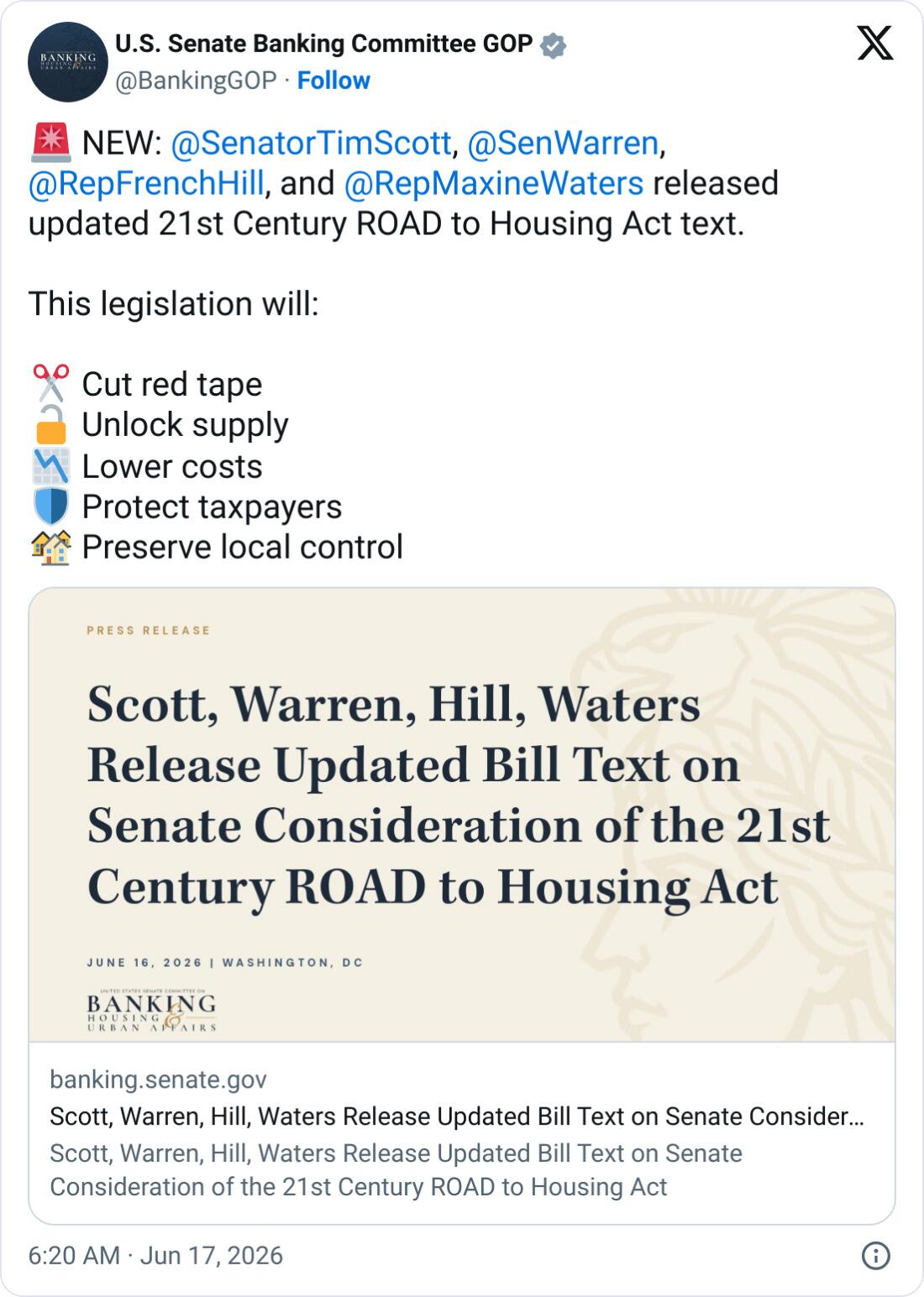
A bipartisan group of House and Senate leaders released an updated version of the 21st Century Road to Housing Act on Tuesday, which aims to address housing affordability and bans institutional investors from buying existing single-family homes to rent out.

The bill has included a CBDC ban since the Senate passed it in March. The House also passed its version of the bill with strong support in May, but the House and Senate disagreed on some aspects. The Senate has now added further amendments that will be put before the House for a final vote.

The bill is likely to pass quickly and would hand a win to Republicans who have tried to pass a CBDC ban for years, as earlier standalone bills had stalled in Congress. Crypto advocates have long criticized CBDCs, which they see as an attempt by governments to repurpose crypto technology to a centrally-controlled asset.

The deal also means Congress can focus on passing other legislation before the August recess and the November midterm elections, in particular, the crypto-regulating CLARITY Act that many lawmakers have been pushing to advance.

House Republican leaders plan to put the bill up for a vote after the House returns from recess on June 23, two people familiar with the plan told Politico.

The housing bill includes language that says the Federal Reserve may not, directly or indirectly, “issue or create a central bank digital currency or any digital asset that is substantially similar to a central bank digital currency.”

It adds the clause will expire on Dec. 31, 2030, and creates a carveout for crypto stablecoins, or “dollar-denominated currency that is open, permissionless, and private.”

The clause revives much of the language from Republican Representative Tom Emmer’s Anti-CBDC Surveillance State Act, which was introduced in June 2025, passed by the House the next month, but was never picked up in the Senate.

US President Donald Trump signed an executive order in January 2025 banning federal agencies from all work related to CBDCs, saying they threatened “the stability of the financial system, individual privacy, and the sovereignty of the United States.”

Tyler Durden
Thu, 06/18/2026 – 08:05

via ZeroHedge News https://ift.tt/flo7iD5 Tyler Durden