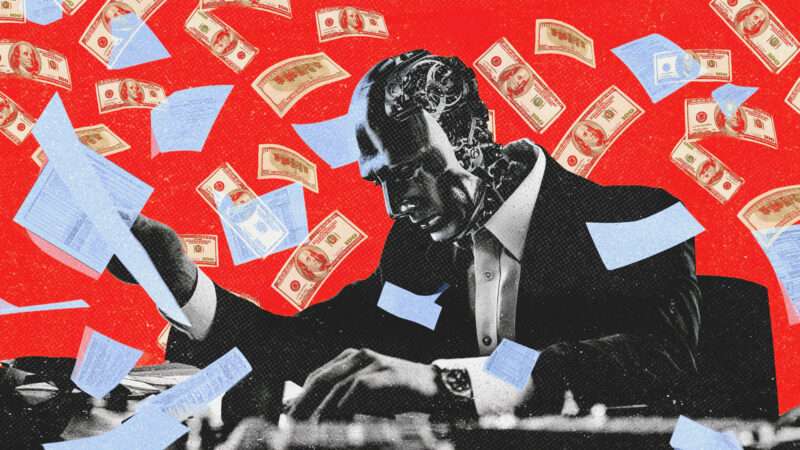
Hysteria over the potential consequences of AI has led Democratic lawmakers to propose another tax on the industry.
On Thursday, Rep. Greg Casar (D–Texas) introduced the AI Tax and Work Protection Act, which would impose a federal excise tax on major AI firms to establish and fund a federal jobs program. Casar previewed the idea in a May op-ed for The American Prospect, where he wrote that “an AI tax should target the companies that stand to make billions of dollars by laying people off.”
“One goal of this tax should be to shift incentives to save jobs. Our tax system basically gives companies huge tax savings when they automate a job, because we currently tax wages but not AI,” he added. “If you replace a worker with an AI-powered robot, you save on payroll taxes: That’s functionally a tax break. That’s wrong, and an AI tax would start to change it by leveling the playing field.”
The bill would calculate the tax in two ways—one based on how much AI is used (“token usage”) and another based on how much companies charge for AI services—and impose whichever is higher. If overall unemployment rises, the tax rate would automatically rise, under the bill.
The bill would also establish a Work Protection Administration in the Labor Department, which would give grants to governments, schools, universities, and nonprofit organizations to hire people. The bill stipulates that job creation must support childcare, early education, healthcare, elderly care, “local news and journalism,” and other initiatives. These jobs would be required to provide various compensation benefits, including collective bargaining, healthcare, and at least 12 weeks of paid family and medical leave.
This bill is part of a wider push to increase taxes on AI companies. In June, Sen. Bernie Sanders (I–Vt.) introduced a bill that would impose a 50 percent tax on the stock of leading AI companies to give Americans a “direct ownership stake” in these firms. Sanders argued that “The future of AI and the fate of humanity must not be decided behind closed doors in Silicon Valley by the wealthiest people in the world. It must not be dictated by billionaires seeking to maximize their power and their profit.”
Fear of technological advancements, and their effect on employment, is certainly not new. When computers were invented, there were widespread fears that the advancements would cause disruptions so great and so permanent that significant proportions of the population would be left without work. As early as 1961, TIME magazine was running stories about how “automation is beginning to move in and eliminate office jobs,” and that “labor experts” are afraid that “unless something is done by management, union and Government, the hard core of permanently unemployed will continue to rise.”
In a 1960 Labor Day rally, then-presidential candidate John F. Kennedy said that “the problem of automation…threatens millions of Americans with technological unemployment.” He then called for “a top level conference of industrial, union, and Government officials” and the expansion of “the U.S. Employment Service to assist men who have been displaced by machines to find new employment.”
Of course, these fears were entirely unfounded. Some jobs which existed in the 1960s may now no longer exist, but new jobs have been created in their place. This process of destruction and creation makes companies more efficient, generates productivity gains, and ultimately, makes people richer. This adjustment process happens far more quickly in the United States, thanks to its relatively free labor markets.
So far, there is not much evidence that AI is causing mass unemployment either. An April study by the Census Bureau found that “AI-driven employment change instances remain modest, with only about 5% of AI-using firms reporting any headcount impact” and that “AI-related employment decreases are rare, occurring in only 2% of firms.” One survey of nearly 750 corporate executives found “little evidence of near-term aggregate employment declines due to AI.” Another survey of nearly 6,000 executives in the U.S., U.K., Germany, and Australia finds “little own-firm impact of AI over the last 3 years, with nine-in-ten reporting no impact on employment or productivity.”
It seems, therefore, that taxing AI to “save jobs” may only succeed in taxing the gains that create them. Ultimately, it is businesses that create jobs, not the government. This bill is just one more way to tax companies that progressives do not like, without consideration for the harms it may cause.
The post Democrats Want To Tax AI Companies for Job Losses That Haven't Happened appeared first on Reason.com.
from Latest – Reason.com https://ift.tt/y6K3bxW
via IFTTT