A Minnesota law that took effect August 1 says it’s illegal to run a website, app, or software program that lets users “nudify” images. Elon Musk’s xAI is challenging the law on First Amendment grounds—and it should win.
When it comes to nudify services, the behavior we want to stop is people using them to nonconsensually “strip” others of their clothes and then share these images in order to harass or embarrass someone or pretend that they have gotten nude in front of you when they have not.
Minnesota’s law goes beyond targeting that undesirable behavior and sweeps in any use of artificial intelligence or other software programs to create images of anyone in a less than fully-clothed state.
It’s broad enough to ban even satirical, journalistic, or artistic uses of “nudify” software—a term the state defines so broadly that even depicting someone’s inner thigh or a shirtless man would be off limits.
Minnesota’s nudify law is also broad enough to ban services from letting people ask AI to nudify themselves or to use it on an image of another person who has consented to that use. It’s even broad enough to ban services from letting someone ask AI to generate an image of themself in a bikini.
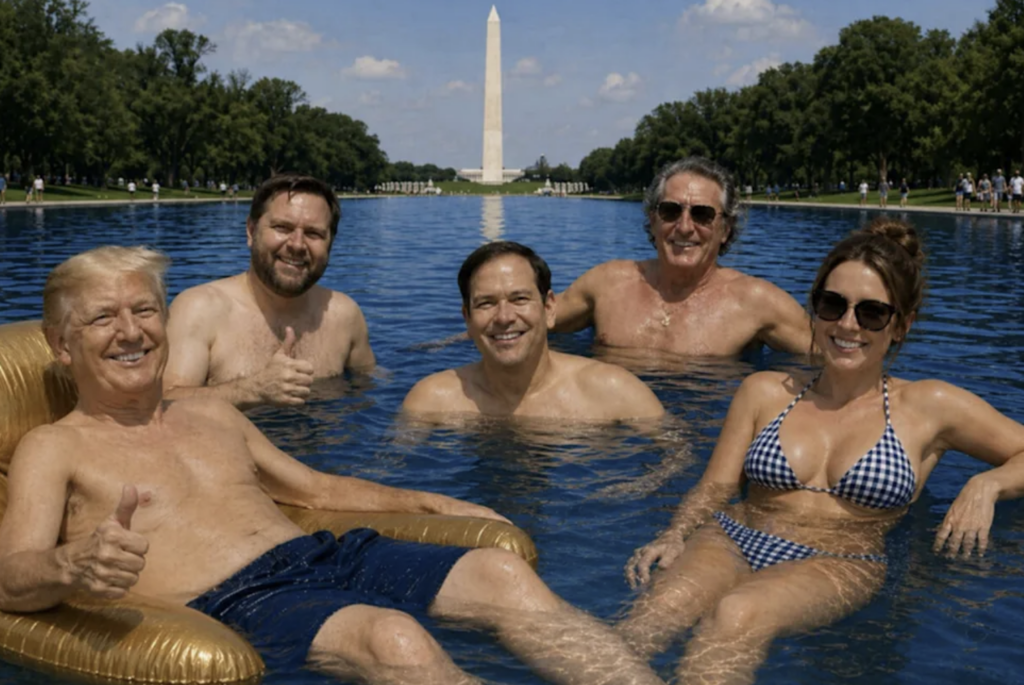
As Mike Masnick points out at Techdirt, Minnesota’s law is written so broadly that it could include a South Park parody featuring a fake video of Donald Trump wandering nude in a desert or even a fake image that Trump himself posted of him, Vance, and others swimming in the Lincoln Memorial reflecting pool.
And, no, this law is not simply about stopping AI-generated nudes depicting minors, as Masnick points out. Such images would fall under the federal definition of “child sexual abuse material,” or CSAM, and that “is already quite illegal under both state and federal law,” notes Masnick. Besides, “nothing in [House File] 1606 is limited to images of minors.”
The law, H.F. 1606, states that “a person who owns or controls a website, application, software, program, or other service must not” allow users “to nudify an image or video,” nor “nudify an image or video on behalf of a user.” It also bans advertising or promoting any nudification service. To nudify is defined as “the process by which: (1) an image or video is altered or generated to depict an intimate part not depicted in an original unaltered image or video of an identifiable individual” when the image is “realistic” enough that “a reasonable person” might not know it was a fake. Intimate parts include “the primary genital area, groin, inner thigh, buttocks, or breast of a human being.”
Violating the law can lead to a $500,000 fine per “access, download, or use,” in addition to serving as grounds for a lawsuit by any person depicted in a nudified photo or video.
And it doesn’t matter if an app or AI service has made good-faith efforts to stop people from using it to nonconsensually generate nude images of others. If someone uses the service for that purpose—even in violation of a program’s terms of service and even despite technical blocks intended to prevent it—the company or individual behind the service could still be liable.
Criminalizing the mere provision of any service that could nudify an image runs afoul of the First Amendment, argued xAI in a complaint filed July 27. It’s “an overbroad, content-based ban on free speech and the tools of visual expression,” it says.
While xAI “prohibits its users from generating nude or sexualized images of people without their consent and has indeed filed suit against users who evade its extensive technological blockers to generate such images,” the fact remains that users could evade this prohibition. And the way the law is written, xAI would still be in trouble if that happens, no matter “how many mitigations” it had in place to try and stop this.
And xAI could be in trouble even if no one is nonconsensually generating nude or sexual images of a real person. Letting male users generate an image of themselves shirtless, or female users generate images of themselves in a bikini, or someone stick J.D. Vance in a ballet leotard or Gavin Newsom in cutoff shorts could suffice.
The law goes “far beyond what an ordinary person would consider ‘nudification,” notes xAI.
On July 29, it asked the U.S. District Court for the District of Minnesota to issue a temporary restraining order stopping enforcement of the law before it took effect—a request that Judge Donovan W. Frank rejected. xAI’s emergency motion seeking the injunction was filed “nearly three months after the law was signed, and only three days before the law is set to take effect,” suggesting to the judge that “harm is not immediate,” he wrote.
The Court is now scheduled to hold a hearing on xAI’s motion for a preliminary injunction on August 19.
Hopefully, Judge Frank will agree that this law as written is unconstitutional.
One need not champion nudify programs or all uses of them to see that Minnesota’s law takes things too far, or that a more narrowly written law could still target undesirable behavior. At minimum, any such law should include exceptions for satire, political commentary, and art; for people using services to nudify themselves; and for people using them on images which the subject has consented to be nudified. Such a law should also include an exception from liability for companies that make good faith efforts to stop their services from being used in nefarious ways.
Personally, I’m skeptical of any law that targets the mere existence or use of “nudifying” technology—a category which can include general-use AI image generation programs—rather than specific actions around these images.
Existing torts and criminal laws could probably cover a lot of this territory. We already have criminal laws against blackmail, extortion, harassment, and child pornography. We already have torts against intentional infliction of emotional distress, defamation, and invasion of privacy. These existing laws seem ripe for use against people who share faked nudes with nefarious intent.
If existing laws prove insufficient, a law narrowly targeting the intentional sharing of nonconsensual deepfake nudes—with exceptions for legitimate purposes, like parody involving public figures—might be warranted. But it would have to be very carefully crafted to avoid roping in those legitimate uses and to avoid punishing those who merely serve as conduits for images they’re unaware were faked. And even then, I would worry about overreach and the ways enforcement could go wrong.
Neither this sort of narrowly crafted new law nor existing laws and torts would cover the private creation of such images, but that’s OK. I know it icks people out—and understandably so—to think of someone “nudifying” someone else for their own private purposes. But people are free to fantasize about someone else nude without the “nude” person’s consent, and they’re free to use older tools—like Photoshop—to “nudify” someone the old-fashioned way. There’s nothing special about using AI to create a fake nude, except that it’s likely going to look more realistic. And that realism only really matters if the image is being used publicly and deceptively.
I’ve heard people compare creating fake nudes of someone without their consent to a form of sexual assault, and I wholeheartedly reject that premise. If someone fakes a nude of you, it’s not actually your body they’re viewing. It’s really not far off from someone fantasizing about you without asking permission first.
None of this means we need to condone people pornifying others without permission. Apps that strip “people of their clothes are…bad. They should be socially shunned,” and we should develop norms that shun this behavior, suggests Masnick. “But passing a badly drafted, obviously unconstitutional law does not help form those norms.”
Today in Congress
The Senate Commerce Committee is formally considering a national age-verification scheme for adult websites (the SCREEN Act) and the latest version of the Kids Online Safety Act (KOSA), along with several other bills purportedly about protecting kids from technology. These include a bill to study and develop an “action plan” on AI toys, a host of regulations around AI chatbots and minors, and a bill that would require AI chatbots to determine whether users are adults and, if not, require them to get parental consent.
The version of KOSA under consideration would require social media companies to somehow protect minors from developing eating disorders, drug habits, anxiety, depression, suicidal thoughts, and compulsive social media use habits, from suffering from sexual exploitation or financial harm, and from exposure to tobacco or cannabis products, online harassment, and physical violence. The bill’s text says this is only about companies “exercis[ing] reasonable care in the creation and implementation of any design feature,” but clearly, it is about content—a.k.a. speech—and amounts to a requirement that social media companies censor whole categories of content.
This is why KOSA is so sneaky—it doesn’t outright say that these companies need to take drastic action, but it would effectively require it.
It might not explicitly require age verification, but unless social platforms are going to massively curtail everyone’s ability to speak freely and access perfectly legal content, they’re going to have to check IDs to determine who is underage.
It might not say that encryption is illegal, but designing apps to prevent exposure to various harms could be interpreted to mean monitoring all private messages, which would of course mean the end of encrypted messaging features.
Meanwhile, the Shielding Children’s Retinas from Egregious Exposure on the Net (SCREEN) Act would require that people show ID to access online porn and any other content that lawmakers deem “harmful to minors” by virtue of “appeal[ing] to the prurient interest in nudity, sex, or excretion.”
In the News
AI hackers—who’s responsible? Recent instances of hacking by OpenAI and Anthropic AI systems highlight some murky legal territory, notes Wired:
Who is legally responsible when agentic AI goes rogue, and what recourse do victims have when they’ve been breached by joyriding models? Great question.
In the wake of disclosures from both OpenAI and Anthropic that versions of their models escaped containment during internal cybersecurity experiments and hacked real-world organizations, calls for government regulation of AI have been mounting. But as more and more incidents emerge, questions about legal liability and repercussions have also come to the fore.
Researchers and lawyers WIRED spoke to emphasize that these questions have not been answered in practice in the United States legal system. In other words, there haven’t been decisions in enough relevant cases for the picture to start to form. But the recent high-profile incidents from OpenAI and Anthropic suggest that answers will need to come soon.
Follow-Up
Candeub confirmation hearing: A few weeks ago, I wrote about Adam Candeub, the lawyer who wants to revive the Comstock laws to attack online porn (and maybe racy books, too) and to use antitrust provisions to punish social media companies for “mak[ing] Americans less happy.” If President Donald Trump gets his way, Candeub will start heading up antitrust enforcement at the Department of Justice, which sounds…fun, if you’re into Victorian morality and making antitrust definitions completely meaningless. The Senate Judiciary Committee is holding a hearing on Candeub’s nomination today.
More Sex & Tech News
• Police body camera company Axon is now “pitching products (Draft One and Form One) that use AI to automate report writing for police officers,” notes Techdirt. What could go wrong?
• A new study links increased suicidal ideation by teen girls with states enacting abortion bans, and The 19th suggests that abortion bans are causing suicidal ideation. That seems like a leap, considering there are a lot of differences between the kinds of states that ban abortion and those that don’t.
• A federal appeals court ruled last week “that Arkansas’ 2023 law restricting access to library materials can go into effect, three years after a judge blocked two sections of the law on First Amendment grounds,” reports the Arkansas Advocate. Judges said the plaintiffs don’t have standing to challenge the law, which criminalizes librarians “furnishing a harmful item to a minor” and allows anyone to “challenge the appropriateness of material available in the county or municipal library.”
The post Minnesota's Nudification Ban Could Punish People Over Parodies and Stripped-Down Selfies. Elon Musk's xAI Is Suing appeared first on Reason.com.
from Latest – Reason.com https://ift.tt/oBfCOAm
via IFTTT