On The Market's Central-Bank-Induced Bipolar Disease

“We’re suffering from central-bank-induced bipolar disease, bouncing from joy to despair number by number,” notes Bloomberg’s Richard Breslow.

“We certainly have aspirations of better growth, higher inflation and a road map,” but he adds, this is simply “another way of saying we’re completely data-dependent.”

As Eric Green at TD wrote, that explains why yields are more correlated to data surprises than at any point this year.  

You could see it as numbers came out last night that were statistically inside projections, and markets responded exactly as you’d expect.

And then there is Bill Dudley, who made it quite clear yesterday you shouldn’t put too much weight on the dots, that economic projections are guesses by nature.

*  *  *
So “good news is bad news, bad news is good news,” for the foreseeable future; and The Fed is entirely making it up as they go along now, having exposed to the world the reality that QE does nothing for the real economy.


via Zero Hedge http://ift.tt/1mNUYW1 Tyler Durden

On The Market’s Central-Bank-Induced Bipolar Disease

“We’re suffering from central-bank-induced bipolar disease, bouncing from joy to despair number by number,” notes Bloomberg’s Richard Breslow.

“We certainly have aspirations of better growth, higher inflation and a road map,” but he adds, this is simply “another way of saying we’re completely data-dependent.”

As Eric Green at TD wrote, that explains why yields are more correlated to data surprises than at any point this year.  

You could see it as numbers came out last night that were statistically inside projections, and markets responded exactly as you’d expect.

And then there is Bill Dudley, who made it quite clear yesterday you shouldn’t put too much weight on the dots, that economic projections are guesses by nature.

*  *  *
So “good news is bad news, bad news is good news,” for the foreseeable future; and The Fed is entirely making it up as they go along now, having exposed to the world the reality that QE does nothing for the real economy.


via Zero Hedge http://ift.tt/1mNUYW1 Tyler Durden

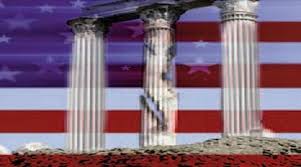
Bread, Circuses, & Bombs – Decline Of The American Empire

Submitted by Jim Quinn via The Burning Platform blog,

“Already long ago, from when we sold our vote to no man, the People have abdicated our duties; for the People who once upon a time handed out military command, high civil office, legions — everything, now restrains itself and anxiously hopes for just two things: Bread and Circuses.”Juvenal – Satire (100 A.D.)


Roman satirist and poet Juvenal was displaying contempt for a degraded Roman citizenry that had shunned civic responsibility, shirked their duties of citizenship within a republic, and had chosen to sell their votes to feckless politicians for assurances of bread and circuses. Rather than govern according to noble principles based upon reason, striving for public policies that led to long term sustainability and benefitting the majority of citizens, politicians chose superficial displays and appeasing the masses utilizing the lowest common denominator of "free' food and bountiful spectacles, pageants, and ceremonies in order to retain power.

The Roman Empire’s decline stretched across centuries as the gradual loss of civic virtue among its citizenry allowed demagogues to gain power and barbarians to eventually overrun the weakened empire. While the peasants were distracted with shallow exhibitions of palliative pleasures, those in power were debasing the currency, enriching themselves, and living pampered lives of luxury. The Roman leaders bought public approval and support, not through exemplary public service, but through diversion, distraction, and the satisfaction of base immediate needs and desires of the populace. Satisfying the crude motivations of the ignorant peasants (cheap food and entertainment) is how Roman politicians bought votes and retained power. Free wheat, circus games, and feeding Christians to lions kept the commoners from focusing on politicians pillaging and wasting the empire’s wealth.

History may not repeat exactly because technology, resource discoveries, and political dynamics change the nature of society, but it does rhyme because the human foibles of greed, lust for power, arrogance, and desire for conquest do not vary across the ages. The corruption, arrogance, hubris, currency debasement, materialism, imperialism, and civic decay that led to the ultimate downfall of the Roman Empire is being repeated on an even far greater scale today as the American Empire flames out after only two centuries. The pillars of western society are crumbling under the sustained pressure of an immense mountain of debt, created by crooked bankers and utilized by corrupt politicians to sustain and expand their welfare/warfare state. Recklessness, myopia, greed, willful ignorance, and selfish disregard for unborn generations are the earmarks of decline in this modern day empire of debt, delusion and decay.

“Armaments, universal debt, and planned obsolescence – those are the three pillars of Western prosperity. If war, waste, and moneylenders were abolished, you’d collapse. And while you people are over-consuming the rest of the world sinks more and more deeply into chronic disaster.”Aldous Huxley – Island

Rome was eight and a half centuries old when Juvenal scornfully described the degenerative spiral of the Roman populace. Still, the Western Empire lasted another three centuries before finally succumbing to the Visigoths and Vandals. The far slower pace of history and lack of other equally matched competing nation states allowed Rome to exist for centuries beyond its Pax Romana period of unprecedented political stability and prosperity, which lasted for two centuries. Prior to becoming an empire, the Roman Republic was a network of towns left to rule themselves with varying degrees of independence from the Roman Senate and provinces administered by military commanders. It was ruled, not by Emperors, but by annually elected magistrates known as Roman Consuls. The Roman citizens were a proud people who had a strong sense of civic duty and made government work for the people.

During the 1st century B.C. Rome suffered a long series of internal conflicts, conspiracies and civil wars, while greatly extending their imperial power beyond Italy through military conquest. After the assassination of Julius Caesar and the ascension of Augustus to emperor in 27 BC, after a century of civil wars, Rome experienced an unprecedented period of peace and prosperity. During this era, the solidity of the Empire was furthered by a degree of societal stability and economic prosperity. But it didn’t last. The successors to Augustus contributed to the progressive ruination of the empire. The repugnant reigns of Tiberius, Caligula, Claudius, and Nero reflected the true nature of the Roman people, who had relinquished their sovereignty to government administrators to whom they had granted absolute powers, in return for food and entertainment. It was the beginning of the end.

The American Republic began as a loose confederation of states who ruled themselves, with little or no direction from a central authority. The Articles of Confederation, ratified in 1781 by all 13 States, limited the powers of the central government. The Confederation Congress could make decisions, but lacked enforcement powers. Implementation of most decisions, including modifications to the Articles, required unanimous approval of all thirteen state legislatures. After winning the war for independence from England, the U.S. Constitution, which shifted power to a central authority, was ratified in 1789. The Bill of Rights, the first ten amendments to the Constitution, was passed in 1791 with the purpose of protecting individual liberties and insuring justice for all. Their function was to safeguard the citizens from an authoritarian federal government. These imperfect documents would benefit and protect the rights of the American people only if applied by moral, just, incorruptible, noble, honorable leaders and enforced by an educated, concerned, vigilant citizenry.

As with the Roman Empire, the quality of leadership has rapidly deteriorated over the last two centuries and now wallows at disgustingly low levels. These leaders are a reflection of a people who have abandoned their desire for knowledge, responsibility for their lives, work ethic, belief in freedom and the U.S. Constitution. The Juvenal of our times was H.L. Mencken who aptly and scornfully described the citizenry in 1920 as an ignorant mob who would eventually elect a downright moron to the presidency. He was right.

“The larger the mob, the harder the test. In small areas, before small electorates, a first-rate man occasionally fights his way through, carrying even the mob with him by force of his personality. But when the field is nationwide, and the fight must be waged chiefly at second and third hand, and the force of personality cannot so readily make itself felt, then all the odds are on the man who is, intrinsically, the most devious and mediocre—the man who can most easily adeptly disperse the notion that his mind is a virtual vacuum.

The Presidency tends, year by year, to go to such men. As democracy is perfected, the
office represents, more and more closely, the inner soul of the people. We move toward a lofty ideal. On some great and glorious day the plain folks of the land will reach their heart’s desire at last, and the White House will be adorned by a downright moron.”
H.L. Mencken

A Republic was formed 225 years ago, as opposed to a monarchy, by men of good intentions. They weren’t perfect, but their goals for the new nation were honorable and decent. Ben Franklin had his doubts regarding whether we could keep a republic. He had good reason to doubt the long-term sustainability of this experiment. Freedom is not something bestowed on us by men of higher caste. We are born into this world free, with the liberty to live our lives as we see fit, the opportunity to educate oneself and the freedom to succeed as far as our capabilities and efforts allow. Only a self-reliant, virtuous, moral, civic minded people are capable of enjoying the fruits of freedom. Once corruption, self-interest, greed, and dependency upon government bureaucrats for sustenance become prevalent, the populace seeks masters who promise safety and security in return for sacrificing essential liberty and basic freedoms.

The country has defeated foreign invaders, withstood financial calamities, endured a bloody civil war, benefitted immensely from the discovery of oil under its soil, became an industrial power, fought on the winning side of two world wars, and since 1946 has become the greatest imperial empire since Rome fell to the barbarians. Over the course of our 225 year journey there has been a gradual relinquishment of the citizens’ sovereignty and autonomy to an ever more overbearing central government. Lincoln’s unprecedented expansion of Federal government authority during thwe Civil War marked a turning point, as state and local rights became subservient to an all-powerful central authority. Individual liberty has been surrendered and freedoms forfeited over a decades long insidious regression of a once courageous, independent, self-sufficient citizenry into a mob of cowering, willfully ignorant dependents of the deep state.

From the inception of the country there has been a constant battle between the banking interests and the common people. Bankers have used fraudulent fractional reserve banking to speculate for their own benefit, made risky loans, and created every financial crisis in the country’s history. The profits from excessive risk taking are retained by the bankers. The inevitable losses are borne by taxpayers with the excuse that the financial system must be saved and preserved. The storyline never changes. The beginning of the end of the American Empire can be pinpointed to the year 1913, only 124 years after its inception. Private banking interests captured the monetary system of the empire with the secretive creation of the Federal Reserve. The power of the central state was solidified with the implementation of the personal income tax, allowing politicians to bribe their constituents with modern day “bread and circuses”, paid for with money taken at gunpoint from them by the central state. We are now nothing but the hollowed out shell of a once noble Republic.

A century of central banking and heavy taxation of the people by bought off politician puppets has coincided with a century of war, depressions, currency debasement, overconsumption, obscene levels of consumer debt, trillions of excessive debt financed government spending, hundreds of trillions in unfunded entitlement liabilities, and a persistent decline in standard of living for the masses due to Federal Reserve manufactured inflation. We have failed to heed the lessons of history. We have repeated the blunders committed by the Romans.

The American Empire will not be murdered by an external force because it is too busy committing suicide. The moneyed interests, corporate oligarchs and their hand-picked politician front men see themselves as conquering heroes. Their colossal hubris and arrogance is only matched by the ignorance, gullibility, quivering fear of bogeymen, and susceptibility to propaganda of the general populace. The Wall Street bankers and feckless politicians are not gods, they are only men. Death is the great equalizer for emperors and peasants alike. The only thing that remains is your legacy and whether you positively impacted the world. It can be unequivocally stated that those in power today are leaving a legacy of despair, destruction, and debt.

Empires are born and empires die. The American Empire will not be sustained for eight centuries, as the swiftness of modern civilization, nuclear proliferation, religious zealotry, and sociopathic leadership ensures we will flame out in a blaze of glory before reaching our third century. The spirit of independence, idealism, self-reliance, entrepreneurship, knowledge seeking, advancement, and goodwill towards our fellow citizens that marked the height of our fledgling country has succumbed to a malaise of government dependency, cynicism, living on the dole, financial Ponzi schemes, willful ignorance, materialism, delusion, and myopic self-interest. The moral decline of the American populace has been reflected in the deteriorating quality of leaders we have chosen over the last century. Prosperity was taken for granted and no longer earned. We abdicated our civic responsibility to corrupt financiers and power seeking politicians. As time has passed, the ruling elite have grown ever more powerful and wealthy, at the expense of the peasantry. These sociopaths see themselves as god-like emperors, on par with the vilest of the Roman emperors.

Historians will mark 1980 as another turning point, when the nation capitulated to the financiers and ceded control of our destiny to Wall Street bankers, the military industrial complex, and globalist billionaires. The final deformation from a productive society built upon savings, capital investment, and goods production to a borrowing, gambling, and consumption society built upon debt and profiteering by powerful corporate and banking interests had commenced. The peak of this warfare/welfare state insanity was reached in 2000 and the road to decline and decay is now littered with the figurative corpses of a gutted middle class and the literal corpses of men, women and children across the globe, killed during our never ending imperial conquests. The ruling elite sense the futility and foolishness of their folly, but their insatiable appetite for wealth, power, triumph and glory blind them to the destructive consequences of their actions upon the nation and their fellow man. Power and dominion over others is a powerful aphrodisiac for our current day emperors and self-preservation at all costs is their mantra.

While they bask in their perceived triumph and glory, achieved through rigging the financial and political systems in their favor, they should heed the faint whisper in their ear that all glory is fleeting.

“For over a thousand years Roman conquerors returning from the wars enjoyed the honor of triumph, a tumultuous parade. In the procession came trumpeteers, musicians and strange animals from conquered territories, together with carts laden with treasure and captured armaments. The conquerors rode in a triumphal chariot, the dazed prisoners walking in chains before him. Sometimes his children robed in white stood with him in the chariot or rode the trace horses. A slave stood behind the conqueror holding a golden crown and whispering in his ear a warning: that all glory is fleeting.” George S. Patton, Jr.

The decline of the Roman Empire can be attributed to a number of supportable hypotheses, which have been documented by historians over time. They include:

  • Perpetual warfare depleted the treasury and wasted the manhood of the empire. The use of mercenary armies eventually led to the sacking of Rome by the very armies they had employed.
  • Military overexpansion and spending resulted in resources being diverted from technological advancement, maintenance of the civil infrastructure, and worthwhile investments to support economic growth.
  • Excessive welfare spending, oppressive taxation and currency debasement widened the gap between rich and poor, resulting in discontent, mistrust and rebellion.
  • The emergence of an all-powerful centralized authoritarian government ruling by mandate, racked by corruption, and kept in power by bribing its subjects with promises of bread and circuses.
  • Emperors and Senators became oligarchs and their conspicuous consumption provided proof of their corruption and decadence. The widespread corruption and incompetence of its leadership led to a waning in civic pride among the citizens.
  • The decline in productive commercial and agricultural industries due to high taxes on producers, used to support the military empire, contributed to the circumstances that allowed barbarian invasions to succeed.
  • The moral decay of the people was caused by the influx of slave labor from conquered territories, resulting in a decline in middle class work ethic, and the subsequent rise in the level of citizens on the dole. An economy based upon slave labor precluded a middle class with buying power.

In Part Two of this tale of two empires, I’ll document the parallels between mistakes made, eternal human foibles, military misfortunes, financial misconduct, and moral decay, that denote the decline of the Roman and American Empires.


via Zero Hedge http://ift.tt/1uXdQmq Tyler Durden

Bread, Circuses, & Bombs – Decline Of The American Empire

Submitted by Jim Quinn via The Burning Platform blog,

“Already long ago, from when we sold our vote to no man, the People have abdicated our duties; for the People who once upon a time handed out military command, high civil office, legions — everything, now restrains itself and anxiously hopes for just two things: Bread and Circuses.”Juvenal – Satire (100 A.D.)


Roman satirist and poet Juvenal was displaying contempt for a degraded Roman citizenry that had shunned civic responsibility, shirked their duties of citizenship within a republic, and had chosen to sell their votes to feckless politicians for assurances of bread and circuses. Rather than govern according to noble principles based upon reason, striving for public policies that led to long term sustainability and benefitting the majority of citizens, politicians chose superficial displays and appeasing the masses utilizing the lowest common denominator of "free' food and bountiful spectacles, pageants, and ceremonies in order to retain power.

The Roman Empire’s decline stretched across centuries as the gradual loss of civic virtue among its citizenry allowed demagogues to gain power and barbarians to eventually overrun the weakened empire. While the peasants were distracted with shallow exhibitions of palliative pleasures, those in power were debasing the currency, enriching themselves, and living pampered lives of luxury. The Roman leaders bought public approval and support, not through exemplary public service, but through diversion, distraction, and the satisfaction of base immediate needs and desires of the populace. Satisfying the crude motivations of the ignorant peasants (cheap food and entertainment) is how Roman politicians bought votes and retained power. Free wheat, circus games, and feeding Christians to lions kept the commoners from focusing on politicians pillaging and wasting the empire’s wealth.

History may not repeat exactly because technology, resource discoveries, and political dynamics change the nature of society, but it does rhyme because the human foibles of greed, lust for power, arrogance, and desire for conquest do not vary across the ages. The corruption, arrogance, hubris, currency debasement, materialism, imperialism, and civic decay that led to the ultimate downfall of the Roman Empire is being repeated on an even far greater scale today as the American Empire flames out after only two centuries. The pillars of western society are crumbling under the sustained pressure of an immense mountain of debt, created by crooked bankers and utilized by corrupt politicians to sustain and expand their welfare/warfare state. Recklessness, myopia, greed, willful ignorance, and selfish disregard for unborn generations are the earmarks of decline in this modern day empire of debt, delusion and decay.

“Armaments, universal debt, and planned obsolescence – those are the three pillars of Western prosperity. If war, waste, and moneylenders were abolished, you’d collapse. And while you people are over-consuming the rest of the world sinks more and more deeply into chronic disaster.”Aldous Huxley – Island

Rome was eight and a half centuries old when Juvenal scornfully described the degenerative spiral of the Roman populace. Still, the Western Empire lasted another three centuries before finally succumbing to the Visigoths and Vandals. The far slower pace of history and lack of other equally matched competing nation states allowed Rome to exist for centuries beyond its Pax Romana period of unprecedented political stability and prosperity, which lasted for two centuries. Prior to becoming an empire, the Roman Republic was a network of towns left to rule themselves with varying degrees of independence from the Roman Senate and provinces administered by military commanders. It was ruled, not by Emperors, but by annually elected magistrates known as Roman Consuls. The Roman citizens were a proud people who had a strong sense of civic duty and made government work for the people.

During the 1st century B.C. Rome suffered a long series of internal conflicts, conspiracies and civil wars, while greatly extending their imperial power beyond Italy through military conquest. After the assassination of Julius Caesar and the ascension of Augustus to emperor in 27 BC, after a century of civil wars, Rome experienced an unprecedented period of peace and prosperity. During this era, the solidity of the Empire was furthered by a degree of societal stability and economic prosperity. But it didn’t last. The successors to Augustus contributed to the progressive ruination of the empire. The repugnant reigns of Tiberius, Caligula, Claudius, and Nero reflected the true nature of the Roman people, who had relinquished their sovereignty to government administrators to whom they had granted absolute powers, in return for food and entertainment. It was the beginning of the end.

The American Republic began as a loose confederation of states who ruled themselves, with little or no direction from a central authority. The Articles of Confederation, ratified in 1781 by all 13 States, limited the powers of the central government. The Confederation Congress could make decisions, but lacked enforcement powers. Implementation of most decisions, including modifications to the Articles, required unanimous approval of all thirteen state legislatures. After winning the war for independence from England, the U.S. Constitution, which shifted power to a central authority, was ratified in 1789. The Bill of Rights, the first ten amendments to the Constitution, was passed in 1791 with the purpose of protecting individual liberties and insuring justice for all. Their function was to safeguard the citizens from an authoritarian federal government. These imperfect documents would benefit and protect the rights of the American people only if applied by moral, just, incorruptible, noble, honorable leaders and enforced by an educated, concerned, vigilant citizenry.

As with the Roman Empire, the quality of leadership has rapidly deteriorated over the last two centuries and now wallows at disgustingly low levels. These leaders are a reflection of a people who have abandoned their desire for knowledge, responsibility for their lives, work ethic, belief in freedom and the U.S. Constitution. The Juvenal of our times was H.L. Mencken who aptly and scornfully described the citizenry in 1920 as an ignorant mob who would eventually elect a downright moron to the presidency. He was right.

“The larger the mob, the harder the test. In small areas, before small electorates, a first-rate man occasionally fights his way through, carrying even the mob with him by force of his personality. But when the field is nationwide, and the fight must be waged chiefly at second and third hand, and the force of personality cannot so readily make itself felt, then all the odds are on the man who is, intrinsically, the most devious and mediocre—the man who can most easily adeptly disperse the notion that his mind is a virtual vacuum.

The Presidency tends, year by year, to go to such men. As democracy is perfected, the office represents, more and more closely, the inner soul of the people. We move toward a lofty ideal. On some great and glorious day the plain folks of the land will reach their heart’s desire at last, and the White House will be adorned by a downright moron.” H.L. Mencken

A Republic was formed 225 years ago, as opposed to a monarchy, by men of good intentions. They weren’t perfect, but their goals for the new nation were honorable and decent. Ben Franklin had his doubts regarding whether we could keep a republic. He had good reason to doubt the long-term sustainability of this experiment. Freedom is not something bestowed on us by men of higher caste. We are born into this world free, with the liberty to live our lives as we see fit, the opportunity to educate oneself and the freedom to succeed as far as our capabilities and efforts allow. Only a self-reliant, virtuous, moral, civic minded people are capable of enjoying the fruits of freedom. Once corruption, self-interest, greed, and dependency upon government bureaucrats for sustenance become prevalent, the populace seeks masters who promise safety and security in return for sacrificing essential liberty and basic freedoms.

The country has defeated foreign invaders, withstood financial calamities, endured a bloody civil war, benefitted immensely from the discovery of oil under its soil, became an industrial power, fought on the winning side of two world wars, and since 1946 has become the greatest imperial empire since Rome fell to the barbarians. Over the course of our 225 year journey there has been a gradual relinquishment of the citizens’ sovereignty and autonomy to an ever more overbearing central government. Lincoln’s unprecedented expansion of Federal government authority during thwe Civil War marked a turning point, as state and local rights became subservient to an all-powerful central authority. Individual liberty has been surrendered and freedoms forfeited over a decades long insidious regression of a once courageous, independent, self-sufficient citizenry into a mob of cowering, willfully ignorant dependents of the deep state.

From the inception of the country there has been a constant battle between the banking interests and the common people. Bankers have used fraudulent fractional reserve banking to speculate for their own benefit, made risky loans, and created every financial crisis in the country’s history. The profits from excessive risk taking are retained by the bankers. The inevitable losses are borne by taxpayers with the excuse that the financial system must be saved and preserved. The storyline never changes. The beginning of the end of the American Empire can be pinpointed to the year 1913, only 124 years after its inception. Private banking interests captured the monetary system of the empire with the secretive creation of the Federal Reserve. The power of the central state was solidified with the implementation of the personal income tax, allowing politicians to bribe their constituents with modern day “bread and circuses”, paid for with money taken at gunpoint from them by the central state. We are now nothing but the hollowed out shell of a once noble Republic.

A century of central banking and heavy taxation of the people by bought off politician puppets has coincided with a century of war, depressions, currency debasement, overconsumption, obscene levels of consumer debt, trillions of excessive debt financed government spending, hundreds of trillions in unfunded entitlement liabilities, and a persistent decline in standard of living for the masses due to Federal Reserve manufactured inflation. We have failed to heed the lessons of history. We have repeated the blunders committed by the Romans.

The American Empire will not be murdered by an external force because it is too busy committing suicide. The moneyed interests, corporate oligarchs and their hand-picked politician front men see themselves as conquering heroes. Their colossal hubris and arrogance is only matched by the ignorance, gullibility, quivering fear of bogeymen, and susceptibility to propaganda of the general populace. The Wall Street bankers and feckless politicians are not gods, they are only men. Death is the great equalizer for emperors and peasants alike. The only thing that remains is your legacy and whether you positively impacted the world. It can be unequivocally stated that those in power today are leaving a legacy of despair, destruction, and debt.

Empires are born and empires die. The American Empire will not be sustained for eight centuries, as the swiftness of modern civilization, nuclear proliferation, religious zealotry, and sociopathic leadership ensures we will flame out in a blaze of glory before reaching our third century. The spirit of independence, idealism, self-reliance, entrepreneurship, knowledge seeking, advancement, and goodwill towards our fellow citizens that marked the height of our fledgling country has succumbed to a malaise of government dependency, cynicism, living on the dole, financial Ponzi schemes, willful ignorance, materialism, delusion, and myopic self-interest. The moral decline of the American populace has been reflected in the deteriorating quality of leaders we have chosen over the last century. Prosperity was taken for granted and no longer earned. We abdicated our civic responsibility to corrupt financiers and power seeking politicians. As time has passed, the ruling elite have grown ever more powerful and wealthy, at the expense of the peasantry. These sociopaths see themselves as god-like emperors, on par with the vilest of the Roman emperors.

Historians will mark 1980 as another turning point, when the nation capitulated to the financiers and ceded control of our destiny to Wall Street bankers, the military industrial complex, and globalist billionaires. The final deformation from a productive society built upon savings, capital investment, and goods production to a borrowing, gambling, and consumption society built upon debt and profiteering by powerful corporate and banking interests had commenced. The peak of this warfare/welfare state insanity was reached in 2000 and the road to decline and decay is now littered with the figurative corpses of a gutted middle class and the literal corpses of men, women and children across the globe, killed during our never ending imperial conquests. The ruling elite sense the futility and foolishness of their folly, but their insatiable appetite for wealth, power, triumph and glory blind them to the destructive consequences of their actions upon the nation and their fellow man. Power and dominion over others is a powerful aphrodisiac for our current day emperors and self-preservation at all costs is their mantra.

While they bask in their perceived triumph and glory, achieved through rigging the financial and political systems in their favor, they should heed the faint whisper in their ear that all glory is fleeting.

“For over a thousand years Roman conquerors returning from the wars enjoyed the honor of triumph, a tumultuous parade. In the procession came trumpeteers, musicians and strange animals from conquered territories, together with carts laden with treasure and captured armaments. The conquerors rode in a triumphal chariot, the dazed prisoners walking in chains before him. Sometimes his children robed in white stood with him in the chariot or rode the trace horses. A slave stood behind the conqueror holding a golden crown and whispering in his ear a warning: that all glory is fleeting.” George S. Patton, Jr.

The decline of the Roman Empire can be attributed to a number of supportable hypotheses, which have been documented by historians over time. They include:

  • Perpetual warfare depleted the treasury and wasted the manhood of the empire. The use of mercenary armies eventually led to the sacking of Rome by the very armies they had employed.
  • Military overexpansion and spending resulted in resources being diverted from technological advancement, maintenance of the civil infrastructure, and worthwhile investments to support economic growth.
  • Excessive welfare spending, oppressive taxation and currency debasement widened the gap between rich and poor, resulting in discontent, mistrust and rebellion.
  • The emergence of an all-powerful centralized authoritarian government ruling by mandate, racked by corruption, and kept in power by bribing its subjects with promises of bread and circuses.
  • Emperors and Senators became oligarchs and their conspicuous consumption provided proof of their corruption and decadence. The widespread corruption and incompetence of its leadership led to a waning in civic pride among the citizens.
  • The decline in productive commercial and agricultural industries due to high taxes on producers, used to support the military empire, contributed to the circumstances that allowed barbarian invasions to succeed.
  • The moral decay of the people was caused by the influx of slave labor from conquered territories, resulting in a decline in middle class work ethic, and the subsequent rise in the level of citizens on the dole. An economy based upon slave labor precluded a middle class with buying power.

In Part Two of this tale of two empires, I’ll document the parallels between mistakes made, eternal human foibles, military misfortunes, financial misconduct, and moral decay, that denote the decline of the Roman and American Empires.


via Zero Hedge http://ift.tt/1uXdQmq Tyler Durden

Great News from California: Anti-Opioid Drug Naloxone To Be Available At Pharmacies Without Prescription

Great news snuck out of Gov. Jerry Brown’s office in California
last week, as
discussed in a press release
from the Drug Policy Alliance, who
worked for this result.

Governor Jerry Brown signed Assemblymember Richard Bloom’s
pharmacy naloxone bill (AB 1535), which will permit pharmacists to
furnish the opiate overdose reversal medicine naloxone
hydrochloride upon request. Previously, naloxone was available only
by prescription from a healthcare provider or from a handful of
naloxone distribution programs throughout the state. The bill,
sponsored by the Drug Policy Alliance and the California
Pharmacists Association, was strongly supported by health and drug
treatment organizations, as well as parents’ groups….

The new law will permit pharmacists to furnish the life-saving
drug to family members – people who may be in contact with a person
at risk of an opiate overdose – or to the patient requesting it,
pursuant to guidelines to be developed by the state’s boards of
pharmacy and medicine. It also ensures education and training for
both the pharmacist and the consumer.

“Lives can be lost in the minutes waiting for an officer or an
ambulance to arrive with naloxone.  This makes it much easier
for caregivers and family members to keep naloxone on hand for use
in those critical moments,” said Meghan Ralston, harm reduction
manager of the Drug Policy Alliance.  “Expanding pharmacy
access to naloxone in California reflects the movement nationally
to make naloxone more widely available,” she added.

While full-on unrestricted over the counter availability would
be ideal, for California and the nation at large, this is a great
advance in access to this definitively life-saving substance for
California. 

I
blogged about the drug’s lifesaving importance
last year. It
can, if administered even during an ongoing opiate overdose,
reverse the effect and save lives.

from Hit & Run http://ift.tt/ZIOe1l
via IFTTT

The Rise Of The Teenage Intern: How China Keeps 'iGadget' Costs Down

China is increasingly relying on ‘student interns’ to make gadgets like iPhones in Western China, according to The Wall Street Journal, where lower wages make it harder to attract ‘real’ migrant workers. As the following brief clip explains, the government has created ‘vocational’ schools in very rural areas of China for high-school students but the quality of education (and ‘jobs’) is not what they had hoped…


* * *

So with that in mind, we hope you enjoy your iPhone 6 plus…


via Zero Hedge http://ift.tt/1vep7gw Tyler Durden

The Rise Of The Teenage Intern: How China Keeps ‘iGadget’ Costs Down

China is increasingly relying on ‘student interns’ to make gadgets like iPhones in Western China, according to The Wall Street Journal, where lower wages make it harder to attract ‘real’ migrant workers. As the following brief clip explains, the government has created ‘vocational’ schools in very rural areas of China for high-school students but the quality of education (and ‘jobs’) is not what they had hoped…


* * *

So with that in mind, we hope you enjoy your iPhone 6 plus…


via Zero Hedge http://ift.tt/1vep7gw Tyler Durden

The Fed Kills Emerging Markets For Profit

Submitted by Raul Ilargi Meijer via The Automatic Earth blog,


DPC Herald Square, New York 1903

Emerging markets are about to get hit by a whopper of a double whammy. And if I were you, I wouldn’t be too surprised if it takes on epic proportions.

The exposure that emerging markets, countries in the less wealthy parts of the globe, Asia, Eastern Europe, Africa, Latin America, have to the west has grown at a very rapid clip since, let’s say, Lehman. These countries were hit hard by the western crisis, but found what looked like a sugar mountain afterward when western interest rates plunged to zero and beyond, which provided them with both of the seemingly beneficial sides of what will now become their double whammy.

First, western money flowed, make that flooded, into their economies at unparalleled levels, driven by a chase for yield instigated by the difference between ultra low interest rates in the west and much higher rates beyond. For emerging countries, this has been a boon beyond belief. No matter how corrupt or poorly organized they may have been or still are, most showed nice growth numbers for a few years. It wasn’t really a carry trade in the literal sense of the word, but it was close. And it’s now coming to an end.

Second, and likely to work out even much worse, the ‘emerging governments’ borrowed those cheap US dollars using anything not bolted down, including their national treasures, as collateral, and they now face a doubling, tripling, quadrupling etc. of the interest rates they have to pay on those loans. Which looks about like this (and something tells me this could well underestimate reality by a considerable margin):

Janet Yellen is about to announce rising rates, and whether it’s tomorrow or in 6 months is not that relevant in all this, it’s expectations that rule the day. Emerging markets will first be hit by outflows of western investment – or rather casino – capital, just because of the fear in the markets of what Yellen will do, and then get the second whammy when rates move from 0.25% to 1.25% and then some.

We see the initial jitters today. Or rather, they’re not the initial ones, just the first ones to come from people other than western investors.

What sticks out that the western press has very little attention for the ‘other side’s’ point of view. Still, here’s the Indonesian FM with a pretty clear message for someone who sees his country being suspended by its balls:

Asia May Need to Sacrifice Growth to Cope With Fed Rate Hike

Asia’s developing nations may have to sacrifice some growth next year and focus on keeping their economies stable amid potential fallout from higher U.S. interest rates, Indonesian Finance Minister Chatib Basri said. Capital outflows are a threat facing emerging markets as the prospect of the Federal Reserve lifting rates lures funds, Basri said [..] In Indonesia, where the benchmark rate is already at its highest since 2009, policy makers may have to tighten further to preserve the nation’s relative appeal to investors, he said. “In the short term, some emerging markets may have to choose stabilization over growth,” Basri said. “You cannot promote economic growth when dealing with this issue. It will exacerbate the situation.”


The U.S. dollar has appreciated as the Fed edges closer to its first rate increase since 2006, while Indonesia’s rupiah has dropped for five straight weeks amid global funds pulling money from local stocks in anticipation of higher U.S. borrowing costs. As some of the world’s fastest-growing economies adapt to changing policy at the Fed, their contribution to global expansion might weaken, Basri said. [..] The prospect of higher rates in the U.S. is the single biggest challenge facing Indonesia’s new government, Basri said.


Basri has called for the incoming government to focus on narrowing the budget deficit, raising fuel prices and luring foreign investment. In Indonesia, where the key rate is at 7.5%, policy makers may have to hold firm to prevent funds from flowing out of the country, Basri said.


“Maybe the tightening cycle will continue, from both the fiscal and the monetary side,” he said. Such a step “is not really conducive to promoting economic growth,” he said. Indonesia also needs to diversify its base of investors, the finance minister said. Relying more on domestic bond buyers would help, he said. “If global liquidity becomes tighter because of this tightening policy at the Fed, it will be more difficult for a country like Indonesia to get foreign financing,” Basri said.

Not that all investors will leave. If only because the emerging market countries need to raise their base rates even higher.

Investors Bet on Asia Despite U.S. Rate Threat

A consensus is emerging among investors that some Asian markets can do well even with the prospect of higher U.S. interest rates on the horizon. Fund managers see stepped up corporate and economic overhauls by leadership in China and India this year, combined with relatively strong growth in Asian economies compared with the rest of the world, as reasons to be bullish. Investors choosing Asia have been rewarded in the past three months. The MSCI Asia ex-Japan index is up 2.4%, topping the 0.4% gain in emerging markets globally and comparable to the 2.6% increase in the S&P 500.


The Fed said Wednesday that it remains on track to end its bond-buying stimulus program in October. It is widely expected to raise interest rates next year. Higher interest rates in the U.S. can hurt Asian assets by drawing investment money into U.S. assets and away from Asia’s markets. Despite the concerns over U.S. interest rates, investors say they are selectively investing in Asian markets that they see as cheap and where economic fundamentals have improved or where they believe reforms are on the way. Investors continued putting money into Asian emerging markets last month, according to the latest data on money flows from the Institute of International Finance.

Still, the world’s smaller economies are plenty afraid.

Wary of Another ‘Tantrum,’ Emerging Economies Prep for Fed Rate Hike

As the Federal Reserve debates the timing of a potential interest rate increase, some policymakers in the developing world aren’t taking any chances. Officials from Indonesia to Hungary say they’re trying to curb their reliance on foreign investors in case an eventual Fed rate increase sparks another broad retreat from emerging markets. “Everyone is getting prepared” for a U.S. rate increase, Mauricio Cardenas, Colombia’s finance minister, said in an interview on Tuesday.


Mr. Cardenas said his government has worked to shift its borrowing from foreign to domestic buyers, on the vi
ew that locals are less likely to sell en masse based on shifts in global monetary policy. “I don’t think it fully insulates us from an increase in interest rates in the U.S., but it certainly protects us,” Mr. Cardenas said.


Years of low rates and stimulus from the Fed, deployed in an effort to jumpstart growth in the U.S., had the side effect of sending investors piling into developing world assets. The rock-bottom interest rates available in the U.S. essentially made the higher returns promised by bonds and stocks in countries such as Brazil and Turkey more attractive.


But what happens when that flow reverses? Global markets got a taste last year during a so-called “taper tantrum,” as investors fled emerging markets in anticipation of a reduction in the Fed’s stimulus efforts.

One more then, because you enjoy it so much:

Fed Dims Emerging Markets’ Allure

Fears of higher U.S. interest rates are prompting fund managers to cut back on investments in emerging markets. For now, investors still are moving into developing markets, though the pace has moderated. Emerging-market stocks and bonds received $9 billion from investors in August, compared with an average $38 billion a month between May and July, according to the latest data from the Institute of International Finance. But after months of heavy buying in such places as Brazil and India, lured by the prospect of higher returns than in the Western world, investors are taking a more cautious stance. Chief among these money managers’ concerns: that the recent rally in emerging-market stocks, bonds and currencies could be derailed as the U.S. Federal Reserve gets closer to raising interest rates.

The Fed, by raising its rates and relinquishing its downward pressure on the US dollar, is about to kill off most of the emerging markets. That’s a whole lot of misery in one pen stroke. That’s a whole lot of millions of people who will see their dreams of better lives shattered, just as they were beginning to think they had a chance.

It’s how the game is played. The weak must be sacrificed so the strong be stronger. It’s like a law of nature. From some point of view, at least. For me, it looks more like ‘we’ have found another way, and another victim, to keep ‘our’ game going a bit longer. There is no way this just happens, in some accidental kind of way. There is a reason the Fed raises both interest rates and the US dollar inside the same timeframe.

Short emerging markets. Play it well and their misery can make you a fortune. Isn’t that what life is all about?


via Zero Hedge http://ift.tt/1xaLAPC Tyler Durden

Tonight on The Independents: Our New War, With John Bolton, Thaddeus McCotter, and Michael Weiss; Plus Cuddle Parties, White House Jumpers, Confessions of an Asset-Forfeiture Judge, the Steve Hayes Terrorist Threat, and Aftershow

Michael Peña's edgiest role yet. |||Last
night’s episode
of The Independents got a little
caddywhompus with the whole bombing-begins-15-minutes-into-the-show
thing, but such are the joys of live television. On tonight’s
installment (Fox Business Network, 9 p.m. ET, 6 p.m. PT, with
re-airs three hours later) we’ll dive back into
bombing
and
murk
, with a hawkish Party Panel of former U.S. ambassador to the
United Nations
John Bolton
and laconic former GOP congressman Thaddeus McCotter.
Ubiquitous foreign policy talker Michael
Weiss
will then come on to walk us through the latest Scariest
Threat You Never Heard About Until Literally Like Twelve Hours Ago,

Khorasan
.

John Yoder, director of the Justice Department’s Asset
Forfeiture Office from 1983-85, will explain why he
thinks it should be abolished
. The co-hosts will discuss the
implications of
jumping the White House fence
. Bolton and McCotter will be
forced to comment on cuddling apps, and I will likely cheer the
Transportation Security Administration’s placing of Weekly
Standard
journalist Stephen Hayes on the “high risk” list of
airline passengers, because of comedy gold.

Assuming no pre-emption by crazy breaking news, online-only
aftershow begins at http://ift.tt/QYHXdy
just after 10. Follow The Independents on Facebook at
http://ift.tt/QYHXdB,
follow on Twitter @ independentsFBN, and
click on this page
for more video of past segments.

from Hit & Run http://ift.tt/1mN7mWw
via IFTTT

FBI, DHS Go Full Scaremonger: Warn Police Of Airstrike-Inspired "Homegrown Extremists" & "Disgruntled Employee" Threats

While careful to note 'no specific threats' have been found, it appears the FBI and DHS have decided it's time to show why local police departments needed to be fully militarized after all. In the first bulletin, according to Bloomberg, US security officials warned federal and local police to watch for “homegrown violent extremists” who may be motivated to attack by airstrikes in Syria. In the second bulletin, the FBI and DHS assess that disgruntled and former employees pose a significant threat to US businesses due to their authorized access to sensitive information and the networks businesses rely on (no doubt inspired by today's dreadful occurrences at UPS in Birmingham). It's just a good thing all those local police forces have MRAPs, don't you feel safer already? However, don't forget, as The UK made clear, the definition of terrorist is a tricky one since even viewing ISIS propaganda constitutes a criminal offense.

  • *U.S. WARNS LOCAL POLICE TO WATCH FOR `HOMEGROWN' EXTREMISTS
  • *FBI, DHS SAY U.S. AIRSTRIKES MAY INSPIRE TERROR PLOTTING

Money well spent?

*  *  *

It would appear so (as Bloomberg reports), as while the FBI, DHS didn’t offer details on possible threats, U.S. airstrikes in Syria may inspire terrorist plots, according to joint bulletin from Homeland Security Dept and FBI obtained by Bloomberg News…

U.S security officials warned federal and local police to watch for “homegrown violent extremists” who may be motivated to attack by airstrikes in Syria.


The Department of Homeland Security and the Federal Bureau of Investigation issued a joint intelligence bulletin today in which they said the strikes “may have temporarily disrupted attack plotting” by the Khorasan group, a militant network that includes former members of al-Qaeda.


An attack by that group and by the Islamic State, both of which were the targets in last night’s strikes, “are less likely near-term” though “plotting by these groups may accelerate,” according to the bulletin.


The alert, obtained by Bloomberg News, addresses no specific plots and encourages police to alert federal authorities of suspicious activity.


The U.S.-led airstrikes hit targets in Iraq and, for the first time, in Syria. U.S. officials said Khorasan has emerged in recent weeks as a more immediate threat to the U.S. than Islamic State.

*  *  *

And finally, in case you were concerned, the definitive chart of identfying terrorists…


*  *  *

It appears Ron Paul was right...

If we want to stop radical terrorists from operating in Syria and Iraq, how about telling our ally Saudi Arabia to stop funding and training them? For that matter, how about the US government stops arming and training the various rebel groups in Syria and finally ends its 24 year US war on Iraq.


There are 200 million people bordering the countries where ISIS is currently operating. They are the ones facing the threat of ISIS activity and expansion. Let them fight their own war, rather than turning the US military into the mercenary army of wealthy Gulf states. Remember, they come over here because we are over there. So let’s not be over there any longer.

*  *  *

Who could have seen that coming?


via Zero Hedge http://ift.tt/1mN3FQB Tyler Durden