FBI, DHS Go Full Scaremonger: Warn Police Of Airstrike-Inspired "Homegrown Extremists" & "Disgruntled Employee" Threats

While careful to note 'no specific threats' have been found, it appears the FBI and DHS have decided it's time to show why local police departments needed to be fully militarized after all. In the first bulletin, according to Bloomberg, US security officials warned federal and local police to watch for “homegrown violent extremists” who may be motivated to attack by airstrikes in Syria. In the second bulletin, the FBI and DHS assess that disgruntled and former employees pose a significant threat to US businesses due to their authorized access to sensitive information and the networks businesses rely on (no doubt inspired by today's dreadful occurrences at UPS in Birmingham). It's just a good thing all those local police forces have MRAPs, don't you feel safer already? However, don't forget, as The UK made clear, the definition of terrorist is a tricky one since even viewing ISIS propaganda constitutes a criminal offense.

  • *U.S. WARNS LOCAL POLICE TO WATCH FOR `HOMEGROWN' EXTREMISTS
  • *FBI, DHS SAY U.S. AIRSTRIKES MAY INSPIRE TERROR PLOTTING

Money well spent?

*  *  *

It would appear so (as Bloomberg reports), as while the FBI, DHS didn’t offer details on possible threats, U.S. airstrikes in Syria may inspire terrorist plots, according to joint bulletin from Homeland Security Dept and FBI obtained by Bloomberg News…

U.S security officials warned federal and local police to watch for “homegrown violent extremists” who may be motivated to attack by airstrikes in Syria.


The Department of Homeland Security and the Federal Bureau of Investigation issued a joint intelligence bulletin today in which they said the strikes “may have temporarily disrupted attack plotting” by the Khorasan group, a militant network that includes former members of al-Qaeda.


An attack by that group and by the Islamic State, both of which were the targets in last night’s strikes, “are less likely near-term” though “plotting by these groups may accelerate,” according to the bulletin.


The alert, obtained by Bloomberg News, addresses no specific plots and encourages police to alert federal authorities of suspicious activity.


The U.S.-led airstrikes hit targets in Iraq and, for the first time, in Syria. U.S. officials said Khorasan has emerged in recent weeks as a more immediate threat to the U.S. than Islamic State.

*  *  *

And finally, in case you were concerned, the definitive chart of identfying terrorists…


*  *  *

It appears Ron Paul was right...

If we want to stop radical terrorists from operating in Syria and Iraq, how about telling our ally Saudi Arabia to stop funding and training them? For that matter, how about the US government stops arming and training the various rebel groups in Syria and finally ends its 24 year US war on Iraq.


There are 200 million people bordering the countries where ISIS is currently operating. They are the ones facing the threat of ISIS activity and expansion. Let them fight their own war, rather than turning the US military into the mercenary army of wealthy Gulf states. Remember, they come over here because we are over there. So let’s not be over there any longer.

*  *  *

Who could have seen that coming?


via Zero Hedge http://ift.tt/1mN3FQB Tyler Durden

FBI, DHS Go Full Scaremonger: Warn Police Of Airstrike-Inspired “Homegrown Extremists” & “Disgruntled Employee” Threats

While careful to note 'no specific threats' have been found, it appears the FBI and DHS have decided it's time to show why local police departments needed to be fully militarized after all. In the first bulletin, according to Bloomberg, US security officials warned federal and local police to watch for “homegrown violent extremists” who may be motivated to attack by airstrikes in Syria. In the second bulletin, the FBI and DHS assess that disgruntled and former employees pose a significant threat to US businesses due to their authorized access to sensitive information and the networks businesses rely on (no doubt inspired by today's dreadful occurrences at UPS in Birmingham). It's just a good thing all those local police forces have MRAPs, don't you feel safer already? However, don't forget, as The UK made clear, the definition of terrorist is a tricky one since even viewing ISIS propaganda constitutes a criminal offense.

  • *U.S. WARNS LOCAL POLICE TO WATCH FOR `HOMEGROWN' EXTREMISTS
  • *FBI, DHS SAY U.S. AIRSTRIKES MAY INSPIRE TERROR PLOTTING

Money well spent?

*  *  *

It would appear so (as Bloomberg reports), as while the FBI, DHS didn’t offer details on possible threats, U.S. airstrikes in Syria may inspire terrorist plots, according to joint bulletin from Homeland Security Dept and FBI obtained by Bloomberg News…

U.S security officials warned federal and local police to watch for “homegrown violent extremists” who may be motivated to attack by airstrikes in Syria.


The Department of Homeland Security and the Federal Bureau of Investigation issued a joint intelligence bulletin today in which they said the strikes “may have temporarily disrupted attack plotting” by the Khorasan group, a militant network that includes former members of al-Qaeda.


An attack by that group and by the Islamic State, both of which were the targets in last night’s strikes, “are less likely near-term” though “plotting by these groups may accelerate,” according to the bulletin.


The alert, obtained by Bloomberg News, addresses no specific plots and encourages police to alert federal authorities of suspicious activity.


The U.S.-led airstrikes hit targets in Iraq and, for the first time, in Syria. U.S. officials said Khorasan has emerged in recent weeks as a more immediate threat to the U.S. than Islamic State.

*  *  *

And finally, in case you were concerned, the definitive chart of identfying terrorists…


*  *  *

It appears Ron Paul was right...

If we want to stop radical terrorists from operating in Syria and Iraq, how about telling our ally Saudi Arabia to stop funding and training them? For that matter, how about the US government stops arming and training the various rebel groups in Syria and finally ends its 24 year US war on Iraq.


There are 200 million people bordering the countries where ISIS is currently operating. They are the ones facing the threat of ISIS activity and expansion. Let them fight their own war, rather than turning the US military into the mercenary army of wealthy Gulf states. Remember, they come over here because we are over there. So let’s not be over there any longer.

*  *  *

Who could have seen that coming?


via Zero Hedge http://ift.tt/1mN3FQB Tyler Durden

Ivan Reitman Cops to Libertarian Subtext of Ghostbusters

This may well be old news but first time I noticed Reitman
discussing it: Entertainment Weekly asked
Ghostbusters director Ivan Reitman to react to a common
(among conservatives and libertarians at least) reading of
Ghostbusters as having an explicit and intentional
anti-regulatory, pro-small-business message.

While I’ve been unable to find it online, it’s on page 113 of
EW’s Sept. 19/26 double issue. They ask Reitman: “Did you
ever imagine that National Review wold name
Ghostbusters one of the best conservative
movies?” 

He replies: “I never knew that. I’ve always been something of a
conservative-slash-libertarian. The first movie deals with going
into business for yourself, and it’s anti-EPA–too much government
regulation. It does have a point of view that really
resonates.”

Jesse Walker
wrote about this point in February
. Ben Schwart at suck.com
laid out the Baby
Boomer conservatism
underlying Harold Ramis’s comedy, and also
notes the Reagan-era perfection of
Ghostbusters anti-reg message.

from Hit & Run http://ift.tt/1uWUON1
via IFTTT

GDP = Waste

Submitted by Charles Hugh-Smith of OfTwoMinds blog,

Any system that has no way to measure, much less prioritize, opportunity costs and maximization of utility is not just flawed–it is terribly misguided and structurally destructive.
 

We're told the gross domestic product (GDP) measures growth, but what it really measures is waste: capital, labor and resources squandered in quixotic pursuit of waste masquerading as "growth."
 
50 million autos and trucks stuck in traffic, burning millions of gallons of fuel while going nowhere? Growth! All that wasted fuel adds to GDP. Everyone who works from home detracts from "growth" since they didn't waste fuel sitting in traffic jams.
 
Repaving a little-used road: growth! Never mind the money could have been invested in repairing a heavily traveled road, or adding safe bikeways, etc.–in the current neo-Keynesian system, building bridges to nowhere is "growth." 
 
GDP has no mechanism to measure mal-investment or the opportunity costs of squandering capital, labor and resources on investments with marginal or even negative returns.
 
Buying a new refrigerator that could have been fixed by replacing a $10 sensor: growth! GDP has no mechanism for calculating the utility still remaining in roads, vehicles, buildings, etc. that are replaced–throwing away all the fixed-investment's remaining utility to buy a new replacement is strongly encouraged because it adds to "growth."
 
Building and maintaining extraordinarily costly weapons systems that are already obsolete: growth! The gargantuan future costs of interest paid by taxpayers on the debt borrowed to pay for the obsolete weapons is not calculated by GDP. The staggering costs of indebting future taxpayers is ignored by GDP–the only thing that counts in GDP is "growth."
 
Tearing out a functioning kitchen to install granite countertops and new appliances: growth! GDP has no mechanism to measure the decline of quality in new appliances, or the marginal utility of granite countertops over the existing surfaces.
 
Writing complex derivatives designed to defraud the buyers: growth! The immense profits booked by investment banks and the bloated salaries of the financiers who wrote and sold the guaranteed-to-default derivatives add greatly to GDP.
 
Creating another huge bureaucracy to oversee the financiers: growth! Squandering taxpayers' money on more layers of bureaucracy adds to "growth" and GDP–never mind that the labor is all wasted, since a 12-page law could have achieved the same results at near-zero cost.
 
GDP has no mechanism to measure the value of alternatives that use less capital, labor and resources to get the same results.
 
Tossing out an item of clothing that was worn once or twice in favor of the latest fashion: growth! GDP has no mechanism to measure what else could have been done with the oil burned to ship the new item of clothing across the Pacific and truck it to the retailer; if a consumer spends money on the new clothing, GDP registers that as "growth" (the only economic metric we measure and value) without calculating what else could have been done with the non-renewable resources squandered on frippery.
 
GDP is another outmoded part of the Keynesian Cargo Cult that worships "growth" and spending (a.k.a. aggregate demand) as the only goal. The Keynesian Cargo Cultists believe that paying people to dig holes and refill them is an excellent strategy for "growth:" ordering bureaucrats to bury wads of cash in abandoned mines and then turning the unemployed hordes loose to find the cash is Keynes' own example of worthy ways to generate "growth."
 
This narrow way of understanding the world completely ignores the non-renewable nature of fossil fuels and the critical concept of maximizing the utility of capital, labor and resources.
 
Any system that has no way to measure, much less prioritize opportunity costs (i.e. what else could have been done the capital, labor and resources) and maximization of utility is not just flawed–it is terribly misguided and structurally destructive.


via Zero Hedge http://ift.tt/1mMOZ3S Tyler Durden

Just 3 WTF Earnings Charts

If a picture paints a thousand words, these three charts should write an entire book about the "market's" earnings…


Chapter 1: Bottom-Up Ugly

While the constant jibber-jabber on business media proclaims 'earnings are awesome… in fact everything is awesome', the truth is an oddly divergent reality. Net earnings revisions have been positive only 12 times in the last 104 weeks…


Chapter 2: Top-Down Hockey Sticks

Despite these chronic historical downward-revisions, Forward S&P 500 EPS estimates continue to surge (driven by large market cap effects and the hockey-stick hopes and dreams)


Chapter 3: Keeping The Dream Alive

Which leaves, the disconnect between 12-month forward index P/E and consensus EPS growth rates getting a little extreme


Chapter 4: Time's Up

If Blackrock is right that the corporate bond market is broken and unprepared for the "stress" of a withdrawing fed, then exactly what will keep this divergent dream alive as the ability to fund cheap buybacks dries up faster than a broad coalition of Western allies invading Syria.

*  *  *

h/t @Not_Jim_Cramer

Bonus Chart: Of course, we have the Fed's "other mandate" now of financial stability to maintain the wealth creation…


via Zero Hedge http://ift.tt/1ve3s88 Tyler Durden

The Fed's Credit Channel Is Broken And Its Bathtub Economics Has Failed

Submitted by David Stockman via Contra Corner blog,

Among the many evils of monetary central planning is the conceit that 12 members of the FOMC can tweak the performance of a $17 trillion economy on virtually a month to month basis – using the crude tools of interest rate pegging and word cloud emissions (i.e. “verbal guidance”). Read the FOMC meeting minutes or the actual transcripts (with a five-year release lag) and they sound like an economic weather report. Unlike the TV weathermen, however, our monetary politburo actually endeavors to control the economic climate for the period immediately ahead.

Accordingly, the Fed is pre-occupied with utterly transient and frequently revised-away monthly release data on retail sales, housing starts, auto production, business investment, employment, inflation and the like. But its always about the latest ticks in the data – never about the larger patterns and the deeper longer-term trends.

And of course that’s the essence of the Keynesian affliction. The denizens of the Eccles Building – -overwhelmingly academics and policy apparatchiks – -rarely venture into the blooming, buzzing messiness of the real economic world. They simplistically believe, therefore, that the US economy is just a giant bathtub that must the filled to the brim with “aggregate demand” and all will be well.

Filling the economic bathtub is accomplished through something called “monetary accommodation”, which essentially means credit expansion. That is, market capitalism left to its own devices is held to have an inherently suicidal tendency toward depression – or at least chronic recessions and underperformance. As the Keynesians have it, households and businesses almost always spend too little and therefore need to be induced to become more exuberant in the shopping aisles and on the factory floor.

In this framework, the blunt instrument of artificially depressed interest rates is the natural policy tool of choice. If cautious households are saving too much for a rainy day or even their children’s education or their own retirement – – why then club them with ZIPR (zero interest rates). Get them shopping until they drop. Likewise, if businessmen are too benighted to see the case for opening another store or buying a new lift truck for their warehouse (or expanding same), bribe them with cheap debt financing.

In short, the primary route of  monetary policy transmission for Keynesian central bankers is the credit expansion channel. Using that economic plumbing system they endeavor to goose aggregate demand and thereby fill the economic bathtub to its brim – otherwise known as potential output and full employment. Furthermore, by a Keynesian axiom – -the Phillips Curve trade-off between inflation and employment – there is no possibility of serious goods and services inflation until the tub is full and all capital and labor resources are fully employed.

So the whole gig amounts to a simple plumbing procedure: Keep pumping aggregate demand through the credit channel until potential GDP is fully realized because, ipso facto, that means that the Fed’s Humphrey-Hawkins mandates of price stability and maximum employment have also been achieved.  At the end of the day, therefore, the Fed heads watch the ticks and blips of the “in-coming data” with such ferocious but misguided intensity because they believe their job will be done when the US economy finally reaches its brim. Just there; no more, no less.

This entire Keynesian bathtub model is nonsense, of course, not the least because the US economy is not a closed system, but functions in a rambunctious, open global economy. In that setting, massive flows of trade, investment and finance impinge heavily on prices, costs, wages and productive asset returns, and therefore the daily behavior of millions of domestic workers, businessmen, investors and financial intermediaries. Accordingly, if domestic costs and wages are too high relative to the global competition, the Fed can create “aggregate demand” to its heart’s delight, but the added borrowing and spending will leak off into incremental imports, not added domestic production and jobs.

So the Fed’s Keynesian model is fundamentally flawed – a reality that perhaps explains its stubborn adherence to policies that do not achieve their stated macro-economic objectives, but simply fuel serial financial bubbles instead. And it also explains its inability to recognize or acknowledge either untoward effect.

However, even apart from the fundamental flaws of its basic economic model, the Fed’s Keynesian pre-occupation with the economy’s mythical full-employment brim (and the short-run business cyclical fluctuations related to it) causes our monetary central planners to ignore the obvious. Namely, that the credit transmission channel is broken and done, and that the massive resort to money printing – especially since the dotcom bust in 2000 – hasn’t worked at all. In fact, massive monetary stimulus has been accompanied by sharply deteriorating economic trends.

Stated differently, the growth rate and general health of the US economy has drastically down-shifted during the last decade and one-half and now stands at only a fraction of its historic trends.  Specifically, real GDP grew at a 4.0% rate during the golden age of sound money and fiscal rectitude between 1950 and 1970.

Then it dropped to about 3% during the next 30 years after Nixon defaulted on our Bretton Woods obligation to redeem the dollar in a constant weight of gold. This was an epochal move that permitted the world’s leading central bank to launch its one-time ratchet of the US economy’s leverage ratio, raising it from 1.5X national income before 1970 to 3.5X  shortly after the turn of the century. The consequence was to allow the US economy to generate about $30 trillion of public and private debt beyond what would have been the case under the 100-year trend ratio that prevailed prior to 1971. This amounted to an incremental dollop of spending beyond that available from current production and income that temporarily juiced economic growth as measured by the Keynesian GDP accounts,

But since the dotcom bust in 2000 – – when the Greenspan Fed finally went all out with printing press monetary expansion – -real GDP growth has amounted to only 1.7% annually.  That is just 40% of its golden age rate, and in truth probably even less if inflation were to be honestly measured by the government’s statistical mills.

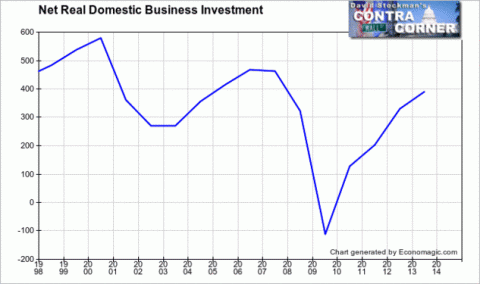
Faltering growth, in turn, has meant severe job market deterioration and declining investment in productive assets. Indeed, during the last 14 years of its intense economic weather watching and money printing, the Fed has never once noticed that breadwinner jobs have declined by 5%, real net investment in business plant and equipment is down by 20% and the median household income is not only sharply lower, but actually only at levels first achieved in 1989.

Breadwinner Economy Jobs- Click to enlarge
Breadwinner Economy Jobs- Click to enlarge


Real Business Investment - Click to enlarge

Real Business Investment – Click to enlarge

Needless to say, these failing trends in the fundamental measures of macroeconomic health occurred at a time when the Fed’s balance sheet virtually exploded, rising from $500 billion to nearly $4.5 trillion – or by 9X – during the same 14 year period. Yet it keeps attempting to shove credit into the economy notwithstanding this self-evident failure because at the end of the day there is nothing else in its playbook.

So we have reached peak debt in both the household and business sectors. That means the fed’s massive flood of liquidity never gets out of the canyons of Wall Street, yet it nevertheless keeps the spigot wide open, and promises to do so for 80 months running at least thru mid-year 2015.

*  *  *

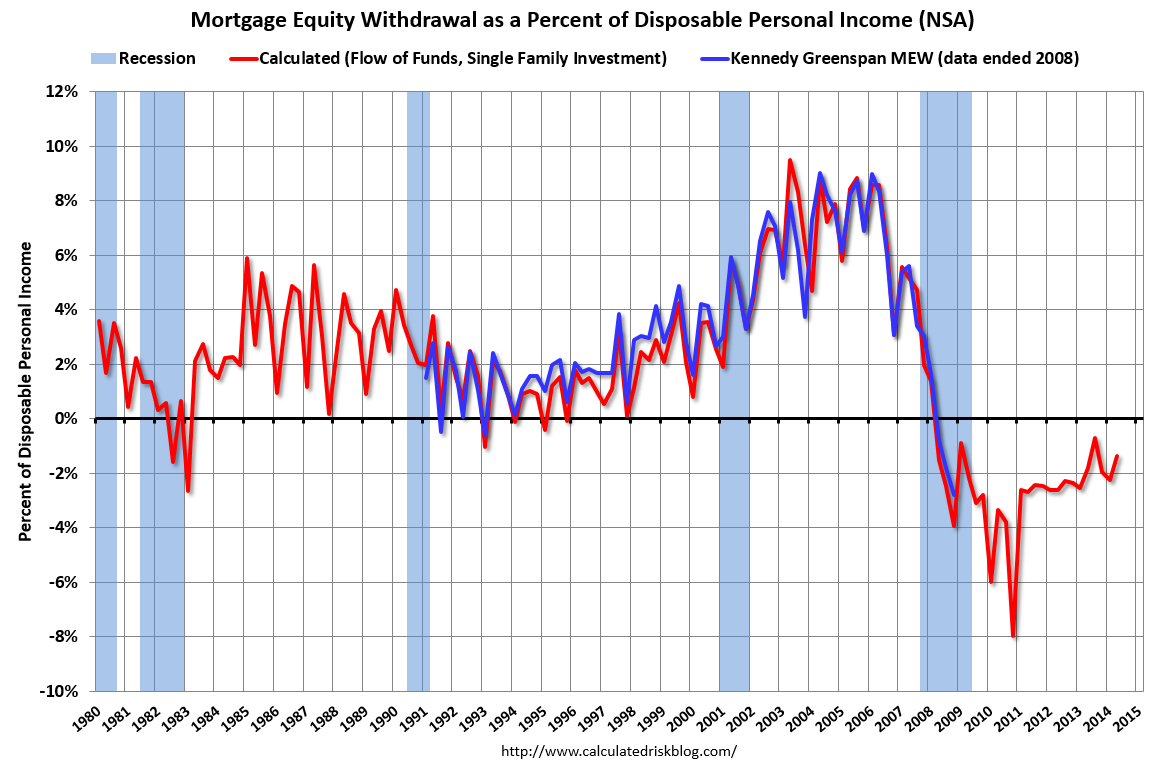
In short, believing they are filling the macroeconomic bathtub with aggregate demand and full-employment jobs, Janet Yellen and her merry band of Keynesian money printers are simply blowing chronic, giant, dangerous bubbles on Wall Street. If they are beginning to become fearful of a Wall Street hissy fit, perhaps they should look at the two charts below.
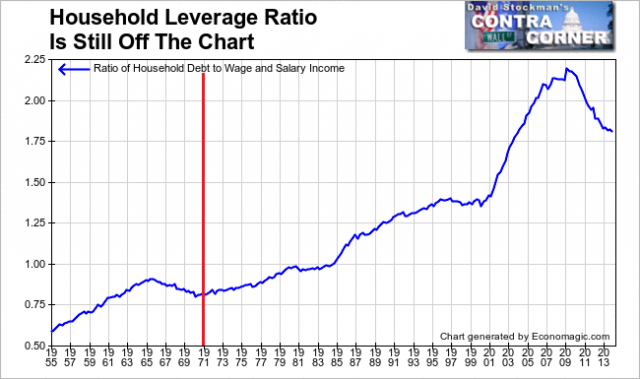
Household Leverage Ratio - Click to enlarge

Household Leverage Ratio – Click to enlarge

Easy money is always the wrong medicine, but most especially for an economy that is already and self-evidently saturated with too much debt. In particular, the inflated and unsustainable growth that the Greenspan Fed engineered by encouraging main street households to stage a massive raid on their home ATM machines has sharply reversed, and properly so.

And this is no small number. Compared to the peak MEW (mortgage equity withdrawal) rate of 8% of disposal income, today’s negative 2% rate means there has been an approximate $1 trillion swing in household “spending”.  Our Keynesian central bankers lament this as a loss of “aggregate demand” that they intend to remedy by printing more money. In truth, this was always phony demand that could not be sustained and had not been earned through production; its disappearance, therefore, marks the fact that households have been forced back to the old fashion virtue of “living within their means”.

Stated differently, the supply side is back in charge after a 30 year spree of one-time debt and leverage expansion. Consumer spending now depends on income – which means production, investment and enterprise are once again the source of growth, jobs and true national wealth.

The implication of all of this, of course,is that our monetary politburo is out of business; that “monetary accommodation” is nothing more than a one time parlor trick of central bankers. Unfortunately, like the real politburo in the Kremlin, the incumbents in the Eccles Building will not desist until they are finally chased from office by a massive uprising of the people – –that is, the savers, workers and entrepreneurs of America who have been shafted by the bubble finance policies of our monetary central planners.


via Zero Hedge http://ift.tt/1mMsGLJ Tyler Durden

The Fed’s Credit Channel Is Broken And Its Bathtub Economics Has Failed

Submitted by David Stockman via Contra Corner blog,

Among the many evils of monetary central planning is the conceit that 12 members of the FOMC can tweak the performance of a $17 trillion economy on virtually a month to month basis – using the crude tools of interest rate pegging and word cloud emissions (i.e. “verbal guidance”). Read the FOMC meeting minutes or the actual transcripts (with a five-year release lag) and they sound like an economic weather report. Unlike the TV weathermen, however, our monetary politburo actually endeavors to control the economic climate for the period immediately ahead.

Accordingly, the Fed is pre-occupied with utterly transient and frequently revised-away monthly release data on retail sales, housing starts, auto production, business investment, employment, inflation and the like. But its always about the latest ticks in the data – never about the larger patterns and the deeper longer-term trends.

And of course that’s the essence of the Keynesian affliction. The denizens of the Eccles Building – -overwhelmingly academics and policy apparatchiks – -rarely venture into the blooming, buzzing messiness of the real economic world. They simplistically believe, therefore, that the US economy is just a giant bathtub that must the filled to the brim with “aggregate demand” and all will be well.

Filling the economic bathtub is accomplished through something called “monetary accommodation”, which essentially means credit expansion. That is, market capitalism left to its own devices is held to have an inherently suicidal tendency toward depression – or at least chronic recessions and underperformance. As the Keynesians have it, households and businesses almost always spend too little and therefore need to be induced to become more exuberant in the shopping aisles and on the factory floor.

In this framework, the blunt instrument of artificially depressed interest rates is the natural policy tool of choice. If cautious households are saving too much for a rainy day or even their children’s education or their own retirement – – why then club them with ZIPR (zero interest rates). Get them shopping until they drop. Likewise, if businessmen are too benighted to see the case for opening another store or buying a new lift truck for their warehouse (or expanding same), bribe them with cheap debt financing.

In short, the primary route of  monetary policy transmission for Keynesian central bankers is the credit expansion channel. Using that economic plumbing system they endeavor to goose aggregate demand and thereby fill the economic bathtub to its brim – otherwise known as potential output and full employment. Furthermore, by a Keynesian axiom – -the Phillips Curve trade-off between inflation and employment – there is no possibility of serious goods and services inflation until the tub is full and all capital and labor resources are fully employed.

So the whole gig amounts to a simple plumbing procedure: Keep pumping aggregate demand through the credit channel until potential GDP is fully realized because, ipso facto, that means that the Fed’s Humphrey-Hawkins mandates of price stability and maximum employment have also been achieved.  At the end of the day, therefore, the Fed heads watch the ticks and blips of the “in-coming data” with such ferocious but misguided intensity because they believe their job will be done when the US economy finally reaches its brim. Just there; no more, no less.

This entire Keynesian bathtub model is nonsense, of course, not the least because the US economy is not a closed system, but functions in a rambunctious, open global economy. In that setting, massive flows of trade, investment and finance impinge heavily on prices, costs, wages and productive asset returns, and therefore the daily behavior of millions of domestic workers, businessmen, investors and financial intermediaries. Accordingly, if domestic costs and wages are too high relative to the global competition, the Fed can create “aggregate demand” to its heart’s delight, but the added borrowing and spending will leak off into incremental imports, not added domestic production and jobs.

So the Fed’s Keynesian model is fundamentally flawed – a reality that perhaps explains its stubborn adherence to policies that do not achieve their stated macro-economic objectives, but simply fuel serial financial bubbles instead. And it also explains its inability to recognize or acknowledge either untoward effect.

However, even apart from the fundamental flaws of its basic economic model, the Fed’s Keynesian pre-occupation with the economy’s mythical full-employment brim (and the short-run business cyclical fluctuations related to it) causes our monetary central planners to ignore the obvious. Namely, that the credit transmission channel is broken and done, and that the massive resort to money printing – especially since the dotcom bust in 2000 – hasn’t worked at all. In fact, massive monetary stimulus has been accompanied by sharply deteriorating economic trends.

Stated differently, the growth rate and general health of the US economy has drastically down-shifted during the last decade and one-half and now stands at only a fraction of its historic trends.  Specifically, real GDP grew at a 4.0% rate during the golden age of sound money and fiscal rectitude between 1950 and 1970.

Then it dropped to about 3% during the next 30 years after Nixon defaulted on our Bretton Woods obligation to redeem the dollar in a constant weight of gold. This was an epochal move that permitted the world’s leading central bank to launch its one-time ratchet of the US economy’s leverage ratio, raising it from 1.5X national income before 1970 to 3.5X  shortly after the turn of the century. The consequence was to allow the US economy to generate about $30 trillion of public and private debt beyond what would have been the case under the 100-year trend ratio that prevailed prior to 1971. This amounted to an incremental dollop of spending beyond that available from current production and income that temporarily juiced economic growth as measured by the Keynesian GDP accounts,

But since the dotcom bust in 2000 – – when the Greenspan Fed finally went all out with printing press monetary expansion – -real GDP growth has amounted to only 1.7% annually.  That is just 40% of its golden age rate, and in truth probably even less if inflation were to be honestly measured by the government’s statistical mills.

Faltering growth, in turn, has meant severe job market deterioration and declining investment in productive assets. Indeed, during the last 14 years of its intense economic weather watching and money printing, the Fed has never once noticed that breadwinner jobs have declined by 5%, real net investment in business plant and equipment is down by 20% and the median household income is not only sharply lower, but actually only at levels first achieved in 1989.

Breadwinner Economy Jobs- Click to enlarge

Breadwinner Economy Jobs- Click to enlarge


Real Business Investment - Click to enlarge

Real Business Investment – Click to enlarge

Needless to say, these failing trends in the fundamental measures of macroeconomic health occurred at a time when the Fed’s balance sheet virtually exploded, rising from $500 billion to nearly $4.5 trillion – or by 9X – during the same 14 year period. Yet it keeps attempting to shove credit into the economy notwithstanding this self-evident failure because at the end of the day there is nothing else in its playbook.

So we have reached peak debt in both the household and business sectors. That means the fed’s massive flood of liquidity never gets out of the canyons of Wall Street, yet it nevertheless keeps the spigot wide open, and promises to do so for 80 months running at least thru mid-year 2015.

*  *  *

In short, believing they are filling the macroeconomic bathtub with aggregate demand and full-employment jobs, Janet Yellen and her merry band of Keynesian money printers are simply blowing chronic, giant, dangerous bubbles on Wall Street. If they are beginning to become fearful of a Wall Street hissy fit, perhaps they should look at the two charts below.

Household Leverage Ratio - Click to enlarge

Household Leverage Ratio – Click to enlarge

Easy money is always the wrong medicine, but most especially for an economy that is already and self-evidently saturated with too much debt. In particular, the inflated and unsustainable growth that the Greenspan Fed engineered by encouraging main street households to stage a massive raid on their home ATM machines has sharply reversed, and properly so.

And this is no small number. Compared to the peak MEW (mortgage equity withdrawal) rate of 8% of disposal income, today’s negative 2% rate means there has been an approximate $1 trillion swing in household “spending”.  Our Keynesian central bankers lament this as a loss of “aggregate demand” that they intend to remedy by printing more money. In truth, this was always phony demand that could not be sustained and had not been earned through production; its disappearance, therefore, marks the fact that households have been forced back to the old fashion virtue of “living within their means”.

Stated differently, the supply side is back in charge after a 30 year spree of one-time debt and leverage expansion. Consumer spending now depends on income – which means production, investment and enterprise are once again the source of growth, jobs and true national wealth.

The implication of all of this, of course,is that our monetary politburo is out of business; that “monetary accommodation” is nothing more than a one time parlor trick of central bankers. Unfortunately, like the real politburo in the Kremlin, the incumbents in the Eccles Building will not desist until they are finally chased from office by a massive uprising of the people – –that is, the savers, workers and entrepreneurs of America who have been shafted by the bubble finance policies of our monetary central planners.


via Zero Hedge http://ift.tt/1mMsGLJ Tyler Durden

How The Fed 'Broke' The Markets (In 2 Simple Charts)

The next time your friendly, local, asset-gathering, commission-taking, wealth-transferer explains that “you should BTFATH because stock valuations are supported by the fundamentals” – show them these two charts.


Now – what do you think will happen when the Fed turns off the QE tap?

Source: Citi


via Zero Hedge http://ift.tt/1mMsFr6 Tyler Durden

How The Fed ‘Broke’ The Markets (In 2 Simple Charts)

The next time your friendly, local, asset-gathering, commission-taking, wealth-transferer explains that “you should BTFATH because stock valuations are supported by the fundamentals” – show them these two charts.


Now – what do you think will happen when the Fed turns off the QE tap?

Source: Citi


via Zero Hedge http://ift.tt/1mMsFr6 Tyler Durden