Just 3 WTF Earnings Charts

If a picture paints a thousand words, these three charts should write an entire book about the "market's" earnings…


Chapter 1: Bottom-Up Ugly

While the constant jibber-jabber on business media proclaims 'earnings are awesome… in fact everything is awesome', the truth is an oddly divergent reality. Net earnings revisions have been positive only 12 times in the last 104 weeks…


Chapter 2: Top-Down Hockey Sticks

Despite these chronic historical downward-revisions, Forward S&P 500 EPS estimates continue to surge (driven by large market cap effects and the hockey-stick hopes and dreams)


Chapter 3: Keeping The Dream Alive

Which leaves, the disconnect between 12-month forward index P/E and consensus EPS growth rates getting a little extreme


Chapter 4: Time's Up

If Blackrock is right that the corporate bond market is broken and unprepared for the "stress" of a withdrawing fed, then exactly what will keep this divergent dream alive as the ability to fund cheap buybacks dries up faster than a broad coalition of Western allies invading Syria.

*  *  *

h/t @Not_Jim_Cramer

Bonus Chart: Of course, we have the Fed's "other mandate" now of financial stability to maintain the wealth creation…


via Zero Hedge http://ift.tt/1ve3s88 Tyler Durden

The Fed's Credit Channel Is Broken And Its Bathtub Economics Has Failed

Submitted by David Stockman via Contra Corner blog,

Among the many evils of monetary central planning is the conceit that 12 members of the FOMC can tweak the performance of a $17 trillion economy on virtually a month to month basis – using the crude tools of interest rate pegging and word cloud emissions (i.e. “verbal guidance”). Read the FOMC meeting minutes or the actual transcripts (with a five-year release lag) and they sound like an economic weather report. Unlike the TV weathermen, however, our monetary politburo actually endeavors to control the economic climate for the period immediately ahead.

Accordingly, the Fed is pre-occupied with utterly transient and frequently revised-away monthly release data on retail sales, housing starts, auto production, business investment, employment, inflation and the like. But its always about the latest ticks in the data – never about the larger patterns and the deeper longer-term trends.

And of course that’s the essence of the Keynesian affliction. The denizens of the Eccles Building – -overwhelmingly academics and policy apparatchiks – -rarely venture into the blooming, buzzing messiness of the real economic world. They simplistically believe, therefore, that the US economy is just a giant bathtub that must the filled to the brim with “aggregate demand” and all will be well.

Filling the economic bathtub is accomplished through something called “monetary accommodation”, which essentially means credit expansion. That is, market capitalism left to its own devices is held to have an inherently suicidal tendency toward depression – or at least chronic recessions and underperformance. As the Keynesians have it, households and businesses almost always spend too little and therefore need to be induced to become more exuberant in the shopping aisles and on the factory floor.

In this framework, the blunt instrument of artificially depressed interest rates is the natural policy tool of choice. If cautious households are saving too much for a rainy day or even their children’s education or their own retirement – – why then club them with ZIPR (zero interest rates). Get them shopping until they drop. Likewise, if businessmen are too benighted to see the case for opening another store or buying a new lift truck for their warehouse (or expanding same), bribe them with cheap debt financing.

In short, the primary route of  monetary policy transmission for Keynesian central bankers is the credit expansion channel. Using that economic plumbing system they endeavor to goose aggregate demand and thereby fill the economic bathtub to its brim – otherwise known as potential output and full employment. Furthermore, by a Keynesian axiom – -the Phillips Curve trade-off between inflation and employment – there is no possibility of serious goods and services inflation until the tub is full and all capital and labor resources are fully employed.

So the whole gig amounts to a simple plumbing procedure: Keep pumping aggregate demand through the credit channel until potential GDP is fully realized because, ipso facto, that means that the Fed’s Humphrey-Hawkins mandates of price stability and maximum employment have also been achieved.  At the end of the day, therefore, the Fed heads watch the ticks and blips of the “in-coming data” with such ferocious but misguided intensity because they believe their job will be done when the US economy finally reaches its brim. Just there; no more, no less.

This entire Keynesian bathtub model is nonsense, of course, not the least because the US economy is not a closed system, but functions in a rambunctious, open global economy. In that setting, massive flows of trade, investment and finance impinge heavily on prices, costs, wages and productive asset returns, and therefore the daily behavior of millions of domestic workers, businessmen, investors and financial intermediaries. Accordingly, if domestic costs and wages are too high relative to the global competition, the Fed can create “aggregate demand” to its heart’s delight, but the added borrowing and spending will leak off into incremental imports, not added domestic production and jobs.

So the Fed’s Keynesian model is fundamentally flawed – a reality that perhaps explains its stubborn adherence to policies that do not achieve their stated macro-economic objectives, but simply fuel serial financial bubbles instead. And it also explains its inability to recognize or acknowledge either untoward effect.

However, even apart from the fundamental flaws of its basic economic model, the Fed’s Keynesian pre-occupation with the economy’s mythical full-employment brim (and the short-run business cyclical fluctuations related to it) causes our monetary central planners to ignore the obvious. Namely, that the credit transmission channel is broken and done, and that the massive resort to money printing – especially since the dotcom bust in 2000 – hasn’t worked at all. In fact, massive monetary stimulus has been accompanied by sharply deteriorating economic trends.

Stated differently, the growth rate and general health of the US economy has drastically down-shifted during the last decade and one-half and now stands at only a fraction of its historic trends.  Specifically, real GDP grew at a 4.0% rate during the golden age of sound money and fiscal rectitude between 1950 and 1970.

Then it dropped to about 3% during the next 30 years after Nixon defaulted on our Bretton Woods obligation to redeem the dollar in a constant weight of gold. This was an epochal move that permitted the world’s leading central bank to launch its one-time ratchet of the US economy’s leverage ratio, raising it from 1.5X national income before 1970 to 3.5X  shortly after the turn of the century. The consequence was to allow the US economy to generate about $30 trillion of public and private debt beyond what would have been the case under the 100-year trend ratio that prevailed prior to 1971. This amounted to an incremental dollop of spending beyond that available from current production and income that temporarily juiced economic growth as measured by the Keynesian GDP accounts,

But since the dotcom bust in 2000 – – when the Greenspan Fed finally went all out with printing press monetary expansion – -real GDP growth has amounted to only 1.7% annually.  That is just 40% of its golden age rate, and in truth probably even less if inflation were to be honestly measured by the government’s statistical mills.

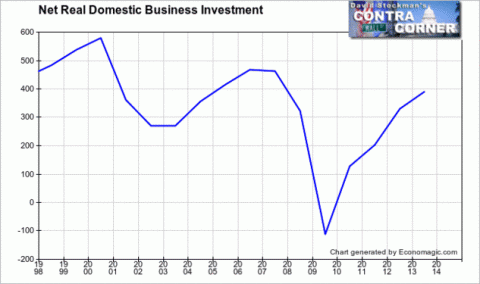
Faltering growth, in turn, has meant severe job market deterioration and declining investment in productive assets. Indeed, during the last 14 years of its intense economic weather watching and money printing, the Fed has never once noticed that breadwinner jobs have declined by 5%, real net investment in business plant and equipment is down by 20% and the median household income is not only sharply lower, but actually only at levels first achieved in 1989.

Breadwinner Economy Jobs- Click to enlarge
Breadwinner Economy Jobs- Click to enlarge


Real Business Investment - Click to enlarge

Real Business Investment – Click to enlarge

Needless to say, these failing trends in the fundamental measures of macroeconomic health occurred at a time when the Fed’s balance sheet virtually exploded, rising from $500 billion to nearly $4.5 trillion – or by 9X – during the same 14 year period. Yet it keeps attempting to shove credit into the economy notwithstanding this self-evident failure because at the end of the day there is nothing else in its playbook.

So we have reached peak debt in both the household and business sectors. That means the fed’s massive flood of liquidity never gets out of the canyons of Wall Street, yet it nevertheless keeps the spigot wide open, and promises to do so for 80 months running at least thru mid-year 2015.

*  *  *

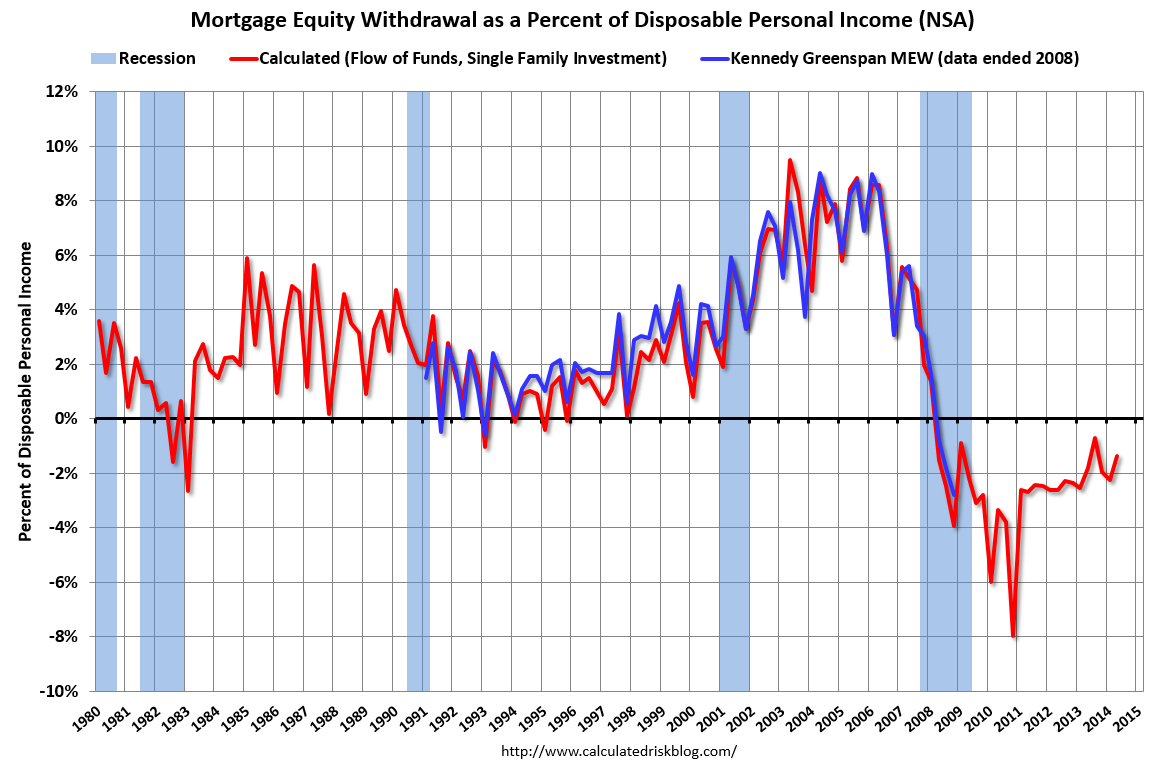
In short, believing they are filling the macroeconomic bathtub with aggregate demand and full-employment jobs, Janet Yellen and her merry band of Keynesian money printers are simply blowing chronic, giant, dangerous bubbles on Wall Street. If they are beginning to become fearful of a Wall Street hissy fit, perhaps they should look at the two charts below.
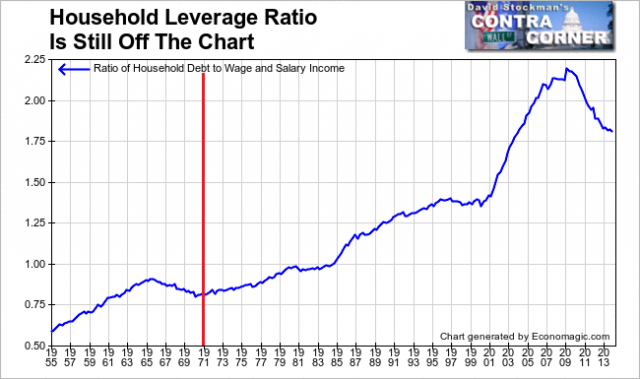
Household Leverage Ratio - Click to enlarge

Household Leverage Ratio – Click to enlarge

Easy money is always the wrong medicine, but most especially for an economy that is already and self-evidently saturated with too much debt. In particular, the inflated and unsustainable growth that the Greenspan Fed engineered by encouraging main street households to stage a massive raid on their home ATM machines has sharply reversed, and properly so.

And this is no small number. Compared to the peak MEW (mortgage equity withdrawal) rate of 8% of disposal income, today’s negative 2% rate means there has been an approximate $1 trillion swing in household “spending”.  Our Keynesian central bankers lament this as a loss of “aggregate demand” that they intend to remedy by printing more money. In truth, this was always phony demand that could not be sustained and had not been earned through production; its disappearance, therefore, marks the fact that households have been forced back to the old fashion virtue of “living within their means”.

Stated differently, the supply side is back in charge after a 30 year spree of one-time debt and leverage expansion. Consumer spending now depends on income – which means production, investment and enterprise are once again the source of growth, jobs and true national wealth.

The implication of all of this, of course,is that our monetary politburo is out of business; that “monetary accommodation” is nothing more than a one time parlor trick of central bankers. Unfortunately, like the real politburo in the Kremlin, the incumbents in the Eccles Building will not desist until they are finally chased from office by a massive uprising of the people – –that is, the savers, workers and entrepreneurs of America who have been shafted by the bubble finance policies of our monetary central planners.


via Zero Hedge http://ift.tt/1mMsGLJ Tyler Durden

The Fed’s Credit Channel Is Broken And Its Bathtub Economics Has Failed

Submitted by David Stockman via Contra Corner blog,

Among the many evils of monetary central planning is the conceit that 12 members of the FOMC can tweak the performance of a $17 trillion economy on virtually a month to month basis – using the crude tools of interest rate pegging and word cloud emissions (i.e. “verbal guidance”). Read the FOMC meeting minutes or the actual transcripts (with a five-year release lag) and they sound like an economic weather report. Unlike the TV weathermen, however, our monetary politburo actually endeavors to control the economic climate for the period immediately ahead.

Accordingly, the Fed is pre-occupied with utterly transient and frequently revised-away monthly release data on retail sales, housing starts, auto production, business investment, employment, inflation and the like. But its always about the latest ticks in the data – never about the larger patterns and the deeper longer-term trends.

And of course that’s the essence of the Keynesian affliction. The denizens of the Eccles Building – -overwhelmingly academics and policy apparatchiks – -rarely venture into the blooming, buzzing messiness of the real economic world. They simplistically believe, therefore, that the US economy is just a giant bathtub that must the filled to the brim with “aggregate demand” and all will be well.

Filling the economic bathtub is accomplished through something called “monetary accommodation”, which essentially means credit expansion. That is, market capitalism left to its own devices is held to have an inherently suicidal tendency toward depression – or at least chronic recessions and underperformance. As the Keynesians have it, households and businesses almost always spend too little and therefore need to be induced to become more exuberant in the shopping aisles and on the factory floor.

In this framework, the blunt instrument of artificially depressed interest rates is the natural policy tool of choice. If cautious households are saving too much for a rainy day or even their children’s education or their own retirement – – why then club them with ZIPR (zero interest rates). Get them shopping until they drop. Likewise, if businessmen are too benighted to see the case for opening another store or buying a new lift truck for their warehouse (or expanding same), bribe them with cheap debt financing.

In short, the primary route of  monetary policy transmission for Keynesian central bankers is the credit expansion channel. Using that economic plumbing system they endeavor to goose aggregate demand and thereby fill the economic bathtub to its brim – otherwise known as potential output and full employment. Furthermore, by a Keynesian axiom – -the Phillips Curve trade-off between inflation and employment – there is no possibility of serious goods and services inflation until the tub is full and all capital and labor resources are fully employed.

So the whole gig amounts to a simple plumbing procedure: Keep pumping aggregate demand through the credit channel until potential GDP is fully realized because, ipso facto, that means that the Fed’s Humphrey-Hawkins mandates of price stability and maximum employment have also been achieved.  At the end of the day, therefore, the Fed heads watch the ticks and blips of the “in-coming data” with such ferocious but misguided intensity because they believe their job will be done when the US economy finally reaches its brim. Just there; no more, no less.

This entire Keynesian bathtub model is nonsense, of course, not the least because the US economy is not a closed system, but functions in a rambunctious, open global economy. In that setting, massive flows of trade, investment and finance impinge heavily on prices, costs, wages and productive asset returns, and therefore the daily behavior of millions of domestic workers, businessmen, investors and financial intermediaries. Accordingly, if domestic costs and wages are too high relative to the global competition, the Fed can create “aggregate demand” to its heart’s delight, but the added borrowing and spending will leak off into incremental imports, not added domestic production and jobs.

So the Fed’s Keynesian model is fundamentally flawed – a reality that perhaps explains its stubborn adherence to policies that do not achieve their stated macro-economic objectives, but simply fuel serial financial bubbles instead. And it also explains its inability to recognize or acknowledge either untoward effect.

However, even apart from the fundamental flaws of its basic economic model, the Fed’s Keynesian pre-occupation with the economy’s mythical full-employment brim (and the short-run business cyclical fluctuations related to it) causes our monetary central planners to ignore the obvious. Namely, that the credit transmission channel is broken and done, and that the massive resort to money printing – especially since the dotcom bust in 2000 – hasn’t worked at all. In fact, massive monetary stimulus has been accompanied by sharply deteriorating economic trends.

Stated differently, the growth rate and general health of the US economy has drastically down-shifted during the last decade and one-half and now stands at only a fraction of its historic trends.  Specifically, real GDP grew at a 4.0% rate during the golden age of sound money and fiscal rectitude between 1950 and 1970.

Then it dropped to about 3% during the next 30 years after Nixon defaulted on our Bretton Woods obligation to redeem the dollar in a constant weight of gold. This was an epochal move that permitted the world’s leading central bank to launch its one-time ratchet of the US economy’s leverage ratio, raising it from 1.5X national income before 1970 to 3.5X  shortly after the turn of the century. The consequence was to allow the US economy to generate about $30 trillion of public and private debt beyond what would have been the case under the 100-year trend ratio that prevailed prior to 1971. This amounted to an incremental dollop of spending beyond that available from current production and income that temporarily juiced economic growth as measured by the Keynesian GDP accounts,

But since the dotcom bust in 2000 – – when the Greenspan Fed finally went all out with printing press monetary expansion – -real GDP growth has amounted to only 1.7% annually.  That is just 40% of its golden age rate, and in truth probably even less if inflation were to be honestly measured by the government’s statistical mills.

Faltering growth, in turn, has meant severe job market deterioration and declining investment in productive assets. Indeed, during the last 14 years of its intense economic weather watching and money printing, the Fed has never once noticed that breadwinner jobs have declined by 5%, real net investment in business plant and equipment is down by 20% and the median household income is not only sharply lower, but actually only at levels first achieved in 1989.

Breadwinner Economy Jobs- Click to enlarge

Breadwinner Economy Jobs- Click to enlarge


Real Business Investment - Click to enlarge

Real Business Investment – Click to enlarge

Needless to say, these failing trends in the fundamental measures of macroeconomic health occurred at a time when the Fed’s balance sheet virtually exploded, rising from $500 billion to nearly $4.5 trillion – or by 9X – during the same 14 year period. Yet it keeps attempting to shove credit into the economy notwithstanding this self-evident failure because at the end of the day there is nothing else in its playbook.

So we have reached peak debt in both the household and business sectors. That means the fed’s massive flood of liquidity never gets out of the canyons of Wall Street, yet it nevertheless keeps the spigot wide open, and promises to do so for 80 months running at least thru mid-year 2015.

*  *  *

In short, believing they are filling the macroeconomic bathtub with aggregate demand and full-employment jobs, Janet Yellen and her merry band of Keynesian money printers are simply blowing chronic, giant, dangerous bubbles on Wall Street. If they are beginning to become fearful of a Wall Street hissy fit, perhaps they should look at the two charts below.

Household Leverage Ratio - Click to enlarge

Household Leverage Ratio – Click to enlarge

Easy money is always the wrong medicine, but most especially for an economy that is already and self-evidently saturated with too much debt. In particular, the inflated and unsustainable growth that the Greenspan Fed engineered by encouraging main street households to stage a massive raid on their home ATM machines has sharply reversed, and properly so.

And this is no small number. Compared to the peak MEW (mortgage equity withdrawal) rate of 8% of disposal income, today’s negative 2% rate means there has been an approximate $1 trillion swing in household “spending”.  Our Keynesian central bankers lament this as a loss of “aggregate demand” that they intend to remedy by printing more money. In truth, this was always phony demand that could not be sustained and had not been earned through production; its disappearance, therefore, marks the fact that households have been forced back to the old fashion virtue of “living within their means”.

Stated differently, the supply side is back in charge after a 30 year spree of one-time debt and leverage expansion. Consumer spending now depends on income – which means production, investment and enterprise are once again the source of growth, jobs and true national wealth.

The implication of all of this, of course,is that our monetary politburo is out of business; that “monetary accommodation” is nothing more than a one time parlor trick of central bankers. Unfortunately, like the real politburo in the Kremlin, the incumbents in the Eccles Building will not desist until they are finally chased from office by a massive uprising of the people – –that is, the savers, workers and entrepreneurs of America who have been shafted by the bubble finance policies of our monetary central planners.


via Zero Hedge http://ift.tt/1mMsGLJ Tyler Durden

How The Fed 'Broke' The Markets (In 2 Simple Charts)

The next time your friendly, local, asset-gathering, commission-taking, wealth-transferer explains that “you should BTFATH because stock valuations are supported by the fundamentals” – show them these two charts.


Now – what do you think will happen when the Fed turns off the QE tap?

Source: Citi


via Zero Hedge http://ift.tt/1mMsFr6 Tyler Durden

How The Fed ‘Broke’ The Markets (In 2 Simple Charts)

The next time your friendly, local, asset-gathering, commission-taking, wealth-transferer explains that “you should BTFATH because stock valuations are supported by the fundamentals” – show them these two charts.


Now – what do you think will happen when the Fed turns off the QE tap?

Source: Citi


via Zero Hedge http://ift.tt/1mMsFr6 Tyler Durden

Another Police Beating Caught on Dash Cam, Ruled A-OK. It’s Just Police Work

booking photoWhat kind of restraint should cops have to
exercise when trying to induce compliance in a target? Judging from
how often the use of force by cops is ruled not excessive, not much
restraint is necessary. More cases of alleged police brutality may
be videotaped, by passersby or by cops’ various cameras, but cops
can often still expect to be exonerated. It took fellow cops at the
Red Bank Police Department in Tennessee
about a month
to rule that the use of force by their colleagues
in the video below, including multiple punches while the suspect
was already restrained, was not excessive:

Typical police work?

Lawyers for the man in the video say they may sue, so the police
department says it can’t discuss the matter further. 

from Hit & Run http://ift.tt/Y33O6x
via IFTTT

Another Police Beating Caught on Dash Cam, Ruled A-OK. It's Just Police Work

booking photoWhat kind of restraint should cops have to
exercise when trying to induce compliance in a target? Judging from
how often the use of force by cops is ruled not excessive, not much
restraint is necessary. More cases of alleged police brutality may
be videotaped, by passersby or by cops’ various cameras, but cops
can often still expect to be exonerated. It took fellow cops at the
Red Bank Police Department in Tennessee
about a month
to rule that the use of force by their colleagues
in the video below, including multiple punches while the suspect
was already restrained, was not excessive:

Typical police work?

Lawyers for the man in the video say they may sue, so the police
department says it can’t discuss the matter further. 

from Hit & Run http://ift.tt/Y33O6x
via IFTTT

Students and Teachers Protest in Colorado After Proposal to Censor “Civil Disobedience Topics” from AP History

Screen Shot 2014-09-23 at 3.59.59 PMMust the citizen ever for a moment, or in the least degree, resign his conscience to the legislator?  Why has every man a conscience then?  I think that we should be men first, and subjects afterward.  It is not desirable to cultivate a respect for the law, so much as for the right. The only obligation which I have a right to assume is to do at any time what I think right.

– Henry David Thoreau in Civil Disobedience (1849)

Civil disobedience is as American as apple pie. In fact, one of the most memorable moments in the formation of the republic was the Boston Tea Party, a much celebrated and historic act of civil disobedience.

From colonists dressed as Native Americans dumping East India Company tea into the Boston Harbor, to Henry David Thoreau’s Civil Disobedience. From Rosa Parks, to Martin Luther King Jr., civil disobedience has been a significant part of what has made these United States free, and is a tactic that should be elevated and encouraged, rather than censored and demonized.


Protect your wealth – Buy Gold and Silver Bullion with Goldbroker.com


continue reading

from Liberty Blitzkrieg http://ift.tt/1x9SUuO
via IFTTT

U.S. and China Both Pledge Nothing at U.N. Climate Summit

Obama Climate ChangeNew York-At the United
Nations Climate Summit
today, the world’s two biggest emitters
of greenhouse gases, China and the United States, both held off on
making any specific additional pledges regarding their future
emissions. In 2012, humanity emitted
36 billion tons of carbon dioxide
into the atmosphere, of which
10 billion came from China and 5.2 billion from the United States.
Convened by General-Secretary Ban Ki Moon, the Summit is supposed
to “catalyze action” in advance of the big U.N. climate change
conference at Paris in 2015. At the Paris conference, the nations
of the world are supposed to make pledges to cut their emissions
sufficient to keep future warming below the internationally agreed
upon threshold of 2 degrees Celsius. It is not at all clear that
today’s Summit catalyzed much more than pious clichés.

In his
remarks
before the U.N. General Assembly, President Barack
Obama opened by noting that while the world is confronting the
current issues of terrorism, instability, inequality, and disease,
“there’s one issue that will define the contours of this century
more dramatically than any other, and that is the urgent and
growing threat of a changing climate.” The president proudly added
that since he took office the U.S. produces three times more
electricity from the wind and 10 times more from the sun. How much
is that? The Energy Information Administration reports that in 2013
electricity from wind power amounted to 4.13 percent
and solar to 0.23 percent
of supply.

The president observed that “the United States has reduced our
total carbon pollution by more than any other nation on Earth.” In
fact, by 2012, U.S. carbon dioxide emissions were down by more
than 12 percent
over the 2007 peak; down to about where they
were in 1994. However, emissions
upticked 2 percent
in 2013. While the president reiterated his
pledge that the U.S. would by 2020 cut its greenhouse gas emissions
17 percent below the levels emitted in 2005, he held off making any
new ones, promising that “by early next year, we will put forward
our next emission target.”

With China clearly in mind, President Obama declared, “We can
only succeed in combating climate change if we are joined in this
effort by every nation –- developed and developing
alike. Nobody gets a pass.”

ZhangGeneral
Secretary Ban Ki Moon had hoped to attract heads of state of most
the big emitting countries to the Summit, but China’s President Xi
Jinping declined to come. Instead, Vice-Premier Zhang Gaoli

put forward China’s views
at the international confab today.
Like Obama before him, Zhang largely stuck to restate China’s
earlier pledge of cutting its carbon intensity by 40 to 45 percent
by 2020 from the 2005 level. Carbon intensity is the ratio of
carbon dioxide emissions per unit of gross domestic product –
basically burning ever less fossil fuel to produce goods. Zhang
noted that by 2013 China’s carbon intensity was already down by
28.5 percent. There is plenty of room to improve: China emits
almost twice as
much carbon dioxide per dollar of GDP
as does the United
States.

Like President Obama, the Chinese vice-premier was not yet ready
to reveal his country’s negotiating bid just yet, stating, “We will
announce post-2020 actions on climate change as soon as we can.”
Zhang did, however, suggest that China’s future pledges with regard
to its greenhouse gas emissions will aim to bring “about marked
progress in reducing carbon intensity, increasing the share of
non-fossil fuels and raising the forest stock, as well as the
peaking of total CO2 emissions as early as possible.”
 

On the face of it, this part of Zhang’s statement – especially
the part about peaking emissions – should cheer those concerned
about man-made global warming. Well, maybe. In his remarks, Zhang
also restated China’s dogged insistence on adherence to the United
Nations Framework Convention on Climate Change. In that treaty,
China and a bunch of other developing countries have no firm
obligations whatsoever to do anything about their emissions. That
treaty was adopted in 1992 when China’s was much poorer and its
emissions hovered around a third of what they are today. In other
words, Zhang seems to be insisting that the world’s biggest emitter
should be given a “pass” with regard to making any commitments
toward actual cuts in greenhouse gas emissions. Meanwhile Zhang
also declared that “developed countries need to intensify emission
reduction and fulfill their commitment of annual financial support
of 100 billion US dollars and technology transfer to developing
countries by 2020.”

I plan to do a more in-depth report and analysis of what
happened – and did not happen – at the U.N. Climate Summit later
this week.

from Hit & Run http://ift.tt/1mMdZYY
via IFTTT

"This Is About As Good As Things Are Going To Get For The Middle Class"

Submitted by Michael Snyder of The Economic Collapse blog,

The U.S. economy has had six full years to bounce back since the financial collapse of 2008, and it simply has not happened.  Median household income has declined substantially since then, total household wealth for middle class families is way down, the percentage of the population that is employed is still about where it was at the end of the last recession, and the number of Americans that are dependent on the government has absolutely exploded.  Even those that claim that the economy is "recovering" admit that we are not even close to where we used to be economically.  Many hope that someday we will eventually get back to that level, but the truth is that this is about as good as things are ever going to get for the middle class.  And we should enjoy this period of relative stability while we still can, because when the next great financial crisis strikes things are going to fall apart very rapidly.

The U.S. Census Bureau has just released some brand new numbers, and they are quite sobering.  For example, after accounting for inflation median household income in the United States has declined a total of 8 percent from where it was back in 2007.

That means that middle class families have significantly less purchasing power than they did just prior to the last major financial crisis.

And one research firm is projecting that it is going to take until 2019 for median household income to return to the level that we witnessed in 2007…

For everybody wondering why the economic recovery feels like a recession, here’s the answer: We’re still at least five years away from regaining everything lost during the 2007-2009 downturn.


Forecasting firm IHS Global Insight predicts that real median household income — perhaps the best proxy for middle-class living standards — won’t reach the prior peak from 2007 until 2019. Since the numbers are adjusted for inflation, that means the typical family will wait 12 years until their purchasing power is as strong as it was before the recession. That would be the longest period of stagnation, by far, since the Great Depression of the 1930s.

Of course that projection assumes that the economy will continue to "recover", which is a very questionable assumption at best.

Meanwhile, total household wealth has been declining for middle class families as well.

According to the New York Times, the "typical American household" is now worth 36 percent less than it was worth a decade ago.

That is a pretty substantial drop.  But you never hear our politicians (especially the Democrats) bring up numbers like that because they want us to feel good about things.

So why is all of this happening?

The biggest reason why the middle class is struggling so much is the lack of good jobs.

As the chart posted below demonstrates, the percentage of the working age population that is actually employed is still way, way below where it was prior to the last recession…

Employment Population Ratio

The "employment recovery" (the tiny little bump at the end of the chart) has been so miniscule that it is hardly even worth mentioning.

At the moment, we still have 1.4 million fewer full-time jobs than we did in 2008 even though more than 100,000 people are added to the U.S. population each month.

And a lot of the workers that have lost jobs since the start of the last recession have never been able to find a new one.

According to a brand new survey conducted by Rutgers University, more than 20 percent of all workers that have been laid off in the past five years still have not found a new job.

Meanwhile, the control freak bureaucrats that run this country continue to kill off small businesses.

In recent years we have seen large numbers of small businesses fail, and at this point the rate of small business ownership in the United States is at an all-time low.

As a result of everything that you have just read, the middle class is shrinking and dependence on the government is soaring.

Today, there are 49 million Americans that are dealing with food insecurity, and Americans received more than 2 trillion dollars in benefits from the federal government last year alone.

For many more statistics just like this, please see my previous article entitled "30 stats to show to anyone that does not believe the middle class is being destroyed".

Without a doubt, things are not that good for the middle class in America these days.

Unfortunately, the next great wave of financial trouble is rapidly approaching, and once it strikes things are going to get substantially worse for the middle class.

Yes, the stock market set record high after record high this summer.  But what we have observed is classic bubble behavior.  So many of the exact same patterns that occurred just prior to previous stock market crashes are happening once again.

And it is interesting to note that September 22nd has marked important market peaks at various times throughout history…

For traders, September 22 is one of those days with a notorious history. UBS's Art Cashin notes that September 22 marked various market highs in 1873, 1929, 1980, and even as recent as 2008.

Could the coming months be the beginning of the next major stock market decline?

Small-cap stocks are already starting to show signs of real weakness.  In fact, the Russell 2000 just hit a "death cross" for the first time in more than 2 years

The Russell 2000 has been diverging from the broader market over the last several weeks, and now technicians point out it has flashed a bearish signal. For the first time in more than two years, the small-cap index has hit a so-called death cross.


A death cross occurs when a nearer-term 50-day moving average falls below a longer-term, 200-day moving average. Technicians argue that a death cr
oss can be a bearish sign.

None of us knows what the market is going to do tomorrow, but a lot of the "smart money" is getting out of the market right now while the getting is good.

So where is the "smart money" putting their assets?

In a previous article, I discussed how sales of gold bars to wealthy clients is way up so far this year.

And CNBC has just reported that the ultra-wealthy "are holding mountains of cash" right now…

Billionaires are holding mountains of cash, offering the latest sign that the ultra-wealthy are nervous about putting more money into today's markets.


According to the new Billionaire Census from Wealth-X and UBS, the world's billionaires are holding an average of $600 million in cash each—greater than the gross domestic product of Dominica.

Why are they doing this?

Are they concerned about the potential of a market crash?

And if we do see another market crash like we witnessed back in 2008, what is that going to mean for the rest of us?

2008 certainly did not destroy our economy.

But it did cause an immense amount of damage that we have never recovered from.

Now the next wave is approaching, and most people don't even see it coming.


via Zero Hedge http://ift.tt/1vdJqe0 Tyler Durden