China Plans To Build Giant Wind Farm Next To USAF Base In Texas 

China Plans To Build Giant Wind Farm Next To USAF Base In Texas 

Texas lawmakers have launched an all-out effort to block a Chinese billionaire from building a massive wind farm near Laughlin Air Force base in southwest Texas. The wind farm’s close proximity to the military base has raised concerns about potential spying and attacks on the energy grid by China. 

The Chinese-backed project called Blue Hills Wind, which could house up to 40 turbines in Val Verde County, Texas, is being managed by GH America Energy, the US subsidiary of the Chinese Guanghui Energy Company. The project sits on approximately 140,000 acres of land located about 70 miles from Laughlin. 

According to American Military News, Guanghui is owned by Chinese billionaire Sun Guangxin, who reportedly has close relations with the ruling Chinese Communist Party.

The legislation called the “Protecting Military Installations and Ranges Act,” was passed last month by a handful of lawmakers, Congressman Tony Gonzales (TX-23) today with Senators Cruz (R-TX) and Rubio (R-FL), and Congressmen Ronny Jackson (TX-13) and Pat Fallon (TX-04), to prevent foreign enemies from acquiring land near military bases.

Lawmaker’s behind the bill are attempting to stop the Chinese billionaire from hooking into the Texas power grid and potentially spying for China. 

“Our greatest concern is the long-term implications this will have on the Air Force’s mission of pilot training not with a single application, but rather a cumulative strategy that cannot be evaluated in the first filing,” Val Verde County Judge Lewis G. Owens Jr. and Del Rio Mayor Bruno Lozano wrote in a letter obtained by Foreign Policy. “We believe that this project and all future projects of a similar nature will result in unacceptable risk to the national security of the United States.”

Meanwhile, the Committee on Foreign Investment in the US (CFIUS) authorized GH America Energy’s Texas wind farm project in 2020. However, the lawmakers in the state are making sure the project is stopped. 

Whatever the outcome is in Texas will certainly be a testament to the deteriorating Sino-US relations, even under a new US administration.

Last week, President Biden made his first public address to Congress. Speaking to the chamber, he frequently said his expansive domestic policy agenda is a call to confront Beijing in a battle of “democracy versus autocracy.”

Tyler Durden
Fri, 05/07/2021 – 20:40

via ZeroHedge News https://www.zerohedge.com/geopolitical/china-plans-build-giant-wind-farm-next-usaf-base-texas Tyler Durden

Rising Bond Yields Threaten Financial Market Stability

Rising Bond Yields Threaten Financial Market Stability

Authored by Alasdair Macleod via GoldMoney.com,

There is a growing recognition in financial circles that price inflation will increase significantly in the near future, and official estimates that it will be a temporary phenomenon limited to an average of 2% are overly optimistic. There is, therefore, increasing speculation about the need for interest rates to rise.

The bond yield on 10-year US Treasuries has already more than doubled over the last year. It is in the nature of market cycles for equity and other financial assets to continue to rise in value during an initial increase in bond yields. It is the second increase that can be expected to turn bullish optimism about the economic outlook into the beginning of a bear market. Financial markets, already dislocated from fundamental realities, appear to be acutely vulnerable to such a change in sentiment.

This article points out that equity markets are driven more by money flows rather than perceived economic prospects. Bank credit for industry is contracting, commodity prices are soaring, and supply chains remain disrupted. Fuelled by earlier expansions of money supply and further expansions to come, the world faces a far larger increase in price inflation than currently contemplated, and therefore far higher interest rates, threatening to destabilise both financial markets and fiat currencies.
Introduction

There is a rustling in the undergrowth, disturbing the sylvan setting where we complacently enjoy the dappled sunlight, innocently unaware of the prowling bear. The bear heralds another rise in bond yields as we grapple with the inflationary consequences of recent and current events.

Public participation in equity markets is at an all-time high, not just through direct holdings — amateurish speculation is rife — but through passive index tracking funds and the like. With respect to these, the underlying assumption financial advisors make and tell their innocent clients is that trackers are risk free, because exposure to individual corporate failures is so diluted as to be immaterial. And over time, markets always rise, captured by investing in these funds. But this is deception, ignoring market cycles and systemic risks. Ignorance of the inevitable cyclical switch from greed for profits to fear of loss that defines the divide between bull and bear markets invalidates the permabulls’ advice.

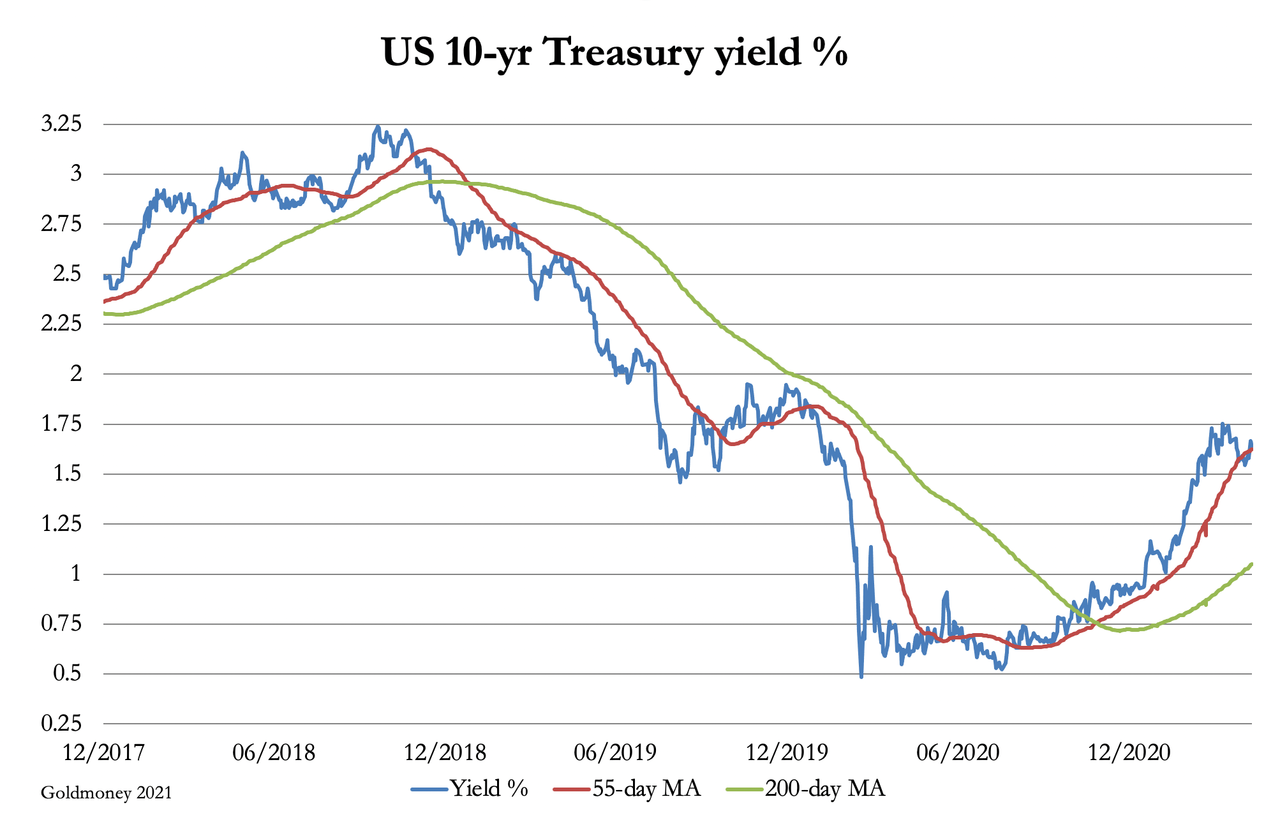
Without doubt, the prowling bear in our so far untroubled scene is bond yields. Unnoticed, they have begun to rise as shown in the chart heading this article. With increasing urgency, it is time to consider the effect on market relationships. Over many investing cycles it has been observed that bond prices conventionally top out before equities. It is one of the most reliable warning signs, which, despite its track record is routinely dismissed by wishful thinkers until it is too late.

Instead, it is a commonplace to argue that prospects for corporate profits have improved at this stage of the economic cycle because of the growing certainty of a better economic outlook. And now that this time the civilised world is emerging from lockdowns, every analyst in the mainstream media delivers this message. For them, the rise in bond yields confirms that improving business conditions are in place to justify yet higher equity prices. But it is all a cycle, having little to do with economic prospects.

Today, we see that the relationship between declining bond prices and rising equities, and all the sentiment and commentary around them, are as we should expect.. But beware the bear lurking in the woods. It’s the second rise in bond yields that often slays the equity bull. I vividly recall meeting an industrialist the autumn of 1972, who told me that his business was the best it ever had been. He then paraded his ignorance of financial matters by telling me that it was wholly irresponsible for the London Stock Exchange to permit the FT 30 share index to have halved in the previous fifteen months. Following that conversation, the FT 30 halved again after interest rates were jacked up in October 1973, creating the infamous secondary banking crisis and losing 70% from its peak in May 1972 by January 1975. And the last I heard of the unfortunate industrialist his business had gone bust and he had committed suicide.

It is a mistake to take opinions or evidence of economic conditions as the principal reason to invest in equities. It is more important to follow the money, specifically the cycle of bank credit. While amateur investors are buying into equity market tops, bankers begin to see that the early signs of rising interest rates are disrupting business plans and will lead inevitably to corporate failures. This comes at a time when their own balance sheets are most highly leveraged. With this credit cycle, there are some additional features specific to it. Even though the ending of pandemic restrictions is expected to lead to a substantial recovery in economic activity, these extra features are extreme, and the bear case is therefore strong.

Banks have begun to withdraw credit from non-financial sector borrowers, meaning they will lack the finance to process and deliver goods to meet increasing demand. Banks are also over-leveraged as they usually are at this stage of the credit cycle, but they have never been more so than they are this time around. The transition from banking greed to banking fear always leads to a substantial cut in bank lending, with the potential outcome of banks being forced to liquidate collateral into falling markets. Unthinkable? It would have happened every credit cycle without central banks taking action to avoid it — which they have achieved every time so far since the 1930s. And consider interest rates, which are already at zero, and negative in euros, yen and Swiss francs. Where can they go to rescue a global economy failing for lack of bank credit?

The stand-out indicator is always bond yields. The chart at the head of this article strongly suggests to us that after the current pause they are heading higher — probably much higher. This article explains why, and what will be the consequences for financial markets. And why, despite higher bond yields, the purchasing power of fiat currencies have not only started to fall at an accelerating pace but will almost certainly continue to do so.

Why bond yields are rising

The 10-year US Treasury yield fell to only 0.48% in March 2020, when deflationary fears were mounting. The S&P 500 index had fallen by 32% in just five weeks as China’s covid crisis was followed by the prospect of other jurisdictions going into pandemic lockdowns. Commodity prices were collapsing. The Fed then did what it always does in these conditions. It cut interest rates to the minimum possible (zero this time) and it flooded markets with money ($120bn in QE every month) along with some other market fixes to cap corporate bond yields from rising to reflect lending risks.
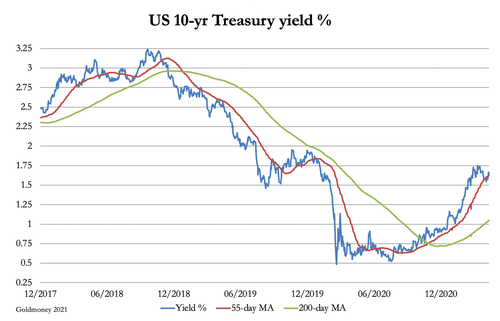
Immediately, almost everything began to recover with the exception of bond prices. But the initial increase in their yields can be justified on the basis that they were previously depressed by fears of deflation ahead of the spreading pandemic, and that with the worst fears of deflation had now passed a state of normality had returned. In the year following, equity markets recovered fully and have gone on to new highs. Commodity prices are now rising strongly, which so far is believed by market optimists to indicate recovering demand and therefore confirmation of economic recovery. Having some time ago changed the inflation target from 2% to an average of 2% over time, only last week the Fed saw no reason to expect a rise in price inflation to be more than a temporary phenomenon.

Officially, it’s a case of seeing no evil. But already the establishment consensus is testing more bearish ground. Infrastructure investment plans, not just in the US, but supporting green agendas everywhere are expected to drive oil and copper prices higher, along with a raft of other commodities. As well as state-induced infrastructure spending, in anticipation of strong post-pandemic demand manufacturers are bidding up commodity and raw material prices as well as the cost of the logistics to deliver them. Key industries, particularly agriculture, are suffering acute labour shortages. In many cases, skilled workers are not available. Even the most irresponsibly inflationist economists and commentators are beginning to point out that interest rates will probably have to rise because prices risk spinning out of control.

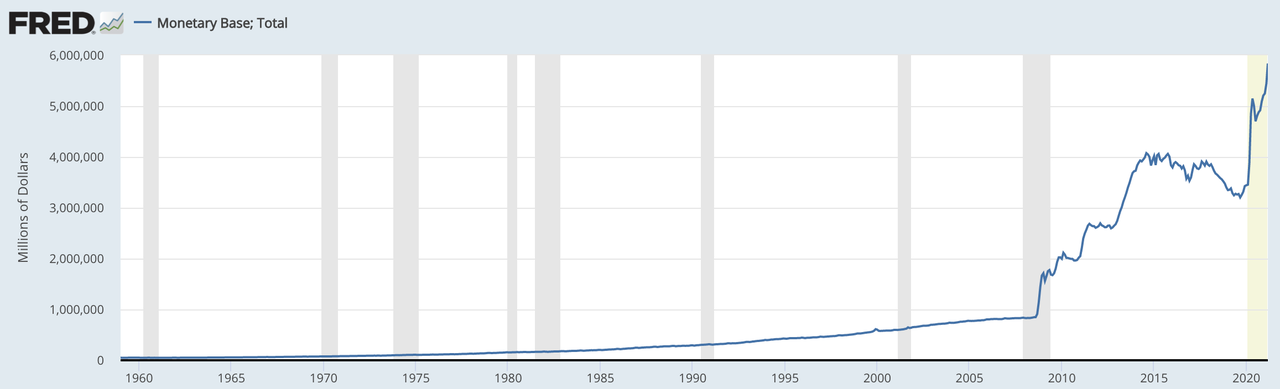
Fuelling it all is the expansion of base money by central banks. The St Louis Fed’s FRED chart below showing the Fed’s monetary base illustrates the point and is a proxy for the global picture, because the dollar is the reserve currency and the pricing medium for all commodities.
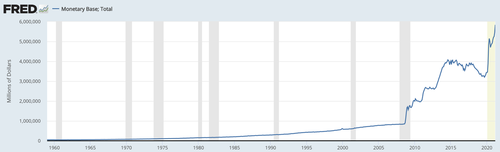
From the beginning of March 2020, which was the month the Fed announced virtually unlimited monetary expansion, base money has grown by 69%. It is this rapid growth in central bank money which is undoubtedly behind rising commodity prices, or put more accurately, is why the purchasing power of the dollar in international markets is falling.

When the outlook for the purchasing power of a fiat currency falls, all holders expect compensation in the form of higher interest rates. Partly, it is due to time preference — the fact that an owner of the currency has parted with the use of it for a period of time. And partly it is due to the expectation that when returned, the currency will buy less than it does today. Official forecasts of the CPI state that the dollar’s purchasing power will probably sink to 97.5 cents on the dollar, then the yield on the ten-year UST should be at least 2.56% (2.5%/0.97), otherwise new buyers face immediate losses. The official expectation that the rise in the rate of price inflation will be temporary is immaterial to an investment decision today, because the yield can be expected to evolve over time in the light of events.

This is before adding something to the yield for time preference (admittedly minimal in a freely traded bond), plus something for currency risk relative to an investor’s base currency and plus something for creditor risk. Stripped of these other considerations, on the basis of expected inflation alone a current yield of 1.61 appears to be far too low, and a yield target of at minimum of 2.5% appears more appropriate.

Apologists for the dollar argue that the deeper the crisis, the greater is the desire for dollars. It is true that many holders of dollars accord to it a safe-haven status compared with their own currencies. But that is fundamentally an argument that applies to short-term liquidity more than to any other reason to hold dollars, with the exception, perhaps, of holders whose base currencies are minor and systemically weak. But with the dollar’s trade weighted index sinking itself since March 2020 that is not true of the wider currency universe. With the dollar falling against other currencies and non-Governmental foreign ownership of dollar financial assets over-owned to the point which exceeds US GDP, the safe haven argument for the dollar lacks credibility.

The Fed’s apparently optimistic assumptions about the dollar’s stability appear to play to its own vested interest. Naturally, there is a reluctance to admit to a greater erosion of its prospective exchange rate, which consequently might require a change in interest rate policy. But commodity prices are soaring, and as locked-up consumer and business spending is unleashed, the supply of goods will be limited, partly due to a lack of domestic capital resources due to the commercial banks restricting bank credit, and partly due to continuing chaos in the supply chains. Instead of a price inflation rate at 2.5%, we should look for a significantly higher rate with which to discount the future purchasing power of the dollar.

It is likely to be only a brief matter of time before holders of all fiat currencies address this issue soberly without the bullish sentiment currently pervading in markets. However, the advanced signs of one final fling for financial assets were visible to those who understand money in March 2020, when the Fed cut its funds rate to zero and announced QE of $120bn per month. It has been a theme of these articles ever since.

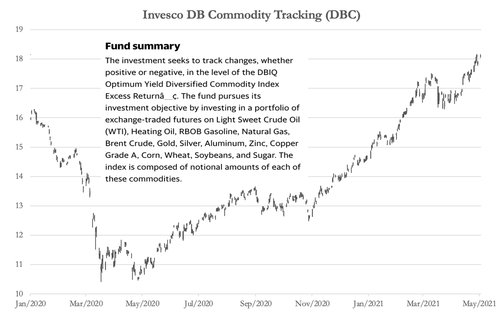
Since then, commodities have soared in price along with other inflation hedges, such as cryptocurrencies, equities and residential property. Other than the purchasing power of currencies, the fallers are fixed interest bonds as their yields have risen.
The first class of dollar holder to be affected is foreigners. Some of them are businesses which don’t really need dollars, given they will end up holding even more by exporting to the US. They must be learning it is better to have stockpiled the raw materials for production.

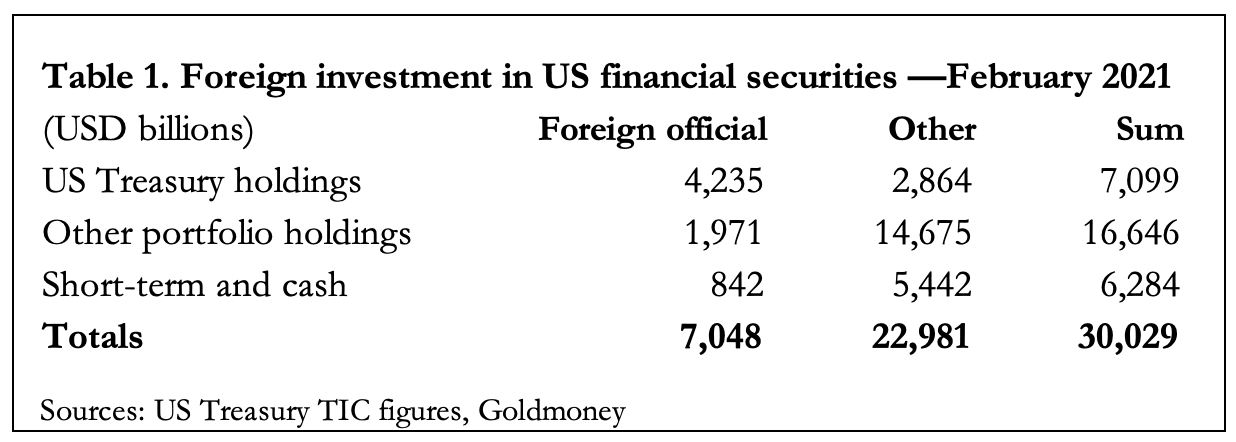
Some of them are investors based in other currencies, diversifying their portfolios, ephemeral holders of financial assets who will sell them when bond yields rise further. This liquidation potential in foreign hands is a major consideration because of the enormous quantities involved. The splits between official and private sector holders (Others) are shown in Table 1 below.
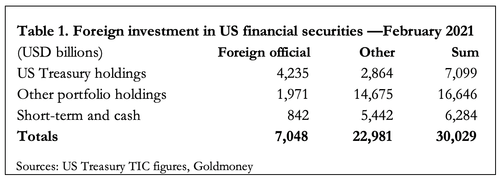
It should be noted that American holdings of foreign currencies are minimal becaause lending to foreigners is overwhelmingly in dollars instead of foreign currencies, and America’s massive trade deficit ensures that while dollars accumulate in foreign hands, foreign currencies do not accumulate in American hands. This makes the figures in Table 1 as a dollar crisis waiting to happen all too real.

Once non-official holders awaken to what is happening to their dollars and to the consequences of increasing bond yields for the wider classes of financial assets, they will almost certainly reduce their holdings of nearly $23 trillion. Holdings of all dollar-denominated financial assets will be at risk, and where they go, financial assets denominated in all other currencies naturally follow. We can expect the dollar to continue its fall against other currencies as well, in part driven by President Biden’s highly inflationary spending plans. Irrespective of the domestic economic conditions, the Fed will then have no practical alternative to raising interest rates to stabilise the dollar against other currencies. But we can be sure the Fed will be extremely reluctant to do so.

The latent primacy of markets over monetary policy

Without doubt, there were urgent reasons for the Fed to rescue stocks and other markets in March 2020. For several decades successive Fed chairmen from Alan Greenspan onwards have openly admitted that a rising stock market is central to monetary policy, because of its roles for wealth creation and the enhancement of economic confidence. But the market rescue fourteen months ago also confirmed, if confirmation was needed, that the Fed would always address any financial and economic crisis by inflationary means. This has not yet led to the inflationary crisis that will eventually occur.

As the much-vaunted post-lockdown consumer spending is unleashed, the lack of available production supply together with supply chain chaos can only result in consumer prices rising significantly above the Fed’s average target of 2%. Not only will this naturally lead to higher bond yields, but the valuation basis for equity markets will shift, undermining prices. Even if the Fed tries to offset it by increasing QE to feed more cash into bonds and equities, it will be impossible to offset the valuation effect. Equities will almost certainly succumb to an interest rate shock. At the same time, the increase in bond yields will undermine government finances. The prospect of increasing losses on portfolio investments will inevitably lead to the foreign liquidation described above, causing a weaker dollar and yet higher bond yields.

In these conditions the Fed will be trapped. It cannot let bond and equity prices slide and risk commercial banks accelerating the contraction of bank credit, leading inexorably to the liquidation of loan collateral. Investment sentiment would turn deeply negative. Nor can it stand back and let markets sort themselves out, because of the record levels of corporate and other debt which would become impossible to refinance. Nor can it just print money in order to rescue everything, because the dollar will be further undermined. That leaves it with only one alternative left to pursue, albeit with the greatest reluctance. And that is to raise interest rates — substantially.

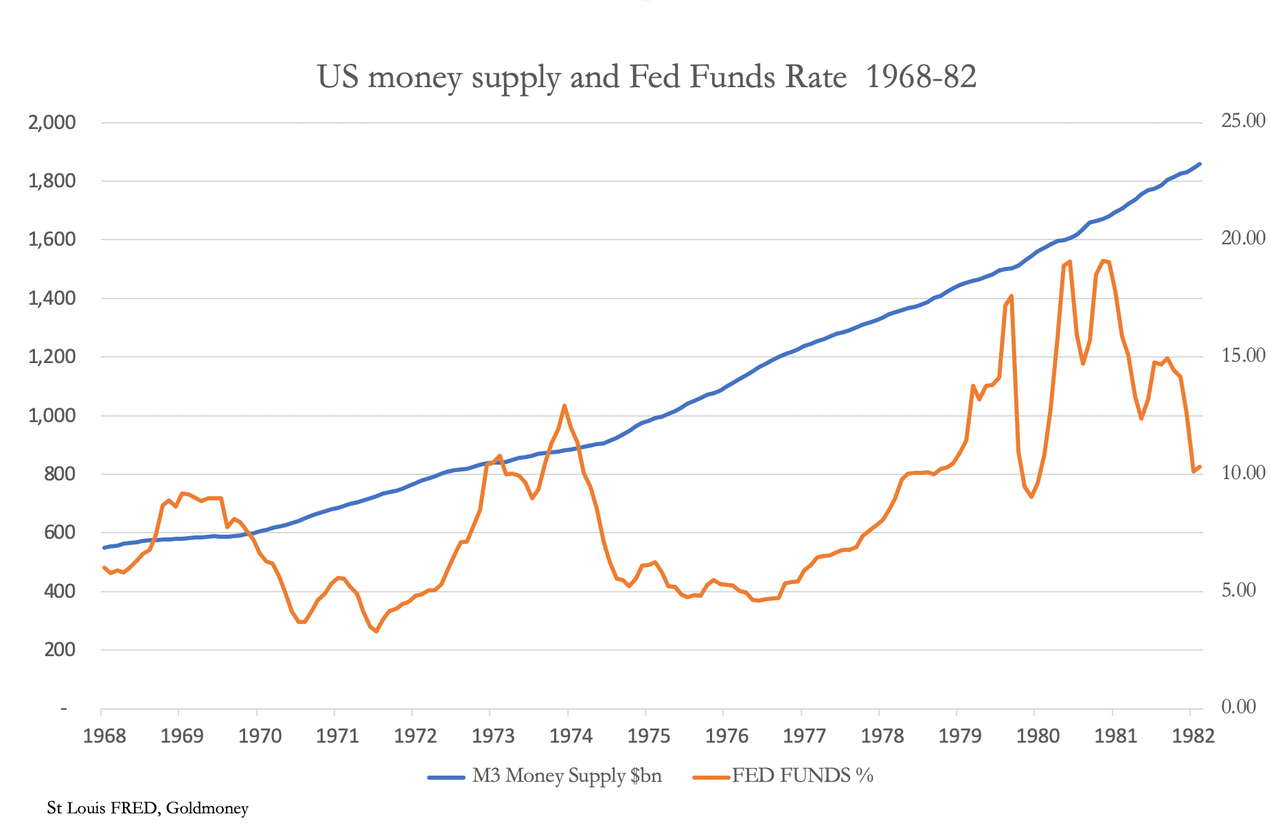
Neo-Keynesians, who appear to subscribe to the belief that interest is usuary and savers must be denied returns for the benefit of everyone else, are embedded in central banks and are certain to denounce this attempt at a remedy. But the experience of the 1970s confirms that central banks will raise rates, too little too late, before eventually deciding to kill market expectations of higher interest rates by pre-empting them. Famously, this is what Paul Volcker did in 1979-81. What is less remembered is that despite prime rates hitting 20%, money supply growth continued, so that the interest cost was covered by inflationary means. This is illustrated in the chart below.
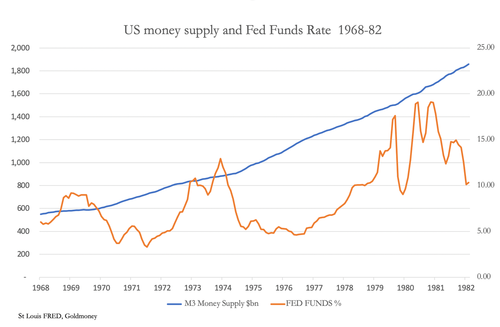
From this earlier precedent, we can conclude that in the choice between ceasing to print money and raising interest rates, the Fed will raise interest rates. This adds to the growth of money supply, as can be detected by the increased rate of climb from 1979 onwards. But what would be the effect of such a policy today?

In the 1970s, the build-up of domestic debt beyond that required to genuinely finance production had yet to occur, and the financialisation of the US economy did not happen until the mid-1980s. The increase in debt was mainly sovereign as US banks recycled oil dollars to Latin America. The only significant domestic casualty from high interest rates was the Savings & Loan industry.

Today, the US and other economies are loaded up with debt, much of which is unproductive. A sharp rise in interest rates to contain price inflation would drive the world’s economy into an humungous debt-induced slump. And while that is exactly what is needed to clear out all the zombie deadwood, it is not within the Fed’s remit to take such action. Furthermore, with government borrowing already out of control, the US Government would be forced to curtail its spending dramatically at a time of rapidly escalating welfare obligations.

But we are previewing the end of the road, describing events which logically procede from the dangers before us today. But for now, the consequences of rising bond yields are that they will bring a rapid shift from overtly bullish assumptions to a more considered bearish outlook, bringing with it a wholly different perspective. Instead of bad and inflationary policies being tolerated or even demanded by investors, their thinking turns on a dime to a fear of anything and everything. Under bearish circumstances, every turn of the central management of economic outcomes only makes things worse, when before it appeared to resolve them. Greenspan and the Fed chairmen who followed him were correct about the psychology of improving markets, while they kept quiet about the negative psychology of bear markets. Suddenly, we will find that Charon is waiting to ferry the bodies of the bulls over the river Styx.

Such is the violence of market imbalances that when they are unleashed from the Fed’s control, not only will financial markets face rapid value destruction, but fiat currencies will also be undermined by the need to accelerate the pace of monetary inflation. The emphasis for inflationary policies will shift from financing governments by debauching the money to debauching the money in order to rescue the wider economy. The Fed and its sister central banks will seek to supplement contracting bank credit, make capital freely available to businesses which would otherwise collapse, continue with helicopter drops of money to consumers, and compensate for supply chain disruption. The policy planners are likely to be so confused and the task so enormous that they will end up robbing Peter to pay… who else but Peter himself.

The relevant precedent for this madness comes from 1720, when John Law in France, who among other things was appointed Controller General of Finance, printed unbacked livres to inflate and then support the collapsing Mississippi bubble. His venture lived on to fight Clive in India, but the livre became worthless within seven months. Today, some contemporary corporations will survive, as did Law’s Mississippi venture, but by tying the bubble to the currency, the currency failed completely and is almost certain to do so again today.

Gold and rising interest rates

As a consequence of current events, the failure of fiat currencies is increasingly assured. Unlike the runaway inflation in the 1970s which followed the ending of the Bretton Woods Agreement, debt levels are now so high and state intervention in markets so great that hiking interest rates in the manner deployed by Paul Volcker would simply prick the everything bubble. Debt defaults would be overwhelming. Nevertheless, as the purchasing power of fiat currencies continues to slide, higher and higher interest rates become inevitable as markets try to discount yet further declines towards their ultimate valuelessness.

There is a common misconception that does not accord with the facts: that higher interest rates are bad for the gold price. It is assumed by those promoting this nonsense that gold does not have an interest rate and is therefore at a disadvantage compared with fiat money. This is only true of both physical gold and fiat cash to hand, when neither folding notes nor gold pay interest. But both can be loaned and leased to borrowers for interest. It’s just that the interest on ephemeral fiat tends to be higher than on physical gold, because gold is the more stable form of money with no issuer risk.

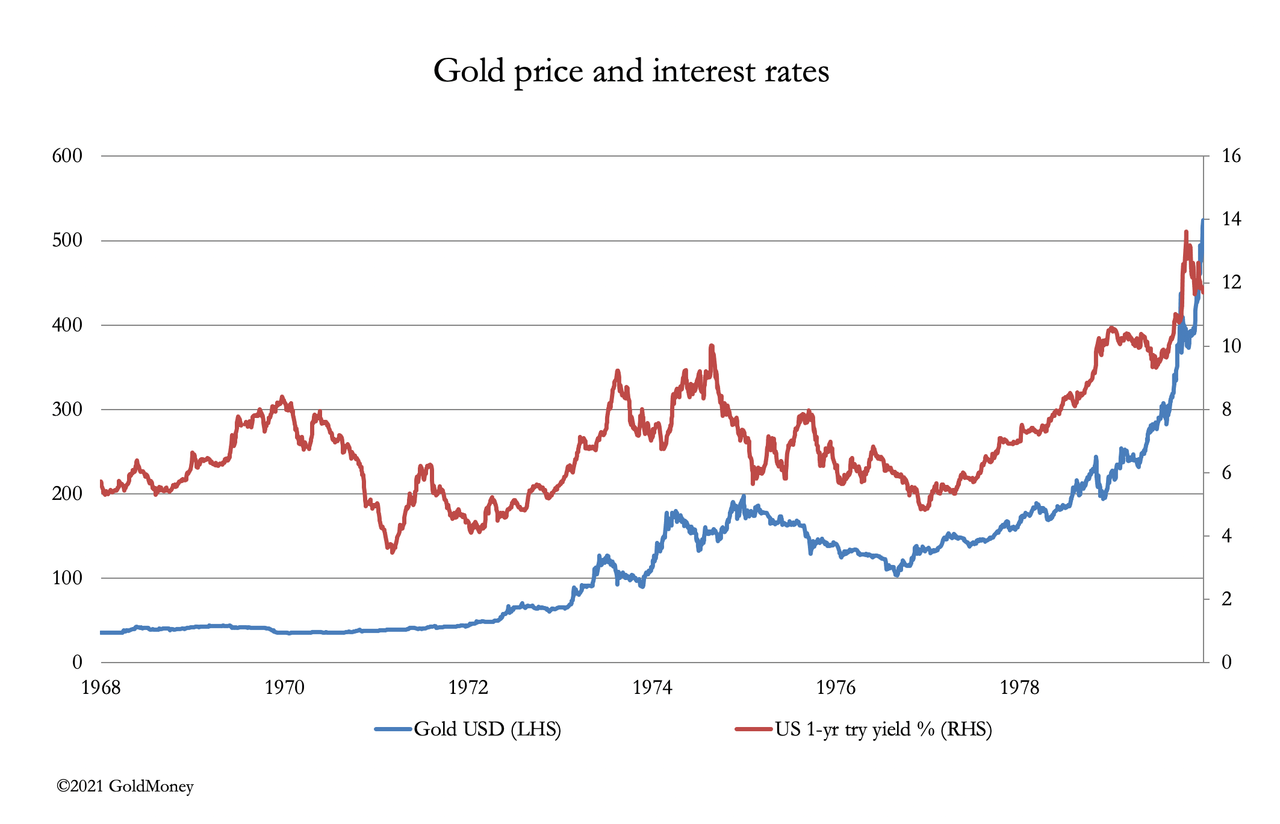
That rising interest rates on fiat currencies are no deterrent to a rising gold price is confirmed in the chart below, which shows how these relationships evolved in the 1970s.
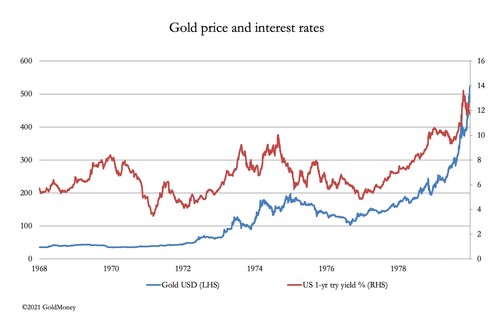
Not only did the decade commence with the yield on the 1-year US Treasury bond at less than six per cent, ending at more than double that, but the gold price rose from $35 to $524 by the end of the decade. Furthermore, the chart shows that from 1972 onwards, gold tended to rise with the yield on the bond and fall with it, defying those who fail to grasp the true relationship.

All this assumes that the collapse of fiat currencies’ purchasing power will take some time. But the truth of the matter is we do not know either the timing or how long it will take. It is unlikely to echo the great European inflations of the 1920s, because to a large degree commerce subsisted on the alternative of gold-backed dollars, instead of local currencies. Today, the collapse of the dollar will mean there is unlikely to be any alternative currency available, because they are all tied to the dollar.

A collapse of financial asset values taking the currencies down with them appears to be more in common with a repetition of John Law’s bubble and subsequent collapse, which incidentally was a forerunner of Keynesianism in action. But a fiat currency going to zero today could take less time, given instantaneous modern communications. In that event, anyone who does not plan to get hold of some physical gold and silver with a high degree of urgency could end up sinking with nothing but valueless fiat currencies.

Tyler Durden
Fri, 05/07/2021 – 20:20

via ZeroHedge News https://www.zerohedge.com/markets/rising-bond-yields-threaten-financial-market-stability Tyler Durden

Screw Lumber, Just 3D-Print Your Next Home 

Screw Lumber, Just 3D-Print Your Next Home 

With lumber prices up 67% since the start of this year and up 340% from a year ago, according to Random Lengths, a wood products industry tracking firm, adding tens of thousands of dollars to new residential builds, there is a viable new option to construct a home (lumber free) through machine-printed clay. 

Machine-printed clay homes are lumber-free and mitigate the ecological impacts of construction could soon become a viable option for affordable housing. 

The push for 3D-printed homes could already be underway due to the historic rise in lumber prices. The National Association of Home Builders recently said lumber costs for a new single-family home had risen $36,000 in the past year. Lumber is found in framing, roofing, flooring, windows, cabinets, railings, and the list goes on and on. 

Now there’s a new way to completely circumvent lumber via the Italian 3D printing company, WASP, who built a prototype of a 3D-printed home that looks like Lars homestead from Star Wars. 

WASP works with Milan-based architectural firm, Mario Cucinella Architect, to develop one-of-a-kind clay homes that are entirely 3D printed out of clay. 

“From the shapeless earth to the earth as house-shaped. Today we have the knowledge to build with no impact in a simple click,” said Massimo Moretti, the founder of WASP. 

The WASP printer can print 538 square feet of living space and, therefore, make it possible to build independent living modules, of any shape, in a few days. Multiple printers can be linked together and create a more elaborate home.

Instead of clay, Apis Cor, 3D printing specialists based in Russia and San Francisco, are printing homes with a concrete solution in under 24 hours

The disruptive nature of 3D printing allows homes to be constructed lumberless. Given today’s market conditions, we could see an uptick in interest as people seek other methods and or materials to build houses. 

Tyler Durden
Fri, 05/07/2021 – 20:00

via ZeroHedge News https://ift.tt/3tr49yF Tyler Durden

Daily Briefing: Raoul Pal: Is Macro “Dead”?

Daily Briefing: Raoul Pal: Is Macro “Dead”?

Managing editor Ed Harrison welcomes Raoul Pal, Real Vision CEO and co-founder, to introduce Real Vision’s latest campaign, “Welcome to the Exponential Age.” Raoul will be going in-depth on his new macro framework, the Exponential Age, and he and Ed tease their interview that’s being released on Monday. They also contextualize today’s U.S. jobs report, which fell far from economists’ expectations, and Raoul explains what the Exponential Age means for employment going forward.

Tyler Durden
Fri, 05/07/2021 – 14:15

via ZeroHedge News https://ift.tt/33tecsB Tyler Durden

Blinken Demands WHO Invite Taiwan Into Decision-Making Body Over Chinese Objections

Blinken Demands WHO Invite Taiwan Into Decision-Making Body Over Chinese Objections

Secretary of State Antony Blinken on Friday issued a statement that’s sure to once again provoke Beijing, urging the World Health Organization (WHO) to formally invite Taiwan’s participation in the global body which works alongside the UN.

China has long seen such a proposal as an “illegal” violation of the longstanding One China policy, which both the UN and WHO have thus far upheld. Ignoring this, Blinken called on the WHO to facilitate Taiwan’s participation in the upcoming World Health Assembly meeting which is set for the last week of May in Geneva.

Left: one of China’s top foreign policy officials, Yang Jiechi

There is no reasonable justification for Taiwan’s continued exclusion from this forum, and the United States calls upon the WHO Director-General to invite Taiwan to participate as an observer at the WHA – as it has in previous years, prior to objections registered by the government of the People’s Republic of China,” Blinken said in a statement Friday.

China has consistently blocked Taiwan’s participation even as an ‘observer’ going back to 2016. 

Blinken argued that Taiwan is a “reliable partner” and a “vibrant democracy,” saying that—

“We urge Taiwan’s immediate invitation to the World Health Assembly.”

He said the urgency of stopping the global pandemic means “political disputes” must not get in the way, given the virus knowns no boundaries or conflicts over autonomy. 

“Global health and global health security challenges do not respect borders nor recognize political disputes,” Blinken’s statement continues.

“Taiwan offers valuable contributions and lessons learned from its approach to these issues, and WHO leadership and all responsible nations should recognize that excluding the interests of 24 million people at the WHA serves only to imperil, not advance, our shared global health objectives.”

The fresh Friday statements echoed similar statements of US officials at the G-7 meeting in London at the start of this week. China’s Foreign Ministry has vehemently fought Taiwan’s WHA entry on the basis that Taipei and its backers refuse to “recognize that both sides of [the Taiwan Strait] belong to one and the same China.”

Tyler Durden
Fri, 05/07/2021 – 19:40

via ZeroHedge News https://ift.tt/3xW53qn Tyler Durden

South Carolina To Add Death-By-Firing-Squad As Execution Method 

South Carolina To Add Death-By-Firing-Squad As Execution Method 

South Carolina House members voted Wednesday to add execution by firing squad amid a lack of lethal injection drugs, according to local newspaper The State

State lawmakers voted 66-43 Wednesday for a bill that would add death by firing squad to the default method of execution from lethal injection to the electric chair. The state is one of nine that still use the electric chair and will become the fourth to use firing squads. 

The state Senate approved the bill in March but conducted another procedural vote after some minor modifications. The bill now heads to the desk of Republican Gov. Henry McMaster, who is expected to sign it. 

“We are one step closer to providing victims’ families and loved ones with the justice and closure they are owed by law. I will sign this legislation as soon as it gets to my desk,” McMaster tweeted after the bill’s passage. 

Supporters say execution by firing squad will deliver justice. Opponents say the form of execution could lead to an innocent person’s death. 

Once McMaster signs the bill into law. It will end South Carolina’s 10-year dry streak on executions. Current law states inmates have the option of death by the electric chair or lethal injection. But due to a nationwide shortage of drugs, death by firing squad is set to become a quick, cheap, and easy way to execute criminals. 

Getting the death penalty back on the track will be positive for the criminal justice system, I know it will be for the victims in those cases, unfortunately, I have victims in those cases that I’ve helped that are waiting too,” Rep. Tommy Pope, R-York, who is also a prosecutor, told local news WIS

Meanwhile, Democrats are concerned the law would lead to the death of potentially innocent people.

“It would not sit well on my conscience,” said Rep. Jermaine Johnson, D-Richland, about the vote. “Especially in a state where we claim to be pro-life, and we claim to believe in individuals and their rights to live and survive, but we are literally talking about a bill today that if this stuff passes we are literally signing their death certificates,” he said.

Utah, Mississippi, and Oklahoma are the only other states that allow death by firing squad. As soon as McMaster signs the bill into law, South Carolina will be added to the list. 

Tyler Durden
Fri, 05/07/2021 – 19:20

via ZeroHedge News https://ift.tt/2SrqoHU Tyler Durden

Joe Biden’s Offshore Wind Energy Mirage

Joe Biden’s Offshore Wind Energy Mirage

Authored by Craig Rucker via RealClearEnergy.com,

President Biden recently announced ambitious plans to install huge offshore industrial wind facilities along America’s Atlantic, Gulf of Mexico and Pacific coasts. His goal is to churn out 30 gigawatts (30,000 megawatts) of wind capacity by 2030, ensuring the U.S. “leads by example” in fighting the “climate crisis.”

Granted “30 by 2030” is clever PR. But what are the realities?

The only existing U.S. offshore wind operation features five 6-MW turbines off Rhode Island. Their combined capacity (what they could generate if they worked full-bore, round the clock 24/7) is 30 MW. Mr. Biden is planning 1,000 times more offshore electricity, perhaps split three ways: 10,000 MW for each coast.

While that might sound impressive, it isn’t.  It means total wind capacity for the entire Atlantic coast, under Biden’s plan, would only meet three-fourths of the peak summertime electricity needed to power New York City.  Again, this assumes the blades are fully spinning 24/7. In reality, such turbines would be lucky to be operating a top capacity half the time. Even less as storms and salt spray corrode the turbines, year after year.

The reason why is there is often minimal or no wind in the Atlantic – especially on the hottest days. Ditto for the Gulf of Mexico. No wind means no electricity – right when you need it most.

Of course, too little wind isn’t the only issue. Other times, there’s too much wind – as when a hurricane roars up the coast. That’s more likely in the Gulf of Mexico. But the Great Atlantic Hurricane of 1944 had Category 4 winds in Virginia, Category 3 intensity off Cape Hatteras (NC), Long Island and Rhode Island, and Category 2 when it reached Maine. It sank four U.S. Navy and Coast Guard ships.

When storms or hurricanes hit, turbines can be destroyed. Repairing or replacing hundreds of offshore turbines could take years.

If the White House is planning to generate all that power using common 6-MW turbines, our coastlines would need a hefty 5,000 of the 600-foot tall monsters dotting them. The Washington Monument is 655 feet tall.

Going instead with 12-MW turbines, like the 850-foot-tall GE Haliade-X turbines Virginia is planning to install off its coast, America would still need 2,500 of the behemoths – just to complete Phase One of Biden’s plan. 30,000 megawatts by 2030.  Even if these were all plopped in the Atlantic, it still would not be enough to meet New York State’s current electricity needs.

And what about the environment?

How many millions of tons of steel, copper, lithium, cobalt, rare earth elements, concrete, petroleum-based composites (for turbine blades) and other raw materials would be required to manufacture and install the turbines and undersea electrical cables, especially where deep-water turbines are involved? 

How many billions of tons of ore would have to be mined, crushed, processed and refined – considering that it takes 125,000 tons of average ore for every 1,000 tons of pure copper metal?

Not only would nearly all of this mining and manufacturing require fossil fuels, but much of it would be done in China, or in other countries by Chinese-owned companies. Haliade-X turbines are also manufactured in China. And much of the mining and processing is done under horrid workplace safety and environmental conditions, often with near-slave and child labor.

More turbines will also kill countless birds and bats. Turbine infrasound and other noise have been implicated in disorienting and stranding whales and dolphins. The numbers, height and low-frequency turbine noise also interferes with surface ships, submarines, aircraft and radar.

Nuclear power or billions of batteries (or retained fossil fuel power plants) will have to back up every megawatt of intermittent, unreliable wind power, so that society can function every time the wind fails. That means more raw materials, transmission lines and costs.

Even with massive taxpayer subsidies, electricity generated by offshore turbines will cost many times what we are paying today, even in New York and California. That will have especially heavy impacts on energy-intensive industries, hospitals, and poor, middle-class, minority and fixed-income families.

Economic, environmental and climate justice reviews must fully, carefully and honestly assess every one of these factors. No “expedited” or “climate emergency” shortcuts should be permitted.

President Biden likes to say offshore wind energy is clean, green, renewable and sustainable. Wind itself certainly is. But harnessing the wind (or sun), to meet the needs of modern civilization is not – especially in ocean environments.

Claiming otherwise is a mirage – a scam. Maybe that’s why the Bureau of Ocean Energy Management already canceled two wind projects off Long Island. The costs and impacts are enormous, and local opposition was high. Do climate activists in and out of the Biden Administration expect otherwise anywhere else?

Tyler Durden
Fri, 05/07/2021 – 19:00

via ZeroHedge News https://ift.tt/2SruZKc Tyler Durden

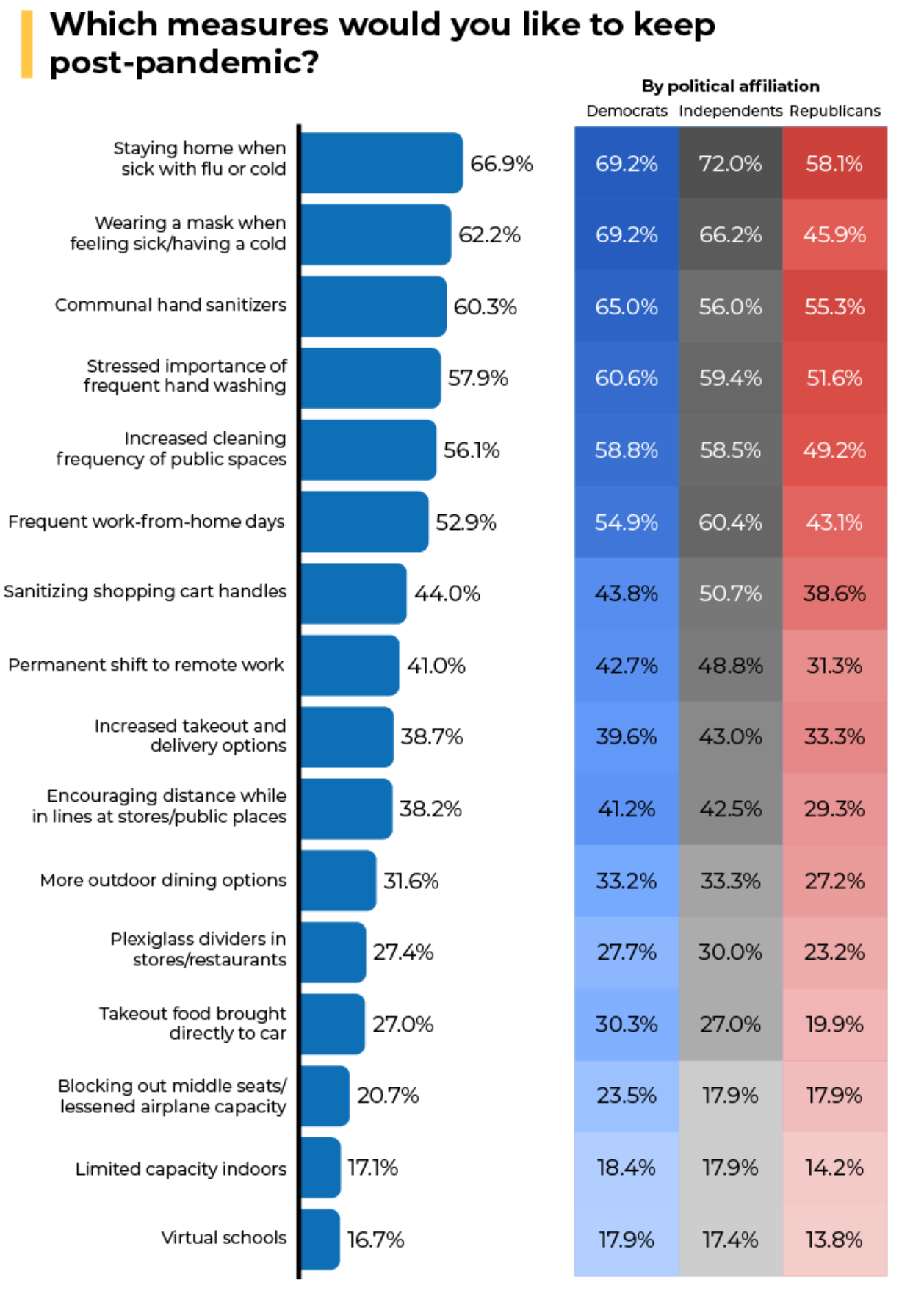
Nearly 50% Of Americans Believe Social Distancing Will Become Permanent

Nearly 50% Of Americans Believe Social Distancing Will Become Permanent

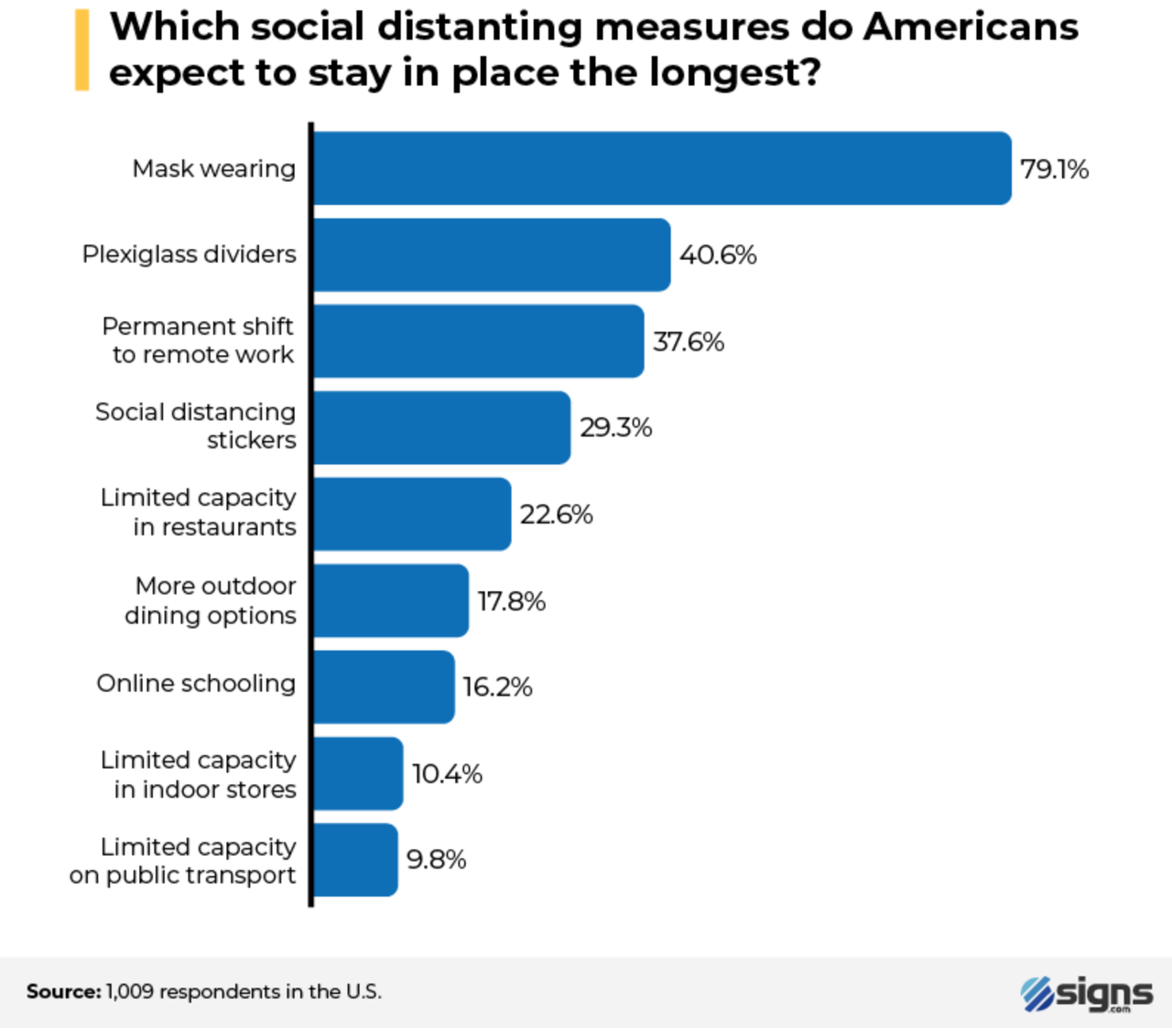
The persistent question over the past months as more of the US population has had access to COVID-19 vaccines has remained: “when will it all end?” A new poll has found that nearly half of Americans believe some form of social distancing measures will now become permanent, according to a study by Signs.com

The majority, however, at 64% believe that their local and state governments will loosen up restrictions like caps on attending public venues or being in places like bars or restaurants, even should national policies remain in place, at some point within the next three months. 

Getty Images

The recent study on Americans’ views of distancing measures was published as it’s becoming increasingly clear that large states like Texas have not suffered a resurgence in the virus even after it “opened 100%” at the start of March.

The extensive polling data was also released just as a major MIT study challenged many social distancing guidelines, including the effectiveness of mask-wearing. The study found that “one is no safer from airborne pathogens at 60 feet than 6 feet.”

“We need scientific information conveyed to the public in a way that is not just fearmongering but is actually based in analysis,” the MIT scientists said.

Yet Americans now fear that many of these policies previously forced on the population like the “6 foot rule” (even as they were anything but “established science”) will now become permanent.

Below are some of the key takeaways from the survey, which was published Friday:

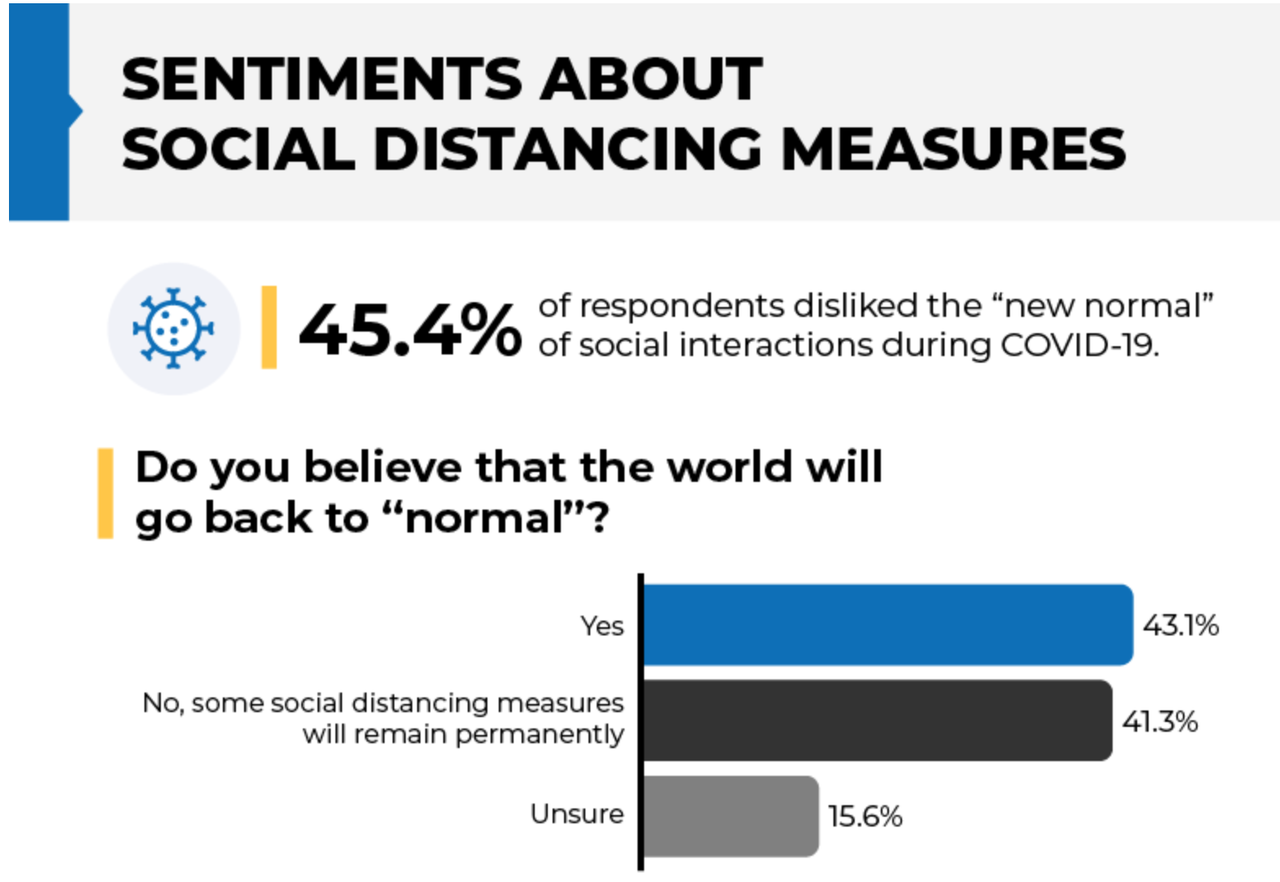
  • 45.4 percent of respondents disliked the “new normal” of social interactions during COVID-19
  • 43.1 percent believe the world would go back to normal, just as it used to be 
  • 41.3 percent thought that some social distancing measures would remain permanently, even after the pandemic ends
  • 57.6 percent said they are uncomfortable visiting the gym, while 54.4 percent said the same about restaurants and 45.2 percent said the same about hospitals. 
  • 72.6 percent said they felt most comfortable going to places like parks (72.6 percent), grocery stores (59 percent) and pharmacies (57.9 percent) in person. 
  • 54.8 percent listed one-way aisles in stores as the most annoying social distancing measure
  • 22.9 percent confirmed they were following social distancing rules more strictly now than at the beginning of the pandemic compared with 27.7 percent who had decreased their efforts in following the previously adopted practices. 

Via Signs.com study…

And there was this interesting line from the study: “53.7% of baby boomers believed some social distancing measures would remain in place permanently.”

Ultimately, the survey concluded, “43.1% of respondents believed that the world would go back to normal, just as it used to be” while in contrast “41.3% thought that some social distancing measures would remain permanently, even after the pandemic ends.”

Tyler Durden
Fri, 05/07/2021 – 18:40

via ZeroHedge News https://ift.tt/2SpwwjV Tyler Durden

Stephen Moore: “Something Is Very Fishy” About The Biden Census Bureau Data

Stephen Moore: “Something Is Very Fishy” About The Biden Census Bureau Data

Authored by Stephen Moore, op-ed via The Epoch Times,

Why Did Biden Census Bureau Add 2.5 Million More Residents to Blue-State Population Count?

There is something very fishy about the new 2020 Census Bureau data determining which states picked up seats and which states lost seats.

Most all of the revisions to the original estimates have moved in one direction: Population gains were added to blue states, and population losses were subtracted from red states.

The December revisions in population estimates under the Biden Census Bureau added some 2.5 million blue-state residents and subtracted more than 500,000 red-state residents. These population estimates determine how many electoral votes each state receives for presidential elections and the number of congressional seats in each state.

Is this a mere coincidence?

These population estimates determine how many electoral votes each state receives for presidential elections and the number of congressional seats in each state.

Remember, the House of Representatives is razor-thin today, with the Democrats sporting just a six-seat majority with five seats currently vacant. So, a switch in a handful of seats in 2022 elections could flip the House and take the gavel from current Speaker Nancy Pelosi and the Democrats. A shift of 3 million in population is the equivalent of four seats moving from Republican to Democrat.

The original projections for Census reapportionment had New York losing two seats, Rhode Island losing a seat, and Illinois perhaps losing two seats. Instead, New York and Illinois only lost one seat, and Rhode Island lost no seats. Meanwhile, Texas was expected to gain three seats, Florida two seats, and Arizona one seat. Instead, Texas gained only two seats, Florida only one, and Arizona none.

Was the Census Bureau count rigged? Was it manipulated by the Biden team to hand more seats to the Democrats and to get more money—federal spending is often allocated based on population—for the blue states?

The evidence is now only circumstantial, but when errors or revisions are almost all only in one direction, the alarm bells appropriately go off.

Here are some of the strange outcomes in the Census revisions just released:

No. 1: New York—We’ve been tracking the annual population/migration changes between states since the last census in 2010. Over the past decade, New York LOST about 1.3 million residents on net to other states. (This does not include immigration, births, and deaths.) Still, this is a population loss that is the equivalent of two, maybe three, lost congressional seats. But the final numbers ADDED approximately 860,000. That’s roughly twice the population of Buffalo and Rochester—combined. This is the state that has lost by far the largest population over the past decade.

No. 2: Many deep-blue states had 2020 Census numbers significantly revised upward from their December estimates: Connecticut, Hawaii, Illinois, Massachusetts, New Jersey, New York, Rhode Island, and Vermont.

No. 3: Many red states had 2020 Census numbers lower than their 2020 estimates: Arizona, North Carolina, and South Carolina.

No. 4: Going back to the 2010 Census, the final headcount in every state was within 0.4 percent of the original estimate, and 30 of them were within 0.2 percent. This time around, 19 states were more than 1 percent off, 7 were more than 2 percent off, New York was more than 3.8 percent off, and New Jersey was more than 4.5 percent off.

No. 5: Virtually every one of the large deviations from the estimates favored Democrats. Just five states in the 2020 Census were within the same margin (0.41 percent) that all states were within from the 2010 census.

Maybe the 2010 estimates were abnormally accurate, or maybe the 2020 estimates were abnormally inaccurate. The Census Bureau needs to tell Congress why these revisions under former President Barack Obama were so much larger than normal and so weighted in one direction: toward the blue states.

Tyler Durden
Fri, 05/07/2021 – 18:20

via ZeroHedge News https://ift.tt/2SBsaGE Tyler Durden

Developer Pivots Luxury Brooklyn High-Rise Condo To Rentals 

Developer Pivots Luxury Brooklyn High-Rise Condo To Rentals 

A high-end condominium glut in Brooklyn forced one developer to reconstruct its entire business model from condos to rentals for one of its new luxury highrises. 

Avery Hall Investments announced Monday the commencement of leasing at One Boerum Place located at Brooklyn Heights and Boerum Hill. Bloomberg notes the building was never intended for rentals, but a glut of condos in the borough and citywide forced the developer to change paths. 

Avi Fisher, a founding partner of Avery Hall, told Bloomberg that One Boerum Place “was very much envisioned as a condo.” At the time of construction, which began around 2016, the condo market in the borough was “roaring, and all signs were pointing to continued growth, and in our company’s history, this was the culmination of the condo pipeline we’d amassed,” he said. 

In all, Fisher said his firm spent about $250 million on building costs. When 2019 came along, the condo market began to deteriorate. A year later, during the pandemic, the condo market plunged as city dwellers moved to suburban areas and rural communities to escape the socio-economic collapse of the liberal-run city. 

Sales of One Boerum Place were to begin in late 2020, but Fisher and his team began to evaluate the oversupplied condo market. That’s when they decided to flip the business model from selling condos to high-end rentals. 

“What solidified the fate of this building was ultimately the pandemic,” Fisher said. “The condo market deteriorated to the point where the decision was clear to us.”

To change course, Fished received approval from lenders and partners. The press release today outlines “pre-leasing commences” at the luxury building. 

“One Boerum Place will now become luxury rentals, with prices ranging from $8,500 a month for a roughly 1,200-square-foot three-bedroom to $12,000 a month for a roughly 3,120-square-foot four-bedroom. There are also, the developer says, “not many” one-bedroom apartments which will start in “the low $4,000s,” and a few two-bedroom apartments that will rent for just under $6,000,” Bloomberg said. 

Fisher said his company made the right move:

“As an organization, we felt the right move for us and our investors and partners was to [create] a rental portfolio,” he said, “because we believe it will stand the test of time.”

Fisher explained the “exodus in Manhattan” resulted in a “large number of [those] people came to Brooklyn.” He believes his building could be in a perfect spot to capture the outflow of Manhattanites.

He added: “We don’t have to sell this asset now, and the best way we can help participate in the recovery of New York and capitalize on that [recovery] is to execute a rental plan.”

Brooklyn’s rental glut may get worse as new supply via One Boerum Place has just hit the market. 

Tyler Durden
Fri, 05/07/2021 – 18:00

via ZeroHedge News https://ift.tt/3bcGdJ7 Tyler Durden