Sudan Military Council To Rule For 2 Years, Airspace And Ports Closed, State Of Emergency Declared

The Sudanese Army has announced that Sudan is now in a state of emergency status for three months and that a “transitional military council” would be formed to rule the country for a two-year period after that. Sudanese Defense Minister Awad Mohammed Ibn Ouf made the announcement on state TV in Khartoum on Thursday.

As we reported earlier in the day the country’s 75-year-old president Omar al-Bashir was arrested by the Sudanese Army after a lighting fast military coup d’état, which involved very little gunfire or violence. 

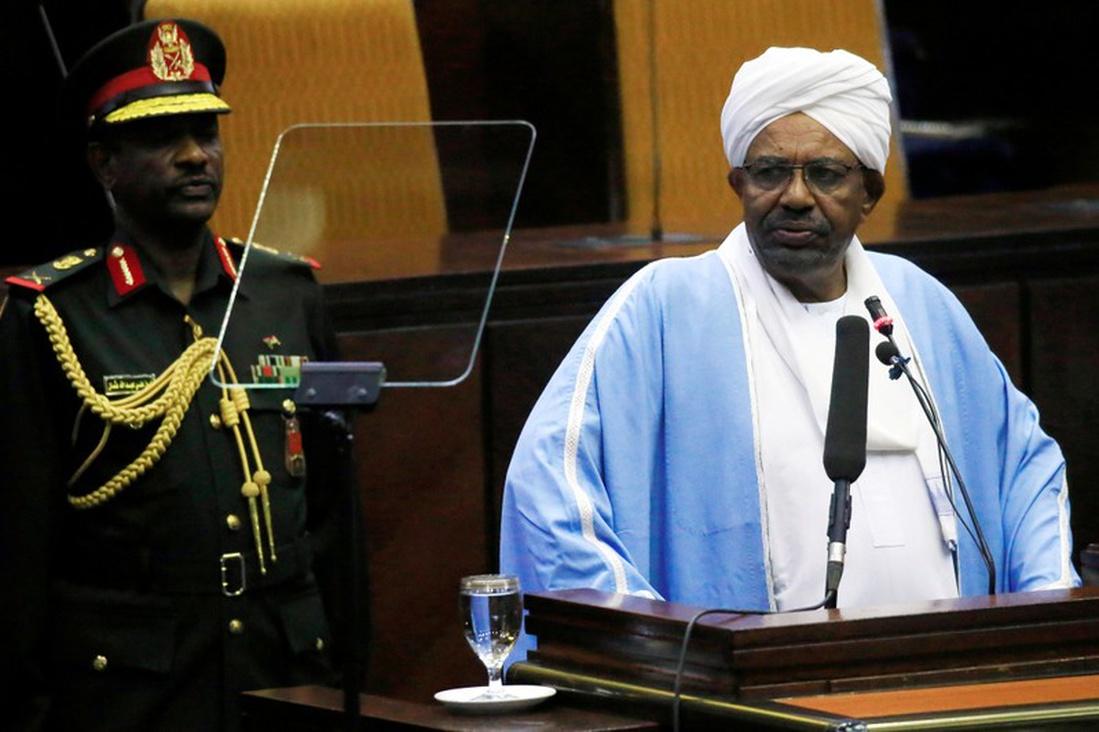
Sudanese Defence Minister Awad Mohammed Ibn Ouf

The military now has Sudan’s former strongman, who ruled for three decades since 1989 after himself coming to power in a coup, under house arrest and “heavy guard” in the Sudanese capital of Khartoum.

It’s widely believed, though unconfirmed, that the country’s Defense Minister Brigadier General Awad Mohamed Ahmed Ibn Auf, who was appointed as Sudan’s first vice president last February and acting Defense minister, was the one ultimately behind Bashir’s removal.

Defense chief over the Sudanese armed forces, Gen. Awad Mohammed Ibn Ouf, declared a state of emergency and a 2-year transitional period:  

The Sudanese Defense Minister also confirmed that al-Bashir was in a “safe location” and that the state of emergency would include a one-month curfew, the closure of airspace, ports and crossings in Sudan, and the dissolving of the presidency and cabinet, according to a translation of the remarks by Middle East news source Al-Masdar.

It was further noted the Army will oversee a “transition period” which “will end with federal elections.”

However, the possibility for continued violence remains high in the historically tumultuous northeast African nation, given the coup follows months of protests which saw dozens of demonstrators killed. 

Though there’s current festivities on the streets of Khartoum celebrating al-Bashir’s resignation and arrest, time will tell if the Army keeps order and more crucially if it will be true to its word regarding transition to civilian rule. 

* * *

previously

On Thursday, the 75-year-old three decade long president of Sudan, Omar al-Bashir stepped down after a lighting fast military coup d’état, which involved very little gunfire or violence. 

The military now has Sudan’s former strongman, who ruled since 1989 after himself coming to power in a coup, under house arrest and “heavy guard” in the Sudanese capital of Khartoum. It’s widely believed, though unconfirmed, that the country’s Defense Minister Brigadier General Awad Mohamed Ahmed Ibn Auf, who was appointed as Sudan’s first vice president last February and acting Defense minister, is the one behind Bashir’s removal.
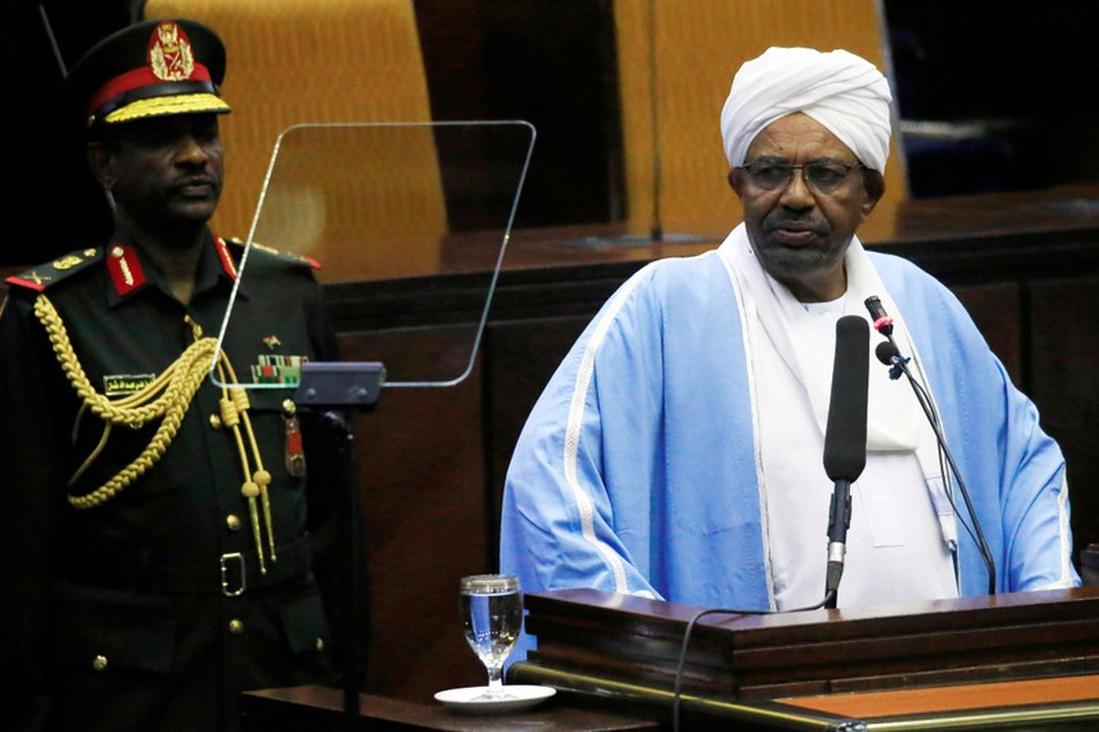
Three decade ruling President Omar al-Bashir, via Reuters

There are reports of a festive mood in Khartoum, with people celebrating in the streets and general optimism that a military appointed transition council will result in civilian elections and rule. 

Protesters outside the defense ministry are changing: “It has fallen, we won,” according to Reuters. 

The army is reportedly in full control of the capital, including all government buildings and streets, though are reportedly allowing full movement of protesters and civilians. 

Hours after Bashir’s detention the Sudanese Intelligence Agency announced via state TV that it has ordered the release of all political detainees, official news agency (SUNA) reported.

It is as yet unclear what will now happen to Bashir

He has been indicted by the International Criminal Court in The Hague and is facing an arrest warrant over allegations of genocide in Sudan’s Darfur region during an insurgency that began in 2003 and led to death of an estimated 300,000 people.

Bashir, a former paratrooper who seized power in a bloodless coup in 1989, has been a divisive figure who has managed his way through one internal crisis after another while withstanding attempts by the West to weaken him.

Sudan has suffered prolonged periods of isolation since 1993, when the United States added Bashir’s government to its list of terrorism sponsors for harboring Islamist militants. Washington followed up with sanctions four years later.

The latest crisis has escalated since the weekend, when thousands of demonstrators began camping out outside the Defence Ministry compound in central Khartoum, where Bashir’s residence is located. — Reuters

Bashir’s personal guard has been replaced and currently a military council is communicating to the public via state TV. 

The command of the Army responsible for toppling Bashir is said to be coordinating its contacts with other parts of the Army posted throughout the country. 

The military has been behind every ruler of Sudan for the past 54 years, and though now peaceful transition to democratic civilian leadership has been promised by a temporary military council — which could run things inside Sudan for up to another year — the prospect of further turmoil and unrest is likely. 

via ZeroHedge News http://bit.ly/2ULHWyb Tyler Durden
Stocks, Bonds, Bitcoin, & Bullion Sink As USA ‘Risk’ Plunges

Liquidity drying up?


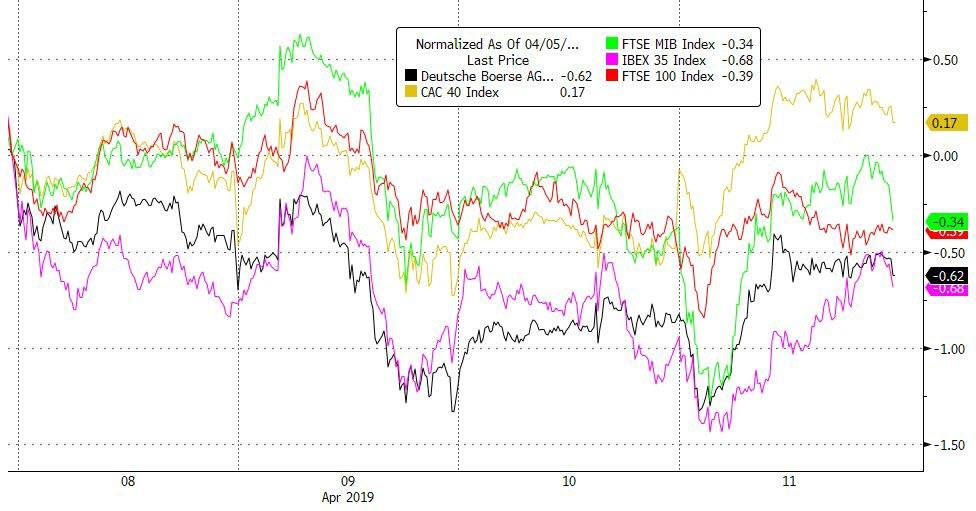
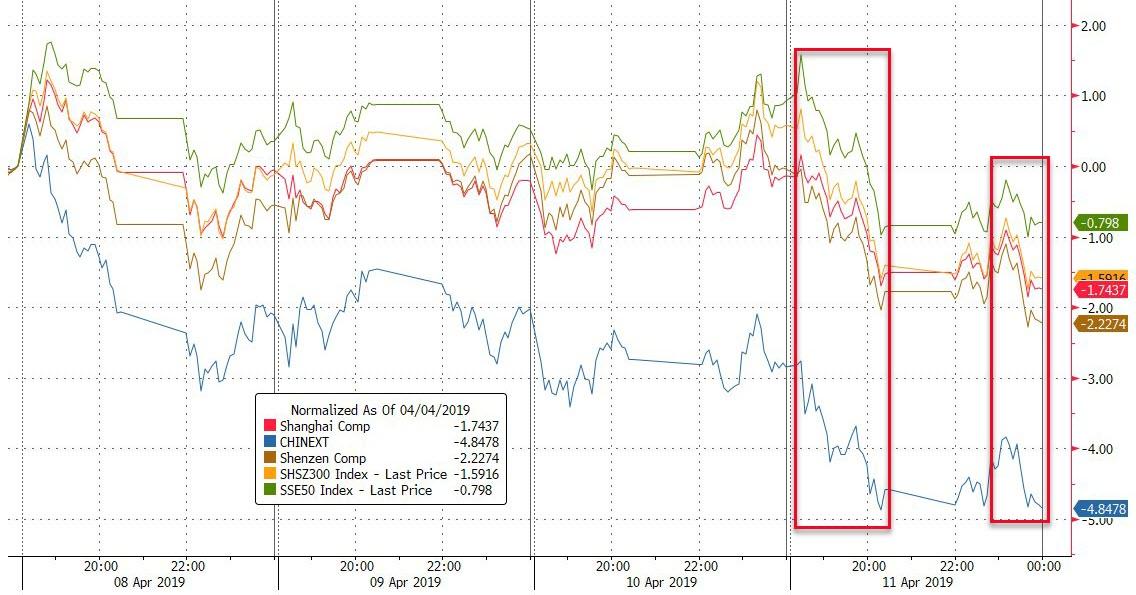
Notable weakness in Chinese stocks overnight, pushing them all into the red for the week…

Maybe the Chinese are starting to lose confidence?


European stocks opened weak, but bounced before ECB comments on neg rates for TLTROs prompted some weakness into the close…


US equities were mixed with Trannies the biggest clear winner. Every effort was made to get the S&P green and they succeeded…


It was an odd day for stocks – Dow Futures traded in a 30 point range for hours (ignoring the typical chaos around the open), before tanking at the EU close…


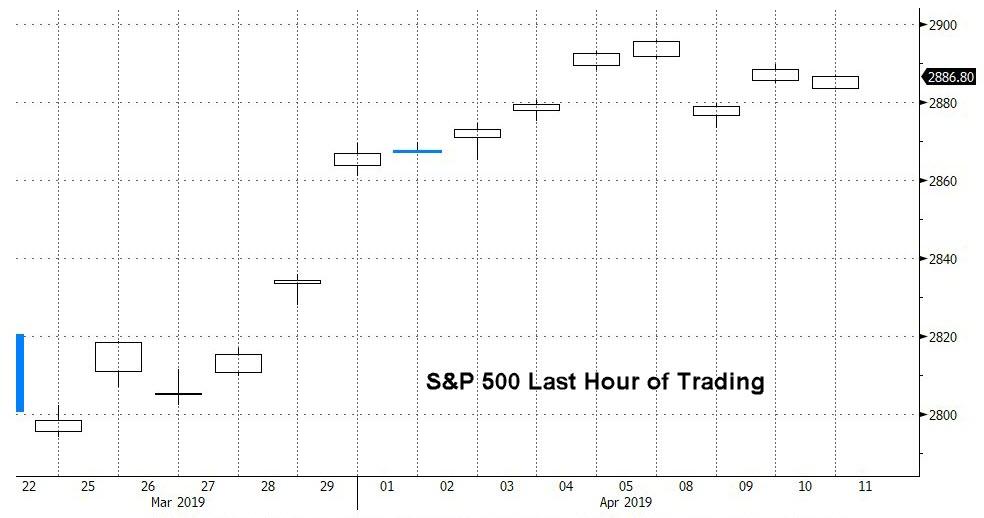
The S&P 500 is up 13 of the last 14 days in the last hour of the day (and the only down day was 4/2 with a 0.01% drop in the last hour)…

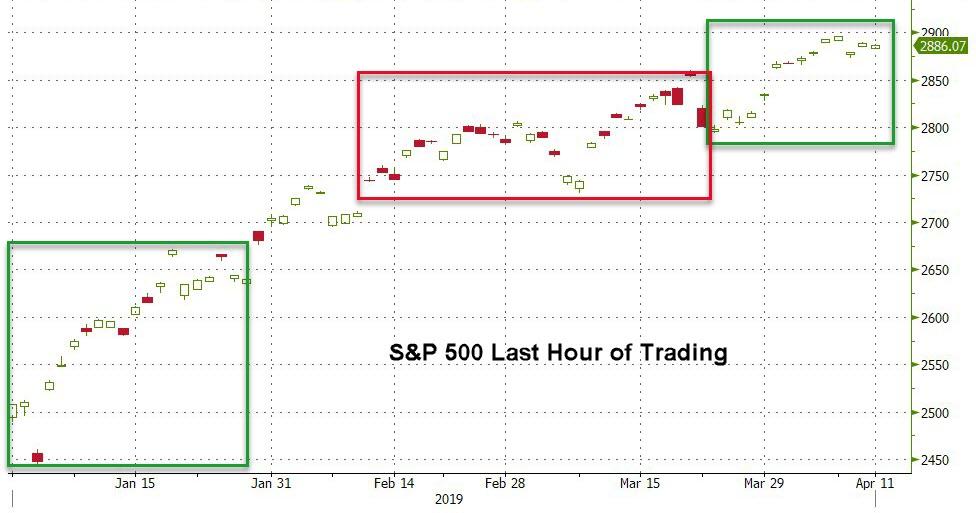
In fact, 2019 has been a year of last hour ramps…


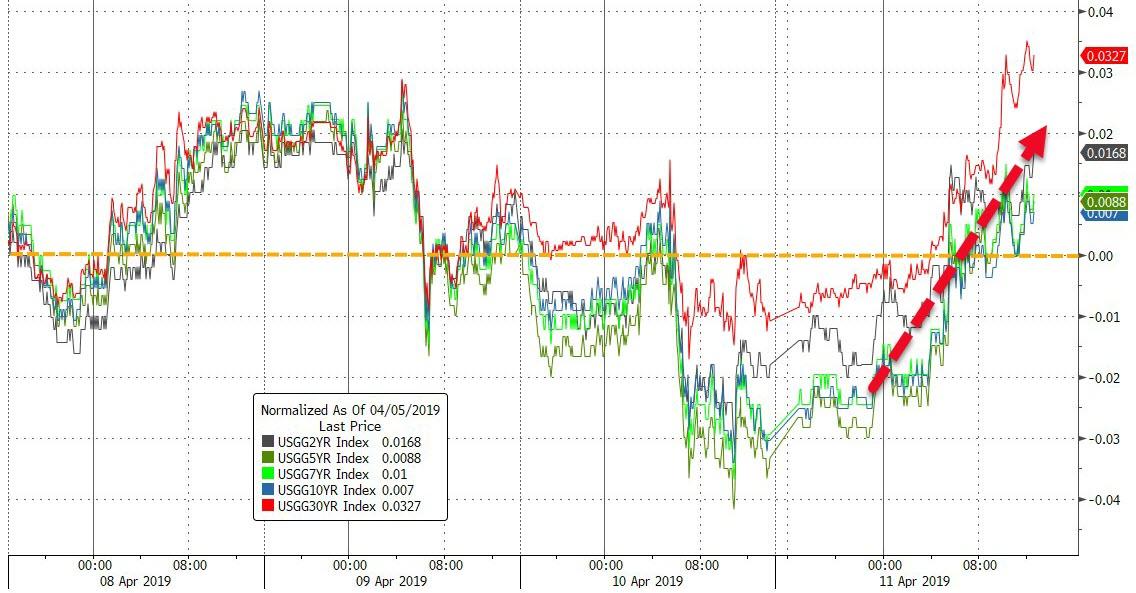
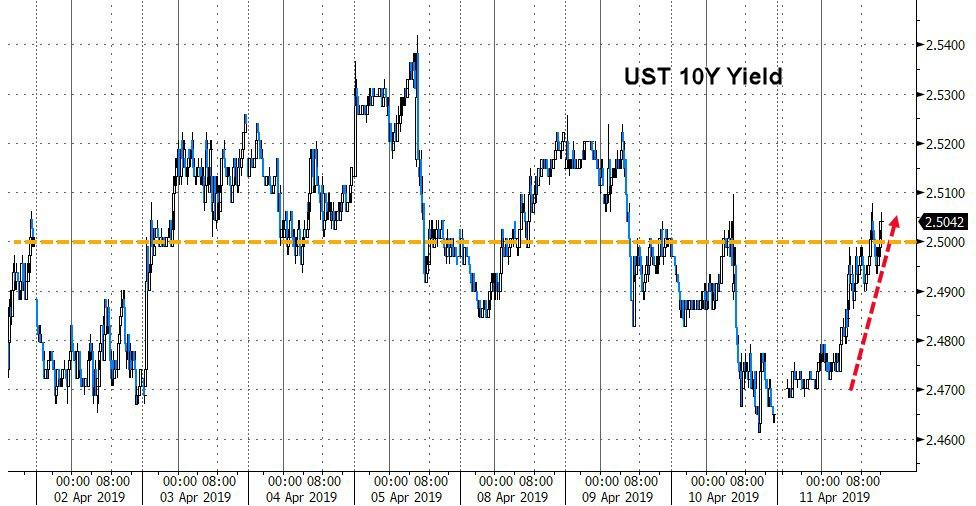
Treasury yields rose (despite stock weakness), jumping 3-4bps across the curve…leaving the curve flat to higher in yields on the week…


With 10Y back above the 2.50% level…


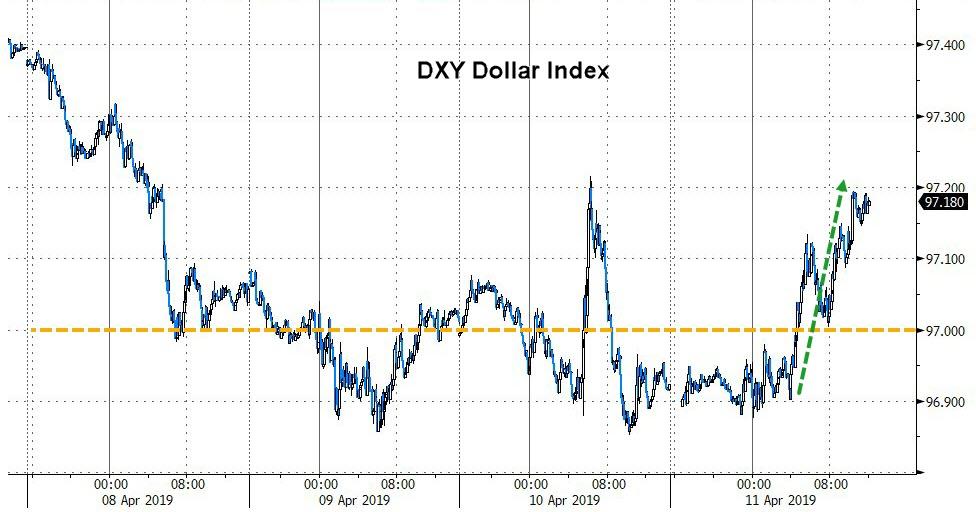
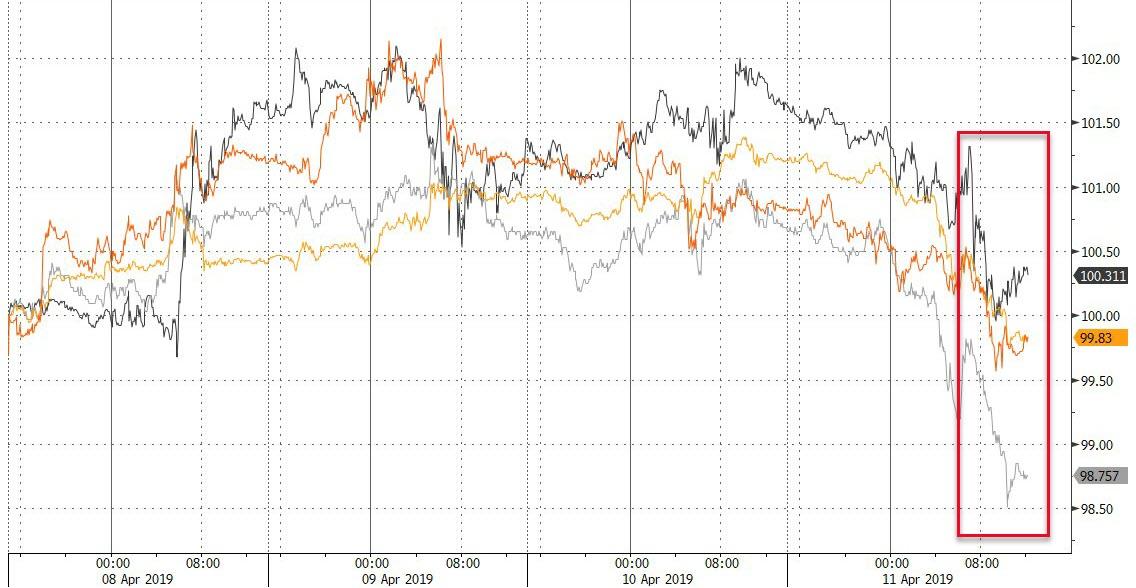
The Dollar surged on the day – ending a 3-day losing streak – back above 97.00…


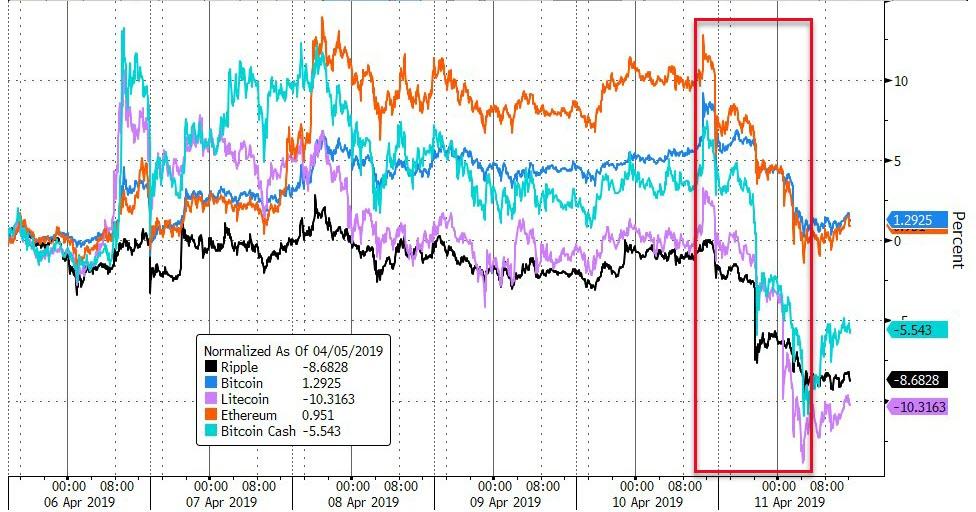
Cryptos were weaker today pushing Ripple, Litecoin, and Bitcoin Cash into the red for the week…


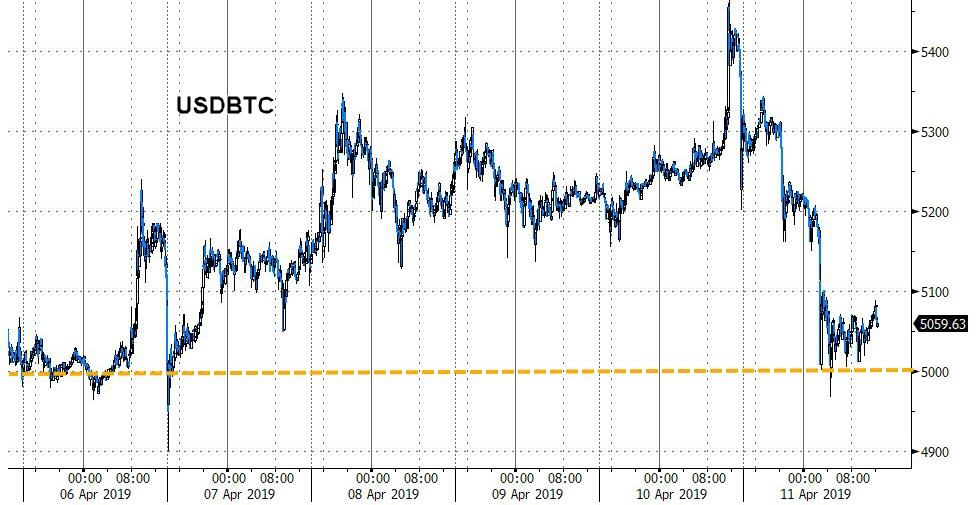
With Bitcoin briefly testing $5000…


Commodities were down across the board…


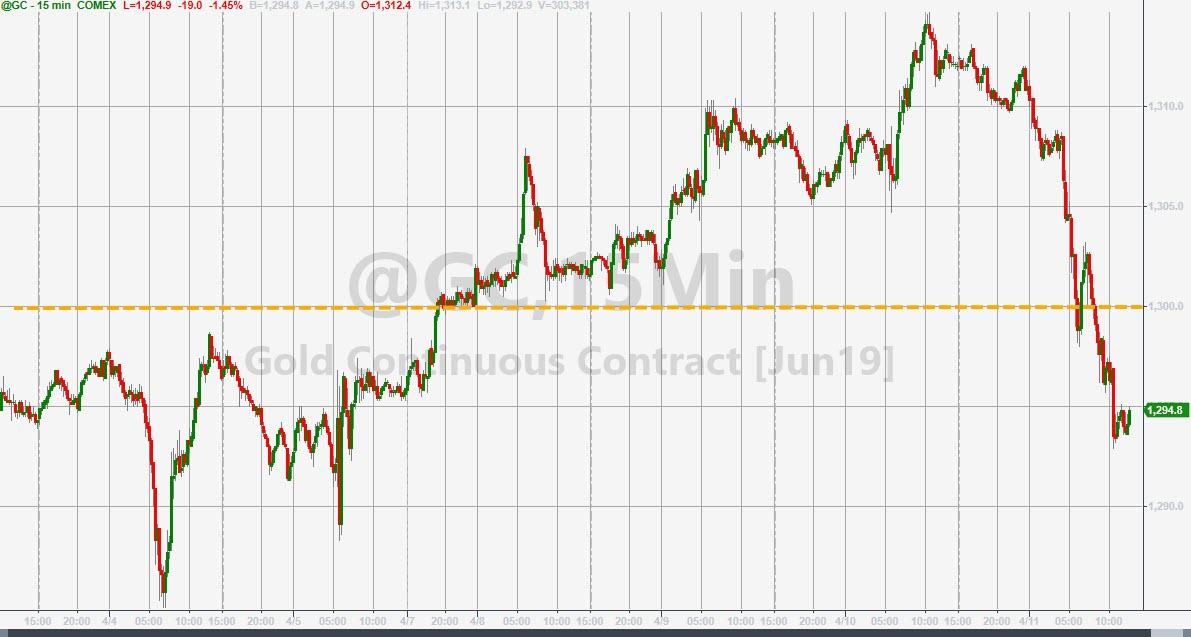
Gold tumbled back below $1300 as the dollar rebounded…


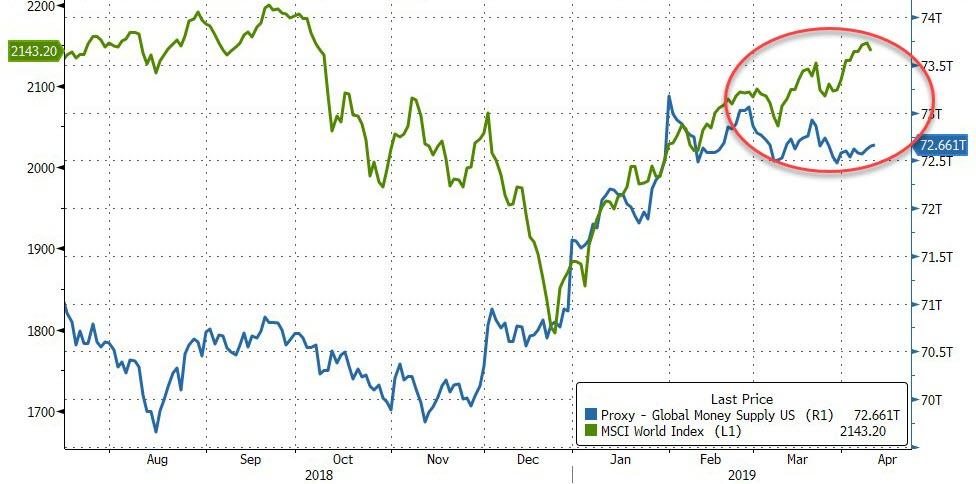
Finally, amid all the chatter and worries about President Trump, deficits, debt-loads, petrodollar threats, and on and on… USA Sovereign risk (default/devaluation) tumbled to its lowest since Lehman…

Are stocks starting to recognize that the liquidity buffer is fading…

via ZeroHedge News http://bit.ly/2D593Kf Tyler Durden

“Bubble Drunk” Asian-Millennials-In-Hoodies Blow $28 Million On Simpsons Art

Authored by Jesse Colombo via RealInvestmentAdvice.com,

During an economic bubble like the late-1990s dot-com bubble or the U.S. housing bubble, frivolous, hubristic investments and business decisions become appealing to many people who are what I call “bubble drunk.” In a bubble, money is flowing, the social mood is euphoric, and asset prices are surging – greed is the dominant emotion and risk is barely an afterthought. In this type of environment, speculation in art and collectibles becomes popular, often leading to an art bubble (for example, Japan’s bubble fueled an art bubble in the late-1980s). Of course, after a tremendous surge, the bubble eventually bursts and speculators are left holding works of art that are worth a fraction of what they paid. For the past several years, there has been an art bubble that has been primarily driven by the Greater China region – here is a recent anecdote reported by Bloomberg:

Millennials snapped up $28 million worth of art inspired by the Simpsons television show, along with skateboarding shoes and cans of spray paint at a Sotheby’s auction in Hong Kong as a new generation of collectors comes of age.

“The auction room suddenly got a lot hipper, with all these cool millennial buyers in hoodies,” said Edie Hu, art advisory specialist at Citi Private Bank in Hong Kong. “Their tastes are very different from their parents, and Sotheby’s is tapping into that.”

The highlight of the 33-lot auction of items belonging to Japanese fashion designer Nigo was a painting by Brooklyn street artist KAWS based on the Beatles’ “Sgt. Pepper’s Lonely Hearts Club Band” album but populated with Simpsons characters. It sold to an unidentified buyer for $14.8 million including fees, a record for the artist and about 15 times the estimate.

A young Chinese buyer with a short back and sides haircut, who was wearing a green army camouflage jacket, shelled out $2.6 million for another KAWS piece called “UNTITLED (KIMPSONS #3).” The work depicts the Simpson family sprawled unconscious on their couch, with the artist’s signature crosses for eyes.

“I am not surprised by the demand, but I am surprised by the final number,” said Max Dolgicer, a New York collector who’s been buying the artist’s work for seven years. “It’s a very fast-moving market.”

‘The Kaws Album’, KAWS. Courtesy Sotheby’s.

Young, hip millennials paying jaw-dropping amounts for trendy, lowbrow art is the type of behavior that you see in a bubble. That Simpson’s “art” is tacky and sophomoric – it’s what would pass as art in the year 2505 in the movie Idiocracy, except this is real life. Art from 500 years ago is objectively more beautiful and sophisticated than that Simpsons art, which is just more evidence of the dumbing down of modern culture. These young, hip millennial art buyers in Asia are drunk on easy money – plain and simple. In the next few charts, I will explain why a dangerous bubble is inflating in China and Hong Kong, where the Sotheby’s auction discussed earlier took place.

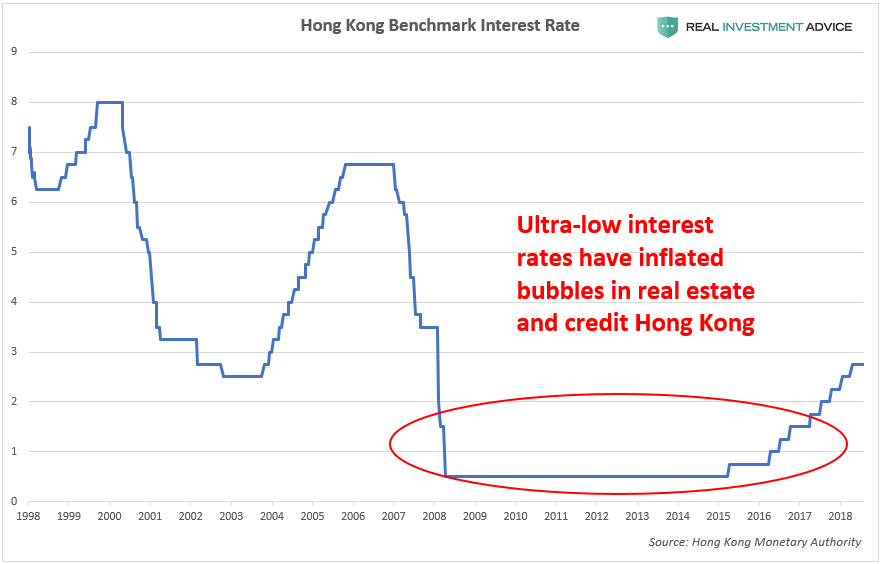
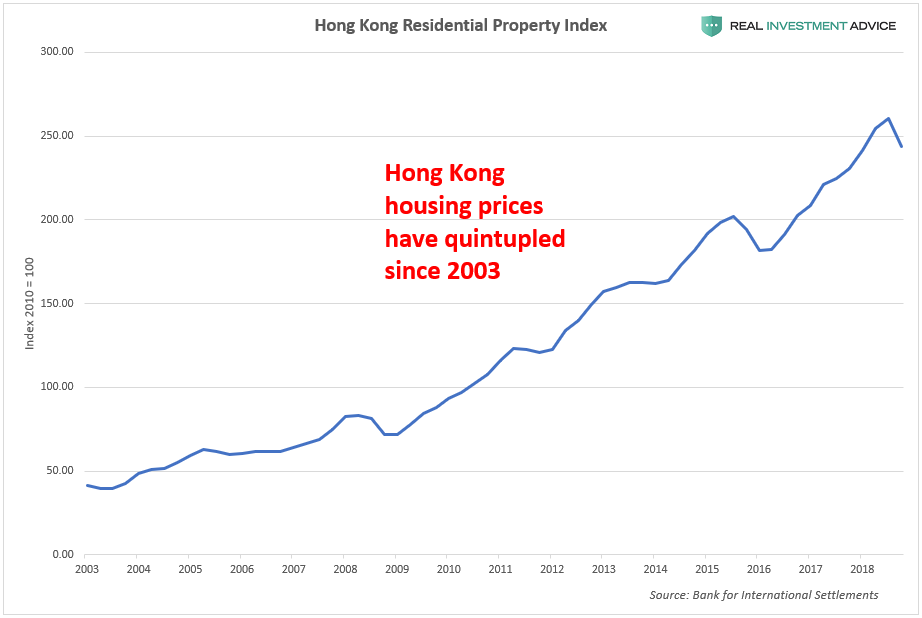
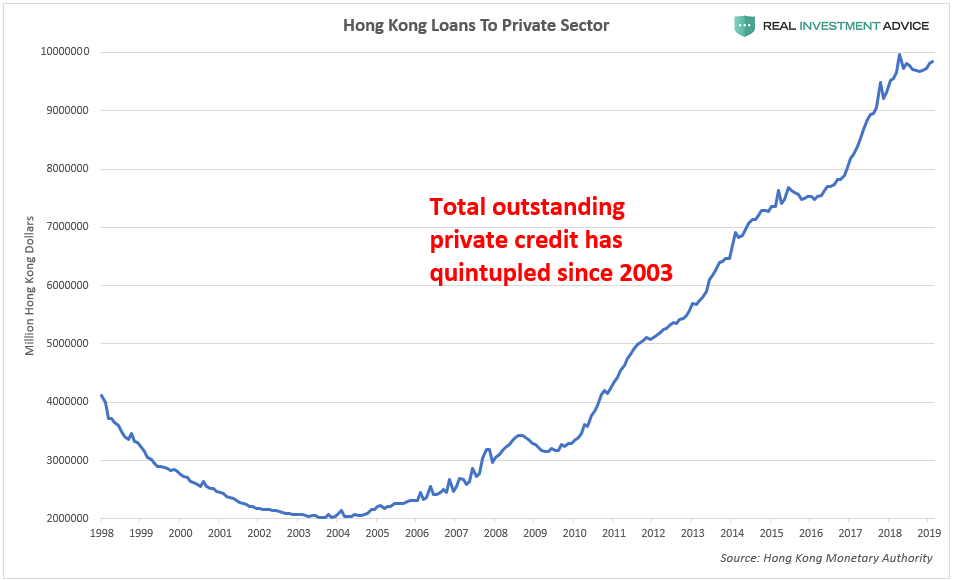
Since the 2008 global financial crisis, Hong Kong has held its benchmark interest rate at record low levels for a record length of time. These interest rates were far too low for Hong Kong’s economy – this anomalous situation only occurred because Hong Kong was trying to match U.S. interest rates to keep the currency exchange rate between the two countries stable. After 2008, the U.S. was a post-bust economy that was struggling with deflationary pressures – Hong Kong was not. Unfortunately, Hong Kong’s excessively low interest rates have helped to inflate a massive credit and asset bubble.

Hong Kong’s housing prices have quintupled since 2003:

Similarly, total outstanding private sector loans have quintupled since 2003:

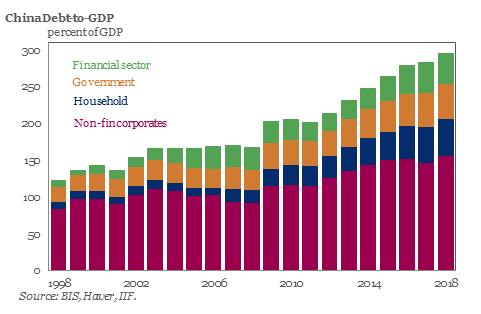
Mainland China has also been experiencing a tremendous credit bubble in the past decade that has been artificially boosting economic growth:

Ultra-low interest rates and other stimulative central bank policies are creating bubbles (and stupid decisions) across the globe. These bubbles are everywhere from China to Singapore to Australia to the U.S. to Canada to Western Europe. When asset prices are soaring and cheap credit is flowing, the result is “easy money” that finds its way into art and supercars. Unfortunately, as the Japanese art speculators experienced in the early-1990s, art bubbles always burst. The Chinese are going to be taught this lesson very soon. Even if you don’t live or invest in Asia, you are still tied into the same global economic system, which means that your investments and way of life are at risk.

via ZeroHedge News http://bit.ly/2X63KCe Tyler Durden
Ominous Signal Hints At Coming Emerging Market Turmoil

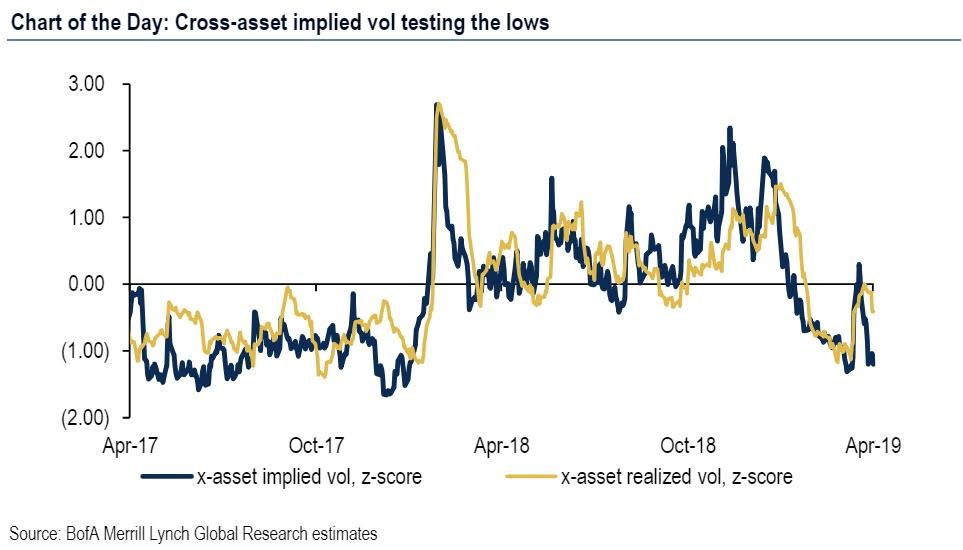
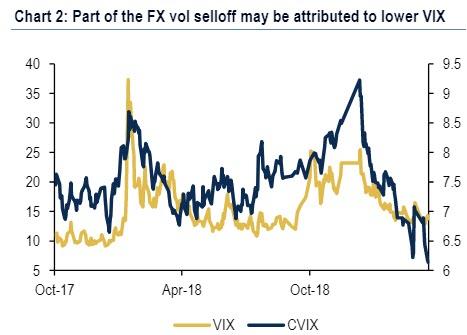
In a world drowning in complacency following the abrupt dovish reversal by virtually all central banks, investors have been starving for clues about potential market inflection points. Indeed, in the first quarter we saw cross-asset vols testing lows not seen since the record low days of 2017, even though as BofA notes, realized vols have been “more constructive”. And while, investors sold volatility across markets at already cheap levels to improve yield, doing so exposed them to highly asymmetric risks according to BofA FX strategist Vadim Iaralov.

Meanwhile, persistent political uncertainty has shackled directional traders and kept some corporates from investing overseas and thereby reducing both speculative as well as transactional FX flows. However, a bigger part of the FX vol weakness may be attributed to a falling VIX. Indeed, CFTC positioning data show a significant build-up of speculative VIX future shorts, which has coincided with falling FX vols. As a percentage of the open interest, VIX shorts are exceeding levels prior to major de-risking episodes in January and October 2018.

This crowded short vol positioning across assets suggests the next shock could lead to a vol spike, magnified by elevated cross-asset correlations according to BofA. 

But is a shock coming? That of course, is the $64K question, and by at least one measure, despite the prevailing market calm, some traders are convinced that a shock is imminent and are yanking their money.

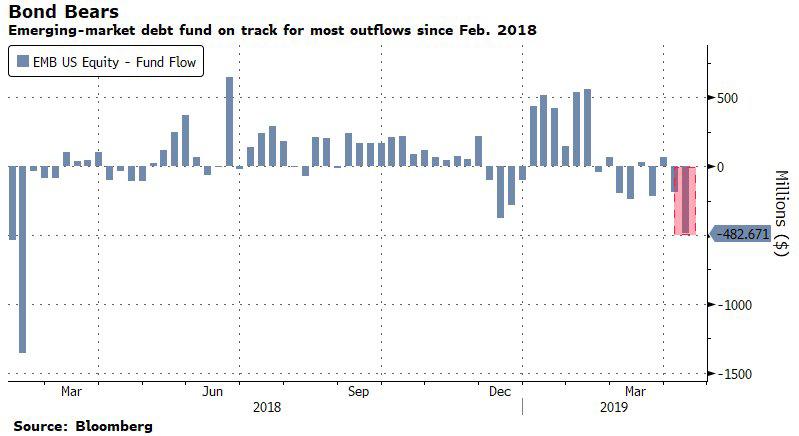
As Bloomberg shows in the chart below, even with the S&P back near all time highs, and with global stocks at 6 month highs, investors are inexplicably pulling more money from the biggest emerging-market bond ETF than at any time in the past year – even more than during the depth of the December mini-bear market.

The $16.5 billion J.P. Morgan Emerging Markets Bond ETF, the biggest ETF dedicated to EM debt, is heading to its worst week of outflows since February 2018, when the so-called volmageddon wrecked vol shorts and crushed EM longs. And while the catalyst is still unknown, the signal is there as investors have pulled $482 million from the EMB fund.

While some of Wall Street’s marquee firms such as Goldman and T. Rowe Price continue to push clients in emerging markets (as they themselves offload their EM exposure), others are growing skeptical that the dovish Fed and the “weaker dollar” (which it not only not weaker, but is near its highest level since early 2017, will weaken as much as expected to give global bonds a boost.

Is this a notable inflection point and should it be taken seriously? Considering that developing-nation bonds have underperformed stocks this year after posting a smaller slide in last year’s selloff, it may well be the case that the excess liquidity that flooded the market at the start of 2019 is starting to shrink rapidly, and as a result investors are reeling in those bets that have underperformed. And while this does not mean that an equity market crash is imminent, should the liquidity crunch continue – for whatever reason – and investors are forced to shift their selling from EM bonds to DM stocks, it’s only a matter of time before this “ominous signal” spreads to riskier asset classes.

But going back to the EM space for now, “the outlook for EM is now neutral going forward,” said Mohit Bajaj, director of ETFs at WallachBeth Capital. “The dollar hasn’t sold off as much as people expected it to, so part of it could just be profit taking.” Bajaj added that money moving out of EMB could be going to longer duration U.S. debt ETFs or equity funds, which have outperformed recently; and while he is right, it is only a matter of time before investor disappointment with the recent fizzle in the global equity rally turns into outright selling, and the next leg lower in risk assets begins. Until then, keep an eye on investor flows in “less loved” assets such as EM bonds, which are now the best canary in the equity market coalmine.

via ZeroHedge News http://bit.ly/2Z4XkoD Tyler Durden
Coinbase Crypto Exchange Launches Visa-Enabled Payments Card

Authored by Ana Alexandre via CoinTelegraph.com,

Major American cryptocurrency exchange Coinbase has launched Coinbase Card, that enables its United Kingdom-based customers to pay in-store and online with cryptocurrency. The development was announced in a blog post published on April 10.

image courtesy of CoinTelegraph

The Coinbase Card is Visa debit card powered by customers’ Coinbase account crypto balances, which allows them to make purchases with digital currencies worldwide. Coinbase instantly converts customers’ cryptocurrency funds into fiat currency in order to complete the purchase.

Coinbase also released the Coinbase Card app for iOS and Android, which links customers’ Coinbase accounts with the app and allows them to choose a particular wallet to fund their Coinbase Card. The app additionally provides access to receipts, transaction summaries, spending categories, and other features. The card reportedly supports all digital assets available to purchase and sell on the Coinbase platform.

The card is issued by authorized and regulated as an electronic money institution Paysafe Financial Services Limited. Currently, Coinbase Card is available for customers in the U.K., however Coinbase reportedly plans to add support for other European countries in the near term.

Earlier this month, Visa itself published a crypto and blockchain-related job opening. The firm is ostensibly seeking someone to fill the position of Technical Product Manager at Visa Fintech at its Palo Alto office. The position’s description states that a candidate should have an in-depth understanding of distributed ledger technology and the crypto industry.

via ZeroHedge News http://bit.ly/2P3zcOs Tyler Durden
Wall Street Is Now Buying College Students Like Stocks

Shortly after we wrote about an online software engineering school that was allowing students to pay their tuition by forfeiting 17% of their income after they graduated, it’s becoming clearer that the model of selling an “equity stake in yourself” to fund tuition is making its way to the mainstream.

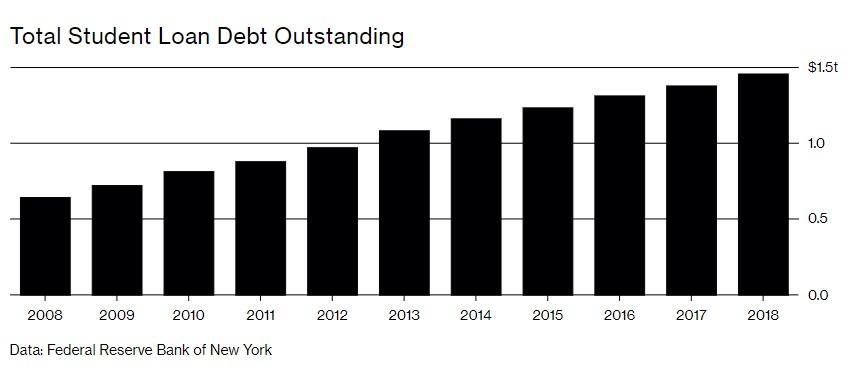
Equitizing students was the topic of an in-depth Bloomberg Businessweek look into the details of what Americans are doing to combat the $1.6 trillion in higher education debt that they owe. Specifically, the article followed the path of 23 year old Amy Wroblewski, who has been literally turning over a set percentage of her salary to investors – and will do so for the 8 1/2 years after graduating college. 

Wroblewski (Photo: Bloomberg)

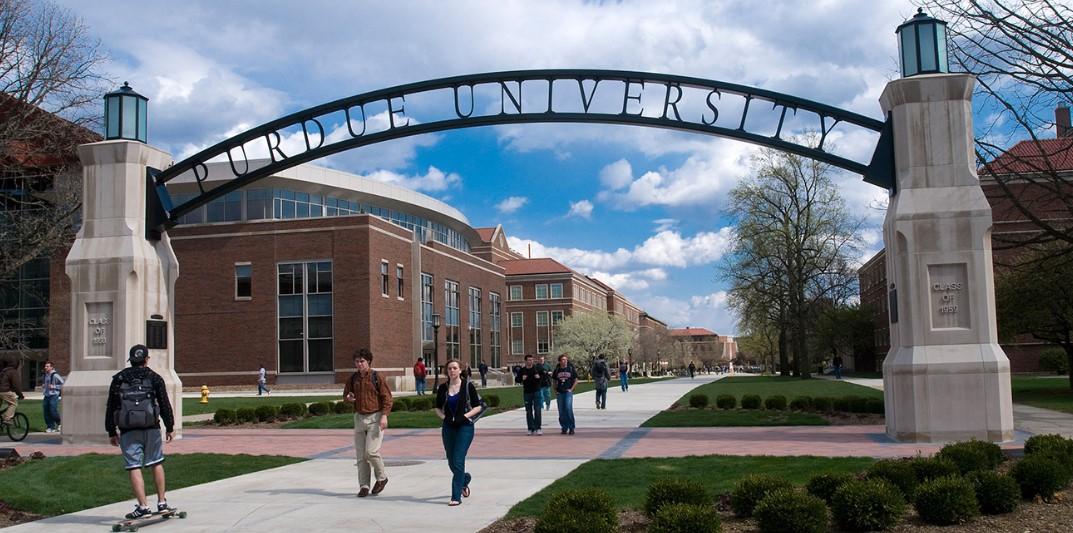
Wroblewski makes about $50,000 a year as a higher education recruiter and surrenders about $279 a month to investors who helped pay for her tuition. If she winds up doing extremely well in her field, she may wind up paying twice as much. But if she loses her job, she won’t have to pay anything and investors will be stuck with the bill until she finds work. Wroblewski is part of a new program at Purdue University that sidesteps regular student loans in favor of allowing students to hand over future earnings through an “income sharing agreement”. The agreement turns students into equity investments, instead of debt notes.

And like any investment in equity, students require some amount of due diligence. Wroblewski’s history of always holding down two jobs and rising to vice president of Delta Sigma Pi, a business fraternity, attracted a company called Vemo Education, who made her the offer after vetting her as a “potential investment”.

Chuck Trafton, who runs hedge fund FlowPoint Capital Partners LP, which has invested in ISAs said: “I envision a whole new equity market for higher education in the next five years where today there’s only debt.” 

The market for these types of agreements is now only in the tens of millions, a very small sliver of the $170 billion in outstanding asset backed securities from student loans. And only some some select schools are allowing outside investment firms to buy a stake in students. Others seek out individual donors, wealthy alumni or use money from their endowment. Purdue is the most high-profile school to implement such a program so far. 

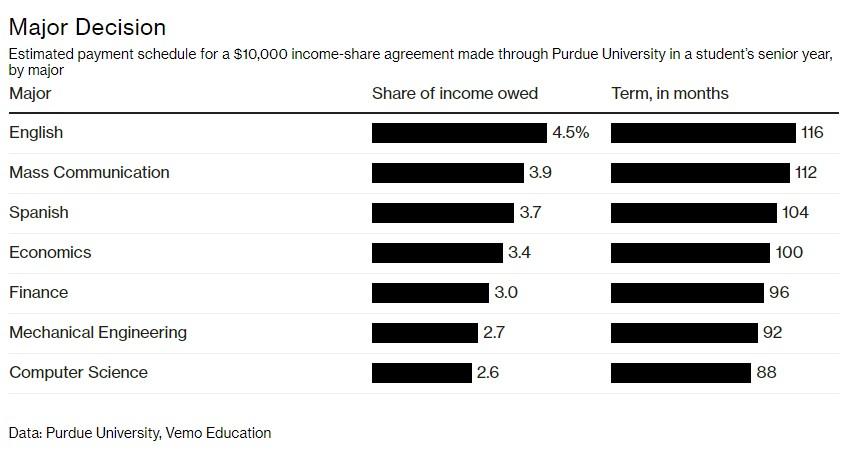
ISA investors ask for a smaller “piece of the pie” from students with more lucrative majors. For example, at Purdue, English majors pay 4.52% of their future income over 10 years, whereas chemical engineers paid 2.57% in a little over seven years.

The program is set up to be competitive with student loans:

Consider a junior economics major who needs $10,000. Through a private loan, she’d likely pay $146 a month, or $17,576 over the course of 10 years. Through an ISA, a student with a starting salary of $47,000, Purdue’s estimate for its 2020 economics graduates, would pay $15,673, assuming 3.8 percent annual salary increases. That would be a good deal. But, if she found a $60,000-a-year job, she’d have to fork over $20,010.

But financial firms and for-profit colleges are, naturally, still trying to turn a buck. These ISAs may have a luster to them now, because they are a new instrument, but students still wind up paying back more than they borrow.

Julie Margetta Morgan, a fellow who studies higher education at the Roosevelt Institute said: “There’s a level of enthusiasm that’s overstated. It’s pretty darn near impossible to say whether an ISA is better or worse for an individual.”

The last time something like ISAs were tried, at Yale in the 1970s, it wound up in many students defaulting, leaving borrowers waiting for longer than they had anticipated to get paid. The goal then was to pool all borrowers and have them pay the school a percentage of their income for 35 years. Yale ultimately wound up bailing out the borrowers (preparing them for their futures on Wall Street) and winding down the program in 2001. And the terms of some of these plans weren’t capped in any way. One graduate, Juan Leon, borrowed $1500 through the program and wound up paying back $8000.

“We didn’t read the fine print. It was quite, quite onerous,” Leon said. 

Under these new plans, like Purdue’s, students have more protection. Purdue caps total payments at 2.5 times what a student borrows, so that the most successful students don’t feel like they’re being gouged. Students making less than $20,000 a year aren’t charged at all, as long as they are working full-time or in the process of seeking work. These payments are instead deferred.

So far, Purdue has arranged about 700 of these contracts worth about $9.5 million and they have closed $17 million in investments from two funds. David Cooper, the chief investment officer for Purdue, hoped to develop the program and pitch it to investors after overseeing Indiana‘s retirement system. 

“We feel like we’ve got the pricing for the students at a pretty good spot. At the same time, it’s a reasonable return for the investors,” he said. 

Charlotte Hebert graduated from Purdue in 2017 and doesn’t share Cooper’s enthusiasm about the $27,000 she took to pay for her schooling costs. She’s going to be required to shell out 10% of her income for the term of her deal, which is about 2.5% more than what an engineer would pay. She makes about $38,000 a year as a writer and pays investors $312 a month.

“I don’t think it’s the perfect solution. I am of the opinion that in a society where most of its workers need a college education, nobody should be paying this much to be what is considered a functional member of society,” she concluded. 

via ZeroHedge News http://bit.ly/2G9FZ53 Tyler Durden
Nein Nein Nein: 4th GOP Senator Comes Out Against Cain, Sinking Fed Board Nomination

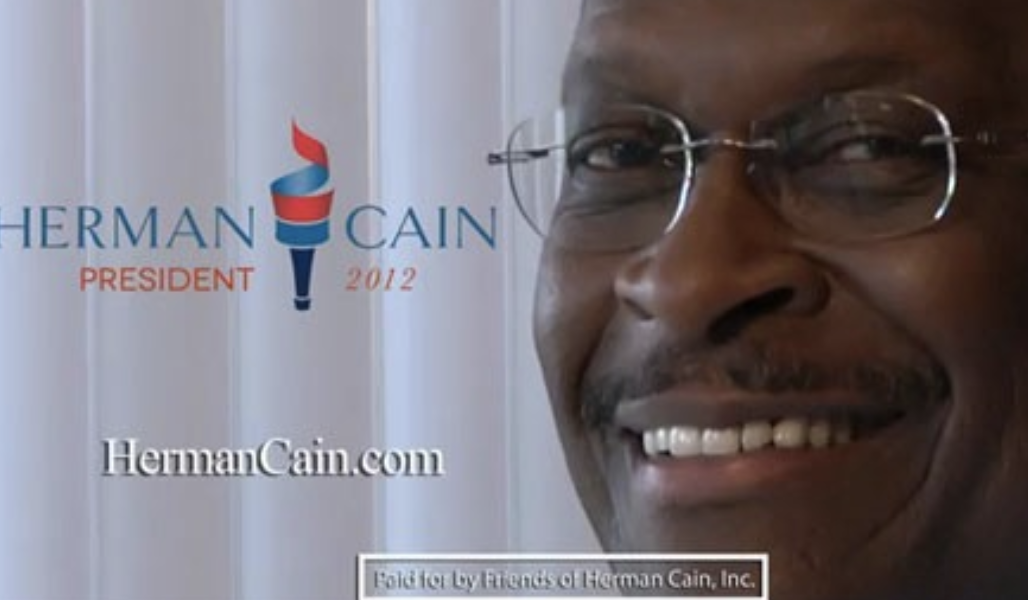
Whether it’s because of his support for “fringe” monetary policy prescriptions like a return to the gold standard, or lingering disgust over the sexual harassment scandal that sunk his 2011 presidential bid – or simply the memory of his infamous campaign-ad ‘smile’ – enough Republican Senators have now publicly opposed former Godfather’s Pizza CEO Herman Cain that his nomination for a seat on the Fed board has been sunk before the official vetting process had even finished.

Cain

The Hill reports that Sen. Kevin Cramer, a North Dakota Republican and a close ally of President Trump ally, told reporters that “if I had to vote right now, there’s no way I could vote for” Cain.

And of course Chuck Schumer has confirmed that he doesn’t know any Democrats who would back Cain.

Ostensibly, the Republican opposition to Cain is the second presidential snub by the Republican controlled senate in as many months (it also backed a measure to try and terminate his national emergency, which Trump ultimately vetoed). However, we wouldn’t be surprised to learn some day that Trump only floated Cain to make Steve Moore look better by comparison, bolstering the chances that the former Trump campaign advisor would be confirmed by the Senate to fill one of the two empty board of governors seats for the ‘non-partisan’ central bank.


via ZeroHedge News http://bit.ly/2G81gMI Tyler Durden
Vulnerable To Failure – Boeing 737 Sensors Linked To Over 140 Incidents

In their preliminary report, the team investigating the crash of ET302 determined that while there were actions that the pilots could have taken to avert the crash, the confusing alarms triggered by a faulty sensor ultimately proved too confusing, even as the pilots followed the steps laid out by Boeing in its safety manual.

As the focus of the investigation shifts to sensors that have been installed on all planes (not just those made by Boeing) – though the company has said it will include an additional sensor on 737 MAXs as part of its revamp of the plane’s anti-stall software – Bloomberg has published  chilling report that raises serious questions about how these sensors managed to avoid scrutiny, given a history of malfunctions that stretches back to the 1990s.

Boeing

Some 140 incidents involving faulty or damaged sensors have been reported in that time, according to a review of publicly available data by Bloomberg. Of those, 25 cases involved the same type of faulty alert that led to the crash of ET302, and all 157 people on board.

Though the investigation into the Lion Air crash is ongoing, it’s believed a faulty sensor was also to blame in that crash.

Pilots have for decades relied on the weather-vane-like “angle of attack” sensors to warn them when they near a dangerous aerodynamic stall. But investigators are probing Boeing’s decision to enable the sensors on the Max model to go beyond warning pilots and automatically force the plane’s nose down.

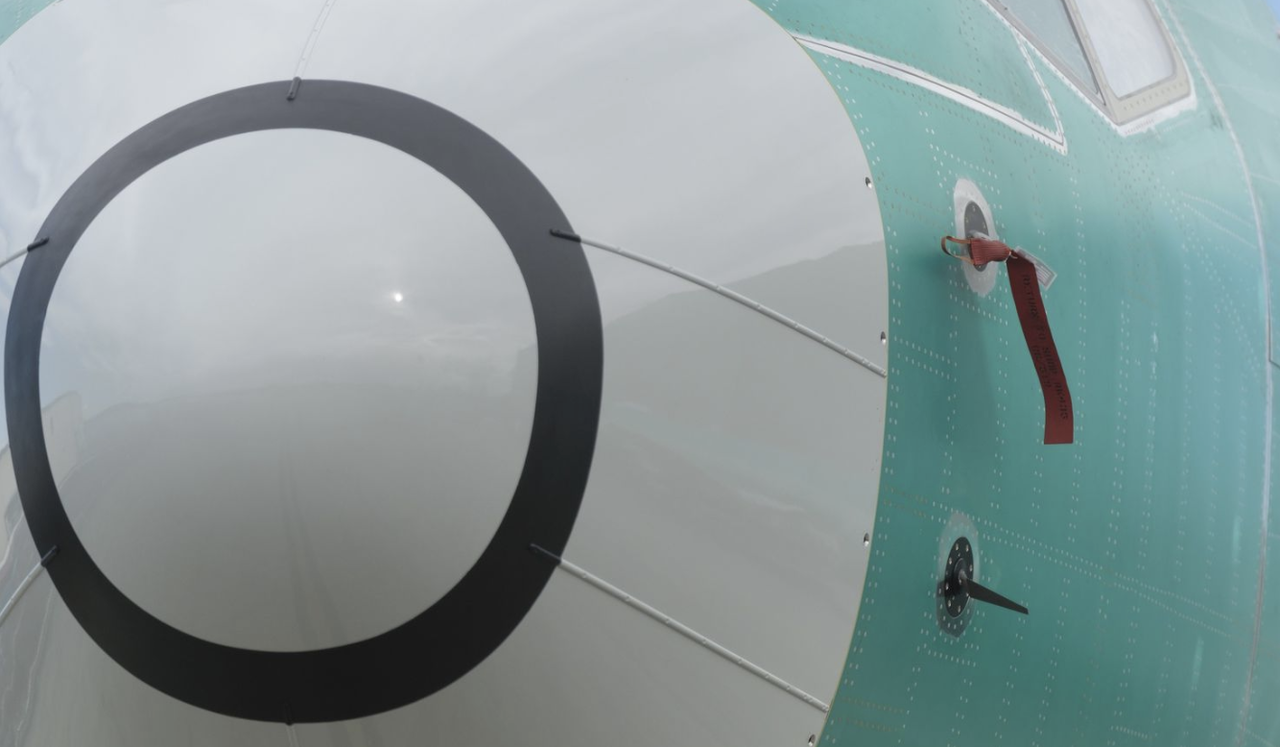
A review of public databases by Bloomberg News reveals the potential hazards of relying on the devices, which are mounted on the fuselage near the plane’s nose and are vulnerable to damage. There are at least 140 instances since the early 1990s of sensors on U.S. planes being damaged by jetways and other equipment on the ground or hitting birds in flight.

In a chilling revelation that raises questions about why these sensors weren’t more heavily scrutinized, an Airbus SE crashed in 2008 while on a demonstration flight. All seven people onboard died as the plane plunged into the ocean. Moisture inside the sensors was eventually blamed for the accident, but strangely, nothing was done.

Before the 737 Max crashes, the most recent accident involving the sensors occurred when an Airbus SE A320 on a 2008 demonstration flight went down off the coast of France killing all seven people aboard. Moisture inside two of the plane’s three angle-of-attack vanes froze, confusing the aircraft’s automation system, according to France’s Office of Investigations and Analysis. The report also faulted the pilots for multiple errors.

Examining such previous episodes is all the more important because of Boeing’s decision to use a single sensor as the trigger for the anti-stall mechanism on the Max known as MCAS, or Maneuvering Characteristics Augmentation System.

“With that many pilot reports and with the unknowns that we’re dealing with in these two accidents, that’s an important area to be investigated,” said James Hall, the former chairman of the U.S. National Transportation Safety Board.

In an amusing twist, many of these malfunctions were caused by incidents where birds collided with the sensors, damaging them (and killing the birds).

On April 1, 2012, a United Airlines 767-300 was taking off from San Francisco when it struck a flock of western sandpipers, according to a Federal Aviation Administrationdatabase. The birds damaged the left sensor, scrambling the speed readings and auto throttle. The plane returned to the airport.

A Republic Airlines Inc. flight was struck by a tundra swan as it neared arrival into Newark, New Jersey, on Dec. 5, 2016, according to the FAA. It damaged the angle-of-attack sensor and other equipment on the Embraer SA EMB-170, rendering unreliable airspeed and altitude readings on the regional jet. It landed safely.

Though these incidents represent a minuscule fraction of the hundreds of millions of successful flights that have happened in that time, the fact that they sensors weren’t investigated before now comes as a shock, according to some experts.

Examining such previous episodes is all the more important because of Boeing’s decision to use a single sensor as the trigger for the anti-stall mechanism on the Max known as MCAS, or Maneuvering Characteristics Augmentation System.

“With that many pilot reports and with the unknowns that we’re dealing with in these two accidents, that’s an important area to be investigated,” said James Hall, the former chairman of the U.S. National Transportation Safety Board.

The FAA was aware of previous angle-of-attack failures and considers such incidents when it evaluates aircraft designs for certification, the agency said in a statement.

“As part of the FAA’s oversight of the continuous operational safety of our nation’s aviation safety system, the agency continues to monitor, gather and evaluate all available information and data regarding the performance of aircraft and related components,” the agency said.

Even more chilling: BBG’s investigation turned up one flight with circumstances eerily similar to those that led to the deaths of everyone aboard both the Lion Air and Ethiopian Airlines flights. However, since the plane involved was an older model 737, it wasn’t equipped with MCAS, and thus the nose of the plane wasn’t automatically forced lower.

One March 2016 incident closely resembled the recent crashes, except that the plane, an earlier 737-800 model, wasn’t equipped with MCAS and the pilots maintained control.

As soon as the plane got airborne, the captain, seated on the left side, got the loud thumping noise and vibrating control column warning that the plane was about to stall, according to the NASA report. The captain’s airspeed and altitude displays disagreed with the copilot’s, indicating an error and setting off additional alerts. All of those symptoms occurred on the two recent Max crashes.

The pilots opted to continue onto their destination in spite of the multiple failures. Both the captain and the copilot said that they regretted continuing the flight and didn’t realize that they had violated their airline’s procedures by disabling the stall warning.

“A return, while considered, should have been accomplished,” said the captain.

Despite this report, Boeing shares rebounded on Thursday as worries about more order cancellations failed. But the report raises an interesting question about the Airbus crash: Since the deaths of seven people likely didn’t make a splash in the headlines, did that make it easier for regulators at the time to ignore?

via ZeroHedge News http://bit.ly/2P3uvUQ Tyler Durden

He Was Tased, Arrested and Totally Innocent. Now He’s Suing.

|||Screenshot via YouTube/WRCB Chattanooga

Nate Carter is bringing a $3 million lawsuit against the city of Chattanooga, Tennessee, its police department, and the officer responsible for his tasing and wrongful arrest.

According to the complaint, the April 2018 incident began when police responded to a 911 call about a man threatening the caller with a gun. The caller described the suspect as a black man with short hair, who was heavy-set and wearing green and black pants.
The suspect had fled by the time police arrived. Instead, they saw Carter, who was wearing a purple t-shirt and black shorts. Officer Cody Thomas asked Carter to identify himself. Carter, who said he was checking his mail outside, responded that Thomas was not welcome to come to his house. The situation escalated with Thomas telling Carter, “How about you watch your mouth before your ass gets thrown in the back of my car.”

Thomas pulled out a Taser and threatened to shoot Carter’s “fucking dog,” which was barking in the front yard. Carter attempted to go into his house, at which point Thomas shot Carter in the back with his taser, causing him to fall on his front porch. Carter managed to make his way inside, and Thomas called for backup. Carter then re-emerged from his home with his family while several officers, including Thomas, pointed guns and tasers toward Carter, his family, and his dog. After the family was out of the way, the officers moved to arrest Carter.

Body camera footage shows Carter’s arrest.

(The arrest begins after 3:27)

Thomas later claimed that Carter was standing in the street and “bolted” prior to the incident. He charged Carter with disorderly conduct and resisting arrest. Those charges were thrown out by a judge in November and Carter is now suing.

This is not the first incident involving Officer Thomas. In February 2018, Thomas and other officers entered the home of Dale Edmonds after a neighbor told emergency services that someone was sitting in a black vehicle in Edmonds’ driveway. The person in the vehicle was a Department of Child Services agent who was waiting while a second agent was meeting with Edmonds inside of the house. Though the agent explained to officers the purpose of their trip, Thomas and others entered the house through the backdoor without a warrant. The officers led Edmonds, his housemate, and the agent outside of the house at gunpoint, but not before Thomas “manhandled” Edmonds, who was recovering from a gunshot wound.

Robin Flores, an attorney and former police officer who works on police brutality cases, is representing Carter. Their suit argues that the city “has long-established patterns of overlooking or providing excuses and reasons to justify the misconduct of its officers.” Flores told Reason that the complaint highlights how the city fails to “discipline and supervise” officers. The complaint lists other reports of bad policing by Chattanooga police dating back to 2003, including excessive force, lingering investigations, domestic abuse, and sexual harassment.

Flores told Reason that the Supreme Court has ruled that the language Carter used during his arrest is a form of protected speech. In 1974, the court ruled against a Louisiana statute that criminalized the use of obscene language while an officer is performing their duties. Justices argued that the law was too broad to fit within the legal definition of “fighting words” and had the potential to be abused in instances lacking a valid reason for an arrest.

Though Thomas’ body camera was rolling during the incident, he turned his cruiser’s dash camera off in violation of the department’s policy. At one point, Thomas’ hand covers his body camera. The complaint argues that this was done either in an attempt to turn it off or conceal his interaction with Carter.

Flores says that the footage available in both Carter’s case and in the Edmonds case is “critical enough to bring a claim” against Thomas, the department, and the city. In other instances, footage has been enough to drop charges and reopen the cases of offending officers. He also mentions another case where he dismissed a suit after his client’s version of events did not match the camera footage. This, he says, also protects police officers.

from Hit & Run http://bit.ly/2IsvA7C
via IFTTT

US Treasury Growth Expectations Tumble To 6-Month Lows

Authored by Steven Vanelli via Knowledge Leaders Capital blog,

The IMF made news yesterday by announcing its latest updates to 2019 GDP growth around the world. It guided global growth down and made an especially large cut to Eurozone growth estimates, bringing them down 30bps since January to 1.3%.

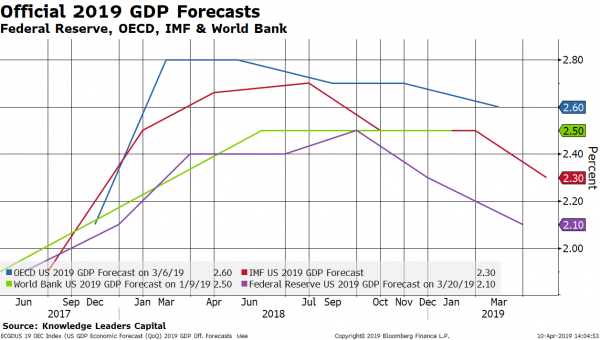
They also took their estimates down a touch for the US as well. In the chart below, I show the various “official” forecasts for US GDP growth in 2019. There a couple observations that stand out here:

  1. The Federal Reserve has cut its 2019 GDP forecast by 40bps in the last four months and is the most bearish official forecaster.

  2. The IMF was earlier than the Fed to bring its rosy growth estimates down in September 2018, but they have also trimmed their estimates by 40bps total too.

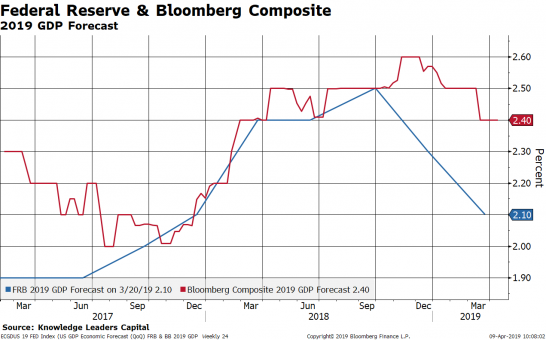
Private forecasters are also a bit behind the Fed on their 2019 US GDP estimates. The Bloomberg Contributor Composite forecast for 2019 growth is 2.4%, having come down only 20bps since November. Interestingly, private forecasters raised their estimates in November by 10bps just before the wheels came off the stock market in December. The net here is that private forecasters are still a bit optimistic relative to the Fed, raising the risk that private estimates need to come down some more.

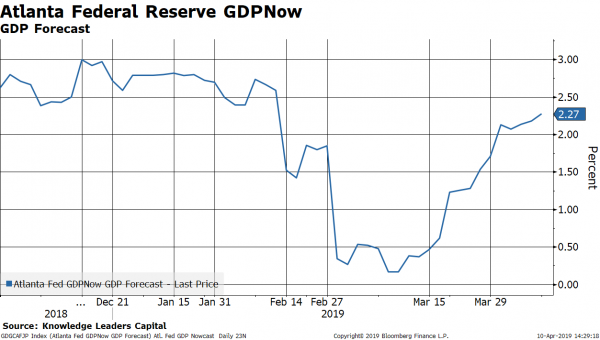
In all fairness, economic data has been pretty volatile lately, especially after the drop in rates. In February, weak consumer spending started dragging down its expected contribution to first quarter growth, according to the Atlanta Fed. But, then in early March, likely a result of the drop in mortgage rates, the expected contribution to residential investment picked up.

In the last three weeks, first quarter growth got another boost when it became clear the economy was not purging inventories, but was instead building inventories. This swing in inventory contribution alone is 75bps since mid-March.

The Atlanta Fed’s GDP Nowcast for the first quarter is now back to 2.27% as a result of these swings in housing and inventories. This is about spot on the IMF’s annual target.

Given the latest data points, the Fed is clearly not on the same page as everyone else… it is more negative on growth. This is a pretty decent signaling mechanism of patience and gives quants some numbers to play with in assessing the attractiveness of US Treasuries.

Perhaps this explains why 10-Year US Treasury growth expectations are making a new break lower for the year as 10-Year TIPS are ticking to new low yields for the year as of this writing.

via ZeroHedge News http://bit.ly/2USGnyn Tyler Durden