Inflation Expectations Around The Globe Just Hit Record Lows

Having seen what monetary-policy failure looks like in Japan.. and in the US, we now turn our attention to the world. Amid NIRP temptations, growth fears, and faltering faith in central banker control, market-implied inflation expectations have collapsed to record lows. Worse still, even The Fed's own survey of consumer's inflation expectations has slumped to record lows.

Inflation expectations are collapsing… (US and Europe at record lows – worse than the lows in the middle of the last crisis)…

As Bloomberg adds, while ECB policy makers have reiterated in recent weeks that they are committed to their mandate of boosting annual inflation rates to just under 2 percent, consumer-price growth is currently only about one-fifth of that level.

And The Fed is no better as all the money-printing, jawboning, and promises have left consumer expectations of inflation at record lows…


And finally – what we all have to look forward to… Japanese policy projects the impotence of the current efforts in US and Europe… it does not end well…


#PolicyFail


via Zero Hedge http://ift.tt/1mtayH1 Tyler Durden

It Was Never About Oil

Submitted by Jeffrey Snider via Alhambra Investment Partners,

The link between stock prices and oil has been especially high of late, and that has left quite a few traders and experts stumped. For a good long while any impact from oil was denied as only “transitory” or even helpful to consumers through some sort of “tax cut” effect. In January 2016, however, liquidations appeared regularly in one alongside the other. This is/was not supposed to occur. From last month:

“Absent an economic recession, stocks have fallen too far in my mind as a long-term investor,” says John Buckingham, who manages about $600 million as chief investment officer of Al Frank Asset Management…


“It’s a big move, and the sentiment in crude is driving pretty much all asset classes right now,” said Brett Mock, managing director at brokerage JonesTrading Institutional Services LLC.

Again today, stocks sold precipitously (in the morning) while oil crashed, as if there might be some common monetary theme behind all the liquidation efforts. It has left even the most veteran stock watchers as reluctant petroleum analysts still wondering why so much crude supply could be so devastating.

“It’s the oil tail wagging the market dog ,” said Art Hogan, chief market strategist at Wunderlich Securities.

That has left the “market” seemingly in desperation for the Fed to come back and save stocks as so many believed had happened before.

“There could be some growing optimism ahead of Janet Yellen’s testimony. She has in the past had the ability to push markets higher, although that’s diminished in recent years,” said Randy Frederick, managing director of trading and derivatives at Charles Schwab.

It’s a nice fairy tale, but the very fact that stocks and oil are where they are suggests the Fed hasn’t been effective at all; particularly since all anyone will talk about is a looming recession contradicting everything monetary policy has described or promised. In fact, the entire idea of the “Greenspan” put, updated from Bernanke to Yellen, never materialized. When needed, when the market was most pressed, the Fed failed – spectacularly. And 2008 was not the first as this century has already witnessed just 15 years in two 60% declines in stocks (for the S&P 500; worse in other segments/indices).

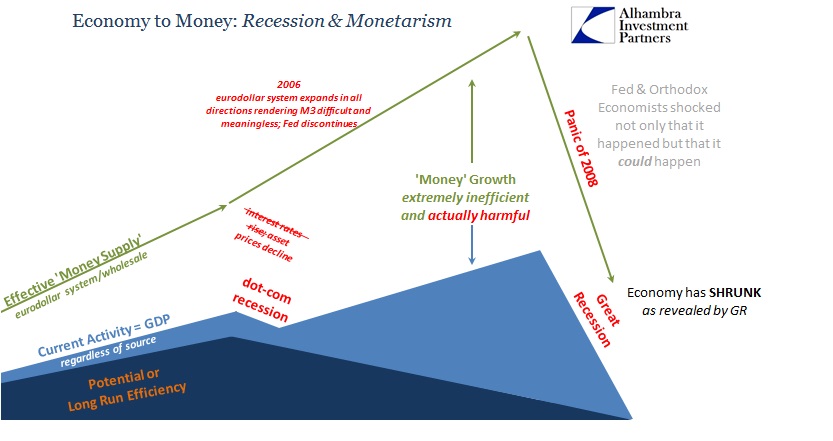
What clouds the issue of monetarism is the difference between them. The dot-com bust was just as severe and in many ways more painful (the Chinese torture of slow erosion of the first versus the much faster and immediately violent crash of the most recent) but there was no great recession with it, only mild economic discomfort. Alan Greenspan and his committee of the orthodox faithful had been given a lot of credit for “guiding” the economy through that period with minimal damage. The fact that it was “achieved” via a massive housing bubble was only later appended to the narrative as if still a backhanded acknowledgement of monetary power and authority.

Even that still gives the Federal Reserve and monetary policy too much credit. We know this for sure because both Alan Greenspan and Ben Bernanke told us; and contemporarily. In Greenspan’s words it was a “conundrum” while Bernanke posited a “global savings glut.” Both are the same interpretation of a monetary system far out of alignment with not just economics but even central bank policy. The context of both those ridiculous theories holds the dispostive interpretation – the FOMC was attempting to “tighten” monetary policy but the “conundrum” and “global savings glut” showed that the true monetary system was having none of it.

The relationship of money to economy is supposed to be robust and highly conducive as a tool for increasing efficiency. In the past, the mechanism guiding that relationship was hard money in the form of metal (gold or silver). Economists of the Progressive Age judged that unreliable and proceeded to undo as many hard money constraints as possible – giving us the Great Depression as their first step.

SABOOK Feb 2016 Never About Oil Money to Economy

While the Bretton Woods standard had lasted until 1971, in truth it had come undone as early as the late 1950’s. The US, for instance, had actually removed the gold exchange mechanism as early as 1960 in the London Gold Pool. When gold was finally banished officially, ostensibly the dollar was believed its replacement, but it wasn’t as if the global stash of “reserves” of physical Federal Reserve Notes were its basis. The dollar system that came to create global trade liquidity and finance was credit-based, a distinction that makes all the difference.

Despite that fact, very few seem to stand in appreciation of what it meant then; and fewer still now. The Fed, for one, with its monetarist orthodoxy believes that recession is everywhere unhelpful and thus tries to influence the money supply via a federal funds rate. In the dot-com bust and recession, they brought the rate down to as low as 1%; and that was almost two years after it was over. Again, that provides another clue as to whether theory matches actual conditions.

The point of recession in the first place is to temporarily deviate in order to remove inefficiency; the necessary pruning of creative destruction. In terms of money supply, under hard money systems that meant actually tighter money conditions where interest rates rose and asset prices fell. These were, like economic recession, true market forces trying to re-establish more toward the foundation baseline – to maintain that solid, “strong dollar” relationship between money and economy.

SABOOK Feb 2016 Never About Oil Money to Economy Recession

In the dot-com recession, however, stock prices declined severely but really nothing else did – as if the money supply factor had been unperturbed at all. That wasn’t as much of a difference as it might seem, given that as early as 1996 Alan Greenspan was speaking about monetary correlations gone awry. His “irrational exuberance” speech was really about that point. It was the eurodollar standard becoming a fully bloomed parallel banking system as it both supplied funding (“dollars”) and pushed credit and debt for offshore and now onshore capacities.

The Fed taking no note or concern over the eurodollar at all, aside from M3 calculating, insisted that monetary policy be driven by the consumer inflation rate as translated into economic potential via still the Phillips Curve. Thus, if consumer inflation was low, then current activity was believed at least near enough to economic “potential” no matter the other true factors.

SABOOK Feb 2016 Never About Oil Money to Economy Recession Bubbles

In reality, the active and comprehensive “money supply” was simply exploding – so much so that it barely noticed the dot-com bust and therefore produced almost nothing of the recession. It certainly did not signal the usual “tight money” conditions that accompany the more robust relationship with the economic foundation. This was the serial asset bubbles that were really larger than any single expression of them.

SABOOK Feb 2016 Never About Oil Money to Economy dot com Housing

The relationship between money supply growth and economy became truly tenuous during the housing mania of the middle 2000’s. The reason was simply that asset bubbles (inflation) are highly inefficient and so produce great imbalances in the liquidity and monetary structures that link money to economy. Banks were making money in money dealing activities based solely on the premise that the entire system could and would continue expanding on that insane baseline as if permanent; and if it were ever interrupted by recession, as 2001, then that would be a trivial and temporary deviation.

This was the outlook of not just global banking but monetary policy and orthodox economics. Thinking that consumer inflation supplied all the necessary information about the state of money as it related to economic potential, neither central banks nor economists were prepared for what hit on August 9, 2007, and everything thereafter. To monetary policy and economic theory derived from the Phillips Curve, there could not have been “too much money” and the recession should not have been very large at all. In fact, that was the scenario that every single one of their models kept suggesting deeper and deeper into it.

SABOOK Feb 2016 Never About Oil Money to Economy GR

Thus, they were wholly surprised and unprepared for not just the size and scale of deterioration money and economy, but that it could have happened at all. The decrepit recovery thereafter similarly confounds, but it reveals to the awakened monetary sense of the credit-based reserve currency a singular truth about the US and global economy: it has shrunk. It’s not that the recession in 2008 and 2009 performed that act, but more so that it revealed the destruction in economic potential from the monetary misalignment dating back a long, long time.

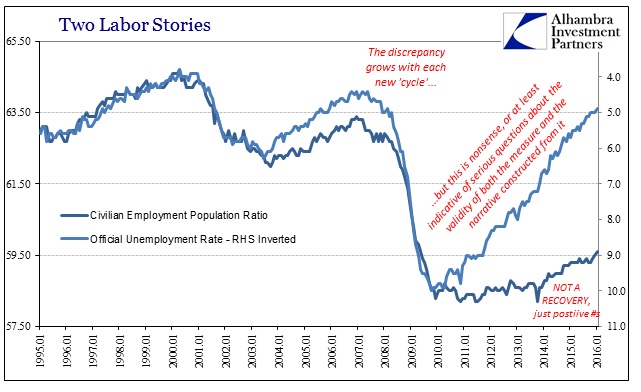
We know without doubt that is the case because you can’t simply lose 15 million potential workers and suggest anything else; only a shrunken economy would so significantly diminish in labor utilization.
SABOOK Feb 2016 Never About Oil Money to Economy GR ShrunkABOOK Feb 2016 Payrolls Unem Rate Emp Ratio Longer ABOOK Feb 2016 Payrolls Unem Rate Part Rate

In other words, even though GDP was positive and appearing somewhat like a lackluster recovery during the housing bubble, that was only masking the erosion in economic potential via what Austrian economists call malinvestment – and on a grand scale.

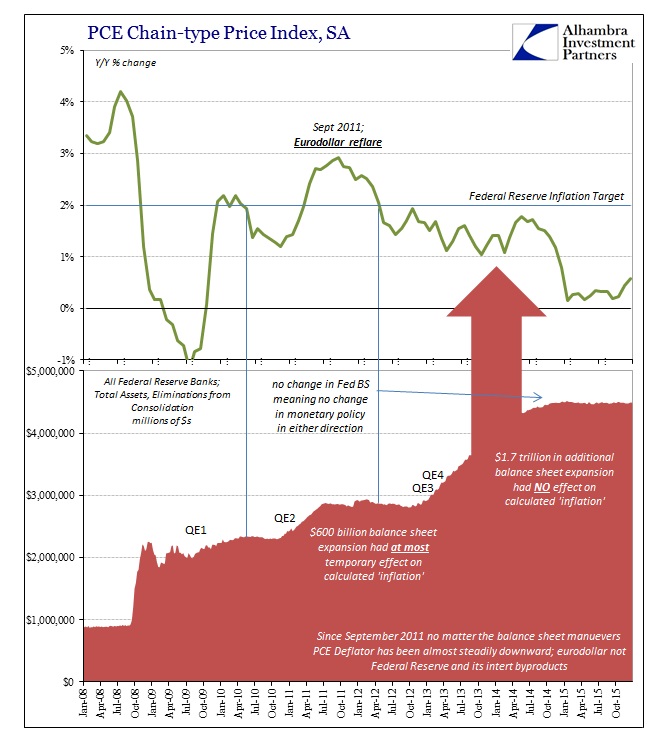
That is why central bankers responded as they did, both in terms of heavy size of intervention and the single goal of them. They thought the GR was just another cycle only far larger, therefore their task was to remove any financial or monetary impediments such that the global economy would find its way back to the 2005 baseline. It never did, nor did any of these trillions in “money printing” create much if any “inflation” which was supposed to be one of the primary mechanisms restoring full growth (as believed by orthodox economists). In fact, no matter what or how insane and ridiculous, central bank policy appears only more and more ineffective as if no matter what they do a larger and more basic dynamic supersedes all of it.

It has left us with an intermittent battle of up, down, up, down, with central banks having to repeat these massive operations over and over. And in the failure of each one they are left wondering what happened.

SABOOK Feb 2016 Never About Oil Money to Economy GR AftermathABOOK Feb 2016 PCE Deflator Fed BS

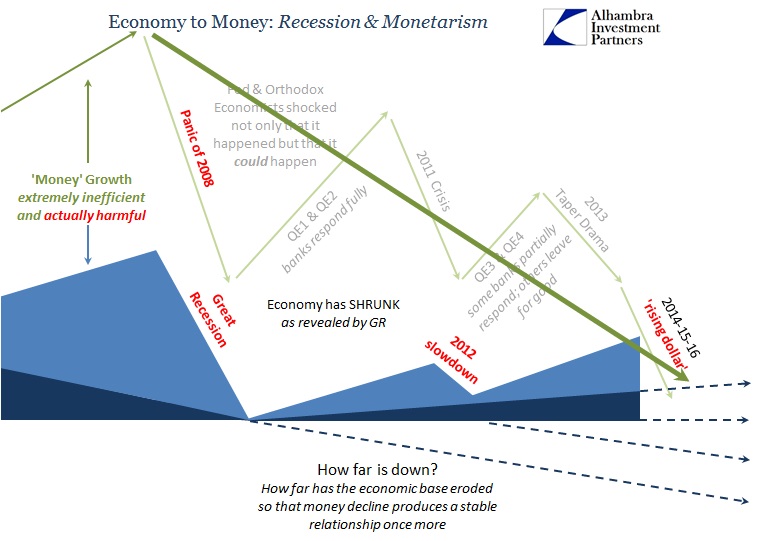
Through all of them, the economy at most responds temporarily before slumping “unexpectedly” each time. In viewing each episode narrowly as if a contained whole or even just singular factors within them, the big picture of sound money and sound economy can get lost. Focusing too much on the exact nature and structures of growing illiquidity and “deflation”, via market crashes and currency disruptions, can have the same effect. In other words, those are just the mechanisms for deeper market forces trying to resolve that primary imbalance that was left unanswered even after the Great Recession and Panic of 2008.
SABOOK Feb 2016 Never About Oil Money to Economy GR Eurodollar Decay

The money supply, for lack of a more appropriate term in the “dollar’s” universe, is in the long run converging with the shriveled economic baseline. The immediate problem for our current circumstances is that we don’t yet have any idea what that foundation might look like even now- how far is down.

What we do know is that the eurodollar system is failing and we know how it is failing. From negative swap spreads to the shrunken, depressed money and credit curves, they all spell out the death of the current standard. In that sense, “death” may be too strong a term since that isn’t necessarily the end point (I find it unlikely that the eurodollar can continue as it is, but that isn’t impossible if perhaps reduced enough to some rump resource function). Money is via market forces now almost fully stripped of its artificial nature, whatever was left of the pre-crisis expectations and orientations, leaving only that bedrock of actual potential for support however desiccated it may be now.

Oil prices, among other indications, suggest perhaps much worse than we would like on that count. As noted yesterday, money markets, too. Whatever ultimately the case, this has never been about oil prices except that they are the most visible and straddling indication between finance and economy; the money supply attempting a rebalancing in reverse of leverage that once dominated everything but no longer can fix to even slightly stable fashion. It is the representation of the structure behind the seeming cyclical.


via Zero Hedge http://ift.tt/1Sh2Mhp Tyler Durden

New Lawsuit Attempts to Fix Broken Indiana Property Forfeiture Rules

For the children! (The children of police officers)Indiana permits civil asset forfeiture, where police and prosecutors are able to seize citizens’ property if it’s connected to a crime, but it has a catch: All the money from forfeitures is supposed to go to the school system. This is according to the state’s constitution and is intended to pretty clearly avoid handing police and prosecutors a profit motive. Since they don’t get the keep the money for their departments, there’s less of an incentive to abuse the tools to try to take property and money from average citizens or to fight having to give it back if it turns out the accused are innocent.

But it turns out this system is not what is actually happening in Marion County, where Indianapolis is situated. A state law gave police and prosecutors permission to deduct law enforcement costs from these seized assets. You can probably guess what happened next. From the Indianapolis Star:

The state law in question is interpreted differently by each county. Some meticulously account for the investigative costs and send the remaining dollars to the school fund. Many do not put money into the school fund. In Marion County, forfeited funds are divided between the law enforcement agency and the prosecutor’s office, according to court records.

According to memorandums of agreement between the agencies, the prosecutor’s office gets 30 percent of forfeited funds. The remaining 70 percent goes to IMPD or to the Metro Drug Task Force, a group of officers from Marion and neighboring counties, depending on which law enforcement body is involved in an investigation. …

Indianapolis law enforcement officials say asset forfeiture is a tool that allows them to target criminal organizations, and forfeited funds are a small portion of their budgets but are an important source of revenue to train officers and purchase vehicles and equipment. The Metro Drug Task Force in Indianapolis, for instance, is funded almost entirely by forfeited dollars. In an earlier interview with IndyStar, Curry said his agency uses the money to pay for the salary and benefits of deputy prosecutors who specialize in forfeiture cases.

Officials also say forfeited funds do not fully cover their investigative costs.

If you give police permission to deduct their expenses, then they are going to expense as much as they can, aren’t they? This isn’t new, and it’s a known problem in Indiana. Former Reason editor Radley Balko highlighted Indiana law enforcement agencies’ dreadful abuse of asset forfeiture tools all the way back in a 2010 issue of Reason magazine.

Today the civil forfeiture-fighting lawyers of the Institute for Justice have stepped in. They are representing Jack and Jeanna Horner, who had two of their vehicles seized after police suspected their son, who was borrowing the vehicles, of using them to transport marijuana. The Horners were never charged with a crime (and the case against the son failed) but fought for months to get their property back.

The Institute for Justice is arguing that the law that’s allowing the police to keep the money is a violation of Indiana’s constitution and must be struck down:

For far too long, police and prosecutors in Indianapolis have been keeping 100 percent of forfeiture proceeds for themselves. The constitution couldn’t be clearer—”all forfeitures” belong to the schools—yet the Indiana school fund hasn’t seen a penny of forfeiture money from Indiana’s capital since before some current students were even born. Meanwhile, police and prosecutors are siphoning off millions of dollars in civil forfeiture proceeds, violating both the Indiana Constitution and the state’s Civil Forfeiture Statute and fueling an increasingly aggressive forfeiture machine.

It’s a bit of an unusual angle compared to other fights against civil asset forfeiture. Typically activists are trying to end the practice entirely as a blatant Fourth Amendment violation. In this case, they’re just trying to make sure Indiana law enforcement officials follow the state’s constitution.That matters because the state’s constitution so thoroughly defeats the profit motive for forfeiture that it would essentially be “reform” if the rules were followed properly.

Read more about the case here.

from Hit & Run http://ift.tt/20M2P9E
via IFTTT

Tasers Are Bad For Your Brain, Especially When Being Interrogated By Police

The first independent randomized clinical trial Tasers are bad for your brain.of the effects of tasers on human beings’ cognitive functioning has revealed the not-so-shocking news that 50,000 volts to the nervous system significantly hampers brain functions like memory and comprehension.

In some cases, the results were “comparable to dementia,” which makes police interrogations of suspects shortly after they’ve been tased highly questionable. If a person is experiencing a trauma akin to dementia, can they really understand what “the right to remain silent” is? 

A joint study by Arizona State University and Drexel University titled, “TASER Exposure and Cognitive Impairment: Implications for Valid Miranda Waivers and the Timing of Police Custodial Interrogations,” published in Criminology & Public Policy, put 142 healthy, “high-functioning,” and sober participants through a series of tests intended to determine the physical, mental, and emotional effects of being tased. The report concluded that “Taser exposure caused statistically significant reductions in verbal learning and memory” and that the effects of such exposure lasted about an hour. 

The carefully screened subjects of these tests were almost certainly operating in a more optimal physical and mental state than the average person likely to encounter a police taser. The report notes that more typical examples of tased individuals “may be high, drunk or mentally ill and in crisis,” which would cause “even greater impairment to cognitive functioning” and make them less likely to understand the rights enumerated in the Miranda statement.  

One of the authors of the report, Robert J. Kane, PhD, explains:

If suspects are cognitively impaired after being Tased, when should police begin asking them questions? There are plenty of people in prison who were tased and then immediately questioned. Were they intellectually capable of giving ‘knowing’ and ‘valid’ waivers of their Miranda rights before being subjected to a police interrogation? We felt we had moral imperative to fully understand the Tasers’ potential impact on decision-making faculties in order to protect individuals’ due process rights.

You can read more Reason coverage of Tasers here, and also check out my recent interview with Nick Berardini, director of the documentary Killing Them Safely, the first feature-length exploration of TASER International and its eponymous product.

Reason TV’s Paul Detrick covered the lethality of Tasers in a 2012 doc, which you can below.

from Hit & Run http://ift.tt/1oszK1X
via IFTTT

Bernie Sanders Is Clearly Capturing Part of the Ron Paul Student Vote

SandersLast night’s big win for Bernie Sanders was partly fueled by his utter dominance of the under-30 crowd. As I argued in a short piece for CNN, Sanders’ popularity among students is reminiscent of Ron Paul’s successes in 2008 and 2012:

Sanders seems even more wildly popular among young voters than Barack Obama was in 2008.

He’s likely capturing some of the non-interventionist, libertarian-leaning college-aged people who last time around would have supported Ron Paul — another septuagenarian white man with a radical streak and surprising youth cred.

Now that there isn’t anyone named Paul in the race (RIP: Rand, who failed to inspire as much devotion as his father), there’s no obvious inheritor of the libertarian vote, which is split among several imperfect candidates — including avowed socialist Sanders.

Read the rest here.

[Related: Bernie Sanders and Donald Trump Win New Hampshire. That’s a Rebuke to the Status Quo.]

from Hit & Run http://ift.tt/1QWciDo
via IFTTT

“Buy High, Sell Low” – The Psychology Of Loss

Submitted by Lance Roberts via RealInvestmentAdvice.com,

In this past weekend’s newsletter, I discussed the formation of a very important “head and shoulders” topping pattern in the market.

I know…I know. As soon as I wrote that I could almost hear the cries of the “perma-bull” crowd exclaiming “how many times have we heard that before.” 

They would be right. The problem with the majority of technical analysis, in my opinion, is that time frames are too short for most investors. When looking at technical price patterns using daily data, there have been numerous occasions where analysts have spotted “Head and Shoulder” patterns, “Hindenberg Omens,” and Puppy Monkey Baby patterns that have failed to predict a market downturn.

Of course, like “crying wolf,” when these patterns and prognostications fail they are summarily dismissed as being wrong, or just “mumbo jumbo.” As I stated above, the problem is the “duration mismatch” between most technical analysis, which is typically very short-term (minute, hourly, daily), and the outlook for investors which is in years. 

As a portfolio manager, what is important for me is the understand the longer-term “TREND” of market prices. By looking at weekly and monthly data, the trend of prices is revealed allowing for a better match between portfolio goals and related market risks.

During “bull markets,” prices are in a steady advance with corrections to the longer-term bullish trend presenting buying opportunities. When prices become extended from the trend, such deviations provide opportunities to take profits and rebalance portfolios.

Conversely, during “bear markets,” prices are in a steady decline with corrections to the longer-term bearish trend presenting selling, hedging and shorting opportunities. When prices become extended away from the bearish trend, such deviations should be used to take profits in short positions and portfolio hedges.

This idea is shown in the chart below.

SP500-Trends-Tops-020916

By using a 72-month (6-year) moving average, the longer-term trend of prices is more clearly revealed. As stated, corrections to the longer-term trend during bull markets were buying opportunities, whereas during bear markets they were selling/shorting opportunities.

VERY IMPORTANTLY – note that at the peak of the previous two markets the change from the bullish to bearish trend was denoted by the following price action:

  1. A break of the long-term moving average
  2. A rally back to the long-term moving
  3. A failure and a move lower in price than the most recent bottom.

This has now occurred with the last break in price lows for only the third time since the turn of the century.

This also takes me back to this past weekend’s newsletter where I discussed the potential completion of the “head and shoulders” topping process. To wit:

“The good news, if you want to call it that, is that the market is currently holding above the recent lows as short-term oversold conditions once again approach. It is critically important that the market holds above that support, which is also the neckline of the current “head and shoulders” formation, as a break would lead to a more substantive decline.”

SP500-Chart2-020516

“However, this isn’t the first time that we have seen a “head and shoulders” topping pattern COMBINED with a long-term major sell signal as shown above. I emphasize this point because many short-term technicians point out“head and shoulders” formations that consistently do not lead to more important declines. However, when this topping process combines with enough deterioration in the markets to issue long-term “sell signals,” it is something worth paying attention to.


The first chart shows the same development in 2000.”

SP500-Chart2000-020516

“And again in 2007.”

SP500-Chart2007-020516

“These are the only two points since the turn of the century where a topping process was combined with a long-term sell signal.”

Importantly, no matter how we look at longer-term data, all of the messages are the same – the bull market that began in 2009 is over – for now. 

3 Consecutive Negative Months & Bear Markets

Let’s take a look at another “warning flag” that is currently being waived. The S&P 500 was negative in both December and January which, according to historical statistics already suggest that 2016 will be a weak performance year. However, with February already sporting a pretty healthy decline to start the month, what does history suggest about the potential for 3-negative consecutive months.

Using the data provided by Dr. Robert Shiller, I took at look at the inflation-adjusted monthly return of the S&P 500 going back to 1900 as shown below.

SP500-3-ConsecutiveNegativeMonths-020916

I have highlighted recessions in gold and 3-or more consecutive negative return months in blue.

Interestingly, 3-consecutive negative months is not a rarity. Since 1900, there have been 87-periods of 3-OR MORE consecutive negative months. Not surprisingly, most of them occurred either during recessionary periods or bear markets. 

With the markets currently once again oversold, a bounce in the markets will not be surprising. However, for now, those bounces should be used to reduce risk, raise cash and hedge portfolios against further declines. That is, unless and until, the trend is changed back to positive. 

The Psychology Of Loss

Recently, I wrote an article about the fallacies of “buy and hold” investing which received a good bit of push back from the community of advisors who tout that the only way to invest is to buy low-cost ETF’s and hold them long-term. As I penned:

The “power of compounding” ONLY WORKS when you do not lose money.


Emotions and investment decisions are very poor bedfellows. Unfortunately, the majority of investors make emotional decisions because, in reality, very FEW actually have a well-thought-out investment plan including the advisors they work with. Retail investors generally buy an off-the-shelf portfolio allocation model that is heavily weighted in equities under the illusion that over a long enough period of time they will somehow make money. Unfortunately, history has been a brutal teacher about the value of risk management.”

I bring this up because of an email I received from a client of Betterment, the widely touted and praised Robo-advisor.

“My portfolio is down 35% from May of last year and is with a moderate risk profile. “

Betterment-Performance-020816

“Here is the message they gave me to keep me from leaving:


‘Amongst all the edicts investors should heed, one stands out above all others: It’s time in the market that builds returns, not market timing.

We’ve illustrated this rule with one of the longest-running index data sets available: the daily returns of the S&P 500 from Jan. 2, 1928, through 2014. You can explore the difference that a few years makes by changing the slider or pressing the play button. The interactive presents the distribution of returns an investor would have received for an investment of $100 for a given holding period in the S&P 500.'”

Betterment-BuyandHoldAnalysis-020916

“From 1928 to 2014 there were 21,502 possible holding periods that lasted 12 months (e.g., Jan. 2, 1928, to Jan. 2, 1929; Jan. 3, 1928, to Jan. 3, 1929, etc.). Of those 21,502 holding periods, 74% resulted in positive returns with a median return of $13 on a $100 investment. On the other end of the slider, there were 18,730 possible holding periods that lasted 12 years. The returns for these holding periods were more widely dispersed and overwhelmingly positive, with a median return of $240 on a $100 investment.”

There are several problems that the investor currently faces with Betterment:

  1. In order to make up a 35% loss, it will require a nearly 55% return from the market. Given an average rate of return of 8% annually, it will only take a little more than 5 years to get back to even. 
  2. That is 5-years lost toward reaching this particular individual’s retirement goals.
  3. While Betterment’s message to stay in for the long-term certainly sounds good, the reality is most individuals will not live long enough to achieve the long-term average rate of return.
  4. As with this individual, the most important problem that Betterment will now face with investors – is the loss of confidence and the emotional impact of loss.

Despite all of the arm waving and pounding on the table by advisors touting long-term average returns, time-in-the-market, etc., the psychological impact of loss is all too real. While “buy and hold” investing has its appeal during bullish trending markets, the impact of loss on individuals is a far greater emotional pull. This is why investors tend to do everything backwards by “buying high” (greed) and “selling low” (fear).

This is why managing “risk” always “wins” over the long-term by reducing the emotional pull to “do something” at precisely the wrong time.

For clients of robo-advisors, the reality of loss will be more than most can stomach and sentiments of “time in the market” will go mostly unheeded. This is, of course, why many of the coveted millennial investors have already rejected much of the Wall Street rhetoric after watching the devastation that wrecked their parents over the last 15 years.

You can do better.


via Zero Hedge http://ift.tt/20M0dJ2 Tyler Durden

WTI Crude Plunges To New Cycle Lows As Energy Credit Risk Hits Record Highs

The on-the-run WTI crude futures price just plunged to $27.27 (for the March contract) which is a new cycle low for black gold (below March’s previous “This is the low” lows in January.) It should not be entirely surprising since US Energy credit risk has spiked once again to new record highs.

Oil hits new cycle lows…


As even investment grade emergy credit risk spikes to record highs…


The real swarm of bankruptcies has yet to begin but CHK will be the first biggest test.


via Zero Hedge http://ift.tt/20M0dsx Tyler Durden

Something Unexpected Happened When A Distressed Credit Fund Tried To Liquidate

Ever since the unexpected gating and liquidation of Third Avenue’s credit fund in early December, there has been a jump in comparable credit money managers, both of the mutual and hedge fund variety, such as Claren Road and Stone Lion Capital, who have decided they’d rather hand in the keys and repay their investors (at a loss) than try to eek out alpha in an environment where, as Richard Breslow put it earlier, “it feels like the algos are hooked up to Tinder.”

It is also clear that as long as both IG and HY continue to bleed, the liquidations will continue: just this Monday in his latest fire and brimstone sermon, Jeff Gundlach told Reuters that more “credit fund bankruptcies are coming.” Sure enough they are, and as HF Alert reported today, the latest hedge fund to liquidate is London-based Warwick Capital, which was founded in 2010 by former Polygon executives Ian Burgess and Alfredo Mattera and which according to its website had $900 million in AUM most recently.

As HFA writes, the London firm began liquidating its Warwick European Distressed & Special Situations Credit Fund in May after investors submitted redemption requests amounting to 90% of the fund’s assets, and yet, nearly a year later limited partners have yet to get all of their money back, or even a majority of it.

Because something unexpected happened: “the problem” as HFA writes, is that “the fund’s remaining assets — encompassing debt and equity positions in Fitness First, New Gulf Resources, Oasis Holdings and Punch Taverns — are too illiquid to be sold right away.”

This is what the fund said:

“In the final quarter of 2015, the funds experienced a substantial increase in volatility in the credit markets, primarily due to market concerns over global growth, the collapse in oil and other commodity prices and the illiquidity experienced by certain credit funds,” Warwick director Ralph Woodford wrote in a Feb. 5 letter to investors. “As a consequence, there was little or no liquidity in the markets for the fund’s remaining positions. Where liquidity was available, there was dramatic widening of the bid-offer spreads, meaning that it was not possible to sell these assets at what we considered to be their fair price.”

Actually, what HFA says is the problem is not the problem at all, because there is always a buyer for any bond – even bankrupt ones – at the right, low enough price. The real problem is that Warwick Capital had marked these bonds at ridiculously high levels and had refused to mark them lower to follow market prices. As a result, its LPs have an erroneous impression of what their true holdings are, which are based on bond prices which may never be seen again.

The result: another redemption gate, in the vein of Third Avenue:

“the bottom line: For now, limited partners will receive cash payments equal to just 57% of the fund’s net asset value on Dec. 31. The remaining assets will be transferred to a special-purpose vehicle dubbed Realising Fund, which will be unwound as market conditions permit.”

In short, a modest 10-20% correction in equity prices from all time highs, and suddenly nobody can possibly find buyers due to massive deltas between marks and markets.

Adding insult to injury, investors will pay fees equal to 1.25% of assets and 20% of profits on their stakes in Realising Fund.

Finally, what is perhaps most disturbing is that like in the case of many other liquidating credit funds, the NAV of Warwick’s European Distressed & Special Situations Credit Fund fell only 5.3% in 2014 and presumably continued to drop in 2015, but hardly too much if the management team was using such bettered-up marks that it can’t possibly find a willing buyer anywhere close to its marks.

As HFA concludes, “how much money remains in the Warwick vehicle is unclear. Warwick pegged the fund’s assets at $340 million last May. But at the time, investors representing perhaps 30% of the fund’s capital expressed interest in transferring their money to Warwick European Credit Opportunities Fund, a private equity-like vehicle that locks up capital for at least four years.”

Or that may be just more fabrications by the fund’s management team in hopes of buying some more time, time which will force central banks into reflating asset values once again, and Warwick will luck out and can sell at higher prices.

It may not be so lucky.

And so, as another hedge fund gates, we wonder, as we did back in December, just how many other funds are artificially inflating marks on largely OTC instruments like junk bonds, to avoid a panic among the LPs and prevent a redemption scramble; one thing is certain – the longer junk and IG bond prices drift lower, the greater the concerns of LPs around the entire asset management world, until one day the massively pent up redemption flood is unleashed.

It is only then that we will truly see what a bidless bond market looks like, and incidentally that is the catalyst Jeffrey Gundlach has been waiting for to start buying.


via Zero Hedge http://ift.tt/1o3K7JB Tyler Durden

John Kerry Makes Last Ditch Effort To Avert World War III As Saudis, Turks Prepare For Syria Invasion

Tomorrow, John Kerry will meet Sergei Lavrov and several of his other counterparts from Europe and the Mid-East in Munich in a last ditch effort to revive Syrian peace talks, which fell apart amid an intense Russian air assault on rebel positions in Aleppo.

For all intents and purposes, the rebels are surrounded. Initially, it appeared that the “moderate” opposition might be able to persist and bog down the Russians and the Iranians with the help of supplies from the US, Turkey, and Saudi Arabia. Those hopes faded over the past two weeks when Hezbollah advanced on Aleppo and ultimately encircled the city, cutting the rebels off from key supply lines and triggering a mass civilian exodus.

The talks in the Bavarian capital come at what is perhaps the most crucial point in the conflict to date. With the opposition on the ropes, it’s do or die time for Riyadh, Ankara, Doha, and the UAE. Either the Gulf monarchies send in ground troops to shore up the rebels or Hezbollah and the IRGC will overrun them in a matter of weeks – or perhaps even days.

Of course the opposition’s Sunni benefactors can’t exactly say they’re going into Syria to fight Iran and the Russians. Any ground incursion will be justified by the need to “fight ISIS” even though the Islamic State presence in Aleppo is markedly less pronounced than in other besieged urban centers like Raqqa and Deir ez-Zor. Indeed, the effort is so transparent that even the mainstream media has been forced to acknowledge it. Here’s FT, for instance:

Saudi Arabia is discussing plans to deploy ground troops with regional allies, including Turkey, for a safe zone in Syria, in a last-ditch effort to keep alive a rebellion at risk of collapse as a Russian-backed offensive by Syrian regime forces encroaches on the northern province of Aleppo.


Although western officials have dismissed the plans as lacking credibility, they are a sign of the desperation that many of Syria’s opposition backers feel towards what looks like an increasingly bleak outcome in the war. Two people familiar with Saudi plans told the Financial Times that high-ranking Gulf officials are in Riyadh meeting Turkish officials to discuss options for deploying ground troops to head a coalition of fighters inside Syria.


Aleppo city, Syria’s former business hub, is the last significant urban centre controlled by the rebels. Its countryside, on the northern border with Turkey, is their lifeline.


President Bashar al-Assad’s forces, bolstered by Iranian-funded Shia militias, advanced last week into opposition-held territory in Aleppo’s northern countryside under the cover of Russian air strikes. The violence prompted thousands of civilians to flee, exacerbating the already vast humanitarian crisis.


Publicly, Saudi Arabia, the UAE and Bahrain are calling for troops to be deployed as part of the US-led international coalition already ranged against Isis. This comes after Washington singled out Arab countries for not doing more to fight the Islamist group. But regional observers say the moves are cover for an intervention to help the Syrian rebels.

Of course the most absurd aspect of the “fight ISIS” narrative is that the force which is most effective at combatting Islamic State – the YPG- is under attack by Turkey. That would be the same Turkey who, like everyone else, is using ISIS to justify its intervention in Syria. “Are you our side or the side of the terrorist PYD and PKK organization?” President Recep Tayyip Erdogan asked, in a speech in Ankara to provincial officials on Wednesday. He went on to say the US has caused “a sea of blood” in Turkey by supporting the YPG in Syria. “Ankara summoned the U.S. ambassador to express its displeasure after State Department spokesman John Kirby said on Monday the United States did not regard the PYD as a terrorist organization,” Reuters notes.

As for the opposition in Aleppo, the rebels are literally begging the US to intervene. “I believe he can really stop these attacks by the Russians,” Spokesman Salim al-Muslat told Reuters, referring to President Obama. If he is willing to save our children it is really the time now to say ‘no’ to these strikes in Syria. I believe he can do it but it is really strange for us that we don’t hear this from him.”

Actually it’s not at all strange. John Kerry can’t simply “ask” Sergei Lavrov to stop the bombing in Aleppo. As he told aid workers in London over the weekend, the US can’t exactly “go to war with Russia,” which is what would be required to compel the Kremlin to halt airstrikes on rebel positions. 

The French are also skeptical of America’s ability to halt the Russian and Iranian offensive. “There are the ambiguities including among the actors of the coalition … I’m not going to repeat what I’ve said before about the main pilot of the coalition,” French Foreign Minister Laurent Fabius said. “But we don’t have the feeling that there is a very strong commitment that is there.”

Again though, it’s not a matter of “commitment.” It’s a matter of whether or not the US wants to challenge Russia and Iran militarily because as should be abundantly clear by now, this has nothing at all to do with ISIS and everything to do with what’s about to happen at Aleppo. “It’s seen as the heart of what’s left of the rebel movement in terms of holding a major city without being infested by Islamic State,” Julian Barnes-Dacey, a senior policy fellow at the European Council on Foreign Relations told Bloomberg. “If Assad can get that, then it’s hard to imagine the opposition surviving.”

Precisely. Which was the plan from the beginning. It’s not that Russia and Iran don’t want to fight Islamic State. They do. But unlike Washington and its regional allies, Moscow has never pretended that the fight in Syria is strictly about ISIS. Rather, the conflict is about putting down an insurgency that threatens to plunge yet another Mid-East country into failed state status and it’s also about drawing a line in the sand when it comes to the West’s persistent meddling in the affairs of sovereign states. The most effective way to turn the tide and end the insurgency is to recapture the country’s urban centers first, and Aleppo is crucial to that plan. Once it’s secured, they’ll be a push east to liberate Raqqa and relegate ISIS to the annals of jihadist history. 

We suppose the most important thing to understand here is this: Saudi Arabia, Turkey, and the UAE are mulling sending ground troops to fight the Russians and Iranians who are attempting to put an end to an insurgency that’s cost the lives of hundreds of thousands of Syrians. That campaign has most assuredly aggravated the violence in the short-term, but it’s an effort to restore a sense of normalcy to a country that’s seen nothing but chaos for nearly six years. Rather than let Moscow and Hezbollah finish the job, the US and its regional Sunni allies would rather send in ground troops to prop up the rebels. So please tell us: who are the bad guys and who are the good guys here? 


via Zero Hedge http://ift.tt/1nZbRhU Tyler Durden