One Ring To Rule Us All: A Global Digital Fiat Currency

One Ring To Rule Us All: A Global Digital Fiat Currency

Via SchiffGold.com,

We’ve written extensively about the “war on cash.”

In a nutshell, governments would love to do away with cash in order to better track and control their citizens. There have been numerous moves closer to a cashless society in recent years, from capping ATM withdrawals to doing away with large-denomination bills. Last year, China launched a digital yuan pilot program and the US has floated moving toward a digital dollar.

We got a first-hand look at what happens when governments restrict access to cash when India plunged into a cash crisis after the country’s government enacted a policy of demonetization in November 2016.

It’s bad enough that various countries are exploring ways to move toward cashlessness, but there’s an even worse scenario – a global digital currency.

Economist Thorsten Polleit compares it to the “master ring” in J.R.R. Tolkien’s classic Lord of the Rings.

The following article was originally published by the Mises Wire.

1.

Human history can be viewed from many angles. One of them is to see it as a struggle for power and domination, as a struggle for freedom and against oppression, as a struggle of good against evil.

That is how Karl Marx (1818–83) saw it, and Ludwig von Mises (1881–1973) judged similarly. Mises wrote:

The history of the West, from the age of the Greek Polis down to the present-day resistance to socialism, is essentially the history of the fight for liberty against the encroachments of the officeholders.

But unlike Marx, Mises recognized that human history does not follow predetermined laws of societal development but ultimately depends on ideas that drive human action.

From Mises’s point of view, human history can be understood as a battle of good ideas against bad ideas.

Ideas are good if the actions they recommend bring results that are beneficial for everyone and lead the actors to their desired goals;

At the same time, good ideas are ethically justifiable, they apply to everyone, anytime and anywhere, and ensure that people who act upon them can survive.

On the other hand, bad ideas lead to actions that do not benefit everyone, that do not cause all actors to achieve their goals and/or are unethical.

Good ideas are, for example, people accepting “mine and yours”; or entering into exchange relationships with one another voluntarily. Bad ideas are coercion, deception, embezzlement, theft.

Evil ideas are very bad ideas, ideas through which whoever puts them into practice is consciously harming others. Evil ideas are, for example, physical attacks, murder, tyranny.

2.

With Lord of the Rings, J. J. R. Tolkien (1892–1973) wrote a literary monument about the epic battle between good and evil. His fantasy novel, published in 1954, was a worldwide success, not least because of the movie trilogy, released from 2001 to 2003.

What is Lord of the Rings about? In the First Age, the deeply evil Sauron—the demon, the hideous horror, the necromancer—had rings of power made by the elven forges.

Three Rings for the Elven-kings under the sky,

Seven for the Dwarf-lords in their halls of stone,

Nine for Mortal Men doomed to die,

One for the Dark Lord on his dark throne

In the Land of Mordor where the Shadows lie.

One Ring to rule them all, One Ring to find them,

One Ring to bring them all, and in the darkness bind them.

In the Land of Mordor where the Shadows lie.

But Sauron secretly forges an additional ring into which he pours all his darkness and cruelty, and this one ring, the master ring, rules all the other rings.

When Sauron puts the master ring on his finger, he can read and control the minds of everyone wearing one of the other rings.

The elves see through the dark plan and hide their three rings. The seven rings of the dwarves also fail to subjugate their bearers. But the nine rings of men proved to be effective: Sauron enslaved nine human kings, who were to serve him.

Then, however, in the Third Age, in the battle before Mount Doom, Isildur, the eldest son of King Elendils, severed Sauron’s ring finger with a sword blow. Sauron is defeated and loses his physical form, but he survives.

Now Isildur has the ring of power, and it takes possession of him. He does not destroy the master ring when he has the opportunity, and it costs him his life. When Isildur is killed, the ring sinks to the bottom of a river and remains there for twenty-five hundred years.

Then the ring is found by Smeagol, who is captivated by its power. The ring remains with its finder for nearly five hundred years, hidden from the world.

Over time, Sauron’s power grows again, and he wants the Ring of Power back. Then the ring is found, and for sixty years, it remains in the hands of the hobbit Bilbo Baggins, a friendly, well-meaning being who does not allow himself to be seduced by the power of the One Ring.

Years later, the wizard Gandalf the Gray learns that Sauron’s rise has begun, and that the Ring of Power is held by Bilbo Baggins.

Gandalf knows that there is only one way to defeat the ring and its evil: it must be destroyed where it was created, in Mordor.

Bilbo Baggins’s nephew, Frodo Baggins, agrees to take the task upon himself. He and his companions—a total of four hobbits, two humans, a dwarf, and an elf—embark on the dangerous journey.

They endure hardship, adversity, and battles against the dark forces, and in the end, they succeed at what seemed impossible: the destruction of the ring of power in the fires of Mount Doom. Good triumphs over evil.

3.

The ring in Tolkien’s Lord of the Rings is not just a piece of forged gold. It embodies Sauron’s evil, corrupting everyone who lays hands or eyes on it, poisons their soul, and makes them willing helpers of evil.

No one can wield the cruel power of the One Ring and use it for good; no human, no dwarf, no elf.

Can an equivalent for Tolkien’s literary portrait of the evil ring be found in the here and now? Yes, I believe so, and in the following, I would like to offer you what I hope is a startling, but in any case, entertaining, interpretation.

Tolkien’s Rings of Power embody evil ideas.

The nineteen rings represent the idea that the ring bearers should have power over others and rule over them.

And the One Ring, to which all other rings are subject, embodies an even darker idea, namely that the bearer of this master ring has power over all other ring bearers and those ruled by them; that he is the sole and absolute ruler of all.

The nineteen rings symbolize the idea of establishing and maintaining a state (as we know it today), namely a state understood as a territorial, coercive monopoly with the ultimate power of decision-making over all conflicts.

However, the One Ring of power stands for the particularly evil idea of creating a state of states, a world government, a world state; and the creation of a single world fiat currency controlled by the states would pave the way toward this outcome.

4.

To explain this, let us begin with the state as we know it today. The state is the idea of the rule of one over the other.

This is how the German economist, sociologist, and doctor Franz Oppenheimer (1864–1946) sees it:

The state … is a social institution, forced by a victorious group of men on a defeated group, with the sole purpose of regulating the dominion of the victorious group over the vanquished and securing itself against revolt from within and attacks from abroad…. This dominion had no other purpose than the economic exploitation of the vanquished by the victors.

Joseph Stalin (1878–1953) defined the state quite similarly:

The state is a machine in the hands of the ruling class to suppress the resistance of its class opponents.

The modern state in the Western world no longer uses coercion and violence as obviously as many of its predecessors.

But it, too, is, of course, built on coercion and violence, asserts itself through them, and most importantly, it divides society into a class of the rulers and a class of the ruled.

How does the state manage to create and maintain such a two-class society of rulers and ruled?

In Tolkien’s Lord of the Rings, nine men, all of them kings, wished to wield power, and so they became bearers of the rings, and because of that, they were inescapably bound to Sauron’s One Ring of power.

This is quite similar to the idea of the state. To seize, maintain, and expand power, the state seduces its followers to do what is necessary, to resort to all sorts of techniques: propaganda, carrot and stick, fear, and even terror.

The state lets the people know that it is good, indispensable, inevitable. Without it, the state whispers, a civilized coexistence of people would not be possible.

Most people succumb to this kind of propaganda, and the state gets carte blanche to effectively infiltrate all economic and societal matters—kindergarten, school, university, transport, media, health, pensions, law, security, money and credit, the environment—and thereby gains power.

The state rewards its followers with jobs, rewarding business contracts, and transfer payments. Those who resist will end up in prison or lose their livelihood or even their lives.

The state spreads fear and terror to make people compliant—as people who are afraid are easy to control, especially if they have been led to believe that the state will protect them against any evil.

Lately, the topics of climate change and coronavirus have been used for fear-mongering, primarily by the state, which is skillfully using them to increase its omnipotence: it destroys the economy and jobs, makes many people financially dependent on it, clamps down on civil and entrepreneurial freedoms.

However, it is of the utmost importance for the state to win the battle of ideas and be the authority to say what are good ideas and what are bad ideas.

Because it is ideas that determine people’s actions.

The task of winning over the general public for the state traditionally falls to the so-called intellectuals—the people whose opinions are widely heard, such as teachers, doctors, university professors, researchers, actors, comedians, musicians, writers, journalists, and others.

The state provides a critical number of them with income, influence, prestige, and status in a variety of ways—which most of them would not have been able to achieve without the state. In gratitude for this, the intellectuals spread the message that the state is good, indispensable, inevitable.

Among the intellectuals, there tend to be quite a few who willingly submit to the rings of power, helping—consciously or unconsciouslyto bring their fellow men and women under the spell of the rings or simply to walk over, subjugate, dominate them.

Anyone who thinks that the state (as we know it today) is acceptable, a justifiable solution, as long as it does not exceed certain power limits, is seriously mistaken.

Just as the One Ring of power tries to find its way back to its lord and master, an initially limited state inevitably strives towards its logical endpoint: absolute power.

The state (as we know it today) is pushing for expansion both internally and externally. This is a well-known fact derived from the logic of human action.

George Orwell put it succinctly: “The object of power is power.”  Or, as Hans-Hermann Hoppe nails it, “[E]very minimal government has the inherent tendency to become a maximal government.”

Inwardly, the state is expanding through all sorts of interventions in economic and social life, through regulations, ordinances, laws, and taxes.

Outwardly, the economically and militarily strongest state will seek to expand its sphere of influence. In the most primitive form, this happens through aggressive campaigns of conquest and war, in a more sophisticated form, by pursuing political ideological supremacy.

In recent decades the latter has taken the form of democratic socialism. To put it casually, democratic socialism means allowing and doing what the majority wants.

Under democratic socialism, private property is formally upheld, but it is declared that no one is the rightful owner of 100 percent of the income from their property.

People no longer strive for freedom from being ruled but rather to participate in the rule. The result is not people pushing back the state, but rather coming to terms and cooperating with it.

The practical consequence of democratic socialism is interventionism: the state intervenes in the economy and society on a case-by-case basis to gradually make socialist ideals a reality.

All societies of the Western world have embraced democratic socialism, some with more authority than others, and all of them use interventionism. Seen in this light, all Western states are now acting in concert.

What they also have in common is their disdain for competition, because competition sets undesirable limits to the state’s expansive nature.

Therefore, larger states often form a cartel. Smaller, less powerful states are compelled to join—and if they refuse, they will suffer political and economic disadvantages.

But the cartel of states is only an intermediate step. The logical endpoint that democratic socialism is striving for is the creation of a central authority, something like a world government, a world state.

5.

In Tolkien’s Lord of the Rings, the One Ring, the ring of power, embodies this very dark idea: to rule them all, to create a world state.

To get closer to this goal, democracy (as we understand it today) is proving to be an ideal trailblazer, and that’s most likely the reason why it is praised to the skies by socialists.

Sooner or later, a democracy will mutate into an oligarchy, as the German-Italian sociologist Robert Michels pointed out in 1911.

According to Michels, parties emerge in democracies. These parties are organizations that need strict leadership, which is handed to the most power-hungry, ruthless people. They will represent the party elite.

The party elite can break away from the will of the party members and pursue their own goals and agendas. For example, they can form coalitions or cartels with elites of other parties.

As a result, there will be an oligarchization of democracy, in which the elected party elites or the cartel of the party elites will be the kings of the castle. It is not the voters who will call the tune but oligarchic elites that will rule over the voters.

The oligarchization of democracy will not only afflict individual states but will also affect the international relations of democracies.

Oligarchical elites from different countries will join together and strengthen each other, primarily by creating supranational institutions.

Democratic socialism evolves into “political globalism”: the idea that people should not be allowed to shape their own destiny in a system of free markets but that it should be assigned and directed by a global central authority.

The One Ring of power drives those who have already been seduced by the common rings to long for absolute power, to elevate themselves above the rest of humanity. Who comes to mind?

Well, various politicians, high-level bureaucrats, court intellectuals, representatives of big banking, big business, Big Pharma and Big Tech and, of course, big media—together they are often called the “Davos elite” or the “establishment.”

Whether it is about combating financial and economic crises, climate change, or viral diseases—the one ring of power ensures that supranational, state-orchestrated solutions are propagated; that centralization is placed above decentralization; that the state, not the free market, is empowered.

Calls for the “new world order,” the “Great Transformation,” the “Great Reset” are the results of this poisonous mindset inspired by the one ring of power.

National borders are called into question, property is relativized or declared dispensable, and even a merging of people’s physical, digital, and biological identities—transhumanism—is declared the goal of the self-empowered globalist establishment.

But how can political globalism be promoted at a time when there are (still) social democratic nation-states that insist on their independence? And where people are separated by different languages, values, and religions?

How do the political globalists get closer to their badly desired end of world domination, their world state?

6.

Sauron is the undisputed tyrant and dictator in his realm of darkness. He operates something like a command economy, forcing his subjects to clear forests, build military equipment, and breed Orcs.

There are neither markets nor money in Sauron’s sinister kingdom. Sauron takes whatever he wants; he has overcome exchange and money, so to speak.

Today’s state is not quite that powerful, and it finds itself in economies characterized by property, division of labor, and monetary exchange.

The state wants to control money—because this is one of the most effective ways to gain ultimate power.

To this end, the modern state has already acquired the monopoly of money production; and it has replaced gold with its own fiat money.

Over time, fiat money destroys the free market system and thus the free society. Ludwig von Mises saw this as early 1912. He wrote:

It would be a mistake to assume that the modern organization of exchange is bound to continue to exist. It carries within itself the germ of its own destruction; the development of the fiduciary medium must necessarily lead to its breakdown. (6)

Indeed, fiat money not only causes inflation, economic crises, and an unsocial redistribution of income and wealth. Above all, it is a growth elixir for the state, making it ever larger and more powerful at the expense of the freedom of its citizens and entrepreneurs.

Against this backdrop, it should be quite understandable why the political globalists see creating a single world currency as an important step toward seizing absolute power.

In Europe, what the political globalists want “on a large scale” has already been achieved “on a small scale”: merging many national currencies into one.

In 1999, eleven European nation-states gave up their currencies and merged them into a single currency, the euro, which is produced by a supranational authority, the European Central Bank.

The creation of the euro provides the blueprint by which the world’s major currencies can be converted into a single world currency.

This is what the 1999 Canadian Nobel laureate in economics, Robert Mundell, recommends:

Fixing the exchange rates between the US dollar, the euro, the Chinese renminbi, the Japanese yen, and the British pound against each other and also fixing them against a new unit of account, the INTOR. And hocus pocus: here is the world fiat currency, controlled by a cartel of central banks or a world central bank.

7.

Admittedly, creating a single world fiat currency seems to have little chance of being realized at first glance. But maybe at second glance.

First of all, there is a good economic reason for having a single world currency: if all people do business with the same money, the productive power of money is optimized. From an economic standpoint, the optimal number of monies in the world is one.

What is more, nation-states have the monopoly of money within their respective territory, and since they all adhere to democratic socialism, they also have an interest in ensuring that there is no currency competition—not even between different state fiat currencies. This makes them susceptible to the idea of reducing the pluralism of currencies.

Furthermore, one should not misinterpret the so-called rivalry between the big states such as the US and China and between China and Europe, which is being discussed in the mainstream media on a regular basis.

No doubt that there is a rivalry between the national rulers: they do not want to give up the power they have gained in their respective countries; they want to become even more powerful.

But the rivalry between the oligarchic democracies of the West has already weakened significantly, and there are great incentives for the oligarchic party elites to work together across borders.

In fact, it is the oligarchization of democracy in the Western world that allowed for the rapprochement with a socialist-communist regime: the state increasingly taking control of the economic and societal system.

This development could be called “the Chinacization of the West.”

The way the Western world has dealt with the coronavirus—the suspension, perhaps the termination of constitutional rights and freedoms—undoubtedly shows where the journey is headed: to the authoritarian state that is beyond the control of the people—as is the case in Communist China. The proper slogan for this might be “One System, Many Countries.”

Is it too farfetched to assume that the Western world will make common cause with Communist China not only on health issues but also on the world currency issue? The democratic socialists in the West and the Chinese Communist Party have a great deal of common ground and common interest, I would think.

It is certainly no coincidence that China has pushed hard for the Chinese renminbi to be included in the International Monetary Fund’s special drawing rights, and that the IMF already agreed in November 2015.

8.

The issue of digital central bank money, something the world’s major central banks are working on, could be a catalyst in the creation of a single world currency.

The issue of digital central bank money not only heralds the end of cash—the anonymous payment option for citizens and entrepreneurs.

Once people start using digital central bank money, it will be easy for the central bank and the state to spy on people’s transactions.

The state will not only know who pays what, when, where, and what for. It will also be in a position to determine who gets access to the deposits: who gets them and who doesn’t.

China is blazing the trail with its “social credit system”: behavior conforming to the Communist regime is rewarded, behavior that does not is punished.

Against this backdrop, digital central bank money would be particularly effective at stifling unwanted political opposition.

Digital central bank money will not only replace cash, but it will also increasingly compete with money from commercial banks.

Why should you keep your money with banks that are exposed to the risk of default when you can keep it safe with the central bank that never goes bankrupt?

Once commercial bank deposits can be exchanged one to one for digital central bank money—and this is to be expected—the credit and monetary system is de facto fully nationalized.

Because under these conditions, the central bank transfers its unlimited solvency to the commercial banking sector.

This completely deprives the financial markets of their function of determining the cost of capital—and the state-planned economy becomes a reality.

In fact, this is the type of command and control economy that emerged in National Socialist Germany in the 1930s. The state formally retained ownership of the means of production.

But with commands, prohibitions, laws, taxes, and control, the state determines who is allowed to produce what, when, and under what conditions, and who is allowed to consume what, when, and how much.

In such a command and control economy, it is quite conceivable that the form of money production will change—away from money creation through lending toward the issue of helicopter money.

The central bank determines who gets how much new money and when. The amount of money in people’s bank accounts no longer reflects their economic success. From now on, it is the result of arbitrary political decisions by the central banks, i.e., the rulers.

The prospect of being supplied with new money by the state and its central bank—that is, receiving an unconditional basic income—will presumably drive hosts of people into the arms of the state and bring any resistance to its machinations to a shrieking halt.

9.

Will the people, the general public, really subscribe to all of this?

Well, government-sponsored economists, in particular, will do their very best to inform us about the benefits of having a globally coordinated monetary policy; that stabilizing the exchange rates between national currencies is beneficial; that if a supranational controlled currency—with the name INTOR or GLOBAL—is created, we will achieve the best of all worlds. And as the issuance of digital central bank money has shut down the last remnants of a free capital market, the merging of different national currencies into one will be relatively easy.

The single world currency creature that the political globalists want to create will be a fiat money, certainly not a commodity money.

Such a single world fiat currency will not only suffer from all the economic and ethical defects which weigh on national fiat currencies.

It will also exacerbate and exponentiate the damages a national fiat currency causes. The door to a high inflation policy would be pushed wide open—as nobody could escape the inflationary single world fiat currency.

The states are the main beneficiaries: they can get money from the world central bank at any time, provided they adhere to the rules set out by the world central bank and the special interest groups that govern it.

This creates the incentive for national states to relinquish sovereignty rights and to submit to supranational rules—for example, in taxation and financial market regulation.

It is therefore the incentive resulting from a single world currency that paves the way toward a world government and a world state.

In this context, please note what happened in the euro area: the starting point was not the creation of the EU superstate, which was to be followed by the introduction of the euro. It was exactly the opposite: the euro was introduced to overcome national sovereignty and ultimately establish the United Nations of Europe.

One has good reason to fear that the idea of issuing a world fiat currency—which the master ring relentlessly pushes for—would bring totalitarianism—that would most likely dwarf the regimes established by Joseph Stalin, Adolf Hitler, Mao Zedong, Pol Pot, and other criminals.

10.

In Tolkien’s Lord of the Rings, evil is eventually defeated. The story has a happy ending. Will it be that easy in our world?

The ideas of having a state (as we know it today), of tolerating it, of cooperating with it, of giving the state total control over our money, of accepting fiat money, are deeply rooted in people’s minds as good ideas.

Where are the forces supposed to come from that will enlighten people about the evil that the state (as we know it today) brings to humanity?

Particularly when in kindergartens, schools, and universities—which are all in the hands of the state—the teachings of collectivism-socialism-Marxism are systematically drummed into people’s (especially impressionable children’s) heads, when the teachings of freedom, free market and free society, and capitalism are hardly or not at all imparted to the younger generation?

Who will explain to people the uncomfortable truth that even a minimal state will become a maximal state? That states’ monopolies over money will lead to a single world currency and thus world tyranny?

It does not take much to become bleak when it comes to the future of the free economic and social order.

However, it would be rather shortsighted to get pessimistic.

Those who believe in Jesus Christ can trust that God will not fail them. If we cannot think of a solution to the problems at hand, the believers can trust God. Because “[e]ven in the darkest night, there is a bright light shining somewhere.”

Or: please remember the Enlightenment movement in the eighteenth century. At that time, the Prussian philosopher Immanuel Kant explained the “unheard of” to the people, namely that there is such a thing as “autonomy of reason.”

It means that you and I have the indisputable right to lead our lives independently; that we should handle it according to self-imposed rules, rules that we determine ourselves based on good reason.

People back then understood Kant’s message. Why should such an intellectual revolution—triggered by the writings and words of a free thinker—not be able to repeat itself in the future?

Or: the fact that people have not yet learned from bad experience does not mean that they won’t eventually learn from it.

When it comes to thinking about changes for the better, it is important to note that it is not the mass of people that matters, but the individual.

Applied to the conditions in today’s world, among those thinkers who can defeat evil and help the good make a breakthrough are Ludwig von Mises, Murray Rothbard, and Hans-Hermann Hoppe—and all those following their teachings and fearlessly disseminating them—as scholars or as fans.

They are—in terms of Tolkien’s Lord of the Rings—the companions. They give us the intellectual firepower and the courage to fight and defeat evil.

I don’t know if Ludwig von Mises knew Tolkien’s Lord of the Rings. But he was certainly well aware of the struggle between good and evil that continues throughout human history.

In fact, the knowledge of this struggle shaped Mises’s maxim of life, which he took from the verse of the Roman poet Virgil (70 to 19 BC):

“Tu ne cede malis, sed contra audentior ito,” which means “Do not give in to evil but proceed ever more boldly against it.”

I want to close my interpretation with a quote from Samwise Gamgee, the loyal friend and companion of Frodo Baggins.

In a really hopeless situation, Sam says to Frodo: “There is something good in this world, Mr. Frodo. And it’s worth fighting for.”

So if we want to fight for the good in this world, we know what we have to do: we have to fight for property and freedom and against the darkness that the state (as we know it today) wishes to bring upon us, especially with its fiat money.

In fact, we must fight steadfastly for a society of property and freedom!

Tyler Durden
Sat, 10/09/2021 – 22:00

via ZeroHedge News https://ift.tt/2YCwJni Tyler Durden
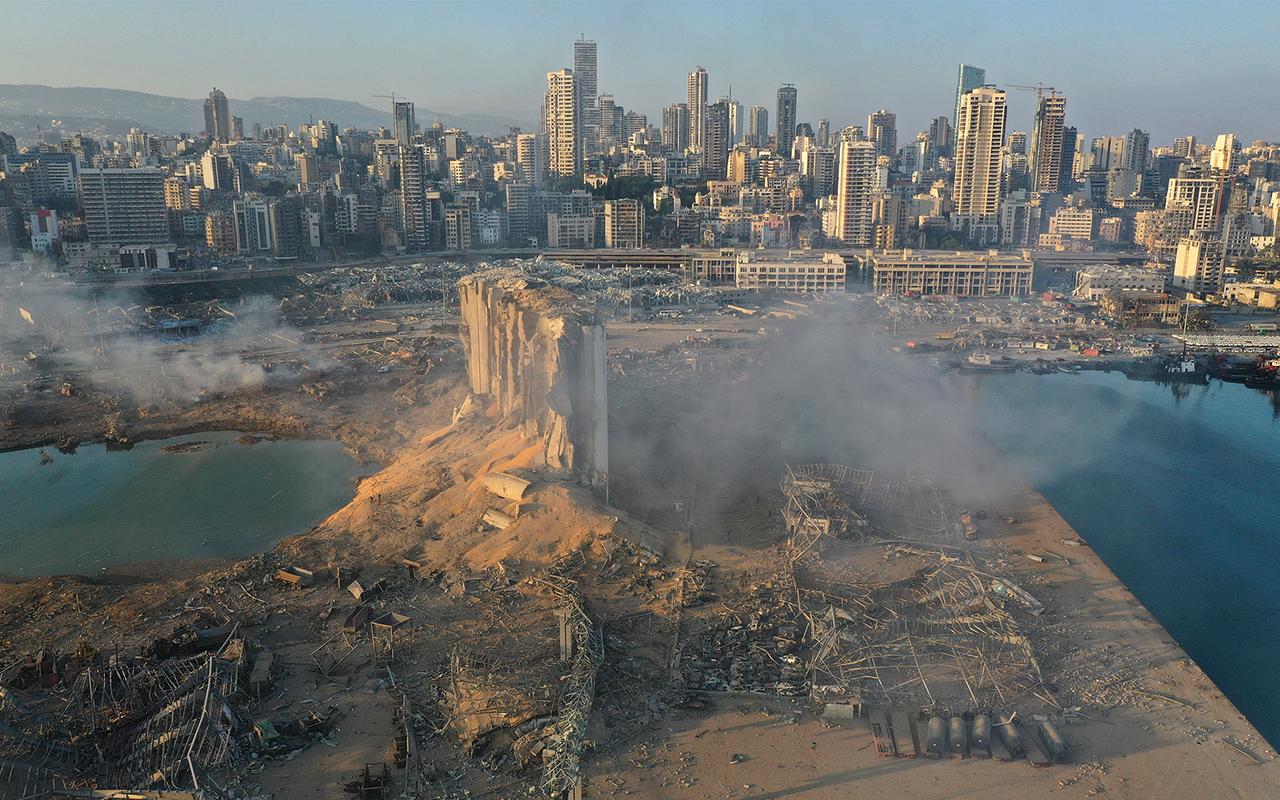
Lebanese Army Seizes Over 28 Tons Of Ammonium Nitrate In Town With Terror Ties

Lebanese Army Seizes Over 28 Tons Of Ammonium Nitrate In Town With Terror Ties

The Lebanese Army announced this week that it has seized over 28 tons of ammonium nitrate during a raid at a gas station in Arsal in the Bekaa region, which is near the border with Syria. The fertilizer can be used in bomb-making, and the seizure comes after hundreds of tons of the same substance caused the August 2020 blast which killed 200 people and decimated whole neighborhoods in Beirut. 

“Following information about the presence of ammonium nitrate in the town of Arsal, on October 4, an army patrol and military intelligence raided a gas station in the town, and seized 28,275 kilogrammes of ammonium nitrate,” Lebanon’s army announced in a Tuesday statement.

After math of Beirut port explosion in Aug.2020, Associated Press

Three Syrian men and a Lebanese citizen were arrested for improper storage, and possible charges that they skirted proper permits from the Economy Ministry – though it remains that given the area it was found is also a farming community, it could be that it was legitimately meant to be used as fertilizer. Some reports said it was being stored in a truck at the gas station.

According to Middle East news source The National, “The quantities seized on Monday sparked fears among Lebanese that dangerous chemicals continue to be improperly stored, putting the country at risk of another incident at a time of economic crisis.”

Currently Lebanese authorities are testing it the substance to see its concentration, according to the army statement: “It added that the bags storing the material indicated a nitrogen content of 26 per cent. The Army sent samples of the seized substance to check the percentage of nitrogen it contains.”

Arsal is a town that has been under the authorities’ microscope ever since the height of the Syrian war. “Arsal has become notorious in Lebanon after extremists from Syria briefly took over the small border town and engaged in deadly clashes with the Lebanese army in 2014,” The National noted.

“Days of fighting between the army, Al Nusra Front and ISIS killed at least 19 soldiers, dozens of civilians and 60 militants,” the report said. “Hezbollah is also active on Lebanon’s porous border with Syria.”

Various conspiracy theories being floated as to who is ultimately to blame for the Aug.4 2020 Beirut port explosion range from Hezbollah involvement, to blame placed on the Iranians, to Syria’s Assad – with some speculating the Israelis were behind it. However, consensus is that it was an accident after years of horrible neglect by government oversight authorities allowed unsafe and unstable amounts of ammonium nitrate to sit in a port warehouse, the immense blast was likely triggered when maintenance and wielding work ignited the substance.

Tyler Durden
Sat, 10/09/2021 – 21:30

via ZeroHedge News https://ift.tt/3BugIhE Tyler Durden

Is The Small Business Sector Being Deliberately Targeted For Destruction?

Is The Small Business Sector Being Deliberately Targeted For Destruction?

Authored by Brandon Smith via Alt-Market.us,

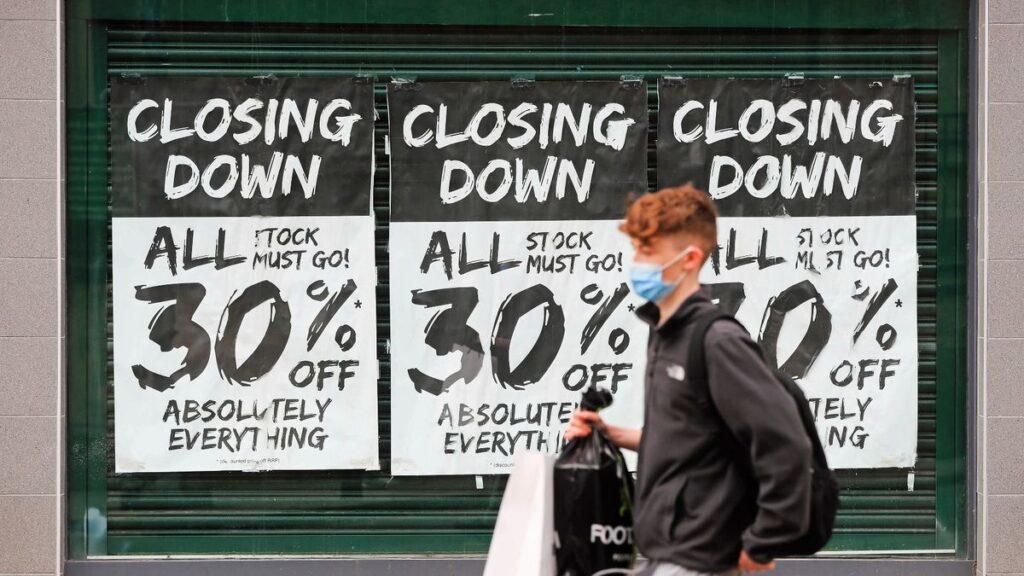
The past 18 months have not been kind to small businesses. If you were unfortunate enough to live in a blue state during the onset of the covid lockdowns and you own a brick-and-mortar business then you have probably spent a large part of that 18 months closed, or struggling to stay open with a skeleton crew of employees. If you did manage to get a PPP loan from the government during shutdown you are now realizing that the 24-week grace period is running out and you will probably have to pay most if not all of that money back soon. Many who tried to get a PPP loan failed because the money was quickly chewed up by major corporations instead of being reserved for small businesses.

And this isn’t even the beginning of the list of troubles for small companies. I have to say, unless a large part of your business is handled online your chances of staying solvent are slim. This is not the fault of most business owners, though, it is a consequence of artificially created conditions and restrictions.

What do I mean by this? Well let’s look at some factors that many people might not be aware of…

Here’s why small businesses are suffering

For example, both state and federal governments have been offering some level of covid unemployment stimulus. In the case of federal programs this could amount to $300 extra a week on top of a person’s existing unemployment checks, even more if their state has a separate program. This has created a massive drought in the employee pool. No one wants to work when they can stay home, do nothing and make more money than they ever were before the pandemic. The reality is that there are jobs everywhere right now, but almost no one is applying.

This has led to major corporations and retailers offering unheard of sign-on bonuses in the range of $300 to $500. Some companies are offering to pay people just to put in an application. Many are offering incredible wage increases in the range of $15 an hour for unskilled labor.

But guess who can’t make offers like that? The majority of small businesses. Large corporate chains have enjoyed endless stimulus packages from the federal government and the central bank and as long as this continues they will always be able to outbid small businesses for employees. And though the federal covid checks are slowly winding down, there are still millions of people receiving regular unemployment for many months to come. In a bizarre twist, the jobless are now flush with cash and are in no hurry to rejoin the workforce. Small companies simply cannot compete and lure these workers from their covid vacations.

On top of this, we are now witnessing a dynamic which I have been warning would happen for years now – a stagflationary grind. That’s right, the debate that has been raging for a decade among alternative economists is finally over: It’s not a deflationary depression or a Weimar-style hyperinflationary collapse that is bringing America down, but a crippling stagflationary malaise. This means that U.S. GDP will continue to decline and certain sectors of the economy will continue to decline while prices on many products (primarily necessities) will continue to increase or remain very high.

This creates a conundrum for small business owners – Their overhead is rising and this is shrinking their profit margins. But, if they raise prices it makes it even harder to compete with large corporations that are able to keep prices lower for longer because they have government stimulus backing them up. So, not only are brick and mortar businesses unable to compete for employees, they also can’t compete in terms of prices as the cost of materials and goods spikes. It’s inevitable, they will have to close down. There were over 200,000 extra small business closures in the past year alone due to covid and the lockdowns.

With small businesses being hit with a perfect storm leading to mass closures, the end result will be that only major corporations will be left to offer services in the near future, and I’ve been wondering for the past several months now if this is not part of the plan…

Re-engineering the Great Depression

I am reminded of the situation that took place during the Great Depression involving small banks. In the 1920s there were thousands of small town and county banks across the country that were unaffiliated with major banks like J.P. Morgan or Chase National. It might sound strange to hear it but before the Depression many banks used to be small mom and pop businesses. By the end of the 1930s over 9000 small banks had failed, and the primary beneficiaries were the major corporate banks that absorbed all the assets into their portfolios for pennies on the dollar.

In other words, the banking industry and the massive power it holds today was consolidated in the wake of the economic collapse of the 1930s, and nothing was ever the same again. This beneficial crisis was helped along by the Federal Reserve, which had artificially lowered rates through the 1920s, only to rip rates higher in the late 1920s and the early 1930s. In an address to economist Milton Friedman on his birthday, former Fed Chairman Ben Bernanke admitted that the Fed was essentially responsible for the disaster of the Great Depression, stating:

“In short, according to Friedman and Schwartz, because of institutional changes and misguided doctrines, the banking panics of the Great Contraction were much more severe and widespread than would have normally occurred during a downturn.

Let me end my talk by abusing slightly my status as an official representative of the Federal Reserve. I would like to say to Milton and Anna: Regarding the Great Depression. You’re right, we did it. We’re very sorry. But thanks to you, we won’t do it again.”

It’s interesting to me that the collapse that the Federal Reserve “accidentally” caused just happened to be the same collapse that allowed their good friends in corporate banking to centralize financial power for decades to come.

Today, we may be seeing a similar scenario unfolding. Look at it this way – The lockdowns were completely unnecessary. They didn’t stop infection rates and thus they didn’t save any lives anyway. In fact, the states with the harshest lockdowns and strictest mask mandates also had the worst infection spikes.

The covid unemployment programs are mostly unnecessary and only justified by the pointless lockdowns. And the stagflationary conditions have been mainly inflamed by the trillions in stimulus that the federal government and the Federal Reserve printed from thin air to pay for the unnecessary covid response programs and unemployment. The covid checks and loans have conjured a workforce calamity, but they have also fueled a retail buying spree which is mostly enriching manufacturing hubs like China, triggering exploding shipping demand and shipping costs, straining the supply chain, jamming up cargo ports and raising overall prices by leaps and bounds.

Every single element of this crisis has been engineered. And I would suggest the possibility that, like in the Great Depression, major corporations are once again in a convenient position to devour the small business sector and become the only game in town for all retail and services.

Not only do corporations benefit from the death of small business, but so does the Biden Administration in its relentless pursuit of covid vaccine mandates. Consider for a moment that small businesses are the antithesis to covid controls. Why? Because they offer people who refuse to take the experimental vaccines an alternative to major retailers that might demand to see their vax passports. Small businesses are much more likely to defy the draconian mandates, so Biden also wins by removing competition to the corporate oligarchy that support his controls.

Even if a small business complies with the passport mandates it will not save them, because the amount of extra costs involved in enforcement will be too much for most of them. Constantly policing customers and employees for up-to-date vaccine cards will become a full time job. Any slip up could mean a $70,000 to $700,000 fine, and because they have already submitted to the passports those businesses will have no backup from the community if they try to refuse to pay. They will ultimately close down anyway.

Without liberty minded small businesses, the only options left for the unvaxxed will be self employment (which will also be made more difficult over time), or barter and black markets.

Ironically, it is this threat that also creates an opportunity for small business owners. If they band together within their communities and let their communities know that they absolutely will not enforce the vaccine passports on employees or customers, then they could actually have a way to compete with and defeat the big box stores. They would have far more potential workers applying for jobs so their employee pool would grow at this critical time, and, they would gain all the customers in their area that also refuse to comply with the jab. Unless they are operating in a blue county, they will likely gain considerable business.

All the incentives are there. Small businesses will succeed and local communities will have options for defiance of medical tyranny. Will it anger the overlords? Yes, but who cares. They want to put you out of business anyway, so why not take a risk and fight back? The choice is to make a stand now, or live under the heel of a boot for the rest of your days. That’s all there is.

However, these measures need to be taken now before it’s too late. I also expect that as stagflationary pressures mount smaller businesses and the communities around them will have to start considering alternatives to the U.S. dollar. Precious metals are one option, along with barter and trade or local scrip as long as it is backed by commodities. There is much to be done. It is time for small businesses to accept the possibility that they have been targeted for destruction; they can do nothing and wait for the hammer to fall, or they can take measures to protect themselves. I suggest the latter.

*  *  *

With global tensions spiking, thousands of Americans are moving their IRA or 401(k) into an IRA backed by physical gold. Now, thanks to a little-known IRS Tax Law, you can too. Learn how with a free info kit on gold from Birch Gold Group. It reveals how physical precious metals can protect your savings, and how to open a Gold IRA. Click here to get your free Info Kit on Gold.

Tyler Durden
Sat, 10/09/2021 – 21:00

via ZeroHedge News https://ift.tt/3uVemG5 Tyler Durden

China’s Xi: Taiwan’s “Complete Reunification” With The “Motherland” Must Be Fulfilled

China’s Xi: Taiwan’s “Complete Reunification” With The “Motherland” Must Be Fulfilled

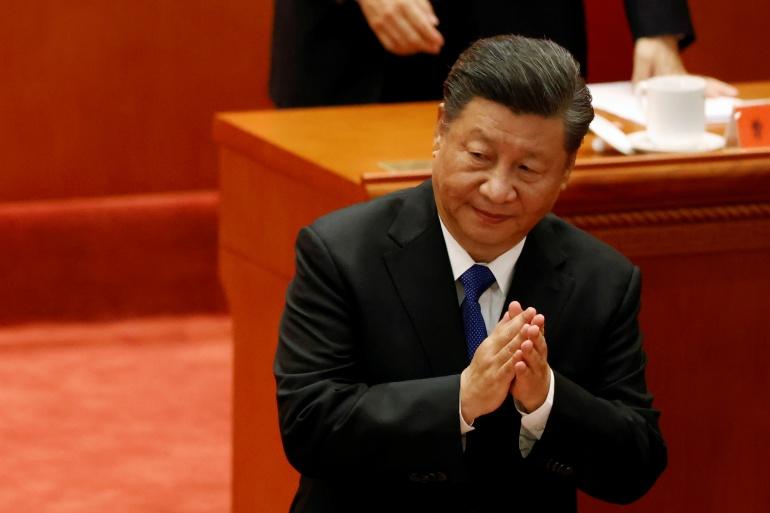
Chinese President Xi Jinping addressed the growing tensions surrounding the Taiwan issue during a speech Friday given in Beijing to mark the 110th anniversary of the “Xinhai Revolution” that brought down the last imperial dynasty, paving the way to establishment of the Republic of China.

Not quite as bellicose as the last Taiwan-focused remarks he gave in a fiery address in July, Xi emphasized China is fully committed to full reunification of the island to the “motherland by peaceful means”. He vowed that a “one country, two systems” policy will “definitely” be implemented at some point in the near future. It “must be and can be realized,” he said.

Via Reuters

“To achieve the reunification of the motherland by peaceful means is most in line with the overall interests of the Chinese nation, including our compatriots in Taiwan,” Xi said in the address.

In a veiled warning against the West, and in particular the United States, Xi called the issue “entirely China’s internal affair”:

“No one should underestimate the Chinese people’s determination and strong ability to defend [our] national sovereignty and territorial integrity. The historical task of the complete reunification of the motherland must be fulfilled, and it will definitely be fulfilled,” Xi said.

He additionally urged Taiwan to “stand on the right side of history jointly to create the glorious cause of the full reunification and the great rejuvenation of the Chinese nation”.

However, it’s being widely noted that he emphasized “peaceful” means of reunification, without spelling out exactly how that scenario would happen:

Chinese President Xi Jinping promised on Saturday to realize peaceful “reunification” with Taiwan, though did not directly mention the use of force after a week of tensions with the Chinese-claimed island that sparked international concern.

This was a much softer tone compared to the early July speech which he gave on the occasion of the 100th anniversary of the Chinese Communist Party.

For that prior event the president had donned  a gray Mao suit and said the nation is committed to Taiwan reunification ensuring continued “stability” in Hong Kong, vowing that any outside “bullying” powers will inevitably “get their heads bashed”.

Tyler Durden
Sat, 10/09/2021 – 20:30

via ZeroHedge News https://ift.tt/3FA5Von Tyler Durden

Furious School Parents Will Not Be Silenced – Doesn’t AG Garland Have Better Things To Do?

Furious School Parents Will Not Be Silenced – Doesn’t AG Garland Have Better Things To Do?

Authored by Mark Glennon via Wirepoints.org,

It’s tempting to see the new directive by Attorney General Merrick Garland as merely a transparent attempt to intimidate parents into silence over opinions that the Biden Administrations doesn’t like. However, it’s worth going though some of the other reasons why this misconduct by federal law enforcement is is so appalling, and to remind parents why they should not be deterred.

Many parents in Illinois and across the country have spoken out recently with unprecedented anger in unprecedented numbers at school board meetings and beyond. Their complaints have been about Critical Race Theory in classrooms, mask mandates and explicit materials for minors about sexuality and gender. We’ve written here often supporting some of those complaints. My colleague Ted Dabrowski and I have participated in some of the efforts directed toward our own childrens’ schools.

U.S. Attorney General Merrick Garland

But on Monday, Garland issued a directive to the FBI and federal law enforcement officials across the nation to focus on alleged criminal conduct in protests by parents.

Outrage ensued immediately, and appropriately, from parents, their organizations and commentators who are infuriated that a threat of federal law enforcement is being used to try to scare them out of constitutionally protected speech.

Garland’s Department of Justice has responded simply by saying it isn’t true, and its defenders, particularly MSNBC, have cited examples of conduct by parents that allegedly were either inappropriate or illegal.

Linked here are Garland’s directive and an accompanying DOJ press release. They should be read in conjunction with a letter sent by the National School Boards Association late last month to President Biden, which gave rise to the directive. It claimed that school officials are “under immediate threat” and asked Biden to sic nearly the full force of the national security establishment on offending parents.

It contains these astonishing requests, from which you would think the entire Taliban is loose in America:

NSBA respectfully asks that a joint collaboration among federal law enforcement agencies, state and local law enforcement, and with public school officials be undertaken to focus on these threats. NSBA specifically solicits the expertise and resources of the U.S. Department of Justice, Federal Bureau of Investigation (FBI), U.S. Department of Homeland Security, U.S. Secret Service, and its National Threat Assessment Center regarding the level of risk to public schoolchildren, educators, board members, and facilities/campuses. We also request the assistance of the U.S. Postal Inspection Service to intervene…. including any technical assistance necessary from, and state and local coordination with, its National Security Branch and Counterterrorism Division, as well as any other federal agency with relevant jurisdictional authority and oversight. Additionally, NSBA requests that such review examine appropriate enforceable actions against these crimes and acts of violence under the Gun-Free School Zones Act, the PATRIOT Act in regards to domestic terrorism, the Matthew Shepard and James Byrd Jr. Hate Crimes Prevention Act, the Violent Interference with Federally Protected Rights statute, the Conspiracy Against Rights statute, an Executive Order to enforce all applicable federal laws for the protection of students and public school district personnel, and any related measure.

The DOJ was happy to oblige. It’s directive, as you can see in the documents they released, is much shorter but conveys the same point.

And the DOJ made sure that school boards and officials will be trained in how to be claimed as victims who can call on those enforcement mechanisms. From the DOJ press release:

The Justice Department will also create specialized training and guidance for local school boards and school administrators. This training will help school board members and other potential victims understand the type of behavior that constitutes threats, how to report threatening conduct to the appropriate law enforcement agencies, and how to capture and preserve evidence of threatening conduct to aid in the investigation and prosecution of these crimes.

Keep in mind that a real crime requires violence or a threat to commit either violence or some other illegal act. But most of the offensive conduct being referenced by the media and school officials is not criminal. Is it criminal to say, for example “we will get you,” or “we will not forget this,” or “your career is education is dead”?

Some such things may be vile and reprehensible, like saying “we know where you live,” but criminality is a different matter. The meanings of many statements are not clear nor is their criminality.

Yes, there are other, worse examples of some actual, criminal conduct, including violence, which should not be tolerated. But neither the DOJ nor anybody else has put up any evidence that it is widespread enough to justify such an unprecedented federal response.

That’s part of why Garland’s directive is so pernicious. He could have provided a useful service by delineating what is prosecutable and what isn’t. Instead, he used the tactic of exploiting the murkiness about where the line gets drawn between criminal conduct and protected speech, thereby purposely chilling what is constitutionally protected.

“Garland knows this is dangerous nonsense. I personally know that he knows it.” That’s from Andrew McCarthy, who worked under Garland in the DOJ.

McCarthy further wrote that “Garland incorrectly — indeed, outrageously for someone of his experience as a Justice Department official and federal appellate judge — claimed that free-speech principles yield not only to “threats of violence” but also to “efforts to intimidate individuals based on their views.”

Why is the federal government getting involved at all in this? Crimes like those at issue are the domain of local officials.

In fact, the constitutionality of federal involvement is highly questionable. At least two state attorneys general, in Arizona and Missouri, already blasted the DOJ for that reason and more may be coming. McCarthy, too, made that point in the column linked above.

Selective enforcement of law for political reasons is reprehensible in itself, and it’s brazen in this case. If conduct like parents’ at school boards, even when intimidating, is colorable as a federal offense, where was the DOJ when rioting, vandalism and destruction of statues was overlooked for being supposedly acceptable protest?

Doesn’t the DOJ have better things to do?

Here in Illinois, it’s been over two years since a federal criminal investigation was opened about Gov. JB Pritzker’s removal of toilets to reduce property taxes. It’s still open. The event happened over four years ago. His reelection is approaching and his state would like to know if he will be its next indicted governor. But now the U.S. Attorney’s office in northern Illinois, which is handling the case, is ordered to spend time on parents and school boards.

How about if federal resources were directed instead to, oh, say, enforcing the border? Or providing what assistance they can to major cities like Chicago being destroyed by crime?

Garland’s biggest error is underestimating parental devotion to children. Few forces in nature are more unrelenting. Parents will not be frightened off from doing what is right for their offspring by the FBI or anybody else.

Garland apparently has a different notion of parental devotion. It turns out that his son-in-law is the co-founder and president of Panorama Education, which sells teacher training and curriculum for race-focused surveys and conducts trainings on systemic oppression, white supremacy, unconscious bias, and intersectionality. CRT-type stuff, the primary thing parents are complaining about.

Parents, know that there is safety in numbers. Countless other parents around the country will not stand for this.

We will not change what we say and write.

Nor should you.

Tyler Durden
Sat, 10/09/2021 – 20:00

via ZeroHedge News https://ift.tt/3alN7L9 Tyler Durden

Former Central Banker Says US Economy Already In Recession

Former Central Banker Says US Economy Already In Recession

In his latest note, SocGen’s Albert Edwards made an ominous – if obvious – comparison: “as energy prices surge with a backdrop of central bank tightening it’s starting to feel a bit like July 2008” referring to that moment of “unparalleled central bank madness as the ECB raised rates just as oil prices hit $150 and the recession arrived.” Then, looking at the dire impact that higher yields would have on the economy and markets which are still convinced the inflation (and in the case of European energy, hyperinflation) is transitory, he warned that not only has stagflation arrived, but that investors should “think hard about the likelihood that higher energy prices and bond yields will trigger a ‘wholly unexpected’ recession. For that is where the biggest risk might lie for investors.”

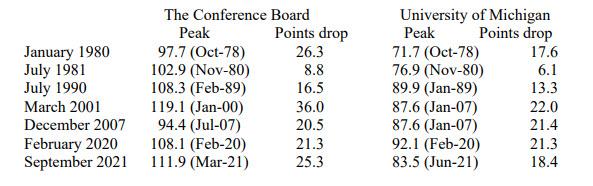
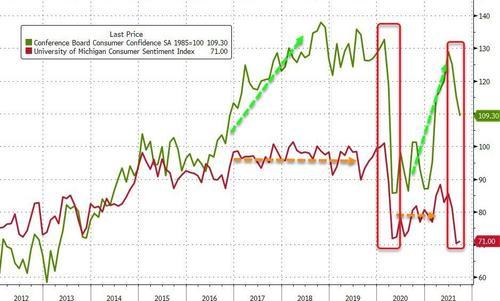
For once, Albert’s doomsday grumblings may be behind the curve, because according to former BOE central banker during the 2008 financial crisis and current Dartmouth College professor, David Blanchflower, and Alex Bryson of University College London, despite rising employment and wages, the US is already in a recession according to the recent plunge in consumer expectations. In a paper published on Thursday titled “The Economics of Walking About and Predicting US Downturns“, the establishment economist duo concluded that consumer expectations indexes from the Conference Board and University of Michigan tend to predict American downturns 18 months in advance.

“The economic situation in 2021 is exceptional, however, since unprecedented direct government intervention in the labor market through furlough-type arrangements has enabled employment rates to recover quickly from the huge downturn in 2020,” wrote Blanchflower and Bryson quoted by Bloomberg. “However, downward movements in consumer expectations in the last six months suggest the economy in the United States is entering recession now, even though employment and wage growth figures suggest otherwise.”

According to the authors, “all the recessions since the 1980s have been predicted by at least 10 and sometimes many more point drops in expectations indices.” Additionally, a single monthly rise of at least 0.3 percentage points in unemployment and two consecutive months of employment rate declines are also notable leading indicators.

The economists concludes that “this is a bold call of course, and not consistent with consensus and only time will tell if we are right.” However, they add “equivalent falls in these data in 2007 were an early indicator of recession, missed at the time by policymakers and economists. There is a possibility of course, that these data are giving a false steer. However, missing the declines in these variables in 2007, as most policymakers and economists did, proved fatal. It is our hope such mistakes will not be repeated this time around. They missed it last time, hopefully they won’t miss it this time. These qualitative data trends need to be taken seriously.”

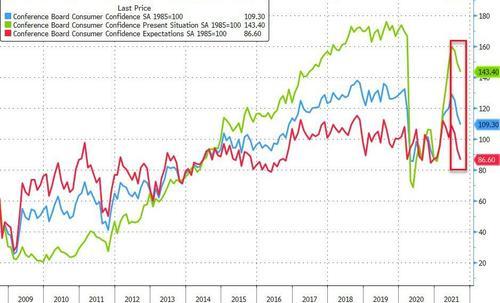
As we noted at the end of September, the Conference Board’s gauge of current conditions fell to 143.4, a five-month low, while the group’s expectations index dropped to 86.60 the lowest since November.

Potentially offsetting this plunge, the University of Michigan’s gained. However, as we also noted, while one is private-entity sourced the other is government sponsored. Figure out which one is which from the chart below.

Tyler Durden
Sat, 10/09/2021 – 19:32

via ZeroHedge News https://ift.tt/3lqHWA4 Tyler Durden

Government Spending Cannot “Stimulate” The Economy

Government Spending Cannot “Stimulate” The Economy

Authored by Patrick Barron via The Mises Institute,

Government economic policy is completely backwards. We are told that massive deficit spending, interest rates driven to zero, and now higher taxes on the “rich” will bring the American economy out of the doldrums or whatever fake malady seems to be popular. It is hard to imagine an economy in the doldrums when unemployment, the scourge of mankind for decades, is so low that businesses cannot attract enough workers. That’s number one; i.e., is the US economy really so bad? I admit that it always could be better, but we are not in the Great Depression of the 1930s, in which one-fourth of those seeking work could not find a job. At least not yet. Stay tuned, though.

Stimulus Spending and the Cantillon Effect

But let’s get back to the main point: Whether or not the US economy is underperforming, can government spending help? That has been the mantra since Keynesianism swept the economic and then government hallways shortly after World War II. So, we may ask ourselves, just how does government stimulus spending work? Well, from what I can conclude, the government sells its debt to the Fed (called monetizing the debt, which increases the monetary base), spends it on all kinds of programs, some (but not all) of us get more money in our pockets and spend it. So, we can see that, from government’s perspective, spending is the key. More spending MUST mean that the economy is doing better. Keynesian economists call this increasing aggregate demand, just a fancy name for more spending.

The implied mechanism is that more spending via money created out of thin air somehow draws more goods out of hiding. Why these goods were hiding is not quite clear, except that aggregate demand was deemed to be too low. On the face of it, it appears logical. Let’s say that you are the surprise inheritor of a great deal of money from a distant relative. Your personal lifestyle certainly will be stimulated. But let’s consider the source of this windfall—your distant relative. He certainly did not print buckets of money that he left you in his will. Either he earned the money himself or inherited it from someone who did. In other words, the source of your newfound wealth was previous production. You are the new owner of that wealth. Whether you produced it or someone else, you are the new owner of what Professor Frank Shostak calls “something for something.” This is in contrast to receiving stimulus dollars printed by the government. Now you have received “something for nothing.” It is pure monetary inflation without any previous production in exchange. Therefore, any stimulus in the form of increased spending is pure smoke and mirrors, masking capital decumulation. The result is rising prices, at a minimum, and possibly hyperinflation if carried too far.

But let me give you two thought experiments. For the first one, let’s assume that you and some others are marooned on an uncharted island, similar to the plot of the hit TV comedy Gilligan’s Island. The only resources you have are whatever washed ashore when your ship sank, whatever natural resources are at hand, and whatever survival skills you possess. Now let’s suppose that some large boxes wash ashore later. You rush to open them and find that they contain millions and millions of dollars in paper Federal Reserve notes. Not knowing when, or even if, you will be found, what good are these millions to you and your fellows? Do you all cheer, because now you all are rich? Since your most urgently desired goods certainly are not paper dollars, I doubt it. You all are left with the original resources—natural resources at hand, whatever goods washed ashore earlier, and your survival skills. But, you may say, I do not live on an uncharted island. I certainly can spend the millions and enrich my life. OK, now let’s assume that in the middle of the night Federal Reserve chairman Jerome Powell wakes you and slides a suitcase with a million dollars in Federal Reserve notes under your bed. Wow! What would you do? You might spend a little time thinking how to spend the money, but sooner or later you will take your suitcase of money and start to spend. Then you are shocked to find out that Mr. Powell, like a magical Santa Claus, visited every one of America’s 300 million-plus citizens and gave everyone of them a suitcase with a million dollars in Federal Reserve notes, too. You find that all the luxury cars are gone from dealers’ lots. When you enquire about ordering one, you find that the price has skyrocketed. When government engages in stimulus spending, the same thing happens, only on a smaller scale. A fortunate few, mostly bankers and bond dealers, get the newly printed money first. They buy current goods at current prices. Good for them! But subsequent receivers of the new money find that prices have gone up and their newly acquired money really doesn’t do them that much good. Then people much further down the line as recipients of the new money find that prices have gone up and their incomes haven’t gone up nearly as much or not at all (think of retirees on fixed pensions). Rather than enticing production out of hiding, government stimulus spending has caused a transfer of wealth from the later receivers of new money to the earlier receivers of new money. This is known in economic circles as the Cantillon effect.

A Four-Point Plan from Forty Years Ago

So, what can government do, if anything, to aid the economy? I have four main points, all from the Republican platform of 1980. (These four points were articulated by vice presidential candidate George Herbert Walker Bush on the steps of the capitol building in Springfield, Illinois, in the summer of 1980. I was in attendance.)

  1. Return to sound money by freezing the money supply. That requires two reforms. First, do not increase the monetary base by selling government debt to the central bank. Government must spend only what it raises in taxes or obtains through honest borrowing in the bond market. Secondly, forbid the ability of banks to engage in credit expansion through fractional reserve banking, whereby banks themselves create money out of thin air when they increase lending.

  2. Cut government spending. Of course, this is exactly opposite of what government does today, but government spending is parasitical on the real economy. Government does not create goods and services itself. It can only hand out what it has taken from others. It is the private economy that brings people what they most urgently want, not what government thinks they want or what government wants them to have.

  3. Number three, reduce regulations. The free market economy and the legal system are all that is needed to bring people what they most urgently want . Disputes are best resolved in the commercial and criminal justice systems.

  4. Number four, once the budget is balanced, finally goes into surplus, and the debt is slowly being reduced, government can begin to cut taxes. Tax reductions will take money from the destructive power of government spending and increase the capital accumulation power of the private sector. Since the money supply has remained the same, increased production will result in a slow and steady fall in prices, benefiting all levels of society. The cost of living will fall and the standard of living will rise.

The American people need to be told the truth. Government can help the economy only by protecting you and your property. A free market economy, limited government, and the rule of law are the keys to prosperity and peace.

Tyler Durden
Sat, 10/09/2021 – 19:00

via ZeroHedge News https://ift.tt/302wHFG Tyler Durden

The US Is Officially A Banana Republic: The Top 1% Now Own More Wealth Than The Entire Middle Class

The US Is Officially A Banana Republic: The Top 1% Now Own More Wealth Than The Entire Middle Class

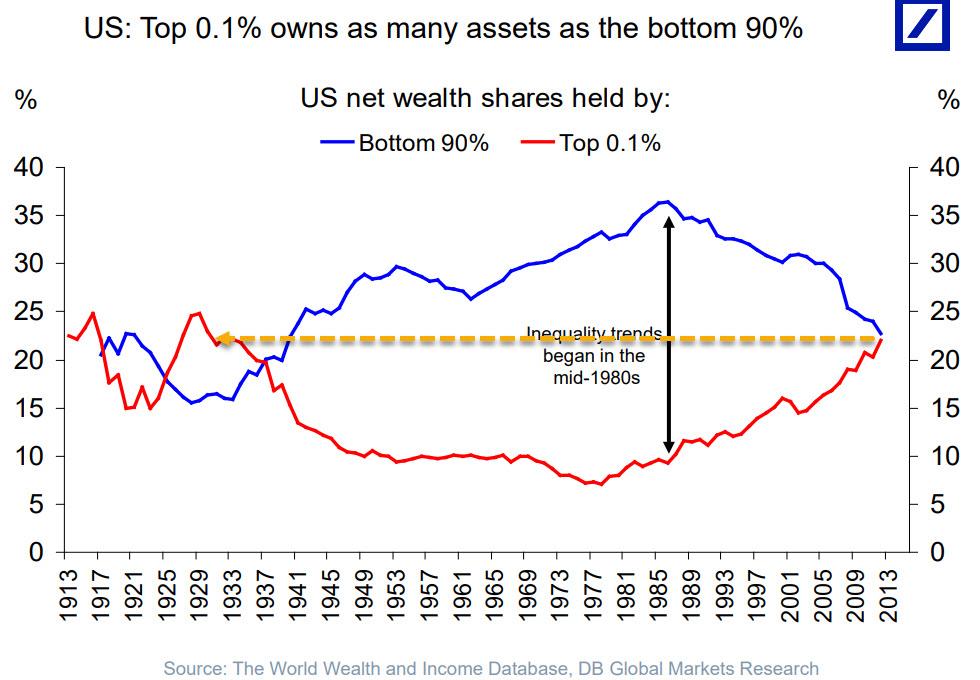
In some ways, we sympathize with Neel Kashkari’s fake “concern” about the unprecedented wealth inequality that has emerged in the US in recent years and which has resulted in a slow, methodical and relentless destruction of the US middle class … or rather make that precedented because there was another time when the top 0.1% had amassed as much wealth and it was just before the Great Depression.

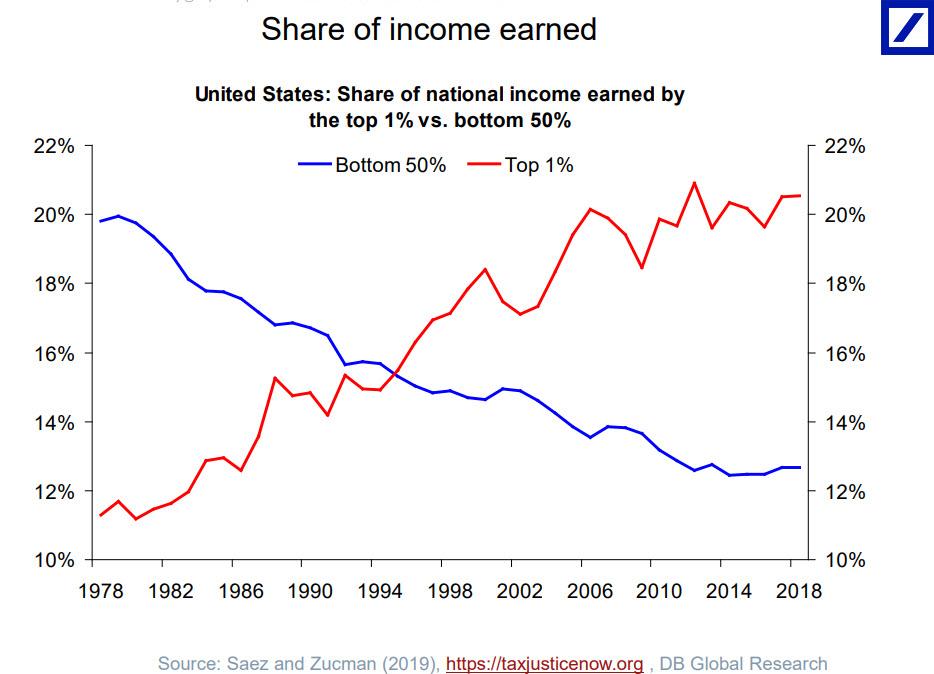
After all, who hasn’t seen charts such as these showing the tremendous divergence in income earned by America’s Top 1% at the expense of the middle and lower classes:

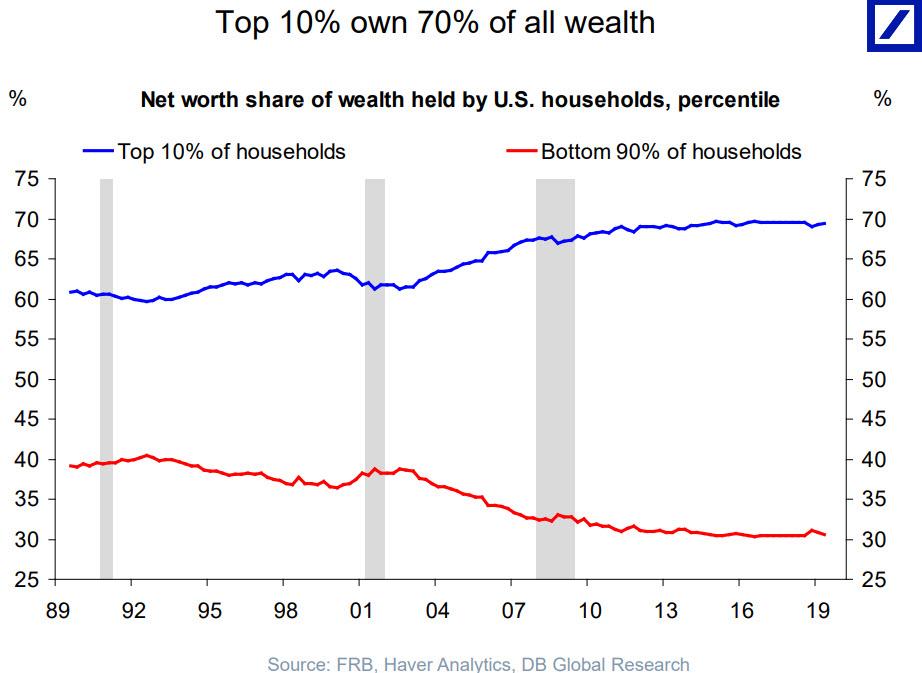
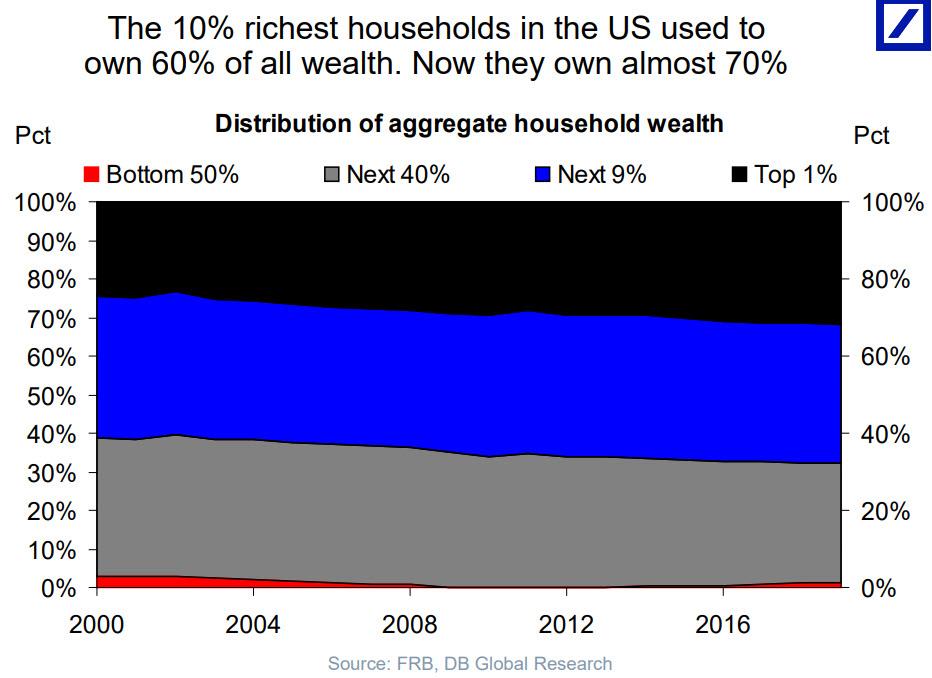
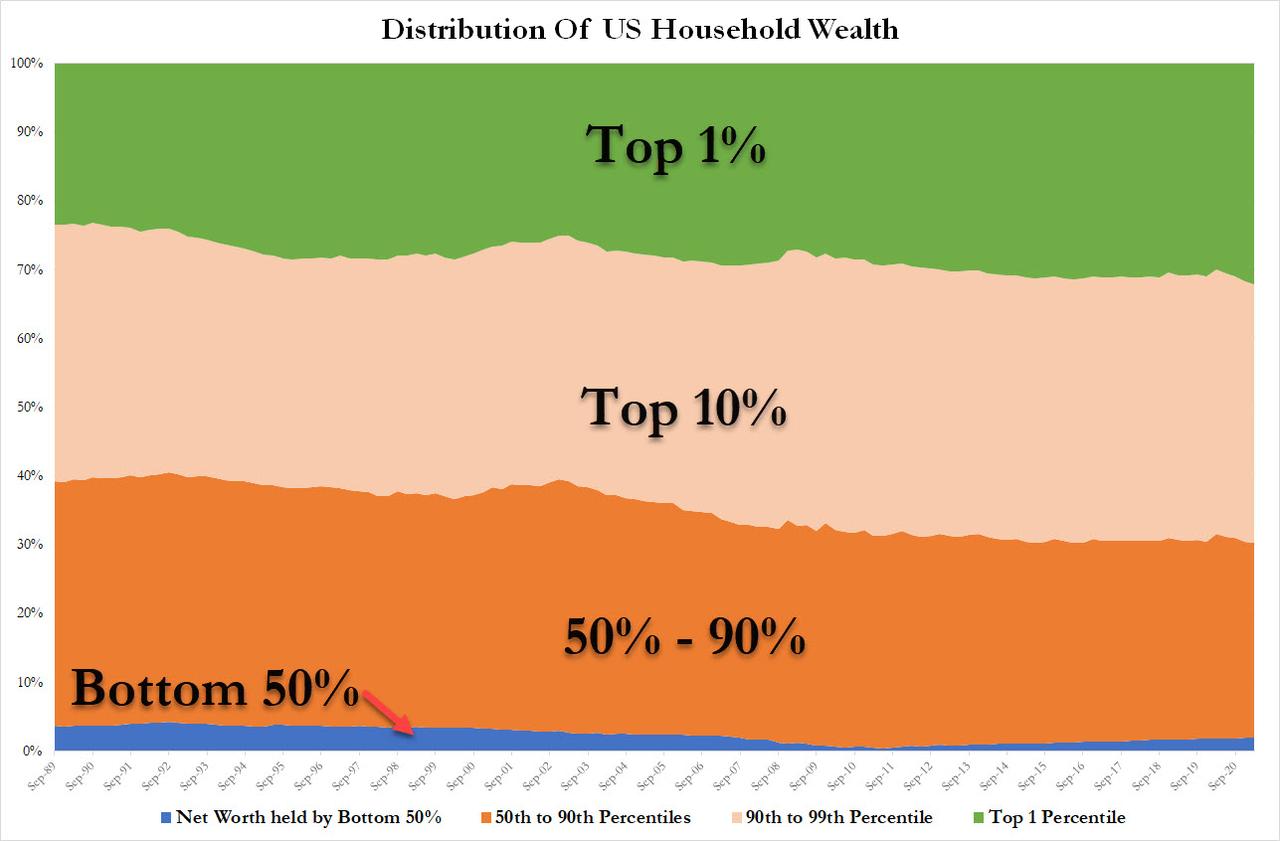
Or that the top 10% now own 70% of all the US wealth, the same as the middle and lower classes combined

… up 10% from the 60% of wealth they controlled at the start of the century.

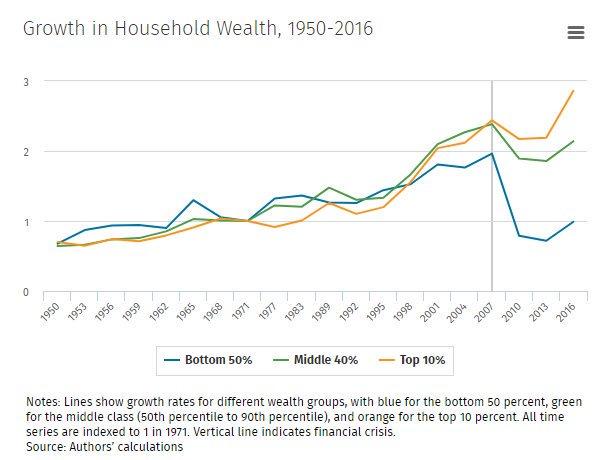
Yet we find Kashkari’s “jaw-dropping” virtue signalling proposal to grant the Fed wealth redistribution power not only laughable but absolutely terrifying: after all it was the Fed’s ZIRP and QE that was behind the greatest wealth redistribution in the past decade

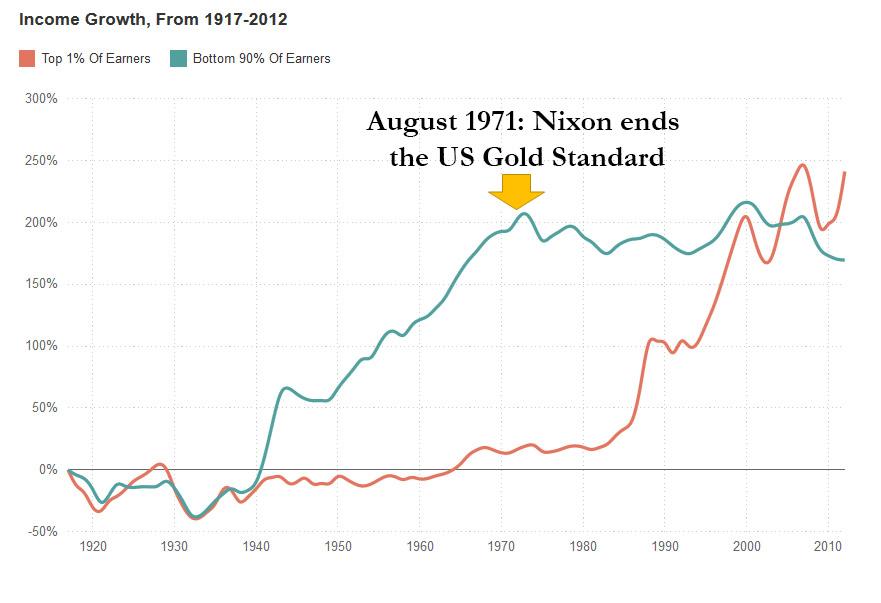
… a redistribution that started almost 50 years ago, when Nixon decided to end the Fed’s biggest nemesis – the US gold standard – launching an unprecedented increase in income growth for the “Top 1%”, even as the income of the “Bottom 90%” has remained unchanged ever since 1971.

For those confused, Rabobank’s Michael Every put it best: of course the Fed can redistribute wealth but “that redistribution has been from the poor and middle-class to the rich, not the other way round.

Unfortunately, as we showed back in November 2019, it may already be too late to fix the US: as the following stunning chart shows, the US is already effectively a banana republic if one defines such a nation as one which has a small but ultrapowerful and unaccountable kleptocracy which gets richer year after year by stealing from the rapidly shrinking middle class.

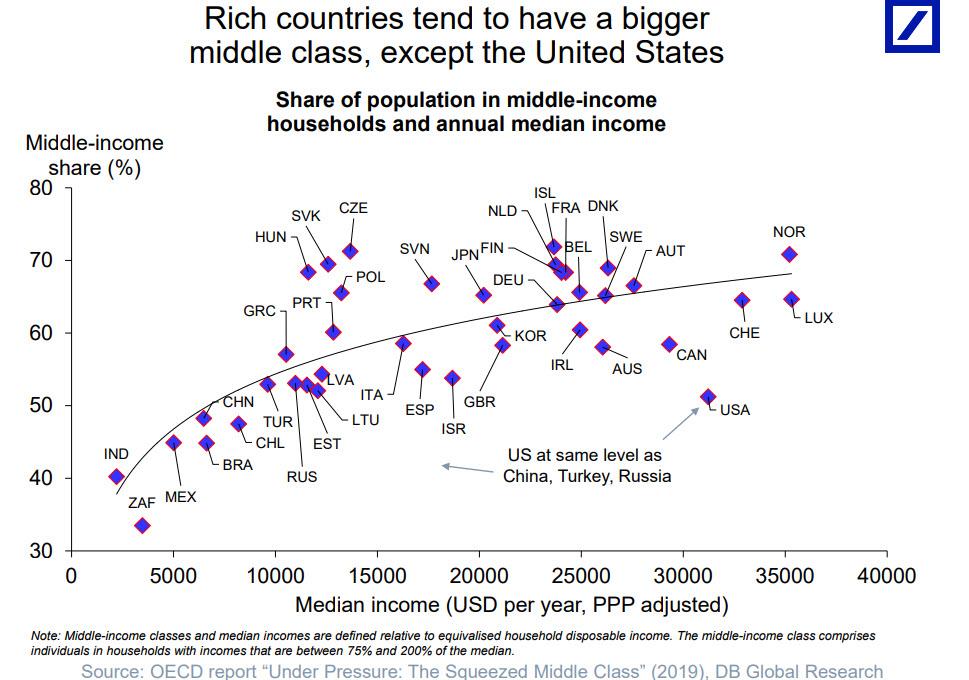
Here is the problem: while the US has one one of the highest median incomes in the entire world, with only three countries boasting a higher income, it is who gets to collect this money that is the major problem, because as the chart also shows, with just a 50% share of the population in middle-income households, the US is now in the same category as such “banana republics” as Turkey, China and, drumroll, Russia.

What is just as stunning: according to the OECD, more than half of the countries in question have a more vibrant middle class than the US.

Alas, since November 2019 it has only gotten worse… much worse because as a result of the unprecedented wealth redistribution unleashed by the covid pandemic, America’s has truly cemented its banana republic status as the wealth of the top 1% exploded as a direct result of the Fed pumping trillions into the stock market and levitating asset values, while the lower and middle classes stagnated.

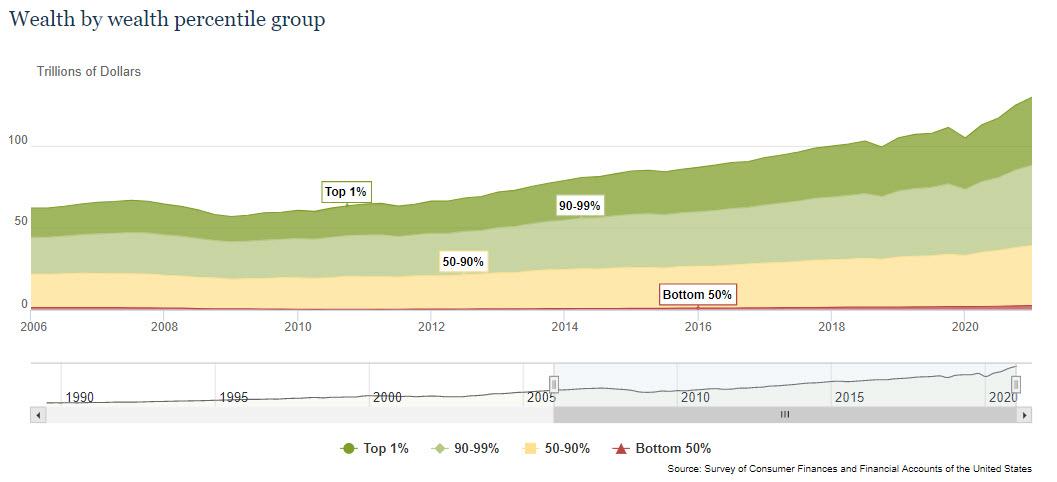
Two weeks ago, when discussing the latest US record household net worth number, which hit an all time high of $142 trillion or up $31 trillion since Covid, we showed that it would be great if this wealth increase was spread evenly across most Americans, but unfortunately, most Americans have not benefited from recent gains in wealth.

Indeed, the latest data as of Q1 shows that the top 1% accounts for over $41.5 trillion of total household net worth, with the number rising to over $90 trillion for just the top 10%. Meanwhile, the bottom half of the US population has virtually no assets at all. On a percentage basis, just the Top 1% now own a record 32.1% share of total US net worth, or $45.6 trillion. In other words, the richest Americans have never owned a greater share of US household income than they do, largely thanks to the Fed. Meanwhile, the bottom 50% own just 2% of all net worth, or a paltry $2.8 trillion. They do own most of the debt though…

And the saddest chart of all: the wealth of the bottom 50% is virtually unchanged since 2006, while the net worth of the Top 1% has risen by 132% from $17.9 trillion to $41.5 trillion.

All of which brings us to the latest update from the Fed on Household Wealth distribution published on Friday and covering the second quarter of 2021, and which revealed yet another jawdropping fact about America’s full transformation into a banana republic.

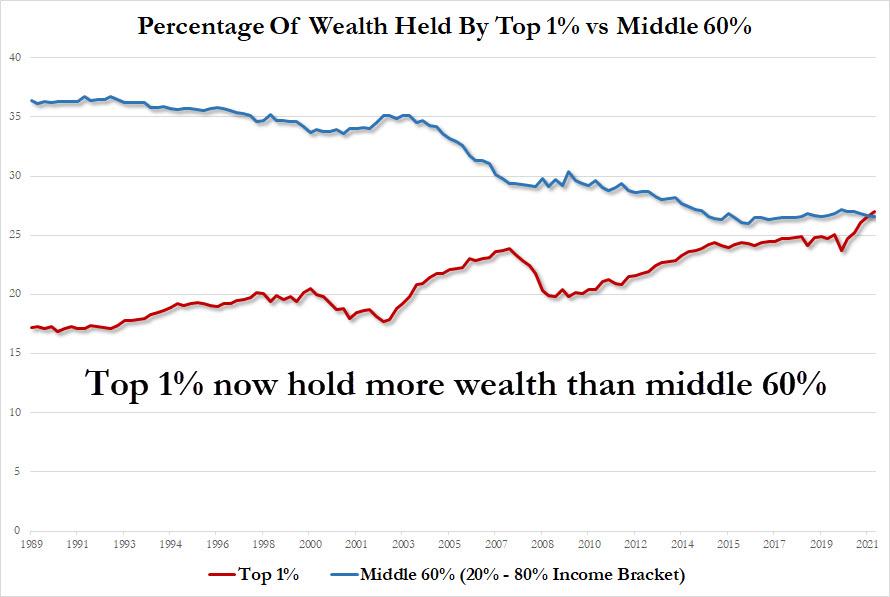
According to the Fed data, which breaks down the distribution of wealth according to income quintile (or 20% bucket) with a special carve out for the top 1%, the middle 60% of US households by income (those in the 20% to 80% income range) – a measure economists use as a definition of the middle class – saw their combined assets drop from 26.7% to 26.6% of national wealth as of June, the lowest in Federal Reserve data, while for the first time the super rich had a bigger share, at 27%.

While especially true for the top 1%, it is all the rich that have benefited at the expense of the extinction of the US middle class – as the next chart shows, over the past 30 years, 10 percentage points of American wealth has shifted to the top 20% of earners, who now hold 70% of the total. The bottom 80% are left with less than 30%.

Some context: while “middle class” is a fluid concept, many economists use income to define the group. The 77.5 million families in the middle 60% make about $27,000 to $141,000 annually, based on Census Bureau data. As Bloomberg notes, their share in three main categories of assets – real estate, equities and private businesses – slumped in one generation. That made their lives more precarious, with fewer financial reserves to fall back on when they lose their jobs.

On the other end, the top 1% represents those 1.3 million households out of a total of almost 130 million, who roughly make more than $500,000 a year. The concentration of wealth in the hands of a fraction of the population is at the core of some of the country’s major political battles. It was also made possible entirely by the Fed, which as Stanley Druckenmiller said back in May echoing what we have said since our inception back in 2009, has been the single “greatest engine of wealth inequality” in history (to which we would also add the end of the gold standard under Nixon).

“If the economic system isn’t working for the clear majority of the population, it will eventually lose political support,” Nathan Sheets, newly appointed chief economist at Citigroup Inc., said by email. “This observation is motivating many of the economic reforms that the Biden Administration is putting forward.”

And while Joe Biden is seeking to “bolster” working- and middle-class families with a $3.5 trillion package before Congress that includes assistance with child care, education and health care paid for with tax increases on high-income individuals, what he will do is make the rich even richer as the Fed will have to monetize all those trillions in new debt, boosting risk asset prices even higher, and while the middle class spends any one-time fiscal stimulus merely to cover soaring costs of everyday items like rent and gas, it is the top 1% who will benefit the most again as they stock portfolios hit new all time highs.

It’s not just stocks that have benefited the super rich: housing has too. While a generation ago, the middle class held more than 44% of real estate assets in the country, it is now down to 38%. The pandemic generated a boom in housing values that has benefited most those who owned real estate in the first place. It also led to soaring rents this year, which hurt those who can’t afford a house. The self-feeding loop was yet another source of wealth transfer for the wealthier. 

So the next time someone abuses the popular phrase  “they hate us for our [fill in the blank]”, perhaps it’s time to counter that “they” may not “hate” us at all, but rather are making fun of what has quietly and slowly but surely become the world’s biggest banana republic?

And it has not Russia, nor China, nor any other foreign enemy to blame except one: the Federal Reserve Bank of the United States. 

Tyler Durden
Sat, 10/09/2021 – 18:30

via ZeroHedge News https://ift.tt/3mGkKx4 Tyler Durden

“First Big Winter Storm” Of Season To Bring “Feet Of Snow” To Western US

“First Big Winter Storm” Of Season To Bring “Feet Of Snow” To Western US

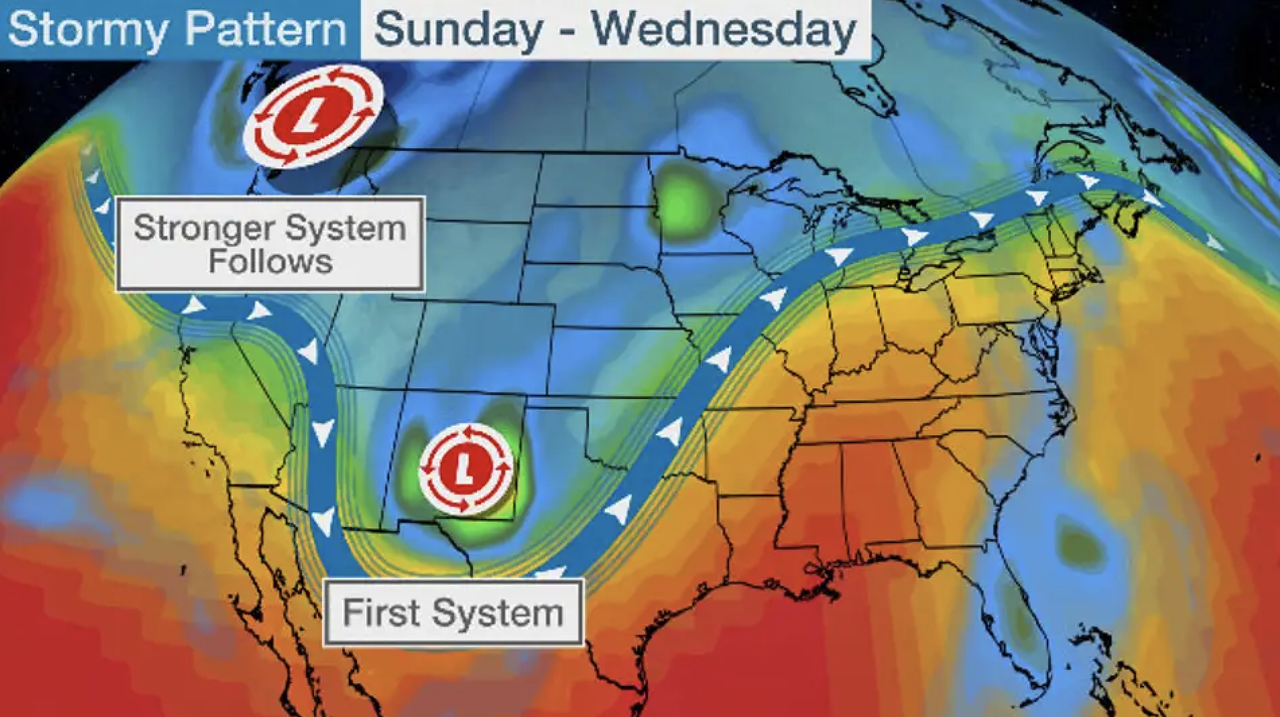
A series of weather systems will traverse the western part of the US into the central region early next week. According to the National Weather Service, significant snowfall could fall in portions of the northern Rockies. 

After record drought, excessive heat, and wildfires, the first signs of winter with heavy snowfall are expected in the Rocky Mountains early next week. Cold air from two jet streams will send temperatures diving across the northern Rockies and the south-central Rocky Mountains through at least mid-week. Cooler air will continue making its way into the mountains of Colorado and High Plains of Montana, Wyoming, and even western Dakotas and western Nebraska. 

Accumulating snow is expected in high elevations of the Sierra Nevada to the central and northern Rockies. Billings, Montana; Casper, Wyoming, parts of Salt Lake City, and foothills west of Collins-Boulder-Denver Front Range urban corridor could expect snow. 

NWS tweeted a 3-7 day weather outlook through next Thursday and said, “heavy snow is expected for portions of the northern Rockies.” 

Weather models show more than a foot of snow is expected for higher elevations. 

The first significant snow event of the year comes as concerns mount some US power grids are unprepared for cooler weather. The green energy transition has been such a failure, pushing up natural gas prices worldwide, that nearly a quarter of US utilities are switching to coal this fall/winter. But declining mining output and labor shortages have resulted in low coal supplies and utilities might be forced to initiate rolling blackouts to protect grids. 

Next week’s winter impact area of cooler weather has an abundance of coal, natgas, and crude burning power plants. 

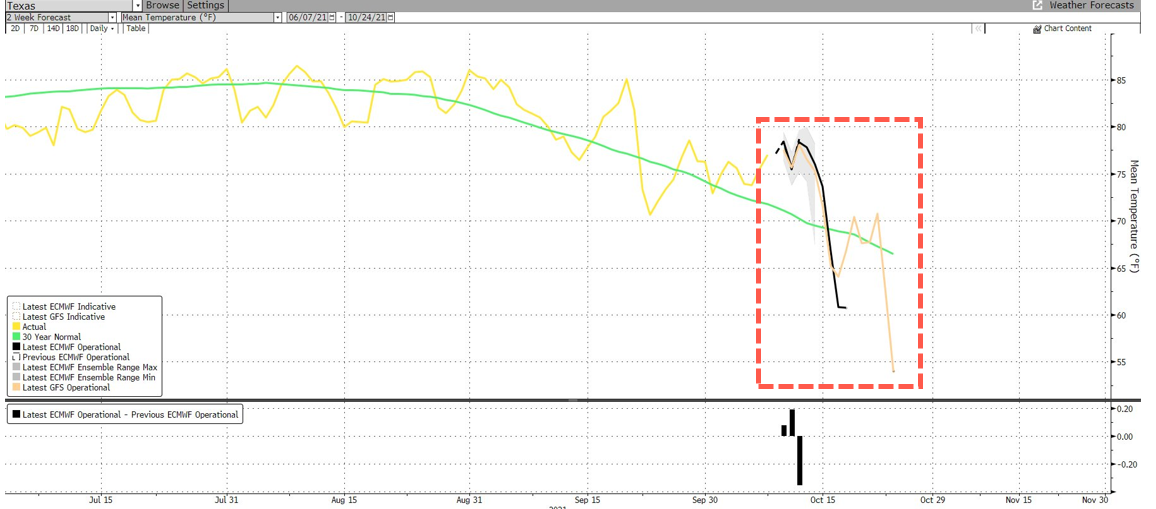
Further south, one major concern is that temperatures across Texas are expected to dive over the next few weeks. It remains to be seen if The Lone Star has rid itself of grid troubles. 

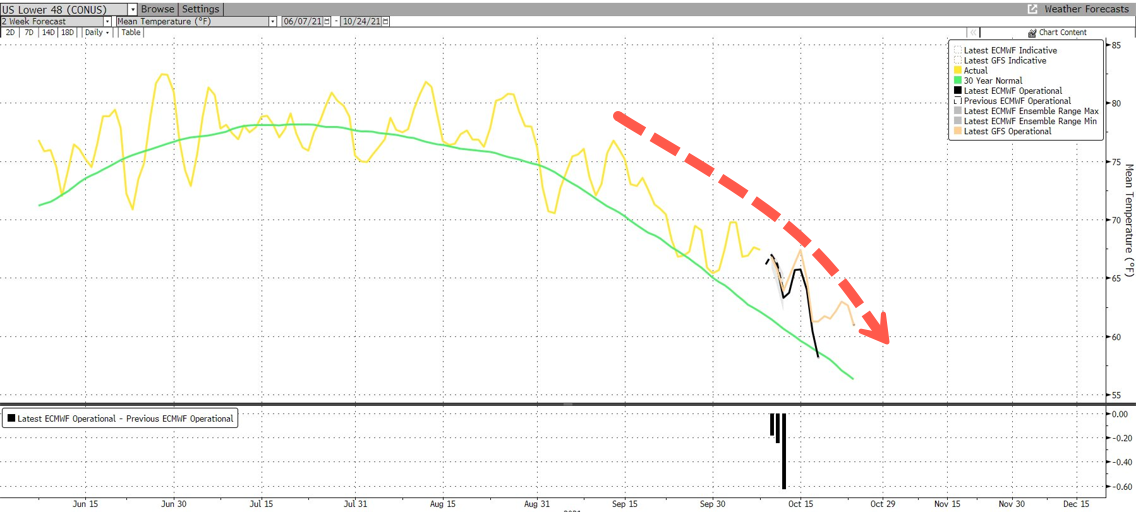
It’s important to note that US Lower 48 mean temps are declining as the colder weather arrives. If your home is heated by fossil fuels, such as heating oil, now is the time to fill up before a shortage materializes or prices continue moving higher. 

While the West is cold and snow is imminent, mild weather continues across the Eastern US next week. 

Tyler Durden
Sat, 10/09/2021 – 18:00

via ZeroHedge News https://ift.tt/3mDvtZb Tyler Durden

Kemp: Forget Russian Intentions, Fundamentals Drove Up Europe’s Gas Price

Kemp: Forget Russian Intentions, Fundamentals Drove Up Europe’s Gas Price

By John Jemp, Reuters energy market analyst and reporter

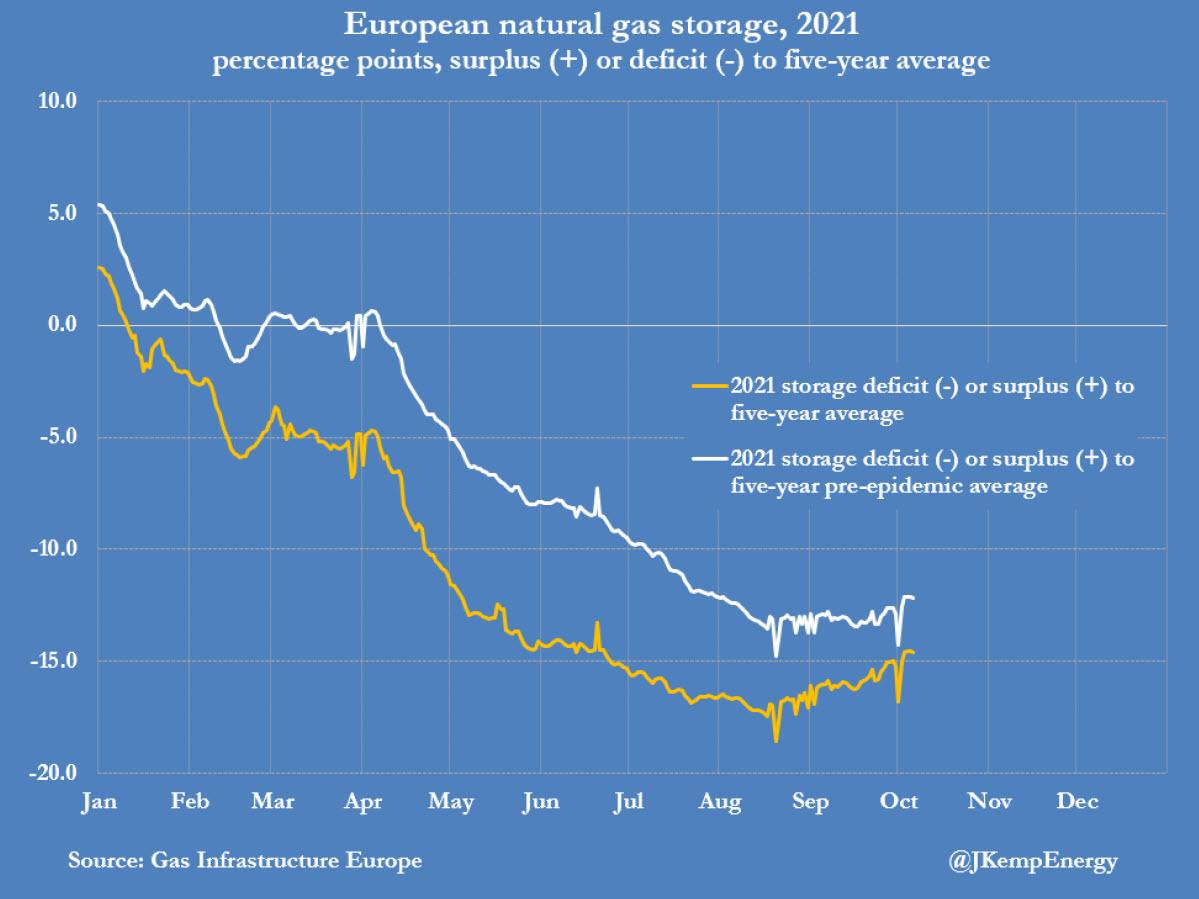
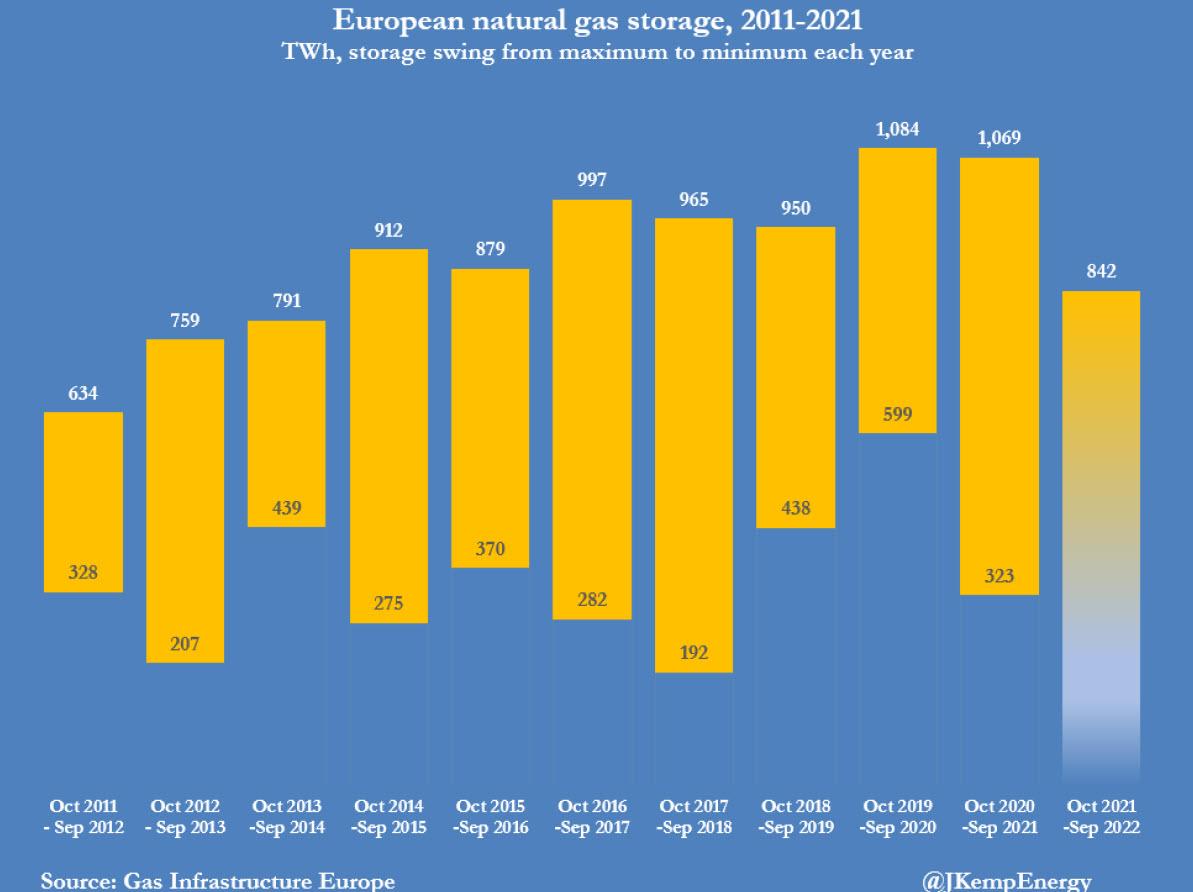
European policymakers and some traders blame Russia for the low volume of gas stored across the region which has sent both gas and electricity prices surging to record highs.

Russia’s pipeline gas export monopoly Gazprom has met commitments for long-term contracts, its clients confirm. But it has not raced to book extra pipeline capacity for spot buyers, despite European calls for more supplies.

Some policymakers and traders have speculated additional gas has been deliberately withheld to make a diplomatic point and accelerate the approval of the Nord Stream 2 pipeline. Others say Russia has withheld gas to create a shortage, drive up prices and increase export revenues, similar to the way the OPEC+ producer group raises oil prices and its revenues.

The other possibility is Russia has not supplied more gas because it faces its own shortage and wants to rebuild domestic stocks after they were depleted by a cold winter in 2020/21.

There is no empirical way to determine which theory is correct or what Russia’s intentions have been. But whatever the reason, the result is the same: gas is in short supply and European energy prices have hit record levels.

Escalating energy prices are a global phenomenon. Shortages of gas, coal, electricity and to a lesser extent oil are evident across North America and Asia as well as Europe. In every case, very high and rapidly rising prices this year are a reaction to very low and rapidly falling prices last year during the coronavirus-driven recession.

Energy prices have always been strongly cyclical. In this instance, an exceptionally severe cyclical slump in 2020 has produced an equally extreme cyclical upswing in 2021.

Energy production and consumption fell sharply last year, with consumption generally falling earlier and faster than production, leading to a big rise in inventories, and intensifying the downward pressure on prices. Since then, the process has reversed. Energy consumption has recovered rapidly, while production has come back more slowly, leading to a big inventory draw and intensifying the price rise.

In the gas market, the long cold winter across North America and Eurasia depleted inventories even further and accelerated the routine cyclical swing from slump to boom conditions.  Compared with five-year averages, energy inventories have moved from large surpluses in 2020 through neutral in the winter of 2020/21 to deficits by late 2021.

In Europe, the volume of gas in storage started the winter of 2020/21 at a near-record level of 1,069 Terawatt-hours (TWh) but ended at just 323 TWh. The winter drawdown of 2020/21 was the second-largest on record and left inventories at their lowest for three years.

The United States experienced a similar though less severe draw that left working gas stocks in underground storage slightly below the same average. By the start of spring 2021, conditions for a future gas shortage and a sharp rise in prices were in place if production and deliveries did not rise faster than normal over the summer.

When Russia failed to increase deliveries to Europe above contracted levels, and U.S. shale producers failed to increase drilling, the potential shortage in the spring of 2021 was transformed into an actual shortage by the autumn.

Squeezing

“You always squeeze with the grain of a market, never against it,” as one senior commodity trader once told me. Tight fundamentals and deliberate squeezes are inseparable. But it is the tight fundamentals that create conditions for a squeeze not the other way around.

Did Russia spot an opportunity this year to squeeze an already tight market by deliberately reducing gas exports? Or did Russia prioritize rebuilding its own depleted inventories? We will probably never know. But what is clear is that most or all of the rise in gas, coal and electricity prices in Europe and the rest of the world can be explained in terms of regular supply-demand fundamentals.

If the gas market had been comfortably supplied earlier this year, Russia would not have been able to increase prices by withholding production, whether or not that was its intention. In the same way, if the oil market had been comfortably supplied, with rising output from U.S shale fields and other sources, OPEC+ supply curbs would not have been able to lift prices by so much.

Price slumps promote retrenchment and consolidation among energy producers, leaving those that survive with more pricing power and higher revenues when the cycle turns up again.

Current energy shortages are an extreme version of the normal industry cycle, an exceptional price spike in 2021 in reaction to the exceptional slump in 2020.

By the same logic, the exceptionally high prices of 2021 are creating conditions for a more balanced or even oversupplied market later in 2022 and 2023.

Tyler Durden
Sat, 10/09/2021 – 17:38

via ZeroHedge News https://ift.tt/3oINCrf Tyler Durden