Biden’s “Absolute” Defense Of Hunter Leaves Media & Justice Department In A Muddle

Biden’s “Absolute” Defense Of Hunter Leaves Media & Justice Department In A Muddle

Authored by Jonathan Turley,

Below is my column in The Hill on President Joe Biden doubling down on his absolute defense of his son Hunter Biden. The comments only magnify the concerns over Attorney General Merrick Garland refusing to appoint a special counsel despite the clear basis for such an appointment.  It is clear that the President “absolutely” stands by his son and that the media absolutely stands by the President. The question is whether Garland will stand by justice and appoint a special counsel.

Here is the column:

“We absolutely stand by the president’s comment.” With those words, White House communications director Kate Bedingfield reaffirmed that President Biden maintains his son Hunter Biden did “nothing [that] was unethical” and never “made money” in China.
Those claims appear demonstrably false – and they make the positions of both the media and Attorney General Merrick Garland absolutely untenable.

For the media, the ongoing investigation of Hunter Biden by U.S. Attorney David Weiss in Delaware has presented a growing danger of self-indictment over its prior coverage (or noncoverage). Weiss has called a long line of witnesses before a grand jury, and there is growing expectation of criminal charges against Hunter Biden.

Nothing concentrates the mind as much as a looming indictment.

Thus, The New York Times, The Washington Post, CNN and other media faced the embarrassing prospect of an indictment based on a story they previously suggested was either a nonstory or Russian disinformation. Suddenly, in recent days, they all rushed to declare the story legitimate, 18 months after the New York Post reported it in October 2020.

What quickly emerged, though, was a new narrative: None of this implicates President Biden. On CNN, White House correspondent John Harwood declared, “There is zero evidence that Vice President Biden, or President Biden, has done anything wrong in connection with what Hunter Biden has done.” Anchor Brianna Keilar then added for emphasis that Harwood was making “an important distinction.”

It was important, but not because it was true. While many media figures now willingly admit the legitimacy of Hunter Biden’s abandoned-laptop story, they are avoiding what the emails found on that laptop actually contain. Hundreds of emails appear to detail a multimillion-dollar influence-peddling enterprise by the Biden family, including Hunter Biden and his uncle James Biden.

Influence peddling has long been the way Washington’s elite enriches itself. This common source of political corruption involves the relatives of powerful government figures who shake down corporations or countries for access and influence.

The Bidens would seem to be standouts in this common practice, engaging in a virtual family business. James Biden has been accused of marketing his connection to his brother. And in the emails discovered on his abandoned laptop, Hunter Biden practically sold timeshares of his father by dangling meetings and dinners for investors.

The key in any influence peddling scheme is to protect the principal. People apparently were told to avoid directly referring to President Biden. In one email, Tony Bobulinski, then a business partner of Hunter’s, was instructed by Biden associate James Gilliar not to speak of the former veep’s connection to any transactions: “Don’t mention Joe being involved, it’s only when u [sic] are face to face, I know u [sic] know that but they are paranoid.”

Instead, the emails apparently refer to President Biden with code names such as “Celtic” or “the big guy.” In one, “the big guy” is discussed as possibly receiving a 10 percent cut on a deal with a Chinese energy firm; other emails reportedly refer to Hunter Biden paying portions of his father’s expenses and taxes.

Despite President Biden’s repeated claims he knew nothing about these dealings, Bobulinski has said he personally met with the senior Biden to discuss Hunter Biden’s business activities. Bobulinski had been selected by the family to handle these deals.

As vice president, Joe Biden flew to China on Air Force Two with Hunter Biden, who arranged for his father to meet some of his business interests. Hunter Biden’s financial interest in a Chinese-backed investment firm, BHR Partners, was registered within weeks of that 2013 trip. Yet, President Biden repeatedly insisted that he never discussed such dealings with his son, a claim Hunter Biden has contradicted.

There are emails of Ukrainian and other foreign clients thanking Hunter Biden for arranging meetings with his father. There are photos from dinners and meetings that tie President Biden to these figures, including a 2015 dinner with a group of Hunter Biden’s Russian and Kazakh clients.

It is important to note that when these foreign interests were clamoring to give Hunter Biden millions of dollars, he was, by his own admission, a hopeless addict. In his 2021 memoir, Hunter Biden admits he was “drinking a quart of vodka a day” and “smoking crack around the clock,” up until his father’s 2020 presidential campaign began. So why would Russian, Chinese and other foreign figures give Hunter Biden all of this money, if not to influence his father?

The new narrative suggests that, while Hunter Biden maintained one of the largest influence-peddling schemes in recent history, it did not involve the object of that scheme — his father.

Even if President Biden was not influenced by all of this, it’s hard to believe he didn’t know his son was selling access. In his book, Hunter Biden claims his father repeatedly intervened due to his addictions — and yet we are to believe that Joe Biden did not express curiosity about how his addicted son was raking in millions from foreign sources?

The point is that President Biden really did not have to ask: Hunter Biden had nothing to sell but influence. All President Biden had to do to facilitate such schemes was to be accessible — to allow his family to deliver face-to-face meetings and photo ops.

And that brings us to the untenable position of Garland.

It is hard to imagine a stronger case for a special counsel. Any effort to investigate Hunter Biden’s dealings will lead investigators to encounter repeated references to the president and how he may have benefited from those schemes. At the same time, the president is “absolutely” standing by his denial that his son did anything wrong or made any money from China.

The White House statement this week serves as a reminder to investigators that the president is heavily invested in this narrative and his denial of now-established facts.

This is not to say that Weiss, the U.S. Attorney investigating Hunter Biden, will not be independent in his efforts. However, the concern is the appearance of how a conflict might affect the investigation or limit the scope of any potential charges. Moreover, absent a special counsel, there is unlikely to be a report on these apparent influence peddling schemes.

Garland pledged to protect the Justice Department from such conflicts and to avoid even the appearance of political influence. He now has a president stating that alleged wrongdoing by his son is “absolutely” untrue, including dealings possibly impacting the president personally and financially. If Garland declines to appoint a special counsel, he will absolutely fail on his pledge.

Tyler Durden
Mon, 04/04/2022 – 15:45

via ZeroHedge News https://ift.tt/2gbEsr0 Tyler Durden
Airlines Canceled Thousands Of US Flights Over Weekend 

Airlines Canceled Thousands Of US Flights Over Weekend 

Airlines canceled more than 3,500 US flights this weekend and delayed thousands more, citing weather-related issues in Florida and airspace congestion, according to AP News

On Saturday morning, storms in Florida caused widespread cancelations and delays at several Florida airports (including Miami, Ft. Lauderdale, Tampa, and Orlando), along with ones in Baltimore and New York, according to the flight-tracking website FlightAware

“Severe weather in the Southeast and multiple air traffic control delay programs have created significant impacts on the industry,” a JetBlue spokesperson told AP News in an email. 

Today’s cancellations will help us reset our operation and safely move our crews and aircraft back in to position,” the spokesperson continued. 

Southwest Airlines said “weather and airspace congestion” in Florida resulted in more than 1,000 canceled flights over the weekend. The airline noted that “technology issues” were also a factor but didn’t expand on those problems. 

In a separate issue, Alaska Airlines canceled flights after a pilot shortage emerged as pilots striked at major West Coast airports. These pilots demanded more pay and more flexible schedules. 

“Alaska Airlines failed to properly plan for increased travel demand and take the steps necessary to ensure it attracted and retained pilots,” the pilots union said on Friday. 

The flight woes come as travel demand surges despite increasing ticket prices due to soaring jet fuel costs. It also comes during the busy spring break travel season. 

Air travelers were furious this weekend, some told Southwest, “Unbelievable!! Canceled our flights again!! Looks like we need to start using another airline.” 

“I hope you are compensating your customers for their rental cars, hotels, and re-bookings on other airlines. The last time this happened, you blamed it on weather because that way you’re not responsible for any re-booking costs. I’m sure you’re doing the same thing now,” another traveler told Southwest. 

The good news is that FlightAware data on Monday morning shows the weekend mayhem of flight cancelations has abated. 

Tyler Durden

Mon, 04/04/2022 – 15:24

via ZeroHedge News https://ift.tt/h6odBlt Tyler Durden
Putin Driving Up Oil Prices Is An “Outrageous Lie”: USF Geology Professor Dr. Marc Defant

Putin Driving Up Oil Prices Is An “Outrageous Lie”: USF Geology Professor Dr. Marc Defant

Submitted by QTR’s Fringe Finance

About two weeks ago, I published an interview with Dr. Marc Defant about why he thought President Biden’s oil policies were “bat-shit crazy” and creating more turmoil than they were helping alleviate problems in markets.

This past weekend, I was happy to welcome him onto my podcast for a discussion about the current state of energy in the U.S., including pros and cons of natural gas, fracking, shutting down pipeline projects in the U.S. and the cost benefit analysis of extreme activist environmentalists.

Why We are Alone in the Galaxy | Marc Defant | TEDxUSF - YouTube

Dr. Marc J. Defant is a professor of geology/geochemistry at the University of South Florida. He worked for Schlumberger Well Services and Shell Oil for three years, with two years at Shell working as an exploration geologist.

He has been funded by the National Science FoundationNational Geographic, the American Chemical Society, and the National Academy of Sciences, and has published in many internationally renowned scientific journals including Nature. He has written a book entitled Voyage of Discovery: From the Big Bang to the Ice Age and published several articles for general readership magazines such as Skeptic and Popular Science and appeared on the Joe Rogan Experience podcast. You can reach him via this contact form.

First, we talked about how the price of oil got so high to begin with.

Dr. Defant told me: “Gas was up 40% and oil was up 80% before the Ukrainian war started. What got me a little incensed was that Biden is going around saying the price of gasoline is due to to Putin.”

“It’s kind of an outrageous lie,” he continued. “Most of [what’s pushing prices up] is totally unrelated to the war in Ukraine.”

“There was literally nowhere to put the oil, there was so much of it,” I said to him about oil’s crashing price several years ago.

Today’s post is free, but if you have the means and want to support my work, I’d love to have you as a subscriber: Subscribe now

“They’re saying right now that the average family in America can expect to pay an extra $5,200 because of the rise of oil prices. For some people, that’s the difference between food on the table and no food on the table. It’s becoming a crisis and Biden isn’t taking the steps to mitigate this major problem,” Dr. Defant continued.

“Biden is literally destroying the U.S. economy trying to get to net zero pollution,” he continues. “I consider myself an environmentalist, but not a radical environmentalist.”

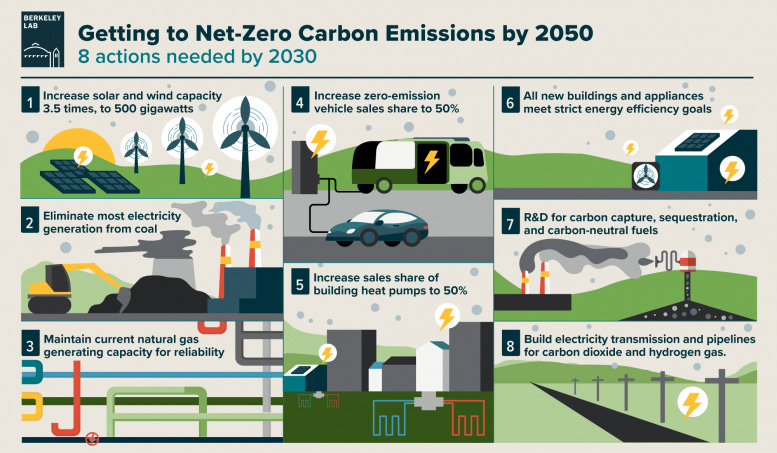
Dr. Defant told me: “I think we do have global warming but I’m not willing to destroy the economy to do some of the crazy things they’re trying to do. We’re supposed to go to net zero carbon emissions while the rest of the world is burning it as fast as they can.”

Net Zero Carbon Emissions 2050

Chart: Scitech Daily

He added: “If we do it, we’re just being foolish and we’re losing out to these other countries – many of whom are still burning coal!”

“We’ve reduced our carbon imprint more than any country in the world over the last 10 years, and I think we need a pat on the back for that.”

“[Environmentalists] are creating an evil boogeyman where there isn’t one and telling people it has to be addressed in a certain amount of time with certain methods and it doesn’t matter what the collateral damage,” I tell Dr. Defant about the country’s obsession with net zero emissions.

“B of A says it’ll cost America $150 trillion in 30 years to go to net zero emissions. I don’t know an economy in the world that can do that and not have a major crisis. We and Europe seem to be the only countries interested in doing this,” Dr. Defant tells me. “We’ve seen how Germany has failed. Now Germany is completely dependent on Russian oil because they’ve tried to go to net zero. They’ve realized it’s going to take a long time and it’s going to be very expensive.”

“I read a lot of the literature on global warming and for AOC to come out and say 2 or 3 years ago that the world was going to end in 12 years – that’s just hysterical craziness. I don’t know where that hysteria comes from,” he adds.

From there, we go on to discuss the pros and cons of fracking, petroleum’s use in our everyday lives, why the U.S. is now dependent on countries like Iran for oil and what the future of energy generation will look like in the future.

You can read my interview with Dr. Defant from March 22, 2022, here and you can listen to our full podcast, for free, here:

Thank you for reading QTR’s Fringe Finance . This post is public so feel free to share it: Share

Tyler Durden
Mon, 04/04/2022 – 15:05

via ZeroHedge News https://ift.tt/PgKnuSl Tyler Durden
Goldman: We Enter The Quarter With A Set Of Glaring Disjunctions

Goldman: We Enter The Quarter With A Set Of Glaring Disjunctions

By Tony Pasquariello, head of hedge fund sales at Goldman Sachs

Q1 is in the books; boring, it was not.  

After setting all-time highs on the first business day of 2022, by late February US equities were tracking for one of the worst starts to a new year on record — as stock operators wrestled with a reckoning of post-COVID demand, a considerably more hawkish Fed and a geopolitical disaster — resulting in a down 5% quarter.  

The twists and turns of S&P, however, belie the presence of a very few significant underlying trends that are apt to stay with us:

  • i. One year ago, the yield on US 2-year notes was 15bps; today, they’re marked at … 2.38%.  One year ago, the FOMC expected the Fed Funds rate to be 0% at the end of 2023; today, the dot plot suggests they expect to be at 2.75% by the end of 2023.  what I’m trying to say here: the Fed has a lot of wood to chop, they’ve just begun that chopping, and on any given Sunday, you’d be excused for wondering what the consequences of that chopping could be. 

  • ii. On October 6th of 2020, Jeff Currie in GIR remarked, “I’m the most bullish I’ve been on commodities since 2003/2004.”  the Bloomberg commodity spot index was trading at 350 back then; today, it’s marked at 625.  despite the magnitude of that rally, as you saw very clearly over the past few months, the commodities market is a small one — very, very small in the grand scheme of things — and is likely to remain a high velocity space.  

  • iii. In April of 2020, GMD colleague Pete Bartlett argued that “in 2017, the aggregate market cap of cryptocurrencies went from basically zero to ~ $750bn dollars … importantly, this was all done without any significant institutional participation.  the fear-of-missing-out on an upwardly trending chart turned about to be enough for retail to take a massive leap of faith into an asset with no earnings, no dividends or coupons, and very few existing use cases … it helps illustrate the capacity of retail, when aggregated, to trade in massive size, move assets to levels that don’t seem to jibe with fundamentals, and to trade on hope.”  since this remarkably prescient comment, the US retail investor has been the single largest sponsor of the domestic equity market, and absolutely remained on the bid throughout Q1; whether they can sustain that demand is one of the single most important questions for the balance 2022.  

In addition, we enter the quarter with a set of glaring disjunctions, reflective of a very uneven world that’s been subject to a series of jolts.  

  • You can easily see a wedge in positioning data: professionals continue to de-risk, while households have kept the hammer down

  • You can easily see a wedge in the macro data: U-M consumer sentiment is on decade lows, while ISM remains in the upper 50s

  • You can easily see a wedge in COVID case count and response function: the US and UK feel back to normal, while China continues to lock down some of the world’s largest cities.  

This again underscores the challenges of money management within a cycle that is going to look and feel different from what came before — and, where the biases we accumulated from 2009 through 2021 are the enemy now.

In the end, it was an action-packed quarter that rewarded pattern recognition, experience and gut instincts — thus playing to the strengths of both systematic managers and the discretionary macro community.  

Looking ahead, I have a feeling those big trends — upward pressure on US rates, upside convexity on commodities and the big footprint of the US retail investor — while they are arguably extended in the short-term, I believe they will remain with us for a while longer.

* * *

1. Before yesterday, the question of “how is it that stocks trading so well off the lows” was coming up 444 times a day. Unto itself, this is a reflection of how negative professional sentiment was coming into March. More elementally, simply judging from price action in the VIX and RUB, there’s been a major easing of asset market risk premia on the prospect of geopolitical de-escalation (I worry this truncation of downside tails has perhaps gone too far). Alongside this, again, the easiest story I can tell is flow-of-funds have skewed clearly positive: part of this is model-driven/non-discretionary strategies (~ $8bn/day), part of this is the aforementioned retail investor (witness the GS retail favorites basket — ticker GSXURFAV — is up 20% over the past two weeks), part of this has been forced short covering of underwater hedges.  For a more fulsome read, GIR’s Peter Oppenheimer put out a punchy note with seven takes on the recent strength: link; my favorite line: “equities are a real asset with a claim on nominal GDP.”

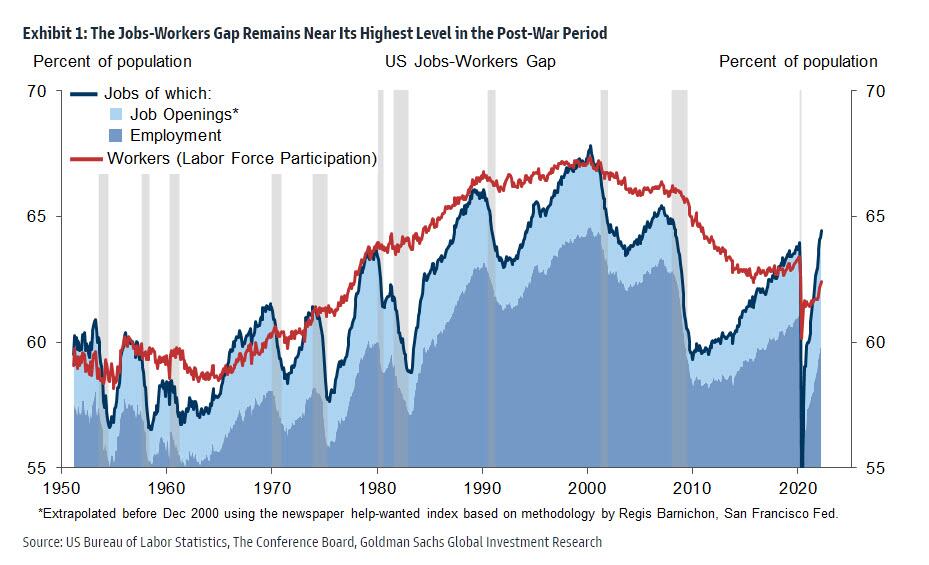
2. Another key ballast in recent months has been ongoing strength in the US labor market; The big picture: we’re witnessing the widest gap between US labor supply and labor demand in the post-WWII era. Wwhile acknowledging that labor market data is classically regarded as a lagging indicator, my point here is that it should remain healthy for a while longer; again, we have 7mm unemployed against 11mm job openings, and that wedge isn’t closing tomorrow.  furthermore, for all the shocks that households are contending with these days, I have to believe the trends in both jobs and wages are sticky will serve as an ongoing counter-balance.  for a differing opinion: link; for an assessment of what the asset markets are pricing: link.   

3. Praveen Korapaty, GIR, on yield curve inversion: “when talking about the curve inversion, it is worthwhile specifying which curve we are talking about.  while most investors track the 2y10y yield curve, some academic work suggests other curves, such as the 3m10y or a front end forward curve may be a ‘better’ predictor of recessions. Irrespective of the curve being tracked, inversions in the last few decades have been mild. However, we haven’t had a high inflation environment like the one we’re currently in for a while, and our work (link) suggests that curves can get much more inverted in such environments — so rather than a 20-40bp inversion, you could see a greater than 50bp inversion. In the 70s and early 80s, for instance, you saw yield curves invert between 100-200bp ahead of recessions. While we think curve inversion shouldn’t be ignored even in the current environment, we find that mild inversion has in past instances with high inflation has tended to generate more false positive signals for a recession commencing in the subsequent 12 months.”

4. US mega cap tech has traded notably well of late (e.g. ticker GSTMTMEG is up 9-of-13 days for 14%).  I presume some of this a function of TINA (to be sure, it’s been the worst start for US Fixed Income in 42 years … see point 13 at bottom).  I presume part of this is, yes, thanks to the strong hands of the retail investor (namely AAPL and TSLA). And, to Peter’s earlier point, global real rates remain deeply negative — note that since liftoff commenced at the March FOMC, US financial conditions have actually eased. Going forward, I believe the quality factor — which has a bias towards big cap tech — will remain a stronghold.    

5. Earnings: the month of April will feature a hugely important reporting period for Q1 (to commence, in earnest, in three weeks). On one hand, consensus is expecting ~ 5% y/y growth — and, zero growth ex-energy — so, one can argue the bar is low.   that said, with inflation this high, it’s reasonably — if remarkably — difficult to forecast sales and margins’ that to me is the biggest open question. Given the significance of external factors at work right now, at the very least I suspect the coming earnings barrage will generate a significant dose of dispersion at the single stock, sector and factor levels of the market.    

6. US exceptionalism: to repeat a point from last week, the US is self-sufficient with respect to energy, food and defense.  I don’t want to go too far with this argument, as we know the domestic economy is far more complicated (and externally-linked) than that would suggest. Where the home-field advantage does seem to be clearly manifesting is flow of capital, as the US continues to see inflows, while Europe is the funder: link. Given all the challenges in Europe, Asia and select parts of EM, I reckon this trend towards the US will remain in place a while longer.

7. in the context of localization/regionalization, this note from GIR’s Ronnie Walker on reshoring, supply chain diversification and inventory overstocking is highly interesting. The punch line as I saw it: “greater supply chain resilience comes at a price, and some investors worry that these trends will add to inflationary pressures.  But the costliest of the three responses — reshoring production to the US — is also the least underway, suggesting that the shifts to date are a second-tier influence on the inflation outlook relative to key macroeconomic forces like labor market overheating” (link). 

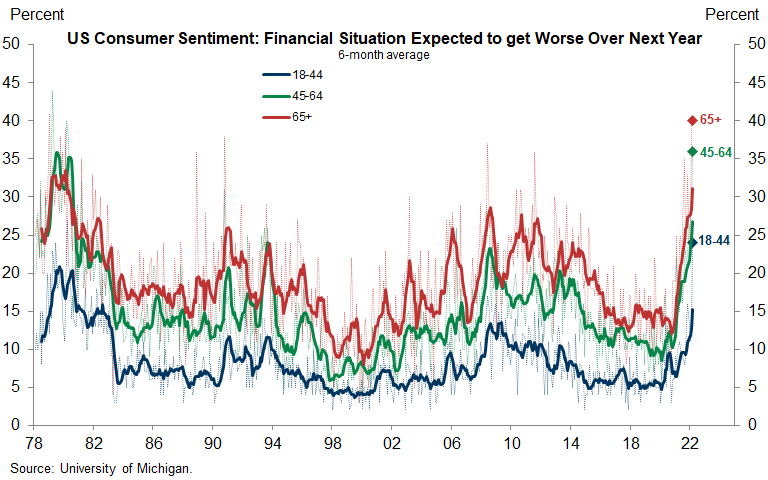
8. Speaking of U-M consumer confidence data, this is an interesting take from Mike Cahill in GIR, which breaks down consumer sentiment by age group. As you can see, older cohorts began reporting significantly worsening expectations last spring. More recently, however, younger respondents started to also get more pessimistic, with a big jump this month (in fact, the most negative younger adults have been since 1980):

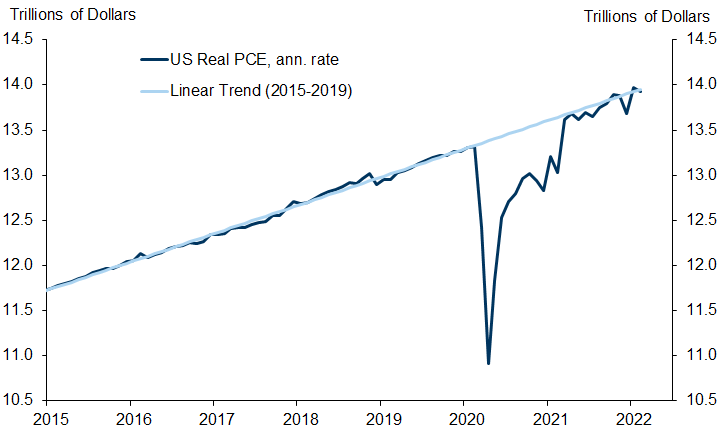
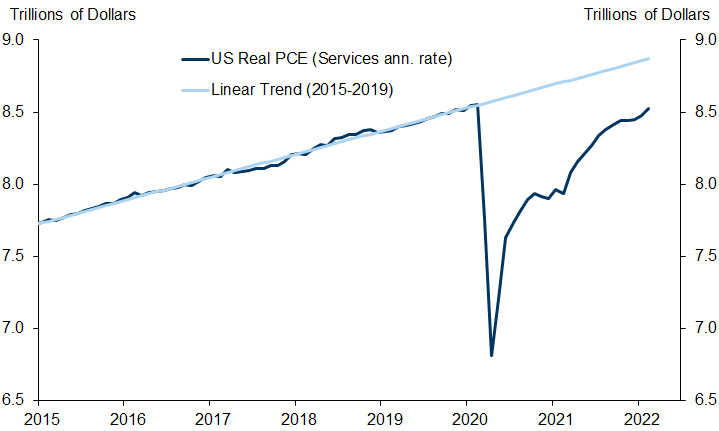
9-a. On the topic of US retail sales, it’s worth revisiting these three charts on US consumption, also credit to Mike Cahill … if you squint, you’ll see a shift from goods to services:

9-b:

9-c.

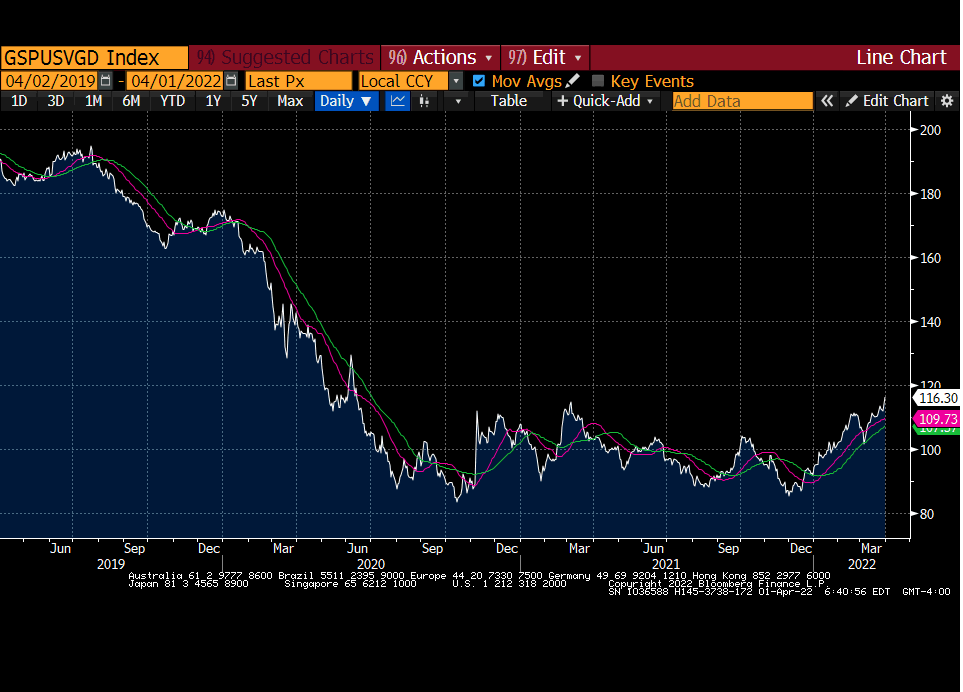
10. following that sequence, a GS pair trade … long stocks levered to services, short stocks levered to goods:

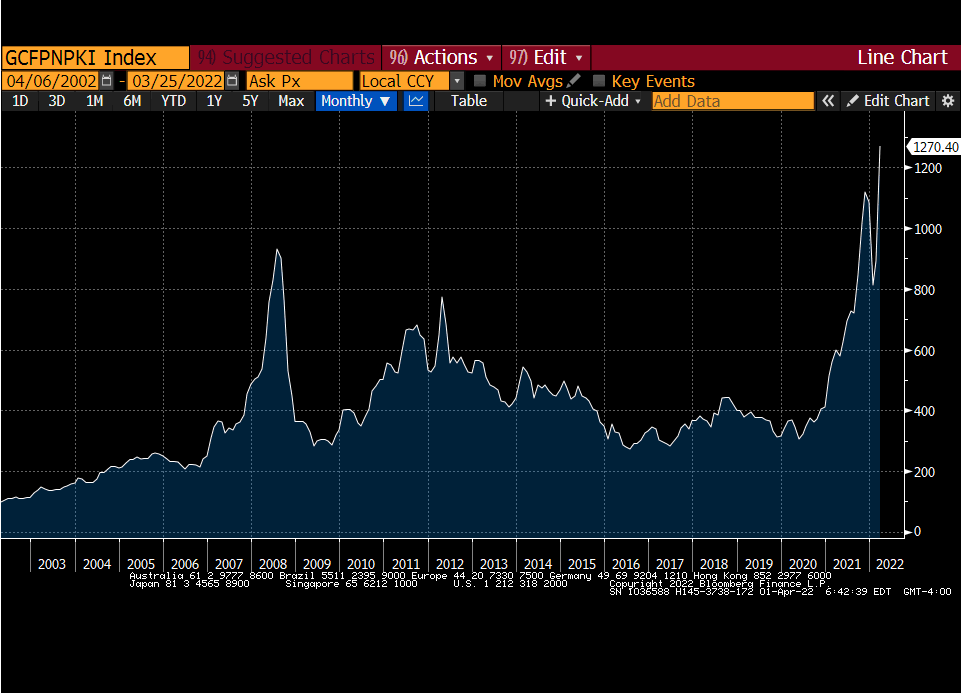
11. Russia is the world’s largest exporter of fertilizers.  this is a generic index of fertilizer prices.  I wonder if folks are too complacent about the inherent risks here?  As Adam Samuelson in GIR put it to me, “the spike in fertilizer is a major issue underpinning the bullish view on agricultural commodities and why some of the inflationary pressures in the food system won’t abate anytime soon.  These kinds of increases don’t fully start flowing to the grocery store until 2H22 and beyond.”

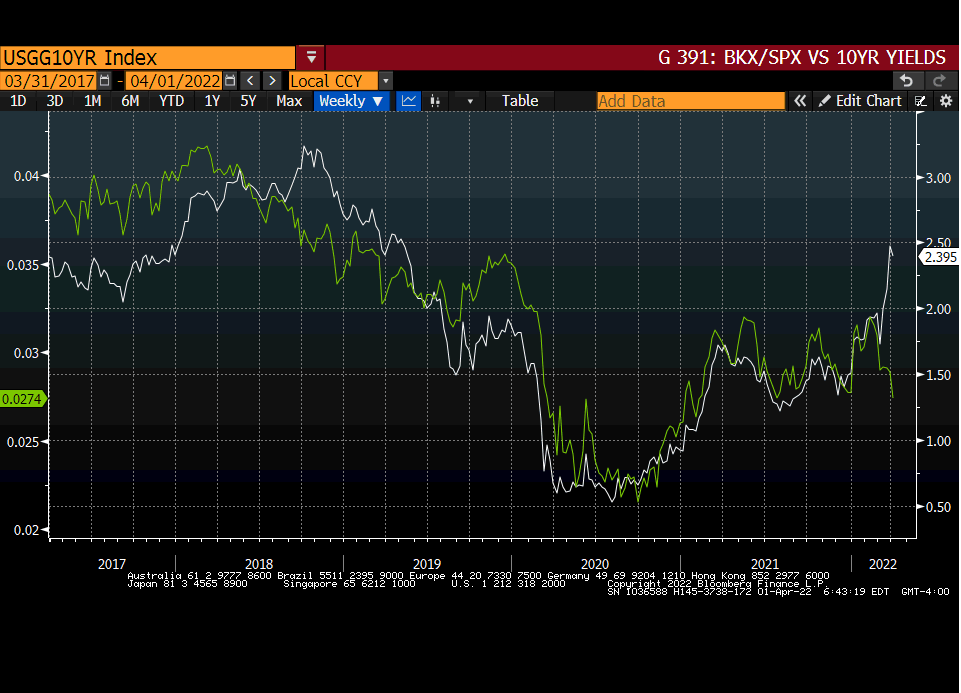
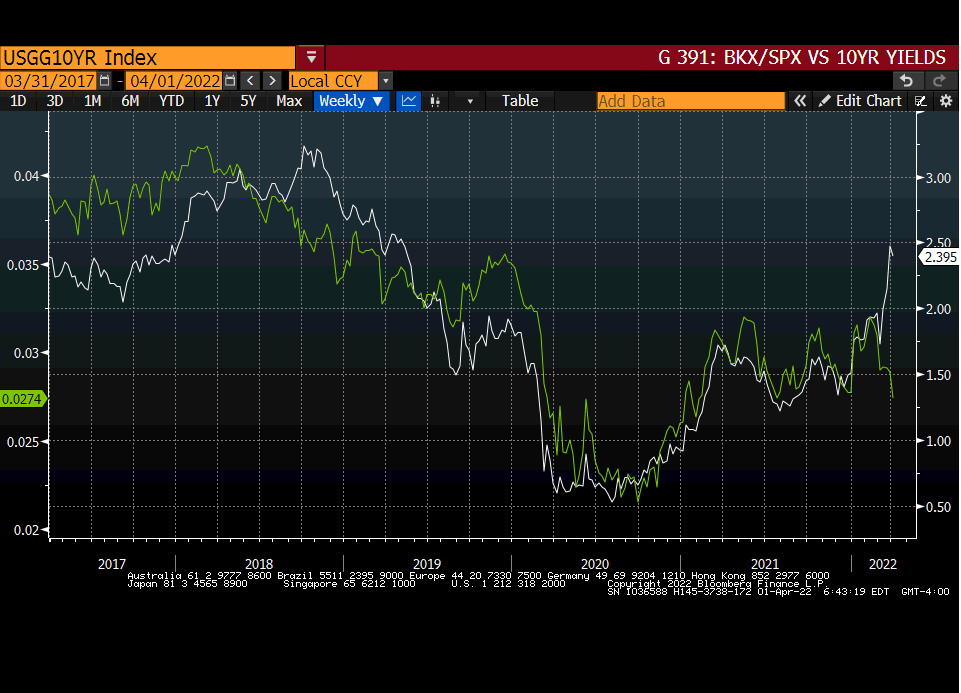
12. The white line is US 10-year note yields; the green line is the ratio of BKX over S&P.  what’s going on with this huge divergence? Informal take from Ryan Nash in GIR: “we have seen a major decoupling between interest rates and bank stocks over the past few weeks.  while banks benefit from both higher short-term and long-term interest rates and are as sensitive to higher rates as they’ve ever been, this is all about the market worrying about inflation risk and the likelihood of stagflation or a recession.   in addition, the investor community has begun to question what the inverted yield curve is telling us and that the fed might have to start cutting at some point, leading to markets pricing in some downside risk.” 

13. presented without bias, the aforementioned US Aggregate bond index.   the top line is the rolling price of the index; the bottom half is the quarterly rate of change:

Tyler Durden
Mon, 04/04/2022 – 14:45

via ZeroHedge News https://ift.tt/neGfkMz Tyler Durden
Court Rules California’s Corporate Diversity Law Unconstitutional

Court Rules California’s Corporate Diversity Law Unconstitutional

Authored by Mimi Nguyen Ly via The Epoch Times,

A Los Angeles court determined on April 2 that a California law requiring certain workplace boardroom quotas of underrepresented communities is unconstitutional.

Conservative watchdog group Judicial Watch filed a lawsuit (pdf) in early October 2020 arguing that any spending of taxpayer funds or taxpayer-paid resources on the quota law is “illegal under the California Constitution.”

The lawsuit was filed days after California Gov. Gavin Newsom signed it into law. The measure required publicly traded companies to have a minimum of one director from an “underrepresented community” on its board by the end of last year and potentially more such directors by the end of 2022, depending on the number of members on a given board.

According to the law, a “director from an underrepresented community” refers to “an individual who self-identifies as Black, African American, Hispanic, Latino, Asian, Pacific Islander, Native American, Native Hawaiian, or Alaska Native, or who self-identifies as gay, lesbian, bisexual, or transgender.”

California Gov. Gavin Newsom speaks to reporters at AltaMed Urgent Care in Santa Ana, Calif., on March 25, 2021. (John Fredricks/The Epoch Times)

California’s Assembly Appropriations Committee has noted that AB 979 “will result in ongoing costs in the hundreds of thousands of dollars to gather demographic information and compile a report on this data on its internet website,” Judicial Watch stated in its complaint.

Judicial Watch stated in its motion for summary judgment (pdf):

“Laws that explicitly distinguish between individuals on racial or ethnic, sexual preference, and transgender status grounds fall within the core of the prohibition of the equal protection clause.”

The group stated that the law’s quotas requirement is “immediately suspect and presumptively invalid and triggers strict scrutiny review.”

“Because it classifies directors by virtue of their race, ethnicity, sexual preference, or transgender status, AB 979 can only be justified by a compelling governmental interest, and its use of race and ethnicity must be narrowly tailored to serve that compelling interest,” the motion reads.

“As Defendant cannot make these difficult showings, AB 979 is unconstitutional and any expenditure of taxpayer funds or taxpayer-financed resources in furtherance of, ensuring compliance … quotas required by AB 979 is illegal.”

Tom Fitton, president of Judicial Watch, in Washington on Oct. 31, 2019. (Samira Bouaou/The Epoch Times)

“This historic California court decision declared unconstitutional one of the most blatant and significant attacks in the modern era on constitutional prohibitions against discrimination,” Judicial Watch President Tom Fitton said in an April 2 statement.

“In its ruling today, the court upheld the core American value of equal protection under the law. Judicial Watch’s taxpayer clients are heroes for standing up for civil rights against the Left’s pernicious efforts to undo anti-discrimination protections.”

California’s governor, secretary of state, and attorney general didn’t respond to The Epoch Times’ requests for comment by press time.

Tyler Durden
Mon, 04/04/2022 – 14:25

via ZeroHedge News https://ift.tt/Q604bhX Tyler Durden

“Now It’s About The Ice”: Mike Wilson Says Bear Market Rally Is Over

“Now It’s About The Ice”: Mike Wilson Says Bear Market Rally Is Over

With one half of Wall Street – such as the degenerate permabulls at JPM – desperate to see the record distribution extend and retail investors continue to buy everything that liquidating hedge funds have to sell, and urging anyone who still listens to them to ignore such recession signs as yield curve inversion, while the other half of Wall Street is dazed and confused and unable to decide whether to buy here (along with most other hedge funds) or to bet it all on green (along with most degenerated retail traders) and pray for another short squeeze, few dare to invoke the worst case: namely, that the March bear market rally is over and that a recession is imminent.

However, Morgan Stanley’s chief US equity strategist Mike Wilson, who has been feuding with BofA’s Michael Wilson for biggest reformed bear (unlike the likes of Albert Edwards who were always bearish), has no such problems and in his latest Weekly Warm-up note writes that “after one of the roughest quarters in history for stocks and bonds collectively, the markets better reflects the “Fire” part of our narrative; but now it’s about the “Ice,” and that’s decidedly worse for stocks relative to bonds.” And so, as the market comes to the realization of just how bad it will still get, Wilson declares that “the bear market rally is now over” as markets grasp the realization that the US economy is heading for a sharp slowdown driven by  i) payback in demand from last year’s fiscal stimulus, ii) demand destruction from high prices, iii) food and energy price spikes from the war that serve as a tax, and iv) inventory builds that have now caught up to demand. And as this increasingly brutal macroeconomic backdrop eats away at corporate profits, it will be increasingly harder for investors to ignore, and stock prices will be hammered next.

Some more background.

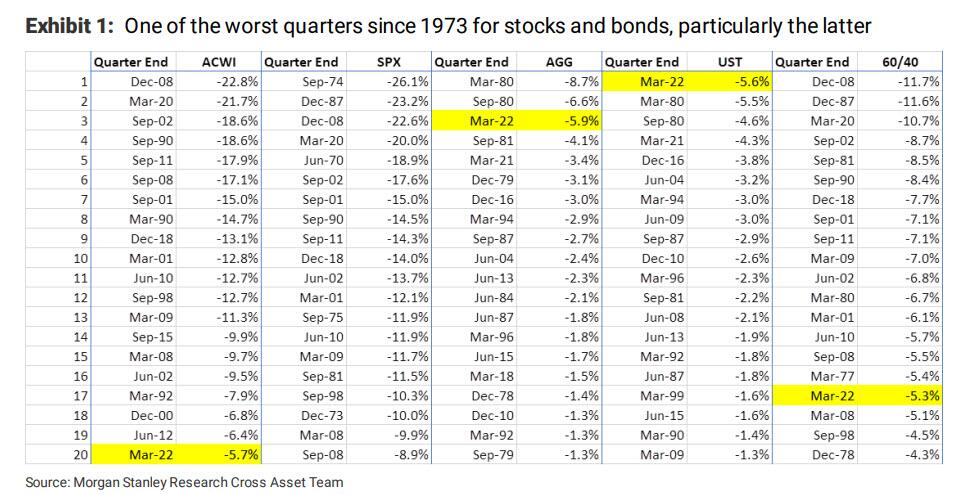
First, looking back at the just concluded quandary of a quarter, Wilson writes that given how bad first quarter returns were for both stocks and bonds, “most investors (both asset owners and manager) were probably happy to see it end.” Furthermore, the bear market rally in the second half of March – which as we explained on several occasions was not due to fundamentals but to technicals and positioning – made it considerably better for stocks than it was looking just a few weeks ago. In the end, Wilson notes, “bond returns ranked much worse than stocks from a historical perspective, with Treasuries posting their worst quarter in 50 years.”

Yet while for many the turmoil of Q1 was a surprise, it was not surprise to Wilson who writes that “the tough 1Q was very much in line with our view coming into 2022 – i.e. we didn’t see many fat pitches given the Fed’s (and other central banks’) resolve to fight the surge in inflation in the face of slowing growth (Tightening Fed and Slowing Growth = Defense).” Indeed, whether it was for technical or fundamental reasons, bond and stock markets ignored this risk into year end 2021 and instead they required an additional prompt, which the Fed – which as a reminder is hoping to crash stocks according to Zoltan Pozsar – gladly supplied with the minutes of its December meeting on January 5th. From that moment, both stocks and bonds made a sharp U-turn and never really looked back for the entire first month of the year.

In short, headline indices in stocks and bonds finally adjusted to the “Fire” part of Wilson’s narrative, i.e., the sharply higher rate reality, a risk that started to price under the surface in early November when Powell was renominated. And so, with inflation (finally) on everyone’s mind in 1Q more than any other risk, it made sense that bonds would be worse than equities. It also makes sense that stocks most vulnerable to higher rates did even worse than the more diversified S&P 500 index – i.e. the Nasdaq performance was considerably worse than both the S&P 500 and Russell 2000, a very rare occurrence over the past few years. And, this is after a major rally in the past two weeks that was led by the Nasdaq.

Wilson’s takeaway was that markets were preoccupied with the Fed’s sharp pivot more than anything else and it played out in asset prices, appropriately.

… but now comes the slowdown

It’s not just the fire and ice narrative: the other major driver of markets in Q1 was the war in Ukraine. While tensions had been building since late last year, it’s fair to say markets had ignored this risk as much as the Fed’s pivot. The only difference is that the Fed’s pivot was well telegraphed while Russia’s invasion was far from a sure thing and more of an unknown known to most, including Wilson. Such an event did materially factor into the risks for 1Q by accentuating the Fire and Ice – i.e., it made inflation worse while dampening growth prospects simultaneously.  It has also rattled confidence for both businesses and consumers, especially in Europe. And since this was not in Morgan Stanley’s already bearish calculus when the bank made its forecasts for 2022, it now finds itself “incrementally more negative on growth trends than we were at the end of last year.”

Wilson lays out what this incremental bearishness means in practical terms:

Last fall we pushed out the timing of the Ice part of our narrative to 1H22 when we realized the economy still had plenty of strength left for companies to deliver on earnings growth. But, now investors face multiple headwinds to growth that will be harder to ignore – i) payback in demand from last year’s fiscal stimulus, ii) demand destruction from high prices, iii) food and energy price spikes from the war that serve as a tax, and iv) inventory builds that have now caught up to demand. While the first three headwinds are somewhat appreciated, we think the last one is not.

Specifically, and in keeping with last week’s FreightWaves “recession is imminent” note that crushed the freight sector, Morgan Stanley had been highlighting the risk for supply to overwhelm demand in many goods this year while most have viewed the recent build in inventory as mainly a positive that will help tame inflation. Here, Wilson would warn investors to be careful what you wish for: “Inflation has been an elixir for profits for most of this recovery. Until now, companies have had little problem passing along higher costs, hence why we have inflation. However, as supply catches up to demand, pricing power will likely dissipate and discounting could return in many areas of consumer goods that typically are price takers.”

Separately, Wilson expects to also see cancellations of orders that were doubled up due to the shortages. It’s why the bearish strategist warns that “semiconductor stocks and other areas of the market that have very fragmented supply chains look to be the most vulnerable.” Which brings us to the punchline of Wilson’s latest note:

The bear market rally is over

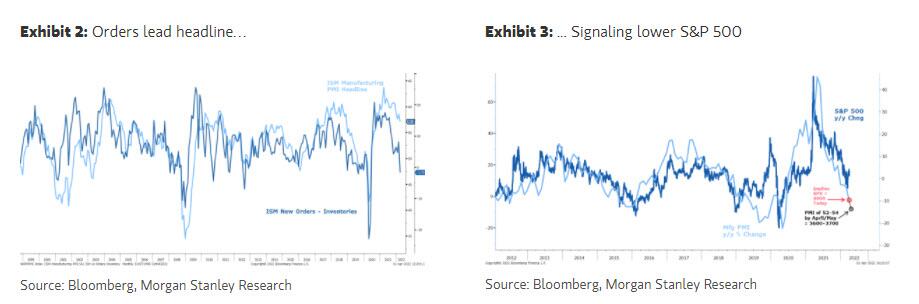
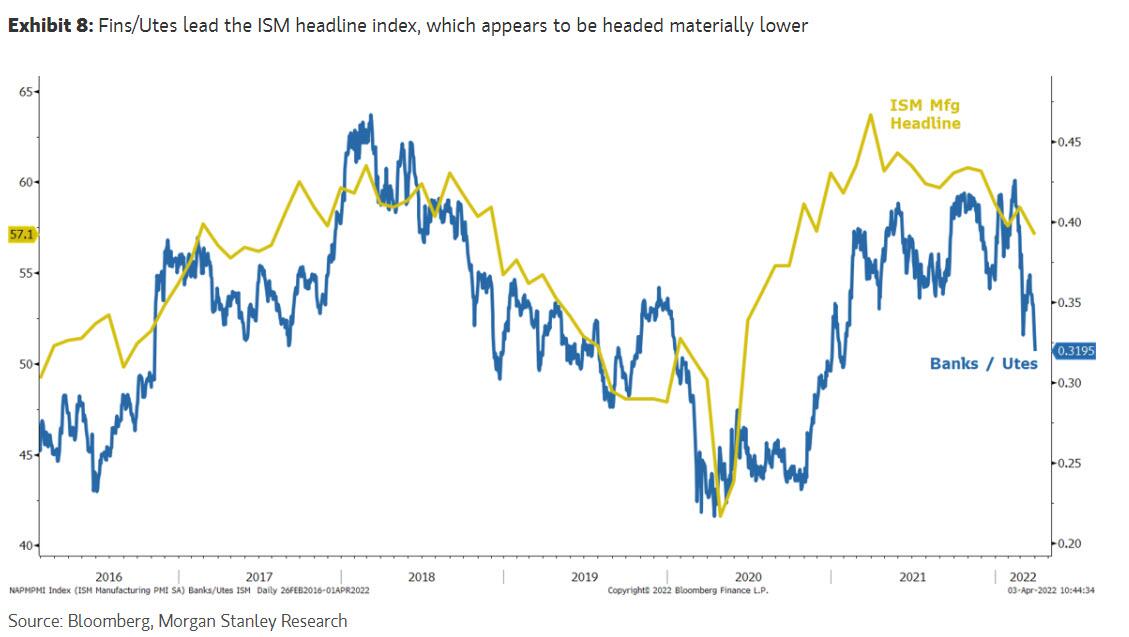
On that score, the strategist writes that “Friday’s ISM release showed a sharp deterioration in the orders component, and relative to inventories, it looks even worse, with the inventory component of the index now below orders for the first time since the recovery began.” Think of this as a book to bill for the broader manufacturing economy. Based on the Ice and over-ordering thesis, this is precisely the worst case outcome that Wilson had been expecting… and now it is here.

As shown previously, this differential between the orders and inventories components leads the headline index (Exhibit 2). Importantly for investors, it suggests the S&P 500 has another rough month(s) ahead (Exhibit 3). Bottom line, the rally in stocks over the past few weeks has been remarkable, but in our view it has all the characteristics of a bear market rally, and we view month/quarter end as the perfect spot for it to come to an end.

How to trade the end of the bear market rally?

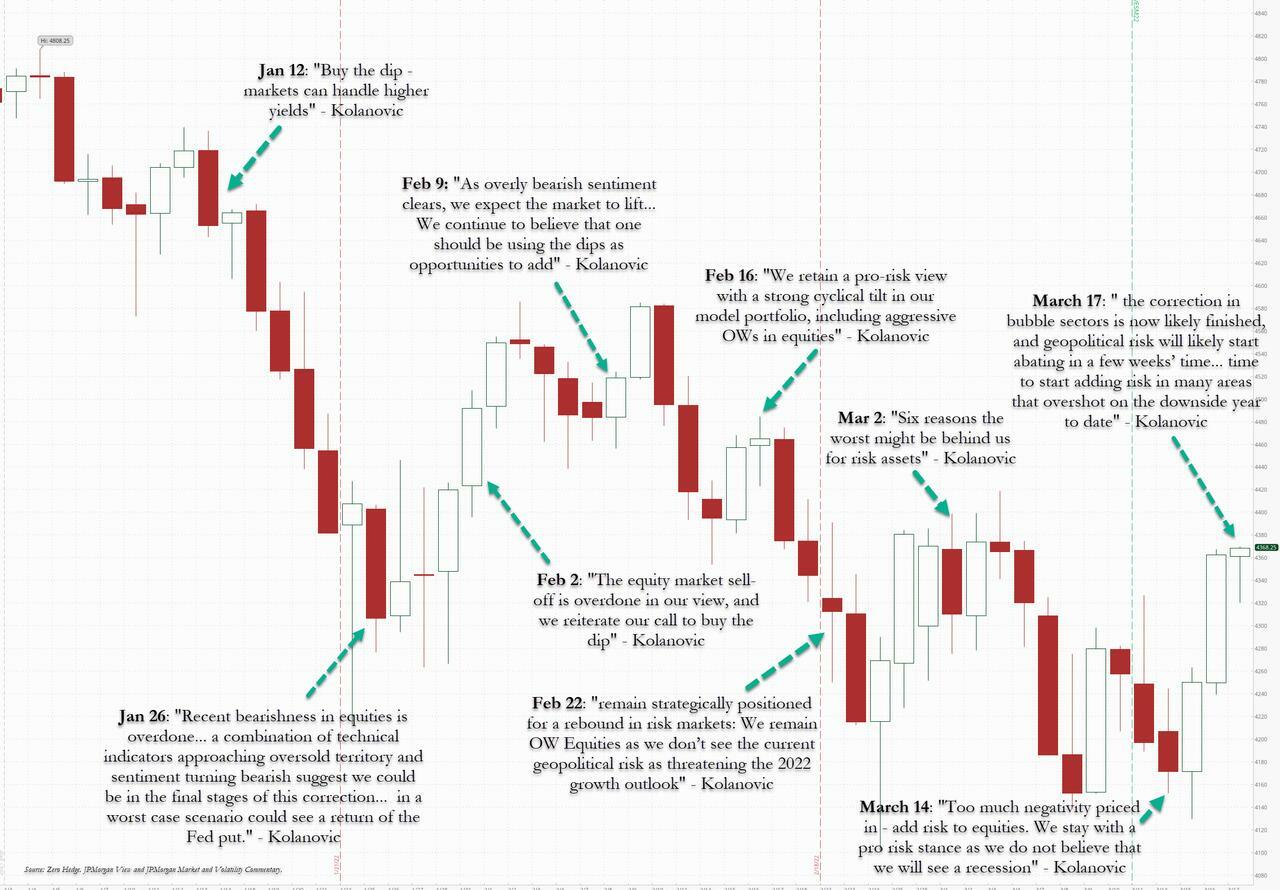
While we know of quite a few banks and strategists who will go apeshit at Wilson’s dismal assessment, most of all Marko Kolanovic who has literally said to buy the dip every single week in 2022…

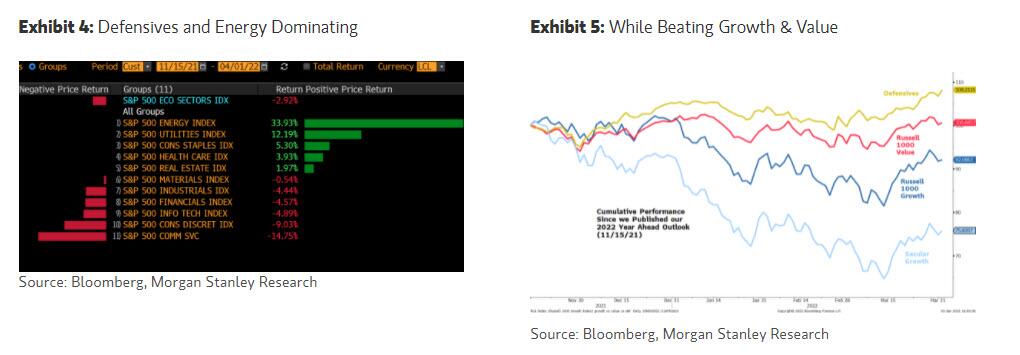
… Wilson goes one step further and rubs it into the faces of all those sellsides who expected the S&P to close above 5,000 (and are now desperately dragging their forecasts lower) and writes that based on his Fire and Ice narrative and all of the building evidence to support it, he has been defensively positioned in his strategy recommendations since he published his year ahead outlook back in mid November: “while not a straight line, this positioning has worked well and has dominated a growth or cyclicals bias (Exhibit 4 and Exhibit 5). Our big miss was being equal weight Energy although in our Fresh Money Buy list we have effectively been overweight with our 10% position in Exxon as a “defensively” oriented energy stock. Bottom line, defensive positioning has been the right move.”

This defensive domination may surprise Wilson’s readers given the large weighting of Energy within cyclicals and the fact that rates have moved up so much in the past several months. As he explains, “typically defensives act poorly in a rising rate environment as they serve as a bond proxy in many ways. However, bond proxies are doing well, especially over the past week when Real Estate and Utilities were the best-performing sectors. It’s also worth noting that on the back of Friday’s strong labor market report, 30-year bonds rallied 2 points from the intra-day lows.”

While some of this may be due to the ugly ISM report noted above, Wilson’s sense is that the markets are starting to price in our Ice scenario right on cue. And, in this context, the strategist thinks that 30-year Treasuries offer an excellent hedge against the growth scare he expects now that the Fed is fully priced: “Last week’s price action seems to support such a view and we’re sticking to it with our reiteration of defensive stocks as the place to be. We remain overweight Utilities, REITs and Healthcare.”

Conversely, Wilson is also underweight Consumer Discretionary and cyclical Tech while keeping equal weights in everything else and focusing on stock picking; MS is also recommending Defensives over both cyclicals and growth.

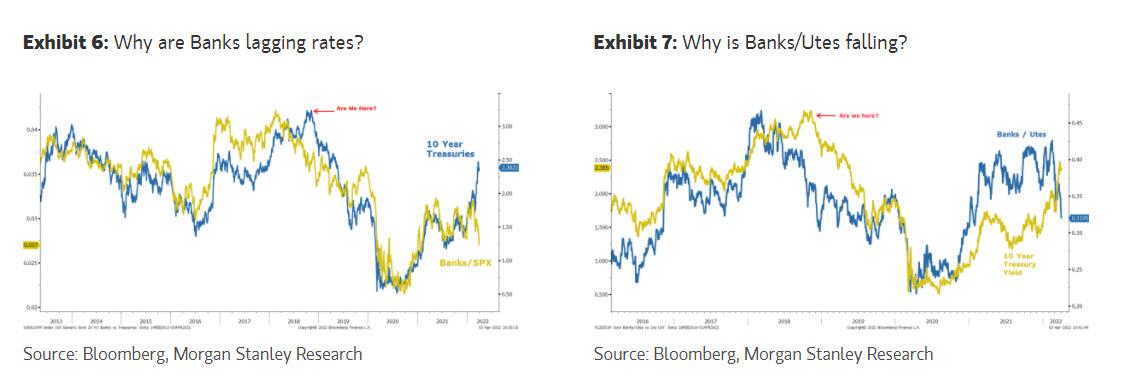
Finally, following Wilson’s last week downgrade of Banks, he thinks that the pair of Utilities over Banks looks particularly attractive. With Banks positively correlated to back end rates, “this is another example of the internals of the market saying we close to a top.”

Last but not least, the inversion of the yield curve – which was not mentioned yet – is clearly supportive of this relative value trade as it signals late cycle, a time when Utilities dominate early cycle groups like Banks. The pair is also highly correlated to the ISM manufacturing index, which is headed much lower.

Tyler Durden
Mon, 04/04/2022 – 14:05

via ZeroHedge News https://ift.tt/OnMK7AY Tyler Durden

18-34 Year Olds Want More Free-Money For Themselves (But Who Will Pay For It?)

18-34 Year Olds Want More Free-Money For Themselves (But Who Will Pay For It?)

Authored by Mike Shedlock via MishTalk.com,

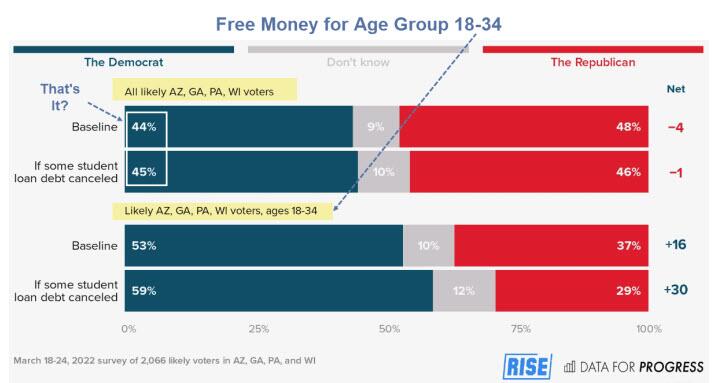
Please consider a very biased poll on student debt cancellation and disingenuous reporting by Business Insider…

Data on Progress Poll, annotations by Mish

Business Insider writer Ayelet Sheffey says Student loan forgiveness could lure nearly half of Americans in key battleground states to vote in November.

  • Data for Progress and Rise surveyed Americans in key battleground states on student-debt relief.
  • It found 45% of respondents would be more likely to vote if Biden cancels $10,000 in student debt.

If you are looking for fluff reporting, look no further. 

Hoot of the Day 

Amusingly, Sheffey quoted delusional thinkers commenting about delusional thinking.

New York Rep. Alexandria Ocasio-Cortez said in December it would be “actually delusional” to think Democrats could win elections if they fail to follow through on voter priorities. Massachusetts Sen. Elizabeth Warren said in January that canceling student debt “would persuade a lot of young people that this president is in the fight for them.”

Delusional Thinking

AOC and Warren are delusional.

Democrats will get trounced in November because the radical Left hijacked the party, not because Democrats failed to pass the legislation. 

Curiously, Sheffey did not even link to the poll! 

The Touted Poll 

Headline vs Reality

  • BI Headline: Student loan forgiveness could lure nearly half of Americans in key battleground states to vote in November.

  • BI Bullet Point: It found 45% of respondents would be more likely to vote if Biden cancels $10,000 in student debt.

  • Reality: The baseline poll shows an edge for republicans over Democrats 48-44. That changed to 46-45 in favor of Republicans after a series of leading questions.

The change, assuming it’s believable, is from R+4 to R+1 in the battleground states. 

Is the Change Even Believable?

Perhaps, but I rather doubt it. 

People who believe in free money for student loans are going to vote Democratic anyway. 

Ask enough leading questions and a percentage of people will change their reply along the lines of “Heck yes, I would rather have even more free money.”

What Would More Free Money Do?

In three words: Dramatically increase inflation. 

  • More free money would increase demands for all kinds of goods and services. 
  • Increased demand for goods and services would further strain supply constraints and increase labor demands and constraints.

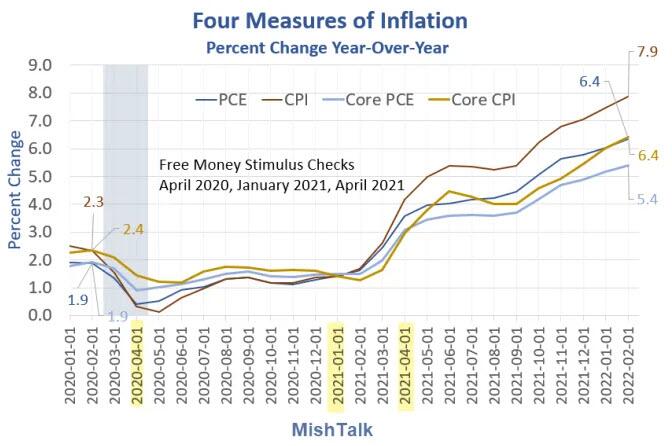
Four Measures of Inflation

Inflation data from St. Louis Fed, chart by Mish

Chart Notes

  • CPI stands for Consumer Price Index

  • PCE stands for Personal Consumption Expenditures.

  • PCE differs from the CPI (Consumer Price Index) in that it includes expenses paid on behalf of consumers such as Medicare and company medical plans whereas the CPI only included expenses directly paid by consumers.

  • Core means excluding food and energy

  • Neither the CPI nor PCE directly includes home prices, instead they incorporate rent

  • The yellow highlights on dates indicates timing of free money stimulus checks

Inflation had already taken off before the final and biggest round of free money.

That third round of fiscal was grossly unwarranted and fueled huge inflation in a big shotgun blast of free money.

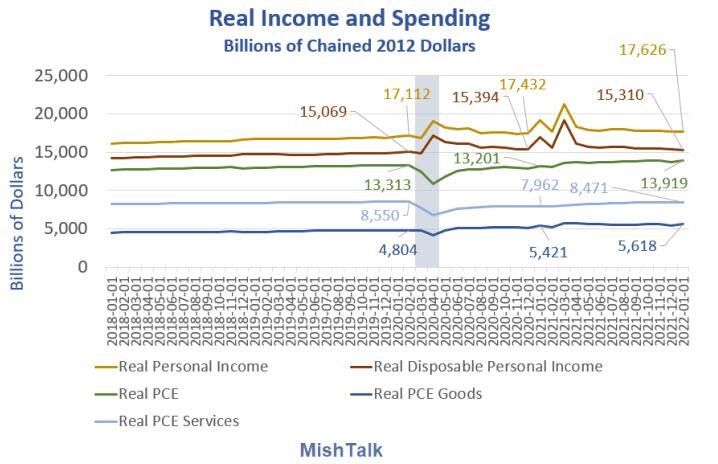
Real Income and Spending Billions of Dollars 

Real Income and Spending data from the BEA, chart by Mish

I bet you can easily spot three rounds of free money. Inflation started to accelerate before the third and biggest round.

Fluff Questions and Reporting

It’s easy to ask biased fluff questions and get the answers you want in polls.

Next time, I would like to see Data for Progress and Rise Free ask “Would you be willing to cancel student debt if it meant higher prices for rent, higher prices for goods, and higher prices for everything in general?” 

Of course those saddled in student debt would still say yes. Everyone else would say no, or lie.

“Rise Free Org” is an amusing name. If you want a further rise in inflation, vote for more free money.

Real Personal Income Declines for the 9th Time in 10 Months

For discussion of the above chart, please see Real Personal Income Declines for the 9th Time in 10 Months

For discussion of inflation measures including an additional focus on food, please see Let’s Look at Four Measures of Inflation Plus a Spotlight on Food

The economic illiteracy of Progressives is astounding.

*  *  *

Please Subscribe to MishTalk Email Alerts.

Tyler Durden
Mon, 04/04/2022 – 13:45

via ZeroHedge News https://ift.tt/to3X2LZ Tyler Durden

Biden Vows More Russia Sanctions, Urging ‘War Crimes Trial’ For Putin

Biden Vows More Russia Sanctions, Urging ‘War Crimes Trial’ For Putin

President Biden on Monday repeated his view that Russian forces have committed war crimes, after last month he for the first time called Putin a “war criminal” – but in the latest comments the US president focused on allegations coming out of the town of Bucha, which lies on the outskirts of Kiev.

Biden said of Putin on Monday, “This guy is brutal and what’s happening in Bucha is outrageous and everyone has seen it.” He told reporters, “I think it is a war crime.” He called for a war crimes trial while saying “we have to gather all the details” to be able to have one, AFP reports.

Biden further affirmed, “I am seeking more sanctions” – but didn’t get into specifics, after EU officials have said they are in discussions for rolling out new penalties on Moscow. Some top German officials are even calling for banning Russian natural gas.

Scene from Bucha, via NDTV

Biden’s comments were the first he’s issued specifically on Bucha, where Ukraine officials are alleging that Russian troops “massacred” over 400 civilians, which they say in many instances had hands tied behind their backs and were shot at close range execution-style. 

“He should be held accountable,” Biden said further of Putin, suggesting the US will seek a formal charge for Putin at the International Criminal Court (ICC). The Hill reports that the administration is still collecting evidence

Biden reiterated his characterization of Putin as a “war criminal” on Monday but said more evidence needed to be collected so a war crimes case can be tried. The International Criminal Court has launched an investigated into whether Russia committed war crimes in Ukraine.  

The State Department already formally accused Russia of committing war crimes in Ukraine by deliberately targeting civilians, including in strikes on a maternity hospital and theater that was being used as a shelter in Mariupol. 

Videos purporting to show the aftermath of atrocities began coming out in the last days after Ukrainian forces re-entered the town for the first time. However, some independent geopolitical commentators are questioning what they say is a hasty narrative with little that’s confirmed. 

Even The New York Times initially admitted it cannot “independently verify” the allegations surrounding what happened at Bucha…

The Pentagon too has said it can’t verify the Ukrainian narrative of events, but one official said the following:

Meanwhile, a senior U.S. defense official said the Pentagon could not independently confirm reports of killings in Bucha but said officials have “no reason whatsoever to refute the Ukrainian claims about these atrocities.” 

The Kremlin has rejected the claims of atrocities and a “genocide” at Bucha as part of ‘staged provocations’. Russian officials have urged a special UN Security Council meeting to refute the allegations – a prospect which Western allies aren’t keen on.

Tyler Durden
Mon, 04/04/2022 – 13:26

via ZeroHedge News https://ift.tt/LXDp1SI Tyler Durden

Saudi Arabia Hikes Oil Prices To Record Premiums (As Russia Sells At Record Discount)

Saudi Arabia Hikes Oil Prices To Record Premiums (As Russia Sells At Record Discount)

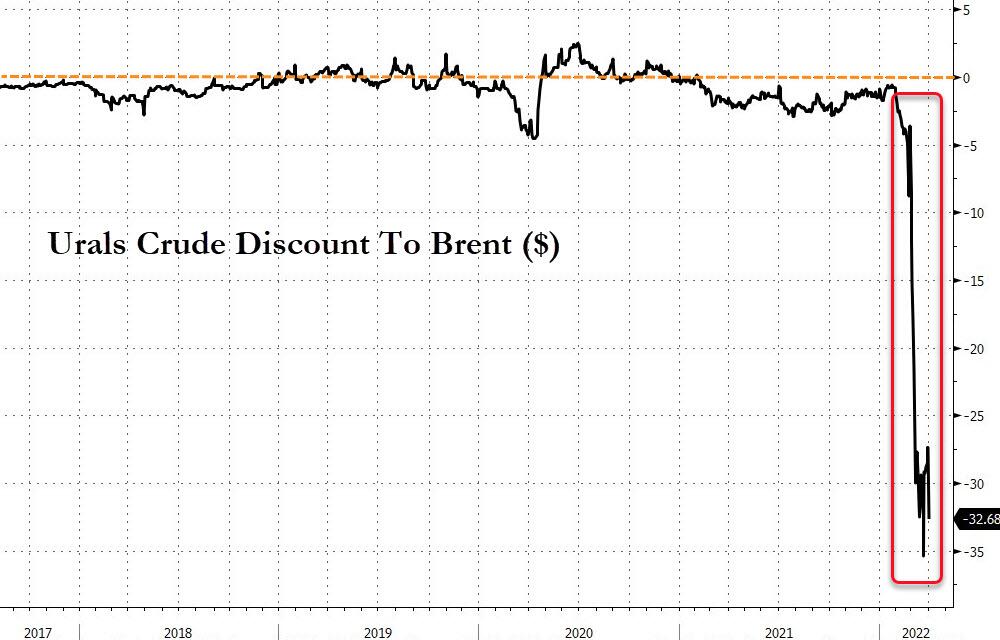
As Russia is forced to offer its crude at a record (and massive) discount to Brent benchmarks (due to self-sanctioning among crude buyers nationwide, notably except China and India)…

…it appears other OPEC+ ‘allies’ are more than willing to take advantage of the situation with buyers forced to look elsewhere (or face the wrath of Biden?)

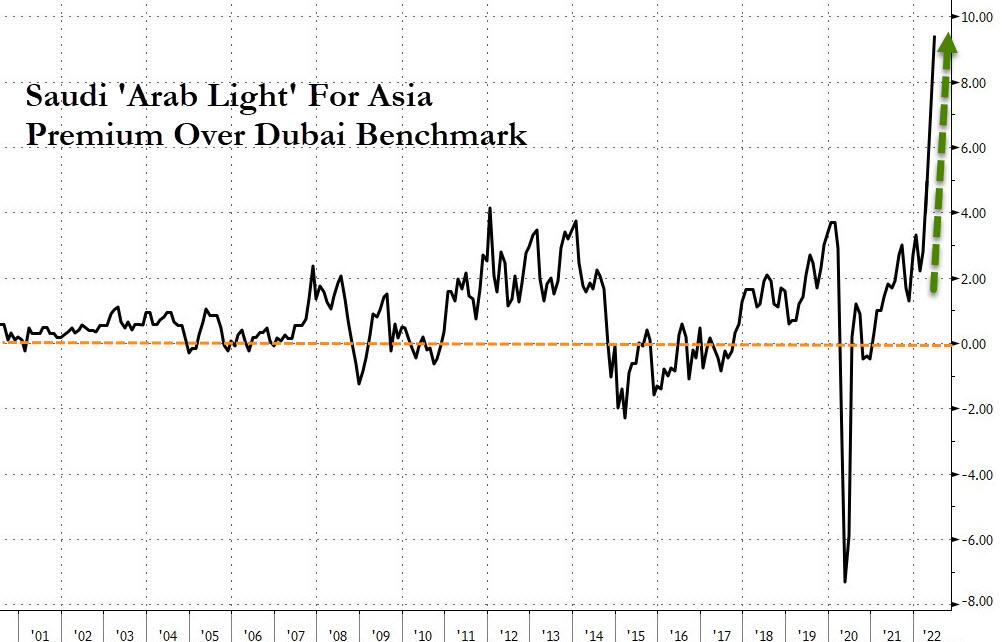
As OilPrice.com’s Tsvetana Paraskova reports that the world’s largest crude oil exporter, Saudi Arabia, raised its official selling prices for its flagship crude to the Asian market in May to a fresh record against regional benchmarks, in a move widely expected by traders and refiners.

The Saudis hiked the OSP for May for Asia for Arab Light – the Kingdom’s flagship grade – to a record premium of $9.35 per barrel above the Oman/Dubai benchmark, off which Middle Eastern crude is priced in Asia.

The price for May is raised by a massive $4.40 a barrel over the April OSP for Arab Light of $4.95 a barrel premium over Oman/Dubai, per Bloomberg’s estimates.

Last week, a Bloomberg survey showed that Asian refiners and traders expected Saudi Arabia to once again hike significantly the prices of its crude going to Asia in May to a record premium over the Middle Eastern benchmarks.  

For May, Saudi Arabia’s oil giant Aramco hiked the prices of all its crude going to all markets.

The soaring oil prices and the “buyers’ strike” over purchasing Russian crude could be an opportunity for Russia’s key ally in the OPEC+ pact, OPEC’s de facto leader Saudi Arabia, to hike its official selling prices to another all-time high over the Oman/Dubai benchmark.

Saudi Arabia generally sets the pricing trends of the other major Middle Eastern oil producers, and it usually sets the OSPs of its crude for the following month around the fifth of each month, typically after the monthly OPEC+ meeting.

Last week, the OPEC+ meeting concluded that no change in production plans was needed, and agreed to lift the group’s production by another 432,000 barrels per day starting in May.

The 32,000 bpd above the originally agreed to 400,000 bpd is due to shifting baselines of five of its members.

Saudi Arabia’s production quota has been lifted to 10.549 million bpd, and Russia’s quota was raised to the same amount.

Tyler Durden
Mon, 04/04/2022 – 13:05

via ZeroHedge News https://ift.tt/aqJV3RI Tyler Durden

“Will Retail Traders Force Institutions To Chase Stocks” – Why Goldman Expects “Massive” Rotation Into Stocks In Q2

“Will Retail Traders Force Institutions To Chase Stocks” – Why Goldman Expects “Massive” Rotation Into Stocks In Q2

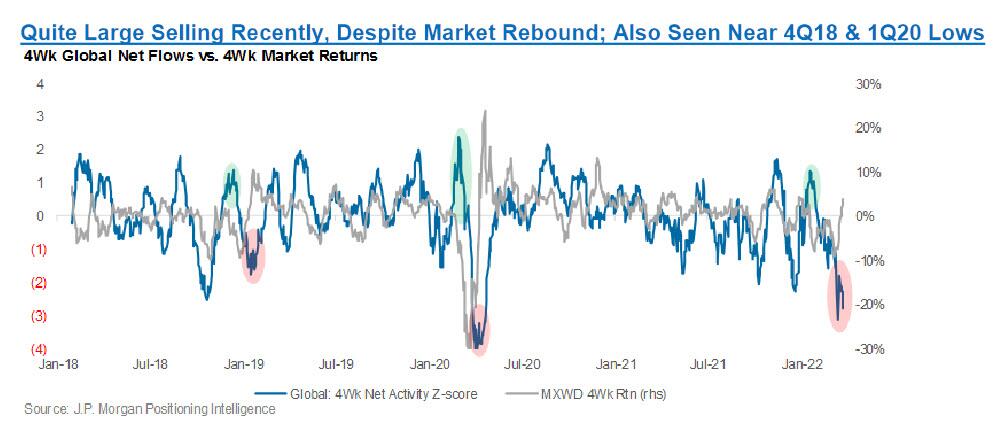
Over the weekend, when looking at the latest JPMorgan Prime Brokerage data, we noted that the “pain trade” remains higher as unlike retail, hedge funds have been selling every rally aggressively with the largest US bank seeing “net selling in 8 of the past 9 days,” during which stocks have staged a torrid rally.

At the same time, we also observed that the bulk of the recent market meltup has been on the back of a massive short squeeze and covering of puts (creating a delta and gamma squeeze) which makes it especially difficult to predict what happens next as most if not all of the recent market meltup has been due to technicals and positioning, not fundamentals.

Still, one can conclude that either hedge funds will reverse their selling soon and jump on board the retail buying bandwagon (at which point it will again be time to short), or retail will run out of buying power amid the hedge fund-to-retail “distribution”, and stocks will tumble once again.

The outcome of that tensions is, according to Goldman’s flow trader Scott Rubner, the $64 trillion question: as he writes in his latest Tactical Flow of Funds note – in which he says that the top institutional investor question has been “who is buying the market +500 points in the last two weeks?” do retail traders force institutional investors to re-leverage back into the equity market above (the prior ceiling of $4600).

Here are Rubner’s 5 main (bullish, of course) observations:

  1. The S&P 500 has closed up more than >1% in 6 out of the last 8 trading days. In the last 80 years, that’s only happened 2 other times.
  2. US bonds are down -6.3% so far this year, on pace for their worst year on record (record is – 2.9% in 1994).
  3. If the month closed today, US bonds would have the worst monthly performance in 42 years.
  4. “I expect a MASSIVE rotation into equities in Q2. When do we start talking about new all-time highs for US Equities? Great Rotation / Great Migration type of stuff.”
  5. Global PWM’s are making the calls today for next week. “hey, so we have these bonds, and we are sitting on cash”….. but inflation, yadda yadda yadda. new Q = new inflows.

Going back to the divergence between retail and institutional investors, here is why Rubner is “tracking the message boards again”:

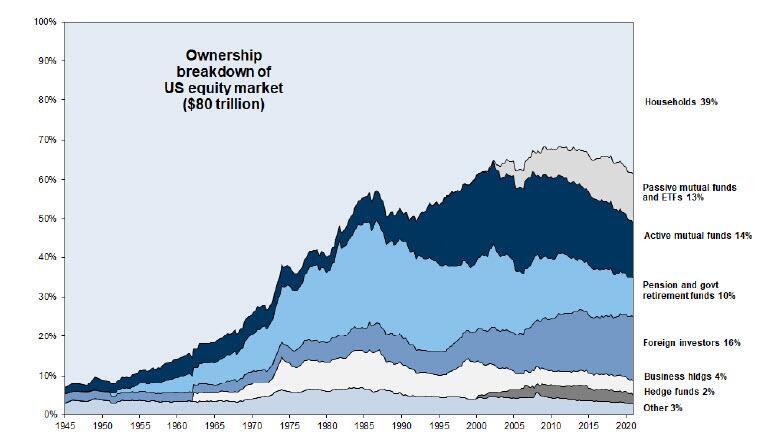
  1. US Households own 39% of the $80 Trillion US Equity Market. ($31 Trillion)
  2. Hedge Funds own 2% of the US Equity Market. Households own 20x more market cap than Hedge Funds (ZH: this, however, is a grossly inaccurate at best, since household ownership is a plug in the Fed’s Flow of Funds report, and if anything, represents how little the Fed actually knows where the money ends up).
  3. Goldman’s analysis shows that the largest owner of the equity market, has scope to become the largest trader of the equity market yet again (ZH: we very much doubt this, which is nothing more than Goldman’s desperate attempt to goal seek a bullish case).
  4. This is the biggest swing factor in the market today, and also the largest source of aggressive trading demand (at a time when liquidity and value traded has decreased).
  5. You have to remember, despite the bearish macro backdrop and investor sentiment, this is not true for message board traders. Open the apps’s today to get the vibe.

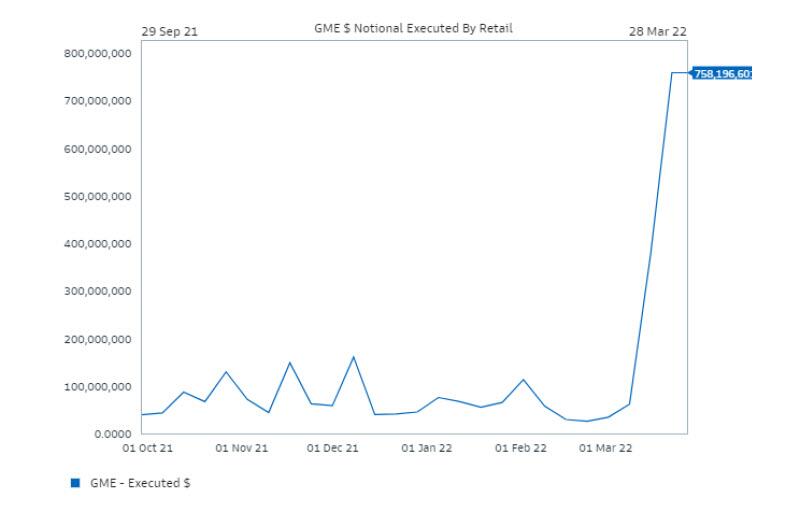
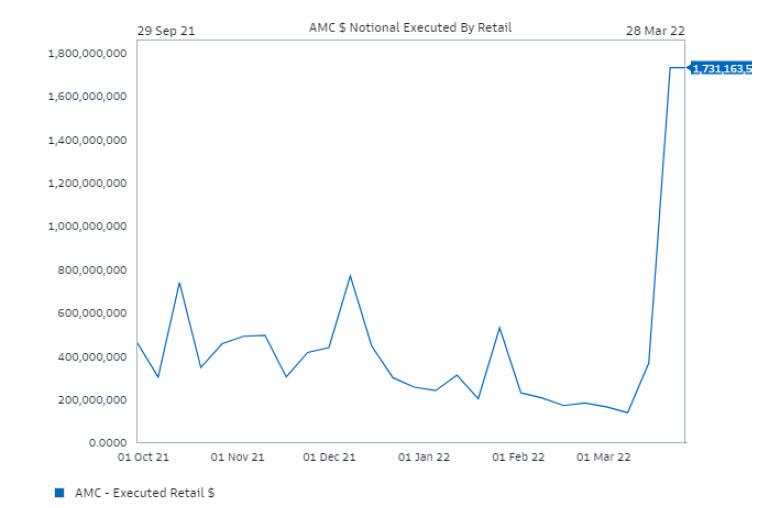
The next few charts show the surge in recent retail participation:

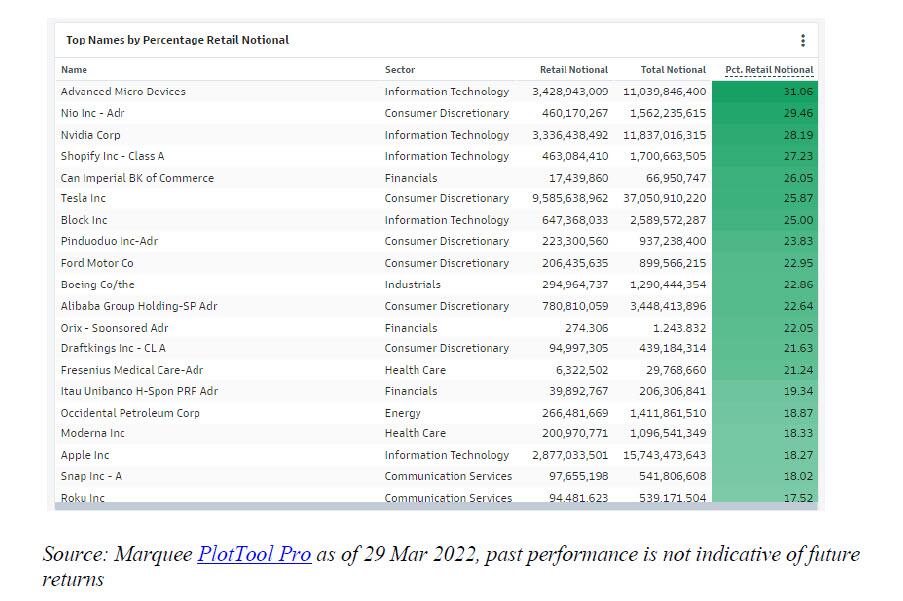
This is where retail participation is highest:

Rubner then takes a look at the bigger tactical flow of funds checklist, and gives the lists the following 12 reasons why the S&P rallied ~500 handles in 11 trading days, and why he expects it will keep rallying?

  1. April is a strong seasonal month. Over the last decade the average return for April is 2.34%, the second best month after November.
  2. Great Rotation – Investors are reducing money in bonds, 11 straight weeks of outflows, and huge redemptions from cash funds losing to inflation by -7%. Households have $15 Trillion in cash holding.
  3. Retail is back. Retail participation has dramatically increased and retail are buying weekly calls again. (+50% moves in GME, and huge gains in core retail favorites, TSLA/NVDA). Watch TSLA stock split news. They have fully paid their April 18th tax bill.
  4. Great Repatriation Migration “I’m coming home”. This was the largest monthly move back into the USA on record (out of rest of world). Lot of $ is parked in low quality overseas. Foreigners also coming back to the US.
  5. Systematic. We have +$46B worth of equities to buy from CTAs. This will take us through the end of the quarter.
  6. Corporates are still the largest buyer in market, in a modest blackout window. Net demand (buybacks ex-issuance) is expected to be a record $700 Billion.
  7. $3.5 Trillion worth of option notional rolled off two weeks ago. Gamma is short. The street is very short gamma around ATM strike.
  8. PWM Model portfolios are aggressively selling bonds / credit, and moving back into US quality / tech / dividends.
  9. Our PB team, showed a further capitulation of gross and net HF exposure.
  10. HF’s generally are under exposed to a rally, and want not lag indices before statements go out on quarter-end.
  11. Sentiment remains below COVID, March 2020 lows. (-1.8%)
  12. Liquidity remains challenged. You can trade $5M on the screens of ESA (E-mini futures), this ranks in the 4th percentile in the last decade. This has had the most impact on the shorts trying to cover.

Goldman’s bottom line: “flow of funds are still positive for the next two weeks, and there is a lack of supply.”

Tyler Durden
Mon, 04/04/2022 – 12:45

via ZeroHedge News https://ift.tt/MLa6pDQ Tyler Durden