Twelve Principles Of Public Health

Twelve Principles Of Public Health

Authored by Dr. Martin Kulldorff via The American Institute for Economic Research,

  1. Public health is about all health outcomes, not just a single disease like Covid-19. It is important to also consider harms from public health measures. More.

  2. Public health is about the long term rather than the short term. Spring Covid lockdowns simply delayed and postponed the pandemic to the fall. More.

  3. Public health is about everyone. It should not be used to shift the burden of disease from the affluent to the less affluent, as the lockdowns have done. More.

  4. Public health is global. Public health scientists need to consider the global impact of their recommendations. More

  5. Risks and harms cannot be completely eliminated, but they can be reduced. Elimination and zero-Covid strategies backfire, making things worse. More

  6. Public health should focus on high-risk populations. For Covid-19, many standard public health measures were never used to protect high-risk older people, leading to unnecessary deaths. More

  7. While contact tracing and isolation are critically important for some infectious diseases, it is futile and counterproductive for common infections such as influenza and Covid-19. More.

  8. A case is only a case if a person is sick. Mass testing asymptomatic individuals is harmful to public health. More

  9. Public health is about trust. To gain the trust of the public, public health officials and the media must be honest and trust the public. Shaming and fear should never be used in a pandemic. More

  10. Public health scientists and officials must be honest with what is not known. For example, epidemic models should be run with the whole range of plausible input parameters. More

  11. In public health, open civilized debate is profoundly critical. Censoring, silencing and smearing leads to fear of speaking, herd thinking and distrust. More

  12. It is important for public health scientists and officials to listen to the public, who are living the public health consequences. This pandemic has proved that many non-epidemiologists understand public health better than some epidemiologists. More

Tyler Durden
Mon, 12/21/2020 – 14:05

via ZeroHedge News https://ift.tt/3nAbc62 Tyler Durden

Here Is The Full Text Of The Covid Stimulus Bill, All 5593 Pages Of It

Here Is The Full Text Of The Covid Stimulus Bill, All 5593 Pages Of It

There was some confusion on Monday afternoon when the release of the full text of the stimulus bill was prevented due to a computer glitch, because the file was – no joke – corrupt.

But that was promptly resolved (we can only hope the hacked password wasn’t Pork123), and moments ago Congress released the full text of the bill… all 5593 pages of it.

Good luck to anyone tasked with reading this porkulus monster from cover to cover.

Full text below (pdf link here)

Tyler Durden
Mon, 12/21/2020 – 13:58

via ZeroHedge News https://ift.tt/3rioxSQ Tyler Durden

US Charges Libyan Man For Pan Am Flight 103 Bombing… 32 Years Later

US Charges Libyan Man For Pan Am Flight 103 Bombing… 32 Years Later

Nobody can accuse AG William Barr of doing things fast – or frankly doing them at all, especially when faced with glaring evidence of a years-long attempt to spy on (and remove) the president of the US in an unprecedented effort stretching all the way from the FBI to top members of the Obama administration. So there were few expectation when the DOJ announced a hearing this morning, and Barr did not disappoint when instead of focusing on a crime currently in progress, he instead announced charges against a Libyan man accused of making the bomb that detonated on a Boeing 747 passenger flight in 1988, killing all 259 people on board.

The bombing of Pan Am flight 103 also resulted in the deaths of 11 Lockerbie, Scotland residents who were killed by falling debris, many just after they sat down for dinner. Most of the victims on the flight, 190, were Americans.

Two Libyan intelligence officers, Abdel Baset al-Megrahi and Lamen Khalifa Fhimah, were charged in 1991 in connection with the devastating bombing, but a third individual known only as Abu Agela Masud could not be positively identified.

Barr told reporters at the Justice Department that individual’s identity has been uncovered over three decades later, saying the man is Abu Agila Muhammad Mas’ud Kheir al-Marimi, a former Libyan intelligence officer.

“Let there be no mistake: no amount of time or distance will stop the United States, and its partners in Scotland, from pursuing justice in this case,” Barr said. This was also around the time Barr said he doesn’t plan to appoint a special counsel to investigate President-elect Joe Biden’s son Hunter or the election

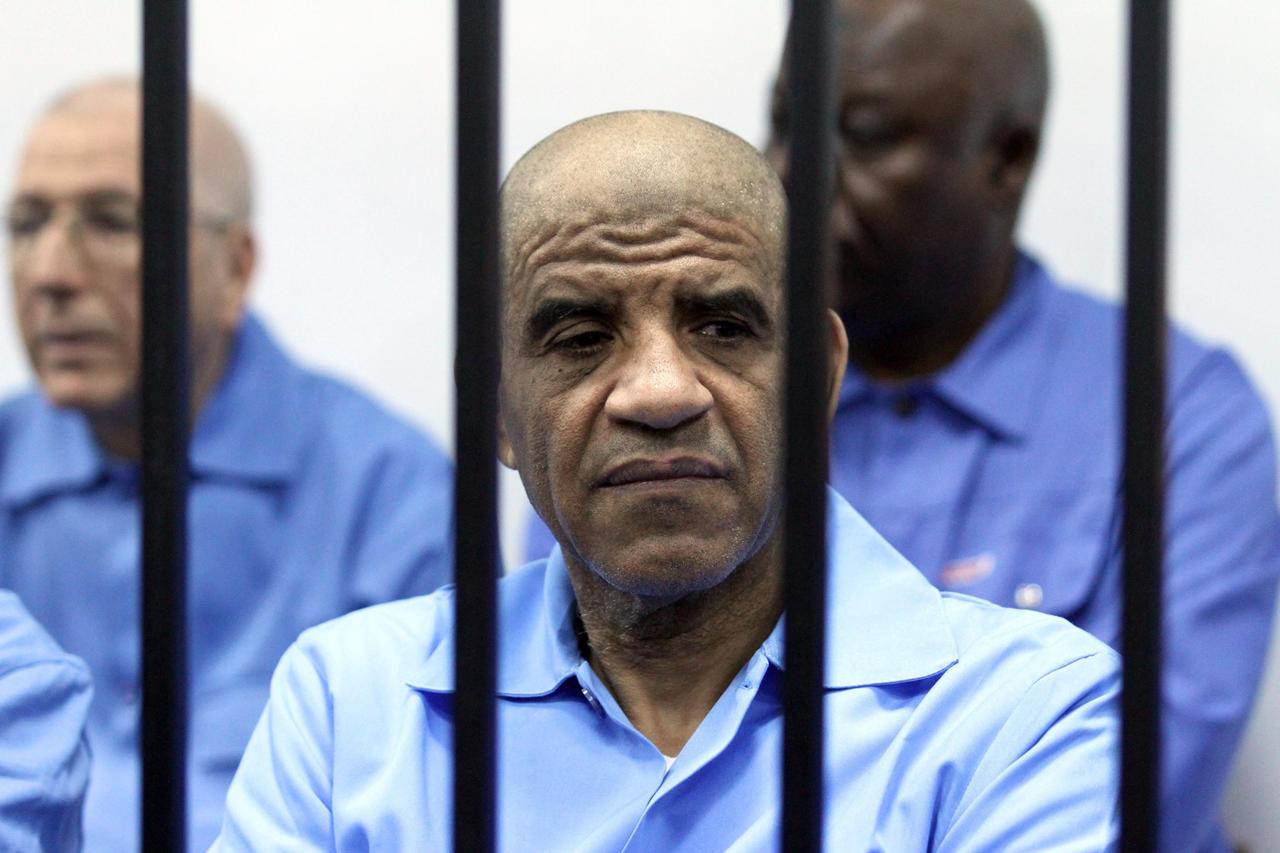
Abu Agela Masud Kheir Al-Marimi was charged with the 1988 Pan Am explosionCredit: Getty Images.

Investigators reached what Barr called a “breakthrough” in determining al-Marimi’s role following the overthrow of former Libyan leader Muammar Gaddaffi’s government.

Five years after he was deposed in 2011 the US learned that the suspect was interviewed by Libyan law enforcement in 2012, and admitted to his role in the Pan Am bombing, as well as the 1986 bombing of a night club in Berlin that killed two American service members and a Turkish woman. Libyan authorities have passed on a copy of that interview to the US.

Al-Marimi, al-Megrahi and Fhimah were all members of Libya’s former External Security Organization, according to court documents. But it was al-Marimi who worked as a technical expert for the organization from roughly 1973 to 2011.

Libya, under Gaddaffi, accepted responsibility for the bombing in 2003.

Al-Marimi remains in Libyan custody. Prosecutors will seek his extradition to face charges.

Tyler Durden
Mon, 12/21/2020 – 13:50

via ZeroHedge News https://ift.tt/3rjJgpq Tyler Durden

FBI Listened To Papadopoulos’ Call On Elusive Grounds, Documents Indicate

FBI Listened To Papadopoulos’ Call On Elusive Grounds, Documents Indicate

Authored by Petr Svab via The Epoch Times,

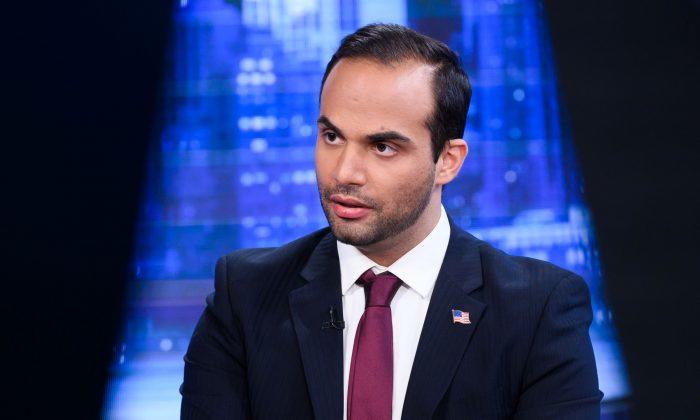
The FBI was listening to at least one phone call of former Trump campaign aide George Papadopoulos, according to a recently released text message of Peter Strzok, former head of FBI counterintelligence operations.

The text raises the question of what authority the FBI had to conduct such surveillance, particularly because, based on the text, the call with Fox News executive took place on Jan. 11, 2017, two weeks before Papadopoulos’s voluntary FBI interview during which he later admitted he lied. The lying was the only crime he was charged with in the sprawling investigation into supposed collusion between the Trump campaign and Russia, which failed to substantiate any such collusion occurred.

The FBI declined to comment.

Papadopoulos confirmed the call with Fox’s vice president took place, but couldn’t pinpoint the date.

“I don’t know if the call was then,” he told The Epoch Times via Twitter direct message. “I met and talked to the VP at least 5 times in person and on the phone.”

The government isn’t allowed to tap Americans’ calls unless a judge agrees there’s a probable cause that a crime has occurred or is about to occur, as dictated by the constitution and Supreme Court precedent. The government has significantly eroded those protections through laws that allow surveillance for national security reasons, such as the Foreign Intelligence Surveillance Act (FISA).

But even under FISA, Americans’ calls can be spied on only after a secret FISA court grants a special warrant based on a probable cause that the subject is an agent of a foreign power. The review of the Russia investigation by Justice Department’s Inspector General Michael Horowitz uncovered such spying warrants on only one subject—former Trump campaign aide Carter Page. The FBI acknowledged that two of the four warrants were invalid and resulted in illegal surveillance. Page is now suing the government and the responsible current and former officials for $75 million in damages (pdf).

The FBI team running the Russia probe, codenamed “Crossfire Hurricane,” apparently intended to get a FISA warrant on Papadopoulos as well.

“CH team will pursue [redacted] new FISA surveillance on CROSSFIRE TYPHOON [redacted]. CH Team will analyze the results of FISA surveillance on an ongoing basis,” said an FBI document outlining the team’s plans for the investigation around November 2016 (pdf). Crossfire Typhoon was the codename the FBI gave Papadopoulos.

But another document outlining a briefing on the probe to the FBI director on May 1 says that “[redacted] in not pursuing FISA, and is awaiting returns on [redacted].”

Prosecutors acknowledged that the government had obtained search warrants and subpoenas for Papadopoulos’s “emails, text messages, internet search history, and other information,” according to the government’s sentencing memorandum (pdf).

But this is not how phone wiretaps are regularly obtained, according to Marc Ruskin, an FBI veteran and Epoch Times contributor.

The FBI is supposed to ask a judge for a phone intercept order under Title III of The Omnibus Crime Control and Safe Streets Act, which needs to clear the probable cause standard, he told The Epoch Times in a phone call. The order needs to be renewed every 30 days and agents are only supposed to record conversations that pertain to the alleged criminal activity.

Some speculated that the FBI used a National Security Letter to obtain Papadopoulos’s calls, but such letters are not allowed to be used to obtain content of communications, only metadata, such when the call took place and which number was called.

Papadopoulos believes the FBI did obtain a FISA warrant to spy on him, not through the Russia probe, but via his business engagements with Israel.

“They were spying on the Israelis and my business dealings,” he said.

“That’s why the heat was turned up immediately upon me joining the Trump campaign.”

The final report by former FBI Director Robert Mueller, who took over the Russia probe in May 2017 as a special counsel, mentioned that the FBI probed whether Papadopoulos acted as an unregistered agent of Israel. It failed to substantiate the charge.

“While the investigation revealed significant ties between Papadopoulos and Israel (and search warrants were obtained in part on that basis), the Office ultimately determined that the evidence was not sufficient to obtain and sustain a conviction under FARA or Section 951,” the report said (pdf).

FARA refers to the Foreign Agents Registration Act, which requires people to register with the Department of Justice (DOJ) if they do political or lobbying work in the U.S. for a foreign entity as long as the work principally benefits a foreign government. Section 951 requires registration of any “agent of a foreign government.”

The key text message Strzok received on Jan. 12, 2017, indeed references FARA.

“I know you’re not point on this anymore, but typhoon [Papadopoulos] got a call from the VP at Fox News yesterday, who advised that the government was conducting ‘checks’ on him a few months back,” an unidentified individual said in the text.

“I haven’t listed to the exact audio, but I’m guess[ing] that’s the FARA checks that we did with DOJ on our 4 main guys; especially given the article that you pushed yesterday.”

The four “main guys” were most likely Papadopoulos, Page, former head of Trump’s campaign Paul Manafort, and former Trump adviser Lt. Gen. Michael Flynn. The FBI opened separate investigations on them under the Crossfire Hurricane umbrella. All four were officially marked as probing for FARA violations and, as the text indicates, the FBI cooperated with the DOJ to check for potential FARA violations. At the same time, the investigation was also led as a counterintelligence one, meaning the goal was to probe national security threats rather than crimes.

It appears the only time Papadopoulos gave the FBI some indication that he may have violated FARA by acting as an unregistered Israeli agent came in his talk with FBI informant Stephan Halper in September 2016. Papadopoulos boasted about his assistance to the Israeli government, saying he’s “done some sensitive work for that government,” and the Israelis had “allowed [him] quite a high level of access.”

“No one else did my, the work that I basically did. Some, some folks always joke they say you should go into the CIA after this if he [Trump] ends up losing,” he said, according to an FBI transcript of the conversation (pdf).

But the FBI’s obtaining a wiretap order on such a justification would raise further questions.

“It’s doubtful that this would consist of sufficient probable cause for violation of FARA, unless there was other evidence to corroborate the statement of the informant,” Ruskin commented.

“’Doing some sensitive work for the government’ is hardly sufficient to articulate that crime was committed, and that the crime was a violation of the FARA.”

FARA violations are almost never prosecuted because the law require “willfulness,” meaning the subject needs to be aware that he was supposed to register. Usually, the DOJ FARA Unit just sends violators letters asking them to register.

Moreover, publicly available information indicates it was Papadopoulos making overtures to Israel, pushing his policy proposals for a Israel-Cyprus-Greece alliance. His initiative, initially funded by the Texas-based Noble Energy, was to convince the countries to move natural gas from the Israeli Leviathan field to Europe through Greece instead of Turkey, he said in his book, “Deep State Target.” Noble, recently acquired by Chevron, discovered the gas field in 2010 and had a license from Israel to drill it.

Papadopoulos’s proposal indeed benefited Israel, which was likely to prefer a pipeline to Greece as it had reservations about Ankara’s support of the anti-Israel Muslim Brotherhood. Promoting the proposal, Papadopoulos met with a number of Israeli officials. He was also under the impression that the Obama administration didn’t like the plan. But none of this appears to make him a foreign agent.

“I never worked for any foreign government, never took money from a foreign government. It seems the Obama administration did not appreciate my views, which eventually became policy on the ground in the region,” he said.

Tyler Durden
Mon, 12/21/2020 – 13:30

via ZeroHedge News https://ift.tt/3aypIYb Tyler Durden

Foreign Buyers Slide In Otherwise Strong 20Y Treasury Auction

Foreign Buyers Slide In Otherwise Strong 20Y Treasury Auction

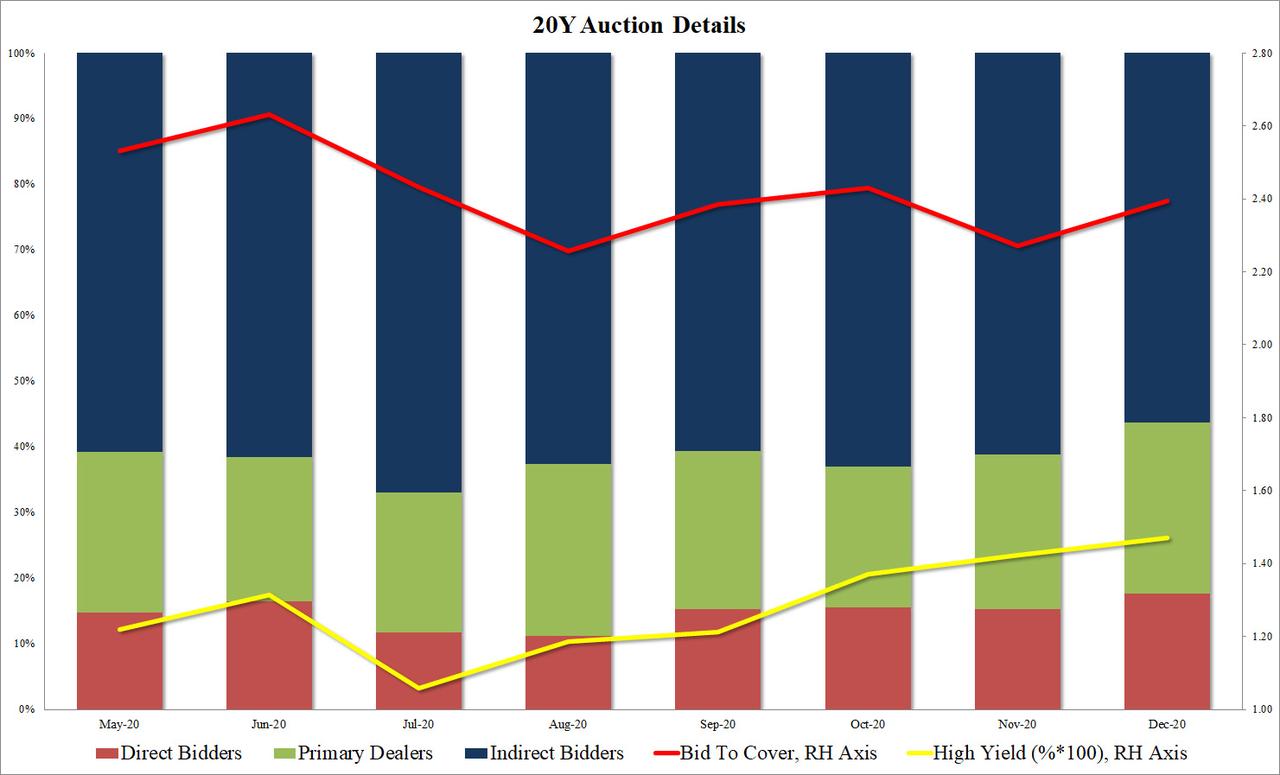
The quiet week before Christmas is hardly the best time of the year for the US government to go out begging for cash and sell bonds, unfortunately with the US deficit set to soar (yet again) thanks to the latest $900BN stimulus bill which will pass shortly, the US Treasury does not have the luxury of deciding what to beg, and moments ago it sold $24 billion in a reopening of the November 20Y Treasury, the 8th such auction since it returned in May after a 34 year hiatus.

The auction stopped at a high yield of 1.470%, the highest since the return of the tenor. That said, the auction came in stronger than expected, stropping through the When Issued 1.478% by 0.8bps, compared to November’s 0.9bps tail.

The bid to cover was also an improvement compared to last month, rising from 2.27 to 2.39; it was also right on top of the six-auction average of 2.40.

Alas, while the rest of the auction was strong the internals were dismal with Indirects taking down 56.3%, not only far below last month’s 61.2%, and below the six auction average of 61.2%, but also the lowest since the auction’s return in May. And with Directs stepping up just modestly from 15.3% to 17.7%, Dealers were left with 26.0%, the highest since the return of the 20Y auction, and well above November’s 23.5%.

Overall, a solid auction on pricing terms, but disappointing in terms of participation and foreign demand.

Tyler Durden
Mon, 12/21/2020 – 13:17

via ZeroHedge News https://ift.tt/3h6duY4 Tyler Durden

Here’s A Breakdown Of Everything Inside The $900BN Stimulus Bill, And What It Means For The US Economy

Here’s A Breakdown Of Everything Inside The $900BN Stimulus Bill, And What It Means For The US Economy

Within hours, Congress is set to vote on (and pass) a $900 billion Covid-19 aid bill that includes assistance for households and businesses, as well as funding for vaccine distribution and more. As discussed previously, the bill excludes the Republican priority of liability protections for businesses and other entities, and left the key Democrat demand of state and local bailouts.

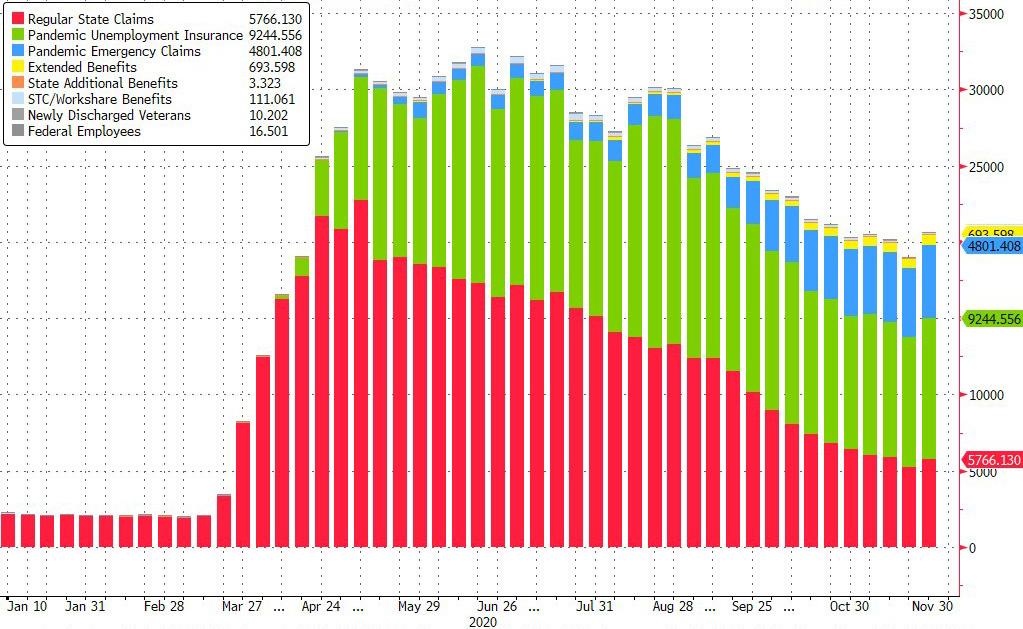
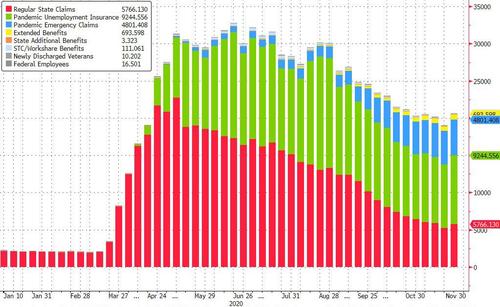
In a nutshell, the new package extends federal UI programs (e.g. PUA, PEUC) with an extra $300/week for all UI claimants for at least an additional 11 weeks.
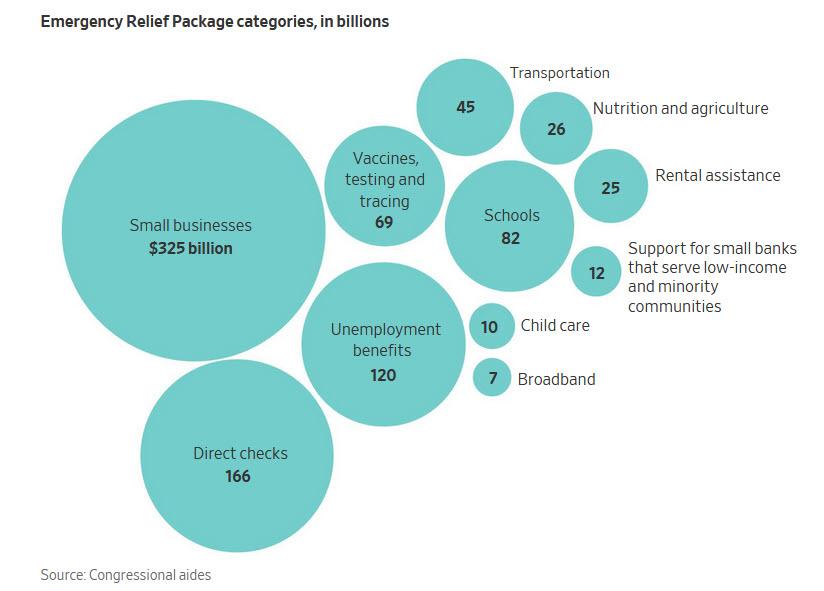
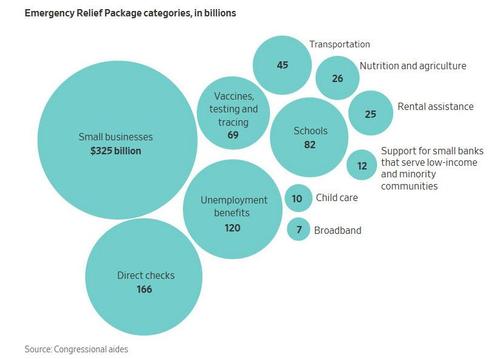
It also sends another round of stimulus checks worth $600 per individual per household for those making less than $75k ($150k for married couples) and gradually phases out at higher incomes. The bill renews funding for PPP to support small businesses and provides targeted aid to transportation and other hard hit sectors of the economy.  Similar to the prior bipartisan proposal, $325bn would go to small businesses support, including $284bn for a second round of PPP grants. Of note: the bill also allows businesses to deduct expenses paid with the first round of loans, which the Treasury had previously disallowed (i.e., a double dip). With around $525bn in forgivable PPP loans issued and more coming, this looks likely to reduce tax receipts by tens of billions and possibly more than $100bn, though it depends on the profitability of the businesses that received the loans

It also provides additional funding for schools, healthcare, SNAP, childcare and various other programs. While the package excludes aid for state and local government and language around liability protection for businesses and schools as BofA notes, many of the provisions (e.g. aid for public transportation, schools, funding for vaccine distribution, testing and tracing) will channel aid to state and local governments

Here are the details of what is in the legislation.
Workers and Households

Direct Payments: The legislation would authorize a second round of economic-impact payments, following the checks Americans received in the spring and summer, at a cost of $166 billion. Households would receive $600 for each adult and $600 for each dependent, instead of $1,200 and $500, respectively, in the first round. Mixed-status households, where some people are ineligible noncitizens, would get payments based on the number of eligible people in the households, as opposed to being shut out as they were in the first round.

The payments would be based on income from 2019 and begin phasing out for individuals with adjusted gross incomes over $75,000 and married couples over $150,000. Treasury Secretary Steven Mnuchin said Monday that the first electronic payments could reach bank accounts by the beginning of next week. Households whose incomes were too high to qualify or who added dependents in 2020 might not qualify for full payments immediately. But they can request additional money as part of the 2020 tax returns they will file in early 2021.

Jobless Aid: Workers would be eligible for a $300-a-week federal unemployment subsidy. As with the prior aid package enacted in March, gig workers and others who don’t ordinarily qualify for benefits would be eligible for the jobless aid. The money is available through March 14. The legislation would also extend to 50 weeks the amount of time for which workers may claim benefits through both state and federal programs. Most states typically provide 26 weeks of jobless benefits.

The measure also provides an additional $100-a-week subsidy for workers who have both wage and self-employment income but whose basic unemployment benefits don’t take into account their self-employment income. The cost of the enhanced unemployment benefits are projected at $120 billion.

Rental Assistance: The bill provides $25 billion of assistance to tenants in arrears on their rent. It also extends until the end of January 2021 a federal eviction prohibition, which the incoming Biden administration may extend again. The Treasury Department would be responsible for dispersing the rental assistance to states via a formula based on population. Landlords and building owners can apply on behalf of tenants meeting the eligibility requirements, generally those who make less than 80% of median income in their area, have at least one person in their households who has lost a job and can demonstrate they are at risk of losing their home.

Covid response

Health Care: The bill includes $9 billion for health-care providers and $4.5 billion for mental health, as well as more than $1 billion for the National Institutes of Health to conduct Covid-19 research.

Schools: The bill provides $82 billion for public and private K-12 schools, as well as colleges. Of that, the bulk would go to a $54.3 billion fund for public schools, while $22.7 billion would go to public and private higher education.

Testing and Tracing: States would receive $22 billion for testing, tracing and Covid-19 mitigation programs. Of this, $2.5 billion would be sent as grants targeting rural areas and communities of color.

Vaccines: States and federal agencies would receive funding for vaccine distribution. About $20 billion would go to the Biomedical Advanced Research and Development Authority, or Barda, for procuring vaccines and therapeutics. Nearly $9 billion would go to the Centers for Disease Control and Prevention and states for further distribution of the vaccine, and $3 billion is designated for the national stockpile. Included in those sums is $300 million that is directed to go to high-risk areas and to communities of color.

Businesses

Airlines: Tens of thousands of airline employees would get their jobs back, at least for a few months, under the new bill, which includes $15 billion to cover airline salaries and benefits through the end of March. The bill also includes $1 billion for airline contractor payrolls. Airlines received $25 billion under the Cares Act in the spring to cover workers’ pay and benefits, and in exchange agreed not to lay off or furlough employees until Oct. 1. As that date neared without much improvement in their outlook, carriers and labor unions warned that job cuts would be coming and pleaded for another round of aid. When it didn’t arrive in time, they furloughed tens of thousands of workers, including 19,000 at American Airlines Group Inc. and over 13,000 at United Airlines Holdings Inc. The bill also includes $2 billion for airports and airport-based businesses.

Banks: The bill would provide $12 billion in support to small lenders focused on low-income and minority communities, buttressing minority-owned banks and firms known as community financial development institutions.

Entertainment Venues: The bill has $15 billion for independent movie theaters, live entertainment venues and cultural institutions.

Farms: The U.S. agriculture sector is set for another multibillion-dollar injection in the new relief bill, which directs $13 billion to crop farmers, cattle ranchers and rural communities. The new aid would come on top of roughly $46 billion that the U.S. Department of Agriculture projects the federal government will directly pay to the nation’s farmers this year, a record. That sum includes previous Covid-19 relief for farmers who had to plow up fields of produce ordinarily destined for restaurants, as well as hog producers who had to euthanize livestock because of pandemic-driven shutdowns at meatpacking plants.

Rail and transit: The bill would provide $1 billion in relief funds to Amtrak, aimed at helping the national passenger railroad avoid further layoffs and furloughs of its workers. Amtrak receives a regular operating subsidy of around $2 billion a year from the federal government, but its ticket revenue was devastated by the pandemic and lockdown orders. Ridership on some routes fell by more than 90% this year. The company says it will need a total of $4.9 billion in relief aid to get through the remainder of the year without deeper worker and service cuts. The bill also sets aside $14 billion for transit systems, many of which are considering major cuts in service and layoffs. In New York City alone, elected officials say they need an immediate $4.5 billion infusion to stave off severe reductions in subway and bus service. The bill also sets aside $2 billion for the bus industry and $10 billion for state highways.

Small Business: The $325 billion allotted to help small businesses includes $284 billion for first and second forgivable Paycheck Protection Program loans, and expands eligibility for local newspapers and TV and radio broadcasters. The bill also includes $20 billion for Economic Injury Disaster Loans. Businesses that received PPP loans would be able to take tax deductions for the expenses covered by forgiven loans, overcoming objections from Mr. Mnuchin. The provision would save businesses about $200 billion, according to an estimate from Adam Looney of the Brookings Institution. But it doesn’t count as part of the overall cost of the legislation.

U.S. Postal Service: The bill loosens some of the strings imposed on the U.S. Postal Service from the Cares Act, which provided a $10 billion Treasury loan after terms were negotiated. The bill would still provide $10 billion to the financially strained institution, but the Postal Service wouldn’t be required to repay it, and the conditions imposed by the Treasury wouldn’t apply. In exchange, the bill would require the Postal Service to provide more information to Congress, including a plan about its long-term financial solvency, within 180 days of the bill’s passing and information about how it plans to use the funds in reports to the Postal Regulatory Commission.

Taxes: Aside from the PPP break, the bill would extend a tax credit for struggling employers who keep workers on the payroll, and it would let recipients of certain tax credits qualify based on their 2019 incomes; in some cases, lower 2020 incomes could reduce their eligibility. The bill would also temporarily extend tax breaks for renewable energy, including incentives for wind energy and carbon capture. It also includes deductions for business meals, a provision that President Trump backed but that faced criticism from Democrats as a subsidy for three-martini lunches and indoor dining during a pandemic. Lower excise taxes on beer, wine and spirits that were set to expire Dec. 31 will be permanently extended, and tax incentives for investing in low-income areas and hiring workers from disadvantaged groups would be extended for five years.

* * *

Economic Impact

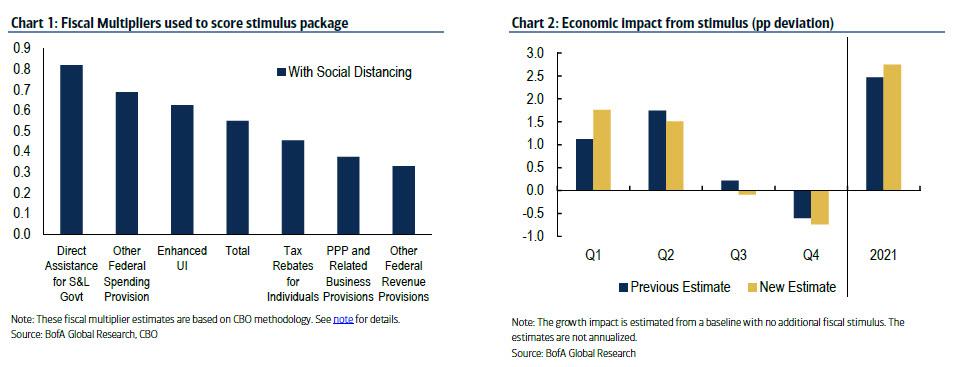
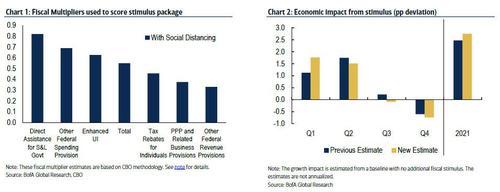
Based on cost estimates of the various provisions and applying the corresponding fiscal multipliers (Chart 1), Bank of America estimates that the new stimulus package will contribute approximately 2.7% to growth in 2021. The bank now expects that more of the stimulus impact will be frontloaded into 1Q (Chart 2). The start of the year has cross currents with weaker economic data but an earlier and more targeted fiscal stimulus (we had expected passage after inauguration). On balance, the bank now sees upside risk to the bank’s forecast of 1% GDP growth in 1Q.
One final point: no more stimulus?

As we reported last week, Goldman’s economists believe that this is the last major COVID-focused fiscal package. Assuming that President-elect Biden is facing a divided Congress next year, this looks likely to be the last fiscal package that Congress passes worth several hundred billion dollars or more (as by 2021 covid vaccines will be widely distributed making the passage of another broad-based stimulus virtually impossible). That said, Goldman does expect another debate over fiscal support in Q1, ahead of the expiration of the extended unemployment provisions in March. However, since Congress left the most difficult issues out of the current package, it seems unlikely that lawmakers will be able to agree on those in subsequent legislation. Of course, this would likely change if Democrats win both Senate seats in Georgia on January 5 and reach 50 seats in the Senate. In that scenario, Goldman would expect at least another few hundred billion in additional fiscal measures, including aid to states.

Tyler Durden
Mon, 12/21/2020 – 13:10

via ZeroHedge News https://ift.tt/3rgSG4U Tyler Durden

Stocks Surge Off Pre-Open Plunge Lows, Dow Goes Green On Bank Gains

Stocks Surge Off Pre-Open Plunge Lows, Dow Goes Green On Bank Gains

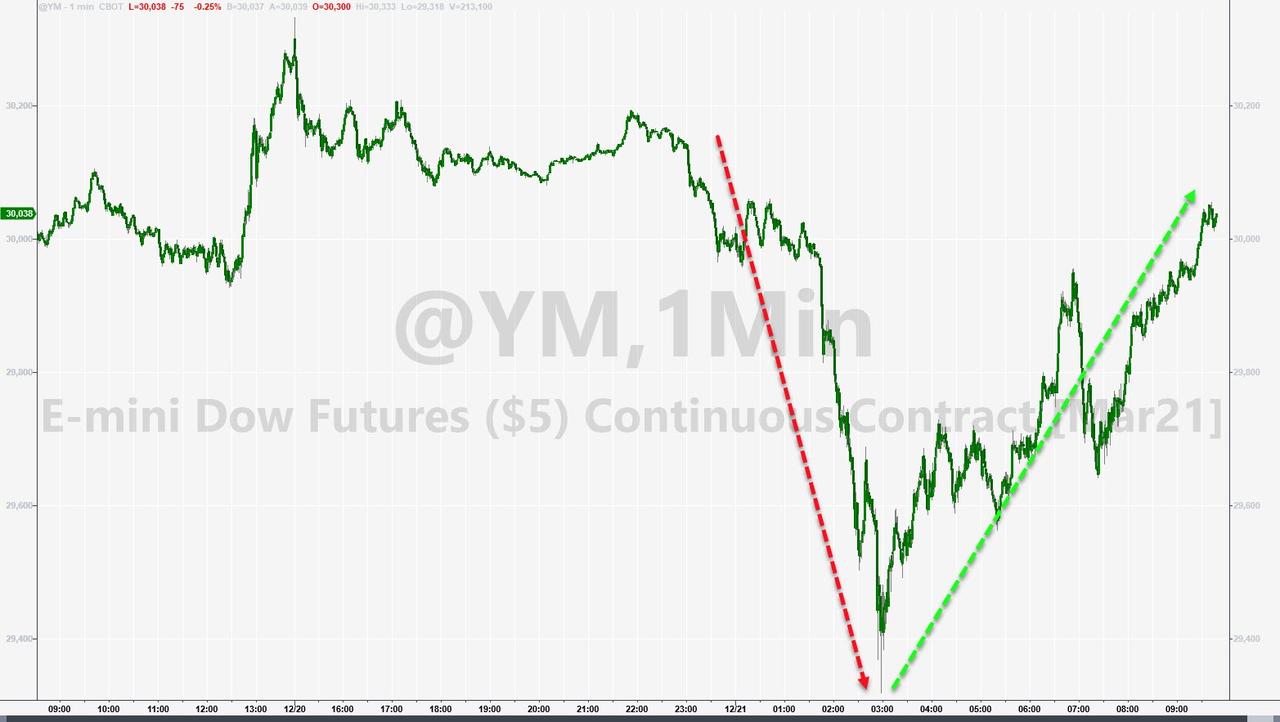
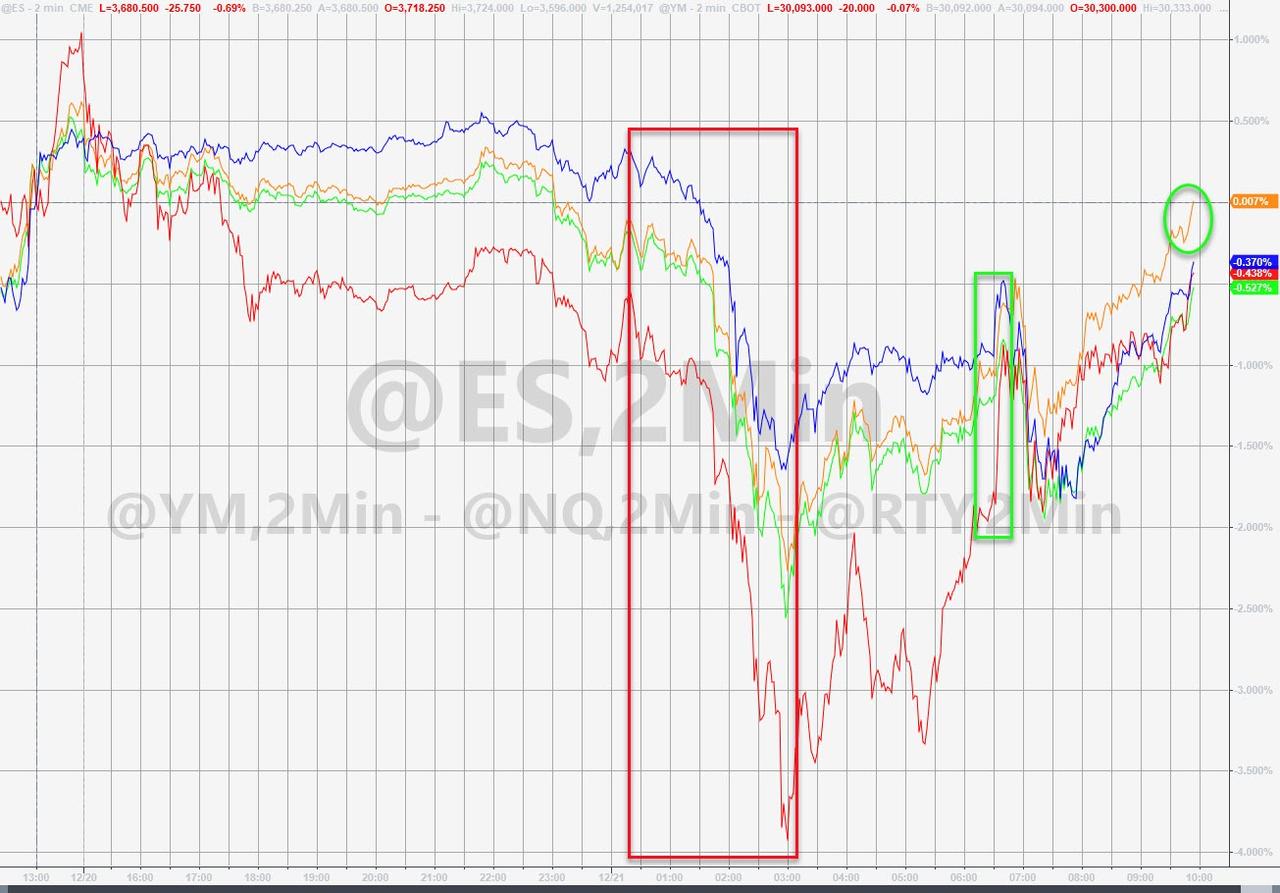
The Dow is up over 800 points from its pre-open lows and has pushed into the green for the day, shrugging off pandemic mutations as Fed Stress Test-enabled buybacks have sent Goldman and JPMorgan soaring, adding around 150 points to the index alone

The Dow is leading the major indices but they are all soaring back…(NOTE – Small Caps were down 4% in the pre-open and are almost unch)

We can only assume that $900 billion was the Goldilocks number after all…

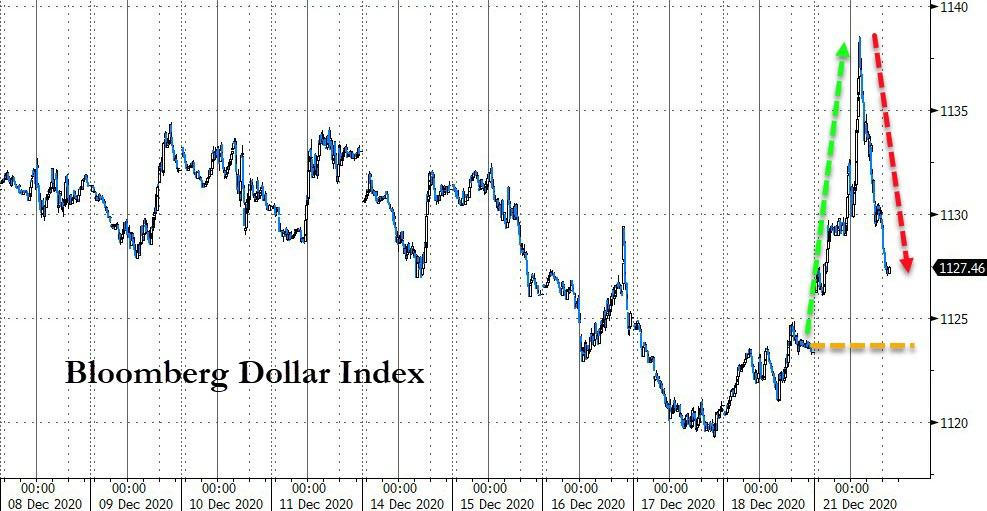
The dollar has reversed a major part of its spike…

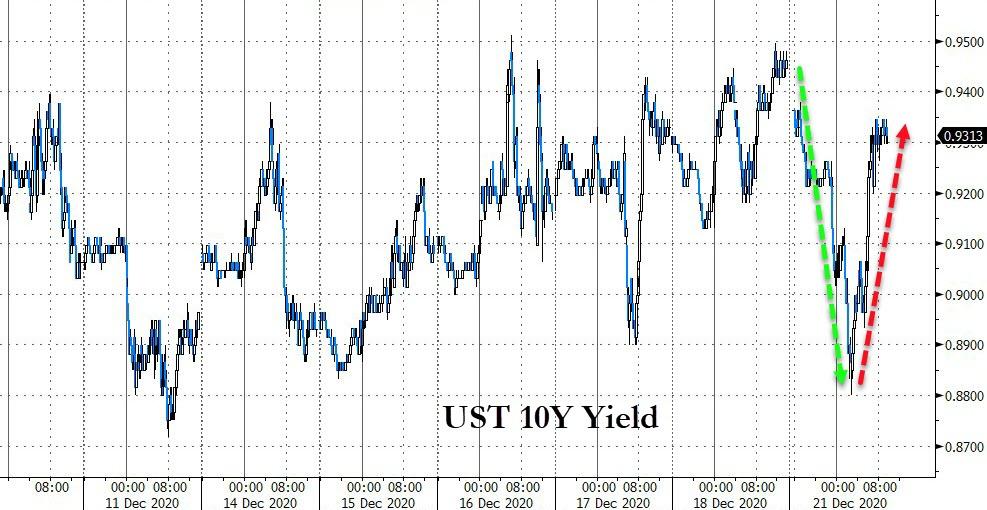
Bonds have also erased earlier gains with yields almost back to breakeven…

It appears Mnuchin’s magic this morning worked after all.?

Tyler Durden
Mon, 12/21/2020 – 12:53

via ZeroHedge News https://ift.tt/3ridY28 Tyler Durden

Pompeo Slaps Broad New Travel Ban On Top China Officials Over Human Rights Abuses

Pompeo Slaps Broad New Travel Ban On Top China Officials Over Human Rights Abuses

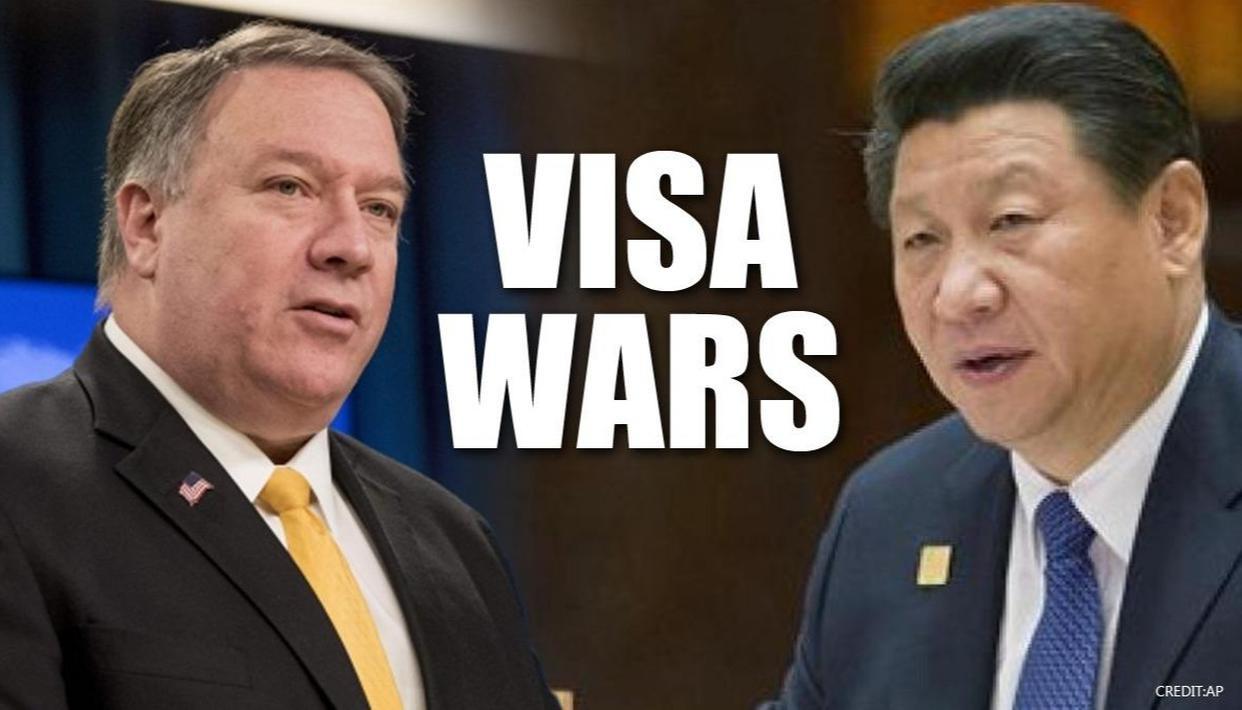
On Monday Trump’s State Department continued the aggressive pressure campaign on Beijing, slapping new sweeping travel restrictions on top Chinese government officials tied to human rights abuses.

The new visa restrictions appear subject of broad interpretation by the Department of Homeland Security (DHS) given they apply to any “Chinese officials who are believed to be responsible for, or complicit in, policies or actions aimed at repressing religious and spiritual practitioners, members of ethnic minority groups, dissidents, human rights defenders, journalists, labor organizers, civil society organizers, and peaceful protestors,” according to a just released statement by Secretary of State Mike Pompeo.

Even family members of those communist party officials whose visas will be block or revoked can be targeted, according to the official statement. 

“China’s authoritarian rulers impose draconian restrictions on the Chinese people’s freedoms of expression, religion or belief, association, and the right to peaceful assembly,” Pompeo began in his statement. “The United States has been clear that perpetrators of human rights abuses like these are not welcome in our country.”

As Pompeo recalled, this new action is on top of prior travel restrictions:  This year, the United States has imposed visa restrictions and financial sanctions on CCP officials involved in the horrific abuses taking place in Xinjiang, restrictions on access to Tibet, and the destruction of Hong Kong’s promised autonomy, ” he said. “Today’s action creates additional restrictions applicable to all CCP officials engaged in such repressive activities, no matter their location.”

The Trump administration has announced new punitive actions and sanctions targeting Chinese officials and companies on a near daily bases, continuing from last week:

Again, this is yet further evidence the Trump administration is not backing off the anti-Beijing pressure campaign even in the final weeks of his presidency.

Indeed the pressure appears designed to “box in” Biden on China, and these measures will be hard to roll back – likely taking months to do so at the very least, assuming the political appetite to reverse the policy is there.

Tyler Durden
Mon, 12/21/2020 – 12:40

via ZeroHedge News https://ift.tt/3atNYec Tyler Durden

Why Are Mainstream Economic Forecasts So Often Wrong?

Why Are Mainstream Economic Forecasts So Often Wrong?

Authored by Daniel Lacalle,

Every end of the year, by the end of the year, we receive numerous estimates of global GDP growth and inflation for the following year. Historically, almost in all cases, expectations of inflation and growth are too optimistic in December for the following year.

If we look at the track record of central banks, it is particularly poor in predicting inflation while large supranational entities tend to err on the side of optimism in GDP estimates. The IMF or the OECD, for example, have been particularly poor at estimating recessions, but mostly accurate at making long-term trend estimates. Contrary to popular belief, it seems that most forecasts are better at identifying long-term economic dynamics than short term ones.

Forecasting is a dirty job, but somebody has to do it. Economic forecasting is exceedingly difficult because there are numerous factors that can drastically change the course of a global economy that is increasingly complex and subject to important uncertainties. However, macroeconomic forecasting is also essential to provide a frame of reference for investors and policymakers. It should not be considered the revealed truth nor entirely dismissed, just an important framework that allows us to at least identify the major points of discrepancy as well as the areas to look at for positive or negative surprises as the year unravels. Yes, macroeconomic forecasting is essential.

The first lesson is that independent forecasts are almost every year more accurate than those of supranational bodies and central banks. There is a logic behind it. Independent forecasters do not feel the political pressure to use a benign view of government policies in their estimates. This is one of the main reasons why investors increasingly use their own economic forecasting teams alongside truly independent firms. While it is always worth paying attention to investment banks and international bodies’ forecasts, most investors have learnt to understand that the estimates of these large entities are often blurred by political correctness and a tendency to be overly diplomatic. Notice how even in countries where governments have destroyed the economy with wrong policies, one-year-ahead forecasts tend to be diplomatically optimistic.

The second lesson, particularly after years of financial repression, is that most forecasts tend to assume an optimistic and extraordinary multiplier effect of government spending and central bank stimulus plans. In most cases, when we look at the estimates of large central banks and international entities, the biggest mistakes in forecasting come from expecting a surprisingly large positive impact on consumption, growth, employment, and investment from demand-side policies. In my experience, the two largest divergences between forecast and reality tend to appear in capital expenditure (capex) and inflation. This is not a coincidence. When the forecaster gives too much impact to demand-side policies while ignoring the accumulated debt, overcapacity, and the poor track-record of most of these measures, the mistakes in capex and inflation forecasts are almost inevitably going to be enormous and much larger than the mistake on output and employment. Likewise, the tendency of large forecasting entities of ignoring or dismissing supply-side policies leads to forecast errors on the side of caution. This was particularly evident in the recovery of some Eurozone countries in 2014 or the estimates for jobs and growth of 2018-19 in the United States. One of the clearest examples is the almost annual slump in growth in the eurozone relative to early estimates.

The third lesson is that forecasts tend to be significantly more accurate when negative news are already consensus. Even when considering risks that may erode significantly the estimates for the next year, large entities tend to consider a lower probability of occurrence of those events in order to maintain a “positive” outlook. There are still too many politicians and economists that believe that the economy is a matter of sentiment and animal spirits and that, as such, some believe that one should maintain a healthily optimistic outlook to support the economy. This has obviously been debunked by reality. Being too optimistic has impacted the credibility of very valuable forecasts while done nothing to lead economic agents to see a brighter prospect in a recession.

In the past nine years we have seen important improvements in economic forecasting. Some investment banks have stepped out of their historical role of painting rosy outlooks where next year is always a “this time is different” story, and we have seen a more realistic approach. Unfortunately, there is still an eyebrow-raising tendency to end global outlook reports with the same recommendations every year: carry-trade your way into the next twelve months.

International bodies have also improved. We have seen a much more realistic approach to forecasting than ten years ago, but inflation and GDP estimates still err on the side of figures that governments will be happy with. However, the intense and rising pressure from governments that these bodies are receiving is actually a sign that forecasting is becoming more independent.

The final lesson for us as investors is simple: Take with a pinch of salt those estimates that place too much positive impact of government and central bank stimuli. Remember that things that have never happened and multipliers that have never occurred are not going to happen, even less so with all-time high levels of debt and widespread overcapacity.

Reading only mainstream macroeconomic reports, even if coming from different entities, can lead to a massive confirmation bias, and I learned many years ago that we may get dozens of different sources that ultimately just say one same thing: Government spending is always good and central banks always get it right.

We must also remember that mainstream bodies are almost entirely populated by Keynesian economists, and there is a tendency to adopt the messages of pressure groups in the economic debate, as we are witnessing with things like the Great Reset, the whitewashing of MMT (modern monetary theory) and the adoption of concepts like inequality, stakeholder investment and social spending in ways that are uncomfortably close to the political agendas of some interventionist parties. Mainstream bodies should have understood by now that adopting political mantras does not combat wrong economically radical agendas, it only undermines the entity’s credibility.  

Independent research and forecasts have become increasingly important precisely because of the lack of pressure from governments or central banks to produce a pre-designed estimate. And this rise of the independents has been absolutely critical to spur international bodies and investment banks to step up their game. That is why it is so important to use different sources of research.

The best way to use forecasts is to do what many of us learned to do, for example, with brokers’ equity and fixed income research, forget the first page and read the data, the details and the deep content. The headlines and recommendations of brokers and international entities should be the last, not the first thing to read in outlook reports.

Forecasting is essential. Independence is key. Independent forecasting will be even more important in 2021 than it was in 2020.

Tyler Durden
Mon, 12/21/2020 – 12:23

via ZeroHedge News https://ift.tt/2KqdF4H Tyler Durden

Taiwan Scrambles Jets & Warships As China Aircraft Carrier Shandong Sails Through Strait

Taiwan Scrambles Jets & Warships As China Aircraft Carrier Shandong Sails Through Strait

Tyler Durden
Mon, 12/21/2020 – 12:00

Just a day after the Chinese PLA Navy trailed a US warship through the contested waters of the Taiwan Strait, alarms have been further raised in the region given China just sent its newest domestic-built aircraft carrier, the Shandong, through the strait on Sunday

While it’s ostensibly for the purpose of “routine drills” in the South China Sea, according to a PLA Navy statement issued Monday, Taiwan still mobilized large forces to monitor the carrier and accompanying battle group of ships.

The PLA statement said it’s part of “normal arrangements made in accordance with annual plans” and that “in the future, we will continue to organize similar operations based on training needs.”

Taiwan scrambled a significant amount of naval and aerial assets in response to the Shandong carrier’s sail through:

Taiwan’s Ministry of National Defense said the Shandong was accompanied by four warships and had set out from the northern Chinese port of Dalian on Thursday. In a statement on its website, it said the convoy continued to move south.

Taiwan said it sent six warships and eight military aircraft to monitor the Chinese ships’ movements.

As both the US and Chinese sides continue bolstering naval presence in the South China Sea, there’s greater potential and likelihood of an ‘accidental’ military encounter, especially given the status of currently stalled military-to-military talks which are aimed precisely at de-escalation and avoiding unnecessary conflict.

Last week agreed upon China-US military maritime consultative agreement (MMCA) meetings broke down after each side blamed the other for being a “no show”. At first the US blamed the Chinese officers for failing to participate. 

Following this, PLA spokesperson Liu Wensheng said, “The U.S. side did not abide by the consensus reached between the two sides and called black white to make the accusation.”

“The US side insisted on forcing its unilateral agenda, arbitrarily reducing the length of the annual meetings and changing the nature of the talks,” Liu said further of what was to be an online meeting. “The US side even tried to force China’s participation without an agenda agreed by both sides.”

Regional tensions are especially on edge given the unpredictable nature of Trump’s continuing pressure campaign on China during his last weeks in office before Biden enters the White House.

via ZeroHedge News https://ift.tt/2WNd1kx Tyler Durden