Is The Fed Stuck With “Forever Stimulus”?

Is The Fed Stuck With “Forever Stimulus”?

Tyler Durden

Sun, 11/15/2020 – 15:55

Authored by Lance Roberts via RealInvestmentAdvice.com,

I recently have discussed both the “Importance of Recessions” and how the ongoing Rescues Ruining Capitalism.” However, while the data is clear that ongoing stimulus programs lead to weaker economic growth and a rising wealth gap, is the Fed stuck with “forever stimulus?”

Such was a point that Mohammed El-Erian recently made, stating:

“They are increasingly on what I call a no-exit paradigm.” 

To understand the problem, we have to go back to the beginning. As we noted in our article on financial rescues, the bailouts and stimulus programs started in 2008 when the Federal Reserve intervened with the insolvency of Bear Stearns. They haven’t stopped since.
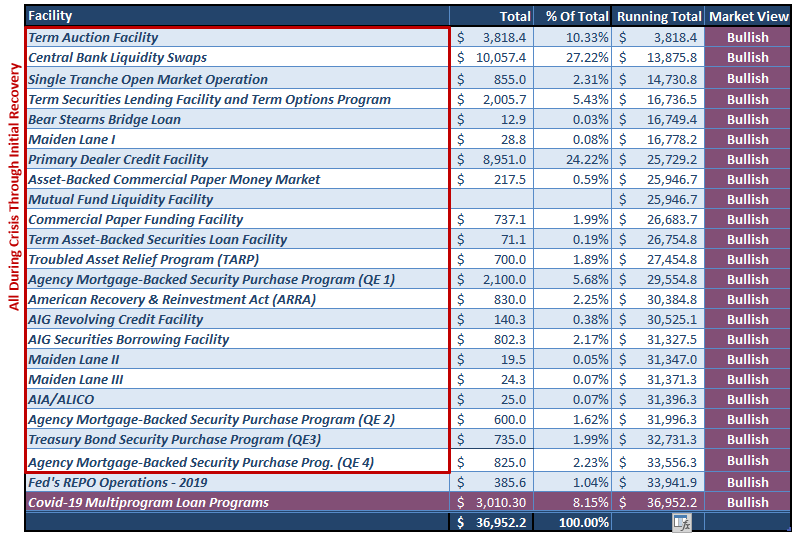
To date, the Federal Reserve, and the Government,  have pumped more than $36 Trillion into the economy. As shown below, the amount of economic growth achieved has been minimal during that same time frame. (The chart is the cumulative growth of interventions compared to the incremental increase in GDP.)
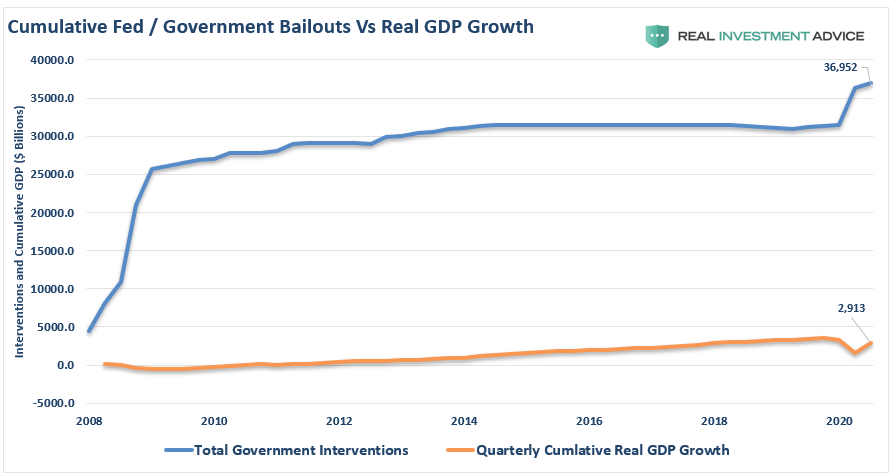
What this equates to is more than $12 of liquidity for each $1 of economic growth.

Trapped

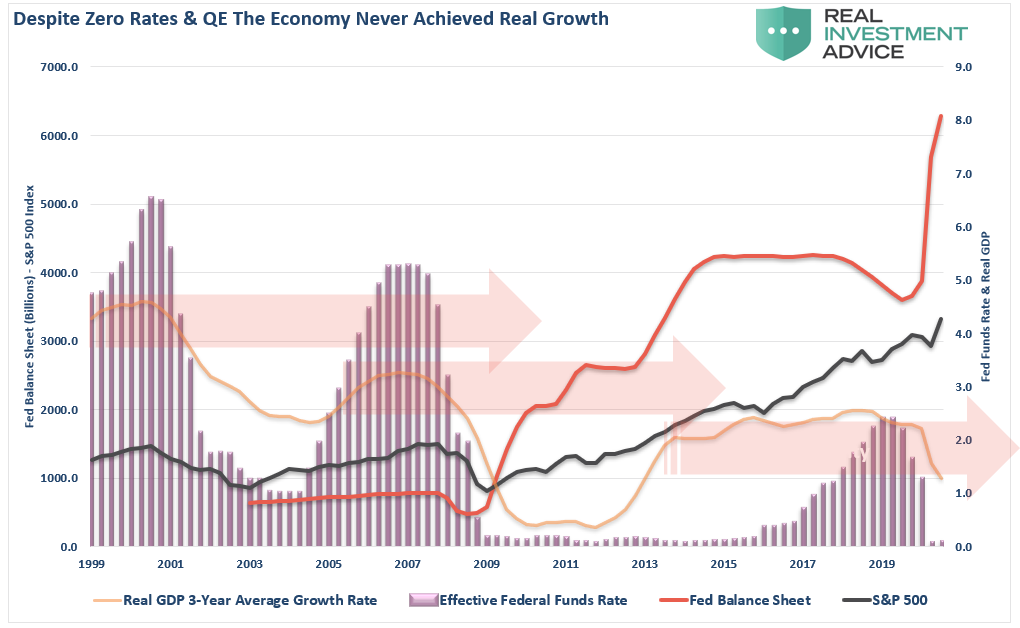
The trap the Federal Reserve has stumbled into is that it continues to require more interventions to sustain lower rates of economic growth. Whenever the Fed withdraws interventions, economic growth collapses.

As shown, since the turn of the century, each economic cycle has failed to attain a higher rate of growth than previously. The Federal Reserve lowered interest rates to stimulate growth. However, after reaching the “zero bound,” the Fed engaged in expansionary monetary policy.
Such is why Fed Chairman Jerome Powell has repeatedly pressed for more “fiscal” support from Congress. Without more debt issuance, the Federal Reserve’s ability to “monetize” bonds to provide “monetary stimulus” to the markets is limited. In theory, boosting asset markets should increase consumer confidence and create a “trickle-down” effect on the economy.

Unfortunately, as shown below, this has yet to be the case. Since 2009, the raw increase in just the Fed’s balance sheet, excluding all the other interventions in the table above, was 438%. During that same time frame, the S&P 500 increased by 199.94% and GDP just 21.24%.
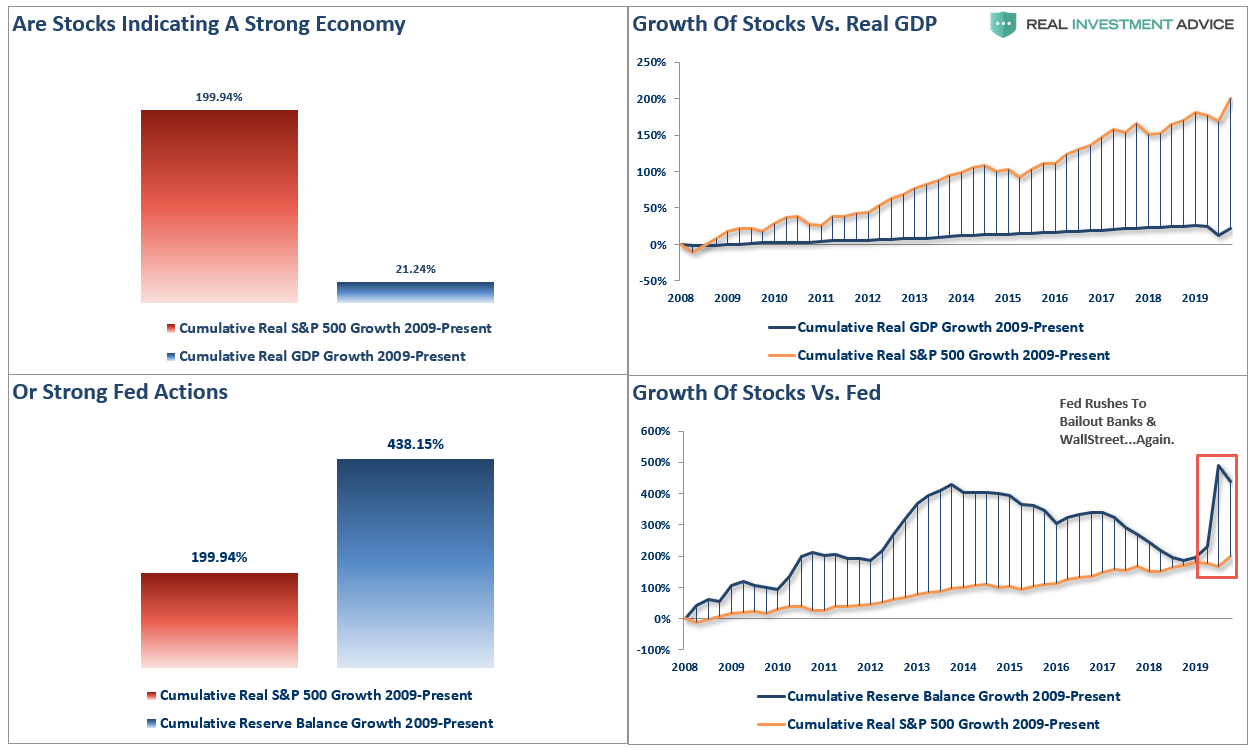
Again, while Jerome Powell continues to suggest “the recovery will be stronger and move faster if monetary policy and fiscal policy continue to work side by side,” there is little evidence to support that statement.

Debts Are The Problem

The question that plagues Central Bankers globally is why higher economic growth rates, and ultimately inflation, fail to appear.

“Instead, faced with slowing global growth and resurgent infections, the focus of policy makers at last week’s all-virtual International Monetary Fund and World Bank meetings was on more support for the world economy, not less. Central banks are pulling out the stops to do all they can, boosting financial markets with massive asset purchases and pushing government borrowing costs to record lows.” – Bloomberg

As previously discussed, there is a long historical correlation between increasing debts and lower economic growth rates.

“Unfortunately, higher levels of debt continue to retard economic growth keeping the Fed trapped in a debt cycle as hopes of “growth” remain elusive. The current 5-year average inflation-adjusted growth rate is just 1.64%, a far cry from the 4.79% real growth rate in the ’80s.”
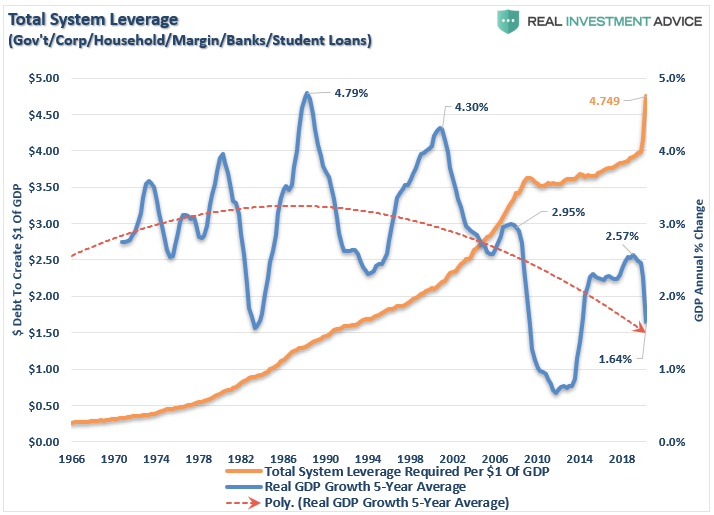
“In 1998, the Federal Reserve “crossed the ‘Rubicon,’ whereby lowering interest rates failed to stimulate economic growth or inflation as the “debt burden” detracted from it. When compared to the total debt of the economy, monetary velocity shows the problem facing the Fed.”

As stated, this isn’t just a “Fed” problem. It’s a “global” problem.

No Exit

As stated, the Federal Reserve is in a trap from which there is no exit. As Former Fed Governor Randall Kroszner recently said:

“The big debts that governments are racking up are going to make it difficult for central banks to raise rates when they feel the need to do so because that will increase borrowing costs.”

In an economy laden by $75 Trillion in debt, a record number of “Zombie” companies kept alive only by low borrowing costs, and a near-record number of companies with negative equity, higher rates are a “death knell.”

Furthermore, despite Wall Street’s demands to keep asset prices elevated, the Federal Reserve has allowed itself to become politicized by Congress, who allocated money to the Treasury to set up emergency lending facilities.

The Federal Reserve can’t withdraw the “life support” even though the support may be doing more harm than good in the long run.

Markets Are Now Dependent On The Fed

“The Central Bank has conditioned the market to such an extent that every time the Fed tries to step back, the market forces them back in by selling off and tightening financial conditions.” – Mohammed El-Erian

Such explains the trap the Federal Reserve has gotten themselves. Even Former Bank of England policymaker Paul Tucker agreed that the financial markets have come to expect periodic support from central banks. Such is not surprising after years in which policymakers delivered just that.

“I wait, longing for a central banker to do for financial stability what Paul Volcker did for inflation, which is to break that psychology that you, the capitalist markets, are actually utterly dependent on the Federal Reserve and other central banks, propping up prices come what may,” – Paul Tucker

Such is the problem facing the Fed.

The debt deluge, and co-dependent financial markets, is leading to other potential consequences. The Treasury market is now so large that it may not function smoothly on its own during times of stress. Such was a point made by Fed Vice Chair for Supervision Randal Quarles.

“It is an open question of whether the Fed would have to keep buying Treasuries to aid the working of the market.”

We know that the Fed is dependent on the financial markets, believing the “Fed” will provide support as needed. With the entirety of the financial ecosystem now more heavily levered than ever, the “instability of stability” is now the most significant risk.

The Paradox

The “stability/instability paradox” assumes that all players are rational, and such rationality implies avoidance of destruction. In other words, all players will act rationally, and no one will push “the big red button.”

The Fed is highly dependent on this assumption as it provides the “room” needed, after more than 10-years of the most unprecedented monetary policy program in U.S. history, to try and navigate the risks that have built up in the system.

The Fed is dependent on “everyone acting rationally.”

Unfortunately, that has never been the case.

The behavioral biases of individuals is one of the most severe risks facing the Fed. Throughout history, the Fed’s actions have repeatedly led to adverse outcomes despite the best of intentions.

  • In the early 70’s it was the “Nifty Fifty” stocks,

  • Then Mexican and Argentine bonds a few years after that.

  • “Portfolio Insurance” was the “thing” in the mid -80’s

  • Dot.com anything was an excellent investment in 1999

  • Real estate has been a boom/bust cycle roughly every other decade, but 2006 was a doozy.

  • Today, well, it’s pretty much everything tied to “debt.” 

Risk concentration always seems rational at the beginning, and the initial successes of the trends it creates can be self-reinforcing. That is, until suddenly, and often without warning, it all goes “pear-shaped.”

The Single Biggest Risk To Your Money

“If the Fed and other central banks are constrained from scaling back emergency stimulus, the continued flood of liquidity could spur asset bubbles and even too-rapid inflation.” – Bloomberg

Such is already likely the case and underscores the single most significant risk to your investments.

In extremely long bull market cycles, investors become “willfully blind” to the underlying inherent risks. Or rather, it is the “hubris” of investors as they believe they are now “smarter than the market.”

Yet, the list of concerns remains despite being completely ignored by investors and the mainstream media.

  • Growing economic ambiguities in the U.S. and abroad: surging autos and housing against a backdrop of high unemployment.

  • Political instability.

  • The failure of fiscal policy to ‘trickle down.’

  • An important pivot towards easing in global monetary policy.

  • Geopolitical risks.

  • Deteriorating earnings and corporate profit margins.

  • Record levels of private and public debt.

For now, none of that matters as the Federal Reserve continues providing stimulus to the market. The problem comes when they can’t do more, or the markets demand more than the Fed can give.

That is the point where “instability” will exceed the grasp of Central Bankers.

via ZeroHedge News https://ift.tt/38MA1am Tyler Durden
Dr. Fauci Warns US Likely To Cancel Christmas, Hints That Masks & Social Distancing Are Here To Stay

Dr. Fauci Warns US Likely To Cancel Christmas, Hints That Masks & Social Distancing Are Here To Stay

Tyler Durden

Sun, 11/15/2020 – 15:30

Across the US, millions of Americans are planning on scaled-back Thanksgiving dinners, with only members of their immediate family “bubbles” invited. Mayors of some of America’s large cities, along with the governors of California, Oregon and Washington State, have asked residents to limit travel over the holidays.

As angst about the spoiled Thanksgiving holiday simmers, Dr. Anthony Fauci acknowledged Sunday during an appearance on CNN’s “State of the Union” that American families should probably prepare to skip Christmas dinner, too.

While Dr. Fauci has repeatedly praised Pfizer and Moderna, and assured the American public that the FDA’s first vaccine emergency-use authorization could be handed down within days, he cautioned during Sunday’s interview that people should continue to wear masks and observe social distancing even after they’ve been vaccinated.

It’s just the latest unsettling hint that social distancing requirements could be here to stay.

“I would recommend to people to not abandon all public health measures just because you’ve been vaccinated,” Fauci said during an appearance on CNN’s State of the Union. “Because even though for the general population it might be 90% to 95% effective, you don’t necessarily know for you how effective it is.”

Later in the interview, Dr. Fauci agreed, with some trepidation, with Jake Tapper’s assessment that Christmas “is probably not going to be possible.”

Dr. Fauci responded that people “can’t abandon fundamental public health measures” until the vaccine has been somewhat widely distributed. That might not be until the second or third quarter of next year.

As the interview turned toward the “models” calling for massive numbers of COVID-19 deaths over the winter, Dr. Fauci claimed that calls for another 200,000 deaths in the US over the coming 4 months (a rate many times higher than where we are currently) could come to pass if people don’t obey new COVID-19 restrictions (exactly what he said last time). At this time, Dr. Fauci said that while a national lockdown doesn’t seem to be imminent, if the situation continues to worsen, anything might be possible.

Watch the full interview below:

Finally, Dr. Fauci also discussed the importance of making sure the vaccines appear safe, an issue we touched upon earlier today.

via ZeroHedge News https://ift.tt/3kx8WtZ Tyler Durden

Newsmax Buyout Eyed By Trump Allies Seeking ‘Fox News Killer’; CEO Denies Deal

Newsmax Buyout Eyed By Trump Allies Seeking ‘Fox News Killer’; CEO Denies Deal

Tyler Durden

Sun, 11/15/2020 – 15:05

The CEO of conservative pro-Trump cable channel Newsmax has denied rumors that a Trump-allied private equity firm Hicks Equity Partners has ‘held talks in recent months’ about acquiring them, according to the Wall Street Journal.

Newsmax never had any deal with the Hicks group, and if it’s true they were using our name for the purposes of capital fundraising, that is wholly inappropriate,” said Newsmax Media CEO Chris Ruddy, who noted that he’s had many discussions over the years with interested parties.

Newsmax CEO Chris Ruddy at Trump National Golf Club in Bedminster, N.J., in 2018. (Photo: Carolyn Kaster/Associated Press )

According to the Journal, Hicks. which has ties to a RNC co-chair, has reportedly been exploring ways to build a competitor to Fox News.

Newsmax, meanwhile, has seen a sharp rise in viewership since Election Day, when Fox News’ anti-Trump mask came off – with the network taking heat for a way-too-early call on Arizona for Joe Biden, while several hosts from the ‘conservative’ news outlet were all but rooting for Biden. Fox’s bias was on full display during the first presidential debate, when moderator and Fox host Chris Wallace essentially became a third debater, engaging in frequent arguments with the president.

Mr. Trump and Fox News have had a complicated relationship. The network’s opinion hosts are highly supportive of the president. He devours Fox content, tweets and about it and is influenced by it in policy and personnel decisions, aides say. Yet he spars with the network when he feels it is criticizing or undermining him. –Wall Street Journal

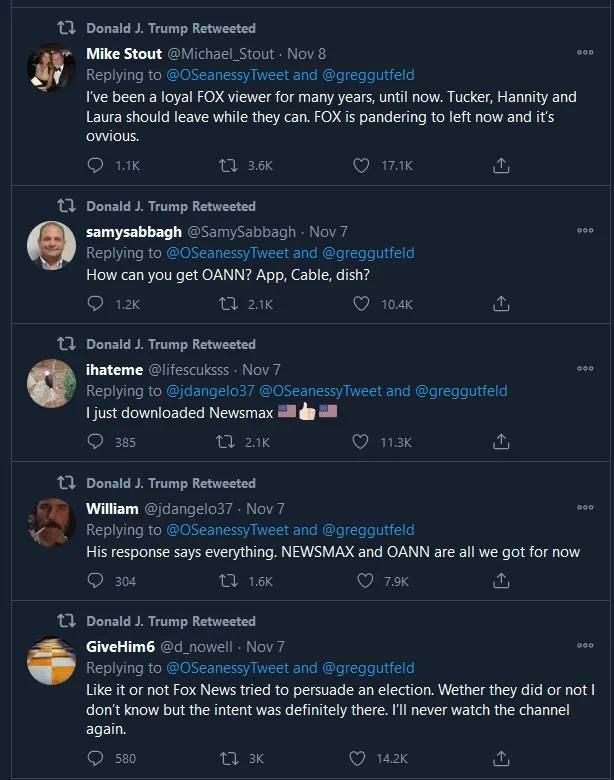
Last week, President Trump retweeted over a dozen posts critical of Fox News, including several which made mention of switching to Newsmax and conservative competitor OANN.

Capitalizing on Fox’s ‘Drudgian’ shift, Newsmax’s average prime-time audience has jumped 156% to 223,000 during election week according to data from Nielsen. Last Thursday, the fledgling network exceeded one million viewers between 7 p.m. and 8 p.m., “about half of Fox’s audience during the time period” according to the report. That said, “Sustaining those gains when interest in the election subsides won’t be easy. Fox averaged nearly six million prime-time viewers during the week of the election, about 22% higher than the previous four weeks.”

via ZeroHedge News https://ift.tt/32NCHR9 Tyler Durden

Martin Armstrong: This Is The Most Corrupt Election In American History

Martin Armstrong: This Is The Most Corrupt Election In American History

Tyler Durden

Sun, 11/15/2020 – 14:40

Via Greg Hunter’s USAWatchdog.com,

Legendary financial and geopolitical cycle analyst Martin Armstrong said his computers picked up massive fraud coming in the 2020 Election years ago. 

Armstrong explains, “The computer doesn’t ask my opinion, or anybody else’s, it just goes on the numbers from the economic data.  It’s never been wrong…”

“Besides 2016 (predicted Trump win) and for this one, it said it would be the most corrupt election in American history.  I published this out at least two years ago.  People have to understand, this isn’t my opinion.  This has gone far beyond anything I would have anticipated.  Every election you have had dead people voting.  That’s pretty standard, and that’s not something new. . . . This is just off the charts.  This is the Left, and they are so desperate to take over the United States.”

If the cheating is “off the charts,” then how bad was it in terms of fraudulent votes, including votes taken from President Trump and votes given to Joe Biden?  Armstrong contends,

“The cheating is in the millions, definitely millions, and perhaps as much as 38 million.  This is some of the information I am getting from behind the curtain.”

Martin Armstrong also warns, “They (Democrats/communists) want to eliminate the Supreme Court—period.  This is outrageous what they are doing…”

”  That’s why I have said this is not a simple election between Republican and Democrat.  This is something much more sinister. . . . You will own nothing, and you will be happy.  Their idea is to strip everybody of all property—period.  That’s communism.  Then you are going to give guaranteed basic income.  If you don’t do what the government tells you to do, like get a vaccine or whatever, then, oh, your guaranteed basic income will be suspended.  Then how are you going to eat?  This is what they are doing. . . . In communism, they take all assets away from everybody.”

Armstrong also says, “They are using CV19 and climate change to set an agenda for control.”

In closing, Armstrong says, “We are getting into a situation where it is a war against us...”

”  I hope Trump wins because . . . he’s our last defense against some of these people, and that’s why they have been trying to steal this election. . . . They are promoting this great reset–and it’s communism.  These people think this is good for the climate, but they are going to find out they are selling out, not just themselves, but their families and all posterity.”

Join Greg Hunter of USAWatchdog.com as he goes One-on-One in this in-depth interview (40 mins. in length) with Martin Armstrong of ArmstrongEconomics.com.

To Donate to USAWatchdog.com Click Here

Martin Armstrong says he likes gold but is more bullish on physical silver.  He says you can make small transactions with it.  Silver will probably not be confiscated by the government, and it is also not tracked by government, at least for the time being.

via ZeroHedge News https://ift.tt/3pxTFN5 Tyler Durden

In Striking Reversal, One Bank Warns That 2021 Could See The “Biggest Fiscal Contraction In History”

In Striking Reversal, One Bank Warns That 2021 Could See The “Biggest Fiscal Contraction In History”

Tyler Durden

Sun, 11/15/2020 – 14:15

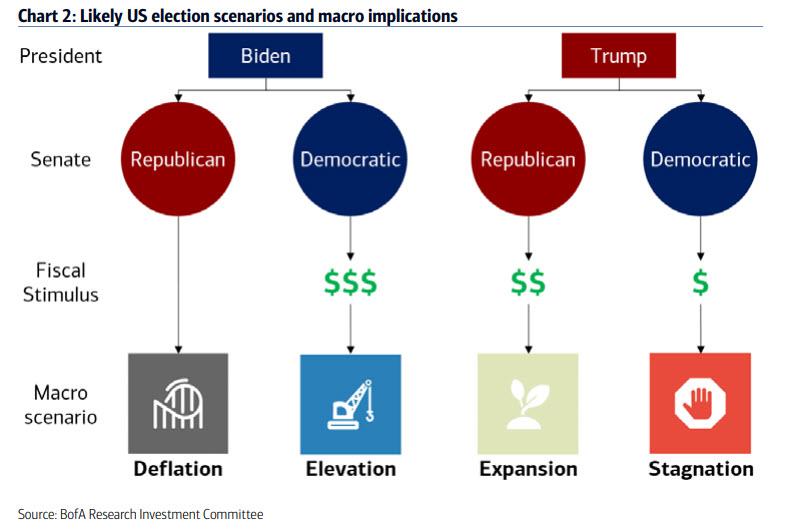
Echoing the skepticism voiced on Friday by BofA CIO Michael Hartnett who bucked the Wall Street trend of optimism, and said to “sell the vaccine“, another BofA strategist, Jared Woodard, writes in the bank’s latest Research Investment Committee note that a confirmed Biden presidency & GOP-led Senate would imply modest growth and corporate profits, maximum QE, and mediocre returns to risky assets, quite contrary to the euphoria gripping Wall Street which is now projecting the S&P rising to (or above) 4,500 by 2022.

Not so fast, Woodard says, arguing that the closest comparison may be 2010-2015 with secular stagnation, an easy Fed, and an iceberg of austerity and when winners were US growth stocks & HY bonds (similar to now). As a result, while he expects small policy progress on Global-to-Local, health care coverage, and a capex/R&D rebound, he anticipates only temporary gains for cyclicals & inflation. AS a result, the “all one trade” market – which he first defined back in August – is still with us.

Meanwhile, according to Woodard, the greatest risk is that benefits of a divided government are front-loaded.

This means that while good vaccine news & macro data may be short-term bullish they will prove to be “medium-term bearish if used as a pretext for tighter budgets, with 2021 set to be the fastest fiscal contraction on record.”

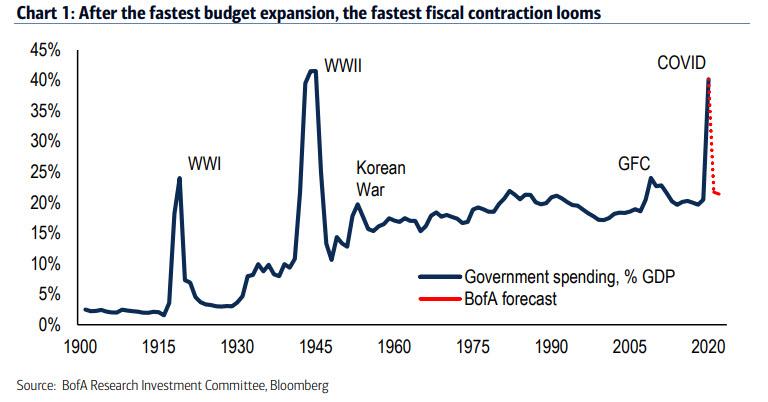
Indeed, in a world where what goes up must come down – unless extended indefinitely which however can’t happen under gridlock – Woodard warns that after the fastest budget expansion on record, “the fastest fiscal contraction ever looms.”

In his narration of election night, Woodard who one month ago put together the 4 election scenarios for markets…

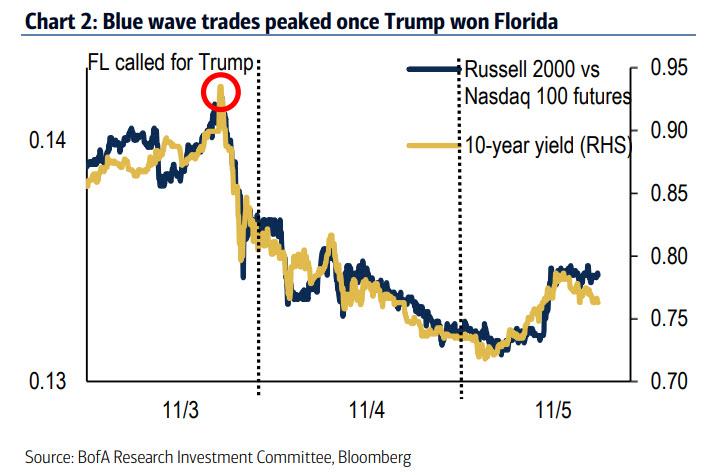
… said there was no surprise in the market’s response: investors initially reacted that a unified government is bullish if short-lived: as “Blue wave” odds peaked on election night, small caps rallied and Treasury yields spiked to 5-month highs, then reversed as it became clear the election results would be close and contentious.

That said, the worst-case deflation scenario Woodard highlighted last month has been postponed after Senate leadership promised more pandemic relief this year (although the number will likely be far smaller than many had expected). In any case, the estimated package of up to $1.0tn (coupled with the year’s previous fiscal injections) would make 2020 the largest year of fiscal expansion relative to GDP in US history.

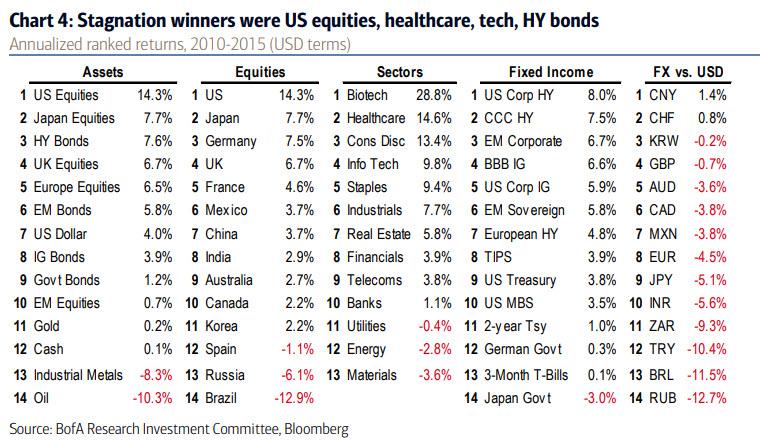
However, and this goes back to BofA’s key warning, “the challenge for investors is that with a divided Congress and appetites for budget austerity rising in both parties, 2021 could also become a record year via the fastest and largest fiscal contraction in history” according to Woodard who says that the “best historical comparison might be 2010-2015, which also featured a Democratic president, divided Congress, and an iceberg of austerity keeping the economy in a freeze.” The next chart shows the annualized returns from that period.

Back then, secular stagnation winners were:

  • US vs. the rest of the world,
  • defensive growth (health care, discretionary, tech) vs. cyclical value (financials, energy, materials),
  • high yield & EM bonds vs. cash and government bonds.

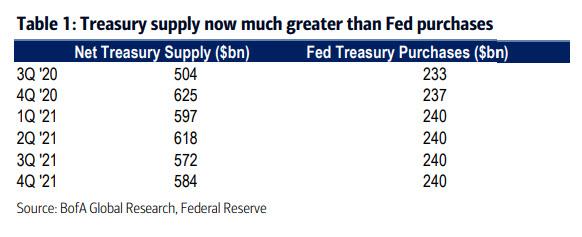
Then, as now, investors were rewarded by a maximally-dovish Fed, and while Woodard expects the QE boost to markets to be smaller now, we remind readers that earlier today we noted that for 2021 we expect the Fed to double its QE as the Treasury is expected to net $2.4 trillion in TSY issuance next year…

… more than double the $1 trillion in scheduled debt monetizations.

In other words, if Woodard is right and the fastest ever fiscal contraction is imminent, it only means that the Fed will have no choice but to offset it with an even greater monetary injection. In retrospect, Goldman’s 2022 price target for the S&P of 4,600 may prove to be too conservative after what is shaping up as the biggest monetary deluge ever.

via ZeroHedge News https://ift.tt/3kx0VoT Tyler Durden

Another Brexit Deal Deadline Blown As Boris Johnson Stands His Ground; Extension Expected

Another Brexit Deal Deadline Blown As Boris Johnson Stands His Ground; Extension Expected

Tyler Durden

Sun, 11/15/2020 – 13:50

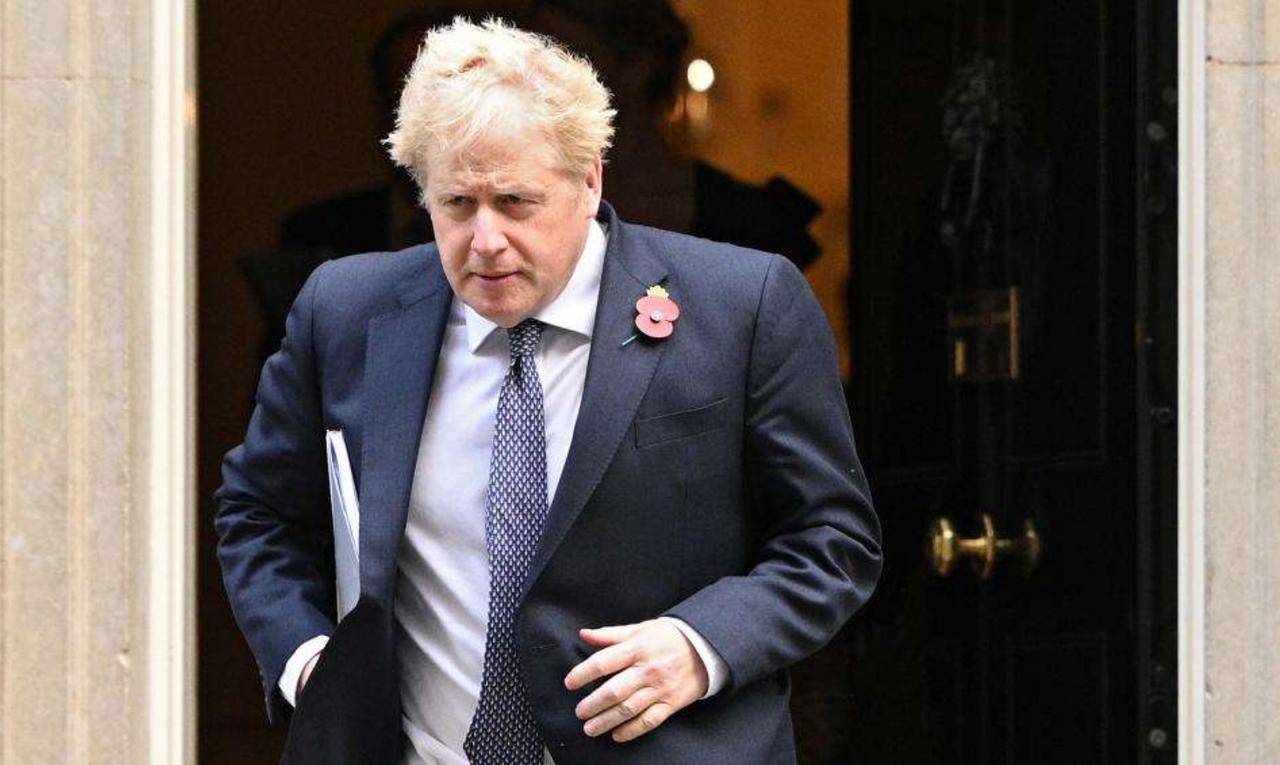
Yet another Brexit trade-deal deadline is about to be blown, as PM Boris Johnson and the EU27 contemplate an extension, the latest sign that talks will inevitably go down to the wire as the UK is set to complete its departure from the EU on Jan. 1.

British Environment Secretary George Eustice said Sunday it might be possible to “squeeze out extra time” if the two sides were close to an agreement. And although the UK’s chief Brexit negotiator David Frost said on Sunday that he was heading back to Brussels for more talks with his EU counterpart, Michel Barnier, he insisted that the UK “will not be changing its position” in the coming talks, as BoJo continues his heavy-handed push to force the EU to cave on issues from fisheries access, to Brussels’ demands for a “level playing field”, to the powers of the European Court of Justice.

Frost added in a string of tweets that while there has been “some progress” during the latest round of talks, it’s still extremely possible that “we may not succeed” in striking a mutually agreeable deal. At this point, even the BBC has pointed out that whatever deal does come to pass will be minimal.

“Arriving once again in Brussels shortly for another round of negotiations with EU and @MichelBarnier this afternoon. I and our British🇬🇧 team have been in talks almost every day since 22 October.

We are working to get a deal, but the only one that’s possible is one that is compatible with our sovereignty and takes back control of our laws, our trade, and our waters. That has been our consistent position from the start and I will not be changing it.

There has been some progress in a positive direction in recent days. We also now largely have common draft treaty texts, though significant elements are of course not yet agreed. We will work to build on these and get an overall agreement if we can.

But we may not succeed. Either way, as the Prime Minister @BorisJohnson made clear on 16 October, people and businesses must prepare for the change that is coming on 31 December, most of which happens whether there is a deal or not.

Now that the US election has passed, and Dominic Cummings has been booted from the government, Telegraph opinion writer Jeremy Warner suggested recently that a deal was now extremely likely. However, even with the deal, Britain’s exit from the EU is bound to be “shambolic,” since the coronavirus has delayed important infrastructure upgrades to the UK’s customs capabilities.

Deal or no deal, Britain’s final departure from the EU’s embrace on Jan 1 promises to be a shambolic nightmare from all I hear, threatening a surge in prices and the future of many smaller freight handlers.

The Government’s antiquated Customs Handling of Import and Export Freight system is struggling to cope with even its present workload, which will more than double once we leave.

This was meant to be replaced in March this year with a shiny new Customs Declaration Service, but inevitably the construct is long overdue. Government incompetence is not confined to test, track and isolate procedures, it would seem.

Industry insiders told a House of Lords committee hearing last week that there was “no realistic chance it would work” even for the limited purpose of trade with Northern Ireland, for which it is initially scheduled as a dress rehearsal for eventual wider use.

Apparently, one anonymous Tory MP confided in Warner that he was tired of Britons blaming Tories for not having a clear-cut Brexit plan.

“I’m sick to death with being lectured by the Government on how it is up to us to prepare, and it is all our fault if we are not ready,” one intermediary told me. “Prepare for what? Nobody has a clue.”

From what we can tell, that notion has yet to be internalized by Wall Street analysts, who are telling clients that a deal is virtually assured. Did they learn nothing from the original upset Brexit Referendum vote?

via ZeroHedge News https://ift.tt/3kzbN5B Tyler Durden

Was That It For Value? How Does Last Monday’s Quant Crash Compare To The “June Swoon” And What Happens Next

Was That It For Value? How Does Last Monday’s Quant Crash Compare To The “June Swoon” And What Happens Next

Tyler Durden

Sun, 11/15/2020 – 13:25

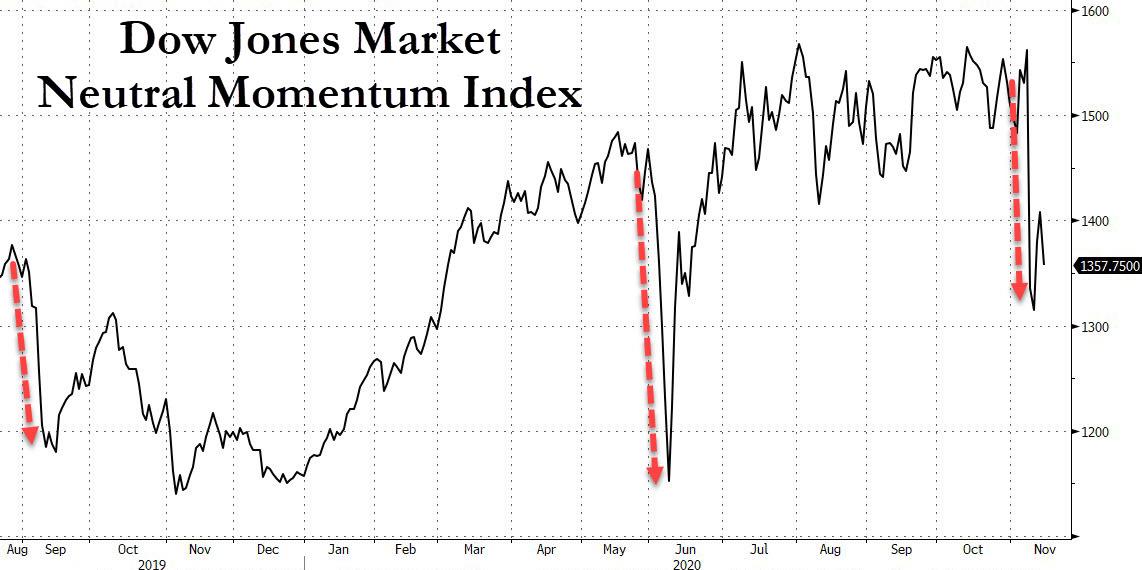
While last Monday’s “Pfizer vaccine”-inspired 15-sigma momentum crash, which unleashed an unprecedented rotation out of growth and into value stocks crushed countless momentum-heavy quant (and Robinhood) portfolios, traders may have forgotten that a similar if not greater plunge in momentum names was observed in early June when the Dow Jones market neutral momentum index – which had escaped the March covid crash largely unscathed – lost all of its YTD gains virtually overnight.

However, considering that the June momentum crash was completely reversed in less than a month, traders are asking if the November 9 plunge is just another headfake in the “great rotation” from value to growth which Wall Street strategists have been predicting as imminent virtually every week for the past 2 years, only to leave their clients nursing massive P&L losses.

Picking up on this skepticism, on Friday JPM’s Nick Panigirtzoglou writes in his iconic Flows and Liquidity newsletter that there are indeed indications that last Monday’s manic reflation moves may already be U-turning again with “almost half of the recent selloff in global  government bond yields has been reversed over the past two days, echoing last June’s pattern.”

It is this re-flattening of global government bond yield curves which to JPM represents a headwind for value stocks given the signaling importance of the slope of the yield curve.

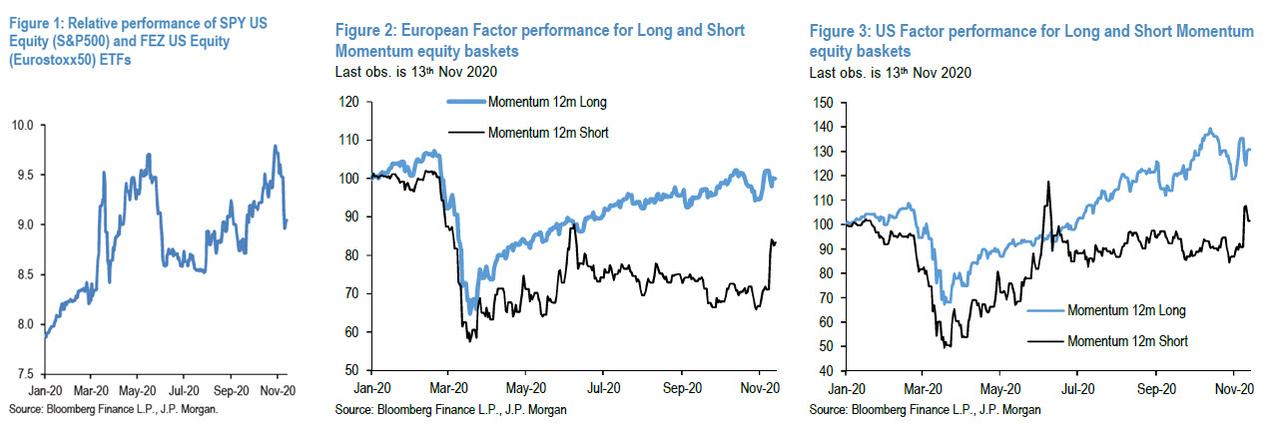
Pointing to the charts below, JPM notes that “the rotation trade lost steam later on the week” with the relative underperformance of the S&P500 vs. the Eurostoxx50, the main manifestation of the value rotation trade in the equity index space, stalled echoing last June’s pattern. Additionally, the Short Momentum equity baskets reversed some of their previous gains at the beginning of the week, especially in the US, though the reversal has not yet showed the steepness of last June’s reversal (Figure 2 and Figure 3).

So what happens next?

Unlike Nomura’s Charlie McElligott’s who predicted that the momentum crash will persist following last Monday’s epic crash, JPM is not so sure and according to Panigirtzoglou, “for this week’s value rotation to be sustained it likely needs some continued positive news on the vaccine front or positive news on growth prospects, such as support from further fiscal stimulus.” This makes the forthcoming vaccine announcement by Moderna particularly important as a comparable vaccine effectiveness to that of the Pfizer earlier this week “would help to sustain this week’s value rotation trade. At the same time, an announcement of vaccine effectiveness by Moderna that would be seen as significantly weaker could prompt some further reversal of the value rotation trade.

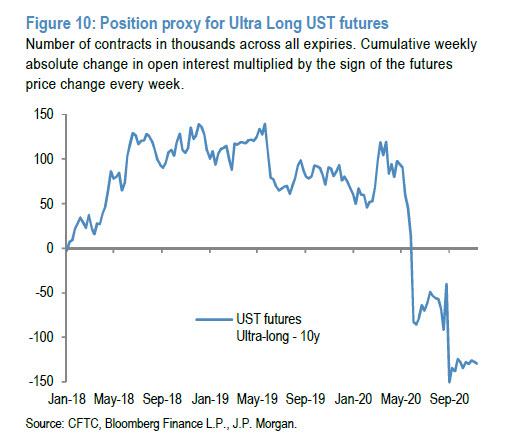
Finally, JPM also finds headwinds for a continued rotation from “elevated curve steepening exposure” as a result of a record net short positioning in Ultra Treasury futures.

Drilling down into the technicals, the JPM quant says that the latest reversal of the bearish global government bond duration impulse in yield and curve space “raises questions about the investor position backdrop in the rate space.” To answer these questions JPMorgan resorts to its arsenal of bond position indicators to look at how extended or concentrated these positions are. In short, it finds the following:

  • First, looking at dedicated bond funds, JPM finds that both US and Euro active bond mutual funds have played a role in driving the market swings over the past two weeks, “and that positions are now likely on the short side.”
  • Second, looking at CTA, the bank concludes that CTAs may have contributed to amplifying market moves, “but likely not significantly given that the momentum signals were far from extreme territory that would have signalled a greater risk of profit taking or mean reversion signals kicking in.” In sum, JPM finds CTA signals modestly long in 10y Bunds and short in 10y USTs.
  • What about risk parity and balanced mutual funds? The chart below shows the rolling 21-day partial betas to bonds, which shows that bond betas of risk parity funds saw a short-lived, sharp spike in the aftermath of the election from close to or modestly below their longer-term averages. This suggests the gradual decline in vol had seen increase leverage and found themselves longer duration as volatility spiked, likely reversed at least in part post-election. By contrast, balanced mutual funds appear to have remained modestly short and added to those short positions this week.

  • Next, looking at retail investors, we find that inflows into bond funds in 2020 have been “robust”, particularly against the backdrop of the $270bn of outflows seen in March. But what about the duration impulse of these flows? To look at this duration impulse, JPM calculated the duration impact of bond ETF flows by adjusting for the empirical duration of each bond ETF. When the bank adjusts for empirical duration, shown in Figure 9, the bullish duration impulse appears to have peaked in the second half of October, but only shown tentative signs of a reversal.

  • Finally, JPM looks curve positions via its position proxy for futures contracts based on the cumulative absolute change in the open interest multiplied by the sign of the futures price change each week. It finds that at the very long-end of the curve its position proxy for the 10s/30s part of the UST curve suggests that speculative investors continue to hold elevated curve steepening exposure, with only modest signs of reversal in recent weeks.

In summary, and intuitive, JPMorgan finds that active bond mutual funds played a role in recent yield swings, amplified by momentum investors, while positions appear to be skewed short overall on duration among active bond mutual funds, balanced mutual funds and, in the case of USTs, for momentum-based investors.

In conclusion, JPM finds that absent more fundamental drivers to bolster the value to growth rotation, such as good news on the Moderna vaccine front, even more concerning for the value trade in the near-term is the headwind from elevated curve steepening exposure, where a peak value rotation appears to already be priced in.

via ZeroHedge News https://ift.tt/38ObUYO Tyler Durden

Experts Say “We’re Doomed!” Reality Says “Probably Not”…

Experts Say “We’re Doomed!” Reality Says “Probably Not”…

Tyler Durden

Sun, 11/15/2020 – 13:00

Authored by Mark Jeftovic via OutOfTheCave.io,

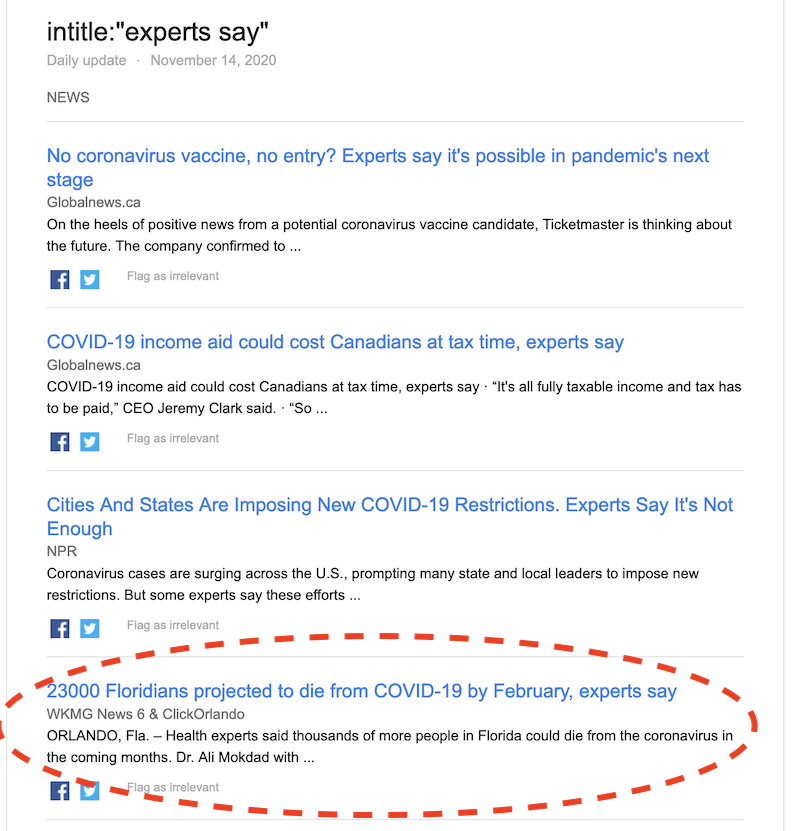
For a little over a year, before all this began, I setup a news alert filter for the words “experts say” in the headline. It’s provided a non-stop stream of puerile idiocy ever since. Once Coronavirus hit, the shriek-o-meter has been cranked to the level where I almost need to turn it off for my own sanity.

What it does do is vividly illustrate how the media frames events and how divorced from actual reality those narratives really are.

Today’s example is the bottom one in my latest alert, 23,000 Floridians projected to die from COVID-19 by February, experts say…

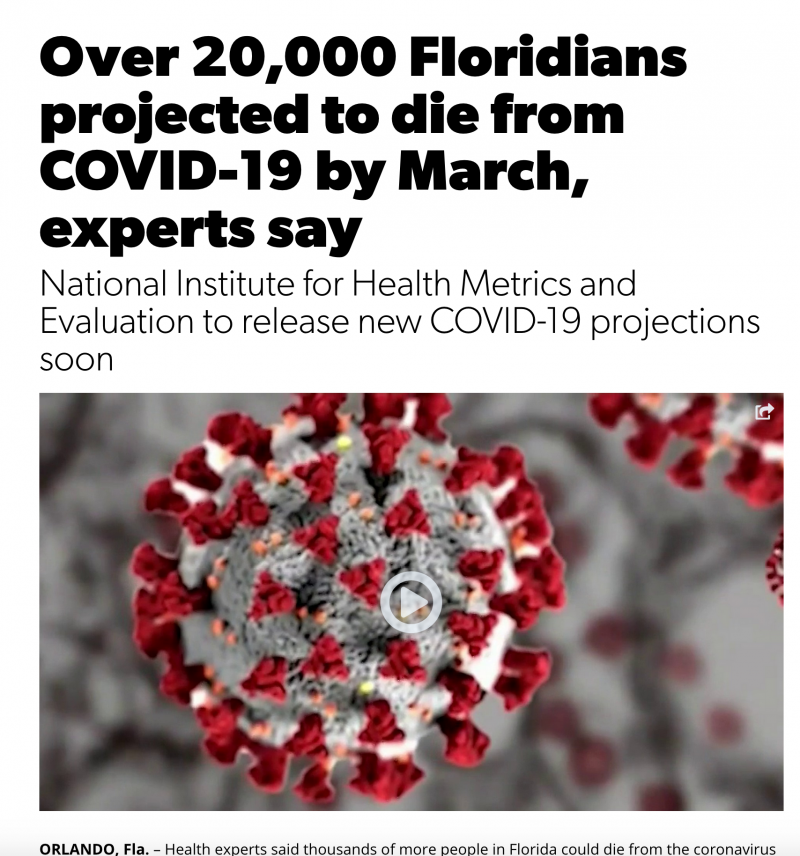
When I read that, it sounds like between now and February, 23,000 Floridians will die from Covid. When you click through to the link, the headline is changed from “by February” to “by March”, so let’s use March for our calculations and give it until the end of March, which is 137 days away.

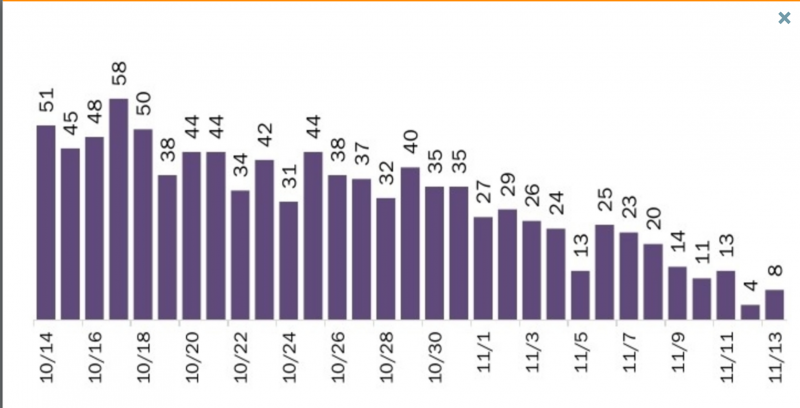
For 23,000 Floridian souls to die from Covid by March 31, it would mean 167.4 fatalities per day. When we pull up Florida COVID-19 stats, we see we’d a similar pattern that I reported on in the “Follow the science!” post, for the loudest, most hysterical prognostications to be fulfilled. Actual fatalities are in a pronounced downtrend, and to hit this number the data would have to blast off at a near vertical incline right now.

Via https://floridahealthcovid19.gov/#latest-stats

That’s how the headline reads to me. If what they really meant to say was “By February, the cumulative death toll from COVID-19 will be 23,000”, there are ways to convey that in a headline, like “COVID-19 Death toll to hit 23,000 by March, experts say”. It still sounds scary enough to draw in the clicks, especially if people don’t know that 17,445 Floridians have succumbed with COVID-19 already.

That means (carry the 1, ….) by the end of March, an additional 5,556 Floridians will die with COVID-19. That’s 40 per day, which is still higher than the current trend, even if you factor in that additional fatalities may very well be added onto the most recent 5 or 6 data points in a rolling fashion.

Also, notice how I keep writing that these fatalities, sad as they are, will die with COVID, not of it. We know already from both CDC and WHO data that co-morbidities are present in as many as 96% of all fatalities (even though I did say previously that I think the remaining 6% “death by COVID” number is higher than 6%).

All of which shows, when you look at the total deaths in a state like Florida, which looks like about 200,000/annually, across all causes (this is 2016 data here), approximately 547 Floridians pass on every day. Even if the headline read as seems (23K deaths between now and March), it would make for in increase in absolute fatality rate of about 20%, 1/5th. Which would be very bad, but not civilization ending catastrophic.

As it stands however, when you factor the 23K is the end of a cumulative series, we’re talking about a 0.07x increase (7%) in absolute death rate, and that’s if every single fatality is of COVID as opposed to with COVID.

So even there, the numbers are not as bad as the media makes them out to be. As I said before, all of this should be good news! So why are the major media outlets hysterically shrieking at us that our way of life is over forever instead of delivering the good news that we could be closer to the end of this thing than the beginning?

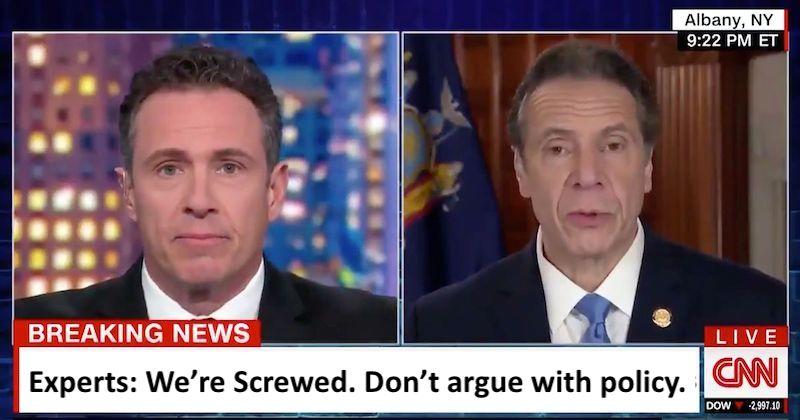
I’ll leave with a montage around Anthony Fauci telling Americans to basically shut up and do what they’re told.  Americans may prefer to tell him to Fauc-off instead.

*  *  *

Subscribe to my newsletter to get the next instalment or follow me on Twitter here.

via ZeroHedge News https://ift.tt/3nmqqeg Tyler Durden

Elon Musk Confirms He “Likely” Has A “Moderate Case” Of COVID

Elon Musk Confirms He “Likely” Has A “Moderate Case” Of COVID

Tyler Durden

Sun, 11/15/2020 – 12:35

“Everybody dies,” was the response Elon Musk gave on a September podcast where he was asked about the risk of Covid to his employees and their families. He continued: “We’ve been making cars this entire time and it’s been great. Through this entire thing, [SpaceX] didn’t skip a day. We had national security clearance because we were doing national security work. We sent astronauts to the space station and back.”

Fast forward the tape about two months and Musk has now confirmed that he “likely” has a “moderate case of Covid. “My symptoms are that of a minor cold, which is no surprise, since a coronavirus is a type of cold,” Musk said on Twitter on Saturday.

When asked how he was feeling, he said “a little up & down” and that it “feels just like a regular cold, but more body achy & cloudy head than coughing/sneezing.”

“DayQuil rocks,” he wrote. Cool, bro. Fist bump.

But it’s odd than Musk could be contracting Covid in November, since, as we noted Friday, his very large brain once led him to the genius-level conclusion that there would be no new Covid cases by April 2020…

Also on Friday morning, Musk claimed that “something extremely bogus” was going on because he had tested for Covid four times during one day, and the results were split, with two negative and two positive tests:

He made the comment after he took a series of rapid antigen tests, which can produce results within 15 minutes. The far left mob, including people like “Senior Producer” Kyle Griffin at MSNBC, didn’t waste any time in calling Musk “irresponsible” for saying his test may not have worked.

But as we noted Friday, Musk actually might be on to something. Days prior, we wrote that both the FDA and several states were warning about “careless” antigen testing being used for asymptomatic Covid cases. 

The appeal of these tests is that they can be spread widely and cheaply, giving the illusion of control over the virus to individuals and organizations that use them for quick blanket testing. But these tests could “miss some infections that can be picked up by costlier gold-standard assays, and can incorrectly return positive results,” we noted at the time.

Musk has publicly called Bill Gates a “knucklehead” and said he would not be getting the Covid vaccine when it comes out. 

via ZeroHedge News https://ift.tt/3nmnDSk Tyler Durden

Winter Is Coming…

Winter Is Coming…

Tyler Durden

Sun, 11/15/2020 – 12:10

Authored by Charles Hugh Smith via OfTwoMinds blog,

Realism must precede optimism or the optimism will collapse as the tsunami of reality comes ashore.

It’s time to prepare materially and psychologically for a winter unlike any other in our lifetimes.

Here’s the view from 30,000 feet:

1. The stock market and the general zeitgeist of optimism have soared based on expectations that the real-world economy and efforts to suppress Covid would also track a V-shaped recovery.

While GDP did make a V-shaped recovery, GDP (gross domestic product) is a measure of flows and consumption, not a measure of the socio-economic “balance sheet.” GDP measures the money flowing through accounts but not the “assets” of a functioning society: functional institutions and infrastructure and the well-being and security of the citizenry.

Thus GDP soars while the real-world economy and society are hollowed out by economic inequality, declining health, financial insecurity, rising prices for essentials, dysfunctional institutions and decaying infrastructure.

Simply put, GDP doesn’t measure what’s important; it creates destructive incentives to squander resources and borrow staggering sums to support more consumption. This systemic flaw in what we measure has long been recognized by mainstream economists such as Joseph Stiglitz. Measuring What Counts: The Global Movement for Well-Being (Joseph E. Stiglitz et al.)

So the recovery of GDP doesn’t mean the real-world economy has been restored to pre-Covid settings. GDP is a deceptive metric that’s masking a free-fall in our well-being, security and social cohesion.

2. Just as GDP is a deceptive measure of the economy, counting Covid fatalities is equally deceptive: a declining death count is good news, of course, but that ignores the other effects of Covid, particularly organ damage and “Long-Covid” debilitation, not just in people with pre-existing conditions and the elderly but in healthy middle-aged and even some young people.

As this article from the University of California – San Francisco (UCSF)–one of the world’s top healthcare research centers–explains, this is the result of Covid being a hybrid virus. Initially it was thought to be a respiratory virus like influenza, but it is now clear that Covid infects and disrupts many other systems in the body–endothelial, digestive, the heart and other organs.

We Thought It Was Just a Respiratory Virus: We were wrong.

What We Know So Far about How COVID Affects the Nervous System (scientificamerican.com)

Risk for In-Hospital Complications Associated with COVID-19 and Influenza (CDC) 

“Patients with COVID-19 had almost 19 times the risk for acute respiratory distress syndrome (ARDS) than did patients with influenza. The percentage of COVID-19 patients who died while hospitalized (21.0%) was more than five times that of influenza patients (3.8%), and the duration of hospitalization was almost three times longer for COVID-19 patients.”

The precise pathways and mechanisms of these long-term consequences are under intense study. Initial estimates are that about 1 in 20 people who came down with Covid are suffering some long-term consequences. These consequences–for example, damage to the heart–are typically only identifiable by exams and tests: superficially, the damage is not visible.

What is known is that Long-Covid affects females more than males, it affects otherwise healthy people who were previously fit and active, and tens of thousands of people have reported long-term symptoms of extreme fatigue, brain fog, etc.

There are no treatments yet and the prognosis is cloudy. There is no clarity yet on how long these problems may last or if damage to organs is permanent.

So the percentage of people dying from complications of Covid may not be the number that most accurately reflects the disease’s toll: the number of people with Long-Covid might be the more accurate reflection of the toll and the seriousness of the challenges ahead.

At 12, She’s a Covid ‘Long Hauler’

3. Many see herd immunity as the eventual solution to Covid. History suggests this isn’t as neat and tidy as many expect. The first wave of a novel pathogen may appear to reach herd immunity, only to re-emerge a few years later with renewed contagious vigor.

While it’s far too early to reach any definitive conclusions, preliminary evidence suggests natural immunity might decay within 6 months. This is supported by documented cases of re-infection, and in some cases the second infection is much worse than the initial infection. What reinfections mean for COVID-19 (The Lancet)

This evidence suggests herd immunity might not be the solution many expect.

Herd immunity is reached around 60% or higher, which suggests 200 million Americans would need to be infected to reach herd immunity.

4. The death rate for Covid is low for the entire populace, but it rises sharply for those with pre-existing conditions such as metabolic disorders (diabetes, pre-diabetes, etc.) and age (over 65).

A recent study on at-risk patients (ages 60 to 72) in 38 hospitals found about 30% had died within 60 days.

Sixty-Day Outcomes Among Patients Hospitalized With COVID-19 (Annals of Internal Medicine)

The problem is these at-risk populations are not small. There are 34 million people with diabetes, and an estimated 88 million Americans are pre-diabetic. 53 million Americans are 65 or older, and roughly 7 million are 80 and over.

There is obvious overlap in these categories–people may be diabetic at age 70–but even with the overlap, these at-risk populations are roughly half the entire population (165 million people).

As this article from Nature.com explains, the infection fatality ratio (IFR) rises from near-zero for young people to 3.1% for 65-74 year olds and 11.6% for those 75 and older. The coronavirus is most deadly if you are older and male — new data reveal the risks (Nature.com)

According to this report from the American Diabetes Association, the data from early reporting indicates the death rate for those with diabetes was 7.3%.

COVID-19 in People With Diabetes: Urgently Needed Lessons From Early Reports (American Diabetes Association)

As a thought experiment, let’s apply these death rates to at-risk populations at the “herd immunity” minimum of 60% of the populace:

A. 34 million diabetics X 60% = 20 million X 7% = 1.4 million deaths

B. 65-74 age group (28.6 million) X 60% = 17 million X 3.1% = 553,000 deaths

C. 75-84 group (14.2 million) + 85+ group (6.4 million) = 20.6 million X 60% = 12.4 million X 11.6% = 1.4 million deaths

This adds up to 3.3 million deaths without even counting any deaths in the populace younger than 65 or among the 88 million people with metabolic disorders.

The data suggests that 200 million infected people (60% of the U.S. population) would lead to about 3 million deaths and 10 million cases of Long-Covid.

Let’s say better treatments and self-isolation will cut the deaths to 2.5 million. That would be extremely positive, but what about the Long-Covid cases? The system has yet to even start collecting comprehensive data. Thus many of the eventual consequences and costs will remain unknown.

5. Hospitalizations are rising rapidly. Hospitalizations and deaths are trending upward.

Yet experts warn that the variability may simply end with the virus resurging to high levels across the entire country. “I don’t see any location in the United States that’s going to be free of a major increase in cases,” he said. “And I think we’re just getting started.”

When high case counts emerge in communities, the spillover to surrounding populations is rapid, Dr. Osterholm said. The situation, he noted, can be likened to a “coronavirus forest fire.”

“A forest fire never burns evenly everywhere,” he said. “But if the embers are still around, they ignite again and then that area does burn eventually. And I think that that’s what we’re seeing here.”

“We’re going to see much less evidence of regionalization of this virus over the course of the next several weeks,” said Dr. Michael Osterholm, an infectious diseases expert at the University of Minnesota. “I think this is going to ultimately end up being an entire country on fire.”

6. If you look at the chart of hospitalizations, the healthcare system in many locales was experiencing extreme stress at 60,000 hospitalizations, and so the rise above this level could trigger second-order effects which could cascade into a breakdown.

As this report from the CDC explains, a significant number of healthcare workers have been infected and hospitalized, and many died. COVID-19–Associated Hospitalizations Among Health Care Personnel (CDC)

Should the number of healthcare workers who contract the disease or burn out due to extended shifts and exhaustion rise beyond a certain point, the ability to provide care from everyone who is seriously ill may become severely impaired.

So there are two limiting factors on care as the number of hospitalizations soars: the number of beds available in Covid-secure wards and the number of healthcare workers available to provide care.

If either of these limits are reached, death rates may rise as patients are unable to get all the care they would have received had cases and hospitalizations not exceeded the capacity of the system.

7. There are lag times in effects and reporting:

–3 weeks: infection-to-death

–4 weeks: deaths reporting

–4 weeks: propagation to older age groups

–8 weeks: infection, partial recovery/discharged from ICU, death

Note the almost exponential rise in cases being reported. We can anticipate a surge in hospitalizations, deaths and spread to older populations in the weeks and months ahead.

8. Vaccines: I provided an analysis and numerous links on the many uncertainties surrounding vaccines in

Everything You Don’t Want to Know About Covid Vaccines (Because You Can’t Be Bullish Anymore) (November 11, 2020)

Covid-19 Vaccine Protocols Reveal That Trials Are Designed To Succeed (Forbes.com) by William A. Haseltine

9. The virus remains highly contagious. Wedding and Birthday Party Infect 56, Leaving Nearly 300 in Quarantine (New York Times)

The projections presented here are basic math, yet few seem to have done the simple math, perhaps because the results are sobering and don’t fit the desired “optimism.”

Realism must precede optimism or the optimism will collapse as the tsunami of reality comes ashore.

No one knows the future, but current trends suggest all the euphoric expectations of a fast, painless recovery were tragically misplaced.

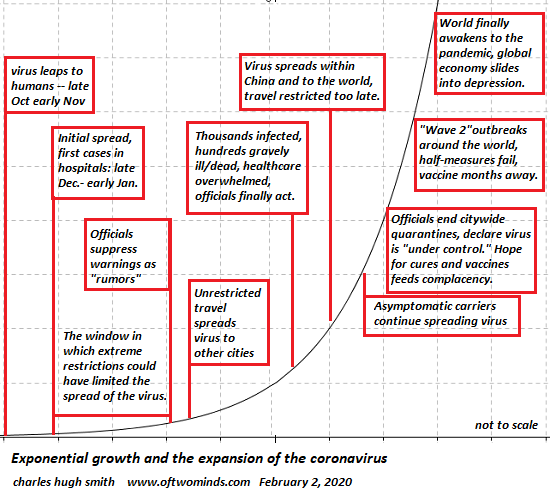
Here is the chart I prepared a week after Covid-19 hit the news in late January. 

Reality has been tracking my first-out-of-the-gate projection with remarkable coherence.

*  *  *

My recent books:

A Hacker’s Teleology: Sharing the Wealth of Our Shrinking Planet (Kindle $8.95, print $20, audiobook coming soon) Read the first section for free (PDF).

Will You Be Richer or Poorer?: Profit, Power, and AI in a Traumatized World
(Kindle $5, print $10, audiobook) Read the first section for free (PDF).

Pathfinding our Destiny: Preventing the Final Fall of Our Democratic Republic ($5 (Kindle), $10 (print), ( audiobook): Read the first section for free (PDF).

The Adventures of the Consulting Philosopher: The Disappearance of Drake $1.29 (Kindle), $8.95 (print); read the first chapters for free (PDF).

Money and Work Unchained $6.95 (Kindle), $15 (print) Read the first section for free (PDF).

*  *  *

Become a $1/month patron of my work via patreon.com.

via ZeroHedge News https://ift.tt/3pwxOG0 Tyler Durden