‘Catastrophic Flooding Expected’ – Hanna Hammers Virus-Infected South Texas Tyler Durden
Sun, 07/26/2020 – 11:01
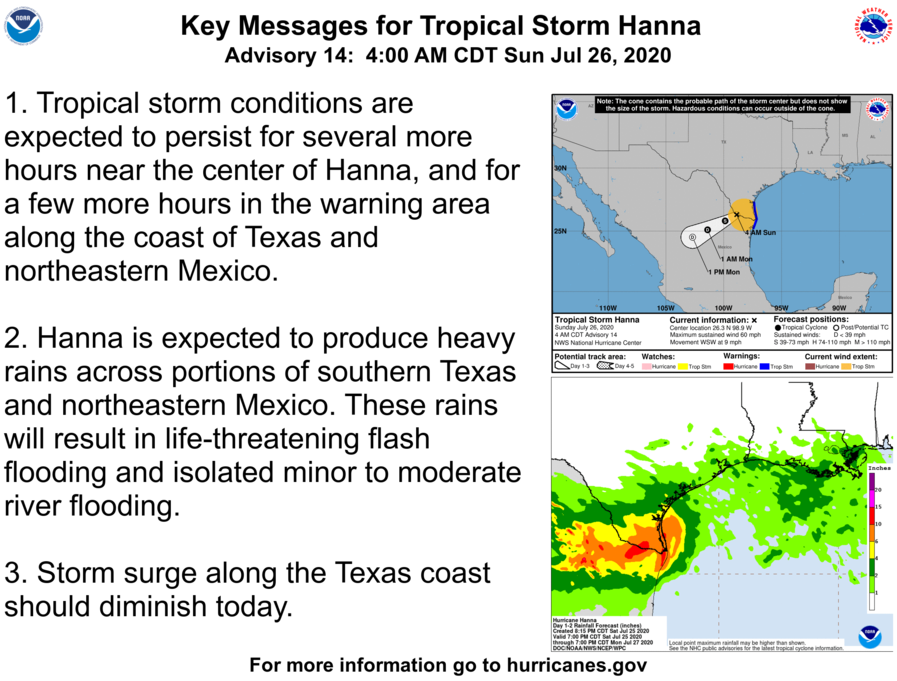
Tropical storm conditions are expected for South Texas and northeastern Mexico on Sunday after Hurricane Hanna roared ashore on Saturday as a Category 1 storm.
Hanna was the first hurricane of the 2020 Atlantic hurricane season and came ashore on Saturday afternoon around Port Mansfield, Texas, with maximum sustained winds of 90mph. The National Hurricane Center (NHC) downgraded the hurricane to a tropical storm early Sunday.
Chris Birchfield, a meteorologist with the National Weather Service (NWS) in Brownsville, told AP News the storm’s real threat continues to be heavy rainfall. “We’re still expecting catastrophic flooding,” he said.
Torrential rain band aimed right in-between McAallen and Brownsville, Texas producing extremely heavy rainfall rates of 2-4 inches an hour. #HurricaneHanna#TXwxpic.twitter.com/yCVDE2tCHu
Rainfall estimates are in the range of 6 to 12 inches through Sunday night, with isolated areas could receive upwards of 18 inches. Willacy County, Texas, which is near Brownsville and the border with Mexico, has already reported 12.6 inches. Brownsville is reporting 5.6 inches and Reynosa, a city in Mexico, has already seen 11 inches.
Here’s the latest update on Hanna via NWS:
Here’s the latest update on Hanna via the National Oceanic and Atmospheric Administration (NOAA).
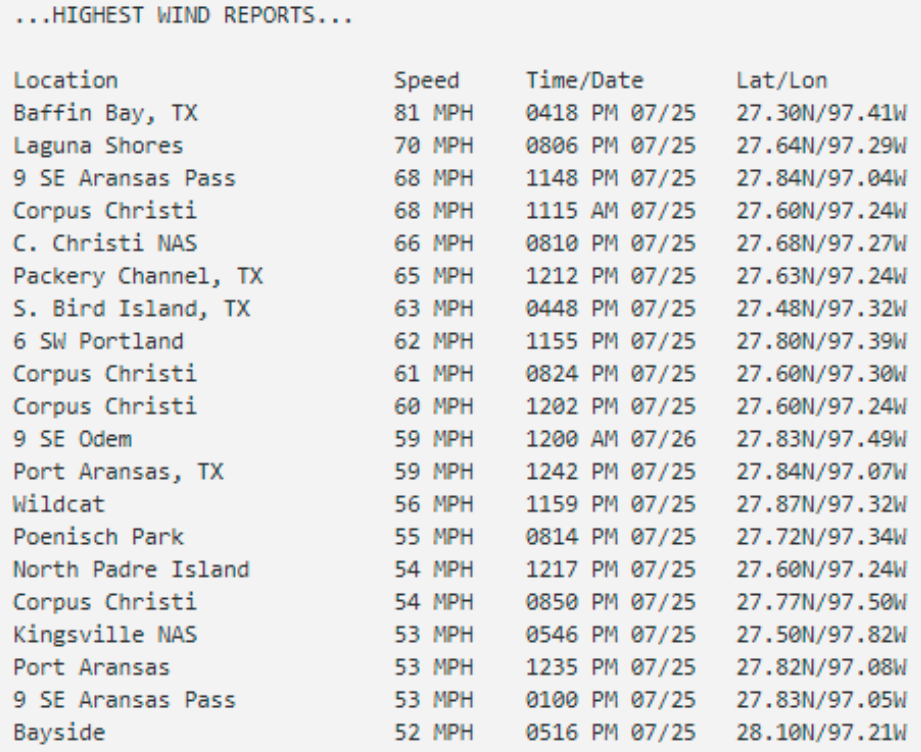
NWS’s highest wind report shows Baffin Bay, Texas, recorded 81mph in the last 24-hours.
Storm chasers were out on Saturday evening as the hurricane made landfall in south Texas.
“We cannot allow this hurricane to lead to a more catastrophically deadly event by stoking the additional spread of COVID-19 that could lead to fatalities.”
The hurricane comes at a time when the state is seeing a massive surge in COVID-19 cases and deaths. Many hospitals are beyond intensive-care unit capacity, with the risks the state could end up shutting down parts of its economy to mitigate further spreading.
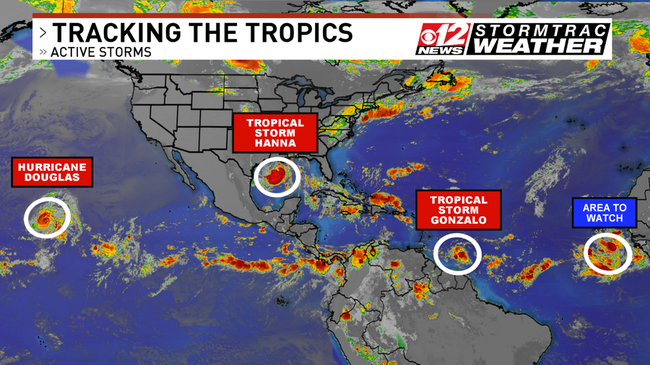
As for the tropics this weekend, well, it’s very busy!
We’ll be updating readers on tropical developments next week.
via ZeroHedge News https://ift.tt/2WVca1i Tyler Durden
Previously, we discussed how stocks struggled as virus cases rose. Importantly, the market had remained within a consolidation range since the mid-June highs. To wit:
“Furthermore, the S&P 500 continues to remain ‘technically trapped’ between the June highs and the recent consolidation lows. With the market overbought on a short-term basis, the upside has remained limited. However, there is substantial support between the current uptrend line and the 50- and 200-dma’s, limiting downside risk.”
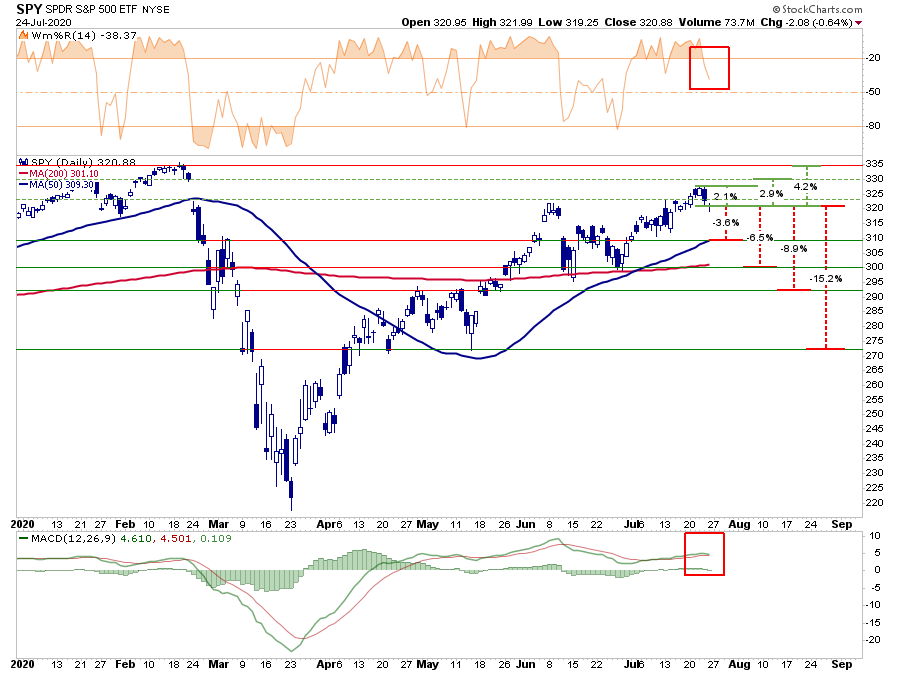
With the late week sell-off, we have updated our risk/reward ranges below. Unfortunately, the market failed to hold its breakout, which keeps it within the defined trading range. The market did hold its rising bullish uptrend support trend line, which keeps the “bullish bias” to the market intact for now.
The “not-so-bullish” aspect is that all four (4) of the primary buy/sell indicators have now tripped into “sell” territory. Such does not mean an imminent crash for the market. It does suggest upside is limited in the near term.
Tech Extremes
Currently, we are focusing our attention on the Nasdaq, which is currently being driven by the 5-largest mega-cap names. As discussed in this week’s #MacroView, the “Tech Bubble” is back in terms of technical deviations from long-term means. As shown below, whenever the Nasdaq trades at 3-standard deviations above its 200-dma, prices always correct.
Most of the time, the corrections come very quickly. However, there are a few occasions where the payback was NOT immediate. Such lured investors into more risk before the reversion eventually came. (Note the extremity of the MACD indicator in the lower panel.)
As we have discussed over the last couple of weeks, July has held to its historical trends of strength. However, with a bulk of the S&P 500 earnings season concluding next week, we suspect the weakening economic data will collide with the more exuberant market sentiment in August and September.
Too Many Stocks Underperforming
In Tuesday’s Technically Speaking post, we laid out 15-charts, which should give any investor a bit of pause. The purpose was to potentially counteract the “confirmation bias” trap that typically befalls investors during more bullish market episodes.
Sentiment Trader added another warning to the list yesterday.
“The percentage of stocks trailing the index by more than 10% has spiked. While we have different data sources and likely a different methodology, we can see that this is the case.”
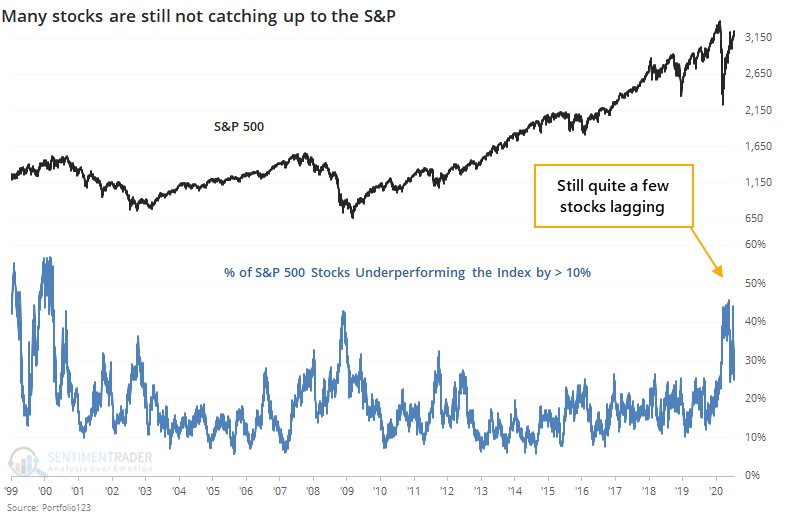
The chart shows the percentage of stocks within the S&P 500 that are trailing the index’s returns by 10% or more over the past 13 weeks. It’s not unusual to see this figure jump during bear markets, which it did during the pandemic. Still, it is relatively unusual to see so many stocks continue to lag the index by so much when the index has climbed close to its prior highs.
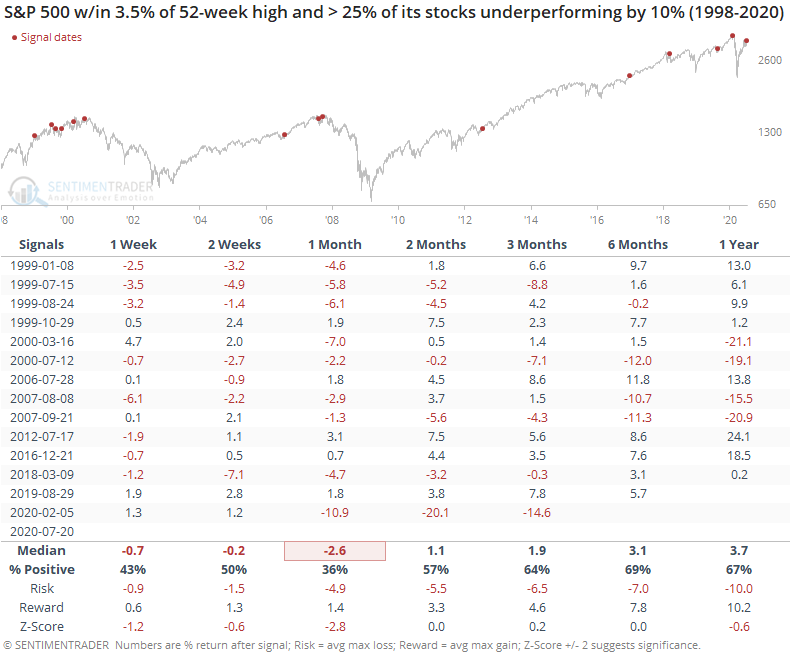
The table below shows every date since 1999 when the S&P was within 3.5% of its 52-week high. And, more than a quarter of its component stocks were trailing the index by double-digits.”
Forward returns over the shorter-term were poor, with a very negative risk/reward skew during the next month. Even up to three months later, the risk/reward was more heavily tilted toward ‘risk.’“
Such further confirms our concerns about a market correction over the next couple of months.
Yes, as noted above, there are instances where this indicator failed to provide a timely signal. However, more often than not, investors were punished for ignoring the warning signs.
Such is why “confirmation bias,” the act of seeking out only information that confirms your current views, is inherently dangerous. Investing is always about weighing possibilities versus probabilities and managing the “risk of failure” over time.
The term relates to an old story from Dehli, India.
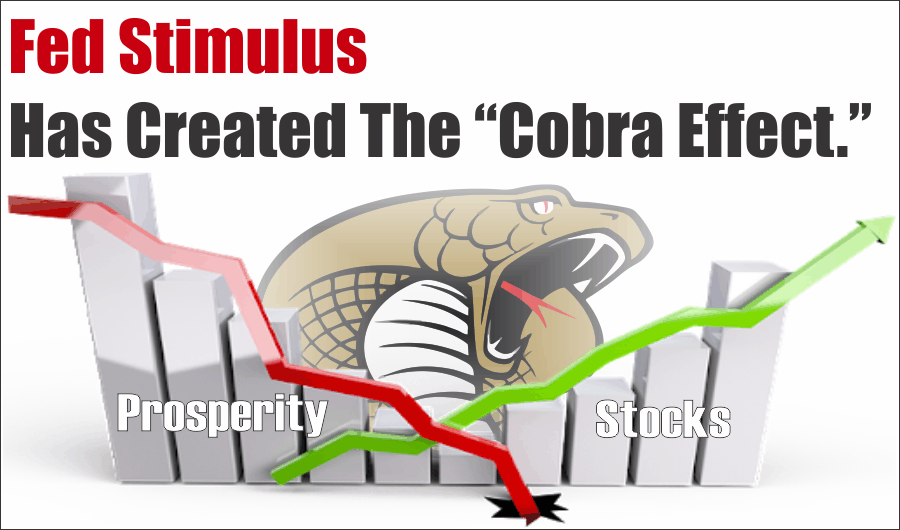
“As the story goes, there was once so many cobras in Delhi was a bounty placed on each dead one delivered to the government. At first, it worked. But then, entrepreneurs began breeding cobras to garner more income from the bounties. When the authorities figured out the scam, they canceled the program.
The problem came when the breeders, who had a large inventory of cobras, released them into the wild. With the demand (the bounty) for the snakes removed, the cobra population exploded worse than before.”
As Jeff goes on to discuss, the actions taken currently though Fed stimulus to sustain the economy, and buoy the stock and bond markets, will eventually cause a bigger problem. The flood of liquidity is hitting a highly illiquid market that has now detached the market from the underlying economy.
In other words, as Jeff concludes, the “cure will be worse than the disease.”
The “consequence” of the Fed’s actions isn’t necessarily a failure in the stock market. Such would only impact a small portion of the population that owns stocks. The real concern is it manifests itself in weaker economic growth, a widening of the “wealth gap,” and an acceleration toward socialism.
Fed Stimulus Drives Psychology
However, the main point Jeff makes is that while the eventual outcome of massive amounts of Fed stimulus will be negative, asset managers will do what they are paid to do. They will continue to invest in ways that reap their clients the best returns.
An underlying trend that prevails in reality, and;
A misconception relating to that trend.
When positive feedback develops between the trend and the misconception, a boom-bust process is set into motion.The process is liable to be tested by negative feedback along the way, and if it is strong enough to survive these tests, both the trend and the misconception will be reinforced.
Eventually, market expectations become so far removed from reality that people are forced to recognize that a misconception is involved. A twilight period ensues during which doubts grow, and more people lose faith. Still, the prevailing trend is sustained by inertia.
Eventually, a tipping point is reached when the trend is reversed; it then becomes self-reinforcing in the opposite direction.”
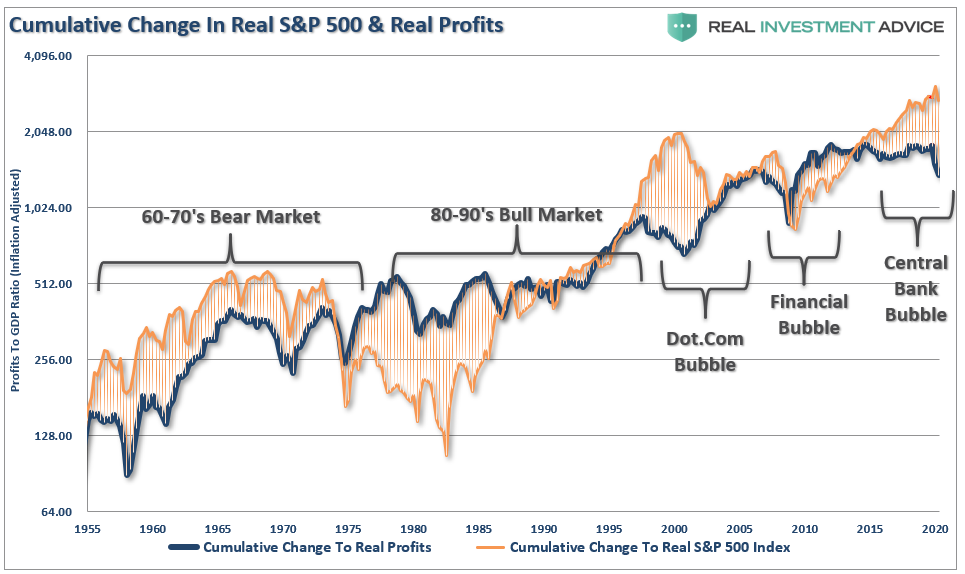
The pattern of bubbles is interesting because it changes the argument from a fundamental view to a technical view. Prices reflect the psychology of the market, creating a feedback loop between the markets and fundamentals.
In a world where there is “no fear” of a market correction, a sense of “urgency” to be invested, and a continual drone of “bullish chatter;” the market is poised for an unexpected, unanticipated, and inevitable event.
“After several failed tests of the June highs this week, we derisked our portfolios and added to our hedges. Even with those adjustments, our portfolios continued to perform as the rotation to ‘risk-off’ sectors kept portfolios stable. The reason for the derisking is the negative tilt to the risk/reward ranges currently.”
This week, that negative bias came into effect as the market failed to maintain its attempt to break out of the consolidation range. Importantly, we saw the rotation from “growth” to “value” gain some traction.
-3.6% to the 50-dma vs. +2.1% last week’s highs (Negative)
-6.5% to the 200-dma support vs. +2.9% to all-time highs. (Negative)
-8.9% to the previous consolidation highs vs. +4.2% to all-time highs. (Negative)
-15.2% to previous consolidation lows vs. +4.2% to all-time highs. (Negative)
This negative tilt to the market’s risk/reward dynamics keeps our current portfolios hedged more than usual.
The Guidelines
This week’s report’s universal theme is that “risk” has become more elevated as we enter into August and September. Such doesn’t mean markets will “crash.” It does mean there is an increased potential for a correction to occur.
In the #MacroView below, these guidelines are ones I have learned over the last 30 years. These are our guidelines, but maybe you will find some value in them.
Investing is not a competition. There are no prizes for winning, but there are severe penalties for losing.
Emotions have no place in investing. You are generally better off doing the opposite of what you “feel” you should be doing.
The ONLY investments you can “buy and hold” provide an income stream with a return of principal function.
Market valuations (except at extremes) are inferior market timing devices.
Fundamentals and Economics drive long-term investment decisions – “Greed and Fear” drive short-term trading. Knowing what type of investor you are, determines the basis of your strategy.
“Market timing” is impossible– managing exposure to risk is both logical and possible.
Investment is about discipline and patience. Lacking either one can be destructive to your investment goals.
There is no value in daily media commentary– turn off the television and save yourself the mental capital.
Investing is no different than gambling– both are “guesses” about future outcomes based on probabilities.
No investment strategy works all the time. The trick is knowing the difference between a bad investment strategy and one that is temporarily out of favor.
As an investor, our job is to view the markets through the lens of statistics and probabilities. If we can control risk, the opportunity to create wealth becomes simpler.
Yes, markets have always recovered their losses, but getting back to even isn’t the same thing as making money.
via ZeroHedge News https://ift.tt/3eVCf6M Tyler Durden
North Korea Locks Down Border Area After Acknowledging “Vicious” COVID-19 Outbreak Tyler Durden
Sun, 07/26/2020 – 09:55
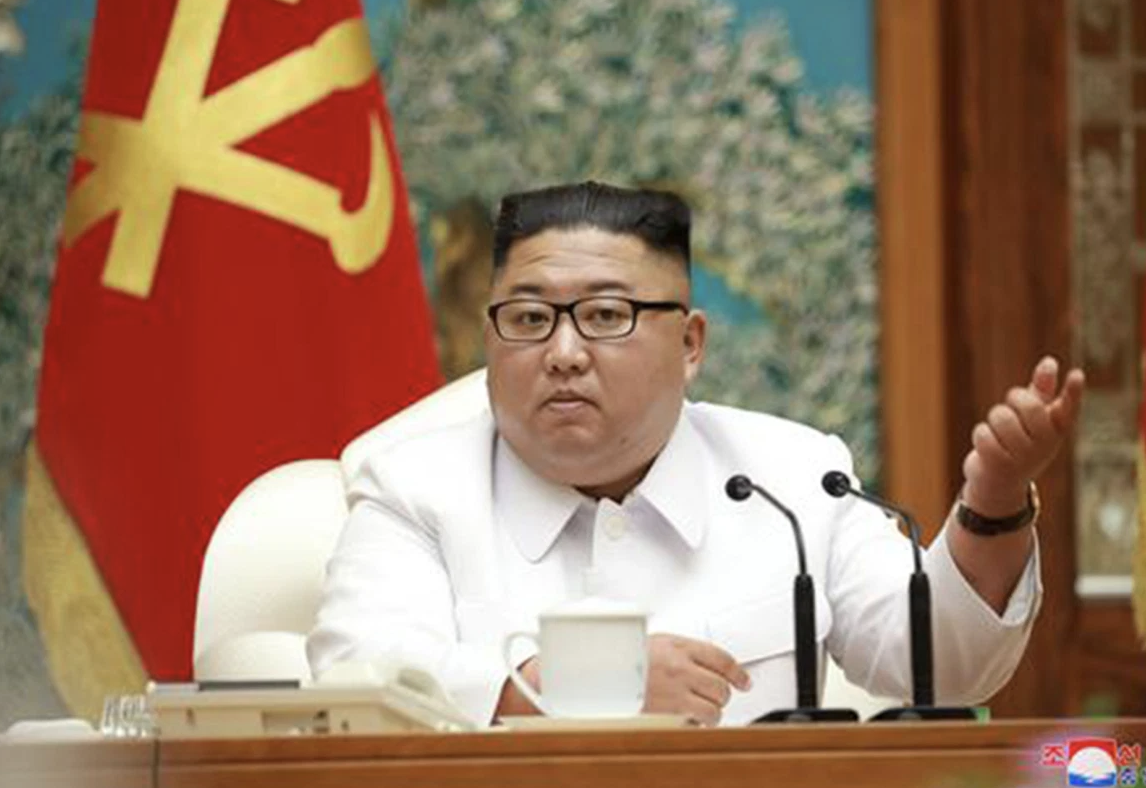
After months of insisting that North Korea had dodged the depredations of the coronavirus, media reports published Saturday afternoon (local time) claimed that ‘Dear Leader’ Kim Jong Un declared an emergency lockdown in an area near the DMZ after a person suspected of being infected with the virus returned to the North after illegally crossing into South Korea, according to state media reports.
If confirmed by international monitors, this would mark the first case officially acknowledged by North Korean authorities.
Kim convened an emergency Politburo meeting to address fears of an outbreak, with NK state propaganda network KCNA warned the population about a “critical situation in which the vicious virus could be said to have entered the country.”
The story shared by the NK government isn’t very believable, although we imagine that millions of people living in the North unquestionably accepted it as the truth. But the notion that an individual who defected from North Korea three years ago decided to sneak back across one of the world’s most heavily fortified borders and re-enter one of the world’s poorest, most repressive states simply isn’t believable. Western readers probably surmised that the virus has been running rampant across the country for months now.
After arriving first along the country’s northern border with China, the virus has clearly cut across the country and landed in the border villages along NK’s border with South Korea.
Amid the intensified anti-epidemic campaign for thoroughly checking the inroads of the world’s threatening pandemic, an emergency event happened in Kaesong City where a runaway who went to the south three years ago, a person who is suspected to have been infected with the vicious virus, returned on July 19 after illegally crossing the demarcation line.
The anti-epidemic organization said that as an uncertain result was made from several medical check-ups of the secretion of that person’s upper respiratory organ and blood, the person was put under strict quarantine as a primary step and all the persons in Kaesong City who contacted that person and those who have been to the city in the last five days are being thoroughly investigated, given medical examination and put under quarantine.
The Political Bureau of the Central Committee of the Workers’ Party of Korea convened an emergency enlarged meeting in the office building of the Central Committee of the WPK on July 25 as regards the dangerous situation in Kaesong City that may lead to a deadly and destructive disaster.
Kim Jong Un, chairman of the WPK, chairman of the State Affairs Commission of the Democratic People’s Republic of Korea and supreme commander of the armed forces of the DPRK, was present at the meeting.
Attending the meeting also were members and alternate members of the Political Bureau of the C.C., WPK.
Present there as observers were members of the Central Emergency Anti-epidemic Headquarters.
Party and administrative leading officials of the Cabinet, ministries and national institutions, members of the executive committees of provincial Party committees and senior officials of the leading institutions at provincial level were present in the video conferencing rooms as observers.
Upon authorization of the Political Bureau of the C.C., WPK, Supreme Leader Kim Jong Un presided over the meeting.
Despite the intense preventive anti-epidemic measures taken in all fields throughout the country and tight closure of all the channels for the last six months, there happened a critical situation in which the vicious virus could be said to have entered the country, the Supreme Leader said, adding that he took the preemptive measure of totally blocking Kaesong City and isolating each district and region from the other within July 24 afternoon just after receiving the report on it.
To tackle the present situation, he declared a state of emergency in the relevant area and clarified the determination of the Party Central Committee to shift from the state emergency anti-epidemic system to the maximum emergency system and issue a top-class alert.
He specified tasks for each sector to be immediately implemented by Party and working people’s organizations, power organs, public security and state security institutions, anti-epidemic and public health institutions.
The meeting unanimously adopted a decision of the Political Bureau of the Central Committee of the WPK on shifting from the state emergency anti-epidemic system to the maximum emergency system.
He instructed all the participants to immediately conduct follow-up organizational work to carry out the decision of the Political Bureau of the Party Central Committee in their fields and units, and party organizations at all levels and every field to ensure and guarantee the most correct implementation of the directions and assignments of the Party Central Committee with a sense of boundless responsibility, loyalty and devotion.
He underscored the need to thoroughly maintain tough organizational discipline and ensure the unity in action and thinking throughout the Party and society, to keep order by which everyone absolutely obeys and moves as one under the baton of the Emergency Anti-epidemic Headquarters and the need for party organizations at all levels to perfectly perform their role and duty.
Saying that everyone needs to face up to the reality of emergency, he appealed to all to overcome the present epidemic crisis by not losing the focus of thinking and action, practicing responsibility and devotion to be faithful and true to the leadership of the Party Central Committee, being rallied closer behind it so as to defend the welfare of the people and security of the country without fail.
The meeting sternly took up the issue of the loose guard performance in the frontline area in the relevant area where the runaway to the south occurred, and decided that the Central Military Commission of the WPK would get a report on the results of an intensive investigation of the military unit responsible for the runway case, administer a severe punishment and take necessary measures.
One analyst quoted by the New York Post said Kim’s announcement was important not only because it amounted to confirmation that the virus was present, but also that Kim was appealing for help on NK’s behalf.
“It’s an ice-breaking moment for North Korea to admit a case,” said Choo Jae-woo, a professor at Kyung Hee University. “It could be reaching out to the world for help. Perhaps for humanitarian assistance.”
Given NK’s recent track record of belligerence, we wouldn’t be surprised to hear one of the NK regime’s classic ploys to tone down its rhetoric and destabiiizing behavior in exchange for humanitarian assistance from SK and the US.
via ZeroHedge News https://ift.tt/2OWlSMP Tyler Durden
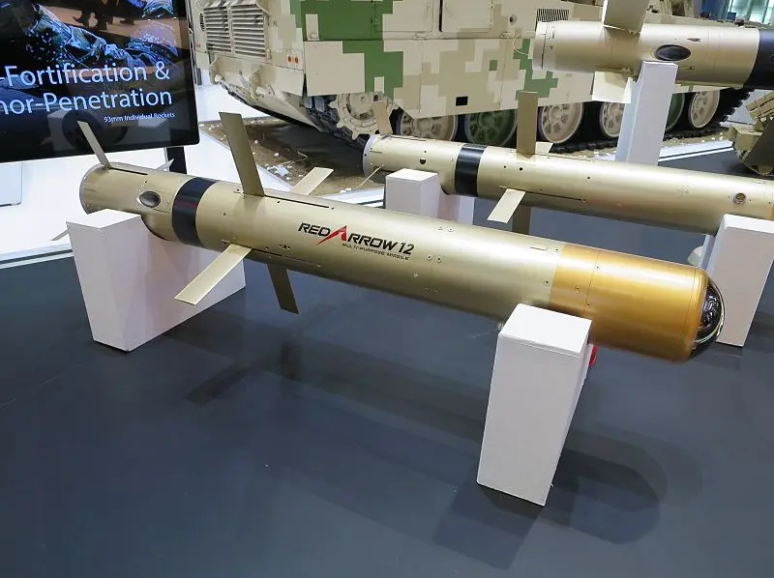
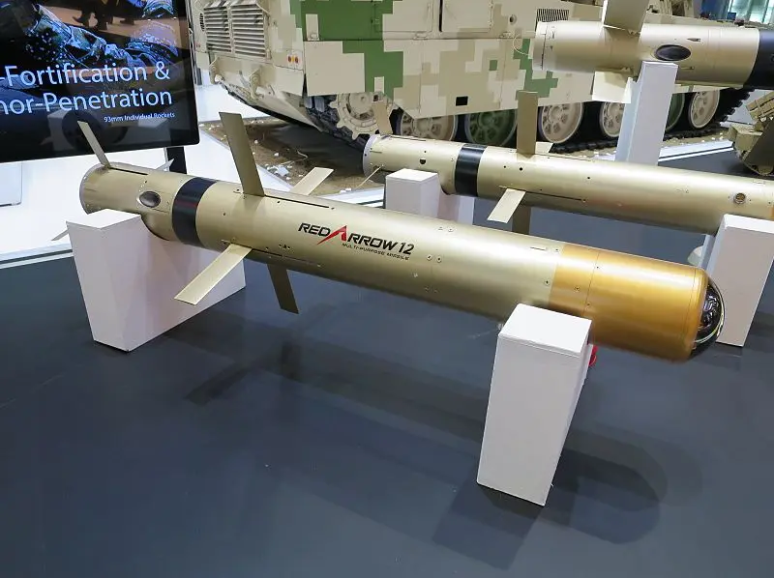
China has started exporting the third generation of their Red Arrow-12 anti-tank systems, also known as the HJ-12.
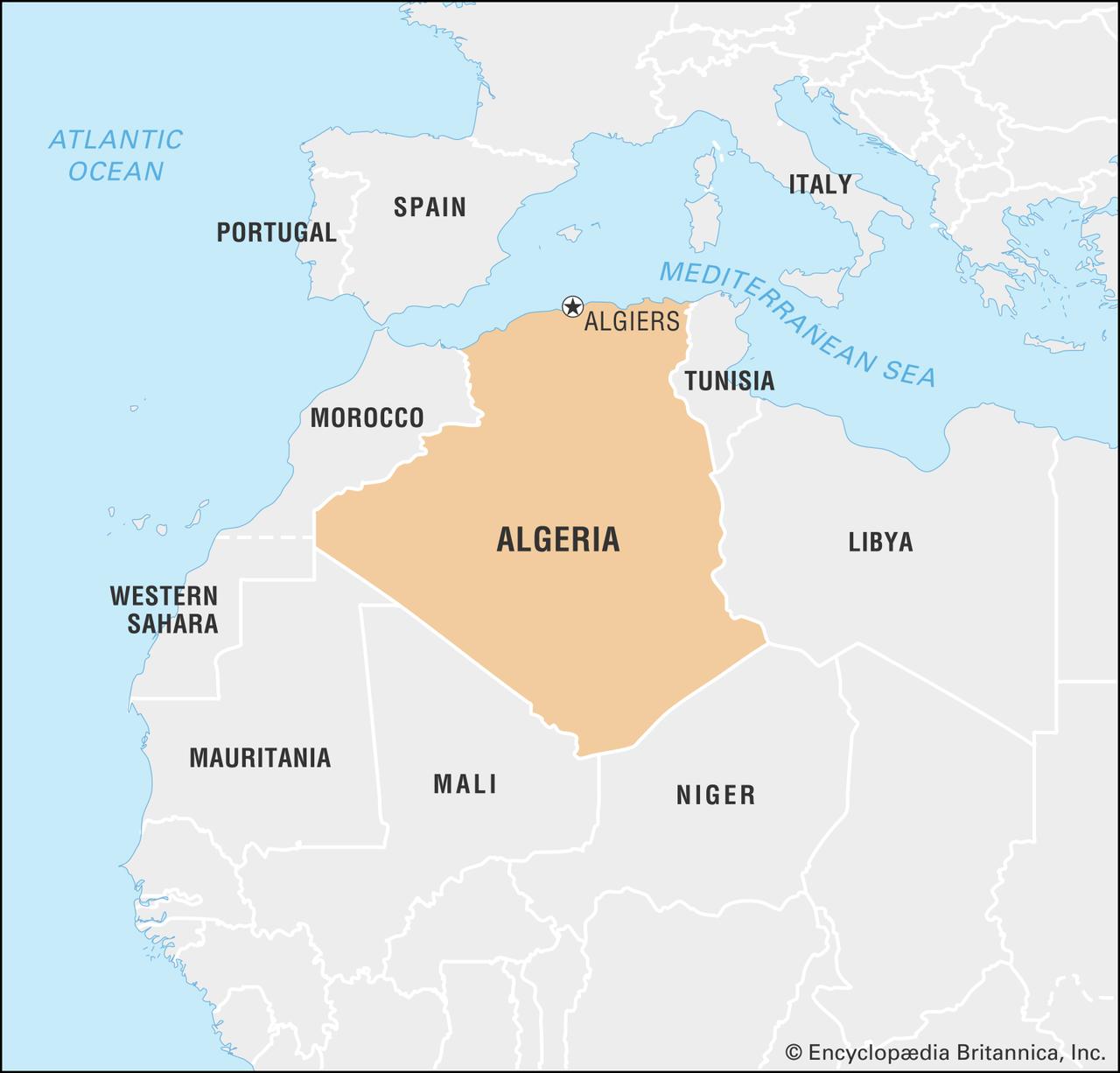
According to the China Defense website, Algeria has become the first Arab country to obtain the upgraded Chinese anti-tank system.
A Chinese Red Arrow 12 missile on display at IDEX 2017.
Not surprisingly, the Algerian military has long-standing relationships with the Chinese military-industrial complex. It has bought from China self-propelled howitzers, mortars, and multiple missile launch systems, as well as reconnaissance and attack drones and marine equipment.
According to military experts, HJ-12 will replace the old Soviet complexes that were developed in the first half of the 1970s.
The Red Arrow-12 is one of the systems that operates on the “launch and forget” principle. It was first shown in 2014.
The total mass reaches 22 kg. The missile itself weighs 17 kilograms, and another 5 kilograms is a target, and it has thermal imaging channels, day and night, in addition to a laser range finder. The total length of the launch container is 1200 mm.
This graph of how much Arab peoples want more trade with China is a good measure of how angry they are with America. pic.twitter.com/XnlLjCt7ar
China’s influence across the Middle East and North Africa (MENA) has steadily been increasing. Seventeen countries have signed documents related to its Belt and Road Initiative (BRI). Many countries, including Lebanon, Tunisia, Egypt, and Iraq have seen dramatic increases in Chinese engagement, leading some to question if they are on the verge of becoming Chinese clientstates. More recently, China has dramatically and visibly increased its aid to a number of MENA countries in response to the recent COVID pandemic.— Arab Barometer
Dimensions and weight allow this weapon to be used from the shoulder. The maximum shooting range in daylight conditions is 4,000 meters, at night it drops to 2,000 meters.
via ZeroHedge News https://ift.tt/3eX8jad Tyler Durden
Turkey Rejects US & EU Calls To Cease East-Med Gas Drilling As Greece Threatens Military Action Tyler Durden
Sun, 07/26/2020 – 08:45
Days after the US State Department warned Turkey over its gas reserves exploration and drilling plans in waters between Cyprus and Greece, which Athens has declared ‘illegal’ given it cuts into Greece’s Exclusive Economic Zone (EEZ), the European Union has also put Turkey on notice, warning it could move forward with sanctions.
French President Emmanuel Macron said late this week that it’s “not acceptable for the maritime space of a European Union member state to be violated or threatened” andcalled for sanctions if it moves forward. On Tuesday a US State Department statement demanded that Turkey back down from its drilling plans which have put the Greek Navy on “high alert” – given Turkish exploration ships are already in or near Greek waters.
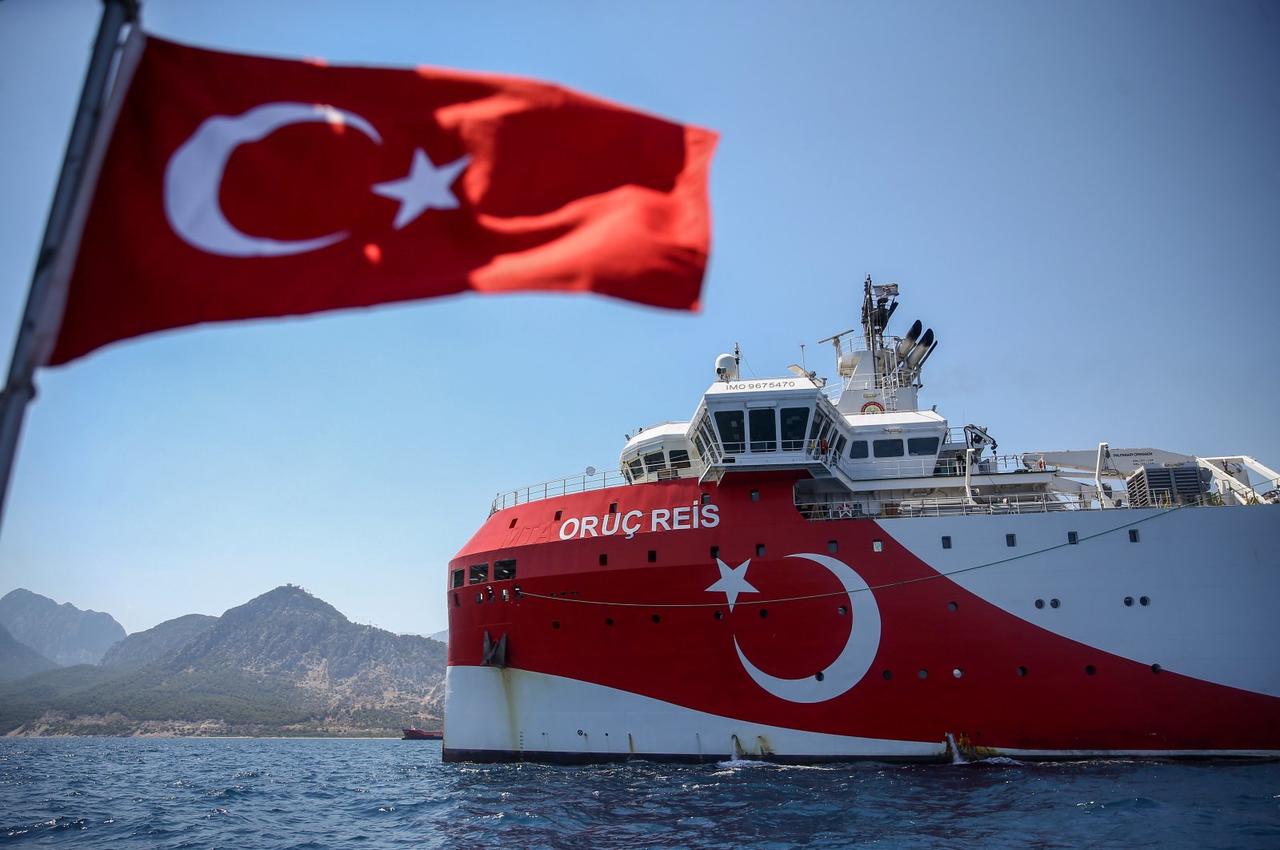
Greek media sources are now reporting that Turkey through its embassy in Washington DC has informed the Americans that it plans to proceed unimpeded with its drilling research with the Oruc Reis vessel in the disputed eastern Mediterranean waters.
Turkey’s seismic exploration ship Oruc Reise in the Eastern Mediterranean this week, via Anadolu Agency.
“We urge Turkish authorities to halt any plans for operations and to avoid steps that raise tensions in the region,” the statement said. And Greece’s foreign ministry said it clearly violates the country’s sovereignty and that it stands ready to defend its territory.
Turkey has so far rejected all demands from the US, EU, Greece and Cyprus that it back down. Turkey’s Daily Sabah newspaper cited President Erdogan’s office as follows:
Turkey rejects Greece’s “maximalist” objectives in the Eastern Mediterranean, which lack a legal basis and disregards logic, Presidential Spokesperson Ibrahim Kalın said Thursday.
Kalın highlighted that Turkey opposes the rhetoric of threats and favors an equal distribution of resources.
The Greek side’s “maximalist” position claims that the island of Kastellorizo (Meis in Turkish)-only 2 kilometers from the Turkish shore, but about 580 km away from the Greek mainland-“should have a 40,000 square km continental shelf area, which is almost like half of Turkey’s Gulf of Antalya,” Kalın told an online policy briefing by the European Policy Centre in cooperation with the Foreign Economic Relations Board of Turkey (DEIK).
Turkey has claimed that it’s “well within its rights” amid the gas exploration and drilling.
Though Turkish media has claimed the Oruc Reis vessel has already commenced with its mission in the disputed waters, a number of analysts have cried foul, citing that it hasn’t actually left port, given Ankara may be taking Greek threats of military action seriously:
Turkey has used its claims over northern Cyprus, or the so-called “Turkish Republic of Northern Cyprus,” to say it can drill in waters encircling the entire island.
Analysts have feared the additional deployment of naval forces by both sides amid the dispute could easily lead to a break out into war.
This is the geographical / legal distribution of the EEZs of Turkey (red) and Greece (brighter blue).
No surprise, Turkey is extremely p*ssed at the situation.
However explorations and drillings without the consent of its EEZ neighbors is surely not the answer to the problem … pic.twitter.com/dh6kltzNB7
A new statement issued by US Ambassador to Greece Geoffrey Pyatt hinted at just such a scenario of military confrontation on the high seas.
“I want to echo the clear message from Washington and elsewhere in Europe, urging Turkish authorities to halt operations that raise tensions in the region, such as plans to survey for natural resources in areas where Greece and Cyprus assert jurisdiction in the eastern Mediterranean,” he said.
via ZeroHedge News https://ift.tt/2WU0L1J Tyler Durden
The sensational headlines screaming on the front pages of British newspapers this week showed that the parliamentary Russia Report was a triumph of bombast.
The Daily Mail led with “Damning Russia Dossier” while The Times heralded “MI5 to get more powers” and “Tough new laws will combat threat of Russian spies”. The Times also splashed its front page with a large photograph of Russian President Vladimir Putin seemingly lurking behind a curtain, which just goes to show how much British journalism has descended into cartoonish trivia.
There is sound reason why the British government delayed until this week publication of the so-called Russia Report by a cross-party parliamentary committee. That’s plainly because there is nothing in it that could in any way substantiate lurid claims of alleged Russian interference in British politics.
The 55-page document was neither “damning” nor “devastating” as The Daily Mail asserted. The groundless hype suggests that the headline writers simply were looking for something to sell to readers regardless of facts.
Boris Johnson, the prime minister, received a copy of the report 10 months ago, but decided to postpone its publication until after the general election that was held in December. That delay led to claims that his Conservative government was hiding something sinister. There were procedural hiccups from the Intelligence and Security Committee (ISC) being replaced with new members. However, now that the report is published any rationale reader can see that the real cause of the delay is down to the report being a dud, despite all the breathless speculation. It is an empty vessel, with no evidence or substantive detail. It consists of entirely prejudiced assertions that Russia is “a hostile state” and the UK “is clearly a target for Russia disinformation campaigns and political influence”.
The nine lawmakers on the committee and their nine predecessors acknowledge among their sources for the report the following individuals: Anne Applebaum, William Browder and Christopher Steele. All of them are zealously anti-Russia and are prodigious purveyors of “Russian interference” narratives to anyone who will listen to them. Steele is the notorious former MI6 spy who cooked up the ludicrous “Russia Dossier” for the Democrats to smear Trump with in the 2016 elections. That dossier fueled the bogus “Russiagate” scandal.
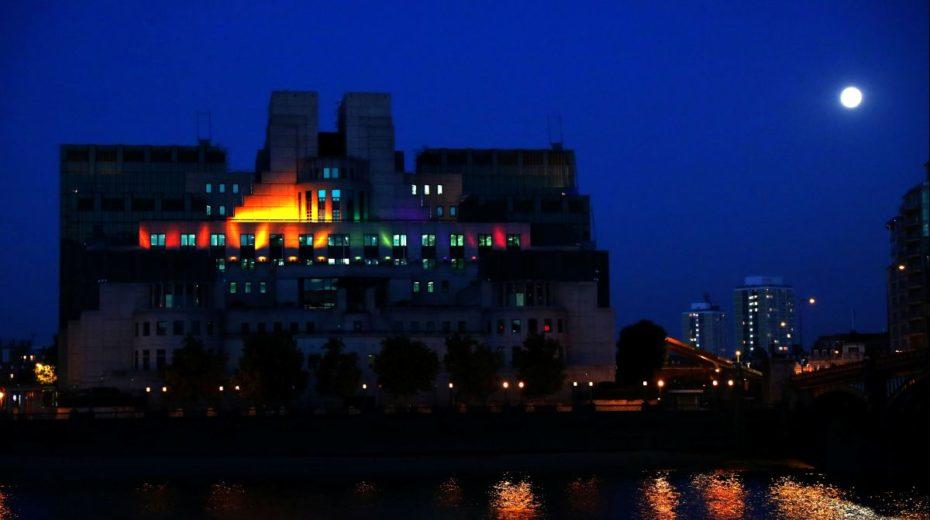
Of course, the main sources for the parliamentary committee are British intelligence agencies, MI6, MI5 and GCHQ. Candid admission of all those sources should underscore with redlines that the so-called report is nothing but a propaganda screed. Yet the British media treat it with deference and respect as if it is a credible, objective assessment.
What is rather laughable is the unrestrained prejudice of the authors who are, in reality, propagandists more suited to being frozen in Cold War mentality than offering any kind of “expertise”. They claim Russian politics is “paranoid” and “nihilistic” driven by “zero-sum calculation”. All those attributed defects are merely self-projection by the authors of this report and their sources.
It is rather telling that in place of anything resembling substance of alleged Russian interference, the parliamentarians refer to “open sources” of media influence by Russian state-owned RT and Sputnik. They accuse these media of “direct support of a pro-Russian narrative in relation to particular events”. Oh, how shocking! And the British state-owned BBC does not also do the same?
Again referring to “open sources” – meaning public media reports – the parliamentarians claim that the Kremlin interfered in the Scottish referendum on independence back in 2014. So just because Russian news media featured that subject in its coverage is supposed to be “evidence” of Kremlin interference. The absurd accusation is also a convenient way to smear Scottish pro-independence.
Oddly enough, the report says there was no manifest Russian interference in the 2016 Brexit referendum. Well that’s handy. The Tory government wouldn’t want to smear its ambitions of reviving the British empire, that’s for sure.
The ISC publication is a self-serving dud that is “not worth a penny”, as Russian lawmaker Aleksy Chepa put it.
It is loaded with complacent British self-regard and knee-jerk Russophobia.
The parliamentarians repeatedly rebuke the British government and state intelligence for not taking the “threat” of alleged Russian meddling seriously enough.
A more plausible explanation is because there is negligible Russian meddling in British politics, as Moscow has consistently stated. If the British government and its spooks fail to get excited – in private – about allegations of Russian malfeasance it’s because there is actually nothing to the allegations. Still, the parliamentarian anti-Russia ideologues assume to know better. They are convinced that Britain is a target for Kremlin hostility and they lambast the government and intelligence services for “not making it a priority issue”.
The Orwellian plot thickens when the authors of the boilerplate Russian Report then conclude by urging MI5 to be given more secretive powers to collaborate with social media networks in order to control information in the name of combating a “hostile state threat”. This is a sinister, anti-democratic call worthy of a dictatorship for censoring and blackballing any dissenting views under the guise of “defending democracy”.
One area where the ISC document begins to deal with reality – but only superficially and misleadingly – is on the subject of super-rich Russian expatriates living in London, which is dubbed “Londongrad”. Many of these oligarchs are beneficiaries of looting Russian state assets during the privatization-robbery frenzy under former President Boris Yeltsin. They are not “friends of Putin” as the British lawmakers make out. These shady oligarchs are often big donors to the Conservative party, not because they want to inject pro-Russian influence, but rather because they are typically opposed to the current Russian government and are seeking to destabilize it. If there is any Russian “influence” in British politics it is that which promotes illegal regime-change policies in opposition to the Russian state.
In every aspect the much-vaunted Russia Report is a worthless pile of propaganda. Even a glimmer resembling something real – the Russian oligarchs in Londongrad – turns out to be an inversion of reality. And yet, pathetically, the British media amplify the nonsense with reverence and gravitas.
via ZeroHedge News https://ift.tt/2OU52xW Tyler Durden
Tens Of Thousands March In Russia During Second Week Of Anti-Putin Protests Tyler Durden
Sun, 07/26/2020 – 07:35
Tens of thousands of Russians marched in the city of Khabarovsk over the arrest of a regional governor on charges of murder, in what is now the second week of protests against the Kremlin.
Another video from the large-scale #protest march today in #Khabarovsk, eastern #Russia, where estimated 95,000 people are protesting against Putin:
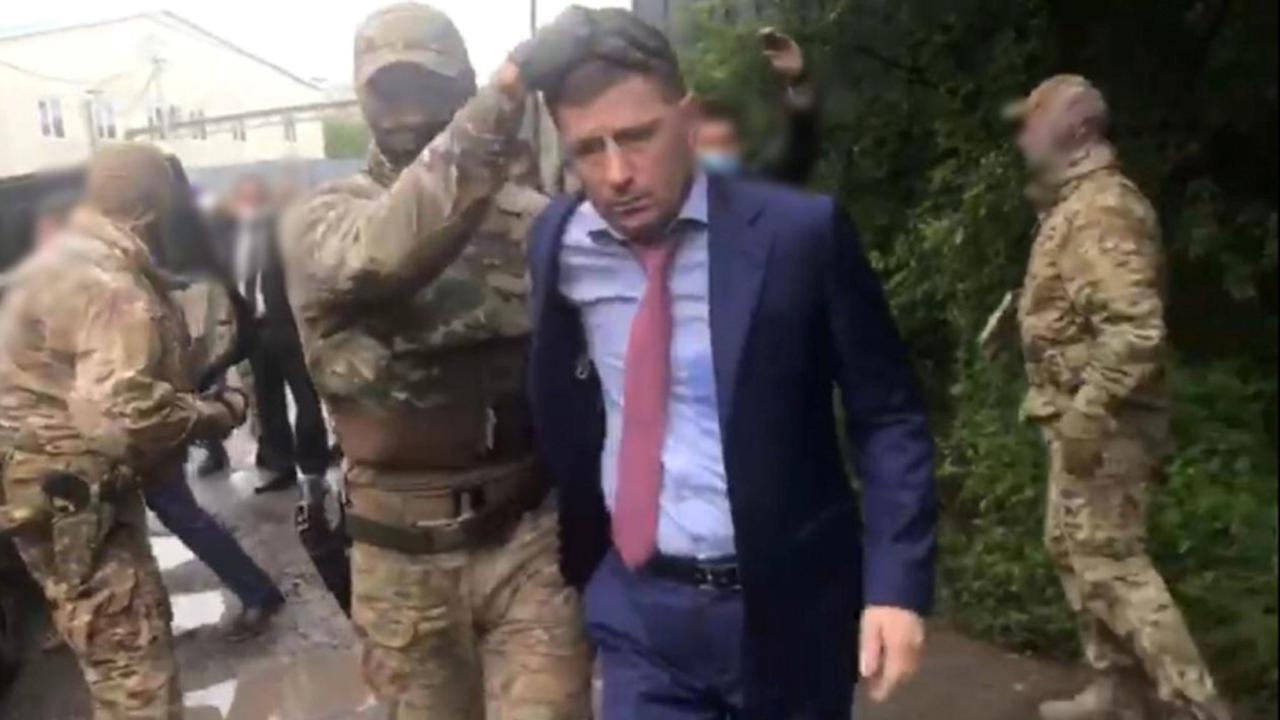
Governor Sergei Furgal was arrested July 9 and swiftly replaced after Russian President Vladimir Putin named an acting successor, according to TIME.
Sergei Frugal
Protesters claim the charges against Furgal are unsubstantiated, and he should be allowed to stand trial at home. He stands accused of involvement in the murders of several businessmen in 2004 and 2005 when he was a businessman in the timber and metals industries – charges which he has denied.
“People are offended,” said protester Dmitry Kachalin. “I think people take to the streets because their vote in the 2018 election was taken away.“
Unlike Moscow, where police usually move quickly to disperse unsanctioned opposition protests, authorities haven’t interfered with unauthorized demonstrations in Khabarovsk, apparently expecting them to fizzle out over time.
But daily protests, peaking at weekends, have gone on for two weeks, reflecting anger against what local residents see as Moscow’s disrespect of their choice and simmering discontent with Putin’s rule. Local officials’ attempts to discourage people from joining the demonstrations by warning about the risk of coronavirus infection have been unsuccessful. –TIME
“We elected the governor and we want to be heard and decide ourselves what to do with him. Bring him here, and a fair and open trial will decide whether to convict him or not,” said protester Anastasia Schegorina. “We had enough.”
Furgal, a lawmaker on the nationalist Liberal Democratic Party ticket, won the gubernatorial election in 2018 despite the fact that he had refrained from campaigning, and publicly supported his rival who had the support of the Kremlin. His victory was a giant embarrassment to Putin’s administration, United Russia, which has seen its control over the regional legislature slip over the past several years.
Furgal earned a reputation as a “people’s governor,” cutting his own salary, ordering the sale of an expensive yacht that the previous administration had bought and offering new subsidies to the population.
“We want to protect Furgal,” said Evgenia Selina, who joined Saturday’s protest. “If we hadn’t elected him, he would have been living quietly with his family and working at the State Duma. He would have had a normal life.” –TIME
Furgal’s Putin-picked successor, Mikhail Degtyaryov, is also a member of the Liberal-Democratic Party, which was apparently done in an attempt to calm down locals over the change in management. He has thus far refused to address the protesters, and fled the city on Saturday for an inspection of the region.
via ZeroHedge News https://ift.tt/32XtgzM Tyler Durden
The problem with alliances is that they ultimately either become victims of their own success, or cannot figure out what to do with themselves once the original rationale disappears.
The original Cold War-era NATO was a relatively cohesive entity led by one of the two superpowers, with most of its members being the industrialized democracies of Western Europe, with West Germany being its eastern-most European member, and alliance planning revolving around USSR. But even then there were cracks in the alliance. Italy, for example, had nearly no role to play as it did not border any Warsaw Pact country and did not practice deploying its forces to West Germany to practice its defense against the anticipated Warsaw Pact invasion. And while Greece and Turkey were ostensibly part of that alliance as well, in practice they spent more time clashing with one another than planning for joint action against USSR.
The end of the Cold War made the problem of alliance cohesion far worse, for two reasons. One, it quickly added as many members as possible thus greatly expanding its geographical extent, and two, it lost that single unifying factor in the form of USSR. Today’s NATO is a patchwork of mini-alliances revolving around the United States which is determined to replace the alliance aspect of NATO which assumes that all members have interests that are to be taken into consideration, by patron-client relationships.
Not to put too fine a point on it, the goal of the United States is global domination. This goal is shared by the entire political elite and major portions of the population, though it is nearly never discussed openly or directly. Instead, it is framed in terms of “American Leadership”, “New American Century”, and of course “American Exceptionalism” which is used to justify any policy that violates international law, treaties, or agreements. Given that every country which has not recognized “American Leadership” is described as a “regime”, there is no indication the US elite is interested in anything resembling peaceful coexistence with other sovereign states.
America’s self-appointed task is made not easier or harder by the fact that today’s NATO is therefore fragmented along both geographic and national power lines. The geographical divide is plainly easy to see: Norway and Denmark mainly care about the Arctic, Poland and Romania obsess about Russia, Mediterranean countries freak out about what’s happening in North Africa. The wrangling over sending more troops to Mali or to Estonia is the reflection of the differing security concerns of individual members of the far-flung pact. The power divide is less easy to see but more problematic for Washington. V_3 (A2) Of the European powers, only four—Germany, France, Italy, and Great Britain—may be considered to be powerful and independent political actors with which the US has to contend on anything like an equal basis. The first three form the core of the European Union, whereas Great Britain opted for Brexit, likely in part because of the looming big power struggle between the US and the EU that has the potential of degenerating into a destructive trade war. It is doubtful that the skirmishes over Huawei and North Stream 2 are anything but the opening salvoes in the confrontation over whether the EU will emerge as a political actor independent of the US, or be reduced to a collection of client states. Unfortunately, America’s task is made easier by the fact of the intra-European divisions mentioned above.
United States is pursuing development of several hypersonic missile systems with the aim of ultimately fielding very large numbers of them in order to be able to launch disarming first strikes against Russian and Chinese nuclear arsenals. Since the weapons themselves are relatively short-ranged (though that may change once the US allows New START to lapse), they require basing close to their intended targets. That means having to find countries willing to base them in Europe, where it is liable to provoke a political debate of the magnitude comparable to that of the original Euromissile controversy of the 1980s. Since Germany is not interested in being reduced to the status of a US client, it has resisted the US on a variety of fronts, including the North Stream 2, the refusal to buy F-35s, and now also the lack of desire to host the new US missiles. Even the German defense spending increases are intended at least as much to counter US influence in Eastern Europe as the supposed Russian threat to NATO. The United States has responded using the usual array of tools: economic sanctions on any and all European entities participating in the project and even using the gas, apparently launching a cyber-attack that US-friendly German intelligence promptly blamed on Russia, and also threatening to move US troops out of Germany and possibly to Poland. There is even discussion and rumors that US nuclear weapons stationed in Germany might be moved to Poland.
The outcome of this so far is a power struggle between two NATO allies, US and Germany, over the political alignment of a third—Poland. While Germany has the power of EU institutions on its side and massive economic gravitational pull, US has cultivated a cadre of friends, possibly intelligence assets, as a result of post-9/11 collaboration in Afghanistan, Iraq, and in the realm of intelligence-sharing. This has produced a government more than willing to deploy US troops, missiles, and even nukes on Poland’s territory. The power of US influence is visible in Poland’s weapons procurement: Patriot, Javelin, HIMARS, F-35, and not a single comparable European system in recent years. The US weakness in this confrontation consists of the unwillingness to subsidize Poland economically which, combined with the ruling party’s fiscal irresponsibility, will make it difficult for the country to maintain its anti-German course in the longer term.
While in Eastern Europe US national security state is using Poland as a proxy against Germany, in the Mediterranean it has adopted Turkey as a proxy against France and Italy. After some hemming and hawing, the US hawks dropped the Kurds yet again, with Trump happily taking the blame, in order to piggy-back on Erdogan’s Libya ambitions to curtail French and Italian interests there. To be sure, Turkey retains far more autonomy in the relationship than Poland, which was unable or unwilling to play US and Russia and EU against one another in order to secure a measure of freedom of action. But the US Congress measures to allow the purchase of S-400 weapons from Turkey is an indicator that Turkey’s behavior is once again useful to the US. And even though Turkey was excluded from the F-35 program, its firms continue to make components for various assembly plants. The result has been a number of stand-offs between Turkish warships on one hand and French and Italian on the other off the coasts of Libya. And whereas France and Italy are backing the Marshal Haftar’s LNA, Turkey’s preferred proxy is the GNA, leading to a veritable “anti-Turkey” alliance being formed that includes Turkey’s old time NATO adversary Greece. While the US is officially aloof of the entire situation, in practice controlling Libya’s oil is part of the Washington strategy of “energy dominance” every bit as the North Stream 2 sanctions are.
The remarkable part of these two sets of conflicts among NATO powers is that in both cases Russia has sided with Germany and France against the US in both cases. It is Russia’s policies that are more beneficial to French and German interests than America’s, since Russia is not actually seeking to monopolize energy supplies to Europe in the way that the US clearly and openly is.
So far the US strategy consisted of steadily ratcheting up pressure through sanctions and proxies and occasional intelligence-generated anti-Russia provocations (sometimes helpfully delivered by British agencies), trying to find that happy middle of policies that actually force Germany, France, and Italy to change their policies and which do not force a permanent breach in the trans-Atlantic relationship. But the cracks in the relationship are clearly visible and they are not attributable to Trump’s erratic and brusque manner. It is the US Congress which passed the successive rounds of anti-North Stream 2 sanctions, with strong partisan majorities. It means the assertion of US control over European major powers is part of the US agenda. Since that agenda is motivated by a US political and economic crisis of a magnitude not seen since the 1930s, there is little likelihood Biden’s presidency would represent a radical departure from the current trend.
Of course, for Germany, France, and Italy to successfully resist US encroachment they would first need to transform the EU into something closer than a federation. The COVID-19 pandemic and the associated economic crisis already providing considerable impetus for such a transformation, America’s insatiable appetites might provide the rest.
via ZeroHedge News https://ift.tt/2OWz18n Tyler Durden
Austin Protester Dead After Gunman Opens Fire Into Crowd Tyler Durden
Sun, 07/26/2020 – 01:09
A protester in downtown Austin is dead following a Saturday night shooting, according to local station KXAN.
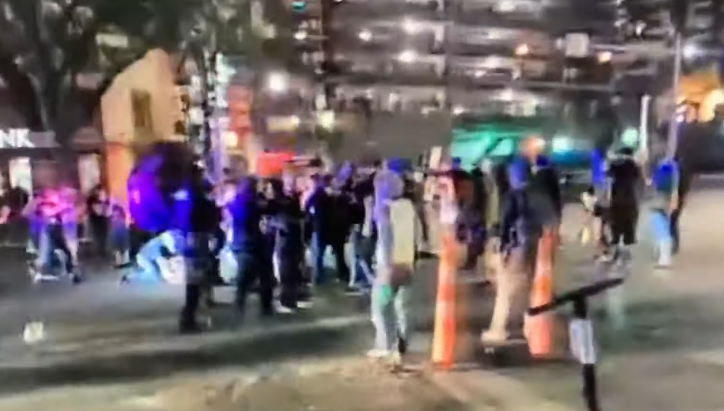
The incident, filmed by journalist Hiram Gilberto and broadcast via Facebook Live, shows BLM protesters marching into an intersection at Congress Avenue and East 6th Street just after 10 p.m. when some type of altercation occurs before several shots can be heard in quick succession.
A woman who appears to be an acquaintance of the deceased protester, who she identified as Garrett – the husband and sole caretaker of a quadriplegic woman named Whitney. The woman says Garrett was on his 50th day of protesting.
“A car drove up, and he shot Garrett,” she says, through tears.
— Cassandra Fairbanks (@CassandraRules) July 26, 2020
Austin-Travis County EMS said they responded to an incident near East 6th Street and Congress Avenue around 9:52 p.m. According to ACTEMS officials, the call initially came in as a shooting with multiple victims. According to KXAN, Austin PD is expected to give a press conference Saturday night.
Has China’s Military Deeply Infiltrated US Medical Research? Tyler Durden
Sat, 07/25/2020 – 23:50
Submitted by Lawrence Sellin, Ph.D. is a retired U.S. Army Reserve colonel, who previously worked at the U.S. Army Medical Research Institute of Infectious Diseases and conducted basic and clinical research in the pharmaceutical industry. He is a member of the Citizens Commission on National Security.
It is a widely accepted fact that China has stolen U.S. intellectual property worth billions of dollars.
The U.S. government recently ordered the closure of the Chinese consulate in Houston, Texas, which Senator Marco Rubio (R-FL) described as a “central node of the Communist Party’s vast network of spies & influence operations in the United States.”
At virtually the same time, the U.S. Department of Justice indicted two Chinese nationals for seeking to steal COVID-19 vaccine research and hacking hundreds of companies in the United States and abroad, including defense contractors.
Now, Juan Tang, 37, who had been a visiting cancer researcher at the University of California, Davis, School of Medicine for several months, has been arrested by the FBI after hiding in the Chinese consulate in San Francisco.
She is one of four Chinese researchers charged by federal authorities in recent days with lying about their background to gain entrance into the United States.
A federal criminal complaint filed in court in Sacramento charges Juan Tang with lying about her connections to the Chinese military when she applied for a nonimmigrant visa on Oct. 28, 2019.
The FBI criminal complaint shows Juan Tang in Chinese military uniforms and her scientific affiliations are listed as the National Translational Science Center for Molecular Medicine & Department of Cell Biology, The Fourth Military Medical University, Xi’an 710032, China.
According to Andy Fell, a spokesman for the University of California, Davis, Juan Tang was a visiting researcher in the School of Medicine’s Department of Radiation Oncology. Her research was funded by the Chinese Scholarship Council, “a study-based exchange program affiliated with the China’s Ministry of Education and Xijing Hospital in China.”
Yes, but why the University of California, Davis?
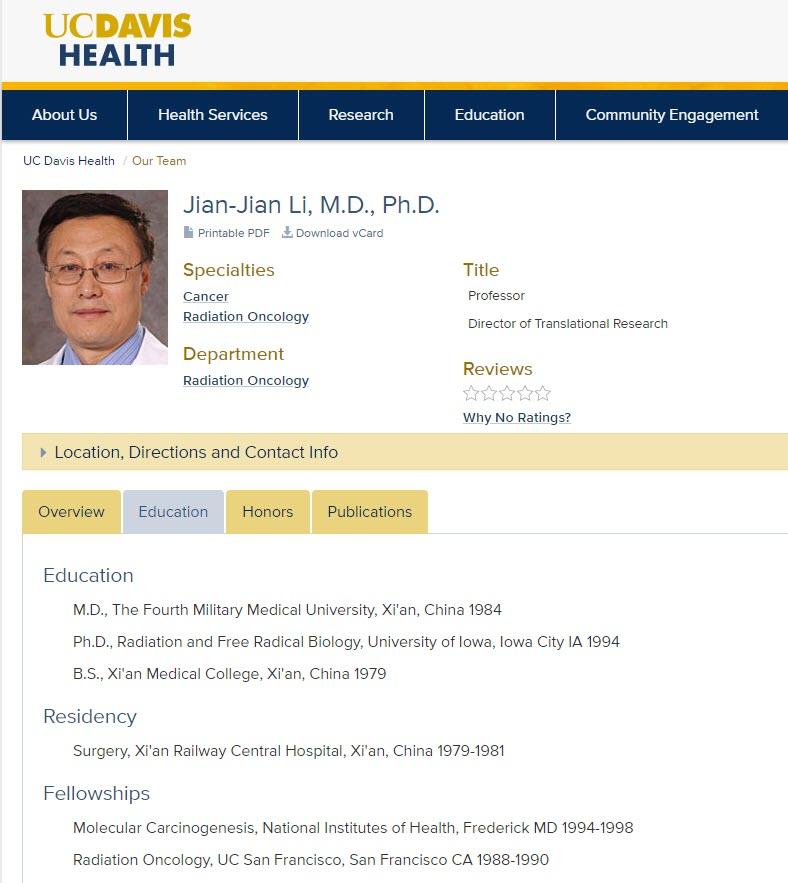
It may be because Jian-Jian Li, who received his M.D. degree in 1984 from China’s Fourth Military Medical University in Xi’an, is a professor in the Department of Radiation Oncology at the University of California, Davis School of Medicine and, like Juan Tang’s position in China’s National Translational Science Center for Molecular Medicine, Dr. Li is Director of Translational Research at the University of California, Davis.
Dr. Li received a Ph.D. in 1994 from the Department of Radiation and Free Radical Biology, University of Iowa and was trained at the National Cancer Institute of the National Institutes of Health from 1995 to 1998.
Over many years, Dr. Li has maintained extensive collaboration with scientists in China, some of whom work at the Fourth Military Medical University.
It seems highly unlikely that Dr. Li did not know of Juan Tang’s affiliation with China’s Fourth Military Medical University.
The arrests of the four Chinese nationals mentioned in this article represent only a tiny proportion of the Chinese students, postdoctoral researchers and full-time medical scientists, many of whom are supported by U.S. taxpayer dollars, and may be actively assisting China’s military obtain U.S. secrets and proprietary information, medical research being the softest of the soft espionage targets.
The time is long past for a comprehensive investigation of the medical research exchange programs between the U.S. and China.
via ZeroHedge News https://ift.tt/3jDlSzb Tyler Durden